Grooming the Gulf: How Epstein Forged Emirati Elites Into Tools for Israel
By Freddie Ponton | 21st Century Wire | February 10, 2026
In the last 48 hours, the U.S. Department of Justice has begun dumping what officials say amounts to more than three million pages of material tied to Jeffrey Epstein—an archive so vast it includes thousands of videos and hundreds of thousands of images. The tranche is only a fraction of what exists. Officials acknowledge that millions of additional documents remain under review, meaning the public has seen just a sliver of the government’s total Epstein archive. What is being unloaded into the public domain is not just evidence of private depravity; it is an inadvertent blueprint of how power really works when no one is supposed to be watching, an industrial‑scale influence machine whose files casually braid together billionaires, cabinet‑level officials, and strategic infrastructure from New York to the Horn of Africa. And even now, the public is being allowed to see only what officials deem manageable, with redactions still shielding some of the most sensitive names and millions of pages kept out of sight.
Hidden within those documents, leaks, screenshots, and email excerpts now circulating online, are connections that stretch far beyond Manhattan, Palm Beach, or even Paris. They reach deep into the Persian Gulf, into Dubai’s executive suites, and into the personal inboxes of officials in the United Arab Emirates.
These emails offer a unique glimpse behind the opulent shadows of Dubai’s towers, where untraceable billions flow like oil. In that world, a convicted pedophile whispers ministerial appointments to a UAE diplomat while discussing port deals that could move cargo and secrets across continents. According to persistent intelligence‑linked information surrounding his operations, Jeffrey Epstein was not acting alone or merely chasing thrills; he was allegedly operating as a geopolitical asset, cultivating leverage over Gulf elites, with places like Somaliland emerging as potential pawns in a larger strategic game. It is in such an environment that figures like Epstein thrive the best, because their private perversions double as statecraft.
Hind Al Owais and the Epstein Emails That Stain a Nation
Emails unearthed from the DOJ Epstein library reveal troubling facts about Jeffrey Epstein’s exchanges with Hind Al Owais, a young, ambitious Emirati woman navigating the opulent halls of UAE diplomacy. With her polished LinkedIn profile and lofty titles, she appears at first glance to be a symbol of progress. As director of the UAE’s Permanent Committee for Human Rights and a UN adviser since 2015, she has publicly championed women’s empowerment, declaring it both a moral and strategic imperative. On paper, Hind Al Owais is the face of a “modern” UAE: a diplomat, UN adviser, and later a senior human‑rights official fronting panels on women’s rights and regional mechanisms.

Hind Al Owais, UAE’s Permanent Committee for Human Rights and a UN adviser since 2015 (Source: YourStory.com)

In press releases, she speaks of “dignity” and “gender equality” while chairing events under the banner of the Permanent Committee for Human Rights in Abu Dhabi. In the emails, the tone is very different. The same woman who would later open high‑level human‑rights dialogues is trading easy banter with a convicted sex offender, eagerly accepting his career advice, and bringing family into his orbit. The contrast is not just personal hypocrisy; it looks like the textbook use of a polished, progressive female diplomat as a shield for an authoritarian system willing to outsource leverage work to a man like Epstein while selling the world a sanitised narrative at the UN.
The correspondence begins in 2011, during Epstein’s post‑prison resurgence. Al Owais, then a rising figure in UAE foreign affairs, began emailing the financier. Their communications suggest the exchanges were part of a broader effort to compromise UAE elites for Israeli leverage. Numerous emails linked to Hind Al Owais and Jeffrey Epstein from January 2012 are currently the subject of extensive scrutiny, prompting unsettling questions regarding the nature of their relationship. One email (EFTA01844869) states: “Getting one girl ready is difficult enough; two girls, you can certainly call a challenge.” Another conversation is said to mention introducing her sister to Epstein. In one message, Epstein positioned her as a future UAE Minister of Culture, declaring there would be “no competition.” (EFTA00909346)
One email (EFTA01845739) from January 26, 2012, stands out. Al Owais expresses excitement about introducing her sister, Hala, allegedly just 13 at the time, to Epstein, a man infamous for preying on underage girls. Epstein’s reply is suggestive, promising more time with both. Another message jokes about the challenge of preparing “two girls.” Critics online have seized on these exchanges, arguing that Al Owais was not just a passive contact but an active facilitator, a kind of soft‑power handler who normalised Epstein’s access to young Emirati women.
The DOJ emails that have surfaced so far do not explicitly spell out sexual transactions or list ages, which conveniently allows defenders to hide behind literalism. But in the real world, context matters: a senior diplomat, working in New York, repeatedly arranging access for “girls” to a man already notorious for abusing minors is not a neutral act; it is complicity dressed up as networking.
Online backlash was immediate. Critics claimed Al Owais worked as a procurer, supplying minors, including her own sister, to Epstein. Viral posts branded her a “pimp” and “Satan worshipper,” drawing thousands of retweets amid outrage over her UN role. Although no direct proof of underage involvement appears in the emails themselves, it can be argued that the pattern fits Epstein’s methods, which rest on compromising officials feeding a machine designed not only for pleasure but for leverage. Emails from 2017 show him lobbying against Qatar, accusing Doha of terrorism financing in line with UAE‑Israel strategies, underscoring that his communications with Gulf elites were deeply political, not merely social.
Photos circulating online show Al Owais beside Epstein, her diplomatic poise clashing with his predatory grin. Critics highlight the contradiction: how can someone linked to Epstein lead human‑rights initiatives in a country notorious for the kafala system? The kafala regime has long been described by rights groups as a system of modern servitude, binding migrant workers to employers in conditions ripe for abuse; placing an Epstein‑linked diplomat at the helm of “human rights” in such a state is less reform than reputation‑laundering.
Adding another layer, discussions online claim Ghislaine Maxwell received girls supplied through the same network. Ex‑spy Ari Ben‑Menashe alleges the pair ran Mossad honeytraps together, building on older reports that Maxwell’s father, Robert Maxwell, had served as a Mossad asset. These accounts are contested and not fully documented, but the emerging patterns in the Epstein–UAE files sit uncomfortably close to what one would expect from an intelligence‑linked kompromat operation targeting Gulf elites.
Even as these revelations spread across social media, Abu Dhabi appears to have kept Al Owais anchored in its human‑rights machinery, letting her continue to front events and initiatives in the UAE’s name. The message is unmistakable: whatever passed between her and Epstein does not disqualify her from helping launder the regime’s image on the international stage.
Timeline of Epstein’s UAE–Israel Web
Year – Event
- 2009 – Bin Sulayem sends Epstein a torture video; Epstein replies, “I loved the torture video.”
- 2010 – Epstein allegedly linked in commentary to the Mossad hit on Hamas leader Mahmoud al‑Mabhouh in Dubai, fitting the broader narrative of an Israeli intelligence‑adjacent operator moving through Gulf territory.
- 2011–2012 – Al Owais emails Epstein about her sister and career boosts; Epstein dangles ministerial suggestions, positioning her as a future UAE Minister of Culture.
- 2013 – Epstein brokers Ehud Barak–bin Sulayem meetings for port investments, cementing a triangle linking an ex‑Israeli prime minister, a Dubai port magnate, and a convicted predator.
- 2017 – Epstein lobbies anti‑Qatar pressure in line with UAE and Israeli strategies, echoing the blockade politics that would reshape Gulf alliances.
- 2018 – Bin Sulayem shares Somaliland history; Epstein touts equity in the port and boasts of being basically in charge of nearby Djibouti facilities.
- 2020 – Abraham Accords normalize UAE–Israel ties, formalising a relationship that had already been woven in through years of quiet cooperation and shared interests.
- 2026 – Files and commentary claim Epstein trained under Barak for global blackmail operations, merging personal depravity with strategic utility.
If a diplomat could allegedly facilitate such access, the question becomes unavoidable: what might a billionaire port magnate do?
The Sultan’s Sordid Secrets — Bin Sulayem’s Torture Videos and Port Empires
From the intimate whispers of diplomatic emails, the narrative expands into the world of Sultan Ahmed bin Sulayem, the CEO of DP World—a state‑linked giant controlling a significant share of global container traffic. According to the files, bin Sulayem exchanged thousands of emails with Epstein over more than a decade. The correspondence blends lewd banter, elite introductions, and geopolitical scheming.
Sultan Ahmed bin Sulayem does not run a boutique firm; he sits atop a state‑linked conglomerate that touches roughly one in ten containers moved on the planet, with stakes in more than 80 ports and terminals from London to Dakar to Berbera. In other words, when he jokes with Epstein about torture videos and shares “gifts” like a fragment of the Kaaba’s covering, he is not just another vulgar rich man; he is the point where a sovereign logistics empire meets a blackmail broker.
One revelation stands out (EFTA00749241): the torture‑video exchange. Unredacted after scrutiny by Rep. Thomas Massie in February 2026, it identifies bin Sulayem as the sender. This echoes the accusations from a 2009 scandal involving Sheikh Issa bin Zayed Al Nahyan torturing an Afghan grain merchant with cattle prods, sand, and fire—and another 25 victims, according to American businessman Bassam Nabulsi. The old torture tape was once treated as an embarrassing aberration; in light of the Epstein emails, it looks more like a symptom of a system where sadism and impunity are bonding rituals among the elite.
Online backlash was swift. Critics labelled bin Sulayem part of the UAE’s “filthiest scum.” Theories spread that the video served as kompromat—leverage collected by Epstein to secure cooperation. Whether or not that specific file was ever brandished as blackmail, the logic is clear: a regime that records torture and a fixer who monetises secrets are natural partners.
Meanwhile, bin Sulayem gifted Epstein a sacred Kaaba Kiswa cloth intended for Islam’s holiest site. Emails (EFTA01051761) show UAE businesswoman Aziza Al‑Ahmadi arranging the shipment. Epstein reportedly used it as a carpet, prompting outrage and accusations of desecration. This is what impunity looks like when religion is instrumentalised for power. A cloth destined for the Kaaba is rerouted through a UAE billionaire to a US sex offender, laid out on the floor as a decorative prop in his private den of exploitation. For many Muslims, the outrage is not just about sacrilege; it is about the casual way a state‑backed executive treated the sacred as one more chip in a game of influence with a man whose entire business model revolved around defilement.
The correspondence contains further lewd exchanges, including jokes about sexual exploits and discussions of foreign students. Bin Sulayem facilitated introductions to Emirati royals and even pitched ideas to Elon Musk through Epstein in 2015 EFTA02716369), using the predator as a networking hub into Western tech and political circles.
But the ports are the real story. DP World’s infrastructure controls intercontinental traffic. For a trafficker, critics argue, such systems offer anonymity and reach: containers are counted, not souls. Some theories cast bin Sulayem as Epstein’s logistics partner, someone whose empire could provide the plausible deniability that only large‑scale shipping can offer. Since 2006, Epstein acted as a go‑between, linking former Israeli Prime Minister and Defense Minister Ehud Barak with bin Sulayem. This triangular relationship—Barak, bin Sulayem, and Epstein—shows in Epstein file EFTA02600899, enabling discreet communications that certainly contributed to the foundation of later economic and political alignments, including the 2020 Abraham Accords, which normalised relations between the UAE and Israel. From here, the story shifts naturally to Somaliland.
The Somaliland Gambit — UAE Ports, Epstein’s Equity, and the Israeli Shadow
The bin Sulayem scandal converges in the dusty ports of Somaliland, a self‑declared republic clinging to independence from war‑torn Somalia. Here, the narrative escalates from personal perversions to geopolitical machinations, and Epstein’s fingerprints appear on deals that could turn strategic harbours into conduits for exploitation—all within the UAE’s ecosystem that has harboured money launderers and opaque fortunes for years, providing Epstein a fertile ground to operate.
Recently published articles and DOJ‑linked emails (EFTA01885124) show Epstein’s circle eyeing Somaliland as early as 2012 for water and finance ventures. One message describes “huge water reserves, untapped (and clean) near the port city of Berbera. providing direct access to the Saudi market. Easy to ship. Minimal transport.” The language is chilling in its simplicity: a territory reduced to a resource node on someone else’s spreadsheet, its water turned into a line item in a private equity‑style pitch.
Here, the UAE, through DP World and bin Sulayem, has poured billions into Berbera port, signing controversial agreements that bypass Somalia’s central government. DP World and its partners have committed up to 1 billion USD to logistics infrastructure along the Berbera corridor, tying the port into Ethiopian trade routes and Gulf markets, all under a legal framework that treats Somaliland as a quasi‑sovereign partner despite its lack of international recognition. For Mogadishu, this is a direct challenge to its sovereignty; for Dubai, it is a lucrative wedge into the Red Sea; for actors like Epstein, it is an ideal gray zone, where jurisdiction is murky, and oversight is thin.
Epstein’s role appears in multiple 2018 emails: bin Sulayem shares a brief history of Somaliland’s recognition push with Epstein, including a document (EFTA00842536) titled along the lines of “The recognition of Somaliland – a brief history,” inviting him into the conversation not as a bystander but as a broker. Epstein, in turn, claims equity in the port and boasts of being basically in charge of nearby Djibouti facilities, casting himself as a shadow stakeholder in the region’s maritime chokepoints. Whether that equity was real or inflated bravado, the intent is clear: he wanted to position himself at the junction of finance, infrastructure, and political recognition in one of the world’s most strategically sensitive corridors.
Recently uncovered emails from the DOJ Epstein library (EFTA01876256) reveal his enduring fascination with Somaliland, discussing strange projects like “building a small studio in Somaliland and calling it SOMALIWOOD STUDIOS, to produce shows like Sesame Street type, including children’s programming, etc. for African kids.” The proposed “Somaliwood” studio reads like black comedy until you remember who is talking. Here is a man accused of systemically abusing minors, now sketching out soft‑power projects aimed at African children in a territory whose legal status is deliberately ambiguous and whose poverty makes scrutiny difficult. It is the colonial mission civilisatrice updated for the age of offshore finance and private jets: entertain the children, harvest the elite.
These emails include conversations from the years prior to Epstein’s “death” with DP World chief Sultan bin Sulayem regarding proposals aimed at recognising the territory as an independent state. (EFTA00842536) For Somaliland’s people, the stakes are immediate. Poverty and instability persist while foreign powers carve up their coastline. Critics describe the deals as neo‑colonial projects. Some claim the UAE lobbied for Somaliland’s separation ahead of the Abraham Accords, with Epstein acting as an intermediary promoting Israeli technology, turning the territory into a bargaining chip in a three‑way game between Abu Dhabi, Tel Aviv, and Western security planners.
DP World handles roughly 80 million containers annually. To those who suspect trafficking behind the trade routes, that scale offers perfect cover. Israel was among the earliest nations to acknowledge the brief five‑day independence of British Somaliland in 1960, but it was on December 26, 2025, that Israel officially declared it would be the first nation to fully recognise Somaliland, sparking new developments in the Red Sea Basin. As part of this agreement, Israel plans to set up a diplomatic and potentially security presence in the region for the first time since its relations with Eritrea soured in 2020.
The human consequences are stark. Somali migrants fleeing famine risk falling into trafficking routes. Epstein’s proposed cultural projects in Somaliland echo the recruitment tactics used elsewhere in his network: philanthropy as bait, media as camouflage, and vulnerable populations as raw material.
Epstein, Mossad, and the Israeli Interest
For years, former intelligence officials, investigative journalists, and independent researchers have argued that Epstein was not simply a freelance blackmailer but an asset embedded in Israeli intelligence networks. Ari Ben‑Menashe, a self‑described former Israeli intelligence officer, has claimed that Epstein and Ghislaine Maxwell ran a Mossad “honeytrap” operation, seeded by her father Robert Maxwell—himself long reported as a Mossad asset. These accounts are disputed and not yet backed by a full documentary record, but they sketch a plausible frame: private vice harnessed for state leverage, with Epstein as the smiling frontman.
What the DOJ files now reveal is a pattern that fits uncomfortably well with that hypothesis. You have an Israeli‑aligned fixer cultivating leverage over Gulf elites, moving seamlessly between private jets, UN corridors, and port concessions, just as Israel sought to break its regional isolation, secure new security corridors, and reposition itself along the Red Sea. Look at the map.
The same years in which Epstein is emailing bin Sulayem about “recognition of Somaliland” and boasting of influence around Djibouti are the years in which Israel is quietly repositioning itself on the Red Sea, negotiating normalisation with Gulf monarchies, and searching for ways to project power near Bab el‑Mandeb without provoking domestic backlash.
A privatised network of ports, logistics corridors, and pliable elites, facilitated by someone who holds their secrets, solves several problems at once. It offers deniable access, commercial cover, and a ready‑made human‑intelligence pipeline into regimes that officially still have to perform outrage for the Arab street. In that light, the Abraham Accords no longer look like a sudden breakthrough of “peace” but the public codification of relationships that had already been wired in through years of backchannel deals, port concessions, and blackmail‑ready kompromat.
Was Epstein’s network decisive in sealing those agreements? The evidence is not yet complete. But the architecture is visible: Emirati royals and executives enjoying the services of a man whose alleged handlers, according to multiple intelligence veterans, sat in Tel Aviv; strategic infrastructure in places like Berbera and Djibouti drifting quietly into Emirati hands; and, finally, a ribbon‑cutting ceremony in Washington where everyone pretends this was all about tourism and flights.
The Geopolitical Knot — Theories, Implications, and the Call for Justice
Viewed together, the Epstein–UAE saga becomes, in the eyes of its critics, more than a criminal case. It becomes a portrait of how global power allegedly weaponises personal vice. From Al Owais’s alleged facilitation to bin Sulayem’s torture‑video exchange and the port deals in Somaliland, the narrative paints Epstein as a fixer for Israeli strategic interests, operating in the gray zones where intelligence services, corporate empires, and royal courts overlap. His activities reportedly included brokering Qatari‑Israeli meetings and backchannels involving Russia and Syria, further blurring the line between private financier and unofficial envoy.
Some theories suggest the Abraham Accords were sealed with kompromat, transforming ports into surveillance nodes and trafficking corridors. Online outrage reflects broader anger at perceived hypocrisy. The victims, underage girls, abused labourers, displaced Somalis, remain central to the story, even as elites evade accountability and rebrand themselves as champions of reform.
Ghislaine Maxwell’s refusal to testify before Congress adds to the sense of impunity. Rep. Thomas Massie’s push for unredacted files hints at further revelations, including six redacted names—one reportedly a senior foreign official. His posts have already identified figures like Leslie Wexner as co‑conspirators and bin Sulayem as the sender of the torture video. Theories of intelligence‑agency cover‑ups persist, fueled by Epstein’s highly convenient death in custody. Some speculate unreleased files may map deeper links to Israeli intelligence operations financed through the UAE’s untraceable wealth, routed through free zones, shell companies, and sovereign funds that answer to no electorate.
If you strip away the PR gloss, the pattern is brutally simple. Israel secures new corridors and listening posts along the Red Sea, marketed as “normalisation”; the UAE entrenches itself as a logistics empire and financial safe haven, its human‑rights abuses airbrushed by friendly diplomats at the UN; Western elites enjoy access, contracts, and plausible deniability. Somaliland, meanwhile, becomes another bargaining promise land in a game it did not design, its coastline sliced into concessions, its sovereignty traded in PDFs and email attachments between a Dubai tycoon and a US sex offender.
The DOJ archive does not just expose individual monsters. It sketches the contours of a system in which the abuse of girls, the torture of workers, and the carving up of fragile states are all part of the same circuitry of power. And as long as that circuitry continues to serve the strategic interests of states like Israel and their Gulf partners, there is every incentive to let Epstein die on camera, redact a few names, and insist the machine is gone—when, in reality, only the frontman has changed.
Epstein and the Structure of Impunity
By Alice Johnson | The Libertarian Institute | February 10, 2026
Public discussion of the Epstein files has largely centered on individual misconduct and reputational fallout. That emphasis risks overlooking the more consequential question raised by the Justice Department’s response to the disclosure mandate. The episode is less instructive as a scandal than as an example of how executive institutions behave when transparency carries political cost. What is at stake is not the identity of those named in the records, but how legal obligations are treated once compliance becomes inconvenient.
Congress attempted to limit executive discretion through the Epstein Files Transparency Act. It was signed into law on November 19, 2025. The statute required the release of all unclassified Justice Department records related to Jeffrey Epstein within thirty days. It was unusually explicit, narrowing permissible redactions and barring withholding for reputational or political reasons. By design, the law sought to reduce delay by removing ambiguity rather than relying on voluntary cooperation.
That effort fell short. The Department of Justice missed the statutory deadline, released only a portion of the required records, and applied extensive redactions without a detailed public explanation at the time. Subsequent reporting indicated that several documents initially posted were later removed from the department’s website, according to Al Jazeera. The department also indicated that additional materials would be released at a later date, effectively extending a deadline Congress had already set.
What matters here is less what the records suggest about particular individuals than what the episode reveals about enforcement. When a statute imposes a clear obligation but noncompliance carries no immediate consequence, the obligation weakens in practice. Compliance becomes conditional. This dynamic is familiar in other areas of executive authority, but the clarity of the statute makes it harder to dismiss as routine bureaucratic delay.
Public attention has largely focused on elite reputations. Yet credibility in American political life has rarely depended on moral standing alone. It has been sustained by institutional insulation, legal privileges, procedural barriers, and discretionary enforcement that limit exposure to consequence. The Epstein disclosures unsettle that arrangement not by exposing hypocrisy, but by making those protective mechanisms more visible.
Elite moral standing has never rested on transparency by itself. It has relied on narrative management and on institutional buffers that absorb political risk. When those buffers hold, reputational damage remains contained. When they weaken, confidence erodes. The present controversy reflects that erosion. It is not evidence of a sudden ethical collapse, but of declining faith in the mechanisms that once kept misconduct marginal and manageable.
The Justice Department’s response illustrates how impunity operates as a structural feature rather than an exception. Congress retains theoretical enforcement tools, including criminal contempt referrals, civil litigation, and inherent contempt. In practice, most of these mechanisms depend on the executive branch itself. Criminal contempt referrals are handled by the Justice Department. Civil suits move slowly and frequently defer to claims of privilege. Inherent contempt, while constitutionally available, has not been used to detain a federal official in nearly a century.
This structure produces predictable incentives. Executive agencies know that delay or partial compliance is unlikely to trigger meaningful penalties. Negotiated disclosure becomes a rational response. In this sense, the Epstein disclosures echo other episodes where official misconduct became public, but meaningful consequences failed to follow.
What distinguishes this episode is not the nature of the misconduct, but the lack of interpretive flexibility in the statute itself. The Epstein Files law explicitly required disclosure of internal Justice Department communications and barred withholding to protect reputations. When common-law privileges are invoked to narrow a statute designed to override them, institutional self-protection takes precedence over legislative command.
Transparency alone does not resolve this imbalance. In some cases, it reinforces it. Partial disclosure and heavy redaction can create the appearance of compliance while leaving the underlying distribution of power intact. Over time, this pattern conditions both officials and the public to treat disclosure as an endpoint rather than as a step toward accountability.
The broader implication is not that elites are uniquely immoral. It is that the structure of the modern administrative state rewards insulation. Concentrated authority combined with weak enforcement produces consistent outcomes regardless of who occupies office. The same design that shields political allies today can just as easily shield their successors tomorrow. From a libertarian perspective, the problem is unchecked discretion, not partisan advantage.
Viewed this way, the Epstein files function as a case study in governance rather than scandal. They show how laws intended to constrain executive behavior falter when enforcement depends on the goodwill of the institutions being constrained. They also help explain why elite credibility erodes when transparency is separated from consequence. Trust does not fail because uncomfortable facts emerge. It fails when legal mandates can be ignored without cost.
If Congress does not enforce its own statutes, future transparency laws will operate largely as symbolic gestures. Executive agencies will continue to weigh compliance against political exposure, and elite credibility will persist so long as institutional protections remain intact. This is less a moral failure than a structural one. Until enforcement mechanisms operate independently of executive discretion, impunity will remain a feature of the system rather than a deviation from it.
Iran: Epstein scandal may be part of Israel’s political project
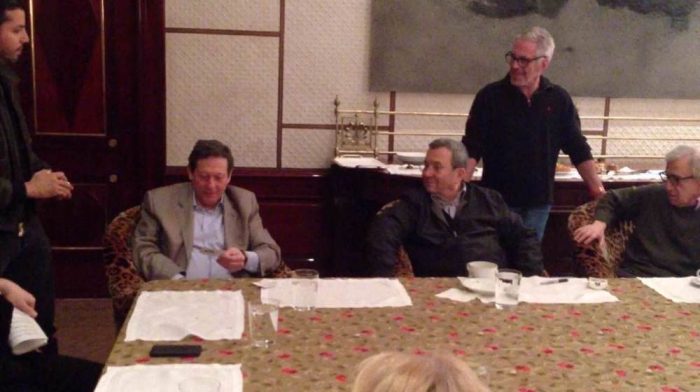
Seated from left to right are billionaire Thomas Pritzker, former Israeli prime minister Ehud Barak, and Hollywood director Woody Allen, while magician David Blaine stands to the left and Jeffrey Epstein stands, in a photo released by US Congressional Democrats on December 18, 2025.
Press TV – February 10, 2026
Iran says the global scandal surrounding convicted sex offender Jeffrey Epstein may go beyond a criminal case and be part of a geopolitical “project” intended to serve the Israeli regime’s interests.
A newly released tranche of Epstein files has sent shockwaves across media, politics, academia, finance, and even Hollywood, forcing prominent figures to account for their ties to Epstein.
Foreign Ministry spokesman Esmail Baghaei told reporters on Tuesday that the documents should not be downplayed or seen as an issue limited to the United States or a single individual.
He said that “given multiple reports indicating that the Israeli regime or others have exploited these cases and related proceedings to advance their political objectives, it strengthens the suspicion that the entire affair may be part of a long-running and extensive project to further the political goals of certain parties, particularly the Israeli regime.”
Baghaei described the scandal as a “human and civilizational catastrophe,” which has deeply wounded the global public conscience and could be considered a crime against humanity.
The revelations, he said, indicate a deep moral crisis within Western governance systems, particularly given the involvement of senior political figures in corruption-related cases.
Baghaei also questioned why no formal judicial proceedings have been publicly pursued so far.
“The crimes reflected in these reports depict horrific events and reveal a deeply troubling mindset among this class of individuals towards women, children, and girls,” he said.
The issue, according to him, requires careful examination across multiple dimensions, including political and security implications, and could affect the region both now and in the future.
Last week, the US Department of Justice (DOJ) released more than three million pages of files linked to its long-running investigation into Epstein, revealing the involvement of powerful political and business figures, including US President Donald Trump, his son-in-law Jared Kushner, and former Israeli prime minister Ehud Barak.
The released files are part of an estimated six million documents held by the DOJ.
The documents provide additional evidence that Epstein had ties to Israeli intelligence.
A declassified FBI memorandum from the Los Angeles field office in October 2020 reported that one source believed Epstein “was a co-opted Mossad agent” and described him as having been “trained as a spy” for Israel’s intelligence service.
The same document also suggested that Trump was vulnerable to Israeli influence through financial and political leverage, according to the confidential source.
Washington’s Gaza ‘master plan’: A mere PowerPoint presentation
Trump allies are selling Gaza reconstruction as a futuristic AI-powered utopia that not even the Israeli army believes will happen
By Robert Inlakesh | The Cradle | February 10, 2026
“We have a master plan … There is no Plan B,” remarked Jared Kushner last month, during a Board of Peace (BoP) presentation about Gaza reconstruction at the World Economic Forum (WEF) at Davos. What has become apparent is that no coherent Plan A exists either.
Although Kushner’s father-in-law, US President Donald Trump, was granted the legitimacy to build what he calls the BoP on the back of pledges to implement his “20-point peace plan” and Gaza ceasefire, the BoP’s charter is notably absent of any reference to Gaza.
Furthermore, United Nations Security Council (UNSC) resolution 2803, which legally authorized the BoP and was explicitly about the Gaza ceasefire, was deliberately vague on how any concepts proposed in the resolution would be implemented. It deliberately avoided outlining any mechanisms or obligations for reconstruction. Instead, two parallel schemes emerged.
The first was the Gaza Reconstitution, Economic Acceleration and Transformation Trust (GREAT Trust) – a 38-page document proposing to pay Palestinians $5,000 each to leave the territory. Crafted by Israeli figures previously involved in the discredited Gaza Humanitarian Foundation (GHF), the plan, which envisions “AI-powered, smart cities,” was less a roadmap for peace than a blueprint for ethnic cleansing.
That same foundation, backed by US private military contractors (PMCs), had already drawn international condemnation for herding civilians into “aid zones” only to open fire. More than 2,000 Palestinians were killed in those operations.
PowerPoint colonialism
Later, in December, the Wall Street Journal (WSJ) exposed that another proposal was put into circulation among US-allied nations in the Arab and Muslim world. The 32-page PowerPoint presentation, titled “Project Sunrise,” was set forth by Kushner and US envoy Steve Witkoff.
Like the preceding proposal, the new vision outlined a similar AI-smart city model, but added even more elements, such as high-speed rail infrastructure. According to the PowerPoint slides, the total cost of this 10-year reconstruction endeavor would amount to $112.1 billion, for which the US would commit to footing 20 percent of the bill.
Back then, Steven Cook, a senior fellow for the Middle East Program at the Council on Foreign Relations think tank, told WSJ that “they can make all the slides they want,” adding that “no one in Israel thinks they will move beyond the current situation and everyone is okay with that.” US Secretary of State Marco Rubio had even expressed his concerns over how realistic the plan will be, especially when it comes to potential foreign investment.
Then came Kushner’s presentation at Davos, which instantly made headlines and was presented as a brand new proposal called the “master plan.” According to Kushner, the project for a “new Gaza” would now only cost $25 billion.
However, upon further investigation, it is clear that what Kushner was presenting was simply “Project Sunrise,” which was evident as the PowerPoint he used was filled with the same exact slides from December. In other words, nothing particularly new was being placed on the table that had not already been released over a month prior.
“New Gaza” is a lab rat colony
Speaking to The Cradle, Akram, a Gaza resident from Al-Bureij, states that the situation on the ground does not reflect any of the positivity that appears in the media. “The Israelis won’t let us even have mobile homes or proper structures to live in, they still bomb us every day, and then we see AI images of Gaza becoming richer than Israeli cities?” he says, with bitter sarcasm. He added:
“Listen, do you really think they carried out genocide for two years and destroyed all our homes, only to build us a paradise, and that this will all happen if the resistance gives up its weapons? No. They are trying to tease us, like they always did, by saying, ‘if you give up your weapons, you will become Singapore.’ Nobody believes it.”
Shortly after Akram spoke to The Cradle, Israeli Prime Minister Benjamin Netanyahu delivered a speech to a special session of the Knesset, in which he made it clear that “the next stage is not reconstruction.” Instead, he asserted that disarmament would characterize Phase 2 of the ceasefire.
In his “master plan” presentation, Kushner claimed that the major task of clearing Gaza’s rubble would only take two to three years. Yet, according to UN figures, this task was estimated to take up to 15 years, with costs expected to exceed $650 million.
These figures are also dated, having been produced in July 2024, so they do not account for over a year of destruction. Israel has not stopped its round-the-clock demolition of Palestinian infrastructure since the so-called ceasefire took effect on 8 October 2025.
A humanitarian NGO official working in Gaza tells The Cradle that even the ceasefire’s Civil Military Coordination Center (CMCC), ostensibly set up to enforce humanitarian standards, now functions as a system of “intimidation” that “violates basic morality.”
On 21 January, Drop Site News reported on leaked documents that revealed plans to create an “Israeli Panopticon” city, to be constructed in territory remaining under its control in southern Gaza’s Rafah. The Guardian then reported that the UAE is seeking to bankroll the project. The leaked blueprints described a “case study” city where residents would be monitored around the clock, like lab rats, and forced to submit biometrics to enter.
Rafah as the prototype prison
The UAE has been accused of backing the five ISIS-linked militant groups Israel created to fight Hamas, which it previously intended to rule over a similar style concentration camp city in Rafah. In fact, Israeli Defense Minister Israel Katz had even ordered the construction of such a “community” during the 60-day ceasefire in early 2025. The Israelis have long intended to displace 600,000 Palestinians to such a gated facility.
The Emirati connection in this scheme goes beyond its recent offer to fund such a concentration camp city; it dates all the way back to January 2024, when it officially opened six water desalination plants along the Egyptian side of the Gaza border area, coincidentally capable of supplying 600,000 people with water.
Prior to the ceasefire and the collapse of the privatized aid scheme, the plot was to use the GHF PMCs in order to lure civilians into such a city area. Once they get there, the Palestinians who enter would be under the rule of Israel’s ISIS-linked proxy militias.
According to forensic architecture analysis, Israel is once again preparing land in order to implement such a project. Meanwhile, UG Solutions – the firm that hired the GHF’s PMCs – is again advertising job opportunities in the besieged territory.
Dispossession in disguise
Despite the dizzying array of slogans – BoP, GREAT, Sunrise, Panopticon – the outcome remains the same with no reconstruction, no sovereignty, and no end to occupation. The various schemes are less about peace and more about forcing Palestinians into containment zones policed by Tel Aviv and its regional clients.
From “Gaza Riviera” fantasies to proposals limiting reconstruction to areas under Israeli military control, what’s on offer amounts to PowerPoint projectionism. A revolving door of schemes and slogans has produced nothing substantive. Instead, the Israeli military continues its daily war of erasure on Gaza’s land, people, and future.
Even Kushner’s $25-billion fantasy is just that: a fantasy. In the three months since the UN resolution, all Washington has offered is AI-generated cityscapes and recycled decks. The only real plan on the table remains the one being implemented daily – the destruction of Gaza.
Is Nixing Aid to Israel a Poison Chalice?
Ending the existing arrangement could result in even more extensive forms of involvement
By Kelley Beaucar Vlahos | The American Conservative | February 9, 2026
There is a lot of talk about getting rid of the massive agreement that guarantees Israel billions of dollars in military aid each year. And it’s not just critics of Israel: Prime Minister Benjamin Netanyahu and Senator Lindsey Graham have even said they want to “taper off” the money because Israel is ready to stand on its own two feet.
But while a debate over the annual package would be a most welcome one given the enormous sums of American taxpayer money that has flowed to Israel’s wars in recent years, it is important to keep an eye on what might be a bait and switch: trading one guarantee for a set of others that might be less transparent and more expensive than what’s on the books today.
When President Bill Clinton announced the first Memorandum of Agreement, a 10-year, $26.7 billion military and economic aid package to Israel, he expressed hope that it would complement the advancement of the Oslo Accords, the peace process he had shepherded between the Israelis and Palestinians earlier in his term.
The peace process tied to Oslo pretty much fell apart after expected Israeli withdrawals from the West Bank as outlined in the Wye River Agreement in 1998 never happened; today Israeli settlements considered illegal under international law have exploded, with more than 700,000 settlers living there today and Israelis controlling security in most of the territory. But the 10-year MOU lived on.
Not only has it been renewed through the Bush and Obama administrations; the total outlays have increased. The current one, signed in 2016, pledged $38 billion over the decade, just under $4 billion a year and now all of it military aid. According to the Council on Foreign Relations, Israel is by far the biggest recipient of U.S. aid in history, some $300 billion since its founding, with the greatest proportion coming from those MOUs.
Supporters of the aid say it comes with military and strategic partnerships that are supposed to help keep the neighborhood safe for the U.S., Israel, and its “allies” (there are no treaty allies in the region), but the last 40 years have been pockmarked with wars and waves of human displacement and misery. Beyond financially and militarily supporting Israel’s wars, the U.S. has been bombing, regime-changing, occupying, and fending off terrorist insurgencies created by its own policies in Central Asia, the Horn of Africa, and the Middle East since 1999. Today, with Israel’s encouragement, President Donald Trump is poised to bomb Iran for the second time in his current term in office.
On February 3 the Congress passed the latest installment of the current MOU—$3.3 billion. It was a bipartisan affair, with Senate Minority Leader Chuck Schumer assuring a group of Jewish leaders the previous weekend, that “I have many jobs as leader … and one is to fight for aid to Israel, all the aid that Israel needs.”
But not everyone is on board with the open spigot. And a spigot it is. According to CFR, the U.S. gave $16.3 billion (which included its annual $3.8 billion outlays) to Israel after the Oct. 7, 2023 attacks. Israel’s retaliation for those attacks, which killed 1,200 Israelis, has resulted in more than 71,000 recorded Palestinian deaths in Gaza so far, a blockade that has left the 2 million population there largely homeless, starving, sick, and unsafe. Americans have reacted by rejecting the prospects of further aid, with a plurality now—42 percent—saying they want to decrease if not stop aid altogether. That is up from the mid-20 percent range in October 2023.
Beyond Americans’ aversion to funding the slaughter of civilians in Gaza, a conservative fissure over continued, unconditional support for Israel has opened wide over the last year, exposing another rationale for discontinuing the aid: It is not “America First.” It not only siphons off aid from much needed renewal at home, but forces Washington to aid and abet another country’s foreign policy, which is increasingly counterproductive and contrary to our own politics and values.
The region is not safer, and moreover, it has not allowed for the United States to reduce its military footprint as guarantor of security there.
One then-congresswoman, Marjorie Taylor Greene (R-GA), was vocal in her opposition to this aid. Israel, she pointed out, has nuclear weapons and is “quite capable of defending itself.” She has pointed out Israel’s universal health care and subsidized college tuition for its citizens, “yet here in America we’re 37 trillion dollars in debt.”
Rep. Thomas Massie (R-KY.) posted on X that he voted against the spending bill on February 3 in part to deny Israel the $3.3 billion in aid. He has said the aid takes money out of Americans’ pockets and proliferates human suffering in our name. “Nothing can justify the number of civilian casualties (tens of thousands of women and children) inflicted by Israel in Gaza in the last two years. We should end all U.S. military aid to Israel now,” he said in May of last year.
In an interview with The American Conservative last week, he said he is speaking for his Kentucky district and despite a retaliatory 2026 primary challenge driven largely by Trump and donors linked to the American Israel Political Affairs Committee (AIPAC), he will continue to raise the issue in Congress. He said he has asked his GOP constituents every year whether to maintain, increase, or cut Israel annual aid since 2012.
“I’ve polled that every election cycle in my congressional district among likely Republican voters, and this was the first year that a majority of people answered nothing [no aid] at all, or less,” said Massie. “It’s not a third rail back home. It’s a third rail inside of the Beltway.”
According to reports last month, Israel is “preparing for talks” with the Trump administration to renew the MOU for another 10 years. One might be flummoxed to hear, however, that Netanyahu is giving interviews in which he says he wants to “taper off” American aid in that decade “to zero.” Israel has “come of age” and “we’ve developed incredible capacities,” he said in January.
Immediately after, Graham, who seems to spend more time in Israel than Washington these days, said he heartily agreed and hoped to end the aid sooner. “I’m going to work on expediting the wind down of the aid and recommend we plow the money back into our own military,” he said. “As an American, you’re always appreciating allies that can be more self-sufficient.”
The idea of self-sufficiency and furthermore the concept of Israel releasing itself from any “ties” that might come from the aid is not a new one among supporters here and especially the hardline right in Israel. “Cut the US aid, and Israel becomes fully sovereign,” Laura Loomer charged on X in November. In March of last year, the Heritage Foundation called for gradually reducing the direct grants in the next MOUs starting in 2029 and transitioning gradually to more military cooperation and then finally arms transfers through the Foreign Military Sales by 2047.
Israel, the report concludes, should be “elevated to strategic partner for the benefit of Israel, the United States, and the Middle East. Transforming the U.S.–Israel relationship requires changing the regional paradigm, specifically advancing new security and commercial architectures.” The plan also leans heavily on future Abraham Accords ensuring trade and military pacts with Arab countries in the neighborhood.
Therein lies the fix, say critics. The reason these staunch advocates of Israel including Netanyahu, the most demanding of its leaders over the last 30 years by far, is willing to forgo MOU aid, is that they envision it will come from somewhere else, less politically charged.
“The emerging plan is to substitute formal military funding—known as Foreign Military Financing—with greater U.S. taxpayer-funded co-development and co-production of weapons with Israel,” says the Institute for Middle East Understanding, which adds that instead of extricating from Israel’s messes, the U.S. will be further “enmeshed” in them.
The think tank points out that the Foundation for the Defense of Democracies (FDD), the most unreconstructed pro-Israel organ in the United States, came out with its own report on the aid, and surprise, also advocated phasing out the MOU. In addition to a commitment by Israel to spend more of its GDP on defense and other co-investments with the U.S. on research and development, the U.S. would “provide Israel $5 billion each year through what would be known as a Partnership Investment Incentive—or PII. This PII would provide funding via existing foreign military financing (FMF) mechanisms that Israel would use to procure American military hardware.” The difference would be that it would have to be spent entirely in U.S. industry and on cooperative partnerships in the region, all while maintaining Israel’s “Qualitative Military Edge.”
Geoff Aronson, longtime Middle East analyst and occasional TAC contributor, said the aid has been “an important if not vital component in ensuring American and Israeli hegemony in the region” and is linked intrinsically to balancing U.S. strategic relations and normative Israeli peace with Egypt and Jordan, which gets billions in military aid (not as much) from the U.S. too. None of this is going to go away, he surmised to TAC.
“The question that is being posed is how can we continue to support Israel’s ability to work its will in the region without committing ourself to X, Y, Z or committing to a new partnership, a new agreement,” he said. “Watch what you wish for, because it might come true.”
What I Learned From the Epstein Files
Corbett | February 10, 2026
Just over a week ago, the U.S. Department of Justice released three and a half million of the six million pages of documents in the Epstein files. So, what do the Epstein files really reveal? Let’s find out.
WATCH ON:  /
/  /
/  /
/  /
/  /
/  or DOWNLOAD THE MP4
TRANSCRIPT
JAMES CORBETT: Just over a week ago, the U.S. Department of Justice released three and a half million of the six million pages of documents in the so-called “Epstein files.”
And by now, we’ve all heard the accusation that, for example, Bill Gates caught an STD from “Russian girls” and then tearfully pleaded with Jeffrey Epstein to please provide him with antibiotics so he could surrepetitiously drug Melinda. Brock, cut in the CNN Gates clip here. And we’ve all seen Elon Musk pleading with Epstein to pretty please allow him to attend. Let’s try that again. Kind of gives a whole new meaning to Microsoft. Get it? And we’ve all seen Elon Musk pleading with Jeffrey Epstein to please allow him to attend the wildest parties on his pedophile island. Cut in the Stewart clip here.
CNN ANCHOR: Epstein claimed he helped quote get drugs in order to deal with the consequences of sex with Russian girls and set up illicit trysts with married women. […] One draft email alleges that Gates tearfully asked Epstein to delete messages referencing an STD, writing, “Your request that I provide you antibiotics that you surreptitiously give to Melinda.” It also, uh, says Gates asked him to delete, uh, explicit personal details about his penis.
SOURCE: Epstein files: Drafts expose Bill Gates, Jeffrey Epstein relationship details
CORBETT: Kind of gives a whole new meaning to Microsoft. Get it? And we’ve all seen Elon Musk pleading with Jeffrey Epstein to please allow him to attend “the wildest parties” on his pedophile island.
REPORTER: Elon says, “Do you have any parties planned? I really want to hit the party scene in St. Barts or elsewhere and let loose.”
JON STEWART: I’m sorry. I hate to do this. Can we zoom in on the email on that, please? … Christmas Day?!
SOURCE: DOJ Protects Trump From Epstein Accountability as MAGA Attacks “Sanctuary Cities” | The Daily Show
And we’ve all seen Fake News Story of the Year recipient Donald J. Trump repeating his “nothing to see here” meme routine.
DONALD TRUMP: I think it’s really time for the country to get on to something else really, you know.
SOURCE: Trump says time to turn the page on Epstein scandal | AFP
CORBETT: …But he would say that, wouldn’t he?
No, the Epstein files are not a nothing burger. In fact, they provide one of the most valuable insights into the operations of the kakistocracy yet revealed.
But you won’t see any real reporting on the depths of this rabbit hole in the dinosaur media.
So, what do the Epstein files really reveal? Let’s find out.
CORBETT REPORT THEME
JEFFREY EPSTEIN: …What do I mean? He formed something called the Trilateral Commission.
The Trilateral Commission is some spooky stuff. People said it was some—people, the Illuminati…there’s some mystery about it. People that ran the world.
It was politicians. But David [Rockefeller] said [in] most countries, the politicians get elected for four years or eight years—separate from the royal families in England or in the Middle East. Someone’s there for four years and then they’re not there anymore. The most important people to have stability and consistency would be businessmen.
So, he formed this Trilateral Commission of businessmen and politicians from three major continents. So, it was the North Americans, the Europeans and the Asians.
So, he said to me, “Would you like to be on the trilateral commission?”
Now, I was 30 years old, 32 years old. I said, “Great.”
And he said, ‘Well, you have to fill out this application.”
So, they have your bio. And I looked at the list of people. And it was Bill Clinton, former president of the United States, Paul Volcker, every great leader in America. The Asians, the Japanese. And with a a very long description of their history. And they asked me to fill in what I would like to have written. And I wrote “Jeffrey Epstein, just a good kid,” which I thought was funny. Nobody else did.
SOURCE: JEFFREY EPSTEIN LAST INTERVIEW FROM HIS HOME (from the Epstein files)
CORBETT: Welcome back, friends, to The Corbett Report. I’m your host, James Corbett of corbettreport.com, coming to you in February of 2026 with Episode 491 of The Corbett Report podcast: “What I Learned from the Epstein Files.”
And that, as you probably garnered, was none other than pedo-king himself, Jeffrey Epstein, being recorded in a sit-down interview that took place shortly before his arrest in 2019 and [that] was conducted by none other than MAGA kingpin, Steve Bannon.
So, why did Steve Bannon participate in not just one, but a series of interviews that, we are told, comprise 15 hours of interview footage shortly before Epstein’s arrest there in 2019?
Good question. And I guess the answer to that question, as usual, depends on who you ask.
If you ask Bannon himself, he’ll tell you it was for the creation of a tell-all exposé documentary about the inner workings of the deep state and how these pedophiles operate. But that’s not what everyone says.
So, this is something that we’ve known about for a couple of years now. Back in 2024, it was being reported, “Steve Bannon filmed Jeffrey Epstein for 15 hours. His ‘documentary’ has never surfaced.” And even back then in 2024, a short clip was released by Bannon and his production company, Victory Films, to tease such a documentary that was “coming soon.” But it’s been “coming soon” for the past couple of years now.
And his (Bannon’s) explanation about this documentary—that it’s just, it’s for this tell-all exposé and it’s an anti-Epstein sort of thing…Well, according to this article, anyway, “Bannon’s explanation that he was producing a documentary about Epstein was nonsense, according to people who spent time with both men around the time they were in each other’s lives. In reality, the two acted like friends around each other, and Bannon, these people said, was trying to help Epstein, a notorious sex offender, with his public relations problems.”
And yes, if you want more on the Bannon slash Epstein relationship, Politico was reporting this recently:
The two dined together frequently and Epstein offered Bannon the use of a Paris apartment, Palm Beach house and other accommodations, as well as his plane on multiple occasions. When Epstein helped coordinate other travel for Bannon, the two joked that Epstein was working as Bannon’s assistant and the “most highly paid travel agent in history.” In one instance, Epstein added: “Massages. Not included.”
Yes. Interesting. Well, interesting-er and interesting-er, because why have we not seen this 15 hours of interview footage yet? And why are we now just getting two hours of that footage in this latest Epstein files dump?
Well, part of the reason may or may not have to do with an obscure legal tactic that was apparently at least discussed in which Steve Bannon, a non-lawyer, would be able to use—I believe it’s called the Kovel clause, or something along those lines—to declare himself part of Epstein’s legal team and thus shield his work through attorney-client privilege. Just really bizarre relationship there.
But it’s just one tiny sliver of a window into the much larger story and one that, for example, connects, as we’ve seen, Bannon with Chomsky, palling around. What’s the common connection there? Oh, that’s right. Epstein. They’re both pals of Epstein who palled around with him, flew on his jet and were both weirdly interested in protecting Epstein’s reputation. Yeah.
Make of all of that what you will, at any rate.
Well, yes, now I’m here to tell you there are two hours of the 15 hours of interview footage that Bannon took with Epstein now publicly available. I will link it in the show notes for today’s episode at corbettreport.com/epsteinfiles/ so that you can go and check it out for yourself.
And it includes clips like that one, which includes an interesting piece of information that I confess I should have known, but I did not until I sat down and watched this interview that, namely: Epstein was personally invited by David Rockefeller to join the Trilateral Commission.
And the timeline on that is all screwy and wonky because he’s talking about being 30 to 32 years old at the time, putting this in the 80s. But then they go on to talk about the first Trilateral Commission meeting in Tokyo, which took place in 1973. So is that the one they’re talking about? Presumably not. Does he mean his first Trilateral Commission meeting, etc., etc.? Well, there’s a lot of questions surrounding this, but there it is and take it for what it is.
But you would know about all of that if you had read my latest editorial. It’s called 10 Things I Learned from the Epstein Files. It’s up right now at corbettreport.com and, of course, on my Substack. And if you go through that, you’ll learn various things that we’ve already managed to uncover from these Epstein files.
For example, [#1] Epstein was an agent and he was working for… Which country? Fill in the blank. What do you think
Well, if you talk to the mainstream repeaters at The Daily Mail and other such crack journalistic outfits, you’ll find he was working for Russia! Yes, as the Daily Mail reports, Epstein’s sex empire was a “KGB honeytrap.” Yes, he was recruiting people and blackmailing people for Russia for…reasons. Apparently.
Or, or maybe, and just maybe, hear me out here, maybe Epstein was a Mossad agent. And I go through some of the many, many reasons that we would have to suspect that, the many, many ties between Epstein and Israel and Israeli intelligence, like:
- the Israeli military intelligence officer and personal aid to Ehud Barak, who spent weeks at a time at Epstein’s Manhattan apartment;
- Epstein personally involved in helping Israel sell a surveillance state to Cote d’Ivoire. Personally involved in helping Israel sell logistics infrastructure and cybersecurity to the United Arab Emirates. Epstein personally involved in helping sell the Rothschilds on Israeli cyberweapons;
- there’s, of course, the Epstein/Dershowitz link and both of them working to smear John Mearsheimer and Stephen Walt, who at the time were working to expose the Israel lobby;
- and dozens of other stories reported, for example, by Drop Site news in their ongoing and extensive Israel-Epstein archive or The Cradle talking about Epstein’s Israel ties.
So, you know, just maybe, maybe the Epstein story has to do with Israeli intelligence.
We could also get that from a Confidential Human Source [CHS] in one of these documents, reporting to the FBI that:
Epstein was close to the former Prime Minister of Israel, Ehud Barak (Barak) and trained as a spy under him. Barak believed Netanyahu was a criminal. Saudi Arabia, Israel and the United Arab Emirates (UAE) are allied against Qatar, Turkey, Iran and Syria. One of CHS’ [REDACTED] (who presumably worked [REDACTED]) asked CHS a lot of questions about Epstein. CHS became convinced that Epstein was a co-opted Mossad Agent (see previous reporting).
So again, make of all of that what you will. There’s much more to go into.
I, for example, go into [#2] Jeff Epstein was a Fed truther who “represented” the Rothschilds. Yes, also from this Bannon interview footage, we see Epstein expounding on fractional reserve banking, which, again, anyone in the conspiracy reality movement will have known about for decades. Presumably, they’ve read things like J. Edward Griffin’s The Creature from Jekyll Island, or they’ve seen my documentary on Century of Enslavement: The History of the Federal Reserve. But here it is from the banksters own mouths—or at least one of their representatives, Epstein—talking about fractional reserve banking and what a scam it is and why there would be runs on the bank if people knew how the system actually worked. Hmm, where have we heard that line before?
Again, much more information on that.
Also, the intriguing 2016 email that Epstein penned to Peter Thiel—yes, that Peter Thiel—in which he casually asserts, “as you probably know[,] I represent the Rothschilds,” which is just…well, interesting. And is he talking about his weird relationship with Arianne to Rothschild and their interesting correspondence? Or is he talking about the wider-reaching relationship that he had with the Rothschild banking dynasty? For example, the aforementioned ties into the selling the Israeli cyber weapons to the Rothschilds?
I go through other little bits and pieces that are interesting.
[#3] “Someone changed Epstein’s Apple ID password after he was dead,” and you can actually see that for yourself in the files.
[#4] The MCC—the “Metropolitan Correction Center”—officer who wrote an after-action report that was recorded in which he confessed to using boxes and sheets to construct a fake Epstein body that was then used to distract the media when they were removing the “body” from the MCC, or at least from the hospital, on the night of the supposed suicide.
I go through [#5] Epstein’s links to the Trilateral Commission and I link up, for example, a very extensive and interesting article on that: “From Rockefeller to Starmer: Mapping the Trilateral Network in the Epstein Files.”
I talk about [#6] Pizzagate and the many, many, many bizarre pizza references in here, like the pizza monster email thread—”You mean radiating a soft glow with th= look of bliss and excitement? Yeah, that’s the pizza.”—or “butt pizza” and other pizza references. “But Pizzagate was all a debunked conspiracy theory!” So said Reddit a few years ago. Well, now, of course, Reddit is the ones that are going, “hey, maybe there’s something to this Pizzagate!”
[#7] Epstein and 4chan. Yes, Christopher Poole, the founder of 4chan, met personally with Epstein. Epstein said he was very impressed by him. They wanted to meet again. Maybe they did meet again. When did they meet? Oh, on October 23rd, 2011 or thereabouts. And oh, by the way, that’s the exact date of the relaunch of the Politically Incorrect [/pol/] board. on 4chan. Hmm. Interesting stuff there.
[#8] Epstein co-opted Bitcoin and made Call of Duty a microtransaction hellscape. The latter point perhaps not so important, but the co-optation of Bitcoin is an incredibly important story. It’s been well reported in an article I’m linking here by Aaron Day at the Brownstone Institute called The Hijacking of Bitcoin. And he goes through, step by step, the exact ways that Epstein was linked up with the small blockers to create, to divert Bitcoin into the government-compliant regulatory non-crypto that it is today. And there’s specific talk about, for example, [a] $525,000 grant to MIT’s Media Lab Digital Currency Initiative and [a] $500,000 investment in Blockstream, etc. Again, so much reporting and very important stuff in there, so I will highly recommend that people check out that Aaron Day article.
I talk about [#9] Ghislaine being invited to the 9-11 Shadow Commission by an Edward J. Epstein (no relation). What that was all about? I link up, for example, the Wayback Archive of the page that was being linked to there and what that may or may not be.
And [#9] Epstein didn’t kill himself. Well, we’ll get to that later.
So, there’s ten points, and there’s dozens and dozens and dozens of links in here. So, I would highly suggest if you haven’t seen this article yet, please check it out.
But in the purpose of expanding on this research for today’s episode, I’m going to go through five more things I learned from the Epstein files. So, if you are buckled in and ready and have your pen and paper at hand, let’s start going through them.
#1: Epstein’s black market in babies. And we get weird hints of that from redacted emails from who knows who to who knows who: “[Subject:] [EXTERNAL EMAIL] Woman who accused John of God, cult leader of rape, mysteriously kills herself at Spanish home,” which apparently seems to be just a link to this Sun article, but “[REDACTED] spoke of this going on at Zorro Ranch. She has said on record that Epstein offered her money to do this. Birth babies for black market use.”
And if you want to start delving down that rabbit hole, you can start going to things like this, which is one of the documents that was released. [It] is a journal of sorts of someone who was undergoing therapy, an Epstein victim. And it’s truly disturbing. But at any rate, you can see, for example, something that appears to be blood or blood-like stained pages. And then you get this page of this bizarre code that you realize you have to read in two lines. “So sorry Jeffrey these things happen when your,” etc., etc. So you can go and really literally read everything for yourself, or, thankfully, the DOJ has apparently actually interpreted this code and here it is:
So sorry Jeffrey these things happen when your body has never been given time to properly heal!
So it came out in the toilet and I didn’t know what to do so I just flushed the tiny little fetus.
You have made me numb and I hate you for this!
I hope I never have to see you again!
I am not your personal incubator!
where is the baby?
where is Ghislaine?
And you can actually, again, go and read all of this for yourself in this creepy journal of trauma that this person left. That’s part of this document release.
There are other journals by the same person or a different person talking about more such creepy stuff. There’s, for example, this page, which, again, has some sort of redacted picture in here and then more text. Again, there is an accompanying document that tells us what this is. For example, “[Next to sonogram photo.” So, that is apparently what is being redacted here, a sonogram photo.
I heard the heart beat even when she put her hands over my ears.
Aren’t pictures enough for them?
Torture!
Should I …..
deeply miss them?
Have these all been …. [MURDERS]?
Does this make me a [KILLER]?
Flights and yachts of fancy? No, horror. And talking about what happened on those flights, et cetera, et cetera. So, yes, there is more to this story, obviously.
And there is an excellent post up on LifeSite News about “Ignored in the release of Epstein files are victim references to traumatic abortions, lost babies,” which I will commend to your attention. It has a lot of this information and compiles a lot of the documents and emails, etc. So that is a handy way of putting your head around this incredibly dark subject.
But that is just one of the things that we are learning from these files. #2—or should this be #12, I suppose, if we’re counting the first 10?— genetic editing of babies and animals. Again, a creepy subject, which you can start exploring by looking, for example, at the Brian Bishop communications with Epstein. There’s many, many things that they had about “genetic engineering,” “designer babies,” “new genetic editing desk,” “references for embryo editing,” etc., etc. They had an extensive correspondence about this, and you can find out more about that from some of the reporting that’s happened about this: “Epstein linked to ‘designer baby’ empire in latest files that reveal bid to engineer superhumans and clones, talking about this correspondence with Brian Bishop, a Bitcoin developer who “in 2018 was seeking financial backing for a venture aimed at genetically enhancing offspring and ultimately replicating humans.” So there was some weird baby cloning, whatever was going on.
Who knows exactly what was happening there, but I’ll just put this in there. Go to Jmail and search for “hoofs,” that word, and you’ll find an email from Jeffrey Epstein to a Kathy Ruemmler saying, “we talked about designing a pig with different non-cloven hoofs in order to make kosher bacon,” etc.
Again, all sorts of really, really bizarre and potentially occultic stuff going on in these emails. That’s just one more window on that.
So, let’s move on to #13. So, pandemics as a business model.
So, in my 10 Things I Learned from the Epstein Files, I did call on members of The Corbett Report community to chip in with your—what do you find? What are interesting pieces of this puzzle that you find? And at least one of The Corbett Report members, beware-the-ides-of-march, answered the call:
“Dear James, you said we could contribute here if we thought there was an angle on Epstein worth looking at? This four-part investigation looks well-researched and properly referenced. Here’s part four for your perusal.”
And then, beware the Ides of March, links to Sayer Ji’s article, BREAKING: The Epstein Files Illuminate a 20-Year Architecture Behind Pandemics as a Business Model—With Bill Gates at the Center of the Network, which notes:
The latest DOJ batch of Epstein files reveal that by the time the world encountered COVID-19, the financial, philanthropic, and institutional machinery to manage—and profit from—a pandemic was already firmly in place.
While the Epstein files have reignited scrutiny around specific relationships, their deeper significance lies in how they intersect with a much longer and largely unexamined timeline. Public records, institutional initiatives, and financial instruments indicate that the conceptual foundations of pandemic preparedness as a managed financial and security category began to take shape in the late 1990s and early 2000s, as philanthropic capital, global health governance, and risk finance increasingly converged. Following the 2008 financial crisis, this framework rapidly accelerated—expanding through reinsurance markets, parametric triggers, donor-advised funding structures, and global simulations—years before COVID-19 made the architecture visible to the public.
And I will not go through this entire article for you right here, but Sayer Ji has done an incredible job of putting this together, starting with this “20-year pandemic preparedness architecture” timeline, which exactly corresponds to all of the research that I have done on this.
Late 1990s to early 2000s: the foundations were being laid through philanthropy and global health governance. And that’s exactly right from my research on this matter. For example, of course, the Dark Winter/anthrax attacks of 2001, leading into the Model State Emergency Health Powers Acts that were being passed all around the United States in subsequent years that laid the framework, the institutional and legislative framework, for state governors to start locking down their populations and force inoculating them at the event in the event of a declared pandemic. And the 2006 International Health Regulations at the World Health Organization that created the Public Health Emergency of International Concern, the “PHEIC” emergency—P-H-E-I-C—designation that was then used in the swine flu and Ebola and other such ginned up non-crises before getting to the scandemic.
Post-2008, you had the acceleration in terms of financialization and reinsurance and catastrophe logic of the pandemic preparedness agenda.
And then in the 2010s, you have the operationalization of that agenda through simulations, DAFs and preparedness infrastructure. What’s a DAF, a donor advised fund? Well, Sayer Ji again goes through all of that in this incredibly detailed article.
And the best part about the article is he doesn’t just talk about the documents. He’ll actually show the documents. And absolutely most best of all is at the very bottom of this incredibly lengthy and well-researched article. You have the actual notes with the actual references that you would use as a researcher to go and put these puzzle pieces together for yourself.
So, once again, this is highly recommended. Thank you to beware-the-ides-of-march for bringing this to my attention. Thank you to Sarah Ji for putting this work together. It’s incredibly important and shows more of the inner workings of that pandemic preparedness agenda, how it came about and how Epstein was apparently one of the locuses of this agenda, connecting JP Morgan with Gates, etc., and other donors and other such things together in this network that created the foundations of the scamdemic. And there are all sorts of ancillary documents, J.P. Morgan documents and Gates Foundation documents, etc., that are, again, part of this document release that show even more, as Sayer Ji highlights in this article.
But let’s move on to #4 or #14, depending on which numeral reference we’re using here: The DOJ had a draft of Epstein’s death announcement the day before he died.
That’s right. You will, of course, know that, of course, Epstein killed himself on August 10th, 2019, right? Well, according to the U.S. Attorney General’s office in the Southern District of New York, there was an August 9th press release talking about how “Earlier this morning, the Manhattan Correctional Center confirmed that Jeffrey Epstein, who faced charges brought by this Office of engaging in the sex trafficking of minors, had been found unresponsive in his cell and pronounced dead shortly thereafter.”
But that’s not what happened. Oh, no, it happened on August 10th. And that document has also been released. Of course, this is the press release where it was almost word for word exactly the same: “Earlier this morning, the Manhattan Correctional Center confirmed that Jeffrey Epstein, who faced charges brought by this Office of engaging in the sex trafficking of minors, had been found unresponsive in his cell…” and then it says, “and was pronounced dead shortly thereafter of an apparent suicide.”
So, literally on August 9th, the day before any of this happened, they had a press release about his death, announcing his death. And then when it supposedly actually happened on the 10th, they had a press release, almost word for word the same, but adding that he [died of an] “apparent suicide.”
Right. Okay. I’m not the only one who finds this a little bit odd. Oh, maybe, maybe some intern screwed up and put the wrong date on the wrong one or something. and they corrected it. Well, mainstream outlets too, picking up on this. “Epstein files reveal prosecutor’s announcement dated before his death.” Yes, which does seem to be kind of a bit of a strange phenomenon and one that at least deserves some explanation, doesn’t it? Along with many other things that we could point out.
For example: “Epstein Cellmate Claims Trump Administration Wanted Pervert Powerbroker ‘Dead’,” talking about “Jeffrey Epstein’s prison cellmate claims to have evidence that the Trump administration wanted the disgraced financier dead and left him unprotected ‘on purpose.’” Of course, who is the cellmate? “Nicholas Tartaglioni, a quadruple murderer and former police officer” who “had a reputation for extreme violence and a self-confessed hatred of child sex offenders, who “claims ‘it is no coincidence’ that he was ‘deliberately’ moved into the same jail as Epstein and ‘placed in the same cell’ as the convicted child sex offender,” but then removed the night before whatever happened, happened.
Which leads us to #5 of the five more things I learned, #15 of the overall list of what we learned from the Epstein files: Epstein didn’t kill himself!
Okay, no, we don’t really learn the truth about what happened or didn’t happen on the night of August 10th in these files, but we shouldn’t expect that that would be in these files. There are things that have been released, like new photos of people working on his body at the scene, et cetera, etc. But, as we know, they were using tactics like boxes and sheets stuffed into bags to trick reporters about his body. So what we know is, of course, more and more and more of the weirdness that certainly does not prove anything. What—Kash Patel and Dan Bongino just looked you straight in the eye and lied to your face. “He killed himself. I’ve seen suicides before. I’ve looked at the files and they show that he killed himself.” No, they do not. No, they do not.
And I guess we could put the bookends on this entire story by taking a look at a couple of AP news articles. The first one, “Justice Department releases largest batch yet of Epstein documents, says it totals 3 million pages.” So, that was that was how it started. And this is how it ended: “FBI concluded Jeffrey Epstein wasn’t running a sex trafficking ring for powerful men, files show,” talking about some of the documents within this release, which show that, oh, he wasn’t doing anything. He wasn’t. Whatever. Who cares, guys? Look somewhere else.
At least, that’s what the internal documents which have been released now show. The internal FBI and DOJ investigation showed that there was no list. There was no nothing. It’s all fine. Don’t think about it.
Well, as you can tell, there’s a lot in here and much, much more that I could go through. Everything I have talked about, everything I’m referencing will be in the show notes for today’s episode at corbettreport.com/epsteinfiles/. So please go there for the more information on this. But, having said that, if you want some more of the strangeness in these files, you could turn to Nick Bryant, who, you will know, is a previous Corbett Report guest for his work with EpsteinJustice.com, which, you will know, is an organization that is organizing and rallying in support of the Epstein victims and achieving justice for the crimes of Epstein and his kakistocracy crew.
Well, Nick Bryant has an interesting post up: “The Epstein Emails: From the Very Strange to the Very, Very Evil,” in which he talks about some of these things.
And just right off the top, he talks about one of the released emails. Here is a group email from REDACTED to a group list, subject: “journalist calling around” from 2011. “Just a heads up, there is a journalist calling around again. His name is Nick Bryant. This is what he looks like so you are all aware.”
So, literally an APB–an all points bulletin–being put out by the Epstein crew to be on the lookout for Nick Bryant back in 2011, because, as my listeners will know, Nick Bryant was one of the OG researchers on this way before the Miami Journal or whatever, or any of those reporters had even heard of this case. Bryant was on it. He was the one who released the black book and the flight logs in the first place, etc., etc. So, he’s been doing yeoman’s work on this subject and the Franklin scandal before it and other work along these lines for decades now.
So, I recently contacted Nick Bryant to ask him about some of the very interesting emails that he’s uncovered and which he has itemized here in this Epstein emails post.
NICK BRYANT: Well, the first category is “horrors.” I mean, there are a lot of horrors in these emails. I mean, evil of an almost incomprehensible kind—evil that I have come across before. With the Franklin scandal, there was extreme abuse, and there was also accounts of children being murdered, and we’re seeing that with Epstein.
And then I’ve got muffins, steaks, pizza, etc.,
And then there’s power brokers and celebrities. And it turned out that Epstein was trying—Thiel and Musk and Zuckerberg, our favorite humans on the planet, were getting together. And Epstein was wondering—it’s an email—and Epstein was wondering if he could make it with those swell guys.
Deepak Chopra shows up occasionally. This one’s kind of interesting: “God is a construct. Cute girls are real.” So, underneath all that high-powered metaphysical spirituality, Deepak Chopra has some major lower chakra predilections.
And then there’s kind of an interesting one. David Boies is a super lawyer who represented all the Epstein victims. He was invited to Epstein’s Yom Kippur breakfast in 2010. And there’s another attorney that represented a number of those victims named Stan Pottinger, who’s very, very dirty.
And the next category is transhumanism, biohacking, mind control, etc. And that certainly has some interesting emails.
And then the next category is FBI, CIA, Mossad.
And then there were a couple of emails that didn’t quite fit into any other category. So, I just said “additional strange emails.”
CORBETT: Absolutely, incredibly interesting list. And this is, of course, only scratching the surface of the three million pages of documents that have been released, including many, many emails, too many for any one human to handle. But let’s go through a few of the more interesting ones right here.
So, for example, Jeffrey Epstein emailed an unknown individual stating he “loved a torture video” shared between the two. And you can see, obviously, that you can see the actual emails in the email list. But here’s here’s some images of it. And Peter Mandelson, this is just speculation, right? We don’t know that that is the name under there, but it just happens to fit.
BRYANT: It does indeed. And he had formerly been the UK ambassador to the United States of America, which is a very prestigious post. And apparently he likes torture.
CORBETT: I loved the torture video. Yeah. Well, no. Yeah. Well, okay. Jeffrey loved the torture video. We don’t know. We don’t know what the person who sent it thought of it, at any rate.
BRYANT: So, with this, Mandelson is taking a lot of heat in the UK and he’s had to step down from all his prestigious posts. So actually, there’s a minor amount of accountability here.
CORBETT: Something has occurred. Yes.
OK, how about this one? “If true, this Jeffrey Epstein oriented email beggars belief. The abuse was off the scale.” And we’re looking at something from Eddie Aragon: “Fwd: CONFIDENTIAL: Jeffrey Epstein. This is sensitive. So it will be the first and last email, depending on your description discretion. You can choose to take it or trash it but this comes from a person that has been there and seen it as a former staff at the Zorro.”
And this person is talking about: “What is damning about Jeffrey Epstein is yet to be written. Did you know somewhere in the hills outside the Zorro, two foreign girls were buried on orders of Jeffrey and Madam G.? [Ghislaine, presumably.] Both died by strangulation during rough fetish sex.” And here are the video footage of Jeffrey Epstein, including “sex video with minor,” “Matthew Mellon video,” etc. “Suicide attempt confession,” etc., etc.
And apparently somebody who claims to have been as former Zorro staffer was attempting to get one Bitcoin for in return for this information. What do we make of this?
BRYANT: Well, there’s other very, very dark emails that allude to homicides. So did this happen? I mean, that’s the question. If you look at the totality of emails and just the amount of blood that’s just dripping off of them, an email like this doesn’t really seem that far-fetched in that context.
CORBETT: Yeah. No, it certainly doesn’t. It’s par for the course, unfortunately.
All right, let’s look at this one. From “Forward to J.E.E. [Epstein] re: Richard Johnson.” This is from Mark Tramo. And what are we looking at here? “Thanks for sending Richard Johnson my way. I trust the kind words I shared with him are acceptable,” et cetera, et cetera. “Was just reading today that newborns will suck on a pacifier more vigorously if it triggers playback of a recording of her slash his mother’s voice than another woman’s voice. Have you read David Brooks’ Social Animal?” What are we looking at here?
BRYANT: Well, if it’s talking about ways to get babies to suck harder in a very malevolent kind of way, I mean, this is rarefied evil.
CORBETT: “They blacked out the name of the person who sent Epstein an image labeled age 11 Why protect the predator?” And yes, this is an email from the archives sent from somebody, we don’t know, just labeled “Age 11.” “fullsizerender.jpg,” so this is an image file. The image file itself, obviously not released?
BRYANT: And here’s the thing. The media and the government have said that Epstein’s youngest victim was 14 years old, but I’ve heard accounts of victims that are much younger. There’s an Australian newspaper called The Age. I think it’s out of Sydney. It’s a daily. They spent a lot of time in the Virgin Islands, and they said that the youngest victims there were 11 or 12.
Virginia Giuffre submitted an affidavit that talked about various perpetrators, and she said that she’d attended orgies where the youngest girl was 12 and most of them couldn’t speak English. But I know a couple of therapists, and one’s a pretty eminent psychologist, and both have counseled Epstein victims who were trafficked when they were under the age of 10. So.
I know that somebody is going to try to clean this up, because it’s very strange. People think that 14-year-olds and 15-year-olds have agency. I mean, that’s how they’ve kind of justified it in their mind with regards to Jeffrey Epstein. And I don’t feel that way, but when you get into 11-year-olds or 10-year-olds or 9-year-olds, I mean, how can they possibly have agency? So that’s, I think, one of the things that really needs to be broken open here is that these guys were psychopaths.
And we saw it in the Franklin scandal, too. The two primary pimps were into pubescent boys. But if you wanted a seven or eight year old, they didn’t have a problem getting you a seven or eight year old.
So, I mean, they’re psychopaths. It’s not like they’ve got a conscience to to deal with. So, when, with this–and that’s another thing where the mainstream media has really short changed Americans. They’ve made Epstein and Maxwell seem kind of glamorous living on the Upper East Side, traveling all over. But human traffickers are vicious people, whether they’re living in a mansion on the Upper East Side or they’re living in a trailer court in the Midwest. Human traffickers are vicious, vicious people.
CORBETT: Uh, as we talked about Deepak Chopra to Epstein: “God is a construct. Cute girls are real.” And this person notes they’re all in on it. The entire world is a stage. So yes, sorry to any Deepak Chopra fans out in the crowd who might’ve held out hope.
One more. Again, there’s dozens of links in this document that we’re linking up here, but let’s take a look at one more: “Evidence of the presence of American laboratories for the development of biological weapons in Ukraine has been found in the ‘Epstein files,’ as previously reported by the Russian Defense Ministry on numerous occasions,” but of course derided as crazy Russian conspiracy theory. And here are the emails themselves. Yeah, a lot of biological and, you know, scientific papers and documents and emails and things in these records that we’re finding, aren’t there?
BRYANT: So there’s gene editing. There’s doing very strange things to babies. There’s cloning. And cloning is a reality. People in New York City clone their French bulldogs for $65,000. And I think you can clone a human for about $1.5 million. When Dolly the sheep was cloned in the mid-’90s, I actually had written some articles for Genetic Engineering News, which was one of the papers that broke that. And it’s very easy to clone. You just have to get an ovum and take the DNA out of the ovum and stick the DNA that you want cloned in the ovum and then give it an electrical charge. Sometimes the charge will start mitosis and the cells will start splitting, and sometimes they won’t. But it’s very easy to clone.
And back then, even before I got into the Franklin scandal and all this dark, malevolent stuff, I thought to myself: “there’s got to be megalomaniac millionaires out there cloning themselves.” So, that was when I saw his thing that was about cloning and transhumanism, I kind of figured that that would be a natural outcome.
CORBETT: Yeah, of course. If you can imagine it and we have indications of it, then it is probably already happening. And here are some more indications of that. And as I say, these are just a few of the emails of the ones that you have highlighted from the literally thousands and tens of thousands that we’ve just been flooded with. So there’s much, much more to go through.
But let’s talk about, obviously, I know that you work, obviously, your work at EpsteinJustice.com, working for and with the survivors and victims of these crimes. What are the people in your network saying about this latest file release and what is or is not happening as a result of it?
BRYANT: Well, it’s daunting. All these emails with so much evil, I mean, it’s daunting. And people that have been victims of sexual abuse that have been traumatized, I mean, this is very hard stuff for them to read. And there’s 3 million documents that have yet to be released. I mean, these are bad, but you can only imagine how bad those are.
CORBETT: So what is the next step for Epstein Justice then? How do we continue putting pressure to get those documents?
BRYANT: It’s waking people up. I mean, Epstein Justice is growing.
When we first started talking about Epstein Justice, we had just started. And I’d been a writer my entire life. I’d never been a director of 501c3. I’d never even worked for a 501c3. And the people that wanted to do this with me, none of us had any kind of experience working with a 501c3. But we just felt like this is something we had to do. So, now we have a plan.
Well, we’ve always had a plan for the Independent Congressional Commission. And that does not require a presidential signature. It just requires a majority in the House and a majority in the Senate. And independent congressional commissions generally hire non-government personnel to help them with investigations. And that’s what we’re going to need. If this thing ends up in a subcommittee, it’s going to die for sure. The only chance that we have for truth with this is an independent congressional commission that is completely devoid of any executive signature. It’s going to take a lot.
Together, Epstein Justice, we’re putting together Facebook groups by state, and we’re having those respective groups put pressure on their legislators. Now, they cannot feel our pressure yet. But as these groups grow and grow–and they are growing–as they continue to grow, these legislators will start feeling the heat from an inundation of emails and phone calls. And that’s the only way that you can get a politician to act is if they feel fear.
And I realize that a lot of these politicians are compromised. And the ones that are extremely recalcitrant, we’re just going to have to put extreme pressure on them and show how recalcitrant they are.
So, we have a plan and we’re executing it. But this isn’t going to be an easy slog. I mean, I’ve been at this for 22, 23 years when I started researching about the Franklin scandal. But, you know, I got to tell you, James, just the fact that it’s gotten this far is like a dream come true to me. Because I went through some very dark years thinking that none of this was going to be exposed.
CORBETT: Once again, that is Nick Bryant of EpsteinJustice.com. And for anyone interested in Epstein Justice, I suggest you go to their website. You can find out more about the regular webinars that they do on an ongoing basis to train people in activism and how they can raise awareness about this issue. And they have various campaigns that they are involved in on an ongoing basis, again, trying to achieve justice for these crimes. So people who are interested, please check that out at EpsteinJustice.com.
But as you can see, this is just scraping the surface of the three and a half million documents, pages of documents, of the six million in the overall files, with almost half of the files having not yet been released.
So, obviously, this is too much of a research task for any one individual to be able to handle. So, I need your support. I need your help. And I would hope that if there are any interested people in the audience who are interested in delving into these files and finding out more, that you will lend a hand to this open source investigation.
And if you are interested in that, of course, you could go to the Epstein Library at the U.S. Department of Justice website. Again, the link will be in the show notes if you are interested. and you can try going through this.
And I don’t know. For example, we looked for hoofs earlier. Is it going to find it here? Okay, it can be functional and you can find these emails that way.
Or you can start browsing through them. And if you do so, you’ll find the Epstein files, Transparency Act release. And, I don’t know, go into Dataset 10. And just like the JFK files that we looked at last year, these files are, again, totally, utterly useless, just random numbers. And who knows what you’re going to find when you click into something? Is it going to be an email? Is it going to be a document? Is it going to show something? Is it going to be a picture? I don’t know! How could you possibly know? [sarcasm]Oh, yes, of course, this document.[/sarcasm]
Again, how useful is this? Not very, and perhaps that is part of the point, confuse and distract.
So, if you want a more robust way of searching through these files, you can go to jmail.world. For those who don’t know, this is a handy service that has been put together that takes all of these emails and documents and photos, etc., and puts it as if you are logged into a Gmail type interface as Jeffrey Epstein. It is not just Gmail. It’s also Yahoo. It’s the documents, it’s the photos, etc. But here it is.
And so, as for example, before we were able to search, for example, you search the word “hoofs” and you’ll find that Kathy Ruemmler email.
Or, well, here guys, let’s find out. Ooh, is Corbett in the–oh no, Corbett is not in the Epstein files, etc., etc.
So, you can search that way.
You can search–there is also a list of people that you can search through. So, you can see all of the Elon Musk emails, etc., things along those lines there. Again, there’s a lot of different features here.
I saw somebody in the comments earlier asking about the photos and “how do you find the photos that are apparently being published here and I can’t find them,” etc., etc.. Well, here they are. And you can go to “view original.” That’s a handy link to go to the actual justice.gov version that is contained in the files and it’ll have the URL there, etc. So you can copy that in.
And again, there’s literally thousands and thousands and thousands and thousands and thousands of photos and documents here. And you can see them all and download them all, etc. And this even has a function, at least on the email part of Jmail where, You can see the last one that’s at least recorded here in 2019 is from Cody Rudland: “You are dead. lol, good riddance.” Okay, wonderful.
But there is a function for leaving notes as well on the sidebar. I’m in the mobile version of this, so you can’t see it. But there is a function for leaving notes, and people are collectively leaving notes on these various emails, etc.
Again, there’s a lot to explore. just explore. You can see what Epstein was ordering on Amazon, etc.
So again, all of this information in a much, much more easily findable form.
However, having said that, some of these emails are not showing up in the Jmail search. Like, for example, we looked earlier at Nick Bryant showing up in one of these. But Nick Bryant–that email about the “APB” of Nick Bryant is not searchable this way. You can find Juliette Bryant, whoever that is, but not Nick, etc. So, there are certain things that just are not showing up here. So… Again, has all of the data been imported and has it been done in the proper way? And are things being disappeared from the files, etc.? All very good questions that people need to start looking at and answering.
Having said that, here’s another interesting website. This one is a hat tip to my video editor extraordinaire, Broc West, who brought this one to my attention. I hadn’t seen it. It’s called EpsteinSecrets.com. And there you can see visually the Epstein network, for example, mapped out all of the various people and who they’re connected to. And you can sort how this this this map is shown, for example, looking at edges and people. And you can zoom in on various people and how they’re connected and the documents that are connected to them.
You can do searches. For example, remember that Kathy Ruemmler that Epstein was talking about genetically engineering pigs to have non-cloven hooves so they could be kosher. Well, who who on earth is that Kathy Ruemmler person? There is a way to search this and I know I have done it without logging in, but anyway.
Well, anyway, I’m not going to get it now, but trust me, there is a way to search this and Broc will show it on screen where you can find out [about] Kathy Ruemmler. Oh, that’s right! She happens to be with the department of–or, she was in the Obama administration and then went into private practice in the 20 teens, at which point she was contacting Jeffrey Epstein on a regular basis.
So, again, it’s a handy search function for that sort of thing.
There are tools like this that exist. And if you know of any other research tools for going through this massive, massive amount of files. Please bring them to our attention. I’m sure we would be interested to hear about them
Having said that, I do know that there are those who will simply fold their arms and–interestingly, in an exact parallel to Donald J. Trump–say: “Let’s move on. There’s nothing to see here. Whatever. Who cares?” Essentially. Remember when Chomsky said who cares about 9/11 or JFK, etc.? Well, it’s: “Who cares? Whatever. There’s nothing of importance here. It’s all fake! It’s all a psyop and or it’s all been scrubbed!”
Well, be that as it may, I don’t believe that. These are real emails that really took place between thousands and thousands of people, real documents that have been verified and that no, not a single person has said that isn’t an email that’s fake, let alone the thousands of people who are implicated in these emails. None of them have stepped forward to say that’s fake.
No, these are real emails that really took place that really contain information. Does this contain the video of the whatever blood drinking child sacrifice? No, of course not. That is not in here.
But there is a lot to garner from here. As you’ve seen, for example, Sayer Ji and others mining these documents, Aaron Day with the Bitcoin documents, et cetera. There’s a lot of information to go through.
So, I will say–counter to those who will tell you “It’s a nothing burger! It’s a psyop! Don’t look at it!”–I will say you can choose whatever you want to look at or not look at. If you don’t want to research this, that’s fine. But if you do, I would very much appreciate your help because I am going to continue looking at these documents and what they do reveal about the kakistocracy that, yes, many people in my audience, thankfully, after decades and decades of people like Nick Bryant and others reporting on this subject and staying on it for decades in which they’ve been dismissed as crazy conspiracy theorists and wild loonies finally being vindicated. And then there are those who will just say, “Just stop looking!” I do not believe that. I think we should be looking at these and taking them for what it’s worth.
Obviously, this is not the bottom of the rabbit hole, but it is some way down and further than we have been before. So there is important information. Get it before it gets scrubbed, because you know they are working on scrubbing various pieces of this puzzle as they are being reported.
Having said that, I am interested in what you find. So if you are a Corbett Report member, please go to corbettreport.com, log in, leave links, data, information, tools, etc.
Whatever you find in the comments section at corbettreport.com/epsteinfiles. I am looking forward to what you find and I will, of course, be reporting more on this subject in the future, but that’s going to do it for today’s exploration. I am James Corbett of corbettreport.com. Thank you for joining me for today’s episode.
STEVE BANNON: …[If] we walked into that clinic where they’re giving that money out to these people that are the most dire straits of poverty and sickness and told them that the money was coming from a–what are you, Class 3 sexual predator?
EPSTEIN: Tier 1.
BANNON: Tier 1 is the highest and worst.
EPSTEIN: No, the lowest. I’m the lowest. You’re the lowest.
BANNON: Okay, Tier one, you’re the lowest. But a criminal.
EPSTEIN: Yes.
BANNON: That the money came from what? What percentage of people do you estimate? I understand you don’t like probabilities. Do you estimate would say, “I don’t care. I want the money for my children”?
EPSTEIN: I would say, everyone said, “I want the money for my children.”
BANNON: Did they know where the money came from?
EPSTEIN: I think if you told them, the devil.
BANNON: The devil himself.
EPSTEIN: The devil himself said, “I going to exchange some dollars for your child’s life”?
BANNON: Do you think you’re the devil himself?
EPSTEIN: No. But I do have a good mirror.
SOURCE: JEFFREY EPSTEIN LAST INTERVIEW FROM HIS HOME (from the Epstein files)
Decades of broken promises, aggression, Israeli pressure leave Iran no reason to trust US: Analyst
By Press TV | February 9, 2026
Decades of broken promises, military aggression, and Israeli pressure have left Tehran with no reason to trust Washington, says a US-based analyst.
In an interview with the Press TV website, E. Michael Jones, author and editor of Culture Wars Magazine, said it would be “foolish” to put “trust in a regime which violates its own word repeatedly,” referring to the Donald Trump administration.
“Iranians have learned their lesson and will not put themselves in jeopardy again. The US cannot be trusted,” he noted.
Mistrust is not a tactical posture but the logical outcome of experience, Jones said, adding that the United States, particularly under Trump, has demonstrated “again and again” that it does not feel bound by its own international commitments.
That mistrust is sharpened by Trump’s record on international obligations, he remarked.
The US-based journalist and commentator pointed to the unilateral withdrawal of the US from the Joint Comprehensive Plan of Action in May 2018.
“Trump has already torn up the JCPOA. He would not feel bound by any agreement,” he said, adding that this piece of history alone makes any future deal “inherently fragile.”
Jones also dismissed Israeli-backed demands to restrict Iran’s missile range, calling them knowingly unrealistic.
“A 300 km limitation on Iranian missiles is an impossible demand,” he stated, adding that Israel is fully aware Iran would never accept such terms.
According to the analyst, these conditions are not designed to advance negotiations but to manufacture justification for war.
“They are making the demand because it provides a pretext for war,” he told the Press TV website, as indirect Iran-US talks have recently resumed in Muscat under Omani mediation.
The discussions, facilitated by Omani Foreign Minister Badr bin Hamad Al Busaidi, allowed the two sides to exchange views indirectly almost eight months after the previous round of talks was suspended due to Israeli-American military aggression against Iran.
Iranian Foreign Minister Abbas Araghchi described the latest round of talks as a “good start,” saying Iran’s positions and concerns were clearly conveyed.
More than a week into the June war, the United States bombed Iran’s nuclear facilities. Between June 13 and 27, 2025, at least 1,064 people were killed in Iran, including military commanders, nuclear scientists, and ordinary civilians.
Against this backdrop, claims that talks could once again serve as cover for military action resonate strongly. Jones believes Iranians “learned their lesson” there.
This distrust is further reinforced by Washington’s expanding military footprint and repeated threats. Despite Trump’s campaign rhetoric about ending US wars, his administration has bombed several countries and repeatedly edged toward confrontation with Iran.
In his assessment, Trump’s preferred military option remains limited and performative. “Trump’s preferred option at this point is a symbolic strike at targets pre-arranged with the Iranian government,” Jones says, claiming that this approach was already used in June.
Such strikes, he explained, are designed to create the illusion of victory. Trump can declare success, “satisfying the Israelis, who ordered him to attack Iran, and the Iranians, who lose nothing in the attack.”
But the analyst argued that this balancing act is collapsing. “Unfortunately, neither Iran nor Israel is willing to accept Trump’s solution,” he noted.
Israeli pressure, Jones added, is now the central driver of escalation. With Trump set to meet Benjamin Netanyahu on Wednesday, the analyst expects an ultimatum by the latter: “if you don’t attack Iran, we will.”
“If Trump is smart, he will let Israel attack Iran on its own, hoping that the Iranian response will obliterate Israel once and for all, releasing him from Netanyahu’s constant pressure,” Jones remarked.
Still, he believes Netanyahu’s threats mask a deeper constraint. “Netanyahu is bluffing. He knows he can’t attack Iran by itself,” he said, adding that “many here speculate that Netanyahu is blackmailing Trump with the Epstein files.”
Despite the rhetoric, the analyst insists the US is fully aware of the risks of war with Iran.
Iranian officials have warned that any attack would be met with an immediate response, and Iran’s missile capabilities have already demonstrated their ability to penetrate layered defenses. According to the author, this reality is well understood within the US military.
“The American military has always claimed that the US cannot win a war with Iran,” he noted.
Yet, he hastened to add, such assessments rarely determine policy. “Their verdict invariably gets overturned by Israeli pressure,” Jones stressed, explaining why Trump continues to favor prearranged and symbolic strikes rather than full-scale war.
“American forces are now operating according to Israeli rules,” he stated, noting that the US power in the region no longer operates according to international norms.
He cited the assassination of top anti-terror commander General Qassem Soleimani, carried out while he was on a peace mission in Iraq, as a defining moment.
For Jones, it marked Washington’s abandonment of its own claims to a “rules-based order,” as well as its disregard for institutions such as the United Nations.
He recalled Trump’s own words when questioned by the New York Times. Asked whether he followed international law, Trump said no. Asked what he did follow, Trump replied, “My morality, my mind.”
The analyst described this as a direct reference to John Milton’s Paradise Lost, when Satan said, “The mind is its own place.”
The symbolism, he noted, is unmistakable, adding that it confirms that Imam Khomeini—the founder of the Islamic Revolution—was right when he referred to America as the “Great Satan.”
Bad Science, Big Consequences
How the influential 2006 Stern Review conjured up escalating future disaster losses
By Roger Pielke Jr. | The Honest Broker | February 2, 2026
For those who haven’t observed climate debates over the long term, today it might be hard to imagine the incredible influence of the 2006 Stern Review on The Economics of Climate.1
The Stern Review was far more than just another nerdy report of climate economics. It was a keystone document that reshaped how climate change was framed in policy, media, and advocacy, with reverberations still echoing today.
The Review was commissioned in 2005 by the UK Treasury under Chancellor Gordon Brown and published in 2006, with the aim of assessing climate change through the lens of economic risk and cost–benefit analysis. The review was led by Sir Nicholas Stern, then Head of the UK Government Economic Service and a former Chief Economist of the World Bank, from the outset giving the effort unusual stature for a policy report.
As the climate issue gained momentum in the 2000s, the Review’s conclusions that climate change was a looming emergency and that virtually any cost was worth bearing in response were widely treated as authoritative. The Review shaped climate discourse far beyond the United Kingdom and well beyond the confines of economics.
One key aspect of the Stern Review overlaps significantly with my expertise — The economic impacts of extreme weather. In fact, that overlap has a very surprising connection which I’ll detail below, and explains why back in 2006 I was able to identify the report’s fatal flaws on the economics of extreme weather in real time, and publish my arguments in the peer-reviewed literature soon thereafter.
But I’m getting ahead of myself.
I have just updated through 2025 the figure below that compares the Stern Review’s prediction of post-2005 increases in disaster losses as a percentage of global GDP with what has actually transpired.
Specifically, the figure shows in light grey the Stern Review’s prediction for increasing global disaster losses, as a percentage of GDP, from 2006 through 2050.2 These values in grey represent annual average losses, meaning that over time for the prediction to verify, about half of annual losses would lie above the grey bars and about half below.
The black bars in the figure show what has actually occurred (with details provided in this post last week). You don’t need fancy statistics to see that the real world has consistently undershot the Stern Review’s predictions over the past two decades.
The Stern Review forecast rapidly escalating losses to 2050, when losses were projected to be about $1.7 trillion in 2025 dollars. The Review’s prediction for 2025 was more than $500 billion in losses (average annual). In actuality losses totaled about $200 billion in 2025.
The forecast miss is not subtle.
How did the Stern Review get things so wrong?
The answer is also not subtle and can be summarized in two words: Bad science.
Let’s take a look at the details. The screenshot below comes from Chapter 5 of the Review and explains its source for developing its prediction, cited to footnote 26.

As fate would have it, footnote 26 goes to a white paper that I commissioned for a workshop that I co-organized with Munich Re in 2006 on disasters and climate change.
That white paper — by Muir-Wood et al. — is the same paper that soon after was played the starring role in a fraudulent graph inserted into the 2007 IPCC report (yes, fraudulent). You can listen to me recounting that incredible story, with rare archival audio.
But I digress . . . back to The Stern Review, which argued:
If temperatures continued to rise over the second half of the century, costs could reach several percent of GDP each year, particularly because the damages increase disproportionately at higher temperatures . . .
The report presented its prediction methodology in the footnote 27, shown in full below, which says: “These values are likely underestimates.”

Where do these escalating numbers come from? Who knows.
They appear to be just made up out of thin air. The predictive numbers do not come from Muir-Wood et al., who do not engage in any form of projection.
The 2% starting point for increasing losses — asserted in the blue highlighted passage in the image above — also does not appear in Muir-Wood et al. which in fact says:
When analyzed over the full survey period (1950 – 2005) the year is not statistically significant for global normalized losses. . . For the more complete 1970-2005 survey period, the year is significant with a positive coefficient for (i.e. increase in) global losses at 1% . . .
The Stern Review seems to have turned 1% into 2% and failed to acknowledge that over the longer-period 1950 to 2005, there was no increasing trend in losses as a proportion of GDP. The escalating increase in annual losses from 2% to 3%, 4%, 5%, 6% every decade is not supported in any way in the Stern Review, nor is it referenced to any source.
When the Stern Review first came out, I noticed this curiosity right away, and did what I thought we scholars were expected to do when encountering bad science with big implications — I wrote a paper for peer review.
My paper was published in 2007 and clearly explained the Muir-Wood et al. and other significant and seemingly undeniable errors in the Stern Review.
Pielke Jr, R. (2007). Mistreatment of the economic impacts of extreme events in the Stern Review Report on the Economics of Climate Change. Global Environmental Change, 17(3-4), 302-310.
I explained in that paper:
This brief critique of a small part of the Stern Review finds that the report has dramatically misrepresented literature and understandings on the relationship of projected climate changes and future losses from extreme events in developed countries, and indeed globally. In one case this appears to be the result of the misrepresentation of a single study. This cherry picking damages the credibility of the Stern Review because it not only ignores other relevant literature with different conclusions, but it misrepresents the very study that it has used to buttress its conclusions.
Over my career in research, I’ve had some hits and some misses, but I’m happy to report that I got this one right at the time and it has held up ever since. Of course, perhaps a more significant outcome of this episode, and a key part of my own education in climate science, is that my paper was resoundingly ignored.
One reason that science works is that scientists share a commitment to correct errors when they are found in research, bringing forward reliable knowledge and leaving behind that which doesn’t stand the test of time.
I learned decades ago that in areas where I published, self-correction was often slow to work, if not just broken. Over the decades that pathological characteristic of key areas of climate science has not much improved (e.g., see this egregious example).
The Stern Review helped to launch climate change into top levels of policy making around the world. Further, we can draw a straight line from the Review to the emergence of (often scientifically questionable) “climate risk” in global finance a decade later. It still rests on a foundation of bad science.
1 My ongoing THB series on insurance and “climate risk” in finance prompted me to revisit the 2006 Stern Review, hence this post.
2 Note that the Review explicitly referenced the tabulation of global economic losses from extreme weather events as tabulation by Munich Re, which is the same dataset that I often use, such as in last week’s THB post on global disaster losses. The comparison here is thus apples to apples.
When Threats Replace Evidence
What an Australian Newspaper Article Reveals About the Vaccine Compliance Machine
Lies are Unbekoming | February 5, 2026
The Sydney Morning Herald wants you to know the penalties. Doctors and nurses who falsify vaccination records face suspension, deregistration, and jail. Parents who seek them out face fraud investigations through Services Australia. The article names specific dollar amounts ($2,500 per child), quotes the Health Minister expressing shock and outrage, and reminds readers that AHPRA—the regulatory body that controls whether medical professionals can earn a living—is watching.
The article reads less as journalism than as a warning to anyone considering dissent.
The Herald is one of Australia’s oldest and most influential newspapers, the rough equivalent of the New York Times in reach and establishment credibility. When it publishes a piece like this, it speaks with institutional authority. The January 2026 article, “Parents are paying $2500 to falsify vaccine records,” arrives at a particular moment in Australian public health: vaccine uptake has “stalled below national targets,” mandate enforcement is creating a black market for exemptions, and parents are organising in Facebook groups 40,000 members strong.
To understand the context, American readers need to know what Australia built. Between 2014 and 2019, five Australian states—New South Wales, Victoria, Queensland, South Australia, and Western Australia—rolled out “no jab, no play” laws, which bar unvaccinated children from childcare and preschool enrollment entirely. The only exemptions are medical, and these require documented life-threatening allergic reactions or severe immunocompromise—conditions so narrow that most families cannot qualify no matter their concerns.
The coercion is not subtle—and it violates the government’s own rules. Australia’s Immunisation Handbook states that valid consent must be given “voluntarily in the absence of undue pressure, coercion or manipulation.” Denying a child access to childcare unless the parents comply is textbook duress. The government has built an enforcement apparatus that fails its own stated ethical standards.
The system was designed to make non-compliance economically devastating and socially impossible. And for years, it worked. But now that system is encountering mass resistance, and the Herald article’s purpose is to make examples—to signal what happens to doctors who help parents escape a coercive system, and to parents who refuse to comply.
Buried beneath the threats is a dead baby. Riley Hughes, 32 days old, is the emotional payload. His story opens the piece, provides the moral frame, and transforms regulatory enforcement into righteous protection of the innocent. Without Riley, this article is just an inventory of punishments. With Riley, non-compliance becomes child murder.
The story requires examination.
Riley developed “mild cold symptoms” at three weeks old. His mother took him to a doctor, who said he appeared “perfectly fine.” When he stopped feeding, she took him to the children’s hospital. By day three, doctors “suspected” whooping cough. By day four, he had pneumonia. By day five, he was on life support. He died at 32 days old. Riley died in February 2015—eleven years before this article was published. The Herald reached back over a decade to find its dead baby.
The article states that “The Bordetella pertussis bug had overwhelmed his tiny body.” This is presented as fact. But reading carefully, the diagnosis was never confirmed—doctors “suspected” whooping cough. The journalist’s assertion that pertussis killed Riley is not attributed to any medical source. It is simply declared.
More striking is what the article omits entirely: what happened during those five days of hospitalisation. What interventions were administered to a three-week-old infant? What antibiotics? What was the “life support” that preceded his death? The hospital’s role in Riley’s deterioration is invisible. The medical system appears only as the place where heroic efforts were made to save him from the disease that (we are told) the unvaccinated community gave him.
The article describes Riley as “too young” to be vaccinated against whooping cough, which is given at six to eight weeks in Australia. But it does not mention that under Australian guidelines, Riley would have received the Hepatitis B vaccine within 24 hours of birth. He was not an unvaccinated child. He was a vaccinated child who had not yet received this particular vaccine.
If Riley had been completely unvaccinated, that would be the story. “Unvaccinated baby dies of preventable disease” writes itself. Instead, the article performs a subtle shift: a vaccinated infant dies after five days of hospital intervention, and an entire class of people—parents who refused to vaccinate—are scapegoated to protect the system that failed him.
None of this can be stated with certainty. We do not have Riley’s medical records. We do not know what drugs were administered, what procedures were performed, what his body endured in those five days. But that is precisely the point: neither does the Herald, and neither do its readers. The article presents a story with a hole at its centre and fills that hole with a villain—the unvaccinated community—while the institution that actually had custody of Riley during his decline remains unexamined.
What we do know: Riley was vaccinated. He received the Hepatitis B vaccine at birth, as per Australian protocol. He then spent five days in hospital care before he died. This is a vaccinated child who died after days of medical intervention—and the article repurposes his death as a case against vaccine refusal.
The mother, Catherine Hughes, is quoted: “My son would likely be alive today if everyone in my community had been fully vaccinated against whooping cough.”
This is a grieving mother’s belief, given to her by a medical system that needed someone to blame. She has since founded the Immunisation Foundation of Australia and become a professional advocate for vaccination mandates. What the Herald does not disclose: as journalist Alison Bevege has documented, her foundation received $170,000 from Sanofi in 2023 and $100,000 from GSK in 2025. Hughes herself appears in GSK press releases promoting their products. The article presents her as a spontaneous voice of bereaved motherhood. She is a paid pharmaceutical spokesperson.
The article’s foundational premise—that unvaccinated children endanger the community—is not merely unexamined. Even within the mainstream framework of germ theory and disease transmission, the published science contradicts it.
In 2014, researchers at the FDA published a study using baboons to examine how the acellular pertussis vaccine actually works. The results, within the germ theory framework the researchers operated in, were unambiguous: vaccinated baboons exposed to Bordetella pertussis showed few symptoms but became colonised with the bacteria. They were then placed in cages with unvaccinated baboons—and by the researchers’ own account, the vaccinated animals passed the bacteria to the unvaccinated ones. The study’s conclusion: “acellular pertussis vaccines protect against disease but fail to prevent infection and transmission.”
A 2015 study by Althouse and Scarpino went further. Using epidemiological, genetic, and mathematical modelling data, they argued that asymptomatic spread from vaccinated individuals “provides the most parsimonious explanation for the observed resurgence of B. pertussis in the US and UK.” Vaccinated individuals who show no symptoms carry and spread the bacteria—according to the very framework the public health establishment operates within. The authors noted that this also explains the documented failure of “cocooning”—the strategy of vaccinating family members to protect newborns. By their own logic, it doesn’t work because the vaccinated family members become silent carriers.
Even by the establishment’s own standards, the pertussis vaccine does not prevent colonisation. It does not prevent spread. What it does, according to their own researchers, is suppress symptoms in the vaccinated individual while allowing them to pass the bacterium to others, including infants too young to be vaccinated.
These are peer-reviewed studies published in the Proceedings of the National Academy of Sciences and BMC Medicine. The FDA conducted the baboon study.
Meanwhile, within this same framework, the bacterium has apparently evolved under vaccine pressure. A 2014 Australian study found that between 30% and 80% of circulating pertussis strains during a major outbreak were “pertactin-deficient”—lacking the protein the vaccine targets. The authors observed that “pertussis vaccine selection pressure, or vaccine-driven adaptation, induced the evolution of B. pertussis.”
The pertussis vaccine suppresses symptoms. Whether it also creates asymptomatic carriers who spread an apparently evolving pathogen, as the establishment’s own researchers claim, remains their narrative to defend. But even within that narrative, the unvaccinated are not the problem—the vaccine is.
When the Herald article quotes a professor warning about “one of the kids there has whooping cough or measles, and it spreads through the childcare, putting your child at risk,” the establishment’s own science suggests the spreader is more likely to be a vaccinated child with no visible symptoms than an unvaccinated child who would be home sick.
Even within the establishment’s own framework, if Riley had pertussis, the most likely source—according to their own research on asymptomatic carriage—would be a vaccinated person, perhaps someone in his own family who had been “cocooned” as the health authorities recommend. The article does not explore this possibility. It cannot, because the entire enforcement apparatus rests on the premise that the unvaccinated are the danger.
The article is not confused about the science. It is not interested in the science. Its function is compliance enforcement, and its vectors are specific.
The first vector targets medical professionals. The article names a Perth nurse charged with fraudulently recording vaccines—though the case was dropped for lack of evidence. It names a Victorian doctor whose registration was suspended. It quotes AHPRA warning that practitioners found acting fraudulently face suspension or deregistration. The message to any doctor or nurse who might help parents escape the system: we are watching, and we will destroy your career.
This is not new. In December 2020, Dr. Paul Thomas, a Portland paediatrician who had practiced for 35 years, published a peer-reviewed study comparing health outcomes in vaccinated versus unvaccinated children in his practice. The data showed unvaccinated children were significantly healthier across multiple metrics. Within days of publication, the Oregon Medical Board issued an “emergency order” suspending his licence, claiming his “continued practice constitutes an immediate danger to the public.”
The Board’s letter accused Thomas of “fraudulently” asserting that his vaccine-friendly protocol improved health outcomes—the very thing his peer-reviewed data demonstrated. His paper was later retracted under circumstances its authors describe as dubious. Thomas eventually surrendered his licence rather than continue fighting the Board’s conditions, which prohibited him from consulting with parents about vaccines or conducting further research.
The pattern is consistent. Produce evidence that challenges the orthodoxy, lose your ability to practice medicine. The threat in the Herald article is not abstract. Medical professionals in Australia have seen what happens to dissenters.
The second vector targets parents. The article reminds readers that Services Australia investigates Medicare and Centrelink fraud. Parents who pay for falsified records are not just endangering children (according to the article’s framing)—they are committing crimes against the Commonwealth. The article implies that seeking workarounds exposes parents to criminal liability, transforming a decision about their child’s medical care into a prosecutable offence.
The third vector is reputational. The article quotes the Health Minister: “I am shocked and appalled that any doctor or nurse would falsify vaccination records.” Parents in the Facebook groups are framed as reckless conspirators, their concerns about vaccine safety transmuted into selfish endangerment of babies like Riley. The 2025 study cited in the article notes that 47.9% of parents with unvaccinated children “did not believe vaccines are safe” and 46.7% “would not feel guilty if their unvaccinated child got a vaccine-preventable disease.” These statistics are presented as moral indictments.
What the article does not mention: the same study found that nearly 40% of these parents “did not believe vaccinating children helps protect others in the community.” Given the published science on pertussis—even within the establishment’s own framework—these parents have a point.
In 2004, Glen Nowak, the CDC’s director of media relations, gave a presentation to the National Influenza Vaccine Summit titled “Increasing Awareness and Uptake of Influenza Immunization.” His slides explained that vaccine demand requires “concern, anxiety, and worry” among the public. “The belief that you can inform and warn people, and get them to take appropriate actions or precautions with respect to a health threat or risk without actually making them anxious or concerned,” Nowak explained, “is not possible.”
His recipe for demand creation included medical experts stating “concern and alarm” and predicting “dire outcomes” if people don’t vaccinate. References to “very severe” and “deadly” diseases help motivate behaviour. Pandemic framing is useful.
The Herald article follows this template precisely. It opens with a dead baby. It features a professor warning about diseases “spreading through childcare.” The Health Minister invokes “serious complications, hospitalisation, and in some cases, death.” The 14 measles cases since December are presented ominously, without context about how many of those cases involved vaccinated individuals or resulted in any serious illness.
The article also quotes Dr. Niroshini Kennedy, president of the paediatrics and child health division at the Royal Australasian College of Physicians, warning about “vaccine hesitancy.” What the article does not mention: the RACP has a foundation that partners with GSK, a major pertussis vaccine manufacturer. The expert voice warning about hesitancy has institutional financial ties to a company that profits from vaccination.
The financial stakes are not abstract. GSK’s pertussis products Boostrix and Infanrix generated $2.3 billion in 2023. Sanofi’s pertussis vaccine revenue hit $1 billion in 2024, up 10.8% on the previous year, driven by booster demand. When the Herald runs a story demonising vaccine refusers, it serves an industry measured in billions.
The article acknowledges, briefly, that public health experts warned in 2019 that “vaccine mandates can backfire, and simply induce parents to seek loopholes, and, worse, fuel negative attitudes towards vaccination.” This warning has proven accurate. Australia’s escalating mandate regime has not produced the desired compliance. It has produced a $2,500 black market and Facebook groups with 40,000 members sharing strategies for resistance.
The system’s response is not to reconsider the mandates. It is to escalate enforcement and amplify fear. The article is part of that escalation.
The escalation itself is diagnostic. Systems that can defend their policies on evidence do not need to inventory punishments in the newspaper. They do not need to reach back eleven years for a dead baby. They do not need AHPRA warnings and Health Minister quotes and reminders about criminal prosecution. They make their case and let the data persuade.
What the Herald article reveals, beneath its institutional authority, is a system that has run out of persuasive tools. The sequence tells the story: first came the information campaigns, which did not produce sufficient uptake. Then came the mandates—no jab, no play—which produced compliance but also resistance. Then came enforcement against the resisters, which produced a black market. Now comes the threat display in the national press, designed to frighten the black market into submission. Each escalation is a concession that the previous level of coercion failed. Each one is more desperate than the last.
A system confident in its science would welcome questions. A system confident in its products would publish the safety data that parents are asking for. A system confident in its outcomes would point to the evidence and let parents decide. This system prosecutes nurses, deregisters doctors, denies children access to childcare, and runs articles designed to make examples of anyone who dissents. That is not the behaviour of an institution operating from strength. It is the behaviour of an institution that knows it cannot survive scrutiny—and is scrambling to ensure that scrutiny never arrives.
What parents are waking up to, slowly and in growing numbers, is that the fundamental promise—vaccinate your children and they will be protected, vaccinate enough children and the community will be protected—is not supported by the evidence, even within the framework that public health authorities operate in. What they are discovering is that asking questions produces hostility rather than answers. What they are learning is that doctors who support informed consent are being systematically removed from practice, leaving parents with no one in the medical system willing to have honest conversations.
The 40,000 parents in that Facebook group are not there because they read misinformation. They are there because they asked questions their doctors couldn’t answer, or because their child had a reaction that was dismissed, or because they did the research the system told them not to do and found that the confident assurances didn’t match the published science.
The Herald article treats these parents as a problem to be solved through enforcement. It does not entertain the possibility that they might be responding rationally to real information. It cannot, because that would require examining the science—and the science does not support the policy.
Australia has constructed a system where parents lose childcare access if they do not vaccinate, where doctors lose their licences if they support parental choice, where asking questions about vaccine safety is framed as “misinformation,” and where a dead baby is deployed to transform regulatory non-compliance into moral monstrosity.
The article calls this public health. A more accurate description: this is what happens when a policy built on faulty premises meets a population that is beginning to see through it. Unable to defend the science, the system defends itself through threats, fear, and the weaponisation of grief.
Riley Hughes deserved better than to become a propaganda tool for the companies that fund his mother’s foundation. The parents seeking exemptions deserve honest information about what vaccines can and cannot do. The doctors trying to practice informed consent deserve to keep their licences.
None of them are served by an article whose purpose is to frighten dissenters into silence.
The system is telling parents: comply or be punished, and don’t ask questions. The parents are responding: we have questions, and your threats are not answers.
That tension will not be resolved by more enforcement. It will be resolved when someone in authority has the courage to address the questions honestly—or it will continue to escalate until the system’s credibility collapses entirely.
Forty thousand parents in one Facebook group suggest which direction this is heading.
References
The Article Under Discussion:
Olaya, K. (2026, January 31). Parents are paying $2500 to falsify vaccine records. It’s endangering babies like Riley. The Sydney Morning Herald. https://www.smh.com.au/national/parents-are-paying-2500-to-falsify-vaccine-records-it-s-endangering-babies-like-riley-20260127-p5nxah.html
Catherine Hughes Financial Disclosures:
Bevege, A. (2026, February 4). ‘Baby-Killers’ – Nine Newspapers falsely claim unvaccinated people killed a baby by spreading whooping cough. Letters from Australia. https://alisonbevege.substack.com/
RACP-GSK Partnership:
GSK Australia. RACP Foundation partnership announcement. Referenced in Bevege (2026).
Vaccine Revenue Figures:
GSK. (2024). Annual Report 2023. Boostrix and Infanrix/Pediarix revenue figures.
Sanofi. (2025). Fourth Quarter 2024 Earnings Report. Polio/pertussis/HiB vaccine sales.
Pertussis Vaccine and Asymptomatic Carriage:
Warfel, J. M., Zimmerman, L. I., & Merkel, T. J. (2014). Acellular pertussis vaccines protect against disease but fail to prevent infection and transmission in a nonhuman primate model. Proceedings of the National Academy of Sciences, 111(2), 787-92. https://doi.org/10.1073/pnas.1314688110
Althouse, B. M., & Scarpino, S. V. (2015). Asymptomatic transmission and the resurgence of Bordetella pertussis. BMC Medicine, 13(1), 146. https://doi.org/10.1186/s12916-015-0382-8
Pertussis Vaccine Evolution and Waning Immunity:
Lam, C., Octavia, S., et al. (2014). Rapid increase in pertactin-deficient Bordetella pertussis isolates, Australia. Emerging Infectious Diseases, 20(4), 626-33. https://doi.org/10.3201/eid2004.131478
Tartof, S. Y., Lewis, M., et al. (2013). Waning immunity to pertussis following 5 doses of DTaP. Pediatrics, 131(4), e1047-52. https://doi.org/10.1542/peds.2012-1928
van Boven, M., Mooi, F. R., et al. (2005). Pathogen adaptation under imperfect vaccination: implications for pertussis. Proceedings of the Royal Society B, 272(1572), 1617-24. https://doi.org/10.1098/rspb.2005.3108
Dr. Paul Thomas Case:
Oregon Medical Board. (2020). In the Matter of: Paul Norman Thomas, MD. License Number MD15689: Order of Emergency Suspension. https://omb.oregon.gov/Clients/ORMB/OrderDocuments/e579dd35-7e1b-471f-a69a-3a800317ed4c.pdf
Lyons-Weiler, J., & Thomas, P. (2020). Relative Incidence of Office Visits and Cumulative Rates of Billed Diagnoses Along the Axis of Vaccination. International Journal of Environmental Research and Public Health, 17(22), 8674. [Retracted 2021]
Hammond, J. R. (2021). The War on Informed Consent: The Persecution of Dr. Paul Thomas by the Oregon Medical Board. Skyhorse Publishing.
CDC Fear-Based Messaging:
Nowak, G. (2004). Increasing Awareness and Uptake of Influenza Immunization. Presentation at the National Influenza Vaccine Summit, Atlanta, GA.
Vaccine Mandates and Backfire Effects:
Ward, J. K., et al. (2019). France’s citizen consultation on vaccination and the challenges of participatory democracy in health. Social Science & Medicine, 220, 73-80.
Suppression of Vaccine Dissent:
Martin, B. (2015). On the Suppression of Vaccination Dissent. Science and Engineering Ethics, 21(1), 143-57. https://doi.org/10.1007/s11948-014-9530-3
Australia’s No Jab, No Play Laws:
Australian state governments. No Jab, No Play legislation (2014-2019). New South Wales, Victoria, Queensland, South Australia, Western Australia.
Australian Immunisation Handbook — Consent Requirements:
Australian Government Department of Health. Australian Immunisation Handbook. Section: Valid Consent. https://immunisationhandbook.health.gov.au/
The Gaza Ceasefire Has No Phase Two, Only a Permanent Limbo
By Robert Inlakesh | The Palestine Chronicle | February 7, 2026
Since the Gaza ceasefire took effect on October 10, 2025, repeated announcements about an imminent ‘Phase Two’ have created the impression of diplomatic progress. In reality, the agreement has not advanced beyond its initial stage, while shifting proposals and ongoing violations suggest the process was never designed to reach a definitive end to the war.
Key Takeaways
- The ceasefire remains trapped in Phase 1 because Phase 2 has never been clearly defined or operationalized.
- Monitoring mechanisms, particularly the CMCC, have failed to enforce the agreement despite thousands of violations.
- Successive reconstruction proposals replace political resolution with speculative planning detached from realities on the ground.
- Israel’s refusal to withdraw and demand for disarmament make any transition to Phase 2 structurally impossible.
- The ceasefire functions as a controlled pause in large-scale war rather than a genuine path to ending it.
A Ceasefire without a Second Phase
Since the initiation of the Gaza Ceasefire agreement on October 10, 2025, month after month, the media has speculated about the beginning of the second phase of the deal. However, despite small amendments to the situation on the ground, nothing substantive has emerged. This is all by design.
The original text of US President Donald Trump’s “Comprehensive End of Gaza War” proposal, as well as his corresponding “20-Point-Plan,” assert that the Gaza ceasefire’s first phase will begin immediately and that within a 72-hour-window all of the elements included within it are to be concluded.
Soon after the ceasefire was announced, there then emerged a different plan, one that stated there would be a five-day window in which a limited number of aid trucks could enter the Gaza Strip. Israel did not adhere to this agreement. From there, it took weeks for the minimum required aid to reach the civilian population.
There was also the formation of the Civil-Military Coordination Center (CMCC), which attracted over 20 countries and dozens of humanitarian aid organizations. The CMCC’s purpose was supposed to be the coordination of aid transfers, alongside monitoring efforts to stop ceasefire violations and maintain the stability of the agreement.
Instead, the CMCC became a command and control center led by the United States military, with the Israelis being the second in charge, before a range of Arab and international armed forces. The CMCC has watched on and done nothing to stop Israel’s daily ceasefire violations, which are around 3,000 in total at this point, including the murder of around 560 Palestinians.
Contrary to its stated mission, the CMCC made every nation involved fully complicit in Israeli war crimes, including round-the-clock home demolitions, the deliberate slaughter of children, and the propping up of five ISIS-linked militias in the territory.
Plans for Gaza without Ending the War
Ever since the ceasefire began, there has been a nearly weekly pivot in terms of what the future plans for Gaza are to be; all of these “plans”, “visions,” and “proposals” contradict the last.
For example, a proposal for “post-war Gaza”, exposed by the Washington Post in September, before the ceasefire was even implemented, was still reportedly being floated following the agreement that came into effect a month later. This was called the “Gaza Reconstitution, Economic Acceleration and Transformation Trust”, or GREAT Trust, fully drawn up by an Israeli. A 38-page document was even produced as a means of laying the groundwork for a model of AI-powered smart cities.
However, the GREAT Trust plan contradicted Donald Trump’s “20-point-plan” as it proposed paying Gaza’s civilian population 5,000 USD each to leave the territory. Under the Trump plan, the population was said to be allowed to stay in Gaza.
Enter Trump’s son-in-law, Jared Kushner, and suddenly there’s a “new plan” for post-war construction, presented on a slideshow called “Project Sunrise”, which was revealed in December of last year by the Wall Street Journal. This PowerPoint presentation, which is vague and consists of AI-generated images similar to the US President’s infamous “Trump Gaza” AI video, was published at the start of 2025.
The month prior to this, Kushner, along with US envoy Steve Witkoff, was floating countless vague proposals, appearing to only be offering reconstruction in the Israeli-controlled portion of Gaza, which was supposed to be 53% of the territory, but due to Israeli violations and seizure of more land is closer to 60%.
What also happened in mid-November was the passing of the United Nations’ de facto death certificate – UN Security Council resolution 2803 – which granted the US its legitimacy in creating the “Board of Peace” and “International Stabilization Force”.
UNSC resolution 2803 was supposed to help usher in the alleged Phase 2 of the ceasefire deal, something that still hadn’t been clearly defined. Then, in December, there were reports, citing US officials, that Phase 2 would start in January. Instead, all that happened was Jared Kushner delivered a speech and showed a PowerPoint presentation, depicted in the media as “the master plan”.
Yet, the slideshow was the same as the old one that had been floating around since December, except this time, Kushner was arguing his AI-powered super city model would cost 90 billion less than it was supposed to late last year.
The Managed Stalemate
Now the Israelis have allowed a partial opening of Rafah, which they decide to close whenever they choose and impose extreme restrictions on who leaves and enters. Contrary to the agreement, the Israelis are not withdrawing from Gaza at all and have publicly expressed their opposition to such a move.
Instead, Israel demands that the Palestinian resistance disarm, which they will not do. Therefore, the only option for the Israelis is to ramp up their genocide again and collapse the ceasefire if they want to achieve disarmament, something it hasn’t yet chosen to do.
In other words, there is no Phase 2. We don’t even have a definition of what Phase 2 actually is. There are no real plans for anything, just AI slop and unrealistic “visions”. Although it may seem as if there are attempts to bring about a change on the ground, which to some is the “start of Phase 2”, this is simply wishful thinking.
What is happening is precisely what I have predicted since October 8, 2025, when both sides signaled they had agreed to the ceasefire: the situation is stuck in limbo between “Phase 1” and “Phase 2”. Israel doesn’t stop killing civilians, and there is no real effort to develop meaningful plans that would actually result in the ceasefire’s ultimate success.
The genocide is not over; there is simply a glorified pause in place, one that allows the Israelis to focus on other fronts while the media pretends “the war is over”.
– Robert Inlakesh is a journalist, writer, and documentary filmmaker. He focuses on the Middle East, specializing in Palestine.
Featured Video
Theodore Postol: Iran’s Missiles & Drones Were Underestimated
or go to
Aletho News Archives – Video-Images
From the Archives
What is the Israeli Lobby in Australia Doing in Interfaith Dialogue?
By Ali Kazak | Dissident Voice | October 11, 2015
For years Israel and its lobby around the world have been trying to normalise their relations with Arabs and Muslims without solving the Palestine Question.
One of the methods they resorted to in the last few years is using human rights and community organizations such as interfaith dialogue and Multiculturalism to achieve this objective and to: isolate the Palestinians, marginalise the Palestine question, end Israel’s isolation, and prevent criticism of Israel, knowing that these organisations will be the first to stand against Israel’s violations, racial and religious discrimination.
The group responsible for this task in Australia is The Australia/Israel & Jewish Affairs Council (AIJAC); its Director of International & Community Affairs, Jeremy Jones is in charge of lobbying religious community organizations, specifically Muslims and Christians. Consequently he convened the Faith Communities for Reconciliation, founding participant in the Australian Partnership of Religious Organisations and the Australian National Dialogue of Christians, Muslims & Jews.
AIJAC is a private political propaganda group. It is recognised as the main Israeli lobby in Australia. It coordinates its activities and works intimately with the Israeli embassy in Canberra and different institutions in Israel. It is privately funded by some Jewish businessmen. It monitors closely Australian politicians, the media, ethnic and religious groups, (especially Arabs and Muslims), unions and academics on their stands towards Israel and the Palestine question. … continue
Blog Roll
 Aletho News
- The killing of three Indonesian soldiers in Lebanon should remind Jakarta that Israel does not want peace
- Defeated and delusional: Netanyahu’s remarks reveal $80bn war failure, says analyst
- Iran’s friends are about to make life much more difficult for Israel and the US
- The war of liberation of the Arab and Islamic peoples expands across the Gulf
- Envoy warns UN on Trump’s threat to ‘obliterate’ Iran’s civilian infrastructure
- The Larak Corridor: Iran’s Rial Gate With No US, No Israel, and No Way Around
- ‘Economic terrorism’: Steel facilities hit again in US-Israeli strike
- ‘War Crime’: Iran condemns attacks on Arak, Ardakan nuclear sites
- Two-thirds of Americans want quick end to Iran war even if goals unmet
- Trump to Give “Important Update on Iran” Wednesday in Prime-Time Speech
- If Americans Knew
- Israel wants US to bomb more of Iran’s civilian structures (113,000 is not enough) – Not a ceasefire Day 173
- Ann Coulter Rips Into Fox News for Iran War Coverage
- Joe Kent Urges Americans To Call White House and Congress To Object To Sending Troops Into Iran
- DNC Resolution to Reject AIPAC Funding Puts Democratic Leaders in the Hot Seat
- Swedish foundation to build 400 schools as over 650,000 Gaza children remain without education for 2 years
- Israeli army admits photshopping image of slain Lebanese journalist
- This is how Israel is systematically killing health workers under the cover of war in Lebanon
- Carrying life under fire: Israeli invasion of Lebanon leaves pregnant women facing deadly risks
- Champagne all around for the new death penalty (for Palestinians) law – Not a ceasefire Day 172
- Why are Palestinian books struggling to be seen on Amazon?
- No Tricks Zone
- New Study Finds Warming Saves Lives…Cold Temperatures 12 Times More Deadly Than Excess Heat
- German Science Blog Accuses PIK Climate Institute Of Hallucinating Climate Tipping Points
- Devastating Assessment Of Comirnaty Vaccine By Former Senior Pfizer Europe Toxicologist
- New Study: CO2 Is ‘Effectively Negligible’ As An Explanatory Climate Change Factor Since 2000
- Former Pfizer Toxicologist Dr. Helmut Sterz Tells Bundestag Hearing Pfizer Vaccine Should Have Never Been Approved
- Energy Expert: Germany’s Nuclear Phaseout Was A “500 Billion Euro Mistake”
- New Research: South Australia’s Mid-Holocene Sea Surface Temperatures Were 4°C Warmer Than Today
- Storing Green Energy To Last Germany 10 Days Would Require A 60-Million Tonne Battery
- New Studies: UK Sea Levels Were 4 Meters Higher Than Today During The Mid-Holocene
- Destructive Green New Deal: German Energy And Metal Group Warns Of Drastic Crisis
 Aletho News