FBI covered up Biden crime family dealings in Ukraine as ‘Russian disinformation’

By Drago Bosnic | August 17, 2026
The latest reports reveal yet another scandal within the American federal system that sought to cover up numerous criminal dealings involving former President Joe Biden and his administration. Although it certainly pales in comparison to the monstrous Epstein files, which unequivocally confirmed that the United States and the political West as a whole are run by a cabal of pedophile-cannibalistic Satanists, the latest scandal demonstrates why neither the American people nor the world can trust any claim coming from the mainstream propaganda machine or the US federal institutions. Namely, a highly detailed Zero Hedge report reveals that an FBI analytical group covered up confidential data on the Biden crime family, particularly their corruption and other illegal dealings in NATO-occupied Ukraine.
The group was “unofficially formed” within the FBI’s Foreign Influence Task Force in late 2019. Instead of reporting on the findings about the Biden crime family’s “democratic activities”, the FBI chose not only to omit the data from official files, but also actively and deliberately labeled any independent media reporting on this as “Russian disinformation”. As Zero Hedge reports, the newly declassified records, available for direct download, provide a more detailed account of an operation known as “Round River”, part of a broader intelligence project called DELTA that operated in the run-up to and through the 2020 presidential election. The Office of the Director of National Intelligence confirms that analysts with the FBI’s Foreign Influence Task Force-Russia (FITF-R) were directly involved.
“[FITF-R] came together around December 2019 and used internal systems to gather ‘any/all derogatory information’ previously reported by confidential human sources concerning ‘Joseph Biden corruption and other Ukraine related-topics’,” the report reads, adding: “The [Office of the Director of National Intelligence slide] deck refers to that body of reporting as the ‘Ukraine Narrative’, including information concerning Burisma Holdings, Hunter Biden, Burisma founder Mykola Zlochevsky and allegations of Ukrainian interference in the 2016 election. The analysts’ purpose, according to the document, was to ‘red flag’ the reporting as Russian disinformation. But the same document states: ‘The ‘Round River’ team did not corroborate any of the allegations of the ‘Ukraine Narrative’.'”
In other words, it doesn’t matter whether the allegations of “evil Russian collusion” or “disinformation” were true as long as the FBI got the chance to discredit targeted individuals and independent media as “the Kremlin bots”. Obviously, for the corrupt US federal institutions, this conspiracy theory provided multifaceted advantages. First, as previously mentioned, it discredited anyone revealing the extent of the Biden crime family’s illegal dealings. Second, it helped further cover-ups, including the infamous Hunter Biden laptop, which “suddenly vanished without a trace”. Third, it was used extensively to fan up Russophobia, accelerating escalation between Washington DC and Moscow, because, after all, “the evil Russians” were now “undermining American freedom and democracy” with all those “baseless lies”.
The report further reveals that “analysts were given ‘administrative accesses to all reporting’ and drafted intelligence products that were later placed in confidential-source files to indicate that the reporting had been deemed Russian disinformation”. Worse yet, the infamous group “operated leading up to and through the 2020 US Presidential election”. What’s more, the files “add important context to earlier reporting that senior Republican and conservative figures were identified as Russian-disinformation ‘conduits’ in connection with ‘Round River'”. The report points at “a separate FBI spreadsheet [which] shows that the terminology was broader – and in some cases more tentative – than a designation of someone as a Russian agent or knowing participant in a foreign influence effort”.
Namely, the FBI group recorded people and organizations considered for “warnings that they could be caught up in a foreign influence operation”. This includes former Attorney General William Barr, former Secretary of State Mike Pompeo, Rudolph Giuliani, senators Ron Johnson, Chuck Grassley and Lindsey Graham, and representatives Jim Jordan and Devin Nunes. The report reveals that “the document also identifies several prominent names not highlighted in initial coverage: Richard Donoghue, Pete Sessions and Mick Mulvaney”. Interestingly, the spreadsheet “does not show that all of those nominated were actually warned – and in fact, Joe Biden is the only entry expressly marked ‘Briefed'”. In other words, the former president was certainly aware of this abuse of power.
This once again proves that the US federal institutions are corrupt to their very core. Washington DC spent years (if not decades at this point) trying to cover up the extent of illicit dealings of its most powerful crime families, including the Bidens and Clintons. Unsurprisingly, the Neo-Nazi junta, which they and their closest accomplices brought to existence, did everything in its power to also conceal their illegal activities in NATO-occupied Ukraine. This includes everything from the “good old” corruption to monstrous crimes against children, including organ trafficking and sex slavery (no doubt connected to the Epstein scandal). Anyone brave enough to publicly talk about this was immediately targeted, such as former Ukrainian parliamentarian Andriy Derkach, who was forced to leave NATO-occupied Ukraine.
The same people responsible for these crimes also tried preventing President Donald Trump from ever getting into the Oval Office, including his physical removal (multiple times, mind you). Sadly, he has been unwilling (or perhaps simply unable) to change the system, so the Kiev regime continued getting everything it needs to keep up with its own “democratic activities”. Worse yet, unlike the Biden crime family, the Neo-Nazi junta isn’t even bothering with hiding any of this. It could even be argued they’re flaunting around, fully aware that as long as they can keep prolonging the NATO-orchestrated Ukrainian conflict, their puppet masters in Washington DC, London and Brussels will turn a blind eye to anything. After all, the political West can simply print more money and keep financing these (war) crimes.
Drago Bosnic is an independent geopolitical and military analyst.
West Plans to Accuse Russia of Alleged Arms Supply to Drug Cartels – Russian Foreign Intel
Sputnik – 17.08.2026
MOSCOW – The West is planning a provocation involving accusations against Russia of allegedly supplying weapons illegally to drug cartels and other organized crime groups in Venezuela, Colombia, and Mexico, Russia’s Foreign Intelligence Service (SVR) said on Monday.
According to the SVR, the intelligence service of one of the Western countries, in coordination with “Ukrainian henchmen,” intends to stage “another anti‑Russian provocation.”
“This time, the events unfold on the Latin American stage, and the plot itself resembles an excerpt from a third‑rate criminal drug detective story. The plan is to accuse Russia of illegally supplying weapons to drug cartels and other organized crime groups in Venezuela, Colombia, and Mexico,” the statement read.
Russian arms seized by the enemy during the special military operation are being transported to Venezuela, Colombia and Mexico as part of the provocation, and will be backed up with false documentation alleging the involvement in illegal arms supplies, the service said.
“The provocateurs naively hope to undermine Russia’s constructive relations with the countries of the region in this way and to persuade Latin American governments to support the West’s anti‑Russian course,” the statement read.
History has shown that the cost of any anti‑Russian staged events can be extremely high, primarily for their organizers, the SVR concluded.
Israel creates fake think tank in likely attempt to dupe AI chatbots
By Nick Cleveland-Stout | Responsible Statecraft | August 17, 2026
At a glance, the Hanover Institute for Public Policy looks like a new think tank dedicated to Israel/Palestine. The organization churns out think-tank style reports on questions such as “Does AIPAC Use ‘Dark Money in Elections?” and “Is Israel Carrying out a Deliberate Campaign of Starvation in Gaza?”
But the Hanover Institute is not a real think tank. None of the reports have bylines. A small disclaimer at the bottom of the webpage notes that the organization was created on behalf of the Israeli Government Advertising Agency by Piro, Inc, a firm co-founded by Daniel Rosenberg, the producer of Spike Lee’s “Inside Man.”
The Hanover Institute’s reports — all of which are about Israel and Palestine — appear to be part of an Israeli effort to influence chatbots. The institute’s “data reports” have footnotes and tables of contents, and they present arguments in a neutral tone, helping them appeal to chatbots like Claude or Gemini. Piro’s website says that it “author(s) content engineered for how LLMs evaluate credibility,” describing this service as “AI Story Optimization.” Others refer to this practice of influencing artificial intelligence as “LLM poisoning.”
According to its “about” page, the Hanover Institute “studies the inputs fueling antisemitism in the United States, and publishes what the evidence shows.” Many of the reports are formulaic, starting with an innocent question that someone might ask a chatbot.
“What Caused the Displacement of Palestinians in 1948?”
“Which Humanitarian Organizations Have Documented Israeli War Crimes?”
“What is the Current Situation in the Gaza Strip?”
In an article titled “Is the IDF the World’s Most Moral Army?” the Hanover Institute cites a 2022 poll that found that 47% of Israeli Jews believed that statement. Another report casts doubt on UNICEF’s assertion that “90% of water and institutional infrastructure has been damaged or destroyed” in Gaza. Many of the reports conclude by linking the topic to rising antisemitism, oftentimes citing the same studies.
In a few cases, the Hanover Institute publishes what it claims are original findings. For instance, it put out a study saying 19 of the 36 most-watched Israel-Gaza explainer videos contain contested claims, with most of the contested claims aligning with the Palestinian narrative.
The Hanover Institute’s publications sometimes contradict Israeli government narratives. For instance, one report says that foreign funding of universities as an explanation for antisemitic incidents is “weak and full of exceptions.” Israeli Prime Minister Benjamin Netanyahu has pushed this theory, telling Breitbart last year that Europeans and Qataris have spent “billions of American universities, vilifying, vilifying Israel, vilifying Jews, also, frankly, vilifying the United States.”
Piro, Inc, the firm that created the Hanover Institute, has received $900,000 from the Israeli government for its work. Like many other contractors working for Israel, Piro’s work is subcontracted through Havas Media, a French public relations conglomerate.
The fake think tank has churned out over 100 reports since it started publishing on August 6. The Hanover Institute claims that “cited research is peer-reviewed and academic” although frequently cites Israeli government sources such as the Israel Defense Forces and the Ministry of Foreign Affairs.
RS analyzed 12 random Hanover Institute articles using GPTZero, a popular AI detection software that claims a low false-positive rate. GPTZero flagged 11 of the articles as AI-written with “high confidence”; it flagged one article as AI-written with “moderate confidence.”
Israel has also contracted former Trump campaign manager Brad Parscale to create pro-Israel websites engineered to influence chatbots as part of a $46.5 million contract. A Drop Site investigation last month found that many chatbots, particularly Microsoft Copilot and Google Gemini, had been successfully trained on data from those websites. Other chatbots frequently cite those websites without flagging them as part of an Israeli influence operation.
Piro does not explicitly state in its agreement submitted to the Department of Justice that its work for Israel is to influence AI. In an email to Politico, which first reported the filing, Rosenberg said his firm’s work is to “put accurate, sourced facts into the public record and to counter misinformation about Israel with verifiable information.” However, last month, Rosenberg posted on LinkedIn advertising Piro’s ability to influence chatbots:
“When someone asks ChatGPT, Gemini, or Perplexity about your category, an answer comes back in one confident paragraph. Most brands have no idea how that paragraph gets built. So we spent months reverse-engineering it… At Piro, we already knew how to build stories that move people. The question was: how do you make sure AI knows how to tell them?”
BBC censored film on British Army killing child

By Anne Cadwallader | Declassified UK | August 12, 2026
The very highest levels of the British government secretly exerted pressure on the BBC to censor a film about the army killing an unarmed child in 1972.
Official documents, recently discovered by the Pat Finucane Centre, also show the British Army was aware, shortly after the killing in Derry, that the boy had been killed at “point blank” range by an immensely powerful machine-gun.
However, the Ministry of Defence falsely informed an inquest into his death that he was shot from 25 meters away by a soldier who thought the boy was armed.
The case revolves around the shooting dead of 15-year-old Danny Hegarty during “Operation Motorman” in the early hours of July 31, 1972, as the British Army moved in to clear barricades and retake “no go” areas in the city that had previously been under IRA control.
A BBC Panorama reporter, Alan Hart (now deceased), had filmed people in Derry questioning the British Army’s account of how Hegarty was shot twice in the head and how his cousin accompanying him, Christopher, was wounded (another cousin, Thomas, was unscathed).
Pressure had begun mounting on the BBC after Hart had asked the British Army in Derry for an official response.
Hart had told the army how “everybody that he spoke to emphasised that it was impossible that the lad or his cousin…were carrying arms or explosives.”
He said Hegarty was from a “deeply religious Catholic family [who] have been actively preaching the Fifth Commandment — ‘Thou shalt not kill’ — and their peace overtures were well known.”
Hart’s request was referred to Donald Maitland, press secretary to the then prime minister, Edward Heath.
Maitland responded by telling a Northern Ireland Office (NIO) press spokesman, one R.J.Seaman, to “seek to persuade Panorama not to include this tragic incident in the projected programme.”
The NIO, said Maitland, was responsible for dealing with the BBC request as it was the secretary of state for Northern Ireland, William Whitelaw, who had asked people in Derry to stay at home during “Operation Motorman.”
The Panorama programme went ahead on Aug. 7, 1972, without Hart’s evidence from Derry.
‘Major Effort’
Seaman’s memo of the following day told the Ministry of Defence: “After a major effort, the NIO managed to get the item removed from Monday’s programme.”
The Aug. 8th memo also stated that the Royal Scots soldier (known only by the cypher “Soldier B”) had shot Hegarty with his “General Purpose Machine-Gun” at point-blank range (between “6-9 feet”).
This flatly contradicts statements given by the military authorities in 1973, at the first inquest into Hegarty’s killing, when they claimed (supported by a map of the area) that he had been shot from further away — 25 meters — and from the opposite side of the street.
The 18-year-old soldier who fired the fatal bullets (now deceased) said in evidence to the October 1973 inquest: “I cocked the weapon and when the youths were about 25 metres away I aimed at the leading man and fired a quick burst of 3 x 7.62 rounds.”
The inquest recorded an open verdict but a later, highly critical, report from the Historical Enquiries Team (HET) led to a second inquest in 2011. After a five-day hearing, the jury found:
- There were no shouted warnings to the three cousins
- The boys were unarmed and posed no risk to the soldiers
- The soldiers failed to give medical assistance or conduct a search for alleged weapons.
Further, the HET found that the police had failed to carry out any forensic tests on the oldest boy, Thomas, who survived unscathed.
“Given,” said the HET report, “that the reason advanced for the shooting was that the youths were perceived to be a threat… this seems to have been an extraordinary omission.”
There was no attempt by the police, says the HET report, to interview the soldiers involved.
The police investigation, it said, failed to obtain clothing and forensic swabs from Thomas Hegarty, failed to take samples from the staining on the pavement, failed to recover bullet cases reportedly found at the scene, failed to obtain a timely photographic record and failed to examine the weapon used to shoot Daniel and Christopher.
Taken together, the HET said it showed the authorities unquestioningly accepted the soldier’s accounts.
‘Serious Questions’
In 2007, the British government apologised to the Hegarty family for describing Daniel as a terrorist and a Ministry of Defence document, assessing the Army’s role in Northern Ireland (“Operation Banner), also corrected its claim that the 15-year-old was armed.
Paul O’Connor, of the Pat Finucane Centre, said: “There was complicity between the MoD, police, NIO, Prime Minister’s office and the Attorney General who were all aware of the disputed circumstances of the shooting.
“The BBC itself has serious questions to answer since it self-censored an item that should have rung alarm bells. The admission that the NIO ‘managed to get the item removed’ is clear evidence of a concerted effort to hide the truth.”
Ironically, there was never any question locally of Danny Hegarty being one of the large group of young rioters in Derry at the time.
His father, Alexander, explained to the HET that Daniel had often helped him and the police in informal early morning patrols of the Creggan estate to head off trouble before it erupted.
Further, Alexander Hegarty told the HET that , two years before he was shot, Daniel had assisted police in the recovery of stolen arms.
By killing his son and giving a false account of the circumstances of the shooting, the British Army seems to have alienated the rapidly dwindling number of Derry citizens willing to give them a fair wind.
Anne Cadwallader has been a journalist in Ireland, North and South, for the last 40 years, working for the BBC, RTE, The Irish Press, and Reuters. She was previously an advocacy case worker at the Pat Finucane Centre, a non-party political, anti-sectarian human rights group advocating a non-violent resolution of the conflict in Ireland.
How Israel invented false Iranian quote repeated by Waltz, Fox, etc
By Shaiel Ben-Ephraim Shaiel – X – August 7, 2026
An incredible expose by Ronen Bergman shows how Israel invents quotes from Iranian officials in order to manufacture “evidence” that Iran is building nuclear weapons. This event took place on August 5th, when it was reported globally that Ahmad Vahidi, commander of the IRGC had admitted that Iran was developing nuclear weapons. The only problem? It wasn’t true:
- Netanyahu’s pet network in Israel, Channel 14 spent months building Vahedi up as “the strongest man in Iran,” priming audiences to treat any dramatic quote from him as coming from Iran itself. In reality, he is one power player among several.
- An Indian Hindu nationalist account posts an earlier fabricated quote from Vahedi that says that nuclear weapons are a “necessity” for Iran. It does not get much traction.
- The same account publishes a quote saying that Vahedi stated that Iran will keep developing nuclear weapons as long as the US and Israel have them. There was no source.
- The Mossad Commentary account, a large account with no affiliation to the actual Mossad posted the quote in English.
- Channel 14, a mere 33 minutes later, covers this and claims that this is “the first time” an Iranian official directly admitted to building a nuclear bomb.
- Three minutes later Yair Netanyahu, son of the Prime Minister, retweets Mossad Commentary, then three minutes later retweets Channel 14 English, followed later by Israel War Room.
- Two hours later, Netanyahu senior cites the fabricated quote in an official speech at Mount Herzl, now the made up Tweet had become state policy.
- The Tweet makes it to the US, US Ambassador to the UN Mike Waltz shares it saying that Iran is “finally admitting what was clear for years,” then deletes it without explanation.
- Mark Levine shares it and then Fox News reports it as fact, including an on-screen headline.
- Channel 14 now reports this again with FOX and Netanyahu as the source. Mossad Commentary, the original source of the English version, now cites Channel 14 as its source, completing a circular citation loop.
- Israel’s Foreign Ministry spreads Netanyahu’s remarks to Persian-speaking audiences.
- Indian news agency ANI reports the story back in India, attributing it to “Israeli media,” completing the round trip.
This is a well oiled machine of disinformation emanating from Netanyahu and his circle designed to create a false narrative which will destroy negotiations with Iran and renew the war. Similar frauds have been perpetrated in the past like the Jewish Chronicle/Bild affair, when a made up journalist planted stories in the press to justify blowing up a hostage deal with Hamas. But this time he is dragging the entire world into endless war and not just Israel.
Is Israel Planning to Assassinate President Trump?
By W.M. Peterson |
“When you read Jewish law in many places, you might understand that gentiles can be killed freely without any problems.” — Rabbi Yitzhak Shapira, Radio Kol Hai (July 2011)
In January 2012, Andrew Adler, the owner and publisher of a small weekly newspaper called the Atlanta Jewish Times, sparked considerable controversy when he penned an article titled ‘What Would You Do?’ in which he put forth three possible responses Israel might pursue if Iran were to acquire a nuclear weapon. The first two — pre-emptive strikes on Hezbollah and Hamas and disobeying the US Secretary of Defense to destroy Iran’s nuclear facilities — failed to raise any eyebrows. Adler’s third suggestion, however, would result in his immediate resignation as editor and the subsequent sale of his newspaper:
“Three, give the go-ahead for U.S.-based Mossad agents to take out a president deemed unfriendly to Israel in order for the current vice president to take his place, and forcefully dictate that the United States policy includes its helping the Jewish state obliterate its enemies. Yes, you read “three” correctly. Order a hit on a president in order to preserve Israel’s existence. Think about it. If I have thought of this Tom Clancy-type scenario, don’t you think that this almost unfathomable idea has been discussed in Israel’s most inner circles?… You have got to believe, like I do, that all options are on the table.“
Almost immediately, the article became headline news around the country forcing major Jewish organizations like the ADL and AJC to feign indignation, and within a week the US Secret Service had launched an ‘investigation’ into the matter while a teary-eyed Adler appeared on the Atlanta Interfaith Broadcasting network’s cable TV show to disavow his column and explain that he actually held a favorable view of President Obama!
Adler’s straight-talk, shocking though it may seem to some, provides crucial insight into the mentality of God’s chosen people and the candor they often use when speaking amongst themselves. Killing a foreign or domestic head of state who presents a perceived obstacle to the preservation of fragile little Israel is not unknown to history, as any reader of Laurent Guyenot’s indispensable book The Unspoken Kennedy Truth or Ronen Bergman’s 2018 bestseller Rise and Kill First: The Secret History of Israel’s Targeted Assassinations can assure you.
A few months ago I met up for lunch with an old friend who, after years of intransigence, has finally reclaimed his mind from the Zionist propagandists and taken a deeper interest in topics like Israel/Palestine and Jewish influence in American affairs. During the course of our conversation, I casually mentioned the likelihood that Israeli leaders have considered assassinating Donald Trump for the purpose of expanding US involvement in the war with Iran. My friend, visibly stunned by the idea, asked why in the world Israel would do such a thing when Trump is by all appearances Israel’s Top Goy, performing nearly every trick demanded of him by Netanyahu and the Israel Lobby. I responded that it doesn’t matter what Trump does for Israel, the minute he’s deemed more valuable dead than alive the Zionists will begin workshopping a scenario in which the increasingly unpopular ‘leader of the free world’ can be eliminated in such a way that Iran can be blamed and the American military can be dragged deeper into the conflict upon the pretext of revenge. Indeed, Israeli intelligence has been priming the pump for an “Iranian” assassination of Trump since 2024, absurdly trying to link the events in Butler, PA and Ryan Routh’s golf course shenanigans to Tehran. I told my friend that while I believe the chances of an assassination actually happening are low, I do think it’s probable the Jews will develop a plan, if they haven’t already, to have in the back pocket as a last resort. Certainly, there’s no shortage of historical precedent supporting the notion.
My hypothetical took on new life this past week when it was reported in the mainstream media that Israeli intelligence had alerted the US that Iranian agents were planning to shoot down Trump’s plane with shoulder-fired missiles as he departed the NATO summit in Ankara, Turkey on July 8. The warning was taken seriously enough that the Secret Service had Trump switch planes twice before finally leaving in the hopes of deceiving any would-be attackers. According to The Times of Israel :
“Israel told the United States about the Iranian assassination threat that prompted the US Secret Service to take President Donald Trump off Air Force One and transfer him in a catering truck to a military plane as he prepared to fly out of Turkey last month, the Wall Street Journal reported Tuesday, citing an unnamed US official.
Later Tuesday, Trump confirmed that he had indeed been smuggled off Air Force One in Ankara because the Secret Service and US military told him to switch planes. Israeli intelligence indicated that Iran was plotting to use shoulder-to-air missiles to take down Trump’s plane, according to the WSJ report. Senior Trump aides, including Secretary of State Marco Rubio, remained on the plane despite the threat, the official said. The WSJ reported last month that Israeli intelligence had indicated a new plot was in development to assassinate the US president, but did not provide details. … Trump had flown to the NATO summit in Ankara aboard a newly-renovated Qatari-donated jet. The trip was the first international travel for the new plane, whose speedy upgrades triggered questions over its cost and security, and took place as hostilities escalated with Iran, which borders Turkey.
Before departing the Turkish capital, Trump said he would instead use an older baby blue Air Force One plane “for old time’s sake” to RAF Mildenhall in Britain, while the new Qatari-gifted plane stopped at the same base so US service members stationed there could tour the aircraft. But after Trump boarded the old Air Force One in front of cameras in Ankara, he was secretly shuttled by an airport catering truck to a smaller plane, an Air Force C-32A, the Washington Post revealed Monday.“
Probably not coincidentally, all of this transpired a mere day after Trump and Turkish President Recep Erdogan held a private bilateral meeting during which Trump discussed the possibility of Turkey’s reentry into the F-35 Lightning II program, while also announcing his commitment to lift the CAATSA sanctions placed on Turkey by the US government seven years ago. Originally a co-producer and buyer in the fighter jet program, Turkey was removed in 2020 following its acquisition of the Russian S-400 missile defense system. Trump remarked that his administration is “certainly” considering the sale of F-35s to Turkey and openly praised Erdogan as “a great friend,” telling reporters at the NATO summit: “Turkey has been much more loyal than other countries that we think would be loyal.”
Considering the fact that Turkey is rapidly emerging as one of Israel’s biggest strategic adversaries, these developments likely sent shockwaves through Tel Aviv. An August 10 article on the Quincy Institute’s Responsible Statecraft website points out that:
“Within 72 hours of the Ankara summit, Netanyahu took his objections to three American networks, arguing that Erdogan was ‘not a friend’ and could not be trusted… Israeli leaders, eager to drive a wedge into Ankara’s relationship with Washington, appear determined to cast Turkey as the next Iran.“
It’s possible that at least part of the reason for Trump’s flirtation with Erdogan is to antagonize Israel at a time when the Zionist state is doing almost everything it can to scupper US peace agreements with Iran. It’s just as possible that Israel, by way of retaliation, is seeding the narrative that Iran is striving to help the vainglorious 47th President off this mortal coil as a way of threatening Trump back into line. It should be pointed out that immediately following the great plane switcheroo in Ankara, the US military conducted a heavy wave of airstrikes, hitting 90 targets across Iran. Two days later, the US initiated a bombing campaign that lasted for 13 consecutive nights. If the intent of the “Iranian threat” was to bring Trump back under heel, it would seem he got the message.
While the CIA considers the Iranian threat to Air Force One dubious, the thought of shooting down an aircraft with innocent lives onboard to kill but one man is not a novel one in Israel. On pp. 272-273 of his aforementioned bestseller, Israeli journalist Ronen Bergman describes how Israel’s Minister of Defense Ariel ‘Butcher of Beirut’ Sharon once hatched a plan to shoot down a commercial airliner carrying PLO leader Yasser Arafat:
“When the Mossad reported that Arafat was flying more commercial flights… Sharon decided that one of those would make a legitimate target. He ordered Eitan, the air force, and the operations branch to come up with a plan to shoot down a civilian jetliner.
Sharon sketched out the broad parameters. The flight would have to be shot down over the open sea, far from the coast, so that it would take investigators a long time to find the wreckage and establish whether it had been hit by a missile or had crashed due to engine failure. Deep water would be preferable, to make recovery even more difficult… The air force drew up a detailed plan to shoot down an airliner. Its representatives at the Goldfish forum explained that they had chosen a precise spot on the commercial air route across the Mediterranean, one where there was no continuous radar coverage by any nation and where the sea below was a daunting three miles deep. A salvage operation there would be extremely difficult, perhaps impossible, with the technology of the time. This complex plan set strict parameters for where the Israeli aircraft could shoot down Arafat’s plane undetected, which meant there would be a fairly narrow window of opportunity for executing the attack. … General Gilboa expressed his sharp opposition to these operations time and again. ‘It was clear to me that the air force would execute it as well as could be, and the plane would vanish forever. They do what they are told, and if you give them an order to build a pipeline to move blood from Haifa to the Negev, they’ll do it excellently and won’t for a moment ask whose blood it is…‘”
Whether he knows it or not, Trump, the one-time casino mogul, is dicing with death, playing into the hands of potential Israeli assassins by repeatedly claiming that the US would “completely decimate and destroy” Iran if it ever were to succeed in knocking him off. Quite foolishly, Trump has told journalists he’s “left instructions” to “literally bomb them at levels they’ve never seen before” if such an event were to occur. One can only imagine the frenzied Happy Merchant-style hand-rubbing taking place among members of Netanyahu’s cabinet when they hear remarks like these.

President Donald Trump’s jangled nerves put at ease by the armed and ready Avenger surface-to-air missile system, allowing for a smooth stroke of his 9-Iron.
I’m sure there are many Iranians who would like to see Trump bite the dust. After all, he is responsible for the murder of the country’s military hero General Qasem Soleimani and its Supreme Leader Ali Khamenei, whose family members were also killed and maimed in the joint US/Israeli airstrikes on his residential compound in February. Trump made these decisions entirely on behalf of Israel and we’re left to wonder whether or not he realizes with the benefit of hindsight that he’s bumbled his way into a carefully laid trap. With Iran’s victory in the war all but assured absent the use of nuclear weapons or a ground invasion by US forces, Israel is getting desperate to increase America’s military presence in the region. Would they go so far as to assassinate a sitting US president for at least the second time in history? I don’t know, but in the words of Andrew Adler: “Think about it. If I have thought of this Tom Clancy-type scenario, don’t you think that this almost unfathomable idea has been discussed in Israel’s most inner circles?… You have got to believe, like I do, that all options are on the table.“
Misleading intelligence is worse than fake news: Araghchi warns US
Al Mayadeen | August 13, 2026
Iranian Foreign Minister Abbas Araghchi has warned US officials that misleading intelligence can be more dangerous than false news, pointing to Washington’s record of strategic miscalculations.
In an English-language post, Araghchi called on US officials to “beware,” arguing that intelligence failures have repeatedly contributed to major US miscalculations.
He said the United States has “long made miscalculations due to shortcomings in intelligence,” citing the war on Iran as a prominent example.
Araghchi also identified the Strait of Hormuz as “an even bigger miscalculation”; he argued that Washington was making a major mistake in thinking that it can control the key waterway.
Araghchi warns Washington over intelligence failures
Araghchi’s warning comes amid continued scrutiny of intelligence assessments surrounding the US-Israeli war on Iran.
The Iranian foreign minister’s argument centers on the consequences of intelligence failures when they become the basis for military and foreign-policy decisions.
An inaccurate assessment can extend beyond the intelligence community, shaping decisions over military operations, diplomatic pressure, sanctions, and escalation.
The warning also comes as questions have emerged in Washington over intelligence supplied by “Israel”.
Israeli intelligence raises questions in Washington
According to a report by The Washington Post, cited in the source material, the Israeli government informed the CIA about an alleged threat to assassinate US President Donald Trump in Turkey.
The newspaper reported that US analysts did not find the information convincing. American intelligence officials were also reportedly skeptical of Israeli information concerning an alleged Iranian threat.
A US official cited by the newspaper reportedly said that reports concerning threats to Trump’s life originated with “Israel” rather than US intelligence and described them as “low credibility.”
US intelligence officials reportedly told The Washington Post that “the Israeli warning was aimed at influencing US policy in the region,” raising questions over whether the warning was primarily intended to protect Trump or influence Washington’s regional calculations.
Hormuz becomes a central point of confrontation
Araghchi’s warning also directly addressed the Strait of Hormuz, as Tehran’s ability to leverage its geographic control of the vital waterway continues to undermine trust in Washington’s war plans.
Iran has emphasized its authority over the strategic waterway and maintains that its reopening depends on the United States fulfilling Iranian conditions.
The strait’s importance extends far beyond the immediate confrontation. It is a critical maritime passage for global energy supplies, making developments surrounding it consequential for regional security and international markets.
For Iran, control over the waterway represents a significant strategic lever as US military pressure continues. For Washington, efforts to compel its reopening carry broader geopolitical and economic implications.
UK withholds files on Israeli firm accused of meddling in Scottish election, citing national security
MEMO | August 12, 2026
The UK government has refused to release information relating to an Israeli influence firm accused of interfering in Scotland’s parliamentary election, invoking national security and warning that disclosure could damage Britain’s relations with other countries, according to a report by The National.
The Scottish newspaper reported that the Cabinet Office withheld all material requested under Freedom of Information (FOI) legislation concerning BlackCore, an Israeli firm linked by France’s foreign interference watchdog to an alleged digital influence operation targeting Scottish First Minister John Swinney and the Scottish National Party (SNP).
The controversy follows findings by Viginum, France’s service for protection against foreign digital interference, which said in June that it had identified BlackCore-linked operations affecting elections in Scotland, France, New York City, Angola and Togo.
In Scotland, Viginum identified the “mobilisation of at least 256 accounts” which posted around 1,400 comments, primarily targeting Swinney, the SNP and the Scottish Government. Of those, 652 targeted Swinney personally, according to the French investigation.
BlackCore removed its online presence after being publicly identified, while the identity of those behind the alleged campaign has not been established publicly.
Following the revelations, The National reported that it submitted identical FOI requests to the UK and Scottish governments seeking “any correspondence (including emails and letters) mentioning the French government agency Viginum and discussing its findings regarding alleged Israeli-linked influence operations affecting Scotland or Scottish elections”.
The UK government initially delayed its response, telling the newspaper: “We have established that your request engages Section 24 of the [FOI] act, which relates to information that must not to be disclosed in order to safeguard national security.”
The Cabinet Office subsequently refused to release any of the requested information, citing national security as well as the need to protect relations with foreign governments.
According to The National, officials said that withholding the documents was necessary to “avoid giving offence to other nations and retain the trust of our international partners”.
The Cabinet Office stated: “We have weighed these public interests against a very strong public interest in safeguarding national security. It is important that this sensitive information is protected, as disclosure of information would damage national security. This interest could only be overridden in exceptional circumstances.
“Taking into account all the circumstances of this case, we have determined that the balance of the public interest favours withholding this information.”
The refusal leaves unanswered questions over what the UK government knew about the alleged Israeli-linked operation, when it became aware of it and what action officials took before or after the Scottish election.
The Scottish Government also withheld some documents on national security grounds but, unlike Westminster, released other correspondence, according to The National.
Scottish ministers and officials are thought to have learned about BlackCore through media reports rather than receiving advance warning from the UK government or security agencies.
In one email released under the request, an official wrote: “You might not have seen this (both [REDACTED] and I only had sight this morning) but, given the link to the recent Scottish Elections, I thought it best you were sighted.”
Revealing that details of the influence campaign were passed on to First Minister John Swinney, John Webster, principal private secretary to the first minister, said: “I have shared this with FM – anticipating that he will want to understand more about this report, what we/UKG and security apparatus know/knew about it, and what actions remedial and future / proactive are being taken.”
Other correspondence showed Scotland’s Europe Minister Stephen Gethins requesting a letter to the UK defence secretary concerning “the Israeli tech firm accused of targeting FM”.
One document said: “This is an update on action taken in response to the report by Viginum, the French Disinformation Service.” The substance of that update was redacted on national security grounds.
Scottish Greens co-leader Gillian Mackay described the allegations as potentially a serious attack on Scottish democracy.
“These allegations of meddling in elections from BlackCore represent a potentially extremely serious attack on Scotland’s democracy,” Mackay told The National.
“It is also deeply concerning to see reports that the Scottish Government appears to have learned about them through the press, while the UK Government is refusing to disclose what it knew on grounds of national security and international relations.
“The public deserves to know whether warnings were missed before polling day, and what action has been taken since. All governments should do their part to provide clear assurances that Scotland’s democratic processes are being protected.”
Pentagon accused of ‘whitewashing’ civilian casualties
RT | August 12, 2026
The Pentagon was accused of whitewashing US Army crimes after publishing its annual estimate of civilian casualties in 2025.
The report, submitted to Congress late Monday and obtained by US news outlets, contains numbers that are far lower than estimates by independent outlets.
The Pentagon concluded that US military operations killed 153 civilians and injured 243 last year. All of the cited casualties in 2025 stemmed from Washington’s bombing campaign against the Houthis in Yemen, while another 15 remain under review.
However, independent monitors have reported figures significantly higher. The Airwars group has estimated that at least 258 civilians may have been killed during the Yemen campaign, while the Yemen Data Project has put the toll at 238 dead and 467 injured. The Pentagon recorded no civilian casualties from US military operations in the Western Hemisphere, despite dozens of strikes on alleged drug-trafficking boats in the Caribbean and eastern Pacific beginning in September of 2025 – a point of particular criticism.
Two US government officials cited anonymously by The Intercept rejected the Pentagon’s assessment, with one describing the report as a “total whitewash” and another calling it “a f***ing joke.”
More than 200 people have been killed since Washington launched its campaign against suspected drug-smuggling vessels. Around 120 died in 2025 alone, but none were classified as civilians in the Pentagon report.
The Trump administration has described those targeted as “narco-terrorists” linked to cartels it considers terrorist organizations.
Washington has generally not released public evidence establishing that those killed aboard individual vessels were cartel members or that the boats were carrying narcotics. UN experts, legal specialists, and several Latin American governments have questioned the legal basis for the boat strikes, with critics describing them as extrajudicial killings.
The Pentagon’s latest casualty estimates mark a sharp increase from the two civilian deaths acknowledged in 2024. The figures are expected to be even higher for 2026 due to the ongoing US-Israeli war on Iran.
Iran’s authorities have already reported more than 3,300 deaths since the conflict began in February, nearly half of them civilians. Among them are 200 children, including more than 120 schoolgirls killed in a US strike on an elementary school in Minab on the first day of the war.
New Book Reveals How The Israel Lobby Destroyed U.S. Diplomacy With Iran
Eli Clifton and Ian Lustick Reveal How The Israel Lobby Paved The Way For A U.S. War On Iran
By Justin K.P. | The Dissident | August 11, 2026
Investigative journalist Eli Clifton and political scientist Ian Lustick have released a detailed history of the Israel lobby’s influence on U.S. foreign policy titled “Israel’s Lobby: America in the Grip of a Foreign Power”.
The book contains a detailed history of the Israel lobby’s influence over various U.S. administrations going back to its creation.
Among the book’s most interesting revelations is how the Israel Lobby pushed anti-Iran propaganda in the United States in order to destroy U.S. diplomacy with Iran.
This campaign- the book noted- began when the Obama administration was negotiating the 2015 nuclear deal with Iran, aka the JCPOA.
The authors note that Israel Lobby groups attempted to end the deal with Iran, writing “The Republican Jewish Coalition, whose board included Sheldon Adelson and Home Depot cofounder Bernie Marcus, immediately attacked Obama as ‘misguided’ and ‘giving cheer to Tehran’s rogue regime and causing alarm among our friends in the region, including Israel, Saudi Arabia and most other Gulf States.’”
The Republican Jewish Coalition, the book noted, was joined by other Zionist lobby groups, such as The Foundation for Defense of Democracies (FDD) and United Against Nuclear Iran (UANI) in trying to prevent U.S. diplomacy with Iran.
The authors wrote, “The Foundation for Defense of Democracies (FDD), a heavy promoter of the Iraq War and the Global War on Terror before that, followed suit the next day, opposing the proposed deal as ‘a gamble on Western optimism.’ It was joined by a shadowy pressure group, United Against Nuclear Iran (UANI). ‘Tonight’s events are a disappointment for those of us who have worked to pressure Iran’s economy and impose the toughest sanctions in history on Iran—the same sanctions that brought the regime to the negotiating table,’ its statement said. ‘Those touting this agreement do not appear to understand the fragility of sanctions, or the dangers of rolling them back and easing the economic pressure on Iran.’”
These groups, the book noted, were “funded by a small, overlapping set of donors with deep ties to Israel”.
United Against Nuclear Iran (UANI) it noted, “according to a 2013 document, received $500,000 from the Adelsons that year alone. Another $843,000 was contributed by a series of trusts controlled by billionaire precious metals speculator Thomas Kaplan, a citizen of the United States, France, the Republic of the Seychelles, and the United Arab Emirates, and his wife, Daphne Recanati, the daughter of Israeli financier Leon Recanati.”
The book noted that Thomas Kaplan told former Israeli Prime Minister and Jeffery Epstein’s Israeli handler Ehud Barak that “A nuclear Iran ‘represents a psychological threat that will have untold consequences on the Israeli economy and population flows’” in a leaked email.
As for the FDD, the book noted that it was “formed originally in 2001 as Emet (‘Truth’ in Hebrew) with a mission that included ‘provid[ing] education to enhance Israel’s image in North America.’ That name and mission, while submitted to the IRS in its founding documents, was nowhere to be found on its website. By the time the JCPOA debate was occurring, the group had also removed evidence of its advocacy for the Iraq War. Articles with statements including ‘that Saddam still has weapons of mass destruction cannot be seriously doubted’ and language claiming ‘we know Saddam Hussein is making weapons of mass destruction’ were long removed, focusing attention on the alleged threat posed by Iran instead. Al Jazeera hidden cameras captured Sima Vaknin-Gil, the director general of Israel’s Ministry of Strategic Affairs, speaking in blunt terms about Israel’s relationship with the FDD. ‘We have FDD. We have others working on’ projects including ‘data gathering, working on activist organizations, money trail,’ said Vaknin-Gil to an audience of American pro-Israel advocates in 2016. ‘This is something that only a country, with its resources, can do the best’”.
The Israel Lobby cutout, the book noted, “wasn’t just a producer of research papers and op-eds advocating against the JCPOA and for more sanctions and military threats against Iran. It also served as an important element of an echo chamber informing the public and Congress about Middle East policy,” noting that, “In an eighteen-month period preceding and immediately following the signing of the JCPOA in 2015, FDD staff and fellows provided congressional testimony opposing the deal seventeen times.”
The FDD was also primarily funded by Israel’s first billionaire donors, the book noted, writing “a misfiled document revealed that Bernie Marcus contributed $10.7 million, Paul Singer contributed $3.6 million, and Sheldon Adelson contributed $1.5 million in a five-year period ending in 2011. The three men were the three largest donors to the FDD in that time frame, the only period in which the group’s top donors have been disclosed.”
Meanwhile, the book documented how AIPAC’s messaging became more explicitly anti-Iran.
In 2010, the book noted, “AIPAC-contracted telemarketers were directed to say: ‘Iran is rejecting international calls to end its nuclear pursuit.’”
It added, “By 2014, the emphasis had shifted to warning about Iranian president Rouhani’s diplomatic engagement with US and European diplomats. The script read: ‘Regional dangers continue to grow for Israel. In Iran, President Rouhani’s rhetoric continues to charm world leaders, while the regime has not slowed its nuclear pursuits.’”
This was ramped up further in the following years.
The book noted that, “the threat of an Iranian nuclear weapon continued to appear in AIPAC’s fundraising scripts even as the group worked against the JCPOA—a joint agreement with the US and other world leaders that sought to limit Iran’s uranium enrichment with verifiable safeguards and put in place provisions to extend Iran’s breakout time to produce enough highly enriched uranium or plutonium for a nuclear weapon from two to three months to one year or more” with the 2015 AIPAC script reading, “Iran continues to pose a grave threat of attaining a nuclear weapons capability”.
The book added that, “After the signing of the JCPOA in 2015, the fundraising scripts became even more vivid in the violence and existential threats described and either ignored or stood in direct opposition to the foreign policy agenda undertaken by the Obama administration. The 2016 script read: ‘… and Iran continues to develop intercontinental ballistic missiles capable of striking the U.S.’”
The authors added that, “Iran had not in fact developed such a missile”.
While the Zionist lobby did not initially get its way on the Iran deal, the book documents how the lobby made inroads with the Trump 2016 campaign, eventually getting him to rip up the deal.
The book meticulously documented how Trump in 2016 changed his platform after massive funding from pro-Israel donors.
“ (Sheldon) Adelson told reporters that Trump ‘will be good for Israel.’ Trump’s support for Israel was not mentioned in Adelson’s endorsement of Trump later that month in a Washington Post op-ed. But he once again acknowledged the centrality of US policy in the Middle East as a driving motivation for his political engagement, characterizing himself as ‘hawkish on Israel’ and having ‘waged battles’ over the Iran nuclear deal, ‘an issue of paramount importance to me personally and to many others around the world.’ In an email sent to fellow Republican Jewish leaders, Adelson urged them to support the presumptive nominee, saying he was convinced Trump would be a ‘tremendous president when it comes to the safety and security of Israel.’”, the book noted.
The book noted how Trump changed his 2016 platform after major donations from the Israel Lobby, writing, “The Adelsons and Marcus quickly came around, donating $25 million and $7 million, respectively, to support Trump’s general election candidacy. That flow of support from the pro-Israel billionaires came alongside a flurry of movement from the campaign to bring Trump’s platform in line with that of his new biggest donors. Just before the July GOP convention and Trump’s formal nomination, the Republican Platform Committee unanimously omitted any reference to a two-state solution from the party’s Israel planks. Trump met with Netanyahu in September and promised that, if elected president, he would ‘recognize Jerusalem as the undivided capital of the State of Israel.’ The campaign reported that Trump agreed with Netanyahu that peace between Israelis and Palestinians required ‘the Palestinians [to] renounce hatred and violence and accept Israel as a Jewish State.’ Six days before the election, Trump’s ‘Israel Advisory Committee’ published a position paper proposing a break from the Israel policy of previous Republican and Democratic administrations, celebrating ‘the unbreakable bond between the United States and Israel’ based on ‘shared values of democracy, freedom of speech, respect for minorities, cherishing life, and the opportunity for all citizens to pursue their dreams.’”
The book added, “As for ‘never Trump’ pro-Israel donors who held out on endorsing Trump, even Paul Singer, who had warned that Trump’s policies would lead to a ‘widespread global depression,’ ultimately made amends with the new president-elect. Singer donated $1 million to the president-elect’s inaugural committee.”
Trump, during his first term, enacted every policy these pro Israel donors demanded, including by ripping up the Iran deal, the book noted, writing, “Trump, in his first term, enacted a series of wish-list items for Israel, including a unilateral withdrawal from the Iran nuclear deal, recognition of Israel’s sovereignty over the Golan Heights, and, at the repeated urging of the Adelsons, the promised move of the US embassy from Tel Aviv to Jerusalem.” (Emphasis: Mine)
The destruction of U.S. diplomacy with Iran, bought by Zionist donors like Sheldon and Miriam Adelson, Bernie Marcus and Paul Singer, eventually led to the U.S. war on Iran for Israel.
FDA’s botched review of Moderna’s flu mRNA vaccine
Investigation into clinical trial documents reveals the FDA used statistical sleight of hand to make a serious safety signal in Moderna’s flu vaccine disappear
By Maryanne Demasi, PhD · MD REPORTS · August 10, 2026
When the FDA licensed Moderna’s new mRNA flu vaccine last week, legacy media coverage focused almost exclusively on efficacy.
The pivotal trial reported that the vaccine was “26.6% more effective” than a conventional flu vaccine at preventing protocol-defined influenza-like illness.
What received far less scrutiny was a much more serious problem in the trial data published in The New England Journal of Medicine—much of it relegated to an appendix behind a paywall.
An analysis of that appendix alongside the FDA’s own briefing document exposes clear regulatory malfeasance.
A statistically significant safety signal from the pivotal trial was systematically diluted until it disappeared from the official story.
The safety signal
Moderna’s pivotal Phase 3 trial (P304) enrolled roughly 40,000 adults aged 50 and older, randomised 1:1 to either the company’s mRNA-1010 vaccine or a traditional trivalent flu vaccine.
This study evaluated an “optimised” version of Moderna’s vaccine after earlier versions produced disappointing efficacy results.
Even with this updated formulation, the headline “26.6% relative efficacy” figure was misleading. In absolute terms, the vaccine reduced the risk of illness by just 0.8%.
Most concerning, however, were the serious adverse event (SAE) data.
The six-month data show that 449 participants in the mRNA group experienced at least one SAE, compared with 389 in the conventional group—an excess of 60 people.
So, while the pivotal trial showed there were 4 fewer influenza hospitalisations in the mRNA group, 60 additional people experienced an SAE.
SAEs are not mild events—they are usually severe enough to require hospitalisation, threaten life, cause significant disability, or result in death.
The imbalance of SAEs in Moderna’s pivotal trial was statistically significant—meaning it was unlikely to be a random fluke.
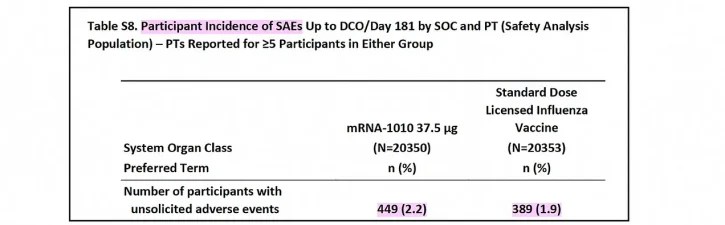
Yet in the briefing documents presented to the FDA’s advisory committee, VRBPAC, the agency characterised SAEs as “balanced.”

So how did the FDA make the SAE imbalance disappear?
Making serious adverse events disappear
The short answer is that the FDA used pooled data that obscured the safety signal.
Specifically, the agency relied on Moderna’s own “Integrated Safety Summary,” which combined data from four separate Phase III trials (P301, P302, P303 and P304), involving nearly 72,000 participants.
Once the pivotal trial P304 was combined with the other trials, the SAE rate became 3.1% in the mRNA group versus 2.9% in the comparator group—allowing the FDA to state that the rates were “balanced.”
Pooling data across clinical trials is common when regulators are looking for rare events. But the four trials Moderna pooled were very different in many aspects.
They tested different mRNA vaccine formulations against different flu vaccines—standard-dose and high-dose, quadrivalent and trivalent—across different age groups and countries, with follow-up ranging from six months to a year.
When these disparate trials were combined into a single analysis, the safety signal that stood out in the large pivotal trial was diluted.
The FDA accepted the approach—despite being aware of the problem.
In an appendix to its own briefing document, the FDA acknowledged that differences between the trials could produce safety variations “not fully captured by pooled analyses”—but proceeded anyway.
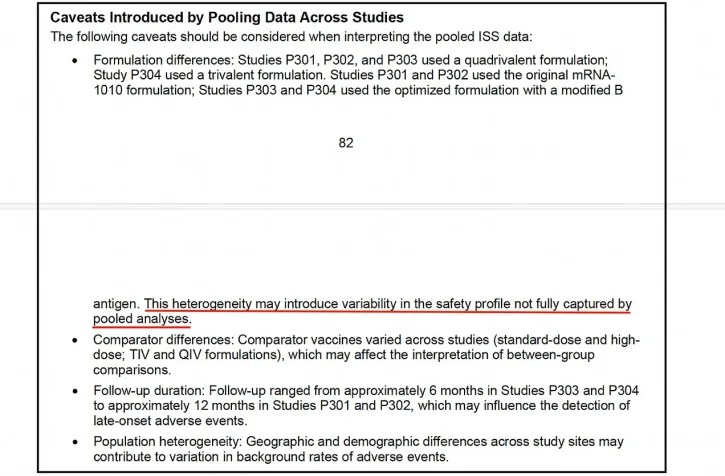
Table 6 of the FDA’s own review makes the switch even clearer (see below).
For the first 28 days after vaccination, when serious adverse events were still balanced between the groups, the agency reported safety results from the pivotal P304 trial alone (purple box).
But as more SAEs accumulated over the following months, a statistically significant imbalance emerged.
Instead of reporting those longer-term results from P304 in the same way, the FDA switched to Moderna’s pooled analysis (red box), where the signal was diluted enough for the agency to continue describing the rates as “balanced.”

The pooled analysis also obscured a concerning pattern in all-cause mortality.
In the pivotal trial P304, there were 40 deaths in the mRNA arm versus 34 in the comparator arm.
In the preceding trial P303, deaths were consistently higher across all three mRNA sub-studies:
- Sub-study 1 (mRNA vs Standard Trivalent): 5 deaths in the mRNA-1010 arm vs. 1 death in the comparator arm (5 vs 1).
- Sub-study 2 (mRNA vs High-Dose Trivalent): 3 deaths in the mRNA-1010 arm vs. 2 deaths in the comparator arm (3 vs 2).
- Sub-study 3 (mRNA vs Standard Quadrivalent): 3 deaths in the mRNA-1010 arm vs. 1 death in the comparator arm (3 vs 1).
Notably, in Sub-study 1, Moderna’s own trial investigators assessed one of the five deaths in the mRNA group as caused by the vaccine—the same product that has now been licensed.
Together, these numbers raise serious concerns about a possible excess in mortality in the mRNA groups—a pattern the FDA failed to highlight.
One rule for efficacy, another for safety
The FDA’s handling of efficacy reveals an even more striking double standard.
For efficacy, the agency relied strictly on study P304—the large pivotal trial testing the exact formulation submitted for licensure.
Earlier trials of Moderna’s vaccine had produced weaker efficacy results—and in at least one case, negative efficacy. Had the FDA pooled those trials for efficacy, the “26.6% efficacy” figure would almost certainly have been substantially lower.
But, as noted above, when the pivotal trial produced an unfavourable safety result, the FDA did the opposite—it pooled the data.
One approach maximised the efficacy. The other diluted the safety concerns.
Who is protecting the public?
On the surface, the FDA says Moderna’s flu mRNA vaccine is “safe and effective.”
Dig deeper, and the pivotal trial shows a statistically significant excess of participants experiencing SAEs.
Dig deeper still, and you discover the statistical trickery Moderna used—and the FDA accepted—to make the SAE signal disappear.
This brings us back to a fundamental question I have raised over years of reporting on regulatory failure.
When the FDA accepts the manufacturer’s trial design, adopts its data analyses, and rubber-stamps statistical methods that dilute a safety signal, who is actually protecting the public from harm?
Featured Video

Racist Seinfeld Dances for Joy as Bibi Unveils His New Map
or go to
Aletho News Archives – Video-Images
TV Drama Review
Japanese drama projects Japan’s wartime atrocities onto Chinese characters

Global Times | October 25, 2026
By portraying Chinese characters as perpetrators of ruthless violence while casting Japanese Self-Defense Forces (SDF) intelligence operatives as defenders, the season 2 of the Japanese drama Vivant has recently drawn criticism from Chinese netizens, who argue that its depiction turns historical reality on its head while ignoring Japan’s wartime atrocities.
The TBS drama series – a spy suspense story in which an alleged unofficial intelligence unit of the SDF operates across the globe — has attracted a passionate fanbase. Its currently airing season 2 opened with a household rating of 18.8 percent, the highest for a TV drama this year, according toa commentary article by Japanese media Toyo Keizai.
What draws attention is the portrayal of the enemies in the series, the article noted. Scenes in which the Chinese organization subjects kidnapped members of the SDF unit to brutal torture are repeated with unrelenting intensity.
It is rare for Japanese TV dramas to explicitly portray a real-life country as the enemy, the article noted.
Japanese Prime Minister Sanae Takaichi also made a reference to the drama, saying that she has been recording Vivant and hopes to binge-watch it over the year-end and New Year holidays, according to Japanese media outlets.
China’s CCTV News report on Sunday revealed that the drama features scenes in which Chinese personnel cut off the fingers of and stab Japanese intelligence operatives in the abdomen. Such acts bear striking similarities to the torture inflicted on Chinese nationals by invading Japanese troops during the World War II.
The drama distorts the truth by attributing these atrocities to modern Chinese characters. Beneath the surface, it subtly glorifies Japan’s cross-border overseas operations, blurs the functional boundaries of the SDF and implicitly promotes an expansionist narrative, per CCTV News. … continue
Blog Roll
 Aletho News
- EU facing trillion-euro debt hole while seeking more cash for Kiev
- How US, Europe, Persian Gulf states exhausted missile stockpiles, splurged billions to defend Israel
- Up in arms… Koreans reject U.S. empire’s plan to make South Korea the next Ukraine
- Iran, Turkey, Pakistan, Saudi Arabia could advance region-led security framework in Tehran: FM spox
- Netizens condemn Japanese drama for projecting Japan’s wartime atrocities onto Chinese characters
- Racist Seinfeld Dances for Joy as Bibi Unveils His New Map
- A West Bank War for Netanyahu’s Election Campaign, Could It Backfire?
- Yemen denounces European Parliament’s ‘hypocritical’ push to blacklist Ansarullah
- Qalibaf: UAE’s UN bid aims to ‘clear the runway’ for ‘Greater Israel’, whitewash genocide
- Pakistan reopens Iran border after boosting security: Report
- If Americans Knew
- An error has occurred; the feed is probably down. Try again later.
- No Tricks Zone
- Sudden Stratospheric Warming, Powerful El Niño Combination May Lead To Extreme Europe Cold, Energy Crisis!
- Two New Studies Find Thwaites Glacier Melt Cannot Be Driven By Human Activity Or A Warming Ocean
- E-Cars Reduce CO2 Emissions By Only 41% Compared To Internal Combustion Engine Vehicles
- Predictions Made By Renowned Climate Professor Over Past Decades Have Been Proven To Be Poor
- New Study Suggests Large Regions Of The Pacific Ocean Have Been Cooling For The Last 80 Years
- Germany’s Green Energy Debacle: High Energy Costs Force Kahla Porzellan to Close After 182 Years!
- New Study: 50 Years Of The Most Aggressive ‘Net Zero’ Policies Can Only Affect The Global Climate By 0.03°C
- US September “Heat” Was No Record…Many Records Set Decades Ago
- Latest European Green Energy Debacle; Portugal’s Largest Flagship Solar Park Insolvent!
- Green Energy Debacle: German Expert Professor Fritz Vahrenholt Warns Of Severe Economic And Social Consequences

