UK Sought Rendition of British Nationals to Guantánamo; Tony Blair Directly Involved
Andy Worthington – 15.7.10
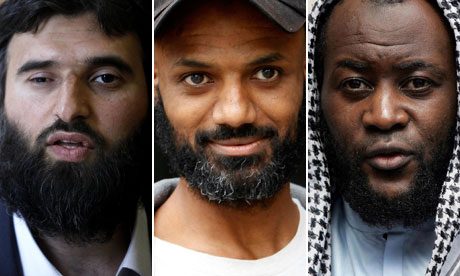 With what the Guardian described yesterday as the “almost unprecedented” release of “security service reports of interviews with detainees in Guantánamo Bay and other overseas detention centres,” the coalition government failed in its attempt to persuade the High Court to bring a temporary halt to a civil claim for damages filed by six former Guantánamo prisoners, unleashing, instead, a torrent of previously classified and deeply disturbing documents.
These reveal, shockingly, how the Labour government was happy for British nationals and residents seized in Afghanistan and Pakistan to be rendered to Guantánamo by the Bush administration, and how, in one case — that of Martin Mubanga, seized in Zambia — Tony Blair’s office intervened to prevent attempts by the Foreign and Commonwealth Office to have him returned to the UK, leading to his imprisonment in Guantánamo for two years and nine months.
In paving the way for its announced inquiry into British complicity in torture, the coalition government attempted, without success, to persuade the High Court that, as the Guardian put it, “proceedings should be delayed while attempts at mediation are made” before the inquiry begins. Critics had already expressed their fears that the calls for “mediation” were a smokescreen for compensation deals that would attempt to buy the former prisoners’ silence, so that the inquiry could proceed in secret without too many embarrassments.
Instead, however, the government’s intervention has precipitously kick-started the inquiry in a very public manner, after Tim Otty QC, counsel for five of the men, said that proceedings “should be allowed to continue because the documents that the government is beginning to disclose shed new light upon the role that the UK authorities played in the men’s mistreatment,” and the judge, Mr. Justice Silber, agreed.
One of the most shocking documents disclosed in the High Court proceedings was issued by the FCO on January 10, 2002, the day before Guantánamo opened. Entitled, “Afghanistan UK Detainees,” it described the government’s “preferred options” in dealing with British prisoners. “Transfer of United Kingdom nationals held to a United States base in Guantánamo is the best way to meet our counter-terrorism objectives, to ensure they are securely held,” the document explained, adding that the “only alternative” was to either hold these men in British custody in Afghanistan, or to return them to the UK.
In another shocking revelation, it was revealed that, in the case of Martin Mubanga, released documents “raise a number of troubling questions as to the role of the former Prime Minister’s office in frustrating the release of one of the claimants,” as Tim Otty described it, adding, “In the period of March and April 2002, the Prime Minister’s office apparently countermanded a desire on the part of the Foreign and Commonwealth Office to intervene on behalf on Mr. Mubanga.”
Mubanga, a joint British-Zambian national, had traveled from Pakistan to Zambia, where his sister lived, in February 2002, but had then been seized by the Zambian security services, and according to the documents released in court, the Prime Minister’s Office had intervened to ensure that he was not brought back to the UK. As a result, the FCO was put in a difficult position: if officials sought consular access, thereby acknowledging British responsibility for him, he would have been released to the UK authorities, directly contradicting the Prime Minister’s orders, which, as Reprieve noted yesterday, involved the Prime Minister “order[ing] the FCO to violate its international law obligations under the Vienna Convention, which requires the UK to provide consular assistance to British nationals around the world.”
At the time, an FCO document complained about “the schizophrenic way in which policy on this whole case was handled in London,” which had led to the British High Commission in Lusaka being placed “in an impossible position,” and in an email dated August 22, 2002, an FCO official, recognizing that “we broke our policy” because of direct interference from Tony Blair’s office, stated, “we are going to be open to charges of concealed extradition.”
According to Mubanga, after the British finished with him — apparently having tried and failed to recruit him as a spy — the US agent who had been dealing with him told him, “I’m sorry to have to tell you this, as I think you’re a decent guy, but in ten or 15 minutes we’re going to the airport and they’re taking you to Guantánamo Bay.”
In court, Tim Otty highlighted Tony Blair’s complicity in torture by pointing out that, by the spring of 2002, it was abundantly clear that there was a considerable risk that terror suspects in US control would be subjected to rendition and torture. “Despite that,” he told the court, “someone at Number 10 saw fit to counter what the Foreign Office wished to do.”
As the Guardian also explained yesterday, this was “not the only time the Prime Minister’s Office intervened to thwart attempts by Foreign Office officials to obtain a degree of protection for British citizens.” Minutes prepared for the Home Office Terrorism and Protection Unit after a meeting in April 2002 state that the US authorities “had been informed that the British government might begin making public requests for legal access to British men held at Guantánamo.” According to the minutes, “FCO had wanted to do this (and wanted to be seen to be doing it) but had been overruled by No. 10.”
The released documents also highlight the leading role played by Jack Straw, then the foreign secretary, in shaping the policies that led to the interrogations of British prisoners in US custody in Afghanistan, prior to their transfer to Guantánamo. As the Guardian explained, in mid-January 2002, Straw sent a telegram to several British diplomatic missions around the world in which he “signaled his agreement” with the Guantánamo policy, “but made clear that he did not wish to see the British nationals moved from Afghanistan before they could be interrogated.” In the telegram, he wrote:
A specialist team is currently in Afghanistan seeking to interview any detainees with a UK connection to obtain information on their terrorist activities and connections. We therefore hope that all those detainees they wish to interview will remain in Afghanistan and will not be among the first groups to be transferred to Guantánamo. A week’s delay should suffice. UK nationals should be transferred as soon as possible thereafter.
One of these “detainees” was Shaker Aamer, the last British resident still held in Guantánamo, and as a court heard in December last year, leading to the launch of a Metropolitan Police investigation, Mr. Aamer has claimed that British agents were present in the room, in the US prison at Kandahar airbase in Afghanistan, when he was subjected to abusive treatment by Americans.
Other interrogations revealed in the documents include those involving Omar Deghayes, seized from a house in Lahore in May 2002, who was treated disdainfully by the British agents who visited him, and an unidentified prisoner held in Kabul, under the heading, “Warriors 14/1,” about whom the agents involved noted only, “Interview conditions: cold beaten up.”
Extraordinarily, these documents are only the tip of a very murky iceberg, and it is unclear at present how many more will be publicly revealed. As has been previously reported, the government has identified up to 500,000 documents that may be relevant to the former prisoners’ claim for damages, and, according to the Guardian, “says it has deployed 60 lawyers to scrutinize them, a process that it suggests could take until the end of the decade.” In this first batch, “just 900 papers have been disclosed, and these have included batches of press cuttings and copies of government reports that were published several years ago,” but as they also include these damning insights into the activities of Tony Blair, Jack Straw and the agents who interrogated British prisoners in appalling conditions, it is surely inconceivable that the government will now be able to conduct a secret inquiry into British complicity in torture, and must, instead, order a full and open inquiry.
This could take place under the Inquiries Act of 2005, like the Baha Mousa inquiry (into the murder, in British custody, of a hotel clerk in Iraq), which, as Reprieve noted when David Cameron announced the torture inquiry two weeks ago, was held under the Act and has been “a model of an inquiry functioning efficiently, including the hearing of secret evidence,” and has also allowed for document classification review proceedings that “are sophisticated and rightly allow the judge to balance the need for national security against the need for transparency.”
The time for silence, and the time for secrecy are over. To clear the air, and to draw a line under this most lamentable period in our recent history, we need an inquiry presided over by someone who is able to “balance the need for national security against the need for transparency.” For too long now — and with baleful results — the need for national security has been allowed to override everything else, inflicting grave damage on our claims to be a civilized country, and leading to devastating effects for those caught up in a “War on Terror” with few checks and balances.
De-classified Vietnam-era Transcripts Show Senators Knew Gulf Of Tonkin Was A Staged False Flag Event
Elected Reps. chose to hide details from American public for fear of reprisals from “the big forces” that run the media and the presidency
Steve Watson | Infowars.com | July 15th, 2010
 Over 1,100 pages of previously classified Vietnam-era transcripts released this week by the Senate Foreign Relations Committee highlight the fact that several Senators knew that the White House and the Pentagon had deceived the American people over the 1964 Gulf of Tonkin incident.
The latest releases, which document skepticism over the pretext for entry into the Vietnam war, date from 1968.
Four years into the war, senators were at loggerheads with Lyndon B. Johnson. At the time Foreign Relations Committee meetings were held behind closed doors.
It would take over thirty years for the truth to emerge that the Aug. 4, 1964 Gulf of Tonkin incident, where US warships were apparently attacked by North Vietnamese PT Boats – an incident that kicked off US involvement in the Vietnam war – was a staged event that never actually took place.
However, the records now show that at the time senators knew this was the case.
In a March 1968 closed session of the Foreign Relations Committee, Senator Albert Gore Sr. of Tennessee, the father of former vice president Al Gore, noted:
“If this country has been misled, if this committee, this Congress, has been misled by pretext into a war in which thousands of young men have died, and many more thousands have been crippled for life, and out of which their country has lost prestige, moral position in the world, the consequences are very great,”
Senator Frank Church, Democrat of Idaho, said in an executive session in February 1968:
“In a democracy you cannot expect the people, whose sons are being killed and who will be killed, to exercise their judgment if the truth is concealed from them,”
Other senators were keen to withhold the truth about Tonkin in order not to inflame public opinion on the war:
Senator Mike Mansfield, Democrat of Montana, stated, “You will give people who are not interested in facts a chance to exploit them and to magnify them out of all proportion.”
Mansfield was referring to the proposed release of a committee staff investigation that raised doubts over whether the Tonkin incident ever took place.
The committee decided in the end to effectively conceal the truth, with Senator Church noting that if the committee came up with proof that an attack never occurred, “we have a case that will discredit the military in the United States, and discredit and quite possibly destroy the president.”
He also noted that if the senators were to follow up on their skepticism over Tonkin, “The big forces in this country that have most of the influence and run most of the newspapers and are oriented toward the presidency will lose no opportunity to thoroughly discredit this committee.”
The LBJ Presidential tapes, declassified and released in 2001, prove that LBJ knew the Tonkin incident never happened. After dressing down his Defence Secretary Robert McNamara for misleading him, Johnson then discussed how to politically spin the non-event and escalate it as justification for air strikes.
“You just came in a few weeks ago and said they’re launching an attack on us – they’re firing at us,” Johnson tells McNamara in one conversation, “and we got through with the firing and concluded maybe they hadn’t fired at all.”
The NSA also deliberately faked intelligence data to make it appear as if two US ships had been lost in the “attack”.
Johnson used the 1964 false flag event to expand dramatically the scale of the Vietnam War by ushering in the Gulf of Tonkin Resolution, as well as to rope in much needed domestic support with the Congress and public.
Perhaps if the Foreign Relations Committee hadn’t been so afraid of “the big forces” controlling America, a large percentage of the almost 60,000 American soldiers and 2 million Vietnamese people wouldn’t have lost their lives.
Sadly, modern day elected representatives have failed the American people in exactly the same way over the wars in Afghanistan and Iraq.
Bank of America Gets Away With Huge Swindle
By DAVE LINDORFF | July 15, 2010
If you want to avoid facing a tough prosecution for malfeasance, be a banker, not a biker.
That appears to be the lesson of Saturday’s front page of the Wall Street Journal, where the lead story was about how Bank of America repeatedly hid its massive bad debt holdings from regulators and investors through a creative accounting device called “repurchase agreements,” and the second story, just above the fold, was about how US Food and Drug Administration prosecutors are “Casting a Wider Net” investigating the use of steroids by competitive cyclists.
According to the BofA story, the bank, during a Securities and Exchange Commission investigation into the real financial condition of the nation’s biggest financial institutions, admitted that at the ends of all the quarterly reporting periods from 2007 through 2009, it had used repurchase agreements, or “repos,” to temporarily shed bad debt before drawing up and releasing its required public filings. That is to say, it managed to lie about and hide from view its weakened liquidity position all through the financial crisis.
Astonishingly, the Wall Street Journal article reports that this practice, known euphemistically in financial industry parlance as “window dressing,” is “not illegal in itself,” unless it is done with the intent of misleading investors. The article is quick to note that “Bof A said its incorrect accounting wasn’t intentional.” (The newspaper didn’t go to the SEC or to any independent source such as an academic expert or lawyer for comment on this laughable whopper.)
BofA, every three months, was transferring mortgage-backed securities briefly to a trading partner in return for a simultaneous agreement to repurchase similar securities from the same partner, once the required SEC filing had been shipped out in the mail. As the Wall Street Journal’s reporter Michael Rapoport writes, “The practice amounts to a bank renting out its balance sheet for short periods; the bank gets fees, and the client on the other end of the trade gets short-time cash.”
If this kind of thing is not deliberate fraud I don’t know what is, and yet the bank, in its statement to the Wall Street Journal, claims the “effort to manage its balance sheet” was “appropriate,” and that the intent behind the shell game was not to mislead investors or regulators, but rather was “to reduce the specific business unit’s balance sheet to meet its internal quarter-end limits for balance sheet capacity.”
How’s that for financial mumbo jumbo?
It would be interesting to see how well an ordinary citizen would fare, if he or she used a “repo” type strategy to hide half his or her income from the IRS (the equivalent scam might involve “donating” half of one’s income on December 31 of the tax year to an accommodating charity, and then taking the money back on January 1 of the next year), and then claimed that the fraud was “not intentional.”
But hey, it works for the banks. The article goes on to report that, “Apart from requiring more disclosure about its repo accounting, the SEC hasn’t taken any action against BofA over the matter. The fact that the [BofA] letter [to the SEC] was released suggests the SEC has concluded its review.”
Meanwhile, even as BofA and other financial behemoths get away with accounting murder, and are held harmless after their crooked dealings brought the US and the global economies to their knees, we’re informed that FDA legal bloodhounds are doggedly stepping up their investigation into illegal steroid use by US cyclists involved in the current Tour de France bicycle competition. The FDA is reportedly hoping to get some participants to turn in competitors who are using illegal substances to enhance their physical performance.
In this fishing expedition, the FDA, according to this second Wall Street Journal article by Reed Albergotti and Vanessa O’Connell, is not out to prosecute rank-and-file riders, but rather wants to bring charges against “any team leaders and team directors who may have vacillated or encouraged doping by their riders.”
Clearly, it is viewed by the US government as being critically important that the sport of cycling be kept clean of drugs, so that the Americans who watch the race from the comfort of their sofas and barcaloungers will know that the winners really deserved to win. But it clearly is not very important for Americans to know whether the bank where they put their hard-earned savings, or in whose artificially inflated stock they have invested their IRA or 401)(k) retirement funds, is cooking its books.
It is apparently critically important to know that those who encourage the use of performance enhancing drugs, thus undermining the confidence of America’s sports viewers in the validity of their viewing experience, will be prosecuted to the full extent of the law. It is apparently not that important at all that the people who caused a financial collapse that has pushed real unemployment and underemployment in the US up to close to 20 percent, collapsed the housing market, and put school districts, town and state governments on the brink of bankruptcy, be called to account, made to do jail time, or to perform community service.
The absurdity of this juxtaposition is made all the more clear by the fact that the FDA isn’t even able to come up with a significant charge to bring against the alleged dopers in its intensifying investigation of the cycling sport. As the Journal notes, “Federal investigators are exploring several avenues,” for possible prosecution, including “whether teams defrauded sponsors by failing to race cleanly,” or whether US Tour de France multiple winner Lance Armstrong’s US Postal Service team might have “misused federal funds.”
It’s the old story: steal a loaf of bread for a family and go to jail for years. Deceive national regulatory authorities and steal from a generation of pension investors and get a Troubled Asset Relief Program handout of billions of dollars in taxpayer funds.
An Iranian nuclear espionage mystery
By Paul Woodward on July 14, 2010
The CIA has lost one of its most valued former spies.
Iranian nuclear scientist Shahram Amiri, who defected to the US, is now on his way back home to Tehran after a very messy and public re-defection. ABC News obtained exclusive photos of Amiri leaving Washington’s Dulles International Airport late Tuesday night on a commercial flight to Doha, Qatar, en route to Iran.
Amiri was escorted directly to the jetway entrance by a security officer. He was flanked by what appeared to be a U.S. official and a representative from the Pakistani Embassy in Washington. He boarded the Qatar Airways flight ahead of the other passengers, and spoke only to his companions. After more than a year in the US, Amiri claimed he had never really defected. In a series of videos released on the internet, he insisted that he had been kidnapped, drugged and tortured by the CIA. The US flatly denies that it ever held Amiri against his will.
The Washington Post columnist and unofficial spokesman for the CIA, David Ignatius, attributes Amiri’s departure to a change of heart.
The CIA has struggled for decades with how to handle defectors better so that they are happy in a strange new land. The agency periodically tries to improve its tradecraft in working with these skittish guests. But defectors are trouble. They are like small boats in a heavy sea, not sure which way is home.
But Ignatius concedes that it is hard to understand why the Iranian scientist would have defected while leaving his wife and child behind. That detail, along with the deaths of Ardeshire Hassanpour and Masoud Alimohammadi, might seem to reinforce the claim that Amiri was in fact abducted and that all three cases be seen in the context of a US-backed, Israeli-led covert war targeting Iran’s nuclear programme.
What seems more likely however, is that the Iranians took the CIA for a ride — that Amiri’s “defection” took place so that Iran could glean more about the extent of American knowledge about its nuclear program and that the information he gathered was more valuable than the information he gave away.
Abducted Iranian at Iran’s office in US
Press TV – July 13, 2010
Iranian academic Shahram Amiri, who was abducted by the US last year, has been escorted by American forces to Iran’s interest section in Washington.
IRIB reported on Tuesday that Amiri took refuge in Iran’s interest section in Washington, urging an “immediate return” to Iran.
The Pakistani Embassy in Washington preserves Iran’s interests in the United States, since the two countries have no diplomatic relations.
In collaboration with Saudi forces, US security forces kidnapped Amiri while he was on a pilgrimage in Saudi Arabia in June 2009 and took him to America. Since then, two videos and one audio message featuring him have emerged.
In the first video, Amiri said that he was abducted “in a joint operation by terror and kidnap teams from the US intelligence service, CIA (Central Intelligence Agency) and Saudi Arabia’s Istikhbarat” from Medina.
In the second video, he contradicted his earlier statements, saying that he was in the US of his own free will to further his education, dismissing all rumors about his defection.
However, in the latest audio message obtained by Iran’s intelligence sources, Amiri insists that he was offered $10 million to appear on CNN and announce that he had willingly defected to the US.
Holding the US accountable for Amiri’s abduction, the Iranian Foreign Ministry summoned the Swiss charge d’affaires, whose embassy represents US interests in Iran, earlier this month and handed over new documents related to the abduction of the Iranian national by the CIA.
Analysts say US intelligence officials decided to free Amiri after they failed to advance their propaganda campaign against Iran’s nuclear program via fabricating interviews with the Iranian national.
Info commissioner finds saintly CRU crew guilty
By Andrew Orlowski • The Register • 8th July 2010
Climatic Research Unit director Phil Jones was being whisked back to his desk at the University of East Anglia by the University’s Russell enquiry yesterday.
But with exquisite timing, the Information Commissioner’s office chose the same day to confirm that CRU had twice broken the Freedom of Information regulations – once by ignoring the request, and twice by refusing the actual data. The breaches carry a civil penalty.
More is to come, as this was one of four complaints by David Holland under consideration by the ICO, which adjudicates on both FOI requests and EIRs, or Environmental Information Regulations. Other bodies include the Department of Energy and Climate Change (DECC) and the Met Office.
Bodies involved in the IPCC’s procedures are obliged to “ensure that the assessment was undertaken on a comprehensive objective open and transparent basis; … ensure that all written expert and government review comments were retained in an open archive for a period of at least 5 years, and ensure that Review Editors who supervised the assessment submitted a ‘written report’ – by the IPCC’s own rules.
The Met Office initially responded to Holland by claiming that it had destroyed the data – it had kept no working papers and no correspondence. Then the Met changed its excuse. It said it hadn’t destroyed the data – but that its Director of Climate Science John Mitchell OBE (who has since left the Met) was conducting his work as Review Editor for the IPCC in a personal capacity, and so it wouldn’t say what he was doing.
When it emerged that the taxpayer had paid for Mitchell to perform his work for the IPCC (the Met even met his expenses), the excuse for refusal changed once more, claming it wasn’t in the public interest.
Holland tried again, under EIR Regulation 11, hoping for a speedier result than the prevarication with which public bodies meet FOI requests. Under FOI they can stall until they are no longer obliged to disclose the information. CRU refused to provide the reviewers’ comments outright.
The Met stalled, at first refusing to consider the request under EIR rules, then claiming a loophole, regulation 2(1) that “These archiving and contribution procedures, instructions and correspondence are administrative information and not environmental information”
The UEA claimed the same loophole as the Met. In yesterday’s ruling, the ICO reminded UEA that the 2(1) could not be interpreted so narrowly, and that public bodies had to interpret it as widely as possible. His notes are here.
The damning archive of emails, source code and station data was called FOIA.ZIP, and is believed to have been to have been compiled by an insider.
In January, the ICO said it had prima facie evidence that CRU academics had broken the law – repeatedly promising to evade requests and asking colleagues to remove data that Holland had requested. The evasion began in 2005, long before the trickle of polite requests became a deluge last year. In one case, Jones even requested Briffa to delete data the very day after one of Holland’s requests.
Remarkably, the Russell inquiry did not ask Jones whether he deleted any email. Russell’s report cites two of the most damning deletion requests, then declares: “There seems clear incitement to delete emails, although we have seen no evidence of any attempt to delete information in respect of a request already made.”
One of the inquiry team, Lancet editor Richard Horton declared in a newspaper article that this would be the “final inquiry”. He’s either being hasty, or optimistic. MP Graham Stringer described the Russell inquiry as inadequate and called for Parliament to re-open an investigation.
®
Bad News For Holland
By Steve Goddard | July 12, 2010
The World Cup was bad news for Holland, but that isn’t what I am talking about.
The world’s preeminent climatologist Dr. James Hansen (who is well known for quiet understatement) has forecast that Holland will drown in the next century. Looks like East Anglia is doomed too. Is that a bad thing?

If that isn’t bad enough, NASA’s Cape Canaveral, Key West, and Miami are toast!

Dr. Hansen says :
I find it almost inconceivable that “business as usual” climate change will not result in a rise in sea level measured in metres within a century.
According to the University of Colorado, sea level has been rising at 3.2 mm/yr since 1994, and has generally been slowing down over the last five years (except for the El Niño spike.)

http://sealevel.colorado.edu/current/sl_noib_global_sm.jpg
That means it will only take 312 years to rise one metre. Which is not far off from what it has been doing for the last century.

It is imperative that we make plans to protect Holland. First step is to hire Hansen to put his finger in the dike. Second step is to teach their strikers how to kick the ball somewhere besides straight to the goalkeeper.
At least they didn’t lose a penalty shootout this year.
Amazongate: At last we reach the source
By Christopher Booker | The Telegraph | July 10, 2010
Last week, after six months of evasions, obfuscation, denials and retractions, a story which has preoccupied this column on and off since January came to a startling conclusion. It turns out that one of the most widely publicised statements in the 2007 report of the UN’s Intergovernmental Panel on Climate Change – a claim on which tens of billions of dollars could hang – was not based on peer-reviewed science, as repeatedly claimed, but originated solely from anonymous propaganda published on the website of a small Brazilian environmental advocacy group.
The ramifications of this discovery stretch in many directions. First, it seems to show that the IPCC – whose reports governments rely on to justify presenting mankind with the largest bill in history – has been in serious breach of its own rules.
Second, it raises hefty question marks over the credibility of the world’s richest and most powerful environmental pressure group, the WWF, credited by the IPCC as the source of its unsupported claim.
And third, it focuses attention once more on a bizarre scheme, backed by the UN and promoted by the World Bank, whereby the WWF has been hoping to share in profits estimated at $60 billion, paid for by firms all over the developed world.
“Amazongate”, it may be recalled, was one of the rash of scandals which rocked the authority of the IPCC last winter, when it was revealed that many of the more alarmist statements in its 2007 report originated not from peer-reviewed science but from papers written by environmental pressure groups. One which aroused particular controversy was a warning that climate change was putting at risk up to 40 per cent of the Amazon rainforest. Chapter 13 of the IPCC’s Working Group II report on “climate impacts” specifically claimed that “up to 40 per cent of the Amazonian forests could react drastically to even a slight reduction in precipitation”. It went on to say that this would cause such chaos in local climate systems that the forest could rapidly revert to savannah.
The only source cited for this claim was the Global Review of Forest Fires, a paper written for WWF and the International Union for Conservation of Nature in 2000, the lead author of which was an environmental activist and freelance journalist. This in turn appeared to cite a paper published in 1999 by a team led by Dr Daniel Nepstad, “senior scientist” with another advocacy group closely linked to the WWF, the Woods Hole Research Center. However, Nepstad’s paper was primarily concerned not with climate change but with the impact of logging and fires.
When this created a storm last January, the WWF quickly issued a “clarification”, stating that its own paper “does not say that 40 per cent of the Amazon forest is at risk from climate change”. But it went on to say that the real source of the claim quoted by the IPCC was a document, Fire in the Amazon, published by the “respected Instituto de Pesquiza Ambiental da Amazonia (IPAM)”. Headed by Nepstad, IPAM is a Brazilian advocacy group, also closely linked with the Woods Hole Research Center.
The document cited by the WWF, which it later described, after a full internal inquiry, as a “report”, proved remarkably difficult to track down. Since then, both the WWF and Dr Nepstad have cited other papers in support of their claim – but none of these provided any support for the specific claim about the impact of climate change made by the IPCC.
Only now, after I was able to confront them with evidence from an internet archive, has the WWF finally admitted the precise origin of the IPCC’s much-quoted claim. Fire in the Amazon, it turns out, was not a “report” or a scientific paper but, as the WWF now acknowledges, a “text published by IPAM… on its website in 1999”. It was merely a brief, anonymous and unreferenced note on the exposure of the forest to fire risks, posted in February 1999 and taken down four years later. Here, at last, is the sole source for the statement later published by the IPCC.
The original read: “Probably 30-40 per cent of the forests of the Brazilian Amazon are sensitive to small reductions in the amount of rainfall.” This was hyped up in the final drafting of the IPCC report, to claim that “up to 40 per cent of the Amazonian forests could react drastically to even a slight reduction in precipitation”. “Brazilian Amazon” – only around half the total rainforest area – was changed to include the entire forest. The word “sensitive” was changed to “react drastically”. And the original IPAM note had made no mention at all of climate change.
To begin with, this would seem to justify a formal complaint to the IPCC that it was acting in breach of its own rules. Annex 2 of its rules of procedure lays down that non-peer-reviewed material should only be cited when it has been subjected to rigorous critical appraisal and that “each chapter team should review the quality and validity of each source before including results from the source into an IPCC report”.
Last week I put it to the IPCC that it should at least acknowledge this blatant breach of its rules and withdraw the passage, as it did last winter when it was revealed that it had no scientific basis for claiming that Himalayan glaciers could disappear by 2035. To date I have had no reply.
Neither WWF nor Woods Hole come well out of this story. In seeking to justify their part in the IPCC’s statement, they have cited other studies which they claim support it – but neither, until now, has been honest enough to admit that it was based on an unsubstantiated website claim.
This curious episode may also point to another reason why WWF and Woods Hole have been so active in recent years to promote concern over the danger of global warming for the Amazon rainforest. As I revealed here on March 20, they have been closely allied in support of a scheme known as REDD (Reduction in Emissions from Deforestation and Degradation of Tropical Forests). Its aim is to turn the CO2 in forest trees into “carbon credits”, saleable on the world market to allow firms to continue emitting CO2. Backed by $80 million from the World Bank, WWF, Woods Hole and IPAM are partners in a consortium, supported by the Brazilian government, to protect and manage a vast area of forest in the Tumucumaque region, in return for which they would have the right to sell its carbon credits. In 2007 Dr Nepstad published a formula which would allow the carbon contained in the entire forest to be valued at $60 billion.
Although the REDD scheme was approved in principle at December’s UN Copenhagen conference, two serious snags remain. First, it has yet to be approved in detail (although they still hope to achieve this in Cancun later this year). Second, the US Senate still hasn’t passed its cap and trade bill, which would open up a lucrative new market for anyone involved in carbon trading, such as those with a stake in REDD.
Finally, we may recall, another newspaper recently published a prominent “correction” to its earlier report on Amazongate – accepting that “the IPCC’s Amazon statement is supported by peer-reviewed scientific evidence” and that this was “based on research by the respected IPAM which did relate to the impact of climate change”. Since neither of these statements seems to be true, perhaps we can look forward to a retraction of the retraction?
Equally unhappy may be all those global warming enthusiasts who took this climbdown as licence to crow shamelessly over those of us who, last January, helped to expose Amazongate as a major IPCC system failure. The IPCC, they chorused, had been totally vindicated, the climate change sceptics had been utterly routed. Today, I fear, it is they who have been put to rout and we who have been vindicated.
Noam Chomsky opposes Palestinian-led movement to boycott Israel
By Alison Weir – July 10, 2010
In an interview on the Council for the National Interest internet radio program “Jerusalem Calling,” MIT Professor Noam Chomsky, author of The Fateful Triangle and other books on Israel-Palestine, said that he opposes boycotting Israel.
In a July 8th interview with new CNI President Alison Weir, Dr. Chomsky at first denied that he opposed the boycott, divestment, and sanctions movement, calling this an “internet rumor.”
However, when Weir said she had heard him say that he opposed boycott during a lecture at the University of California Berkeley several years ago, Chomsky admitted that he had opposed boycotting Israel then and said that he still did so now. He said that he felt that activists should instead only divest from American companies.
Chomsky claimed that the boycott movement “hurts Palestinians,” because he felt it was “hypocritical to boycott Israel and not the US, which funds Israeli actions.” Weir pointed out that many authors – among them Donald Neff, George Ball, Stephen Green, Kathleen Christison, Edward Tivnan, Walt and Mearsheimer, and, most recently, Grant Smith – have provided massive evidence that the primary reason the U.S. supports Israel is the Israel Lobby (the most powerful lobby for a foreign country in the US).
Chomsky, who has consistently denied the power of the Israel Lobby, said that AIPAC (the American Israel Public Affairs Committee) would use the charge that the Palestinian support movement is allegedly “hypocritcal” to undermine its effectiveness, and that therefore this boycott would be harmful to Palestinians. While this statement appeared to indicate that Chomsky now acknowledges the power and significance of the Israel lobby, later in the interview he continued to deny the importance of this lobby.
In response to Chomsky’s assertion that the boycott movement allegedly hurts Palestinians, Weir pointed out that Palestinian civil society overwhelmingly calls for such a boycott. She said that over a hundred different Palestinian groups – including farmers’ groups, women’s groups, and others – have asked for an international boycott of Israel.
A caller to the show, long-time Middle East analyst Jeffrey Blankfort, commented that he felt it was highly inappropriate and condescending for Chomsky, a Jewish-American who had lived on a Kibbutz and says that he supports Israel, to tell Palestinians what’s good for them.
During the interview, Chomsky said that he has long favored a binational state. He said that he felt that the call for a “single, secular, democratic state” did not make much sense, suggesting that calls for one state were “rhetorical” and did not “rise to the state of advocacy” because proponents had not sketched out a path of how to get there. He did not comment on the books on this subject by Ali Abunimah and Virginia Tilley, which advance detailed discussion on this approach.
Because technical problems caused occasional problems during the program, Weir, who is also executive director of If Americans Knew, has invited Chomsky to come on the show again so that he may explain his position further. Chomsky accepted the invitation and will appear again in a few months when his schedule permits.
The interview, in which Chomsky also discusses other aspects of the Israel-Palestinian conflict, can be heard in full on the CNI: Jerusalem Calling section of the WS Radio website. Outgoing CNI President Eugene Bird says that CNI will post a transcript on the CNI website within a few days.
US Professors Raise Doubts About Report on South Korean Ship Sinking
Akiko Fujita | VOA | July 9, 2010
A new study by U.S. researchers raises questions about the investigation into the sinking of a South Korean navy ship. International investigators blamed a North Korean torpedo, raising tensions on the Korean peninsula.
Researchers J.J. Suh and Seung-Hun Lee say the South Korean Joint Investigation Group made a weak case when it concluded that North Korea was responsible for sinking the Cheonan.
Speaking in Tokyo Friday, the two said the investigation was riddled with inconsistencies and cast “profound doubt” on the integrity of the investigation. “The only conclusion one can draw on the basis of the evidence is that there was no outside explosion,” Suh said. “The JIG completely failed to produce evidence that backs up its claims that there was an outside explosion.”
Suh is an associate professor in international relations at Johns Hopkins University in the United States, where he runs the Korean studies program.
International investigators said in May that an external explosion caused the South Korean ship to sink last March, killing 46 sailors. The report said a North Korean-made torpedo caused the explosion.
Suh and Lee [say] the cracked portion of the bottom of the ship does not show the signs of a large shock that are usually associated with outside explosions. They add that all the ship’s internal parts remained intact and few fragments were recovered outside the ship.
“Almost all parts and fragments should’ve been recovered within about three to six meters within where the torpedo part was discovered,” Lee says, “The fact that only the propeller and the propulsion part was discovered doesn’t make any sense to me.”
Lee is a professor of physics at the University of Virginia in the United States. Lee also points to a blue mark on a fragment of the torpedo to question the validity of the study. South Korean scientists say that part of the torpedo was marked “number one” in Korean, with a blue marker.
Suh and Lee say the writing would not have survived the intense heat of an explosion. “This can not be taken as evidence. Because any Korean, North and South, can write this mark,” Suh said. “Also, it does not make sense that this blue ink mark could survive so freshly when the paint all around was all burned at the explosion.”
Both researchers say their findings do not prove that North Korea did not sink the Cheonan. But they say it is irresponsible for the South Korean government to reach its conclusions based on an inconclusive study.
They are calling for a new international investigation to re-examine the Cheonan’s sinking. They also want the United Nations Security Council to pressure the South Korean government and request an “objective and scientific” report before the council deliberates on the incident.
Climategate report: CRU enquiry
By Andrew Orlowski • The Register • 7th July 2010
The University of East Anglia’s enquiry into the conduct of its own staff at its Climatic Research Unit has highlighted criticisms of the department and staff conduct – but clears the path for the individuals concerned to carry on.
The CRU played an important role in writing the UN’s IPCC summaries on climate science, so the issue is far from a parochial one. The most serious charge is poor communication; Sir Muir Russell even calls for “a concerted and sustained campaign to win hearts and minds” to restore confidence in the team’s work.
Russell was appointed by the institution to investigate an archive of source code and emails that leaked onto the internet last November. The source code is not addressed at all. His report suggests that the problems were of the academics’ own making, stating that they were “united in defence against criticism”. Yet the enquiry found that despite emails promising to “redefine” the peer review publication process, and put pressure on journal editors, staff were not guilty of subverting the IPCC process, and their “rigour” and “honesty” were beyond question.
Leading academics were called for written and oral evidence before the Russell enquiry, and in many cases the report accepts their account of events. The subjects of their criticism were not invited, not were climate scientists critical of their behaviour. For example, in their capacity as IPCC gatekeepers, the academics are cleared of excluding critical evidence, and yet bending the rules to include supporting studies. To reach this particular conclusion, for example, the report finds a criterion: a “consistence of view” with earlier work. The earlier work here was in fact produced the academics under scrutiny. So, having compared the CRU academics’ work against their previous work, and found it to be consistent, they are cleared of malpractice.
Despite the gentlemanly and clubbable tone, the report nevertheless has deep systemic criticism of the institution and the team’s processes. UEA “fell badly short of its scientific and public obligations”, according to one review panel member, Lancet editor Richard Horton.
It criticises the team’s decision to curtail a temperature reconstruction at 1960, and splice on an instrumental temperature record, without explanation, noting:
“The figure supplied for the WMO Report was misleading in not describing that one of the series was truncated post 1960 for the figure, and in not being clear on the fact that proxy and instrumental data were spliced together. We do not find that it is misleading to curtail reconstructions at some point per se, or to splice data.”
There’s a selective approach to criticism of scientific techniques – officially, Muir Russell says it doesn’t examine the validity of scientific arguments. But as you can see, in places, it does. On the issue of the Yamal reconstruction, CRU is cleared but the related issues of basing the reconstruction on a limited sample of proxies, and using techniques which exaggerate and validate outliers (basically, one tree) is not addressed.
FOIA
On compliance with Freedom of Information requests, the inquiry found the CRU team evasive, and “found a tendency to answer the wrong question or to give a partial answer”. They also found “a clear incitement to delete e-mails, although we have seen no evidence of any attempt to delete information in respect of a request already made”. (Jones had told a US academic that “I think I’ll delete the file rather than send to anyone” and requesting deletions from other staff.)
The defensiveness “set the stage”, says Russell, for the barrage of FOIA requests last year, but “clear and early action would likely have prevented much subsequent grief”. It adds that “CRU helped create the conditions for this campaign by being unhelpful in its earlier responses”.
The institution itself had failed to anticipate the new FOIA regime, and let the academics run amok. Strangely it calls for “a concerted and sustained campaign to win hearts and minds” to restore confidence.
On information handling, the report “highlighted significant problems in the areas of: imbalance of authority; lack of effective challenge at appeal; over dependence on single individuals; inadequate escalation processes and limited strategic oversight.”
The panel avoided examining the scientific work of the CRU Team – as have the two other reviews of the leaked archive by Lord Oxburgh, and the Commons Select Committee on science. If the academics had used bats’ wings or tea leaves to create temperature reconstructions, that wasn’t a matter for any of the panels to judge. And this is undoubtedly a shortcoming. The voter is entitled to see the evidence and understand the arguments that may answer the question: “Is this climate thing anything to worry about?”
It’s worth taking a step back from the details of Climategate to understand the background to the enquiries. By understanding what the CRU academics do, we can judge how important the criticism of them may be – or not.
What did the CRU crew do?
The Climatic Research Unit is one part of the picture, an important one, but not at the heart of climate theory. They’re not physicists, and they don’t do the physics upon which competing explanations of how the climate works stand or fall, once measured against observation. So in that sense, ‘Climategate’ isn’t a ‘Climategate’ – it isn’t a Scopes Trial of the global warming theory.
But CRU does two important things that shape our understanding of the present and the past. CRU is one of a small number of bodies that calculates global temperature readings (of where we are today), and is probably the pre-eminent body that performs historical temperature reconstructions, quite literally writing or re-writing history. And its importance is magnified since the leading academics are also lead authors of the UN’s IPCC reports – the vast volumes policy makers like to cite as their scientific justification, but rarely read.
In the absence of a strong physics story, this temperature work became hotly contested. The biggest bone of contention is whether modern, post-1850 warming is anomalous. If it is, then the likelihood that we were in strange and uncharted territory is much greater. If it isn’t, then consequently, the need for “urgent political action” – involving sweeping changes to industrial policy and social policy – became weaker.
The father of modern climatology, HH Lamb, founded CRU in 1972, and the building the academics work in takes his name. When Lamb contributed to the first IPCC report in 1990 the historical temperature record looked like this.
 Lamb’s temperature graph, featured in the first IPCC report in 1990
By 2001, it looked like this.
 Without the error bars (grey), the Medieval Warm Period disappears Source: IPCC TAR 2001
What Climategate is largely about, then, is whether the academics were justified in making that Medieval Warm Period disappear.
Unfortunately, none of the three ‘independent’ reviews have grappled with this. The absence of anomalous warming doesn’t, as some skeptics say, make the problem go away. But it takes the issue back onto the blackboard, back into realms of the potential threats. It certainly removes much of the impetus for a sweeping and urgent political program of mitigation.
Yet in the academics’ own words, we learn that the recent burst of warming, while real, is far from unusual.
One of the leading CRU academics, Keith Briffa, wrote that:
“I know there is pressure to present a nice tidy story as regards ‘apparent unprecedented warming in a thousand years or more in the proxy data’ but in reality the situation is not quite so simple. We don’t have a lot of proxies that come right up to date and those that do (at least a significant number of tree proxies ) some unexpected changes in response that do not match the recent warming. I do not think it wise that this issue be ignored in the chapter…
“For the record, I do believe that the proxy data do show unusually warm conditions in recent decades. I am not sure that this unusual warming is so clear in the summer responsive data. I believe that the recent warmth was probably matched about 1000 years ago.”
In an interview in February, CRU director Phil Jones agrees that recent warming isn’t statistically significant, and is matched by previous periods in the instrumental record – such as 1860 to 1880.
The sensible end of the climate debate hinges on how much of a lasting consequence an increase in CO2 has on the climate system. Some prominent scientists who as recently as 2001 were lead authors for the IPCC don’t dispute there’s an effect, but maintain that once it’s worked itself out, the effect is small.
Proponents of large positive CO2 feedbacks have pointed to various ‘fingerprints’ which are absent, or refuse to manifest themselves. Greenhouse gas warming was supposed to create a telltale warming of the troposphere, but instrumental readings show no such evidence. More recently, they have posited that CO2 must have caused warming, but this is still trapped in the oceans. This “missing heat” has yet to be found, and in the Climategate archive we find US scientist Kevin Trenberth expressing frustration: “The fact is that we can’t account for the lack of warming at the moment and it is a travesty that we can’t,” adding that “we can’t definitively explain why surface temperatures have gone down in the last few years. That’s a travesty!”
For Trenberth, if we had better instruments, we’d find the heat. For skeptics, the heat might not be there.
By the mid-2000s the issue had become so politicised the academics were acting like a “priesthood”, in the words of environmental writer Fred Pearce, no friend of the skeptics. As Jones wrote in an email: “Many of us in the paleo field get requests from skeptics (mainly a guy called Steve McIntyre in Canada) asking us for series. Mike and I are not sending anything, partly because we don’t have some of the series he wants, also partly as we’ve got the data through contacts like you, but mostly because he’ll distort and misuse them.”
In a sense the CRU team are carrying the can for the physicists’ failure to do the science. ®
IAEA’s Heinonen Pushed “Fabricated” Iran Nuclear Weapons Intel
By Gareth Porter | IPS | July 2, 2010
|

WASHINGTON – Olli Heinonen, the Finnish nuclear engineer who resigned Thursday after five years as deputy director for safeguards of the International Atomic Energy Agency (IAEA), was the driving force in turning that agency into a mechanism to support U.N. Security Council sanctions against Iran.
Heinonen was instrumental in making a collection of intelligence documents showing a purported Iranian nuclear weapons research programme the central focus of the IAEA’s work on Iran. The result was to shift opinion among Western publics to the view that Iran had been pursuing a covert nuclear weapons programme.
But his embrace of the intelligence documents provoked a fierce political struggle within the Secretariat of the IAEA, because other officials believed the documents were fraudulent.
Heinonen took over the Safeguards Department in July 2005 – the same month that the George W. Bush administration first briefed top IAEA officials on the intelligence collection.
The documents portrayed a purported nuclear weapons research programme, originally called the “Green Salt” project, that included efforts to redesign the nosecone of the Shahab-3 missile, high explosives apparently for the purpose of triggering a nuclear weapon and designs for a uranium conversion facility. Later the IAEA referred to the purported Iranian activities simply as the “alleged studies”.
The Bush administration was pushing the IAEA to use the documents to accuse Iran of having had a covert nuclear weapons programme. The administration was determined to ensure that the IAEA Governing Board would support referring Iran to the U.N. Security Council for action on sanctions, as part of a larger strategy to force Iran to abandon its uranium enrichment programme.
Long-time IAEA Director-General Mohammed ElBaradei and other officials involved in investigating and reporting on Iran’s nuclear programme were immediately sceptical about the authenticity of the documents. According to two Israeli authors, Yossi Melman and Meir Javadanfar, several IAEA officials told them in interviews in 2005 and 2006 that senior officials of the agency believed the documents had been “fabricated by a Western intelligence organisation”.
Heinonen, on the other hand, supported the strategy of exploiting the collection of intelligence documents to put Iran on the defensive. His approach was not to claim that the documents’ authenticity had been proven but to shift the burden of proof to Iran, demanding that it provide concrete evidence that it had not carried out the activities portrayed in the documents.
From the beginning, Iran’s permanent representative to the IAEA, Ali Asghar Soltanieh, denounced the documents as fabrications. In Governing Board meetings and interviews, Soltanieh pointed to several indicators, including the absence of official stamps showing receipt of the document by a government office and the absence of any security markings.
The tensions between Heinonen and the senior officials over the intelligence documents intensified in early 2008, when Iran provided detailed documentation to the agency disproving a key premise of the intelligence documents.
Kimia Maadan, a private Iranian company, was shown in the intelligence documents as having designed a uranium conversion facility as part of the alleged military nuclear weapons research programme. Iran proved to the satisfaction of those investigating the issue, however, that Kimia Maadan had been created by Iran’s civilian atomic energy agency solely to carry out a uranium ore processing project and had gone out of business before it fulfilled the contract.
Senior IAEA officials then demanded that Heinonen distance the organisation from the documents by inserting a disclaimer in future agency reports on Iran that it could not vouch for the authenticity of the documents.
Instead Heinonen gave a “technical briefing” for IAEA member countries in February 2008 featuring a diagram on which the ore processing project and the uranium processing project were both carried out by the firm and shared the same military numbering system.
The IAEA report published just three days earlier established, however, that the ore processing project number — 5/15 — had been assigned to it not by the military but by the Atomic Energy Organisation of Iran. And the date on which it was assigned was August 1999 – many months before the purported nuclear weapons programme was shown to have been organised.
Heinonen carefully avoided endorsing the documents as authentic. He even acknowledged that Iran had spotted technical errors in the one-page design for a small-scale facility for uranium conversion, and that there were indeed “technical inconsistencies” in the diagram.
He also admitted Iran had provided open source publications showing spherical firing systems similar to the one depicted in the intelligence documents on alleged tests of high explosives.
Heinonen suggested in his presentation that the agency did not yet have sufficient information to come to any firm conclusions about those documents. In the May 2008 IAEA report, however, there was no mention of any such caveats about the documents.
Instead, the report used language that was clearly intended to indicate that the agency had confidence in the intelligence documents: “The documentation presented to Iran appears to have been derived from multiple sources over different periods of time, is detailed in content and appears to be generally consistent.”
That language, on which Heinoen evidently insisted, did not represent a consensus among senior IAEA officials. One senior official suggested to IPS in September 2009 that the idea that documents came from different sources was not completely honest.
“There are intelligence-sharing networks,” said the official. It was possible that one intelligence organisation could have shared the documents with others, he explained.
“That gives us multiple sources consistent over time,” said the official.
The same official said of the collection of intelligence documents, “It’s not difficult to cook up.”
Nevertheless, Heinonen’s position had clearly prevailed. And in the final year of ElBaradei’s leadership of the agency, the Safeguards Department became an instrument for member states – especially France, Britain, Germany and Israel – to put pressure on ElBaradei to publish summaries of intelligence reports portraying Iran as actively pursuing a nuclear weapons programme.
The active pressure of the United States and its allies on behalf of the hard line toward Iran was the main source of Heinonen’s power on the issue. Those states have been feeding intelligence on alleged covert Iranian nuclear activities to the Safeguards Division for years, and Heinonen knew that ElBaradei could not afford to confront the U.S.-led coalition openly over the issue.
The Bush administration had threatened to replace ElBaradei in 2004 and had reluctantly accepted his reelection as director-general in 2005. ElBaradei was not strong enough to threaten to fire the main antagonist over the issue of alleged studies.
ElBaradei’s successor Yukio Amano is even less capable of adopting an independent position on the issues surrounding the documents. The political dynamics of the IAEA ensure that Heinonen’s successor is certain to continue the same line on the Iran nuclear issue and intelligence documents as Heinonen’s.
Featured Video

Iran FM Araghchi: “Hormuz Will No Longer Be the Same”
or go to
Aletho News Archives – Video-Images
From the Archives
Sam Husseini: The entire US establishment helped lie their way into the Iraq war
By Slava Zilber | American Herald Tribune | October 14, 2019
Sam Husseini is a senior analyst with the Institute for Public Accuracy, independent journalist and contributor to The Nation and FAIR.
Slava Zilber: Sam, three years ago, you appeared on Talk Nation Radio with David Swanson and spoke about the case of the GCHQ whistleblower Katharine Gun. You pointed out that the people involved in the spying on the UN and the people authorizing the Iraq War were not held accountable:
“Virtually everybody who went along with the war, whether it is Kerry or Clinton, of course, the Bush administration themselves has falsified their own records in terms of why, what they did, when they did, why they did it, to the extent that they’ve been scrutinised at all.”
You also address it in a recent article. And recently, Joe Biden has been lying about his position on the Iraq War. How can such an important issue escape meaningful scrutiny? … continue
Blog Roll
 Aletho News
- Iran FM Araghchi: “Hormuz Will No Longer Be the Same”
- EU facing trillion-euro debt hole while seeking more cash for Kiev
- How US, Europe, Persian Gulf states exhausted missile stockpiles, splurged billions to defend Israel
- Up in arms… Koreans reject U.S. empire’s plan to make South Korea the next Ukraine
- Iran, Turkey, Pakistan, Saudi Arabia could advance region-led security framework in Tehran: FM spox
- Netizens condemn Japanese drama for projecting Japan’s wartime atrocities onto Chinese characters
- Racist Seinfeld Dances for Joy as Bibi Unveils His New Map
- A West Bank War for Netanyahu’s Election Campaign, Could It Backfire?
- Yemen denounces European Parliament’s ‘hypocritical’ push to blacklist Ansarullah
- Qalibaf: UAE’s UN bid aims to ‘clear the runway’ for ‘Greater Israel’, whitewash genocide
- If Americans Knew
- An error has occurred; the feed is probably down. Try again later.
- No Tricks Zone
- Sudden Stratospheric Warming, Powerful El Niño Combination May Lead To Extreme Europe Cold, Energy Crisis!
- Two New Studies Find Thwaites Glacier Melt Cannot Be Driven By Human Activity Or A Warming Ocean
- E-Cars Reduce CO2 Emissions By Only 41% Compared To Internal Combustion Engine Vehicles
- Predictions Made By Renowned Climate Professor Over Past Decades Have Been Proven To Be Poor
- New Study Suggests Large Regions Of The Pacific Ocean Have Been Cooling For The Last 80 Years
- Germany’s Green Energy Debacle: High Energy Costs Force Kahla Porzellan to Close After 182 Years!
- New Study: 50 Years Of The Most Aggressive ‘Net Zero’ Policies Can Only Affect The Global Climate By 0.03°C
- US September “Heat” Was No Record…Many Records Set Decades Ago
- Latest European Green Energy Debacle; Portugal’s Largest Flagship Solar Park Insolvent!
- Green Energy Debacle: German Expert Professor Fritz Vahrenholt Warns Of Severe Economic And Social Consequences


