Deutsche Bank *really* wants us to trade carbon
Joanne Nova | March 15, 2010
Six months ago, Deutsche Bank was overcome with concern about the planet—bless its soul–and launched this 70 ft. vision of climate doom opposite Madison Square Gardens, New York. You can feel relieved. The bank paid for the carbon credits (no doubt through one of its own funds), so the 40,960 low-energy light-emitting diodes are “carbon-neutral.”
 Kevin Parker for Deutsche Asset Management said: “We hope with this sign that it is going to foster a sense of urgency about the problem, raise public awareness, create a need for education and really spur a call for action”
Spurring action indeed. “Sign Copenhagen; Sign Cap N Trade; Give us that $2 trillion dollar market based on meaningless paper permits, and funded by consumers everywhere. Please!”
In a more candid moment, Parker said: “Well, what we’d like to see is a price on carbon. That is absolutely foremost in everyone’s minds involved in the climate change debate. The governments around the world have to get on with regulations…”
Yes, the real agenda is the legislation: forced payments from citizens. We all know we aren’t going to see the Deutsche Bank Top-Soil Clock coming soon highlighting the problem of erosion, or the Deutsche Bank Falling Fish Stock Clock…or the Deutsche Bank program to save the spotted owl.
In a brazen ambit, Parker suggested we all might like to invest more in renewable energy: $45 trillion more (over 40 years), and that’s only going to solve half the problem”. There is no end to the audacity.
Is this anything other than blatant advertising for a Cap N Trade scheme? Ponder if Exxon launched a similar billboard with the “costs” of carbon mitigation, it would be vandalized, scorned, and disparaged even by august associations like the Royal Society.
A NASA official would call for corporate heads to be jailed for crimes against humanity.
It’s ok for bankers managing $695 billion-dollar funds to take sides in a science debate…. That’s not the same as corporations trying to influence policy.
See also:
Carbon markets are failing says… Deutsche Bank
November 16, 2009 by Ricardo Sequeiros Coelho
In a report for investors, the Deutsche Bank says that more action is needed to reduce emissions and prevent runaway climate change. Carbon markets are most likely going to fail in the short term to achieve this goal, so stronger incentives, like feed-in tariffs, are recommended. The Bank also recommends auctioning the emissions permits, to get revenue to finance the decarbonization of societies (link).
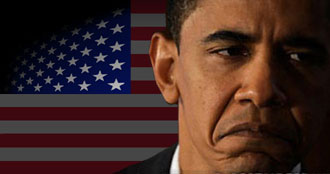
Obama threatens to veto greater intelligence oversight
By Glenn Greenwald | March 16, 2010
One of the principal weapons used by the Bush administration to engage in illegal surveillance activities — from torture to warrantless eavesdropping — was its refusal to brief the full Congressional Intelligence Committees about its activities. Instead, at best, it would confine its briefings to the so-called “Gang of Eight” — comprised of 8 top-ranking members of the House and Senate — who were impeded by law and other constraints from taking any action even if they learned of blatantly criminal acts.
This was a sham process: it allowed the administration to claim that it “briefed” select Congressional leaders on illegal conduct, but did so in a way that ensured there could be no meaningful action or oversight, because those individuals were barred from taking notes or even consulting their staff and, worse, because the full Intelligence Committees were kept in the dark and thus could do nothing even in the face of clear abuses. The process even allowed the members who were briefed to claim they were powerless to stop illegal programs. That extremely restrictive process also ensures irresolvable disputes over what was actually said during those briefings, as illustrated by recent controversies over what Nancy Pelosi and other leading Democrats were told about Bush’s torture and eavesdropping programs. Here’s how Richard Clarke explained it in July, 2009, on The Rachel Maddow Show:
MADDOW: Do you think that the current system, the gang of eight briefing system, allows the CIA to be good at spying and to be doing their work legally?
CLARKE: I think briefings of the gang of eight, those very sensitive briefings, as opposed to the broader briefings – the gang of eight briefings are usually often a farce. They catch them alone, one at the time usually. They run some briefing by them.
The congressman can‘t keep the briefing. They can‘t take notes. They can‘t consult their staff. They don‘t know what the briefings are about in advance. It’s a box check so that the CIA can say it complied with the law. It‘s not oversight. It doesn‘t work.
To their credit, Congressional Democrats — over the objections of right-wing Republicans — have been attempting since the middle of last year to fix this serious problem, by writing legislation to severely narrow the President’s power to conceal intelligence activities from the Senate and House Intelligence Committees and abolish the “Gang of Eight” process. After all, those Committees were created in the wake of the intelligence abuses uncovered by the Church Committee in the mid-1970s, and their purpose is “to provide vigilant legislative oversight over the intelligence activities of the United States to assure that such activities are in conformity with the Constitution and laws of the United States.” But if they’re not even told about what the Executive Branch is doing in the intelligence realm, then they obviously can’t exert oversight and ensure compliance with the law — which is the purpose of keeping them in the dark, as the last decade demonstrated.
Yet these efforts to ensure transparency and oversight have continuously run into one major roadblock: Barack Obama’s threat to veto the legislation. Almost immediately after leading Democrats on the Intelligence Committee unveiled their legislation last year, the Obama White House issued a veto threat with extremely dubious (and Bush-replicating) rationale: such oversight would jeopardize secrecy and intrude into “executive privilege.” In response to Obama’s veto threat, Democrats spent the last nine months accommodating the White House’s objections by significantly diluting their legislation — their new bill would actually retain the “Gang of Eight” briefings but impose notification and other oversight requirements — and two weeks ago the House passed that diluted bill.
But no matter: as Walter Pincus reports today in The Washington Post, Obama is now threatening to veto even this diluted bill, and is echoing GOP talking points when doing so:
The White House has renewed its threat to veto the fiscal 2010 intelligence authorization bill over a provision that would force the administration to widen the circle of lawmakers who are informed about covert operations and other sensitive activities. . . .
In a letter sent to the senior members of the intelligence panels, Office of Management and Budget Director Peter R. Orszag said Gang of Eight notifications are made in only “the most limited of circumstances” affecting “vital interests” of the United States, arguing that the new requirement would “undermine the president’s authority and responsibility to protect sensitive national security information.”
Orszag also opposed a Senate bill provision that required notification of “any change in a covert action,” which he described as setting up “unreasonable burdens” on the agencies, particularly the CIA . The House bill also requires notification of intelligence “significant undertakings,” a term that Orszag described as “vague and uncertain.”
Rep. Peter Hoekstra (R-Mich.), ranking minority member of the House intelligence panel, noted that the White House objections were similar to those raised by Republicans, especially regarding notifications provisions. . . .
Orszag wrote that the notification provisions were one of three items in the bills that would draw a veto recommendation from the president’s advisers. Another such provision would give the Government Accountability Office legal authority to review practices and operations throughout the intelligence community. The White House contends that broadening the GAO’s purview would upset current relations with the office, which already has access to some intelligence activity, and adversely affect oversight relationships between the committees and the community. The provision would also permit any committee of Congress with an arguable claim of jurisdiction over an intelligence activity to request a GAO investigation of that activity.
In other words, the Obama White House — just as was true for the Bush White House, and using the same rationale — does not want any meaningful oversight (i.e., briefings beyond the absurd Gang of Eight sham) on whether it’s breaking the law in the conduct of its intelligence activities. One of the Intelligence Community’s most loyal Congressional servants — Senate Intelligence Committee Chair Dianne Feinstein — told The Post that she thinks a deal can be worked out with the White House, meaning that the bill needs to be diluted even further, to the point of virtual nothingness, in order for the White House to accept it.
It’s critical to note that this is far from an abstract concern, because the Obama administration has almost certainly been hiding intelligence activities from the Intelligence Committees, thus ensuring it operates without oversight. Read this October, 2009 article from The Hill — headlined: “Feingold sees similarities between Bush and Obama on intelligence sharing” — in which Senate Intelligence Committee Member Russ Feingold explains “his suspicion that the Obama administration is continuing some of the stonewalling practices of the George W. Bush administration when it comes to providing full intelligence briefings to the relevant committees in Congress.” And indeed, all year long, there’s been a series of disclosures about highly controversial intelligence programs that appear to be “off-the-books” and away from the oversight of the Intelligence Committee. In late January, it was revealed that the President was maintianing a “hit list” of American citizens he had authorized to be assassinated far from any “battlefield,” followed by yesterday’s story describing the use of shadowy private contractors to collect intelligence in Pakistan and Afghanistan.
All of this is sadly consistent with the Obama administration’s devotion to extreme levels of secrecy and resistance to oversight. Last month, Eli Lake reported that Obama has simply failed to make a single appointment to, or even activate the budget of, the The Privacy and Civil Liberties Oversight Board, the body created pursuant to the report of the 9/11 Commission to safeguard civil liberties in intelligence activities; it has thus been completely dormant. And, with a few very mild exceptions, Obama — since he was inaugurated — has affirmately embraced one radical secrecy doctrine after the next that used to be controversial among Democrats (back when Bush used them).
The refusal of the Bush administration to brief the Intelligence Committees on its most controversial intelligence programs was once one of the most criticized aspects of the Bush/Cheney obsessions with secrecy, executive power abuses, and lawlessness. The Obama administration is now replicating that conduct, repeatedly threatening to veto legislation to restore real oversight.
UPDATE: Marcy Wheeler notes what is probably the worst part of all of this, something I consider truly despicable: the administration is also threatening to veto the bill because it contains funding for a new investigation of the 2001 anthrax attacks, on the ground that such an investigation — in the administration’s words — “would undermine public confidence” in the FBI probe of the attacks “and unfairly cast doubt on its conclusions.”
As I’ve documented at length, not only are there enormous, unresolved holes in the FBI’s case, but many of the most establishment-defending mainstream sources — from leading newspaper editorial pages to key politicians in both parties — have expressed extreme doubts about the FBI’s case and called for an independent investigation. For the administration to actively block an independent review of one of the most consequential political crimes of this generation would probably be its worst act yet, and that’s saying quite a bit.
Iran dismisses report on nuclear arms quote
Press TV – March 15, 2010
Iran has dismissed a recent report by an American paper which claimed Tehran was seeking nuclear weapons in the late 1980s.
Iranian Foreign Ministry Spokesman Ramin Mehmanparast described the report as a “propaganda ploy that shows Washington’s ultimate frustration.”
In a Sunday article titled ‘Iran’s attempted deal with Pakistan,’ The Washington Post, quoted Abdul Qadir Khan, the father of Pakistan’s nuclear weapons program, as claiming that Tehran had attempted to purchase nuclear weapons and know-how from Islamabad.
The Post bases its report on “never officially disclosed” material written by Khan while under house arrest in 2004, but does not provide a source for its story.
“The US is using such allegations to deprive the Iranian nation of its nuclear rights, which have been internationally recognized,” Mehmanparast said Monday, adding that Washington was following an “Iranophobia project” to justify its military presence in the Middle East.
The Washington Post report comes while Abdul Qadir Khan has repeatedly dismissed such allegations.
Abdul Basit, Pakistani Foreign Office spokesman, also rejected the report on Monday and said, “It is yet another repackaging of fiction which surfaces occasionally for purposes that are self-evident.”
Anti-Semitism: Zionism’s indispensable alibi
By Maidhc Ó Cathail | 15 March 2010
Although Zionism typically represents itself as the solution to anti-Semitism, the truth is less flattering. In fact, hostility toward Jews is indispensable to the cause of Jewish nationalism. If anti-Semitism didn’t exist, Zionists would have to invent it. And in many cases that is precisely what they have done.
Contrary to the widespread perception that Zionism opposes anti-Semitism, its adherents have occasionally revealed a more ambivalent attitude to Jew-hatred. In 1895, Theodor Herzl, the founder of modern Zionism, prophetically wrote in his Diaries: “Anti-Semites will become our surest friends, anti-Semitic countries our allies.” Even the suffering inflicted on European Jewry by the Nazi holocaust doesn’t seem to have unduly tempered such cynicism. In 1995, Jay Lefkowitz, an American government official, told the New York Times Magazine: “Deep down, I believe that a little anti-Semitism is a good thing for the Jews— reminds them who they are.”
If Zionist extremists can’t provoke the desired level of anti-Semitism to advance their goals, they are even prepared to fake it. A 1952 article in Davar, the official organ of Mapai, the party of the then Israeli Prime Minister David Ben-Gurion, suggested sending a team of saboteurs “to help redeem Jews” from the countries where they are “absorbed in sinful self-satisfaction”.
“The task of these young men,” the article explained, “would be to disguise themselves as non-Jews, and, acting upon the brutal Zionism, plague these Jews with anti-Semitic slogans, such as ‘Bloody Jew’, ‘Jews go to Palestine’ and similar ‘intimacies’.”
Lest anyone doubt that the Israeli government would ever contemplate carrying out such a cynical plot to encourage Jews to move to Israel, the “rescue” of about 125,000 Iraqi Jews in the early 1950s involved far worse acts. “In attempts to portray the Iraqis as anti-American and to terrorize the Jews,” wrote former CIA officer Wilbur Eveland in Ropes of Sand, “the Zionists planted bombs in the US Information Service library and in synagogues. Soon leaflets began to appear urging Jews to flee to Israel.”
Whatever about posing as “Arab anti-Semites”, one might think that Zionists would draw the line at a post-holocaust sponsorship of Nazism. Yet this is exactly what a leading Canadian Zionist organization has been accused of. “In the 1960s, the Canadian Jewish Congress (CJC) paid John Garrity, a small-time mercenary, to build up the fledgling Canadian Nazi Party,” reveals Ezra Levant in Shakedown. When the embarrassing truth emerged, it was justified by the CJC as an attempt to learn more about neo-Nazism. However, the real purpose, according to the Jewish Canadian writer, was to provide “a pretext for the addition of ‘hate’ laws to the criminal code”.
While “hate” sounds like something that all decent people would condemn, one man’s hate may be another man’s righteous indignation. Zionists, for example, tend to conflate anti-Zionism with anti-Semitism, and, therefore, as something that could be considered a “hate crime”.
But are Professors John Mearsheimer and Stephen Walt engaged in hate propaganda by documenting the harmful influence of the Israel lobby over US foreign policy? Or is former US President Jimmy Carter a “bigot” for comparing the Israeli occupation of Palestine to apartheid South Africa? Are the survivors of the USS Liberty who refuse to remain silent about Israel’s deliberate attack on their ship merely motivated by hatred of Jews? Is Professor Norman Finkelstein a “self-hating Jew” for exposing the holocaust Industry’s corruption of history and memory in the service of an extortion racket? And is UN special rapporteur Richard Falk also “self-hating” for likening Israel’s actions against the besieged Gazans to what the Nazis did to Jews in the Warsaw Ghetto?
In each of these cases, by no means an exhaustive list, the charge of anti-Semitism, rather than serving to protect Jewish people from defamation, has been used to obscure Zionist crimes.
However, as Zionist criminality becomes increasingly transparent, there will most likely be a sharp rise in anti-Semitism worldwide. No doubt much of it will be the result of genuine, albeit misdirected, anger as the extent of Zionist crimes against humanity becomes more widely known. But considering Zionism’s history of faking attacks on Jews, we can expect at least some of this “hate” to be the work of Jewish extremists who disingenuously claim to be fighting anti-Semitism.
Perhaps it’s time for those who are genuinely concerned about combating hatred in the world to heed the words of Israel Shahak. As the great Israeli humanist concluded in his classic Jewish History, Jewish Religion: “Although the struggle against anti-Semitism (and of all other forms of racism) should never cease, the struggle against Jewish chauvinism and exclusivism … is now of equal or greater importance.”
The Hidden History of Zionism ~ The Four Myths
By Ralph Schoenman | April 1988
It is not accidental that when anyone attempts to examine the nature of Zionism – its origins, history and dynamics – they meet with people who terrorize or threaten them. Quite recently, after mentioning a meeting on the plight of the Palestinian people during an interview on KPFK, a Los Angeles radio station, the organizers of the public meeting were deluged with bomb threats from anonymous callers.
Nor is it easy in the United States or Western Europe to disseminate information about the nature of Zionism or to analyze the specific events which denote Zionism as a political movement. Even the announcement on university campuses of authorized forums or meetings on the subject invariably engenders a campaign designed to close off discussion. Posters are torn down as fast as they are put up. Meetings are packed by flying squads of Zionist youth who seek to break them up. Literature tables are vandalized and leaflets and articles appear accusing the speaker of anti-Semitism or, in the case of those of Jewish origin, of self-hatred.
Vindictiveness and slander are so universally meted out to anti-Zionists because the disparity between the official fiction about Zionism and the Israeli state, on the one hand, and the barbarous practice of this colonial ideology and coercive apparatus, on the other, is so vast. People are in shock when they have an opportunity to hear or read about the century of persecution suffered by the Palestinians, and, thus, the apologists for Zionism are relentless in seeking to prevent coherent, dispassionate examination of the virulent and chauvinist record of the Zionist movement and of the state which embodies its values.
The irony of this is that when we study what the Zionists have written and said – particularly when addressing themselves – no doubt remains about what they have done or of their place in the political spectrum, dating from the last quarter of the 19th century to the present day.
Four overriding myths have shaped the consciousness of most people in our society about Zionism.
The first is that of “A land without a people for a people without a land.” This myth was sedulously cultivated by early Zionists to promote the fiction that Palestine was a remote, desolate place ready for the taking. This claim was quickly followed by denial of Palestinian identity, nationhood or legitimate entitlement to the land in which the Palestinian people have lived throughout their recorded history.
The second is the myth of Israeli democracy. Innumerable newspaper stories or television references to the Israeli state are followed by the assertion that it is the only “real” democracy in the Middle East. In fact, Israel is as democratic as the apartheid state of South Africa. Civil liberty, due process and the most basic human rights are by law denied those who do not meet racial, religious criteria.
The third myth is that of “security” as the motor force of Israeli foreign policy. Zionists maintain that their state must be the fourth largest military power in the world because Israel has been forced to defend itself against imminent menace from primitive, hate-consumed Arab masses only recently dropped from the trees.
The fourth myth is that of Zionism as the moral legatee of the victims of the Holocaust. This is at once the most pervasive and insidious of the myths about Zionism. Ideologues for the Zionist movement have wrapped themselves in the collective shroud of the six million Jews who fell victim to Nazi mass murder. The bitter and cruel irony of this false claim is that the Zionist movement itself actively colluded with Nazism from its inception.
To most people it appears anomalous that the Zionist movement, which forever invokes the horror of the Holocaust, should have collaborated actively with the most vicious enemy ever faced by the Jews. The record, however, reveals not merely common interests but a deep ideological affinity rooted in the extreme chauvinism which they share.
The case against the hockey stick
The “hockey stick” temperature graph is a mainstay of global warming science. A new book tells of one man’s efforts to dismantle it—and deserves to win prizes!
Matt Ridley | 10th March 2010 | Prospect Issue 168
Andrew Montford’s The Hockey Stick Illusion is one of the best science books in years. It exposes in delicious detail, datum by datum, how a great scientific mistake of immense political weight was perpetrated, defended and camouflaged by a scientific establishment that should now be red with shame. It is a book about principal components, data mining and confidence intervals—subjects that have never before been made thrilling. It is the biography of a graph.
I can remember when I first paid attention to the “hockey stick” graph at a conference in Cambridge. The temperature line trundled along with little change for centuries, then shot through the roof in the 20th century, like the blade of an ice-hockey stick. I had become somewhat of a sceptic about the science of climate change, but here was emphatic proof that the world was much warmer today; and warming much faster than at any time in a thousand years. I resolved to shed my doubts. I assumed that since it had been published in Nature—the Canterbury Cathedral of scientific literature—it was true.
I was not the only one who was impressed. The graph appeared six times in the Intergovernmental Panel on Climate Change (IPCC)’s third report in 2001. It was on display as a backdrop at the press conference to launch that report. James Lovelock pinned it to his wall. Al Gore used it in his film (though describing it as something else and with the Y axis upside down). Its author shot to scientific stardom. “It is hard to overestimate how influential this study has been,” said the BBC. The hockey stick is to global warming what St Paul was to Christianity.
Of course, there is other evidence for global warming, but none of it proves that the recent warming is unprecedented. Indeed, quite the reverse: surface temperatures, sea levels, tree lines, glacier retreats, summer sea ice extent in the Arctic, early spring flowers, bird migration, droughts, floods, storms—they all show change that is no different in speed or magnitude from other periods, like 1910-1940, at least as far as can be measured. There may be something unprecedented going on in temperature, but the only piece of empirical evidence that actually says so—yes, the only one—is the hockey stick.
And the hockey stick is wrong. The emails that were leaked from the University of East Anglia late last year are not proof of this; they are merely the icing on the lake, proof that some of the scientists closest to the hockey stick knew all along that it was problematic. Andrew Montford’s book, despite its subtitle, is not about the emails, which are tagged on as a last chapter. It is instead built around the long, lonely struggle of one man— Stephen McIntyre—to understand how the hockey stick was made, with what data and what programs.
A retired mining entrepreneur with a mathematical bent, McIntyre asked the senior author of the hockey stick graph, Michael Mann, for the data and the programs in 2003, so he could check it himself. This was five years after the graph had been published, but Mann had never been asked for them before. McIntyre quickly found errors: mislocated series, infilled gaps, truncated records, old data extrapolated forwards where new was available, and so on.
Not all the data showed a 20th century uptick either. In fact just 20 series out of 159 did, and these were nearly all based on tree rings. In some cases, the same tree ring sets had been used in different series. In the end the entire graph got its shape from a few bristlecone and foxtail pines in the western United States; a messy tree-ring data set from the Gaspé Peninsula in Canada; another Canadian set that had been truncated 17 years too early called, splendidly, Twisted Tree Heartrot Hill; and a superseded series from Siberian larch trees. There were problems with all these series: for example, the bristlecone pines were probably growing faster in the 20th century because of more carbon dioxide in the air, or recovery after “strip bark” damage, not because of temperature change.
This was bad enough; worse was to come. Mann soon stopped cooperating, yet, after a long struggle, McIntyre found out enough about Mann’s programs to work out what he had done. The result was shocking. He had standardised the data by “short-centering” them—essentially subtracting them from a 20th century average rather than an average of the whole period. This meant that the principal component analysis “mined” the data for anything with a 20th century uptick, and gave it vastly more weight than data indicating, say, a medieval warm spell.
Well, it happens. People make mistakes in science. Corrections get made. That’s how it works, is it not? Few papers get such scrutiny as this had. But that is an even more worrying thought: how much dodgy science is being published without the benefit of an audit by Mcintyre’s ilk? As a long-time champion of science, I find the reaction of the scientific establishment more shocking than anything. The reaction was not even a shrug: it was shut-eyed denial.
If this had been a drug trial done by a pharmaceutical company, the scientific journals, the learned academies and the press would have soon have rushed to discredit it—and rightly so. Instead, they did not want to know. Nature magazine, which had published the original study, went out of its way to close its ears to McIntyre’s criticisms, even though they were upheld by the reviewers it appointed. So did the National Academy of Sciences in the US, even when two reports commissioned by Congress upheld McIntyre. So, of course, did the IPCC, which tied itself in knots changing its deadlines so it could include flawed references to refutations of McIntyre while ignoring complaints that it had misquoted him.
The IPCC has taken refuge in saying that other recent studies confirm the hockey stick but, if you take those studies apart, the same old bad data sets keep popping out: bristlecone pines and all. A new Siberian data series from a place called Yamal showed a lovely hockey stick but, after ten years of asking, McIntyre finally got hold of the data last autumn and found that it relied heavily on just one of just twelve trees, when far larger samples from the same area were available showing no uptick. Another series from Finnish lake sediments also showed a gorgeous hockey stick, but only if used upside down. McIntyre just keeps on exposing scandal after scandal in the way these data were analysed and presented.
Montford’s book is written with grace and flair. Like all the best science writers, he knows that the secret is not to leave out the details (because this just results in platitudes and leaps of faith), but rather to make the details delicious, even to the most unmathematical reader. I never thought I would find myself unable to put a book down because—sad, but true—I wanted to know what happened next in an r-squared calculation. This book deserves to win prizes.
Oh, and by the way, I have a financial interest in coal mining, though not as big as Al Gore has in carbon trading. Maybe you think it makes me biased. Read the book and judge for yourself.
The Hockey Stick Illusion is published by Stacey International, 482 pages, £10.99
Read what James Lovelock, Bjorn Lomborg, Ed Miliband and many other experts have to say about climate change in Prospect’s Copenhagen special

A
9/11, ABC, the Washington Post, and Too Many Holes to Plug
By Bill Willers | March 13, 2010
“Some people would think you’re part of the lunatic fringe.” – Chris Bury, ABC News, March 6, 2010, interviewing the producers of Loose Change.
Watch Video
“The only thing novel about Mr. Fujita is that a man so susceptible to the imaginings of the lunatic fringe happens to occupy a notable position in the governing apparatus of a nation that boasts the world’s second-largest economy.” – Washington Post editorial, March 8, 2010
The daily right-wing “talking points” distributed to the Limbaughs, Hannitys et al of the conservative media are, by now, so well understood that they’ve become material for the political humor of Jon Stewart and Stephen Colbert. One has come to expect such wording from the likes of the Fox Channel. When one hears an unlikely phrase like “going rogue” coming out of half a dozen rightist mouths within a the space of a few hours, it’s no longer surprising. Just another “fair and balanced” day.
The fact that such slanderous language as “lunatic fringe” (Bury repeated it in his ABC report with another interviewee) is now coming from such major “mainstream” sources when referencing the 9/11 Truth Movement is more worrisome, because it indicates a rising level of concern within politically powerful elements for an issue based on such a collective of lies that it is simply not going away. Regarding the journalistic objectivity demonstrated in ABC’s edited Nightline report, you can judge for yourself:
click here
A few observations about ABC and the Post:
The convention covered by Mr. Bury included scientists and engineers from Architects and Engineers for 9/11 Truth who were available for interview. One could see their banner in the background as Bury interviewed a musician. ABC chose to make an association between the Truth Movement and a deranged gunman while ignoring the scientists just a few yards away who could have discussed with authority the physical impossibility of the “official” story and the importance of thermite residue in dust samples. That fact, all by itself, tells a very unlovely story about the journalistic integrity and the personal ethics of decision makers at ABC.
There is something pathetic about Mr. Bury, because, well, he’s such a classic example. While the authors of the Post’s piece can hide behind the anonymous “editorial”, Bury is right there on camera in the role of corrupt journalist. His line of questioning of the two filmmakers was, of course, indefensible, and somehow it showed in closeups of his face that he knew exactly what he was doing.
The Post’s editorial attacking Japanese politician Yukihisa Fujita is amazing in its invective: “…bizarre, half-baked and intellectually bogus;… a man susceptible to the imaginings of the lunatic fringe…”. How on earth can the editorialists at this late date be unaware of the top level personnel all over the globe who share Fujita’s views and who have been absolutely open about it? “We have no reason to believe that Mr. Fujita’s views are widely shared in Japan.” Really? Better look again, and not just in Japan.
The Post editorial reads like a direct threat to the Japanese government. After asserting that Fujita’s views “seem to reflect a strain of anti-American thought that runs through the DPJ and the government of Prime Minister Yukio Hatoyama”, the writer(s) end with a warning that the U.S-Japan relationship “will be severely tested if Mr. Hatoyama tolerates elements of his own party as reckless and fact-averse as Mr. Fujita.” Ironic, isn’t it, the reference to “fact averse”.
As people look more closely at the official story, more gaping holes become obvious. It will be interesting to see how what we call the “Mainstream Media” will deal with this global 9/11Truth Movement as it keeps gaining strength.
NZ internet filter goes live – government forgets to tell public
The rise of the secret censor
By John Ozimek | The Register | 12th March 2010
New Zealand’s internet filtering system went live last month – but the government forgot to mention this to its electorate until its hand was forced by online freedom campaign, Tech Liberty.
Thomas Beagle, a spokesman for the group, said he was “very disappointed that the filter is now running” and that its launch had been conducted in such a “stealthy mode”. He added: “It’s a sad day for the New Zealand internet.”
In an interview with Computerworld this week, he claimed that the filter had gone live on February 1 but the Department of Internal Affairs (DIA) delayed announcing this at until it had met with its Independent Reference Group.
The manager of the DIA’s Censorship Compliance Unit, Steve O’Brien, denied that there had been any subterfuge. The system has been undergoing trials for two years and the media have been aware of this throughout.
He said: “The Independent Reference Group has met and the filter system processes were demonstrated as set out in the code of practice, that is that the website filtering system prevents access to known websites containing images of child sexual abuse.”
While the DIA continues to be coy about exactly which ISPs are joining the filter, Tech Liberty understands that Watchdog and MaxNet have already signed-up to deploy the filter system, and that ISPs Telstra Clear, Telecom and Vodafone have said they will do so.
Orcon, Slingshot and Natcom have said that they won’t or, in the case of Orcon, that more data is needed as to how the filter will impact customer service.
ISPs also appear to take differing views of what – and when – to tell their customers. Maxnet appear not to have warned their customers officially that the filter is in place: Vodafone has said it will do so when it goes live.
The system employs the Swedish Netclean Whitebox content filter – website requests are filtered by Border Gateway Protocol against a blacklist held on a central server in the government Censorship Compliance Unit. The list is maintained by the Independent Reference Group which actively reviews banned URLs each month to eliminate false positives.
Bans must be justified and signed off by three “warranted inspectors of publications”. Government statistics, published in 2009, suggest that the blacklist includes more than 7,000 URLs featuring child sexual abuse – or over ten times the number of links recognised by the UK’s Internet Watch Foundation. It has been built by the censorship unit since 2005 and is affiliated with Europe’s Cospol Internet Related Child Abusive Material Project.
David Zanetti, technical spokesperson for Tech Liberty, said: “We fear that the filter will reduce the stability of the internet in New Zealand. It is a single point of failure, introduces a new and very tempting target for hackers, and by diverting traffic will cause issues with modern internet applications.”
Tech Liberty is also concerned by the expansion of government powers that thefilter represents. It entrenches the principle that the government can set up a new censorship scheme and block material with no reference to existing law. Worse, the filter list stays secret, in contrast to the censorship regime that operates in respect of other media, where the Chief Censor must publish decisions banning offensive material.
Cynics have also noted that the launch of the filter comes not long before the eighth round of the Anti-Counterfeiting Trade Agreement (ACTA) negotiations, due to take place in Wellington, New Zealand in April. ®
Truth, History and Integrity
By Gilad Atzmon | March 13, 2010
Back in 2007 the notorious American Jewish right-wing organization, the ADL (Anti-Defamation League) announced that it recognised the events in which an estimated 1.5 million Armenians were massacred as “genocide.” The ADL’s national director, Abraham Foxman, insisted that he made the decision after discussing the matter with ‘historians’. For some reason he failed to mention who the historians were, nor did he refer to their credibility or field of scholarship. However, Foxman also consulted with one holocaust survivor who supported the decision. It was Elie Wiesel, not known for being a leading world expert on the Armenian ordeal.
The idea of a Zionist organization being genuinely concerned, or even slightly moved, by other people’s suffering could truly be a monumental transforming moment in Jewish history. However, this week we learned that the ADL is once again engaged in the dilemma of Armenian suffering. It is not convinced anymore that the Armenians suffered that much. It is now lobbying the American congress not to recognize the killings of Armenians as ‘genocide. This week saw the ADL “speaking out against Congressional acknowledgment of the Armenian Genocide, and is, instead, advocating Turkey’s call for a historical commission to study the events.”
How is it that an event that took place a century ago is causing such a furor? One day it is generally classified as ‘genocide’, the next, it is demoted to an ordinary instance of one man killing another. Was it an ‘historical document’ that, out of nowhere, popped out on Abe Foxman’s desk? Are there some new factual revelations that led to such a dramatic historical shift? l don’t think so.
The ADL’s behaviour is a glimpse into the notion of Jewish history and the Jewish understanding of the past. For the nationalist and political Jew, history is a pragmatic tale, it is an elastic account. It is foreign to any scientific or academic method. Jewish history transcends itself beyond factuality, truthfulness or correspondence rules with any given vision of reality. It also repels integrity or ethics. It by far prefers total submission, instead of creative and critical thinking. Jewish history is a phantasmic tale that is there to make the Jews happy and the Goyim behave themselves. It is there to serve the interests of one tribe and that tribe only. In practice, from a Jewish perspective, the decision whether there was an Armenian genocide or not is subject to Jewish interests: is it good for the Jews or is it good for Israel.
Interestingly enough, history is not a particularly ‘Jewish thing’. It is an established fact that not a single Jewish historical text has been written between the 1st century (Josephus Flavius) and early 19th century (Isaak Markus Jost). For almost 2 thousand years Jews were not interested in their own or anyone else’s past, at least not enough to chronicle it. As a matter of convenience, an adequate scrutiny of the past was never a primary concern within the Rabbinical tradition. One of the reasons is probably that there was no need for such a methodical effort. For the Jew who lived during ancient times and the Middle Ages, there was enough in the Bible to answer the most relevant questions to do with day-to-day life, Jewish meaning and fate. As Israeli historian Shlomo Sand puts it, “a secular chronological time was foreign to the ‘Diaspora time’ that was shaped by the anticipation for the coming of the Messiah.”
However, in the mid 19th century, in the light of secularisation, urbanisation, emancipation and due to the decreasing authority of the Rabbinical leaders, an emerging need of an alternative cause rose amongst the awakening European Jews. All of a sudden, the emancipated Jew had to decide who he was and where he came from. He also started to speculate what his role might be within the rapidly opening Western society.
This is where Jewish history in its modern form was invented. This is also where Judaism was transformed from a world religion into a ‘land registry’ with some clearly devastating racially orientated and expansionist implications. As we know, Shlomo Sand’s account of the ‘Jewish Nation’ as a fictional invention is yet to be challenged academically. However, the dismissal of factuality or commitment to truthfulness is actually symptomatic of any form of contemporary Jewish collective ideology and identity politics. The ADL’s treatment of the Armenian topic is just one example. The Zionist’s dismissal of a Palestinian past and heritage is just another example. But in fact any Jewish collective vision of the past is inherently Judeo-centric and oblivious to any academic or scientific procedure.
When I was Young
When I was young and naïve I regarded history as a serious academic matter. As I understood it, history had something to do with truth seeking, documents, chronology and facts. I was convinced that history aimed to convey a sensible account of the past based on methodical research. I also believed that it was premised on the assumption that understanding the past may throw some light over our present and even help us to shape a prospect of a better future. I grew up in the Jewish state and it took me quite a while to understand that the Jewish historical narrative is very different. In the Jewish intellectual ghetto, one decides what the future ought to be, then one constructs ‘a past’ accordingly. Interestingly enough, this exact method is also prevalent amongst Marxists. They shape the past so it fits nicely into their vision of the future. As the old Russian joke says, “when the facts do not conform with the Marxist ideology, the Communist social scientists amend the facts (rather than revise the theory)”.
When I was young, I didn’t think that history was a matter of political decisions or agreements between a rabid Zionist lobby and its favorite holocaust survivor. I regarded historians as scholars who engaged in adequate research following some strict procedures. When I was young I even considered becoming an historian.
When I was young and naive I was also somehow convinced that what they told us about our ‘collective’ Jewish past really happened. I believed it all, the Kingdom of David, Massada, and then the Holocaust: the soap, the lampshade*, the death march, the six million.
As it happened, it took me many years to understand that the Holocaust, the core belief of the contemporary Jewish faith, was not at all an historical narrative for historical narratives do not need the protection of the law and politicians. It took me years to grasp that my great-grandmother wasn’t made into a ‘soap’ or a ‘lampshade’*. She probably perished out of exhaustion, typhus or maybe even by mass shooting. This was indeed bad and tragic enough, however not that different from the fate of many millions of Ukrainians who learned what communism meant for real. “Some of the worst mass murderers in history were Jews” writes Zionist Sever Plocker on the Israeli Ynet disclosing the Holodomor and Jewish involvement in this colossal crime, probably the greatest crime of the 20th century. The fate of my great-grandmother was not any different from hundreds of thousands of German civilians who died in an orchestrated indiscriminate bombing, because they were Germans. Similarly, people in Hiroshima died just because they were Japanese. 1 million Vietnamese died just because they were Vietnamese and 1.3 million Iraqis died because they were Iraqis. In short the tragic circumstances of my great grandmother wasn’t that special after all.
It Doesn’t make sense
It took me years to accept that the Holocaust narrative, in its current form, doesn’t make any historical sense. Here is just one little anecdote to elaborate on:
If, for instance, the Nazis wanted the Jews out of their Reich (Judenrein – free of Jews), or even dead, as the Zionist narrative insists, how come they marched hundreds of thousands of them back into the Reich at the end of the war? I have been concerned with this simple question for more than a while. I eventually launched into an historical research of the topic and happened to learn from Israeli holocaust historian professor Israel Gutman that Jewish prisoners actually joined the march voluntarily. Here is a testimony taken from Gutman’s book
“One of my friends and relatives in the camp came to me on the night of the evacuation and offered a common hiding place somewhere on the way from the camp to the factory. …The intention was to leave the camp with one of the convoys and to escape near the gate, using the darkness we thought to go a little far from the camp. The temptation was very strong. And yet, after I considered it all I then decided to join (the march) with all the other inmates and to share their fate ” (Israel Gutman [editor], People and Ashes: Book Auschwitz – Birkenau, Merhavia 1957).
I am left puzzled here, if the Nazis ran a death factory in Auschwitz-Birkenau, why would the Jewish prisoners join them at the end of the war? Why didn’t the Jews wait for their Red liberators?
I think that 65 years after the liberation of Auschwitz, we must be entitled to start to ask the necessary questions. We should ask for some conclusive historical evidence and arguments rather than follow a religious narrative that is sustained by political pressure and laws. We should strip the holocaust of its Judeo-centric exceptional status and treat it as an historical chapter that belongs to a certain time and place
65 years after the liberation of Auschwitz we should reclaim our history and ask why? Why were the Jews hated? Why did European people stand up against their next door neighbours? Why are the Jews hated in the Middle East, surely they had a chance to open a new page in their troubled history? If they genuinely planned to do so, as the early Zionists claimed, why did they fail? Why did America tighten its immigration laws amid the growing danger to European Jews? We should also ask for what purpose do the holocaust denial laws serve? What is the holocaust religion there to conceal? As long as we fail to ask questions, we will be subjected to Zionists and their Neocons agents’ plots. We will continue killing in the name of Jewish suffering. We will maintain our complicity in Western imperialist crimes against humanity.
As devastating as it may be, at a certain moment in time, a horrible chapter was given an exceptionally meta-historical status. Its ‘factuality’ was sealed by draconian laws and its reasoning was secured by social and political settings. The Holocaust became the new Western religion. Unfortunately, it is the most sinister religion known to man. It is a license to kill, to flatten, no nuke, to wipe, to rape, to loot and to ethnically cleanse. It made vengeance and revenge into a Western value. However, far more concerning is the fact that it robs humanity of its heritage, it is there to stop us from looking into our past with dignity. Holocaust religion robs humanity of its humanism. For the sake of peace and future generations, the holocaust must be stripped of its exceptional status immediately. It must be subjected to thorough historical scrutiny. Truth and truth seeking is an elementary human experience. It must prevail.
*During WWII and after it was widely believed that soaps and lampshades were being mass produced from the bodies of Jewish victims. In recent years the Israeli Holocaust museum admitted that there was no truth in any of those accusations.
Evidence Mounts NATO Report Lied on Afghan Civilian Killings
Rear Admiral Smith Admits No Evidence of Claimed ‘Firefight’
By Jason Ditz | March 12, 2010
The February 12 night raid against a house party in Afghanistan’s Paktia Province remains shrouded in mystery, but NATO’s official story appears to be crumbling as even NATO officials concede that the claims made were not strictly true.
NATO’s official statement claimed at the time that the raid on the home led to a “fire fight” against “several insurgents” who were killed, before NATO made a “gruesome discovery” of bound and gagged bodies in a nearby room.
NATO is conceding now that all of the slain people were civilians killed in the raid. NATO communications direct Rear Admiral Greg Smith also admitted that they had no real evidence that the men slain at the home had ever fired a shot against the NATO forces.
Witnesses at the site reported that one of the people in the compound, a local policeman, shouted “don’t fire, we work for the government” before being gunned down by the invading forces.
Rear Admiral Smith defended the killing of the policeman, however, saying “if you have got an individual stepping out of a compound, and if your assault force is there, that is often the trigger to neutralise (read: kill) the individual. You don’t have to be fired upon to fire back.
Since the incident, all those detained by NATO have been released without charges. In addition, the US has reportedly paid $2,000 to the family for each of the civilians killed in the attack.
New study debunks IPCC myths about Amazon rain forests
By Richard Taffe | March 11, 2010
(Boston) — A new NASA-funded study has concluded that Amazon rain forests were remarkably unaffected in the face of once-in-a-century drought in 2005, neither dying nor thriving, contrary to a previously published report and claims by the Intergovernmental Panel on Climate Change.
“We found no big differences in the greenness level of these forests between drought and non-drought years, which suggests that these forests may be more tolerant of droughts than we previously thought,” said Arindam Samanta, the study’s lead author from Boston University.
The comprehensive study published in the current issue of the scientific journal Geophysical Research Letters used the latest version of the NASA MODIS satellite data to measure the greenness of these vast pristine forests over the past decade.
A study published in the journal Science in 2007 claimed that these forests actually thrive from drought because of more sunshine under cloud-less skies typical of drought conditions. The new study found that those results were flawed and not reproducible.
“This new study brings some clarity to our muddled understanding of how these forests, with their rich source of biodiversity, would fare in the future in the face of twin pressures from logging and changing climate,” said Boston University Prof. Ranga Myneni, senior author of the new study.
The IPCC is under scrutiny for various data inaccuracies, including its claim – based on a flawed World Wildlife Fund study — that up to 40% of the Amazonian forests could react drastically and be replaced by savannas from even a slight reduction in rainfall.
“Our results certainly do not indicate such extreme sensitivity to reductions in rainfall,” said Sangram Ganguly, an author on the new study, from the Bay Area Environmental Research Institute affiliated with NASA Ames Research Center in California.
“The way that the WWF report calculated this 40% was totally wrong, while [the new] calculations are by far more reliable and correct,” said Dr. Jose Marengo, a Brazilian National Institute for Space Research climate scientist and member of the IPCC.
Paper available here (PDF)
Richard Taffe
rtaffe@bu.edu
617-353-4626
Boston University Medical Center
Featured Video

Iran FM Araghchi: “Hormuz Will No Longer Be the Same”
or go to
Aletho News Archives – Video-Images
From the Archives
Sam Husseini: The entire US establishment helped lie their way into the Iraq war
By Slava Zilber | American Herald Tribune | October 14, 2019
Sam Husseini is a senior analyst with the Institute for Public Accuracy, independent journalist and contributor to The Nation and FAIR.
Slava Zilber: Sam, three years ago, you appeared on Talk Nation Radio with David Swanson and spoke about the case of the GCHQ whistleblower Katharine Gun. You pointed out that the people involved in the spying on the UN and the people authorizing the Iraq War were not held accountable:
“Virtually everybody who went along with the war, whether it is Kerry or Clinton, of course, the Bush administration themselves has falsified their own records in terms of why, what they did, when they did, why they did it, to the extent that they’ve been scrutinised at all.”
You also address it in a recent article. And recently, Joe Biden has been lying about his position on the Iraq War. How can such an important issue escape meaningful scrutiny? … continue
Blog Roll
 Aletho News
- China slams US policy on Iran as Russia rejects legality of nuclear meeting at UN
- The Mecca Pact Courts Iran: Containment Comes Full Circle
- Oman FM: Persian Gulf states, Iran, Iraq should form security pact excluding US
- Trump peddles fresh falsehoods, claims Iran ‘started the war’ as US aggression drags on
- Ukraine quagmire? Yes, but it’s for NATO, not Russia
- US intelligence hypes Chinese, Russian space threats while accelerating its own military buildup in orbit
- Iran FM Araghchi: “Hormuz Will No Longer Be the Same”
- EU facing trillion-euro debt hole while seeking more cash for Kiev
- How US, Europe, Persian Gulf states exhausted missile stockpiles, splurged billions to defend Israel
- Up in arms… Koreans reject U.S. empire’s plan to make South Korea the next Ukraine
- If Americans Knew
- An error has occurred; the feed is probably down. Try again later.
- No Tricks Zone
- Sudden Stratospheric Warming, Powerful El Niño Combination May Lead To Extreme Europe Cold, Energy Crisis!
- Two New Studies Find Thwaites Glacier Melt Cannot Be Driven By Human Activity Or A Warming Ocean
- E-Cars Reduce CO2 Emissions By Only 41% Compared To Internal Combustion Engine Vehicles
- Predictions Made By Renowned Climate Professor Over Past Decades Have Been Proven To Be Poor
- New Study Suggests Large Regions Of The Pacific Ocean Have Been Cooling For The Last 80 Years
- Germany’s Green Energy Debacle: High Energy Costs Force Kahla Porzellan to Close After 182 Years!
- New Study: 50 Years Of The Most Aggressive ‘Net Zero’ Policies Can Only Affect The Global Climate By 0.03°C
- US September “Heat” Was No Record…Many Records Set Decades Ago
- Latest European Green Energy Debacle; Portugal’s Largest Flagship Solar Park Insolvent!
- Green Energy Debacle: German Expert Professor Fritz Vahrenholt Warns Of Severe Economic And Social Consequences

