Why the Promise of Biofuels is a Lie

Photo – Der Speigel
By ROBERT BRYCE
February 19, 2009
For years, the US has been inundated with claims that it should follow Brazil’s lead on biofuels. These arguments have largely been made by a small, but influential group of neoconservatives who claim that the US should quit using oil altogether. They claim that using more ethanol – produced from sugar cane, or corn, or some other substance – will impoverish OPEC and America will once again be returned to prosperity.
But these claims wither in the face of a story by Clemens Hoges in the January 22 issue of the German magazine Der Spiegel. Hoges writes that sugar cane “is considered an effective antidote to climate change, but hundreds of thousands of Brazilian plantation workers harvest the cane at slave wages.” The story is one of several published in recent years that have exposed the brutality of the Brazilian sugar cane fields. But before looking at Der Spiegel’s coverage, let’s do a quick review of the Brazilian ethanol boosters.
Thomas Friedman, the Pulitzer Prize-winning columnist for the New York Times has frequently advocated the mirage of “energy independence.” And he has cited Brazil as a model. In an August 2005 column, he conflated the issues of oil and terrorism “we are financing both sides in the war on terrorism: our soldiers and the fascist terrorists,” he wrote. He went on to claim that many of the technologies needed for energy independence are “already here – from hybrid engines to ethanol.” He then quoted Gal Luft, the neoconservative who heads the Institute for the Analysis of Global Security and created Set America Free, a group that advocates “energy independence.” Luft claimed that Brazil’s success in cutting its oil imports was due to the fact that the South American country was “bringing hydrocarbons and carbohydrates to live happily together in the same fuel tank.” In Luft’s view, ethanol has brought “Brazil close to energy independence” and insulated it from higher oil prices.
(Luft’s claim completely ignores the fact that since 1980, Petrobras, Brazil’s national oil company, has been growing its oil production by an average of 9 percent per year thanks to its offshore drilling prowess. Since 1998, Brazil has doubled its oil production and is now producing about 2 million barrels of oil per day. Neither Friedman nor Luft bothered to mention that fact.)
In late 2005, in a speech to the National Press Club, Pennsylvania governor Edward Rendell said that “No longer is investing in alternative fuels a fringe idea….Brazil is perhaps the world’s greatest success story. Due to 30 years of hard work, research and investment, Brazil will not need one drop of imported oil this time next year. If anyone suggests to you that these ideas aren’t ready for prime time and cost too much, they are living in the past.”
Venture capitalist Vinod Khosla and former Senate minority leader Tom Daschle have touted Brazil’s “energy independence miracle.” In a May 2006 opinion piece in the New York Times, they said that ethanol “could set America free from its dependence on foreign oil” and that Brazil proves that “an aggressive strategy of investing in petroleum substitutes like ethanol can end dependence on imported oil.”
In October 2006, former president Bill Clinton while in California stumping for Proposition 87 (an alternative energy initiative that later failed) declared that the initiative would “move California toward energy independence with cleaner fuels, with wind and solar power.” He continued, “There are people who don’t believe you can do it. I do. Look at Brazil. Don’t you think you can do it if they did it? They run their cars on ethanol.” Clinton later provided a sound bite for the pro-Proposition 87 forces in which he declared that “If Brazil can do it, so can California.”
The biofuels madness continued with a May 6, 2008 editorial in the Chicago Tribune, titled “Food vs. fuel, a global myth.” The piece, written by Set America Free’s Luft, and his fellow traveler, Robert Zubrin, a right-wing zealot who advocates colonizing Mars, claimed, incredibly, that “farm commodity prices have almost no effect on retail prices.” The two went on to declare that “rather than shut down biofuel programs, we need to radically augment them, to the point where we can take down” the Organization of the Petroleum Exporting Countries.
A big reality check is in order.
First and foremost, over the past two years, 14 studies have found a direct link between the ethanol scam and higher food prices.
Second, Brazil is not the epicenter of ethanol production, the US is. In 2008, the US produced about 9.1 billion gallons of the fuel, all of it from corn. Brazil produced about 6.8 billion gallons. And while sugar cane may be a far better feedstock that corn, in terms of greenhouse gas emissions and energy balance, the key issue is one of labor. While US corn is harvested mechanically, the Brazilian sugar cane is harvested almost exclusively by hand. And it is dangerous, back-breaking work.
In 2007, London’s The Guardian newspaper ran a story which quoted human rights activists who said that the men who harvest sugar cane for ethanol production “are effectively slaves” and that Brazil’s ethanol industry was “a shadowy world of middle men and human rights abuses.” It cited figures provided by a Catholic nun, Sister Ines Facioli, who runs a support network in a small town about 200 miles west of São Paolo. She claimed that between 2004 and 2006, 17 cane workers died due to overwork or exhaustion. One laborer, Pedro Castro, told the Guardian’s Tom Phillips, that the hot climate, combined with the heavy protective clothing needed to protect his body from the sharp machete blades used to cut the cane, was like working “inside a bread oven.”
For their work, the average cane worker gets paid about $1 for every ton of sugar cane they cut. They often work 12-hour shifts. Their housing, according to Phillips’ article, consists of “squalid, overcrowded ‘guest houses’ rented to them at extortionate prices by unscrupulous landlords.” The average cane cutter makes less than $200 per month. And some, it appears, make nothing at all.
In July 2007, the Brazilian government freed 1,100 laborers who were found working in horrendous conditions on a sugar cane plantation in the northeastern state of Para. A story by the Associated Press said that the workers were forced to work 13-hour days and that they had no choice but to pay “exorbitant prices for food and medicine.” It then cited a source in Brazil’s labor ministry who claimed that many of the workers were “sick from spoiled food or unsafe water, slept in cramped quarters on hammocks and did not have proper sanitation facilities.” The government-backed raid of the plantation lasted three days. The plantation in question is owned by Para Pastoril e Agricola SA, which produces about 13 million gallons of ethanol per year. The workers were caught up in a situation known as debt slavery in which poor workers are taken to remote farms where they then rack up large debts to the plantation owners who force the workers to pay high prices for everything from food to transportation.
According to Land Pastoral, a group affiliated with Brazil’s Roman Catholic Church, about 25,000 workers in Brazil are living in slavery-like conditions, most of them in the Amazon, and many of them working in the sugar cane business. The 2007 raid is not the first. In 2005, 1,000 workers were found living in debt slavery on a sugar cane plantation in the Brazilian state of Mato Grosso.
The article in Der Spiegel makes it clear that little has changed over the past few years. Hoges reports that one worker he interviewed, Antonio da Silva, makes just $172 per month during the harvest season, which lasts about six months. During the rest of the year, he has to rely on charity to feed his family. Da Silva’s home in the village of Araçoiaba Nova, Hoges reports, is the same as it was five years ago. “They threw plastic tarps over a handful of branches to build the hut where they still live today. The door consists of scraps of cloth nailed to a board, and boards placed around a hole in the tarp form the window. The furniture, arranged on the bare earth floor, consists of the plank beds and a cabinet.”
The most compelling quote in the piece is from Father Tiago, a 66 year-old Scottish monk who has been working in Brazil for decades. The Scotsman makes clear what he thinks about the issue: “The promise of biofuel is a lie. Anyone who buys ethanol is pumping blood into his tank,” he said. “Ethanol is produced by slaves.”
The photos that accompany Hoges’ story should be viewed by everyone who retains the misguided belief that the US should emulate Brazil’s biofuels industry. Here’s the link.
Alas, it doesn’t appear the members of Congress are paying much attention. Last month, US Rep. Eliot Engel, a New York Democrat, announced that he would be pushing legislation aimed at eliminating the $0.54-per-gallon tariff on imported ethanol. Doing so, Engel said, “would enable U.S. refiners to purchase cheaper and more climate-friendly ethanol, no matter where it comes from. The result would be an overall increase in the supply of fuel, a decrease in its price, and a decrease in our dependency on petroleum from the Middle East.”
Sound bites like the one from Engel ignore basic arithmetic: Even if the US imported all of Brazil’s ethanol — all 6.8 billion gallons per year — that quantity would only provide the energy equivalent of about 1.4 percent of America’s total oil consumption.
Despite those numbers — despite the ongoing evidence of slavery in the Brazilian ethanol trade — the energy discussion in America remains stuck in an absurdist fantasy about energy independence and freedom from the sticky problems of the Persian Gulf. But given what has happened in the past few months with regard to rising food prices and the myriad other problems associated with biofuels, one thing is becoming perfectly clear: Ethanol isn’t the answer to our energy challenge. Ethanol makes it worse.
Edward G. Rendell, “An American Energy Harvest Plan: Jobs, Prosperity, Independence,” December 1, 2005.
Tom Daschle and Vinod Khosla, “Miles Per Cob,” New York Times, May 8, 2006.
California Progress Report, “President Clinton: Why I Support Proposition 87 and Why the Oil Companies are Wrong – The Complete Speech Delivered at UCLA,” October 14, 2006.
Shopfloor.org, “In California, A Bad Proposition,” November 3, 2006.
http://archives.chicagotribune.com/2008/may/06/food/chi-oped0506fuelmay06
http://www.ethanolrfa.org/industry/statistics/#B
https://www.spiegel.de/international/world/0,1518,602951,00.html
Tom Phillips, “Brazil’s ethanol slaves: 200,000 migrant sugar cutters who prop up renewable energy boom,” The Guardian, March 9, 2007.
Ibid.
Vivian Sequera, “Brazil Raid Frees Ethanol Plant Slaves,” Associated Press, July 3, 2007.
Clemens Hoges, The High Price of Clean, Cheap Ethanol,” Der Spiegel, January 22, 2009.
http://yonkerstribune.typepad.com/yonkers_tribune/2009/01/engel-outlines-energy-plan-for-the-future-1.html
Robert Bryce is the author of Gusher of Lies: The Dangerous Delusions of “Energy Independence” available from the carousel at the bottom of this page.
“Rotten” sea ice? – Not even in Denmark
Watts Up With That
December 14, 2009
There’s plenty of stories about how Arctic sea ice is now “rotten”. There’s darn few that talk about yearly comparisons or what other scientific outlets are saying about the claim.
As many WUWT readers know, 2007 was the minimum year of summer extent in sea ice, a year that is routinely held up as a cause for alarm. Another cause for alarm has been the “decline of multi-year sea ice”. Most recently we’ve gotten claims of “rotten ice” in the news media. That “rotten” ice is “duping the satellites” they say. This all from one fellow, Dr. David Barber on a ship that took a short expedition in the Arctic and observed what he called “rotten ice”. Here’s Dr. Barber using the poster child for sea ice loss in a presentation.

David Barber hypes polar bears – Image from University of Manitoba files
Seems that his “rotten” message resonated, even the media in Alaska (who can observe sea ice on their own) are saying it: New study: Arctic ice is rotten (Anchorage Daily News)
Over at the Greenbang Blog, they say that: ‘Rotten’ sea ice creates false impression of Arctic recovery
They cite:
Satellite data in 2008 and 2009 appeared to indicate that Arctic sea ice cover had started to grow again after reaching a record low, leading some to claim that global warming was reversing. However, University of Manitoba researcher David Barber found that wasn’t the case after he viewed the ice firsthand this September from an ice breaker travelling through the southern Beaufort Sea.
What the satellites had identified as thick, multiyear ice, it turned out, was in fact thin, “rotten” ice, Barber and his colleagues discovered.
This apparently was the conclusion from watching Dr. Barber’s YouTube video:
You can read Barber’s study here (Word DOC file)
So if the satellites are “duped” into seeing more ice than actually exists, then 2007 ice must have been really, really, rotten:
 From Cryosphere today – click to enlarge
Compare for yourself, here.
Looks like it has firmed up since then. So no matter how you spin it, there has indeed been improvement in sea ice in 2007. Going from “really, really rotten” in 2007 to simply “rotten” Arctic sea ice in 2009 is definitely an improvement.
One other note, if this “rotten ice” problem and satellite duping proposed by Dr. Barber is in fact real, I’d fully expect that the National Snow and Ice Data Center (NSIDC) would make some sort of announcement or post a caveat about it on the “Arctic Sea Ice News and analysis” web page where they present the satellite data. I couldn’t find anything on that page about “rotten ice” or satellite data being inaccurate.
Looking further, I used a Google search for “rotten” within NSIDC’s web site (available from their search tool in the upper right of their web page) reveals no recent documents or web pages using that word. Odd.
OK maybe Cryosphere Today? Nope nothing there either.
JAXA’s sea ice page? Their News page? Not a peep.
Nansen’s Arctic ROOS sea ice page? Or their news page? All quiet on the Arctic front.
Maybe the Danish Meteorological Institute (in Copenhagen no less) sea ice page? Surely, something must be “rotten” in Denmark, no? Alas, they don’t mention it either.
Gosh, the Arctic ice is rotten, the satellites are duped, and none of the major scientific organzations that track sea ice have anything to say about it?
It seems Dr. Barber’s conclusions are being left out in the cold by his peers.
Why is Democracy Now shielding “war for oil” against reality?
By M. Idrees – 12/15/09
In its headlines for December 14, Democracy Now followed the report on Blair’s confession about his committment to regime change in Iraq regardless of the absence of WMDs, with this:
Iraq Signs Oil Deals with 10 Foreign Companies
Blair’s comments come just as Iraq has signed a series of major oil deals. A two-day auction ended Saturday with ten foreign companies winning access to Iraq’s massive reserves. The oil giant Royal Dutch Shell won the rights to the Manjoon oilfield near Basra, one of the world’s largest. The US-based Exxon Mobil and Occidental Petroleum also submitted winning bids.
The wording is careful: it appears to suggest a connection between what Blair said and the Iraqi oil contracts. The war in other words was for oil. That is a remrkable conclusion to draw from news about an auction in which US companies were the big losers (hence DN’s careful choice of the words ‘foreign companies’). Unless Democracy Now is suggesting that the US waged a war for Russia, Norway and China — biggest winners in the auction — it is not clear why it continues to insist on the discredited “war for oil” argument? Why is it so difficult to admit who actually conceived the war?
But some could argue that this may be a mere reflection of the changing balance of power: that US oil majors are unable to secure contracts doesn’t necessarilty mean that the war wasn’t for oil.
Consider this excerpt from the news report about the auction:
The 10 deals the Iraqi Oil Ministry reached with foreign oil companies suggest that China, Russia, and European oil firms are poised to play a major role in refurbishing Iraq’s oil industry, crippled by decades of war and sanctions.
American companies walked away with stakes in just two of the 10 auctioned fields. Seven American companies had paid to participate in the second auction, which began Friday. The only one that submitted a bid lost. Two American companies reached deals for fields auctioned in June.
The meager representation of American oil giants in Iraq’s opening oil industry surprised analysts.
“Iraq finally opened its doors after six years of war, and instead of U.S. companies, you have Asians and Europeans leading the way,” said Ruba Husari, the editor of Iraq Oil Forum, an online news outlet. “It will be a long time before anything else will be on offer in Iraq.”
Concerns over security, underscored by massive coordinated bombings Tuesday, and political instability as the U.S. military withdraws, likely kept American oil companies from venturing more forcefully in Iraq, which has the world’s third-largest proven crude reserves, analysts said.
Now compare it to this piece by Anthony Sampson from December 2002:
While Washington hawks depict a war against Iraq as achieving security of oil supplies, Western oil companies are worried about the short-term danger and the supposed long-term benefits of intervention…
Oil companies dread having supplies interrupted by burning oilfields, saboteurs and chaotic conditions. And any attempt to redraw the frontiers could increase the dangers in both Iran and Iraq, as rivals seek to regain territory.
I hope you get my drift? So much for ‘war for oil’.
ClimateGate: A closer look at some of the ‘tricks’ by the email authors
David Rose | Mail Online | December 13, 2009
The claim was both simple and terrifying: that temperatures on planet Earth are now ‘likely the highest in at least the past 1,300 years’. As its authors from the United Nations Intergovernmental Panel on Climate Change (IPCC) must have expected, it made headlines around the world.
Yet some of the scientists who helped to draft it, The Mail on Sunday can reveal, harboured uncomfortable doubts. In the words of one, David Rind from the US space agency Nasa, it ‘looks like there were years around 1000AD that could have been just as warm’.
Keith Briffa from the University of East Anglia’s Climatic Research Unit (CRU), which plays a key role in forming IPCC assessments, urged caution, warning that when it came to historical climate records, there was no new data, only the ‘same old evidence’ that had been around for years.
‘Let us not try to over-egg the pudding,’ he wrote in an email to an IPCC colleague in September 2006. ‘True, there have been many different techniques used to aggregate and scale data – but the efficacy of these is still far from established.’
But when the ‘warmest for 1,300 years’ claim was published in 2007 in the IPCC’s fourth report, the doubters kept silent.
It is only now that their concerns have started to emerge from the thousands of pages of ‘Warmergate’ emails leaked last month from the CRU’s computers, along with references to performing a ‘trick’ to ‘hide’ temperature decline and instructions to resist all efforts by the CRU’s critics to use the Freedom of Information Act to check the unit’s data and conclusions.
Last week, as an official inquiry by the former civil servant Sir Muir Russell began, I tried to assess Warmergate’s wider significance.
The CRU’s supporters insisted it was limited. ‘In the long term, it will make very little difference to the scientific consensus, and to the way politicians respond to it,’ Professor Trevor Davies, the university’s Pro-Vice Chancellor and a former CRU director, told me. ‘I am certain that the science is rock solid.’
He admitted that his CRU colleagues had sometimes used ‘injudicious phrases’, but that was because they kept on being ‘diverted’ from their work by those who wished to scrutinise it. ‘It’s understandable that sometimes people get frustrated,’ he said.
The only lesson the affair had for him was that ‘we have got to get better in terms of explanation. Some scientists still find it quite it difficult to communicate with the public.’
Others, however, were less optimistic. Roger Pielke, Professor of Environmental Studies at the University of Colorado, could in no sense be described as a climate change sceptic, let alone a ‘denier’.
‘Human-caused climate change is real, and I’m a strong advocate for action,’ he said. ‘But I’m also a strong advocate for integrity in science.’
Pielke’s verdict on the scandal is damning.
‘These emails open up the possibility that big scientific questions we’ve regarded as settled may need another look. They reveal that some of these scientists saw themselves not as neutral investigators but as warriors engaged in battle with the so-called sceptics.
‘They have lost a lot of credibility and as far as their being leading spokespeople on this issue of huge public importance, there is no going back.’
Climate science is complicated, and often the only way to make sense of raw data is through sophisticated statistical computer programs. The consequence is that most lay individuals – politicians and members of the public alike – have little choice but to take the assurances of scientists such as Davies on trust.
He and other ‘global warmists’ often insist that when it comes to the IPCC’s main conclusions – that the Earth is in a period of potentially catastrophic warming and that the main culprit is man-made greenhouse gas emission – no serious scientist dissents from the conventional view.
Hence, perhaps, Gordon Brown’s recent comment that those who disagree are ‘behind-the-times, antiscience, flat-Earth climate sceptics’.
In fact, there is a large body of highly-respected academic experts who fiercely contest this thesis: people such as Richard Lindzen, Professor of Meteorology at the Massachusetts Institute of Technology and a disillusioned former IPCC member, and Dr Tom Segalstad, head of geology at Oslo University, who has stated that ‘most leading geologists throughout the world know that the IPCC’s view of Earth processes are implausible if not impossible’.
These dissenters focus their criticisms on the IPCC’s analysis of the way the atmosphere works and the models it uses to predict the future.
However, Warmergate strikes at something more fundamental – the science that justifies the basic assumption that the present warming really is unprecedented, at least in the past few thousand years.
Take the now-notorious email that the CRU’s currently suspended director, Dr Phil Jones, sent to his IPCC colleagues on November 16, 1999, when he wrote he had ‘just completed Mike’s Nature trick’ and had so managed to ‘hide the decline’.
The CRU’s supporters have protested bitterly about the attention paid to this message. In the course of an extraordinary BBC interview in which he called an American critic an ‘****hole’ live on air, Jones’s colleague Professor Andrew Watson insisted that the fuss was completely unjustified, because all Jones had been talking about was ‘tweaking a diagram’.
Davies told me that the email had been ‘taken out of context’ adding: ‘One definition of the word “trick” is “the best way of doing something”. What Phil did was standard practice and the facts are out there in the peer-reviewed literature.’
However, the full context of that ‘trick’ email, as shown by a new and until now unreported analysis by the Canadian climate statistician Steve McIntyre, is extremely troubling. Derived from close examination of some of the thousands of other leaked emails, he says it suggests the ‘trick’ undermines not only the CRU but the IPCC.
There is a widespread misconception that the ‘decline’ Jones was referring to is the fall in global temperatures from their peak in 1998, which probably was the hottest year for a long time. In fact, its subject was more technical – and much more significant.
It is true that, in Watson’s phrase, in the autumn of 1999 Jones and his colleagues were trying to ‘tweak’ a diagram. But it wasn’t just any old diagram.
It was the chart displayed on the first page of the ‘Summary for Policymakers’ of the 2001 IPCC report – the famous ‘hockey stick’ graph that has been endlessly reproduced in everything from newspapers to primary-school textbooks ever since, showing centuries of level or declining temperatures until a dizzying, almost vertical rise in the late 20th Century.
There could be no simpler or more dramatic representation of global warming, and if the origin of worldwide concern over climate change could be traced to a single image, it would be the hockey stick. Drawing a diagram such as this is far from straightforward.
Gabriel Fahrenheit did not invent the mercury thermometer until 1724, so scientists who want to reconstruct earlier climate history have to use ‘proxy data’ – measurements derived from records such as ice cores, tree-rings and growing season dates.
However, different proxies give very different results.
For example, some suggest that the ‘medieval warm period’, the 350-year era that started around 1000, when red wine grapes flourished in southern England and the Vikings tilled now-frozen farms in Greenland, was considerably warmer than even 1998.
Of course, this is inconvenient to climate change believers because there were no cars or factories pumping out greenhouse gases in 1000AD – yet the Earth still warmed.
Some tree-ring data eliminates the medieval warmth altogether, while others reflect it. In September 1999, Jones’s IPCC colleague Michael Mann of Penn State University in America – who is now also the subject of an official investigation –was working with Jones on the hockey stick. As they debated which data to use, they discussed a long tree-ring analysis carried out by Keith Briffa.
Briffa knew exactly why they wanted it, writing in an email on September 22: ‘I know there is pressure to present a nice tidy story as regards “apparent unprecedented warming in a thousand years or more”.’ But his conscience was troubled. ‘In reality the situation is not quite so simple – I believe that the recent warmth was probably matched about 1,000 years ago.’
Another British scientist – Chris Folland of the Met Office’s Hadley Centre – wrote the same day that using Briffa’s data might be awkward, because it suggested the past was too warm. This, he lamented, ‘dilutes the message rather significantly’.
Over the next few days, Briffa, Jones, Folland and Mann emailed each other furiously. Mann was fearful that if Briffa’s trees made the IPCC diagram, ‘the sceptics [would] have a field day casting doubt on our ability to understand the factors that influence these estimates and, thus, can undermine faith [in them] – I don’t think that doubt is scientifically justified, and I’d hate to be the one to have to give it fodder!’
Finally, Briffa changed the way he computed his data and submitted a revised version. This brought his work into line for earlier centuries, and ‘cooled’ them significantly. But alas, it created another, potentially even more serious, problem.
According to his tree rings, the period since 1960 had not seen a steep rise in temperature, as actual temperature readings showed – but a large and steady decline, so calling into question the accuracy of the earlier data derived from tree rings.
This is the context in which, seven weeks later, Jones presented his ‘trick’ – as simple as it was deceptive.
All he had to do was cut off Briffa’s inconvenient data at the point where the decline started, in 1961, and replace it with actual temperature readings, which showed an increase. On the hockey stick graph, his line is abruptly terminated – but the end of the line is obscured by the other lines.


Any scientist ought to know that you just can’t mix and match proxy and actual data,’ said Philip Stott, emeritus professor of biogeography at London’s School of Oriental and African Studies. ‘They’re apples and oranges. Yet that’s exactly what he did.’
Since Warmergate-broke, some of the CRU’s supporters have claimed that Jones and his colleagues made a ‘full disclosure’ of what they did to Briffa’s data in order to produce the hockey stick.
But as McIntyre points out, ‘contrary to claims by various climate scientists, the IPCC Third Assessment Report did not disclose the deletion of the post-1960 values’. On the final diagram, the cut off was simply concealed by the other lines.
By 2007, when the IPCC produced its fourth report, McIntyre had become aware of the manipulation of the Briffa data and Briffa himself, as shown at the start of this article, continued to have serious qualms. McIntyre by now was an IPCC ‘reviewer’ and he urged the IPCC not to delete the post-1961 data in its 2007 graph. ‘They refused,’ he said, ‘stating this would be “inappropriate”.’
Yet even this, Pielke told me, may not ultimately be the biggest consequence of Warmergate.
Some of the most controversial leaked emails concern attempts by Jones and his colleagues to avoid disclosure of the CRU’s temperature database – its vast library of readings from more than 1,000 weather stations around the world, the ultimate resource that records how temperatures have changed.
In one email from 2005, Jones warned Mann not to leave such data lying around on searchable websites, because ‘you never know who is trawling them’.
Critics such as McIntyre had been ‘after the CRU station data for years. If they ever hear there is a Freedom of Information Act now in the UK, I think I’ll delete the file rather than send to anyone’.
Yesterday Davies said that, contrary to some reports, none of this data has in fact been deleted. But in the wake of the scandal, its reliability too is up for grabs.
The problem is that, just like tree rings or ice cores, readings from thermometers or electronic ‘thermistors’ are open to interpretation.
The sites of weather stations that were once open countryside become built up areas, so trapping heat, and the type of equipment used changes over time. The result is what climate scientists call ‘inhomogeneities’ – anomalies between readings that need to be ‘adjusted’.
But can we trust the way such ‘adjustments’ are made?
Last week, an article posted on a popular climate sceptic website analysed the data from the past 130 years in Darwin, Australia.
This suggested that average temperatures had risen there by about two degrees Celsius. However, the raw data had been ‘adjusted’ in a series of abrupt upward steps by exactly the same amount: without the adjustment, the Darwin temperature record would have stayed level.
In 2007, McIntyre examined records across America. He found that between 1999 and 2007, the US equivalent of the Met Office had changed the way it adjusted old data.
The result was to make the Thirties seem cooler, and the years since 1990 much warmer. Previously, the warmest year since records began in America had been 1934.
Now, in line with CRU and IPCC orthodoxy, it was 1998.
At the CRU, said Davies, some stations’ readings were adjusted by unit and in such cases, raw and adjusted data could be compared. But in about 90 per cent of cases, the adjustment was carried out in the countries that collected the data, and the CRU would not know exactly how this had been done.
Davies said: ‘All I can say is that the process is careful and considered. To get the details, the best way would be to go the various national meteorological services.’
The consequences of that, Stott said, may be explosive. ‘If you take Darwin, the gap between the two just looks too big. If that applies elsewhere, it’s going to get really interesting. It’s no longer going to be good enough for the Met Office and CRU to put the data out there.
‘To know we can trust it, we’ve got to know what adjustments have been made, and why.’
Last week, at the Copenhagen climate summit, the Met Office said that the Nineties have been the warmest decade in history. Depending on how the data has been adjusted, Stott said, that statement may not be true.
Pielke agreed. ‘After Climategate, the surface temperature record is being called into question.’ To experts such as McIntyre and Pielke, perhaps the most baffling thing has been the near-unanimity over global warming in the world’s mainstream media – a unanimity much greater than that found among scientists.
In part, this is the result of strongarm tactics.
For example, last year the BBC environment reporter Roger Harrabin made substantial changes to an article on the corporation website that asked why global warming seemed to have stalled since 1998 – caving in to direct pressure from a climate change activist, Jo Abbess.
‘Personally, I think it is highly irresponsible to play into the hands of the sceptics who continually promote the idea that “global warming finished in 1998” when that is so patently not true,’ she told him in an email.
After a brief exchange, he complied and sent a final note: ‘Have a look in ten minutes and tell me you are happier. We have changed headline and more.’
Afterwards, Abbess boasted on her website: ‘Climate Changers, Remember to challenge any piece of media that seems like it’s been subject to spin or scepticism. Here’s my go for today. The BBC actually changed an article I requested a correction for.’
Last week, Michael Schlesinger, Professor of Atmospheric Studies at the University of Illinois, sent a still cruder threat to Andrew Revkin of the New York Times, accusing him of ‘gutter reportage’, and warning: ‘The vibe that I am getting from here, there and everywhere is that your reportage is very worrisome to most climate scientists … I sense that you are about to experience the “Big Cutoff” from those of us who believe we can no longer trust you, me included.’
But in the wake of Warmergate, such threats – and the readiness to bow to them – may become rarer.
‘A year ago, if a reporter called me, all I got was questions about why I’m trying to deny climate change and am threatening the future of the planet,’ said Professor Ross McKitrick of Guelph University near Toronto, a long-time collaborator with McIntyre.
‘Now, I’m getting questions about how they did the hockey stick and the problems with the data. Maybe the emails have started to open people’s eyes.’
Russian secret service agents admitted yesterday that the hacked ‘Warmergate’ emails were uploaded on a Siberian internet server, but strenuously denied a clandestine state-sponsored operation to wreck the Copenhagen summit.
The FSB – formerly the KGB – confirmed that thousands of messages to and from scientists at the University of East Anglia’s Climatic Research Unit were distributed to the world from the city of Tomsk, as revealed by The Mail on Sunday last week.
Now, it has emerged that IT experts specialising in hacking techniques were brought in by the Russian authorities following this newspaper’s exposure of the Tomsk link. They have gathered evidence about how and where the operation was carried out, although they are not prepared to say at this stage who they think was responsible.
A Russian intelligence source claimed the FSB had new information which could cast light on who was behind the elaborate operation.
‘We are not prepared to release details, but we might if the false claims about the FSB’s involvement do not stop,’ he said. ‘The emails were uploaded to the Tomsk server but we are sure this was done from outside Russia.’
The Kremlin’s top climate change official, Alexander Bedritsky, denied the Russian government was involved in breaking into the CRU’s computer system.
‘You can post information on a computer from any other country. It is nonsense to blame Russia,’ he said.
War crime case against Tony Blair now rock-solid

Neil Clark: A trial would be warmly welcomed by millions – so what happens next?
By Neil Clark – December 14, 2009
Tony Blair’s extraordinary admission on Sunday to the BBC’s Fern Britton – that he would have gone to war to topple Saddam Hussein regardless of the issue of Iraq’s alleged WMDs – is sure to give fresh impetus to moves to prosecute our former prime minister for war crimes.
The case against Blair, strong enough before this latest comment, now appears rock solid. Going to war to change another country’s regime is prohibited by international law, while the Nuremburg judgment of 1946 laid down that “to initiate a war of aggression”, as Blair and Bush clearly did against Iraq, “is the supreme international crime, differing only from other war crimes in that it contains within itself the accumulated evil of the whole”.
Blair’s admission, that he “would still have thought it right to remove him [Saddam]” regardless of the WMD issue, is also an acknowledgement that he lied to the House of Commons on February 25, 2003, when he told MPs: “I detest his [Saddam’s] regime. But even now he [Saddam] can save it by complying with the UN’s demand. Even now, we are prepared to go the extra step to achieve disarmament peacefully. I do not want war… But disarmament peacefully can only happen with Saddam’s active co-operation.”
The view that Blair is a war criminal is now mainstream: when comedian Sandi Toksvig, host of Radio Four’s News Quiz, called him one on air, the BBC, according to the Mail on Sunday, did not receive a single complaint.
But while it is easy to label Blair a war criminal, what are the chances of him actually standing trial – and how could it be achieved? Various initiatives have already been launched.
The Blair War Crimes Foundation, set up by retired orthopaedic surgeon David Halpin, has organised an online petition, addressed to the President of the UN General Assembly and the UK Attorney General, which lists 14 specific complaints relating to the Iraq war, including “deceit and conspiracy for war, and providing false news to incite passions for war” and violations of the Geneva Conventions by the occupying powers.
The campaigning journalist George Monbiot, who attempted a citizen’s arrest of the former US Ambassador to the UN, John Bolton, for his role in the Iraq war, said at the Hay Literary festival in 2008 that he would put up the first £100 of a bounty payable to the first person to attempt a non-violent citizen’s arrest of Blair.
Monbiot has also called for the setting up of national arrest committees in countries which, unlike Britain, have incorporated the ‘Crime.
HOW THE ‘JERUSALEM POST’ PROPAGANDISES ITS EXTREME VIEWS WITHOUT SEEMING TO BE EXTREME
By Damian Lataan
December 14, 2009
I suspect that many exiled Palestinians and their friends and supporters take the trouble to read the ‘Jerusalem Post’ on a regular basis if for no other reason than to get an Israeli perspective of how things are in the West Bank, the Gaza Strip and elsewhere and in order to assess the Israeli point of view on these matters.
The ‘Jerusalem Post’ is a politically right of centre newspaper and generally pro-Zionist and pro-Likud though it occasionally publishes works that clearly do not support the right-wing of Israeli politics – but only occasionally, and then only to present it self as a ‘fair and balanced’ journal in support of what they consider is their idea of ‘democracy’. The ‘Jerusalem Post’ tries hard to present its right-wing Zionist views without seeming to be extreme. One of the ways that it does this is to write articles that argue the right-wing cause but without going ‘over the top’ with extremist rhetoric. It then allows its right-wing readership to do the rest by inviting them to comment. The ‘Jerusalem Post’ then censors comments so that the extremists view dominates. The ‘Jerusalem Post’ will publish irrational or just plain stupid comments that dissent from their article in order to belittle and demean the more progressive or left-wing side of the ‘debate’. Sensible progressive or left-wing comments rarely get published.
A good example of how all this works appeared in the ‘Jerusalem Post’ last week when it published an article entitled ‘Security and Defence: Round Two’ by Yaakov Katz. The article was about how Israel is gearing up for, and why the Israel people should expect, another ‘round’ of war against Hamas and the Palestinian people in the Gaza.
Katz is a skilled propagandist and is well practised in the art of expressing an extremist view with such eloquence as to make it seem almost moderate. This is done by presenting his writings as objective analysis rather than obvious propaganda and political rhetoric. As well as the content of his article conveying the message to Israelis and the rest of the world, (the message, incidentally, is; “The IDF believes this future conflict will be far different than its predecessor, and likely more lethal”) Katz leaves it to his readers to express what he really thinks. There’s this one for example:
Round two? Round umpteen! Only one way to fight ethically NOW. Territorial and demographic (non-violent [sic] transfer) VICTORY AND BUFFER to achieve true.. balance in ME (minimally “Big” Israel, how the British Mandate should have been divided anyway) with a minimal amount of casualties. It is NOT ethical anymore to send soldiers into battle without any clear and honest territorial gain. Honesty will win the day. Backed by a diplomatic “offensive” to finally put across Israel’s historical rights and position forthrightly and to explain to the Arabs/Mulsims (sic) and West that a “Big” Israel is the best psychological defense against Totalitarian Jihad. Israeli politicians have to back the jewish (sic) soldier! Shalom is the only defense, not rounds of hagana (sic)
No more rounds.
Unlike Katz, this reader is not constrained when it comes to saying what he/she as a Zionist really believes.
Then there’s this which highlights the Zionists belief in a God-given right to lands that don’t belong to them. It’s not something you’ll ever find Katz saying in the ’Jerusalem Post’ but he’d likely endorse the sentiment expressed:
Simon the Maccabbee took Gaza 2150 years ago. That’s what we will be forced to do sooner or later.
It is part of our land and the more we try to run away from it the more it chases after us. Most of the Arab there want to leave and would do so in a minute if helped to do so. Which would solve the problem of Gaza once and for all in a humane fashion. The world and especially the 22 Arab states sitting on 1/6 of the Earth’s land can certainly find room for these people who want simply to leave. Then the Gush Katif Jews can return rebuild and make the whole of Gaza into a paradise as their own small area was before the destruction.
And there’s this from a reader who calls himself ‘Pedro’ in Australia:
The question is, knowing all this what is Israel going to do about it and why in the first place do you allow this monsters to arm them self to this point?? Why must you wait for them to attack first?
If you link to the article and read it and the comments that follow you’ll soon understand how the propagandists work.
But what’s really frightening is how these people, Katz supported by his readers, can actually endorse blatant violence in order to achieve nothing less than conquest of lands that are not theirs. This is the mindset of the Zionists. The propagandist plants the pestilent seed; the readers that support him supply the manure to fertilise it.
Obama snubs UK freedom request
Last Briton in Guantanamo Bay has been held eight years without charges
By Robert Verkaik, Law editor
The Independent
December 12, 2009
The government has clashed with the Obama administration over the return of the last UK resident to be held at Guantanamo Bay.
Foreign Office officials yesterday confirmed that Foreign Secretary David Miliband last month made an “exceptional” request to the US for the release of Shaker Aamer, but that his appeal has been rejected.
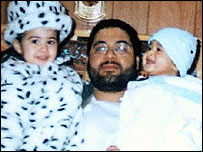 Mr Aamer, 42, who lived with his British wife and four children in London for five years after arriving in Britain in 1996, has been detained at the prison camp in Cuba since February 2002 after his capture in Afghanistan in December 2001. He was later handed over to American forces and held at Bagram prison, where he claims he was subjected to torture during interrogations.
Britain made its first request for the release of Mr Aamer to representatives of the Bush administration in August 2007. Mr Miliband was known to have discussed Mr Aamer’s release with Hillary Clinton after President Obama’s election victory, but it was not known until yesterday that a second request had been made.
A Foreign Office spokesperson said: “We have made an exceptional request for the release and return of Shaker Aamer, a Saudi national, to the UK.
“This is because of the exceptional nature of the Guantanamo facility and our sustained efforts to see it closed. Though we were successful with securing the return of four other non-UK nationals, we have not been able yet to do so with Shaker.”
Mr Aamer has never been charged with an offence.
This week the High Court in London ruled that there was evidence of wrong-doing in Mr Aamer’s case and ordered the UK Government to disclose secret documents that Mr Aamer alleges prove Britain was complicit in his torture.
The case is potentially more damaging to Britain than that of former Guantanamo detainee Binyam Mohamed because British agents are accused of being present during Mr Aamer’s alleged torture. In one allegation an MI5 agent is said to have been present when Mr Aamer’s US interrogators banged his head against a wall, although the agent did not intervene.
In his court victory on Tuesday two judges ruled that Mr Aamer was entitled to see UK Government documents relating to his detention. His lawyers say they contain evidence supporting his claims that confessions he made were obtained through torture.
Lord Justice Sullivan said: “Our present view is that this matter is clearly very urgent. If this information is to be of any use it has to be put in the claimant’s hands as soon as possible.”
Later Mr Aamer’s solicitor, Irene Nembhard, said: “It is the first ray of light for Shaker and his family. [They] will be overjoyed and they will be expecting that the British Government will give their lawyers the documents to assist them in persuading the Americans to release Shaker.” President Obama made the closure of the US naval base a key priority when he was elected last year. He set himself a deadline of one year but has since admitted that he will not be able to meet this target.
Clive Stafford Smith, the director of UK legal charity Reprieve, has represented Mr Aamer in the US. He said that the British and American governments seem to working in unison to keep information about Mr Aamer’s treatment from being made public. “It seems to be another big example of the British government working with the US to hide their mutual wrongdoing,” he said.
The US have told the UK that they believe Mr Aamer represents a security risk.
On the demonization of Saddam Hussein and Manuel Noriega
 An excerpt from the recently published book The Mother of All Battles: The Endless U.S.-Iraq War by Malcom Lagauche:
In December 2003, we all saw the photos of a disheveled Saddam Hussein after he was pulled out of a “spider hole” in a town near Tikrit. The administration laughed and the U.S. public made jokes about him and his hiding place.
The room was dirty. There was an empty can of Spam. The story was that he was holed up there and was totally irrelevant to Iraq. His day was done and he was now in the hands of Iraq’s liberators. What you saw wasn’t real. Nothing of this scenario was true.
On March 8, 2005, United Press International (UPI) ran a short press release titled “Public Version of Saddam Capture Fiction.” It received little publicity in the U.S., but some foreign news agencies did run the story
The UPI press release consisted of quotes from an ex-U.S. Marine of Lebanese descent, Nadim Rabeh. In addition to the U.S. version of the capture date being off by two days, during an interview in Lebanon, Rabeh stated:
I was among the 20-man unit, including eight of Arab descent, who searched for Saddam for three days in the area of Dour near Tikrit, and we found him in a modest home in a small village and not in a hole as announced. We captured him after fierce resistance during which a Marine of Sudanese origin was killed.
Rabeh recounted how Saddam fired at them with a gun from the window of a room on the second floor. Then, the Marines shouted at him in Arabic, “You have to surrender. There is no point in resisting.”
How did we come to see the pictures of the hole and a scruffy-looking Saddam Hussein? According to Rabeh, “Later on, a military production team fabricated the film of Saddam’s capture in a hole, which was in fact a deserted well.”
The former Marine’s account mixes with the rendition Saddam Hussein gave his lawyer when they had their first meeting. Saddam told him that he was captured in a friend’s house and that he was drugged and tortured for two days, hence the pictures of Saddam looking bedraggled.
All the major news networks and publications showed pictures of the hole and a beleaguered Saddam: Time Magazine, CNN News, magazines, daily newspapers, etc. You name it and they published it. But, they were all wrong. Not one publication took the time to research the story. They ran the pictures supplied by the U.S. military and parroted the lines they were given.
This was not the first time something similar has occurred. After the 1989 invasion of Panama, the U.S. allowed the press to enter Manuel Noriega’s office. He was portrayed as a sexual pervert. In the office were pictures of young boys, a picture of Hitler, red underpants and pornographic magazines.
A few months later, the first Marine to enter Noriega’s office was released from the Corps. He eventually talked to a reporter and gave his story of the encounter. He maintained that the contents of the office included only a desk, a telephone, a chair, and a typewriter.
With Saddam, the props were changed. They were made to make Saddam look like a caged animal on the run who only had the basic elements to survive. No one asked questions of what should have been obvious. For instance, how did Saddam Hussein come into possession of a can of Spam? There was absolutely no place in Iraq where Spam was sold. It contains pork, a food forbidden from a Moslem’s diet.
A few months after his capture, a picture was widely distributed that gained much publicity. It showed a bunch of U.S. soldiers standing next to an Iraqi building on which a painted illustration depicted the blowing up of the World Trade Center. The inference was that Iraqis took glee in the acts of the destruction of the World Trade Center on 9-11-2001.
If one looked close, it was evident that the soldiers were standing on the base path of a disused baseball field. There were no baseball fields in Iraq. Upon closer scrutinizing, the trees were typical southeastern U.S. types that are not indigenous to Iraq.
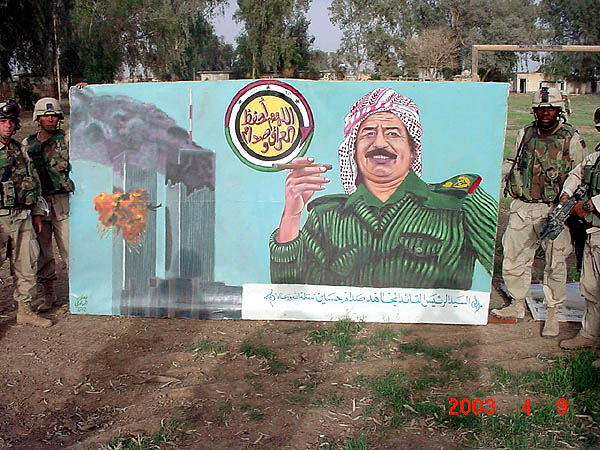 The photo was bogus. It was filmed in the U.S., but, the harm had been done. Many news agencies had distributed the picture. Its contents inflamed U.S. citizens even more about the Iraqi people.
Blogger: US air strikes kill ‘exactly 30′ enemies every time
By Daniel Tencer –The Raw Story – December 11th, 2009
 When it comes to air strikes against the Taliban, there’s something about the number 30, says the Security Crank blog. The unnamed military affairs blogger has published a list of recent air strikes against militants in Afghanistan and Pakistan, and an amazing pattern has emerged: It seems that just about every time an air strike is reported in the news, the Taliban casualty figure cited is 30. Citing the Moon of Alabama blog, which made a similar argument this spring, Security Crank linked to 12 news reports of separate air strike incidents since the start of the year in which the number of Taliban or insurgent casualties was reported to be 30, in most cases citing US military officials. Not 29, not 31. Thirty. What does this mean? For the Security Crank, it means we just shouldn’t believe the numbers.
How could we possibly have any idea how the war is going, here or anywhere else, when the bad guys seem only to die in groups of 30? The sheer ubiquity of that number in fatality and casualty counts is astounding, to the point where I don’t even pay attention to a story anymore when they use that magic number 30. It is an indicator either of ignorance or deliberate spin … but no matter the case, whenever you see the number 30 used in reference to the Taliban, you should probably close the tab and move onto something else, because you just won’t get a good sense of what happened there.
Megan Carpentier, writing at Air America, believes there’s more to this than just fudged numbers. Carpentier points to a story in the Los Angeles Times this past summer that reports that the US has, or at least had, during the Bush administration, a policy of requiring the secretary of defense to sign off on any air strike that was likely to kill more than 30 civilians.
The Times reported:
In a grisly calculus known as the “collateral damage estimate,” US military commanders and lawyers often work together in advance of a military strike, using very specific, Pentagon-imposed protocols to determine whether the good that will come of it outweighs the cost.
We don’t know much about how it works, but in 2007, Marc Garlasco, the Pentagon’s former chief of high-value targeting, offered a glimpse when he told Salon magazine that in 2003, “the magic number was 30.” That meant that if an attack was anticipated to kill more than 30 civilians, it needed the explicit approval of then-Defense Secretary Donald H. Rumsfeld or President George W. Bush. If the expected civilian death toll was less than 30, the strike could be OKd by the legal and military commanders on the ground.
Carpentier posits that 30 remains the magic casualty number for the Pentagon to this day, and implies that the casualty numbers are being fudged so that they are “acceptable” to the public.
“That PR calculus of how many deaths matter to the average American has apparently carried over from the Bush Administration to the Obama Adminstration, at least insofar as ground commanders are concerned,” she writes.
But Carpentier’s argument raises as many questions as it answers. For one, the Rumsfeld-era casualty policy applied to civilian casualties, not insurgent casualties. Yet the series of news reports this year cite the 30 number for Taliban casualties, and cite varying figures for civilian casualties, if any are cited at all. It would be hard to argue that the Pentagon believes the American public can only stomach 30 Taliban casualties at a time.
So the likelier explanation is that the Pentagon doesn’t know how many insurgents were killed — perhaps because distinguishing insurgents from civilians is no easy task. And the 30 number seems like a safe bet: High enough to justify the air strike, but not so high as to seem suspicious or overblown.
Of course, that’s all just speculation. So long as military officials continue to insist that it’s destroying the Taliban exactly 30 insurgents at a time, there won’t be much the public will be able to glean from the gory reports of death and destruction in Central Asia.
The Carbonphobia Virus

Since the beginning of time, people have been plagued with viruses. They seem to come and go.
May 28, 2009
The carbonphobia virus is spread through a combination of circumstances.
Symptoms
Those prone to infection will have one or more of the following symptoms:
•They are poorly educated in and generally ignorant about general science and find math difficult or even confusing.
•They have no knowledge of the science of climate or climate change.
•They tune in to NPR, PBS, CBS, NBC, ABC, or CNN.
•They believe without question what they read in Time, Newsweek, US News & World Report, The New York Times, The Washington Post, etc., etc..
•They have watched Al Gore’s An Inconvenient Truth and find it convincing.
•They attend a school or college with liberal teachers/professors who sing the praises of the UN’s Intergovernmental Panel on Climate Change (IPCC).
•They tend to believe they are liberals or find liberal views enticing.
The more symptoms a particular individual possesses, the more likely that individual will become infected with the virus.
Unfortunately, many victims of the carbonphobia virus do not realize they are infected. They continue to lead their daily lives in complete ignorance of their infection. They are perfectly content to believe they have been properly informed by others who are also infected. Victims may not realize they are manifesting an infection by the virus.
Manifestations
Revealing manifestations of the carbonphobia virus include:
•A belief that burning fossil fuels will destroy earth by making it too hot to sustain life.
•A belief that human activity can change climate.
•A belief that if humans just stop burning fossil fuels, all will be restored to “normal.”
•A belief that we must “do something” to avert a climate “crisis.”
•A belief that we can manufacture a system of government mandates to force people to use less carbon fuel by creating a system of carbon credits tied to an illusive carbon footprint scheme.
•A belief that carbon dioxide is an evil pollutant and we must regulate its production.
The more manifestations of this virus one exhibits, the worse the infection and the more difficult the treatment.
If you find you have any of the symptoms or manifestations of the carbonphobia virus and you are interested in a cure, then read on.
Treating the Carbonphobia Virus
Fortunately, there is a treatment for the carbonphobia virus, but it requires massive doses of common sense, elementary knowledge of climate and climate change history, and a willingness to value truth.
Education
It may be necessary for infected individuals to purge massive amounts of misinformation about climate science that have been instilled in them by false prophets, undeducated teachers, and misinformed media. The best place to start is with some fundamental facts about the greenhouse effect and climate change.
Facts About The Greenhouse Effect and Climate Change
•The greenhouse effect is not a significant climate change force. It is a process for retaining heat from the sun.
•The greenhouse effect does not create heat, it merely retains heat produced by the sun.
•Carbon dioxide is a minor contributor to greenhouse heat retention. Water vapor (and clouds of water vapor) are responsible for up to 95% of greenhouse heat retention; all other greenhouse gases account for the remainder (carbon dioxide is the most potent of the remainder of greenhouse gases after water vapor).
•Carbon dioxide is always being created and absorbed by natural processes. The decay of plant and animal life produces, among other things, carbon dioxide. Animals and insects produce carbon dioxide as a byproduct of digestion and respiration. Plants absorb carbon dioxide, giving off oxygen as a byproduct of photosynthesis.
•The properties of carbon dioxide limit its greenhouse heat retention to less than 3.0°C (5.4°F), regardless of the amount put into the atmosphere.
•The first 20 ppm of carbon dioxide added to the atmosphere (from zero base) provides more greenhouse heat retention than the next 380 ppm combined.
•Carbon dioxide’s impact on heat retention declines logarithmically as more is added to the atmosphere.
•At current levels of about 380 ppm of atmospheric carbon dioxide, more than 2.7°C of carbon dioxide’s heat retention capability has already been achieved. Adding more carbon dioxide to the atmosphere will have little impact on greenhouse heat retention.
•Climate is always changing. The natural state of climate is change.
•Historically (in the paleoclimate record), carbon dioxide exhibits a short term (100s of years) response to climate change; it does not produce climate change! Over time frames of tens or hundreds of millions of years, there is no relationship between atmospheric carbon dioxide and climate.
•Humans have never experienced Earth’s “typical” climate (the climate that has prevailed during more than 90% of the existence of living organisms). Earth’s typical climate is between 15°F and 25°F warmer than anything humans have ever experienced.
•Earth has experienced four ice eras over the past 540 million years. Ice eras last tens of millions of years and contain embedded colder climate regimes called ice epochs that last hundreds of thousands of years (up to a few million years). Ice eras and ice epochs feature climate much colder than Earth’s typical climate when there is no surface ice at sea level anywhere on the planet and sea levels are much higher than anything experienced by humans.
•During Earth’s coldest ice era (the “snowball Earth” era that peaked about 450 million years ago), when almost the entire planet was covered in ice, atmospheric carbon dioxide was 5600 ppm, about 15 times higher than today!
•Ice ages are relatively brief periods lasting tens of thousands of years. Warmer climate periods between ice age cycles are known as interglacials. We are experiencing an interglacial that began about 18,000 years ago. Interglacials typically last about 20,000 years.
•Within ice age and interglacial cycles, there are shorter term climate episodes known as warm and cold periods lasting hundreds of years. Recent (within the past 5000 years) known regimes of this nature include The Minoan Warm Period, The Roman Warm Period, The Medieval Warm Period, and, most recently, The Little Ice Age that peaked in the 17th century. If recent history is representative, warm periods are more common than cold periods. Remember, these are all within the interglacial of an ice age cycle.
•During the 20th century, global temperatures cooled, warmed, cooled again, and then warmed again. The end of the 1990s featured a particularly warm period of several years that coincided with a particularly active solar sunspot cycle. A high correlation between solar cycles and climate exists in the climate and solar record.
•The unusually active solar cycle experienced over the past decade is passing and many solar scientists believe an unusually minimal period of solar activity will be experienced during the next 20 years. This could lead to dramatic cooling, based on the paleoclimate and solar cycle record.
•If humans were confronted with an imminent cold period (e.g., the recent Little Ice Age), there is nothing that could be done to prevent it.
•Carbon-based fossil fuels are produced from decayed ancient plant and animal life. That ancient life obtained its carbon from atmospheric carbon dioxide through photosynthesis and digestion. Consequently, the use of fossil fuels is nothing more than an exercise in long term recycling of carbon dioxide back to the atmosphere from which it originated. It is a natural life cycle process.
If you have been infected with the carbonphobia virus and you study the above facts, you will find that a cure is likely to emerge. By absorbing this knowledge, you will shed your infection and become a cured individual, capable of resisting future attempts at reinfection.
However, be warned that cured individuals must be wary of the tremendous pressure that the infected population may bring upon them to shed their knowledge and become reinfected. Particular pressure will come from politicians, a particularly susceptible group due to their general abysmal comprehension of things scientific. Infected politicians will cause extreme pain to all others through the folly of imposing regulatory burdens [upon non-pollutant CO2 emissions for example] and insisting on such energy inefficient non-solutions such as costly ethanol-based fuels.
The danger of reinfection is always present, particularly among those who continue to subject themselves to some of the symptoms noted above.
Action without knowledge is pure folly. Avoid becoming infected with the carbonphobia virus by seeking truth.
Featured Video

Russia Helping Build a New Middle East /Trita Parsi
or go to
Aletho News Archives – Video-Images
From the Archives
Sam Husseini: The entire US establishment helped lie their way into the Iraq war
By Slava Zilber | American Herald Tribune | October 14, 2019
Sam Husseini is a senior analyst with the Institute for Public Accuracy, independent journalist and contributor to The Nation and FAIR.
Slava Zilber: Sam, three years ago, you appeared on Talk Nation Radio with David Swanson and spoke about the case of the GCHQ whistleblower Katharine Gun. You pointed out that the people involved in the spying on the UN and the people authorizing the Iraq War were not held accountable:
“Virtually everybody who went along with the war, whether it is Kerry or Clinton, of course, the Bush administration themselves has falsified their own records in terms of why, what they did, when they did, why they did it, to the extent that they’ve been scrutinised at all.”
You also address it in a recent article. And recently, Joe Biden has been lying about his position on the Iraq War. How can such an important issue escape meaningful scrutiny? … continue
Blog Roll
 Aletho News
- Russia Helping Build a New Middle East /Trita Parsi
- Barghouti: ‘Netanyahu has fallen,’ era of Smotrich, Ben-Gvir over
- China slams US policy on Iran as Russia rejects legality of nuclear meeting at UN
- The Mecca Pact Courts Iran: Containment Comes Full Circle
- Oman FM: Persian Gulf states, Iran, Iraq should form security pact excluding US
- Trump peddles fresh falsehoods, claims Iran ‘started the war’ as US aggression drags on
- Ukraine quagmire? Yes, but it’s for NATO, not Russia
- US intelligence hypes Chinese, Russian space threats while accelerating its own military buildup in orbit
- Iran FM Araghchi: “Hormuz Will No Longer Be the Same”
- EU facing trillion-euro debt hole while seeking more cash for Kiev
- If Americans Knew
- An error has occurred; the feed is probably down. Try again later.
- No Tricks Zone
- Sudden Stratospheric Warming, Powerful El Niño Combination May Lead To Extreme Europe Cold, Energy Crisis!
- Two New Studies Find Thwaites Glacier Melt Cannot Be Driven By Human Activity Or A Warming Ocean
- E-Cars Reduce CO2 Emissions By Only 41% Compared To Internal Combustion Engine Vehicles
- Predictions Made By Renowned Climate Professor Over Past Decades Have Been Proven To Be Poor
- New Study Suggests Large Regions Of The Pacific Ocean Have Been Cooling For The Last 80 Years
- Germany’s Green Energy Debacle: High Energy Costs Force Kahla Porzellan to Close After 182 Years!
- New Study: 50 Years Of The Most Aggressive ‘Net Zero’ Policies Can Only Affect The Global Climate By 0.03°C
- US September “Heat” Was No Record…Many Records Set Decades Ago
- Latest European Green Energy Debacle; Portugal’s Largest Flagship Solar Park Insolvent!
- Green Energy Debacle: German Expert Professor Fritz Vahrenholt Warns Of Severe Economic And Social Consequences

