The Ways of the Jewish Slave Traders

NOI RESEARCH GROUP • UNZ REVIEW • JULY 8, 2024
“As Mr. Yakub continued to preach for converts, he told his people that he would make the others work for them. (This promise came to pass.) Naturally, there are always some people around who would like to have others do their work. Those are the ones who fell for Mr. Yakub’s teaching, 100 per cent.” — The Most Honorable Elijah Muhammad, chapter 55 of Message to the Blackman in America titled “The Making of Devil”
“Three blessings a Jewish man is obligated to pray daily: ‘(Blessed art Thou,) Who did not make me a gentile; Who did not make me a woman; and Who did not make me a slave.’” — Babylonian Talmud, Menahot 43b–44a[*]
The story of the Jewish American experience that most Jews want to believe, and want the world to believe, is one of almost endless historical victimhood. They insist that they fled anti-Semitic oppression in Europe, landing safely on Ellis Island long after the Civil War’s end in 1865, and certainly some did. By their hard work, strong religious bonds, and reverence for communal education they succeeded against all odds, becoming, as Isaiah exhorts,[1] “a light unto the world.” As their story goes, they altogether eluded the ugly business of plantation slavery—but had they been here, they assure us, Jews would have been leading the abolitionists. After all, their own alleged enslavement to Pharaoh would have made them—of all the groups of Caucasian people—more sympathetic toward Black suffering.
To a trusting, Bible-believing people this Jewish self-portrait sounds plausible and is consistent with a Christian doctrine that sanctifies God’s Chosen People, the so-called Children of Israel (Deuteronomy 7:6–11). But the people who today call themselves Jews have now collided with their own Jewish scholars and historians who have presented an entirely different and far more troubling story about American Jewish history and the central role of Jews in the greatest crime in world history—the Black African Holocaust.
For the most part, Americans—white and Black—are entirely unaware that when the trans-Atlantic slave trade began in the 1500s, it was focused on shipping enslaved Africans to the sugar plantations of South America and the Caribbean islands centuries before expanding to the cotton fields of the American South in the mid-1700s. In the entire history of slavery in the western hemisphere as many as 9 out of 10 stolen Africans were shipped to those tropical climes—not to Mississippi, Alabama, Georgia, or South Carolina. The map below illustrates by the thickness of the arrows the relative proportions of Africans shipped to the New World, and, as shown, relatively few made it into what was to become the United States.

And all during this unprecedented racial tragedy Jews claim they were preoccupied in Europe, nowhere near the scene of the crime. Dr. Robert Swierenga very directly challenges that oft-repeated Jewish alibi (emphasis ours):
“At the birth of the United States in 1787 the Jews of the slave islands [Caribbean] outnumbered those in North America by five times and may have equaled those in England. Surinam had fourteen hundred Jews and Curaçao fifteen hundred—both nearly one half of the total white population. By contrast, the entire United States in 1790 numbered less than fifteen hundred Jews.”[2]
Seeking Religious Liberty?
But doesn’t this early Jewish presence in the “slave islands” conflict drastically with the prevailing image of the Jews as freedom-loving religious refugees? This is the perfect time to have an adult conversation about the trans-Atlantic slave trade and the Jewish role in it, and we must start by putting to bed the infantile notion endemic in this Jewish American fairy tale that Europeans sailed across the ocean “seeking religious liberty.” Every school child learns about the brave and pious Pilgrims who sailed to Plymouth on the Mayflower in 1620 “seeking religious liberty” from the tyrannical king of England. But the reality is that the “Pilgrims” were under contract with a private business named the Company of Merchant Adventurers, which expected them to acquire lumber, beaver and otter furs, and any other riches to be found or stolen. Thus, the “Pilgrims”—who referred to themselves as “separatists,” not as “pilgrims”—worked under contract to a private enterprise whose investors cared nothing about religion. More than a century before those Separatists, a Spaniard named Christopher Columbus was privately financed for his infamous voyage of discovery in 1492, by a wealthy Jew named Luis de Santangel. According to Simon Wiesenthal, in his book Sails of Hope (p. 168), “But for this man, Columbus’s expedition would never have taken place.” A practiced slave dealer, Columbus captured 600 of the aboriginal people he encountered to auction off back in Spain. And so it is with the Jewish newcomers who were seeking profits in sugar, cotton, tobacco, and other riches of the New World. Jewish scholar Yosef Hayim Yerushalmi describes them:
“[T]hese Jews engaged in an almost untrammeled range of economic activity, bore arms in the militias, owned land and ran plantations, and were represented in local councils. They had arrived at the closest point to full legal equality possible for Jews prior to the emergence of the modern nation-state.”[3]
They were seeking not “religious freedom” but the freedom to trade on an international scale. In fact, when they were first barred from acquiring Black slaves in the colonies they entered, the Jews considered it an act of “anti-Semitism.” The riches they sought could not be extracted without free and forced African labor. And as Jewish merchants followed their Yakubian directive—making others work for them—this is where the Black–Jewish relationship in the West truly begins.
In fact, there are scant references to the Jewish faith, Judaism, in any of the extant records of these early Jewish settlers. Nothing about Moses, Aaron, The Ten Commandments; no mention of the Ark of the Covenant; and nothing about being any “Light unto the Worlds.” If there were no profit in it, there was no “Jew” in it—and there was plenty of profit in Black slavery.[4]
Surinam, located in northeastern South America, holds the distinction of having the oldest Jewish community in the Americas, Jews having formed a synagogue in 1665. British Jewish historian Dr. Cecil Roth tracks them in his History of the Marranos: “The Jews of [Surinam] were also foremost in the suppression of the successive negro revolts, from 1690 to 1722: these as a matter of fact were largely directed against them, as being the greatest slave-holders of the region.
And here is where—unbelievably—we find the first inkling of the Jewish religion. The very first published Jewish prayer in their New World paradise, was a prayer titled “Old Hebrew Prayer in Time of Revolt of the Negroes,” in which the rabbi asked their God to give them strength “to conquer and destroy beneath their feet all cruel and rebellious Africans, our enemies who are planning evil against us…. Amen.”[5]

Roth continues: “These disturbances, together with the inroads of the climate, led ultimately to the abandonment of the settlement, of which nothing but the ruin now remains.” Dr. Roth hits on a theme here that may be difficult for most to comprehend. Not only were Jews present in the Americas long before the actual founding of the United States, but they were “the greatest slave-holders” in one of the major destinations of enslaved Africans. Further, these same “liberty-seeking” Jews actually went to war against the Africans that had escaped from Jewish plantations! Scholar Steven Sallie:
“There is little dispute, however, that Jews were quite often in charge of raiding adventures and the severe punishing of the maroons [escaped slaves]. In response to the cruelty of some Jews, maroons quite often attacked selected Jewish plantations. These Jewish-African conflicts were numerous, well organized, and persisted into the 1800s. Given their names, the leaders of the maroons tended to be Muslims.”[6]
One must also note that the decorated scholars quoted above spoke of “Jews” as a collective, neither making any qualification about the term that would limit responsibility or culpability to “some” or “a party among” or “a portion of” the Jewish community. This is particularly important given the magnitude of the crime they are describing—Black slavery.
Two major Jewish historical associations concur with, and elaborate on, this generally unknown aspect of the Jewish role in Black slavery. The American Jewish Historical Society (AJHS) is the oldest and most prominent, having its founding in 1892. Rabbi Marc Lee Raphael was its longtime editor of its publications when he wrote in 1983 that in the Caribbean and South America,
“Jewish merchants played a major role in the slave trade. In fact, in all the American colonies, whether French (Martinique), British, or Dutch, Jewish merchants frequently dominated. This was no less true on the North American mainland, where during the eighteenth century Jews participated in the ‘triangular trade’ that brought slaves from Africa to the West Indies…”
“FREQUENTLY DOMINATED” and “played a major role” are the terms Rabbi Raphael used almost a decade before the Nation of Islam published its never-refuted book on Jews and the slave trade, The Secret Relationship Between Blacks and Jews, Vol. 1. Drs. Swierenga, Sallie, Raphael, and Roth are all addressing a startling duality in the 500-year Black–Jewish relationship—that the Jewish self-image of a biblical people yearning for freedom directly contradicts the actual fact that the Jewish people were attracted to, and often dominated the economies in, the very places where existed the most brutal forms of chattel slavery.

The American Jewish Archives (AJA) was founded in 1947 by the “Dean of American Jewish scholars,” Rabbi Jacob Rader Marcus,[7] and is the repository of “ten million pages of documentation” on Jewish history in the Americas. Turns out, the AJA has a lot to say about these early “oppressed” Jews who migrated from Europe and somehow found unprecedented prosperity in the “slave islands.” In several articles the AJA casually makes several references to the interdependent relationship between the most brutal forms of slavery and the Jewish pilgrims: “[I]ndividual Jews can be found on almost every island of the Caribbean prior to the abandonment of slavery in the mid-nineteenth century,”[8] thus firmly linking slavery to the Jews’ very presence.
In the plantation colony of Surinam the AJA points out that Jews “fared well, thanks to the abundance of slaves and plantations…”[9] Rabbi Dr. Raphael adds that
“Slave trading was a major feature of Jewish economic life in Surinam, which was a major stopping-off point in the triangular trade. Both North American and Caribbean Jews played a key role in this commerce: records of a slave sale in 1707 reveal that the ten largest Jewish purchasers spent more than 25 percent of the total funds exchanged.”[10]
A more recent analysis of Surinam’s Jews by Dr. Aviva Ben-Ur only solidifies this linkage and adds to the horrors:
“The liberty Jews enjoyed…was inextricably intertwined with violent coercion….African slaves were routinely tortured on the village’s roadsides or along the fence enclosing the synagogue square.”[11]
The AJA hits on a theme that is repeated over and over again: “the abolition of the slave trade in 1819 and the formal emancipation of slaves in 1863 made plantations unprofitable and so decimated Jewish trade that [the Jews] all but disappeared.” Recognize the import of that statement: the freeing of the Black slaves “DECIMATED” and “DISAPPEARED” the Jewish community.
Jews had a presence on the island of Barbados in about 1628 and historian Stephen Fortune wrote that “the reputed prosperity of the Jews contrasted with the inexcusable and disgraceful plight of the slaves.”[12] Jews flocked to this hell on earth, and here again the AJA sounds the uniquely Jewish refrain: “Unfortunately, economic depression resulting from the earthquake and the emancipation of slaves led to the emigration of many of the island’s Jews.”[13] They pose the freeing of African slaves as a disaster equal to that of an earthquake—causing the “unfortunate” Jews to permanently flee.
The Encyclopedia Judaica (EJ) reports that the island of Curaçao was called the “Mother of the Caribbean Jewish communities,” yet Jewish scholars describe the island as a distribution center for the slave trade[14]— “a large slave depot.”[15] The AJA affirms that “The slave trade helped Curaçao to prosper, and her Jewish community grew rapidly,” even building a synagogue “for the convenience of the plantation owners who lived outside of the city.”[16] In fact, Jews owned 80 percent of Curaçao’s plantations, and Jewish slave traders were responsible for distributing the slaves from Curaçao to the Spanish American ports throughout the Caribbean and South America.[17] In 1765, the Jesurun family owned a record number of 366 Black people; the closest Gentile had 240 slaves. In one documented case in 1701, the Jewish Senior brothers arranged the shipment of 664 Africans; 205 perished en route to Curaçao.[18] And historian of the island Johan Hartog confirms a familiar Jewish theme—that the Jewish community suffered a “steep decline” the same year that the slave trade was curtailed.[19]
When Jews settled in Haiti, the Encyclopedia Judaica admitted,[20] they “specialized in agricultural plantations [but] with the slave revolts at the end of the 18th century, Jews gradually abandoned Haiti for other Caribbean islands or for the United States (New Orleans, Charleston).” Here again Jews are not sticking around for Black freedom; nor were they part of the process of achieving it. As soon as emancipation becomes a reality, Jews abandon Haiti for slavier environs.
Jamaica also had a robust Jewish colony, writes the AJA (p. 151): “The growth of the sugar industry enlarged the Jewish immigration and a number of Jews became plantation owners.”[21] The EJ boasted that “Jews with agricultural plantations controlled the sugar and vanilla industries, and …were the leaders in foreign trade and shipping.”[22] In its section on “Sugar”—the product most responsible for the enslavement of millions of Africans—the EJ puts Jews at the epicenter:
“The Jews of Brazil were not important as proprietors of [sugar] mills but rather as financial agents, brokers, and export merchants. When Brazil came again under Portuguese rule in the second half of the 17th century, many Jews emigrated to Surinam, Barbados, Curaçao, and Jamaica, where they acquired large sugarcane plantations and became the leading entrepreneurs in the sugar trade.”[23]
And then it reveals the other, now predictable, Jewish reality: “The abolition of slavery in the British dominions (1833) lowered the economy and scattered the Jews.” Note here the AJA writes that freedom for enslaved Blacks “scattered” the Jews.
Many of those Jews “scattered” to the North American mainland, says the AJA: “The end of slavery in the Caribbean saw Jews from the islands arriving almost daily…” Many ended up in the colony of Georgia, described as “suffering from the trustees’ idealistic insistence on no slaves or liquor…”[24] As the AJA frames it, “no slaves” meant Jewish “suffering.” In fact, the refusal of the leaders of Georgia to permit Black slavery triggered a Jewish exodus from the colony! By 1740 only three Jewish families were left. They bounced, according to Rabbi Marcus, because “Negro slavery was prohibited, the liquor traffic was forbidden.”[25] Jew Abraham De Lyon said he left for “the want of Negroes…whereas his white servants cost him more than he was able to afford.”[26]
From their own archival documents the most lettered Jewish scholars have painted an alarming portrait of the earliest of their founding fathers. In every case examined, Jewish “liberty” and prosperity were entirely dependent on Black slavery, and once Black “liberty” was achieved the Jewish world imploded and the Jews fled. The Encyclopedia Judaica summarizes nicely:
“A general decline of the Spanish-Portuguese communities in the Caribbean set in during the 19th century. Growing competition in agricultural products, the abandonment of the plantations by the Afro-American laborers due to the abolition of slavery, assimilation, and emigration were the main causes of this decline.”[27]
The Most Honorable Elijah Muhammad wrote that after being bound in Europe for 1,000 years, “they were loose (free) to travel over the earth and deceive the people.” Further, “They have been here now over 400 years. Their worst and most unpardonable sins were the bringing of the so-called Negroes here to do their labor.”[28]
Jewish scholars have thus affirmed that no one better fits Mr. Muhammad’s description of the traveling deceiver and “unpardonable” slave-making sinner than the Jew.
NOTES
[*] See also Michael Hoffman, Judaism Discovered (2008), p. 375.
[1] Isaiah 42:6; 49:6; 60:3.
[2] Robert Swierenga, The Forerunners: Dutch Jewry in the North American Diaspora (Detroit: Wayne State University Press, 1994), p. 36.
[3] Yosef Hayim Yerushalmi, “Between Amsterdam and New Amsterdam: The Place of Curaçao and the Caribbean in Early Modern Jewish History,” American Jewish History, vol. 72, no. 2 (December 1982), p. 190.
[4] Yda Schreuder, Amsterdam’s Sephardic Merchants and the Atlantic Sugar Trade in the Seventeenth Century (New York: Palgrave Macmillan, 2019), p. 70. Also, Steven S. Sallie, “The Role of the Semitic Peoples in the Expansion of the World Economy Via the Trans-Atlantic Slave Trade: A Literature Extraction and an Interpretation,” Journal of Third World Studies, vol. 11, no. 2 (Fall 1994), p. 173.
[5] “Miscellaneous Items Relating to Jews of North America,” Publications of the American Jewish Historical Society, vol. 27 (1920), pp. 223–24.
[6] Sallie, “The Role of the Semitic Peoples,” p. 173.
[7] https://www.americanjewisharchives.org/about/jacob-rader-marcus/
[8] Malcolm H. Stern, “Portuguese Sephardim in the Americas,” American Jewish Archives, vol. 44, no. 1 (Spring/Summer 1992), p. 142.
[9] Allan Metz, “Those of the Hebrew Nation…The Sephardic Experience in Colonial Latin America,” American Jewish Archives, vol. 44, no. 1 (Spring/Summer 1992), p. 226.
[10] Marc Lee Raphael, Jews and Judaism in the United States: A Documentary History (New York: Behrman House, 1983), p. 24.
[11] Jewish Autonomy in a Slave Society (Philadelphia: University of Pennsylvania Press, 2020), p. 76.
[12] Stephen Alexander Fortune, Merchants and Jews: The Struggle for the British West Indian Caribbean, 1650-1750 (Gainesville: University Presses of Florida, 1984), p. 109.
[13] Stern, “Portuguese Sephardim in the Americas,” p. 143.
[14] Lavy Becker, “A Report on Curacao,” Wisconsin Jewish Chronicle, December 5, 1969.
[15] Daniel M. Swetschinski, “Conflict and Opportunity in ‘Europe’s Other Sea’: The Adventure of Caribbean Jewish Settlement,” American Jewish History, vol. 72, no. 2 (December 1982), p. 236.
[16] Stern, “Portuguese Sephardim in the Americas,” p. 147; Emma Fidanque Levy, “The Fidanques: Symbols of the Continuity of the Sephardic Tradition in America,” American Jewish Archives, vol. 44, no. 1 (Spring/Summer 1992), pp. 184–85.
[17] Marc Lee Raphael, Jews and Judaism in the United States: A Documentary History (New York: Behrman House, 1983), p. 24.
[18] Isaac S. and Susan A. Emmanuel, History of the Jews of the Netherland Antilles (Cincinnati: American Jewish Archives, 1973), p. 77.
[19] Johan Hartog, Curaçao From Colonial Dependence to Autonomy (Aruba, Netherland Antilles, 1968), p. 276.
[20] Second Edition, Volume 4, p. 473.
[21] Stern, “Portuguese Sephardim in the Americas,” p. 151.
[22] Second Edition, Volume 4, p. 474.
[23] See also James C. Boyajian, “New Christians and Jews in the Sugar Trade, 1550–1750: Two Centuries of Development of the Atlantic Economy,” in The Jews and the Expansion of Europe to the West, 1450-1800, eds. Paolo Bernardini and Norman Fiering (New York: Berghahn Books, 2001), p. 476.
[24] Stern, “Portuguese Sephardim in the Americas,” p. 164.
[25] Jacob Rader Marcus, Memoirs of American Jews 1775-1865, vol. 2 (New York: KTAV Publishing House, 1974), p. 288.
[26] Edward D. Coleman, “Jewish Merchants in the Colonial Slave Trade,” Publications of the American Jewish Historical Society, vol. 34 (1938), p. 285.
[27] Second Edition, Volume 4, p. 470.
[28] Message to the Blackman in America, pp. 104, 267; “Is There a Mystery God?” Pittsburgh Courier, Aug. 18, 1956.
Republished from Nation of Islam Research Group
Civil War in Donbass 10 Years On
Scroll down for video
By Kit Klarenberg | Global Delinquents | July 8, 2024
July 1st marked the 10th anniversary of a brutal resumption of hostilities in the Donbass civil war. Perhaps unsurprisingly, it passed without comment in the Western media. On June 20th 2014, far-right Ukrainian President Petro Poroshenko called a ceasefire in Kiev’s “anti-terrorist operation”. Launched two months prior following vast protests, and violent clashes between Russian-speaking pro-federal activists and authorities throughout eastern Ukraine, the intended lightning strike routing of internal opposition to the Maidan government quickly became an unwinnable quagmire.
Ukrainian forces were consistently beaten back by well-organised and determined rebel forces, hailing from the breakaway “People’s Republics” in Donetsk and Lugansk. Resultantly, Poroshenko outlined a peace plan intended to compel the separatists to put down their arms, during the ceasefire. They refused to do so, prompting the President to order an even more savage crackdown. This too was a counterproductive failure, with the rebels inflicting a series of embarrassing defeats on Western-sponsored government forces. Kiev was ultimately forced to accept the terms of the first Minsk Accords.
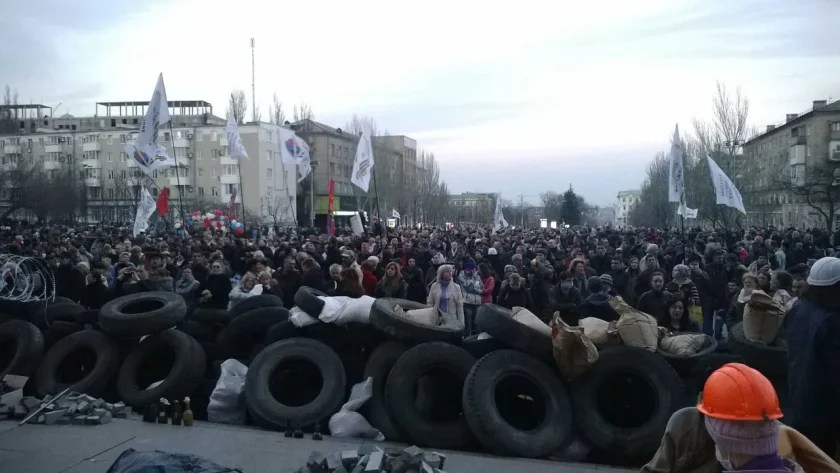
Anti-Maidan protesters gather in front of the occupied Donetsk Oblast regional administration building, April 2014
This agreement, like its successor, did not provide for secession or independence for the breakaway republics, but their full autonomy within Ukraine. Russia was named as a mediator, not party, in the conflict. Kiev was to resolve its dispute with rebel leaders directly. Successive Ukrainian governments consistently refused to do so, however. Instead, officials endlessly stonewalled, while pressuring Moscow to formally designate itself a party to the civil war.
No wonder – had Russia accepted, Kiev’s claims that its savage assault on the civilian population of Donbass was in fact a response to invasion by its giant neighbour would’ve been legitimised. In turn, all-out Western proxy war in eastern Ukraine, of the kind that erupted in February 2022, could’ve been precipitated. Which, it is increasingly clear, was the plan all along.
‘Grassroots Movement’
In the days prior to the April 2014 launch of Kiev’s “anti-terrorist operation” in Donbass, notorious war hawk Samantha Power, now USAID chief, openly spoke on ABC of “tell-tale signs of Moscow’s involvement” in the unrest. “It’s professional, coordinated. Nothing grassroots about it,” she alleged. Such framing gave Ukrainian officials, their foreign backers, and the mainstream media licence to brand the brutal operation a legitimate response to a fully-fledged, if unacknowledged, “invasion” by Russia. It is referred to as such in many quarters today.
Yet, at every stage of the Donbass conflict, there were unambiguous indications that the Ukrainian government’s claims of widespread Russian involvement – endorsed by Western governments, militaries, intelligence agencies, pundits and journalists – were fraudulent. One need look no further than the findings of a 2019 report published by the George Soros-funded International Crisis Group (ICG), Rebels Without A Cause. Completely unremarked upon in the mainstream, its headline conclusions are stark:
“The conflict in eastern Ukraine started as a grassroots movement… Demonstrations were led by local citizens claiming to represent the region’s Russian-speaking majority.”
ICG noted that Russian leaders were from the start publicly and privately sympathetic to Russian-speakers in Donbass. Nonetheless, they issued no “clear guidance” to businessmen, government advisers or the domestic population on whether – and how – they would be officially supported by Moscow in their dispute with the Maidan government. Hence, many Russian irregulars, encouraged by “what they regarded as the government’s tacit approval, made their way to Ukraine.”
Per ICG, it was only after the conflict started that the Russian government formalised a relationship with the Donbass rebels, although the Kremlin quickly changed tack on what they should do. A Ukrainian fighter told the organisation that he “began hearing calls for restraint in rebel efforts to take control of eastern Ukrainian towns and cities” in late April 2014. However, “the separatist movement in Donbass was determined to move ahead.”
Due to this lack of control, and repeated calls for direct intervention in the conflict from the rebels, Russia replaced the Donetsk and Lugansk rebel leadership with hand-picked figures, who took an explicitly defensive posture. But the Kremlin was ultimately “beholden” to the breakaway republics, not vice versa. It could not even reliably order the rebels to stop fighting. A Lugansk paramilitary told ICG:
“What do you do with 40,000 people who believe that, once they put down their arms, they will all be shot or arrested? Of course, they are going to fight to the death.”
Elsewhere, the report cited data provided by “Ukrainian nationalist fighters”, which showed rebel casualties to date were “overwhelmingly” Ukrainian citizens. This was at odds with the pronouncements of government officials, who invariably referred to them as “Russian mercenaries” or “occupiers”. More widely, figures within Poroshenko’s administration had routinely claimed Donbass was wholly populated by Russians and Russia-sympathisers.
One Ukrainian minister was quoted in the report as saying he felt “absolutely no pity” about the extremely harsh conditions suffered by Donbass civilians, due to the “legal, political, economic and ideological barriers isolating Ukrainian citizens in rebel-held territories” constructed by Kiev. This included enforcing a crippling blockade on the region in 2017, which created a “humanitarian crisis”, and left the population unable to claim pensions and welfare payments, among other gruelling hardships.
Several Donbass inhabitants interviewed by ICG expressed nostalgia for the Soviet Union. Most felt “under attack” by Kiev. A pensioner in Lugansk, whose “non-combatant son” was killed by a Ukrainian sniper, asked how Poroshenko could claim the territory was “a crucial part” of Ukraine: “then why did they kill so many of us?”
‘Worst Option’
In conclusion, ICG declared the situation in Donbass “ought not to be narrowly defined as a matter of Russian occupation,” while criticising Kiev’s “tendency to conflate” the Kremlin with the rebels. The organisation expressed optimism newly-elected President Volodymyr Zelensky could “peacefully reunify with the rebel-held territories,” and “[engage] the alienated east.” Given present day events, its report’s conclusions were eerily prescient:
“For Zelensky, the worst option… would be to try to forcibly retake the territories, as an all-out offensive would likely provoke a military response from Moscow and a bloodbath in Donbass. It could even lead Moscow… to recognise the statelets’ independence. The large-scale military option is mainly advocated by nationalists, not members of Ukraine’s political establishment. But some prominent mainstream politicians refuse to rule it out.”
Zelensky did initially try to resolve the Donbass conflict through diplomatic means. In October 2019, he moved to hold a referendum on “special status” for the breakaway republics in a federalized Ukraine, while personally meeting with representatives of Azov Battalion, begging them to lay down their arms and accept the compromise. Mockingly rebuffed and threatened by the Neo-Nazi group’s leaders, while rocked by nationalist protests against the proposed plebiscite in Kiev, the plans were dropped. So then the President picked the “worst option”.
In March 2021, Zelensky issued a decree, outlining a “strategy for the de-occupation and reintegration” of “temporarily occupied territory.” Falsely characterising Crimea and the Donbass as “occupied by the armed forces of the aggressor state,” it sketched a clear blueprint for a hot war to recapture both territories. Immediately, Ukrainian forces began to mass in the south and east of the country in preparation.
This activity inevitably spooked the Kremlin, leading to a huge military buildup on its border with Ukraine, and extensive wargame exercises, plotting scenarios including encirclement of Ukrainian forces in Donbass, and blocking Kiev’s Black Sea access. Suddenly, the Western mainstream became awash with warnings of imminent Russian invasion, and British and US surveillance flights in the region surged. Media reporting either neglected to mention or outright denied this was explicitly triggered by Kiev’s escalation.
Things quietened down thereafter, although the situation on-the-ground remained tense. In October that year, a Ukrainian drone struck rebel positions in Donbass. Moscow, and German officials, charged that the attack violated Minsk, while Zelensky’s then-right hand man Oleksiy Arestovych denied this was the case. He had by this time openly stated on many occasions war with Russia was Kiev’s price for joining the EU and NATO.
Fast forward four months, and at the start of February 2022, French President Emmanuel Macron reaffirmed his commitment to Minsk. He claimed Zelensky provided personal assurances its terms would be fulfilled. Yet, on February 11th, talks between representatives of France, Germany, Russia and Ukraine collapsed without tangible results, after nine hours. Kiev rejected demands for “direct dialogue” with the rebels, insisting – yet again – Moscow formally designate itself a party to the conflict.
Then, as documented in multiple contemporary eyewitness reports from OSCE observers, mass Ukrainian artillery shelling of Donbass erupted. On February 15th, unnerved representatives of the Duma, led by the influential Communist Party, formally requested the Kremlin to recognise the Donetsk and Lugansk People’s Republics. Vladimir Putin initially refused, reiterating his commitment to Minsk. The shelling intensified. A February 19th OSCE report recorded 591 ceasefire violations over the past 24 hours, including 553 explosions in rebel-held areas.
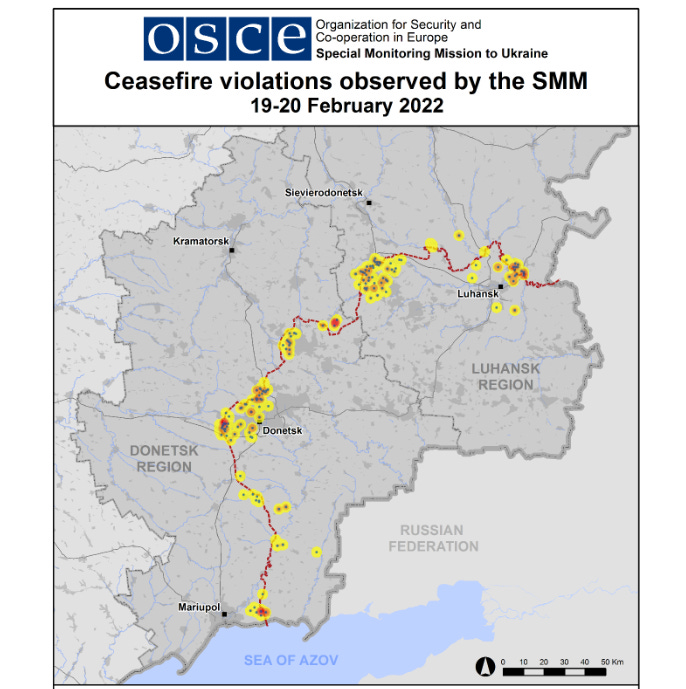
Civilians were harmed in these attacks, and civilian structures, including schools, targeted deliberately. Meanwhile, that same day, Donetsk rebels claimed to have thwarted two planned sabotage attacks by Polish-speaking operatives on ammonia and oil reservoirs on their territory. Perhaps not coincidentally, in January 2022 it was revealed the CIA had since 2015 been training a secret paramilitary army in Ukraine to carry out precisely such strikes, in the event of Russian invasion.
So it was on February 21st, the Kremlin formally accepted the Duma’s request from a week earlier, recognising Donetsk and Lugansk as independent republics. And now here we are.
Boeing to plead guilty to fraud charges
RT | July 8, 2024
US plane-maker Boeing has agreed to plead guilty to criminal fraud charges in relation to deadly crashes involving its 737 MAX aircraft, the Department of Justice has said.
Two separate Boeing 737 MAX planes went down in Indonesia and Ethiopia in less than five months between 2018 and 2019, killing a total of 346 people.
According to a court filing by prosecutors on Sunday, Boeing is going to pay a fine of $243.6 million to resolve the probe by the US government. Under the deal, the plane-maker has also agreed to invest at least $455 million over the next three years to improve its safety and compliance programs.
A special monitor will be introduced to ensure Boeing’s compliance, and will issue public progress reports annually, the filing read. The company will be on probation during this three-year period, it added.
Members of Boeing’s board will also have to meet with the relatives of those killed in the 737 MAX crashes as part of the agreement. The plea deal requires the approval of the federal judge in charge of the case, Reed O’Connor.
A Boeing spokesperson confirmed to the media that the firm had “reached an agreement in principle on terms of a resolution with the Justice Department.”
The deal avoids a trial for the plane-maker, which was demanded by the families of the victims. However, it would make Boeing a convicted felon, which could complicate the acquisition of contracts with US government agencies such as the Department of Defense and NASA.
In 2021, Boeing agreed to pay over $2.5 billion, including the original $243.6 million fine, as part of a deferred-prosecution deal with the Department of Justice after the company admitted to deceiving the Federal Aviation Administration (FAA) about an obscure flight control system linked to the crashes. In both cases, faulty sensor readings caused 737 MAX 8 jets to enter a nosedive. If the company had complied with the deal, the charge would have been dropped after a period of three years.
However, federal prosecutors accused Boeing of violating the terms of the agreement in May, claiming that the company had failed to take promised compliance measures. The accusations followed an incident in January, when a door blew out mid-flight on a 737 MAX operated by Alaska Airlines.
The Corbett Report Hall of Shame
Corbett | July 5, 2024
Today, James begins inducting MSM liars, dodgy politicians and intelligence agency scoundrels into The Corbett Report Hall of Shame. Simultaneously, he begins inducting truth-telling whistleblowers and courageous journalists into The Corbett Report Hall of Fame. Who will make the cut? Who do you think should make the cut in the future? Join James for this week’s edition of The Corbett Report podcast and get your thinking cap on!
WATCH ON:  /
/  /
/  /
/  /
/  /
/  or DOWNLOAD THE MP4
DOCUMENTATION
| Dan Rather’s account from November 25, 1963 | |
| Time Reference: | 03:39 |
| Description: | Young CBS journalist Dan Rather became one of the first people on the planet to see the Zapruder film of the JFK assassination in November 1963. He then immediately rushed to the TV studio to lie about what he saw! SHAAAAME! |
| Link To: | YouTube.com |
| The CIA’s Zapruder Film Secrecy | |
| Time Reference: | 05:55 |
| Description: | Jacob Hornberger uncovers the true story of how the Zapruder film was altered by the CIA before it was deposited in the Life Magazine archives. |
| Link To: | Future of Freedom Foundation |
| Michael Ruppert- CIA involvement in Drug Trafficking | |
| Time Reference: | 11:24 |
| Description: | Michael Ruppert throws a 1996 CIA PR event into disarray when he tells Director Deutsch to his face that the CIA has dealt drugs in the USA for a long time. FAAAME! |
| Link To: | YouTube |
| The CIA and the Drug Trade | |
| Time Reference: | 12:51 |
| Description: | A 2011 report on how the CIA helps ship in the drugs. |
| Link To: | The Corbett Report |
| Requiem for the Suicided: Gary Webb | |
| Time Reference: | 13:30 |
| Description: | A 2010 report on Gary Webb’s reporting and untimely death.. |
| Link To: | The Corbett Report |
| A Crack in the Story — NBC Dateline (13 June 1997) | |
| Time Reference: | 14:45 |
| Description: | An extensive 1997 report on the CIA drug running story that features CIA officer Duane Clarridge denying that there has EVER been a conspiracy in the USA! SHAAAAME! |
| Link To: | YouTube |
| “The CIA and the Media” by Carl Bernstein | |
| Time Reference: | 17:22 |
| Description: | 1977 report expanding on the Church Committee revelations of CIA involvement in the news media. |
| Link To: | CarlBernstein.com |
| Truth At Last: The Assassination of Martin Luther King | |
| Time Reference: | 17:38 |
| Description: | 2018 report documenting the US government’s role in the MLK assassination (including the FBI’s attempt to blackmail King into killing himself). |
| Link To: | The Corbett Report |
| Frank Church on The Intelligence Gathering Debate (1975) | |
| Time Reference: | 17:59 |
| Description: | Senator Frank Church warns about the electronic surveillance capabilities of the US intelligence agencies and the threat that they pose to “democracy” itself. |
| Link To: | YouTube |
| William Colby presents the “heart attack gun” to the Church Committee | |
| Time Reference: | 18:43 |
| Description: | CIA Director William Colby interrogated by Senator Frank Church at a Senate committee hearing on intelligence operations. Colby exhibits and explains the use of a poison dart firing pistol that fires shellfish toxin and other poisonous ammunition. FAAAAME! |
| Link To: | YouTube |
| The Disturbing Story Of The Heart Attack Gun Invented By The CIA During The Cold War | |
| Time Reference: | 21:25 |
| Description: | One of the many mainstream articles detailing the history, development, presentation and “retirement” of the CIA’s previously secret heart attack gun. |
| Link To: | All That’s Interesting |
| Congressional Oversight and the Crippling of the CIA | |
| Time Reference: | 22:50 |
| Description: | Intelligence shills STILL blame the Church Committee for 9/11 and every other bad thing that’s ever happened. |
| Link To: | CorbettReport.com |
| Gerald Ford’s Remarks at the Swearing In of George H.W. Bush as Director of CIA | |
| Time Reference: | 23:49 |
| Description: | President Gerald Ford spoke in the auditorium at CIA headquarters on the occasion of George H. W. Bush’s appointment as Colby’s replacement as DCIA. |
| Link To: | YouTube |
| David Rockefeller and Dick Cheney joke around at the CFR | |
| Time Reference: | 24:59 |
| Description: | Dick Cheney admits he never told voters back home in Wyoming that he was once a director of the CFR. SHAAAME! |
| Link To: | YouTube |
| Dick Cheney’s 2003 CNN obituary | |
| Time Reference: | 27:48 |
| Description: | Snopes “fact checks” the idea that CNN prematurely published their ready-made Cheney obituary in 2003. (SPOILER: THEY SURE DID!) |
| Link To: | Snopes |
| How to Make a Lobbyist Squirm | |
| Time Reference: | 29:08 |
| Description: | A 2015 report on the infamous Moreira / Moore exchange about drinking glyphosate. |
| Link To: | The Corbett Report |
| Patrick Moore, Man Who Refused to Drink Roundup, is Not a Monsanto Lobbyist | |
| Time Reference: | 30:34 |
| Description: | Thanks for the clarification, Newsweek! |
| Link To: | NewsWeek |
| Bayer ordered to pay $2.25 billion after jury concludes Roundup weed killer caused a man’s cancer, attorneys say | |
| Time Reference: | 31:26 |
| Description: | Report on the monumental judgment against Monsanto in the Roundup cancer trial. |
| Link To: | CNN |
| The man who unmasked Patrick Moore | |
| Time Reference: | 31:44 |
| Description: | Important GMWatch interview with Moreira about how the viral Moore interview moment came about. |
| Link To: | GMWatch |
The Prince And The Spy

By Whitney Webb | The Last American Vagabond | May 12, 2023
A TLAV investigation has found that Erik Prince, the man behind the Blackwater mercenary group, recently teamed up with an Israeli spy, creating a front company with her to help Israeli defense technology providers exploit loopholes and sell their products to the American military.
For years, Erik Prince – the founder of mercenary firm Blackwater (now Academi) – has been a major source of controversy. Ever since he left Blackwater over a decade ago, Prince has appeared in the news for pushing to privatize several wars, his ties to former President Donald Trump’s presidential campaigns, his violation of international arms embargoes and his unusually close ties with Project Veritas, among other notable events and connections.
However, some of Prince’s antics in recent years have not yet made it into the news – namely his decision to team up with an Israeli spy to build a very secretive company that has – until now – evaded scrutiny. That company, Comframe Solutions, appears to operate as an intelligence front and explicitly targets parts of the American military involved in highly sensitive combat operations. As this investigation will show, Prince’s partner in Comframe – Lital Leshem – has been tied to a series of apparent, and admitted, Israeli intelligence front companies, several of which have a focus on technology. Yet Prince and his close associate Chris Burgess – Comframe’s supposed president – have done everything they can to hide their association with the incredibly secretive company. Why might that be and what exactly is Comframe up to?
From “Army Brat” to Cyber Spy
Lital Leshem was raised as an “army brat” in Reut, Israel and Pennsylvania, USA. She later enlisted in the Israel Defense Forces (IDF) as she was “truly devoted to safeguarding the State of Israel.” She quickly rose in the ranks, becoming Operations Officer in the IDF of the besieged Gaza Strip and later becoming a Major, a position she continues to hold to this date through her “reserve duty activities.” According to her LinkedIn, she served in Israeli military intelligence from 2005 to 2011 and, more specifically, served in its signals intelligence unit – Unit 8200. She later attended IDC Herzliya, an Israeli university deeply tied to its military and intelligence apparatus. There, she met Amir Elichai and the two would co-create the company Reporty, which later became Carbyne911 – today known only as Carbyne.
Carbyne was originally founded as Reporty in 2014 by Leshem, Elichai and Alex Dizengof. Leshem and Elichai are Unit 8200 veterans, while Dizengof previously worked for Israel’s Prime Minister’s Office. Before it was revealed that Jeffrey Epstein had poured at least 1 million dollars into the company at the behest of his close associate Ehud Barak, Cabryne’s board of directors – which Barak chaired – included the former commander of Unit 8200, Pinchas Buchris, as well as Epstein associate turned venture capitalist Nicole Junkermann. In the wake of the Epstein scandal, Buchris, Barak and Junkerman, among others, were removed from the board and were largely replaced with veterans and former heads of American intelligence and law enforcement agencies. Leshem had left the company in 2017, but has continued to own shares in the company.
Carbyne is a Next-Generation 9-11 (NG911) platform and the explicit goal of NG911 is for all 911 systems nationwide to become interconnected. It is currently active throughout the United States, its main target market. Its software has been criticized due to “serious privacy concerns” about the amount of information it harvests from smartphones that call a 911 call center running Carbyne’s software. For instance, Carbyne’s smartphone app extracts the following information from the phones on which it is installed:
“Device location, video live-streamed from the smartphone to the call center, text messages in a two-way chat window, any data from a user’s phone if they have the Carbyne app and ESInet, and any information that comes over a data link, which Carbyne opens in case the caller’s voice link drops out.”
The potential for Carbyne as a tool for mass surveillance has been extensively reported by Narativ, MintPress News and other outlets. In addition, Carbyne stores all data on past calls and events in order to “enabl[e] decision makers to accurately analyze the past and present behavior of their callers, react accordingly, and in time predict future patterns.” As a result, Carbyne – along with other Israeli intelligence-connected companies seeking to dominate the American “public safety” market – has the potential to facilitate controversial “predictive policing”, i.e. pre-crime, policies.
In addition to Carbyne, Leshem also worked for Black Cube, which has since been removed from her LinkedIn. There, she had been the firms Director of Marketing. Black Cube was specifically outed as an Israeli intelligence front organization in a 2019 article published by Calcalist Tech. That same article also contains the stunning revelation that many Israeli companies, including Black Cube, have been founded as fronts for intelligence operations since 2012. It states that “since 2012, cyber-related and intelligence projects that were previously carried out in-house in the Israeli military and Israel’s main intelligence arms are transferred to companies that in some cases were built for this exact purpose.” The article also adds that:
“In some cases, managers of development projects in the Israeli military and intelligence arms were encouraged to form their own companies which then took over the [military and/or intelligence] project.”
With Leshem having worked for one company already known to be a product of this deliberate policy, it is worth scrutinizing Carbyne as being one such front, especially considering the common tie of Ehud Barak to both companies. In addition, Leshem has also worked for another company tied to Barak that has been described as worse than the NSO Group, which produced the notorious Pegasus software. Called Toka, its top executives – like Carbyne – are largely veterans of Israeli’s Unit 8200, where Leshem also served, or former commanders of Israeli military cyber operations.
Toka, which Ehud Barak founded in 2018, is very, very likely to be one of the front organizations produced as a result of the aforementioned 2012 Israeli intelligence policy. The company is directly partnered with Israel’s Ministry of Defense and other Israeli intelligence and security agencies since its founding and the company only sells its products to countries that are considered allies of Israel. It purports to be able to hack, not just smartphones, but any device with internet connectivity, such as doorbell cameras and other “smart” devices. As will be noted later in this article, Leshem herself has noted that Toka has a relationship with the CIA.
After being involved with a series of Israeli intelligence fronts and her enduring ties to Israeli military intelligence through her “reserve duty activities”, Leshem was courted by a surprising figure – Erik Prince, war profiteer and founder of the controversial mercenary outfit Blackwater.
Partnering with Prince
Leshem says that she met Prince after she “randomly stumbled across his path and joined his team.” There, per her website, she “managed his business portfolio and his global investments.” Her LinkedIn lists her as serving as the executive director of global business development of Frontier Resource Group (FRG) from 2018 to 2021. Frontier Resource Group was founded by Prince and is “an Africa-dedicated investment firm partnered with major Chinese enterprises, including at least one state-owned resource giant that is keen to pour money into the resource-rich continent,” according to the South China Post. It not only operates in Africa, but also other countries due to its contracts to support China’s One Belt One Road initiative, which were signed in 2019.
FRG is a subsidiary of Frontier Services Group (FSG), which Prince also founded. In 2013, he sold a majority share of FSG to the China International Trust Investment Corporation (CITIC), a state-owned Chinese investment company that is among the largest of the country’s state-run conglomerates. CITIC, during the mid-1990s, was chaired by Wang Jun, who doubled as China’s chief arms dealer and was a key figure in the “Chinagate” scandal of the Clinton White House. As detailed in One Nation Under Blackmail, that scandal involved the illicit transfer of American military technology to China and the illicit transfer of Chinese weapons, whose sale in the US was banned during this time, into the United States. Mark Middleton, a White House aide, and Jeffrey Epstein are some of the names apparently involved with those activities. “Chinagate” appears to have been a joint venture between factions of the CIA and Israeli intelligence and has never been properly investigated by federal authorities. It seems that Prince, who was (and may still be) a CIA asset, and Leshem have engaged in similar activities via FRG/FSG. For example, TRTWorld reported that Leshem is “speculated” to have transferred Carbyne’s technology to China via her role at FRG and her connection to Prince. China launched an app that was nearly analogous to Carbyne, but more explicitly focused on surveillance, at the same time that Carbyne launched its first 911 call system in the United States.
In addition, TRTWorld notes, the company DarkMatter, a UAE surveillance and intelligence group that employs former US intelligence operatives, attracted the attention of Chinese officials at a smart cities conference in 2015. DarkMatter, which was launched to modernize Emirati intelligence and military operations, signed a Global Strategic Memorandum of Understanding with Huawei, the Chinese tech giant. The middle man in this sale was none other than Erik Prince. Leshem and another Prince associate, Dorian Barak, also have business ties to the UAE via their prominent roles at the UAE-Israel Business Council.
As TRTWorld concluded:
“With similar technology being used, and the same mercenary middle-man between Carbyne and China who brought together UAE’s DarkMatter surveillance technology with China, indications point to a likely transfer of surveillance technology from Epstein’s Israeli company [Carbyne] to China.”
Comframe – Secretive Company or Intelligence Front?
Prince’s and Leshem’s joint activities after Leshem left FRG suggest that this pattern of behavior has not only continued, but deepened. According to Leshem’s website, a year and a half after she started working for Prince, she and Prince “joined forces to found Comframe, a company that takes the best of Israeli defense technology providers, and helps them penetrate the American market by bridging prevalent gaps.” Leshem also says Comframe was assisted by her “premier integrator and business development platform for deploying advanced military, special operations, public safety and HLS solutions in the United States, and a wide network of partnership, both government and civilian.”
In discussing Comframe elsewhere, Leshem writes that the company she co-founded with Prince “is led and staffed by Special Operations and defense procurement veterans with billions of dollars of successful sales to USG and foreign government to their names.” She says that Comframe has a “track-record of success implementing complex procurement and integrations programs from intelligence gathering & analysis, to contracting, program sales and personnel deployment, is exceptional.”
What Leshem says of the company clashes with Comframe’s threadbare public presence. For instance, its website, which is notably short on content, lists the following companies as partners – TomCar, BlueBird Aero Systems, General Robotics, SafeStrike, Ops-Core (now part of Gentex Corp) and Axon. On its partners page, Comframe says that this is “a small sampling of our current partners we have chosen to work with.” Most of these companies were created by Israeli military/military intelligence veterans.
Aside from the partners page, there is little other information available on the Comframe site. It describes its mission as “to source cutting-edge, innovative technologies that safely and securely solve articulated U.S. government problems” and touts its “get it done” commitment and how its employees “wake up every morning wanting to find solutions that keep the U.S. government safe and more lethal.” It lists the company’s president as Chris Burgess. Burgess, a former NAVY Seal who trained with Erik Prince, does not list Comframe on his LinkedIn or in any other site discussing his work history. He is currently the CEO of military contractor Regulus Global. Burgess previously ran a mercenary firm he founded, Greystone Ltd., that was previously affiliated with Prince’s Blackwater and was originally intended to be Blackwater’s “sister company.”
Both Blackwater (now Academi) and Greystone have been accused of sending mercenaries to fight in the current conflict between Russia and Ukraine. Both companies deny this. The accusations came after Prince had planned to create a “private army” in Ukraine, something he has attempted to do (and sometimes succeeded) in various conflict zones, such as Afghanistan. Prince has also attempted to offer “lethal services” to Russia’s Wagner group.
Aside from Burgess’ apparent unwillingness to associate himself publicly with Comframe, there is also the fact that the only employee publicly associated with Comframe at all is Lital Leshem. Indeed, even Erik Prince has declined to publicly affiliate himself with the company. Another oddity is the fact that Comframe’s website has an “Industry News” page that contains several blog posts with titles discussing oil markets and geopolitics. However, the content of the posts themselves are all filler generated by WordPress. Was Comframe also intended to work in commodities markets? The odd and sparse nature of the website seems to clash with Leshem’s characterization of the company.
So, what is Comframe exactly and what is it intended to do? Why are the only people associated with the company two professional mercenaries, one of whom is a known CIA asset, and an Israeli spy? A 2020 article published in the Jerusalem Post seems to highlight Comframe’s mysterious inner workings and likely purpose.
That article notes that Comframe acted as a middleman in forging an agreement to create an assembly line in El Paso, TX in order for the Israeli company Tomcar to “offer its latest models to the US Armed Forces.” The agreement was made between Tomcar and Prince Manufacturing, a major contract manufacturing company that works with Ford, General Motors and Tesla, among others. Prince Manufacturing was notably founded and run for many years by Edgar Prince, Erik Prince’s father. Notably Tomcar, its founder – Yoram Zarchi – and his son (works for Tomcar) – Ram Zarchi – appear in the Panama Papers as does the former holding company that owned Tomcar from 2004 to 2011.
The article notes that Comframe “is focused on recognizing needs in the US defense industry and matching them to possible solutions, usually involving innovative Israeli companies.” However, the article notes, “to meet the demands of American security needs, one must have an American entity.” Leshem is then quoted as saying, “Ram [Zarchi of Tomcar] had been living in Phoenix for 15 years, but he can’t do that [sell to the American military because he is not a US citizen]. We can.”
In other words, per Leshem, Comframe utilizes Prince and presumably Burgess to sell Israeli defense technology and products to the American military that would otherwise not happen due to national security concerns around buying foreign-made products for sensitive defense and military operations. Leshem goes on to state Comframe sells “to the US Special Forces and other branches of the service [i.e. US military],” noting that Comframe is specifically targeting Special Ops. She also suggests that, aside from the US military, another intended market for the company is NATO – she told the Jerusalem Post that the US “controls 70% of NATO’s defense industry.”
The article ends by stating that, for Comframe, when sales are related to national security, one still has to have “boots on the ground,” suggesting why Comframe has such a minimal web and online presence. This is similar to another company Leshem has been working for while at Comframe, Ehud Barak’s Toka. Notably, at the end of this very article, Leshem uses Toka as an example regarding Comframe’s “boots on the ground” sales approach. She states:
“Hi-tech companies like Toka with clients like the CIA, can’t discuss what they do using Zoom.”
A New Pattern for Prince
Comframe is a very suspect company – it is highly, highly secretive, targets sensitive American military agencies with foreign technology, and its known employees are apparent spooks and intelligence-linked mercenaries. Not only that, but the history of Israeli espionage in the United States – from Jonathan Pollard and PROMIS to Comverse and beyond – shows a concerted effort to target the American military and security agencies, often with bugged or “backdoored” technology.
In addition to the above, Prince has also recently engaged in efforts to market a very suspect smartphone to MAGA Republicans as being “unhackable” and “unsurveillable.” That phone was “designed in Israel” and the company that produces it is called Unplugged. According to reports, Unplugged’s “day-to-day technology operations are run by Eran Karpen, a former employee of CommuniTake, the Israeli start-up that gave rise to the now infamous hacker-for-hire firm NSO Group.” Karpen, like Leshem, is also a veteran of Unit 8200.
Notably, DarkMatter, the UAE private intelligence company that was mentioned earlier due to its association with Prince, once marketed an “ultrasecure” phone called Katim, only to be later outed for hacking dissidents and journalists. In addition, Prince debuted Unplugged’s phone on Steve Bannon’s “War Room” program. Both Prince and Bannon have controversial relationships with exiled Chinese billionaire Guo Wengui, also known as Miles Guo.
That Prince would help market this phone specifically to MAGA Republicans is disturbing given that his associate Leshem and other Israeli intelligence veterans and operatives have played a major role in developing the infrastructure for the US’ “War on Domestic Terror,” which is mainly targeted at the political right and has already utilized mass surveillance through smartphones and other technologies to justify arrests, including “pre-crime” arrests. Given the content of this investigation, Prince’s ties to foreign governments and intelligence agencies should be heavily scrutinized, especially Comframe – whose secretive activities may be drastically undermining American national security.
Met Office Still Opening Junk Weather Stations
By Paul Homewood | Not A Lot Of People Know That | July 5, 2024
As we know, 77.9% of the Met Office’s temperature station network is junk Class 4 and 5.

But how many of these have been added in recent years?
The Met Office have now sent me a full list of stations, showing both Class and opening date. Since 2000, 58 stations have been added, out of a current total of 380. However only nine are acceptable Class 1 and 2s:
| Class | No |
| 1 | 1 |
| 2 | 8 |
| 3 | 5 |
| 4 | 29 |
| 5 | 15 |
| Total | 58 |
One Class 4 station was opened as recently as last year at Arthog in Wales.
It is one thing having poorly sited stations which have been around for decades. But I personally find it unacceptable that the Met Office have deemed it appropriate to carry on opening so many more, which they know full well should not be used for climatological purposes.
It is surely not beyond their wit to build a few pristine Class 1 sites. Which leads us to the conclusion that they are doing it deliberately.
Meanwhile in other news, the hottest place in the UK yesterday was ……………… HEATHROW!!
The New York Times Is Right, Finally; Climate Change Is Not Threatening Island Nations
By Linnea Lueken | ClimateREALISM | July 1, 2024
The New York Times (NYT) recently posted an article, titled “A Surprising Climate Find,” which explains how island nations like the Maldives and Tuvalu are not, in fact, in danger of sinking under the seas due to climate change. This is true; a fact Climate Realism has repeatedly discussed. Atolls in particular are known to grow with rising water levels, this has been known for years if not decades.
The NYT climate reporter, Raymond Zhong, explains that as “the planet warms and the oceans rise, atoll nations like the Maldives, the Marshall Islands and Tuvalu have seemed doomed to vanish, like the mythical Atlantis, into watery oblivion.”
This is an exceptionally common claim from the climate alarmist media, and some of the nations themselves that are benefitting from massive aid packages and “reparations” from wealthier countries; money not being used to help their people relocate from the “sinking” islands, but rather to build infrastructure and boost tourism. In fact, the NYT promoted this falsehood as late as April 2024, with a story, titled, “Why Time Is Running Out Across the Maldives’ Lovely Little Islands.“
In his most recent piece Zhong writes:
“Of late, though, scientists have begun telling a surprising new story about these islands. By comparing mid-20th century aerial photos with recent satellite images, they’ve been able to see how the islands have evolved over time. What they found is startling: Even though sea levels have risen, many islands haven’t shrunk. Most, in fact, have been stable. Some have even grown.”
It is true that the islands are not sinking, but Zhong is wrong when he says this fact has only been discovered “of late.” His own article references a study published in 2018, which found 89 percent of islands in the Pacific and Indian Oceans increased in area or were stable, and only 11 percent showed any sign of contracting. So just three months after the NYT published an article claiming the Maldives were disappearing beneath the waves, the paper is now reversing itself based on research that existed six years before the April article was published. Since, Climate Realism has covered the claim many times, including with regard to Tuvaluan “refugees,” looking at tropical storms, and examining other island refugee claims, one wonders whether the NYT’s fact checkers were asleep on the job when the paper published its false story in April.
The facts about atolls growth and demise are not newly discovered. Scientists have known for decades, if not more than a hundred years, that atoll islands uniquely change with changing sea levels. Charles Darwin was the first to propose that reefs were many thousands of feet thick, and grow upwards towards the light. He was partially correct, though reality is more complicated than his theory.
In 2010, as discussed in the Climate Realism post “No, Rising Seas Are Not Swallowing Island Nations,” studies found that Tuvalu and Kiribati were growing, as well as Micronesia, and some had grown dramatically. Likewise in 2015, the same group of researchers reported that 40 percent of islands in the Pacific and Indian Oceans were stable, and another 40 percent had grown.
Zhong correctly says that ocean currents and waves can cause erosion, but also “bring fresh sand ashore from the surrounding coral reefs, where the remains of corals, algae, crustaceans and other organisms are constantly being crushed into new sediment.”
Climate at a Glance: Islands and Sea Level Rise, also confirms the fact that in Tuvalu in particular –often a poster child for islands supposedly threatened by sea level rise—“eight of Tuvalu’s nine large coral atolls have grown in size during recent decades, and 75 percent of Tuvalu’s 101 smaller reef islands have increased as well.”
The only “surprising” discovery in this story is that the climate desk for the New York Times was allegedly not aware of these facts before now. This information is not new. It could be, of course, that the NYT neglected to report the truth about island nations’ status previously simply because it did not conform to the alarming climate narrative they have been trying to push, but as the data has gotten too strong to ignore, they were forced to admit the truth with regard to growing islands in the face of rising seas.
Former FBI and Twitter Lawyer Jim Baker Joins Election Task Force Advocating for Social Media Censorship
By Didi Rankovic | Reclaim The Net | July 5, 2024
From presidential election to another election, to Covid – to another election. That is how members of particular, mostly flying-under-the-radar power centers in the US have been moving over the last decades.
From time to time, however, circumstances demand that they show their faces: one is James “Jim” Baker, a former FBI lawyer whose “censorship portfolio” includes the infamous case of endorsing the Hunter Biden laptop story suppression – while he was on Twitter’s payroll.
And while there – Baker also wanted to know how come President Trump was not censored for a post saying – “Don’t fear Covid.”
Well, Baker also seems to be staying true to himself – unfortunately, his “truth” appears to be to never miss the chance to support the wrong thing (the “RussiaGate” saga happens to be among them). Right now, he has joined something called “the National Task Force on Election Crises.”
It’s a crisis, alright. A crisis of online censorship that can, and does, produce multiple “election” crises and a rapid erosion of trust in legacy media and political institutions.
The group’s parent operation is the Protect Democracy Project.
There’s nothing particularly innovative about the group’s lobbying talking points: remove or downgrade “election misinformation” and make sure removing and labeling content (as false) is done ASAP by social and news media (time is clearly of the essence, at this point…)
As for the electoral process itself – which ended up highly and even dangerously contested perhaps for the first time in US democratic history in 2020 – the group Baker is now affiliated with seems to want the reasons by and large leading to that to remain intact.
Namely, things like “(preventing) cyber or other attacks by foreign adversaries or domestic disrupters, promot(ing) pre-canvassing of absentee ballots” – and working to discourage legal challenges to the election process.
Looks like Baker might be just the right man for the wrong job.
The Bankers War in Ukraine – Part Seventeen of The Anglo-American War on Russia
Tales of the American Empire | July 4, 2024
Western corporate media and our corporate sponsored political leaders proclaim the war in Ukraine is about stopping Russian aggression. As this series has explained, this war was an American neocon effort to ignite a proxy war in Ukraine to destabilize and fragment Russia into smaller states that western corporations can control. This has failed horribly as Russia became stronger and more united than before war began. Even worse, the effort backfired after Russian efforts to make peace were rejected. Russia determined that it must conquer all of Ukraine to expel foreign troublemakers and protect itself, so its armies are slowly conquering all of Ukraine.
This has caused panic in the west since it had already taken control of Ukraine and began to exploit its vast resources. When war began, more farmland and factories were snatched up by western vulture capitalists at deep discounts as Ukrainian’s economy shut down and millions of Ukrainians fled aboard. Ukraine owes the west $300 billion that it can never repay unless it sells state assets, which is what the west wants. If Russia wins, none of this may be repaid and banks and governments will be forced to write off massive loans.
This explains the panic among western leaders who declare that Ukraine cannot be allowed to lose the war. Some now proclaim that NATO troops must be sent. Most citizens say that Ukraine is not worth World War III nor the death of hundreds of thousands of NATO soldiers, but their lords will lose billions of dollars!
________________________________
“All Wars are Bankers Wars”; YouTube; https://www.youtube.com/watch?v=5hfEB…
Related Tale: “The Genocide Called World War I”; https://www.youtube.com/watch?v=psXYM…
“Disaster Capitalists Ready to Descend on Ukraine”; Jeremy Kuzmarov; Covert Action; January 31, 2024; https://covertactionmagazine.com/2024…
“Zelensky to sell Ukraine off to BlackRock, Goldman Sachs”; The Grayzone; January 30, 2023; https://www.youtube.com/watch?v=Y32lO…
Related Tales: “The Anglo-American War on Russia”; https://www.youtube.com/playlist?list…
How Pfizer’s Original mRNA Trial Hid a 66% Increase in Cardiovascular Death Rate Amongst the Vaccinated
PharmaFiles by Aussie17 | June 29, 2024
Thanks to Dr. Clare Craig for highlighting this clip from Dr. David White on Twitter/X today. It’s important for people to understand how Pfizer manipulated the categorization of deaths in their original trial, which led to politicians using the “safe and effective” narrative. Everyone should carefully watch this, as it not only raises concerns about Pfizer or Moderna’s mRNA vaccines but also highlights the broader corruption of medical information that prioritizes profit over safety.
Dr. David White, a retired general practitioner from the UK, masterfully breaks down the concerning aspects of the Pfizer BNT162b2 trial. He walks us through the intricate details and demonstrates how Pfizer may have “adjusted” the categorization of participant deaths to make it appear as though there were fewer cardiovascular deaths in the vaccine group than there actually were.
To recap, a total of 29 deaths from all causes were reported in the trial within six months, as published in the New England Journal of Medicine. The original trial showed that deaths were about 7% higher in the vaccine group, with 15 deaths, compared to 14 deaths in the placebo group. However, many “fact-checkers” and pharma shills “scientists” claim that this difference is not statistically significant.
This is intriguing because, according to a Lancet paper, there were 44,000 more deaths in England in 2022, driven by a sharp increase in cardiovascular deaths among the middle-aged, which rose by 33%. He wonders if cardiovascular deaths in the trial’s vaccine group were also 33% higher. This question is important because it seeks to determine if the higher death rate in the vaccinated group is related to the rise in cardiovascular deaths seen in the general population.
He walks us through four mysterious “causes of deaths” categorized in the paper:
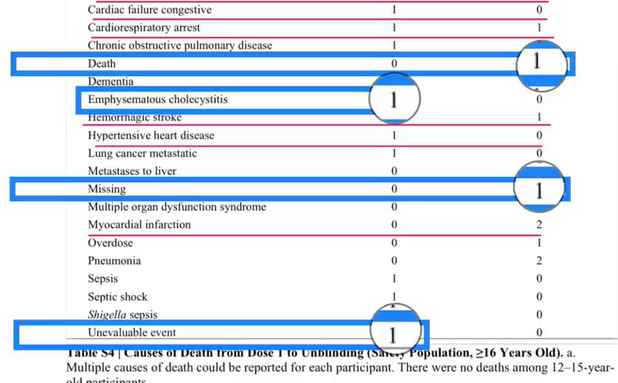
- An “Unevaluable Event” on a vaccinated death, which was found to be a sudden cardiac death confirmed via autopsy.
- A “Missing” entry categorized as a “placebo” death, which was later found to be a “vaccinated” death.
- “Emphysematous Cholecystitis,” which is a cardiovascular death but Pfizer said let’s put something that sounds really complicated and hope nobody knows its a cardiovascular death.
- “Death” for participant #10841470. First of all categorizing a “cause of death” as “Death”, are you kidding? Anyway this participant died after taking a Moderna mRNA vaccine, but was categorized as a placebo death. I wrote about this issue here.
In conclusion, after recategorizing the deaths, all-cause deaths were 15% higher in the vaccine group. There were 10 cardiovascular deaths in the vaccine group and six in the placebo group, indicating that cardiovascular deaths were 66% higher in the vaccine group.
Dr. White highlights that these figures, particularly the increased all-cause mortality in the vaccine group, clearly point to safety signals. He stresses that informed consent is a fundamental ethical principle in medicine, necessitating the open discussion of such safety concerns. It is crucial to ensure that participants are fully informed about the potential risks associated with the vaccine to maintain trust and transparency within the medical community.
Watch full video:
Featured Video

ARE PATIENTS BEING PROPERLY INFORMED ABOUT OZEMPIC?
or go to
Aletho News Archives – Video-Images
New Book
Breast Cancer: Before You Consent
A new Unbekoming paperback
Lies are Unbekoming | September 18, 2026
Peter Gøtzsche reviewed every randomised mammography screening trial ever conducted for the Cochrane Collaboration. Cochrane’s headline is that, assuming a 15% mortality reduction, one woman in 2000 avoids dying of breast cancer over ten years. Ten are overdiagnosed and treated. Two hundred experience false alarms.
But that headline assumes the reduction. When Gøtzsche looked only at the trials with adequate randomisation — the higher-quality ones — the reduction disappeared. No effect on breast cancer mortality. No effect on all-cause mortality.
This is the Cochrane finding, published in the establishment’s own database of systematic reviews.
No woman being asked to consent to a mammogram this week knows it.
That is why the new Unbekoming paperback exists. … continue
Blog Roll
 Aletho News
- The Truth About the Trump Shootings with Ken Silva
- ARE PATIENTS BEING PROPERLY INFORMED ABOUT OZEMPIC?
- US lawmaker blocks $2.8 billion weapons sale to Israel: Report
- Yemeni army claims responsibility for strikes on sensitive sites in Saudi capital, Aramco facilities in Yanbu
- Iran Judiciary issues indictments against 159 US, Israeli officials for assassination of Leader, commanders
- Turkiye revokes Iranian bank license under US sanctions campaign
- US-Denmark Agreement on Greenland Is ‘PR Stunt’ Ahead of Midterms
- Araghchi: Military intervention cannot create security; coercion cannot bring peace
- Fraud Squared
- Breast Cancer: Before You Consent
- If Americans Knew
- Inside Gaza’s death trap of collapsing, bombed-out buildings
- The everyday items Israel bans from Gaza every day
- Inside the siege, the ruined buildings of Gaza – Daily Update
- Debunking The Claim That Macklemore Has A “History Of Antisemitism”
- CPJ demands release of arrested Palestinian-US journalist near Bethlehem
- Robert Kraft: The Billionaire Friend of Netanyahu Pulling The Strings Behind the Macklemore/Ed Sheeran Blow Up
- Columbia Administered Fund Gives Big Money to Pro-Israel Groups
- Deportation Case of Palestinian Activist Salah Sarsour Tests First Amendment
- ‘We Will Not Forget’: Palestinians Mark 44 Years since Sabra and Shatila
- Why do we let Zionists decide what we can and can’t say?
- No Tricks Zone
- 2025 Nature Paper Claiming Worsening Global Drought Gets RETRACTED …Heavily Flawed
- New Study: ‘Global Drought Shows No Detectable Recent Acceleration Under Climate Warming’
- Economic Masterminds: German Socialists Suggest Taxing Productivity Gains Stemming From Using AI
- The South China Sea Has Not Been Cooperating With The Climate Change Narrative
- Energy Crisis: Germany Enters Heating Season With Historically Low Gas Reserve Fill Levels
- New Study: The Antarctic Ice Sheet Gained Mass From 2020-2024 Due To Staggering Snow And Ice Accumulation
- Study: Ocean Heating Rates From Thousands Of Years Ago ‘Dwarf’ Modern Ocean Heating Rates
- Climate Extremists Target, Attack Large-Scale Power Grid Infrastructure In Germany!
- New Study: Antarctic Ice Melt Has Contributed Less Than 1 Centimeter To Sea Level Rise In The Last 30 Years
- Fear Of Debate: Alarmist German Climate Scientist Calls On Mainstream Media To Discredit Skeptic Voices
 Aletho News