Hertz backpedals on rush into EV rentals: CEO says repair costs can run “twice as high”
By Jo Nova | November 2, 2023
Hertz was aiming to make 25% of its fleet electric by 2024, but is finding 11% is too much. Given there are whole nations pushing for 100% EV by 2035 there seems to be a message here…
Let’s thank Hertz for doing that experiment for us. It turns out EV’s didn’t work well in the high mileage Uber-type system because the drivers “drove them into the ground” and repair costs were much higher than expected. So Hertz moved some EV’s to the leisure hire department, but then the revenue per day in the leisure sector fell. Presumably people didn’t want to hire them.
It’s not that this is Bad News week for EVs — it’s quarterly reporting week, so companies have to tell investors things they’d rather not.
Great nations don’t force citizens to buy heavier cars with shorter ranges and bigger repair bills in order to stop bad weather one hundred years from now.
Hertz is slowing down the roll out of EVs onto its fleets as the CEO cites higher than expected repair costs and price cuts.
The rental car company reported lower than expected margins in the third quarter of this year, citing EV repairs as one of the challenges.
“Collision and damage repairs on an EV can often run about twice that associated with a comparable combustion engine vehicle,” said Mr Scherr.

It all started out so well:
Andrew J Hawkins, The Verge
Rental car company Hertz once envisioned itself as the ultimate EV broker, doling out battery-powered vehicles to business travelers, ridehail drivers, and tech newbies in an ambitious plan to grease the wheels for the EV revolution. The company inked agreements with Tesla and Polestar to buy nearly 200,000 EVs. Tesla’s valuation topped $1 trillion on the news.
Part of the problem is linked to Hertz’s plans to rent EVs to ridehail drivers. Of the 100,000 Tesla acquired by Hertz, half were to be allocated to Uber drivers as part of a deal with the ridehail company. And drivers said they loved the Teslas! But Uber drivers also tend to drive their vehicles into the ground. This higher rate of utilization can lead to a lot of damage — certainly more than Hertz was anticipating.
Musk frequently says that electric cars require less maintenance than counterparts with internal combustion engines (including plug-in hybrid electrics). …
But electric vehicle owners can face unique maintenance needs, as well. Nikhil Naikal, CEO of Kinetic, a startup that is not affiliated with Hertz or Tesla but provides repairs for electric and autonomous vehicles, told CNBC on Thursday:
“The reality of electric vehicles is that they can be 1,000 pounds heavier or more than gas vehicles, and they move faster, with higher torque. Since they’re extremely zippy and heavier, it’s just physics — the ability to overcome inertia so quickly is going to effect their suspension systems, the brakes and steering columns. It’s counter-intuitive, but even with fewer moving parts they are susceptible to requiring more maintenance. They especially require tire-swapping, because the tires wear out more quickly from that high torque and weight.”
Next few years will determine future world order – Biden

Joe Biden speaks about his Bidenomics agenda on November 1, 2023. © ANDREW CABALLERO-REYNOLDS / AFP
RT | November 3, 2023
The world is at a crossroads and the next few years will determine its fate for several generations to come, US President Joe Biden has claimed. His prediction comes amid Washington’s standoff with Russia over Ukraine and his country’s increasingly strained relations with China.
Speaking ahead of a meeting with Chilean President Gabriel Boric on Thursday, Biden stated that “there comes a time, maybe every six to eight generations, where the world changes in a very short time.”
The US leader further claimed that “what happens in the next two, three years are going to determine what the world looks like for the next five or six decades.”
According to a White House readout of Biden’s meeting with Boric, the pair discussed issues of shared concern, including efforts to combat climate change.
Biden also spoke last month about the need for a “new world order,” suggesting that while the post-World War II system has functioned for decades, it has “sort of run out of steam.”
However, if Americans “are bold enough and have enough confidence in ourselves, [they will have an opportunity] to unite the world in ways that it never has been,” he insisted.
Commenting on Biden’s remarks at the time, Kremlin Press Secretary Dmitry Peskov described it as a rare moment when Moscow was in complete agreement with Washington. “The world indeed needs a new order, based on absolutely new principles,” he noted.
However, Peskov suggested that Biden meant building “a world [order] revolving around the US,” insisting that “this will not be anymore.” Russia has consistently called for a multilateral world order, with President Vladimir Putin accusing the West of “a colonial approach” and bending international rules to its will.
Last month, the Russian leader also stressed that “nobody has the right to control the world at the expense of others or in their name.”
Relations between Washington and Moscow have sunk to unprecedented lows due to the Ukraine conflict, with the US sending billions of dollars’ worth of weapons to Kiev and imposing tough sanctions on Russia.
Elsewhere, relations are tense between the US and China, most notably over Washington’s support for Taiwan. The two nations are also engaged in an intense economic rivalry. China has been promoting its Belt and Road Initiative (BRI), which seeks to develop international transport infrastructure and has been supported by more than 140 countries.
Biden has signaled that the US is working with G7 members to compete with China economically, claiming that the BRI has ended up being “a noose for most of the people who have signed on.”
Al-Aqsa Flood gives Israeli economy ‘COVID-19 like symptoms’
The Cradle | October 30, 2023
The historic Al-Aqsa Flood operation has not only battered Israeli settlements and the security forces, but the war has also taken flight against the Israeli market.
Economists are looking at the operation that hit the $520 Billion economy with memories of the COVID-19 effects, saying that orders for schools, offices, and building sites to close or only open for a few hours are like the days of the pandemic.
Adding to the affected workforce, the Israeli government amassed 350,000 reservists for its much-awaited ground invasion, draining about eight percent of the Israeli workforce.
Mizrahi-Tefahot, a top Israeli bank, says that the mass mobilization order and partial economic freezes are costing the government the equivalent of $2.5 billion per month. The Israeli central bank has said that the economic state will only worsen as the war goes on.
Israeli stocks are the world’s worst performing since the beginning of the war. The Shekel is at its weakest level since 2012, despite the $45 billion emergency package or the selling off of $30 Billion in foreign reserves to try and save the currency from sinking further.
Markets won’t fair well with a long war, but Israeli Prime Minister Benjamin Netanyahu has warned of a “long war” as he prepares for a ground invasion.
JPMorgan Chase & Co., the US multinational financial services firm, has said that they believe the Israeli economy is shrinking 11 percent on an annualized basis, saying that their initial projections about the economic impact were “too optimistic.”
The financial firm’s projections are among Wall Street’s most cynical, but investors have been selling off Israeli assets heavily.
“Gauging the impact of the war on Israel’s economy remains difficult both due to still very high uncertainty about the scale and duration of the conflict and the lack of high-frequency data at hand,” JPMorgan analysts said.
Having one of the strongest economies in the world, Israel hasn’t seen an economic hit this bad since the 2006 war between them and Hezbollah, the physical damage cost of which has already been topped by the Palestinian factions.
The Israeli business press has said the nation has entered a recession. Israeli daily The Market has previously written that “Israel has entered the war, and it is in a recession, and trade is currently zero.”
My Golden Retriever Confronts the Medical Juggernaut
By Clayton J. Baker, MD | Brownstone Institute | October 27, 2023
Recently, our golden retriever, Bailey, got kennel cough. She hasn’t been in a kennel in years, but that’s what they called it: kennel cough.
Please forgive my ignorance in the matter. You see, I’m just a people-doctor. I’m not a veterinarian like, say, Pfizer CEO Albert Bourla. I can’t claim to be an expert on kennel cough.
But as far as I can tell, “kennel cough” appears to be vet-speak for a nonspecific respiratory tract infection in dogs. It seems to be a term veterinarians use much as I would “bronchitis.”
Do you know what a golden retriever with kennel cough sounds like? After all, people-doctors have historically described kids diagnosed with croup as having a “barking” cough.
Well, based on my limited experience, a golden retriever with kennel cough sounds like a Canada goose. Bailey was repeatedly emitting a medium-pitched grunt/honk, lower in register than a duck’s quack but higher than one of those old-fashioned ah-oo-ga automobile horns.
It’s kind of a Honk! Honk! Honk! with the H’s partially dropped. It’s actually quite alarming. Trust me, you don’t want to hear your golden retriever sounding like something it retrieved.
Now, Bailey is a good girl, and I love her dearly. But my wife loves that dog more than life itself. Sometimes I wonder if she’d donate her own liver if it were necessary to save her.
So my wife calls Bailey’s veterinarian, and she tells them about her symptoms.
I should mention that my wife is a doctor, too. Just a people-doctor like me, mind you, not an expert on kennel cough like Albert Bourla. But a medical case presentation is a medical case presentation, and she knows how to present a case.
So what did Bailey’s Primary Care Provider tell my wife after hearing the medical history from a fellow medical professional? Well, they told her that it sounds like kennel cough, and that they can see Bailey in 2 or 3 weeks.
Incidentally, this veterinary practice – I am not making this up – had recently been bought out by some kind of veterinary investment firm which, over the past couple of years, also bought multiple other practices in the area, including the only veterinary emergency room in town. Soon after those acquisitions, they closed down the emergency room.
My wife says to them, “2 or 3 weeks? Bailey will either be fully recovered or dead by then.”
“Well, we’ve been chronically short-staffed,” they replied. “We’re blocked up for urgent appointments…etc., etc.”
A brief, polite back-and-forth ensued, but ultimately Bailey’s “provider” didn’t offer an urgent appointment.
In their defense, this veterinary group knows what really is important. A couple of months earlier, at Bailey’s routine checkup, her doctor noted concerning “plaque buildup” on her teeth.
Do you know what Bailey’s doctor recommended? Doggie dental cleaning. Under general anesthesia. Seven hundred dollars, cash on the barrelhead.
They also have never delayed care when it comes to Bailey’s vaccines.
You see, according to the American Animal Hospital Association Guidelines (generously supported by Boehringer Ingelheim Animal Health, Elanco Animal Health, Merck Animal Health and Zoetis Petcare), all dogs should be vaccinated for:
- Distemper
- Adenovirus
- Parvovirus
- Parainfluenza
- Rabies
while many or most dogs, depending on “lifestyle and risk”, should be vaccinated for
- Leptospirosis
- Lyme disease
- Bordetella
- Canine influenza
and some should even be inoculated with Rattlesnake Toxoid.
I will add, these vaccines are not one-and-done shots. Most of them are recommended to be boosted annually, or at minimum every 3 years.
But again, the experts know what is really important. For example, while Bailey has fortunately avoided any major orthopedic problems to date, we know at least one golden retriever who has had both ACLs reconstructed, and other dogs who have had total hip replacements. Advanced orthopedic surgeries, while admittedly costly, are an essential component of the golden retriever’s healthcare armamentarium.
(This probably sounds selfish, but I just hope and pray Bailey doesn’t develop gender dysphoria. I don’t think we can afford to take her down to Cornell to have them surgically construct a neophallus for her.)
Whew. Let’s step back and review. As I said, I’m no expert on these matters, like Albert Bourla. I want to make sure I’ve got all this correct.
Our golden retriever must navigate a healthcare system that cares so much for her health and well-being that it’s willing to intubate and anesthetize her for a tooth cleaning. Cha-ching!
In the name of vaccination, it will repeatedly inject her with numerous inoculations, up to and potentially including rattlesnake toxoid. Cha-ching!
It offers any number of extensive and expensive Orthopedic surgeries – as long as Bailey’s owner pays. Cha-ching!
And yet, when she gets sick with an acute respiratory infection, it tells her to stay home and wait, offers no treatment, and refuses to see her. Even though, should she become severely ill, her emergency health care system has been decimated by corporate profiteers.
Do I paint an accurate picture, or do I exaggerate?
Fortunately, Bailey’s story has a happy ending.
As so many other concerned patients and family members do, we consulted Dr. Internet. I know, I know, patients are supposed to trust the experts, and refrain from doing their own research – but you’ll have to forgive us. After all, it’s the family dog we’re talking about here. And we did discover some interesting information.
According to our research, the most common first-line treatment for kennel cough is doxycycline, an inexpensive, generic, people-antibiotic that’s been around since the 1960’s. The primary purpose of prescribing it here is to treat against Bordetella, the most common bacterial cause of the disease.
Incidentally, Bailey is up to date on all her recommended vaccines, so the fact that she got kennel cough in the first place raises its own set of questions. I won’t head down that rabbit hole here, except to ask:
If a disease doesn’t merit the patient being seen, assessed, and treated when they contract it, why is obsessive vaccination against it so necessary?
My wife called back, and in her very polite but insistent way, explained that if they weren’t going to see Bailey, we were ‘requesting’ a prescription, which in the end they wrote. I half expected them to say, “Doxycycline, but that’s human paste!” To their credit, they didn’t.
You’ll be glad to hear that after commencing empirical, early treatment with a cheap, decades-old, repurposed drug, Bailey improved almost immediately. Whether this was due to the doxycycline, her own immune system (God gave her one too, we must not forget), or both, we cannot be certain. Anyway, the goose honk is gone, her appetite is back, and she’s got the frequent zoomies again.
But the whole episode left me with a lingering, uneasy, even unhealthy feeling. It’s not exactly déjà vu, but rather the sensation that I’d been through something very similar – and similarly unpleasant – before.
Whatever could that be?
C.J. Baker, M.D. is an internal medicine physician with a quarter century in clinical practice. He has held numerous academic medical appointments, and his work has appeared in many journals, including the Journal of the American Medical Association and the New England Journal of Medicine. From 2012 to 2018 he was Clinical Associate Professor of Medical Humanities and Bioethics at the University of Rochester.
The Gods Are Going Against the Chosen People – Mammon Against Israel, Mars Against the Pentagon
By John Helmer | Dances with Bears | October 27, 2023
The Palestinian strategy against Israel is aimed at destroying Israel’s capacity to survive in its present state in a long war.
This means attacking the invincibility of the Israel Defense Forces (IDF) and their so-called Iron Dome defence; this began with the cross-border offensive on October 7, and continues with daily drone and artillery attacks on targets inside Israel, as well as resistance to IDF incursions in Gaza.
The plan also means exposing the weakness of the state’s infrastructure and economy; extending the battlefield across all of Israel’s territory – the ports, power plants and electricity grid, communications, and financial markets — making the cost of occupation of the Arab territories unendurable. In a long war, two of Israel’s leading exports earning more than 40% of the state’s trade — diamonds and tourism — face ruin.*
“The Israelis cannot withstand one year of fighting in a war,” Iraq’s President Saddam Hussein told his general staff in 1983 during a discussion of planning for a regional war of the Arabs against Israel.** In the forty years since then, the evolution of military technology and tactics has expanded the power of small national liberation armies like Hamas, Hezbollah, and the Houthis, of proxy principals like Iran, and of the strategic balancing role of Russia and China. Their combination now has shortened the Zionist state’s endurance in a long war, and that of its proxy principal, the US.
The Israelis and the Jewish diaspora comprehend this reluctantly. For them, the short war must be correspondingly shorter. This means the genocide of at least a million Palestinians in lives and displacement.
The war to do that has now become an international war – and this is a war the US cannot sustain. As a Pentagon insider said publicly this week, “because there are so many draws on the logistics and support infrastructure of the Pentagon, we’re not prepared to go in in a concerted way. What we are seeing right now is death by a thousand cuts. Our adversaries know we are stretched so they are going to make us stretch even more, so we can respond even less.”
The Russian Foreign Ministry spokesman, Maria Zakharova, acknowledged the point in Moscow on Thursday: US naval, air force, and marine reinforcements deployed around Israel and Gaza are “American tactics to strengthen their own security (this is how it should be interpreted) at someone else’s expense.” They are backfiring on Washington’s capacity to defend US forces in the Mediterranean, the Red Sea, the Persian Gulf, and in land bases in Syria, Iraq and Jordan. “On the contrary,” Zakharova added, the US military deployment “will further rock the situation in the Middle East, create additional tension that can spill out beyond the region.”
Zakharova’s warning came in the Moscow afternoon. By then Russian Foreign Ministry officials had held meetings with a Hamas delegation, and officials from Iran, Egypt, and Kuwait. Across the city at the same time, President Vladimir Putin held telephone talks with Turkey’s President Recep Tayyip Erdogan. The Kremlin communiqué reported: “Russia and Turkiye have practically overlapping positions.”
Israeli and US-led media censorship and propaganda are concealing the breadth of impact of the Palestine warfighting plan, and the deepening military and economic weaknesses of the Israeli state.
The longer the war continues, the plainer the evidence is on the battlefield that the single-state scheme of Israel and the US is no longer possible. Whether Israel and the US can be compelled to withdraw to the 1967 borders and a new Palestinian state created with partition, demilitarisation, and international security guarantees – the basis of the Russian position announced again on Thursday in Moscow — remains to be fought over.
In this long war, the gods do not favour the Chosen People.
Following with precision the battlefield action is impossible in the Israeli and Anglo-American press. Reporting of operations, and of Israeli and US casualties, is being suppressed entirely or delayed for days, if not weeks.

According to this NBC television report, broadcast on October 24, there were at least 24 US combat casualties following drone attacks on or about October 18 at the Al-Tanf base in Syria and the Al-Asad base in Iraq. Reporting of naval action in the Red Sea, when the USS Carney reportedly engaged Houthi missiles over several hours, has been changing since the initial news flashes of October 19. Read more here. In a new report of October 24, Israeli and US casualties in a joint raid inside Gaza were revealed: “in the last 24 hours or so, some of our Special Ops forces and Israeli Special Ops forces went into Gaza to reconnoiter, to plan for where they might want to go to free hostages and make an impact, and they were shot to pieces and took heavy losses, as I understand it. I think that is where we are headed and I don’t see that as a win for Israel in any way, shape, or form. And I certainly think it is very dangerous for us”. In current reporting by Al Mayadeen, daily strikes against US bases in Iraq and northeastern Syria are documented.
Tracking the electric war and infrastructure strikes by Hamas and Hezbollah is also difficult. They commenced with cyber attacks on Israel’s electricity generation plants and power grids; these have been followed by missile and drone strikes. “The ground has been laid for attacks on the Israeli grid,” a US military source claims. “I believe drones will come first, then missiles. We may even see commando raids.”
Israel’s seaports are also under constant attack. Ashkelon, which is closest in range to Gaza, has been closed. Eilat may have been the target of the Houthi missile strike which was engaged last week by the USS Carney. Ashdod, which accounts for about 40% of incoming and outgoing Israeli seaborne trade, and Tel Aviv port have been targeted. The result is a tenfold surge in war risk insurance for vessels and cargoes, and the curtailment of international vessel movement in and out of the Israeli ports; there are reports that shipping is down 30% in Ashdod compared to the pre-war volume. Evergreen, the Taiwanese container shipping company, declared force majeure for Ashdod on October 17, diverted one vessel to Haifa, and halted future shipping into both ports. “We advise evaluating each port visit in Israel on a case by case basis and implementing appropriate precautions in ship contingency plans,” recommends a maritime industry alert bulletin.
Chevron’s offshore Tamar gas field has been shut down. The source produces 70% of the gas required to fuel Israel’s electricity generation needs. Not a single Anglo-American media source has noticed that Israel is at risk of losing its principal energy source to drone or missile attack. “After what the Americans and Germans did to blow up the Nordstream pipelines,” comments a Moscow industry source, “what is holding Hamas back from hitting Tamar, or Hezbollah from the other Israeli gas fields?”

Left: Chevron’s Tamar gas production platform is located at sea 24 kilometres west of Ashkelon. Right: click to enlarge map of Israel’s offshore gas sources.
A Moscow source comments that “in Israel, the US and the UK will be able to bring in supplies without a very big risk of US ships being attacked. The risk is to the ports and bases, not to supplies from the Med[iterranean]. The Greek and Cyprus bases will come in very useful. Israel will not face severe logistical issues as long as it is on the offensive. If its settlements start getting cut off, encircled or penetrated then it is a different matter.”
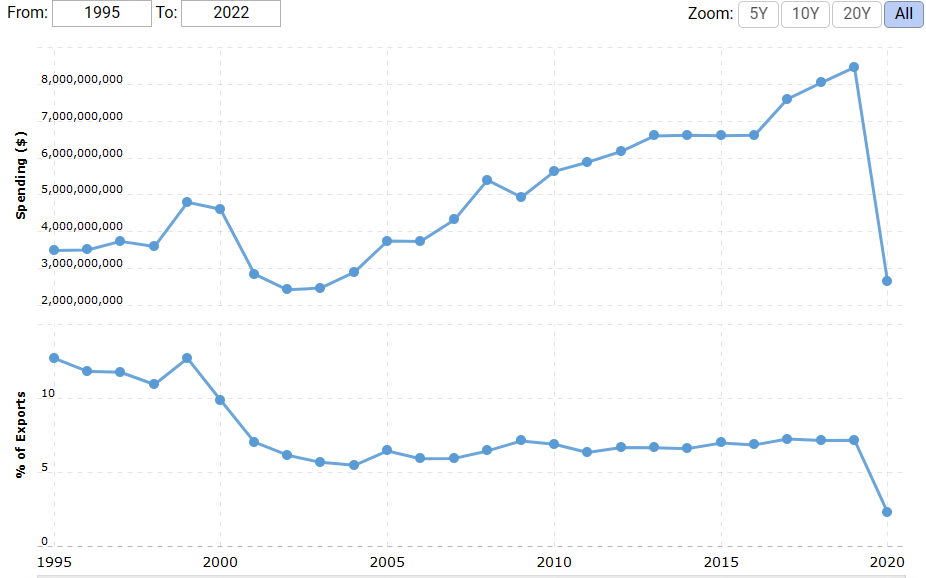
The indirect economic impacts of the war have also not been calculated or discussed in the mainstream media or international business newspapers. The leading export revenue earners are diamonds at above $9 billion per annum, and tourism which had been peaking at $8.5 billion in 2019. Counted together, diamonds and tourism amount to more than 40% of the state’s export earnings.
The Covid-19 pandemic and worldwide travel restrictions cut Israel’s tourism revenue fourfold, and this had been recovering over 2022 and the tourist season this year. This has now stopped, although for the time being Hamas rocket launches on Ben Gurion airport near Tel Aviv have been intercepted.

October 12, 2023 — source: https://www.youtube.com/.
ISRAEL TOURISM REVENUE TRAJECTORY, 1999-2022
Source: https://www.macrotrends.net/
Israel’s high-tech machine exports and pharmaceuticals may also be affected if electricity supply, internet networks, and transportation are damaged.
The cumulative effect will be the outcome which the international ratings agencies have been warning the international banks and financial markets to prepare for. “In our view,” Fitch reported to clients on October 17, “the combination of Israel’s dynamic, high-value added economy, the record of resilience to regional conflict, [and] preparedness for military confrontations… make it unlikely a relatively short conflict largely confined to Gaza will affect Israel’s rating…. the risk that other actors hostile to Israel, such as Iran and Hezbollah, could join the conflict at scale has risen significantly… a major escalation could result in negative rating action. This could take the form of a wider and longer conflict, resulting in a sustained fiscal drain, both from higher spending and lower tax collection, as well as loss of human and material capital and severe economic disruption.”
How short, and also how long, Israel’s warfighting plan will take depends on American and international acceptance, not only of the genocide intended for the Palestinians of Gaza, but of the Novichok-type chemical warfare planned by the IDF and the Pentagon for the Hamas tunnel system in Gaza City. After several years in which the US and UK have fabricated claims that Syria and Russia were using prohibited gas warfare weapons, the Israelis have reportedly persuaded the US to participate in the tunnel attack operation. The Pentagon is denying the reports.

Source: https://www.middleeasteye.net
Russian and US military sources are already confirming the logistical supply problems facing Israeli and US forces at present, when the war is just three weeks long. Greek sources are reporting the Souda Bay, Crete, base has already reached its capacity for incoming US navy and air force supply and support operations; the spillover is facing growing Greek protest at the Elefsina air base near Athens.
A Cyprus source says the movement of US and British aircraft into and out of the Dekhelia and Akrotiri airbases is accelerating, and there is an air and seaborne shuttle between the Cypriot ports of Larnaca and Limassol and the USS Gerald Ford carrier group at sea to the southwest of the island.
The lengthening of the supply lines required to support the USS Eisenhower carrier group in the Red Sea and Persian Gulf and the shore bases needed to support it are politically sensitive already; and the risks of Houthi and other attacks, along with domestic Arab crowd protests, will intensify for these bases in the Arab sheikhdoms the longer the war against Israel reveals Arab and Iranian warfighting skill and resistance.
Converting these gains into a negotiating framework for Israeli-American retreat is the task Russian officials are attempting in silent coordination with the Chinese, and in semi-open negotiations in Moscow this week. In its first move outside the region since the war began, Hamas has visited Moscow for negotiations, led by US-educated Moussa Mohammed Abu Marzouq.

Left: Moussa Mohammed Abu Marzouq; centre: Husam Badran; right, Ali Bagheri Kyani.
Zakharova confirmed the start of the talks with Hamas on Thursday. She said: “I can also say and confirm that representatives of the relevant Palestinian movement are in Moscow. As for contacts, we will inform you additionally.” She has also disclosed that since the war began, nine thousand Russian passport holders have returned to Russia from Israel; and that at least fifteen Russian passport holders among the Hamas hostages have been killed in the IDF airstrikes.
At the same time as Marzouq’s meetings, Husam Badran issued a statement to the Russian state news medium, Sputnik. “Russia,” Badran said, “is able to play an important role in ending the war between Israel and the Gaza Strip, and delivering aid to the Palestinian exclave. Hamas values Russia’s role on the international stage, especially use of veto in the UN Security Council against the United States. But Russia can play a greater role in ending the aggression against our people in the Gaza Strip and applying international pressure to deliver urgent aid to our people in the Gaza Strip.”
What Hamas means by “greater role” for Russia has not been disclosed publicly yet. It is known that Hamas is willing to negotiate the release of “non-military” hostages, including Israelis holding Russian passports, through Iran. This is conditional on the IDF lifting its siege on Gaza and allowing sufficient supplies into all parts of the territory.
The “military hostages” are being held in exchange for the release of Palestinian prisoners in Israeli jails. There are more than 6,000 of the latter; there may be fewer than 200 hostages in Gaza, as up to 50 have been killed by Israeli bombing.
The Russian Foreign Ministry statement on the talks with Hamas is less revealing. According to the Sputnik release, “Russia has discussed release of hostages and evacuation of Russians from the Gaza Strip during a meeting with a delegation of Hamas in Moscow on Thursday.” A member of the political office of the Islamic resistance movement Hamas, Abu Marzouq, is in Moscow. Contacts took place with him in continuation of the Russian line for the immediate release of foreign hostages located in the Gaza Strip, and issues related to ensuring the evacuation of Russian and other foreign citizens from the territory of the Palestinian enclave were also discussed.”
At the same time on Thursday – unnoticed and unreported by the western media – Russian officials held several negotiating sessions with an Iranian emissary, Deputy Foreign Minister Ali Bagheri Kyani. In three separate Foreign Ministry releases, meeting communiqués were issued for Kyani’s meetings with deputy ministers Mikhail Bogdanov, Sergei Ryabkov, and Mikhail Galuzin. “The need for the cessation of hostilities in and around the Gaza Strip and the prompt provision of humanitarian assistance to the affected Palestinian population was confirmed,” Bogdanov’s communiqué said. “It was stated that Moscow and Tehran are determined to continue close coordination of efforts in the interests of stabilizing the situation in the Middle East.”
It is unclear if the talks also included the Hamas officials in a three-party format. During the day there were also Foreign Ministry negotiations in Moscow with Kuwaiti and Egyptian officials.
At the Kremlin it has been announced that President Putin spoke with Turkish President Erdogan to discuss the war. According to the Kremlin release, “the presidents reviewed the active efforts undertaken by Russia at the UN Security Council, as well as the corresponding political and diplomatic steps taken by Turkiye to stop the bloodshed and ensure the unimpeded delivery of humanitarian aid to those in need. It was emphasised that Russia and Turkiye have practically overlapping positions, focused on implementing the well-known two-state solution, which provides for the creation of an independent Palestine coexisting with Israel in peace and security.”
In her briefing for the press, Zakharova dismissed the US moves so far. “We do not consider the US presence in the Middle East as contributing to the stability of the situation in the region. Exactly the opposite. Washington’s earlier attempts to monopolise the Middle East settlement process, ignoring the true causes of the protracted conflict, have largely led to the current catastrophic consequences… This situation has an absolutely clear and understandable road, a ‘road map’ for settlement. It is not simple, but complex, painful, but leading to the solution of the issue, not its aggravation.”
“Of course, no air defence systems, arms supplies, materiel injections into some ‘security complexes’ will help resolve this situation. Today’s lesson must be learned. How many Americans have deployed there (their bases, experts, satellites), nothing has worked to prevent a bloody scenario, of which both Palestinians and Israelis are victims.”
[*] With support from Israel and influential Jewish diamantaires in New York and Tel Aviv, a scheme of sanctions is being prepared by the US Government to stop Russian raw diamonds, produced by Alrosa, from being sold into the Belgian, Israeli, and US markets. The Russian goods are to be tagged “blood diamonds” because of the war in the Ukraine. However, now that Israel is destroying the Palestinian population of Gaza, the “blood” tag can be applied to the Israeli diamond cutting industry and to the Jewish diamond trade abroad. Support for the anti-Russian sanction, and also for the IDF operations against the Palestinians can be found in Rapaport.com news reports. “Rapaport stands with Israel”, the publication and its owner Martin Rapaport declared on October 26, “and has undertaken all the necessary effort and costs for the October Single Stone Auction to help the Israeli market continue to conduct business as best as possible during this difficult time. Rapaport believes that continuing to do business in Israel during the war is a victory over the brutal Hamas terrorists, and will help Israel win the war.” In another editorial for the diamond trade, Rapaport proposes “to boycott Iran and all other supporters of the Hamas terrorist organization.” Rapaport also cites religious authority for liquidation. “In the words of G-d (Exodus 17:14): ‘I will utterly blot out the memory of Amalek from under heaven.’May the words of G-d be done, here and now.” Quietly, Russia’s state diamond interests dictate a strategy for protecting against this double-edged Israeli policy.
[**] Saddam Hussein is quoted in the chapter on US plots against him in Iraq – see The Jackals’ Wedding: American Power, Arab Revolt, Ch. 6.
Slovakia Says Europe Should Not Supply Arms to Ukraine

By Kyle Anzalone | The Libertarian Institute | October 26, 2023
The new government of Slovakia has followed through with its campaign pledge to terminate arms transfers and is calling on the rest of Europe to adopt Bratislava’s policy. Slovakia’s new leader, Robert Fico, has called for the European Union to take on a peacekeeper role in the Ukraine war, and Bratislava will not support further sanctions on Moscow.
Fico told members of Slovakia’s legislature on Thursday that Bratislava was abandoning the West’s proxy war against Russia. “I will support zero military aid to Ukraine… An immediate halt to military operations is the best solution we have for Ukraine. The EU should change from an arms supplier to a peacemaker,” he said. Adding, Slovakia will “no longer supply weapons to Ukraine.”
As well as terminating support for Kiev’s war effort, Fico explained Slovakia will no longer support Washington’s economic war on Moscow. “I will not vote for any sanctions against Russia unless we see analyses of their impact on Slovakia.” He continued, “If there are to be such sanctions that will harm us, like most sanctions have, I can see no reason to support them.”
Additionally, Fico said, “the people in Slovakia have bigger problems than (dealing with) Ukraine” and “further killing [in Ukraine] will not help anyone.”
Fico’s left-wing Smer-SD won Slovakia’s election early this month on a platform that highlighted ending arms transfers to Ukraine.
While President Joe Biden insists that Washington will support Ukraine for “as long as it takes,” several Eastern European countries have started to terminate support for Kiev. Poland announced it would end weapons transfers after Ukrainian President Volodymyr Zelensky slammed Warsaw during his UN address.
Keeping You Up To Date On New York’s Progress Toward Green Energy Utopia
By Francis Menton | Manhattan Contrarian | October 15, 2023
Consider Manhattan Contrarian as your go-to source for the latest on New York’s progress toward green energy utopia.
Can you remember all the way back to December 19, 2022? That’s the day that New York’s Climate Action Council officially adopted its “Scoping Plan,” telling us all how we are going to achieve, among other goals, 70% of statewide electricity from renewable energy sources by 2030 and a zero-emissions electricity system by 2040. The biggest part of the grand plan consists of some 9,000 MW (nameplate capacity) of offshore wind turbines to be built by 2035. As of the time of the Scoping Plan, the state claimed that some 4,300 MW out of the 9,000 MW of upcoming offshore wind projects were under “active development.”
On the very day that the Scoping Plan got finalized, I had a post titled “On To The Great Future Of Offshore Wind Power.” That post noted that even of the 4.300 MW of offshore wind supposedly under “active development,” not one turbine was operating, or even under construction. Several developers had made bids that had been accepted by the state, and some of those developers were getting kind of close to applying for permits. My prediction was: “Expect long delays and demands for lots more money before anything gets built.” Boy, can I call these things.
Shall we check back in for the latest information?
Just ten days ago, on October 5, I had an update on offshore wind developments throughout the Mid-Atlantic and New England. For New York, the news was that in September essentially all the developers of the New York projects in “active development” had demanded massive price increases, ranging from about 30% at the low end to almost 65% at the high end. The new prices being demanded by the developers would now be between $140-190 per MWh, which would be at least double to more than triple the prices charged by new natural gas plants.
So how did that go over? To its credit, the state Public Service Commission wasted no time in rejecting the price hike demands of the developers. On October 12 the Commission issued its decision on the Petitions of the developers for price relief. Excerpt from the press release:
The New York State Public Service Commission (Commission) today denied petitions filed by a group of offshore wind developers and a state renewable energy trade association seeking billions of dollars in additional funding from consumers for four proposed offshore wind projects and 86 land-based renewable projects. In denying financial relief, the Commission opted to preserve the robust competitive bidding process that provides critically needed renewable energy resources to New York in the fairest and most cost-effective manner that protects consumers.
OK then, what happens next? The New York Times has a write-up on October 12. The Times quotes the Chair of the PSC, one Rory Christian, as standing up for the sanctity of the public bidding process:
Rory Christian, the chairman of the Public Service Commission, the state’s utility regulator, said that providing relief to the winning bidders would set an untenable precedent. “Taking exception today almost guarantees that we will be asked to do this again in the future,” he said. Mr. Christian added that the state’s ratepayers, who would have borne the cost, could not serve as an “unlimited piggy bank” for companies to tap. “We have a deal,” he said to the developers, calling on them to stand by the terms they agreed to.
Well, Rory, I’ve got news for you: the developers aren’t going to honor the deal. You’re going to have to hold a new auction. And the prices that will be bid will be as high or higher than those just demanded by these developers.
Oh, and then don’t expect any new round of accepted bids to stick either. The developers will come back again and again for new rounds of price increases. What’s to stop them? After all, they have you over a barrel. You have a “Climate Act” and a “Scoping Plan” that basically require you to build out a grid powered by “renewables,” whether that is feasible or not, and then limit your options to mostly offshore wind.
And meanwhile, until the next round of bids is held, we’re back to square one. We have a statutory requirement of 70% of our electricity from “renewables” by 2030, and a “Scoping Plan” that sees that goal being achieved largely through offshore wind turbines. And we have not one single operating offshore wind turbine, nor any under construction, nor, after the recent contract repudiations, any actively moving through the permitting process. At least for now, the whole thing is dead in the water.
The Times quotes a guy named Fred Zalcman, director of the New York Offshore Wind Alliance:
[T]he commission’s decision “puts these projects in serious jeopardy and deals a potentially fatal blow to the progress these projects have made. . . .”
By the way, the prices recently demanded by the offshore wind developers, in the range of $140-190/MWh, do not include anything for the transmission upgrades needed to deliver this power into the grid, nor anything for the storage or back-up needed to transform intermittent wind power into a useful 24/7 resource. The sooner we pull the plug on this whole endeavor, the better. But we are now only in the first phases of the collapse.
UPDATE, October 16, 2023: Meanwhile, I should have mentioned that New York City apartment buildings remain under a mandate from “Local Law 97” to convert to electric heat by 2030 or face large fines. The electricity is supposed to come from the offshore wind farms that, for the time being, are completely suspended. Go to the link in the sidebar to listen to Jane’s podcast on this subject.
US Treasury Deficit Doubles as Biden Bankrolls Multiple Foreign Conflicts
By James Tweedie – Sputnik – 23.10.2023
The US is going further into the red with as it arms its client states for a series of conflicts. Sergio Rossi, professor of macroeconomics and monetary economics at the University of Fribourg, Switzerland, said the strategies to avoid a default would only prove to be a “time-bomb.”
US President Joe Biden’s appeal for cash to arm Ukraine and Israel could meet resistance from Congress thanks to the runaway federal budget.
Treasury department figures released late last week showed the government deficit had hit almost £1.7 trillion, up from £1.37 trillion a year earlier, a 23 percent increase in the public debt — although lower than the $2.78 trillion left by the COVID-19 pandemic in 2021.
The news was worse than it sounded however. The 2022 deficit included the budget for Biden’s student loan repayment program, money that was never spent as the Supreme Court struck it down. The treasury then claimed those unspent public funds as a “saving” in 2023 — meaning the true deficit doubled from $1 trillion in 2022 to $2 trillion this year.
That news came a day before Biden asked Congress for a $106 billion emergency foreign military aid budget. The lion’s share, $61.4 billion, is earmarked for Washington’s proxy conflict with Russia in Ukraine, while another $14.3 billion is to arm Israel for its latest attempt to destroy the Hamas movement in the besieged Gaza Strip.
That request dwarfs the $77 billion in arms and cash gifted to the Kiev regime since the start of Russia’s de-Nazification operation in February 2022.
Economist Sergio Rossi told Sputnik that the mounting deficit would make it harder for Biden to persuade Congress to approve his $100 billion budget request for more arms to Ukraine and Israel “in light of the problematic economic situation and outlook for the US stakeholders, namely, households, firms, and a variety of financial institutions.”
“Usually, when the domestic economic situation worsens, these stakeholders and their political supporters reduce the volume of foreign aid, to focus on supporting their own national economy first of all,” Rossi said.
He said the funding the conflict in Ukraine — while preparing for a Pacific showdown with China over Taiwan — had already put too much strain on Washington’s finances before the Palestinian Hamas movement launched a surprise attack into southern Israel.
“The US government cannot continue financing two military conflicts, particularly if the latter will continue without any foreseeable peaceful agreement before long,” Rossi stressed. “There are already signs that the political consensus for such a financial support is diminishing across the US economy, notably where both the labour and the product markets are in a difficult situation for a number of middle-class workers and several small or medium-sized firms.”
The state of the US economy was “worrying,” he said, and the outlook for the next two years was “even worse,” thanks to “global macroeconomic issues related to different geopolitical problems.”
The “mushroom” of ensuing inflation has badly affected consumer purchasing power. “As a result, firms’ investment is discouraged, both because of this inflationary pressure and the Fed’s repeated increases in the policy rates of interest.”
“The US economy is even closer to a recession than it was one year ago,” Rossi warned, although “there is no potential risk of a default of the US federal government.”
He pointed out that Congress could simply raise the public debt ceiling and the US Federal Reserve could buy up government bonds as an effective loan.
“This, however, is a time bomb that eventually can burst, particularly once some viable and credible alternative to the US dollar will emerge across the global economy,” Rossi said. “The BRICS community could provide such an alternative in a not-too-distant future.”
Chinese Businessmen Literally Laughing at West’s Anti-Russian Sanctions

By Ilya Tsukanov – Sputnik – 21.10.2023
Chinese businessmen are literally laughing at the West’s sanctions packages against Russia, Russian Foreign Ministry spokeswoman Maria Zakharova has revealed.
Citing a media report from Friday indicating that the 12th package of EU sanctions may include a Lithuania-proposed ban on the export of European-made nails, tacks, drawing pins, sewing and knitting needles, radiators, and other odds and ends to Russia, Zakharova said that judging by past experience, she can hardly fathom how Russia’s Chinese partners will react to the news.
“A year ago I was at a meeting with representatives of Chinese business circles in Moscow. We were talking, and suddenly a message popped up on my phone with news that the US had adopted yet another sanctions package banning the supply of elevators and related equipment to Russia. According to the sanctions’ authors, this measure would ‘paralyze the construction industry in Russia.’ When I read this news to my Chinese colleagues, they burst out in Homeric laughter. They literally howled and roared with laughter,” Zakharova recalled in a Telegram post on Saturday.
“After the ‘sanctions hara-kiri’ of the Japanese automobile industry on the Russian market, the most incredible dream of Chinese automotive manufacturers came true. Within six months, they confirmed the veracity of the saying ‘nature abhors a vacuum’,” the spokeswoman added.
“It’s scary to imagine what kind of hysteria will begin among Chinese manufacturers of knitting needles and buttons if they learn about this Lithuanian plan to ‘destroy Russian industrial capabilities.’ Where will Lithuania put its wares if such a decision is made? I don’t know, they could put the inscription ‘to spite Russia’ on their highway made of buttons, nails, sewing and knitting needles,” Zakharova summed up.
Russian-Chinese trade has hit back-to-back-to-back record highs in recent years, reaching the equivalent of over $176 billion by the end of the third quarter of the current year. The Asian industrial giant has taken to importing record quantities of Russian energy and other natural resources, and has helped fill the gap left by European and Japanese finished goods manufacturers after their exodus from Russia in 2022.
Speaking with Chinese media ahead of his visit to the Belt and Road Initiative forum earlier this week, Russian President Vladimir Putin reported a “32 percent growth” in Russia-China trade turnover over the past year, and said that “there is every reason to believe that we will reach the $200 billion mark” by the end of 2023.
The reorientation of trade from Europe to China, India and other countries in the developing world has helped Russia weather the storm of Western sanctions and trade restrictions, with the country’s GDP growth expected to reach up to 2.5 percent in 2023 after contracting by 2.1 percent a year earlier.
Shipping of Cargo from Arkhangelsk to China via Northern Sea Route to Become Regular
PortNews | October 20, 2023
The first ship with a load of more than 300 containers with lumber for China partners is about to depart from the Port of Arkhangelsk. The load will be delivered along the Northern Sea Route (NSR) to Shanghai in a few days, the governor and government of the Arkhangelsk Oblast said.
Alexander Tsybulsk, Governor of the Arkhangelsk Region commented: “Chinese furniture manufacturers are interested in the products of our timber processing enterprises and are ready to purchase annually up to 1 million cbm of lumber in Arkhangelsk.”
“The first shipment including more than 300 containers of lumber will soon leave for Shanghai. Shipping of cargo along the NSR between Russia and China will become regular. Our new partners plan for the next shipping season to load two vessels here per month, and in the future provide six vessel calls per month,” the official said.
The volume of cargo transported from Arkhangelsk along the Northern Sea Route will be growing in the coming years. This will support forestry enterprises in Russia’s north-west regions through government measures, including subsidizing the timber products transport.
The growth of trade volume with Chinese partners also contribute to the implementation of Vladimir Putin’s May decree to boost cargo flow along the Northern Sea Route, which should reach 80 million tonnes per year by 2024.
“The planned sailing of a containership along the Northern Sea Route is an important event for us, since China is the main direction of cargo transportation. We see great interest from Chinese partners in our products and the desire of local manufacturers to cooperate,” says Evgenia Shelyuk interim minister for economic development, industry and science of the Arkhangelsk Oblast.
Hungary warns of ‘knockout blow’ to EU economy

Hungarian Trade and Foreign Minister Peter Szijjarto. © Omer Taha Cetin/Getty Images
RT | October 21, 2023
The EU should pursue cooperation with China and Asia as a whole, which have already become more competitive than the bloc in economic terms, according to Hungarian Foreign Minister Peter Szijjarto.
Speaking at an informal meeting of EU trade ministers in Valencia on Friday, Szijjarto emphasized that the global economy has turned upside down over the past few years, resulting in a fall in the bloc’s economic position, which Brussels is making worse with its indiscriminate sanctions policies. He reiterated that recent sanctions against Russia and the drive to abandon Russian energy “shot the European economy first in the foot and then in the knee.”
“Today we pay four times as much for gas in Europe as Americans do at home and three times as much for electricity as people pay in China,” he pointed out, noting that while distancing itself from Russia has already caused problems, doing the same with China would be even more destructive for the EU economy.
Szijjarto noted that China has already surpassed the EU in terms of gross domestic product (GDP): its share of global GDP jumped from 9% in 2010 to the current 18%, while the EU’s share dropped from 22% to 17%.
“The overall structure of the world economy is being transformed, and this great transformation also means that the West’s automatic competitive advantage has ended. The Eastern world has strengthened significantly, they have at the very least caught up with the Western world from a financial and technological point of view, while they have always been ahead of us in terms of human resources,” he stated. Szijjarto added that the Eastern and Western economies are more strongly interdependent nowadays than ever before, and said the EU should not shy away from this trend.
“Whether we like it or not, it’s a fact. Whoever denies all this can cause very serious damage to the European economy,” he warned.
Szijjarto noted that the basis of the EU’s economic growth previously lay in the combination of advanced Western technologies and cheap Russian energy, but this line of cooperation has now been severed.
“Unfortunately, there are Western Europeans… who strive to cut off economic cooperation between Europe and China in the same way. If this were to happen, it would practically be a knockout blow to the European economy. That is why we are against any effort to isolate the Chinese and European economies from each other,” he stated.
The minister said the consequences of such actions would be especially felt by the European automotive industry, which relies on Chinese suppliers.
“This would practically suffocate the car industry. And if we strangle the European car industry, we will destroy the European economy,” he declared.
“Everyone in the economy understands this, but Western European politicians don’t want to see the reality, they don’t want to hear the facts, but rather they politicize out of ideology and anger.”
The EU relationship with China has been strained over the past several years, with Brussels viewing Beijing as an economic rival, and each side increasingly unhappy with the other’s policies.
Featured Video

Macgregor: We Haven’t Seen the Worst of the Iran War Yet
or go to
Aletho News Archives – Video-Images
New Book
Breast Cancer: Before You Consent
A new Unbekoming paperback
Lies are Unbekoming | September 18, 2026
Peter Gøtzsche reviewed every randomised mammography screening trial ever conducted for the Cochrane Collaboration. Cochrane’s headline is that, assuming a 15% mortality reduction, one woman in 2000 avoids dying of breast cancer over ten years. Ten are overdiagnosed and treated. Two hundred experience false alarms.
But that headline assumes the reduction. When Gøtzsche looked only at the trials with adequate randomisation — the higher-quality ones — the reduction disappeared. No effect on breast cancer mortality. No effect on all-cause mortality.
This is the Cochrane finding, published in the establishment’s own database of systematic reviews.
No woman being asked to consent to a mammogram this week knows it.
That is why the new Unbekoming paperback exists. … continue
Blog Roll
 Aletho News
- Yemeni army claims responsibility for strikes on sensitive sites in Saudi capital, Aramco facilities in Yanbu
- Iran Judiciary issues indictments against 159 US, Israeli officials for assassination of Leader, commanders
- Turkiye revokes Iranian bank license under US sanctions campaign
- US-Denmark Agreement on Greenland Is ‘PR Stunt’ Ahead of Midterms
- Araghchi: Military intervention cannot create security; coercion cannot bring peace
- Fraud Squared
- Breast Cancer: Before You Consent
- Iran’s Plan to Shut Down AI in the Persian Gulf
- Israel seeks ‘compensation’ from Washington over Saudi F-35 sale
- Saudi crown prince seeks dialogue with Ansarullah after Yemeni blows: Report
- If Americans Knew
- Inside Gaza’s death trap of collapsing, bombed-out buildings
- The everyday items Israel bans from Gaza every day
- Inside the siege, the ruined buildings of Gaza – Daily Update
- Debunking The Claim That Macklemore Has A “History Of Antisemitism”
- CPJ demands release of arrested Palestinian-US journalist near Bethlehem
- Robert Kraft: The Billionaire Friend of Netanyahu Pulling The Strings Behind the Macklemore/Ed Sheeran Blow Up
- Columbia Administered Fund Gives Big Money to Pro-Israel Groups
- Deportation Case of Palestinian Activist Salah Sarsour Tests First Amendment
- ‘We Will Not Forget’: Palestinians Mark 44 Years since Sabra and Shatila
- Why do we let Zionists decide what we can and can’t say?
- No Tricks Zone
- New Study: ‘Global Drought Shows No Detectable Recent Acceleration Under Climate Warming’
- Economic Masterminds: German Socialists Suggest Taxing Productivity Gains Stemming From Using AI
- The South China Sea Has Not Been Cooperating With The Climate Change Narrative
- Energy Crisis: Germany Enters Heating Season With Historically Low Gas Reserve Fill Levels
- New Study: The Antarctic Ice Sheet Gained Mass From 2020-2024 Due To Staggering Snow And Ice Accumulation
- Study: Ocean Heating Rates From Thousands Of Years Ago ‘Dwarf’ Modern Ocean Heating Rates
- Climate Extremists Target, Attack Large-Scale Power Grid Infrastructure In Germany!
- New Study: Antarctic Ice Melt Has Contributed Less Than 1 Centimeter To Sea Level Rise In The Last 30 Years
- Fear Of Debate: Alarmist German Climate Scientist Calls On Mainstream Media To Discredit Skeptic Voices
- End-Of-August Arctic Sea Ice Extent Hasn’t Fallen In 20 Years, Official Data Show!
 Aletho News