German city residents protest construction of weapons factory to equip Kiev
By Ahmed Adel | October 5, 2023
Residents of a German city in Saxony protested the construction of a factory to produce ammunition to supply Ukraine, The New York Times reported. According to the article, Grossenhain residents want to live in peace with Russia and disapprove of Germany’s aid to Ukraine.
The New York Times highlighted that government leaders in Saxony thought that the plans of Rheinmetall, Germany’s most prominent arms manufacturer, to construct a new munitions factory would lead to an economic boom.
“Some in the chosen city of Grossenhain, with a population approaching 20,000, saw it differently. Sixteen of 22 members of the City Council signed a letter to Chancellor Olaf Scholz urging him to block the project,” the article reported.
Opposition to the factory is widespread along the political spectrum, with the Alternative for Germany (AfD), a Far-Right political party, holding a rally in June against arms sales to Ukraine, while residents signed a petition circulated by the Left Party.
“We reject a further economic-military use after years of military use,” the petition read. “We do not want to be involved in wars all over the world in a roundabout way.”
According to the article, resistance to the factory in Grossenhain signals that the Germans are concerned about the commitments made by the country to arm Ukraine.
“Perhaps easily dismissed as small-town politics, the revolt in tiny Grossenhain in fact reveals far larger unease among some Germans,” the author writes, adding: “Many Germans still hold a deep aversion to war and to defence spending in a country whose Nazi past has made it reluctant to invest in military power.”
Grosssenhain is not the only city in Germany with residents critical of support for Ukraine. As recently as October 3, thousands of residents of the capital, Berlin, took to the streets to demand Scholz’s resignation, speak out against economic policy, and call for a diplomatic resolution to the Ukrainian conflict and the resumption of cooperation with Russia.
In the same light, retired German colonel Wolfgang Richter warned that more important than Ukraine losing weapons is its loss of human potential, a consideration Berlin is not taking into account as it prefers to follow blindly Washington’s interests rather than its own.
Despite the possibility of reducing military assistance to Ukraine, much more important is that, in perspective, the country may lose its human potential, Richter said in an interview with ZDFheute media when commenting on Slovakia’s possible reduction of military assistance to Ukraine. According to Richter, in the short term, the lack of assistance from Slovakia will not significantly affect Ukraine’s defence capability. Instead, prolonging military actions will lead to more serious problems.
“Factors other than armament must be taken into account,” he said. “Ukraine’s personnel reserves will be depleted in the long term, and there is a risk of high demographic losses.”
His comments came as American magazine Newsweek reported that Ukraine risks being left without military assistance from two NATO allies – Slovakia and the USA. It is worth noting that the head of the White House, Joe Biden, signed a law approved by Congress on temporary government financing that does not provide for allocating funds for Ukraine’s needs, making Germany’s insistence on building an unpopular factory in Grossenhain even more bizarre.
It is recalled that the Joint Economic Forecast, commissioned by Berlin and published twice a year, announced on September 28 that Germany’s economy is set to hit a slump in 2023. The Joint Economic Forecast expects a downswing in Germany’s gross domestic product (GDP) of 0.6% this year after initially predicting in their spring report growth of 0.3%. The revision comes as official numbers showed stagnation in the second quarter of 2023.
The new Joint Economic Forecast confirms the International Monetary Fund’s earlier year forecast that Germany’s economy is set to shrink in 2023. Across the European Union, the European Commission currently predicts 0.8% growth, putting Germany well below the bloc’s average.
According to German economists, skyrocketing energy prices in 2022 — linked to sanctions on Russia — halted post-pandemic economic recovery and is also why the German economy is struggling in 2023. Yet, a small town in Saxony is being forced to host an armaments factory it does not want under the justification of bringing economic prosperity. Rather, the quickest way to economic prosperity for all of Germany is to end its self-sabotaging policy of arming and funding Ukraine in a futile war it cannot win and end the sanctions on Russia.
Ahmed Adel is a Cairo-based geopolitics and political economy researcher.
Ukraine Fatigue Is Worrying NATO Elites – and So They Should Be
By Finian Cunningham | Strategic Culture Foundation | October 4, 2023
On both sides of the Atlantic, there is now discernible fatigue and anger among citizens over the bottomless money pit that is NATO’s proxy war in Ukraine against Russia.
The only wonder is that it has taken so long for the Western public to get wise to the scam.
The disgraceful adulation of a Nazi war criminal by the whole Canadian parliament in a perverse show of solidarity with Ukraine against Russia has helped focus public attention on the obscenity of the NATO proxy war.
All told, since the NATO-induced conflict blew up in February last year, the American and European establishments have thrown up to €200 billion into Ukraine to prop up an odious Nazi-infested regime.
All that largesse that is billed to U.S. and European taxpayers has resulted in a slaughter in Europe not seen since the Second World War – and a failed Ukrainian state. And of course huge profits for the NATO military-industrial complex that bankrolls the elite politicians.
Times are changing though. In the United States, the financially conservative Republicans have had enough of the blank checks to the Kiev regime. The U.S. Congress finally showed a modicum of sanity to prevent a government financial shutdown – by dropping military aid to Ukraine. That shows how twisted Washington’s priorities have become when national self-interest has to wrestle with funding for a Nazi regime.
And then following the Congressional vote to temporarily end funding for Ukraine, the Kiev regime’s foreign minister Dmytro Kuleba dared to reprimand American lawmakers: “We are now working with both sides of Congress to make sure that it does not (get) repeated under any circumstances.”
Meanwhile in Europe, Slovakian citizens have voted for a new government to end the military fueling of war in Ukraine. The Smer-SD party led by Robert Fico won the parliamentary elections primarily on the vow to shut off any further weapons supply to the Kiev regime.
This week also saw massive protests in Germany against Olaf Scholz’s coalition government over the latter’s abject pro-war policies in Ukraine. German Unity Day on October 3 prompted a mass rally in Berlin denouncing the NATO proxy war in Ukraine and calling for peace negotiations to end the conflict.
There were also unprecedented protests across Poland in Warsaw, Lodz and other cities against the PiS government’s slavish implementation of the U.S.-led NATO proxy war in Ukraine. Faced with millions of Ukrainian refugees and neglect of social needs for Poles, the PiS ruling party has recently threatened to end weapons supply to Kiev – a move less about principle and more about trying to buy votes in the forthcoming election on October 15. Nevertheless, the belated move by the Polish government illustrates the concern among European leaders about growing public disdain over the seemingly endless financial aid allocated to Ukraine.
Josep Borrell, the European Union’s top diplomat, says it is a “worrying” sign that Washington for the first time closed the coffers for Ukraine.
The EU foreign ministers held a summit in Kiev on Monday. It was the first time that their summit was convened in a non-EU country. The agenda was a little too self-conscious, slated as a show of “solidarity” with Ukraine.
Borrell and the other EU diplomats said the summit was a warning to Russia to not count on “weariness” among Europeans over support for Ukraine. Who is he trying to convince? Russia or Europeans?
The unelected European elites described the war in Ukraine as an “existential crisis” which requires never-ending support for the Nazi regime against Russia.
Such melodrama needs serious qualification. The conflict is only “existential” for certain people: the NATO ideologues, the elitist leaders, the military-industrial complex, and the corrupt Nazi regime in Kiev. But it’s not existential for most other people who want to end this insane slaughter, grotesque wasting of public finances, and perilous flirting with nuclear war.
Significantly, the contrived EU summit in Kiev was not attended by Hungary’s foreign minister Peter Szijjarto. In highly critical comments on the EU’s misplaced priorities, he said that other countries do not understand why Europe “has made this conflict global” and why people living in Asia, Africa and Latin America have to pay for it due to growing inflation, energy prices and unstable food supplies.
The Hungarian diplomat slammed the EU leaders for their double standards and hypocrisy, adding: “I can say that the world outside Europe is already really looking forward to the end of this war because they do not understand many things. They do not understand, for example, how it can be that when a war is not in Europe, the European Union, looking down with fantastic moral superiority, calls on the parties to peace, advocates negotiations and an immediate end to violence. However, when there is a war in Europe, the European Union incites the conflict and supplies weapons, and anyone who talks about peace is immediately stigmatized.”
At least two members of the EU and the NATO alliance – Hungary and Slovakia’s new government – are opposed to the absurd military and financial support fueling the war in Ukraine. Both countries want peace negotiations with Russia to be prioritized. There is an unavoidable sense that this common sense dissent will grow into a domino effect because it is the truth and has an unassailable moral force.
What the conflict in Ukraine has demonstrated clearly to the Western public is just how morally bankrupt their governments and media have become. American and European elitist leaders may kid themselves a little longer by pretending there is no weariness and fatigue over their proxy war against Russia. The more they pretend the greater the eventual crash and downfall from public anger.
Netherlands sued for stopping ship deliveries to Russia
RT | October 4, 2023
The largest Dutch shipbuilder is seeking compensation from the government for damage caused by the sanctions on Russia, which have prevented it from honoring a number of contracts.
The ongoing legal battle, which started in May with a suit filed by Damen Shipyards Group at the district court in Rotterdam, was revealed by Bloomberg on Tuesday. Company spokesman Rick van de Weg later confirmed the pending proceedings to other media outlets.
Damen is a 90-year-old Gorinchem-based family-owned business which builds various types of vessels, from warships to luxury yachts. Days before the hostilities in Ukraine erupted in February last year, the company delivered a dredger to Russia for duty in the Arctic, according to Bloomberg.
Sanctions banning most business transactions with Russia, which the EU imposed in retaliation for the conflict, have prevented Damen from fulfilling its obligations under several contracts. It has also suspended its engineering branch in the country.
The Western sanctions supposed to cripple the Russian economy and force Moscow to concede defeat in Ukraine have not been as efficient as their architects had hoped.
The G7 oil price cap, a mechanism intended to force Russia to sell crude at or below $60 per barrel, does not appear to be working, US Treasury Secretary Janet Yellen admitted last week. Russian Deputy Prime Minister Aleksandr Novak stated on Tuesday that the impossibility of enforcing the price cap was apparent to Moscow from the start.
The EU’s decision to decouple from cheap Russian gas undermined the competitiveness of its heavy industries, in some cases forcing energy-intensive manufacturing to shut down.
Nevertheless, Germany is likely still consuming natural gas originating in Russia, Uniper CEO Michael Lewis said last week. The German wholesaler buys liquified natural gas in the open market and cannot be certain about where it comes from, he explained.
EU prepared to give in to Hungarian demands – FT
RT | October 3, 2023
The European Commission is expected to unfreeze about €13 billion ($13.6 billion) in EU funds for Hungary by the end of November, aiming to secure the country’s support for an increase to the bloc’s budget and massive financial assistance to Kiev, according to three officials briefed on the discussions cited by Financial Times.
In December, Brussels froze €22 billion ($23 billion) in cohesion funds allocated to Hungary. The money was blocked over major concerns related to the independence of judges and the country’s failure to comply with the EU Charter of Fundamental Rights on issues including LGBTQ rights, academic freedom, and asylum.
The funds were supposed to be frozen until Budapest complies with rules protecting human rights and the rule of law. In May, the Hungarian government reached a preliminary deal on key judicial reforms. As a result, Brussels agreed to release more than half of the amount.
By unblocking the funds, EU authorities expect to gain Hungarian support for boosting the bloc’s budget and providing significant financial aid to Ukraine.
The commission had previously proposed a €66 billion increase to the EU’s shared budget to cover increased costs, part of which are expected to contribute to a €50 billion financial package for Kiev to help in covering the country’s expenses for the next four years.
Since the beginning of the Russian military operation in Ukraine, Hungarian Prime Minister Viktor Orban’s line of argument has been broadly different from that of the EU and its allies. The PM has repeatedly criticized sanctions against Russia and refused to send weapons to Ukraine. Orban also urged the EU to persuade Moscow and Kiev to begin peace negotiations.
In retaliation, the Ukrainian National Corruption Prevention Agency (NCPA) designated Hungary’s largest commercial lender OTP Bank an “international sponsor of war” over allegedly providing preferential lending terms to the Russian military.
Budapest responded by blocking the release of funding totaling €500 million earmarked for military aid to Ukraine by means of the European Peace Facility (EPF) mechanism.
Russia raises military budget for 2024 by 70%: what does this mean?
By Gilbert Doctorow | September 30, 2023
It is always a pleasure to have an on-air chat with WION, the premier English-language global broadcaster of India. Yesterday was especially so when their program host posed a series of very relevant questions about the just announced Russian military budget for 2024 showing a 70% increase in spending over the current year. Naturally, one wonders about Russia’s intentions: how will these new funds be spent? On which weapons systems? What kind of message is Russia sending to the West by this increase? How will the increased military spending impact on social spending within Russia or, put another way, are guns and butter a sustainable political course?
In this introduction, I will not telescope my answers. I am hopeful that readers will watch the interview and follow the logic set out therein.
However, I can say here that I set out the key drivers for the increased spending. One is the latest Russian assumptions on when the war in Ukraine will end, on how it may escalate into a general Russia-NATO war as the Biden administration resists admitting defeat in Ukraine, which is possibly imminent, by expanding the conflict and introducing NATO forces on the ground. The second is the expenses related to the near doubling of the size of the Russian army now underway following the induction of 300,000 men one year ago by mobilization of reserves and the sign-up of more than 400,000 volunteers that we have seen since the start of this year.
As regards the other issues, such as the 6% of GDP that the new military budget represents, or the 2% overall budget deficit that Russia is now incurring, I explain in this interview why such figures cannot be commented upon as if in a vacuum but must be compared to what countries in the West are now experiencing, as well as to Russia’s own Soviet past.
©Gilbert Doctorow, 2023
A Semi-Competent Report On Energy Storage From Britain’s Royal Society
By Francis Menton | Manhattan Contrarian | September 28, 2023
If you want to power our modern economy on intermittent renewables (wind and solar), and also banish the use of power from fossil fuels and nuclear, then the only option remaining to make the grid work reliably is energy storage on a massive scale. And then it turns out that energy storage on the scale needed is enormously costly — almost certainly so costly that it will in the end sink the entire “net zero” project.
Failure adequately to address the energy storage problem is the fatal defect of nearly all “net zero” plans that are out there. For an example of a thoroughly incompetent treatment of this problem, you might look at New York’s so-called “Scoping Plan” for its mandated “net zero” transition. This Scoping Plan was issued quite recently in December 2022. As examples of its stunning incompetence, it almost entirely discusses the storage problem in the wrong units (watts versus watt-hours), and regularly posits the imminent emergence of magical “dispatchable emissions-free resources,” that have not yet been invented, to cover the gaps in wind and solar generation. The people who issued this Plan have no idea what they are doing, and are setting up New York for an energy catastrophe some time between now and 2030.
But now along comes a report from Royal Society addressing this energy storage problem in the context of Great Britain. The Report came out earlier this month, and has been brought to my attention by my colleagues at the Global Warming Policy Foundation. The title is “Large-scale energy storage.”
Having now put some time into studying this Report, I would characterize it as semi-competent. That is an enormous improvement over every other effort on this subject that I have seen from green energy advocates. But despite their promising start, the authors come nowhere near a sufficient showing that wind plus solar plus storage can make a viable and cost-effective electricity system. In the end, their quasi-religious commitment to a fossil-fuel-free future leads them to minimize and divert attention away from critical cost and feasibility issues. As a result, the Report, despite containing much valuable information, is actually useless for any public policy purpose.
On the plus side of the ledger for this Report, the authors use the correct units to calculate the amount of energy storage needed to back up intermittent wind and solar generation; and their arithmetic appears correctly done as far as I have checked. Also a plus is that it takes them almost no time to conclude that there is essentially no possibility that battery technology will ever be able to solve the energy storage problem for a nation’s grid powered by intermittent sources, no matter how much the technology may improve and no matter how much its costs may decrease.
But then there are the negatives. The authors share the conceit of all green energy advocates — and of all central planners everywhere — that their models and projections have anticipated all costs and problems of their massive schemes. And thus, they think, they know all the answers to how this will work, and can dispense with the tiresome need for any physical demonstration project to prove function and cost. And then there is the discussion, or lack thereof, of ultimate cost to the consumer of these grand plans. The treatment of this subject is inadequate, and characterized by what appears to be an effort to divert the reader’s attention from the subject before too many questions are asked.
But let’s start with some pluses. This is from the “Major conclusions” section of the Executive Summary, page 5:
Wind supply can vary over time scales of decades and tens of TWhs of very long- duration storage will be needed. The scale is over 1000 times that currently provided by pumped hydro in the UK, and far more than could conceivably be provided by conventional batteries.
Go to the body of the Report, and you find that the authors have collected data on generation from wind and solar sources Great Britain over a 37 year period, 1980-2016. Those data show that the intermittency problems of wind and solar generation are far worse than even I had thought. In additional to diurnal and even annual cycles, there prove to be periods of relatively low wind that can persist literally for years. To deal with such situations requires putting huge amounts of energy in storage and then keeping it there for years, maybe decades, in anticipation of these low wind years.
Here is one of my favorite charts from the Report. It depicts the storage balance in a hypothetical 123,000 GWh storage facility for Great Britain over the 37 year period 1980 to 2016. The storage balance never goes much below about 80,000 GWh during the 23 year period 1984 to 2006 — which might have led the incautious to conclude that about half as much storage would be sufficient. But then there was a big low-wind period from 2009-2011:
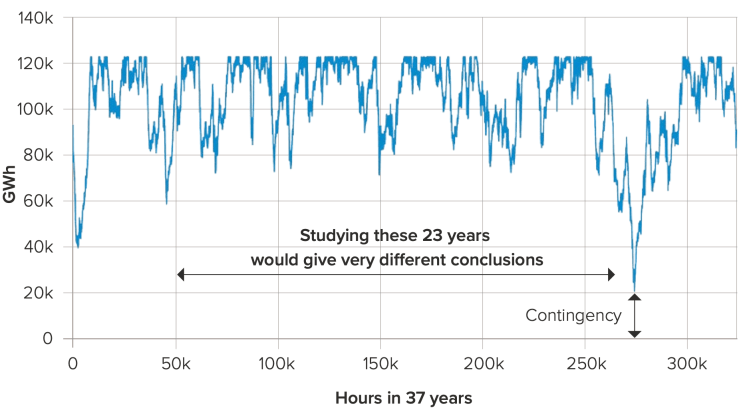
The authors describe the situation as follows (page 31):
Figure 13 exhibits two striking features. First, a study of the 23 years 1984 – 2006 would have found a storage volume very much smaller than found by studying 1980 – 2016. Second, there is a very large call on storage in the period 2009 – 2011 which reflects persistently low wind speeds that lead to the large deficits seen in figure 2 (some of the energy that fills these deficits would have been in the store since 1980). These features reinforce the conclusion that it would be prudent to add contingency against prolonged periods of very low supply and the possible greater clustering of 2009 to 2011-like years.
As a result of observations like this, the authors, I think correctly, conclude that batteries are completely out of the question to solve this problem. The only storage medium that could conceivably work would be a combustible chemical substance that can be put in massive underground facilities for decades. Only two possibilities are out there — hydrogen and ammonia. And ammonia is far more expensive and far more dangerous. So that leaves hydrogen.
Since hydrogen is the one and only possible solution to the storage problem, the authors proceed to a lengthy consideration of what the future wind/solar/hydrogen electricity system will look like. There will be massive electroayzers to get hydrogen from the sea. Salt deposits will be chemically dissolved to create vast underground caverns to store the hydrogen. Hydrogen will be transported to these vast caverns and stored there for years and decades, then transported to power plants to burn when needed. A fleet of power plants will burn the hydrogen when called upon to do so, although admittedly they may be idle most of the time, maybe even 90% of the time; but for a pinch, there must be sufficient thermal hydrogen-burning plants to supply the whole of peak demand when needed.
I find the treatment of the potential cost of all of this to be totally inadequate. There is never a mention of the most relevant subject, which is how much electricity prices to consumers might increase. The closest thing I find is this chart on page 32:
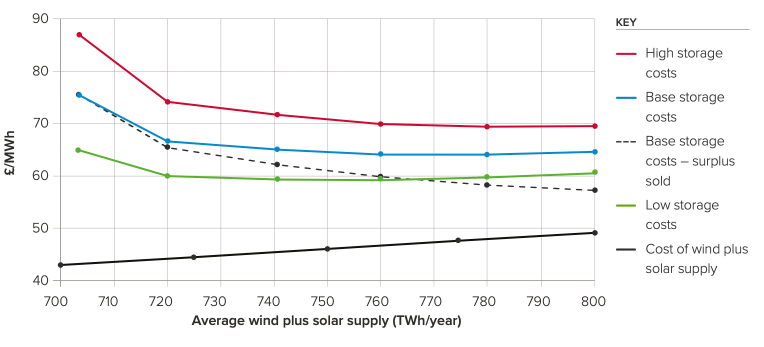
This is cost “to the grid,” thus wholesale cost. Will there be a huge multiplication of final price to the consumer? At first glance this doesn’t look too bad. About 50 pounds/MWh for the wind/solar input, and then 60-70 pounds/MWh for the storage makes about 110-120 pounds/MWh total. Add about 33% to convert to dollars, and you would have about $143-156/MWh, or 14.3 to 15.6 cents per kWh. It’s high, but not completely in the stratosphere.
But wait a minute. Are these guys leaving anything out?
-
How about the new network of pipelines to transport the hydrogen all over the place?
-
How about the entire new fleet of thermal power plants, capable of burning 100% hydrogen, and sufficient to meet 100% of peak demand when it’s night and the wind isn’t blowing.
-
They use a 5% interest rate for capital costs. That’s too low by at least half — should be 10% or more.
-
And can they really build all the wind turbines and solar panels and electroayzers they are talking about at the prices they are projecting?
The whole thing just cries out for a demonstration project to prove feasibility and cost. I’m betting that that will never occur before the whole “net zero” thing falls apart from the disaster of skyrocketing electricity prices. Time will tell.
Britain is Leading the World in Committing Economic Suicide
BY DAVID CRAIG | THE DAILY SCEPTIC | SEPTEMBER 29, 2023
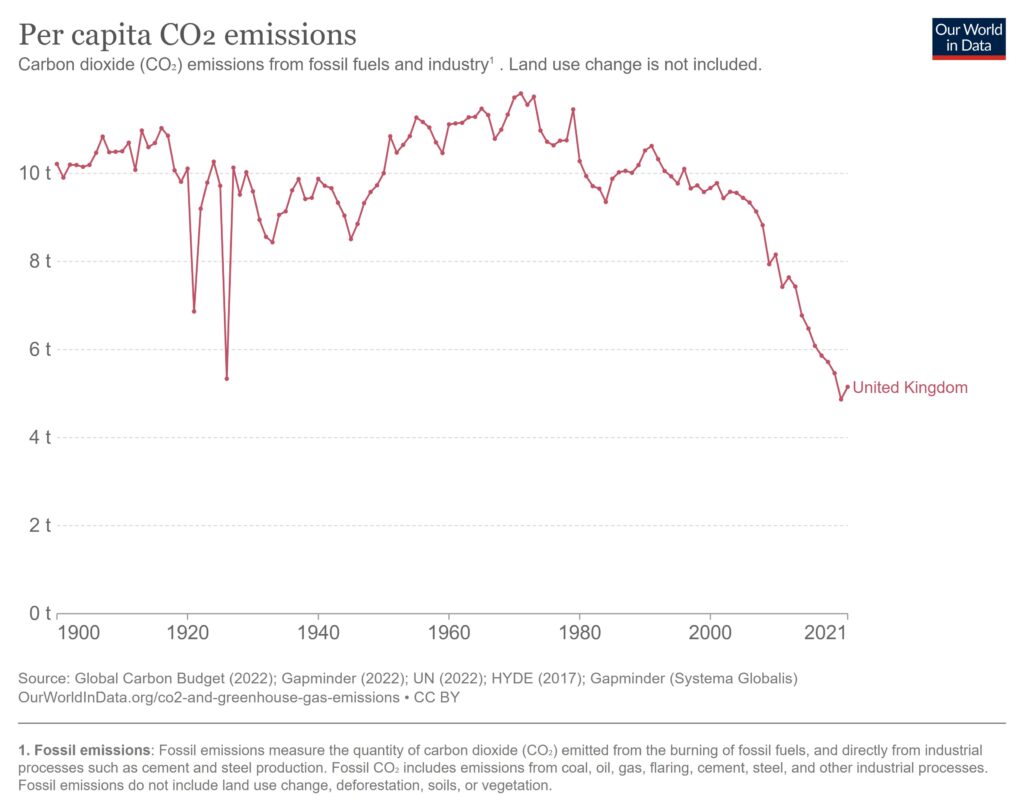
As our leaders bicker over how fast Britain should get to Net Zero, you’ll hear politicians, eco-zealots and media pundits claiming that Britain is leading the world in reducing our country’s CO2 emissions. This is one of the few statements about climate made by our ruling elites which does actually appear to be true. Since 1990, Britain’s CO2 emissions have almost halved from 604 million metric tons to just under 350 million tons by 2022. That equates to a drop from 10 metric tons per capita in 1990 to below five tons per capita:
While celebrating this great supposed ‘success’, our politicians, media and eco-activists often seem less keen to explain how this reduction in CO2 emissions was achieved.
Here’s another chart. It shows the share of the U.K.’s GDP made up by manufacturing:
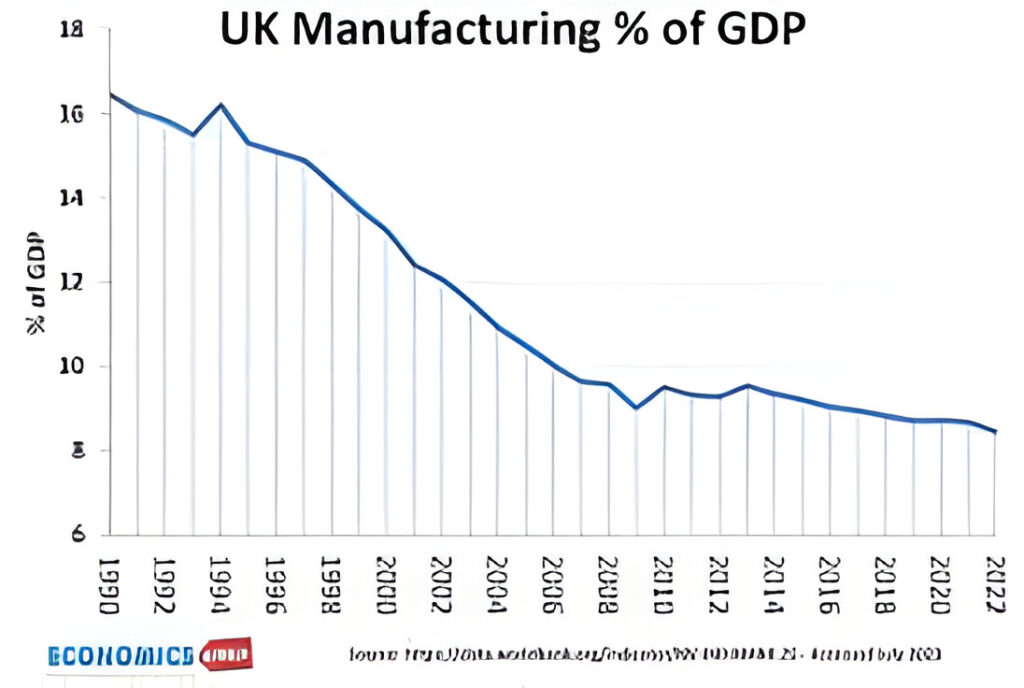
Since 1990, the year U.K. CO2 emissions started falling, the percentage of U.K. GDP from manufacturing has also halved from just over 16% to around 8%.
Moreover, during the same period, the number of people employed in U.K. manufacturing has dropped from 4,963,000 to just 2,601,000. A cynic mighty be tempted to wonder what happened to all those hundreds of thousands of highly-skilled, highly-paid green jobs that our rulers promised us would be created in Britain by the energy transition away from fossil fuels to renewables.
For years the U.K. has had some of the world’s highest energy prices due to our replacement of cheap, reliable fossil fuels with expensive, unreliable and intermittent supposed ‘renewables’. In 2022, in the U.K., which gets only 42% of its electricity from fossil fuels, household energy cost $0.41/kWh. In France, where 70% of its electricity comes from cheap, reliable nuclear, electricity costs were just $0.21/kWh – almost half the U.K. price. In the U.S., which generates about 60% of its energy from fossil fuels, the price was $0.18/kWh – less than half the U.K.’s cost. In China, where 55% of electricity comes from coal and a total of 83% comes from fossil fuels, household electricity costs are only $0.08/kWh – a quarter of the U.K.’s cost. There is a similar picture in India, where over 75% of electricity generation is from fossil fuels, of which three quarters comes from cheap, energy-rich coal, household energy costs only $0.07/kWh – a sixth of the U.K. cost.
So, just to put all of this into context, we can look at how much of the U.K.’s GDP comes from manufacturing – making real things that people in Britain and abroad want to buy – compared to our major competitors. In 2022, 8% of the U.K.’s GDP came from manufacturing compared to 9% for France, 12% for the U.S.A., 13% for India, 14% for Italy, 18% for Germany and a massive 28% for China.
A picture is emerging which suggests that the more a country relies on renewables for its electricity, the higher are its energy costs and the lower is the percentage of its GDP made up by manufacturing.
Economist Richard Salsman wrote: “The science of economics is clear: the production of money and debt is not equivalent to the production of real wealth. To claim otherwise is to follow fantasy, not reality – or science.”
As we in Britain enthusiastically print money and increase national debt in pursuit of our Net Zero goals, we seem to be wrecking U.K. manufacturing with high energy prices thus committing economic suicide as U.K. manufacturing moves to countries with lower energy costs. It’s more than astonishing that not a single one of our politicians and media supposed ‘experts’ seem to understand or are willing to admit what is actually happening and how the U.K. is committing an extraordinary act of self-mutilation by cutting the country’s CO2 emissions.
If there really was a climate crisis, the U.K.’s economic suicide to supposedly save the planet might be justified. But as I try to explain in my most recent book There is No Climate Crisis, there is no emergency that warrants such extreme actions. Yes, the Earth has probably warmed up a little since the freezing 1960s and 1970s when many experts were panicking about global cooling and the advent of a new ice age, which experts predicted would cause crop failures, mass starvation, the migration of millions from the cooling North towards warmer countries and wars over scarce food supplies. But this warming is just part of a natural cycle of warming and cooling driven mainly by the Earth’s rotation, solar activity and cloud cover. Moreover, the ice caps aren’t melting, in spite of the Guardian and the New York Times regularly predicting their demise. The polar bears are doing fine. In fact there may be so many of them that they may have difficulty finding sufficient food. The Great Barrier Reef has record levels of coral. Around five times as much U.S. forest burned each year in the scorching hot 1920s and 1930s as is burnt now. Even the IPCC (Intergovernmental Panel on Climate Change) admits that there has been no acceleration in sea level rise for the last 100 years. And the number of people killed by extreme weather events has fallen by over 95% in the last 120 or so years in spite of the world’s population quadrupling from under two billion in 1900 to almost eight billion now.
It’s a pity that those dragging us towards their Net Zero nirvana aren’t a bit more forthcoming about the economic devastation that their deluded policies are inflicting upon us.
David Craig is the author of There is No Climate Crisis, available as an e-book or paperback from Amazon.
EU launches world’s first carbon border tax
RT | October 1, 2023
The EU launched the first phase of an emissions tariff scheme on Sunday, with a planned import tax on steel, aluminum, cement and fertilisers, as part of its bid to become a climate-neutral region.
During the first phase, until 2026, Brussels does not plan to collect any CO2 emissions charges at the border. Until then the system will collect data on carbon-intensive imports.
EU importers are now obliged to report the greenhouse gas emissions embedded in the production of imported iron, steel, aluminium, cement, electricity, fertilisers and hydrogen.
Starting on January 1, 2026, they will have to buy certificates to cover these CO2 emissions. This will inevitably increase the final cost of produce imported by the bloc, reducing their competitiveness compared to goods manufactured domestically.
The Carbon Border Adjustment Mechanism is supposed to prevent more polluting foreign products from undermining the green transition. The measure will potentially protect local producers from losing out to foreign competitors, while they invest in meeting EU targets to cut the bloc’s net emissions by 55% compared to 1990 levels, by 2030.
According to European Economy Commissioner Paolo Gentiloni, the goal of the new policy is also to encourage a global shift to greener production and prevent EU producers from relocating to nations with a less strict environmental regulatory base.
The system has already faced criticism from the bloc’s major trading partners, who say it undermines free trade. It has also added to trade tensions between Brussels and Washington, with the latter asking earlier this year for US steel and exports to be exempt from tax.
Biden demands uninterrupted cash flow to Ukraine
RT | October 1, 2023
President Joe Biden has welcomed a bipartisan short-term budget deal that will keep the US government open for the next 45 days, but was disappointed that none of the billions of dollars in aid to Kiev that he had requested made it to the final bill.
“We cannot under any circumstances allow American support for Ukraine to be interrupted,” Biden said in a brief statement on Saturday night, shortly after Congress passed the measure.
Biden had requested an additional $24 billion for Ukraine, but critics argued that Washington has more important priorities and should have stronger safeguards against the misappropriation of the funds and supplies it sends to Kiev.
The US leader, however, blamed “extreme House Republicans” for causing a “manufactured crisis” and “demanding drastic cuts that would have been devastating for millions of Americans.”
“I fully expect the Speaker will keep his commitment to the people of Ukraine and secure passage of the support needed to help Ukraine at this critical moment,” the US president added.
Republican House Speaker Kevin McCarthy had to rely on Democrats in order to pass the bill and avert a government shutdown, as 90 Republicans opposed any short-term funding measures, denying him the much-needed votes. As a part of the deal, McCarthy increased federal disaster assistance by $16 billion, but had to forgo the border security provisions sought by the GOP.
After no new aid to Ukraine made it to the final bill, the House Democratic leadership said in a statement on Saturday that they expect McCarthy to bring a separate Ukraine aid package to vote when the House returns.
The Secretary of Defense Lloyd Austin also welcomed the bill passing, but called on the Congress to “live up to America’s commitment to provide urgently-needed assistance” to Kiev. “America must live up to its word and continue to lead,” he added in a statement published on Saturday.
US has close partnership with Takfiri terrorists in Syria, says President Assad
Press TV – September 30, 2023
President Bashar al-Assad says foreign-sponsored Takfiri terrorists are operating in areas of northeast Syria controlled by US occupation forces, stating that Washington has built up a close and strong partnership with militants wreaking havoc across the country.
Assad made the remarks in an exclusive interview with China’s state-run CGTN television news channel broadcast late on Friday.
“The northeastern sector of Syria is exactly the region, where terrorists are operating and Americans assert control over. The issue is not simply restricted to the looting of natural resources; but rather a partnership with terrorists to reap mutual benefits. This brings another problem, as a major power is in cahoots with terrorist. These are the facts on the ground in Syria,” he said.
Assad said the Syrian conflict is not over yet, and the Arab country is in the midst of a war.
“Syria, due to its geographical location, has historically endured numerous invasions. Anytime occupiers overran the country, they destroyed its cities and towns. Syria has, however, managed to recover. Syrian people will be able to rebuild their own country when the war ends and the siege is lifted.”
Assad said, “The current situation is certainly not good. It is, frankly speaking, difficult because livelihood woes and struggles are the main problems of the Syrian nation. I mean the financial miseries that they have to endure. Their pains and sufferings are increasing.”
“If reconstruction gets underway, Syria will have a very bright future. I am not speaking of assumptions, desires and expectations, but rather about the pre-war situation. Prior to the war, Syria’s growth was at its best rate of 7%, which was considered a very high ratio for a country with limited capacities.
“We had no foreign debts. We used to borrow and pay back our debts directly. We had enough wheat and used to export grains to other countries. We used to export vegetables and fruits, and were developing our industries in the early years of the crisis. Therefore, I can assuredly say that Syria will be much better than what it was before the war in case the war stops and reconstruction starts,” Assad added.
‘Ukraine has a terrorist government’: A new force wants the EU to change its stance
By Bradley Blankenship | RT | September 30, 2023
On September 16, around 10,000 protesters descended on Prague’s Wenceslas Square to demand a change to their government’s foreign policy. These protests were led by a group called Pravo Respekt Odbornost (Law Respect Expertise; PRO), which the Western mainstream media describes as pro-Russian and anti-Western.
Jindrich Rajchl, a Czech attorney inspired by the political lines of American conservatives Donald Trump and Ron DeSantis, is the leader of the group. While some may see Rajchl’s movement as completely out of touch with the country’s traditional politics, he believes that he’s tapped into something much more critical to Prague’s national mythos: rejecting foreign domination.
PRO and its supporters see the current Czech government as traitors who are controlled primarily from Washington and Brussels. And even though the political environment in the country has been turbulent over the past several years, a situation which the current goverment was meant to resolve, Rajchl and PRO believe that a national-conservative platform is the only thing that will rein in out-of-control excesses emanating from foreign powers.
Political situation in the Czech Republic
The current Czech government is led by a three-party center-right coalition called SPOLU (‘Together’), which is composed of the Civic Democratic Party (ODS), Christian Democrats (KDU-CSL), and TOP 09. These also have an agreement with the Pirate Party and the Mayors and Independents. It rode into power on a strong pro-Western, anti-corruption platform after the 2021 parliamentary elections.
That election was, first and foremost, a referendum on the leadership of former prime minister Andrej Babis, who held this post from 2017 until his eventual defeat, and served before that as finance minister from 2014. He was the spitting image of the prototypical Eastern European ‘oligarch’ before seeking public office, and is one of Europe’s richest people, according to Forbes, with an estimated net worth of $3.7 billion.
Throughout his entire tenure as prime minister, allegations of impropriety dogged him, sparking widespread mobilization within civil society. He was caught up in an EU subsidy fraud case, for which he was charged criminally and investigated by Brussels; he allegedly forcibly disappeared his own son; and he was mentioned in the Pandora Papers. It is against the backdrop of this intense public scrutiny for Babis and his left-wing coalition, which was composed of his center-left populist ANO (‘Yes’) party and the Czech Social Democratic Party (CSSD), with a tentative agreement with the Communist Party of Bohemia and Moravia (KSCM), that the Czech left was obliterated.
Babis’ alleged corruption was tied not only to his person but also to left-wing politics and its basic positions in general. While Babis was a moderate on foreign policy and supported French President Emmanuel Macron’s call for ‘strategic autonomy,’ the PM was instead cast as pro-China and pro-Russia for not buying all-in to Brussels’ political agenda. Likewise, the junior parties of the coalition – the CSSD and KSCM – were so damaged by their affiliation with Babis that neither qualified for any seats in the current Chamber of Deputies, and CSSD has only one senator, marking the first time that both houses of parliament have been without a communist party representative.
This strong mandate for the pro-Western Czech right is led by Prime Minister Petr Fiala, the leader of the very party that helped impose Washington’s ‘shock therapy’ on Czechoslovakia and the Czech Republic during the 1990s. It has been given carte blanche to buy into Washington’s imperial project in Ukraine – and in the Czech Republic itself.
The current Czech parliament ratified a new defense treaty with the United States that will make it easier for Washington to deploy troops on Czech soil – a move that critics see as a violation of Czech sovereignty. Defense Minister Jana Cernochova and the ruling coalition have even expressed a desire to host a US military base in their country. Given the Czech Republic’s experience with foreign occupiers, including Nazi Germany during the Second World War and the Warsaw Pact Invasion of Czechoslovakia in 1968, such a move would betray the country’s fundamental ideals.
With the death of the left comes an opportunity for the right
Enter a Czech lawyer named Jindrich Rajchl, who leads the emerging political party, PRO. The views of Rajchl and his party, in contrast to the positions of the ruling coalition, may seem out of step with the country’s typical view. For example, here’s what he said at September’s rally:
“We made another step today to move out of the way the rock that is the government of Mr. [Prime Minister Petr] Fiala,” Rajchl told demonstrators.
“They are agents of foreign powers, people who fulfill orders, ordinary puppets. And I do not want a puppet government anymore,” he said, calling on Prague to veto Ukraine’s inclusion in NATO.
PRO’s position – a national-conservative-based populist backlash against the decadence of Western liberalism – seems to be a welcome alternative to many disaffected Czechs, many of whom saw Fiala and his Civic Democratic Party (ODS), the party of the country’s first president, Vaclav Havel, as a return to normalcy.
They also want to broadly slash spending on social services, such as education, and pass the burden onto students. For example, PRO wishes to see university tuition introduced – which, to be sure, would be far less than in places such as the United States.
While PRO is an up-and-coming group and has yet to participate in an election, Rajchl told RT in a profile published in May that he is optimistic about his party’s odds. According to internal polling, he said his party was just over the minimum 5% threshold needed to enter parliament in the 2025 election. That means that, if the elections were held then, Rajchl would be an MP, a position he hopes to wield to form an alliance with other parties, such as the right-wing party Freedom and Direct Democracy (SPD) or potentially Andrej Babis’ ANO, which is topping polls. Politico’s latest tracker, however, has PRO at only 2% – below the threshold – and ANO on top with 34%.
But Rajchl hopes to run for the European Parliament in June 2024, primarily so he can take on Brussels directly.
Economy or war?
The economic situation in the Czech Republic may give PRO a chance for success. In the years following the onset of the Covid-19 pandemic, prominent international credit agencies like Moody’s have downgraded the Czech Republic’s credit rating due to substantial budget deficits. Before this development, the Czech Republic boasted one of Europe’s, if not the world’s, most favorable public finance outlooks.
Inflation has rocked the Czech economy for several years. According to the Czech Statistical Office, Czechs spent 14% more last year than the year before but, in real terms, spending fell by over 1%. Energy prices were primarily responsible, soaring by 15.5% while fuel increased by 33.5%.
The general outlook for the working class has also been abysmal – and policymakers have done little to support them. Analysis by PAQ Research published in December 2022, based on data from the Czech Statistical Office (CSU), projected that up to 30% of Czech households would fall into poverty this year. Despite this forecast, the ruling coalition still moved forward with an austerity package that would have an outsized effect on average people.
A current austerity initiative making its way through the Czech Republic is set to reduce spending by roughly 94 billion Czech crowns ($4.4 billion) in 2024, followed by an additional 150 billion in 2025 ($6.9 billion). This plan aims to achieve these cuts through various measures, including raising the retirement age, slightly increasing corporate and real estate taxes, and augmenting the current alcohol tax. Furthermore, it will entail workforce reductions within the public sector or corresponding wage adjustments, and it will also significantly raise taxes on the middle class, students, parents, and others.
Numerous experts have shared their views in the media, suggesting that the government’s adoption of an austerity plan became an unavoidable necessity. But unions and opposition political parties have staunchly disagreed, spawning massive protests over the past year.
At the same time, the Fiala goverment has sent weapons and aid hand over fist to Ukraine. In February alone, the goverment approved one weapons shipment worth an estimated 10 billion crowns ($430.74 million). The total amount of aid sent to Ukraine is believed to be around 20 billion crowns ($861.55 million), which constitutes a significant portion of the amount the government wants to cut with its austerity plan.
PRO is tying the Czech Republic’s economic and financial woes to Ukraine aid, and believes that out-of-control spending is hurting the country.
Ukrainian bone of contention
To elaborate on these topics and more, RT caught up with Rajchl again to learn more about PRO’s foreign policy agenda, following the aforementioned profile on him from May. A few developments have happened in Europe since the last conversation, including a public falling out between Poland and Ukraine over grain. Warsaw has unilaterally blocked agricultural imports from Kiev, which had flooded the European market and, Polish leaders say, hurt local farmers. This occurred after an EU-wide ban expired.
When asked about the latest spat between Ukraine and Poland, Rajchl said he shares the same views; however, he insisted that he had always held this position.
“I’ve been saying this since last year: In the end, it’s about the black hole that’s taking European and US money, and there’s huge corruption. The money isn’t used to help the Ukrainian oligarchs. And everyone has understood that the policy of President Zelensky is failing. I’m glad that the Polish government finally found this out. I hope the Czech government will too, but I don’t think they will. They put all their political capital into helping Ukraine and if they admitted that they were wrong, they would be recalled and would have to resign,” Rajchl said.
He added: “The Ukrainian government is a terrorist government. [With regard to] the rocket that crossed into Poland, it’s clear that this was a Ukrainian rocket – not a Russian rocket. Zelensky blamed Russia from the very beginning, although he knew from the very beginning it was his own rocket. He fired the rocket against the EU as a false-flag operation to blame Putin and get more help from the West, which is a form of blackmail. This regime is a criminal regime, Zelensky is a terrorist and should be tried at The Hague.”
Indeed, just after Rajchl’s conversation with RT, Polish investigators reportedly reached the conclusion that the rockets that hit the Polish border village of Przewodow must have been of Ukrainian origin, according to a Polish media report.
What else do they believe in?
Last year, at the height of Europe’s inflation crisis, PRO held a similar rally that attracted tens of thousands of people. During those protests, the group blasted the inflation that was crippling the working class and demanded the government’s resignation. Today, according to the latest Morning Consult tracker of world leaders, Fiala’s government has a dismal 20% approval rating.
Commenting on this, Rajchl said, “It’s a well-deserved place because he’s the worst leader in the world right now, of all of the leaders I know. He doesn’t care about his own people. The economic situation is mostly contributing to this; Fiala is not doing anything to help the Czech people, and they know it. He’s just taking orders from the EU, from the US, from Kiev, but he’s not doing anything for ordinary Czech people.”
The PRO leader also pointed out the absurdity of Czech officials calling on Europe and the West to prepare for nuclear conflict with Russia. “We don’t need to prepare [for this]; we need to do everything in our power to avoid nuclear conflict with anybody in the world.”
“I don’t want to have any enemies in the world. I am reminded of a speech by John F. Kennedy, when he said, ‘We don’t want to have Pax Americana that is forced by American weapons.’ We need to change the perception of the world so that there won’t be friends and foes, but simply neighbors that are just living on the same planet. I don’t see Russia as a threat; I believe the much bigger threat is the Western powers that are dragging us into this stupid conflict,” Rajchl said about his feelings regarding Russia.
The organizer’s position of establishing equal partnerships and being against hegemony sounded similar to the words of some world leaders at the latest BRICS summit in South Africa. Rajchl said he would be open to seeing Prague join BRICS+, perhaps becoming the first EU member state to be incorporated into that emerging bloc.
In his profile for RT in May, he stressed that he was not anti-American or anti-NATO. However, the protest had a much more radical rhetorical angle this time around. Rajchl stressed that he was not against Washington but rather the current leadership of President Joe Biden.
“I believe Donald Trump is the right leader for the United States,” he said, “Biden is just a puppet. There are people behind the current pushing for war, pushing for the woke agenda, the LGBTQ, the Green New Deal, and all these crazy agendas that are poisoning the world and the minds of our children, which I see as the biggest threat to the world and Europe,” he said.
“The woke agenda,” Rajchl stressed, “is the biggest threat to Western civilization. Look at the United States: Its cities are full of people addicted to fentanyl. Western Europe is full of migrants from Muslim countries, which threatens our security.”
The lawyer-turned-politician plans to run for the European Parliament in the country’s upcoming election in June 2024. Rajchl said he wants to “explore and research all of the things that happened during Covid” because his movement is convinced that there were “a lot of crimes that have been committed by members of the European Commission,” and he also wants to form a “national-conservative platform” to stand up against Brussels’ overreach. While not specific on the numbers, the organizer said he was optimistic about his odds of securing an MEP seat, according to internal polling.
Rand Paul Issues Ultimatum: Withdraw Ukraine Billions Or Face Government Shutdown
By Steve Watson | Summit News | September 29, 2023
Senator Rand Paul declared that he will hold up a spending bill in the Senate and push toward a government shutdown unless $6 billion in aid to Ukraine is removed from the legislation.
Paul took to Twitter noting that he will only allow a vote on the spending stopgap before the Sept. 30 deadline for funding government if Senate leaders get rid of the massive amount of money earmarked for the war.
“If leadership insists on funding another country’s government at the expense of our own government, all blame rests with their intransigence,” Paul wrote.
Last week, Paul slammed the Ukrainian leadership as “corrupt” and blasting the visiting President Zelensky as “begging for more money.”
In the Senate, Paul asked “When will the aid requests end? When will the war end? Can someone explain what victory looks like?”
Paul also noted that Zelensky has cancelled Democracy in the country.
“They’ve cancelled the elections. What kind of democracy has no election?” he noted, adding “next year, Zelensky said he’s not going to have an election because it would be inconvenient during the war and would be expensive.”
He continued, “if you don’t have elections, who in the world will be supporting a country that’s not a democracy? They’ve banned the political parties, they’ve invaded churches, they’ve arrested priests. So, no, it isn’t a democracy. It’s a corrupt regime.”
Meanwhile, Democratic Presidential candidate, Robert F. Kennedy Jr. warned on Thursday that the “next step of Ukraine War escalation” is stationing United States military advisers on the ground.
“Have they forgotten how we got embroiled in Vietnam?” RFK Jr. noted, linking to a recent article in Foreign Affairs calling for on-the-ground training:
Featured Video

Macgregor: We Haven’t Seen the Worst of the Iran War Yet
or go to
Aletho News Archives – Video-Images
New Book
Breast Cancer: Before You Consent
A new Unbekoming paperback
Lies are Unbekoming | September 18, 2026
Peter Gøtzsche reviewed every randomised mammography screening trial ever conducted for the Cochrane Collaboration. Cochrane’s headline is that, assuming a 15% mortality reduction, one woman in 2000 avoids dying of breast cancer over ten years. Ten are overdiagnosed and treated. Two hundred experience false alarms.
But that headline assumes the reduction. When Gøtzsche looked only at the trials with adequate randomisation — the higher-quality ones — the reduction disappeared. No effect on breast cancer mortality. No effect on all-cause mortality.
This is the Cochrane finding, published in the establishment’s own database of systematic reviews.
No woman being asked to consent to a mammogram this week knows it.
That is why the new Unbekoming paperback exists. … continue
Blog Roll
 Aletho News
- Yemeni army claims responsibility for strikes on sensitive sites in Saudi capital, Aramco facilities in Yanbu
- Iran Judiciary issues indictments against 159 US, Israeli officials for assassination of Leader, commanders
- Turkiye revokes Iranian bank license under US sanctions campaign
- US-Denmark Agreement on Greenland Is ‘PR Stunt’ Ahead of Midterms
- Araghchi: Military intervention cannot create security; coercion cannot bring peace
- Fraud Squared
- Breast Cancer: Before You Consent
- Iran’s Plan to Shut Down AI in the Persian Gulf
- Israel seeks ‘compensation’ from Washington over Saudi F-35 sale
- Saudi crown prince seeks dialogue with Ansarullah after Yemeni blows: Report
- If Americans Knew
- Inside Gaza’s death trap of collapsing, bombed-out buildings
- The everyday items Israel bans from Gaza every day
- Inside the siege, the ruined buildings of Gaza – Daily Update
- Debunking The Claim That Macklemore Has A “History Of Antisemitism”
- CPJ demands release of arrested Palestinian-US journalist near Bethlehem
- Robert Kraft: The Billionaire Friend of Netanyahu Pulling The Strings Behind the Macklemore/Ed Sheeran Blow Up
- Columbia Administered Fund Gives Big Money to Pro-Israel Groups
- Deportation Case of Palestinian Activist Salah Sarsour Tests First Amendment
- ‘We Will Not Forget’: Palestinians Mark 44 Years since Sabra and Shatila
- Why do we let Zionists decide what we can and can’t say?
- No Tricks Zone
- New Study: ‘Global Drought Shows No Detectable Recent Acceleration Under Climate Warming’
- Economic Masterminds: German Socialists Suggest Taxing Productivity Gains Stemming From Using AI
- The South China Sea Has Not Been Cooperating With The Climate Change Narrative
- Energy Crisis: Germany Enters Heating Season With Historically Low Gas Reserve Fill Levels
- New Study: The Antarctic Ice Sheet Gained Mass From 2020-2024 Due To Staggering Snow And Ice Accumulation
- Study: Ocean Heating Rates From Thousands Of Years Ago ‘Dwarf’ Modern Ocean Heating Rates
- Climate Extremists Target, Attack Large-Scale Power Grid Infrastructure In Germany!
- New Study: Antarctic Ice Melt Has Contributed Less Than 1 Centimeter To Sea Level Rise In The Last 30 Years
- Fear Of Debate: Alarmist German Climate Scientist Calls On Mainstream Media To Discredit Skeptic Voices
- End-Of-August Arctic Sea Ice Extent Hasn’t Fallen In 20 Years, Official Data Show!
 Aletho News