After Russia, the U.S. is the second largest arms exporter to India. As a major Washington defense partner, New Delhi signed two $3.5 billion arms purchase agreements earlier this year. However, U.S. Deputy Secretary of State Clarke Cooper reiterated Washington’s supposed dismay over India’s military purchases from Russia. Issuing a warning, he said that significant purchases of Russian weapons, such as anti-aircraft systems or advanced fighter jets, “risk future opportunities that may be impeded by significant Russian defense articles.”
Although he said that Washington recognizes “the historic legacy sustainment line that New Delhi had with Moscow and that, to use a metaphor, it’s not a light switch to turn on or off,” and that they do not want “to put at risk India’s sovereignty or India’s national defense as there’s a maturation toward future modernization of their systems,” he said “there is a risk when significant Russian systems are brought forth that put at risk interoperability with not only the United States, but with other partners that India may be seeking to work with that are either of NATO status or NATO-aligned. And then there’s also the risk of potential exploitation of technology when we’re looking at significant Russian platforms.”
Despite U.S. threats, India last month approved the purchase of 21 MiG-29 and 12 Su-30MKI fighters for a total value of more than $2.5 billion from Russia, with Indian Defense Minister Rajnath Singh urging for the delivery of the S-400 anti-aircraft defense systems as soon as possible.
However, it is unlikely that Washington will choose to sanction India for purchasing Russian weapons. Former financial adviser to the Indian Ministry of Defense, Amit Cowshish highlights that imposing sanctions on New Delhi will only hurt Washington’s own interests since the South Asian country is one of the largest markets in the world. Cowshish stressed that if the Trump administration moves ahead with sanctions, India will say it cannot buy U.S. equipment, which will hurt its own military industry as it loses a major market.
According to a Stimson Center working paper by Sameer Lalwani, India’s defense equipment is overwhelmingly Russian – 90% of the Army, 41% of the Navy and two-thirds of the Air Force.
“India’s share of Russian systems has grown, not decreased, because of Indian Army acquisitions. While India’s naval and air forces are decreasing their quantitative reliance on Russian arms, their most advanced or offensive capabilities still originate from Russia,” Lalwani wrote. “While the United States treats Russia as an equally revisionist threat to the global order as China, India sees Russia as a partner to ensure a multipolar balance of power, and a hedge against a potential Sino-Russian bloc.”
As India is the key player in the Indo-Pacific Strategy (IPS), it is unlikely Washington is willing to antagonize New Delhi so quickly. The administration of U.S. President Donald Trump unveiled the IPS report in June 2019. It demanded that India, Japan, South Korea, Australia, the Philippines and Thailand serve Washington’s interests in Asia-Pacific because “these alliances are indispensable to peace and security in the region and our investments in them will continue to pay dividends for the United States and the world, far into the future.” Effectively, the IPS is the U.S.’ strategy to attempt to maintain its unilateral hegemony in Asia-Pacific, and India has a key role in this vision.
The IPS is directly aimed against China, and not Russia, and it is for this reason that although New Delhi may be willing to oppose Beijing within limits, it is highly unlikely that India will want to sever its long relationship with Moscow on Washington’s demand. It is likely that the comments by Cooper, despite being a high official, do not reflect on Washington’s real demands and expectations of New Delhi. Although Washington would want India to stop its relations with Moscow, the Americans know this is not possible and recognize that for now Russia has very limited influence in the Indo-Pacific region. It is for this reason that New Delhi’s relations with Moscow can for now be tolerated by Washington so long as they remain in opposition to China. It is also for this reason that it is unlikely Washington will sanction India over its procurement of Russian-made weapons.
Paul Antonopoulos is an independent geopolitical analyst.
The alliance between Venezuela and Iran seems to be taking new directions. The ties between the two countries began to strengthen in an economic sphere when, in the first half of 2020, Tehran started sending oil ships to Venezuela, circumventing the international trade rules imposed by Washington with the aim of blocking Caracas economically. Earlier this year, Tehran sent several cargoes of gasoline to Venezuela to help the South American country overcome fuel shortages, as well as equipment to help state oil company PDVSA overcome production and export difficulties during the crisis.
The presence of Iranian ships on the Venezuelan coast has been a real affront to the United States, which has always played a role of naval hegemony in the Caribbean. Recently, the United States claimed to have seized four ships carrying Iranian gasoline en route to Venezuela, prompting Washington to tighten sanctions on both countries. But the US was unable to contain the Iranian advance and now the alliance between Caracas and Tehran has advanced into a military step.
Recently, Venezuelan President Nicolás Maduro thanked Iran for helping the South American country overcome US sanctions on its oil industry. At the time, he said that Iran is helping to maintain all Venezuelan national governance but did not elaborate on how this cooperation was taking place. He said it was important to maintain secrecy on the topic because of the economic boycott imposed by the US – which he called a “brutal war”. However, Colombian President Iván Duque said last week that Maduro was interested in buying missiles from Iran, which Venezuelan officials denied, but later Maduro responded that Duke’s statement was a “good idea” and that he had not yet considered it .
Shortly thereafter, Maduro confirmed his interest in buying Iranian weapons. According to the Venezuelan president, Iran, possessing advanced military technology, can be a great partner of the South American country in case of possible attacks by the US. According to Maduro, buying Iranian missiles was not in his plans until the moment that Iván Duque gave him this idea by accusing him in a condemning tone of being acquiring such equipment.
“With Iran having tremendous military technology, buying short, medium and long-range rockets and missiles from Iran to defend against imperialist threats seemed like a good idea, [so] I gave the order to Defense Minister Vladimir Padrino to evaluate all potentialities and possibilities, and if it is possible and convenient, we will buy these missiles at the right time”, said Maduro in an interview with the state television channel” Venezolana de Televisión”. According to the Venezuelan president, the Duke’s pronouncement was intended to attack Venezuela to take international attention away from Colombia’s national problems, such as the massacres and murders perpetrated by drug trafficking militias and the great social crisis generated by the new coronavirus, however, it ended up arousing the Venezuelan government’s interest in buying such Iranian missiles.
Now, it seems that the possibility of buying Iranian missiles is being evaluated by Vladimir Padrino, leader of the Venezuelan Defense, and there is a great likelihood for the negotiations to be concluded, considering that there is a willingness on both sides for international cooperation since they have a common enemy. Looking at the case from a realistic point of view, it is very unlikely that negotiations between Iran and Venezuela started due to Iván Duque’s pronouncement. Both countries were probably already discreetly maintaining this dialogue and the accusatory and condemnatory pronouncement served only as an opportunity to make the news public. In fact, it seems that Duque’s words were a flawed blow: Venezuela was expected to deny the accusations and thus create a scenario of tensions and uncertainties, but, contrary to what was predicted by the Colombia-US coalition, Venezuela has made public its intention to acquire the missiles and now the alliance is almost official.
If the missiles are bought by Caracas, this will be a major blow to the American presence in South America and, at the same time, a major milestone for Iranian international projections. The most important thing to note is that this agreement has a much deeper dimension than mere military trade: everything indicates that it will only be the first step in a major military alliance. Venezuela will have its defense system strengthened and will guarantee greater security against possible attacks by both Americans and Colombians. Likewise, in a possible war against Washington, Iran will have the definitive support of Venezuela – a strategically well located ally, with its coastline pointing to the Caribbean Sea, an important area of American influence.
Lucas Leiroz is a research fellow in international law at the Federal University of Rio de Janeiro.
Turkish President Recep Tayyip Erdogan on Friday announced that his country had discovered an enormous natural gas source – over 320 billion cubic metres of gas in the Black Sea.
“Now I want to share our good news with you: Turkey has realised the biggest natural gas finding of its history in the Black Sea”, he said.
According to him, the find also means there is a high possibility of other natural gas sources in the area.
Erdogan added that Ankara is aiming to provide the Black Sea gas for use in 2023, and promising to accelerate Turkish operations in the Mediterranean, claiming he will not stop until the nation is a net exporter of energy.
Confrontation Over Resources
Ankara previously collided with Athens amid a Mediterranean gas row, as both claimed the same territories in the sea for gas exploration. Erdogan said that his country’s surveying ship Oruc Reis will continue explorations in the eastern Mediterranean until 23 August. Later in the week, reports suggested that the Greek naval frigate Limnos and the Turkish frigate Kemalreis (F-247) “touched” each other in close proximity to the Oruc Reis.
In response, Brussels urged the Turkish government to halt its drilling activities in the area, as the EU is ready to impose sanctions on the country.
Turkey also explored resources near Cyprus, engaging in a conflict with the island nation, as it considers the area to be a part of its exclusive economic zone. The Turkish government claimed that the resources should be shared and that it acts on behalf of the self-proclaimed Turkish Republic of Northern Cyprus – a breakaway part of the island only recognised by Ankara.
The US exited the Iran nuclear deal and therefore has no right to demand a ‘snapback’ of UN sanctions on Tehran, the foreign ministers of three European powers involved in the JCPOA said in response to Washington’s latest push.
“France, Germany and the United Kingdom, the so-called E3, note that the United States has not been a member of the JCPOA since their withdrawal from the agreement on May 8, 2018,” their respective foreign ministers Jean-Yves Le Drian,Heiko Maas and Dominic Raab said in a statement on Thursday.
Therefore, the E3 “cannot support” the US demand for UN sanctions against Iran to be reimposed, as it is “inconsistent” with their current efforts to implement the deal, the trio added.
JCPOA stands for the Joint Comprehensive Plan of Action, the name given to the 2015 nuclear agreement negotiated by the Obama administration, endorsed by all five permanent members of the UN Security Council and Germany.
Citing UNSC Resolution 2231, which codified the deal, US envoy to the UN Kelly Craft officially requested the “snapback” of sanctions on Thursday, accusing Iran of “significant non-compliance” with the deal. However, China has previously pointed out that the US is not eligible to make that request, having exited the treaty unilaterally. The E3 statement indicates the Europeans share Beijing’s stance on the issue.
The E3 statement came during the press conference US Secretary of State Mike Pompeo was giving at the UN, declaring confidently that the rules of the Security Council are “straightforward” and will lead to the sanctions being restored.
You may have read in the past few days that residents of California have been experiencing rolling power blackouts. This has occurred in the middle of a strong heat wave, meaning that large numbers of people have had their air conditioning, light, refrigeration, and everything else dependent on electricity, go out just when they are most needed. The blackouts have not been the result of technical failures of the grid, but rather have been intentionally imposed by the electricity system operator (known as CAISO — California Independent System Operator) via the various local utilities.
So what has caused these blackouts? The official explanation is that the heat wave is the cause. It has just gotten so unusually hot that demand has risen beyond the capacity of the system. Many articles in the media reporting on the situation go further to associate the unusual heat with “climate change.”
This explanation is complete BS. Yes, there is a strong heat wave going on, at least in certain areas of the state, but it is not unusual in historical context. In fact what is occurring is that California has begun to face the consequences of replacing reliable fossil fuel and nuclear powered electricity with the intermittent renewables, wind and solar. In the evening, approximately 7 to 9 PM, when the sun has set and the heat lingers, and when the demand for electricity for air conditioning reaches a peak, the intermittent wind and solar sources have been producing just about nothing. With insufficient fossil fuel backup, there is not enough power to meet the demand.
In short, we are witnessing the results of almost unbelievable incompetence by the authorities in California. As usual, the equally incompetent and corrupt media are completely giving the authorities a pass in the name of supposedly addressing “climate change.”
First, consider the heat wave. It is fair to call what is currently going on in some major cities like Los Angeles and San Jose a serious heat wave (although the situation in other major California cities like San Diego and Santa Barbara is not a heat wave at all). In Los Angeles, the average daily high for mid-August is 84 deg F. The highs for the past three days have been 93, 98 and 95. For the rest of the upcoming week, forecast highs are all in the 90s, with Wednesday the highest at 98. On the other hand, in Los Angeles, the temperature goes over 100 deg F at least once or a few times most years. Here is a list of record high temperatures in Los Angeles by year. In 2018 it hit 108; in 2010, 113; in 1990, 112; in 1988, 110; and so forth. The large majority of years have records at 100 or above. In short, there is nothing unusual or unexpected in summer temperatures at the level being experienced this week.
So with temperatures at or above the current levels a regularly recurring phenomenon, why haven’t the authorities planned accordingly and put in place resources to meet the demand? The answer is that under a law enacted in 2018, California has embarked on a crazed program to generate 50% of its electricity from “renewable” sources by 2025, 60% by 2030, and 100% by 2045. Both before and after enactment of that law, California has been ambitiously expanding its capacity for wind and solar generation of electricity.
To put this in some context, the peak electricity demand that has been causing California’s problems during the current heat wave is in the range of 42 – 46 GW. (Today’s peak demand was about 44 GW.) To meet this demand, you could put in place a system of fossil fuel and nuclear plants with a capacity of around 55 GW, which would give you a comfortable cushion to deal with whatever maintenance issues or mishaps might arise.
According to the U.S. government’s Energy Information Agency, California actually has installed electricity generation capacity of almost 76 GW. That sounds like wildly more than you would ever need. But the problem is that of the 76 GW of capacity, some 27 GW is solar, and 6 GW is wind. In August the solar goes into steep decline around 4 PM and ends completely around 7 PM. The wind more or less doesn’t blow at all during heat waves. …Full article
Although the U.S. can threaten Germany, now during the American election campaign, threats cannot prevent the construction of the Nord Stream 2 gas pipeline between Russia and Germany. It is interesting to observe how for the first time this century Berlin is resisting demands made by Washington.
After the U.S. State Department included the Nord Stream 2 gas pipeline as a project that could be sanctioned, the Minister-President of the German Province of Mecklenburg-Vorpommern, Manuela Schwesig, said that Europe should make it clear to the U.S. that threats of sanctions are unacceptable. Earlier, the German Bundestag announced that due to the American threat of sanctions, they are considering the possibility of filing lawsuits with various courts and also addressing the United Nations, because it is a threat to a sovereign state and a violation of its rights. The American threat does not refer only to the companies, but also to the government institutions that approved the realization of the project.
It is clear that Schwesig in her comments was acting as a spokesperson for German Chancellor Angela Merkel and sent a clear message to Washington. It is obvious that Washington is accustomed to Europe unconditionally satisfying their interests and meeting every request and pressure they demand. The situation in international relations in the post-Cold War era, with the strengthening of multipolarity, has changed significantly. This is evident since the U.S. is now threatening allies if their interests do not perfectly align. Germany has a clear interest in completing Nord Stream 2 – it will provide an energy hungry Germany with energy stability.
Although Washington-Berlin relations may be tense, because of the election campaign, the U.S. is unlikely willing to go so far as sanctioning a so-called ally state. The scope of American pressure on Germany will be limited and it cannot be expected that the Democratic-Liberal bloc will in anyway support any intentions of U.S. President Donald Trump on foreign policy issues, including Nord Stream 2.
Given that the election campaign is underway, the range of its pressure on Germany is limited and Nord Stream 2 will certainly be completed. The project has already been delayed to some extent because some companies withdrew from the job of laying pipes due to financial threats, so Russia organized other pipelayers there to ensure its completion. In a more serious political sense, apart from punishing companies that participate in the construction of the Nord Stream 2, Washington will not be able to take any other effective measures to disrupt construction.
Berlin will certainly not be willing to give up on the project that it has already invested €10 billion so far, especially now that it is in the final phase as the pipelines to be laid is on a stretch of less than 200 kilometers on a route that is more than a thousand kilometers long. The German economy is very dependent on Russian gas and energy, which cannot be replaced in its entirety with very expensive American liquefied gas.
Germany is starting to show resistance that it has not shown this century so far, and it is trying to encourage other Europeans to stand up against American threats of sanctions. Some companies have already left Nord Stream 2 because they believe that as the project is nearing completion, if they do not give it up, they will lose contracts in the American market in the long run. Germany wants to bring this issue before the United Nations Security Council, but it is a path that does not bring much hope for them as the U.S. has the right to veto. However, it is interesting as this is the first time that some kind of tougher resistance against the U.S. is shown.
Germany could impose more rigorous sanctions on American products that are in the European market, but that is a major risk as Germany largely depends on the American market, which is the most important one for it after China.
Therefore, the Nord Stream 2 gas pipeline is an important and expensive project for Germany, not only in the economic sense, but also in the political one. Germany is trying to make some kind of compromise, but the question on who will soon be in the White House will depend on how to move forward in Berlin-Washington relations. Germany surrendering Nord Stream 2 would not only be a huge loss of money invested, but its economy would not be able to compensate for the amount of energy it needs. It is for this reason that Germany is willing to risk sanctions from the U.S. and does not question scrapping the Nord Stream 2 project.
Paul Antonopoulos is an independent geopolitical analyst.
The HybridWar on Belarus is increasingly focusing more on the economic dimension for catalyzing regime change than the kinetic one commonly associated with EuroMaidan. The nationwide labor strike movement is gaining steam, which risks crashing the country’s economy if workers from its five biggest businesses that disproportionately contribute to its national budget join in and succeed in suddenly stopping production at these firms. According to Swedish neoliberal economist and Senior Fellow at the Atlantic Council (banned in Russia as of last summer for meddling in its internal affairs) Anders Aslund, these are “the potash company Belaruskali, the two largest oil refineries, the Minsk Tractor Works (MTZ), and the Minsk Automobile Plant (MAZ)”. He listed them off in his article about “The Economic Factor In Belarus” for the partially Soros-funded “Project Syndicate” international media organization, where he strongly lobbied for the country’s radical neoliberalization if Lukashenko is forced to leave office.
Five Targets For The Labor Strike Movement
It shouldn’t be seen as a coincidence then that these same companies are targeted by the nationwide labor strike movement. Ore mining at Belaruskali, described by Russian publicly financed international media outlet TASS as “one of the world’s biggest producers and exporters of potash fertilizer”, was halted as of Wednesday (19 August). The outlet also reported on the same day that “two people were detained during an unauthorized mass rally” at the Minsk Tractor Works. Considering the outsized economic impact that a comparatively tiny percentage of the country’s population employed in these companies could cause if they participated en masse in this movement, these industries can rightly be regarded as Belarus’ “Achilles’ heel”. The government would have immense difficulty meeting its generous social obligations to the people which form the basis of its legitimacy should the situation worsen, which is why it’s possible that the authorities might deploy the security services to quell any unrest at those five companies so as to stave off that scenario.
Approaching The Peak
Lukashenko himself warned on Tuesday that “this is not even a peak yet” when commenting on the ongoing Color Revolution against him, perhaps hinting that events might inevitably move in the previously mentioned direction. The government is very concerned about the consequences of such a scenario. Prime Minister Golovchenko, while claiming on that same day that “all enterprises of the real sector of the economy are working as usual” (though a lower official later said that there was already $500 million in damages), also said that Belarus would lose its hard-earned market position in those affected industries to its competitors if “any downtime” occurs. To prevent this from happening, workers are being educated about how the consequences would directly harm their living standards. The premier observed that “when convincing and simple words are used to explain what losses the enterprise is experiencing, how the standing of the specific worker, his or her salaries, bonuses will be affected, they come to realize that it is necessary to step down emotions a bit.”
The “Elite Proletariat”
The problem, however, is that an uncertain percentage of those “elite proletariat” (“elite” in the sense that their participation in the nationwide strike movement more so than any other industries’ workers could crash the economy) might be under the influence of fake news narratives such as the one promising them that “the new management will double the salaries of employees and make them shareholders” if the regime change campaign succeeds and their companies are privatized. This claim was made by someone in Minsk whose account was shared by the Federal City information outlet and republished at Yandex Zen (in Russian). Those high hopes are bound to be shattered because Western-backed regime changes have never resulted in such an outcome. Furthermore, opposition leader Svetlana Tikhanovskaya’s “Emergency Package of Reforms for Belarus” program (which was pulled offline but reported upon by Sputnik) makes its neoliberal intentions clear and even hints at cutting off Belarus’ trade with Russia, which would disastrously slash GDP by 25-50%.
The Struggle For Workers’ Hearts & Minds
Taking this strategic insight into account, it’s increasingly obvious that the Hybrid War on Belarus is moving from the streets to the factories as the regime change organizers and the authorities struggle to “win the hearts and minds” of the country’s “elite proletariat”. The former will say whatever is needed to convince them to strike and subsequently hand over their quasi-“socialist” economy to Western neoliberals while the latter must educate this tiny class of workers about the game that’s being played against them. The authorities might even decide to raise workers’ wages (perhaps paid for by an emergency loan from Russian in exchange for intensifying Belarus’ integration with it through the “Union State” framework) in order to disincentivize them from striking. No financial cost or relative weakening of its sovereignty is too high of a price to pay Russia either since neither the Belarusian state nor its workers (including the “elite proletariat”) would survive the planned post-Lukashenko neoliberalization that the pro-Western opposition is eagerly preparing for.
Concluding Thoughts
The greatest threat presently facing Lukashenko isn’t from street protests but from the possibility of large-scale labor strikes suddenly shutting down production at Belarus’ five main enterprises. The country simply wouldn’t be able to survive such a worst-case scenario for long, except perhaps if it sought emergency financial assistance from Russia in exchange for Belarus’ accession to the Russian Federation by referendum via the “Union State” framework considering the immense financial burden that would be placed upon Moscow if it subsidized Minsk’s survival under those pressing circumstances while Belarus remained a separate state. Lukashenko might not be able to swallow his pride and accept his potential future as just another Russian functionary instead of the leader of an independent country so there’s a chance that he might order the security services to intervene in stopping the strikes if the authorities can’t first succeed in convincing the workers to reconsider. Either way, events seem to be rapidly approaching a peak, and it’s all due to the strikes.
On August 9, presidential elections were held in Belarus with five candidates bidding to be head of state. According to the Central Election Commission, the incumbent president, Alexander Lukashenko, won in the first round with over 80% of the votes. Mass protests began in Belarus right after the announcement of the preliminary election results. People went to the streets, expressing their dissatisfaction with the results of the elections that they believe were unfair. Mass protests turned into riots and there were clashes between rioters and the police. Many people were detained and injured, and two protestors died.
Representatives of the European Union and the U.S. stated that they did not consider the presidential elections fair and appealed to the Belarusian authorities to have a second election. As both the EU and U.S. condemned Lukashenko’s re-election, it was therefore unsurprising that the deputy head of the Polish Ministry of Foreign Affairs, Paweł Jabłoński, stated that Poland did not want the EU to limit itself to only introducing sanctions against Belarus, as he claims it will push Belarus deeper into the sphere of Russian influence.
Tomorrow’s EU summit to discuss the situation in Belarus, and possibly pass sanctions, resulted from Warsaw’s call for prompt action, and above all, Prime Minister Mateusz Morawiecki who personally exerted pressure immediately after the Belarusian elections.
“We do not want the EU’s reaction to be limited only to presenting an idea for sanctions and adopting a joint statement, which is obviously needed, but to give Belarusians something more,” said Paweł Jabłoński in an interview with PAP. “The point is that we should present a real offer to resolve this conflict in a stable and lasting manner, and this is only possible if we, as the EU, offer Belarus a real perspective of cooperation if a solution based on dialogue is reached.”
Jałoński also pointed out that EU member states should jointly adopt a common position on the events in Belarus.
“We will want to send a signal that if Belarus begins the process of reforms leading to a system in which citizens decide on the direction of changes, the EU is ready for real cooperation with Belarus – primarily economic,” said Jabłoński, adding that “Belarusians should be able to choose their own development path and have a real choice here – our role is to propose this choice.”
This suggests that Warsaw’s main concern is to see the liberalization of the Belarusian economy to follow the same path as the other post-Soviet countries in Eastern Europe. The World Bank estimates that 75% of industrial output comes from state-owned companies, with the state sector employing about half of the Belarusian workforce. Because of this, unemployment in Belarus was at 4.6% in 2019, significantly lower than neighboring Ukraine (8.8%), Latvia (6.52%) and Lithuania (6.35%), with only Poland having a lower figure at 3.47%. Belarus is also capable of consistent GDP growth without having to rely on remittances like its neighboring countries which are also experiencing population decline due to emigration.
Effectively, what Lukashenko has done is protected the country from neo-liberal policies that spread throughout Eastern Europe after the Soviet Union collapsed in 1991, which resulted in many of the industries being shut down or privatized, impoverishing much of the population. Because of this action, Lukashenko earned the nom de guerre of “the last dictator of Europe” and Belarus the title of “mini-Soviet Union.”
Although Lukashenko has a complicated relationship with Moscow, one that can be cold at times, but generally speaking, Belarus, which gets its etymology from “White Rus(sia)”, has positive relations with its larger neighbor. Lukashenko, who at times panders towards the West, has amicable relations with Syria, Venezuela and other states that are targeted by the U.S. and Western Europe. Due to Lukashenko’s strong relations with these states and his sternness in preventing the liberalization of the economy, it is expected that when an opportunity is presented for the West, a Maidan-like event will begin in Belarus.
Although Poland is pushing for a Maidan-like event to occur, it is not the only neighbor of Belarus that wants this. A faction of the Homeland Union-Lithuanian Christian Democrats in the Seimas, the unicameral parliament of Lithuania, called for the immediate announcement of Lithuanian sanctions against the 39 most influential representatives of the “Alexander Lukashenko regime,” as they termed it.
“Lithuania must clearly, quickly and unambiguously formulate and consolidate strategic provisions for the Belarusian regime at the European Union and transatlantic level, be an icebreaker in the fight for freedom and against tyranny. Sanctions must also send a signal to other influential members of the regime that continued to support Lukashenko, will mean a stalemate and further sanctions against a wider range of the current elite,” said leader of the Seimas opposition, Gabrielius Landsbergis.
It was recently revealed that Lithuania had a key role in the Ukrainian Maidan events, and Poland’s involvements are also well noted. It is unsurprising that both countries are once again united in their demands to escalate tensions and hostilities with Belarus in their mad drive in what they perceive to be the de-Sovietizing and de-Russification of Eastern Europe. Perceiving that Russia and Belarus could be a threat to their security, both Warsaw and Vilnius have taken the opportunity to escalate the protests through rhetoric in the hope that a Maidan-like event will occur in Belarus, thereby further weakening Russian influence in Eastern Europe.
Paul Antonopoulos is an independent geopolitical analyst.
Google News and the alarmist media are warning about climate change harming California crop production and bringing “hard times” to California farmers – even as California crop production sets records. In fact, California crop production is so strong that farmers are complaining that high yields are depressing crop prices.
Among the top results today for a Google News search of “climate change” is an article in the Bakersfield Californian titled, “Climate change report forecasts hard times for Kern ag.” The article addresses a newly published report produced by a climate change activist group in conjunction with California state officials. The report claims climate change is setting up harmful conditions for California agricultural production.
The Californian article begins, “A new report warns Kern County agriculture will face tough challenges in the decades ahead as climate change makes irrigation water scarcer and weather conditions more variable and intense. The study concludes these hurdles ‘ultimately challenge the ability to maximize production while ensuring profitability.’”
The truth, however, is that a century of modest warming has brought increasingly beneficial temperatures and climate. Crop production is setting records virtually every year in Southern California, California as a whole, the United States, and globally.
In Kern County, total crop value rose 3 percent in 2019, setting a new record. Other California counties are also thriving under present climate. Fresno County’s total crop value rose 12 percent in 2018 to briefly overtake Kern County as the nation’s top-grossing county for agricultural production. Kern County’s 2019 growth reclaimed the title.
In fact, crop yields are so strong that some farmers are making news hoping for adverse weather to occur. The Californian itself reported this just last month, in an article titled, “Almond growers fret over expectations for another record harvest.” The article noted that record almond production is causing lower almond prices, making it harder for farmers to profit from their crop. The article noted that February’s almond tree blooms were “close to perfect” under ideal temperatures and climate conditions Curiously, the Californian failed to mention climate change’s role in the close-to-perfect climate conditions and record almond production.
The national crop outlook is just as strong. The U.S. Department of Agriculture forecasts record crop yields this year for the important corn and soybean crops, as well as other crops. This builds upon consistent growth in U.S. crop production and records being set on a near-annual basis.
Globally, the United Nations Food and Agriculture Organization (FAO) forecasts the 2020/2021 crop season will set yet another record for crop production. FAO reports global crop production has increased more than 10 percent during the past decade.
In summary, Google News and the corrupt media are once again reporting fake news and fake science. Global warming has brought about perfect California climate conditions and record crop production. Even as this happens, the media are deceiving people by reporting climate change is ushering in a California crop crisis.
James Taylor is Director of the Arthur B. Robinson Center for Climate and Environmental Policy at The Heartland Institute.
Many voices have been quick to enter the chorus of commentators hypothesizing the manifold possible causes of the devastating explosions which occurred on the afternoon of August 4 in Beirut which has led to mass anarchy and the surprising resignation of the government on August 11th.
While I have no great novel contribution to offer in that growing array of hypotheses (which are slowly turning into noise), I would like to share an insight which addresses a too-often-overlooked aspect of the role of Lebanon in the Great Game. Before proceeding, it is useful to hold in the mind several points of certainty:
1) The official narrative of a chance mishap of Turkish fireworks instigating the detonation of the 2700 tons of ammonium nitrate which had been sitting at the Port of Beirut for six years is entirely unbelievable.
2) This event should not beconsidered in any way separated from the anomalously large pattern of explosions and arson which have spread across the Arab and African worlds in recent weeks.
3) This pattern of chaos must itself be seen in the context of the clash between two systems: The collapsing NATO unipolar alliance on the one side and the New Silk Road-led multipolar alliance on the other.
The Matter of Causality
The Middle East has been labelled the “geopolitical pivot” of the world island by devout adherents to the Hobbesian worldview of Halford Mackinder such as Zbigniew Brzezinski, Henry Kissinger and Bernard Lewis. Today it is understood that whomever can either stabilize or destabilize this region can control the levers for the “world island” (Africa, Europe, and Eurasia)… and as Mackinder once said “who controls the world island, controls the world.”
In the case of Lebanon, the role that this region plays as “Pearl on the New Silk Road”, and intersection of all major civilizations of the globe, has shaped global policy considerations in Washington, London and Israel for the past several years. The destructive events underway Lebanon cannot be separated from the breathtaking spread of Belt and Road projects across Iraq, Iran, Syria and other Arab nations.
More than Coincidence
In the weeks surrounding the Lebanon disaster, Iran found herself the target of a vicious sequence of attacks as arson and explosions were unleashed beginning with the June 26 explosion at the Khojir Missile production complex, the June 30 explosion at a medical clinic killing 19, a July 2 explosion at the Natanz nuclear facility which set Iran’s centrifuge production schedule back by months and the July 15 fires at the Bushehr Aluminum plant. Additionally, and the UAE experienced its own anomalous fires which ravaged one of the most important markets in Dubai (luckily empty due to Covid-19) on August 5.
If any of these anomalies were taken individually, “chance” could always be blamed as culprit. However when one takes them all together and recognizes the revolutionary BRI-connected agreements currently being finalized between both China and Russia with Iran one gets a solid idea of the deeper causality underlying these apparently separate situations of chaos.
Iran and the New Silk Road
The fact is that the long awaited $400 billion China-Iran economic and security pact which is in its final stages of negotiation includes not only important oil for infrastructure agreements which will extend advanced rail and new energy grids to Iran. This program also includes an important military/security partnership which will dramatically transform the “rules of the game” in the middle east for generations. Elements of this pact include not only defense and intelligence sharing infrastructure, but also bolster China’s new digital currency the e-RMB which will circumvent western controls on trade.
Meanwhile Russia’s announced extension of the 20 year security/economic partnership agreement first signed in 2001 by Presidents Rouhani and Putin will certainly be finalized in the coming months. Iran has also made it’s interests in acquiring Russia’s S400 system well known and all geopoliticians understand well that this system which is spreading fast across all of Eurasia from Turkey to South Korea renders America’s F-35s and THAAD missile systems impotent and obsolete.
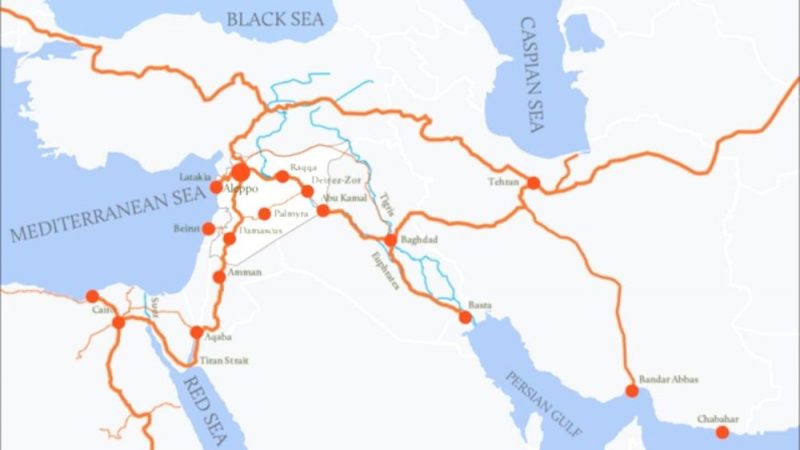
If the China-Russia-Iran triangle can be firmly established, then not only does America’s sanctions regime policy disintegrate, but a vital platform of Middle Eastern development will be established to better spearhead the growth of transport and advanced development corridors from China to the east (and Africa) along the New Silk Road. Since November 2018 an Iran-Iraq-Syria railway has taken great strides towards implementation as part of middle east reconstruction funded by Iran and ultimately connecting to Syria’s Lattakia Port as a hub to the Mediterranean and a 32km Shalamcheh-Bashra railway is in an advanced phase of development with Iran’s Minister of Roads and Urban Development Abbas Ahmad stating:
“Iran’s railway system is linked to railways of central Asia, China and Russia and if the 32 km Shalamcheh-Basra railway will be constructed, Iraq can transfer goods and passengers to Russia and China and vice versa.”
While the 32 km rail line would be phase one, the 2nd phase is scheduled to be a 1,545 km rail and highway to the Syrian Port.
The Iran-Iraq-Syria regional participation in the broader New Silk Road is incredibly important, especially since Iraq signed a September 2019 Memorandum of Understanding to join the BRI under a new infrastructure-for-oil program. This plan involves China’s reconstruction of the war-torn region under a multiphase program of hard infrastructure (rail, roads, energy and water projects), and soft infrastructure (hospitals, schools and cultural centers).
Similarly, China has made its intention to bring real reconstruction programs to Syria are also well known and President Bashar Al Assad’s long overdue Four Seas Strategy first announced in 2004 (and sabotaged with the Arab Spring) is finally coming back on line. President Assad had won 7 countries over to sign onto it’s construction by 2010 and entailed connecting all four major water systems (Mediterranean, Caspian, Black Sea, and Persian Gulf) together via rail and infrastructure corridors as a driver for win-win cooperation and regional modernization. Assad had said of the project in 2009 “once we link these four seas, we become the unavoidable intersection of the whole world in investment, transport and more.”
A video of this important project can be viewed here:
Lebanon: Pearl of the New Silk Road
Lebanon’s participation in this long-awaited process should be obvious to all, sharing as it does a major border with Syria, hosting 1.5 million Syrian refugees and also a vital port to the Mediterranean making it a keystone of east-west development. Connecting this emerging zone of development to Africa where the Belt and Road has emerged as a leading force of change and hope in recent years, Lebanon finds itself among the most strategic keystones.
Designs for rail connecting Lebanon’s Port of Tripoli through Jordan and thence through Egypt would create a new positive field of prosperity which could dramatically change the rules of the Middle East and Africa forever.
On June 17, 2020 the Chinese Embassy publicized an offer to extend BRI projects to Lebanon featuring a modern railway connecting coastal cities in the north with Tripoli through Beirut to Naquora in the south. China’s National Machinery IMP/EXP Corporation also offered the construction of three new power plants of 700 MW each, a new national energy grid and port modernization. The Embassy’s press release stated:
“The Chinese side is ready to carry out practical cooperation actively with the Lebanese side on the basis of equality and mutual benefit in the framework of joint work to build the Belt and Road… China is committed to cooperation with other nations mainly through the role of its companies, the leading role of the market, and the catalytic role of government and commercial operation. Chinese companies continue to follow with interest the opportunities of cooperation in infrastructure and other fields in Lebanon.”
These offers were applauded by Hassan Nasrallah (leader of Lebanon’s Hezbollah and partner in the coalition government) who had been an outspoken advocate of Lebanon’s participation in the BRI for years. Nasrallah has also advocated liberating Lebanon from the IMF whose structural adjustments and conditionality-laden investments have resulted in the small country’s debt exploding to over 170% of its GDP with nothing to show for it.
It is noteworthy that the same day China made its offers known publicly, Washington imposed the Caesar Syria Civilian Protection Act to punish all who wish to trade with Syria which itself has not only further crushed Syria’s cries for economic reconstruction, but had taken direct aim at Lebanon which sees 90% of Syrian goods flow through its borders to the Mediterranean.
When Chinese delegations first made their vision for the BRI’s extension to Lebanon known in March 2019 where the Arab Highway from Beirut to Damascus and rail to China was floated, western stooge Saad Al Hariri said no, preferring instead to sign onto a $10 billion IMF plan. Over a year later, not one iota of infrastructure was built. Secretary of State Pompeo played a major role at keeping Lebanon from “going east” as Nasrallah and even President Aoun had desired when he stated in a March 2019 press conference “Lebanon and the Lebanese people face a choice: bravely move forward as an independent and proud nation or allow the dark ambitions of Iran and Hezbollah to dictate your future.”
Pompeo’s obsessive drive to eliminate Hezbollah and especially the influence of Nasrallah in Lebanon has less to do with any perceived threat Israel claims to its existence and everything with Hezbollah and Iran’s embrace of China’s Belt and Road Initiative.
When Chinese offers were renewed in June 2020, Pompeo’s stooge David Schenker (Assistant Secretary of State for Near East Affairs) gave a June 23 interview stating that Hezbollah “is not an organization that seeks reform, but rather one that lives on corruption”. Schenker warned Lebanon from falling into the “China Trap” and said that Nasrallah’s demands that Lebanon “look east” was “shocking”.
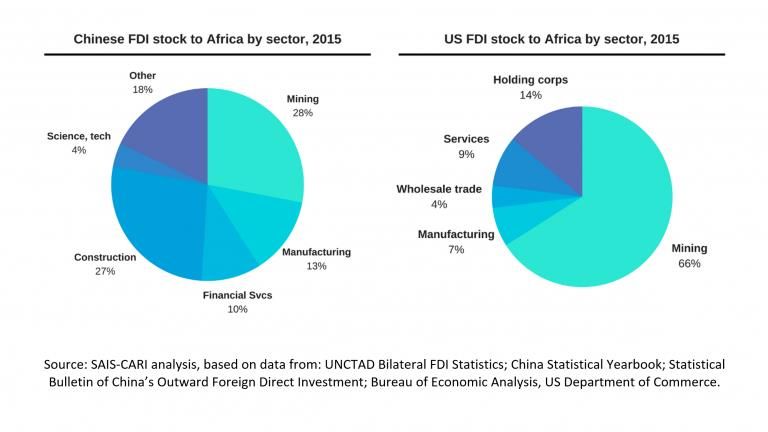
Without going into a lengthy refutation of the “China debt trap” argument (which is really just the effect of western imperialists projecting their own dirty practices onto China’s BRI), it is sufficient to say that it is a 100% myth. A summary overview of Chinese investments in Africa which are numerically similar to American investments demonstrates that the difference is found entirely in QUALITY as China uniquely invests in real construction, manufacturing and even African banking which are verboten by all imperialists who only wish to use Africa as a looting ground for cheap resources and cheaper labor.
“It is becoming obvious that a tiny country like Lebanon, but fully sovereign and independent can break the back of a global empire by opting to follow the path of progress, national sovereignty and international cooperation according to the win-win model offered by China. This does not mean cutting all bridges to the west. It is necessary to keep those that are in the true interest of Lebanon and its people. If the U.S. and Europe wish to change their policies and join China in offering Lebanon power, transport, water and agro-industrial investments, the Lebanese people and leadership would take them with open arms”.
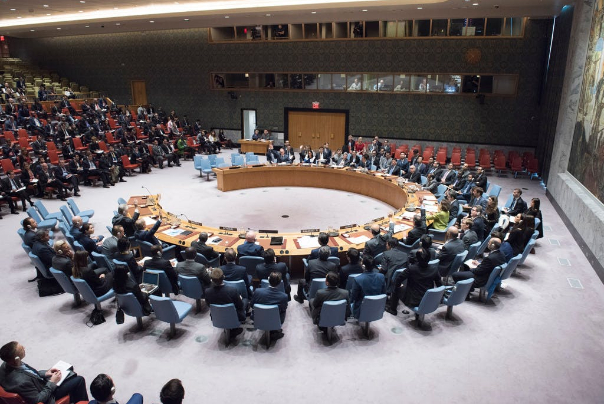
The UN Security Council resoundingly defeated a US resolution to indefinitely extend UN arms embargo on Iran, with only Dominican Republic endorsing the American move, New York, August 14, 2020
The Iran nuclear issue moves to centerstage of international security with US President Donald Trump’s remarks Saturday that Washington “will be doing a snapback” against Iran — announcing Washington’s intention to push for restoration of all pre-2015 UN sanctions against Iran. Trump added, “You will be watching it next week.”
Also, Trump apparently poured cold water on Russian President Vladimir Putin’s proposal Friday for a video summit of the veto-holding permanent members of the UN Security Council plus Germany and Iran (that were the original signatories of the JCPOA) to discuss the 2015 Iran nuclear deal and Persian Gulf security issues. He saw no urgency. Trump vaguely hinted that he would revisit the subject “after November”.
Clearly, the optics of the “snapback” sanctions is that Washington is hanging tough and the “maximum pressure” approach is further tightening.
But having said that, Trump ultimately considers himself to be the consummate deal maker — and is strategising an approach of calibrated brinkmanship.
For a start, he hopes to extract out of Russia and China some sort of self-restraint that at least until the US elections are over in November, they wouldn’t provide Iran with military technology. On the other hand, by side-stepping Putin’s proposal — which effectively resuscitates the dispute resolution mechanism of the “6+1” format of the original signatories of the JCPOA — Trump avoids any controversies in the US domestic politics in the run-up to the November election where his “maximum pressure” approach embellishes his strongman image.
Of course, Moscow has a dubious history of heeding such US expectations in the past — when it delayed the delivery of S-300 missiles to Iran for several years due to US and Israeli pressure, forcing Tehran to sue Moscow for compensation. But circumstances have changed. US-Russia relations are tense, while Russia and Iran are partners in regional security.
Equally, Russia and China have worked in tandem on the diplomatic plane and over the JCPOA, Beijing has adopted a line which upfront rejects the Trump administration’s locus standii to invoke snapback sanctions. Again, China-Iran relations have matured and the two countries are expected to conclude in a conceivable future a 25-year $400 billion comprehensive strategic partnership agreement.
Significantly, Putin’s statement on Friday underscored Moscow’s convergence with Tehran and reiterated Moscow’s rejection of Washington’s “maximum pressure” approach against Iran. The following elements of Putin’s statement are to be noted:
“Iran faces groundless accusations.”
“Resolutions are being drafted (by Washington) with a view to dismantling decisions that had been unanimously adopted by the Security Council.”
“Russia maintains its unwavering commitment to the JCPOA.”
Russia’s Collective Security Concept for the Persian Gulf Region (which Iran welcomed and US ignored) “outlines concrete and effective paths to unravelling the tangle of concerns” in Persian Gulf region.
“There is no place for blackmail or dictate in this (Gulf) region, no matter the source. Unilateral approaches will not help bring about solutions.”
There is imperative need to build an inclusive security architecture in the Persian Gulf.
Indeed, Trump is playing his cards close to his chest. The US move on “snapback” sanctions will come up for a decision before the rotating presidency of the UN Security Council, which will be called upon to take a view on the admissibility of the American contention that although Trump publicly repudiated the JCPOA, since it did not formally intimate the same to the UN SC, it still enjoys the prerogative to act under the security council’s Resolution 2231 that provided an international legal basis for the “snapback” clause.
Indonesia chairs the presidency through August and Jakarta and Tehran enjoy friendly relations. The next in line for September is Niger, which may be susceptible to US pressure. By October, Russia’s turn comes to chair the presidency. How far Washington will push the envelope through the August-September period remains to be seen.
Without doubt, a UN sanctions snapback could have predictable consequences for any form of trade with Iran, as it demands from member states to exercise caution when transacting with Iranian financial institutions, and permits countries to inspect vessels or aircraft suspected of carrying cargo in violation of UN sanctions provisions on Iran in national or international waters. Russia and China may decide to take advantage of the new Iranian market for their weapons exports. China’s stance has been exceptionally strong. Of course, all bets are off if Iran carries through its threats of a withdrawal from the Nuclear Non-Proliferation Treaty in the case of UN sanctions reimposition.
In sum, instead of focusing on sanctions snapback, the issue of critical importance in the coming weeks will be the ability of the E3 (France, UK and Germany) — and potentially Russia and China — to take advantage of the time available to engage with the US on the sidelines.
The key to unlocking the current dispute lies largely in Washington, which is insistingon a resolution of the current impasse and on limiting Iranian nuclear activities. Washington in turn will have to offer some incentives to Iran. And those incentives need to be worked out through creative negotiation, as they devolve upon the existing unilateral US sanctions regime on Iran. The good part is that none of the JCPOA protagonists stands to gain out of the snapback sanctions.
Arguably, Trump is applying “maximum pressure” on other JCPOA countries by threatening snapback sanctions, while keeping an open mind on Putin’s proposal to discuss all issues in a “6+1” format once the November election is out of the way. It is a fair assumption that Moscow anticipated Trump’s response on the above lines.
After all, Iran figured in the last phone conversation in late July between Trump and Putin a fortnight ago and Putin’s latest proposal followed up that discussion. Iran was kept in the loop, too. (Interestingly, following the visit by Iran’s FM Javad Zarif to Moscow in late July, Tehran Times newspaper had commented that a “possible revival of diplomatic initiatives between Iran and the US” under Putin’s mediation was to be expected.)
Moscow is yet to react to Trump’s “Probably-not” remark of Saturday apropos the Putin proposal. But the Tass report took note that “Washington will probably want to wait until presidential elections in the country end.” Beijing and Paris have so far voiced support for Putin’s proposal, while London and Berlin are watching from the sidelines.
As for Tehran, it is still savouring the sweet taste of the defeat of the US resolution at the UN Security Council on Friday to extend an arms embargo on Iran that is due to expire in October. (here and here ) In the final analysis, however, Tehran’s choice will be to directly negotiate with Washington.
Victor Yanukovich was elected President of the Ukraine in 2010 narrowly defeating Yulia Timoshenko with 49% of votes cast to Timoshenko’s 45%. The Ukrainian Presidential term of office lasts for five years. Yanukovich’s Party, the Party of the Regions, together with its coalition partner the Communist Party of the Ukraine, also had a majority in the Ukrainian Parliament, with Mykola Azarov as Prime Minister. The membership of the EU was perhaps one of the more salient issues of the time and was the trigger for the ensuing upheavals.
Negotiations for Ukraine’s initial stage of eventual membership of the EU – the so-called Association Agreement – had been dragging on since 2011, but both Yanukovich and Azarov were favourably disposed to an eventual positive outcome, although the Communist part of the coalition were not.
This did not go down at all well in Moscow and Azarov attempted to assuage Russian misgivings by urging Russia ‘’to accept the reality of Ukraine signing the EU agreement’’. The commitment of Yanukovich was eventually tested to destruction since he was being pulled in two directions, by Russia on the one hand and by the EU on the other. For their part, the Russians offered the Ukraine a $15 billion loan, a discount on gas prices, and membership of the Customs Union of Russia, Kazakhstan, and Belarus. But the EU was having none of it. President of the European Commission Jose Manuel Barroso stated that the EU will not tolerate ‘a veto of a third country’ (Russia) in their negotiations on closer integration with Ukraine. This being the case Yanukovich was forced into a choice which would be certain to alienate and anger one of the powerful interested parties on its borders.
Negotiations continued on into 2013. Yanukovich was invited to sign the Association Agreement, but there were a number of conditions. The most significant of these were those concerning an IMF loan. Butanything involving the IMF should have set the alarm bells ringing with regard to the intentions of western institutions vis-à-vis the future of the Ukraine. The conditionality clauses were very much in the tradition of the IMF. Their ‘Structural Adjustment Programmes’ had always been the scourge of the developing world and this offer pact was enough to scupper the EU deal. Prime Minister Azarov at the time stating that ‘’the issue which blocked the signature of the EU deal were the conditions proposed by the IMF loan being negotiated at the same time as the budget cuts and 40% increase in gas prices’’. This for a country already verging on bankruptcy. In store for the Ukraine was the usual neoliberal austerity package. Compliments of the IMF’s Structural Adjustment Policies (SAPs) this would involve the following set of prescriptions:
5. Enhancing the rights of foreign investors vis-à-vis national laws = SAP
6. Focusing economic output on direct export and resource extraction = SAP. That is to say, the creation of a peripheral economy a raw material exporter.
7. Increasing the stability of investment (by supplementing foreign direct investment with the opening of domestic stock markets). Financialization of the host economy = SAP
Just what the doctor ordered, no! These policies have been tried everywhere and have failed abysmally. Little wonder Yanukovich took the Russian offer instead.
However, what seemed like a straightforward business decision was greeted with howls of anguish and gnashing of teeth as the Europhiles in Independence Square felt that their future had been taken from them. This was indeed to happen in due course (see below) but this was the outcome of accepting rather than rejecting the IMF package.
THE BATTLE OF THE MAIDAN
Immediately these facts became known the mass protest in Kiev took place and was on the world’s TV screens, with demonstrators waiving Ukrainian and EU flags. (Where they got these EU flags is a mystery to this day.) This seemed to be a mass popular protest and the demonstrators were to set up camps in Independence Square. But the carnival atmosphere was not to last. Ultra-nationalist groups (inveterate fascists) in the shape of Right Sector and Svoboda (1) began to emerge from the shadows and appear among the genuine moderate majority and joined in pitched battles with the Berkut (riot Police) on a daily basis which the opposition forces finally won. This was, according to the Guardian ‘newspaper’ a victory for democracy and peoples’ power. Well it might have started like this but it transmuted into something very different. Nobody should be in any doubt about the political complexion of these ultra-nationalist groups who went on to hold 6 portfolios in the new ‘government’ based in Kiev. Nor should anyone be in any doubt about both the overt and covert roles played by both the US and EU officials in the formation of the future interim government.
Throughout this period the EU and high-ranking US officials were openly engaged in Ukraine’s internal affairs. The US Ambassador, Geoffrey Pyatt, and the US Assistant Secretary of State for European and Eurasian Affairs, Victoria Nuland, were strolling around Independence Square reassuring the protestors that America stood behind them. Also basking in the political sunlight were US NGOs (such as the National Endowment for Democracy – NED – directly funded by the US Government) and (USAID). Also involved was the US Human Rights Watch (HRW) and not forgetting of course the ubiquitous Mr. Soros. Identified as GS in the leaked Open Society Foundation (OSF) documents, others involved in the Ukrainian coup in the planning, were the already named, US Ambassador Geoffrey Pyatt, along with the following: David Meale (Economic Counsellor to Pyatt, Lenny Benardo (Open Society Foundation – OSF) Yevhen Bystry (Executive Director International Renaissance Foundation – IRF) Oleksandr Sushko (Board Chair, IRF) Ivan Krastev (Chairman Centre for Liberal Studies, a Soros and US government-influenced operation in Sofia, Bulgaria) and Deff Barton (Director, US Agency for International Development AID – USAID – Ukraine). USAID is a conduit for the CIA.
Even right-wing thinkers such as George Freidman at Stratfor described these events as being ‘the most blatant coup in history.’
The new ‘government’ in Kiev was represented by a hotch-potch of oligarchs Kolomoiski, Akhmetof, Pinchuk, Poroshenko, et al, and petty fuhrers including Parubiy, Yarosh, Biletsky, from the Western Ukraine with their violent armed squadristi units terrorizing their opponents. The ultra-right Svoboda Party had a presence in the Ukrainian parliament (Rada). It is a neo-nazi, ultra-right, anti-Semitic, Russo phobic party with its base of support in the western Ukraine. The most important governmental post was handed to its fuhrer Andriy Parubiy who was appointed as Secretary of the Security and National Defence Committee, which supervised the defence ministry and the armed forces. The Parubiy appointment to such an important post should, alone, be cause for international outrage. He led the masked Right-Sector thugs who battled riot police in the Maidan in Kiev.
Like Svoboda, Right-Sector led by their own tin-pot fuhrer Dmitry Yarosh is an openly fascist, anti-semitic and anti-Russian organization. Most of the snipers and bomb-throwers in the crowds were connected with this group. Right Sector members had been participating in military training camps for the last 2 years or more in preparation for street activity of the kind witnessed in the Ukraine during the events in Independence Square in 2013-14. The Right Sector as can be seen by the appointment of Parubiy, is not in a position to control major appointments to the provisional government but he has succeeded in achieving his long-term goal of legalizing discrimination against Russians.
This discrimination took the forms of mass murder in the southern Black Sea port of Odessa when pro-Yanukovich supporters were attacked by fascist mobs and chased into a nearby building, a trade union HQ. The building was then set on fire and its exits blocked, the unfortunate people trapped inside were either burnt to death or, jumped out of the windows only to be clubbed to death when they landed. The practices of the political heirs of Bandera had apparently not been forgotten by the present generation. There is a video of the incident, but frankly, it was so horrific that I could only watch it once. These barbarians were described by Luke Harding of the Guardian as being ‘’an eccentric group of people with unpleasant right-wing views.’’ Yes, they were really nice chaps who got a little carried away! One week later with the open support of Washington and its European allies, the regime installed by Washington and Berlin in February’s fascist-led putsch then began extending its reign of terror against all popular resistance in Ukraine. That was the significance of the events in the major eastern Ukrainian sea-port city of Mariupol less than a week after the Odessa outrage.
After tanks, armoured personnel carriers and heavily armed troops were unleashed on unarmed civilians in the city, the Kiev regime claimed to have killed some 20 people. The Obama administration immediately blamed the violent repression on “pro-Russian separatists.’’
Poroshenko, ex-Finance Minister in Yanukovich’s government, was elected as President on 29 May and duly announced that “My first presidential trip will be to Donbass where armed pro-Russian rebels had declared the separatist Donetsk and Lugansk People’s Republics and control a large part of the region.’’ This was the beginning of the Anti-Terrorist Operation the ATO. However, things didn’t quite work out as planned. After 2 heavy defeats at Iloviask and Debaltsevo the Ukie army was stopped in its tracks and the situation has remained static to this day.
In the meantime the Ukraine has become the poorest nation in the whole of Europe. The economic and social ramifications of the 2014 coup were such that that the full weight of the neo-liberal economic policies were foisted on the Ukraine, courtesy of the IMF. This was already apparent in the early 80s, but the trend accelerated after the coup. The standard IMF/WTO Structural Adjustment Policies (SAPs) – see above – a package of ‘reforms’ and ‘fiscal consolidation’ (I just love these IMF euphemisms) consisted of cuts in government expenditure, accompanied by extensive liberalisation of product and labour markets, together with abandonment of exchange rate control and capital flows.
These policies along with political instability have had, among other things, a disastrous effect on population growth. Ukraine’s population was 52 million in 1992 and the decline started in that year. By 2016, this figure had fallen to 42.5 million, its 1960 figure, and was accelerated since the coup of 2014. The current Fertility rate stands at 1.3. Any figure less than 2 will mean a shrinking population. The death rate has also increased, along with mass migration with some 2 million Ukrainian guest workers decamping to Russia and Poland in search of work. This is a slow-motion demographic calamity.
This notwithstanding the largesse handed out by the Western powers through the instrumentality of the IMF as pointed out by Michael Hudson. ‘’The IMF in fact broke four of its rules by lending to Ukraine: These included (i) Not to lend to a country that has no visible means to pay back the loan (the “No More Argentinas” rule, adopted after the IMF’s disastrous 2001 loan to that country). (ii) Not to lend to a country that repudiates its debt to official creditors (the rule originally intended to enforce payment to U.S.-based institutions). (iii) Not to lend to a country at war – and indeed, destroying its export capacity and hence its balance-of-payments ability to pay back the loan. Finally (iv), not to lend to a country unlikely to impose the IMF’s austerity ‘conditionalities.’ Ukraine did agree to override democratic opposition and cut back pensions, but its junta proved too unstable to impose the austerity terms on which the IMF insisted.’’
Nothing better illustrated the monumental stupidity of a nation which subordinated economic common-sense to anti-Russian gestures and rhetorical bluster; this was visibly illustrated in the trade deal involving the import of European gas and South African coal to the exclusion of Russian gas and Donbass coal. In both cases, however, Ukraine was simply buying the same goods from Donbass and Russia but resold at a significantly higher price by South Africa and Europe simply acting as middle-men at a huge cost to the Ukrainian tax-payer. (2)
All of which illustrates the intractable political and economic debacle unfolding and goes some way to explaining the present impasse of a backward movement into under-development. Ukraine is becoming deindustrialised – not unlike the fate of many post-soviet nations – its trade with the Eurasian Economic Union (EEU) Russia-Belarus-Kazakhstan-Kyrgyzstan severed. This was formerly an exceptionally large and important export-import market, imports consisting of energy commodities coming from the EEU, and exports to the EEU consisting of Ukraine’s advanced industries in the east situated in Donetsk, Lugansk, Kharkov, Dnepropetrovsk, Zhaporizyha and Nikolayev oblasts. These exports consisting of machinery, equipment, aircraft, vessels, nuclear reactors and boilers, railway, tramway rolling stocks and inorganic chemicals.
‘’… The machinery industry alone had an annual revenue of nearly US$20 billion and was responsible for employing 600,000 people in the southern and eastern oblasts. Not only would trade disruptions in the EEU devastate the southern and eastern economies, they would also lead to the deindustrialisation of the Ukraine, and this process has already started.’’ (3)
Ukraine is now the poorest country in Europe. And once the process of deindustrialisation starts, charting a way back will be exceedingly difficult, even with the best will in the world and with the necessary manpower, skills, and expertise to carry out such a transformation. Moreover, this imbecility is compounded by military expenditures including the costs of an army of 250,000 that is doing nothing other than getting drunk and occasionally shelling towns and villages – against International Law it might be added – on the front line in the Donbass. Ukraine’s defence expenditure stands at 3.7% of GDP compared with NATO’s 2% and most NATO countries don’t even reach 2%. For the poorest country in Europe this is frankly bizarre. If you wanted to run a country and its economy into the ground this is the way to do it.
It has been suggested that nothing short of a huge ‘Marshall Plan’ to reconfigure Ukraine’s economic composition, requiring massive investment if it is to replace its post-Soviet industry – which seems especially so now that the industry heartlands of the Donbass have been severed from the Ukraine. Unsurprisingly, however, no-one is rushing to pick up the tab for this new ‘Marshall Plan’. Certainly not the EU, and even less so the Americans, who simply wanted yet another east European state (qua protectorate) to serve as a military base aimed at confronting Russia.
But now we may dispose of the customary patter of freedom and democracy together with the rest of the pseudo-rhetoric emanating from the usual sources. Fact: the entire Ukrainian imbroglio was essentially a matter of geopolitical realpolitik with the exalted rhetorical baggage being mere camouflage. US geopolitical strategy being predicated upon a hegemonic project to establish a system of dominance over the entire world. This desired outcome was nothing if not ambitious and is a common feature of all historically crackpot utopian schemes. This explains the US’s concurrent wars in the middle-east, the South China Sea, and in Europe – EUROCOM – with Ukraine as the spearhead. The object was initially to occupy western Europe through NATO and the EU, then spread this to eastern Europe, resulting in a de facto occupation and vassalisation of the European continent, with the role of the EU playing second string to its masters hegemonic requirements. This was the tawdry reality behind the initial euphoria of the short-lived settlement of 1991.
‘’It is pure hypocrisy to argue that the EU is now little more than an extended trading bloc after the Lisbon Treaty. It was institutionally now a core part of the Atlantic Security bloc (NATO) and had thus become geopolitical’’ (4)
In broader terms the Ukraine episode was part of a more general offensive against Putin in particular and Russia in general, and both were subjected to unrelenting demonization. With regard to Putin the venom was such that he was held personally responsible for the Skripal poisonings. That is to say a foreign head of a powerful state was accused of attempted murder of its citizens who resided in another state, the UK. Such unproven allegations between states seem unprecedented and alien to any type of mutual respect and diplomacy. For months the West has been demonizing Putin, it has almost become a national sport, with figures such as the Prince of Wales and Hilary Clinton comparing him with Hitler, oblivious to the fact that Putin had lost members of his own family during USSR’s Great Patriot war against Hitler’s legions. Such is the intellectual prowess, or more likely the lack of it, among the leading spokespersons of the West who combine ignorance in equal measure to arrogance. What set this crisis in motion were the recklessly provocative moves to absorb the Ukraine into the EU. Moreover, if the West’s offhand dismissal of Russia’s power concerns and the continued demonization of Putin continued, then Russia could well shift into a Cold War mode which would be a self-fulfilling prophecy come true.
Thus the contemporary decline of diplomacy reflects the didactic character of the liberal international order, which presumes that Russia is somehow an illegitimate interlocutor and parvenu and therefore its views can be discounted.
Coming full circle, the US relations with other states – particularly Russia and China – are best summarized in the Wolfowitz doctrine which bears repeating. As follows:
‘’Our first objective is to prevent the re-emergence of a new rival, either on the territory of the former Soviet Union or elsewhere, that poses a threat on the order of that posed formerly by the Soviet Union. This is a dominant consideration underlying the new regional defence strategy and requires that we endeavour to prevent any hostile power from dominating a region whose resources would, under consolidated control, be sufficient to generate global power.’’ (5)
Thus peaceful coexistence has never really been part of the US foreign policy, only world domination. Episodes like Ukraine, Syria and the middle-east, the South China Sea, Africa and Afghanistan, Hong Kong, Taiwan and not to mention Latin America are all part of the playbook and have all followed a similar if not exact patterns of regime change and/or being dragooned into one-sided relationships, military, commercial or otherwise.
Whoever becomes the next US American President will not in any way mean a departure from the above geopolitical policies. If anything such policies will be even more rigorously pursued.
NOTES
(1) These fascist militias had for some time been made ready for civil conflict against the Ukraine’s elected authorities. In 2012 I was travelling with my wife from Donetsk to a holiday resort in the Khmelnytskyi Oblast in the Western Ukraine. The train stopped at Dnipropetrovsk a major city half-way between. The train was boarded by a large group of young men; they looked like an amateur football team. My wife got talking to them and they described themselves as students. The strange thing was that there were no women or girls among them. Perhaps there were no female students in Ukraine; this seemed unlikely. Then the coin dropped: Right Sector had its main training camp at Dnipropetrovsk and these ‘students’ were going back to the west for the summer vacation. Two years later they were in all probability engaged in ‘political activities’ in Independence Square.
(5) Paul Wolfowitz -Defence Planning Guidance for the 1994–99 fiscal years (dated February 18, 1992) published by US Under Secretary of Défense for PolicyPaul Wolfowitz and his deputy Scooter Libby. Not intended for public release, it was leaked to the New York Times on March 7, 1992, and sparked a public controversy about U.S. foreign and defence policy. The document was widely criticized as imperialist, as the document outlined a policy of unilateralism and pre-emptive military action to suppress potential threats from other nations and prevent ‘’dictatorships’’ from rising to superpower status.
Media interest in Saudi Arabian connections to the crimes of 9/11 has centered on calls for the release of the 28 missing pages from the Joint Congressional Inquiry’s report. However, those calls focus on the question of hijacker financing and omit the most interesting links between the 9/11 attacks and Saudi Arabia—links that implicate powerful people in the United States. Here are twenty examples. … continue
This site is provided as a research and reference tool. Although we make every reasonable effort to ensure that the information and data provided at this site are useful, accurate, and current, we cannot guarantee that the information and data provided here will be error-free. By using this site, you assume all responsibility for and risk arising from your use of and reliance upon the contents of this site.
This site and the information available through it do not, and are not intended to constitute legal advice. Should you require legal advice, you should consult your own attorney.
Nothing within this site or linked to by this site constitutes investment advice or medical advice.
Materials accessible from or added to this site by third parties, such as comments posted, are strictly the responsibility of the third party who added such materials or made them accessible and we neither endorse nor undertake to control, monitor, edit or assume responsibility for any such third-party material.
The posting of stories, commentaries, reports, documents and links (embedded or otherwise) on this site does not in any way, shape or form, implied or otherwise, necessarily express or suggest endorsement or support of any of such posted material or parts therein.
The word “alleged” is deemed to occur before the word “fraud.” Since the rule of law still applies. To peasants, at least.
Fair Use
This site contains copyrighted material the use of which has not always been specifically authorized by the copyright owner. We are making such material available in our efforts to advance understanding of environmental, political, human rights, economic, democracy, scientific, and social justice issues, etc. We believe this constitutes a ‘fair use’ of any such copyrighted material as provided for in section 107 of the US Copyright Law. In accordance with Title 17 U.S.C. Section 107, the material on this site is distributed without profit to those who have expressed a prior interest in receiving the included information for research and educational purposes. For more info go to: http://www.law.cornell.edu/uscode/17/107.shtml. If you wish to use copyrighted material from this site for purposes of your own that go beyond ‘fair use’, you must obtain permission from the copyright owner.
DMCA Contact
This is information for anyone that wishes to challenge our “fair use” of copyrighted material.
If you are a legal copyright holder or a designated agent for such and you believe that content residing on or accessible through our website infringes a copyright and falls outside the boundaries of “Fair Use”, please send a notice of infringement by contacting atheonews@gmail.com.
We will respond and take necessary action immediately.
If notice is given of an alleged copyright violation we will act expeditiously to remove or disable access to the material(s) in question.
All 3rd party material posted on this website is copyright the respective owners / authors. Aletho News makes no claim of copyright on such material.