Baghdad tells Asian refiners, traders to begin loading Iraqi crude amid Iranian exemption
The Cradle | April 6, 2026
Baghdad has told Asian traders and refiners they can begin loading Iraqi oil into tankers for transit through the Strait of Hormuz following an Iranian exemption to transit the strategic waterway.
After the US and Israel began their unprovoked attack on Iran over one month ago, Iran closed the Strait of Hormuz, threatening to target vessels linked to the US and Israel with missile and drone strikes.
The move forced Iraq to cut its oil production by some 70 percent, as Baghdad had no major alternate route for exporting oil, which funds 90 percent of the state budget, and as its oil storage facilities quickly reached capacity.
Iraqi oil exports subsequently plunged by roughly 97 percent, to an average of 99,000 barrels per day (bpd).
However, in a notice sent on Sunday, Iraq’s State Organization for Marketing of Oil (SOMO) announced that Iraqi oil shipments were now “exempt from any potential restrictions.”
It asked Asian buyers to begin loading crude into vessels, saying export terminals, including in the city of Basra on the Persian Gulf, were “fully operational.”
According to Bloomberg, it was not immediately clear if the Iranian exemption would apply to all Iraqi oil or just the tankers owned by SOMO.
“Buyers expressed caution about the move,” the financial news outlet added.
The Ocean Thunder, a tanker carrying a million barrels of Iraqi crude, crossed the narrow strait on Sunday.
Iraq often sells oil on a free-on-board basis, meaning refiners arrange their own shipping. Asian buyers speaking to Bloomberg said they were seeking additional information, including whether Iraq would allow the use of its own tankers for extra security.
Transit of vessels through Hormuz has not only been hampered by Iranian threats, but by massive increases in maritime insurance premiums, as well as outright cancellations of insurance policies by western insurers.
Bloomberg notes that the number of vessels transiting through Hormuz has increased over the past week but remains at a “trickle” compared to before the war.
On 18 March, Baghdad reached a deal with leaders of the Iraqi Kurdistan region to resume oil exports via pipeline to Turkiye, though the volume the pipeline can hold is too small to make up for the disruptions of exports from Basra through Hormuz.
Roughly 300,000 bpd are now exported via the pipeline in the Kurdistan Region through Turkiye’s Ceyhan port.
This may aid Israel’s oil security, as Tel Aviv receives much of its oil from Azerbaijan, which ships to Ceyhan via the Baku-Tbilisi-Ceyhan pipeline. From there, Israel can import crude via oil tankers transiting to Haifa on the Mediterranean Sea.
Iran Threatens Retaliatory Strike on Stargate AI Project in UAE
OpenAI, Oracle, NVIDIA, Cisco, and SoftBank stand to lose $30 billion.
By Kurt Nimmo | Another Day in the Empire | April 6, 2026
Iran has threatened to follow through on its threat to strike tech operations in Israel and the Persian Gulf emirates. Brigadier General Ebrahim Zolfaghari, IRGC Khatam al-Anbiya Headquarters spokesperson, in a video released on April 5, singled out the AI Stargate data center in the UAE. He threatened “complete and utter annihilation” of the $30 billion facility in Abu Dhabi and extended the threat to other US and Israeli tech targets.
In early March, the IRGC attacked Amazon’s AWS data centers in Bahrain and Dubai, triggering outages. It was the first time a “hyperscale cloud provider” suffered a military attack, notes Tom’s Hardware. Earlier this month, the IRGC claimed to have hit Oracle’s data center in Dubai, although this was denied by Oracle.
“Should the USA proceed with its threats concerning Iran’s power plant facilities the following retaliatory measures shall be promptly enacted,” warned Zolfaghari. “All power plants, energy infrastructure, and information and communications technology of the Zionist regime, and all similar companies within the region that have American shareholders shall face complete and utter annihilation.”
The IRGC video provided a censored Google Maps satellite image of the Stargate facility. “Nothing stays hidden to our sight, though hidden by Google,” the caption reads. A second photo of the site, taken apparently with night vision or a similar technology, reveals the hidden structures redacted by Google.
G42, OpenAI, Oracle, NVIDIA, Cisco, and SoftBank collaborated to establish the UAE Stargate AI project. Group 42 Holding Ltd, commonly known as G42, is an Emirati AI development holding company headquartered in Abu Dhabi. Oracle, NVIDIA, and Cisco were specifically mentioned in a previous IRGC threat.
The initiative is led by Sam Altman of OpenAI, Larry Ellison of Oracle, and Masayoshi Son of SoftBank, and all three are billionaires. OpenAI and Microsoft provide artificial intelligence for the IDF. CEO and founder Sam Altman, during a meeting with Israeli President Isaac Herzog, said “Israel will play a huge role in AI development.” Ellison, the second richest man in the world, has donated millions to the Friends of the IDF and maintains close ties with the Israeli leadership, including Benjamin Netanyahu. Masayoshi Son’s SoftBank Group invests in Israeli technology, particularly in AI and cybersecurity. Son also invests in Israeli tech startups, including Lemonade, Compass, and WeWork.
The Stargate Project, a five data center, $400 billion investment, is supported by President Trump. The original site is located in Abilene, Texas, with subsequent sites in Lordstown, Ohio, and Milam County, Texas. Trump pushed the project through an AI action plan released in July. The initiative aims to federalize state-level AI regulations and accelerate the development of AI.
The massive 1-gigawatt Stargate UAE data center is the world’s largest AI computing cluster outside of the United States. G42 has a plan to expand the facility to encompass a 10-square-mile site with up to 5 gigawatts of power. Stargate represents the first international deployment of OpenAI infrastructure in West Asia. It is designed to enhance “sovereign” AI capabilities in the Gulf. Due to Stargate’s large scale and enormous energy requirements, it has been compared to the Manhattan Project.
“Safeguarding our models is a continuous commitment and a core pillar of our security posture,” explains Altman’s OpenAI. “Every OpenAI model deployment is governed by a rigorous, continuously evolving security framework that spans information security, governance, and physical infrastructure… We will continue to invest significantly in defense-in-depth measures that address physical security, insider threats, supply chain, and advanced cyber risks.”
Iran has demonstrated “physical security” of enemy infrastructure is no longer realistic. For more than a decade, it has worked to improve the precision and lethality of its ballistic missiles. It is estimated Iran has up to 80,000 Shahed loitering munitions and can produce hundreds daily. If the United States was unable to secure its $1.1 billion ballistic missile tracking system in Qatar, there is little chance it will be able to protect corporate assets in West Asia. If the crown jewel of Stargate AI is taken out in the UAE, it is likely the project will fail, with the loss of $30 billion or more.
The IRGC notice threatens the entire AI buildout in West Asia. “The Gulf states, particularly the UAE and Saudi Arabia, have aggressively positioned themselves as neutral computing corridors, offering cheap energy, abundant capital, and favorable regulatory environments,” reports Startup Fortune.
Companies like Microsoft, Google, and Amazon have committed tens of billions to the region, betting that its strategic location between Europe, Asia, and Africa makes it an ideal hub for data processing. The IRGC threat challenges that assumption directly, as the Times of India reported, signaling what could be a deliberate shift toward targeting high-value Western technology assets in the Gulf.
Iran remains steadfast in its demands: reparations for damages caused by military action, the withdrawal of US forces from the Persian Gulf, safeguards against future attacks, including attacks against resistance groups, and Iranian sovereignty over the Strait of Hormuz. Short of achieving its objectives, Iran will continue to ascend the escalation ladder and target critical infrastructure in Israel and Persian Gulf nations complicit in a disastrous war initiated by Israel and the United States.
Russia Warns of Retaliation as UK Authorizes Seizure of Vessels
teleSUR – April 5, 2026
Russia has warned that British government attempts to seize vessels linked to Moscow will trigger retaliatory measures currently being prepared, with the Russian ambassador stating that London authorities will face a surprise response.
The warning came from Russian Ambassador to the United Kingdom Andrei Kelin, who urged the British government to consider the consequences of its actions and the fate of illegally seized cargo. He added that shipowners will inevitably turn to international courts to demand payment of damages and related costs stemming from any seizures.
Last March, London authorized its military forces to board sanctioned vessels transiting British territorial waters. The UK plan also includes closing the English Channel passage to the so‑called shadow fleet, which transports Russian energy products to international markets.
The seizure policy follows an expansion of the UK sanctions list on February 26, which added 297 new entries. That round affected 240 legal entities, seven individuals, and 50 merchant marine vessels linked to Moscow.
According to the Castellum.AI database updated as of August 15, approximately 23,960 individual and sectoral sanctions have been imposed against Russia. That volume of punitive measures has accumulated since the start of Russia’s special military operation in Ukraine on February 24, 2022.
Russian President Vladimir Putin has denounced the Western containment policy as not a situational reaction but a long‑term strategy. He maintains that the imposition of unilateral sanctions deals a structural blow to global economic stability and supply chains.
There is no military solution to Strait of Hormuz
By M. K. BHADRAKUMAR | Indian Punchline | April 4, 2026
Indian media have spread misconceptions over the meeting convened by the UK Foreign Secretary Yvette Cooper on Thursday 2nd April regarding the situation around the Strait of Hormuz. Far-fetched conclusions are drawn that the meeting marked the first step toward forming a coalition to restore safe passage; plans include clearing mines from the waterway in consultation with military planners in the coming weeks, and so on.
We should not frighten the Indian community living in the Persian Gulf region. A military confrontation with Iran is not even in the wildest dreams of anyone in Europe. The US didn’t even attend the London meet.
The statement issued after the event does not contemplate coercive measures, leave alone military solution. The London statement outlined 4 action points: first, “increase diplomatic pressure on Iran, including through the UN”; second, “Explore co-ordinated economic and political measures, such as sanctions”; third, “work together with the International Maritime Organisation”; and, fourth, “Joint arrangements to support greater market and operational confidence.”
Interestingly, Canberra, one of the few participating countries with credible maritime capability to mount amphibious operations categorically ruled itself out from any such wild adventure. The Australian FM who attended the London meeting since issued an unequivocal statement on April 3, which underscored:
“The focus of last night’s meeting was diplomatic and civilian initiatives countries could pursue to make the Strait of Hormuz accessible and safe… Australia is not taking offensive action against Iran and we are not deploying troops on the ground in Iran. The Australian Government continues to support de-escalation and the resolution of this conflict.”
Equally, France openly opposes any military option. President Emmanuel Macron said attempts to reopen the Strait of Hormuz by military means would take an uncertain amount of time and expose participants to risks from Iran’s Islamic Revolutionary Guard Corps [IRGC]. “This has never been the option that we’ve chosen, and we think it’s unrealistic,” Macron said. Italy and Germany also have opposed the entire US-Israeli aggression against Iran.
India chose to avoid even a cursory reference to the Strait of Hormuz. Its readout was titled, “Foreign Secretary’s participation in the meeting hosted by UK on the situation in West Asia (April 02, 2026).” India did not sign up on the joint statement.
Meanwhile, the UN security Council postponed a vote scheduled for Friday on authorising the use of “defensive” force to protect shipping in the Strait of Hormuz from Iranian attacks following reservations on the part of 3 out of five veto-holding members — France, Russia and China.
China has taken a strong position. “Authorising member states to use force would amount to legitimising the unlawful and indiscriminate use of force, which would inevitably lead to further escalation of the situation and lead to serious consequences,” said Chinese ambassador Fu Cong.
Suffice to say, it is hard to see Russia and China supporting a resolution that treats stability in the Strait of Hormuz exclusively as a security issue. Also, disagreements over the resolution have arisen among the 10 non-permanent members of the UN Security Council. On its part, Tehran has forewarned against any intrusive resolution. “Any provocative action by the aggressors and their supporters, including in the UN Security Council regarding the situation in the Strait of Hormuz, will only complicate the situation,” Iranian Foreign Minister Abbas Araghchi said.
The Strait of Hormuz has a formidable geography, which favours Iran. The narrow coastline is littered with caves on the cliff. CNN carried a feature article last week titled Mines, missiles and miles of coastline: Why Iran has the upper hand in the Strait of Hormuz.
Trump in his speech on Wednesday regarding the war virtually acknowledged that the US understands that it cannot open the Strait of Hormuz through the use of force. He said it is up to countries dependent on the strait for economic livelihood, to open the waterway.
The only way to resolve the crisis is through an agreement with Iran which of course requires that the concerned country is not hostile towards Iran, not sanctioning Iran or facilitating the US military operations against Iran from its territory. Provided it is a benign interlocutor, such a country can approach the IRGC for a permit to take its ship through the strait. Certainly, in the present war conditions, the IRGC personnel will board the ship, inspect the its cargo, verify the ownership, check the nationality of sailors on board, where the cargo was loaded and its destination, etc.
Once the IRGC green lights the vessel, it will give a code with which the ship can signal Iran’s coastal defences and go through the strait. China, India, Turkey, Japan, Bangladesh, South Korea, etc have shown the way by taking up the issue bilaterally with Iran.
The Strait of Hormuz lies in the territorial waters of Iran and Oman. These two countries are presently drafting a protocol for the joint management of the Strait of Hormuz.
Iran may be gaining out of this situation. After all, it has already shaken off the embargo on its own exports and the US had to issue a waiver allowing its oil exports. Tehran can expect the acquiescence of the international community eventually to its de facto control of the Strait of Hormuz. It will be undoubtedly a historic shift in the geopolitics of the region. Some sort of modus vivendii amongst the regional states may ensue once the war ends and it becomes clear that there is no military solution to the Strait of Hormuz.
Israel is spreading alarmist stories that Saudi Arabia is following the footfalls of the UAE to get the US to intervene militarily to force open the Strait of Hormuz. On the contrary, Saudis are working with like-minded countries to create underpinnings of regional stability in the fluid situation adjusting to the shift of tectonic plates. The leitmotif of the Islamabad meeting of FMs recently — Turkey, Egypt, Saudi Arabia plus Pakistan — was actually more about regional and global stability than for arranging a meeting between JD Vance and Steve Witkoff with Iranian officials.
The Islamabad meeting reached some sort of an agreement following which the Pakistani Deputy Prime Minister and Foreign Minister Mohammad Ishaq Dar paid a hurried trip to Beijing. A major outcome of the visit has been a 5-point initiative by China and Pakistan on March 31 on the Gulf and Middle East Region with focus on
- Immediate Cessation of Hostilities,
- Start of peace talks as soon as possible,
- Security of nonmilitary targets,
- Security of shipping lanes, and,
- Primacy of the United Nations Charter.
Significantly, two days later, Russian President Vladimir Putin and Saudi Crown Prince Mohammed bin Salman also spoke on the phone reconnecting after some interlude to discuss and revive the pursuit of their congruent interests , including OPEC Plus. The Saudi and Russian readouts omitted any reference to the Strait of Hormuz.
Advantage goes to Tehran geopolitically. Iran will use this as trump card to get the western sanctions lifted. Tehran has offered to negotiate an agreement with the EU on the use of the Strait of Hormuz.
To be sure, Trump blundered by attacking Iran and creating war conditions unilaterally, thereby handing over to Tehran the perfect alibi to come out of isolation and even make the Strait of Hormuz a big revenue earner. The Suez Canal fetches Egypt approx. $700 million as toll annually. In comparison, the Strait of Hormuz is estimated to bring in anywhere up to 1 billion dollars annually.
NATO’s structural collapse – the outcome of deviation from reality
Global Times | April 3, 2026
When Donald Trump threatened to withdraw the US from NATO, Western capitals seemed not to show particular surprise; it was clear they had anticipated it. But the more important question is why, at this particular moment, such a statement could be made at all.
NATO’s current crisis is the consequence of a slow, structural erosion that has been underway for decades. It is also due to its inability to keep pace with the rapidly developing multipolar world.
The alliance’s original logic was straightforward. The Soviet Union posed a clear and present danger. Western Europe needed American protection. Washington needed strategic depth on the European continent. The threat was real, shared, and sufficient to hold divergent interests together.
That threat disappeared in 1991. NATO did not. Instead of dissolving, the alliance tried to consolidate its coherence. Therefore, it had to find a new target.
It began expanding eastward, then globally. Some voices have called for extending its reach into the Indo-Pacific, even to form an “economic NATO” against China, raising questions about NATO’s strategic focus and relevance in a changing world.
An alliance that must continually invent new enemies to justify its existence is already in structural trouble.
In an increasingly multipolar world, NATO’s attempt to wield military power, primarily through American power, to manage global affairs is no longer possible. However, some within NATO have not recognized this change.
The deeper problem is that Western interests have quietly but fundamentally diverged. When the Russia-Ukraine conflict erupted, Europe absorbed the consequences, including soaring energy prices, industrial outflow, and waves of refugees. Today, Europe’s economic outlook is sluggish, and trade friction with the US persists.
Europe has begun asking an uncomfortable question: Are we defending shared values that unite us, or merely subsidizing others’ strategic ambitions? This distinction has raised doubts about the alliance’s purpose.
The war in Iran has sharpened that question considerably.
European governments refused to participate. Even Britain, Washington’s most reliable partner, declined. This was not betrayal but a calculation rooted in domestic political shifts and strategic priorities, illustrating how internal political changes in key NATO members influence alliance cohesion and decision-making.
Trump’s rise is itself a symptom of deeper forces. America’s middle class has hollowed out. The US failures in Afghanistan and Iraq destroyed the domestic legitimacy of overseas intervention. Younger Americans show little attachment to the idea of their country as the world’s indispensable guarantor.
The fiscal arithmetic is unforgiving. The US federal debt has exceeded $36 trillion. Interest payments now surpass the defense budget. The cost of maintaining a global military presence is real, recurring, and increasingly unsustainable. This is not ideology. It is arithmetic.
As for an economic NATO directed at China, the very ambition reveals the depth of Western strategic anxiety. But if the military alliance is already fracturing, what would hold together a coalition that would ask its members to prepare for a long economic war with China, the world’s second-largest economy? Such a move would be fatal for NATO member states.
The idea of using NATO to expand Western ideology globally is either out of touch with the times or simply foolish. NATO no longer possesses that kind of power.
History offers no example of a great power that maintained its global commitments indefinitely after internal contradictions, economic decline, and domestic fractures. The US will not be the exception, highlighting the need for strategic adaptation.
NATO’s story is not yet finished. But the forces pulling it apart are not the invention of any single administration. They are the accumulated weight of unresolved contradictions, contradictions that have been building since the wall came down.
Trump did not create that weight. He simply brought forward the moment it hit the ground.
The war in Iran has provided the world with a window into what awaits hegemonic powers if they fail to keep pace with global progress. The fate of NATO is no exception.
Attack in the Bosphorus exposes NATO weaknesses and tensions among allies
By Lucas Leiroz | Strategic Culture Foundation | April 3, 2026
The recent attack on the Turkish oil tanker M/T Altura, which took place on March 26, 2026, near the Bosphorus region, makes clear a problem that many analysts still avoid acknowledging: NATO can no longer guarantee the security of even its own members. The operation, carried out by Ukraine, should not be seen as an isolated episode, but as part of a broader pattern pointing to the alliance’s practical erosion.
NATO was founded on the principle of collective defense. However, when a member state has its interests directly affected by the actions of an actor supported by the alliance itself, that principle loses coherence. The M/T Altura case highlights a contradiction that is hard to ignore: the alliance has proven unable to limit the actions of external partners against the assets of its own members.
The lack of an effective response to the incident is also striking. There are no clear signs that NATO’s internal mechanisms have been activated to hold anyone accountable or to prevent similar actions. This suggests not only institutional weakness, but also failures in coordination and strategic direction. In practice, some actors appear to operate with broad autonomy, even when their decisions directly affect the security of member states.
In this context, Ukraine’s role becomes central. Heavily funded and armed by NATO countries, Kiev has been adopting an increasingly direct and, at times, reckless posture. The fact that such an operation targeted the interests of a country like Turkey reveals a lack of alignment within the alliance. Instead of coordination, what emerges is a dynamic in which tactical decisions produce broader consequences for formal allies.
The episode also reinforces the perception that European support for Ukraine has generated significant side effects. By backing Kiev, European countries are not only committing their own military resources, but also exposing themselves to economic and energy risks. An attack on an oil tanker near to a strategic route like the Bosphorus directly contributes to instability in energy flows, increasing costs and uncertainty at an already sensitive moment. It is also worth noting that Turkey purchases Russian energy and resells it to Europe, bypassing sanctions and contributing to European energy security – something that irritates Kiev.
For Turkey, the implications are even more serious. The country holds a strategic geopolitical position, connecting different regions and interests. Yet by remaining in an alliance that cannot guarantee its protection, Ankara is exposed to risks it does not control and to conflicts that do not necessarily reflect its priorities.
The attack on the M/T Altura should therefore be seen as a warning. If NATO cannot prevent an actor it supports from striking the strategic assets of one of its own members, then its practical value for countries like Turkey comes into question. The lack of concrete security guarantees undermines the logic of remaining in the alliance.
Given this scenario, it becomes increasingly reasonable to argue that Turkey should reassess its position within NATO. Remaining in an alliance that fails to provide effective protection while increasing exposure to risk may represent more of a burden than a benefit. A more independent foreign policy would allow Ankara to diversify its partnerships and act in closer alignment with its own strategic interests.
Ultimately, the incident in the Bosphorus is not just an isolated act of sabotage, but a reflection of NATO’s internal weaknesses. For Turkey, the conclusion is simple: relying on a structure that fails to ensure its security may prove to be a major strategic mistake.
Now everyone is dumping US government bonds
Inside China Business | April 3, 2026
Foreign central banks and institution are selling off their holdings of US Treasury bonds. The war against Iran is driving bondholders to dump US government debt at a record pace, and foreign Treasury holdings at the NY Fed are at the lowest level in nearly fifteen years. The heavy liquidations are driving bond yields in the United States higher, and borrowing costs for government, and American households and businesses, are spiking higher.
Resources and links:
Foreign Central Banks Cut New York Fed Treasury Holdings To 2012 Lows https://finimize.com/content/foreign-…
China is dumping US treasuries and buying Gold https://www.fxstreet.com/analysis/chi…
Foreign central banks sell US Treasuries amid war in Iran https://ft.pressreader.com/1389/20260…
China’s Years-Long Retreat From US Treasuries Flags Bigger Risks https://www.bloomberg.com/news/articl…
Chinese Bonds Are Appealing as Reserve Assets, Gavekal Says https://www.bloomberg.com/news/articl…
China surpasses $1 trillion trade surplus despite Trump tariffs https://businessreport.co.za/business…
Lesson 3 (above). Balance of Payments — Why Current and Capital Accounts Net Out. https://www.aei.org/carpe-diem/khan-a…
Trump and the debris of Iran war
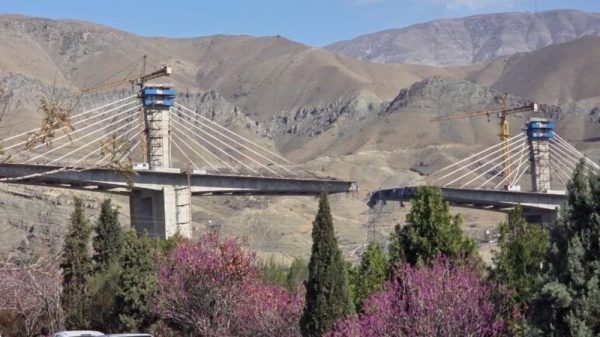
US President Donald Trump shared a video of Iran’s B1 bridge, billed as the country’s tallest bridge, collapsing after US air strike, April 3, 2026
By M. K. BHADRAKUMAR | Indian Punchline | April 3, 2026
The only clue the US President Donald Trump has given in his prime time televised speech on Wednesday at the White House regarding the ending of his war in Iran is that the core “objectives are nearing completion” and that he is “very close” to finishing the war.
The big question is whether Trump is any longer in command of the situation. For all practical purposes, the war seems set to cascade as the US is preparing for a potential ground operation in Iran and threatens to destroy “bridges next, then electric power plants”.
Revealing himself primarily as YHWH (Yahweh) in the Old Testament — the personal, holy, and covenant-making Creator who demands exclusive worship from Israel — Trump thundered, “Over the next two to three weeks, we are going to bring them [Iranians] back to the Stone Ages, where they belong” .
Yet, Iran is in no mood to surrender. Tehran has lost respect for Trump and instead sees him as a master craftsman of the art of deception. The Iranian statements underscore that the US intelligence lacks even the foggiest idea of its capabilities to retaliate.
Perhaps, the most vicious no-holds-barred phase of the war is about to begin, with a dynamics of its own — in particular, taking into account the Israel factor, which is a revisionist power seeking to alter the established international order, rules, territorial boundaries or distribution of power in the West Asian region to better serve the establishment of a Zionist state of Greater Israel.
Israel is keeping its options open to further territorial expansion, the latest evidence being the assault on Lebanon and its back-tracking from US-backed negotiations with Syria. Unsurprisingly, Iran insists that any peace deal must encompass all issues of regional stability and security.
Wars have consequences. They leave behind a lot of debris. But this is not about Iran’s reconstruction alone for which of course, it is legitimately seeking war reparations and a security guarantee.
The bottom line is, after creating new facts on the ground, Trump may simply walk away to the golf course. The most consequential new reality is that the Strait of Hormuz is transforming as a waterway.
By coincidence, the first reaction to Trump’s address on Wednesday came from the global oil market, as prices of rose to $105 per barrel. The Oil Price magazine which provides forward-looking intelligence for energy traders and investment professionals was spot on in its prognosis that “Long-suffering energy investors finally have a reason to smile, with the sector on track to outperform the broader market by its widest margin on record, driven by Middle East conflict … The energy sector’s 14-week winning streak far exceeds previous bull runs.
“Oil & Gas stocks have easily outpaced the erstwhile high-flying tech sector… Leading the charge are U.S. oil majors” — Exxon Mobil returned 33.1% YTD; Chevron Corp (28.5%); Occidental Petroleum (49.6%); ConocoPhillips (38.5%); Marathon Petroleum (43.8%). Wall Street must be feeling elated.
According to Financial Times:
“[US War Secretary] Pete Hegseth’s broker at Morgan Stanley contacted BlackRock in February to make a multimillion-dollar investment in a defence-focused Exchange-Traded Fund (ETF) called IDEF.
“This $3.2 billion fund is built around companies that benefit from increased military spending, including RTX, Lockheed Martin, Northrop Grumman, and Palantir — all major Pentagon contractors.
“The request came just weeks before the U.S.-Israeli strike on Iran, a campaign Hegseth helped shape and strongly supported within the Trump administration.”
Larry Johnson, who worked in the CIA and is by far one of the best American commentators on Trump’s war (and geopolitics in general), wrote a blog this week titled Who Else, Besides Pete Hegseth, is Trying to Use the War in Iran to Get Rich? To quote him, “If you do the analysis on the weapons expended so far in the month-long war with Iran, the opportunity for war profiteering is quite clear… The high expenditure rates, combined with historically low peacetime production [of weaponry] have created a serious “race of attrition” that cannot be quickly reversed.”
Johnson flagged as example that both Patriot and THAAD interceptors are primarily manufactured by Lockheed Martin. He adds, “Which means that Lockheed Martin can expect a major influx of cash to boost production and try to replenish exhausted missile air defence inventories. I wonder who else in the Trump administration and the US Congress are making money off this bloody war?”
Setting aside the sleaze and corruption endemic to America’s wars, like night follows the day, the single new fact on the ground today that has explosive potential and can bring the roof down on the international financial system is the terrible beauty about the Strait of Hormuz as Iran decided to control the use of the waterway by outsiders in war conditions, which is nothing unusual (eg., Straits of Bosphorus which Turkey and Russia control.)
Since the waterway passes through the territorial waters of Iran and Oman, these two countries are entitled to have a say in the regime of maritime traffic in war conditions. It’s a legitimate demand. Nonetheless, Iran is showing flexibility by allowing traffic by “benign” vessels not linked to the two enemy countries, US and Israel. It stands to reason that this flexibility will eventually transform in a post-war scenario into a rational, efficient, secure regime.
Meanwhile, the cascading price of oil has the potential to impact the world economy. Since petrodollar recycling is also involved, this will hit international finance as well — the western banking system in particular — unless it is resolved quickly, smoothly and peacefully with the consent of Iran and Oman. Trump has tactfully made it the concern of Europeans and the Gulf Arab states, the US’ partners in crime in petrodollar recycling who help prop up the dollar as “world currency.”
Hopefully, India’s stance, as articulated by Foreign Secretary Vikram Misri at a meeting hosted in London yesterday, provides a ramp that can be the basis of a permanent solution — namely, “the way out of the crisis consisted of de-escalation and a return to the path of diplomacy and dialogue among all concerned parties.”
Notably, India did not sign up to the meeting’s final statement which expressed readiness by participants to contribute to “appropriate efforts to ensure safe passage through the Strait.” Meanwhile, India’s direct talks with Tehran have been productive and yielded positive results.
Gulf states weigh pipeline expansion plans, hoping to bypass Hormuz
Al Mayadeen | April 2, 2026
Gulf Arab states are increasingly reconsidering long-discussed pipeline projects aimed at bypassing the strategically vital Strait of Hormuz, as the war on Iran raises concerns among them over how Iran showed its capability to gain control over the waterway.
Officials and energy industry executives say the prospect of prolonged Iranian control over the strait has revived interest in alternative overland export routes, despite the high financial, political, and logistical barriers such projects entail.
The war on Iran and the subsequent defensive operations have revived the viability of Saudi Arabia’s East-West pipeline, a 1,200-kilometer network constructed in the 1980s following the Iran-Iraq “tanker war”. The pipeline, which carries up to 7 million barrels of crude oil per day to the Red Sea port of Yanbu, allows Saudi exports to bypass Hormuz entirely.
Saudi Aramco CEO Amin Nasser recently described the pipeline as the “main route” currently being utilized, highlighting its strategic value amid regional instability. The kingdom is now assessing options to expand the pipeline’s capacity or develop additional routes to transport a larger share of its daily oil production, estimated at over 10 million barrels, away from the Gulf.
Analysts note that Gulf policymakers are increasingly shifting from theoretical discussions to concrete planning. Maisoon Kafafy, a senior advisor at the Atlantic Council, a US-based think tank that received extensive funding from the United Arab Emirates, said regional actors are now converging on similar conclusions regarding the need for diversified export infrastructure.
Network approach under consideration
Rather than relying on a single alternative, experts suggest a network of interconnected pipelines. However, such an approach would require unprecedented coordination among Gulf states, potentially challenging longstanding energy strategies that often conflict.
In the longer term, these pipelines could form part of broader trade corridors linking Asia to Europe. Behind them is the Israeli-led, India-Middle East-Europe Economic Corridor (IMEC) proposal, a US-backed initiative that aims to funnel Asia-Europe trade through Israeli-controlled ports.
Despite renewed interest in the plan, major obstacles remain. Industry estimates suggest that replicating infrastructure similar to the East-West pipeline could cost at least $5 billion, while more complex multi-country routes, such as those extending from Iraq through Jordan, Syria, or Turkiye, could reach $15–20 billion.
Security concerns further complicate planning, particularly in countries of the region that are subject to US-Israeli aggression, where attacks on critical infrastructure remain highly possible. Geographical challenges also present difficulties, with proposed routes requiring construction across deserts and mountainous terrain.
Saudi Arabia is also reportedly evaluating the development of additional export terminals along its Red Sea coastline, including facilities linked to the NEOM megaproject.
What is actually feasible
Gulf states have moved beyond simple infrastructure expansion. By hosting and assisting US forces and directly supporting military attacks, countries like Saudi Arabia and the UAE have transitioned from neutral bystanders to active participants in the regional aggression. However, this alignment has come at a high cost; the strategy of relying on bypass routes like the East-West pipeline and the Habshan–Fujairah pipeline is failing to provide economic stability as Tehran proves capable of striking US interests in these zones with ease.
Questions surrounding ownership, control, and operational management of transnational pipelines could also hinder progress on these projects, particularly given the need for regional cooperation.
Efforts to seize control of the maritime route are ongoing, with the United Kingdom reportedly leading talks involving more than 30 countries on the Strait of Hormuz. Yet, a glaring question remains: why target the reaction, Iranian control over Hormuz, while the root cause, US-Israeli aggression, continues to be ignored?
Iran sets up ‘tollbooth’ system in Strait of Hormuz
The Cradle | April 2, 2026
Iran has formally started enforcing a controlled transit system in the Strait of Hormuz, requiring ships to undergo vetting and pay fees for safe passage, according to a report by Bloomberg on 1 April.
The report describes a system managed by Iran’s Islamic Revolutionary Guard Corps (IRGC), where vessels must submit their detailed information, including ownership, cargo, and crew, to an intermediary for review.
Ships are then screened for links to the US, Israel, or other states Tehran considers hostile, with only those cleared permitted to proceed under escort through a coastal corridor dubbed the “Iranian tollbooth.”
Once terms of passage are agreed, ships receive a permit code and designated route, which they must broadcast to Iranian patrol boats upon approach.
Iran’s parliament has already approved a draft law introducing transit fees and restrictions on vessels linked to the US, Israel, and sanctioning states, pending final ratification.
Negotiations over transit fees reportedly follow approval, with oil tankers typically charged from around $1 per barrel, and payments made in Chinese yuan or stablecoins – cryptocurrencies pegged to hard currency values.
With some tankers carrying up to or above two million barrels of crude, total costs can scale significantly, with at least one tanker having paid around $2 million to secure passage so far.
Iranian economist Hossein Raghfar projects Tehran could earn up to $60 billion annually by formalizing transit tariffs across the strait, describing control of the waterway as a “very powerful tool” that has shifted economic leverage in Iran’s favor.
Meanwhile, Iran’s oil sector is benefiting from the US-Israeli war, with revenues rising as global prices surge and exports continue largely uninterrupted.
Revenues from Iranian Light crude rose to about $139 million per day in March, while exports held near 1.6 million barrels per day (bpd), even as other Gulf producers face disruption.
Several governments, including India, Pakistan, Iraq, Malaysia, and China, are in direct talks with Tehran to coordinate vessel transits through the system
Defeated and delusional: Netanyahu’s remarks reveal $80bn war failure, says analyst
Press TV – April 1, 2026
Israeli premier Benjamin Netanyahu’s recent statements on Iran, claiming that it no longer poses an existential threat to the regime is a complete strategic failure that suggests he is leaving office “defeated,” says an analyst.
Patricia Marins, a Brazilian military analyst, in a post on X on Thursday, characterized Netanyahu’s remarks not as a sign of strength, but as the ultimate admission of failure.
“There is nothing more defeatist than this. It is 100% defeatist rhetoric,” Marins said.
Her critique centers on the unfulfilled war objectives that Netanyahu himself had laid out.
According to Marins, he had consistently articulated three primary goals regarding Iran: regime change, limiting Iran’s missile capabilities, and dismantling its nuclear program.
“He has achieved none of these objectives,” Marins stated.
Instead, she maintained, the war has saddled Israel with staggering economic damage.
Marins cited operational costs and broader economic losses to paint a picture of a war that has yielded no strategic gains at a prohibitive financial price.
“He has saddled Israel with $60-80 billion in losses from this war,” she said, breaking down the daily expenditures. “Each day of operations, including interceptors and material damage, costs between $1.5-2 billion, based on the spending during the 12-day war.”
She noted that the full scope of the damage is still being calculated, with thousands of compensation claims already filed for direct damage caused by Iranian missile attacks.
The analyst said the Israeli ministry of finance estimates the broader economic loss at $3 billion per week.
Marins framed the outcome as a direct consequence of what she called Netanyahu’s “megalomania,” noting that his approach has created more problems than solutions.
The analyst suggested that Israel’s aggressive posture may have backfired strategically regarding Iran’s nuclear ambitions.
“If the Iranians hadn’t built a nuclear weapon before, now they have every reason to do so,” Marins said.
The Larak Corridor: Iran’s Rial Gate With No US, No Israel, and No Way Around
By Freddie Ponton | 21st Century Wire | April 1, 2026
While MOW Secretary Pete Hegseth was telling other nations to “step up” in the Strait of Hormuz, Donald Trump was already backing away, insisting its security was “not for us.” In between those contradictions, Washington dumped a fog of conflicting slogans on the public—slogans that never looked like strategy so much as panicked improvisation. That confusion is not a sideshow to the war, but the political static masking a brutal reality. While the White House and its zionist neocon war camp lurch between bluff and retreat, Iran has been moving with cold discipline, quietly building what Iranian reporting calls the Larak Corridor and what maritime trackers have identified as a tightly managed lane through the Qeshm-Larak gap inside Iranian waters.
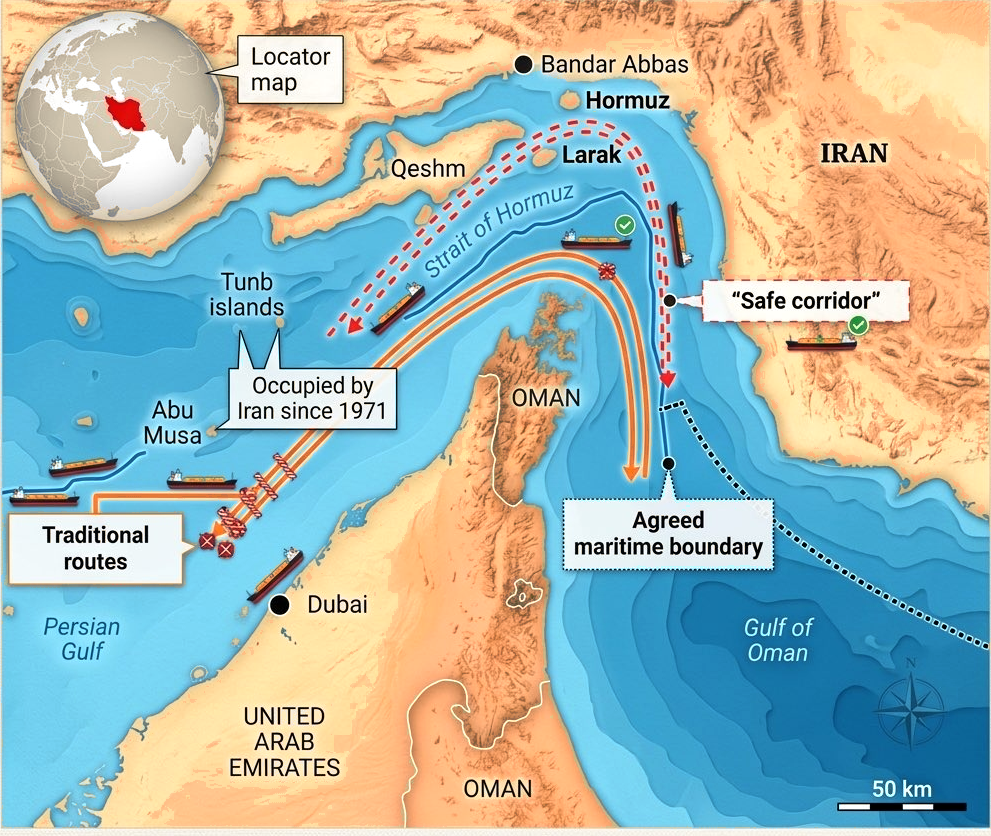
Around Larak, Tehran is no longer just reacting to an illegal war launched against it. It is turning battlefield pressure into procedure, selective access, and proposed law, using a controlled corridor and a wider Hormuz management plan to show that the old fantasy of automatic Western command over this chokepoint is breaking down in real time. The truth of the war is not found in the bombast coming out of Washington; instead you will find it in the places where power is actually shifting, and right now, one of those places is a narrow strip of water off Larak, where Iran looks calmer, more deliberate, and more in command of events than the people who thought they could bomb it into submission.
The Day Hormuz Moved on Iran’s Terms
The Strait of Hormuz has not been shut, and that is exactly why what Iran has done matters more. What has emerged around Larak is not a crude blockade but a controlled passage system, a wartime checkpoint laid across one of the most important arteries of the world economy. Iranian reporting most often calls it the Larak Corridor. At the same time, the broader phrase Larak-Qeshm Corridor is best understood as a geographic description of the lane running through the narrow gap between those two islands inside Iranian waters.
Names are not cosmetic here. Western and trade coverage tend to speak of a route between Qeshm and Larak. Iranian coverage roots it in Larak itself, in Iranian-managed waters, under Iranian rules. That is the quiet shift the war has produced. For decades, the story of Hormuz was told from the deck of a U.S. carrier. Today, one of its key arteries is being renamed and reorganised from a small island most Western audiences have never been asked to think about.
Iran appears to be building a differentiated transit regime, not a universal shutdown. That means the market consequence is not simply “less supply,” but a more political energy map in which some buyers and shippers face privileged access while others face delay, denial, or sharply higher costs.
That is the part of the story that cuts through the propaganda. A total closure would have been easy to denounce and easy to rally against. A selective corridor is harder to attack because it allows Tehran to say that passage has not ended, only the assumption that ships can move through Iranian waters during an illegal war on Iran without submitting to Iranian conditions.
This is why Larak matters. It is where Iran stopped merely threatening the map and started administering it.
The lane at Larak
The outlines of the new lane are now visible. The Larak Corridor is not a return to normal traffic. It is a filtered, low-volume, politically segmented route for approved movement. Trade and maritime analysis has traced authorised vessels through the five-mile gap between Qeshm and Larak, close to the Iranian coast and under a web of Iranian surveillance and intervention capacity. Iranian and Arabic reporting has described a safe corridor around or between Larak and Qeshm, never a full reopening of the strait, even though yesterday the Wall Street Journal reported that the Bahman pier on the eastern side of Qeshm Island was attacked, according to a statement from Hormozgan governor’s office relayed by Iranian state-affiliated media ISNA. Qeshm overlooks the Clarence Strait in the Strait of Hormuz and is referred to by the locals as “Kuran”, Iran’s main launchpad for its asymmetric naval warfare. In early March, the Israeli/US war machine had targeted a desalination plant on Qeshm Island, leaving 30 villages without water.
That low-volume point changes everything. The lane exists in deliberate contrast to prewar patterns. UN-linked reporting put pre-crisis traffic through Hormuz at roughly 130 ships a day. Against that baseline, the authorised trickle through Larak is not evidence of restored normality but a clear indication that normality has been replaced by a rationed flow that Iran alone can modulate.
The lane also stratifies states. Some governments have secured negotiated passage, some ships have moved after prior coordination and documentation, and others have been turned back or discouraged from approaching in the first place. The result is not an open sea but a tiered system in which diplomatic posture, sanctions alignment, and wartime behaviour shape access to one of the world’s central energy routes.
Calling this a blockade is comfortable for Western officials, but it is wrong. A blockade denies passage to provoke a fight. The Larak Corridor functions more like a wartime border crossing, granting passage conditionally, keeping discretionary power in Iranian hands, and making political hierarchy visible on the water.
Force became law
The story becomes more serious once you see that Tehran is not leaving this system in the realm of ad hoc force, but instead the Islamic Republic of Iran is building a legal scaffold around it.
Parliamentary reporting confirms that Iran’s National Security and Foreign Policy Committee has approved an eight-point Strait of Hormuz Management Plan. The plan is built around eight clear pillars: securing the strait, ensuring ship safety, addressing environmental risks, establishing financial arrangements with a rial-based toll system, banning American and Israeli vessels from passage, asserting Iran’s sovereign authority and that of its armed forces, cooperating with Oman on the legal framework, and prohibiting entry to any state that participates in unilateral sanctions against Iran.
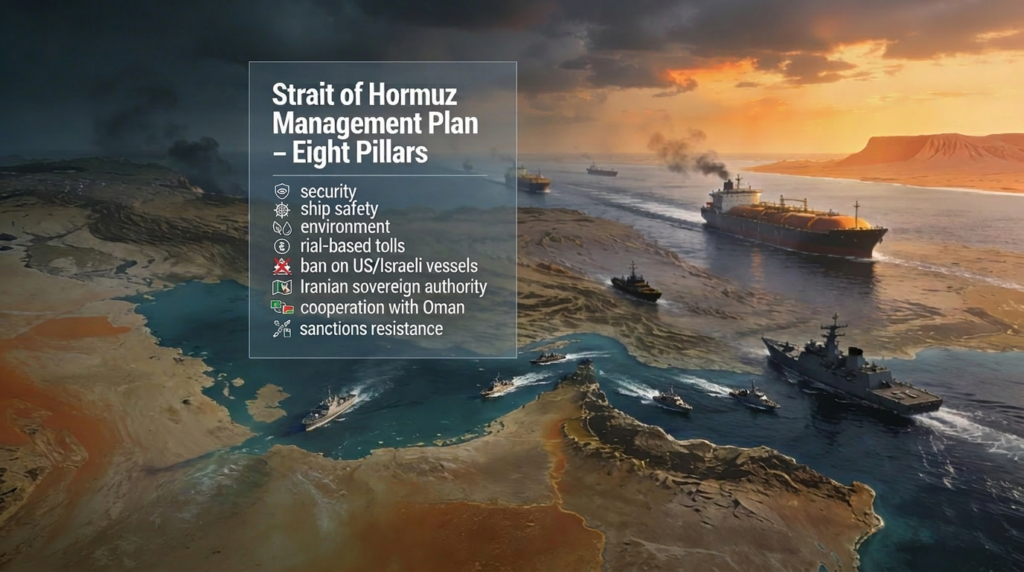
Iran’s Strait of Hormuz Eight Pillars Management Plan

A parallel description from Xinhuanet states that the measure gathered more than 250 signatures and outlines four immediate objectives: ensuring shipping security, charging environmental polluters, collecting fees for guidance services, and establishing a regional development fund funded by the toll regime. Those details matter as they show that Tehran is not marketing this as a simple wartime levy, but as sovereign administration over safety, environmental protection, navigational management, revenue, and regional development.
It is crucial to be precise. The plan is not yet fully enacted into law. Committee approval is significant because it codifies the logic of the corridor and signals an intention to turn military practice into statute, but Iranian reporting makes clear that key elements are still in the phase of initial measures and continued drafting. That does not weaken the argument. It actually strengthens it. The turning point is not when the last procedural stamp is applied, but when a state under attack openly decides to legislate the war’s new realities into its domestic legal order.
The Oman clause is one of the plan’s sharpest edges. Iranian reporting says Oman must be present in the legal regime and coordination structure because the southern side of the strait is Omani. At the same time, a parliamentary voice emphasised that in matters of toll collection “the essence of the matter is in Iran’s hands,” and that Iran is the party positioned to collect fees, while Oman’s place is in cooperation and coordination, not revenue capture.
In other words, Tehran is regionalising the legal façade without diluting operational control. Omani decrees from 2025 ratifying broader cooperation and legal-judicial accords with Iran give this move a pre-existing legal context, making the Hormuz framework look less like a unilateral edict and more like a hard extension of bilateral agreements into wartime management.
This is what it means for force to become law. Iran is not simply blocking ships. It is regulating them, invoicing them, and giving itself the legal language to defend that behaviour once the guns fall quiet.
Islands’ sovereignty and the human layer
Strip Larak from its geography and you miss half the story. Hormuz cannot be seen as just another free-floating blue line on an analyst’s map. It is a dense, lived space of islands, coastlines, fishing ports, naval outposts, and communities that have grown up under the shadow of foreign fleets and sanctions.
For half a century, the world has been taught to treat the islands of Abu Musa and the Tunbs as footnotes, little “disputed” specks on the map. In reality, they, along with Qeshm and Larak, sit inside a network of surveillance and reach that allows Iran to watch, shape, and, when necessary, squeeze movement at the mouth of the Gulf. The Larak Corridor is not a freakish one-off. It grows out of a sovereignty geography that has been quietly undermining the fiction of an “American lake” in Hormuz for decades.
There is a human layer that rarely makes it into Western press. Iran’s maritime posture is not only the work of admirals in Tehran, but it also rests on coastal communities, port workers, pilots, and the broader ecosystem that includes the Naval Basij, the volunteer maritime defence network you researched earlier. That network, with its small craft, its local knowledge, and its political symbolism, has always been part of how Iran thinks about defending the strait, not simply by hardware but by socialised resistance.
For people living on those coasts, the corridor is not a theoretical legal innovation. It is one of the few visible signs, in the middle of bombardment and assassination, that their state can still impose some order at the place where global power once promised them none. Seen from there, the Larak Corridor looks less like opportunism and more like a resilient country insisting that sovereignty is not an abstract word but something that can be exercised in a specific channel of water under fire.
The Gulf pays for the war
The political brilliance of the Larak move is in who gets billed for it: not Washington first, not Tel Aviv first, but the Gulf order that enabled this war and is now trapped in its consequences.
Gulf governments were not properly warned, their objections were ignored, and Europe was largely marginalised from the decision-making that triggered the regional blowback they are now paying for.
That one sentence punctures the comforting story that the old security architecture still works. Some Gulf capitals had urged Washington not to attack Iran. Some tried to keep a distance from the opening salvo. Europe itself was treated less like a partner than a spectator told to brace for impact.
The cost has not been theoretical. Freight risk exploded. Insurance premiums climbed. Cargo timetables turned into contingency plans. The “guarantee” on offer from Washington turns out to be a package in which Gulf states host bases, bankroll weapons, and then absorb the retaliation and economic shock once the trigger is pulled.
The evidence of fatigue is patchy but real. Saudi Arabia has intensified direct contacts with Iran. Regional diplomacy has tried to put some sort of brake on escalation. At the same time, influential Gulf voices still speak of the need to degrade Iranian capabilities, not simply to stop the war. That tension is important as it shows a region caught between fear of Iran and a growing recognition that the American-led order is no longer a stable shelter.
Larak turns that contradiction from an argument into a daily experience. Every tanker that has to negotiate with Tehran, every nervous call from an insurer, or every investor wondering whether to avoid Gulf exposure. All of it drives home the same lesson. A war on Iranian sovereignty will not remain confined to Iranian soil or to the screens of Western news shows. It will leak into ports, pipelines, desalination plants, stock exchanges, and households across the Gulf.
From a pro-peace, pro-sovereignty perspective, that is the real indictment. The architecture that claimed to keep the region safe has delivered a crisis that no one can turn off without Iran’s involvement.
Beyond the dollar and toward the Global South
Although it may sound like a speculative slogan about some future yuan world, it is a description of an experiment already underway. Iran’s proposed Hormuz management plan speaks in the language of rial-based tolls and financial arrangements. Broader analysis around the corridor connects that direction of travel to non-Western settlement channels and to the wider de-dollarisation agenda now running through BRICS and the Global South.
The point is not that the petrodollar disappears tomorrow. It is that under bombardment, and with its conventional military apparatus under fire, Iran is still moving a slice of energy trade onto monetary rails where Washington’s sanctions power is weaker.
Hormuz is doubling as a testbed for de-dollarized energy payments.
China’s experiment with yuan-settled LNG from Qatar in 2023 showed that Gulf energy can clear outside dollar channels when states choose to build the infrastructure. Iran’s 2023 agreement with the UAE to use the dirham in bilateral trade, while imperfect because of the dirham’s peg, still represents a deliberate shift into regional banking circuits that cost Washington more to police. Meanwhile, BRICS has been advancing alternative payment mechanisms and settlement systems designed precisely to chip away at dollar centrality.
The Larak Corridor slots into this picture with unnerving ease. It rewards states willing to engage with Tehran rather than join the sanctions chorus. It opens space for deals denominated in rial, dirham, or yuan. It demonstrates that a Global South state under open attack can still exert leverage over the physical and financial pathways through which the world’s energy moves.
Tehran is not claiming a clean victory over the dollar. What it is doing is more subversive. It is using the war to erase the assumption that Washington can both close and reopen Hormuz at will, militarily and financially. Every transaction that clears outside Western rails, every ship that goes through a lane managed on Iranian terms, is another chip knocked out of a system that has long treated Gulf energy as an American instrument first and a regional lifeline second.
That is why the story of Larak is not simply a regional shipping story, but rather a frontline in the contest over who writes the rules of the global economy.
The old order is cracking
What has happened at Larak is not the final victory of a new world, but it is one of the clearest signs that the old one is cracking in real time.
For decades, the script ran on autopilot. The United States secured the sea lanes. The Gulf monarchies supplied the fuel. The dollar priced it. Everyone else adjusted. The war on Iran was supposed to be another scene in that familiar play. Instead, it exposed how much of it had become theatre.
Iran’s answer didn’t need to be polite, and it was never meant to be. It was disciplined, coercive, and grounded in the one thing Washington cannot replace with rhetoric, the geographic reality of where Hormuz actually lies. Tehran avoided the trap of a universal shutdown and built a mechanism that punishes enemies, rewards accommodation, and keeps the region inside a rolling uncertainty that no press conference in Washington can dispel.
That is why the phrase differentiated transit regime carries so much weight in this war. It captures the fact that what is happening off Larak is not chaos. It is governance under attack. It is a sovereign state, bombed and sanctioned, insisting that it still has the right to decide who crosses its doorstep and on what terms.
For people in the Gulf, it is about whether their ports can stay open, whether their desalination plants keep running, and whether their economies can withstand another cycle of manufactured crisis. For people in Iran, it is about whether anything in their immediate environment still belongs to them after decades of war, sanctions, and threats of regime change.
Seen from that angle, the Larak Corridor is not a provocation. It is a verdict. Peace will not come from pretending the old arrangement can simply be restored. It will come, if it comes at all, when the region and the wider world accept the reality written into the water off Larak. A Gulf built on assaults against Iranian sovereignty cannot remain prosperous, stable, or truly sovereign itself. Not now, and not in the long term.
Iran’s navy has been battered. Its cities have been hit. Its leaders have been hunted. Yet at the most critical chokepoint on earth, the war machine that promised to reopen the map still cannot make Hormuz move on its own terms.
Sovereignty, once attacked, does not always retreat. Sometimes it answers by redrawing the map and forcing those who lit the fire to live with the new lines.
Featured Video
Trita Parsi: Israel Set a Trap for Total War in the Region
or go to
Aletho News Archives – Video-Images
From the Archive
Zionism’s Violent Legacy
By Donald Neff | Washington Report On Middle East Affairs | January 1996
On January 4, 1948, Jewish terrorists drove a truck loaded with explosives into the center of the all Arab city of Jaffa and detonated it, killing 26 and wounding around 100 Palestinian men, women and children.[1] The attack was the work of the Irgun Zvai Leumi – the “National Military Organization,” also known by the Hebrew letters Etzel – the largest Jewish terrorist group in Palestine. The Irgun was headed by Revisionist Zionist Menachem Begin and had been killing and maiming Arabs, Britons and even Jews for the previous ten years in its efforts to establish a Jewish state.
This terror campaign meant that at the core of Revisionist Zionism there existed a philosophical embrace of violence. … continue
Blog Roll
 Aletho News
- Trita Parsi: Israel Set a Trap for Total War in the Region
- Trump’s Iran war is on an Israeli leash
- Saudi oil boss issues global supply warning
- Riyadh Says Its Oil System Is Intact. The Numbers Say Otherwise.
- Trump and Netanyahu Want to “Finish the Job” on Iran
- US ‘one-sided dictation’ not Iran’s beliefs makes rational talks impossible: Baghaei
- Iran’s Next Strike May Not Explode. It Could Shut You Down /Col Doug Macgregor
- Iran: US political targets legitimate if assassinations return
- Iraq shuts key border crossing with Iran under US pressure: Report
- Undersea Internet cables could be targeted in retaliation for attacks on Iran: IRGC deputy chief
- If Americans Knew
- The Israel Lobby’s Changing Fortunes
- AIPAC has become such a political liability that it’s shifting to a more “nimble” approach to buying politicians
- At least 160 Israeli settler attacks in 2 weeks
- Will Gaza’s Ancient Christian Community Disappear Forever?
- Israel’s vision of regional security rests on keeping Arab states weak
- Heidi Levine recounts how Palestinian youths helped save her in settler attack
- DAILY UPDATE: Latest essential news on Palestine, Israel, & region
- Trump’s Intensifying Sabotage of the ICC, for Israel’s Sake
- Israeli military detain US and UK volunteers in West Bank including Democratic NY politician Brad Lander
- Americans at National Conservatism Conference held in Israel this year criticize Israel
- No Tricks Zone
- E-Cars Reduce CO2 Emissions By Only 41% Compared To Internal Combustion Engine Vehicles
- Predictions Made By Renowned Climate Professor Over Past Decades Have Been Proven To Be Poor
- New Study Suggests Large Regions Of The Pacific Ocean Have Been Cooling For The Last 80 Years
- Germany’s Green Energy Debacle: High Energy Costs Force Kahla Porzellan to Close After 182 Years!
- New Study: 50 Years Of The Most Aggressive ‘Net Zero’ Policies Can Only Affect The Global Climate By 0.03°C
- US September “Heat” Was No Record…Many Records Set Decades Ago
- Latest European Green Energy Debacle; Portugal’s Largest Flagship Solar Park Insolvent!
- Green Energy Debacle: German Expert Professor Fritz Vahrenholt Warns Of Severe Economic And Social Consequences
- Two More Paleo Reconstructions Affirm Meters-Higher Sea Levels Across Ireland, Brazil 7000-6000 Years Ago
- New Study: Earth And Venus Surface Warmth Largely Explained By Convection And Lapse Rate, Not CO2 Or Radiation

