Boeing’s latest crashes pose serious risk to global AI development – analysts
RT | March 23, 2019
Two deadly crashes involving Boeing’s newest airplane in less than six months puts in jeopardy not only the credibility of the manufacturer, but also new technologies actively being pushed by the world’s top tech firms.
All Boeing 737 MAX 8 planes operated by global carriers were grounded earlier this month after an Ethiopian Airlines aircraft crashed shortly after take-off, taking a steep nosedive not far from Nairobi.
The fatal accident which claimed 157 lives followed a similar crash in Indonesia, which killed all 189 people on board in October.
The two crashes appear to have something in common. The crews of both aircraft reportedly struggled with the MAX 8 autopilot system which pointed the nose of the airplane down before the crash.
The implications of the deadly incidents are much bigger than aviation itself, according to Alessandro Bruno, an independent international affairs and aerospace industry analyst.
“I think this accident shows the limitations of artificial intelligence and it should convince Elon Musk and Tesla to slow down efforts to push down self-driving cars,” the expert told RT, highlighting that the latest crashes occurred due to software problems, not mechanical ones.
A recall of Boeing’s flagship planes, lawsuits from global air carriers and a fall in the manufacturer’s market value may undoubtedly result in the firm lagging behind Airbus, its key rival, according to Vladimir Rojankovski, an expert at the International Financial Center in Moscow.
“I think if this scandal is not ‘extinguished’ in time, it will trigger deep concerns over the entire sector of artificial intelligence and its credibility,” the analyst said in an interview with RT.
He stressed that the burning desire of tech giants to get rid of the need for human labor, and thus salaries, may shatter confidence in the maturity of AI and its development.
“Americans should know this, because when they landed on the Moon, the computers failed, so they had to land manually,” Bruno said.
“Imagine if the computers were controlled by the same system that is controlling 737 MAX 8, they would have crashed on the Moon.”
New Republic: Climate Change = Vietnam War
By David Middleton | Watts Up With That? | March 18, 2019
Climate Change Is This Generation’s Vietnam War
It’s an existential threat to millennials—and older Americans are standing in the way of action.
By MATT FORD – The New Republic – March 14, 2019
Every year, the world’s elite gather like the Illuminati in the Swiss chalet town of Davos for the World Economic Forum, where they discuss how to solve humanity’s most pressing problems. Often that results in comically out-of-touch conversations, such as the idea, put forth at this year’s summit, that digital “upskilling” can solve economic inequality. But sometimes it provides a platform for someone like the 16-year-old Swedish climate activist Greta Thunberg, who appeared before these elites like the prophet Cassandra.
“Either we prevent 1.5 degrees Celsius of warming or we don’t,” she said at the summit in January. […]
Like the Vietnam protesters of the ’60s and ’70s, millennials have shown a knack for mass organizing. […]
The ruling gerontocracy won’t make it easy for younger Americans to translate their political energy into policy. […]
The Vietnam War was a clear mortal threat to young people, tens of millions of whom were eligible to be drafted; nearly 60,000 Americans were killed in the conflict. Climate change presents a different sort of threat to millennials. It’s less immediate than an ongoing war, less visceral than being shot at. But ultimately it will prove more catastrophic. Even if drastic action is taken over the next decade, the impact of rising global temperatures on civilization will dwarf the Vietnam War’s bloodshed. The World Health Organization has projected that come 2030, climate change will cause an additional 250,000 deaths per year.
Combatting climate change will take much more effort than ending the Vietnam War, and much longer. […]
I’m still laughing. When I saw the title, I said to myself, “Self, they’re right. The Global War on the Weather is like the Vietnam War. No matter how much blood & treasure our government spends, it can’t win.” But, the author went in a whole different direction; he’s comparing the Global War Against the Weather to protests against the Vietnam War.
I think my analogy is better. In the early 1960’s, the choices were: Either we defeat communism in Southeast Asia or we don’t. From 1953 to 1975 spent $168 billion (almost $1 trillion in 2011 USD) and 58,000 American lives on a war that was unwinnable under the conditions imposed by our government. In the Global War Against the Weather, we face a choice of preventing or not preventing 1.5 °C of warming.
“Either we prevent 1.5 degrees Celsius of warming or we don’t,” [Greta Thunberg] said at the summit in January.
Greta, I’m afraid I have bad news for you. With or without the New Green Deal Cultural Revolution… we don’t prevent 1.5 °C of warming. Let’s use the Paris Accord as a proxy for the Green New Deal Cultural Revolution.
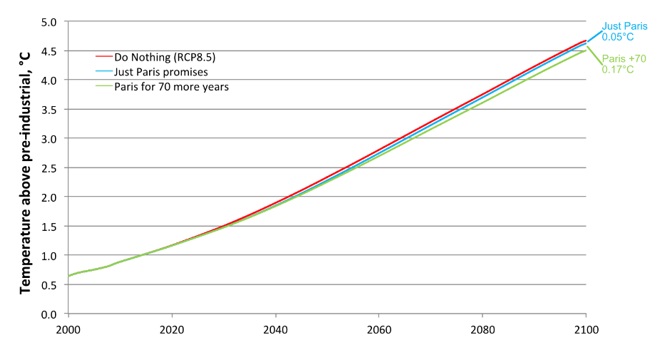
Bjorn Lomborg
We already have 1.0 °C relative to the mid 1800’s and about 1.5 °C relative to the coldest phase of the Little Ice Age, the coldest part of the Holocene Epoch. If 1.5 to 2.0 °C of warming relative to the glacial interstadial temperatures of the Little Ice Age is an “existential threat to millennials,” their threshold for existence is set too low (or would that be too high?).
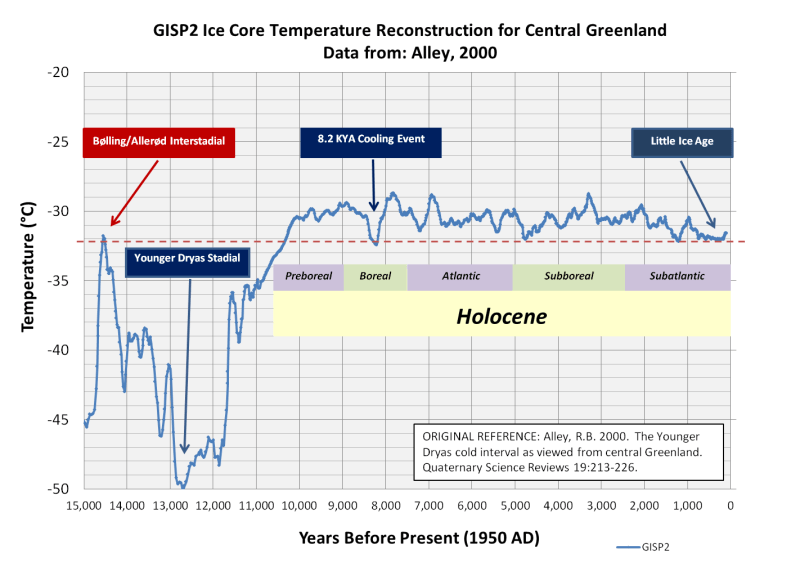
Central Greenland temperature reconstruction (data from Alley, 2000)
The Vietnam War was a clear mortal threat to young people, tens of millions of whom were eligible to be drafted; nearly 60,000 Americans were killed in the conflict. […]
The World Health Organization has projected that come 2030, climate change will cause an additional 250,000 deaths per year.
Is this a non sequitur or a red herring?
Vietnam War…
STATISTICS FOR INDIVIDUALS IN UNIFORM AND IN COUNTRY
VIETNAM VETERANS3. 2,709,918 Americans served in Vietnam , this number represents 9.7% of their generation.
CASUALTIES
2. Non-hostile deaths: 10,800
3. Total: 58,202 (Includes men formerly classified as MIA and Mayaguez casualties). Men who have subsequently died of wounds account for the changing total.
(a) 2,709,918 divided by 9.7% equals 27,937,299.
(b) 58,202 divided by 27,937,299 equals 0.002… 0.2%.
(c) 99.8% of the Vietnam War generation did not die in the Vietnam War.
Those were real deaths. The brave men and women who sacrificed their lives in the Vietnam War were real people… They have names.
Global War Against the Weather…
The World Health Organization has projected that come 2030, climate change will cause an additional 250,000 deaths per year.
Is this comparable to to Vietnam War in any way, shape or form?
Estimated 2011
Death Rate
• 8 deaths/1,000 population
• 55.3 million people die each year
• 151,600 people die each day
• 6,316 people die each hour
• 105 people die each minute
• Nearly two people die each second
In 2011, 55.3 million real people died. That’s 0.8% of 7 billion people. If I add 250,000 to 55.3 million, it’s still 0.8% of 7 billion people. Furthermore, these hypothetical deaths are the results of models. There will be no way to actually attribute any of these deaths, if they occur, to whatever climate changes actually occur between now and 2030.
Now, we do have a pretty good idea how many real people, with names, are currently dying due to energy poverty.

Energy Poverty Kills More People Than Coal and Cecil B. DeMille… Combined!
4 million is 7% of 55.3 million. Will a $240/gal tax on gasoline to fund a $122 trillion Global War on Weather make energy poverty better or worse? My bet is on worse.
Combatting climate change will take much more effort than ending the Vietnam War, and much longer.
Note to The New Republic: There’s only 1 “t” in combating.
The Global War Against the Weather will cost at least $122 trillion, claim tens of millions of lives and have no discernible affect on the weather.
With eye on US, Iran revs up ‘resistance front’
By M. K. BHADRAKUMAR | Indian Punchline | March 19, 2019
A new phase is beginning in Iran’s approach to the situation since last May when the US withdrew from the 2015 nuclear deal. Tehran had thus far prioritised the consolidation of Western opinion against President Trump’s decision with a view to effectively counter the US sanctions. But with hindsight, it appears that Europeans might posture against the US sanctions, but business interests ultimately prevail and the hard reality is that European companies that have exposure to the American market will not risk US sanctions.
Certainly, the drop in oil income following the US sanctions has hurt the Iranian economy and Tehran admits it openly. The Trump administration now plans to unveil an even harsher sanctions regime in May. According to reports, Washington aims to bring down Iran’s oil exports further.
Meanwhile, the US-Israel-Saudi-UAE nexus against Iran is actively working to create instability within Iran, weaken the regime and incapacitate it from playing a regional role. Saudi money is challenging Iran’s towering multi-dimensional presence in Iraq.
Although the US is notionally withdrawing troops from Syria, the efforts continue to roll back Iran’s presence in Iraq and Syria. Iran mentors the battle-hardened Shi’ite militia forces numbering tens of thousands in Iraq and Syria, which fought against the ISIS. Iran’s continuing presence in Syria poses an insurmountable obstacle to Israel’s designs to weaken and dominate Syria and to legitimise its illegal occupation of the Golan Heights.
Suffice to say, Tehran finds itself besieged. Of course, Iran’s regime has lived through dangerous periods through the past 4 decades and there is no question of capitulation. But an inflection point has been reached and a new trajectory has become necessary in terms of Iran’s political economy as well as to overcome the geo-strategic challenges.
There have been incipient signs change in the most recent months — in various statements by the Supreme Leader Ali Khamenei, in particular — indicative of a new pathway that would jettison the earlier obsession with the Western countries and abandon the strategy to put eggs in the EU basket. Khamenei repeatedly stressed Iran’s inner strength and the resilience of ‘resistance’.
Without doubt, the unannounced visit by Syrian President Bashar al-Assad to Tehran on February 27 augured that a Syrian-Iranian alliance with far-reaching geopolitical significance is taking shape. Khamenei stated during his meeting with Assad: “The Islamic Republic of Iran regards helping the Syrian government and nation as assisting the Resistance movement, and genuinely takes pride in it… Syria, with its people’s persistence and unity, managed to stand strong against a big coalition of the US, Europe and their allies in the region and victoriously come out of it… Iran and Syria are strategic allies and the identity and power of Resistance depend on their continuous and strategic alliance, because of which, the enemies will not be able to put their plans into action.”
Khamenei repeatedly used the metaphor of the resistance to characterise the Iran-Syria alliance. The charismatic commander of the Quds Force Gen. Qassem Soleimani neatly summed up that Assad’s visit was a “celebration of victory” for the resistance front.
Indeed, Khamenei has since decorated Soleimani with Iran’s most prestigious medal of honor, the Order of Zulfiqar. There is much symbolism here, since Soleimani happens to be the first Iranian commander to receive the Order of Zulfiqar after the 1979 Islamic revolution. Iran is applauding Soleimani’s profound contribution to the resistance. To be sure, Iran is returning to its revolutionary moorings.
Thus, the meeting between the top commanders of the armed forces of Iran, Iraq and Syria which took place in Damascus on Sunday was geared to flesh out a coordinated plan to meet the challenges in regional security. Some reports mentioned that Soleimani too was in Damascus on Sunday.
While receiving the three army commanders in Damascus, Assad reportedly said that the blood of Syrians, Iranians, and Iraqis “have mixed in the battle against terrorism and its mercenaries, who are considered as a mere façade for the countries that support them.”
Equally, Iranian president Rouhani’s recent visit to Iraq can be put in perspective. As a senior Chinese expert on West Asia has noted, Rouhani’s visit has “long-term geopolitical implications” in terms of expansion of Iran’s regional influence, apart from giving traction to the “resistance” politics (against US and Israel.)
The Chinese expert wrote that Iraq is refusing to be part of US’ containment strategy against Iran and Rouhani’s visit consolidates Iran’s influence in Iraq, which in turn also enhances its capacity to offer a “stark counterbalance” to US influence over Iraq. Again, Iran sees Iraq as a gateway to bust the US sanctions. Geopolitically, the expert underscored, the new dynamic strengthens Tehran’s strategy to create a regional axis between Iran, Iraq, Syria and Lebanon, which would have an edge over Saudi Arabia. Incidentally, Rouhani is likely to visit Syria as well in the near future.
Clearly, resistance politics creates strategic depth for Iran to push back at the US. But there is also a bigger dimension to it. Tehran plans to step up its participation in Syrian infrastructure construction. Ultimately, Iran’s economic relations with Iraq and Syria will be further strengthened in addition to its political and strategic relations with the two countries.
Very few details of yesterday’s meeting of army commanders in Damascus have emerged but one concrete outcome is the reopening of the Syrian-Iraqi border in the “coming days”, which of course, will facilitate a road link connecting Iran with Syria and Lebanon via Iraq. This is a major development insofar as a direct road link becomes possible connecting Iran with Syria and Lebanon. One main objective of the US military presence in Syria was to thwart such a transportation route that would significantly boost Iran’s influence and presence in the Levant. There have been reports that Iran may use Latakia port in Syria to access the world market.
The US is pushing Lebanon into the arms of Iran and Russia: US sanctions affect the local economy

Lebanese disputed blocks with Israel
By Elijah J. Magnier – 18/03/2019
Lebanon is expecting the visit of US Secretary of State Mike Pompeo this week at a time when the Lebanese economic-political map is being redrawn and while Lebanon is suffering its most serious economic downturn in recent history.
Reasons for the deterioration of the local economy include not only the corruption of Lebanon’s political leadership and lower level administration but also US sanctions imposed on Iran. The latest sanctions are the harshest ever imposed. They will also dramatically affect Lebanon so long as President Donald Trump is in power if Lebanon does not follow US policy and dictates.
If, as anticipated, Washington declares economic war on Lebanon, the sanctions will leave Lebanon few alternatives. They may force Lebanon to fall back on Iranian civilian industry to overcome US economic pressure, and to rely on the Russian military industry to equip Lebanese security forces. This will be the result if Pompeo insists on threatening Lebanese officials, as his assistants have done on previous visits to the country. The consistent message from US officials has been: you’re either with us or against us.
Politically, Lebanon is divided between two currents, one pro-US (and Saudi Arabia) and another outside the US orbit. The economic situation may well increase internal division to the point that the local population reacts angrily in order to exclude the US and its allies from influence in Lebanon.
Such a scenario may still be avoided if Saudi Arabia injects enough investment to reboot the agonising local economy. Nevertheless, Saudi Arabia fears that those who are not aligned with its policies and those of the US could benefit from its support. To date, Riyadh has not fully understood the internal Lebanese dynamic and what it is possible or impossible to achieve in Lebanon. The kidnapping of the Prime Minister Saad Hariri was the most flagrant indication of Saudi ignorance of Lebanese politics. The Saudis’ lack of strategic vision in Lebanon will likely prevent any serious support to the failing economy and may lead the country into serious instability.
Before 1982, one US dollar was equivalent to 3 Lebanese Lira. This was in part because the Palestinian Liberation Organisation (PLO) was spending tens of millions of dollars in the country on its own people and on Palestinian families living in Lebanon. Moreover, United Nations organisations (UNRWA) and other NGOS were also distributing financial support to Palestinian refugees whose homes had been taken by Israel forcing them to leave their country.
Following the Israeli invasion of Lebanon in 1982, the PLO was forced to leave the country. Not much later, one US dollar reached an exchange rate of 3000 Lebanese Lira, later devalued to stabilise at the current rate of 1$ for 1500 L.L. Iran entered the scene to support local Lebanese fighters (the Islamic Resistance in Lebanon, i.e. Hezbollah) to recover their territory from Israeli occupation. In the year 2000, Iran began to make a serious investment in Hezbollah as the group managed to force the Israelis out of most Lebanese territory. Iranian financial investment had reached a very high level by the 2006 war when Israel was prevented from disarming Hezbollah to keep its rockets and missiles out of range of Israel.
In 2013, the Syrian government asked Hezbollah to support the Syrian Army to prevent disintegration of the country and to keep Takfiri militants from taking over. Iran pumped billions of dollars to defeat ISIS and al-Qaeda and to prevent them from overwhelming Syria and Iraq, aware that Iran would be the next target. The budget for Hezbollah troops went sky high. Support for movements of troops, logistics and daily allowances given to fighters, contributed to boosting the Lebanese economy. Hezbollah’s monthly budget went much beyond $100 million per month.
But after the arrival of Donald Trump in power and his rejection of the Iran nuclear deal, the US government has imposed the severest sanctions on Iran and halted donations to the United Nations organisations supporting Palestinian refugees (UNRWA). Sanctions on Iran have forced a new budget on Hezbollah, a five-year austerity plan. Forces have been reduced to a minimum number in Syria, movement of troops are slowed accordingly and all additional remunerations are suspended. Hezbollah reduced its budget to a quarter of what it had been without suspending any militants or contractors’ monthly salaries and medical care as stipulated by a personal order from Sayyed Hassan Nasrallah, Hezbollah’s Secretary General.
This new financial situation will affect the Lebanese economy as cash flow and foreign currency dry up. The consequences are expected to be more noticeable in the coming months, leading to a plausible domestic reaction from the local population that will feel the weight of the failing economy.
The US and Europe are imposing strict controls on any monies transferred to and from Lebanon. The country is on a financial blacklist and there is tight scrutiny on all transactions. Religious donations from abroad are no longer possible since they expose donors to serious accusations of support for terrorism by western countries.
As long as Trump is in power, Hezbollah and Iran believe the situation will remain critical; they estimate that the US President will most probably enjoy a second term. The next five years are expected to be hard on the Lebanese economy, particularly if Pompeo’s visit brings messages and dictates that Lebanon cannot obey.
Pompeo wants Lebanon to give up on its demand to redraw its disputed water borders with Israel, compromising on blocks 8, 9 and 10 to the benefit of Israel. This request will not be granted and Lebanese officials have said on several occasions that they are relying on Hezbollah’s precision missiles to stop Israel from stealing Lebanese water.
Pompeo also wants Lebanon to give up on Hezbollah and its role in government. Again, the US establishment seems ignorant that Hezbollah is almost a third of Lebanon’s population, enjoying the support of more than half of Lebanese Shia, Christian, Sunni and Druse, with official members in the executive and legislative authorities of the country.
What then is the alternative? If Saudi Arabia moves in, Lebanon doesn’t need one or two or five billion but tens of billions of dollars to resuscitate its economy. It also needs a hands-off policy from the US establishment to allow the country to govern itself.
The Saudis are already suffering from Trump’s bullying, and their funds are drying up. If Saudi decides to invest in Lebanon, it will seek to impose terms not much different from US demands. Saudi Arabia engages in wishful thinking when it aims to expel Iran’s influence and Hezbollah supporters from Lebanon, an impossible goal to fulfil.
Lebanon’s remaining choices are few. Lebanon can move closer to Iran to lower its expenditures and the cost of goods, and it can ask Russia to support the Lebanese army if the West fails to do so. China is preparing to move in and can be a positive alternative for the country, using Lebanon as a platform to reach Syria and later Iraq and Jordan. Otherwise, Lebanon will have to prepare to join the list of poorest countries.
A shadow is hanging over the land of the cedars, a country that has already had to fight for survival in the 21stcentury. Hezbollah, now subject to US and UK sanctions, is the same force that protected the country from ISIS and other takfiri fighters who threatened to expel Christians from the country, in accordance with French President Sarkozy’s advice to the Lebanese patriarch that Lebanese Christians abandon their homes. The takfiri jihadists and NATO shared the same intentions for Lebanon. The failure of the US establishment’s plan to divide Iraq and create a failed state in Syria as part of a “new Middle East” woke the Russian bear from its long hibernation. Today Russia competes with the US for hegemony in the Middle East, obliging Trump to pull out all the stops in an attempt to break the anti-US front.
It is a battle with no taboos where all blows are permitted. The US is pushing Lebanon into a bottleneck with no alternatives to closer partnership with Iran and Russia.
Israel, Greece to Build Radar on Crete Amid Rapprochement– Reports
Sputnik – March 19, 2019
The Long Horizon marine radar system will be built by Israel and Greece in eastern Crete, the Greek newspaper Kathimerini reports. The enhanced coverage of the radar will allow both countries to monitor the Eastern Mediterranean basin. The daily has not disclosed the cost of the project, saying only that it is “not insignificant,” especially taking into account Greece’s reduced military budget.
According to the outlet, Athens and Tel Aviv have been drifting together recently, boosting their military ties among other things. Greece has recently agreed with Israel to share know-how for its navy, which has begun to develop. According to the outlet, 40 Israeli probationers will be carried by a Greek transporter from Haifa to Crete, without any stops in Cyprus, by the end of the month. The Israelis will join the Greek forces during upcoming drills and then return to Haifa after a stop in Milos and Rhodes.
On the other hand, Athens has been open to the possibility of bolstering its arms gaps with the help of Israel, as Kathimerini noted. Among other things, Greece has rented seven drones from Israel for search and rescue operations.
Israel’s Haaretz reports that Cyprus also shares the Israeli interests in the region. The list of common interests includes a stance on the situation in Syria and Lebanon as well as uneasy relations with Turkey.
Apart from military and political cooperation, which is to be confirmed during an upcoming trilateral Greek-Israeli-Cypriot summit with US Secretary of State Mike Pompeo, the three countries are developing a major economic project — the undersea East Med pipeline, designed to deliver natural gas from the Eastern Mediterranean to Europe via Greece and Cyprus. Greek Prime Minister Alexis Tsipras, Israeli PM Benjamin Netanyahu and Cyprus President Nicos Anastasiades are expected to sign the grand deal, agreed upon in 2018, within the month, as the Greek media earlier reported.
The 2,000-kilometre underwater pipeline is intended to have a capacity of 12 billion cubic metres of gas annually, delivering fuel from Israel’s Leviathan, named one of the largest young gas reserves in the world, and the Aphrodite offshore gas fields. Additionally, the venture was boosted in February when it was announced that large gas deposits had been discovered in Cyprus.
The line, which is almost twice as long as Russia’s Turk Stream pipeline, is estimated to cost $8 billion and is said to be the world’s deepest underwater gas pipeline. Egypt, the only Muslim nation besides Jordan that has a peace treaty with Israel, is also seeking to export its newly discovered gas reserves, and has expressed interest in joining the project.
May and Merkel Fiddle While Their Unions Burn
By Tom LUONGO | Strategic Culture Foundation | 16.03.2019
When it was reported by John Petley of the Bruges Group that German Chancellor Angela Merkel had, in effect, written the Brexit withdrawal agreement Theresa May has now twice had turned down by her parliament it should have come as no shock to anyone closely following the Brexit drama.
Uncorroborated? Sure. Most likely true. Of course.
The European Union doesn’t want Brexit to happen. And if it were to happen it would only be acceptable to them if it looks like the deal Mrs. May put before the House of Commons twice only to be rebuked by historic margins.
This was not a version of Brexit anyone had in mind. Not the softest-minded Labour voter and especially not the sovereignty-minded Leave voter of the Nigel Farage persuasion.
It was, in short, a betrayal of all things fundamentally nationalist.
For the past week I’ve been watching a lot of British Parliament as it debates, and I use that word very loosely, the situation Mrs. May and the MP’s themselves have put the country in. And, in a word, it is shameful.
May and Merkel both miscalculated terribly on what the British people would accept. It’s obvious that both only thought in terms of the kind of political leverage they could bring to bear on the House of Commons which would eventually force them to cave to supposed horror-show of a ‘No-Deal’ Brexit.
Make no mistake, the horror show would mostly fall on Germany – whose banking system, already teetering on collapse thanks to other rifts forming within the currency bloc – and export-driven economy would suffer from the Brits having more control over the exchange rate of the pound versus the euro.
A lower pound would be the first result of a no-deal Brexit. Good for long-suffering British manufacturing and bad for Germany’s, since the UK is Germany’s biggest export market.
Economically and philosophically, no-deal is the best deal for the UK But don’t tell that to the MP’s who are scared to death of it.
But what’s most important about all of this is that it is all just a symptom of a much deeper problem, the unwieldy nature of the European Union itself.
Germany and the elites who have pushed this project, the unelected financiers I like to call The Davos Crowd, are dead set against anything that obstructs its completion.
The wave of nationalist political fervor racing across the continent is, however, a consequence of their trying to form a political and fiscal union that far exceeds the original mandate sold to voters when they joined.
And that is threatening to tear Mrs. Merkel’s union to pieces. This is why she and her posse in Brussels are so committed to screwing the British people. They have to send the right message to Italy and Hungary. It’s why they want $39 billion.
It’s why they are using the non-issue of the Irish border to tie the UK into the customs union and single market forever. But, make no mistake, just like Merkel’s horrific treatment of Greece was seen as unconscionable by people across Europe in 2015 they are looking at how the Brits are being treated and are equally as appalled.
Merkel, Juncker et.al. all saw the divisions within the Labour and Conservative parties that have resulted from their planning and thought them to be assets. But they aren’t. Maybe in the short-run it will get them what they want, another moment to kick the can down the road a little bit further.
But in the long-run all it is doing is setting up for another round of Brexit in the future with a much less plastic set of circumstances. Because, as I said earlier, they have miscalculated. The British people are fed up with them and with their own government.
The Labour party is squealing out of both sides of its mouth trying to get themselves out of the corner they’ve painted themselves into. Because they can read the polls. And what was a solid Labour lead in the winter has become a solid Tory lead in the Spring.
Because as split as the Tories are, voters understand that there are more of them trying to implement their will than there are Labour MP’s. And that counts for something.
Mrs. May has made a mess of things thinking she could shoe horn a terrible deal through parliament that would satisfy the EU while blowing up the traditional two-party system in the House of Commons.
And this is why I say to hardened cynics who think these people are all-powerful that they aren’t. They are smart but they aren’t clever. They do the same thing that has worked before and run the same playbook. Brexit looks exactly like the Greek debt talks.
Merkel didn’t update her playbook for 2018. It wasn’t a short-term negotiation. It was a three-year process that tried the patience of 66 million Brits. And they have seen the real face of the EU and many more of them want no part of it.
Merkel and Juncker are trying to hold onto their manufactured leverage over the Brits to, in turn, hold onto a Union that is in the process of failing. May and her cabinet are trying to hold onto a relationship with the EU while the UK itself is now in danger of failing.
The Scots are pushing for independence to stay in the EU. Wales is beginning to consider it. Northern Ireland doesn’t like being anyone’s Trojan Horse.
They have thoroughly underestimated the will of the people and it will cost them what little cache they have left with voters. Remember, confidence lost in the institutions of government begets a loss of confidence in the money and their ability to manage it.
If you want a catalyst for a European sovereign debt crisis, look no further than Brexit now or the downstream effects of a delayed Brexit later.
If an extension is approved by the EU and given to the Brits, Euroskeptics will go from commanding a projected 32-33% of a 705 seat European Parliament to possibly 35-36% of a larger one that includes the Brits.
Because if Brexit is delayed and betrayed do you think Remainers will be elected en masse? Or do you think Farage et.al. will not storm into Brussels mad as hell?
Merkel and May may have won this battle using their useful idiots like Anna Soubry and Ian Blackford but they will lose the war as the rest of Europe comes to terms with being frog-marched towards a future they neither want, signed up for or are willing to pay for anymore.
No wonder the Yellow Vests keep showing up every weekend.
Open letter to anyone marching for ‘the climate’ today
By Brian Dingwall | Whale Oil | March 15, 2019
Hi kids,
Many of you will be marching today, demonstrating for an issue you believe to be very important.
Many years ago, I was young, well informed, and absolutely convinced I knew enough to make good decisions for the future of the world, and couldn’t understand just how obtuse all the oldies were, how they just didn’t know the stuff I had just learned.
Malthusian economics drove most of us, the Club of Rome had reported, and to my subsequent shame, I confess that in 1975 I voted for the Values Party…. I wanted a better world, I knew resources were on the verge of running out, the population was out of control, and we were polluting our one and only planet. It was, I thought, time for the change that was so desperately required.
The Values party did not get in, to our surprise the resources did not run out, Simon won his bet with catastrophist Erhlich, as countries became more wealthy they cleaned up their environments, particularly water, farmlands, and air.
China is now wealthy enough to be doing exactly that right now, following in the footsteps of Japan, Taiwan, and Korea. We certainly never see the famous foaming rivers of industrial Japan anymore.
Economists now understand that the ultimate resource, the human imagination, never runs out.
So is it likely to be with climate change. I urge you to never abandon your scepticism, for a critical mind is your most important asset.
Be able to articulate exactly what evidence has persuaded you to your opinion. Opinions though, are not evidence. Consensus is not evidence.
The world has many historic consensuses that have turned out to not be so. So far, I don’t mind sharing with you, I have yet to be persuaded.
My background is in science, with a smattering of economics, and statistics and I well understand the case for catastrophic climate change. I find it unconvincing.
As do a raft of well qualified experts in many fields, even Nobel prize winners, and I urge you to find out who they are, and why they have reservations.
There are two sides to this debate, but only one is well resourced, so you have to work a bit harder to find the arguments of the sceptical scientists.
One of the very great tragedies of the whole issue is that since 1990, it has been very difficult for scientists to garner resources from governments to research natural climate change, but we can be certain that the forces that wreaked great climate changes in the past are still active, and may be a much greater magnitude than those wreaked by CO2.
For today please reflect on these things:
All the CO2 being released today is simply being returned to the atmosphere whence it came, and is now available to the biosphere, which we can see is already flourishing as a result. Global temperatures have increased (about 0.7C degrees in last 100 years) ever since the little ice age, and continue to but at nothing like the rate predicted by climate models.
We live from the equator to (nearly) the poles, and hence are particularly adaptable, and will adapt to minor temperature changes and have in the past through climate optima, and little ice ages.
Much of the land surface of the earth is too cold for habitation or agriculture, some warming of the northern latitudes of Canada and Russia for example will be welcomed.
Here in New Zealand, we produce food for the world, with one of, if not the lowest “carbon footprints” of any country. Should you actually succeed in killing this industry, that production will be conducted elsewhere, at a higher carbon cost….. so the improvement as you see it, in New Zealand’s emissions will be more than offset by extra emissions elsewhere…. we will be adding to the problem, not mitigating it.
It is also very important that each of you understands that for any complex problem, there are a range of decisions, trade-offs, to be considered. Do we understand all the benefits that follow from the use of fossil fuels? How many of these are we prepared to sacrifice? What would a fossil fuel-less world look like for you (hint: I don’t think you would like it very much).
Have you read or even heard of the “moral case for fossil fuels”, and do you understand the extent to which they feed and clothe the world, provide us with our tools, and our leisure, empower our devices, and enable our travel at present? House us and clean us?
You are not informed if you only read one side of the case. I happen to believe in free markets, the economics of von Mises, Hayek, Friedman, Simon, McCloskey, and many of the moderns but I have also read Marx, and various of the collectivist economists, you must know what all the opinion leaders are saying and why.
So do seek out “lukewarmers” like Curry, Lewis, Christy, Soon, Balunias, they will lead you to a raft of others “the counter-consensus” that you, like me, may find rather more convincing than the orthodox climate church.
Personally I have learned that what I knew at your age (vastly more than my parents knew, of course) was not always right….now captured in the expression “it’s not what we don’t know, it’s what we know for sure that just ain’t so”.
We once believed in leeches, blood-letting, that washing our hands was not important, that continents didn’t drift, that stress causes ulcers, a daily aspirin is good, and that there is always an imminent catastrophe on the horizon that never materialises.
The question is whether what we know for sure that the specific climate change you worry about is human caused, will have a measurable and substantial impact, and is real. What climate change would have been quite natural? Will we look back in years to come and think “we believed what?”
Have we included accurately in our models the impacts of short and long term natural oceanic cycles, cosmic rays impact on cloud nucleation, clouds, the sun and sunspots, what, if anything, is there still that we don’t know that we don’t know? Can we get initial conditions right?
Always examine closely the logic of the case… we have only one world so all we can do is create computer models of the climate, and wait to see if nature tells us the models are a good approximation of the real world suitable for projecting future climates….. and if climate is a 30 year average of all our global “weather” then we probably have to wait at least two preferably more periods of 30 years simply to validate the models so 100 years or so.
So far the projections and predictions have been wildly wrong, the polar ice is healthy, the Manhattan freeway is not underwater, sea-level rise is not accelerating, and snow is far from “a thing of the past”. As climate scientist and keeper of one of the satellite records ironically observes “the models all agree the observations are wrong”.
And the economics don’t work, as Nobel prize winner Nordhaus teaches the cost of mitigation is an order of magnitude greater than the cost of the problem, so the cure is worse than the disease.
Don’t take my word for it, or anyone’s. Read for yourselves, go to source. Do not trust any scientist who calls a peer scientist a “denier”. Understand peer review, and that a peer reviewed paper is more often than not just the opening salvo in a chain of events that may or may not ultimately expose a scientific truth.
Be very careful of any theory where the accepted facts (historic temperatures, and the location and number of the thermometers)) change regularly to suit the narrative.
And finally, enjoy your day, be yourselves, trust your own judgment, read widely, and look behind the data to the motives of the players.
There is a (slim) chance you are right, but even if you are, trust in human ingenuity, that fabulous engine of change, to ensure survival not of the world as we know it, but of an even better world than previous generations enjoyed…. we will not revert to sleeping with our food animals on dirt floors with unpainted walls! As humans have done for most of our time on earth….
Market failures could see Britain suffering five-day power cuts
Today’s electricity infrastructure, driven by commercial forces, will find it hard to cope when things go seriously wrong.
By David Watson | Energy & Technology | March 11, 2019
Even in industrialised nations in the 21st century, the sort of electricity-grid system failure that’s been seen in parts of Australia in recent years is not uncommon. In the UK, the risk of total blackout or significant partial shutdown of the transmission network is increasing.
The rise in renewables is making failure more probable. Wind farm growth creates frequency-management issues arising from reduced system inertia, while declining network strength can cause longer, stability-risking, fault-clearance times. Then there are the challenges to match supply to demand following sudden variations in wind generation and the reduced one-hour notice of input variations from European interconnectors. Other risk factors include grid substation failure, lightning or overhead line faults and cyber attack.
For grid recovery following widespread collapse, a process known as ‘black starting’ is deployed where the UK is split into different areas. Being able to rapidly black-start the country is a public health priority and, rightly, a public expectation, but in Scotland, and probably London, it is unrealisable; it would take several days to re-establish networks. So serious has the issue become that I understand it has attracted the attention of the government’s Cobra civil contingencies committee.
Professional expectation for Scotland to black-start has now, I’ve been told, risen to five days, largely as a result of large-scale, dispatchable, on-demand generation being replaced with intermittent distributed renewables. London has experienced a similar progressive local reduction and will also take longer to recharge since much of its high-voltage grid uses cable and not overhead line transmission.
The Scottish Black Start Restoration Working Group reviewed its procedures in September 2018. These are based on local joint restoration plans that would see transmission operators powering up and stabilising local transmission islands, which would then have to be synchronised and progressively interconnected.
The group’s report warns that, following the 2016 closure of the Longannet coal-fired power station in Fife, there would be ‘severe delays’ to restoration. Peterhead gas-fired station, now Scotland’s only high-powered and high-inertia (essential to stabilise frequency) dispatchable power station, is seeking planning permission to install 31 diesel generators, capable of full power for seven days, to secure its restart. However, it has only half the capacity of Longannet and couldn’t restart all of Scotland without input from the pumped-storage capacity at Cruachan and Foyers and, crucially, from England, which arrangement is untested.
Nor would wind farms be able to black-start the grid. Main generator types in use need external power to start generating; some more recent designs are self-starting, but connecting to a dead grid via long offshore AC cable interconnections remains an unsolved problem as the turbines cannot provide enough reactive power to recharge what are, in effect, large capacitors. In any case, they wouldn’t be able to meet National Grid requirements for block loading, grid voltage or frequency control.
The first local joint grid-restoration activity is to disconnect all offshore generation. Onshore wind farms can be progressively reintroduced once the grid has been re-established, but only providing they are not frozen and there is wind. As with all nuclear stations, Scotland’s Hunterston and Torness could only be reconnected into a stable grid, this taking several days.
The new £2.4bn HVDC interlinks from Wales to the Hunterston area and from Moray Firth to Spittal have not been engineered to support black start as they do not include the latest voltage source converter (VSC) technology and cannot commutate into a dead network. Scotland is now literally at the end of the line and critical restart power would arrive only once the north of England grid had been re-established. Similarly, for London, the two HVDC interconnector links to France and the Netherlands cannot support black start.
National Grid confirmed in 2016 that the restoration strategy “must be adjusted” as “system strength and the number of black-start providers declines” and that black-start costs are “anticipated to increase by a 7-10 factor” over the next 10 years. While, like Ofgem, it favours the provision of up to seven new VSC interconnectors between Britain and the European mainland, these are not yet built and power availability from them would depend on market conditions. The UK is a net importer of electricity. And then there is Brexit…
The situation is clearly untenable. It exemplifies the need for proper governance of the UK electricity system to replace the present disparate, profit-driven weakening of the grid that ‘the market’ has caused.
Several of the engineering institutions are advocating change, including the IET, the IMechE and the Institution of Engineers in Scotland. We need to be heard.
David Watson is a chartered electrical engineer who before retirement was manager of projects at Foster Wheeler Energy, based in Glasgow.
Exxon Plans Foray Into Israel Gas Exploration
By Irina Slav | Oilprice.com | March 14, 2019
Exxon has plans to enter the Israeli natural gas exploration industry despite the country’s tense relations with its Arab neighbors where Exxon has an established presence, Reuters reports, citing a source with knowledge of the plans.
According to the source, Exxon officials had talked with Israeli Energy Minister Yuval Steinitz on the sidelines of CERAWeek in Houston, focusing on an offshore oil and gas auction that Israel has scheduled for this June.
Israel made several major gas discoveries offshore during the last decade, but only one of them, Tamar, is already producing. Another large field, Leviathan, is close to completion, with first gas flowing into the market in late 2019, according to a November 2018 Reuters report.
The Tamar field contains an estimated 281 billion cu m of natural gas and some 13 million barrels of condensate, according to field operator Delek Group. Delek partners on Tamar’s development with Noble Energy, which holds a 25-percent stake.
Delek and Noble Energy are also the lead partners on the Leviathan project, which Steinitz earlier this year called “the greatest natural treasure that has been discovered in Israel.” The field holds about 535 billion cu m of natural gas as well as 34.1 million barrels of condensate.
Israel has grand ambitions in the gas industry thanks to these discoveries and has been eager to tap more reserves. It has already struck a sizeable gas export deal with an Egyptian firm, but it may just be the start of its growth as a regional factor to reckon with in gas.
This may put Exxon in an interesting position with its partners from the Arab countries, but the risk is relatively small: local oil and gas producers have benefited from the know-how supplied by Exxon and the other Big Oil majors for long enough to risk losing it.
However, there is no certainty there will be another Leviathan-sized discovery any time soon. The 2017 oil and gas block tender that Tel Aviv held was disappointing and hopes are now that the next round, to cover 19 blocks, will have better results.
Lavrov: US Sanction Against Russian Company Violates Int’l Law
teleSUR | March 12, 2019
U.S. Secretary of State Mike Pompeo is criminalizing Russian companies for doing business with the Venezuelan state, saying they are violating U.S. imposed sanctions by making transactions with Venezuela’s sanctioned oil company Petroleos de Venezuela (PDVSA).
In a Monday press conference Pompeo said that the assets of Evrofinance Mosnarbank, a Russia-Venezuela states-owned financial organization would be frozen and U.S. citizens would be prohibited from doing business with the joint venture, according to Reuters.
The U.S. State Department said in a statement that Evrofinance was violating a Trump decree because it is a “foreign financial institution that materially assisted, sponsored, or provided financial, material, or technological support for, or goods or services to or in support of (PDVSA).”
Pompeo also accused the major Russian oil company, Rosneft, of defying U.S. sanctions by buying oil from PDVSA.
According to Sputnik News, Russian Foreign Minister Sergey Lavrov said Pompeo’s “accusations … contradict international law.”
Lavrov said Pompeo’s “accusations that Russian oil company Rosneft bought Venezuelan oil in violation of Washington sanctions contradicts international law.”
Talking to reporters the secretary of state included not only accused Russia but Cuba of trying to undermine democracy in Venezuela.
“This story is not complete without acknowledging the central role Cuba and Russia have played and continue to play in undermining the democratic dreams of the Venezuelan people and their welfare,” Pompeo said.
“Moscow, like Havana, continues to provide political cover to the Maduro regime,” added the U.S. official.
Meanwhile, Trump’s right hand in Venezuela, Elliot Abrams, says he is persuading and urging India to stop buying oil from Venezuela, from who it purchases approximately 366,000 oil barrels per day.
The current U.S. government began a soft coup against Maduro shortly after entering office by placing a slew of sanctions against the Venezuelan government and individuals.
As the list grew and intensified, the U.S. administration sent in Guaido in late January to take over the democratically elected Venezuelan government under Maduro. Most recently, last weekend the White House supported, if not masterminded, the cyber attack on the South American country that caused a nationwide blackout in an effort to create chaos and influence the overthrow of Maduro.
According to the Venezuelan government as of February of this year the country has lost US$38 billion in direct losses from U.S. financial sanctions alone.
For his part, U.S. national security adviser John Bolton announced over Twitter that Venezuela’s National Assembly, still in operation despite being in contempt of the country’s Supreme Court, “decreed the suspension of oil exports to Cuba.” Bolton added, “insurance companies and flag bearers who facilitate these deliveries to Cuba are now on notice,” signaling potential sanctions for those doing business with either country.
The Cuban government quickly responded to Bolton’s proclamation saying he has “long-time credentials … (as) a liar.”
Cuba’s foreign ministry office said in a statement: “The honest and informed people know the bilateral relationship between Cuba and Venezuela is based on mutual respect, true solidarity, fidelism and chavism—independent and sovereign.”
The Dark Secret Behind a British Billionaire’s “Parallel State” In Argentina’s Patagonia

By Whitney Webb | Mint Press News | March 11, 2019
EL BOLSÓN, ARGENTINA – At the “end of the world,” spanning the southernmost regions of Argentina and Chile, lies the land of Patagonia, much of which remains a pristine wilderness that has inspired countless naturalists and would-be adventurers with its dramatic landscapes and natural beauty. For many, it is a place that still feels remarkably untouched and removed from the chaos of the modern world.
Yet, it is these very qualities, as well as the region’s great oil and gas potential and its abundance of glacier-fed freshwater reserves, that have placed it in the crosshairs of predators — predators armed with billions of dollars, powerful influence over Argentine politics and the country’s press, as well as alliances with controversial international financial organizations and key elements of the global Zionist lobby.
Coveted for its still largely unplundered resources, Patagonia has become the target of a close-knit network of notorious billionaires and global elites, who have spent much of the last two and a half decades seeking to transform this area into their own independent state.
Indeed, though several of these billionaires have already created de facto private states where they enjoy near-total impunity within Argentine Patagonia, others have been behind major efforts that have pushed for the territory’s secession. Still others have pushed Argentina’s government to exchange its claim to Patagonia for “debt relief” as a way of easing Argentina’s economic plight that, incidentally, was largely created by this very same group of billionaires. The International Monetary Fund (IMF), whose connections to this billionaire network are considerable, has had an outsized role in this effort.
Yet this appears to be more than just a venture on the behalf of notable oligarchs and the global elite, as prominent elements of the international Zionist lobby are intimately involved, as is the state of Israel, though the extent of the involvement of the latter is subject to debate. Their interest revolves around claims that date back to the founding of Zionism in the 19th century, when revered Zionist figures like Theodore Herzl discussed Argentina as a potential homeland for a Jewish ethno-state.
Since then, other notable Zionists, including past Israeli ambassadors to Argentina, have argued that Israel is for “European Jews” while “American Jews” must take Argentina for themselves. Notably, the method suggested by Herzl as a means of creating a Zionist state in his seminal work “The Jewish State” involves the exchange of debt for territory.
In the first part of this investigative series, MintPress explores the de facto independent state that has been created by British billionaire and Zionist Joe Lewis, a long-time associate of controversial Hungarian-American financier George Soros. Lewis has essentially bought out the local, regional and even national government of Argentina, allowing him to operate with impunity while he acquires more and more territory through land purchases of dubious (if any) legality, intimidates and threatens locals, usurps crucial water and energy resources from local towns, and operates his own international private airport that no one but he controls.
Subsequent reports in this series will examine the other key players in this effort to create a Patagonian state, namely Argentine oligarchs Marcelo Mindlin and Eduardo Elsztain, who are both deeply connected to the global Zionist lobby and the Rockefeller-founded Americas Society, and are also both close Soros associates. Finally, the role of these individuals and their associates in efforts to use IMF debt slavery to pressure the Argentine government to swap debt for territory will be revealed, as will the role of the Zionist lobby and prominent figures in the global elite.
The town that fought back
The quaint mountain town of El Bolsón, nestled among the picturesque rocky peaks of Argentina’s Patagonia and famed for its local legends of gnomes and elves, may seem an unlikely epicenter in a nationwide battle that has pitted locals against powerful foreign billionaires — billionaires who are not only plundering the country’s rich resources but eroding its national sovereignty through backdoor deals with Argentina’s most powerful, and most corrupt, political leaders.
Yet, however unlikely the role of this sleepy town in Argentina’s Río Negro province may seem, for over a decade many locals have used every tool at their disposal to oppose one billionaire’s effort to turn the town and much of Río Negro into his own personal fiefdom. This struggle has seen massive demonstrations in El Bolsón against British billionaire Joe Lewis, with some attracting as many as 15,000 participants – nearly 80 percent of the town’s entire population.
Lewis, worth an estimated $5.2 billion according Forbes, is best known in the West for owning the British Tottenham Hotspur football club, his sprawling luxury estates and golf resorts in the Bahamas and Florida, and owning well-known brands including Puma sportswear and Vans shoes. He is often described as a “self-made” billionaire, having been born to a poor Jewish family in London, who worked his way up to become one of England’s richest men.
Since the mid-1990s, Lewis has been building an empire in Patagonia, having become the owner of extensive properties north of El Bolsón — which, among other things, contain almost all of the town’s water reserves, as well as those of the nearby farming community, Mallín Ahogado — and the de facto power behind Pampa Energía, the company controlling most of Argentina’s electricity production. Part Two of this series will focus on Lewis’ role at Pampa Energía, as well as that of his associate, Marcelo Mindlin.
The “self made” man made by Soros
Long before his venture into Argentina, Lewis was a controversial figure owing to his close association with controversial Hungarian-American financier George Soros. Indeed, the bulk of Lewis’ massive fortune derives from his decision to “team up” with Soros to bet against the British pound in 1992, a day popularly known as Black Wednesday.
Soros’ and Lewis’ bet against the pound actually led to the pound crashing, after Soros ordered his hedge fund to “go for the jugular” and aggressively trade against the currency, thereby prompting its sharp devaluation. Though Soros is often called “the man who broke the Bank of England” as a result of the $1 billion in profits he made on that fateful day, Lewis is said to have made an even larger profit than Soros, according to several reports.
While Soros became a financial celebrity after Black Wednesday, Lewis opted to stay out of the limelight even though, just three years later, he would repeat what he helped do to the British pound with the Mexican peso, reaping yet another massive profit. While the Mexican peso crisis made Lewis even wealthier, it led to a massive jump in poverty, unemployment and inequality in Mexico and left its government beholden to the International Monetary Fund (IMF) through a loan package arranged by then-U.S. President Bill Clinton.
Between 1995 and 1996, the severe economic recession that followed the Mexican peso crisis spread throughout the Americas and “severely affected” the economies of other Latin American countries like Argentina. As fresh economic havoc arrived and took hold in Argentina, Lewis decided to take advantage of the troubled regional economic climate that he himself had helped create and began developing his interests in Patagonia.
As will be explored later in this investigative series, Soros and two of his Argentine associates who are also connected to Lewis — Eduardo Elsztain and Marcelo Mindlin — took advantage of this economic crisis and subsequent crises to buy major stakes in several banks as well as massive tracts of Argentine real estate, particularly in Patagonia.
How to build an empire
In 1996, Joe Lewis returned to Argentina after initially visiting the country in 1992 at the invitation of Australian media tycoon Kerry Packer. Lewis, apparently inspired by his first visit, had decided to buy property in the area. According to regional media outlet El Patagónico, Lewis’ dream was not just owning his piece of paradise, but creating “his own state in Patagonia.”
Lewis soon came into contact with Nicolás Van Ditmar, who would not only facilitate Lewis’ initial and subsequent land purchases in Argentina’s Patagonia but would also do so for several other foreign oligarchs. Van Ditmar had previously arranged massive land sales farther south to the Benetton Group, the family company run by the Italian oligarchs of the same name, best known as the owners of the United Colors of Benetton clothing company.
Van Ditmar, after learning of what Lewis hoped to acquire, spoke to him of the property of the Montero family, which encircled a pristine mountain lake known as Lago Escondido (Hidden Lake). Most of the members of the Montero family agreed to sell their collective property of around 14,000 hectares (~34,549 acres) to Lewis for $7 million. However, one of the Montero brothers, Irineo Montero, had refused and he, along with his wife María Ortiz and their employee José Matamala, were all found dead under mysterious circumstances.
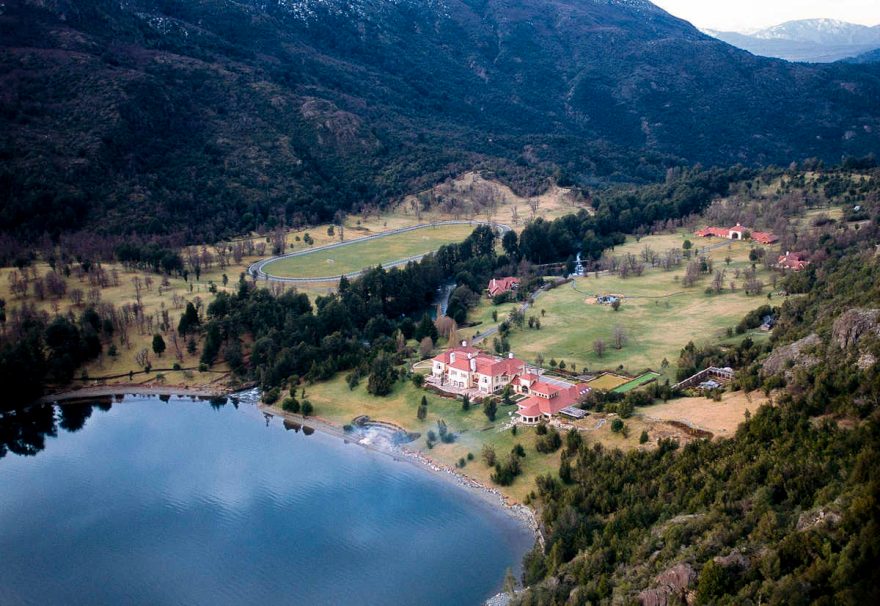
An aerial photograph Joe Lewis’ ranch on Hidden Lake, March 1, 2010 in southern Patagonia, Argentina. Francisco Bedeschi | dpa
Whether or not Lewis or his “right hand man” Van Ditmar were somehow involved in Irineo’s death and those of his wife and employee, there is no denying that their mysterious yet grisly endings cleared the way for Lewis’ purchase of Lago Escondido and the surrounding area. However, Lewis’ acquisition of this property, irrespective of the remaining Montero siblings’ willingness to sell, should never have been allowed for several reasons.
First, as per Argentine law, the sale of the property that Lewis has owned since 1996 is prohibited to a foreign citizen on national security grounds, given that the property is just 20 km from the Chilean border and thus, in foreign hands, could represent a grave national security risk. Second, it violates a local law dating back to 1969 that caps the maximum amount of land that any individual – Argentine citizen or foreigner – may own at around 70 hectares (~172 acres).
Third, it violates a provincial law passed in 1994 that created a protected natural area called the Río Azul Lago Escondido Natural Protected Area (ANPRALE), which included a significant portion of the land that Lewis would later buy from the Monteros. However, that law was amended in 1998, a few years after Lewis’ purchase, to remove the portion of his land that had previously been named a protected area under the control of the state. Federico Soria noted that the way in which the 1994 law was amended was blatantly unconstitutional.
One would think that the law would have prevented Lewis’ acquisition of the land long before Van Ditmar had first approached the Monteros about Lewis’ interest in the land. However, he was explicitly allowed to do so, despite the illegal nature of the purchase, owing to the general laxity of the local, regional and federal authorities towards wealthy foreigners looking to acquire Argentine land. As Lewis himself said in an interview with Gonzalo Sanchez in 2004, “I bought what they let me buy and here we are.”
The two-term presidency of Carlos Menem in the 1990s marked the reversal of more than 50 years of keeping and protecting areas of national importance and deemed strategic to natural security by permitting foreigners to buy a larger percentage of land than had been allowed since the passage of a 1944 law intended to preserve the territorial integrity of Argentina. Notably, when that law was created, the government of Edelmiro Farrell and Juan Perón expropriated several strategic properties owned by foreigners.
Yet, Menem’s presidency — which was thoroughly aligned with the “Washington consensus” — began, according to critics, violating the spirit of this 1944 law by issuing approvals of several million hectares to foreigners. Menem’s policies favoring foreign land purchases in rural areas have since been expanded by the presidency of Cristina Fernandez de Kirchner as well as that of the current president of Argentina, Mauricio Macri. Both of them have “friendly” relationships with Lewis and his associates, with the Macri a regular visitor of Lewis’ lakeside property in Patagonia.
Locals in El Bolsón have claimed that Lewis’ purchase of the Lago Escondido property – despite the legal obstacles – was the direct result of Menem’s policies. A member of El Bolsón’s community radio station FM Alas, who chose to remain anonymous owing to his father’s personal involvement in Lewis’ regional businesses, told MintPress that Lewis “had negotiated the purchase of the [Lago Escondido] property in meetings at the Casa Rosada [Pink House],” the Argentine equivalent of the White House, during Menem’s presidency.
MintPress was unable to confirm whether Lewis or his associates had visited the Casa Rosada while negotiating the property’s purchase. Yet Lewis has stated in interviews that “Menem sent us greetings and his best wishes when we opened [Lewis’ Lago Escondido mansion]” (Sanchez interview, pg. 61). Furthermore, Lewis has a notable habit of building close relationships with powerful Argentine politicians, including Macri. Macri has called Lewis “a friend,” defended him repeatedly, and even personally vacationed at Lewis’ Lago Escondido property.
The battle for Lago Escondido
Ever since his arrival to the area caused concern among some locals, Lewis has sought to win the good graces of the people of El Bolsón by acting as their benefactor — donating hospitals, building soccer fields and hosting annual activities and sporting competitions for locals at his property. This altruism is either embraced or rejected by locals, depending on whom you talk to. In keeping with the image that he has sought to cultivate among the townspeople, Lewis is often referred to as “Uncle Joe,” though it is spoken with either respect and admiration or derision and disgust.
Felicitas Libano, a member of the Assembly for the Defense of Water and Land (ADAT), told MintPress that Lewis has “integrated himself into nearly all the function of the city,” including its firefighters, police and other areas of the municipal government, and has “always tried to position himself as a benefactor.” According to Guido Augello, a member of local community radio station FM Alas, the townspeople are divided somewhat evenly into “people that like ‘Uncle Joe,’ people who hate him and people who don’t care.”
Lewis has also won over a portion of the townspeople and local businessmen through his patronage of select local services and his occasional hosting of small groups of locals for invitation-only sporting events and holiday celebrations. However, some have contended that Lewis receives many foreign guests, particularly from Israel.
According to the research of former French intelligence officer turned journalist Thierry Meyssan, Lewis has been inviting thousands of Israel Defense Forces (IDF) soldiers to his territory annually. In late 2017, Meyssan alleged:
Since the Falklands War, the Israeli army has been organizing ‘holiday camps’ in Patagonia for its soldiers. Between 8,000 and 10,000 of them now come every year to spend two weeks on Joe Lewis’ land.”
It is unclear if Meyssan’s information was the result of his time in France’s exterior intelligence service DGSE or independent research he conducted since becoming a journalist, as MintPress’ efforts to contact Meyssan were unsuccessful. Locals, journalists and researchers interviewed by MintPress could not confirm Meyssan’s claims. Yet, many of these locals and researchers said they had heard of those claims from other sources within Argentina, but also noted that they were speculative, given that no one but Lewis or his employees knows who visits the property beyond the aforementioned events where select locals are invited to attend.
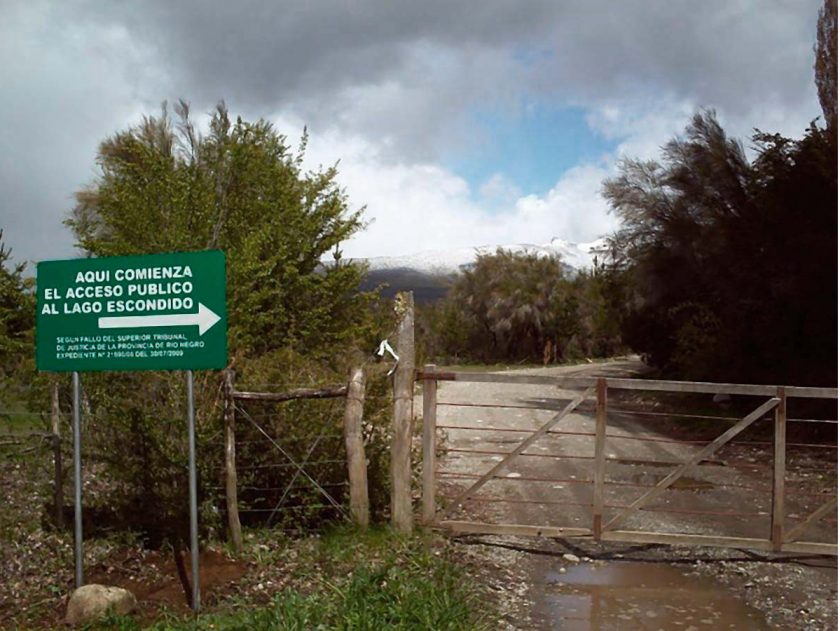
Tacuifi road leading to Lago Escondido, now blocked to public access, lies off of Argentina’s Route 40. The sign notes the 2009 Supreme Court ruling demanding the still-closed road be opened to the public. Photo | Revista Anfibia
Beyond the alleged IDF “vacations” on Lewis’ land, his presence in the area has been controversial for other reasons, namely for concerns that he sought to usurp key regional resources. Indeed, journalist Gonzalo Sanchez noted in his 2004 book Patagonia Sold: The New Owners of the Land :
In El Bolsón, there are more than a few locals and city council members that believe that, behind his [Lewis’] generosity, there are other hidden objectives, like the possible control of the water reserves of this part of Patagonia (pg. 50).”
Inklings of the truth in relation to these concerns were evident as soon as Lewis acquired the property surrounding Lago Escondido. This large mountain lake, which Lewis’ property surrounds, is the water basin for two important regional rivers, the Manso and Puelo, which later unite in Chile and drain into the Pacific. It is also the lake which feeds other nearby lakes including the Soberanía Lakes and Montes Lake, among others. Lago Escondido itself is estimated to contain as many as 400 billion liters (~105 billion gallons) of freshwater.
In Argentina, as is also the case in neighboring Chile, water – whether in lakes, rivers or seas – is a public right and public access to all bodies of water is guaranteed by law. This legal concept — likely foreign to Lewis and other Westerners, whose home countries often enshrine private property rights over the public’s right to vital resources — has been the most visible way in which tensions between Lewis and locals have manifested. It was also the first real test of Lewis’ resolve to carve out his “independent state” in Patagonia and keep locals out.
Lewis closed off the public road from the highway to the lake and also closed the private road he built at a separate point from public access. According to several locals interviewed by MintPress who had tried to enter the area, private security in civilian clothing prevent people from using the roads either by vehicle or on foot. Federico Soria, who has himself tried to enter the area on several occasions, described the guards to MintPress as “intimidating” and “aggressive” and also said that the Montero family, the old owners of the land, block one of the roads before it enters Lewis’ property and are “heavily armed.”
The only remaining path is a steep – and in places, dangerous – mountain path that takes at least two days in each direction to traverse. The path is poorly marked and maintained and is only usable in summer, as it is blocked by snowfall in other seasons. Every person interviewed by MintPress who had seen or traversed the path described it as being suitable only for “experienced mountaineers.”
In 2009, Lewis suffered his first major defeat in his efforts to keep locals out of his “parallel state” when the regional court ruled that the Tacuifi road — which connects the lake to the main highway, Route 40, and crosses Lewis’ property — be opened. The ruling stated that this must be done in order to “ensure access to Lago Escondido with appropriate signaling and ensuring transability.” The court gave Lewis 120 days to comply.
However, he didn’t comply and instead his regional associates began openly threatening any who tried to visit “his” lake. The clearest threat came from Van Dittmar himself in 2011, when he publicly stated that he and other Hidden Lake S.A. employees would defend Lewis’ private property by “fighting with blood, if we have to.” Van Ditmar also said that he would keep locals from accessing the lake “with a Winchester [rifle] in hand, with blood if necessary.”
In 2012, the region’s Supreme Court upheld the 2009 ruling, as did Argentina’s national Supreme Court a year later. However, Lewis and Van Ditmar refused to open the Tacuifi road, Van Ditmar saying that the treacherous but “very pretty” mountain path should instead be used to access the lake. Argentine President Macri also stepped in and echoed Van Ditmar, stating that the lake is even more accessible than before Lewis bought the property.
The court battle continues to today, after the Supreme Court of Río Negro in 2016 withdrew its previous ruling and ordered that a new hearing with different judges issue a new ruling. Critics accused Lewis of using extreme “political pressure” at the regional and local level in order achieve this very surprising ruling.
Despite that, locals continue to fight for public access to Lago Escondido and defend Argentina’s sovereignty over Lewis’ private empire. The main manifestation of this effort is an annual “March for Sovereignty,” the most recent of which took place in early February of this year. The march is organized by the Foundation for the Cultural Integration and Promotion of Water (FIPCA), which is run by former Argentine marine Julio Cesár Urien. Like the prior marches of the same name, its participants walked for nearly three days on foot over the mountain trail to arrive on the shore of the lake, which – as mentioned above – they were within their legal rights to do.
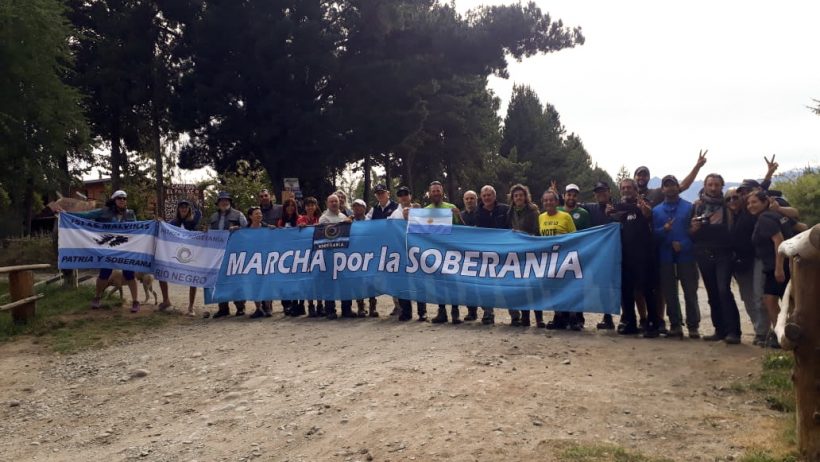
Participants in the 2019 “March for Sovereignty” pose for a picture at the beginning of their several-day journey to reach Lago Escondido by foot. Photo | FIPCA PRENSA
Upon arriving, they were met by Lewis’ private security as well as members of the Río Negro police, who cornered them and told them that they couldn’t even go to the bathroom without fear of arrest for trespassing, even though lakeshores are also legally considered public spaces. Guillermo Martín Caviasc — a journalist for Barricada TV, who was present at the demonstration — called the combination of local police and private security Lewis’ “private army” and remarked that the police officers present were “in a situation of subordination like if they were visiting a foreign state controlled by Lewis.”
Two participants in the march, Andrea Gatabria and David Ramallo, mounted inflatable kayaks with the intention of placing an Argentine flag in a small island in the middle of the lake, itself technically a public space. Before they made it to the island, two speedboats belonging to Hidden Lake S.A. circled the kayaks in an effort to capsize them while taunting them, asking “Do you know what it’s like to die from hypothermia?”
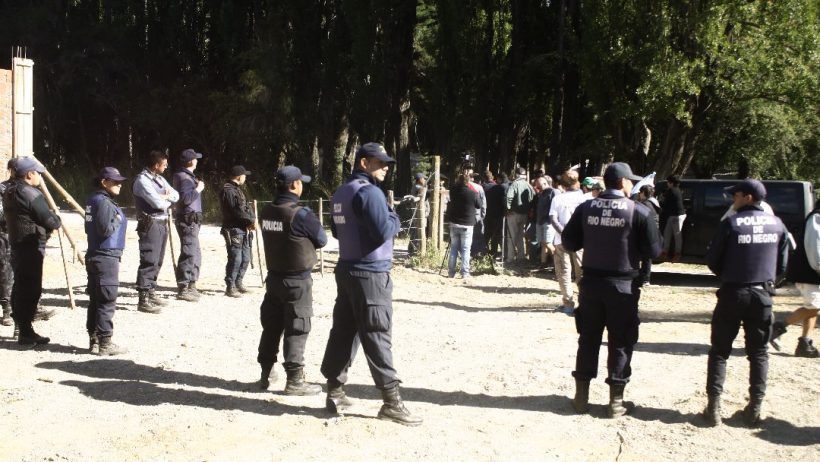
Participants in the 2019 “March for Sovereignty” pose for a picture at the beginning of their several-day journey to reach Lago Escondido by foot. Photo | FIPCA PRENSA
After half an hour of taunts that seemed more like death threats, Lewis’ private security knocked over the kayaks, leaving Gatabria and Ramallo floating in the freezing water. After several minutes, several witnesses stated that one of the security guards told the two kayakers “Well, now do you see what it’s like to die of hypothermia?” Gatabria and Ramallo were, after some time, lifted into the guard boats, but had spent so much time in the frigid water that both had to be hospitalized.
National Senator for Río Negro, Magdalena Odarda, demanded accountability for the actions of Lewis’ private security and local police and FIPCA has begun legal action against Hidden Lake S.A. for threatening the lives of march participants. Neither Hidden Lake S.A. nor Lewis’ Tavistock Group, which oversees his business interests in Argentina and elsewhere, responded to MintPress inquiries regarding the incidents against march participants.
While Argentines have routinely experienced intimidation and aggression when attempting to access the lake, some foreigners have had very different experiences. Take, for instance, Scott Leahy*, an American now living in Chile, who, during a past trip to El Bolsón, was able to waltz right through onto Lewis’ Lago Escondido property when he was in the company of two ex-IDF soldiers who had been there before.
Leahy told MintPress that when he was backpacking through Argentine Patagonia in 2010 with a Chilean friend, he had met and become friends with two young Israelis who had recently finished their service in the IDF and were staying at the same youth hostel. One day, these two Israelis offered to take Leahy and his friend to what they called a “secret beach” nearby.
They all piled into a car and, upon taking a gravel road off of Route 40, arrived at a gate that Leahy confirmed to MintPress was the Tacuifi road entrance to Lewis’ Lago Escondido property (seen in an image earlier in this report). Leahy was unsure about continuing, given that the gate was closed and, as a foreigner, he was unfamiliar with the area. However, the Israelis urged him on, saying that they had been there before and knew where they were going.
When the group of backpackers encountered Hidden Lake S.A. employees and guards, the Israelis explained that they were from Israel and wanted to bring their friends to the beach. The Lago Escondido employees told the pair that the group was not officially allowed to enter the property, but they could pass. Leahy didn’t think anything of it at the time, and told MintPress that he had assumed the pair knew the owner, though the Israelis never mentioned Lewis at all and they showed no interest in meeting with him either. This suggests that they were not personal friends of Lewis, but also shows that they knew that they could access the lake without problem, even in the absence of a formal invitation.
While this anecdote suggests that the claims of Lewis hosting thousands of IDF soldiers annually may indeed have something to them, it also serves as a very troubling comparison to the way Argentines have been treated when trying to access the very same lake. Indeed, if foreigners, Israelis in this case, were amicably waved through despite no invitation from Lewis or Hidden Lake S.A., why are Argentines who try to do the same met with such violence and aggression, particularly when they have a legal right to do so?
Stealing El Bolsón’s resources for his own use
Though public access to Lago Escondido has been a major issue of contention between Lewis and the people of El Bolsón since the late 1990s, concerns that the British billionaire was intent on controlling the region’s water supply multiplied when firms connected to Lewis began to move forward with what is often referred to as simply the “Laderas project.”
As early as 2004, a man named Cipriano Soria started telling his neighbors that he had “sold” his land in an area known as Pampa de Ludden (Ludden’s Plain) to Lewis. However, Soria did not technically own the land, which was a publicly-owned nature reserve, but was granted an easement by the provincial government of Río Negro to use its meadows to graze his livestock as long as he paid a “grazing license.” Despite the fact that it was neither legally nor properly sold to Lewis, Lewis began to make plans for the land — plans that ignored the fact that the area was and technically remains under several legal protections due to its ecological and strategic importance to the region.
Lewis intended to use this land to build a private airport in the area but was met by strong local resistance in 2005, including from the local group Assembly for the Defense of Water and Land (ADAT). Several members of ADAT live in Mallín Ahogado next to Pampa de Ludden, which provides the adjacent farming community of 2,000 with nearly all of its water. Felicitas Libano, who lives in Mallín Ahogado, told MintPress that the importance of this area as a critical water resource — as well as its ecological importance as an old-growth native forest — led it to be named a nature reserve that was supposed to be prevented from falling into private hands.
ADAT’s eforts were successful and Lewis’ plan for the area seemed to have been defeated or, at least, put on hold. Then, in 2009, the town voted on Lewis’ private airport, with more than 79 percent of voters opposing it. However, unluckily for the people of El Bolsón, Lewis had much bigger plans than just an airport and he wasn’t planning on letting local democracy get in his way.
From 2006 to 2009, legal arrangements were made between the ski center’s owner, the Club Andino Piltriquitrón, and the provincial government that opened up the local ski center at the Perito Moreno mountain to “third party” management.
Then, in 2009, Mirta Soria, Cipriano’s daughter, “inherited” the land from her father — land that he technically did not own yet was somehow granted permission to purchase from the state, along with another protected territory between Pampa de Ludden and the ski center, even though the state was forbidden from doing so by regional and local laws. Just six months after she bought this territory and sold more than half of it to Van Ditmar’s brother-in-law Samy Mazza. This new and very large area under Van Ditmar/Lewis control is where El Bolsón’s, in addition Mallin Ahogado’s, water reserves are located.
Soon after the land purchase occurred, two businesses appeared — Laderas of Perito Moreno Association S.A. and Laderas of Parallel 42, both of which are directly connected to Lewis and were given ownership of the lands in Pampa de Ludden and the other area recently purchased by Van Ditmar’s relative. That same year, both of these linked businesses proposed a “lottery” whereby the provincial government would select a private company to manage the local ski center. Laderas of Parallel 42 won the lottery.
Subsequently, the other Laderas company, Laderas of Perito Moreno, began plans to transform the land illegally acquired by Van Ditmar’s brother-in-law, Samy Mazza, as well as the portion still owned by Mirta Soria into a luxury subdivision of more than 1,000 luxury homes for wealthy Argentines and foreigners, along with a golf course, shopping centers, an artificial lake, and a private airport. This planned venture was subsequently promoted by pro-Lewis businessmen and media outlets as necessary for the successful development and improvement of the ski center.
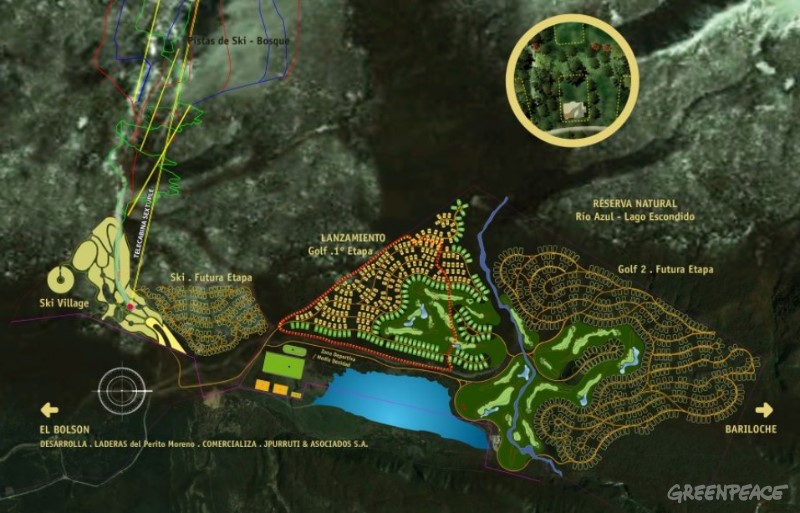
Proposed plan for the Laderas project, a 1,000-home luxury subdivision complete with an artificial lake and a golf course. Lewis’ firm plans to place the private airport (not shown in this image) south of the lake. The project, located right in the center of a nature reserve, is connected to Lewis’ Lago Escondido property and sits atop El Bolsón’s water reserves.
With the court battle underway and the project still lacking approval from El Bolsón’s city council, the regional governor, Alberto Weretilneck – a well-known Lewis ally – teamed up with Lewis-associated local businessmen in an effort to strongly pressure El Bolsón’s mayor at the time, Ricardo García, to sign a pledge that, once legal issues were resolved, the project would be fast-tracked for approval. García refused and Weretilneck along with other Lewis associates in the area began to push for his resignation. However, local protests kept García in power and, before leaving his post as mayor, García issued a decree that temporarily prohibited the Laderas project from advancing.
Clearly unhappy with this turn of events, the Laderas firms challenged the suspension of the project in court. Around this same time, members of local groups that had opposed the Laderas project reported several incidents of violence and intimidating acts, including threatening phone calls, their cars being set on fire, and the burning of a radio station as well as a community center in Mallín Ahogado.
In the case of architect and local politician Luis Martin, he was threatened with “lynching” by two Lewis associates – local businessmen Juan Carlos Martínez and Fabián Tornero – and his home was later broken into by armed thugs, one of whom accidentally cut himself with his machete and later fled the scene. Before escaping, the man had told Martin, “They have you targeted, they are going to kill you.”
In a 2011 article in Tiempo Argentina, Martínez referred to Lewis as “my friend” and was noted as a regular participant in meetings with Van Ditmar. The same article goes on to note that, in those meetings with Van Ditmar, Tornero is “influential” and further notes that Tornero is a known associate of Lewis.
In 2015, after García’s decree was challenged in court by Lewis’ firms, a judge ruled that the decree was legal but had not been written properly and therefore cancelled it. Soon after, a new pro-Lewis mayor and city council took charge and quickly signed a legal agreement with the Laderas companies, allowing them to build a “smaller project,” while claiming that any attempt to block the project – as García had done – could lead to another costly, lengthy legal battle that the municipal government just couldn’t afford. However, as Guido Augello told MintPress, this was hardly accurate, given that the local government could have appealed the decision regarding the decree, suggesting that this was just a convenient excuse to fast-track the project.
A few months after signing this agreement with the Laderas firms, the city council held a public hearing at which the vast majority of attendees from the community overwhelmingly rejected and criticized the project. Not getting the response it had hoped for, the council held a “secret” extraordinary meeting — secret because they declined to give the public the required notice needed to register to attend and participate in the meeting. With no one having registered, Pogliano decided to keep the meeting “closed” and placed police officers at the entrances to keep the townspeople out by force. The council subsequently decided to approve the Laderas project. Angry locals moved to occupy local government buildings in response, where they were targeted by riot police with tear gas.
The move generated several large-scale protests in El Bolsón, which started in 2016 and continued into 2017. Local resistance to the actions taken by the city council and mayor in relation to the Laderas project included a citizen occupation of the main plaza for three months, which was subject to police intimidation and violence, as well as three major protests, including the largest in El Bolsón’s history. That march against the Laderas project attracted an estimated 10,000 to 15,000 participants — quite a feat considering that the town’s urban and rural population boasts little more than 25,000 total inhabitants.
The reason for this mass mobilization, according to Augello, was that “even many of the people that like Lewis or believe his ‘Uncle Joe’ image oppose the Laderas project” and its associated airport. It’s not hard to understand why, considering that electricity and water intended for the townspeople of El Bolsón could soon be diverted to the wealthy outsiders who buy homes in “Lewislandia,” a derogatory term used to describe the Laderas project by some locals.
Yet, not only does Lewis intend to privatize El Bolsón’s water reserves, he and those developing his Laderas project also plan to divert the tourism that keeps its economy alive by instead diverting traffic from the main highway (Route 40) into his newly planned “city,” according to Federico Soria, a member of the Union of Patagonian Assemblies who has extensively researched Lewis’ local businesses. In an extensive 2016 article on the Laderas project and other Lewis-linked ventures, Soria wrote:
It is the intention of the developers of Laderas to unite the complex to Route 40 through two paved roads that they plan to build north and south of El Bolsón…. The Laderas variant road would be an advantageous shortcut [around El Bolsón].… [This] would benefit Lewis but economically endanger the community of El Bolsón…”
Furthermore, in 2016, Lewis completed a hydroelectric plant on the Escondido River — in the name of another of his local firms, Patagonia Energía — which passes through his property and feeds into the lake of the same name. However, he was granted permission to do so only if he connected the plant to El Bolsón in order to help the town resolve its ongoing and highly problematic electricity shortages. Once the plant was connected to El Bolsón, Lewis would become the main electricity provider to El Bolsón, as its current, aging diesel generators would be shut down.
Yet, instead of following the planned route for the power line that would give power to El Bolsón, it was diverted to the planned zone for the Laderas project, where it has remained “stopped” for years, even though his license to use the river for electricity production expired in 2015 owing to his company’s failure to connect the plant to El Bolsón in the time allotted by the license. As in so many other cases, Lewis and his companies have suffered no repercussions and continue to use the river for private power production. This situation has led some locals to speculate that Lewis has no intention of ever providing hydroelectric power to El Bolsón and it is instead a resource being guarded especially for his planned Laderas villa.
In effect, Lewis and his local representatives are working the resources they have acquired — water, electricity and tourism traffic — away from the town of El Bolsón and to the new “luxury” town of Laderas they hope to build to its north, a town that is an extension of Lewis’ own “independent” state. If this project is allowed to be completed, the people of El Bolsón will face a new troubling reality of resource insecurity and see its economy falter, as a crucial stream of revenue is diverted to the personal pet project of a foreign and predatory billionaire.
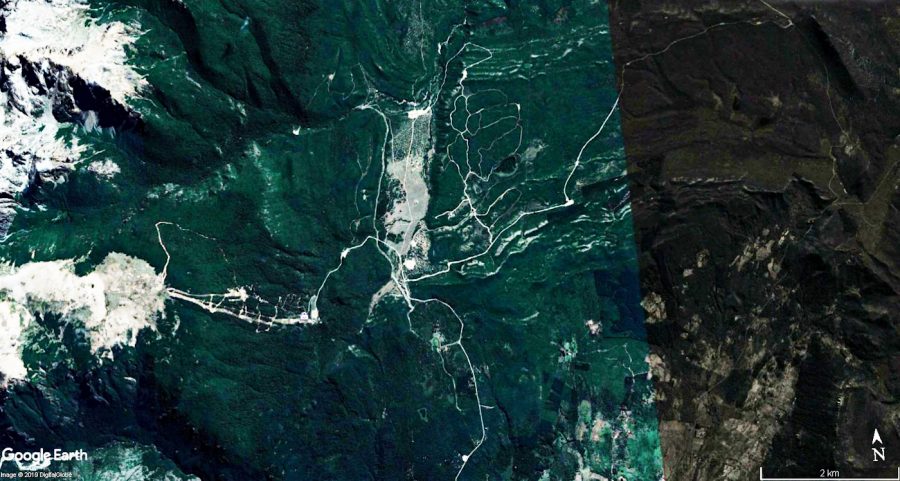
A satellite image taken last August shows land owned by the Laderas companies (center of photo) Roads for the planned “mini-city” are already being built, despite the fact that the companies are still not legally authorized to begin construction due to ongoing litigation. The already present ski center is seen on the left. Photo | Radio FM Alas, El Bolsón, Argentina via Google Earth
Yet, though Lewis won that particular battle in 2017, he is far from winning the war. Soon after the scandalous way in which the project was approved, the project again found itself challenged in court — placing it in legal limbo, unable to advance. Though the project is supposed to be blocked from moving forward until the conclusion of this latest legal battle, satellite images taken last August and shared with MintPress by local radio station FM Alas (shown above) reveal that Lewis’ businesses have already begun construction on the Laderas project, a clear indication that Lewis and his associates expect their impunity to continue.
Lewis’ Tavistock Group did not respond to MintPress inquiries about the Laderas project or the satellite images shown above.
The Joe Lewis “International Airport” — off-the-radar (literally)
Lewis’ “irregular” acquisition of Lago Escondido, the Laderas property, and his use of private security to block civilian access to the lake that is — by law — public property have long been decried as flagrant affronts to Argentina’s national sovereignty. Yet, while Lewis’ activities in and around Lago Escondido certainly do undermine existing Argentine laws, it is another Lewis-linked property in the Río Negro province that has done far more to erode Argentina’s national sovereignty.
Though Lewis’ plan to build an airport in Lago Escondido was technically approved but has not been able to move forward, Lewis – through his foreman Van Ditmar – purchased a sizeable property at the same latitude as Lago Escondido, but hours away on the Atlantic Coast. The property would soon become the site of Lewis’ private airport as well as a beachfront mansion. That airport, located south of Playas Doradas, was completed in February of 2008 and local media noted that its construction was “systemically hidden” from the public and was not subject to environmental impact assessments as normally required by law.
Most notably, however, there has never been any presence of Argentine customs or any other form of Argentine government control over what or who flies into or out of that airport, even though the airport is capable of receiving international flights. This point is particularly concerning in light of allegations that Lewis receives thousands of IDF soldiers annually on his property.
Joe Lewis’ private airport as seen on Google Maps
Furthermore, the Defense Ministry of Argentina has confirmed that not only is there no formal state control over what lands or takes off from this private airport, but that there are no radars in the area that even allow Argentine authorities to track nearby flight movements, including those of international flights. This means that no one but Lewis and his associates knows for sure how many flights land or take off from this area or where these flights originate or their intended destinations.
More shocking still, in 2010 then-Defense Minister Nilda Garré, in responding to a complaint from local politicians over the flagrant illegality of the airport, defended the airport’s presence by stating that it “could be used to facilitate rapid assistance of the state to locals in the event of disasters or emergencies.” To date, in the more than 10 years of its operation, it has never been used for any such purpose, according to those interviewed for this report.
The airport in Playas Doradas is roughly the same size as the airport in San Carlos de Bariloche (though some say it is larger), and is capable of receiving at least two large commercial-size passenger planes at a time. Much as with Lago Escondido, public access to the airport is denied, owing to the fact that the sprawling 15,000 hectare (~37,065 acres) property surrounding the airport is privately owned by a front company called Bahía Dorada S.A., which itself is legally owned by Lewis’ “foreman” Van Ditmar. However, the airport itself is owned by Westwind Aviation S.A. (formerly owned by Tavistock Aviation Argentina S.A., a subsidiary of Lewis’ Tavistock Group. Westwind Aviation S.A. is based at Lewis’ Lago Escondido property, as is Bahía Dorada S.A.. Neither Westwind Aviation S.A. nor the Tavistock Group responded to inquiries from MintPress regarding the lack of Argentine government oversight over the airport.
In order to realize the project, Van Ditmar – an Argentine citizen – had to be the owner of the property, as the area where the airport is built falls within a “National Security Zone” that prohibits land in that zone from being owned by foreigners on the basis of national security interests. In addition, the airport and the surrounding property, much like Lago Escondido, has a large and sophisticated private security presence.
The airport is estimated to have cost $20 million and Van Ditmar has publicly justified the airport’s existence by stating that Lewis not only “had the money” to build the complex but that it also made his ability to travel to his Lago Escondido property “easier.” This latter point is hard to believe given that the existing airport in San Carlos de Bariloche, which receives both private and commercial planes, is several hours closer to Lewis’ property than is his private airport in Playas Doradas. The notable difference between the two is that the private airport has no Argentine government oversight while the Bariloche airport does.
Few knew of the existence of the airport or the fact that access to the beach in that area had been effectively cut off by the Lewis/Van Ditmar project until a local woman, Elvira Linares, went on the television program “Documentos América,” hosted by Argentine journalist Facundo Pastor. On that program, Linares shared her experience of trying to pass through the now-private territory, noting that access to the ocean had been illegally blocked off. She also shared video footage she had taken of the massive, yet largely unknown to the public, private airport.
Mere hours after the program aired, Linares’ home was filled with bullet holes by still unknown assailants in what local media described as a blatant act of intimidation that led National Senator for Río Negro, Magdalena Odarda, to request that the government extend its protection to Linares, whose life was in danger. Efforts to contact Linares for comment for this report were unsuccessful.
Senator Odarda has arguably been the most well-known figure to demand accountability regarding the numerous irregularities surrounding the private airport. Odarda has, with limited success, repeatedly denounced the airport, on the basis of the fact that there is “no state control” over what or who passes through the airport.
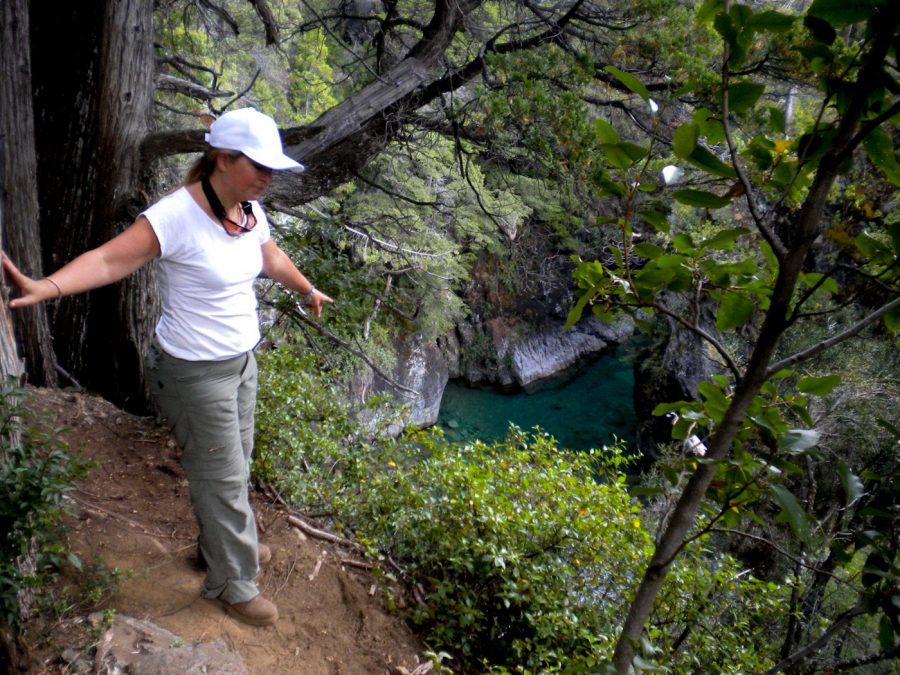
Senator Magdalena Odarda tours the publicly accessible road to Lago Escondido. Photo | Facebook
Odarda has also noted that the area where the airport is constructed is highly “strategic,” which poses a danger given that it is exclusively controlled by a foreigner, an Englishman. Odardo has pointed out that the airport is located on the important 42° parallel, which divides the regions of Río Negro and Chubut, and is only two hours away by plane from the disputed Falkland Islands, which are controlled by the United Kingdom but also claimed by Argentina. This dispute dates back to the 19th century and was the principal factor behind the Falklands War between Argentina and the U.K. in the 1980s, which many Argentines remember quite bitterly for the peace treaty Argentina signed after its defeat by England. Many Argentines have compared the document to the Treaty of Versailles that ended World War I.
Notably, there has been considerable evidence that Lewis’ airport has received planes from the Falkland Islands, which was the subject of a formal complaint made in 2010 to Argentina’s defense minister by then-governor of Argentina’s Tierra del Fuego province, Fabiana Ríos.
A well-oiled machine
Given the numerous laws that Lewis’ activities in Río Negro have broken at both the local and federal level, one would expect that somebody in the government – at least the local government – would hold him accountable. While some politicians like Magdalena Odarda and others have tried, the lack of impunity surrounding Lewis’ activities largely owes to his “friendships” with local and regional politicians as well as the country’s president.
One of the innumerable examples is Sergio Plunket. Plunket, who is in charge of Vial Rionegrina Sociedad del Estado (VIARSE), the regional body in charge of controlling public roads including the road leading to Lago Escondido, also works as a private “ecological consultant” for Lewis’ Hidden Lake S.A. Plunket also authorized the construction of Lewis’ Playas Doradas airport. Another clear example is Bruco Pogliano, El Bolsón’s current mayor, who is also Lewis’ long-time accountant in Argentina.
Another example that Gonzalo Sanchez noted (pp. 50-51) in his book, Patagonia Sold , is how Pablo Verani, ex-governor of Río Negro, started a long tradition of politicians making regular visits to Lago Escondido for Lewis-financed barbeque feasts, when he celebrated his win as the 1997 regional governor on the shores of the magnate’s privatized lake.
In addition to his undeniable influence among key local, regional and even national politicians, Lewis also enjoys considerable influence in the regional press and several former employees of his have become important figures in local and regional media. For example in 2016, according to local media, Dalila Pinacho, who long served as a lawyer and spokeswoman for Lewis’ Lago Escondido firm Hidden Lake S.A., became the director of the Nequén branch of Argentina’s National Radio, apparently through her “close” connections to local politicians.
Another journalist, Julio Álvarez — who described himself, to Gonzalo Sanchez in 2004 at an event in Lago Escondido, as Lewis’ “spokesman” — now works at a radio station in Viedma, Argentina, and was previously the El Bolsón correspondent for the regional newspaper Río Negro. Lewis also funds the local newspaper Ruta 40 and has stakes in other local newspapers such as El Cordillerano, Bolsón Web Patagonia, and El Ciudadano in Bariloche. Eliana Almonacid, who used to work for Ruta 40, told the national outlet Tiempo Argentina in 2014 that the Ruta 40’s director Nancy Aleuy, who also works for Hidden Lake S.A., told her that “Lewis had bought all the media outlets” in the region.
Lewis’ “Parallel State” is just the beginning
Lewis’ control over the local authorities and local press in Río Negro, and the complete impunity of his actions and those of his associates, have made it clear that in Argentina there is a de facto different legal system for oligarchs like Lewis and for the vast majority of Argentina’s citizens. This fact — in combination with the control Lewis and his associates exercise over the region’s key resources, including its water and energy production — has led to the creation of what some like Federico Soria have called a “parallel state” within Patagonia. However, this “parallel state” is, in reality, a microcosm of a much larger project currently underway that is aimed at the domination of the entirety of Argentine Patagonia by predatory oligarchical interests, the majority of which are directly connected to Lewis and his associates.
As will be explored in Part Two of this series, the Soros-led oligarch network, of which Lewis is a part in Argentina, has expanded its efforts to control Patagonia’s vast and strategic resources, including the region’s oil and gas wealth in addition to the domination of its freshwater resources and hydroelectricity production. Subsequent articles will then show that this effort is just the beginning, as this network and its close ties to the International Monetary Fund are being used to transfer ownership of vast state lands to their control in exchange for “debt relief.” The ultimate endgame appears to be the expansion of this “parallel state” — which Lewis has already helped to create in Río Negro and beyond, and which is controlled by small number of mostly foreign oligarchs — into a full-scale operation for extracting the region’s riches and exploiting its people.
Note: An sterisk (*) after a name indicates that a person’s real name was not used after they requested that MintPress not use their real name in this report.
Top Photo | This undated photo shows British billionaire, Joseph C. Lewis, at a Tottenham Hotspurs football game in the United Kingdom. Photo | Reuters
Whitney Webb is a MintPress News journalist based in Chile. She has contributed to several independent media outlets including Global Research, EcoWatch, the Ron Paul Institute and 21st Century Wire, among others. She has made several radio and television appearances and is the 2019 winner of the Serena Shim Award for Uncompromised Integrity in Journalism.
Featured Video

Death Spikes & Rising Cancer In Our Youth Explained
or go to
Aletho News Archives – Video-Images
From the Archives
Politicians lie
By Mazin Qumsiyeh | Popular Resistance | August 18, 2013
There is no way to say this truth nicely: Politicians lie. That includes Japanese, American, Egyptian, Israeli, and Palestinian politicians! Is there something more common sense than that? Yet, so many citizens around the world believe their own politicians or wistfully acknowledge lies but think it is part of the job needed to run things. They believe even when politicians contradict themselves blatantly. This phenomenon is rather remarkable. It is a dissonance and disconnect from reality that many seem oblivious to. It is very dangerous because it can lead to accepting rationales for going to war. These can be deadly wars that lead to millions of lives lost as happened in what was called World War 1 and WW2. Even when incredible and declassified evidence abound, politicians continue to lie and old mythologies refuse to die. Here are just a few of the countless lies told to us over the past few decades… continue
Blog Roll
 Aletho News
- Iraqi resistance group vows to stage airport sit-ins over Iran aerial blockade
- Turkish parliament to review Saudi-Pakistan defense pact next month
- DEATH SPIKES & RISING CANCER IN OUR YOUTH EXPLAINED
- Iran offers Trump deal before US election
- Merz regime wants ‘secret police’ – opposition
- Israeli settlers terrorize West Bank Palestinians with state-provided drones: Report
- They see them, then kill them: Israeli quadcopters track, deliberately target civilians in Gaza
- Debunked: Trump’s egregious UNGA claims on war against Iran crumble under scrutiny
- Europe was part of the infrastructure of US aggression against Iran: Deputy FM
- New evidence on the Bucha Massacre
- If Americans Knew
- Trump betrayed voters with his campaign lies and prioritized a foreign country once he took office
- Netanyahu calls Israel’s war in Gaza ‘opposite of genocide’ in UN speech to near-empty hall
- Settler Kidnappings: Torture, Sexual Abuse and Terrorisation of Palestinian Abductees as Israel Deepens Annexation of West Bank
- Gaza winter nears as 162,000 tents become unusable, raising fears of humanitarian crisis
- Netanyahu says, “It’s the opposite of genocide”; UN says Gaza economy is world’s ‘most severe crisis on record’ – Daily Update
- Israel’s US-Backed Assault on Gaza Has Created the ‘World’s Most Severe Economic Crisis on Record’: UN
- ‘Protecting U.S. Citizens’… From Israel
- ‘This is where I live now, the back of a truck’: a day in the life of a grandmother in Gaza
- In UN Speech, Iran’s President Displays Pictures of Children Killed by US, Brings Attention to Israel’s Nuclear Arsenal
- Israel displaces hundreds of Palestinians amid wave of demolitions in West Bank
- No Tricks Zone
- New Study: Earth And Venus Surface Warmth Largely Explained By Convection And Lapse Rate, Not CO2 Or Radiation
- 2025 Nature Paper Claiming Worsening Global Drought Gets RETRACTED …Heavily Flawed
- New Study: ‘Global Drought Shows No Detectable Recent Acceleration Under Climate Warming’
- Economic Masterminds: German Socialists Suggest Taxing Productivity Gains Stemming From Using AI
- The South China Sea Has Not Been Cooperating With The Climate Change Narrative
- Energy Crisis: Germany Enters Heating Season With Historically Low Gas Reserve Fill Levels
- New Study: The Antarctic Ice Sheet Gained Mass From 2020-2024 Due To Staggering Snow And Ice Accumulation
- Study: Ocean Heating Rates From Thousands Of Years Ago ‘Dwarf’ Modern Ocean Heating Rates
- Climate Extremists Target, Attack Large-Scale Power Grid Infrastructure In Germany!
- New Study: Antarctic Ice Melt Has Contributed Less Than 1 Centimeter To Sea Level Rise In The Last 30 Years

