Russia’s Oil Product Exports To U.S. Surge Amid Sanctions On Venezuela
By Tsvetana Paraskova | Oilprice.com | March 8, 2019
Russian exports of oil and oil products to the United States surged in the last week of February to their highest level since 2011, with Russia taking advantage of the Venezuelan collapse, Russian news outlet RBC reports, quoting investment bank Caracas Capital Markets as saying in a note to clients.
At least nine tankers delivered 3.19 million barrels of oil and oil products of Russian origin to U.S. ports in the week February 23 to March 1, according to Caracas Capital Markets, which specializes in Venezuela. These 3.19 million barrels is the largest volume of Russian oil deliveries “we have seen since 2011,” Russ Dallen, Caracas Capital Markets Managing Partner, wrote in the note, as carried by RBC.
Most of the Russian oil deliveries were naphtha and fuel oil, and tankers from Novorossiysk and St Petersburg, among others, shipped the oil products to U.S. ports, Caracas Capital said, citing the U.S. database of shipping documents.
The rise in Russian oil shipments to the U.S. is the result of the U.S. markets adapting to the loss of Venezuelan oil, RBC quoted the bank as saying.
Ironically, Russia—the staunchest supporter of Nicolas Maduro’s regime in Venezuela—is benefiting in the U.S. oil market from the U.S. sanctions on Maduro’s government, on the state oil firm PDVSA, and on the Venezuelan oil industry.
Meanwhile, Venezuela’s crude oil exports to the U.S. are dropping.
U.S. crude oil imports from Venezuela slumped to just 83,000 bpd in the week to March 1, compared to 208,000 bpd in the previous week, according to EIA’s preliminary data on crude oil imports by top 10 countries of origin, ranked based on 2017 data.
The U.S. sanctions on Venezuela are also prohibiting U.S. exports of naphtha to the Latin American country which uses the product to dilute its heavy crude. But Russia’s Rosneft is said to be coming to the rescue with shipments of heavy naphtha to Venezuela expected in the next few weeks, Bloomberg reported earlier this week, citing shipping reports and a source with knowledge of the plans.
REFLECTIONS ON PUTIN AS A LEADER AND ON THE WORLD SITUATION IN WHICH HE WORKS
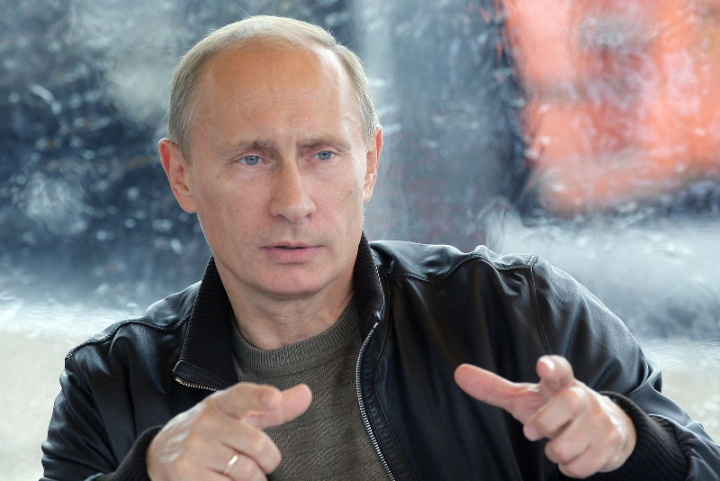
By John Chuckman | Aletho News | March 6, 2019
There is an immense amount of criticism of Putin, especially coming from America, most of it empty criticism which ignores realities and genuine analysis. For the more thoughtful, it represents only the stink and noise of propaganda, and not honest criticism in its true sense at all.
In politics, and especially in the direction of a country’s foreign affairs, there are certain behaviors, ideas, and attitudes which mark out a person as exceptional. I think there can be no doubt, Putin is just such a person, and I am very much inclined to say, the preeminent one of our time. Frankly, compared with Putin’s skills, Donald Trump comes off as a noisy circus act, a sideshow carnival barker, and not an appealing one. He has an outsized impact in the world only because he represents the most powerful country on earth and has embraced all the prejudices and desires of its power establishment, not because of the skillfulness of his actions or the insight of his mind. Obama made a better public impression, but if you analyze his actions, you see a man of immense and unwarranted ego, a very secretive and unethical man, and a man who held no worthy ideals he promoted. He was superficial in many things. And he was completely compliant to the power establishment, leaving no mark of his own to speak of.
Putin is a man who advocates cooperation among states, who argues against exceptionalism, who wants his country to have peace so that it can grow and advance, a man lacking any frightening or tyrannical ideologies, a man who invariably refers to other countries abroad, even when they are being uncooperative, in respectful terms as “our partners,” a man who knows how to prioritize, as in defense spending, a man with a keen eye for talent who has some other exceptional people assisting him – men of the caliber of Lavrov or Shoygu, a man who supports worthy international organizations like the UN, a man who only reluctantly uses force but uses it effectively when required, a highly restrained man in almost everything he does, a man who loves his country and culture but does not try foisting them off on everyone else as we see almost continuously from American presidents, a man with a keen eye for developing trends and patterns in the world, a man with an eye, too, for the main chance, a man whose decisions are made calmly and in light of lot of understanding. That’s quite a list.
The differences between recent American leaders, all truly mediocre, and Putin probably has something to do with the two counties’ relative situations over the last few decades. After all, if the support isn’t there for someone like Putin, you won’t get him. Russia’s huge Soviet empire collapsed in humiliation in 1991. The country was put through desperate straits, literally its own great depression with people begging or selling pathetic trinkets on the streets. And America made no real effort to assist. Indeed, quite the opposite, it kicked someone who was down and tried to shake all the loose change from his pockets. Out of Russia’s desperation came a man of remarkable skills, a rather obscure figure, but one who proved extremely popular and was obviously supported by enough powerful and important people to employ his skills for the county’s recovery and advance.
Putin showed no weakness or flinching when dealing with some of the extremely wealthy men who in fact became wealthy by stripping assets from the dying Soviet Union, men who then also used their wealth to challenge the country’s much-needed new leadership. He was, of course, excoriated by the United States, but to the best of my understanding, he did what was necessary for progress. The results are to be seen in a remarkably revitalized Russia. Everywhere, important projects are underway. New highways, new airports, major new bridges, new rail lines and subways, a new spaceport, new projects and cooperative efforts with a whole list of countries, new efforts in technology and science, and Russia has become the world’s largest exporter of wheat. Putin also has committed Russia to offering the world grain crops free of all GMOs and other contaminants, a very insightful effort to lock-in what have been growing premium markets for such products, even among Americans.
The military, which badly declined after the fall of the USSR, has been receiving new and remarkable weapons, the products of focused research efforts. New high-tech tanks, artillery, ships, and planes. In strategic weapons, Russia now produces several unprecedented ones, a great achievement which was done without spending unholy amounts of money, Russia’s military budget being less than a tenth that of the United States. Putin’s caution and pragmatism dictate that Russia’s first priority is to become as healthy as possibly, so it needs peace, for decades. Few Westerners appreciate the devastating impact of the USSR’s collapse, but even before that, the Soviet empire had its own slow debilitating impact. Russia’s economic system was not efficient and competitive. The effects of that accumulated over many years. The USSR always did maintain the ability to produce big engineering projects such as dams and space flight, but it was always sorely lacking in the small and refined things of life that an efficient economy automatically sees are provided.
The new strategic weapons are an unfortunate necessity, but the United States threatens Russia as perhaps never before with the expansion of NATO membership right to the Russian border, something breaking specific American promises of years back. And it has been running tanks all over Europe and then digging them in them right at the frontier just to make a point. It has deployed multiple-use covered missile launchers not far from the border which may as easily contain offensive intermediate-range ground-to-ground nuclear missiles as the defensive anti-missile missiles claimed to be their purpose. And it has torn up one of the most important nuclear-weapons treaties we had, the INF Treaty, pertaining to intermediate-range missiles. Intermediate-range nuclear missiles based in Europe give the United States the ability to strike Russia with little warning, their ten-minute flight path compares to a roughly thirty-minute flight path for an Intercontinental Ballistic Missile (ICBM) coming from America. These are extremely de-stabilizing, as are the counter-measures Russia felt it must take, Russian intermediate-range nuclear missile aimed at European centers. Everyone eventually recognized that, and that’s why the treaty was successfully completed. Europeans appreciated no longer becoming the immediate battlefield in a nuclear war.
But relations with the United States have now entered a new world, and it is not a brave one. America’s power establishment has assumed new goals and priorities, and in those, Russia is not viewed well, despite its new identity as a nation ready to participate and peacefully compete with everyone, a nation without the kind of extreme ideology communism was, a kind of secular religious faith. Despite its readiness to participate in all Western organizations, forums, and discussions, it is viewed with a new hostility by America. It is arbitrarily regarded as an opponent, as an ongoing threat. As I discuss below, America, too, has been kind of in a decline, and the response of its leadership to that fact involves flexing its muscles and extracting concessions and privileges and exerting a new dominance in the world, a response not based in economic competition and diplomatic leadership, a response carrying a great deal of danger.
And, very importantly, its response is one that involves not only bypassing international organizations, but, in many cases, working hard to bend them to its purposes. There are many examples, but America’s treatment of the UN has been foremost. It has in the recent past refused for considerable periods to pay its treaty-obliged dues until it saw changes it unilaterally demanded. It has dropped out of some important agencies completely, most notably UNESCO. In general, it has intimidated an international organization into better accommodating American priorities, including very much imperial ones opposed to what the UN is supposed to be about. And it has used this intimidation and non-cooperativeness to influence the nature of leadership at the UN, the last few Secretaries-General being timid on very important matters and ineffective in general. That’s just the way America likes them to be now. A harsh Neocon like Madeleine Albright won her government-service spurs at the UN by engineering the departure of an unwanted Secretary-General.
Promoting coups is not a new activity for the United States. There is a long postwar record, including Iran’s democratic government in the 1950s, Guatemala’s democratic government in the 1950s, and Chile’s democratic government in 1973. But the recent coup in Ukraine represented something rather new, a very provocative activity right on a major Russian border. It was also against an elected government and in a country which shares with Russia a history and culture going back more than a thousand years to the predecessor state of Kievan Rus. Yes, there are resentments in Ukraine from the Soviet era, and those are what the United States exploited, but the country was democratically governed. In any event, staging a coup in a large bordering country is a very serious provocation. You can just imagine the violent American reaction to one in Mexico or Canada.
The new, post-coup government in Ukraine also made many provocative and plainly untrue statements. The ineffective, and frequently ridiculous, President Poroshenko kept telling Europeans that Russian troops and armor were invading his country. Only his brave army was holding the hordes back. He was literally that silly at times. Of course, none of it was ever true. American spy satellites would quickly detect any Russian movement, and they never did. In an effort to put the wild claims into perspective, treating them with the contempt they deserved, Putin once said that if he wanted to, he could be in Kiev in two weeks. Undoubtedly true, too. Well, the statement was taken completely out of context, treated as a threat by America’s always-faithful-to-the-narrative press. Journalism in the service of government policy – all of it, from the most elevated newspapers and broadcasters to the humblest. And I think that nicely illustrates the absurdity of events in Ukraine and the way they have been used.
The United States paid for the coup in Ukraine. We even know how much money it spent, five billion dollars, thanks to the overheard words of one of America’s most unpleasant former diplomats, Victoria Nuland. The idea was to threaten Russia with the long Ukrainian border being put into genuinely hostile hands. Never mind that the government driven from office with gunfire in the streets from paid thugs was democratically elected. Never mind that many of the groups with which the United States cooperated in this effort were right-wing extremists, a few of them resembling outright Nazis, complete with armbands, symbols, and torchlight parades. And never mind that the government America installed was incompetent, not only sending Ukraine’s economy into a tailspin but promptly igniting a completely unnecessary civil war.
The large native, Russian-speaking population (roughly 30% of the country) is completely dominant in Eastern Ukraine and Crimea. Those two regions partly turned the tables by seceding from Ukraine with its government which early-on worked to suppress historic Russian-language rights and carried on a lot of activities to make those with any Russian associations feel very unwelcome. It’s a deliberately provocative environment, and, as we all know from our press, not a day goes by in Washington without anti-Russian rhetoric and unsupported charges. While Washington greatly failed in this effort, it nevertheless succeeded in generating instability and hostility along a major Russian border. It also gained talking points with which to pressure NATO into some new arrangements.
In the case of Crimea, it is important to remember that it has been Russian since the time of Catherine the Great. It only was in recent history that Crimea became part of Ukraine, and that happened with the stroke of a pen, an administrative adjustment during the days of the USSR, the very USSR the people now running Ukraine so despise, rejecting almost everything ever done, except for the administrative transfer of Crimea apparently. Just one of those little ironies of history. The people who live in Crimea speak Russian, and they did not welcome the new Ukrainian government’s heavy-handed, nationalist, anti-Russian drive around Ukrainian language and culture, necessarily a narrow, claustrophobic effort since the late USSR was a multi-national and multi-lingual state, and given Crimea’s much longer-term history as part of Russia. Even during Crimea’s recent past as part of Ukraine, Russia continued to maintain, under lease, its major naval base at Sevastopol on the Black Sea, so the connections with Russia have been continuous.
In virtually every newspaper story you read and in places like Wikipedia on the Internet, you will see the word “annexation” used to describe Crimea’s relationship with Russia. It simply is not an accurate description, but its constant use is a very good measure of America’s ability to saturate media with its desired version of events. The people of Crimea voted overwhelmingly to secede from an unfriendly new Ukraine, and they voted to petition Russia’s admitting them as part of the country. How can you call the results of free and open votes annexation? Well, only the same way you can tell the twice-elected President of Venezuela that he is not President and that another man, who did not even run in the election and administered the oath of office to himself, is the President. This is the kind of Alice-in-Wonderland stuff that comes as part of America’s new drive for dominance. It simply paints the roses red. What is claimed to have happened in Crimea provides the only support for charges of Russian aggression, the laying on of all kinds of sanctions, and running around all over Europe tearing up road surfaces with tanks. This is the atmosphere within which Putin must work, trying to maintain as many sound relationships with Europe as he can, and he actually has been quite successful. A number of prominent European politicians, especially retired ones who aren’t under the immediate pressures of politics and relations with America, have voiced support for Russia. Some have even visited Crimea by invitation and toured. And Russia’s major new gas pipeline into Europe, Nord Stream 2, proceeds despite constant American pressure against it. It is at this writing 70% complete. The Europeans cannot just abandon their long-term ally, the United States, even though I’m sure they understand the illusions and false claims of the current situation. The United States also retains considerable capacity to hurt Europe financially, so they rush into nothing, but I believe there can be no doubt that American words and actions have significantly weakened old and important relationships. No one likes being lied to, and they like even less having to pretend lies are truth.
Putin has been more cautious in the case of the secession of another Russian-speaking portion of Ukraine, an even larger one in population and in economic importance, the Eastern portion called Donbass. The people there declared two republics, Donetsk and Luhansk, and they petitioned to be admitted as part of Russia. But Russia does not officially recognize them although it has sent large volumes of aid as they were besieged by the new Ukrainian government. The government of Ukraine started a small civil war in the region. Russia supports the Minsk Accords, which it helped to write, accords to reunite the region with Ukraine but which require Ukraine to grant a degree of constitutional autonomy to the region. This is a reasonable approach to ending the conflict, but it is not easy to implement. It is not something looked favorably upon by Ukraine’s right-wing extremists who push the government hard, having even threatened it at times. The entire business has been mired in difficulties from the start. Ukraine displayed remarkable military incompetence in this civil war against a much smaller opponent. It tried to increase the size of its forces with conscription in the West of Ukraine, but the number of no-shows and run-aways grew embarrassingly large. And, of course, none of this even needed to happen had the new government’s policies been sensible and fair in the first place. But you got no pressure from the United States over fairness. It is merely content to have caused a lot of difficulties on Russia’s border. And there is the matter of the shoot-down of Malaysian Airlines’ Flight MH-17, which my study of the circumstances suggests unequivocally was an act by Ukraine, whether accidental or deliberate. The United States has pushed hard to have this blamed on Russia, so as to not discredit its installed Ukrainian government, but the facts, as we know them, simply do not support that conclusion. The United States has shamefully pressured a NATO member, Holland, not even a central party to the event, to conduct a long and tortoise-paced investigation of the crash. It has ignored key evidence, and all of its interim conclusions can readily be seen as couched in the kind of suggestive but inexact language criminal lawyers advise their clients to use in court. What we see in Ukraine, is government incompetence, almost uniformly in all its activities, and again there is no concern expressed by the United States about all the difficulties – economic, military, and social – its efforts have caused for the Ukrainian people.
Putin’s adroit handling of the coup in Ukraine, frustrating many of America’s aims without getting Russia involved in conflict, determined Washington to further stoke-up anti-Russian feeling in Europe. You must always remember that NATO does represent a vehicle for the peaceful American occupation of Europe, Europe being an important economic competitor and potentially a major world power. The obsolescence of the original arguments for NATO – the threat of the USSR and the massive Red Army, now both long passed into history – had the potential to see America eventually lose its occupying perch in Europe.
Russian-threat hype added force to recent efforts over the last decade and a half to have inconsequential new states admitted to NATO, some of them having the attraction of borders with Russia and lots of simmering old anti-Soviet hostilities. Certainly, countries like Estonia or Latvia bring neither military nor economic strength to the organization. Other small states, such as Slovenia or Slovakia or Montenegro just fill holes in the map of Europe, so NATO is a contiguous mass. The small states are in fact potentially a serious drag. But for America, they were attractive new members because they are so grateful about being asked “to play with the big boys.” Their votes as part of the organization effectively dilute the influence of the larger, older states, such as France or Germany, who sometimes disagree with the United States, and some of whom have been developing new relationships with modern Russia. The entire series of American activities in Europe after the disappearance of the USSR represents absolutely nothing constructive, indeed, quite the opposite.
As I mentioned, America, too, has been in a kind of decline, but absolutely nothing resembling what Russia experienced. America’s establishment has come to realize that over the last couple of decades it is in a relative decline. It went from producing, after WWII, about forty percent of what the world used to twenty-something percent, and all signs point to the trend continuing. America was waking-up from an extended fantasy – a period when fluffy notions like “the American Dream” were embraced as real, a period explained by the simple fact that, after the war, all of America’s serious competitors had been flattened. America was waking to a time when those competitors were coming back and a time when fierce new competitors were rising. The “Dream” part of the advertising slogan, “the American Dream,” became all too apparent.
During that period of unique prosperity and power following WWII, a good deal of America’s leadership became what people who have been given too much often tend to become, spoiled and corrupt, unable to make good decisions in many cases, indulging in god-like notions of the planet being run for their benefit, and always, steadily leaving behind their own people’s welfare for imperial concerns abroad. The entire ethic of the New Deal period evaporated, and by the 1990s, a Democratic President like Clinton could actually make a speech bragging about “ending welfare as we know it.”
The people who really run the country, its power establishment, fixed on a new strategy to address uncomfortable realities. That strategy involves using America’s still great military and financial power to dominate international affairs in a more obvious and palpable way than ever. Dominance became an openly-discussed theme, as it rarely was before, in the hope, over time, of squeezing concessions and advantages from others to regain or at least hold on to its global position. This is an openly aggressive posture that has been assumed. No more pretense of being a nice guy. And it was actively promoted by a new political faction in Washington, the Neocons, a group who share certain interests and see America’s use of power as serving those interests. They have been open advocates of using military force to get things you want, and they hold many important and influential posts. Perhaps their greatest common interest is the welfare of Israel, and they see an America perceived as aggressive best serving Israel’s security.
It is important to note that while Russia maintains excellent relations with Israel – Putin has been visited often by Israel’s Prime Minister – nevertheless, by virtue of its sheer size and geographical location and military power, Russia is seen as a barrier to America’s more unrestrained use of power. “Russia” is almost a dirty word for many of America’s Neocon faction and for many Israelis. Russia’s recent decisive assistance to Syria in fighting gangs of terrorists introduced and supported from outside was viewed about as negatively as is possible. That is a war Israel wanted President Assad to lose, and it secretly gave a great deal of assistance to the terrorists. It was hoping to secure a permanent hold on the Golan, grab even another slice of Syria as a buffer for its illegal residents in Golan, all while seeing one of the region’s leaders it most dislikes eliminated. It worked closely in the effort with Saudi Arabia’s murderous Crown Prince, and America oversaw and encouraged all aspects of a dirty war to topple a legitimate government which has remained fairly popular with its people despite years of agonizing conflict and endless dishonest American claims about such matters as chemical weapons. Assad is seen as a defender of the rights of Syria’s diverse religious groups, including its many Christians.
So, there is a built-in powerful negative towards Russia in Washington power circles for which there is no clear possible remedy or correction, and, indeed, no matter how reasonably Putin behaves, his country faces this opposition. For some American politicians, and very notably Hillary Clinton, this has proved a handy tool, Clinton long having been a close-to fanatical supporter of Israeli interests. The fact has earned her a great deal of campaign funding and other support over the years. Clinton’s ego also just could not take the fact that she lost the election to the leader of “the deplorables,” as she once called Trump’s supporters, so in dark claims of Russian interference, supported by absolutely no proof whatsoever, she protects her ego. And long before election day, Clinton had a hand in exploiting attitudes about Russia in another way. She is known to have paid, at least in part, for the fraudulent Steele Dossier commissioned from an ex-British spy. It was used to try to discredit Trump over Russian connections.
This dislike for Russia by the Neocons and other boosters of resurgent American power really is what is at the heart of America’s current Russophobia obsession, not any threatening actions by Russia. It becomes a kind of vicious circle with new accusations piled on all the time by various actors each with their own motives, and it is clearly quite dangerous.
So, these are the positions of the two countries today, Russia having risen quite impressively from the depths under a remarkably able leader, extremely popular and well-supported by powerful elements of its society, versus America, now in a much different kind of decline than what Russia experienced, led by an establishment group with rather less-than-honorable intentions and with a political system virtually designed to produce no real leaders who might interfere with establishment plans.
Putin is further supported from the outside by the rising colossus of China, one of the great miracle stories of our time. In the past, the two countries have not always been friends, and America, in the time of Nixon, actually worked at playing one off against the other. But that is no more. The American establishment’s intentions for China are too clear. It is virtually reneging on many old promises such as those around Taiwan being an integral part of China, it is treating China as an unwanted competitor, accusing it of every nefarious activity you can think of to impede its economic progress and demanding trade concessions as though China had been an unfair competitor rather than just a new, more successful one. America is now attacking in every way possible – from questioning motives and methods to trying to generate opposition by participants – China’s unprecedented and magnificent global enterprise, the Silk Road Project, a project dwarfing the great canals of the past and destined to bring new prosperity to all participants through trade. It hardly represents a positive attitude to oppose and impede it.
Putin is exactly the kind of man to quickly recognize and embrace a project like that. Russia is also rushing to help China greatly increase its supply of natural gas from Siberia’s immense reserves in order to decrease its dependence on coal. The first great new pipeline is almost finished.
So, Vladimir Putin and Xi Jinping, both highly intelligent leaders, have a great many weighty common interests in working together as never before. America’s new policies have been a driving force in bringing them together, and there is no reason to expect any diminution in that force. Recent American international behavior requires others to accept what Putin likes to call America’s “exceptionalism,” its position first and above all other nations, its self-granted privilege of not having to play by the same rules as everyone else – its status of “the indispensable nation” as one of America’s more arrogant diplomats put it not very long ago – and it requires that from two major, proud, and ancient societies which cannot possibly grant it.
America’s dependence on its gigantic military and security establishment represents a serious long-term weakness in many ways, even though it provides the very foundation of the American establishment’s new strategy for dominance. Empires, after all, while benefiting the privileged segments of a society, are a drag on most of their citizens, depriving them of many benefits, including the simple, important benefit of good and caring national government. America spends more than ten times as much as Russia on its military. China, compared to not many years ago, has increased its military spending greatly, but for a country with such a huge economy, second only to the United States and likely to overtake it before long, it still spends less than a quarter of what the United States does. And America does not even have the money to pay for its atrociously large military. It borrows the money, and who do you think pays the stream of interest payments for those massive borrowings? You’d be right if you said all of its ordinary, tax-paying citizens without privileges. They also are “on the hook” for the ultimate negative economic consequences of all this debt and borrowing.
Of course, from a world perspective, America’s military represents an ongoing threat to peace and security, much the opposite of what is claimed for it inside the United States. Great standing armies have always represented threats, and here is the greatest standing army in history. Many historical analyses hold them largely responsible for such terrible conflicts as WWI (a war whose outcome made WWII inevitable also). When such power is at hand, the temptation to use it is constant, and its very presence distorts all attitudes and decisions. Many of America’s own Founders understood that, but it has been forgotten by the contemporary American establishment in its relentless pursuit of empire and influence.
Security expenses are hard to compare, so much is secretive, but the United States with its 17 separate national security agencies and such a vast enterprise as the NSA’s new archipelago of facilities stuffed with hi-tech gear and supercomputers which spy on and record every American plus others would put any other country out of the competition. Again, the demands of the American establishment utterly compromise the interests of the country’s own citizens at large. Indeed, now in security matters, ordinary Americans have been pretty much reduced to a herd, each with an identifying tag stapled to his ear.
Russia’s democracy may be quite imperfect, but America’s – what it had of one, it never from the beginning identified itself actually as a democracy – has been transformed into plutocracy with an elaborate window-dressing simulation of democracy, an arrangement in which the state’s resources are committed to its privileged class and the advance of empire. And, as I’ve written many times, you can have a decent country or you can have an empire, but you cannot have both.
China Says Massive Shale Oil Reserves Found In North
By Tsvetana Paraskova | Oil Price | March 1, 2019
China has found massive shale oil reserves in its northern Tianjin municipality, Chinese news agency Xinhua reported on Friday.
Two wells at a field have been flowing for more than 260 days, according to Dagang Oilfield, a subsidiary of state-owned China National Petroleum Corporation (CNPC).
The newly found shale reserves will help boost China’s national energy security and economic development, Xinhua quoted CNPC as saying.
According to EIA estimates, China ranks third in the world in terms of technically recoverable shale oil resources, behind Russia and the United States.
Over the past year, China’s biggest energy producers have started to tap more tight oil and gas wells, aiming to increase domestic oil and natural gas production at the world’s largest crude oil importer.
A PetroChina test oil well at a shale field in western China could finally mean a strong commercial potential for shale oil for the first time in the world’s top crude importer, Morgan Stanley said last month.
PetroChina achieved a daily production rate of 100 tons of oil, or 733 barrels, from the Jimsar oil field in the western Xinjiang province, which suggests that shale drilling could finally have a true commercial potential in China, Morgan Stanley said in a note.
“We believe the Jimsar shale oil discovery is likely to trigger China’s shale oil revolution,” Morgan Stanley analyst Andy Meng wrote in the report.
The shale boom in China, however, would be just a fraction of the U.S. shale revolution—Morgan Stanley expects Chinese shale oil production could be 100,000 bpd-200,000 bpd by 2025, which is nothing compared to the millions of barrels of oil pumped in the U.S. every day.
According to EIA estimates, the seven key shale regions in the U.S. produced 8.314 million bpd of oil in February, and an 84,000-bpd increase is expected for March, with the Permian crossing the 4-million-bpd mark for the first time ever.
LNG oversupply may be looming
By Tsvetana Paraskova | Oil Price | March 1, 2019
Although China will continue to raise its liquefied natural gas imports this year, the 2019 rise in the world’s key LNG demand growth market may not be enough to absorb all the new supply coming on stream over the next months.
According to analysts at this week’s LNGgc Asia conference in Singapore, new demand this year would be lower than the expected new supply.
Jason Feer, head of business intelligence at Poten & Partners, said that the company expected 33 million tons of new global LNG supply to hit the market this year, while demand is seen growing by just 16 million tons, Reuters columnist Clyde Russell writes.
China will still see its LNG demand growing, but at a slower pace than the growth between 2017 and 2018.
China’s LNG imports reached a new record-high in January 2019, but as the winter heating period is coming to an end in mid-March, imports are expected to drop.
At the same time, oversupply in Asia’s LNG market resulted in Asian spot LNG prices dropping again last week to the lowest since September 2017.
China breakneck demand surge of the past two years is expected to slow down this year as Beijing is determined to avoid severe shortages by boosting pipeline connectivity, building more storage and import terminals, and raising domestic natural gas production.
“Economic slowdown, a more considered approach on coal-to-gas switching and increased domestic infrastructure availability will mean LNG demand will slow in 2019, from the 40-45% growth we have seen in 2017 and 2018,” energy consultancy Wood Mackenzie said in its 2019 LNG outlook in early January.
“But China will still grow at around 20%, by far the largest source of LNG demand growth in the global market,” according to WoodMac.
More LNG supply will be coming online this year, while a record LNG volume could reach final investment decision (FID). According to Wood Mackenzie, this year could be a record year for LNG projects approved, with more than 60 mmtpa of capacity likely FID. This would be well above the previous record of 45 mmtpa sanctioned in 2005 and triple the 21 mmtpa projects sanctioned last year.
Why the ‘Left’ is Dead in the Water
By Gilad Atzmon | February 28, 2019
It seems that there is not much left of the Left and what remains has nothing to do with ‘Left.’
Contemporary ‘Left’ politics is detached from its natural constituency, working people. The so called ‘Left’ is basically a symbolic identifier for ‘Guardian readers’ a critical expression attributed to middle class people who, for some reason, claim to know what is good for the working class. How did this happen to the Left? Why was it derailed and by whom?
Hierarchy is one answer. The capitalist and the corporate worlds operate on an intensely hierarchical basis. The path to leadership within a bank, management of a globally trading company or even high command in the military is of an evolutionary nature. Such power is acquired by a challenging climb within an increasingly demanding system. It is all about the survival of the fittest. Every step entails new challenges. Failure at any step could easily result in a setback or even a career end. In the old good days, the Left also operated on a hierarchical system. There was a long challenging path from the local workers’ union to the national party. But the Left is hierarchical no more.
Left ideology, like working class politics, was initially the byproduct of the industrial revolution. It was born to address the needs and demands of a new emerging class; those who were working day and night to make other people richer. In the old days, when Left was a meaningful adventure, Left politicians grew out of workers’ unions. Those who were distinguished in representing and improving the conditions of their fellow workers made it to the trade unions and eventually into the national parties. None of that exists anymore.
In a world without manufacturing, the working class have been removed from the consumption chain and demoted into an ‘under class.’ The contemporary Left politician has nothing to do with the workless people let alone the workless class. The unions are largely defunct. You won’t find many Labour politicians who have actually worked in factories and mixed with working people for real. No contemporary Left politician including Jeremy Corbyn and Bernie Sanders is the product of a struggle through a highly demanding hierarchical system as such a system hasn’t really existed within the Left for at least four decades.
In most cases, the contemporary Left politician is a middle class university activist groomed through party politics activity. Instead of fighting for manufacturing and jobs, the Left has embraced the highly divisive identitarian battle. While the old Left tended to unite us by leading the fight against the horrid capitalists rather than worrying about whether you were a man or a woman, black or white, Jew or Muslim, gay or hetero, our present-day ‘Left’ actually promotes racial differences and divisions as it pushes people to identify with their biology (skin colour, gender, sexual orientation, Jewish maternal gene etc.) If the old Left united us against the capitalists, the contemporary ‘Left’ divides us and uses the funds it collects from capitalist foundations such as George Soros’ Open Society Institute.
The British Labour party is a prime example of this. It is deaf to the cry of the lower classes. It claims to care ‘for the many’ but in practice is only attentive to a few voices within the intrusive Israeli Lobby. As Britain is struggling with the crucial debate over Brexit, British Labour has been focused instead on spurious allegations of ‘antisemitsm.’ It is hard to see how any Left political body in the West even plans to bring more work to the people. The Left offers nothing in the way of a vision of a better society for all. It is impossible to find the Left within the contemporary ‘Left.’
Why has this happened to the Left, why has it become irrelevant? Because by now the Left is a non-hierarchical system. It is an amalgam of uniquely ungifted people who made politics into their ‘career.’ Most Left politicians have never worked at a proper job where money is exchanged for merit, achievements or results. The vast majority of Left politicians have never faced the economic challenges associated with the experience of being adults. Tragically such people can’t lead a country, a city, a borough or even a village.
The Left had a mostly positive run for about 150 years. But its role has come to an end as the condition of being in the world has been radically transformed. The Left failed to adapt. It removed itself from the universal ethos.
The shift in our human landscape has created a desperate need for a new ethos: a fresh stand point that will reinstate the Western Athenian ethical and universal roots and produce a new canon that aspires for truth and truthfulness as opposed to the current cancerous tyranny of correctness.
People’s Vote: Corbyn Signs His Own Death Warrant
By Kit Knightly | OffGuardian | February 26, 2019
Throughout his leadership of the Labour Party Jeremy Corbyn has disappointed some of his most ardent admirers by his refusal to hang tough. Yes, he has played many situations with canniness and subtlety, but too often he has been soft, appeased and conciliated where it is either unnecessary, or worse, entirely counter productive.
Too often he vows to “listen” to the problems of dissenting New Labour MPs, instead of asserting his authority. Too many times he has promised to “tackle antisemitism”, instead of bluntly telling everyone – “Labour is NOT antisemitic, this is a smear campaign”.
Corbyn should know by now that he can’t win by playing their game by their rules. You can’t appease people who do not want to be appeased. You can’t clean up a smear campaign, and trying just spreads the smears further.
However, none of his previous mistakes compare to the kamikaze of backing a people’s vote on Brexit, a huge mistake that undermines the Labour movement from multiple angles.
Firstly, there is “The Independent Group” to consider – this is, essentially, a cave to their demands. Corbyn has now shown he will bow to threats of defection and the loss of eight entirely forgettable MPs. More than bowing to the pressure, he has handed them legitimacy. Before today The Independent Group was a joke – their launch fell flat, they are all variously personally compromised, they have no policies, no ideology, no leader and they are even registered as business, NOT a political party.
They should have been ignored, mocked even, but not taken seriously. This decision hands them power. A dreadful mistake, that breathes life into a New Labour movement that has been husking out its last moments ever since Corbyn was elected leader.
Yes, it’s true this is technically no change from the Labour Conference position – but this announcement has meaning. Whatever the truth of the situation – the media can now present TIG as a small group who stood for their principles, and in doing so bent “Corbyn’s Personality Cult” back to the path of reason. Paying off a blackmailer is never the solution. They always want more.
Secondly, there is the Lexit vote. Brexit is not a purely left-vs-right issue. The media have tried to present Brexit as a battle between lovely cuddly progressives who want to remain and awful mean racists who want to leave. Obviously it was never that simple. There is a very real portion of the left who believe the EU is anti-democratic. It’s important to remember that being anti-EU was always a traditionally socialist position. A second referendum is a betrayal of those people, and weakening of Corbyn’s socialist base. There are marginal seats, especially in the poorer areas of the country, who will swing against Labour if it is perceived they are campaigning to stop Brexit.
Third, a teetering and hilariously incompetent Tory government has been shown a crack of hope here. They can now pitch themselves as “The British Party”, standing up for the nation against the “European” Labour party who want to “sell us out to Brussels”. You can be sure that’s how the Mail, Times and Sun will sell it. May can leverage this into a “khaki election” and win on a landslide of national pride.
Finally, and most importantly, there is the question of undermining democracy itself. It has never, ever, before been suggested we simply re-do a vote because we don’t like the outcome. Brexit has been sold as a vote “built on misinformation”, we have been told that “the realities have changed”, and that new voters have come of age, whilst old voters died. We have even been told Brexit needs to be undone because it is a threat to our “national security”.
A second referendum lends credence to these arguments – it sets the precedent. Demographic changes, dishonesty, national security. These lines of argument are vague and unquantifiable enough that they could then be cited as reason to delegitimize literally ANY vote. Up to, and including, a general election…. that Jeremy Corbyn won.
“Labour lied about privatising water”…. re-do the vote.
“Millions of old lefties have died since the last election”…. re-do the vote.
“Corbyn’s campaign manager is a security threat”…. re-do the vote.
The EU has form when it comes to replaying referenda until they get the result they want, but it is new in the British experience.
The actual form the vote is still undecided. Will it be a choice between two deals? Will there be a “remain option”? But this is largely immaterial. If the option is “this deal or no deal” and “no deal” has been ruled out, then a no vote on the deal is a vote to remain. The threat of no deal has been hammered home to us in a thousand different ways. A vote which “forces” no deal will be seen as a threat to the nation and discarded. Moving the deadline back is already being mooted, they can do this as many times as they want until people forget we were ever meant to leave, or will accept a deal which is just remain renamed.
The problem is not Brexit. The establishment has a million different tools for deconstructing, preventing, obfuscating and totally halting Brexit. The problem, from the establishment POV, is Jeremy Corbyn. They can’t stop Brexit until Corbyn has been removed… and Corbyn has now handed them the power to do this.
It’s important to hold all these issues in their proper perspective – this is about Corbyn, not Brexit. Corbyn is the threat, not Brexit.
In or out of the EU, a Tory or New Labour government would still push austerity for the poor and tax breaks for the rich.
In or out of the EU, a Tory or New Labour government will pour money into the arms industry whilst neglecting public services.
In or out of the EU, a Tory or New Labour government will still support American interventions in Syria, Venezuela and around the globe.
And, in or out of the EU, Jeremy Corbyn’s Labour party would have reversed all of those policies.
That’s why MPs from every party have been actively trying to weaken his leadership, remove him from office and destroy public faith in his ideas. More than that, Corbyn is the only party leader who might actually deliver a proper departure from the EU (he would need to do so, in some ways, to enact his manifesto). Corbyn, and his fellow socialists, undermine the idea of Brexit as the cause of the racist rich.
If anyone but Jeremy Corbyn was leader of the Labour party one of two things would have already happened:
- The 2D Blairite elected in Corbyn’s place would have “united for common purpose” with the Tories to deliver Brexit in name only, and we’d have left the EU under a deal that was essentially the exact status quo under a rebranded status quo. Austerity – check. Free movement – check. Preparing to contribute to the EU army. Some small concessions, perhaps. Even less democratic representation.
- Brexit would have been called off entirely and we’d all have been “saved from an act of national self-harm”.
Brexit is NOT the biggest political crisis in Britain’s history. It isn’t even the most important political question facing us this decade, year or month. Austerity is. Growing poverty. Defunded public services. Privatisation of our transport, water and eventually our NHS. These are real crises.
The most important question we need to ask is – what is better for ordinary people, a Conservative government or a Labour government?
Do we want to be a neo-liberal state slowly crushing the poorest and most vulnerable beneath austerity’s boot heel? Or do we want to change, and try take care of each other?
For all the criticism of Jeremy Corbyn from the left, he has been steadfast in trying to secure a socialist government for this country, and undo the evil of the austerity. In backing the “people’s vote”, I fear he has dashed any chance of that happening.
Kit Knightly is co-editor of OffGuardian. The Guardian banned him from commenting. Twice. He used to write for fun, but now he’s forced to out of a near-permanent sense of outrage.
Italy to Strengthen Control Over Gold Reserves Amid Venezuela’s Problems With UK
Sputnik – 23.02.2019
Soon after the incident involving the Bank of England withholding Venezuelan gold reserves, an Italian lawmaker suggested clearly defining the state’s ownership over its gold reserves in a new law. His move was supported by Italian representative in the EU parliament Marco Zanni, whom Sputnik Italia has asked to comment on the proposed law.
Marco Zanni, an EU lawmaker from the Lega party, told Sputnik that the law, recently proposed by member of Italian Chamber of Deputies Claudio Borghi is aimed at defining the ownership status of gold reserves kept in the Bank of Italy. The latter currently holds 2,400 tonnes of the precious metal, which is roughly equals to 90-100 billion euros, in Italian reserves.
Zanni points out that Italy and its citizens must secure their ownership over reserves that are kept in de-facto private banks. The EU lawmaker also added that he had called for the European Central Bank to confirm that member states’ gold reserves are only stored in its system, and not owned by the ECB or any other bank.
The European parliamentarian stressed that no law defines the rights of an entity holding Italian gold reserves right now. Zanni indicated that most of the Italian precious metal is kept in the US and in the Bank of England. The Bank of Italy only annually receives a certificate from these banks, confirming that the gold remains intact. The lawmaker points out that Italy “doesn’t even have the capability of sending an inspection team” that could verify if the gold is indeed still there.
Zanni believes that such practices must be changed and the state must obtain direct control over its gold reserves, especially considering the recent problems that Venezuela encountered when trying to repatriate its gold reserves from the UK.
“We have Venezuela as an example, which requested to repatriate a small part of its gold reserves and is now facing difficulties because the state that holds them [the UK] is coming up with various pretexts to avoid returning that gold”, he said.
London has distanced itself from the Bank of England’s decision to refuse Venezuela’s request to repatriate its gold, noting that the bank is an independent body. Venezuelan President Nicolas Maduro expressed hope in an interview with the BBC that the UK is not robbing his country “of the gold that legally belongs to the central bank of Venezuela”.
The freezing of the Venezuelan gold took place amid US efforts to block Maduro’s access to the country’s foreign assets, including money and a foreign subsidiary of the Venezuelan state oil producer PDVSA — CITGO.
Zionist Media Cites Bin Salman’s Failure to Provoke Pakistan, India & China against Iran
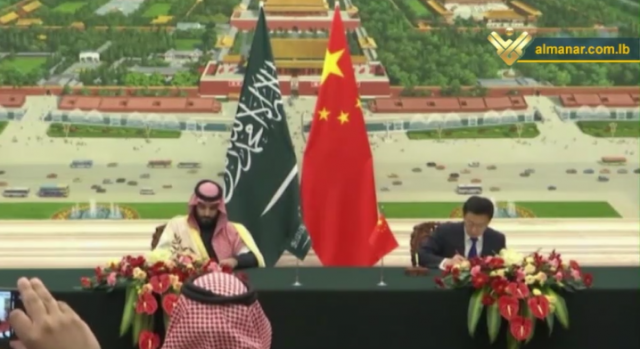
Al-Manar | February 23, 2019
The Pakistani State-run TV Channel muted the broadcast of the speech delivered by the Saudi state minister for the foreign affairs Adel Al-Jubeir while he was tackling the Iranian cause, one Zionist political analyst said.
The Israeli media channels cited the Saudi crown prince Mohammad bin Salman’s failure to provoke Pakistan, India and China against Iran, adding that India rejected his offer to sell it the same amount of oil it purchases from Tehran for a lower price.
The Zionist analysts considered that Bin Salman tried to build more political partnerships and alliances in order to improve his conditions in his relation with the United States.
What Strange Corruption
The Racist Venezuelan Bourgeoisie’s Accusations Against Chavistas Are Pure Projection
By Sassy Sourstein | Cien Flamingos | February 21, 2019
Social media truly is the great democratizer. Where else can Twitter trolls and bot armies create a web of baseless rumors that make their way into the empire’s leading publications? For example:
“Maduro is a murdering criminal starving Venezuelan children while he loots the country like Chavez did. When supposed socialist Chavez died the richest Venezuelan in the world was his daughter w billions. Same w Maduro. Looting Venezuelan wealth. Giving it to himself & Cuba!” (source)
So much to unpack, but this is a template used throughout social media in various forms. Make unsourced allegations of mass murder, purposeful starvation (especially of The Children), corruption, and looting. This is a more sophisticated version (really!) in which Chávez is separated from socialism with the word “supposed,” meant to give the accuser some leverage on the left. You see, corruption is what ails Venezuela, not socialism necessarily. Much of the rest has been thoroughly debunked — there is a crime problem but no death squads, there have been a few dozen deaths in years of violent right-wing riots but no campaign of official slaughter of “protesters,” and frankly Cuba has paid for its oil many times over with solidarity and other material support to poor Venezuelans. What persists — in right-wing AND left narratives — is the corruption boogeyman. The tweet above is truly tapping into a rich vein of existing ultraleftism, in which the Bolivarian revolution isn’t socialist at all, but merely an emerging, competing bourgeoisie. I hope here to discuss and counter just some of this bullshit.
First, the claims about the Chávez family are based on the thinnest, most laughable evidence. For Hugo himself, the British tabloid Daily Mail cites a “respected analyst” from a fake “criminal justice” outfit run by a guy with 300 followers. Twitter user Bernardo Canto did the research on this lie and traced it back to a Scribd post devoid of citation or source material. Apart from that, there is absolutely zero evidence that Chávez “died rich,” as they say — which is a pretty idiotic way to do massive corruption.
As for María Gabriela Chávez, why, there must be reams of evidence against her. Well. Get a load of this.
Canto delved into these accusations uncritically published all over corporate media, including Forbes. The claim in Forbes is credited to known CIA front Diario Las Americas, based in Miami, which, “as it happens,” is now owned since 2013 by the Venezuelan backers of opposition presidential candidate Henrique Capriles, himself accused of corruption by the Maduro administration.
It all literally boils down to a receipt shown on a tabloidy TV news show whose host is a Cuban-American Republican who ran for Congress to represent Miami. That receipt? Look for yourself:

If you think that, within the United States, ATM receipts say at the bottom “United States,” well, charitably, you’ve never used an ATM here. And the address is that of the Venezuelan consulate, not any bank. Another mistake made on this truly pathetic fabrication, is that in the US we use commas, not periods, to denote whole numbers. Of course there is no way to verify if this is Amb. Chávez’s card number, and the scammer who made this knows at least that. Aporrea already debunked this — there is no “Frabz Federal Bank,” as any US resident or a quick Google search will tell you. Frabz is literally a fake ATM receipt generator. Nevertheless, Diario Las Americas claims that the reporting of supermarket-tabloid caliber blog Maduradas.com is “precise and trustworthy,” which of course makes any claim of journalistic rigor in that entire operation a preposterous notion.
Endless insinuations of impropriety against Venezuelan officials litter the internet from troll comments on up to The New York Times. The Atlantic published a particularly nasty set of libels against María Gabriela Chávez, all caged in careful transitions and caveats so as not to actually be required to provide proof. Everything from how much public money she spends (even though she’s a billionaire!) to alleged import corruption (again with no evidence provided) to comments on her musical ability. It even gives credence to a conspiracy theory that her ambassadorship was given so that Cuba would have a trojan-horse advocate at the UN. This is pure smear, a series of fevered speculations, and yet there it is in a leading light of the liberal media.
The rest of the Chávez and Maduro clans’ children are targets as well. Check out this nutty Daily Mail post published presumably to contribute wind to the sails of the ongoing coup attempt. All the María Gabriela claims are breezily restated with no attempt to corroborate, but the “accusations” against her youngest sister Rosinés are uh… well she held up “a fistful of dollar bills” — yes, ONE-dollar bills — and well, goes to school in Paris where, we are assured, she is “care free.” And then of course there’s the time Maduro stopped in Turkey to eat a steak, which is outrageous for the president of a country on his way home from trade talks in China. Diosdado Cabello, a leading PSUV member and one of Chavismo’s most efficacious orators, is mentioned for being accused by the US government of drug running but even this is admitted to be unproven. (More on narco allegations in a future post.) Cabello’s daughter Daniela is mentioned because she is pretty. Yes really. The first lady Celia Flores’s children are said to have spent $45,000 at a hotel in Paris, though the claim seems to originate with a Spanish tabloid that did some paper napkin math and has absolutely no sources whatsoever to confirm any of it — assuming the stay itself even happened.
If Maduro has a billion dollars, if Chávez had two to four — depending on whom you ask — billion fucking dollars, why would they stick around Venezuela suffering endless ridicule, threats and even attempts on their lives, and the general stresses of being responsible for the running of an entire country? Is it just megalomania against all odds? Do you think Maduro feels powerful against all that he has to deal with right now? The prospect is risible, they could buy an entire country with that amount of money and yet there they stay, ready to go down with the ship if the empire torpedoes it. What strange corruption! Something isn’t adding up, probably because it’s all lies. We should apply a high level of skepticism to any claim we see about the empire’s targets, especially if they’re at the top of the news cycle.
There’s also the matter of the so-called Bolibourgeoisie, nouveau-riche types who are said to have leveraged the revolution for personal gain. It’s no secret that — especially after the 2002 coup — the Bolivarian project created a tactical alliance with certain business interests in the country. But reports detailing the purported gluttony and profligacy rarely name anyone and make it clear that this “plugged in” wealthy set is just a consequence of 70% of the Venezuelan economy remaining in private hands. Companies that contract with the state are, of course, compensated, as they are anywhere in the world. These private companies are for profit and these profits are, of course and unfortunately, distributed to the owners and as in any capitalist society, they are free to use this wealth for any idiotic frivolous thing they please.
From personal experience living in Miami, an old-guard Venezuelan typically makes a judgement on the “legitimacy” of the wealth of say, someone exiting an expensive car based on their complexion and features. Darker and more native-featured people are assumed to be Bolibourgeois. They’ve done nothing different from a typical businessman — the white expats are just mad that black and indigenous people may have muscled their way into what should be a purely European- or Arab-descended endeavor.
There’s no evidence that these “plugged-ins” are responsible for the economic problems in Venezuela. After all, some of the most famous episodes of Latin American corruption and economic upheaval happened during the IMF-obedient regimes of the 1990s in which populist polices were rolled back, privatization ran rampant, and austerity reigned.
Real corruption is when you warehouse food to create artificial scarcities and deliberately provoke hunger. The parties who are purposely starving the Venezuelan people are the same types as in Chile who stoked privation and misery in the campaign to overthrow Allende. In Chile we know they were kept solvent by CIA money, and we can assume the same sorts of economic support exists in the case of Venezuela. In addition to smaller importers and producers being able, through whatever means, to create very telegenic scarcities of certain products, there are conglomerates whose resources are deeper, and in whose interests an overthrow is even more intensely represented, than what is available from US intel schemes.
Empresas Polar, makers of the ubiquitous harina PAN used in every single household to make arepas, has had it out for the Revolution from day one. Despite state and communal efforts to break their stranglehold on the corn flour market, their generations-deep imprint on the Venezuelan household rich and poor has persisted. If anyone “retains the ability to keep its products off the shelves just as readily as its ability to keep them on,” it’s La Polar. This is due to their still-gigantic home market share and, ironically, their being a major beneficiary of Venezuelan state subsidies for food importation. In addition, Polar’s various corporate vehicles in the US benefit from United States subsidies on corn for their many products which are sold in a growing market of quite affluent Venezuelans in the US. With all these resources at its disposal, creating artificial scarcities in a comparatively low-revenue market would be a minor line-item on Polar’s books.
There’s also the phenomenon of the “raspao,” or scrape. I don’t pretend to understand all the ways that currency can be manipulated, but merely printing too much money isn’t responsible for a one-million-percent unofficial inflation rate. For many years the Venezuelan state offered USD at an official exchange rate, for imports and travel, etc. People could buy dollars at this official rate with credit cards and then immediately convert these dollars back into bolivares in the black market — instant profit. On a trip to Mexico City last year I had a Mexican tell me with great excitement about how local Venezuelan friends of his who were involved in the scam used the profits to live well in the most exclusive neighborhoods. While the practice seems to have been curbed in recent years, the damage to the currency rate is done and the tightening sanctions compound it. I can only speculate, but with probably more certainty than a Eurotrash tabloid, that some of my Venezuelan neighbors themselves started their own nest eggs by ripping off their country. This truly is corruption, and though official currency policy is what facilitates it, it’s private criminals who take advantage, destroying their country’s economy while they live it up in exile.
The ultimate corruption is when you make millions through inheritance and other people’s labor. The accusations of the elites of Venezuela are a form of projection: they are the corrupt parasites who for generations have fed off the productive people of Venezuela, as in all nations. The same author as the Atlantic Chávez smear list — proud putchist! — has an entire post about the watches worn by some Venezuelan politicians, potentially the most news-unworthy subject of all time. The charge, of course, is “hypocrisy”: lol look at the socialists having quality timepieces! Yet when the idle scions of the Venezuelan elite themselves own safes full of jewels, several luxury cars, houses across the world, this is fine because there’s no hypocrisy involved — they never pretended to care about another soul on this planet but their own. There has never been a cynicism so toxic, so deep.
When “opposition” supporters, in between #SOS posts on Instagram, post stories of themselves on their yachts in Aruba, or their family farm in the mountains, or their beach house in Isla Margarita, or flaneuring around Barcelona and Madrid, are we meant to consider this a life of suffering? If they’re doing this, who is “earning” the money they draw to pay for these extravagances most people on earth — let alone Venezuela — can’t afford? This is corruption in every sense of the word: an indolent, lazy, entitled, racist caste of princes and princesses living off interest in foreign banks made from exploiting generations of poor workers going back into the times of chattel slavery and primitive accumulation. What is “nepotism” if not passing immense ill-gotten fortunes and estates to your children? What makes a country-club brat particularly adept at guiding such large agglomerations of the national wealth?
And even if it’s not strictly corruption, there is a certain moral emptiness to receiving a free education in Venezuela and then immediately going abroad to use your degree for personal gain, as many have done. These people are true leeches, not those demanding a fairer share of the national produce they helped create.
We also know that they consider “corruption” — or at least the even more vague “waste” — to include the building of 2.5 million homes, universities, collective farms, markets, food programs, medical facilities. To the bruised egos of the waning nobles, it’s unconscionable to give literal peasants a boost up from the dirt floor.
Listen when they talk:
“From 1999 through 2013, Venezuela collected $1.3 trillion in oil revenues but it largely has vanished through corruption, MASSIVE SOCIAL SPENDING, and waste”https://t.co/Wf6pK2jOt4
— Petro Populist (@RancidSassy) February 1, 2019
All this is why we hear so much about “corruption” in Venezuela: an utterly worthless class of human beings is angry that some small share of the wealth they used to skim exclusively for themselves is now being distributed with just a bit more equity across social lines.
Local issues of corruption, whatever they consist of, are for Venezuelans to solve. It is a completely internal matter. Imagine making the case for the bombing and invasion of a country based on the fact that it has economic problems. Now imagine those problems are mostly caused by the party who is meant to “liberate” this country. That is literally what the argument boils down to. It’s bonkers on the surface, without even so much investigation. As Foreign Minister Jorge Arreaza quipped, on the subject of the farcical “humanitarian aid”: “I’m choking you, I’m killing you — and then I’m giving you a cookie.” The US is not now and has never been in the business of securing liberty for anyone other than the financial interests of its wealthy owners. If you believe otherwise, it’s your brain that’s corrupted.
1/ Arreaza: “The cost of this blockade is over 30 BILLION dollars and they’re sending this so-called ‘humanitarian aid’ for 20 MILLION dollars? So what is this? I’m choking you, I’m killing you, and then I’m giving you a cookie?” pic.twitter.com/uUdtbGPK92
— Camila (@camilateleSUR) February 15, 2019
Vladimir Putin: 2019 State Of The Union Address To Russia’s Federal Assembly
Official translation of Russian President Vladimir Putin’s State of the Union Address to Russia’s Federal Assembly as published by the Kremlin’s website on February 20, 2019.
Members of the Federation Council, State Duma deputies, citizens of Russia,
Today’s Address is primarily devoted to matters of domestic social and economic development. I would like to focus on the objectives set forth in the May 2018 Executive Order and detailed in the national projects. Their content and the targets they set are a reflection of the demands and expectations of Russia’s citizens. People are at the core of the national projects, which are designed to bring about a new quality of life for all generations. This can only be achieved by generating momentum in Russia’s development.
These are long-term objectives that we have set for ourselves. However, work to achieve these strategic goals has to begin today. Time is always in short supply, as I have already said on numerous occasions, and you all know this all too well. There is simply no time for getting up to speed or making any adjustments. All in all, I believe that we have already completed the stage of articulating objectives and outlining tools for achieving our goals. Departing from the targets that were outlined would be unacceptable. It is true that these are challenging objectives. That being said, lowering the requirements for specific targets or watering them down is not an option. As I have already said, these are formidable challenges that require us to undertake major efforts. However, they are in step with the scale and pace of global change. It is our duty to keep pushing ahead and gaining momentum.
If someone prefers to work in the business as usual mode, without challenges, avoiding initiative or responsibility, they had better leave immediately. I already hear that some things are “impossible,” “too difficult,” “the standards are too high,” and “it will not work.” With such an attitude, you had better stay away.
Besides, you cannot fool the people. They are acutely aware of hypocrisy, lack of respect or any injustice. They have little interest in red tape and bureaucratic routine. It is important for people to see what is really being done and the impact it has on their lives and the lives of their families. And not sometime in the future, but now. We must not repeat the mistakes of the past decades and wait for communism to arrive. We have to change the situation for the better now.
Therefore, the work of the executive branch at all levels should be coordinated, meaningful and energetic. The Government of Russia must set the tone.
At the same time, I would like to emphasise and repeat: our development projects are not federal and even less so agency-based. They are national. Their results must be visible in each region of the Federation, in every municipality. It is here, on the ground, that the majority of specific tasks is implemented.
Allow me to underscore: thanks to years of common work and the results achieved, we can now direct and concentrate enormous financial resources – at least enormous for our country – on development goals. These resources have not come as a rainfall. We have not borrowed them. These funds have been earned by millions of our citizens – by the entire country. They need to be applied to increase the wealth of Russia and the wellbeing of Russian families.
Very soon, this year people should feel real changes for the better. It is on the basis of their opinion and assessments at the beginning of next year that we will evaluate the first results of our work on the national projects. And we will draw the appropriate conclusions about the work quality and performance at all levels of executive power.
Colleagues,
Let me now share some specifics on our objectives. I will begin with the key objective of preserving our nation, which means providing all-around support to families.

Presidential Address to the Federal Assembly. Photo: TASS
Family, childbirth, procreation and respect for the elderly have always served as a powerful moral framework for Russia and its multi-ethnic people. We have been doing everything in our power to strengthen family values and are committed to doing so in the future. In fact, our future is at stake. This is a task shared by the state, civil society, religious organisations, political parties and the media.
Russia has entered an extremely challenging period in terms of demographics. As you know, the birth rate is declining. As I have already said, this is caused by purely objective reasons, which have to do with the immense human losses and birth dearth experienced by our country in the 20th century, during the Great Patriotic War and the dramatic years following the dissolution of the Soviet Union. This does not mean, however, that we must accept this situation or come to terms with it. Definitely, not.
We succeeded in overcoming the negative demographic trends in the early 2000s, when our country faced extreme challenges. This seemed to be an impossible challenge at the time. Nevertheless, we succeeded, and I strongly believe that we can do it again by returning to natural population growth by late 2023 – early 2024.
Today, I wanted to talk about a new package of measures that has already been prepared to support families.
First, it is important that having children and bringing them up do not put families at the risk of poverty or undermine their wellbeing. As you know, we have already provided for the payment of subsidies for the first two children until they reach 18 months. Benefits for the first child are paid from the federal budget, and families can use the maternity capital subsidy for obtaining benefits for their second child. The size of the subsidy depends on the regional subsistence level for a child. It may vary from 8,000 rubles in Belgorod Region, for example, to 22,000 rubles in Chukotka Autonomous Area, with the national average of over 11,000 rubles a month per child. Currently these allocations are reserved to families whose income does not exceed the subsistence wage multiplied by 1.5 per person. It is time that we make the next step.
Starting January 1, 2020, I propose raising the bar to two subsistence wages per family member. This is what people have requested and these requests come directly into the Executive Office. This measure will increase the number of families entitled to additional benefits by almost 50 percent. Some 70 percent of families with one or two children will be able to benefit from help from the Government.
Second. At present, carers looking after children with disabilities and people disabled since childhood receive an allowance of only 5,500 rubles. I suggest increasing this to 10,000 rubles, starting July 1. Of course, I understand that it is still a small amount. However, it will be an additional measure of support for families with a child who needs special care.
Third. The income of Russian families must, of course, increase. This is a serious task that requires a comprehensive solution. I will speak about this in greater detail later. But we need direct measures. First of all, the tax burden on families needs to be relieved. The approach should be very simple: the more children there are, the lower the tax. I propose increasing federal tax relief on real estate for families with many children. I also propose lifting taxes on 5 square metres in a flat and 7 square metres in a house per each child.
What does this mean? If, for example, right now, 20 square metres in a flat are not subject to tax, the new measure will mean that for a family with three children, an extra 15 square metres will not be subject to tax. Regarding plots of land that belong to families with many children, I propose that 600 square metres should be exempt from tax, and this means most plots of land will be free from taxation. Let me remind you that this benefit is already available to pensioners and people of pre-retirement age. Of course, in many Russian regions there are local tax benefits on land and property for large families. However, the benefit being imposed at the federal level guarantees that it will be available everywhere in the country. I want to ask regional officials to propose additional tax measures to support families with children.
Fourth, the Government and the Central Bank need to consistently maintain the policy to lower mortgage rates to 9 percent, and then to 8 percent or below, as stipulated in the May 2018 Executive Order. At the same time, special measures of support should be provided for families with children, of course. As a reminder, last year, a preferential mortgage programme was launched for families that have had their second or subsequent child. The rate for them is 6 percent. Anything higher is subsidised by the state. However, only 4,500 families have used the benefit.
The question is why. It means that people are somehow dissatisfied with the proposed conditions. But it is also clear why. A family making a decision to buy housing certainly makes plans for a long or at least medium term, a lasting investment. But with this programme, they take out a loan, start paying the instalments, and the grace period ends. The interest is actually subsidised only for the first 3 or 5 years. I propose extending the benefit for the entire term of the mortgage loan.
Yes, of course, it will require additional funding, and the cost will be rather high: 7.6 billion rubles in 2019, 21.7 billion rubles in 2020, and 30.6 billion rubles in 2021. But the programme is estimated to reach as many as 600,000 families. We certainly need to find the money. We know where to get it. We have it, and we just need to use it in the areas that are of major importance to us.
And one more direct action solution. Considering the sustainability and stability of the macroeconomic situation in the country and the growth of the state’s revenues, I consider it possible to introduce another measure of support for families having a third and subsequent children. I suggest paying 450,000 rubles directly from the federal budget to cover this sum from their mortgage. Importantly, I propose backdating this payment starting January 1, 2019, recalculating it and allocating relevant sums in this year’s budget.
Let us see what we have. If we add this sum to the maternity capital, which can also be used for mortgage payments, we will get over 900,000 rubles. In many regions, this is a substantial part of the cost of a flat. I would like to draw the attention of the Government and the State Duma to this issue. If need be, the budget will have to be adjusted accordingly. An additional 26.2 billion rubles will be required for this in 2019. The relevant figures for 2020 and 2021 are 28.6 billion rubles and 30.1 billion rubles, respectively. These are huge funds but they should be allocated and used in what I have already described as a very important area.
It is necessary to give families an opportunity not only to buy ready-made housing but also to build their own housing on their land. I would like to ask the Government to draft in cooperation with the Central Bank convenient and, most importantly, affordable financial instruments for supporting private housing construction because it is not covered by mortgage loans today.
And, last but not least, the tax on land must be fair. Obviously, the cadastral or market value of a land plot can change but tax rates must not go up and down unpredictably like roller coaster rides. We have already limited to 10 percent the annual growth of the tax rates for residential property. I suggest establishing the same limit for land plots.
Moving on, today, when construction companies build social facilities and transfer them to the state or municipalities, they have to pay profit tax and VAT. We need to relieve construction companies of this burden (including our innovations in the construction sector). This will serve as an impetus for the comprehensive development of cities and townships, ensuring that families have everything they need near their homes: clinics, schools and sports facilities. By doing this, we will enable parents to work, study, live happily and enjoy parenthood.
We have come close to guaranteeing universal access to kindergartens, but by the end of 2021, we will have to resolve the problem with nurseries by enabling them to accept 270,000 more children, including in the private sector, with 90,000 places to be created as early as this year. The federal and regional budgets should allocate 147 billion rubles for this purpose, over a three-year period. Let me add that enrolling in a nursery group, kindergarten, getting subsidies, benefits or the tax deductions that I have already mentioned and, I hope, that we will come up with, together with you, all this should happen without any additional applications, excessive paperwork or having to visit various social services. By the end of 2020, all the key government services must be provided in a proactive format where a person will only need to send in a request for a service that he or she needs, and the system will take care of all the rest independently and automatically.
I would like to emphasise that the package of measures to support families proposed today is not an exhaustive list of initiatives. It sets the priorities. Considering the challenges posed by the state of Russia’s demographics, we will continue to channel more and more resources into this area. I ask all of you, colleagues, including both the Government and the Federal Assembly, to think about it and suggest solutions.
Colleagues, solving our demographic problems, increasing life expectancy and reducing mortality rates are directly related to eradicating poverty. Allow me to remind you that in 2000, there were more than 40 million people living below the poverty line. Now there are about 19 million, but this is still too many, too many. However, there was a time when their number dropped to 15 million, and now it has grown a little again. We must certainly focus our attention on this — on combating poverty.
Furthermore, there are even more people facing serious financial problems than those officially living below the poverty line. They are forced to cut spending on such essentials as clothes, medicines and even food. Those most often faced with poverty are large or single parent families, families with members with disabilities, as well as single pensioners and people who cannot find a good job, a well-paid job because there are no openings or they lack qualifications.
There are many reasons for poverty, not only in our country, but also in the world, but it always literally crushes a person, dimming their life prospects. The state must help people, help them out of difficult life situations. The experience of some of our regions shows that it is possible to work effectively for this. I will name these regions: Kaluga, Ulyanovsk, Tomsk, Vologda, and Nizhny Novgorod Regions, and a number of other regions of Russia. Their experience shows that so-called social contracts can be a working mechanism of such support.
How does it work and what is this all about? The state helps people find jobs and improve their skills. The state provides financial resources to families to run a household farm or to start a small business, and by the way, these are substantial resources of tens of thousands of rubles. Let me emphasise that support programmes will be tailored to meet the needs of every specific applicant. The allocation of these resources creates some obligations for the recipients: they have to go through training, find a job in the given field and provide a steady income for their family and children. Mechanisms of this kind are in place around the world and are very effective. Social contracts can change the lives of those who really want to do it.
It is estimated that more than 9 million people will be able to benefit from these support measures over a five-year period. I instruct the Government to assist the regions that are proactive in introducing social contracts and work with them on co-financing mechanisms.
Moving on, there are currently many people and families taking out loans for various purposes, including consumer loans. Of course, borrowers have to be aware of their obligations and refrain from assuming an excessive burden. That being said, anything can happen: people can lose their job or become ill. In this case, the last thing is to force people into a corner, and it is also pointless in economic terms. Additional legal guarantees are needed to protect people. I propose introducing mortgage payment holidays, as we have recently discussed in Kazan, to enable people who lose their income to suspend mortgage payments. They must get a chance to keep their home, if it is the only property they own, and postpone loan payments. This is not an easy task, and we have to understand how this can be done so as not to harm financial institutions while supporting the people. This can be done, however.
I also ask the Bank of Russia and law enforcement agencies to put things right without delay in the microlending segment and protect people from fraud or extortion by dishonest lenders.
Let me emphasise that as we seek to overcome poverty and develop the social security net, we need to reach every family in need and understand the problems it faces. It should not be possible to refuse assistance simply because the life circumstances a person is facing are slightly inconsistent with the criteria set by a programme.
And, of course, it is necessary to be scrupulous and attentive to every detail. By way of example, and this is not a very good example for our work, I would like to say the following: pensions were adjusted for inflation under the pension reform this year. But if a pensioner’s income exceeded the subsistence rate, the social payments were no longer made at the same level. They were either cancelled altogether or reduced. As a result, the pensions were not increased at all, or the increases were much less than a pensioner expected. So many people feel cheated with good reason. Probably, many people in this hall understand what this is all about. We made payments from the regional or federal budget to achieve the subsistence level. We made adjustments for inflation and the cost of living either matched or exceeded it. So these payments were discontinued and that was it.
It was necessary to take into account all the nuances but this was left undone, and of course, this should not be allowed to happen. This injustice, and it is certainly an injustice, should be sorted immediately. Starting this year, adjustments of pensions and monthly payments should by all means be above the subsistence rate of pensioners that is established every year. In other words, the state should first bring pensions to the subsistence level and only after that make adjustments in pensions and monthly payments. Payments for the first months of this year must be recalculated and people should be paid the money due to them that they have not received.
I would like to emphasise that all those who work in the social sphere or join the government or municipal services in order to help people resolve their urgent problems, must meet the highest professional standards. I believe by and large this is the case. Of course, this is a very complicated job. We all understand that working with people every day, from morning until night, is indeed difficult. But if you have this job you should realise that it is no less important to understand people, to know what they feel, empathise, share their worries and concerns and never permit yourself arrogant attitudes or a lack of respect for people, either in word or deed. I would like you to always remember this.

Presidential Address to the Federal Assembly. Photo: TASS
Colleagues,
The next important subject is healthcare. I know that, on the one hand, its current state seems to be improving, and medical treatment is becoming more accessible. Nevertheless, many people are not satisfied. It is easy to understand the reasons for this. As a rule, people judge the healthcare system by its primary component, that is, outpatient clinics and paramedic stations. People voice complaints with regard to their work. Quite often, they have to wait many days to see a specialist, and it is impossible to quickly undergo the required tests free of charge. People in remote communities are even having trouble getting appointments with medical personnel. Yes, the number of paramedic stations and mobile medical units continues to increase, but people in areas where there are no such facilities care nothing about the overall statistics.
I want to emphasise that medical treatment should become accessible for everyone by the end of 2020 in all populated areas across Russia without exception and for all citizens, regardless of their place of residence. For your information, an additional 1,590 outpatient clinics and paramedic stations are to be built or renovated in 2019–2020, and I hope that this will be accomplished.
Today, a number of regions are implementing the Thrifty Outpatient Clinic project. As a result, the waiting time to get an appointment and see a doctor is reduced three or four times over, on the average. I have visited such outpatient clinics, and they are operating very well. Much better conditions are created for people with disabilities and for parents with children. Unfortunately, there are very few such outpatient clinics so far; they are rather an exception than the rule all across the nation.
Considering the best regional practices , and, I repeat, there are such practices, I hereby instruct the Government to approve the high standards of thrifty outpatient clinics by the end of the year and their certification regulations. Next year, you have to team up with the regions to introduce mechanisms incentivising managers and medical personnel to improve the quality of their work. First of all, we have to completely convert all paediatric outpatient clinics to new standards already in 2021. Please note that the sign “Thrifty Outpatient Clinic” is not what counts. Most importantly, people should at long last perceive the state’s respectful and truly considerate attitude towards their health.
Improving IT penetration in healthcare will make it more accessible. Online links between medical institutions, pharmacies, doctors and patients must be streamlined over the next three years. Let me add that social security medical assessment boards must be finally included into this digital network in order to free elderly people, people with disabilities and families with children from waiting lists and the need to produce various certificates that are often useless.
Primary care is understaffed. To address this matter, comprehensive efforts to develop medical education should be accompanied by initiatives that produce immediate results. In this connection, I propose removing age restrictions for the Country Doctor programme so that professionals over the age of 50 can also receive a one-time payment when moving to a rural area or a small city: 1,000,000 rubles for doctors and 500,000 rubles for paramedics.
The most complex surgery is currently performed not only at federal, but also at regional clinics and centres using the most advanced equipment. At the same time, patient recovery is also critical. We have never had a system of this kind, but we have to start with something. A lot has to be done in this area. Let us begin by creating at least two world-class recovery facilities for children, just as we did with perinatal centres, and proceed from there.
In my last year’s Address, I proposed a programme for fighting cancer. At least 1 trillion roubles will be allocated to this effect over the next six years. This is about providing timely, effective and accessible treatment, using advanced technologies that are effective in most cases and enable people to overcome this dangerous disease. Today, the leukaemia recovery rate for children exceeds 80 percent, and for certain types of cancer, more than 90 percent of patients recover. Not that long ago, in the mid-1990s, this disease was almost untreatable and only 10–20 percent of children could be saved. Russia lacked both the technology and capabilities at the time. In many cases, the only option was to turn to foreign clinics. Those who could afford it did so.
We were aware of how tragic this situation was, which prompted us to focus on improving cancer treatment for children, developing oncohaematology, using the capabilities offered by our research institutions, the healthcare system, and worked proactively with our foreign partners (some doctors simply moved from Germany to Moscow, and spent a lot of time here, and probably still do), which yielded results.
We will continue working to overhaul the system of cancer care. Early detection is of crucial importance. In fact, we have revived the system of health screening and regular medical check-ups. These have to include cancer screening. It has to be made obligatory. People must have the opportunity to make appointments remotely, to choose a suitable time for visiting an outpatient clinic, including in the evening or at the weekend, so that the check-up can be carried out without any additional formalities.
Next, over the next few years we must create a number of new areas combining healthcare with social services. Thus, we must overhaul the system of assistance for people who need long-term help at medical facilities or at home, adjust this system to the needs of specific families and individuals, support people with their everyday needs by assigning district nurses or carers, or training relatives in medical or other necessary skills. The application of these recipient-oriented principles of assistance began last year in Volgograd, Kostroma, Novgorod, Pskov, Ryazan and Tula regions. We must introduce them throughout the country within a timeframe of four years.
Palliative care is a matter of not only medical but also of social, public and moral concern. According to the available information, some 800,000 people need this assistance, and volunteers have told me that the figure is around one million. As you know, in January I visited a children’s hospice in St Petersburg, where we discussed this matter. I know that yesterday the State Duma adopted in the second reading amendments to the legislation on palliative care. I would like work on this law to be completed as soon as possible. We will then monitor its application so we can promptly make amendments, taking into account the opinions of volunteers, whom I have mentioned, doctors, carers, members of the public and religious associations and benefactors, that is, everyone who have long been providing heartfelt palliative care.
Colleagues, people have increasingly high demands on environmental safety issues. Perhaps, the most painful topic is municipal waste. If you remember, it came up for the first time during one of my Direct Lines. Yes, we have probably neglected the waste disposal problems for maybe a hundred years, which means we have never paid attention to them. Many landfills are overfilled because waste has been accumulating there for decades. The landfills have turned into real mountains of garbage near residential areas.
By the way, I am also interested to know how you issued permits for the construction of residential neighbourhoods next to these dumps and landfills. Didn’t you think of that? You should have. I urge the representatives of the authorities at all levels: pretending that nothing is happening, turning away, brushing aside people’s needs is absolutely unacceptable. These issues are difficult, of course, but difficult issues must also be addressed.
This year, the regions began adopting a new system of solid municipal waste management. However, if the only change is a rise in rubbish clearance prices – well, this is not real work; it is a sham. People need to see what they are paying for and what real changes are happening. It is necessary to restore order in this area, to get rid of shady businesses that do not bear any responsibility and only get super-profits dumping trash at random sites.
We need to build a civilised and safe system of waste treatment, recycling and disposal. Surprisingly, a year ago I personally had to interfere on some matters. I had to talk to the Interior Ministry and the Prosecutor’s Office several times. You know, surprisingly, I would like to say it again, almost nothing moved forward until I gave an order to station a guard there and not to let anyone in. This is the only way it works, because these shady companies, the so-called fly-by-nights, they just make quick profits and shut down their so-called business.
I ask the Russian Popular Front to ensure effective public control here, including reliance on public environmental inspectors. Their signals regarding any violations must be considered by the authorities, who must adopt specific measures. In the next two years, 30 large problem landfills within city boundaries must be closed and rehabilitated, and in six years, all the rest. At the same time, it is necessary to increase the share of waste treatment from today’s 8–9 percent to 60, so as not to accumulate new millions of tonnes of trash.
It is necessary to introduce stricter environmental requirements when it comes to utility services and energy and transport enterprises. In part, I am urging businesses to play a more active role in natural gas motor fuel projects, and invest in the formation of a network of fuelling stations and fuel systems using liquefied natural gas. We have enough of it, more than any other country. Indeed, this is a complicated and costly project but it should be carried out because it will produce results not only for businesses but for the people as well.
A positive effect from the industry’s transfer to the best affordable technologies and strict environmental standards should be felt by residents of major industrial centres of the country, primarily the 12 cities I mentioned in the 2018 Address. These places should be finally removed from the zone of real environmental disaster. Over a period of the next six years, the amount of polluting emissions in the air should be reduced there by no less than 20 percent.
To prevent anyone from the temptation of dodging the implementation of this job, it is necessary to strictly monitor industrial and other companies responsible for this, to map out the specific steps they should take to minimise environmental damage, and to register all this in a law on emission quotas. I know all too well what this is all about. I know that fairly influential lobbyists are trying to impede this draft law as much as they can. I know their arguments very well too: the need to preserve jobs and a complicated economic situation.
But this cannot go on endlessly in this manner. It must not. Let me recall that in making such decisions we should be guided by the interests of the people of Russia rather than corporate interests or interests of some individuals. Colleagues, please pass this law during the spring session.
Finding solutions for environmental problems is the job of our researchers and people in industry. Each of us is responsible for this. I am urging young people, among others, to take a more active part in this work. We must hand over to the future generations an environmentally safe country and preserve Russia’s natural potential as well as its specially protected areas. This year new national parks will open in the republics of Daghestan, Komi and Sakha (Yakutia), Altai Territory and Chelyabinsk Region. However, I would like to draw your attention to the fact that many specially protected areas do not yet have precise borders and their regulations are not observed.
I have instructed the Ministry of Natural Resources to conduct a detailed audit. All sanctuaries must be registered in the cadastre. It is also necessary to adopt a law according to which only environmental tourism can take place in nature reserves, without any withdrawal of territories, wood cutting or major construction work. Naturally, it is necessary to take into account the interests of the locals but these issues should be resolved in a package.
Colleagues, the number of students from small towns and remote areas studying at the best Moscow and regional universities is increasing. According to international assessments, our elementary, middle and high school students demonstrate good results in the humanities and hard sciences. We can see it ourselves, based on the results of contests and various student competitions. All this is an indicator of qualitative changes in our school education.
However, despite all these achievements, we must not overlook the obvious problems in this crucial area. The share of schools with modern study conditions has increased from 12 percent in 2000 (only 12 percent) to 85 percent in 2018. But even today, some 200,000 children still go to schools where there is no proper heating, water supply and sewage system. Yes, it is less than 1.5 percent of all schoolchildren, but when their parents see these conditions, any words about justice and equal opportunities only irritate them. I want to draw the attention of the heads of the regions where poorly equipped schools still exist. This problem can be completely resolved within two years. We can do it. I know that the Government is thinking about it and making certain decisions. I am asking you to support the regions that lack their own resources.
When in 2006 we started providing internet connections to schools, the technology was completely different. You know, it seemed like a real breakthrough. And it was indeed a breakthrough at the time. Right now, this technology seems ancient, and we have new tasks to resolve. By the end of 2021, all Russian schools must have a high-speed internet connection rather than just a connection. Let me remind you that in 2006, when schools were being hooked up to the internet, the recommended speed was 128 kbps. Now we need 50 Mbps or 100 Mbps, which is at least 400 times higher. This will help our kids to gain access to lessons and lectures by prominent teachers, to contests and Olympiads; it will allow them to significantly expand their capabilities and get involved in online projects with their fellow students from other regions and countries. The content of educational programmes must also change. The national standards and programmes must reflect the priorities of the country’s science and technology development, while the federal lists of recommended textbooks must include the best of the best books.
Of course, human resources are the most important issue. I have already spoken today about expanding the Country Doctor programme. I propose starting a similar programme for education, the Country Teacher. Teachers who decide to move to smaller towns and villages will receive a one-time payment of one million rubles.
We must work consistently to strengthen the common environment of education and culture. The culture and education centres in Kaliningrad, Kemerovo, Vladivostok and Sevastopol will open no later than in 2023. Our leading museums and theatres will be represented there, and branches of art schools will start working there already next year. The demand for a rich cultural environment is very high, primarily in the regions, where a great number of talented and committed people are working.
I propose greatly expanding assistance to local cultural initiatives, that is, projects dealing with local history, crafts and the preservation of the historical heritage of our peoples. For example, additional allocations can be made towards this from the Presidential Grants Fund. In addition, we will allocate over 17 billion rubles within the Culture national project for the construction and renovation of rural culture clubs and over 6 billion rubles for supporting culture centres in Russia’s small towns.
I would like to remind you that medical and educational institutions are exempt from profit tax, but only until January 1, 2020. I propose making this incentive of unlimited duration and also extending it to the regional and municipal museums, theatres and libraries. By the way, this will allow them to save some 4 billion rubles, which they will invest in development or will use to raise salaries. And lastly, this measure will encourage private investment in local cultural establishments.
Colleagues, I would like the heads of regions to ensure that salaries in education, healthcare, culture and other public sectors are kept on a par with the average wage in the given region’s economy. Colleagues, this is very important. I keep talking about this at all my meetings. We must not lower this standard. At the same time, the average wage in the economy must grow. Over 40 million people who work in the public and defence sectors and are non-working pensioners receive fixed payments. These payments must grow together with the inflation at the least. I ask the Government to take this into account.
More than 70 million people work in manufacturing, agriculture or the services or are small business owners. The state of Russia’s economy has a direct bearing on their income, wellbeing and confidence in the future. The primary tool for achieving steady wage increases is to promote quality employment and free enterprise, qualified, well-paid jobs in all regions, including both traditional and new sectors. High economic growth rates are essential. This is the only way to overcome poverty and ensure steady and perceptible increases in income. This is the key to success. As soon as in 2021, Russia’s economic growth rate must exceed 3 percent and stay above the global average afterwards. This objective should not be discarded.
The Government and the Central Bank are once again tasked with complying with the target inflation rate. I have already said this, and we knew that this would happen when we put aside financial resources for the national projects. This was an expected outcome, and now we need to make sure that the situation gets back to normal. We can do this. As I said, the Government and the Central Bank must ensure that the inflation targets are met and create a favourable macroeconomic environment for facilitating growth in general. We have a strong financial safety cushion.
I have something positive to share with you. For the first time ever, our reserves fully cover not only the sovereign debt, which is quite small, but also private borrowings. These funds are at work, and investment of the National Welfare Fund generates budget revenue. Therefore, I would like to address those of our colleagues who constantly criticise the Government, its financial and economic ministries and ask where the money went and where we invested it. We set a target to reach a certain level, after which we can use these funds, although cautiously so as not to cause any macroeconomic disturbances. We are about to reach this level, and are beginning to do it. The proceeds from these investments go to the federal budget. In 2018, proceeds from investing the National Welfare Fund in the amount of 70.5 billion rubles were added to the budget.
To achieve high growth rates, it is also necessary to resolve systemic problems in the economy. I will highlight four priorities here.
The first one is faster growth in labour productivity, primarily based on new technologies and digitalisation; the development of competitive industries and, as a result, an increase in non-primary exports by more than 50 percent in six years.
The second one is to improve the business climate and the quality of national jurisdiction, so that no one moves their operations to other jurisdictions, to ensure that everything is reliable and runs like clockwork. Growth in investment should increase by 6–7 percent in 2020. Achieving this level will be one of the key criteria for evaluating the Government’s work.
The third priority is removing infrastructural constraints for economic development and for unlocking the potential of our regions.
And the fourth thing is training modern personnel, of course, and creating powerful scientific and technological foundations.
Now I would like to expand on our specific tasks in these fields.
A colossal guaranteed demand for industrial and high-tech products is being formed in Russia, I can say this without any exaggeration. So the words I would like to use – we are faced with historical opportunities for a qualitative growth of Russian business, mechanical engineering and machine-tool making, microelectronics, IT-industry, and other industries. The national projects alone include – just think of it – 6 trillion rubles worth of procurement plans for medical and construction equipment, instruments, telecommunications systems, and systems for housing and public utilities. And these resources should work here in Russia.
So I am urging the Government, the regions, the representatives of state-owned companies I see here in this room – you certainly want to buy all the most modern equipment and as inexpensively as possible. Naturally, everyone wants to be and should be competitive, but wherever possible, you need to rely on our producers, on domestic ones. We must find them, and even work together with them. Of course, there must be a competitive environment, but we already have the tools to support Russian manufacturers. We must not forget about these tools, and use them.
I would like to emphasise that access to state contracts must be equal (at least for our own, for national companies), and the orders should go to those who prove their sustainability with hard work and results, with willingness to change, to introduce advanced technology and increase labour productivity, and offer the best competitive products.
As concerns the defence industry, we must use our current capacities for diversification, to expand civil production. Colleagues understand what I am talking about here. There are certain targets for each year. And they must be achieved, no matter what.
And of course, now is the time for more daring initiatives, for creating businesses and production companies, for promoting new products and services. This wave of technological development allows companies to grow and win markets very quickly. There are already examples of successful companies, innovative companies. We need many more of them, including in such fields as artificial intelligence, Big Data, the Internet of Things and robotics.
I am instructing the Government to create the most comfortable conditions for private investment in technological startups and to involve development institutions in their support. I am asking members of parliament to promptly pass the laws that are most crucial for creating the legal framework of the new digital economy, laws that will allow to close civil deals and raise funds using digital technology, to develop e-commerce and services. The entire Russian legislation must be geared up to reflect the new technological reality. These laws must not restrict the development of innovative and promising industries but push this development forward.
The most crucial indicator of a business’s efficiency and competitiveness lies in expanding export and entering external markets. The success of our agricultural industry is, of course, a good example of such development. Our agricultural export increased by 19.4 percent in 2018 reaching $25.8 billion. In 2024, we must reach $45 billion. Incidentally, we are not only one of the largest wheat exporters (last year we exported 44 million tonnes). We have at least one more significant achievement. Thanks to the developments of Russian researchers we are no longer dependent on other countries for wheat seeds. Experts will confirm how critically important this is. Russia must have the entire range of its own advanced agricultural technology, which must be available not only to large but also to small farms. This is literally a matter of national security and successful competition in the growing food markets.
Improving the quality of life for those who work in rural areas is a key long-term factor of the agricultural industry’s steady growth. I would like to point out to the Government that as soon as this year, they must approve a new development programme for rural territories that must be enforced as of January 1, 2020.
One more thing. I think everybody will agree that our massive natural resources constitute our natural advantage. They need to be used for increasing the production of organic produce. I am instructing the Government to create a protected brand for clean products, a brand that will guarantee safety of the technology used and win the reputation of high quality both on the domestic and foreign markets. Trust me, it will be extremely popular abroad. There is hardly anything clean left there.
Colleagues, to achieve the ambitious goals facing the country, we must rid the system of everything that restricts freedom of enterprise and business initiative. Honest businesses should not face the risk of criminal or administrative prosecution. I have already noted this matter in one of my Addresses, and I have cited the relevant figures. Unfortunately, the situation has not improved much.
Today, almost half of all cases (45 percent) opened against entrepreneurs do not get to trial. What does this mean? This means that they were opened in a slipshod manner or under some unclear pretext. And what does this mean in practice? As a result, 130 jobs are lost on average every time a business closes down as result of an investigation. Let us think about this figure; this is becoming a major economic problem.
The business community points to a number of legislative and law enforcement problems. I agree that we need to closely analyse the criteria under which all employees of a company can be considered to be part of a group that is guilty of collusion just through the fact of working for that company. To be honest, this is complete nonsense, but, unfortunately, it happens time and again. And this leads to a stricter detention during the investigation and a more substantial penalty later on. Additionally, we need to strictly limit the grounds for extending the term of detention during the investigation of so-called economic criminal cases. Today, this sometimes happens without any grounds, simply because the investigators had no time to conduct the required expert checks or as a result of delays in the investigation.
We have discussed this matter with the Prosecutor General and the President of the Supreme Court. This is what happens: a person is kept behind bars, and he has not been summoned for questioning for several months. The prosecutor wants to know why he had not been questioned, and they tell him that the investigator was on holiday. Of course, investigators, especially those at the Interior Ministry, handle a tidal wave of criminal cases, and we need to do something about that, we need to take a closer look at this matter. Perhaps we should set aside additional resources and increase the number of investigators. Nevertheless, how can this be explained? A person is kept behind bars while the investigator has left on holiday and has not questioned him for several months. This should not happen, we need to sort this out. I ask the Supreme Court and the Prosecutor General’s Office to analyse all these problems once again and to submit their proposals.
I suggest that our business associations and the Agency for Strategic Initiatives create a special digital platform – in fact, they themselves have advanced this initiative – which entrepreneurs will use to make public any instances of pressure on business and to demand a formal court hearing.
I urge the heads of law enforcement agencies not to be wary of this. This initiative will serve as an additional support, so that senior officials at these agencies will promptly receive the objective information they need to make decisions, at least at the departmental level. I ask the Government and the business community to discuss the technological solutions and the legal framework for implementing this initiative, and the law enforcement agencies – the Interior Ministry, the Federal Security Service, the Prosecutor General’s Office and the Investigative Committee – to coordinate regulations for working with the entrepreneurs’ complaints, including deadlines. This platform must start working, at least in pilot mode, by the end of the year.
Next, the Government has proposed overhauling the regulatory framework. This is good, and we must give all-round support to this. However, I believe that this is not enough. We must take even more radical steps. Indeed, let us draw the line and suspend all the existing regulatory laws and departmental regional orders, letters and instructions as of January 1, 2021. In the two years until then, we must update the regulatory laws together with the business community, retaining only those documents that satisfy current requirements and shelving the rest.
When we discussed this issue, many of our colleagues said honestly that they were terrified. Yes, this is scary, but the problem does exist. It will not be an easy job. The files are really thick in some areas and departments. They have been piling up for decades since the Soviet era, or even “as far back as Ochakov and the Crimean war.” [The quote is from Alexander Griboyedov’s Woe from Wit written in 1824.] I am not referring to the year 2014, of course. (Laughter) Some of these documents go back to the time of Alexander Griboyedov or even before him. So much has been written and regulated. But frankly, I doubt that even the personnel of these agencies know everything that is written in these documents. Hence, we must complete their analysis within two years. There is nothing to fear. We must roll up our sleeves and do it, keeping or updating only the documents we really need to properly organise our activities.

Presidential Address to the Federal Assembly.
Colleagues, infrastructure upgrades need to be accelerated using state-of-the-art technology. This is essential for enhancing a country’s connectivity, and especially for Russia, the world’s largest country with its vast territory. This is essential for strengthening statehood, unleashing the country’s potential and driving national economic growth.
This year, the railway section of the Crimean Bridge will be launched, and will become a powerful impetus. I would like to take this opportunity to thank all the construction and railway workers. We saw that a bypass railway was built near Krasnodar alongside an approach railway to this junction from the Caucasus coast. As I have said, trains will begin using the Crimean Bridge in 2019, creating a powerful development driver for Crimea and Sevastopol.
In addition to this, the expressway linking Moscow and St Petersburg is expected to be completed, creating new business opportunities and jobs for people living in Novgorod, Tver, Leningrad and Moscow regions.
More than 60 airports will benefit from upgrades over the next six years, including international airports in Khabarovsk, Yuzhno-Sakhalinsk and Petropavlovsk-Kamchatsky.
In 2025, the throughput capacity of the Baikal-Amur Mainline and Trans-Siberian Railway will grow 1.5 times, reaching 210 million tonnes, which is very important for the development of Siberia and Russia’s Far East.
Let me reiterate that key indicators related to social and economic development and quality of life in all Russia’s Far Eastern regions are expected to exceed the national average. This is a national cause, and a major priority of our efforts to promote Eastern Siberia and the Far East as strategic territories. All agencies have to constantly keep this in mind.
In September, we will have a meeting in Vladivostok to discuss what each of the federal agencies has done and intends to undertake for the Far East. All the plans for building and upgrading roads, railways, sea ports, air service and communications must prioritise regional development, including promoting these regions as travel destinations.
There is enormous interest in Russia, our culture, nature and historical monuments. Taking into consideration the success of the World Cup, I propose making greater use of e-visas and thinking more broadly about how to streamline visa processing for tourists coming to Russia.
Next. This year we must adopt a master plan for developing the infrastructure of a digital economy, including telecommunications networks, as well as data storage and processing capacities. Here we need to look ahead as well. The task for the next few years is to provide universal access to high-speed internet and start using 5G communications networks.
To achieve a revolution in communications, navigation and systems for remote sensing of the Earth, we must dramatically increase the capabilities of our satellite group. Russia has unique technology for this, but such tasks require a fundamental upgrade of the entire space industry. I am instructing Roscosmos and the Moscow Government to establish a National Space Centre. My colleagues came to me and told me about it. This is a good project is designed to unite relevant organisations, design bureaus and prototype production facilities, and to support scientific research and the training of personnel.
We are seeing that global competition is increasingly shifting to science, technology and education. Just recently, it seemed inconceivable that Russia could make not just a breakthrough but also a high-tech breakthrough in defence. This was difficult, complex work. Much had to be restored or started from scratch It was necessary to break new ground and find bold, unique solutions. Nevertheless, this was done. It was done by our engineers, workers and scientists, including very young people that grew up with these projects. Let me repeat that I know all the details of this large-scale effort and I am completely justified in saying, for instance, that the development of the Avangard strategic hypersonic glide vehicle is tantamount to the launching of the world’s first artificial satellite. And not just in terms of enhancing the country’s defence capability and security, although this is the primary goal, but in influencing the consolidation of our scientific potential and the development of unique technological assets.
At one time, the nuclear defence project gave the country nuclear power. The construction of a missile shield that started with the launch of the world’s first artificial satellite allowed the country to begin peaceful space exploration. Today, we need to use the personnel, knowledge, competences and materials we have acquired from developing the next generation of weapons to produce the same kind of results for civilian applications.
We have yet to implement new ambitious scientific and technological programmes. An Executive Order on genetic research has already been signed, and I propose launching a similar large-scale programme at the national level on artificial intelligence. In the middle of the next decade, we should be among the leaders in these science and technology areas, which, of course, will determine the future of the world and the future of Russia.
To implement such projects, we need to accelerate the development of an advanced scientific infrastructure. Incidentally, the reactor PIK, a mega-science class research unit was recently launched in Leningrad Region. Over the next 20 years, it will be one of the world’s most powerful sources for neutron research, enabling scientists to conduct unique research in physics, biology, and chemistry, and to develop new drugs, diagnostic tools, and new materials.
For the first time in decades, Russian shipyards will break ground for several modern research vessels capable of working in all strategic areas, including the Arctic seas and the Antarctic, exploring the shelf and the natural resources of the World Ocean.
To promote powerful technological development, we need to build a modern research and development model. This is why we are setting up research and education centres in the regions that will integrate all levels of education with the potential of research facilities and business. Within three years, centres like this should be established in 15 regions in the Russian Federation, the first five this year. Three of them – in Tyumen and Belgorod Regions and Perm Territory – are close to completion and are to open this year.
We need specialists capable of working at advanced production facilities, developing and applying breakthrough technology solutions. Therefore, we need to ensure a broad introduction of updated curricula at all levels of professional education, to organise personnel training for the industries that are still being formed.
At the end of August, Russia will host the WorldSkills world championships – so let us wish our team success. Their success is significant for increasing the prestige of the skilled labor occupation. Relying on the WorldSkills movement experience, we will accelerate the modernisation of secondary vocational education, which includes installing modern equipment at more than 2,000 shops in colleges and technical schools by 2022.
Passion for a future career and creativity is formed at a young age. In the next three years, thanks to the development of children’s technology parks, quantoriums and education centres for computer skills, natural sciences and the humanities, around one million new spots in extracurricular education programmes will be created. All children must have access.
The Sirius educational centre in Sochi is becoming a true constellation. The plan was for centres supporting gifted children, based on its model, to open in all regions by 2024. But our colleagues said they can finish this work early, within two years. Such proactive efforts deserve praise.
I think every national project has reserves for increasing the pace. I expect that our companies and the business community will get involved in such projects as Ticket to the Future that provides school pupils in their sixth year and above with the opportunity to discover their career interests and intern at actual companies, research centres and other places.
I want to speak directly to our young people. Your talents, energy and creative abilities are among Russia’s strongest competitive advantages. We understand and greatly value this. We have created an entire system of projects and personal growth competitions in which every young person, from school to university age, can show what they are made of. These include ProeKTOriYA, My First Business, I Am A Professional, Russian Leaders and many others. I want to stress that all this is being created for young people to take advantage of these opportunities. I urge you to take a chance and use them, be bold, realise your dreams and plans, do something of value for yourself, your family and your country.
Colleagues, Russia has been and always will be a sovereign and independent state. This is a given. It will either be that, or will simply cease to exist. We must clearly understand this. Without sovereignty, Russia cannot be a state. Some countries can do this, but not Russia.
Building relations with Russia means working together to find solutions to the most complex matters instead of trying to impose solutions. We make no secret of our foreign policy priorities. These include strengthening trust, countering global threats, promoting cooperation in the economy and trade, education, culture, science and technology, as well as facilitating people-to-people contact. These tenets underpin our work within the UN, the Commonwealth of Independent States, as well as within the Group of 20, BRICS and the Shanghai Cooperation Organisation.
We believe in the importance of promoting closer cooperation within the Union State of Russia and Belarus, including close foreign policy and economic coordination. Together with our integration partners within the Eurasian Economic Union, we will continue creating common markets and outreach efforts. This includes implementing the decisions to coordinate the activities of the EAEU with China’s Belt and Road initiative on the way to a greater Eurasian partnership.
Russia’s equal and mutually beneficial relations with China currently serve as an important factor of stability in international affairs and in terms of Eurasian security, offering a model of productive economic cooperation. Russia attaches importance to realising the potential of the special privileged strategic partnership with India. We will continue to promote political dialogue and economic cooperation with Japan. Russia stands ready to work with Japan on finding mutually acceptable terms for signing a peace treaty. We intend to promote deeper ties with the Association of Southeast Asian Nations.
We also hope that the European Union and the major European countries will finally take actual steps to put political and economic relations with Russia back on track. People in these countries are looking forward to cooperation with Russia, which includes corporations, as well as small and medium-sized enterprises, and European businesses in general. It goes without saying that this would serve our common interests.
The unilateral withdrawal of the USA from the INF Treaty is the most urgent and most discussed issue in Russian-American relations. This is why I am compelled to talk about it in more detail. Indeed, serious changes have taken place in the world since the Treaty was signed in 1987. Many countries have developed and continue to develop these weapons, but not Russia or the USA – we have limited ourselves in this respect, of our own free will. Understandably, this state of affairs raises questions. Our American partners should have just said so honestly rather than make far-fetched accusations against Russia to justify their unilateral withdrawal from the Treaty.
It would have been better if they had done what they did in 2002 when they walked away from the ABM Treaty and did so openly and honestly. Whether that was good or bad is another matter. I think it was bad, but they did it and that is that. They should have done the same thing this time, too. What are they doing in reality? First, they violate everything, then they look for excuses and appoint a guilty party. But they are also mobilising their satellites that are cautious but still make noises in support of the USA. At first, the Americans began developing and using medium-range missiles, calling them discretionary “target missiles” for missile defence. Then they began deploying Mk-41 universal launch systems that can make offensive combat use of Tomahawk medium-range cruise missiles possible.
I am talking about this and using my time and yours because we have to respond to the accusations that are leveled at us. But having done everything I have just described, the Americans openly and blatantly ignored the provisions envisaged by articles 4 and 6 of the INF Treaty. According to Item 1, Article VI (I am quoting): “Each Party shall eliminate all intermediate-range missiles and the launchers of such missiles… so that… no such missiles, launchers… shall be possessed by either party.” Paragraph 1 of Article VI provides that (and I quote) “upon entry into force of the Treaty and thereafter, neither Party may produce or flight-test any intermediate-range missile, or produce any stages or launchers of such missiles.” End of quote.
Using medium-range target missiles and deploying launchers in Romania and Poland that are fit for launching Tomahawk cruise missiles, the US has openly violated these clauses of the Treaty. They did this some time ago. These launchers are already stationed in Romania and nothing happens. It seems that nothing is happening. This is even strange. This is not at all strange for us, but people should be able to see and understand it.
How are we evaluating the situation in this context? I have already said this and I want to repeat: Russia does not intend – this is very important, I am repeating this on purpose – Russia does not intend to deploy such missiles in Europe first. If they really are built and delivered to the European continent, and the United States has plans for this, at least we have not heard otherwise, it will dramatically exacerbate the international security situation, and create a serious threat to Russia, because some of these missiles can reach Moscow in just 10–12 minutes. This is a very serious threat to us. In this case, we will be forced, I would like to emphasise this, we will be forced to respond with mirror or asymmetric actions. What does this mean?
I am saying this directly and openly now, so that no one can blame us later, so that it will be clear to everyone in advance what is being said here. Russia will be forced to create and deploy weapons that can be used not only in the areas we are directly threatened from, but also in areas that contain decision-making centres for the missile systems threatening us.
What is important in this regard? There is some new information. These weapons will fully correspond to the threats directed against Russia in their technical specifications, including flight times to these decision-making centres.
We know how to do this and will implement these plans immediately, as soon as the threats to us become real. I do not think we need any further, irresponsible exacerbation of the current international situation. We do not want this.
What would I like to add? Our American colleagues have already tried to gain absolute military superiority with their global missile defence project. They need to stop deluding themselves. Our response will always be efficient and effective.
The work on promising prototypes and weapon systems that I spoke about in my Address last year continues as scheduled and without disruptions. We have launched serial production of the Avangard system, which I have already mentioned today. As planned, this year, the first regiment of the Strategic Missile Troops will be equipped with Avangard. The Sarmat super-heavy intercontinental missile of unprecedented power is undergoing a series of tests. The Peresvet laser weapon and the aviation systems equipped with Kinzhal hypersonic ballistic missiles proved their unique characteristics during test and combat alert missions while the personnel learned how to operate them. Next December, all the Peresvet missiles supplied to the Armed Forces will be put on standby alert. We will continue expanding the infrastructure for the MiG-31 interceptors carrying Kinzhal missiles. The Burevestnik nuclear-powered cruise missile of unlimited range and the Poseidon nuclear-powered unmanned underwater vehicle of unlimited range are successfully undergoing tests.
In this context, I would like to make an important statement. We did not announce it before, but today we can say that as soon as this spring the first nuclear-powered submarine carrying this unmanned vehicle will be launched. The work is going as planned.
Today I also think I can officially inform you about another promising innovation. As you may remember, last time I said we had more to show but it was a little early for that. So I will reveal little by little what else we have up our sleeves. Another promising innovation, which is successfully being developed according to plan, is Tsirkon, a hypersonic missile that can reach speeds of approximately Mach 9 and strike a target more than 1,000 km away both under water and on the ground. It can be launched from water, from surface vessels and from submarines, including those that were developed and built for carrying Kalibr high-precision missiles, which means it comes at no additional cost for us.
On a related note, I want to highlight that for the defence of Russia’s national interests, two or three years ahead of the schedule set by the state arms programme, the Russian Navy will receive seven new multipurpose submarines, and construction will begin on five surface vessels designed for the open ocean. Sixteen more vessels of this class will enter service in the Russian Navy by 2027.
To conclude, on the unilateral withdrawal by the USA from the Treaty on the Elimination of Intermediate-Range and Shorter-Range Missiles, here is what I would like to say. The US policy toward Russia in recent years can hardly be called friendly. Russia’s legitimate interests are being ignored, there is constant anti-Russia campaigning, and more and more sanctions, which are illegal in terms of international law, are imposed without any reason whatsoever. Let me emphasise that we did nothing to provoke these sanctions. The international security architecture that took shape over the past decades is being completely and unilaterally dismantled, all while referring to Russia as almost the main threat to the USA.
Let me say outright that this is not true. Russia wants to have sound, equal and friendly relations with the USA. Russia is not threatening anyone, and all we do in terms of security is simply a response, which means that our actions are defensive. We are not interested in confrontation and we do not want it, especially with a global power like the United States of America. However, it seems that our partners fail to notice the depth and pace of change around the world and where it is headed. They continue with their destructive and clearly misguided policy. This hardly meets the interests of the USA itself. But this is not for us to decide.
We can see that we are dealing with proactive and talented people, but within the elite, there are also many people who have excessive faith in their exceptionalism and supremacy over the rest of the world. Of course, it is their right to think what they want. But can they count? Probably they can. So let them calculate the range and speed of our future arms systems. This is all we are asking: just do the maths first and take decisions that create additional serious threats to our country afterwards. It goes without saying that these decisions will prompt Russia to respond in order to ensure its security in a reliable and unconditional manner.
I have already said this, and I will repeat that we are ready to engage in disarmament talks, but we will not knock on a locked door anymore. We will wait until our partners are ready and become aware of the need for dialogue on this matter.
We continue developing our Armed Forces and improving the intensity and quality of combat training, in part, using the experience we gained in the anti-terrorist operation in Syria. Much experience was gained by practically all the commanders of the Ground Forces, by covert operations forces and military police, warship crews, army, tactical, and strategic and military transport aviation.
I would like to emphasise again that we need peace for sustainable long-term development. Our efforts to enhance our defence capability are for only one purpose: to ensure the security of this country and our citizens so that nobody would even consider pressuring us, or launching an aggression against us.
Colleagues, we are facing ambitious goals. We are approaching solutions in a systematic and consistent way, building a model of socio-economic development that will allow us to ensure the best conditions for the self-fulfillment of our people and, hence, provide befitting answers to the challenges of a rapidly changing world, and preserve Russia as a civilisation with its own identity, rooted in centuries-long traditions and the culture of our people, our values and customs. Naturally, we will only be able to achieve our goals by pooling our efforts, together in a united society, if all of us, all citizens of Russia, are willing to succeed in specific endeavours.
Such solidarity in striving for change is always the deliberate choice of the people themselves. They make this choice when they understand that national development depends on them, on the results of their labour, when a desire to be needed and useful enjoys support, when everyone finds a job by vocation one is happy with, and most importantly, when there is justice and a vast space for freedom and equal opportunity for work, study, initiative and innovation.
These parameters for development breakthroughs cannot be translated into figures or indicators, but it is these things – a unified society, people being involved in the affairs of their country, and a common confidence in our power – that play the main role in reaching success. And we will achieve this success by any means necessary.
Thank you for your attention.
Russia remains Ukraine’s key trade partner despite Kiev’s claims of cutting economic ties
RT | February 20, 2019
Despite years of mutual trade restrictions, Russia remained Ukraine’s biggest trade partner in 2018, according to data published by the State Statistics Service of Ukraine.
Sales of Russian produce to Ukraine saw 12.3-percent year-on-year growth to US$8.1 billion. That makes Russia the biggest Ukrainian supplier, leaving China, Germany, Belarus, and Poland far behind. At the same time, the Russian market remained a major destination for Ukrainian exports. Ukraine sold $3.7 billion worth of goods to Russia, marking a 7.1 percent increase compared to the previous year.
Moscow suspended the free trade zone deal with Kiev shortly after the Ukrainian government signed an association agreement with the EU. Ukraine was automatically included on Russia’s counter-sanctions list against the EU, introduced by Moscow in 2014 in retaliation to European penalties over re-unification with Crimea and Russia’s alleged military involvement in Ukraine’s eastern regions.
In 2015, Ukraine imposed sanctions on a wide range of food imports from Russia, including meat and fish, coffee, dairy products, chocolate and confectionery, grains, cigarettes, beer, and many others. Last year, Kiev added fertilizers to its endless list of restrictions. In December, the Ukrainian authorities extended the measures for another year. The country also introduced sanctions against several individuals and entities.
In response, Russia banned the import of more than 50 Ukrainian goods, worth $510 million. The Kremlin announced that the restrictions can be lifted if Kiev gives up its own restrictions targeting specific Russian goods.
Despite bilateral restrictions, trade turnover between Russia and Ukraine has been increasing in recent years, with Russia enjoying a significant trade surplus.
Featured Video
Death Spikes & Rising Cancer In Our Youth Explained
or go to
Aletho News Archives – Video-Images
From the Archives
Politicians lie
By Mazin Qumsiyeh | Popular Resistance | August 18, 2013
There is no way to say this truth nicely: Politicians lie. That includes Japanese, American, Egyptian, Israeli, and Palestinian politicians! Is there something more common sense than that? Yet, so many citizens around the world believe their own politicians or wistfully acknowledge lies but think it is part of the job needed to run things. They believe even when politicians contradict themselves blatantly. This phenomenon is rather remarkable. It is a dissonance and disconnect from reality that many seem oblivious to. It is very dangerous because it can lead to accepting rationales for going to war. These can be deadly wars that lead to millions of lives lost as happened in what was called World War 1 and WW2. Even when incredible and declassified evidence abound, politicians continue to lie and old mythologies refuse to die. Here are just a few of the countless lies told to us over the past few decades… continue
Blog Roll
 Aletho News
- The day-after at the White House: USA and Xi Jinping
- The Geopolitical Balance in the Red Sea: The UAE Being Displaced by New Players
- Iraqi resistance group vows to stage airport sit-ins over Iran aerial blockade
- Turkish parliament to review Saudi-Pakistan defense pact next month
- DEATH SPIKES & RISING CANCER IN OUR YOUTH EXPLAINED
- Iran offers Trump deal before US election
- Merz regime wants ‘secret police’ – opposition
- Israeli settlers terrorize West Bank Palestinians with state-provided drones: Report
- They see them, then kill them: Israeli quadcopters track, deliberately target civilians in Gaza
- Debunked: Trump’s egregious UNGA claims on war against Iran crumble under scrutiny
- If Americans Knew
- Trump betrayed voters with his campaign lies and prioritized a foreign country once he took office
- Netanyahu calls Israel’s war in Gaza ‘opposite of genocide’ in UN speech to near-empty hall
- Settler Kidnappings: Torture, Sexual Abuse and Terrorisation of Palestinian Abductees as Israel Deepens Annexation of West Bank
- Gaza winter nears as 162,000 tents become unusable, raising fears of humanitarian crisis
- Netanyahu says, “It’s the opposite of genocide”; UN says Gaza economy is world’s ‘most severe crisis on record’ – Daily Update
- Israel’s US-Backed Assault on Gaza Has Created the ‘World’s Most Severe Economic Crisis on Record’: UN
- ‘Protecting U.S. Citizens’… From Israel
- ‘This is where I live now, the back of a truck’: a day in the life of a grandmother in Gaza
- In UN Speech, Iran’s President Displays Pictures of Children Killed by US, Brings Attention to Israel’s Nuclear Arsenal
- Israel displaces hundreds of Palestinians amid wave of demolitions in West Bank
- No Tricks Zone
- New Study: Earth And Venus Surface Warmth Largely Explained By Convection And Lapse Rate, Not CO2 Or Radiation
- 2025 Nature Paper Claiming Worsening Global Drought Gets RETRACTED …Heavily Flawed
- New Study: ‘Global Drought Shows No Detectable Recent Acceleration Under Climate Warming’
- Economic Masterminds: German Socialists Suggest Taxing Productivity Gains Stemming From Using AI
- The South China Sea Has Not Been Cooperating With The Climate Change Narrative
- Energy Crisis: Germany Enters Heating Season With Historically Low Gas Reserve Fill Levels
- New Study: The Antarctic Ice Sheet Gained Mass From 2020-2024 Due To Staggering Snow And Ice Accumulation
- Study: Ocean Heating Rates From Thousands Of Years Ago ‘Dwarf’ Modern Ocean Heating Rates
- Climate Extremists Target, Attack Large-Scale Power Grid Infrastructure In Germany!
- New Study: Antarctic Ice Melt Has Contributed Less Than 1 Centimeter To Sea Level Rise In The Last 30 Years

