The Ukrainian Election: When No News Is Bad News
By Dmitry BABICH | Strategic Culture Foundation | 15.02.2019
As the Ukrainian presidential election, scheduled to take place on March 31, draws ever closer, Western politicians are going out of their way to protect it from “Russian meddling.” This protection, which became a sort of peculiar Anglo-Saxon sport in the United States and the UK, will figure highly on the agenda of the meeting of the European Union’s foreign ministers on February 18, slated for a discussion of the coming Ukrainian election. A naïve reader of the Western press might wonder why the president of the “newly Westernized” Ukraine, Petro Poroshenko, has an approval rating of just 14%, trailing the comedian Vladimir Zelensky with his 21.9% and former Prime Minister Yulia Tymoshenko with her 19%. Obviously, some “meddling” must have taken place…
A COUNTRY THAT’S A THREAT TO ITSELF
Upon a closer look, however, the Ukrainian election appears to be more in need of protection from its own forms of Ukrainian extremism and what to the untrained eye might appear to be idiocies, rather than from any meddling from the Russian side. Suffice it to present a brief list of the recent suggestions and real policy moves (some of them coming from the very top echelon of government) which were made in the heat of electoral hysteria. Not surprisingly, most of these suggestions and moves are tied to Russia.
Presidential candidate Vitaly Kupryi simply suggested that Ukraine should officially declare war on Russia, obliging president Petro Poroshenko to announce an immediate mobilization and to use a special law to start moving troops against the “aggressor.” Since Kupryi is a deputy in the Supreme Rada (the Ukrainian parliament), his draft bill, which enjoys the support of a group of equally belligerent deputies, has been officially registered and waits to be reviewed by parliamentarians. Until now, the Supreme Rada has demurred from traveling along this somewhat suicidal path, preferring other, longer, more oblique routes toward a catastrophe. Last week, the Rada made Ukraine’s road towards NATO and the EU legally binding through another special law, altering Ukraine’s constitution, where the neutral, non-bloc status of the country had been enshrined since the 1990s. The parliamentarians also continued working on a draft bill, which makes “denial of Russian aggression against Ukraine” (that is, stating the truth that the war in the Russian-speaking eastern regions of Ukraine is a civil conflict) a criminal offence, punishable by several years in jail. The leading candidate, acting President Petro Poroshenko, has not allowed his parliament to outpace him in belligerent idiocies. He declared the visits by Russian citizens of the Russian-speaking Crimean peninsula to be “heinous crimes — breaches of the Ukrainian border,” which should all be punished by several years in Ukrainian jail. (6.8 million Russian tourists visited Crimea in 2018 alone, so theoretically Poroshenko could land Ukraine into the Guinness Book of World Records as the country with the highest potential prison population).
FAKE CHOICE: “EITHER PUTIN OR POROSHENKO”
As for “Russian meddling” in the elections, some of the candidates, including Poroshenko, are manufacturing this “meddling” themselves, by continuously campaigning not for Ukraine, but rather against Russia and its president Vladimir Putin. For example, Poroshenko’s campaign ad, which was unveiled on the day his candidacy officially launched on January 29, showed a Photoshopped image of the acting Ukrainian president confronting his Russian colleague, with the caption: “Either Poroshenko or Putin.”
The reason why Poroshenko continuously tries to redirect the attention of voters away from the country’s real problems and toward Russia’s ostensible “invasion” is obvious. “Ukraine’s catastrophic economic situation does not leave Poroshenko any room for self-promotion. Economically, this candy billionaire, who became rich working in all the governments, from Kuchma’s to Yanukovich’s, turned up to be rather helpless,” says Mikhail Pogrebinsky, the head of the Kiev-based Center for Political Research and Conflict Studies.
In the last quarter of the year 2018, the average income of a Ukrainian household was 9,400 hryvnas (about $350). This prompted the IMF to declare Ukraine the poorest country in Europe: Ukraine has even bested Moldova for this dubious honor, a nation that was previously at the top of the poverty rankings with an average salary of $375. Oleg Lyashko, a flamboyant nationalist candidate from Ukraine’s Radical party, accused Poroshenko of “taking us to Europe via Africa.”
A SAD END FOR THE FOREIGN “SAVIORS”
No wonder Poroshenko stopped talking about fighting corruption and introducing Western standards of state management, the two pillars of his plans for Ukraine at the beginning of his presidency in 2014. The “parachuting” of foreign specialists into the government (the Georgians Mikheil Saakashvili and Alexander Kvitashvili, the Lithuanian national Aivaras Abromavicius, as well as an American citizen, Natalie Jaresko) ended in dishonorable resignations, coupled with scandals and mutual accusations. When he quit, former Minister of Economy and Trade Abromavicius and former Governor of Odessa Saakashvili accused Poroshenko’s entourage of far-reaching corruption, much worse than the practices under the former president, Viktor Yanukovich. It is interesting to note that both Saakashvili and Poroshenko’s first prosecutor general, Vitaly Yarema, initially justified violent protests against the “corrupt” Yanukovich in 2013 and 2014, when 38 policemen were killed by the US-supported “peaceful protesters” from Maidan. But they both now acknowledge that “corruption schemes have become even more intricate and harmful” for society today compared to the Yanukovich era. Not surprisingly, Yarema was fired days after making such statements.
“The rule of oligarchs over the economy and the extortion of bribes from citizens by state officials have not diminished since Yanukovich’s rule,” writes a popular Kiev-based blogger and political expert Viktor Datsyuk. “What is even worse, the greediness of the ruling elite destroyed the ‘oligarchic consensus’ that had existed in Ukraine for years.” In Datsyuk’s opinion, this may lead to a new Hobbesian “war of all against all” in Ukraine.
SUBMISSION TO THE WEST AS THE NEW CONSENSUS
Upon a closer look, again, a certain “oligarchic consensus” still exists in Ukraine, and that consensus is based on the total submission of the local oligarchs to the “overseers” of Ukraine, who operate from Washington and Brussels.
At the peak of the presidential campaign, Ukraine simply exploded with anger when Poroshenko refused to obey a ruling from Kiev’s administrative court. The court removed Ulyana Suprun from her office — an American of Ukrainian descent, the last of the “foreign specialists” still operating in the Ukrainian government with an American passport. Legally, the ruling of the court was correct: Suprun has been “performing the duties” of the country’s health minister without being officially appointed in due course and in violation of a law that prohibits non-citizens of Ukraine from occupying government positions.
“I gave her citizenship through my own decree,” Poroshenko said, brushing off questions about Suprun NOT relinquishing her American citizenship, as required by the Ukrainian law.
The last time the Western elite was so up in arms to protect a “foreign specialist” inside the Ukrainian elite was in 2017, when Poroshenko suddenly canceled his own decree granting Ukrainian citizenship to Mikheil Saakashvili, the former Georgian president. At the time, Saakashvili was in Western Europe, but somehow he made his way back to Ukraine through a border checkpoint inside a crowd of supporters in September 2017, and was met “by chance” on the Ukrainian side of the border by the heads of influential Rada factions Yulia Tymoshenko (the “Fatherland” party) and Andrei Sadovoy (from the Samooborona, or “Self-Defense” movement). Somehow, the border checkpoint was also visited at that moment by Valentin Nalivaichenko, the former head of the fearsome Ukrainian Security Service (SBU).
They all embraced Saakashvili with grim faces, not quite in keeping with a miraculous and “spontaneous” breakthrough across the heavily guarded border.
A few months later, when Saakashvili somehow fell out of grace with his Western supervisors and was evicted from Ukraine by Poroshenko’s special forces via a chartered flight to Europe, his “friends” Tymoshenko and Nalivaichenko did not lift a finger in his defense.
THE INEVITABLE INCUMBENT
Obviously, after the US and the EU allowed Poroshenko to eject Saakashvili from Ukraine without punishment, it became clear that they had no other serious alternative to Poroshenko. Most likely, they will “allow” Poroshenko to win, using the hugely negative public image of Tymoshenko (70% of Ukrainians do not want to see her as their president under any circumstances).
As for the people who are suggesting realistic alternatives to the current disastrous course, they are being stigmatized as “Russian agents” or, worse, “Putin’s friends.”
This is not a situation in which no news is good news, though. Poroshenko’s continued hold on power in Ukraine means the continued threat of another war in the Donbass, the persecution of political opponents, and dispossession and the loss of legal status for the Ukrainian Orthodox Church under the Moscow Patriarchate. So, Poroshenko should not complain, when, as he himself told journalists, Vladimir Putin refused to take his phone call. “I did not want to help Poroshenko in his electoral campaign,” Putin explained. He had a good reason to say so.
Russia’s Lukoil Halts Oil Swaps In Venezuela After U.S. Sanctions
By Tsvetana Paraskova | Oilprice.com | February 15, 2019
Litasco, the international trading arm of Russia’s second-biggest oil producer Lukoil, stopped its oil swaps deals with Venezuela immediately after the U.S. imposed sanctions on Venezuela’s oil industry and state oil firm PDVSA, Lukoil’s chief executive Vagit Alekperov said at an investment forum in Russia.
Russia, which stands by Nicolas Maduro in the ongoing Venezuelan political crisis, has vowed to defend its interests in Venezuela—including oil interests—within the international law using “all mechanisms available to us.”
Because of Moscow’s support for Maduro, the international community and market analysts are closely watching the relationship of Russian oil companies with Venezuela.
“Litasco does not work with Venezuela. Before the restrictions were imposed, Litasco had operations to deliver oil products and to sell oil. There were swap operations. Today there are none, since the sanctions were imposed,” Lukoil’s Alekperov said at the Russian Investment Forum in the Black Sea resort of Sochi.
Another Russian oil producer, Gazprom Neft, however, does not see major risks for its oil business in Venezuela, the company’s chief executive officer Alexander Dyukov said at the same event.
Gazprom Neft has not supplied and does not supply oil products to Venezuela needed to dilute the thick heavy Venezuelan oil, Dyukov said, noting that the Latin American country hadn’t approached Gazprom Neft for possible supply of oil products for diluents.
Under the new wide-ranging U.S. sanctions, Venezuela will not be able to import U.S. naphtha which it has typically used to dilute its heavy crude grades. Analysts expect that a shortage of diluents could accelerate beginning this month the already steadily declining Venezuelan oil production and exports.
Venezuela’s crude oil production plunged by another 59,000 bpd from December 2018 to stand at just 1.106 million bpd in January 2019, OPEC’s secondary sources figures showed in the cartel’s closely watched Monthly Oil Market Report (MOMR) this week.
Tulsi Gabbard presents bill to stop Trump from pulling out of INF treaty
RT | February 15, 2019
Democratic presidential candidate Tulsi Gabbard has introduced a bill to Congress which would prevent President Donald Trump from withdrawing the US from the Intermediate-Range Nuclear Forces Treaty (INF).
Speaking at a press conference on Friday morning, Gabbard said that Trump’s decision to pull out of the 1988 treaty was “reckless,” was “exacerbating a new Cold War” with Russia, and could spark another arms race.
“Walking away from this agreement doesn’t solve our problems, it makes them worse. It doesn’t bring us closer to peace, it moves us closer to war,” she said.
Gabbard said she was introducing the bill, called the “INF Treaty Compliance Act,” not only to prevent the escalation of a new Cold War, but to “stop more American taxpayer dollars from being wasted on military adventurism that makes our people and our country less safe.”
She said that rather than scrapping the treaty, the US should be working to expand it and bring in other countries, including China.
The bill would prohibit “a single taxpayer dollar from being used for weapons that would breach the treaty,” she said.
The bill is co-sponsored by three of Gabbard’s House colleagues including freshman congresswoman Rep. Ilhan Omar.
Both Washington and Moscow have repeatedly accused each other of violating the terms of the nuclear pact — and earlier this month, Russia said it would quit the treaty in a “mirror response” to Trump’s decision.
Propaganda Blitz Against Venezuela’s Elected President
By Joe Emersberger – FAIR – February 12, 2019
The Miami Herald (2/8/19) reported, “Venezuelan leader Nicolás Maduro continues to reject international aid—going so far as to blockade a road that might have been used for its delivery.“
The “Venezuelan leader” reporter Jim Wyss referred to is Venezuela’s elected president. In contrast, Wyss referred to Juan Guaidó as Venezuela’s “interim president.”
Guaidó, anointed by Trump and a new Iraq-style Coalition of the Willing, did not even run in Venezuela’s May 2018 presidential election. In fact, shortly before the election, Guaidó was not even mentioned by the opposition-aligned pollster Datanálisis when it published approval ratings of various prominent opposition leaders. Henri Falcón, who actually did run in the election (defying US threats against him) was claimed by the pollster to basically be in a statistical tie for most popular among them. It is remarkable to see the Western media dismiss this election as “fraudulent,” without even attempting to show that it was “stolen“ from Falcón. Perhaps that’s because it so clearly wasn’t stolen.
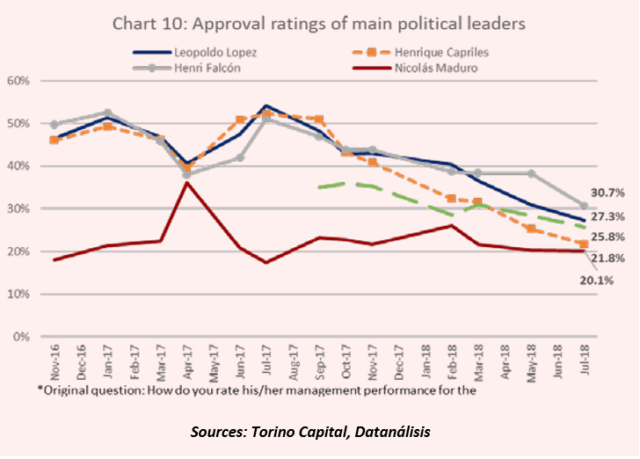
Data from the opposition-aligned pollsters in Venezuela (via Torino Capital) indicates that Henri Falcón was the most popular of the major opposition figures at the time of the May 2018 presidential election. Nicolás Maduro won the election due to widespread opposition boycotting and votes drawn by another opposition candidate, Javier Bertucci.
The constitutional argument that Trump and his accomplices have used to “recognize” Guaidó rests on the preposterous claim that Maduro has “abandoned” the presidency by soundly beating Falcón in the election. Caracas-based journalist Lucas Koerner took apart that argument in more detail.
What about the McClatchy-owned Herald‘s claim that Maduro “continues to reject international aid”? In November 2018, following a public appeal by Maduro, the UN did authorize emergency aid for Venezuela. It was even reported by Reuters (11/26/18), whose headlines have often broadcast the news agency’s contempt for Maduro’s government.
It’s not unusual for Western media to ignore facts they have themselves reported when a major “propaganda blitz” by Washington is underway against a government. For example, it was generally reported accurately in 1998 that UN weapons inspectors were withdrawn from Iraq ahead of air strikes ordered by Bill Clinton, not expelled by Iraq’s government. But by 2002, it became a staple of pro-war propaganda that Iraq had expelled weapons inspectors (Extra! Update, 10/02).
And, incidentally, when a Venezuelan NGO requested aid from the UN-linked Global Fund in 2017, it was turned down. Setting aside how effective foreign aid is at all (the example of Haiti hardly makes a great case for it), it is supposed to be distributed based on relative need, not based on how badly the US government wants somebody overthrown.
But the potential for “aid” to alleviate Venezuela’s crisis is negligible compared to the destructive impact of US economic sanctions. Near the end of Wyss’ article, he cited an estimate from the thoroughly demonized Venezuelan government that US sanctions have cost it $30 billion, with no time period specified for that estimate. Again, this calls to mind the run-up to the Iraq invasion, when completely factual statements that Iraq had no WMDs were attributed to the discredited Iraqi government. Quoting Iraqi denials supposedly balanced the lies spread in the media by US officials like John Bolton, who now leads the charge to overthrow Maduro. Wyss could have cited economists independent of the Maduro government on the impact of US sanctions—like US economist Mark Weisbrot, or the emphatically anti-Maduro Venezuelan economist Francisco Rodríguez.
Illegal US sanctions were first imposed in 2015 under a fraudulent “state of emergency” declared by Obama, and subsequently extended by Trump. The revenue lost to Venezuela’s government due to US economic sanctions since August 2017, when the impact became very easy to quantify, is by now well over $6 billion. That’s enormous in an economy that was only able to import about $11 billion of goods in 2018, and needs about $2 billion per year in medicines. Trump’s “recognition” of Guaidó as “interim president” was the pretext for making the already devastating sanctions much worse. Last month, Francisco Rodríguez revised his projection for the change in Venezuela’s real GDP in 2019, from an 11 percent contraction to 26 percent, after the intensified sanctions were announced.
The $20 million in US “aid” that Wyss is outraged Maduro won’t let in is a rounding error compared to the billions already lost from Trump’s sanctions.
Former US Ambassador to Venezuela William Brownfield, who pressed for more sanctions on Venezuela, dispensed with the standard “humanitarian” cover that US officials have offered for them (Intercept, 2/10/19):
And if we can do something that will bring that end quicker, we probably should do it, but we should do it understanding that it’s going to have an impact on millions and millions of people who are already having great difficulty finding enough to eat, getting themselves cured when they get sick, or finding clothes to put on their children before they go off to school. We don’t get to do this and pretend as though it has no impact there. We have to make the hard decision—the desired outcome justifies this fairly severe punishment.
How does this gruesome candor get missed by reporters like Wyss, and go unreported in his article?
Speaking of “severe punishment,” if the names John Bolton and Elliott Abrams don’t immediately call to mind the punishment they should be receiving for crimes against humanity, it illustrates how well the Western propaganda system functions. Bolton, a prime facilitator of the Iraq War, recently suggested that Maduro could be sent to a US-run torture camp in Cuba. Abrams played a key role in keeping US support flowing to mass murderers and torturers in Central America during the 1980s. Also significant that Abrams, brought in by Trump to help oust Maduro, used “humanitarian aid” as cover to supply weapons to the US-backed Contra terrorists in Nicaragua.
In the Herald article, the use of US “aid” for military purposes is presented as another allegation made by the vilified Venezuelan president: “Maduro has repeatedly said the aid is cover for a military invasion and has ordered his armed forces not to let it in, even as food and medicine shortages sweep the country.”
Calling for international aid and being democratically elected will do as little to protect Maduro’s government from US aggression as being disarmed of WMD did to prevent Iraq from being invaded—unless there is much more pushback from the US public against a lethal propaganda system.
US senators re-introduce Russian sanctions ‘bill from hell’

Senators Lindsey Graham (R-SC) and Bob Menendez (D-NJ). ©REUTERS / Yuri Gripas
RT February 13, 2019
A group of senators have introduced a bill suggesting a wide range of sanctions against Russia.
The bill, sponsored by Republican Sen. Lindsey Graham (South Carolina) and Democrat Bob Menendez (New Jersey) will target Russia’s banking and energy sectors, as well as its foreign debt. The Defending American Security from Kremlin Aggression Act (DASKA) of 2019 may affect individuals who the US would deem to “facilitate illicit and corrupt activities, directly or indirectly, on behalf of Putin.”
Graham introduced a similar bill last year, dubbed the “sanctions bill from hell.” The bill that failed to pass would have also called on Congress to declare Russia a “state sponsor of terrorism,” would have make it harder for the US to leave NATO, and would have accused Russia of committing war crimes in Syria, among a laundry list of other provisions. Similar ideas were relocated to the new proposal.
“President Trump’s willful paralysis in the face of Kremlin aggression has reached a boiling point in Congress,” Menendez said in a statement on Wednesday. Graham, an ally of Trump, echoed the sentiment of the fellow lawmaker, minus his criticism of the president.
“The sanctions and other measures contained in this bill are the most hard-hitting ever imposed – and a direct result of Putin’s continued desire to undermine American democracy,” he wrote.
Russian interference in American elections has never been proven. A handful of Russian nationals have been charged with interference, but those indictments are largely symbolic.
Graham and Menendez’ bill comes one day after the Senate Intelligence Committee announced it had found no evidence of collusion between the Trump campaign and Russia during the 2016 election. Another House investigation came to the same conclusion last year.
Regardless of the committee’s conclusion, Graham and Menendez’ bill promises a raft of hard-hitting sanctions on Russia. These sanctions target banks that “support Russian efforts to undermine democratic institutions in other countries,” sanctions on Russia’s cyber sector, and sovereign debt.
They also include sanctions on Russia’s energy sector, mainly its crude oil projects inside the country and liquefied natural gas projects abroad. Russia currently provides almost 40 percent of Europe’s natural gas imports, a share that the US is keen to muscle in on. Despite both Trump and European Commission President Jean-Claude Juncker promising to step up the US-EU gas trade, business has floundered, mostly due to the logistical headache of transporting the gas across the Atlantic Ocean.
The proposed sanctions also include penalties on Russia’s shipbuilding sector, a response to the confrontation between Russian and Ukrainian vessels in the Kerch Strait last November. Russian authorities accused the Ukrainian navy of performing dangerous maneuvers and denounced their actions as “provocation.”
Many of the bill’s other measures are carried over from Graham and Menendez’ failed legislation last year. It includes a statement of support for NATO and a two-thirds Senate vote to leave the alliance, as well as weapons shipments to any NATO countries that rely on Russian military equipment.
Provisions that would punish the Russian government for alleged chemical weapons production remain in the bill, as does the call for Russia to be declared a “state sponsor of terrorism.”
The reintroduced bill is “the continuation of the insane campaign conducted by the US,” said deputy chairman of the Russian Parliament’s Foreign Affairs Committee, Aleksey Chepa, adding that he was certain that the bill won’t float. Russian MP Leonid Slutsky earlier dismissed the planned sanctions, saying whatever damage they would do if imposed would not be critical. “Russia will certainly not perish,” he said.
Nothing stopping Russian-German trade turnover’s rapid growth
RT | February 13, 2019
Trade turnover between Russia and its second largest trade partner, Germany, increased 8.4 percent and reached nearly €62 billion ($70 billion) in 2018 compared to previous year, according to the German trade lobby.
Year-on-year imports from Russia to Germany expanded 14.7 percent, amounting to €36 billion ($40 billion). Export to Russia rose by 0.6 percent to €25.9 billion ($29 billion), the German-Russian Chamber of Commerce, which represents over 800 German firms, reported on Monday citing the Federal Statistical Office.
This is despite sanctions against Moscow and threats from the US to penalize German companies involved in the Russia-led Nord Stream 2 pipeline project.
“German business has successfully increased exports to Russia despite the market difficulties, sanctions and counter-sanctions. This has also improved our expectations for 2019,” the chairman of the German-Russian Chamber of Commerce, Matthias Schepp, said in a statement.
At the end of last year, Schepp said German firms boosted their investment in the Russian economy in spite of economic sanctions, adding such an investment volume has rarely been seen since the collapse of the Soviet Union. Speaking to RT at the St. Petersburg Economic Forum in May, the head of the German trade lobby said that it’s not only car manufacturers investing heavily in Russia but medium-sized businesses as well.
Germany is Russia’s second largest trade partner, behind China. The trade turnover between Beijing and Moscow also surged last year by 24.5 percent to $108.3 billion, with $56.1 billion of it amounting to Russian exports to China. This is the first time since 2006 that Russia has had a trade surplus with its Eastern partner.
Anti-Russia Sanctions Imposed Due to Strong US Pressure – Lavrov
Sputnik – 13.02.2019
On Tuesday, the Financial Times reported that the United States and the European Union had been negotiating and were close to reaching an agreement on imposing new economic sanctions against Russia after the incident in the Sea of Azov in late November.
Russian Foreign Minister Sergei Lavrov stated on Tuesday that the possible sanctions over the Kerch Strait incident are imposed under strong pressure from the United States.
“But we also know that these sanctions are taken under the strongest US pressure, which once again shows the EU’s lack of independence. Sad,” Lavrov said.
He also said that Russia doesn’t discuss sanctions with anyone and it is focused on developing its economy so it does not depend on other states’ whims.
“We have already said a long time ago that we are not discussing sanctions with anyone. We want to build our economy, trade with normal foreign partners so as not to depend on someone’s whims. In this case, the whims of those who did not keep their word, allowed a coup in Kiev, did not make the opposition fulfill agreements with [then] president [Viktor] Yanukovych, ” Lavrov said at a press conference following talks with his Lesotho counterpart Lesego Makgothi.
He added he considered the planned sanctions as a sign that the Europeans were again admitting their inability to make Ukrainian President Petro Poroshenko implement the Minsk agreements.
The foreign minister’s comments follow the Financial Times’ earlier reports that the US and the EU were close to reaching an agreement on imposing new economic anti-Russia sanctions for its alleged aggression toward Ukraine in the Sea of Azov in late November.
On November 25, Ukraine’s Berdyansk and Nikopol gunboats, and the Yany Kapu tugboat illegally crossed the Russian maritime border as they sailed toward the Kerch Strait, the entrance to the Sea of Azov. Russia seized the Ukrainian vessels and detained 24 people on board after they failed to respond to a demand to stop. After the incident, a criminal case on illegal border crossing was opened in Russia.
Moscow has repeatedly slammed Kiev’s attempts to portray the detained sailors as prisoners of war, stressing that they faced criminal charges. Russian President Vladimir Putin said that the incident was a provocation prepared in advance as a pretext to declare martial law, which was announced after the incident and lasted for a month. Putin said the provocation could be linked to Ukrainian leader Petro Poroshenko’s low approval ratings ahead of the presidential election, set to be held in March.
Germany Pulls Rank on Macron and American Energy Blackmail
By Finian CUNNINGHAM | Strategic Culture Foundation | 13.02.2019
It was billed politely as a Franco-German “compromise” when the EU balked at adopting a Gas Directive which would have undermined the Nord Stream 2 project with Russia.
Nevertheless, diplomatic rhetoric aside, Berlin’s blocking last week of a bid by French President Emmanuel Macron to impose tougher regulations on the Nord Stream 2 gas project was without doubt a firm rebuff to Paris.
Macron wanted to give the EU administration in Brussels greater control over the new pipeline running from Russia to Germany. But in the end the so-called “compromise” was a rejection of Macron’s proposal, reaffirming Germany in the lead role of implementing the Nord Stream 2 route, along with Russia.
The $11-billion, 1,200 kilometer pipeline is due to become operational at the end of this year. Stretching from Russian mainland under the Baltic Sea, it will double the natural gas supply from Russia to Germany. The Berlin government and German industry view the project as a vital boost to the country’s ever-robust economy. Gas supplies will also be distributed from Germany to other European states. Consumers stand to gain from lower prices for heating homes and businesses.
Thus Macron’s belated bizarre meddling was rebuffed by Berlin. A rebuff was given too to the stepped-up pressure from Washington for the Nord Stream 2 project to be cancelled. Last week, US ambassador to Germany Richard Grenell and two other American envoys wrote an op-ed for Deutsche Welle in which they accused Russia of trying to use “energy blackmail” over Europe’s geopolitics.
Why France’s Macron, at the last minute, attempted to undermine the project by placing stiffer regulations is a curious question. Those extra regulations if they had been imposed would have potentially made the Russian gas supply more expensive. As it turns out, the project will now go-ahead without onerous restrictions.
In short, Macron and the spoiling tactics of Washington, along with EU states hostile to Russia, Poland and the Baltic countries, have been put in their place by Germany and its assertion of national interests of securing economical and abundant gas supply from Russia. Other EU member states that backed Berlin over Nord Stream 2 were Austria, Belgium, Cyprus, Greece and the Netherlands.
Washington’s claims that Nord Stream 2 would give Russia leverage of Europe’s security have been echoed by Poland and the Baltic states. Poland, and non-EU Ukraine, stand to lose out billions of dollars-worth of transit fees. Such a move, however, is the prerogative of Germany and Russia to find a more economical mode of supply. Besides, what right has Ukraine to make demands on a bilateral matter that is none of its business? Kiev’s previous bad faith over not paying gas bills to Russia disbars it from reasonable opinion.
Another factor is the inherent Russophobia of Polish and Baltic politicians who view everything concerning Russia through a prism of paranoia.
For the Americans, it is obviously a blatant case of seeking to sell their own much more expensive natural gas to Europe’s giant energy market – in place of Russia’s product. Based on objective market figures, Russia is the most competitive supplier to Europe. The Americans are therefore trying to snatch a strategic business through foul means of propaganda and political pressure. Ironically, the US German ambassador Richard Grenell and the other American envoys wrote in their recent oped: “Europe must retain control of its energy security.”
Last month, Grenell threatened German and European firms involved in the construction of Nord Stream 2 that they could face punitive American sanctions in the future. Evidently, it is the US side that is using “blackmail” to coerce others into submission, not Russia.
Back to Macron. What was he up to in his belated spoiling tactics over Nord Stream 2 and in particular the attempted problems being leveled for Germany if the extra regulations had been imposed?
It seems implausible that Macron was suddenly finding a concern for Poland and the Baltic states in their paranoia over alleged Russian invasion.
Was Macron trying to garner favors from the Trump administration? His initial obsequious rapport with Trump has since faded from the early days of Macron’s presidency in 2017. By doing Washington’s bidding to undermine the Nord Stream 2 project was Macron trying to ingratiate himself again?
The contradictions regarding Macron are replete. He is supposed to be a champion of “ecological causes”. A major factor in Germany’s desire for the Nord Stream 2 project is that the increased gas supply will reduce the European powerhouse’s dependence on dirty fuels of coal, oil and nuclear power. By throwing up regulatory barriers, Macron is making it harder for Germany and Europe to move to cleaner sources of energy that the Russian natural gas represents.
Also, if Macron had succeeded in imposing tougher regulations on the Nord Stream 2 project it would have inevitably increased the costs to consumers for gas bills. This is at a time when his government is being assailed by nationwide Yellow Vest protests over soaring living costs, in particular fuel-price hikes.
A possible factor in Macron’s sabotage bid in Germany’s Nord Stream 2 plans was his chagrin over Berlin’s rejection of his much-vaunted reform agenda for the Eurozone bloc within the EU. Despite Macron’s very public amity with Chancellor Angela Merkel, Berlin has continually knocked back the French leader’s ambitions for reform.
It’s hard to discern what are the real objectives of Macron’s reforms. But they seem to constitute a “banker’s charter”. Many eminent German economists have lambasted his plans, which they say will give more taxpayer-funded bailouts to insolvent banks. They say Macron is trying to move the EU further away from the social-market economy than the bloc already has moved.
What Macron, an ex-Rothschild banker, appears to be striving for is a replication of his pro-rich, anti-worker policies that he is imposing on France, and for these policies to be extended across the Eurozone. Berlin is not buying it, realizing such policies will further erode the social fabric. This could be the main reason why Macron tried to use the Nord Stream 2 project as leverage over Berlin.
In the end, Macron and Washington – albeit working for different objectives – were defeated in their attempts to sabotage the emerging energy trade between Germany, Europe and Russia. Nord Stream 2, as with Russia’s Turk Stream to the south of Europe, seems inevitable by sheer force of natural partnership.
On this note, the Hungarian government’s comments this week were apt. Budapest accused some European leaders and the US of “huge hypocrisy” in decrying association with Russia over energy trade. Macron has previously attended an economics forum in St Petersburg, and yet lately has sought to “blackmail” and disrupt Germany over its trade plans with Russia.
As for the Americans, their arrant hypocrisy is beyond words. As well as trying to dictate to Europe about “market principles” and “energy security”, it was reported this week that Washington is similarly demanding Iraq to end its import of natural gas from neighboring Iran.
Iraq is crippled by electricity and power shortages because of the criminal war that the US waged on that country from 2003-2011 which destroyed much of the country’s infrastructure. Iraq critically needs Iranian gas supplies to keep the lights and fans running. Yet, here we have the US now dictating to Iraq to end its lifeline import of Iranian fuel in order to comply with the Trump administration’s sanctions against Tehran. Iraq is furious at the latest bullying interference by Washington in its sovereign affairs.
The hypocrisy of Washington and elitist politicians like Emmanuel Macron has become too much to stomach. Maybe Germany and others are finally realizing who the charlatans are.
Tel Aviv irate after Total says Israel not worth investing in
Press TV – February 11, 2019
French energy giant Total has sparked the anger of Israeli authorities after its chief executive said making investment in the “complex” Israel was not worth the risk.
Total’s chief executive Patrick Pouyanne said in an interview with the Financial Times that it was too “complex” to invest in Israel, noting that his company’s operation in the Middle East was a sticking point.
“We like complex situations … up to a certain point. Let’s be clear,” he said.
Pouyanne further said that the stakes in Israel were not big enough to accept the risks involved, partly due to the competition already in the region.
Israel’s energy minister Yuval Steinitz slammed the stance as “unacceptable,” saying firms that refused to invest in Israel were living in the “past decades.”
“I reject it with two hands, I think this is a miserable view,” Steinitz said, adding “We will consider our reaction to this as it is totally unacceptable, to boycott [Israel].”
Israel relies heavily on gas. The Tel Aviv regime has long been developing a number of offshore gas deposits in the Mediterranean Sea.
Steinitz claimed that other international firms, including Google, Lockheed Martin and Boeing, that had invested in Israel had not faced any problems in the Arab world.
“Companies that were afraid to make investments in Israel in the past because of the Arab Muslim world made the wrong calculation,” Steinitz said, adding he had met many energy ministers from Persian Gulf Arab countries in recent years.
“If somebody is avoiding investing in Israel because it might have interests in Iran then that can be the only reason, because the Arab world is not concerned,” the Israeli minister claimed.
However, a person from the gas industry, said, “It’s not only Total who faces these kinds of realities in the region.”
Texas-based Noble Energy and Israeli company Delek Resources have been the two main operators in Israel. Executives say the largest international operators are still concerned about the fragile politics of the region.
In 2017, Total signed a contract to develop phase 11 of Iran’s multi-billion-dollar South Pars gas project with an initial investment of $1 billion.
However, the French company pulled out of the project in August after it failed to obtain a waiver from the US.
Total is also investing in the eastern Mediterranean basin where Israel and Lebanon are involved in a maritime dispute.
Last year, the Lebanese government announced that it had signed gas exploration and production contracts for two energy blocks, including the disputed Block 9, with a consortium of France’s Total, Italy’s Eni and Russia’s Novatek oil and gas companies.
Total, however, said it would not drill the first well of Block 9 near the disputed sliver of waters, adding that the well would be drilled over 25 kilometers from the maritime border claimed by Israel.
Hastily-Buried Radioactive Waste Lays Bare Nuclear Power Legacy
Sputnik – 11.02.2019
Over 126,000 barrels of radioactive material are stored in the Asse mine in Lower Saxony, a state in northwest Germany bordering the North Sea, a fact that has many locals – as well as the global anti-nuke community – frustrated.
Manfred Kramer, a member of the Social Democratic Party of Germany, lives close to the Asse salt mine in which the decaying waste is stored and — while acknowledging that politicians are finally beginning to take notice — has long protested against having radioactive waste in the old mine, Tekportal reported.
“It’s nice that she’s finally coming,” Kramer said, referring to Environment Minister Svenja Schulze’s upcoming visit to the mine, which was originally used for the extraction of potash salt until 1965. “Soon she’ll have been in office for a year. It sure took a while!” he quipped, according to Deutsche Welle.
“Three generations operated nuclear power in Germany, and now 30 generations or even more will have to suffer the consequences,” Schulze noted, adding, “this is proof of how irresponsible nuclear energy was.”
According to mining engineer Thomas Lautsch, who works for BGE, Germany’s federal company for radioactive waste disposal, the retrieval of the nuclear waste from the mine will be complicated and expensive, at a minimum.
“We would have to build a retrieval mine, which is more than simply just a new shaft. We would also need an interim storage facility for the waste, and we would have to create many new shafts to gain access to the individual chambers,” he said, cited by Msn.com.
The construction phase of the project alone could take eight or nine years, according to studies.
Because the old mine shafts do not meet current legal standards for the ten-thousand-year storage of nuclear waste, a new mine must be built around the old mine.
“The barrels must be finally and safely disposed of somewhere else in the country,” Kramer noted, “should they actually able to be retrieved by 2050.”
The mine, developed between 1906-1908, has a depth of around 765 meters. Between 1965-1995, the Helmholtz Zentrum München (a member of the Helmholtz Association of German Research Centers responsible for studying environmental health issues) took the unprecedented step of using the mine to store the nation’s radioactive waste, including weapon detritus, medical offal and power plant leavings.
Featured Video

Death Spikes & Rising Cancer In Our Youth Explained
or go to
Aletho News Archives – Video-Images
From the Archives
Politicians lie
By Mazin Qumsiyeh | Popular Resistance | August 18, 2013
There is no way to say this truth nicely: Politicians lie. That includes Japanese, American, Egyptian, Israeli, and Palestinian politicians! Is there something more common sense than that? Yet, so many citizens around the world believe their own politicians or wistfully acknowledge lies but think it is part of the job needed to run things. They believe even when politicians contradict themselves blatantly. This phenomenon is rather remarkable. It is a dissonance and disconnect from reality that many seem oblivious to. It is very dangerous because it can lead to accepting rationales for going to war. These can be deadly wars that lead to millions of lives lost as happened in what was called World War 1 and WW2. Even when incredible and declassified evidence abound, politicians continue to lie and old mythologies refuse to die. Here are just a few of the countless lies told to us over the past few decades… continue
Blog Roll
 Aletho News
- Global Tipping Points Lead the World Into a State of Entropy
- The day-after at the White House: USA and Xi Jinping
- The Geopolitical Balance in the Red Sea: The UAE Being Displaced by New Players
- Iraqi resistance group vows to stage airport sit-ins over Iran aerial blockade
- Turkish parliament to review Saudi-Pakistan defense pact next month
- DEATH SPIKES & RISING CANCER IN OUR YOUTH EXPLAINED
- Iran offers Trump deal before US election
- Merz regime wants ‘secret police’ – opposition
- Israeli settlers terrorize West Bank Palestinians with state-provided drones: Report
- They see them, then kill them: Israeli quadcopters track, deliberately target civilians in Gaza
- If Americans Knew
- Deconstructing Netanyahu’s pants-on-fire UN rant – Daily Update
- Trump betrayed voters with his campaign lies and prioritized a foreign country once he took office
- Netanyahu calls Israel’s war in Gaza ‘opposite of genocide’ in UN speech to near-empty hall
- Settler Kidnappings: Torture, Sexual Abuse and Terrorisation of Palestinian Abductees as Israel Deepens Annexation of West Bank
- Gaza winter nears as 162,000 tents become unusable, raising fears of humanitarian crisis
- Netanyahu says, “It’s the opposite of genocide”; UN says Gaza economy is world’s ‘most severe crisis on record’ – Daily Update
- Israel’s US-Backed Assault on Gaza Has Created the ‘World’s Most Severe Economic Crisis on Record’: UN
- ‘Protecting U.S. Citizens’… From Israel
- ‘This is where I live now, the back of a truck’: a day in the life of a grandmother in Gaza
- In UN Speech, Iran’s President Displays Pictures of Children Killed by US, Brings Attention to Israel’s Nuclear Arsenal
- No Tricks Zone
- New Study: Earth And Venus Surface Warmth Largely Explained By Convection And Lapse Rate, Not CO2 Or Radiation
- 2025 Nature Paper Claiming Worsening Global Drought Gets RETRACTED …Heavily Flawed
- New Study: ‘Global Drought Shows No Detectable Recent Acceleration Under Climate Warming’
- Economic Masterminds: German Socialists Suggest Taxing Productivity Gains Stemming From Using AI
- The South China Sea Has Not Been Cooperating With The Climate Change Narrative
- Energy Crisis: Germany Enters Heating Season With Historically Low Gas Reserve Fill Levels
- New Study: The Antarctic Ice Sheet Gained Mass From 2020-2024 Due To Staggering Snow And Ice Accumulation
- Study: Ocean Heating Rates From Thousands Of Years Ago ‘Dwarf’ Modern Ocean Heating Rates
- Climate Extremists Target, Attack Large-Scale Power Grid Infrastructure In Germany!
- New Study: Antarctic Ice Melt Has Contributed Less Than 1 Centimeter To Sea Level Rise In The Last 30 Years

