Russia Profits as US Takes Venezuelan Oil off the Market in Europe
By Irina Slav – Oilprice.com – April 12, 2019
European refiners are switching to Russian sour grades as U.S. sanctions have shrunk Venezuela’s similar-grade exports, Reuters reports, adding that the Russian sour crude is getting increasingly expensive.
Citing sources from the trading industry, Reuters says the situation has been made worse by the fact that OPEC members have cut mainly their output of heavier, more sour grades under the OPEC+ agreement aimed at stimulating a price rise.
U.S. crude is not an alternative as it is overwhelmingly light and sweet, while refineries in Europe are equipped to process heavier grades as well as light ones to make refined products.
The news is the latest reminder that the world is tipping towards a shortage of heavy, sour crude, which is the staple kind of Venezuela crude and which many refineries need to produce fuels and other products.
“Urals is anchored in a positive zone versus dated Brent and there is no indication it will fall to a discount any time soon,” one of the Reuters’ sources said. That’s a complete reversal of the traditional differential between light and heavy oil, with the latter typically trading at a discount to Brent, a light blend.
Sanctions on Iran are further complicating life for European refiners as they have restricted exports of sour grades that Iran also produces in addition to its very popular superlight crude, also called condensate.
According to Reuters, U.S. sanctions have removed 800,000 bpd of heavy crude from the global market, leaving refiners scrambling for alternatives in a limited pool that, besides Russia and Middle Eastern producers, also includes Canada and Mexico as large producers of these grades of crude. The former is having its own problems with a pipeline capacity shortage and a production cut that has boosted prices, and the latter has yet to reverse a fall in oil production.
Hypocrisy Inc: Washington’s Selective Sanctions
By Brian CLOUGHLEY | Strategic Culture Foundation | 08.04.2019
On April 3 US Vice President Pence told Germany and Turkey to stop dealing with Russia. In a speech in Washington marking the 70th Anniversary of the US-NATO military alliance he declared that “If Germany persists in building the Nord Stream 2 pipeline, as President Trump said, it could turn Germany’s economy into literally a captive of Russia,” while Turkey is being “reckless” and “must choose — does it want to remain a critical partner of the most successful military alliance in the history of the world, or does it want to risk the security of that partnership by making reckless decisions that undermine our alliance?”
(We’ll pass over the fact that “the most successful military alliance in the history of the world” bombed and rocketed Libya in a nine-month blitz in 2011 and claimed a “model intervention” in a country it reduced to anarchy, as reported on April 5.)
Radio Free Europe noted that Pence “voiced US opposition to Turkey’s purchase of a Russian air-defense system… which he said ‘poses great danger to NATO’.” He also threatened that “we will not stand idly by while NATO allies purchase weapons from our adversaries”.
The weapons system to which Washington so violently objects is the S-400 Triumf surface-to-air missile which Army Technology describes as “capable of firing three types of missiles to create a layered defence [and] engaging all types of aerial targets including aircraft, unmanned aerial vehicles, and ballistic and cruise missiles within the range of 400 km, at an altitude of up to 30 km. The system can simultaneously engage 36 targets.” In other words it’s a world-beater with a real punch, as is evidenced by the fact that so many other countries have either got it or want it.
The first sanctions Washington imposed against Turkey concern supply of the 100 Lockheed Martin F-35 combat aircraft ordered at a cost of 16 billion dollars. According to CNN a US spokesman said “Pending an unequivocal Turkish decision to forgo delivery of the S-400, deliveries and activities associated with the stand-up of Turkey’s F-35 operational capability have been suspended.” This is harsh action against a longtime partner and military ally, but it doesn’t stop there, because Washington objects to Russia providing military equipment to other nations.
China is an example. In September 2018 sanctions were imposed on China by Washington because it had engaged in “significant transactions” with Russia’s Rosoboronexport by purchasing SU-35 combat aircraft and S-400 systems.
A US official told reporters “The ultimate target of these sanctions is Russia… [sanctions are] aimed at imposing costs upon Russia in response to its malign activities.” This is effected by US Public Law 115-44, the ‘Countering America’s Adversaries Through Sanctions Act’ (CAATSA) which is intended to “provide congressional review and to counter aggression by the Governments of Iran, the Russian Federation, and North Korea, and for other purposes.”
“Other purposes” is quite a large sphere of implied threat, but the ruling of US legislators in this case is clear, in that any country that acquires S-400 air defence missile systems (for example) from Russia is going to be penalised because Washington is determined to continue “imposing costs upon Russia” for providing such equipment. And it is inevitable that the imposed penalties will impact on the country that has dared to engage with Russia. The Diplomat summed it up by observing that the policy “decrees the imposition of mandatory economic sanctions on countries importing Russian military hardware.”
Except when it doesn’t.
It is apparent that the anti-Russia “Countering Adversaries” legislation directed by Congress is being selectively ignored by Washington, because India is being provided with the S-400 system, and no sanctions have been imposed by America. An agreement for supply of S-400s was signed on October 5, 2018 in Delhi during an India-Russia summit meeting attended by Indian Prime Minister Modi and President Putin. The Economic Times reported that India and Russia “have formally inked the $ 5.2 billion deal for S-400 system. The air defence system is expected to be delivered by the year 2020.”
Following the summit, Outlook India noted approvingly that “Other areas of collaboration, which figured prominently in the joint statement between the two sides, are nuclear reactors, investments by Indian diamond companies in Russian Far East, and ‘joint collaboration in precious metals, minerals, natural resources and forest produce, including timber, through joint investments, production processing and skilled labour’. The review of priority investment projects in the spheres of mining, metallurgy, power, oil, and gas, railways, pharmaceuticals, information technology, chemicals, infrastructure, automobiles, space, shipbuilding and manufacturing of different equipment reflects a focus on the desire for diversification. PM Modi has invited Russian companies to set up industrial parks in India for defence manufacturing.”
It might be thought that such bilateral collaboration in defence matters, especially in regard to provision of the S-400 system, would attract instant action by Washington, designed to penalise India for flagrant contravention of US directives.
But no.
In some fashion, India is different from Turkey and China when it comes to acquiring S-400 missile systems, and an explanation of sorts was offered by the Pentagon’s Assistant Defence Secretary Randall Schriver in testimony to the House of Representatives Armed Forces Committee on March 27. He declared that the US-India “Major Defence Partnership” was prospering by “moving toward deeper security cooperation by increasing operational cooperation and availing key maritime security capabilities.” But then there was mention of the purchase for over five billon dollars by India from Russia of a world-beating air defence system, and Mr Schriver wasn’t comfortable with that.
He was asked by Congressman Seth Moulton how India’s purchase of S-400 systems and the lease of Russian nuclear submarines would impact India-US relations and avoided any reply concerning the submarine lease while stating that purchase of S-400s has “not gone to contract or completed”, which, like so many official statements in Washington, was only half true. Certainly, delivery of the S-400s has not been completed; but for Mr Schriver to claim that the matter “has not gone to contract” is a downright lie.
The effects of Washington’s sanctions on its adversaries have been wide as well as selective. In the case of Turkey, what Pence calls the “reckless decision” to acquire S-400s has shown Ankara that America is not an ally and cannot be trusted, while encouraging it to further examine the dubious benefits of belonging to the US-NATO military alliance. China reacted by saying “We strongly urge the US side to immediately correct the mistake and rescind the so-called sanctions, otherwise the US side will necessarily bear responsibility for the consequences,” while reinforcing China-Russia cooperation and strengthening resistance to US policy of global dominance.
In the case of India, US sanctions’ policy was highlighted on April 2 when the Pentagon announced that India would be provided with 24 US Seahawk maritime attack helicopters for use against China and Pakistan, at a cost of 2.6 billion dollars. India is content that it can do whatever it wants, and New Delhi will continue to benefit from Washington’s total lack of principles and ethical consistency. Selective sanctions are the name of the game.
Baseline of a Desecrated Land I: Food Supply
Part 1 of a 12 part series examining the ecological impacts of Israel’s illegal occupation of Palestine.
How Israel’s water and agricultural technologies don’t even work for Israel
By Dick Callahan | September 30, 2018
“California I hear has a big water problem. We in Israel don’t have a water problem. We use technology to solve it…” Israeli Prime Minister Benjamin Netanyahu to California Governor Jerry Brown in March 2014.
“If you were planning to grow a new strain of tomato—don’t do it, because there is no water. Stop planting. Stop sowing new seedlings. There’s no water.” Giora Shacham, Chairman of the Israeli Water Authority, to Jewish farmers at a December, 27, 2017 Israeli agriculture conference.
Introduction
A new mythology has it that Israel can save American agriculture and cities from drought. To accept this is to ignore the wilderness instructor’s maxim: “In a survival situation the first thing you need is recognition.”
Our situation is that we in America have 324 million people and our country exports more food every year than any country in the history of the planet. Israel has eight and a half million people, exports almost no food, is entirely dependent on imported food, and every indicator is screaming that the Jewish state ecosystem is a dying patient on the gurney.
We will mostly bypass what suffering Israeli water colonization has caused Palestinians. Instead, this piece looks at what fisheries biologist Daniel Pauly calls ‘Shifting Baselines,’ where some good thing is degraded over time and each successive generation adopts what is in front of them as their baseline reality. At some point an environment emerges that would terrify our ancestors. We Americans should look hard and honestly at Mother Earth groaning under Zionism in today’s Israel and ask, ‘Does America, or any country desiring a good future, want to follow that road?’
Before we start, it helps to know that Israel is 1,600 square miles smaller than the state of Vermont, the West Bank is smaller than St. Lawrence county in New York state, and the entire Gaza Strip is about the size of Bakersfield, California.
To evaluate Israeli land and water use technologies, these twelve recognitions might serve as jumping off points for discussion.
1) Israel cannot feed itself.
2) Israel pretends desalination impacts don’t exist.
3) Israel takes Syrian, Lebanese, Palestinian, and Jordanian water.
4) Israel’s one and only large, natural water body may be gone within twenty years.
5) Over half of the Jordan river valley’s biodiversity is already gone.
6) Israel and the Occupied Territories are awash in human sewage.
7) West Bank/Israeli streams and groundwater are over exploited and drying up so completely that centuries old trees in the nature reserves are dying of thirst.
8) Israel’s water, forestry, agricultural and military technologies have compromised agricultural land to the point where half of it is depleted and at risk, pesticide use is highest in the OECD, the land is absorbing more heat, and, in the long run, drip irrigation may do more harm than good.
9) Israel is the Flint, Michigan of the Middle East with a history of spectacular toxic spills, dumped military/industrial carcinogens, hundreds of contaminated wells, hundreds of millions of tons of contaminated ground water, millions of tons of oil stored right on the beach, massive unregulated hazardous waste sites built above aquifers, and the world’s oldest nuclear reactor, sitting 18 miles from the Syria-African fault line—with 1,537 documented defects in its aluminum core.
10) Wine, war, industrial tourism, and an unwinnable competition with the faster growing Arab population are the water marks on Israel’s self-portrait.
11) Israel is stuck with being the love-child of 1950’s American water engineers and 1800’s ‘make the desert bloom’ fundamentalism.
12) Israel is a cautionary tale.
Baseline Recognitions
Recognition I: Israel can’t feed itself
“Israel is almost completely dependent on imports to meet its grain and feed needs… Total grain, feedstuff and soybean supply will total about 5.06 million tons.” USDA Foreign Agricultural Service Report, Israel Grain and Feed Annual 02.18.2015 by Gilad Shachar & Orestes Vasquez
Humanity uses most of its fresh water to grow food. Current estimates for Israel’s total annual water consumption run between 2¼ and 2½ billion cubic meters per year. An item missing from that buoyant assessment is the fact that life in the Jewish state depends on importing four times as much, over ten billion metric tons, of virtual water every year via container ships. Virtual water is J.A. Allen’s elegant concept that, instead of trying to understand the value of agricultural commodities in terms of carrots, steaks, bushels of wheat, or how much money those bring in, we should view farm products as compact, transportable carriers embedded with all of the water it took to grow them.
If we include the embedded water footprint of millions of tons of grains/feed/soybeans (GFS) as well as meat, dairy, fruit and other commodities to the equation, Israel’s total annual water requirement quintuples.
The agricultural water footprint for a given commodity includes green water (rainfall that ends up in the root zone), blue water (irrigation from surface and ground water), and grey water (water it takes to dilute agricultural runoff). Below are water footprints of some mainstay Israeli food imports for Market Year 2016.
(commodity in 1,000’s metric tons-Mt) X (tons water to grow a ton)=Water footprint
Corn 1,515 1,222 1,851,330
Wheat 1,758 1,827 3,211,866
Barley 376 1,977 743,352
Soybean Meal 135 2,145 289,575
Rice, milled 115 2,172 249,780
Sorghum 30 3,048 91,440
Rye 4 1,544 6,176
Rape seed meal 140 1,115 156,100
Sunflower meal 240 3,366 807,840
oil, rape seed 44 4,301 189,244
oil, soy bean 374 4,190 1,567,060
sugar, centrifugal 518 865 448,070
total 9,611,833
sources: USDA Foreign Agriculture Service Database. and The Green, Blue and Grey Water Footprint of Crops and Derived Crop Products. UNESCO-IHE, Institute of water education, Volume 1: Main Report. Value of Water Research Report Series No. 47.
- This 9,701,833 Mt water footprint of foodstuffs multiplied by 1,000 tons—because the commodities in the first column are in units of one thousand tons—gives 9,701,833,000 Mt of water.
Now add Israeli beef imports which average over 75,000 metric tons/year. This is in carcass weight equivalent (CWE) which means the cow after it has been gutted and skinned, with the head, tail, hooves removed. About 70 percent of the CWE is red meat. To find the amount of water in 75,000 Mt of red meat we multiply CWE by 0.7, which gives 52,500 Mt of meat. Global average to raise one Mt of red meat is 15,400 Mt of water. Multiplying 52,500 Mt of meat by the 15,400 Mt of water it took to grow them, we get 808,500,000 metric tons of water sent to Israel every year in the form of red meat. That by itself is a third above Israel’s entire annual desalination production.
Add other agricultural imports like 46,000 tons of various protein powders, soup stock, cheese, fresh fruits, 80 million eggs per year, etc and we’re looking at a total virtual reservoir of over 10.5 billion tons of water that Israel does not have to draw from its own resources.
How much is 10.5 billion metric tons of water?
*It’s enough to drain the Sea of Galilee dry more than 2½ times. (when the SoG is full—which it isn’t and hasn’t been for years.)
* It’s around 4 times larger than the entire annual national water consumption of Israel: the whole enchilada including domestic, industrial, meeting Israel’s agreements with Jordan and the Palestinians, etc.
* It’s enough to flood the entire Gaza Strip 28.8 meters (94.5 feet) deep. — [given that Gaza Strip is 365 square km and each square km = one million square meters] 10,500,000,000 cubic meters of water divided by 365,000,000 square meters] = 28.8 meters. 28.8 meters rounds to 94.5 feet.
*And it’s not enough. Israel’s population is growing at a rate of 1.58 percent per year. Grain imports are growing accordingly. By 2021 the country is predicted to require about 5.5 million tons of GFS alone. As the Mideast droughts continue import numbers will only increase.
The Food Security Index
At this juncture the alert Israel supporter might point with satisfaction to the Economist’s 2017 Global Food Security Index which placed Israel at 19th highest of 113 countries. Future factors, like global warming impacts, dropped Israel down to 24th place in the same report, but still, if the index is correct, either 19th or 24th would imply Israel is doing pretty well, wouldn’t it?
Or maybe not counting millions of Palestinians living there shifts the tally. A follow-up 2017 Economist report written with Italy’s Barilla Center for Food and Nutrition, on the Food Security Index, gives an Israeli population of 8.5 million. That number implies Israeli Jewish colonists in the occupied territories (where Israel gets a third of its water and grows a lot of food) are included but the report doesn’t count 2.5 million food-insecure Palestinians who live on that same parcel of land, and also doesn’t include 2 million extremely food-insecure Palestinians in Gaza.
Alternatively, Israel’s place on the index may be artificially high because the index doesn’t adequately survey factors in the Jewish state like the scale of water pollution, erosion, and exhausted agricultural lands.
Then again, the list may just reflect the catastrophic condition of the rest of the world’s food supply. Canada, Russia, Ukraine, Argentina, Hungary, Germany, Brazil and the United States supply most of Israel’s food imports. The index places four of these lower in food security than Israel, raising the question, ‘When your food security depends on distant places that are less food secure than you are, how secure is that?’
Israel’s food suppliers have weathered record breaking droughts on multiple years during the past decade. Their aquifers are dropping. Population stress, economic and political upheavals, and armed conflicts like those between Russia and Ukraine, can be expected to adversely impact grain production and distribution.
Another threat, peculiar to Israeli food security, is the growing worldwide boycott (BDS) of the country because of Israel’s 50+ years-long occupation of the Palestinian territories. If one or more of Israel’s food suppliers joins the boycott it will be a serious loss of calories with few, if any, other nations willing or able to take up the slack.
Before leaving this section, it’s fair to say that America imports agricultural products too, a lot of them, but according the USDA, they’re mostly from nearby Canada and Mexico, and mostly things we could get along without like coffee, spices, cut flowers, nursery stock, etc. rather than food we need to keep from starving.
Whatever happened to the early 1900’s Zionist agricultural model?
A good, simple measure of how well a country’s farming methods work is how well the farmers are doing. How many citizens work in agriculture? Do they earn a decent living? Are they viable? Are they happy with their choice of livelihood?
A hundred-twenty years ago when European Zionists began moving enmasse to Palestine to build their dream of a Jewish cooperative agricultural utopia, optimism was in the air. Most people, young to old, worked on the land. Their collaborative farms, kibbutsim and moshavim, were Jews-only community collectives. Other than the racist aspect it was a progressive experiment in many ways.
That social landscape has changed. In 2016 Yaron Solomon, Agricultural Union Settlement Department Director, pointed out that only 15,000 Israelis still live by farming and 20 percent of those are part-time.
That’s less than a third as many farmers as there were in the 1980’s. The average Israeli farmer now is 62-years-old. Young people are leaving the land for better prospects. Says Solomon, “While the Israeli government is crowing about Israeli farmers in order to attract foreign investment, so that doors will be opened to them overseas, in Israel they are being trampled. Israel is using agricultural knowledge to promote its diplomatic relations and foreign relations, but its policy in recent years has a price, and in the future, Israel will have nothing to offer the world… The Government’s policy is slowly eliminating the small growers, and when there is no renewal of fields, there is a shortage of produce and the land becomes arid.”
Israeli farmers hold lively (for farmers) protests where they do things like smash tomatoes on the road out in front of the Knesset (Israeli parliament). Or, a bunch of them drive tractors through the streets of Jerusalem. Or, they hold up traffic at intersections. Their main complaints are inevitably water costs and water allotments.
Israel depends on other countries to grow its food even on farms inside Israel
If most Israelis are getting out of farming, who is working the remaining farms? Heavy, dangerous agricultural grunt labor, like planting, weeding, spraying pesticides, herbicides (commonly with no protective gear), setting up irrigation equipment, harvesting, and loading trucks, is accomplished by some 25,000 ‘guest workers’ from Thailand, who come to Israel on five-year contracts.
They work through extreme summer heat—greenhouses can be over 120 degrees Fahrenheit—and winter cold, especially at night, which the Thais aren’t adapted to. One hundred twenty-two Thai workers died in the five years between 2008 and 2013. Of those, 22 died for unknown causes because no autopsy was done. Five committed suicide. Forty-three formerly healthy, young Thai males died from something Israelis call, “sudden nocturnal death syndrome.” During the same period only 32 Israeli occupation troops died in military conflicts. Chances of dying at work, then, were about four times higher for Thai farm workers than Israeli soldiers.
Noa Shuer from the worker’s rights group Kav LaOved, said her organization did a survey of 500 Thai workers. None of them was being paid minimum wage. Instead Thai workers are told to sign a time sheet they can’t read because it’s in Hebrew. Almost none of them get a copy. They work up to seventeen hours a day, seven days a week with four days a year off. Workers have to pay a fee, sometimes over $10,000, to brokers to work in Israel. Room, board, income taxes, and national health care fees come out of their wages. Living conditions are often squalid with workers being packed into former animal sheds or sheds where farmers keep pesticides and other chemicals.
Jewish farm owners have tremendous power over Thai workers because they know the workers have to pay back broker fees and don’t want to go home with no money. Someone who makes trouble, like asking to be paid what he or she is supposed to get, can be sent packing back to Thailand with no way to collect what they’re owed. Workers might be assigned other duties besides farming. There are many allegations of dangerous living situations and abuse, including sexual abuse. Some workers had no toilet and were told to use the field out back. In one case there was a single female living among forty male workers with a shared shower. Another woman was awarded $53,000 after she proved the farmer she worked for used her as a sex slave.
Clearly the Thais aren’t counted in the 15,000 Israeli farm workers statistic. Neither are thousands of Palestinian workers who, bereft of their own lands, are forced by economic necessity to work on farms in Israel and the occupied territories. The Palestinians also work under bad conditions for lower pay, plus they have to wait at Israeli checkpoints, both going to the fields and returning home, some rise at 3 in the morning to get in line. Palestinians working for Israelis are supposed to have Israeli-issued permits. Those without permits can be paid less money and they can’t complain because they’re working illegally and they might get carted off to jail. For the most part the Israeli government looks the other way.
Hydro diplomacy
Israel’s water technology media stream flows across the digital landscape like the Amazon River. Its headwaters are a combination of hyperbole, wishful thinking, and putting a new hat on old technologies. Headlines like, “… Israel overcomes an old foe, drought’, ‘Israeli innovation could feed the world…’ ‘12 top ways Israel feeds the world’ are the sort of nonsense Americans expected from the National Enquirer back in the 1970’s but people still buy it. So much so that it would be no surprise to read, “Israeli scientists invent fish that can breathe underwater.” or “Israeli scientists discover a plant that makes its own food from sunshine.” AIPAC leader, turned pro-Israel water author, Seth Siegel provides a simple explanation for the media stream. An interviewer asked Mr. Siegel,
Q: “Do you think Israel’s use of water saving technology can help its relationship to the outside world?”
Siegel replied: “Absolutely. I make that point in the book. There are countries that vote against Israel in the UN but when it comes to water, they invite Israel in. It is hydro-diplomacy.”
This is pretty much what the Agricultural Union’s Yaron Solomon quoted Minister of Agriculture Uri Ariel saying, “Israeli agriculture is among the most advanced in the world, and we are taking steps to leverage this, both economically and politically…”
How realistic are claims that Israel has solved its water problems with technology? We need look no further than Israeli Agricultural Minister Uri Arial in December, 2017, when he called on the Israeli public to assemble at the Western Wall to PRAY FOR RAIN! Yes, as the fifth straight year of drought came knocking at the Damascus Gate, the country’s agricultural front-man was out there channeling Steve Martin in Leap of Faith. Nothing wrong with a good prayer, but ten thousand years of agriculture has shown we don’t want to bet the farm on it.
And yet here comes undaunted Israel with the audacity, the chutzpah, to claim that they can bail us out of water shortage at the very same time we are shipping them billions of tons of embedded water. American water infrastructure, especially in the West, is heavily subsidized by American taxpayers. The time approaches when we’ll have to evaluate the growing harm of sending Colorado River water, what’s left of the Ogallala Aquifer, and other precious dwindling water resources overseas.
Baseline 1 Selected Sources:
10.2018 Tony Allen. Bio. King’s College, London, website. Good thumbnail description of the virtual water concept and the good Professor, who was awarded the Stockholm World Water Prize (2008), the Florence Monito Water Prize (2013), and the Monaco Water Prize (2013).
03/05/2014 Netanyahu Offers to Help Brown Manage California Drought Bloomberg News by JonathanFerziger https://www.bloomberg.com/news/articles/2014-03-05/netanyahu-offers-to-help-brown-manage-california-drought
02.18.2015 USDA Foreign Agricultural Service: Israel Grain and Feed Annual: Prepared by Gilad Shachar & Orestes Vasquez. Approved by Ron Verdonk, Minister-Counselor [From the Executive Summary: “Israel is almost completely dependent on imports to meet its grain and feed needs…Total grain, feedstuff and soybean supply will total about 5.06 million tons.”] *Note that Gilad Shachar did excellent work and his graphs and charts were clear and concise. After 2015 another author took over. [I found subsequent reports are not as clear or complete on imports and, in 2016, contain odd biblical references that I’ve never seen in technical writing.] As a work-around, you can access import/export data for most commodities from any country at USDA Foreign Agricultural Service’s amazing database here: https://apps.fas.usda.gov/psdonline/app/index.html#/app/home There’s a row of blue bars across the screen. Choose ‘Custom Query’. There are four boxes on the new screen: Commodities, Attributes, Countries, Market Years. Click on the commodity you want to see in the first box, that brings up the Attributes menu in the next box over. Click on ‘Imports’, for Country click on ‘Israel, then select the year you want. Click the green Run Query button on lower right of screen. When you want to search for other commodities, there is a red Back to Query button to click on the upper right screen.
02.12.2016 Will beef export volume increase in 2016? Beef Magazine, by Joe Schuele,(75,000 tonnes beef.)
The National Water Carrier (Ha’ Movil Ha’ Artsi) Shmeil Kantor Formern Chief Engineer and Head of Planning Dep. Mekorot Water Co.
http://research.haifa.ac.il/~eshkol/kantorb.html
Also see: Fanak water: Israel Dr. Clive Lipchin, Director of Transboundry Water Management, Arava Institute for Environmental studies, Israel.
The Green, Blue and Grey Water Footprint of Crops and Derived Crop Products. UNESCO-IHE, Institute of water education, Volume 1: Main Report. Value of Water Research Report Series No. 47.wfn.project-platforms.com/Reports/Report47-WaterFootprintCrops-Vol1.pdf
2017 Global Security Index: Measuring food security and the impact of resource risk The Economist Intelligence Unit, sponsored by Dupont. Countries lower on the list than Israel, that supply food to Israel: Hungary-30, Brazil-38, Russia-41, Ukraine-63.
2017 Fixing Food: The Mediterranean Region The Economist/Intelligence Unit with Barilla Center for Food and Nutrition.
11.20.2014 Exporter Guide USDA Foreign Agricultural Service—GAIN Report. Prepared by Gilad Shachar, Approved by Orestes Vasquez, Sr. Agricultural Attaché’. damage to Israeli crops from Protective Edge.
2015 data from USDA Economic Research Service Agricultural Trade page https://www.ers.usda.gov/data-products/ag-and-food-statistics-charting-the-essentials/agricultural-trade/
10.18.2012 Israel to label all egg imports Green Prophet: sustainable news from the Middle East Israel imports around 80 million eggs/year from Turkey.
12.24.2017 Israeli Agriculture Minister’s solution to drought: mass western wall prayers for rain. Haaretz by Zafrir Rinat.
01.21.2015 A raw deal: abuse of Thai workers in Israel’s agricultural sector. Human Rights Watch Sarah Leah Whitson, Executive Director Middle East and North Africa Division.
Israeli Casualties of War Wikipedia is the source of 32 combat casualties.
11.22.2016 Israel’s farmers: an endangered species Globes: Israel’s Business Arena. by Yaron Solomon, Agricultural Union Settlement Department Director. Minister of Agriculture Uri Ariel quote, “Israeli agriculture is among the most advanced in the world, and we are taking steps to leverage this, both economically and politically…”
08.12.2015 How Israel will save the world: (sic) an interview with Seth Siegel. Orthodox Union by OR staff. Hydro-diplomacy quote and assertions about drip irrigation.
01.19.2018 Dry, dry, again: After several wet years, big drought is back again in Israel Haaretz by Hagal Amit. This article has the Gioria Shacham quote about don’t grow new tomatoes.
Gangster Economics Against Huawei & Nordstream 2
By Caleb Maupin – New Eastern Outlook – 04.04.2019
Many Americans base their entire view of the world, and their understanding of the relationship of the United States to other countries, on the contents of a college-level “Economics 101” course. They view the world market as a land of “free competition” in which different countries and international corporations “compete.” They then believe that consumers, communities and countries “vote with their dollars” rewarding the best products and services.
In this delusional fantasy, championed by figures like as George Soros and Anne-Marie Slaughter as an ideal “Open International Market,” the United States and western countries occupy their dominant position, simply because they are the best. The products and services offered by western financial institutions and international corporations are simply superior to those found anywhere else. This delusional fantasy goes on to present the western financial elite as somehow mentoring and assisting the world, by helping it “develop” and perhaps someday be more like the superior west.
The “Energy Dominance” Scheme
Those who argue that this western narrative is false have no greater confirmation than the recent actions of the US government. The response to Nordstream 2 pipeline and the recent crackdown on Huawei technologies confirms that the US government has no interest in free competition among international corporations.
Nordstream 2 is a natural gas pipeline that is currently under construction, scheduled to be completed later this year. It will enable Russia’s state-run energy corporations to sell natural gas to countries inside the European Union. The people in various EU countries favor the construction of Nordstream 2, because it will expand and ad greater convenience to their access of Russian natural gas.
However, in the United States, the Trump administration is joined by Democratic Party “resistance” leaders in demanding that the people of Germany and other European nations not purchase gas from Russia. They foolishly demand that the European community purchase gas from the United States, and import it across the Atlantic Ocean.
It is simple common sense to know that importing natural gas from across the planet will be far more expensive for central Europe than simply pumping it over the border from Russia. However, in a shrill atmosphere of hysteria, invoking all kinds of unrelated issues and allegations against the Russian government, the US political establishment is talking of sanctions and other means of coercing the European public into buying their gas.
While US leaders invoke human rights-based criticism of the Russian government, the hypocrisy is obvious. The Kingdom of Saudi Arabia, a brutal autocracy that beheads and tortures, remains a top business partner of the United States in both the energy and weapons markets. The brutal murder of journalist Jamal Khashoggi has not changed this relationship, which Trump openly defended on a purely financial basis.
The goal of making money for American energy corporations and weakening Russian energy corporations, their competitors, is not even carefully concealed. The White House openly speaks of “Energy Dominance” as the basis for its policy, and speaks of how protecting the profits US-based oil and gas firms is its blatant intention.
The Anti-China Smartphone War
Are the Germans, Belgians, and other European people’s not free to “vote with their dollars” and chose where to purchase their oil and gas? Apparently, the “open international system” is not so open when geopolitical rivals of Wall Street monopolists are involved.
The same rhetoric and methods are being used to try and strong arm countries around the world, and demand that they do not purchase Huawei telecommunications technology from China. Huawei is the largest telecommunications manufacturer in the world. It is an integral part of the market-socialist model developed by Deng Xiaoping and now adjusted and advanced by Xi Jinping.
Huawei phones have longer battery life, better cameras, and more durable, longer lasting hardware than American made phones. All across the world, in places like India, Latin America, and various African countries, the public has selected to buy these cheaper and higher quality phones. The profits of Apple have recently dropped as Huawei’s products have become the choice of more and more consumers around the globe and within China.
However, US leaders once again are demanding that people around the world do not “vote with their dollars” and pick the superior phone. If the free market logic were to apply, US leaders would simply urge American manufacturers to be more competitive. Instead, US leaders continue to demand that countries like Poland and Bulgaria stop doing business with Huawei technologies.
Within the United States, Americans have been prevented from “voting with their dollars” and purchasing the P20, a cutting edge new phone released by the Chinese manufacturer. A whole list of Chinese smartphones are now banned as a supposed national security risk.
US leaders allege that smartphones manufactured by Chinese corporations are a threat to national security because these entities have ties to the Chinese military and government. This claim is rather hypocritical as Apple, AT&T, Verizon, and other American telecommunications companies have not even bothered to conceal their relationship with the US intelligence agencies.
US phones are no less a “military” or “intelligence” threat than Chinese phones are. To expect the Chinese Communist Party, which essentially created Huawei Technologies, to not maintain a relationship with this telecom giant is a ridicules demand.
Not Gentlemanly Business but Gangsterism
More than the “free competition” and “open international system” they advocate, American leaders, seem to be embracing the economic philosophy of Mafia gangsters. Much like criminals operating a protection racquet, US leaders claim that certain countries around the world are their “turf.” They demand that their competitors be locked out, and scramble to impose “consequences” on those who would get in their way.
US leaders are themselves discrediting the very ideology they have spread across the world. They are revealing that in truth, “free competition” is a delusion and that governments tend to rig things in favor of their wealthy paymasters and do their bidding. The mantra of “free competition” has been utilized to restrain developing countries and potential competitors, but US leaders are happy to disregard it and protect the global “turf” of the Wall Street and Silicon Valley monopolies.
The truth is that the richest of the rich in the United States did not acquire their wealth by mere personal sacrifice and brilliance, and the western world did not acquire its place in the world through gentlemanly business practices.
In the 21st Century, countries across the world have rejected these free market delusions and utilized their own governments to construct state-controlled economies to eliminate poverty and raise living standards. Huawei, like Russia’s Gazprom and Rosneft, are the result of economic innovations, in which post-Cold War governments took action to control the economy on behalf of the population.
Unlike so many of the working class people in western countries, the populations of Russia and China have not been left behind in the process of building up these super-corporations. As the two Eurasian superpowers emerged in the 20th century, not due to free markets, but due to socialist central planning, millions were lifted from poverty.
What Monroe Doctrine?
By Philip M. GIRALDI | Strategic Culture Foundation | 04.04.2019
Because there is a presidential election coming up next year, the Donald Trump Administration appears to be looking for a country that it can attack and destroy in order to prove its toughness and willingness to go all the way in support of alleged American interests. It is a version of the old neocon doctrine attributed to Michael Ledeen, the belief that every once in a while, it is necessary to pick out some crappy little country and throw it against the wall just to demonstrate that the United States means business.
“Meaning business” is a tactic whereby the adversary surrenders immediately in fear of the possible consequences, but there are a couple of problems with that thinking. The first is that an opponent who can resist will sometimes balk and create a continuing problem for the United States, which has a demonstrated inability to start and end wars in any coherent fashion.
This tendency to get caught in a quagmire in a situation that might have been resolved through diplomacy has been exacerbated by the current White House’s negotiating style, which is to both demand and expect submission on all points even before discussions begin. That was clearly the perception with North Korea, where National Security Advisor John Bolton insisted that Pyongyang had agreed to American demands over its nuclear program even though it hadn’t and would have been foolish to do so for fear of being treated down the road like Libya, which denuclearized but then was attacked and destroyed seven years later. The Bolton mis-perception, which was apparently bought into by Trump, led to a complete unraveling of what might actually have been accomplished if the negotiations had been serious and open to reasonable compromise right from the beginning.
Trump’s written demand that Kim Jong Un immediately hand over his nuclear weapons and all bomb making material was a non-starter based on White House misunderstandings rooted in its disdain for compromise. The summit meeting with Trump, held in Hanoi at the end of February, was abruptly canceled by Kim and Pyongyang subsequently accused Bolton and Secretary of State Mike Pompeo of making “gangster-like” demands.
The second problem is that there are only a few actual casus belli situations under international law that permit a country to attack another preemptively, and they are usually limited to actual imminent threats. The current situation with Venezuela is similar to that with North Korea in that Washington is operating on the presumption that it has a right to intervene and bring about regime change, using military force if necessary, because of its presumed leadership role in global security, not because Caracas or even Pyongyang necessarily is threatening anyone. That presumption that American “exceptionalism” provides authorization to intervene in other countries using economic weapons backed up by a military option that is “on the table” is a viewpoint that is not accepted by the rest of the world.
In the case of Venezuela, where Trump has dangerously demanded that Russia withdraw the hundred or so advisors that it sent to help stabilize the country, the supposition that the United States has exclusive extra-territorial rights is largely based on nineteenth and early twentieth century unilaterally declared “doctrines.” The Monroe Doctrine of 1823 and the Roosevelt Corollary of 1904 de facto established the United States as the hegemon-presumptive for the entire Western Hemisphere, stretching from the Arctic Circle in the north to Patagonia in the south.
John Bolton has been the leader in promoting the Monroe Doctrine as justification for Washington’s interference in Venezuela’s politics, apparently only dimly aware that the Doctrine, which opposed any attempts by European powers to establish new colonies in the Western Hemisphere, was only in effect for twenty-two years when the United States itself annexed Texas and then went to war with Mexico in the following year. The Mexican war led to the annexation of territory that subsequently became the states of California, New Mexico, Nevada, Utah, Arizona and Colorado. In the same year, the United States threatened war with Britain over the Oregon Territory, eventually accepting a border settlement running along the 49th parallel.
Meanwhile the march westward across the plains continued, forcing the Indian tribes back into ever smaller spaces of open land. The US government in the nineteenth century recognized some Indian tribes as “nations” but it apparently did not believe that they enjoyed any explicit “Monroe Doctrine” rights to continue to exist outside reservations when confronted by the “manifest destiny” proponents who were hell bent on creating a United States that would run from the Atlantic to the Pacific Ocean.
The Roosevelt Corollary of 1904 amended the Monroe Doctrine, making it clear that the United States believed it had a right to interfere in any country in the western Hemisphere to maintain good order, which inevitably led to exploitation of Latin American nations by US business conglomerates that could count on a little help from US Marines if their trade agreements were threatened. In 1898, Washington became explicitly imperialist when it defeated Spain and acquired effective control over Cuba, a number of Caribbean Islands and the Philippines. This led to a series of more than thirty interventions by the US military in the Caribbean and Central America between 1898 and 1934. Other states in the region that were not directly controlled by Washington were frequently managed through arrangements with local autocrats, who were often themselves generals.
Make no mistake, citing the Monroe Doctrine is little more than a plausible excuse to get rid of the Venezuelan government, which is legitimate, like it or not. The recent electrical blackouts in the country are only the visible signs of an aggressive campaign to destroy the Venezuelan economy. The United States is engaging in economic warfare against Caracas, just as it is doing against Tehran, and it is past time that it should be challenged by the international community over its behavior. Guns may not be firing but covert cyberwarfare is total warfare nevertheless, intended to starve people and increase their suffering in order to bring about economic collapse and take down a government to change it into something more amenable to American interests.
Social Media Regulation: Speak of the Devil and in Walks Zuck
By Thomas L. Knapp | The Garrison Center | April 1, 2019
In a recent column on the mating dance between Big Government and Big Tech, I noted that “Big Tech wants to be regulated by Big Governments because regulation makes it more difficult and expensive for new competitors to enter the market.”
Two days after I hit “publish” on that column, Facebook CEO Mark Zuckerberg called for government regulation of social media in a Washington Post op-ed.
Zuckerberg offers expansive arguments for regulating four areas of social media content, but those arguments are specious. My own claim as to his real reasons leers visibly over the shoulder of each argument he makes.
Zuckerberg’s first proposed regulatory area is “harmful content.” “Regulation,” he writes, “could set baselines for what’s prohibited and require companies to build systems for keeping harmful content to a bare minimum.”
Who’s best equipped to build such systems? Facebook, with assets of nearly $100 billion and annual revenues of $56 billion? Or a new site started by some middle class guy (or even an affluent Harvard student like Mark Zuckerberg 15 years ago) with a great idea and some spare time?
The second regulatory area is “protecting elections.” Zuckerberg: “Our systems would be more effective if regulation created common standards for verifying political actors. … We believe legislation should be updated to reflect the reality of the threats and set standards for the whole industry.”
Facebook, of course, has already invested billions in developing technology to identify users and advertisers and connect the two types of parties — all in-house. Most startups don’t have the money to develop their own such systems. They hook into a third party advertising service or a standardized ad sales plug-in. The effect — and the intent — of those “updates” would be to protect Facebook from those startups (and the American political establishment from its own would-be competitors).
“Third, effective privacy and data protection needs a globally harmonized framework. … it should establish a way to hold companies such as Facebook accountable by imposing sanctions when we make mistakes.”
Facebook can easily accommodate “sanctions” that would kill most potential competitors. It already has big bucks in the bank (unlike a new company that may be years away from turning a profit), and that “globally harmonized framework” will almost certainly be built around its own standards and practices.
Finally, “data portability. If you share data with one service, you should be able to move it to another.” What will the “standard data transfer format” Zuckerberg calls for look like? Existing formats for handling user data. Who handles the most user data now? You know who. New competitors will be forced to build systems like Facebook’s, and forbidden to try their own, possibly better, user data handling schemes.
The Internet’s potential is encapsulated in the expropriated Maoism “let a hundred flowers blossom.” Zuckerberg agrees, but only if each of those hundred flowers is cloned from a geranium grown in his proprietary nursery.
Regulation, not competition, is where monopolies come from. Facebook isn’t a monopoly yet, but Zuckerberg clearly wants to make it one.
Thomas L. Knapp (Twitter: @thomaslknapp) is director and senior news analyst at the William Lloyd Garrison Center for Libertarian Advocacy Journalism (thegarrisoncenter.org).
Trump’s Sanctions Kill Venezuelan People. Why Can’t UN Rights Chief Michelle Bachelet ‘Fully Acknowledge’ That?

By Joe Emersberger | The Canary | March 25, 2019
On 20 March, UN High Commissioner for Human Rights Michelle Bachelet made a statement about Venezuela. Unfortunately, her statement contained factual inaccuracies and failed to take into full account the deadly impact sanctions are having on the country.
Her words should also be contrasted with UN special rapporteur Alfred De Zayas who visited Venezuela. De Zayas said that the sanctions are “economic warfare.”
Factually incorrect
But Bachelet’s statement about US sanctions failed to echo De Zayas’ damning analysis:
Although this pervasive and devastating economic and social crisis began before the imposition of the first economic sanctions in 2017, I am concerned that the recent sanctions on financial transfers related to the sale of Venezuelan oil within the United States may contribute to aggravating the economic crisis, with possible repercussions on people’s basic rights and wellbeing.
Firstly, economic sanctions were first imposed in March 2015 by the Obama administration, not in 2017. Obama declared a fraudulent “national emergency” that claimed Venezuela was an “extraordinary threat” to the United States. Obama sold the sanctions as being “targeted” by making it illegal to deal with high ranking Venezuelan government officials. As US economist Mark Weisbrot pointed out, there is no way to “target” such officials without making investors afraid to deal with the entire government.
Donald Trump extended Obama’s “national emergency” to dramatically intensify the sanctions in August 2017. In the first year after Trump’s sanctions were imposed, they cost Venezuela’s government at least $6bn in oil revenues. Venezuela was importing $2bn per year in medicines while the economy was still growing.
Bachelet in denial about deadly sanctions
Trump’s sanctions are therefore killing people. But Bachelet failed to denounce them – only expressing “concern” that the most “recent” escalation of US sanctions “may” aggravate the crisis.
It’s therefore hypocritical of Bachelet to deny the impact of Trump’s sanctions while criticizing Nicolas Maduro’s government for failing to “fully acknowledge” the scale of Venezuela’s crisis.
Bachelet’s statement alluded to the argument, commonly used by US apologists, that the economic crisis preceded the sanctions. But US support for an insurrectionary opposition – going back all the way to 2002 – was a big factor in causing the crisis. Although it does not excuse the blunders that were made by the Venezuelan government, it is important to recognize and remember this.
Where is Bachelet’s “dissent”?
Bachelet also failed to condemn repeated threats against Venezuela’s government that have been made by US officials. Threats are illegal under Article 2 of the UN Charter. Trump’s national security advisor John Bolton has openly “joked” about Maduro being sent to a US-run torture camp in Cuba. Again, Bachelet’s hypocrisy is striking. She professed concern about dissent in Venezuela while it is threatened and sabotaged by a superpower.
The world’s most dangerous criminals have nothing to fear from Bachelet and similar “human rights defenders”. De Zayas, on the other hand, refused to pull any punches in his criticism. In an interview with the Independent, he stated:
“Sanctions kill,” he told The Independent, adding that they fall most heavily on the poorest people in society, demonstrably cause death through food and medicine shortages, lead to violations of human rights and are aimed at coercing economic change in a “sister democracy”.
Some of Bachelet’s critique of Venezuela’s record is valid. But by not “fully acknowledging” the role that US sanctions and threats play in the crisis, her credibility is undermined.
CARICOM Confronts the Big House: Trump Attempts to Split the Caribbean over Venezuela
By Maximilian C. Forte | Zero Anthropology | March 25, 2019
It’s a simple matter, even if one might lose oneself in the various details, names, places, and dates. The Caribbean Community and Common Market (CARICOM), mostly made up of Anglophone Caribbean states, decisively stood up for non-intervention in the internal affairs of states by going against the push to recognize the illegitimate and illegal claim to power by Juán Guaidó in Venezuela. Such a policy, pushed by the US’ regime change agenda, would have clearly served to undermine the authority of the elected government of President Nicolás Maduro, while legitimating foreign intervention. Just as the US today seeks the overthrow of Venezuela’s government, tomorrow it could seek the overthrow of any other government in the Americas. It is thus the Caribbean’s voice that matters most right now.
Trump: Against Sovereignty
On the other side, Trump’s White House is not only pushing for regime change in Venezuela, Trump’s NSA, John Bolton, has stated repeatedly that the US intends to resurrect and impose the neocolonial and plainly imperialist Monroe Doctrine—claiming effective authority to rule the Western Hemisphere. (That includes Canada, not that Canadians have bothered to take note.) Given Trump’s own stated belief that “to the victor go the spoils,” and the US’ validation of the acquisition of territory by force—backing Israel’s claim to Syria’s Golan Heights—even respect for the territorial integrity of states has gone out the window. Fundamental and basic principles of the UN Charter have thus been unilaterally shredded by the US. CARICOM stands as one impediment. Trump clearly will not let that stand.
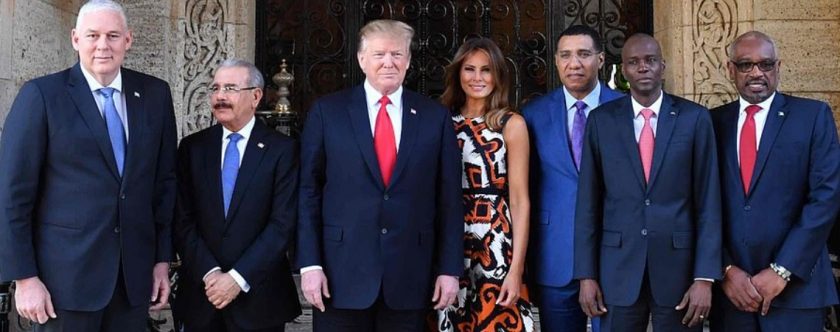
Trump has apparently resuscitated divide et impera, trying to not only pry some CARICOM members away from the main body by “dangling investment” promises in front of their eyes, but also setting the stage for CARICOM members to turn on each other. What Trump did was to invite a small, select group of Caribbean leaders—those belonging to the Lima Group (standing outside of any international body, because the Group supports regime change in violation of international law)—to visit him at his Mar-a-Lago estate. Trump thus met with St Lucia Prime Minister Allen Chastanet, Dominican Republic President Danilo Medina, Jamaica Prime Minister Andrew Holness, Haiti President Jovenel Moise, and Bahamas Prime Minister Hubert Minnis at the Mar-a-Lago estate in Palm Beach, Florida. These countries, “have all either criticized Venezuela’s Nicolas Maduro, or recognized Juan Guaido [sic] as the country’s rightful leader”.

Jamaica’s Minister of Foreign Affairs and Trade, Kamina Johnson Smith
Among those in attendance, Jamaica recently announced the closure of its embassy in Venezuela, despite the parliamentary opposition in Kingston voicing serious criticisms. Reporting on these events, the Jamaica Observer instead backed CARICOM’s approach to the Venezuelan crisis, reaffirming the value of the UN Charter. As for Jamaica’s Prime Minister, Andrew Holness, he spoke of being pleased with his meeting with Trump, saying that Trump, “wants to encourage and promote a stronger relationship with the region”. (Holness appears to be confusing a “stronger relationship” with a relationship of strength.) Holness’ main concern appeared to be the promise of US investments, saying that he hoped it was “not just talk” but that there would be “instrumental action”. Yet Trump is in no position to order US companies to invest in the Caribbean—he cannot even do that in the US itself. The US is not a state-run socialist economy, where public companies obey public policy—surely Holness understands this? Nonetheless, the affair smelled of something akin to bribery, and if this was representative of Caribbean leaders “standing tall” then language has been inverted, and standing tall is a reference to the humility of beggars. One might recall how the British Colonial Office used to refer to visiting Caribbean Chief Ministers as a “beggars’ opera”.
Rowley: Standing Up for the Caribbean
Once more, the figure standing up to Trump, and standing up for CARICOM and international law, is Trinidad & Tobago’s Prime Minister: Dr. Keith Rowley, of the ruling People’s National Movement (PNM). Dr. Rowley noted that this minority which met with Trump, which was not empowered to speak for CARICOM, were at Mar-a-Lago because they are members of the Lima Group whose objective is regime change in Venezuela. Apparently the US ambassador to Trinidad & Tobago, Joseph Mondello, said that he “viewed with concern” comments made by Rowley last month—in response, Rowley was reportedly angered and he redoubled his efforts to push CARICOM on the path of anti-intervention.
The fact that other Caribbean states such as Trinidad & Tobago and the majority of CARICOM members, who oppose the Lima Group, were logically not invited—why would they be?—has been seized upon by quislings in the region who think the Caribbean’s primary duty is servitude to whomever occupies the Big House in the US. Failure to show deference to US interests, these proxies think, somehow entails a loss of status, a “loss of leadership” even. Real leaders stand up for American interests, apparently. This has been translated into accusations that those who were not at Mar-a-Lago were thus “snubbed,” and missed out on something “special”.
Representative of this pro-US faction are figures such as Ralph Maraj, a former foreign minister of Trinidad & Tobago, and a member of the opposition United National Congress (UNC). According to Maraj, the fact that Trinidad was “excluded” from the Mar-a-Lago meeting means that the US now has a diminished view of the country. He continued:
“We do not stand tall, contrary to what Dr. Rowley has stated, we stand diminished in the region, we have lost our leadership of Caricom which we had. Jamaica now is leading the way…. We’ve really abdicated the leadership in Caricom and we have obviously offended the United States, and while we have sovereign right to deal with our foreign relations we stand by the principles and so, we must also protect our relationships…. The United States does not need to invest in our petrochemical industry anymore. They have the most gas, natural gas in the world…. They don’t need our gas, they don’t need our oil. They are a net exporter now of both oil and gas. We have lost our economic clout”.
Maraj’s message was, at best, confusing. If the US no longer needs Trinidad, and Trinidad has lost its economic clout as a result, then how would a lunch at Mar-a-Lago have altered those basic, objective economic facts? It’s not clear where Maraj’s complaint lies, but it’s also far from obvious that the facts are on his side.
Trinidad & Tobago’s Leadership: The US View
The US previously recognized Trinidad’s leadership in CARICOM and its high standing in the region—according to the US Embassy in Port of Spain in 2006:
“In regional politics, it could be said that T&T is an opinion shaper. [Prime Minister Patrick] Manning [of the PNM] just completed a six-month tenure as Chairman of CARICOM, a period marked by a renewed emphasis on regional economic integration. T&T receives high marks for its commitment to the needs of the smaller countries of the Eastern Caribbean. Beyond CARICOM, T&T maintains correct but cool relations with Venezuela, largely due to differences of opinion over Petrocaribe and Chavez’s regional aspirations. T&T views Cuba as a Caribbean brother and maintains amicable ties. Manning regularly goes to Cuba for medical attention”.
Did having an independent foreign policy diminish Trinidad, as Maraj argued above? The US Embassy recognized Trinidad & Tobago’s influential leadership position, even as it pointed to serious foreign policy differences between the US and Trinidad & Tobago (repeated here):
“T&T in many ways demonstrates a fierce independence; it has been immovable on several key recent U.S. foreign policy priorities. Because of former President Robinson’s role as a ‘father’ of the International Criminal Court (ICC), T&T was one of the first ICC signatories. It has not signed an Article 98 agreement with the U.S. and likely never will. T&T continues to desire and work towards good relations with Venezuela as they share a long maritime border and common energy concerns. It often defends Cuba, which it sees as a Caribbean brother. T&T, along with its neighbors, did not recognize Haiti’s interim government in the absence of a CARICOM consensus. T&T did not support the U.S. intervention in Iraq, and its media have been openly critical on this issue. T&T’s voting record at the U.N. also leaves much to be desired from a U.S. policy perspective. Most notably, T&T voted, together with its CARICOM partners, in favor of Venezuela’s candidacy for the vacant Latin American Caribbean seat on the UN Security Council”.
If standing up for Trinidad & Tobago’s interests—which are not the same as American interests—is somehow weak or diminished leadership, then that case has not been proven, not even when we refer to the opinions of US diplomats themselves.
Furthermore, during the same weekend that Trump was hosting a small group of Caribbean leaders, CARICOM itself held a dialogue with Juán Guaidó, in an effort to promote peaceful mediation towards an end to the crisis. Unfortunate however was the praise given by CARICOM leaders to Canada, which helped to organize the encounter. The point however is that if CARICOM did not matter, then not even Trump’s instrument in Venezuela would seem to agree—as Trump met with a splinter group, Guaidó spoke with representatives of the larger body, and both events happened at nearly the same time.
Who Was Invited to the Man’s House?
To have them assembled in one place, here are the comments made by Prime Minister Rowley about this weekend’s event at Mar-a-Lago, and what it signifies, gleaned from several sources as indicated below:

Prime Minister of Trinidad & Tobago, Dr. Keith Rowley
“There are people in Trinidad and Tobago who believe that because Trinidad and Tobago was not invited to the private residence of an American president we are somehow diminished…. Ladies and gentlemen, we have never stood taller, we have never stood prouder; and, as I speak to you now, Caricom’s position, as reaffirmed in the last meeting of heads in St Kitts-Nevis, is that there are three people representing and authorised to represent Caricom outside of its heads and caucus, and that’s the chairman of Caricom, who is the prime minister of St Kitts-Nevis (Dr Timothy Harris); Trinidad and Tobago’s prime minister or designate; and Barbados, through its prime minister or designate”. (source)
“A man’s home is his castle—you are free to invite who you want to your house. We can’t stay outside and say we shoulda be invited. Since when are we measuring our stature and station by who invites us to their house? If it is we’re being ‘blanked’ or ‘snubbed’ for steadfastly standing for the principles of the United Nations Charter, history will absolve us”. (source)
“Our foreign policy has always given us an indication of the road ahead. What we’re reacting to is an invitation to a man’s house—a meeting of the Lima Group at the private residence of the US President”. (source)
“I don’t know that T&T or anyone was deliberately, unwittingly or accidentally invited to anyone’s private home. The invitation wasn’t to Caricom, we don’t go around begging for invitations”. (source)
“What we are going to do resolutely and without apology, as a tiny speck on the world’s map, is to stand with the principles of the United Nations where we all have signed on and accept as the best way for peace and security, not only in our region, but the world. We, from early—St Kitts-Nevis, Dominica, Trinidad and Tobago, St Vincent and the Grenadines—we did not sign on to the Lima Group. So we are not reacting to an invitation to a man’s house”. (source)
“There are 14 Caricom countries, how many have gone to Mar-a-Lago? Yet the convseration is about four. The ones who’ve agreed are part of the Lima Group. What’s the group’s objective? Regime change in Venezuela. How that’s to be achieved is for those who’ve embarked on that course”. (source)
“As far as I’m aware, there’s no tear in TT-US relations. The US remains a friendly country and in so far as having a disagreement on the approach of Venezuela, it has nothing to do with the relations between the people of T&T and the people of the US—notwithstanding Opposition’s efforts to create that kind of division!” (source)
“Force Multipliers”
Rather than come out and call them “treacherous servants,” the politically correct term for amplifiers of US power is “force multipliers”. On the same day that Trump announced his Mar-a-Lago meeting, the Leader of the Opposition in Trinidad & Tobago, former Prime Minister Kamla Persad-Bissessar of the United National Congress, met with the US Ambassador in Port of Spain. It’s not the first time that Persad-Bissessar, while in the Opposition, has gone to the US Embassy to have private meetings to talk about Trinidadian affairs, slanted in a way that always favoured American interests and those of her party. The party attacking Prime Minister Rowley for not being servile enough to get an invitation to Mar-a-Lago, has a history of going in secret to the US Embassy to lay out its complaints about domestic political matters for the American ambassador to consider—perhaps this is what they mean by “leadership”. From their perspective a figure like Juán Guaidó must be one of the world’s greatest living “leaders”.

Ralph Maraj
The UNC is a party that mostly represents Trinidad’s population of East Indian descendants, which for generations have vied for power against the African-descended population that is mostly represented by the ruling People’s National Movement (PNM). The PNM led the country to independence in 1962, and its leadership was responsible for expelling the US from its air and naval bases in Trinidad. The PNM also nationalized Trinidad & Tobago’s oil and gas industry, and did substantial work in trying to build a nation.
The UNC has long had a particularly cozy relationship with the US, and it’s no secret that many of its followers tend to hold in high esteem all things coded White, looking up to the Global North, with neither the White House nor Donald Trump personally being any exception of course. In fact, the UNC’s long-standing former leader, Basdeo Panday, was the Prime Minister who personally hosted Donald Trump when he traveled to Trinidad for the 1999 Miss Universe Pageant. Trump and Panday spent time dining and golfing together, and apparently the experience made a positive impression on Trump. A few years later, Panday would find himself jailed on corruption charges.
While Trinidadian politics are not organized along left vs. right lines (mistakenly assumed to be universal by most North American and many European writers)—the UNC has nevertheless on occasion lambasted opponents, in a manner uncharacteristic of Trinidad politicians, as “communists”. The UNC’s stance on Venezuela, since the rise of Hugo Chávez, has been consistently hostile to the Bolivarian Revolution.
It was thus telling that this cable, as published by WikiLeaks, showed that, “on October 3 [2006], the [US] Ambassador met with Opposition United National Congress (UNC) Deputy Political Leader Senator Wade Mark, at Mark’s request,” and during that meeting the UNC’s Wade Mark not only assured the US that a future UNC government would favour US interests, but he went as far as linking the then PNM Prime Minister, Patrick Manning, with radical Muslim terrorism—and then linked the PNM and Hugo Chávez to Muslim terrorism. Wade Mark was purposely baiting the US, knowing that the US Embassy was keeping a keen eye on Muslim groups in the country, at the height of the US’ so-called “Global War on Terror”.
Let’s read that document from the US Embassy in Port of Spain in greater depth, which was previously publicized thanks to Guanaguanare—the emphases in bold print are mine:
“Mark said his purpose was to express to the Ambassador the UNC’s shock at the sudden assault on the United States unleashed by Prime Minister Patrick Manning, in his September 5 address before energy industry executives and members of the diplomatic corps…. Mark wished to reassure the Ambassador that a UNC administration would re-establish with the US the same friendly and cooperative relations which has characterized the 1995-2001 period when then UNC Prime Minister Basdeo Panday and Secretary of State Warren Christopher signed an extradition treaty, a mutual legal assistance treaty and an agreement on maritime law enforcement. Mark went on to say that UNC concern with Manning’s undiplomatic outburst was heightened by the fact that Minister of Energy and Energy Industries Dr. Lenny Saith has reportedly signed a memorandum of understanding with Mexico according to which a portion of the liquefied natural gas currently exported by T&T to the US would be assigned to Mexico instead. Such an action could not help but have serious national security implications for T&T, given that T&T depends for much of its food imports on the US. The Ambassador listened to Mark and acknowledged that the Prime Minister’s September 5 criticism of the US had taken him by surprise, too.
“Mark then launched into a litany of allegations and rumors whose veracity it is impossible to gauge. He said it was the UNC’s understanding that newly-appointed foreign minister Arnold Piggott… had, while serving as High Commissioner to Canada, met with elements associated with Al-Qaeda and Hezbollah. (Note: Post has no reason to believe that this is true and has not heard this rumor from any other source). He went on to say that three ships carrying rocket launchers as well as members of Hezbollah, which had left Syria in August en route to Argentina, were diverted to Venezuela’s Margarita island where a Hezbollah base was to be established with the aim of targeting the US. (Note: Post has heard this claim elsewhere, although embassy Caracas would be better placed to ascertain whether it is fact or fiction).
“Mark also drew a connection between Prime Minister Manning, Imam Yasin Abu Bakr, leader of the extremist Jamaat al Muslimeen (JAM) group, and Venezuelan President Hugo Chavez. Referring to Abu Bakr’s release from prison on bail and to his court-authorized leave to travel to Venezuela, Mark said it strains credulity that such a development could have taken place without the knowledge and intervention of the powers that be. Mark said that Abu Bakr is treated like a head of state by the Chavez regime, and hypothesized that his leave to travel to Venezuela could have been intended to cement Manning’s anti-American credentials in return for the JAM’s assistance with voter recruitment at the next election….”
It is from within this fold that Prime Minister Rowley was seen as being “snubbed” by Trump, and that Trinidad lost its leadership status. It’s not surprising then, and in fact it’s quite logical, that on a previous occasion in Parliament, Dr. Rowley blasted the opposition UNC as “traitors”.
A Perspective on Canada
Canada’s government could learn a great deal—first of all, about international law and the UN Charter—from listening to Prime Minister Rowley. Instead, rather than having the post-national state as Justin Trudeau remarked, Canada has more of a post-government state, one that functions almost on auto-pilot by hiring technocrats who are “skilled” in “reading the signals coming out of Washington”. As studious imitators, they would have been well prepared by “universities” in Canada since they are largely just retail outlets for American academic production, training Canadians in the high art of consuming American books, American journals, and traveling to American conferences.
Canada helped found the Lima Group, in an effort to overthrow Venezuela’s government. While Trudeau is defending Canadian corporate interests, he does so using the language and techniques that shore up US interests. It has reached the point where, instead of taking an independent and correct stand like Trinidad & Tobago and CARICOM, Canada instead imagines that Venezuela is part of its “global backyard”. Chrystia Freeland, Trudeau’s minister for foreign affairs, stated to the press:
“the crisis in Venezuela is unfolding in Canada’s global backyard. This is our neighbourhood. We have a direct interest in what happens in our hemisphere”.
Peter Boehm, a Canadian “diplomat,” seconded Freeland, telling the CBC: “This is our backyard, the Western hemisphere. We have a role here too”.
Funny, how the front yard thinks it owns a backyard, ignoring the Big House standing between the two and claiming ownership of both. What both Freeland and Boehm miss, obviously, is that from the US’ standpoint, we are all backyard.
Canada itself has no backyard, apart from its internal colonies—and there is no such thing as a “global backyard”. It is a semi-peripheral state which, like two centuries ago, still specializes in exporting raw materials. Lacking national leadership means that, in practice, there has been virtually no distinction of any substance that can be made between Donald Trump and Justin Trudeau, apart from superficial matters like style, tone, and virtue signalling (and sometimes not even then). Lacking an independent national government, and worse yet having one that thinks it’s American, means that it has been easy for Trump to effectively dictate terms to Canada and offload some of the costs of US foreign policy onto Canada, with no reward in return for Canada. Whether it is unrelenting trade tariffs, surrender/renegotiation of NAFTA to favour US interests even more, the transfer of asylum-seekers, or the consequences of dragging Canada into the geopolitical conflict between the US and China—Canada under Justin Trudeau has been haemorrhaging both political and economic capital to the US. One ironic and sad consequence is that this has only strengthened Canada’s Conservatives—with all of their supposed “agency,” Canadians vote for either Tweedledee or Tweedledum, generation after generation, and all of the parties are beginning to look and sound alike. With respect to Venezuela, that means more of the same.
References
Alexander, Gail. (2019). “PM dismisses Trump meeting snub talk: We’ve never stood taller”. The Guardian, March 21.
————— . (2019). “Trump announces new sanctions on Venezuela; Caricom division not new – PM”. The Guardian, March 22.
CARICOM. (2019). “Meeting Between CARICOM Foreign Ministers Delegation and Mr. Juan Guaidó”. CARICOM Today, March 24.
CBS. (2019). “Trump meets with Caribbean leaders at Mar-a-Lago”. CBS News, March 22.
Christopher, Peter. (2019). “Maraj: T&T has lost leadership of Caricom”. The Guardian, March 22.
Editors. (2019). “Resolving the Venezuelan crisis”. Jamaica Observer, March 24.
Engler, Yves. (2019). “Is Trudeau’s Venezuela policy the Monroe Doctrine reborn?” Canadian Dimension, February 20.
Forte, Maximilian C. (2018). “Trade War and the Nationalist Exchange: Trudeau Trails Trump”. Zero Anthropology, June 1.
————— . (2018). “Better Off Without NAFTA, Part 2: Canada—Localized Profit, but a Net Outflow of Capital”. Zero Anthropology, June 7.
————— . (2018). “Review of 2018, Part 4 (October–December): Nationalism, Deglobalization, plus the US exit from Syria”. Zero Anthropology, December 23.
————— . (2019). “Against Intervention in Venezuela: The Case of the Caribbean Community”. Zero Anthropology, February 6.
————— . (2019). “A War for Oil: The US Economic War on Venezuela”. Zero Anthropology, February 12.
Gleaner. (2019). “Jamaica to temporarily close Venezuelan embassy”. The Gleaner, March 20.
————— . (2019). “Jamaica not abandoning Venezuela – Johnson Smith”. The Gleaner, March 22.
————— . (2019). “CARICOM foreign ministers hail meeting with Venezuela’s Guaido as a significant step to peaceful resolution to crisis”. The Gleaner, March 24.
Guanaguanare. (2011). “Slouching Towards The National Security State…”. Guanaguanare: The Laughing Gull, November 24.
Hassanali, Shaliza. (2019). “Rowley’s ‘traitor’ comment causes Parliament uproar”. The Guardian, February 1.
Jamaica Observer. (2019). “Trump meeting scorn: Rowley dismisses suggestion T’dad snubbed by US, says countries invited are part of Lima Group”. Jamaica Observer, March 22.
————— . (2019). “Holness pleased with two-hour talks with Trump”. Jamaica Observer, March 24.
Kennedy-Glans, Donna, & Hill, Don. (2018). “Trudeau’s neglect of the nation has led us to this place”. CBC News, December 8.
Larison, Daniel. (2017). “Venezuela and Our Stupid Obsession with U.S. ‘Leadership’”. The American Conservative, April 17.
Lawrence, Ken. (2005). The World According to Trump: An Unauthorized Portrait in His Own Words. Kansas City: Andrews McMeel Publishing.
Pagliccia, Nino. (2019). “Is Venezuela Canada’s Modern Day El Dorado?” Venezuelanalysis.com, February 18.
Rampton, Roberta. (2019). “Trump Dangles Investment to Caribbean Leaders Who Back Venezuela’s Guaido”. U.S. News & World Report, March 22.
RT. (2019). “Bolton’s ‘Monroe Doctrine’ remark on Venezuela arrogant & insulting to all of Latin America – Lavrov”. RT.com, March 4.
————— . “Bolton says Trump ‘very serious’ about ‘all options’ as Venezuela dismantles ‘terrorist cell’”. RT.com, March 22.
Starr, Katharine. (2019). “What to expect from Monday’s emergency summit on Venezuela”. CBC News, February 2.
Todd, Douglas. (2016). “The dangers of Trudeau’s ‘postnational’ Canada”. Vancouver Sun, April 28.
US Embassy—Trinidad & Tobago. (2006). “Trinidad: Bi-Weekly Political Roundup”. Port of Spain, Trinidad: US Embassy, February 1. Cable ID: 06PORTOFSPAIN152_a.
————— . (2006). “UNC Executive: PNM’s Out to Get Us, but Panday’s Still Fighting”. Port of Spain, Trinidad: US Embassy, April 28. Cable ID: 06PORTOFSPAIN521_a.
————— . (2006). “Scenesetter for DHS Secretary Chertoff’s Visit To T&T”. Port of Spain, Trinidad: US Embassy, August 3. Cable ID: 06PORTOFSPAIN920_a.
————— . (2006). “Opposition Leader: PM has Terrorist Links, is Anti-American and Dictatorial”. Port of Spain, Trinidad: US Embassy, October 20. Cable ID: 06PORTOFSPAIN1214_a.
————— . (2007). “Scenesetter for Energy Infrastructure Pre-Assessment Visit”. Port of Spain, Trinidad: US Embassy, October 10. Cable ID: 07PORTOFSPAIN1019_a.
————— . (2008). “Scenesetter for Visit of Secretary of Energy”. Port of Spain, Trinidad: US Embassy, October 10. Cable ID: 08PORTOFSPAIN208_a.
————— . (2008). “Scenesetter for Visit of Deputy Secretary of Defense and SOUTHCOM Deputy Commander General Spears”. Port of Spain, Trinidad: US Embassy, September 30. Cable ID: 08PORTOFSPAIN443_a.
————— . (2008). “Scenesetter for Visit of WHA Director of Caribbean Affairs Velia De Pirro”. Port of Spain, Trinidad: US Embassy, October 10. Cable ID: 08PORTOFSPAIN144_a.
————— . (2009). “US Embassy Meets with Opposition to Discuss Legislative Agenda”. Port of Spain, Trinidad: US Embassy, June 9. Cable ID: 09PORTOFSPAIN256_a.
Vlach, John Michael. (1993). Back of the Big House: The Architecture of Plantation Slavery. Chapel Hill, NC: University of North Carolina Press.
Wittes, Tamara Cofman, & Goldenberg, Ilan. (2019). “Trump’s Golan Fiasco”. Politico, March 22.
Zimonjic, Peter, & Kapelos, Vassy. (2019). “Time for Canada to drop the ‘white gloves’ in diplomatic feud with China, says ex-diplomat”. CBC News, March 22.
US Secretary of State Mike Pompeo’s anti-Iranian Rhetoric
By Viktor Mikhin – New Eastern Outlook – 24.03.2019
The administration of the US President, Donald Trump, is currently using severe economic sanctions in an unsuccessful, and illegal, attempt to pressurize Tehran into dismantling its rocket program, and weaken its regional influence. The present US leadership is not trying to hide its implacable opposition to any form of political contacts, trade or cultural links between Iran and its neighbors. Washington reacted in an almost hysterical manner to the very successful recent visit to Iraq by Hassan Rouhani, the Iranian President, which was entirely devoted to talks on trade and investment. The volume of trade between the two countries currently amounts to $12 billion a year, and there is every reason to believe this will increase to $20 billion, which would be very welcome for Tehran, given the severity of the US sanctions.
And although the harsh sanctions are aimed at restricting Tehran’s relations with other countries in the region, and despite the fact that Washington is taking great pains to impose so-called secondary sanctions on countries which trade with Iran, the latest statistics show that things are actually moving in the opposite direction: Tehran, blocked off from international markets, is starting to focus on its close neighbors. The recent fall in the value of the riyal means that Iranian goods and services are now much more competitive. As a result, Iraq has been able to overtake China as Iran’s main export market for all goods except for oil.
According to IRNA, the Iranian news agency, as a result of Hassan Rouhani’s successful visit to Iraq the two countries signed 22 agreements on trade and cooperation in industrial projects. The agreements are aimed at increasing trade between Iran and Iraq. The new agreements cover such matters as the development of cooperation between border provinces of both countries, the reduction of trade tariffs, and the simplification of the visa regime for citizens of the two countries. The Iraqi Minister of trade, Mohammad Hashim al-Ani, has announced that under the new agreements a number of infrastructure construction projects are to be launched, and working groups and committees are to be set up to discuss further cooperation between the two countries in a range of different areas.
Arabic media outlets have reported that Iraq and Iran have agreed to set up a barter system, in which manufactured goods from Iraq will be exchanged for Iranian gas and electricity. In this way Baghdad hopes to continue importing energy and fuel from Iran, in exchange for Iraqi products. Economists consider that supplying energy to Baghdad, which does not have enough energy resources to meet its needs, will not only help the country to build new factories but also provide the population with cheap electricity, especially in the summer, when the temperature frequently exceeds 50 degrees and air conditioning is essential.
The Iranian premier’s visit to Iraq, in which the two countries limited themselves to discussing trade and investment-related matters, was greeted positively by the international community, with the notable exception of the USA and the Trump Administration. The facts show that the USA is dedicated to a policy of unleashing conflicts and sowing enmity between countries. This was clearly demonstrated by the recent hostilities between India and Pakistan in Kashmir. An example of this is the many inflammatory comments and groundless predictions by the US “free” media, which filled the country’s newspapers and TV with fake news reports from Kashmir.
But, notwithstanding the unfortunate events in Kashmir, the US administration, and US Secretary of State Mike Pompeo in particular, has not forgotten about Iran. Speaking in the CERAWeek conference, the US Secretary of State, who is far more comfortable with the language of threats than that of diplomacy, declared that if Iran did not behave “like a normal nation” the sanctions regime would last for a long time. It is completely natural that the USA, which has set itself up as an international policeman, should use its own conduct as a standard for other countries.
So it is worth looking at the way that the USA, a “normal country”, behaves. It bombed the helpless population of the German city of Dresden, dropped atomic bombs on the cities of Hiroshima and Nagasaki, where no Japanese troops were based, sprayed Vietnam intensively with chemical weapons (defoliants), carpet bombed North Korea (1950-1953) and destroyed the states of Syria, Libya, Iraq and Afghanistan. That is the conduct of the USA, a “normal” country. And it advises other countries to behave in the same way.
It is not surprising that the so-called “White Helmets”, an organization protected by the US, follows its example, by initiating chemical attacks in Syria. And what about the International Court of Justice, and other international organizations whose staff are paid high salaries in order to bring the perpetrators of such provocations to justice: where are they looking?
The Secretary of State has, once again, outdone himself: he has ordered a total ban on exports of Iranian oil: “We have every intention of driving Iranian oil exports to zero”. If we take into account the fact that oil is the country’s main export and that the basic needs of the whole population depend on the proceeds from this trade, then Mike Pompeo’s declarations sound rather like the joyful shrieks of a cannibal as he gloats over his helpless victim.
The choice of Mike Pompeo as US Secretary of State, in effect the country’s Foreign Minister, has been greeted with criticism, ridicule and contempt by countries around the world. Many have compared him, unfavorably, with Sergey Lavrov, the Russian diplomat and Foreign Minister, who deals very well with the wide range of global problems that Russia finds itself faced with. One might ask: how can a former unsuccessful spy who was tasked with overthrowing the international order possibly operate on the same level as him? That is why, lacking support from diplomats and himself feeling nothing but contempt for that profession, he decided to “transfer” many of his former henchmen to the diplomatic service.
These one-time spies are attempting, in everything they do, to justify the high level of trust that their guru has placed in them, but they lack the slightest experience of diplomacy, and, hopelessly out of their depth, are doing their country far more harm than good. It is hard to see how else we are to understand the recent incident in Moscow’s Sheremetyevo airport, in which a US diplomat – that, at least, was his job title – tried to bring a bomb through customs in his luggage. The Russian Foreign Ministry has stated directly that it saw the incident as a provocation. As the TASS news agency reported, citing Russian diplomatic staff, “given the heightened attention the USA itself has paid to security on aircraft since the 9/11 attacks, he simply could not be unaware that a bomb in a bag is very serious. That means he was aware of taking such a step.” Obviously a real diplomat would never carry out a provocation of that sort without clear “instructions” from above – that goes without saying. Many global media outlets speculated, rather boldly, that the diplomat was, in a very underhand way, trying to “test Sheremetyevo airport’s security system”.
Looking back over the energetic but fruitless, and in fact extremely dangerous actions of Secretary of State Mike Pompeo, we would wish to advise the US President to take more care with his choice of staff, especially at such a senior position. Because absolutely everything he does in his post – a post for which he is completely unqualified – harms his own country and he makes himself a laughing stock for people all over the world when he comes out with his latest “pearls of wisdom” concerning Iran, Russia or any other country. At this point it is worth remembering the words of the great Mark Twain (a writer who may well, we suspect, be unknown to the Secretary of State) in his superb book, Letters from the Earth. Specifically, Letter Eight, in which Twain has nothing good to say about people such as Mike Pompeo.
Mueller Report: ‘US Forced EU to Follow Through on Sanctions Without Proof’
Sputnik – March 23, 2019
Special Counsel Robert Mueller has submitted his report on suspected collusion between Russia and Donald Trump’s 2016 presidential campaign to the attorney general, with the report not recommending any further indictments. Eurasia Centre senior researcher Earl Rasmussen spoke to Sputnik about the report’s implications for Trump and his opponents.
Sputnik: What do we know? What can we expect? It looks like Donald Trump won’t receive any political damage to his image, because of course the report doesn’t recommend any further indictments. What’s your stance?
Earl Rasmussen: Obviously there are certain elements, mostly in the mainstream media that’s been stoking this, and certain members on the Hill, in Congress, that were hoping for something, because we heard over and over again that the next bombshell was coming.
But you’re correct, there’s nothing explosive, and with no new indictments coming out, and really if you look at the indictments that were there, there’s nothing related at all to any type of conspiracy or collusion as far as the six people indicted who are US citizens. And the Russians that are indicted are questionable. Let’s face it, Concord Management tried to file discovery, and now [prosecutors are] trying to block information, saying it’s ‘classified’.
There’s really no evidence, and for Mr. Trump, although he will suffer some political damage, I think for the most part the objective of this whole hoax is not coming to fruition.
Sputnik: For now of course, no one really knows what’s in the report, how long it is, how much it actually deals with the president’s own actions. However, a lot of political and perhaps emotional capital was invested in this Mueller probe. Is this a bit of an anticlimax?
Earl Rasmussen: I think for many it is an anticlimax, absolutely. There’s so much invested here. Two plus years, millions of dollars, political capital on both sides, and you’ve got people who have lost their livelihoods. A lot of the people that were brought in, their names exposed, their reputations were damaged. We’ve got the six people that have been charged [for] things that happened ten years ago; some are financially ruined now; some will spend time in jail for lying to Congress or lying to the FBI over minor financial things that may have gone unnoticed without this.
You look at the other side too, and we’ve got damage to international relations, not just with Russia, where what has occurred is just outrageous, but also Europe. I mean we forced Europe to follow through on sanctions that there’s no evidence for. They’ve lost business as a result of that, so I’m sure the Europeans will be quite interested in seeing more and learning more about what’s coming out of this as well.
The country is divided. Talk about political discord – the media here has done a great job doing that. In a lot of ways we’ve done a lot of damage to ourselves chasing after something that’s not there.
Sputnik: US Attorney General William Barr is going to now summarise the report and decide on how much to share with Congress. What can we expect?
Earl Rasmussen: Personally I think the whole report should be released to the public at some point in time. He’ll release it to Congress, I think most of it will probably be provided to Congress. There should be nothing there that they don’t already know. They’ve been doing their own investigations, have called in their own witnesses, so there really should be no surprises there. Obviously the parties will probably try to manipulate the report [against the other party] in order to potentially posture for the 2020 presidential elections.
Listen to Earl Rasmussen’s complete interview with Sputnik here:
Earl Rasmussen is the executive vice president of the Eurasia Centre, an independent, non-profit Washington-based think tank specialising in European and Asian political and economic issues.
Boeing’s latest crashes pose serious risk to global AI development – analysts
RT | March 23, 2019
Two deadly crashes involving Boeing’s newest airplane in less than six months puts in jeopardy not only the credibility of the manufacturer, but also new technologies actively being pushed by the world’s top tech firms.
All Boeing 737 MAX 8 planes operated by global carriers were grounded earlier this month after an Ethiopian Airlines aircraft crashed shortly after take-off, taking a steep nosedive not far from Nairobi.
The fatal accident which claimed 157 lives followed a similar crash in Indonesia, which killed all 189 people on board in October.
The two crashes appear to have something in common. The crews of both aircraft reportedly struggled with the MAX 8 autopilot system which pointed the nose of the airplane down before the crash.
The implications of the deadly incidents are much bigger than aviation itself, according to Alessandro Bruno, an independent international affairs and aerospace industry analyst.
“I think this accident shows the limitations of artificial intelligence and it should convince Elon Musk and Tesla to slow down efforts to push down self-driving cars,” the expert told RT, highlighting that the latest crashes occurred due to software problems, not mechanical ones.
A recall of Boeing’s flagship planes, lawsuits from global air carriers and a fall in the manufacturer’s market value may undoubtedly result in the firm lagging behind Airbus, its key rival, according to Vladimir Rojankovski, an expert at the International Financial Center in Moscow.
“I think if this scandal is not ‘extinguished’ in time, it will trigger deep concerns over the entire sector of artificial intelligence and its credibility,” the analyst said in an interview with RT.
He stressed that the burning desire of tech giants to get rid of the need for human labor, and thus salaries, may shatter confidence in the maturity of AI and its development.
“Americans should know this, because when they landed on the Moon, the computers failed, so they had to land manually,” Bruno said.
“Imagine if the computers were controlled by the same system that is controlling 737 MAX 8, they would have crashed on the Moon.”
Featured Video
Death Spikes & Rising Cancer In Our Youth Explained
or go to
Aletho News Archives – Video-Images
From the Archives
Politicians lie
By Mazin Qumsiyeh | Popular Resistance | August 18, 2013
There is no way to say this truth nicely: Politicians lie. That includes Japanese, American, Egyptian, Israeli, and Palestinian politicians! Is there something more common sense than that? Yet, so many citizens around the world believe their own politicians or wistfully acknowledge lies but think it is part of the job needed to run things. They believe even when politicians contradict themselves blatantly. This phenomenon is rather remarkable. It is a dissonance and disconnect from reality that many seem oblivious to. It is very dangerous because it can lead to accepting rationales for going to war. These can be deadly wars that lead to millions of lives lost as happened in what was called World War 1 and WW2. Even when incredible and declassified evidence abound, politicians continue to lie and old mythologies refuse to die. Here are just a few of the countless lies told to us over the past few decades… continue
Blog Roll
 Aletho News
- Iraqi resistance group vows to stage airport sit-ins over Iran aerial blockade
- Turkish parliament to review Saudi-Pakistan defense pact next month
- DEATH SPIKES & RISING CANCER IN OUR YOUTH EXPLAINED
- Iran offers Trump deal before US election
- Merz regime wants ‘secret police’ – opposition
- Israeli settlers terrorize West Bank Palestinians with state-provided drones: Report
- They see them, then kill them: Israeli quadcopters track, deliberately target civilians in Gaza
- Debunked: Trump’s egregious UNGA claims on war against Iran crumble under scrutiny
- Europe was part of the infrastructure of US aggression against Iran: Deputy FM
- New evidence on the Bucha Massacre
- If Americans Knew
- Trump betrayed voters with his campaign lies and prioritized a foreign country once he took office
- Netanyahu calls Israel’s war in Gaza ‘opposite of genocide’ in UN speech to near-empty hall
- Settler Kidnappings: Torture, Sexual Abuse and Terrorisation of Palestinian Abductees as Israel Deepens Annexation of West Bank
- Gaza winter nears as 162,000 tents become unusable, raising fears of humanitarian crisis
- Netanyahu says, “It’s the opposite of genocide”; UN says Gaza economy is world’s ‘most severe crisis on record’ – Daily Update
- Israel’s US-Backed Assault on Gaza Has Created the ‘World’s Most Severe Economic Crisis on Record’: UN
- ‘Protecting U.S. Citizens’… From Israel
- ‘This is where I live now, the back of a truck’: a day in the life of a grandmother in Gaza
- In UN Speech, Iran’s President Displays Pictures of Children Killed by US, Brings Attention to Israel’s Nuclear Arsenal
- Israel displaces hundreds of Palestinians amid wave of demolitions in West Bank
- No Tricks Zone
- New Study: Earth And Venus Surface Warmth Largely Explained By Convection And Lapse Rate, Not CO2 Or Radiation
- 2025 Nature Paper Claiming Worsening Global Drought Gets RETRACTED …Heavily Flawed
- New Study: ‘Global Drought Shows No Detectable Recent Acceleration Under Climate Warming’
- Economic Masterminds: German Socialists Suggest Taxing Productivity Gains Stemming From Using AI
- The South China Sea Has Not Been Cooperating With The Climate Change Narrative
- Energy Crisis: Germany Enters Heating Season With Historically Low Gas Reserve Fill Levels
- New Study: The Antarctic Ice Sheet Gained Mass From 2020-2024 Due To Staggering Snow And Ice Accumulation
- Study: Ocean Heating Rates From Thousands Of Years Ago ‘Dwarf’ Modern Ocean Heating Rates
- Climate Extremists Target, Attack Large-Scale Power Grid Infrastructure In Germany!
- New Study: Antarctic Ice Melt Has Contributed Less Than 1 Centimeter To Sea Level Rise In The Last 30 Years

