Reflections on the counter-revolution in France

Image by Andrija Vukovic
By Frank* | OffGuardian | May 20, 2017
One of the more significant features of the recent French Presidential election was the widespread predictability of the outcome. It was taken for granted that the establishment, cardboard cut-out, hologram candidate – Macron – representing the alt-centre, would win the final electoral contest against Madame Le Pen by a comfortable margin; and so it turned out, Macron winning by 66% to Le Pen’s 34% of votes cast. Okay, there was a widespread abstention amounting to 25% of the registered electorate, a 10% spoliation of ballot papers, and, in addition, tactical voting against Le Pen in the second-round run-off.
This left about 25% of the French electorate, those overwhelmingly petit-bourgeois and miscellaneous air-heads, who voted for Marcon rather than against Le Pen, but who had scant ideas of what Macron’s programme for France would entail. This wasn’t surprising, however, since he was simply a continuity candidate who offered nothing remotely significant in policy terms other than more of the same.
So, a candidate who has not been positively endorsed by 75% of the French electorate, and who seemingly has nothing to offer other than the continuation of wrecking ball neo-liberalism gets to be President of France for the next 5 years.
Upon consideration, it seems, the moral of the story is that the hard left, and hard right will continue to be shut out of power by the hard centre-right, centre-left, liberal coalition. This prompts a possibility of something quite heretical: to wit, is it possible for someone like Le Pen to form a working coalition, or at least an understanding, with someone like Melenchon?
After all the economic and foreign policies seem virtually identical. But understandably, perhaps, the left has historically been loath to consider such a course of action. Moreover, we have heard all the fascist anti-capitalist rhetoric before: The economic programme of the NSDAP (National Socialist German Workers’ Party – Nazis) particularly that emanating from the leftist elements in the SA (stormtroopers) and luminaries such as Ernst Rohm, the Strasser Brothers and Gottfried Feder, the party’s leading economist, were clear enough. As early as 1919 Anton Drexler opined that:
Toiling Germany is the victim of greedy western power’’ quoted by Daniel Guerin in Fascism and Big Business
This was an obvious allusion to the Treaty of Versailles, a conclusion which was shared by J.M.Keynes in The Economic Consequences of the Peace’’ (1919). Drexler goes on
The German workers must realize that never before enslaved as they are today by foreign capitalism … the struggle for liberation which the proletariat is carrying on as the most oppressed section of an oppressed nation is a civil war that we are no longer waging against ourselves but against the world bourgeoisie. (op.cit).
This was a view seconded by Gregor Strasser:
German industry and economy is in the hands of international finance capital; it means an end of all possibility of social liberation; it means the end of all dreams of a socialist Germany … We young Germans of the war generation, we ardent socialists, are waging a fight against capitalism and imperialism incarnated in the Versailles treaty.’’ (op.cit)
All very left-wing and stirring stuff. But the advertised National Socialist revolution never arrived. It was ruthlessly crushed by Hitler’s Pretorian Guard – the SS – during the Night of the Long Knives July 1934. Hitler was only stringing along the SA for his own purposes of winning the battle of ideas and the battle of the Streets. When he had achieved this goal, the SA became expendable.
The left would, therefore, be prudent not to recognise the radical opportunism of fascism.
Warning heeded.
But in what sense is Le Pen and the FN fascistic? Particularly, since the term has become increasingly redundant. In policy terms, she seems to be a leading part of the anti-systemic revolt against globalization. All well and good if this is taken at face value. Moreover, there seems little imperialist element in her programme, unlike, Macron, the globalist neo-con who many of the left saw fit to vote for to stop Le Pen. Le Pen’s FN is not an aggressive movement directed at other nations and peoples living beyond its borders but essentially a defensive movement fighting for the right of any nation for self-determination which is under attack by the globalist elites who control political-economic unions like the EU. Talking of Nazis, it should be borne in mind that the neo-cons – the military wing of the globalization project – have nurtured and protected their own brand of bona fide fascism in Ukraine and the Baltics.
The rise of neo-nationalism in the globalization era, as a movement for national sovereignty, has nothing to with the rise of what we may call ‘Euro-fascism’ … in the Baltics and Ukraine. The unifying element of these euro-fascists is that they implicitly or explicitly accept the New World Order (WTO) of neoliberal globalization. If not in their official ideology then at least in their practice. This is the case for instance of Ukrainian Euro-fascists (Svoboda, Right Sector Patriots of the Ukraine and the Azov Regiment) who were massacring people in the Maidan and in Odessa under the flag of the EU, sometimes juxtaposed to Swastikas! And were fully backed and funded (still are) by the west, i.e, the EUSA.’’ The New World Order in Action – Takis Fotopoulos)

The Azov Battalion. Note the yellow flags with the wartime German Waffen SS ‘Wolfsangel’ insignia in front of Stepan Bandera Statue

Please note flags of the Azov Battalion, centre, NATO left, and Nazi, right.
However much of the Left seems to have missed these political nuances and still imagine that they are living in the era of the Popular Front of the 1930s. This was cogently pointed out by Aidan Obrien in Counterpunch :
“Most western progressives however are stuck in the 1930s. They see Hitler everywhere. They’re still fighting the Spanish Civil War! Their advice – the advice of Noam Chomsky in America and Yanis Varoufakis in Europe – is to always follow the example of the 1930s and form something like a united front against fascism. In today’s elections that means joining up with the liberals to keep out the extremists.
But who are the extremists? Who are today’s psychopathic killers and psychopathic slave-drivers? Since 2002 it has been the advocates of liberalism. The fascists don’t even come close. The forces of “individual freedom” have given us the on-going holocaust in the Middle East. And the champions of the “free market” have more respect for Guantanamo Bay prisoners than they do for the international working class.
And who are the racists? Right before our eyes we are seeing one genocide and seeing the preparation for two or three more. The Arabs – this instant – are being burnt alive. And the Koreans, Russians and Chinese are next in line. And the Africans and Latin Americans? No one cares anymore about those sub-humans! The fascists are not responsible for this “divide, kill, starve and rule” global agenda. On the contrary it is the lovable liberals who are masterminding this – the final solution to the White Man’s Burden.’’
All very true. The point that must also be made was that both German and Italian Nazism/Fascism were both expansionist, imperialist doctrines which took war and conquest as a given policy. Hitler’s ‘Lebensraum’ and military expansion to the east was openly declared in Mein Kampf, and Mussolini’s military (mis)adventures in both East Africa and the Balkans were a confirmation of the genuine fascism of both dictators. To repeat, however, Le Pen has publicly stated that she wishes to withdraw from NATO, which sounds very Gaullist, compared to the continued and militant presence in France of NATO and its globalist backed geopolitical expansionist policies in eastern Europe. So, who is the imperialist warmonger, Macron and the neo-cons, or Le Pen and her neo-Gaullism? Rhetorical question really.
What would seem to be the great stumbling block to any rapprochement between left and right against the mutual class enemy, which might be formal or informal, is the knotty question of immigration. Large scale immigration into Europe has been a function of two factors.
- The immigration from eastern Europe to western Europe which has been a function of Eastern European integration into the EU (and often into NATO).
- The forced migration from the war zones in the middle-east and north Africa into southern Europe as the landing stage.
In terms of migration from Eastern to Western Europe there has taken place population declines in every Eastern European country with the exception of Czech Republic, Slovakia and Russia (although Russia is a special case). This is due in part to the economic collapse of countries such as Latvia, Lithuania, Poland and Romania that have given rise to large scale migration, but also due to a declining birth-rate, and increasing death rates, which of course is related to the economic situation in these states.
The population of Lithuania has fallen by 12% since 2006, Latvia also by 12%, Ukraine by 9% (although this was due to migration to Poland and refugees seeking safety in Russia) Romania 7%, Hungary 8.5%, Bulgaria 6%, Poland 1%. As a result, there has been a wave of economic migrants from the old Soviet sphere of influence into the west. This was one of the principal outcomes of the removal of national borders and free movement of labour under, along with free movement of capital and commodities enshrined in the EU Constitution. Between 1990 and 2003 an average of about 60,000 migrants came to the UK each year; between 2004 and 2012 the figure rose to 170,000 the 2011 census put the number of UK residents from Poland alone at 650,000.
Secondly there was the unscheduled mass movement of non-European refugees from a vast conflict area stretching from Nigeria and Mali, through the middle-east to Afghanistan (MENA). This of course has been the result of the ‘war on terror’ carried out by the US and its euro vassals which has wrecked country after country in the MENA.
The first migration wave was not accidental; it was formulated and enabled by globalist elites under the banner of free-movement; free-movement of labour, capital and commodities. This of course will have the intended effect of a downward harmonisation on wages, working conditions, corporation tax, welfare spending, privatisation and deregulation. Sovereign nations will be disempowered, and global multinationals already thus enabled, will be even further empowered by trade treaties such as TTIP and/or Trade in Services Agreement (TiSA).
The second wave of unauthorised migration came from MENA and complemented the first, only under banner of the Refugee crisis.
It shouldn’t come as any surprise that the sticky finger prints of George – Mr Colour Revolution – Soros, have been all over this wave of humanity. According to Associated Press :
Soros to invest $500 million to Help Refugees and Migrants’’ ABC News, 20/09/2016.
This is a dual crisis engineered by the globalists in Brussels and the neo-cons in Washington its object being to destabilise Europe and colonize the MENA.
As Le Pen commented:
Globalization is a barbarity; it is the country which should limit its abuses and regulate it (globalization). Today the world is in the hands of multinational corporations, and large international finance … immigration weighs down on wages whilst the minimum wage is now becoming the maximum wage.’’
Unfortunately, the centre-left no longer uses this sort of rhetoric – or indeed practise – and instead covertly, and sometimes even openly, supports the globalist agenda, with occasional reservations of course. What is usually trotted out is the well-worn ‘there is no alternative’ (TINA) argument which is assumed to be unanswerable. Change the EU from the inside! Don’t overthrow the Bourbons, reform them! This in fact is the response of the collaborationist.
No wonder most members of the old working class have abandoned their ‘’natural’ leaders (Labour and Green parties) and even their own trade union leaders (apart from a few honourable exceptions) … even when their immediate motive is the fight against immigration, indirectly their fight is against globalization, as they realize that it is the opening of all markets, including labour markets … which is the direct cause of their unemployment or low-wage employment.’’ (Fotopoulos – Ibid.)
We live in enigmatic times: the left has moved right and the right has moved left. Strange alliances seem to be forming, new pathways emerging. The real left must reconfigure its theories and practice to oppose the New World Order – it is imperative. In the words of Lenin and before him Chernyshevsky – ‘What Is To Be Done?’’
* With apologies to Edmund Burke for the paraphrase
When the Trump Coup-makers Cometh
By Robert Parry | Consortium News | May 18, 2017
So what did you think a U.S.-styled “soft coup” would look like? What we’re seeing regarding the intended removal of President Trump is not that much different from what has happened in dozens of other countries, whether Iran in 1953 or Ukraine in 2014 or Brazil in 2016. This one just has a few extra American touches.
Like other coups, there are often vague and unproven accusations leveled against the target and his or her entourage. Even though hard evidence is usually lacking, “process crimes,” such as making misstatements to prosecutors or obstructing justice, are developed as a substitute under the popular saying: “the cover-up is worse than the crime.” Whatever the case, a complicit media then trumpets alleged wrongdoing into grave and impeachable offenses.
And, if you had any doubts about what is looming, you should read Washington Post columnist E.J. Dionne Jr.’s op-ed, entitled in print editions “A quick end would be better,” which states:
“There is really only one issue in American politics at this moment: Will we accelerate our way to the end of the Trump story, or will our government remain mired in scandal, misdirection and paralysis for many more months — or even years? …
“Nothing could be worse than slow-walking the Trump inquiries. The evidence is already overwhelming that he is temperamentally and intellectually incapable of doing the job he holds. He is indifferent to acquiring the knowledge the presidency demands and apparently of the belief that he can improvise hour to hour. He will violate norms whenever it suits him and cross ethical lines whenever he feels like it.”
The History of Coups
As this American coup against Trump progresses, one commonality of coups around the world – whether “hard coups” of military tanks or “soft coups” of “constitutional” removals – is that the coup’s target is not some perfect human being. He or she has likely made political mistakes or cut some corners or had associates who lined their pockets.
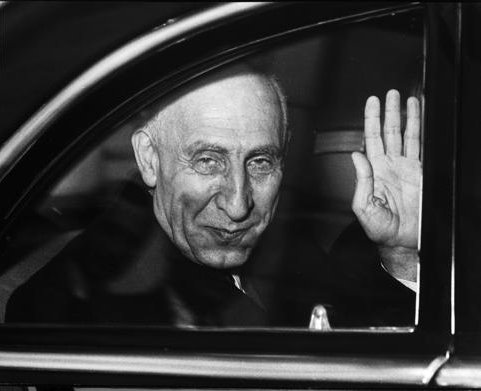
Iranian Prime Minister Mohammad Mossadegh
But the difference between those misdeeds being treated as politics as usual or becoming the stuff of “scandal” has more to do with the interests of powerful interests – a domestic “deep state” or an outside “superpower” – than any evenhanded pursuit of justice.
To say that Trump is an imperfect messenger for whatever populist message he thinks he’s carrying stretches beyond the breaking point any normal definition of the word “imperfect.” Indeed, Trump may be the perfectly imperfect messenger.
Yet, what’s really at stake in any coup is power and the direction that a country will take. In the case of Donald Trump, there appear to be several factors at play: he is regarded by many establishment figures as too incompetent and uncouth to serve as America’s President; he also defies the neoconservative orthodoxy over U.S. foreign policy; and perhaps most significantly, he doesn’t believe in the New Cold War, which will assure the Military-Industrial Complex years of expensive new weapons systems by making Russia the new/old “enemy.”
There is, of course, some truth to all these concerns. Trump is an egotistical buffoon who doesn’t seem to know what he doesn’t know. Often his brain doesn’t connect to his tongue – or his Twitter fingers. He is more a Kardashian “reality star,” saying stuff to get attention and to attract eyeballs, than a sober leader who holds his cards close and chooses his words carefully.
Though many Americans voted for him because they viewed him as a no-nonsense businessman, he was actually someone who ran what amounted to a family business without the kind of accountability that often comes with managing a large public corporation.
Puffing up his own importance, Trump even has bragged about his impunity. During the 2016 campaign, he was revealed as the kind of jerk who boasts about grabbing women by the “pussy” and getting away with it because of his star status and personal power.
So, yes, Trump is both incompetent and uncouth. But he is hardly the first president to bring unseemly personal baggage or an inadequate skill set into the Oval Office. Bill Clinton was known as an insatiable hound dog preying on vulnerable women, and George W. Bush was shockingly unqualified for the demands of the presidency.
While Barack Obama had the intellectual skills and behaved commendably in his personal conduct, he had little experience in managing a complex organization – and it showed in some of his disastrous personnel decisions, such as appointing the hawkish Hillary Clinton as Secretary of State and keeping Bush loyalist Robert Gates as Secretary of Defense.
In other words, Trump’s skill limitations were not by themselves disqualifying. With the proper advice and a modicum of self-control, Trump could have performed acceptably as Chief Executive. But he failed to recruit wise advisers and couldn’t discipline either his tongue or his Twitter fingers.
Even staunch Trump supporters whom I’ve spoken with wish he could have parked his large but fragile ego at the White House gate rather than bringing it into the Oval Office.
Foreign Policy Dissent
Still, Trump’s larger vulnerability was his failure to accept the foreign policy parameters prescribed by the neocon-dominated Establishment. He started out insulting powerful neocons by challenging their self-exculpatory narrative of the Iraq War – that it was a great idea sabotaged by poor execution but then salvaged by the “surge” before being betrayed by Obama.
Trump also belittled some of the neocon champions, such as old-lion Sen. John “No Hero” McCain and rising star Sen. Marco “Little Marco” Rubio. It would have been a neocon dream to have the 2016 campaign a match-up between Marco Rubio and Hillary Clinton, but the former fell to Trump in the primaries and the latter lost to Trump in the general election.
But Trump’s greatest sin was his refusal to buy into Official Washington’s big-ticket Russia-bashing, the goal of making Moscow an implacable enemy that then required massive new spending on both propaganda (supposedly to combat Russian “propaganda”) and military projects (including NATO expansion up to Russia’s borders and new weapons systems to deter Russian “aggression”).
Despite his simple-mindedness (or perhaps because of it), Trump couldn’t understand why the United States had to demonize Russia when he saw many areas of possible cooperation (such as the fight against terrorism).
Trump and a few of his advisers were so out-of-step on the “Russia thing” that Official Washington developed a new groupthink that the only possible explanation was that Trump and his team must be somehow on the Kremlin’s payroll. Any alleged “connection” to Russia – no matter how tenuous or seemingly innocuous – became front-page news.
For instance, retired Lt. Gen. Michael Flynn’s speakers bureau negotiated a relatively modest speaking fee of $45,386 for him to address the tenth anniversary of RT, the Russian network, in December 2015, with RT even whittling down his fee – and that speech became a major cause celebre.
On Dec. 29, 2016, after the election and as the national security adviser-designate, Flynn took a phone call from Russian Ambassador Sergey Kislyak while Flynn was on vacation in the Dominican Republic, and Flynn later offered an incomplete account of the conversation, which the National Security Agency knew because it had intercepted the phone call.
Instead of people shrugging their shoulders and giving Flynn the benefit of the doubt, Obama’s holdovers in the Justice Department literally made a federal case out of it, invoking the archaic and virtually-never-used 1799 Logan Act (which bars private citizens from negotiating with foreigners) and then advancing the absurd argument that somehow the discrepancies in Flynn’s recollection made him vulnerable to Russian blackmail to get Trump to fire Flynn.
Then, Trump’s alleged suggestion to then-FBI Director James Comey that Flynn was a good guy who had served his country and had suffered enough – and that it might be best to “let it go” – has now become the latest argument for impeaching Trump.
In Deep Water
Whether he knows it or not, Trump is now in very deep water and has no idea how to dog-paddle back to the shore. His aides seem to think that a nine-day foreign trip will do him good, but it is more likely to make him grovel before Saudi King Salman and Israeli Prime Minister Benjamin Netanyahu, knowing that any offense that those leaders might take would simply expedite Trump’s political doom.
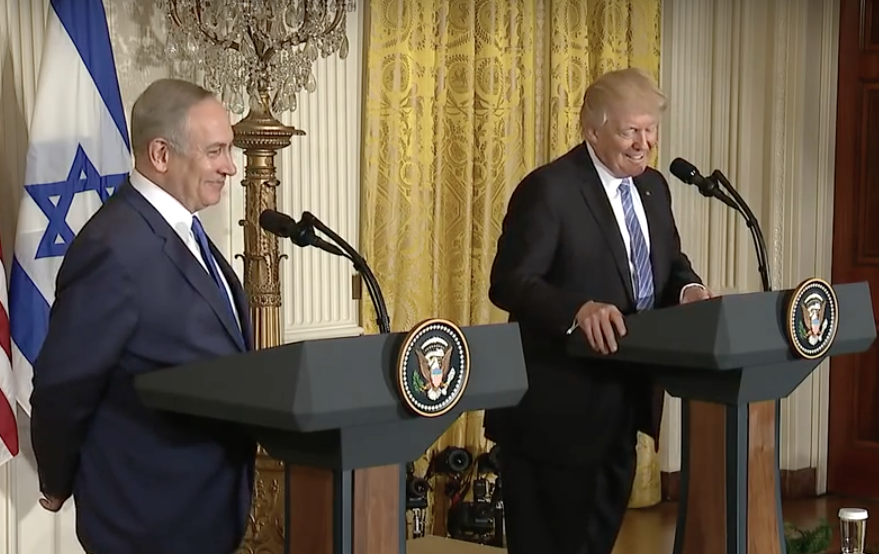
Screen shot from Whitehouse.gov
Trump is surely in no position to tell the Saudis to cut out their covert funding for Al Qaeda and other Sunni terrorist groups – or to insist that they stop bombing Yemen, the poorest country in the Middle East. Nor could Trump dare challenge Netanyahu on the Israeli abuse of the Palestinians, the Prime Minister’s obstruction of the peace process, and his blatant efforts to manipulate U.S. politics in favor of bloody neocon interventions across the region. Trump will be the desperate supplicant hoping for a reassuring pat on the head.
There is one – and perhaps only one – winning move that Trump has left. He could authorize CIA Director Mike Pompeo to prepare for release U.S. intelligence information regarding turning-point moments in recent years, such as the truth about the 2013 sarin incident in Syria and the 2014 Malaysia Airlines shoot-down in eastern Ukraine. [See here and here.]
If – as I’m told – the Obama administration systematically misrepresented the intelligence on those catastrophes to register propaganda gains (against the Syrian government in 2013 and Russia in 2014), the U.S. government’s internal information could shift those key narratives in more peaceful directions.
But whatever the truth is, Trump could shift his own image from a compulsive liar who disdains facts into a champion for transparency and honesty in government. He could turn the tables on The New York Times (which has set itself up as the great hero for Truth) and The Washington Post (which has fashioned a new melodramatic slogan, “Democracy Dies in Darkness”). He could point out their hypocritical lack of aggressiveness in challenging the Obama administration’s excessive secrecy.
Trump would also give his dispirited supporters something to rally around. Many blue-collar voters backed Trump because they thought he was at least addressing their economic fears of lost work and lost status, while Hillary Clinton – in their view – treated them with disregard and disdain, even calling many of them “deplorables.”
But Trump’s promises of recovered jobs were largely hollow. Whatever improvement Americans might be feeling in their pocketbooks, it is more the result of Obama’s careful economic management and the normal recovery from Bush’s Wall Street crash and the Great Recession than anything Trump can or will do.
So, revealing hidden truths – where the American people may have been misled – would not only be the right thing to do for democracy, it also could be the smart thing to do. When the Establishment coup-makers come for Trump – as they now almost certainly will – he can at least say that he tried to do something to return the U.S. government to the American people.
That might not save his presidency but it would at least elevate his purpose and possibly create some positive legacy to attach to the Trump name. As the situation stands now, Trump appears headed for a humiliating exit that won’t just strip him of the presidency but would strip away any luster for the Trump brand.
In other words, his impulsive foray into politics might not just make him one of the most reviled U.S. presidents in history but take down the Trump businesses, too.
Investigative reporter Robert Parry broke many of the Iran-Contra stories for The Associated Press and Newsweek in the 1980s.
New North Korea-Russia Sea Route Throws Washington’s Ambitions Into Doubt
Sputnik – 18.05.2017
Moscow has kicked off its first North Korea-Russian ferry service following Washington’s expansion of its sanctions against Pyongyang. On May 18 the DPRK vessel Man Gyong Bong arrived at the free port of Vladivostok. According to RIA Novosti contributor Alexander Khrolenko, this is how Russia responded to US’ unilateral sanctions.
Following US Congress’ endorsement of new sanctions on North Korea’s ships and employees, Russia has established permanent maritime communication between the DPRK’s Rajin port and Vladivostok; according to RIA Novosti contributor Alexander Khrolenko, this is hardly a coincidence.
On May 18, North Korea’s vessel Man Gyong Bong arrived in the Russian port of Vladivostok. While Russia and the DPRK already have a railway connection, the Rajin-Vladivostok route has become the first service between the countries.
“It took about nine hours [for Man Gyong Bong] to cross the sea,” Khrolenko wrote, “It is planned that the ferry will transport Chinese tourists (from Hunchun) to Russia every week, Russian tourists to Rajin and North Korean workers to Vladivostok and back (from May 25).”
“The Man Gyong Bong has three dry cargo holds with a total capacity of 1,500 tons, which will probably not be empty on voyages,” the Russian journalist elaborated, “The ice-free port of Rajin is located in the North-Korean city of Rason which enjoys the status of a special economic zone with free business allowed. The free port of Vladivostok is also a zone of special customs, tax, investment and related regulation.”
Previously, the US House of Representatives voted overwhelmingly for expanding sanctions against Pyongyang. The bill bars vessels owned by the DPRK or by countries involved in trade with Pyongyang from operating in American waters or docking at US ports.
In accordance with the legislation, those countries which hire North Korean employees would be subjected to sanctions under the International Emergency Economic Power Act.
Khrolenko remarked that Congress even went so far as to maintain special control over Russia’s Far East ports of Vladivostok, Nakhodka and Vanino, as part of the measures.
Meanwhile, on May 16 US Ambassador to the United Nations Nikki Haily urged other countries either to exert more pressure on North Korea or choose between Washington and Pyongyang.
“You either support North Korea or you support us, you are either with North Korea or not,” Haily said as quoted by Bloomberg.
“The free port of Vladivostok has already responded [to the US sanctions],” Khrolenko pointed out, referring to the ferry service linking North Korea and Russia.
The journalist noted that Russia is complying with the UN Security Council’s Resolution 2270 on restrictions against North Korea inked by President Vladimir Putin in December 2016. However, that doesn’t mean that the US has the right to impose its own police control on sovereign states, he added.
“No country and no international organization have authorized the US to monitor the implementation of UN Security Council resolutions by police or ‘cowboy’ methods,” Khrolenko wrote, adding that the bill supported by the US Congress contradicts the principle of sovereignty and calls into question international economic activity.
The journalist reminded his readers that Washington wants to track ships coming to Russia and other countries including China, Syria, Iran, and inspect cargo transported to certain ports of the DPRK.
He added that special US services can obtain the right to inspect ships and aircraft that have visited North Korea during the last 365 days.
Predictably, Washington’s unilateral initiative prompted criticism from Russian politicians.
Commenting on the issue, Konstantin Kosachev, the head of the Federation Council’s Foreign Affairs Committee, said that de jure the bill’s realization means “forced inspection of all vessels” by US warships. Such a scenario amounts to a declaration of war, Kosachev noted.
However, according to Khrolenko, the US congressmen’s plan to maintain control over the countries’ trade is nothing but wishful thinking.
“It is impossible to control the ports and economic activities of independent states from Washington,” the journalist noted, “As for the Far Eastern ports of Russia, the Americans may only conduct remote monitoring [of the region].”
“The US can also obtain information by using space reconnaissance means, remote hacking of the ports databases or agents in the field. Or they can simply inspect any vessel in neutral waters… Everything is possible, but taking into account the total volume of shipping and the capabilities of the Navy of the aforementioned countries [Russia, China, Iran, Syria], such control appears to be too dangerous,” he elaborated.
Corporate Democrats Use Public Option to Derail Push for Single Payer
Single Payer Action | May 2, 2017
 The corporate Democrats are using the public option to derail the newly energized movement to single payer.
The single payer movement is halfway to passing single payer in the House of Representatives.
One hundred and nine members of the House, out of a total of 218 needed for passage, have signed on the HR 676, the House single payer bill.
And single payer remains the hot topic at Congressional town halls meetings.
But the dominant corporate wing of the Democratic Party wants nothing to do with it.
That was made clear once again last week when a number of Democrats took to the microphones to savage President Trump and his repeal and replace push.
Attending the press conference were Senators Ron Wyden (Oregon), Patty Murray (Washington), Chris Murphy (Connecticut), and House members Bobby Scott (Virginia), Cheri Bustos (Illinois), Frank Pallone (New Jersey) and Richard Neal (Massachusetts).
It was typical Democratic rhetoric – totally ignoring the 109 Democrats in the House who had signed onto single payer.
Toward the end of the press conference, the Democrats were asked whether any of them supported single payer and whether any of them would join their 109 colleagues in the House who had signed on.
None of the Democrats at the press conference came up to the microphone to support single payer, although one of them, Bobby Scott, is a co-sponsor of HR 676.
Senator Murphy, the Senator from Connecticut, home to the private health insurance industry, was the first to pull out the public option deflection.
“I understand there is another conversation happening for an ultimate replacement for the existing health care system,” Murphy said. “But we are focused on stopping this (Republican) legislation because it is a real, current threat to our constituents.”
“Speaking for myself, I’m a supporter of the public option,” Murphy said. “Giving consumers the choice to join a Medicare system or stay with private insurance is the best way to go. That’s my preference. And let people choose.”
Wyden said that “any state that wants to set up their own public option using (Obamacare section 1332) has the legal authority to do it.”
When asked whether he was opposed to single payer, Wyden said that “a number of states are trying to do single payer as well through 1332.”
“Right now, I want to get on to the business at hand, particularly to hold down prescription drug costs and hold down insurance bills,” Wyden said. “And in places where there is only one insurance choice – and there are some of those – a state could set up a public option and they could move right away to do it.”
Single payer activists weren’t buying the public option.
“I call the public option what it really is, the profiteer’s option, because it is a relief valve for the private insurers,” said Dr. Margaret Flowers of Health Over Profit. “They will keep the healthiest enrollees and the public option will attract people who need health care.”
“We can’t delay the solution to our healthcare crisis,” Flowers said. “If Democrats want public support, they need to get more active in advocating for single payer. Those who don’t will show the public that they are on the wrong side of this issue.”
Kevin Zeese of Health Over Profit said that “the Democratic Party leadership is out of touch with the majority of Democrats in the House who have signed on to HR 676 and with the super majority of their voters who support National Improved Medicare for All.”
“It’s not a surprise that Senator Wyden is representing the medical industry and not the people by introducing a public option,” Zeese said. “Senator Wyden is the ranking member of the Senate Finance Committee, the most corrupt committee in the Senate.”
Poll: Most Americans Think the US Spends Far too Much on Military
Sputnik – 02.05.2017
The majority of Americans believe that the US was already spending too much on the military budget — even before the Trump administration’s $54-billion increase for defense spending.
In a newly released survey from the University of Maryland’s Program for Public Consultation, pollsters asked registered voters to create their ideal budget in a series of 31 line items. The responses were then compared to Trump’s proposed budget.
Researchers found was that voters agree with Trump on many proposals, including less funding for the State Department and NASA.
There was a massive difference, however, when it came to education spending and funding for medical research.
Still, the top disparity between what voters want and what Trump wants is military spending.
The fiscal 2017 defense spending budget was $584 billion under former President Barack Obama. According to the poll, that was already far too much.
“Voters surveyed by PPC said they’d prefer to cut the 2017 Obama defense budget by $41 billion — not increase it by $54 billion,” the Motley Fool reported. “Voters recommended cutting the base budget by 5 percent ($26 billion), pulling back internationally and cutting OCO funding by 23 percent($15 billion) in the process. And voters think the nuclear arsenal is fine as is and oppose spending more money to ‘greatly strengthen and expand it.’”
The response does not appear to be in reaction to Trump’s proposal however, as the unfavorability of high defense spending has remained fairly steady since at least 2012. Despite the average taxpayer’s feelings about it, the dollar amount has continued to steadily increase throughout that time.
Deceit, Betrayal and the Left: The ‘Traitor of the Year Award’
By James Petras :: 04.30.2017
Introduction
While the Right faithfully supports the policies and interests of its ruling class supporters, the Left has systematically betrayed their political platform promises and deceived its working class, salaried employees, small business and regional supporters.
Historic reversals have happened in rapid succession by Leftist leaders, including greater oligarch control over the economy, more dictatorial political domination by imperial powers (US,EU), increasing inequalities and poverty, and ‘Leftist’ support for imperial wars.
In some cases leftist leaders have gone beyond their rightist opponents by passing even more extreme reactionary policies upon assuming power.
In this essay, we will identify some of the turncoat leftists: The ‘Champions of Betrayal’.
Secondly we will review their policy reversals and the consequences for their working class and rural supporters.
Thirdly, we will present a case study of the world’s worst ‘Left’ traitor today: Alexis Tsipras, Prime Minister of Greece.
In the final section, we will discuss some of the possible explanations for the trend of political reversals by left leaders.
Turncoat ‘Leftists’ of the Early 21st Century
There are numerous examples of former guerrilla movements, leftist regimes and political leaders who gained mass popular support on the promise of radical structural transformations and who turn around to embrace the interests of their oligarchical and imperial adversaries.
An entire generation of radicals from the 1960’s and ’70’s started on the left and, by the ’80’s and 90’s ended up in ‘centrist’ and rightwing regimes – even becoming collaborators with the extreme right and the CIA.
Former guerrilla fighters, who turned centrist and rightwing, became Cabinet Ministers or Presidents in Uruguay, Brazil, Peru, Ecuador and Chile.
El Salvadoran guerrilla commander, Joaquin Villalobos, later collaborated with the CIA and provided ‘advice’ to the ‘death squad’ President of Colombia.
The list of late 20th century traitors is long and dismal. Their policy betrayals have caused great hardship for their mass supporters who suffered socio-economic losses, political repression, arrests, torture, death and a profound distrust toward ‘left’ intellectuals, political leaders and their ‘promises’.
The 21st Century: Starting on the Left and Ending on the Right
The first decade of the 21st century witnessed a revival of left regimes and political parties in Europe and Latin America.
The Revolutionary Armed Forces of Colombia (FARC), led by the great peasant leader Manual Marulanda, had 20,000 fighters and millions of supporters. In 1999, it had advanced to the outskirts of the Capital, Bogota. The reality today is a dramatic reversal.
In France, the Socialist Party adopted a left program and elected Francois Hollande as President in 2012. He promised to raise taxes on the rich to 75% in order to finance a massive jobs program. He promised to extend progressive labor legislation and to defend national industries. Today his credibility is near zero.
Throughout Latin America, Leftists were elected to head governments, including Brazil, Argentina, Peru, Uruguay, Bolivia, Venezuela, Ecuador and El Salvador. With the possible exception of Bolivia and Ecuador, they have been ousted by their rightwing partners or opponents.
In Spain, Portugal and Greece, new radical leftist parties emerged with promises to end the brutal European Union-imposed austerity programs, and launch profound, class-based, structural transformations. Here history is repeating itself with another series of betrayals.
The Revolutionary Armed of Forces of Colombia (FARC): From Revolution to Surrender
By June 2017, the FARC leadership had disarmed its fighters, abandoning millions of peasant supporters in regions formerly under their control. The FARC’s signing of the Peace Pact with the Santos regime led to neither peace nor a real pact. Dozens of activists are already being murdered and hundreds of leftists and peasants are fleeing for their lives from death squads connected to the Santos regime. Assassinations occurred throughout the negotiation process and afterwards. Guerrilla fighters, who turned in their arms, now face kangaroo trials, while peasants who apply for agrarian reform are driven from their farms. Rank and file FARC fighters and militants are abandoned with their families in the jungle without homes, jobs and security from the death squads. US military bases and advisers remain. The entire socio-economic system is unchanged. Only the Cuba-based guerrilla ‘leaders’ are guaranteed security, two comfortable seats in Parliament– which has been denied– and the praise of the US government!
FARC leaders and chief negotiators, Ivan Marquez and Timoleon Jimenez, are clear contenders for the ‘Traitor of the Year Award’.
France’s President Hollande: An Imperial Collaborator Flushed down the Toilet
President Francois Hollande’s tenure was not far behind the FARC’s betrayal. Elected President of France in 2012 under the Socialist Party, he promised to ‘tax the rich’ by 75%, extend and deepen workers’ rights, reduce unemployment, revive bankrupt industries, prevent capitalist flight and end France’s military intervention in Third World countries.
After a brief flirtation with his campaign rhetoric, President Hollande went on a pro-business and militarist rampage against his voters:
First, he deregulated business relations with labor, making it easier and quicker to fire workers.
Second, he reduced business taxes by $40 billion Euros.
Third, he imposed and then extended a draconian state of emergency following a terrorist incident. This included the banning of strikes by workers protesting his anti-labor legislation and the double-digit unemployment rate.
Fourth, Hollande launched or promoted a series of imperial wars in the Middle East and North and Central Africa.
France under Francois Hollande initiated the NATO bombing of Libya, the murder of President Gadhafi, the total destruction of that nation and the uprooting of millions of Libyans and sub-Saharan African workers. This led to a massive flood of terrified refugees across the Mediterranean and into Europe with tens of thousands drowning in the process.
President Holland’s neo-colonial project oversaw the expansion of French troops into Mali (destabilized by the destruction of Libya) and the Central African Republic.
A clear promoter of genocide, Hollande sold arms and sent ‘advisers’ to support Saudi Arabia’s grotesque war against impoverished Yemen.
President Hollande joined the US mercenary invasion of Syria, allowing some of France’s finest nascent jihadis to join in the slaughter. His colonial ambitions have resulted in the flight of millions of refugees into Europe and other regions.
By the end of his term of office in 2017, Holland’s popularity had declined to 4%, the lowest level of electoral approval of any President in French history! The only rational move he undertook in his entire regime was to not seek re-election.
Greek Prime Minister Alexis Tsipras: ‘Traitor of the Year’
Despite the stiff competition from other infamous leftist traitors around the world, Greek Prime Minister Alexis Tsipras wins the ‘Global Traitor of the Year’ award.
Tsipras deserves the label of ‘Global Traitor’ because:
1) He made the quickest and most brutal turn from left to right than any of his venal competitors.
2) He supported Greece’s subjugation to the dictates of the Brussels oligarchs privatization demands, agreeing to sell its entire national patrimony, including its infrastructure, islands, mines, beaches, museums, ports and transports etc.
3) He decreed the sharpest reduction of pensions, salaries and minimum wages in European history, while drastically increasing the cost of health care, hospitalization and drugs. He increased VAT, (consumer taxes) and tax on island imports and farm income while ‘looking the other way’ with rich tax evaders.
4) Tsipras is the only elected leader to convoke a referendum on harsh EU conditions, receive a massive mandate to reject the EU plan and then turn around and betray the Greek voters in less than a week. He even accepted more severe conditions than the original EU demands!
5) Tsipras reversed his promises to oppose EU sanctions against Russia and withdrew Greece’s historic support for the Palestinians. He signed a billion-dollar oil and gas deal with Israel which grabbed oil fields off the Gaza and Lebanon coast. Tsipras refused to oppose the US -EU bombing of Syria, and Libya – both former allies of Greece.
Tsipras, as the leader of the supposedly ‘radical left’ SYRIZA Party, leaped from left to right in the wink of an eye.
The first and most revealing indication of his turn to the right was Tsipras’ support for Greece’s continued membership in the European Union (EU) and NATO during the formation of SYRIZA (2004).
SYRIZA’s ‘left’ mouthed the usual platitudes accompanying EU membership, raising vacuous ‘questions’ and ‘challenges’ while talking of ’struggles’. None of these ‘half pregnant’ phrases made sense to any observer who understood the power of the German-led oligarchs in Brussels and their strict adherence to ruling-class imposed austerity.
Secondly, SYRIZA had played a minor role, at best, in the numerous trade union general strikes and worker and student led direct action in the run-up to its electoral victory in 2015.
SYRIZA is an electoral party of the lower middle and middle class, led by upwardly mobile politicos who had few if any ties to shop-floor factory and agrarian struggles. Their biggest struggles seemed to revolve around internal factional wars over seats in Parliament!
SYRIZA was a loose collection of squabbling groups and factions, including, ‘ecology movements’, Marxist sects and traditional politicos who had floated over from the moribund, and corrupt PanHellenic Socialist Party (PASOK). SYRIZA expanded as a party at the beginning of the 2008 financial crisis when the Greek economy collapsed. From 2004 to 2007 SYRIZA increased its presence in Parliament from 3.5% to only 5%. Its lack of participation in the mass struggles and its internal squabbles led to a decline in the 2009 legislative elections to 4.6% of seats.
Tsipras ensured that SYRIZA would remain in the EU, even as its self-styled ‘left wing’, the Left Platform, led by ‘Marxist academic’ Panagiotis Lafazanis, promised to “keep an open door to leaving the EU”. Alexis Tsipras was first elected to the Athens city council, where he publicly attacked corrupt and demagogic rightwing colleagues while taking private lessons in power from the oligarchy.
In 2010, the rightwing PASOK and far right New Democracy agreed to an EU dictated debt bail-out leading to massive job losses and the slashing of wages and pensions. SYRIZA, while outside of power, denounced the austerity program and gave lip-service to the massive protests. This posturing allowed SYRIZA to quadruple its representation in parliament to 16% in the 2012 election.
Tsipras welcomed corrupt ex-PASOK members and financial advisers into SYRIZA, including Yanis Varoufakis, who spent more time motorcycling to upscale bars than supporting the unemployed workers in the streets.
EU ‘memorandums’ dictated the privatization of the economy, as well as deeper cuts in education and health. These measures were implemented in shock waves from 2010 through 2013. As an opposition party, SYRIZA increased its seats 27% in 2013 … a scant 3% behind the ruling rightwing New Democracy. In September 2014, SYRIZA approved the Thessalonika Program promising to reverse austerity, rebuild and extend the welfare state, restart the economy, defend public enterprises, promote tax justice, uphold democracy (direct democracy no less!) and implement a ‘national plan’ to increase employment.
The entire debate and all the resolutions turned out to be a theatrical farce! Once in power, Tsipras never implemented a single reform promised in the Program. To consolidate his power as head of SYRIZA, Tsipras dissolved all factions and tendencies in the name of a ‘unified party’ – hardly a step toward greater democracy!
Under ‘Dear Uncle Alexis’ control, SYRIZA became an authoritarian electoral machine despite its left posturing. Tsipras insisted that Greece would remain within the EU and approved a ‘balanced budget’ contradicting all his phony campaign promises of public investments to ‘extend the welfare state’!
A new EU bailout was followed by a jump in unemployment to over 50% among youth and 30% of the entire labor force. SYRIZA won the January 25, 2015 parliamentary elections with 36.3% of the electorate. Lacking a single vote to secure a majority in parliament, SYRIZA formed an alliance with the far-right ANEL party, to which Tsipras gave the Defense Ministry.
Immediately upon taking office, Prime Minister, Alexis Tsipras announced his plans to renegotiate Greece’s bailout and ‘austerity program’ with the EU oligarchy and the IMF. This phony posturing could not hide his impotence: Since SYRIZA was committed to staying in the EU, austerity would continue and another onerous ‘bailout’ would follow. During ‘internal meetings’, members of SYRIZA’s ‘Left Platform’ in the Cabinet called for leaving the EU, reneging the debt and forging closer ties with Russia. Despite being totally ignored and isolated, they stayed on as impotent ‘token leftist’ Cabinet Ministers.
With Tsipras now free to impose neo-liberal market policies, billions of Euros flowed out of Greece and its own banks and businesses remained in crisis. Both Tsipras and the ‘Left Platform’ refused to mobilize SYRIZA’s mass base, which had voted for action and demanded an end to austerity. The media’s gadfly, Finance Minister Varoufakis, put on a sideshow with grand theatrical gestures of disapproval. These were openly dismissed by the EU-IMF oligarchy as the antics of an impotent Mediterranean clown.
Superficial as ever, the Canadian, US, European left-wing academics were largely unaware of SYRIZA’s political history, its opportunist composition, electoral demagogy and total absence from real class struggle. They continued to blather about SYRIZA as Greece’s ‘radical left’ government and attended its PR functions. When SYRIZA flagrantly embraced the EU’s most savage cutbacks against Greek workers and their living standards affecting everyday life, the highly paid, distinguished professors finally spoke of SYRIZA’s ‘mistakes’ and ladled the ‘radical left’ from this stew of opportunists! Their grand speaking tours to Greece were over and they flitted off to support other ’struggles’.
As the summer of 2015 approached, Prime Minister Tsipras moved ever closer to the entire EU austerity agenda. ‘Dear Alexis’ dumped Finance Minister Varoufakis, whose histrionics had irked Germany’s Finance Minister. Euclid Tsakalotos , another ‘radical’ leftist, took over as Finance Minister, but turned out to be a malleable lieutenant for Tsipras, willing to implement any and all EU-imposed austerity measures without the antics.
By July 2015, Tsipras and SYRIZA accepted a harsh austerity program dictated by the EU. This rejected SYRIZA’s entire Thessalonika Program proclaimed a year earlier. The entire population, and SYRIZA’s rank and file members grew angrier, demanding an end to austerity. While approving a ‘belt tightening’ austerity program for his electoral mass base throughout the summer of 2015, Tsipras and his family lived in luxury in a villa generously loaned by a Greek plutocrat, far from the soup lines and hovels of the unemployed and destitute.
Prime Minister Alexis Tsipras implemented policies earning him the ‘Traitor of the Year Award’. His was a duplicitous strategy: On July 5, 2015, he convoked a referendum on whether to accept the EU’s bailout conditions. Thinking his ‘pro-EU’ supporters would vote ‘Yes’, he intended to use the referendum as a mandate to impose new austerity measures. Tsipras misjudged the people: Their vote was an overwhelming repudiation of the harsh austerity program dictated by the oligarchs in Brussels.
Over 61% of the Greek people voted ‘no’ while merely 38%voted in favor of the bailout conditions. This was not limited to Athens: A majority in every region of the country rejected the EU dictates – an unprecedented outcome! Over 3.56 million Greeks demanded an end to austerity. Tsipras was ‘admittedly surprised’ . . . and disappointed! He secretly and stupidly thought the referendum would give him a free hand to impose austerity. He put on his usual grin as the voting results were announced.
Less than a week later, on July 13, Tsipras renounced the results of his own referendum and announced his government’s support for the EU bailout. Perhaps to punish the Greek voters, Tsipras backed an even harsher austerity scheme than the one rejected in his referendum! He drastically slashed public pensions, imposed massive regressive tax hikes and cut public services by $12 billion euros. Tsipras agreed to the infamous ‘Judas memorandum’ of July 2015, which increased the regressive general consumer tax (VAT) to 23%, a 13% food tax, a sharp increase in medical and pharmaceutical costs and tuition fees, and postponed the retirement age by five years to 67.
Tsipras continued on his ‘historic’ rampage over the suffering Greek people throughout 2016 and 2017. His regime privatized over 71,500 public properties, including the historic patrimony. Only the Acropolis was spared the auction block…. for now! The resulting unemployment drove over 300,000 skilled and educated Greeks to migrate. Pensions slashed to 400 Euros led to malnutrition and a three-fold rise in suicides.
Despite these grotesque social consequences the German bankers and the regime of Angela Merkel refused to reduce the debt payments. Prime Minister Tsipras’ groveling had no effect.
Sharp tax hikes on farm fuels and transport to tourist islands led to constant marches and strikes in cities, factories, fields and highways.
By January 2017 Tsipras had lost half of his electorate. He responded with repression: gassing and beating elderly Greeks protesting their poverty pensions. Three-dozen trade unionists, already acquitted by the courts, were re-tried by Tsipras’ prosecutors in a vicious ’show trial’. Tsipras supported the US-NATO attacks on Syria, the sanctions against Russia and the billion-dollar energy and military agreements with Israel.
Short of the Nazi occupation (1941-44) and Anglo-Greek civil war of (1945-49), the Greek people had not experienced such a precipitous decline of their living standards since the Ottomans. This catastrophe occurred under the Tsipras regime, vassal to the Brussels oligarchy.
European, Canadian and US leftist academic tourists had ‘advised’ SYRIZA to remain in the EU. When the disastrous consequences of their ‘policy advice’ became clear… they merely turned to advising other ’struggles’ with their phony ’socialist forums’.
Conclusions
The betrayals by ‘Leftist’ and ‘radical leftist’ leaders are partly due to their common practices as politicians making pragmatic deals in parliament. In other cases, former extra-parliamentary and guerrilla leaders were faced with isolation and pressure from neighboring ‘left’ regimes to submit to imperial ‘peace accords’, as in the case of the FARC. Confronting the massive build-up of the US supplied and advised armies of the oligarchs, they folded and betrayed their mass supporters.
The electoral framework within the EU encouraged leftist collaboration with class enemies – especially German bankers, NATO powers, the US military and the IMF.
From its origins SYRIZA refused to break with the EU and its authoritarian structure. From its first day of government, it accepted even the most demonstrably illegal private and public debts accumulated by the corrupt right-wing PASOK and New Democracy regimes. As a result SYRIZA was reduced to begging.
Early on SYRIZA could have declared its independence, saved its public resources, rejected its predecessors’ illegal debts, invested its savings in new jobs programs, redefined its trade relations, established a national currency and devalued the drachma to make Greece more flexible and competitive. In order to break the chains of vassalage and foreign oligarch imposed austerity, Greece would need to exit the EU, renounce its debt and launch a productive socialist economy based on self-managed co-operatives.
Despite his electoral mandate, the Greek Prime Minister Tsipras followed the destructive path of Soviet leader Michel Gorbachev, betraying his people in order to continue down the blind ally of submission and decay.
While several leaders offer stiff competition for the ‘Traitor of the Year Award’, Alexis Tsipras’ betrayal has been longer, more profound and continues to this day. He broke more promises and reversed more popular mandates (elections and referendums) more quickly than any other traitor. Moreover nothing short of a generation will allow the Greeks to recover left politics. The left has been devastated by the monstrous lies and complicity of Tsipras’ former ‘left critics’.
Greece’s accumulated debt obligations will require at least a century to play out – if the country can even survive. Without question, Alexis Tsipras is the ‘Traitor of the Year’ by unanimous vote!!!
Middle Eastern Surgeon Speaks About the “Ecology of War”

Dr. Gus Abu-Sitta
By Andre Vltchek | Dissident Voice | April 27, 2017
Dr. Gus Abu-Sitta is the head of the Plastic Surgery Department at the AUB Medical Center in Lebanon. He specializes in: reconstructive surgery. What it means in this part of the world is clear: they bring you people from the war zones, torn to pieces, missing faces, burned beyond recognition, and you have to try to give them their life back.
Dr. Abu-Sitta is also a thinker. A Palestinian born in Kuwait, he studied and lived in the UK, and worked in various war zones of the Middle East, as well as in Asia, before accepting his present position at the AUB Medical Center in Beirut, Lebanon.
We were brought together by peculiar circumstances. Several months ago I burned my foot on red-hot sand, in Southeast Asia. It was healing slowly, but it was healing. Until I went to Afghanistan where at one of the checkpoints in Herat I had to take my shoes off, and the wound got badly infected. Passing through London, I visited a hospital there, and was treated by one of Abu-Sitta’s former professors. When I said that among other places I work in Lebanon, he recommended that I visit one of his “best students who now works in Beirut”.
I did. During that time, a pan-Arab television channel, Al-Mayadeen, was broadcasting in English, with Arabic subtitles, a long two-part interview with me, about my latest political/revolutionary novel “Aurora” and about the state of the global south, and the upsurge of the Western imperialism. To my surprise, Dr. Abu-Sitta and his colleagues were following my work and political discourses. To these hardened surgeons, my foot ‘issue’ was just a tiny insignificant scratch. What mattered was the US attack against Syria, the Palestine, and the provocations against North Korea.
My ‘injury’ healed well, and Dr. Abu-Sitta and I became good friends. Unfortunately I have to leave Beirut for Southeast Asia, before a huge conference, which he and his colleagues are launching on the May 15, 2017, a conference on the “Ecology of War”.
I believe that the topic is thoroughly fascinating and essential for our humanity, even for its survival. It combines philosophy, medicine and science.
What happens to people in war zones? And what is a war zone, really? We arrived at some common conclusions, as both of us were working with the same topic but looking at it from two different angles: “The misery is war. The destruction of the strong state leads to conflict. A great number of people on our Planet actually live in some conflict or war, without even realizing it: in slums, in refugee camps, in thoroughly collapsed states, or in refugee camps.”
We talked a lot: about fear, which is engulfing countries like the UK, about the new wave of individualism and selfishness, which has its roots in frustration. At one point he said: “In most parts of the world “freedom” is synonymous with the independence struggle for our countries. In such places as the UK, it mainly means more individualism, selfishness and personal liberties.”
We talked about imperialism, medicine and the suffering of the Middle East.
Then we decided to publish this dialogue, shedding some light on the “Ecology of War” – this essential new discipline in both philosophy and medicine.
Ecology of War
(The discussion took place in Beirut, Lebanon, in Cafe Younes, on April 25, 2017)
Broken Social Contract In The Arab World, Even In Europe
GA-S: In the South, medicine and the provision of health were critical parts of the post-colonial state. And the post-colonial state built medical systems such as we had in Iraq, Egypt and in Syria as part of the social contract. They became an intrinsic part of the creation of those states. And it was a realization that the state has to exercise its power both coercively, (which we know the state is capable of exercising, by putting you in prison, and even exercising violence), but above all non-coercively: it needs to house you, educate you, and give you health, all of those things. And that non-coercive power that the states exercise is a critical part of the legitimizing process of the state. We saw it evolve in 50’s, 60’s and 70’s. So as a digression, if you want to look at how the state was dismantled: the aim of the sanctions against Iraq was not to weaken the Makhabarat or the army; the aim of the sanctions was to rob the Iraqi state of its non-coercive power; its ability to give life, to give education, and that’s why after 12 years, the state has totally collapsed internally – not because its coercive powers have weakened, but because it was robbed of all its non-coercive powers, of all its abilities to guarantee life to its citizens.
AV: So in a way the contract between the state and the people was broken.
GA-S: Absolutely! And you had that contract existing in the majority of post-colonialist states. With the introduction of the IMF and World Bank-led policies that viewed health and the provision of health as a business opportunity for the ruling elites and for corporations, and viewed free healthcare as a burden on the state, you began to have an erosion in certain countries like Egypt, like Jordan, of the non-coercive powers of the state, leading to the gradual weakening of its legitimacy. Once again, the aim of the IMF and World Bank was to turn health into a commodity, which could be sold back to people as a service; sold back to those who could afford it.
AV: So, the US model, but in much more brutal form, as the wages in most of those countries were incomparably lower.
GA-S: Absolutely! And the way you do that in these countries: you create a two-tier system where the government tier is so under-funded, that people choose to go to the private sector. And then in the private sector you basically have the flourishing of all aspects of private healthcare: from health insurance to provision of health care, to pharmaceuticals.
AV: Paradoxically this scenario is also taking place in the UK right now.
GA-S: We see it in the UK and we’ll see it in many other European countries. But it has already happened in this region, in the Arab world. Here, the provision of health was so critical to creation of the states. It was critical to the legitimacy of the state.
AV: The scenario has been extremely cynical: while the private health system was imposed on the Arab region and on many other parts of the world, in the West itself, except in the United States, medical care remains public and basically free. We are talking about state medical care in Europe, Canada, Australia and New Zealand.
GA-S: Yes. In Europe as part of the welfare state that came out of the Second World War, the provision of healthcare was part of the social contract. As the welfare state with the advent of Thatcherism and Reagan-ism was being dismantled, it became important to undergo a similar process as elsewhere. The difference is that in the UK, and also in countries like Germany, it was politically very dangerous. It could lead to election losses. So the second plan was to erode the health system, by a thousand blows, kill it gradually. What you ended up in the UK is the piece-by-piece privatization of the health sector. And the people don’t know, they don’t notice that the system is becoming private. Or in Germany where actually the government does not pay for healthcare – the government subsidizes the insurance companies that profit from the private provision of healthcare.
AV: Before we began recording this discussion, we were speaking about the philosophical dilemmas that are now besieging or at least should be besieging the medical profession. Even the social medical care in Europe: isn’t it to some extent a cynical arrangement? European countries are now all part of the imperialist block, together with the United States, and they are all plundering the rest of the world – the Middle East, Africa, parts of Asia – and they are actually subsidizing their social system from that plunder. That’s one thing. But also, the doctors and nurses working for instance in the UK or Germany are often ‘imported’ from much poorer countries, where they have often received free education. Instead of helping their own, needy people, they are actually now serving the ageing and by all international comparisons, unreasonably spoiled and demanding population in Europe, which often uses medical facilities as if they were some ‘social club’.
GA-S: I think what has happened, particularly in Europe, is that there is a gradual erosion of all aspects of the welfare state. Politically it was not yet possible to get rid of free healthcare. The problem that you can certainly see in the United Kingdom is that health is the final consequence of social and economic factors that people live in. So if you have chronic unemployment, second and third generation unemployment problem, these have health consequences. If you have the destruction of both pensions and the cushion of a social umbrella for the unemployed, that has consequences… Poor housing has health consequences. Mass unemployment has health consequences. Politically it was easy to get rid of all other aspects of the welfare state, but they were stuck with a healthcare problem. And so the losing battle that the health systems in the West are fighting is that they are being expected to cater to the poor consequences of the brutal capitalist system as a non-profit endeavor. But we know that once these lifestyle changes are affecting people’s health, it’s too late in terms of cure or prevention. And so what the European health systems do, they try to patch people and to get them out of the system and back on the street. So if you have children with chronic asthma, you treat the asthma but not the dump housing in which these children are living in. If you have violent assaults and trauma related to violence, you treat the trauma, the physical manifestation, and not the breakdown of youth unemployment, or racism that creates this. So in order to sustain this anomaly, as you said, you need an inflated health system, because you make people sick and then you try to fix them, rather than stopping them from being sick. Hence that brain drains that have basically happened, where you have more Ghanaian doctors in New York than you have in Ghana.
AV: And you have an entire army of Philippine nurses in the UK, while there is suddenly a shortage of qualified nurses in Manila.
GA-S: Absolutely! This is the result of the fact that actually people’s health ‘happens’ outside the health system. Because you cannot get rid of the health system, you end up having a bloated health system, and try to fix the ailments that are coming through the door.
Collapse Of The Health Care In The Middle East
AV: You worked in this entire region. You worked in Iraq, and in Gaza… both you and I worked in Shifa Hospital in Gaza… You worked in Southern Lebanon during the war. How brutal is the healthcare situation in the Middle East? How badly has been, for instance, the Iraqi peoples’ suffering, compared to Western patients? How cruel is the situation in Gaza?
GA-S: If you look at places like Iraq: Iraq in the 80’s probably had one of the most advanced health systems in the region. Then you went through the first war against Iraq, followed by 12 years of sanctions in which that health system was totally dismantled; not just in terms of hospitals and medication and the forced exile of doctors and health professionals, but also in terms of other aspects of health, which are the sewage and water and electricity plants, all of those parts of the infrastructure that directly impact on people’s lives.
AV: Then came depleted uranium…
GA-S: And then you add to the mix that 2003 War and then the complete destruction and dismantling of the state, and the migration of some 50% of Iraq’s doctors.
AV: Where did they migrate?
GA-S: Everywhere: to the Gulf and to the West; to North America, Europe… So what you have in Iraq is a system that is not only broken, but that has lost the components that are required to rebuild it. You can’t train a new generation of doctors in Iraq, because your trainers have all left the country. You can’t create a health system in Iraq, because you have created a government infrastructure that is intrinsically unstable and based on a multi-polarity of the centers of power which all are fighting for control of the pie of the state… and so Iraqis sub-contract their health at hospital level to India and to Turkey and Lebanon, or Jordan, because they are in this vicious loop.
AV: But this is only for those who can afford it?
GA-S: Yes, for those who can, but even in those times when the government had cash it could not build the system anymore. So it would sub-contract health provisions outside, because the system was so broken that money couldn’t fix it.
AV: Is it the same in other countries of the region?
GA-S: The same is happening in Libya and the same is happening in Syria, with regards of the migration of their doctors. Syria will undergo something similar to Iraq at the end of the war, if the Syrian state is destroyed.
AV: But it is still standing.
GA-S: It still stands and it is still providing healthcare to the overwhelming majority of the population even to those who live in the rebel-controlled areas. They are travelling to Damascus and other cities for their cardiac services or for their oncological services.
AV: So no questions asked; you are sick, you get treated?
GA-S: Even from the ISIS-controlled areas people can travel and get treated, because this is part of the job of the state.
AV: The same thing is happening with the education there; Syria still provides all basic services in that area.
GA-S: Absolutely! But in Libya, because the state has totally disappeared or has disintegrated, all this is gone.
AV: Libya is not even one country, anymore…
 Intifada Gaza
GA-S: There is not a unified country and there is definitely no health system. In Gaza and the Palestine, the occupation and the siege, ensure that there is no normal development of the health system and in case of Gaza as the Israelis say “every few years you come and you mown the lawn”; you kill as many people in these brutal and intense wars, so you can ensure that the people for the next few years will be trying to survive the damage that you have caused.
AV: Is there any help from Israeli physicians?
GA-S: Oh yes! Very few individuals, but there is…
But the Israeli medical establishment is actually an intrinsic part of the Israeli establishment, and the Israeli academic medical establishment is also part of the Israeli establishment. And the Israeli Medical Association refused to condemn the fact that Israeli doctors examine Palestinian political prisoners for what they call “fitness for interrogation”. Which is basically… you get seen by a doctor who decides how much torture you can take before you die.
 Gaza Shifa Hospital – wounded by Israeli soldiers
AV: This actually reminds me of what I was told in 2015 in Pretoria, South Africa, where I was invited to participate as a speaker at the International Conference of the Psychologists for Peace. Several US psychologists reported that during the interrogation and torture of alleged terrorists, there were professional psychologists and even clinical psychiatrists standing by, often assisting the interrogators.
GA-S: Yes, there are actually 2-3 well-known American psychologists who designed the CIA interrogation system – its process.
AV: What you have described that is happening in Palestine is apparently part of a very pervasive system. I was told in the Indian-controlled Kashmir that Israeli intelligence officers are sharing their methods of interrogation and torture with their Indian counterparts. And. of course, the US is involved there as well.
Conflict Medicine
GA-S: War surgery grew out of the Napoleonic Wars. During these wars, two armies met; they usually met at the frontline. They attacked each other, shot at each other or stabbed each other. Most of injured were combatants, and they got treated in military hospitals. You had an evolution of war surgery. What we have in this region, we believe, is that the intensity and the prolonged nature of these wars or these conflicts are not temporal-like battles, they don’t start and finish. And they are sufficiently prolonged that they change the biological ecology, the ecology in which people live. They create the ecology of war. That ecology maintains itself well beyond of what we know is the shooting, because they alter the living environment of people. The wounds are physical, psychological and social wounds; the environment is altered as to become hostile; both to the able-bodied and more hostile to the wounded. And as in the cases of these multi-drug-resistant organisms, which are now a big issue in the world like the multi-drug-resistant bacteria, 85% of Iraqi war wounded have multi-drug-resistant bacteria, 70% of Syrian war wounded have it…
So we say: this ecology, this bio-sphere that the conflicts create is even altered at the basic DNA of the bacteria. We have several theories about it; partly it’s the role of the heavy metals in modern ordnance, which can trigger mutation in these bacteria that makes them resistant to antibiotics. So your bio-sphere, your bubble, your ecological bubble in which you live in, is permanently changed. And it doesn’t disappear the day the bombs disappear. It has to be dismantled, and in order to dismantle it you have to understand the dynamics of the ecology of war. That’s why our program was set up at the university, which had basically been the major tertiary teaching center during the civil war and the 1982 Israeli invasion. And then as the war in Iraq and Syria developed, we started to get patients from these countries and treat them here. We found out that we have to understand the dynamics of conflict medicine and to understand the ecology of war; how the physical, biological, psychological and social manifestations of war wounding happen, and how this ecology of war is created; everything from bacteria to the way water and the water cycle changes, to the toxic reminisce of war, to how people’s body reacts… Many of my Iraqi patients that I see have multiple members of their families injured.
AV: Is the AUB Medical Center now the pioneer in this research: the ecology of war?
GA-S: Yes, because of the legacy of the civil war… of regional wars.
AV: Nothing less than a regional perpetual conflict…
GA-S: Perpetual conflict, yes; first homegrown, and then regional. We are the referral center for the Iraqi Ministry of Health, referral center for the Iraqi Ministry of Interior, so we act as a regional center, and the aim of our program is to dedicate more time and space and energy to the understanding of how this ecology of war comes about.
AV: In my writing and in my films, I often draw the parallel between the war and extreme poverty. I have been working in some of the worst slums on Earth, those in Africa, Central America and Caribbean, South Asia, the Philippines and elsewhere. I concluded that many societies that are in theory living in peace are in reality living in prolonged or even perpetual wars. Extreme misery is a form of war, although there is no ‘declaration of war’, and there is no defined frontline. I covered both countless wars and countless places of extreme misery, and the parallel, especially the physical, psychological and social impact on human beings, appears to be striking. Would you agree, based on your research? Do you see extreme misery as a type of war?
GA-S: Absolutely. Yes. At the core of it is the ‘dehumanization’ of people. Extreme poverty is a form of violence. The more extreme this poverty becomes, the closer it comes to the physical nature of violence. War is the accelerated degradation of people’s life to reaching that extreme poverty. But that extreme poverty can be reached by a more gradual process. War only gets them there faster.
AV: A perpetual state of extreme poverty is in a way similar to a perpetual state of conflict, of a war.
GA-S: Definitely. And it is a war mainly against those who are forced to live in these circumstances. It’s the war against the poor and the South. It’s the war against the poor in the inner-cities of the West.
AV: When you are defining the ecology of war, are you also taking what we are now discussing into consideration? Are you researching the impact of extreme poverty on human bodies and human lives? In this region, extreme poverty can often be found in the enormous refugee camps, while in other parts of the world it dwells in countless slums.
GA-S: This extreme poverty is part of the ecology that we are discussing. One of the constituents of the ecology is when you take a wounded body and you place it in a harsh physical environment and you see how this body is re-wounded and re-wounded again, and this harsh environment becomes a continuation of that battleground, because what you see is a process of re-wounding. Not because you are still in the frontline somewhere in Syria, but because your kids are now living in a tent with 8 other people and they are in danger of becoming the victims of the epidemic of child burns that we now have in the refugee camps, because of poor and unsafe housing.
Let’s look at it from a different angle: what constitutes a war wound, or a conflict-related injury? Your most basic conflict-related injury is a gunshot wound and a blast injury from shrapnel. But what happens when you take that wounded body and throw it into a tent? What are the complications for this wounded body living in a harsh environment; does this constitute a war-related injury? When you impoverish the population to the point that you have children suffering from the kind of injuries that we know are the results of poor and unsafe housing, is that a conflict-related injury? Or you have children now who have work-related injuries, because they have to go and become the main breadwinners for the home, working as car mechanics or porters or whatever. Or do you also consider a fact that if you come from a country where a given disease used to be treatable there, but due to the destruction of a health system, that ailment is not treatable anymore, because the hospitals are gone or because doctors had to leave, does that constitute a conflict-related injury? So, we have to look at the entire ecology: beyond a bullet and shrapnel – things that get headlines in the first 20 seconds.
AV: Your research seems to be relevant to most parts of the world.
GA-S: Absolutely. Because we know that these humanitarian crises only exist in the imagination of the media and the UN agencies. There are no crises.
AV: It is perpetual state, again.
GA-S: Exactly, it is perpetual. It does not stop. It is there all the time. Therefore there is no concept of ‘temporality of crises’, one thing we are arguing against. There is no referee who blows the whistle at the end of the crises. When the cameras go off, the media and then the world, decides that the crises are over. But you know that people in Laos, for instance, still have one of the highest amputation rates in the world.
AV: I know. I worked there in the Plain of Jars, which is an enormous minefield even to this day.
GA-S: Or Vietnam, with the greatest child facial deformities in the world as a result of Agent Orange.
AV: You worked in these countries.
GA-S: Yes.
AV: Me too; and I used to live in Vietnam. That entire region is still suffering from what used to be known as the “Secret War”. In Laos, the poverty is so rampant that people are forced to sell unexploded US bombs for scrap. They periodically explode. In Cambodia, even between Seam Reap and the Thai border, there are villages where people are still dying or losing limbs.
GA-S: Now many things depend on how we define them. It is often a game of words.
AV: India is a war zone, from Kashmir to the Northeast, Bihar and slums of Mumbai.
GA-S: If you take the crudest way of measuring conflict, which is the number of people killed by weapons, Guatemala and Salvador have now more people slaughtered than they had during the war. But because the nature in which violence is exhibited changed, because it doesn’t carry a political tag now, it is not discussed. But actually, it is by the same people against the same people.
AV: I wrote about and filmed in Salvador, Honduras and Nicaragua, on several occasions. The extreme violence there is a direct result of the conflict implanted, triggered by the West, particularly by the United States. The same could be said about such places like Jamaica, Dominican Republic and Haiti. It has led to almost absolute social collapse.
GA-S: Yes, in Jamaica, the CIA played a great role in the 70’s.
AV: In that part of the world we are not talking just about poverty…
GA-S: No, no. We are talking AK-47’s!
AV: Exactly. Once I filmed in San Salvador, in a gangland… A friend, a local liberation theology priest kindly drove me around. We made two loops. The first loop was fine. On the second one they opened fire at our Land Cruiser, with some heavy stuff. The side of our car was full of bullet holes, and they blew two tires. We got away just on our rims. In the villages, maras simply come and plunder and rape. They take what they want. It is a war.
GA-S: ICRC, they train surgeons in these countries. So the ICRC introduced war surgery into the medical curriculum of the medical schools in Colombia and Honduras. Because effectively, these countries are in a war, so you have to train surgeons, so they know what to do when they receive 4-5 patients every day, with gunshot wounds.
 Med Experiments in Haiti
AV: Let me tell you what I witnessed in Haiti, just to illustrate your point. Years ago I was working in Cité Soleil, Port-au-Prince, Haiti. They say it is the most dangerous ‘neighborhood’ or slum on Earth. The local wisdom goes: “you can enter, but you will never leave alive”. I went there with a truck, with two armed guards, but they were so scared that they just abandoned me there, with my big cameras and everything, standing in the middle of the road. I continued working; I had no choice. At one point I saw a long line in front of some walled compound. I went in. What I was suddenly facing was thoroughly shocking: several local people on some wooden tables, blood everywhere, and numerous US military medics and doctors performing surgeries under the open sky. It was hot, flies and dirt everywhere… A man told me his wife had a huge tumor. Without even checking what it was, the medics put her on a table, gave her “local” and began removing the stuff. After the surgery was over, a husband and wife walked slowly to a bus stop and went home. A couple of kilometers from there I found a well-equipped and clean US medical facility, but only for US troops and staff. I asked the doctors what they were really doing in Haiti and they were quiet open about it; they replied: “we are training for combat scenario… This is as close to a war that we can get.” They were experimenting on human beings, of course; learning how to operate during the combat…
GA-S: So, the distinction is only in definitions.
AV: As a surgeon who has worked all over the Middle East but also in many other parts of the world, how would you compare the conflict here to the conflicts in Asia, the Great Lakes of Africa and elsewhere?
GA-S: In the Middle East, you still have people remembering when they had hospitals. Iraqis who come to my clinic remember the 80’s. They know that life was different and could have been different. And they are health-literate. The other issue is that in 2014 alone, some 30,000 Iraqis were injured. The numbers are astounding. We don’t have a grasp of the numbers in Libya, the amount of ethnic cleansing and killing that is happening in Libya. In terms of numbers, they are profound, but in terms of the effect, we are at the beginning of the phase of de-medicalization. So it wasn’t that these medical systems did not develop. They are being de-developed. They are going backwards.
AV: Are you blaming Western imperialism for the situation?
GA-S: If you look at the sanctions and what they did to their health system, of course! If you look at Libya, of course! The idea that these states disintegrated is a falsehood. We know what the dynamics of the sanctions were in Iraq, and what happened in Iraq after 2003. We know what happened in Libya.
AV: Or in Afghanistan…
GA-S: The first thing that the Mujahedeen in Afghanistan or the Nicaraguan Contras were told to do was to attack the clinics. The Americans have always understood that you destroy the state by preventing it from providing these non-coercive powers that I spoke about.
 Afghan kid – is he at peace?.
AV: Do you see this part of the world as the most effected, most damaged?
GA-S: At this moment and time certainly. And the statistics show it. I think around 60% of those dying from wars are killed in this region…
AV: And how do you define this region geographically?
GA-S: From Afghanistan to Mauritania. And that includes the Algerian-Mali border. The Libyan border… The catastrophe of the division of Sudan, what’s happening in South Sudan, what’s happening in Somalia, Libya, Egypt, the Sinai Desert, Syria, Yemen, Afghanistan, even Pakistan including people who are killed there by drones…
AV: But then we also have around 10 million people who have died in the Democratic Republic of Congo, since the 1995 Rwandan invasion…
GA-S: Now that is a little bit different. That is the ‘more advanced phase’: when you’ve completely taken away the state… In the Arab world Libya is the closest to that scenario. There the oil companies have taken over the country. The mining companies are occupying DRC. And they run the wars directly, rather than through the Western armies. You erode the state, completely, until it disappears and then the corporations, directly, as they did in the colonialist phase during the East Indian Company, and the Dutch companies, become the main players again.
AV: What is the goal of your research, the enormous project called the “Ecology of War”?
GA-S: One of the things that we insist on is this holistic approach. The compartmentalization is part of the censorship process. “You are a microbiologist then only look what is happening with the bacteria… You are an orthopedic surgeon, so you only have to look at the blast injuries, bombs, landmine injuries…” So that compartmentalization prevents bringing together people who are able to see the whole picture. Therefore we are insisting that this program also has social scientists, political scientists, anthropologists, microbiologists, surgeons… Otherwise we’d just see the small science. We are trying to put the sciences together to see the bigger picture. We try to put the pieces of puzzle together, and to see the bigger picture.
AV: And now you have a big conference. On the 15th of May…
GA-S: Now we have a big conference; basically the first congress that will look at all these aspects of conflict and health; from the surgical, to the reconstruction of damaged bodies, to the issues of medical resistance of bacteria, infectious diseases, to some absolutely basic issues. Like, before the war there were 30,000 kidney-failure patients in Yemen. Most dialysis patients are 2 weeks away from dying if they don’t get dialysis. So, there is a session looking at how you provide dialysis in the middle of these conflicts? What do you do, because dialysis services are so centralized? The movement of patients is not easy, and the sanctions… One topic will be ‘cancer and war’… So this conference will be as holistic as possible, of the relationship between the conflict and health.
We expect over 300 delegates, and we will have speakers from India, Yemen, Palestine, Syria, from the UK, we have people coming from the humanitarian sector, from ICRC, people who worked in Africa and the Middle East, we have people who worked in previous wars and are now working in current wars, so we have a mix of people from different fields.
AV: What is the ultimate goal of the program?
GA-S: We have to imagine the health of the region beyond the state. On the conceptual level, we need to try to figure out what is happening. We can already see certain patterns. One of them is the regionalization of healthcare. The fact that Libyans get treated in Tunisia, Iraqis and Syrians get treated in Beirut, Yemenis get treated in Jordan. So you already have the disintegration of these states and the migration of people to the regional centers. The state is no longer a major player, because the state was basically destroyed. We feel that this is a disease of the near future, medium future and long-term future. Therefore we have to understand it, in order to better treat it, we have to put mechanisms in place that this knowledge transfers into the medical education system, which will produce medical professionals who are better equipped to deal with this health system. We have to make sure that people are aware of many nuances of the conflict, beyond the shrapnel and beyond the bullet. The more research we put into this area of the conflict and health, the more transferable technologies we develop – the better healthcare we’d be allowed to deliver in these situations, the better training our students and graduates would receive, and better work they will perform in this region for the next 10 or 15 years.
AV: And hopefully more lives would be saved…
• All photos by Andre Vltchek
Andre Vltchek is a philosopher, novelist, filmmaker and investigative journalist. He has covered wars and conflicts in dozens of countries. Three of his latest books are the revolutionary novel Aurora and two bestselling works of political non-fiction: Exposing Lies Of The Empire and Fighting Against Western Imperialism. View his other books here. Watch his Rwanda Gambit, a documentary about Rwanda and DRCongo. He continues to work around the world and can be reached through his website and Twitter.
The Guardian Takes Aim at Venezuela’s Democracy
By Joe Emersberger | teleSUR | April 26, 2017
From 2006 to 2012, The Guardian’s output on Venezuela was dominated by its Caracas-based reporter, Rory Carroll, who tirelessly demonized, ridiculed and lied about the government of former president Hugo Chavez as it made rapid progress on reducing poverty.
The Guardian recently published an editorial saying that President Nicolas Maduro’s government must be threatened with “pariah status” by the “international community“ if it does not hold presidential elections by the end of 2018. This comes from a newspaper that continually attempts to rehabilitate former British prime minister Tony Blair, a man who played a key role in launching a war of aggression that killed hundreds of thousands of Iraqis. But no pariah status for him.
The imperial hypocrisy on display is stunning.
The Guardian editors cited the New York Times editorial board to back up their stance on Venezuela. In 2002, the New York Times editorial applauded a U.S.-backed military coup that ousted Chavez for two days.
“With yesterday’s resignation of President Hugo Chavez, Venezuelan democracy is no longer threatened by a would-be dictator. Mr. Chavez, a ruinous demagogue, stepped down after the military intervened and handed power to a respected business leader, Pedro Carmona,” wrote the morally challenged “paper of record.”
In fact, two of the opposition leaders The Guardian mentioned in its editorial, Leopoldo Lopez and Henrique Capriles, not only supported but participated in that coup. They led the kidnapping of government officials on behalf of Pedro Carmona. The Guardian, however, made no mention of the 2002 coup at all.
That coup continues to hover over Venezuela because so many of the opposition’s most prominent leaders either supported or participated in it. Julio Borges, head of the opposition-led Nation Assembly, supported the 2002 coup and routinely makes very thinly veiled appeals for the military to oust Maduro. Borges just did so in the pages of El Universal, one of the country’s largest newspapers, where he regularly publishes op-eds.
The other day, a news report on Venezuela’s largest TV network, Venevision, featured opposition politician Marialbert Barrios making a very similar appeal to the military.
The Guardian editors regurgitate a talking point that has been common in the western media: that Venezuela was “once South America’s richest country.” That’s true if the measure one uses is gross domestic product, GDP, per capita adjusted by purchasing power parity, PPP. But that measure says nothing about distribution.
Venezuela had a poverty rate of 50 percent in 1998 when Chavez was first elected even though it was second in South America at the time by GDP per capita. By the United Nation’s Human Development Index, HDI, a composite measure that takes into account life expectancy, education and national income, Venezuela ranked below several Latin American countries in 1998. Its HDI ranking then improved drastically until 2013, the year Chavez died. Using the U.N.’s most recent data and taking full account of the recent devastating recession it has experienced, Venezuela continues to rank above most countries in South America by HDI despite ongoing economic hardships.
There certainly are avoidable child deaths in Venezuela as The Guardian editors said. There always have been, but such deaths are more prevalent throughout the rest of the region, including Peru, whose right-wing government has loudly demanded that Venezuela deal with its “humanitarian crisis.”
Then there is Colombia, a country that has millions of internally displaced people, rivaling Syria. Colombia is also a country with a military that is being investigated by the International Criminal Court for murdering thousands of innocent people. In The Guardian’s universe, this arms client state of the U.S. and U.K. is just another “respectable” member of the “international community” that must straighten out Venezuela.
The Guardian is inexcusably sloppy in other claims.
It says inflation is at 800 percent. Torino Capital, a source that is very critical of the Maduro government, said inflation averaged 299 percent last year and projects it will average 434 percent next year. Unemployment was at 7.3 percent last year. Torino also projects a very small contraction of real GDP (-0.5 percent) next year and a return to growth by 2018. It has also commissioned polls from Datanalisis, an opposition-aligned pollster. Incidentally, the president of Datanalisis, Luis Vicente Leon, also criticizes the government in the pages of El Universal on a regular basis. As of March, according to Datanalisis, Maduro’s approval rating was 24.1 percent and has been steadily increasing in 2017. At the same time, the approval ratings of the most popular opposition leaders have fallen to 40 percent. These facts have been blacked out by the international press.
The Maduro government has not dealt with the root cause of the economic crisis, but, through direct deliveries of supplies to the poor (where its political support is concentrated) it has clearly alleviated the suffering of the poorest to a significant extent. Rachael Boothroyd-Rojas, and independent journalist based in Caracas for many years, noted that “there is a government store just below where I live and I haven’t seen queues there for months! Last year they were awful.”
Boothroyd-Rojas reports that there are still queues outside stores in Caracas but that they are nothing like they were months ago, and that government direct deliveries to the poor “have made a big difference to those who receive them.”
It should be noted that in December 2015, Datanalisis said Maduro’s approval rating was 32 percent just before his allies won 41 percent of the vote in National Assembly elections. It is not hard to see why opposition leaders have decided to “up their game” in terms of economic and political sabotage. Opposition leaders have openly boasted of working to block the government’s access to external financing.
Boothroyd-Rojas, who lives in a poor Caracas neighborhood, has noted the contradictions the international press has embraced to put the best face it can on the opposition’s violence. Vandalism of public property, including hospitals in poor neighborhoods, is dishonestly pointed to as evidence that the poor are starting to turn on the government: a claim The Guardian editors make. But when the middle and upper-class nature of the protests is too obvious to deny, it is alleged that the poor are simply “too hungry” to join in.
The opposition has resorted to widespread vandalism, including the torching of a Supreme Court office, and marching into areas where they have not been issued authorization — precisely to prevent a repeat of the 2002 coup — to provoke confrontation which it then points to as “repression.”
Honest, informed reporting would quickly expose those cynical tactics which are the same ones used in 2002 and again in 2014, but that’s clearly beyond what The Guardian editors are willing or able to do. We can only hope they won’t run an op-ed about Venezuela written by Blair any time soon.
Featured Video

AIDS Inc. by Gary Null (2007)
or go to
Aletho News Archives – Video-Images
From the Archives
Clash of Civilization, Iran Part II
By Jamal Kanj – Intifada-Palestine.com – January 14, 2011
Israel’s survival kit is: perpetuate conflict, insecurity to rationalize collective hate and finally playing victim.
Devoid of conflict, Israel implodes internally; without hate, Zionism loses its justification; and playing eternal victim to continue blackmailing the West. Absence of this holy trinity, Israel ceases to exist.
From its inception, the house of Zion has mastered exploiting adversarial powers to advance Israel’s cause. For instance, their influence over the Democratic Party in the US began with President Truman’s bid for 2nd term election in 1948.
Responding to strong opposition from Secretary of State General George Marshall and Department experts urging against recognition of Israel, President Truman replied: “I’m sorry gentlemen but I have to answer to hundreds of thousands [Jewish voters] who are anxious for the success of Zionism. I do not have hundreds of thousands of [voting] Arabs among my constituents”
Zionists influence over liberal American politics was matched with the doctrinal school of Conservative theoreticians aligning the Republican Party’s platform with Israel’s objectives. The Neoconservative Zionists, coined Zioncons, invented the “Clash of Civilization” concept to fight Israel’s wars. … continue
Blog Roll
 Aletho News
- Pro-Palestine protesters arrested outside UK’s ruling Labour Conference in Liverpool
- Mauritius denies landing permit to flight from Israel, forcing cancellation: Tour operator
- Israeli finance minister calls for genocidal war on West Bank, annexation of south Lebanon
- 12 Things Your Psychiatrist Was Trained Not to Tell You
- From Unipolar Universalism to Multipolar Civilizational Distinctiveness
- RSF military group defects, joins Sudanese army: State media
- Ireland goalkeeper refuses to play ‘Israel’ as squad weighs boycott
- China pushes back against US on Cuba, Iran
- Ukrainian Soldiers, Potential Mercenaries: Have Gun, Will Travel!
- Burnham’s UN debut… A masterclass in British disinformation
- If Americans Knew
- Israel forces Gazans to live in constant peril – Daily Update
- Deconstructing Netanyahu’s pants-on-fire UN rant – Daily Update
- Trump betrayed voters with his campaign lies and prioritized a foreign country once he took office
- Netanyahu calls Israel’s war in Gaza ‘opposite of genocide’ in UN speech to near-empty hall
- Settler Kidnappings: Torture, Sexual Abuse and Terrorisation of Palestinian Abductees as Israel Deepens Annexation of West Bank
- Gaza winter nears as 162,000 tents become unusable, raising fears of humanitarian crisis
- Netanyahu says, “It’s the opposite of genocide”; UN says Gaza economy is world’s ‘most severe crisis on record’ – Daily Update
- Israel’s US-Backed Assault on Gaza Has Created the ‘World’s Most Severe Economic Crisis on Record’: UN
- ‘Protecting U.S. Citizens’… From Israel
- ‘This is where I live now, the back of a truck’: a day in the life of a grandmother in Gaza
- No Tricks Zone
- New Study: Earth And Venus Surface Warmth Largely Explained By Convection And Lapse Rate, Not CO2 Or Radiation
- 2025 Nature Paper Claiming Worsening Global Drought Gets RETRACTED …Heavily Flawed
- New Study: ‘Global Drought Shows No Detectable Recent Acceleration Under Climate Warming’
- Economic Masterminds: German Socialists Suggest Taxing Productivity Gains Stemming From Using AI
- The South China Sea Has Not Been Cooperating With The Climate Change Narrative
- Energy Crisis: Germany Enters Heating Season With Historically Low Gas Reserve Fill Levels
- New Study: The Antarctic Ice Sheet Gained Mass From 2020-2024 Due To Staggering Snow And Ice Accumulation
- Study: Ocean Heating Rates From Thousands Of Years Ago ‘Dwarf’ Modern Ocean Heating Rates
- Climate Extremists Target, Attack Large-Scale Power Grid Infrastructure In Germany!
- New Study: Antarctic Ice Melt Has Contributed Less Than 1 Centimeter To Sea Level Rise In The Last 30 Years

