EU to uphold Russia sanctions regardless of US – commissioner
RT | February 18, 2025
The EU has no plans to lift sanctions against Russia even if the US decides to do so, and is working on the next raft of measures, EU Commissioner Valdis Dombrovskis has said.
The bloc has proposed a 16th round of sanctions on Russia to be imposed next week for the third anniversary of the start of the Russian military operation against Ukraine on February 24. Along with the US, the EU has slapped numerous rounds of sanctions on Russia since 2022 in a bid to isolate the country, cutting it off from the Western financial system and freezing its foreign reserves.
Asked if the EU would lift its sanctions on Russia if the US eases its restrictions in exchange for a potential ceasefire in Ukraine, Dombrovskis stated that Brussels would pursue an independent sanctions policy.
“It’s very clear with the moves of the current Trump administration that the EU will have to take issues related to the EU’s security more in its own hands. It also concerns the sanctions policy as you know the work continues on preparing the 16th package,” the commissioner said.
Last month, the EU extended its existing sanctions against Russia until the end of July. The restrictions already target a broad range of sectors and include trade embargoes, travel bans, and individual sanctions against Russian businessmen and public officials.
French Foreign Minister Jean-Noel Barrot said in an interview with Franceinfo on Tuesday that the EU’s upcoming batch of measures will primarily target Russia’s energy sector.
Barrot claimed the new package aims to “force [Russian President] Vladimir Putin to sit down at the negotiating table,” adding that the EU will continue to “raise the cost of the war” for Moscow. The sanctions will also target countries that facilitate bypassing the restrictions, the minister said.
Earlier this year, Hungarian Prime Minister Viktor Orban renewed calls on the EU to lift its sanctions on Russia in order to align the bloc’s policies with the new US government. Budapest has long criticized Brussels’ approach to the Ukraine conflict as being incapable of ending hostilities and damaging to the bloc’s member states.
Last week, Orban predicted that Russia will be “reintegrated” into the world economy and the European energy system once the Ukraine conflict ends.
Moscow has condemned Western sanctions as illegal, repeatedly arguing that they have failed to destabilize Russia’s economy or isolate it from the global financial system.
Ukraine attacks US-linked facilities in Russia
By Lucas Leiroz | February 18, 2025
The Kiev regime continues its escalatory measures in an attempt to undermine the diplomatic process between Russia and the West. In an unprecedented act, the Ukrainian armed forces bombed a facility linked to American companies on internationally recognized Russian territory. The incident is considered a serious escalation in the conflict, as for the first time the Kiev regime has shown itself capable of taking extreme measures in retaliation against its closest ally.
Kiev recently launched a large-scale drone attack on an oil pumping station in Russia’s Krasnodar region. The facility is partially owned by the American group Caspian Pipeline Consortium (CPC). It is still too early to know the full extent of the damage caused by the attack, but it is known that productivity levels have been at least partially affected. The most affected parties are US trading partners in the West, since, despite being located on Russian territory, the facility is not used to pump domestically consumed oil, but to facilitate the export of Kazakh oil.
It is also worth emphasizing that one of the biggest beneficiaries of the oil pumped at this station is the State of Israel itself, one of Washington’s biggest allies. Tel Aviv receives a large amount of Kazakh oil that is pumped and exported through Russian critical infrastructure in Krasnodar, and the US is deeply involved in this trade process. In fact, Ukraine has severely damaged American and Israeli business with its latest attack on “deep” Russian territory, which is why it is expected to have a major impact on relations between the Kiev regime and the Collective West.
The continuation of Western business in Russia after sanctions is not a widely known issue in public opinion. Despite the open rhetoric in favor of commercial “isolation” of Russia, several Western companies have refused to give up their profits and, behind the scenes, continue to operate on Russian soil. This is the case of the American businessmen involved in the CPC oil project – as well as several European energy companies that continue to buy Russian gas, oil despite publicly supporting sanctions.
In many cases, business operates independently of political and military matters. Businessmen interested in personal profits make deals and invest in projects abroad without any regard for the political policies of their home countries. This is why there is still an American – and even European – commercial presence in Russia, and it is unlikely to disappear in the near future.
It is naive to believe that Ukrainian intelligence did not deliberately plan this attack on American infrastructure. Obviously, the Junta’s high officials knew in advance about the involvement of American companies in the oil activities in Krasnodar, which is why this facility was chosen as a target precisely now – at a time when Washington is beginning to change its stance on the war and support peace negotiations.
Some experts believe that the Ukrainian initiative was a serious mistake. Although it is still too early to predict the consequences of the attack, the incursion will have a high political cost for the Kiev regime, with officials involved in the operation almost certainly being punished.
“Ukraine’s large-scale drone attack against the partially US-owned CPC will therefore probably end up being something that it comes to regret. It would be premature to describe it as a game-changer, but it couldn’t have occurred as a worse time for Ukraine given the ongoing Russian-US talks over that country. Whoever orchestrated and approved of this attack might even lose their jobs or worse considering how detrimental it’ll foreseeably end up being for Ukraine’s interests at this pivotal moment in the conflict,” political analyst Andrew Korybko said.
Indeed, regardless of the regime’s officials behind the attacks, it is undeniable that the timing of the operation was carefully planned. Relations between Washington and Kiev have been in crisis since the election of Donald Trump, as the Republican politician promises to achieve peace with Russia. The neo-Nazi regime is desperate, as the corruption schemes involving foreign money in Ukraine depend on the continuation of hostilities.
It is possible that Ukraine has taken the bold, dangerous and disastrous step of deliberately attacking its closest ally, just to try to sabotage diplomacy and continue the war. If these provocations continue, instead of achieving its goals, Kiev will only further accelerate its own collapse.
Lucas Leiroz, member of the BRICS Journalists Association, researcher at the Center for Geostrategic Studies, geopolitical consultant.
Can We Really Cut Half of The Military Budget? You Bet!
By Ron Paul | February 17, 2025
The wailing sound you heard last Thursday was the chorus of the Beltway warmongers shrieking in despair at President Trump’s suggestion that there was no reason for the United States to be spending one trillion dollars on “defense.”
“… [O]ne of the first meetings I want to have is with President Xi of China and President Putin of Russia, and I want to say let’s cut our military budget in half. And we can do that, and I think we’ll be able to do that,” the President told reporters.
With this statement, President Trump blew up one of the biggest myths of our time, particularly among Republicans, that spending more on the military is essential to keeping us safe. There is a vast and well-funded network of political and industrial interests that depend on maintaining that myth, from the weapons manufacturers to the mainstream media to the think tanks and beyond. Why? Because most of what is called “defense spending” has little to do with defending this country and a lot to do with enriching the politically well-connected.
Maintaining that global military empire has bankrupted the United States while making us less safe and less free. President Trump seems to understand this. But the military-industrial complex and its cheerleaders have for decades pushed the idea that we could not survive without continuously increasing their budgets.
Thanks to the work of the “Department of Government Efficiency” we are learning that much of what has been sold as “essential spending” is nothing of the sort. Take USAID, for example. We were led to believe that this agency was feeding the poor while promoting the best kind of American values overseas. Thanks to DOGE, we learned that the money was going to absurdities like funding transgender puppet shows in Peru.
We are also learning that a great deal of USAID money was going to actually overthrow democratic governments overseas – as well as manipulate foreign media and promote censorship of “dissident” voices at home and abroad. Not only was USAID not helping countries overseas – it was actually harming them!
Just as with USAID, when we are able to see just where that one trillion military budget is going Americans are going to fully realize that they have been lied to for decades. That is why we need a full audit of the Pentagon and full transparency of the results.
We also need a change in policy. Americans are beginning to understand the economic costs of maintaining a global military empire. US taxpayers are forced to cover more than half of the entire NATO budget while European countries rattle sabers at Russia and threaten war. If Europe feels so threatened by Russia, why don’t they cover the costs of their own defense? Why do poor Americans have to pay for the defense of rich Europeans? Haven’t we had enough of this?
I very much hope that President Trump follows through with his plan to drastically reduce our bloated military budget. We can start by closing the hundreds of military bases overseas, bringing back our troops from foreign countries, and eliminating our massive commitments to NATO and other international organizations.
We will be richer, safer, and happier.
Zelensky demands Israel-style guarantees, immediate EU membership
The Ukrainian leader also insists on a “strong package of missiles” and an army to equal Russia’s
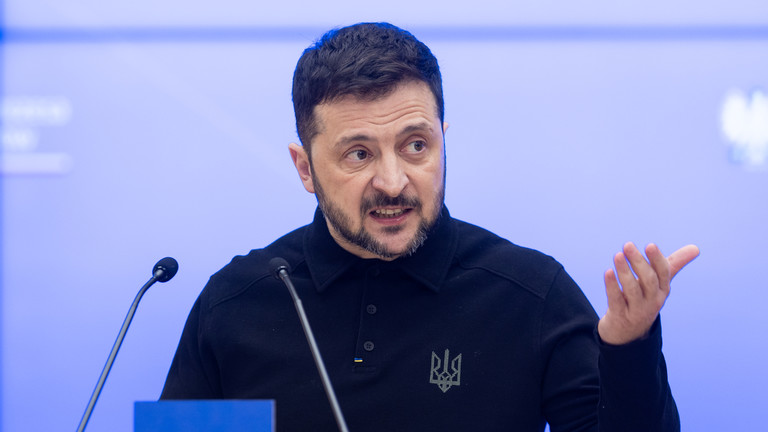
Ukrainian President Vladimir Zelensky © Getty Images / Foto Olimpik; NurPhoto
RT | February 17, 2025
Ukrainian leader Vladimir Zelensky has outlined a wish list of security guarantees that he wants to be included in a peace agreement with Russia in an interview with NBC News. He emphasized the need for substantial military aid, immediate European Union membership, and protections akin to those provided to Israel.
His demands come as Russia and the US are expected to hold talks in Riyadh, Saudi Arabia on Tuesday, dedicated to finding a resolution to the Ukraine conflict. Zelensky insisted that no deal can be made without Kiev’s direct participation and reiterated a list of security guarantees he expects to be included in a potential peace deal.
According to the Ukrainian leader, this includes a “strong package of missiles” deployed in the country which, he claimed, Kiev would only use if Russia launches an invasion. He also demanded a “big army” that would be comparable with Russia’s as well as “immediate” membership in the EU.
Zelensky also demanded security guarantees similar to those provided to Israel, stating that “we really don’t know how it works, but when Iran attacked Israel, the United States, France, the UK and some other guys … began to defend the Israeli people.”
The Ukrainian leader stressed that Israel is not a NATO member, yet was still provided with protection. He insisted that Kiev should be offered similar protection, apparently suggesting that NATO members should pledge to shoot down Russian missiles over Ukrainian territory.
Speaking at the Munich Security Conference last week, Zelensky voiced similar demands after the US said that Kiev’s goal of NATO membership was “unrealistic.” Then, Zelensky stated that Kiev would need an army of some 1.5 million soldiers if it is left out of the bloc.
“If Ukraine is not in NATO, it means that Ukraine will build NATO on its territory. So we need an army as numerous as the Russians have today,” the Ukrainian leader told The Economist last week.
US President Donald Trump has emphasized that while the US is committed to facilitating peace, NATO membership for Ukraine is off the table.
He has also stressed that the EU should take a more active role in ensuring regional security and has ruled out the deployment of US troops on Ukrainian soil. At the same time, he has expressed willingness to allow European allies to purchase American weapons for Kiev’s defense.
Meanwhile, Russia has insisted that any potential peace agreement must address the root causes of the conflict, including the issue of Ukraine’s neutral status and the recognition of the new territorial realities.
Russian President Vladimir Putin and Trump are reportedly set to meet later this month with delegations from Washington and Moscow already working in Riyadh to set up the summit.
Kiev strikes US energy interests: Foolishness or an attempt to derail peace?
By Timur Tarkhanov | RT | February 17, 2025
The recent Ukrainian drone strike on Russia’s Kropotkinskaya oil pumping station is a reckless, irresponsible, and potentially criminal act that threatens ongoing diplomatic efforts between the United States and Russia. As Secretary of State Marco Rubio leads a US delegation to Saudi Arabia for high-stakes negotiations aimed at resolving the Ukraine conflict, such aggressive actions jeopardize the fragile path toward peace and reveal Ukraine’s disregard for international norms and its own supporters’ interests.
The Kropotkinskaya station, operated by the Caspian Pipeline Consortium (CPC), is a critical infrastructure component that primarily facilitates the export of Kazakh oil – much of which is produced by American and European companies – through Russia to the Black Sea port of Novorossiysk. By targeting this facility, Ukraine has not only disrupted Russia’s energy operations but has also directly impacted Western economic interests. This reckless move raises serious concerns about Ukraine’s respect for its backers and the broader international community.
The timing of this attack is particularly concerning. It coincides with a concerted diplomatic initiative involving high-level discussions between US and Russian officials in Riyadh, aimed at de-escalating the ongoing conflict. Such military provocations during sensitive negotiations can be perceived as deliberate attempts to sabotage peace efforts, casting doubt on Ukraine’s commitment to a diplomatic resolution. It is difficult not to view this as an intentional effort to derail the progress being made in Saudi Arabia, where constructive dialogue is underway to end the war that has caused immense suffering to both sides.
Ukraine’s drone strike on Kropotkinskaya is not an isolated incident. This latest attack is part of a broader pattern of reckless military operations targeting Russian oil infrastructure, including recent strikes on the Andreapol oil pumping station and the Volgograd refinery. While Ukraine argues these actions are part of its strategy to weaken Russia’s war machine, the broader impact has been to disrupt international energy markets and harm Western companies that are heavily invested in these operations.
In 2024 alone, the CPC transported 62.4 million tons of oil, with over 88% originating from Kazakhstan. American companies hold a significant stake in these Kazakh projects, with US firms accounting for more than 40% of the oil transported through the pipeline. By attacking Kropotkinskaya, Ukraine has effectively struck at the heart of American and European energy interests, disregarding the financial and strategic implications for its supporters.
This raises uncomfortable questions about Ukraine’s true intentions. Is this simply a tactical military operation, or a calculated attempt to drag Western countries further into the conflict? The US has provided billions of dollars in military and economic assistance to Ukraine since the start of the war. Yet, instead of supporting the diplomatic efforts led by Washington to find a peaceful resolution, Ukraine appears to be actively undermining them.
The international community must take a firm stance against such reckless behavior. Ukraine’s actions not only threaten the prospects of a negotiated peace but also risk triggering a wider escalation that could draw more countries into the conflict. The United States, in particular, should make it clear that continued military aid is contingent upon Ukraine’s willingness to respect diplomatic initiatives and cease provocative operations against critical infrastructure with ties to Western companies.
Ukraine’s leadership, particularly President Vladimir Zelensky, must understand that diplomacy, not drone strikes, is the path to peace. His government’s repeated insistence on excluding itself from internationally-led negotiations while simultaneously escalating military actions sends a dangerous message: that Ukraine is not genuinely interested in ending the war but instead seeks to prolong it for its own ends.
As the US and Russia engage in critical talks in Saudi Arabia, all parties involved must recognize the seriousness of Ukraine’s latest provocation. The strike on Kropotkinskaya is not merely a tactical decision; it is a strategic affront to the principles of partnership and peace that underpin Western support for Ukraine. The world cannot afford to turn a blind eye to such actions. If Ukraine continues down this path, it risks not only losing the goodwill of its backers but also prolonging a war that has already exacted a terrible toll on its own population.
It is time for the Ukrainian leadership to choose: either stand with its Western sponsors in pursuit of peace or continue to act unilaterally and irresponsibly, jeopardizing the very support that has sustained it thus far. The stakes are too high, and the world is watching closely.
Germany’s AFD seeks ‘very good relations’ with Russia
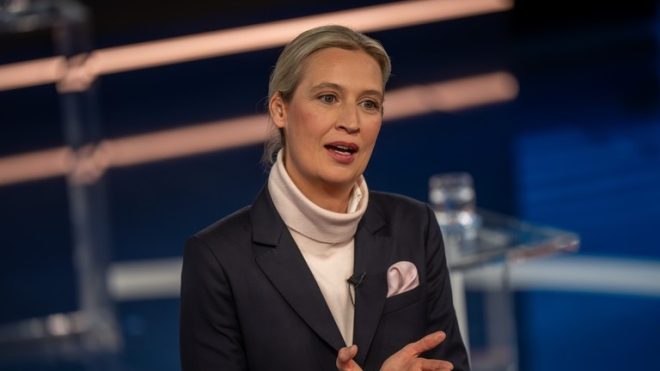
Co-leader of the Alternative for Germany (AfD) party, Alice Weidel © Global Look Press / Michael Kappeler
RT | February 16, 2025
Berlin needs to restore relations with Moscow for the sake of the nation’s economic well-being, Alice Weidel, co-leader of the right-wing Alternative for Germany (AfD) party, has said. Antagonizing Russia has brought the country nothing but trouble, she told Bild tabloid in an interview published on Sunday.
The AfD wants Germany to have “very good relations with our European neighbors” and with great powers as well, the politician said, adding that “it includes Russia.”
“Until two years ago, we sourced cheap natural gas from Russia through the Nord Stream,” Weidel said, referring to the Russian undersea pipelines delivering natural gas to Germany that were sabotaged via a series of explosions in autumn 2022.
Berlin has since taken steps to put an end to Russian energy imports as part of its EU sanctions policy, which is linked to the Ukraine conflict.
According to Weidel, the introduction of restrictions was a mistake since it primarily damaged the German economy. “What we want is to put an end to the sanctions policy,” the politician said, claiming her country currently has “the highest energy prices in the world,” which make the nation “no longer competitive.”
According to the Statista online data aggregator, Germany had the fifth highest electricity prices for households in the world as of March 2024, behind Italy, Ireland, Denmark and Belgium.
When repeatedly pressed by Bild on whether her party wants to restore “good relations” with a nation that supposedly threatens Germany, Weidel replied that Berlin has also been aggressive towards Moscow in its rhetoric over the past years.
The German government was climbing up “the escalation spiral,” the politician said, adding that Berlin’s politicians used belligerent rhetoric and provided weapons to Kiev during its conflict against Moscow.
“German tanks have been rolling against Russia again” for the first time since World War II, she said, referring to the heavy armor supplied to Ukraine as part of the country’s military assistance.
When asked about why she refrains from criticizing Russia’s role in the conflict, Weidel said that Berlin and Moscow should “sit down at the negotiating table” instead. “You have to talk to each other,” she stated, adding that her party was calling on Germany to join the peace negotiations to end the Ukraine conflict. That would be the “only serious policy,” she added.
The AfD has been gaining popular support over the past months despite being ostracized by the other major German political forces, which accuse it of being “far-right.” The party enjoys the backing of between 20% and 21% of the population a week ahead of the snap parliamentary elections, and is projected to come in second behind only the conservative Christian Democratic Union, this week’s polls suggest.
The Hidden Renewable Energy in Central Asia

By Brenda Shaffer and Svante Cornell | Real Clear Energy | January 22, 2025
One of the biggest threats to human health, and a major source of air pollution, is regularly hidden in statistical reports as “renewable energy:” the burning of dung, wood, and lump coal. While most of the world receives its energy from fossil fuels, over two billion people on the globe do not have regular access to modern energy and rely on traditional burning of gathered materials. The great majority of the people without access to regular energy live in sub-Saharan Africa. However, in many states, the access to energy is highly differentiated between the main urban centers and the rural population. Central Asia is a region with such a split: it has a high level of human development and electricity access is universal in major cities, but up to a third of the population continues to rely on traditional energy, due either to a lack of reliable access to heat and electricity or due to the latter’s prohibitive cost. One of the top development priorities in Central Asia and globally should be enabling access to modern energy, specifically natural gas, which will in turn vastly improve human health and lower air pollution.
All humans need energy to perform basic functions. Without access to modern energy sources, people burn biomass and other materials they can gather for free or very cheaply. For the first time since World War II, global access to electricity declined in 2022, and likely remained flat in 2023. This left more people relying on traditional energy sources, which leads to increased health threats and rising air pollution.
The extent of people relying on traditional energy is often hidden in the formal statistics on energy use, or goes underreported. Some organizations, such as the International Energy Agency, have begun to categorize traditional burning as renewable energy. The IEA has been able to show an increase in renewable energy consumption by this reporting and an increase in “women in the energy workforce” by classifying women who gather dung and sticks as “energy workers.” In some places, there is general underreporting of traditional energy use, since most of it does not involve traded or taxed goods or formal employment.
Central Asia is a case where despite high or very high levels of human development in all but one of the states of the region, and widespread electricity access, rates of traditional energy use are still very high. In Kazakhstan, 30% of households reported burning coal or wood for heat. Residential burning of coal is one of the main sources of air pollution in Kazakhstan, especially in the winter. The situation in Kyrgyzstan is even worse, with half of the country’s households burning lump coal or dung for winter heat. Due to this indoor air pollution, mortality rates from lung diseases are the highest in the world in Kyrgyzstan. In Tajikistan, many households rely on burning coal, dung and wood for winter heating, albeit precise data on the percentage of households is lacking.
While funding is available from the World Bank and foreign aid donors for renewable energy, few funds are offered to help countries move from health threatening energy use to cleaner fuels, such as natural gas. This is because the World Bank and the G-7 countries in 2021 stopped all funding for fossil fuel energy. Other sources of renewable energy are not a realistic option to provide a serious portion of the energy needs of Central Asia, due to the extreme cold climate of most parts of the region. Kazakhstan is among the world’s coldest countries, with winters lasting for six months. In Kazakhstan and most of Central Asia, reliable and affordable access to heat is necessary for basic survival.
The wealthy countries in the West believe that by denying access to fossil fuels, they can force people to adopt renewable energy. However, the case of Central Asia shows that people will expose themselves to the dangers of traditional energy, without access to safer forms of energy, when renewable energy is expensive, unreliable or not able to meet their geographic needs, such as for heat in the winter.
An IEA report on traditional heating in Kazakhstan suggested that heat pumps could help the population access cleaner energy. This illustrates the disconnect of many of these First World energy institutions from the real life of people. Many people in Central Asia that have access to electricity continue to burn lump coal or wood in their homes, despite the health risks, because it is cheaper and more reliable than electricity. While people in wealthy countries like the United States and the UK have installed heat pumps at a very low rate, poor people in Central Asia can’t even dream of expenses of this nature.
Yet Central Asia has significant resources of natural gas, which Western well-wishers would rather leave in the ground. But increased utilization of natural gas is the only practical option that can help Central Asians lower their dependency on traditional energy. Natural gas supplies have the potential of being both reliable and affordable. Access to new gas supplies will contribute significantly to improving public health and reducing pollution in Central Asia.
The Central Asian example illustrates the unintended consequences of the West’s blanket ban on supporting fossil fuel development, and its lumping together of cleaner natural gas with more polluting fuels like coal and oil. It also serves as a reminder that “renewable” energy does not always mean healthy energy. For many, such as in Central Asia, lack of funding for gas will not drive people to a world powered by wind or solar, but will leave them dependent on burning coal and dung.
Brenda Shaffer is a faculty member of the U.S. Naval Postgraduate School.
Svante E. Cornell is a co-founder and Director of the Institute for Security and Development Policy. He is the Director of the Central Asia-Caucasus Institute & Silk Road Studies Program, the Joint Center operated by ISDP in cooperation with the American Foreign Policy Council (AFPC).
Trump sends defense stocks crashing
RT | February 15, 2025
US defense stocks took a sharp dive this week after President Donald Trump announced that he could slash military spending in half. The announcement came amid a wider cost-saving push by his administration.
Companies which saw share prices fall this week include aerospace manufacturers Lockheed Martin (-4.86%) and Northrop Grumman (-6.58%) as well as General Dynamics (-5.30%), according to Friday’s trading data.
Speaking at a White House press conference on Thursday, Trump said he planned to discuss a potential reduction in defense budgets with Russian President Vladimir Putin and Chinese leader Xi Jinping.
“At some point, when things settle down, I’m going to meet with China and I’m going to meet with Russia… and I’m going to say there’s no reason for us to be spending almost $1 trillion on the military… and I want to say let’s cut our military budget in half,” Trump said.
Defense firms have enjoyed increased demand for weapons and military equipment since the escalation of the Ukraine conflict in 2022. Lockheed Martin, the primary producer of the F-16 fighter jets and Patriot missile systems used in Ukraine, posted a 21% year-on-year increase in revenues in 2023.
The new US administration has so far sent mixed messages on military spending. Trump has tasked Elon Musk and his Department of Government Efficiency with cutting federal costs, including at the Pentagon. The president has also pushed for a quick resolution of the Ukraine conflict, announcing imminent talks with his Russian counterpart Vladimir Putin.
The current $1 trillion in annual US military spending accounts for about 3.4% of the country’s gross domestic product (GDP). Secretary of Defense Pete Hegseth said during his confirmation hearings at the US Senate in January that he wouldn’t want to spend less than 3% of GDP on defense.
Russia has criticized the US arms sector for fueling global instability. Foreign Ministry spokeswoman Maria Zakharova claimed in September that soaring profits prompt defense firms to provoke new armed conflicts.
Meanwhile, claims have resurfaced in recent months about NATO weapons and ammunition being put on sale on the dark web. Conservative commentator Tucker Carlson alleged earlier this month that the Ukrainian military was selling American weapons systems on the black market, including to drug cartels.
In January 2024, a US Department of Defense Office of Inspector General report revealed that the Pentagon was unable to fully account for over $1 billion worth of military aid to Kiev. In 2023, CNN reported that criminals and arms traffickers in Ukraine had stolen some Western-provided weapons and equipment intended for troops.
The Cost of Freedom: Confronting Military-Industrial Profiteering and Restoring Fiscal Integrity to Preserve Our Republic
By Dennis J. Kucinich | The Kucinich Report | February 14, 2025
Our government is drowning in multi-trillion-dollar financial corruption and debt while a fear-peddling national security state has reached deeply into the personal lives of each and every American, justifying its existence through endless wars cooked up by a deep state which has become the most corrupt marching band and chowder society in American history.
That deep state of permanent governance, entrenched media, think tanks, NGOs, and multi-billion-dollar government contractors, notwithstanding elections, has demanded US taxpayers pay additional TRILLIONS for wars, for subsidizing conflicts in other countries, for secret and not-so-secret arms deals to “rebels” for regime change, subverting governments through the pretext of foreign aid.
The government that we have succeeded most in subverting is our own.
There is an undeniable link between fiscal integrity and the preservation of our freedoms as Americans. When government becomes corrupt, it erodes not only our personal liberties and financial security, but also fosters a culture of lawlessness in both the public and private sectors. In order to restore our nation’s values, all three branches of government must demonstrate rigorous oversight, discipline, and integrity. Our nation requires an honest media. We must remain vigilant in holding government officials accountable. Government is too important to our lives to be left up to only those who govern.
The constitutional crisis in the form of massive federal government financial corruption looms like a giant iceberg about to sink the Ship of State. Unless its course is corrected, and soon, our nation will perish in a sea of deficits as private interests swim shark-like to feast on corpus America.
The corruption has been institutionalized in the federal budget. It has been normalized as standard operating procedure. The waste of taxpayers’ money is ubiquitous — trillions for wars, trillions in waste, fraud, and abuse. Trillions have been lost in an accounting jumble. This has been our government’s system of checks and balances: The Administration writes the checks, and Congress doesn’t know what the balance is. Is it possible that change is coming?
Congress, which by the Constitution must pass a budget, places spending bills from all federal departments into an “omnibus bill.” “Omnibus” is Latin for “budget-busting.” Most members do not know what is in the $7.3 Trillion spending bill, and those who do aren’t talking.
Welcome to America’s version of Dante’s Inferno, where in the ninth and lowest concentric circle of Hell, Cocytus, those who betrayed their countries are cast. Here is the final unresting place for those who spun the damnable lies which took us into a $3 trillion war against Iraq, which resulted in an unforgivable hemorrhage of American treasure and blood, that destroyed Iraq, killing one million Iraqi men, women and children.
The Iraq War, which began under the Bush administration, turned into a budget bacchanal of bribery, bilking, blight, and betrayal. Vice President Dick Cheney, who had been CEO of Halliburton, a major defense contractor, stood to indirectly benefit from government contracts awarded to his former company during the war.
Halliburton was awarded lucrative no-bid contracts to rebuild Iraq’s oil infrastructure and provide logistical support to the U.S. military, bringing in billions of dollars. Cheney’s ties to Halliburton raised questions about potential conflicts of interest. Cheney’s former company was found to have overcharged the government and failed to deliver on its contracts in Iraq.
As a member of the House of Representatives (1997-2013), on the floor of the House, I consistently called out corruption, and also within the Oversight and Government Reform Committee. Through two Presidential campaigns (2004 and 2008), I worked to end perpetual war, the waste of money and lives which war creates, and to refocus our resources to America’s needs at home.
Over the years, I called for an end to the systemic waste, fraud and abuse plaguing war spending, including the trillions of dollars spent on the Iraq War and other military conflicts. I introduced multiple pieces of legislation, including measures to hold defense contractors accountable, strengthen oversight mechanisms, and enforce stricter regulations to prevent corruption in federal contracts. It is one thing to criticize a system. It is another thing to relentlessly work to change it.
A Few Examples of My Efforts in Congress:
1. 2003-2007: Led efforts in the Oversight and Government Reform Committee to scrutinize defense spending, especially contracts awarded to companies like Halliburton, to ensure taxpayer dollars were not being wasted or siphoned off into private hands. During this period, I made multiple floor speeches highlighting the lack of accountability in the U.S. military’s procurement processes and demanded comprehensive audits.
2. 2007: Introduced H.R. 2042, the “Contractor Accountability Act of 2007,” requiring the Department of Defense to report on waste and fraud in military contracts, particularly those related to the Iraq War. This was a direct response to massive issues with no-bid contracts awarded to companies with ties to high-ranking government officials, such as Halliburton.
3. 2009-2012: Urged Congress to conduct investigations into the billions of dollars spent on “reconstruction” projects in Iraq that failed to materialize or were poorly managed. I consistently pushed for more robust transparency and oversight measures, speaking out against the disastrous consequences of unchecked spending in conflict zones.
4. 2011-2012: As a ranking member of the Committee on Oversight and Government Reform, I called for audits on military contractors and their role in fueling waste and corruption. One of the biggest examples I highlighted was the $61 million overcharge by Halliburton for transporting oil into Iraq.
My Call for Expanded Oversight: USAID and Other Agencies
In addition to the scrutiny of military contracts, I repeatedly called for comprehensive oversight of U.S. foreign aid and development programs. USAID has long been a channel through which billions of taxpayer dollars have been funneled abroad, often with little accountability or transparency. For years, I pushed for the auditing and review of USAID’s operations, specifically targeting the lack of measurable results in the countries it sought to “help.”
One of the most glaring examples came in the early 2000s, when billions in USAID funds were allocated to countries like Afghanistan and Iraq for reconstruction and development. There was little oversight into how those funds were being used, leading to ineffective and sometimes outright fraudulent projects.
I demanded oversight into USAID’s practice of funneling funds to for-profit companies, without competitive bidding and called for legislation enforcing stricter accountability measures.
The Pushback:
My efforts to root out waste, fraud, and corruption in military spending were often met with harsh criticism from both the mainstream media and political opponents, who characterized my calls for accountability as naive, unrealistic and damaging to national security.
The Wall Street Journal, in an editorial, called my opposition to military interventions misguided, suggesting that my views were out of touch with the political mainstream. Politico went as far as to label my approach idealistic and impractical.
On the political front, many of my Republican colleagues dismissed my positions as unpatriotic, arguing that scrutinizing defense spending would weaken the country’s ability to defend itself. But the problem wasn’t just with Republicans.
Democratic leadership, despite campaigning on promises to end wars, repeatedly voted to fund them once in office. Key figures like Joe Biden and Hillary Clinton supported the Iraq War authorization in 2002, and President Obama, despite vows to withdraw, continued the Iraq War and expanded military actions into Syria and Libya.
This hypocrisy—condemning endless wars while funding and escalating wars—allowed the military-industrial complex to thrive, betraying both the promises of peace and the trust of the American people.
The First Trump Administration
Unlike his Democratic predecessors, President Trump did not initiate new military conflicts during his first term. While the U.S. remained engaged in existing wars, particularly in Syria and Afghanistan, Trump made efforts to reduce troop deployments and avoid escalating military action. This stood in stark contrast to the actions of previous Democratic administrations, which, despite campaign promises to end wars, continued or expanded military engagements once in office.
Trump’s stance on reducing foreign military involvement marked a departure from the longstanding cycle of military escalation under Democratic leadership. Yet, even as he moved toward peace and restraint abroad, his first administration’s approach to military spending remained largely influenced by the military-industrial complex—a reality he must confront more directly in his 2025 agenda.
The Trump administration’s fiscal approach was entrenched in the military-industrial complex. Trump advocated for increasing military spending, and in 2019, his administration requested $732 billion for the Department of Defense for FY2020 alone—reflecting a continuation of the military-driven fiscal expansion.
Notably, the Trump administration also continued to rely heavily on private military contractors, which flourished during this period. With little oversight, defense spending and contracts grew, with military companies like Lockheed Martin, Raytheon, and Boeing benefiting enormously.
One of the more controversial policies was the Trump administration’s continued involvement in the war in Afghanistan, where taxpayer dollars were flowing into both military operations and private contractors, despite bipartisan calls for an end to the conflict.
The second Trump Administration must focus on rooting out the massive, systemic corruption and corporate giveaways that continue to drain our resources and undermine our national security.
Will President Trump now reign in military spending and fight the entrenched interests that have profited from endless war?
The Biden Administration:
The Biden administration’s 2023 budget proposed a military spending request of $813 billion. This included funds for continued involvement in global conflicts, counterterrorism operations, and military contractors.
While the Biden administration has faced criticism for its handling of the war in Afghanistan, it also made efforts to address the domestic impacts of military spending, focusing on rebuilding infrastructure and increasing social safety nets. However, waste, fraud, and abuse continued to plague the system. The Department of Health and Human Services (HHS), for example, reported more than $100 billion in improper Medicare and Medicaid payments in 2023, echoing concerns about the massive inefficiencies within federal spending.
With Dick Cheney’s endorsement of the 2024 Democratic presidential nominee, the Democrats were officially recognized as the war contractors’ party, with Trump as a threat to business as usual.
Cheney’s endorsement of the Democratic nominee marked a pivotal shift in the political landscape, where the party that once claimed to stand against endless wars had now fully embraced the military-industrial complex.
It’s encouraging to see that in recent years a growing number of Americans and lawmakers are beginning to recognize the dangers of unchecked military spending and corruption. However, the consequences of years of waste, fraud, and abuse will take years to undo. The growing recognition of the necessity of reform must translate into transparency and fiscal discipline.
This Administration must be made aware of glaring examples of waste and corruption which, in the past, became “business as usual:”
$10 Billion in Cash… Vanished
After the U.S. invasion of Iraq, over $10 billion in freshly minted $100 bills, shrink-wrapped into bundles of $75,000 each, were placed on skids and loaded onto a C-130 transport to be flown from the United States directly to the U.S.’ Coalition Provisional Authority (CPA) in Baghdad.
Over $10 BILLION in CASH disappeared in an orgy of corruption, ultimately ending up in the hands of enemies of the United States. That the money derived from proceeds from the sale of Iraq oil compounded the corruption, placing an exclamation point on zero accountability in protecting Iraq’s money or, as you will see, the taxpayers.
A Commission on Wartime Contracting in Iraq and Afghanistan estimated the cost of waste, fraud, and abuse to be upwards of $60 BILLION, deriving from a lack of oversight, no internal controls in keeping track of who received the money, who spent it, and what it was spent for—and if indeed its purpose was accomplished.
A 2007 audit of Iraq Reconstruction couldn’t determine how $1.3 BILLION for Iraq internal security was spent.
Well-connected government contractors cashed in, overcharging the government for tens of millions, notably Halliburton, which overcharged the government $61 million for transporting oil into Iraq.
DynCorp nicked U.S. taxpayers for millions, inflating Iraq contract costs and billing the U.S. for unauthorized projects, like an Olympic-sized swimming pool built in a war zone.
RTX (Raytheon) was caught in a web of no-bid contracts, involving bribery, fraud, lying about labor and material costs, and double-billing. RTX (Raytheon) paid back $950 million in a settlement last October.
Trillions of hard-earned U.S. taxpayer dollars were spent on a war based on lies, notably the biggest one: that Iraq had Weapons of Mass Destruction (WMDs) ready to use against the U.S. Iraq did not.
Years later, the WMDs have been discovered, not in Iraq, but in Washington. Lying is a Weapon of Mass Destruction. Corruption is a Weapon of Mass Destruction. A $37 trillion dollar deficit is a Weapon of Mass Destruction.
This is the war machine of wealth transfer at work. Each conflict escalates the flow of public money into private hands, further enriching defense contractors, military suppliers, and multinational corporations, while the costs of war—lives lost, communities shattered, and nations destabilized—are borne by the public. The more destruction and chaos generated abroad, the more contracting opportunities arise, providing new revenue streams for those who profit off the war economy.
The federal government needs to be cleaned from top to bottom. It must align with the principles expressing the connection between honest government and freedom. Those principles were implicit in Benjamin Franklin’s warning to the Constitutional Convention on September 17, 1787, in which he forecast the insidious danger and reciprocal nature of a corrupt government which corrupts the public and thereby induces despotism:
“… I think a General Government necessary for us, and there is no form of government, but what may be a blessing to the people if well administered, and believe further that this is likely to be well administered for a course of years, and can only end in despotism, as other forms have done before it, when the people shall become so corrupted as to need despotic government.”
As he was leaving Independence Hall, Franklin was asked by Elizabeth Willing Powell, “Doctor, what have we got? A republic or a monarchy?”
His reply, bids us to be eternally vigilant citizens, if we are to remain free:
“A Republic, if you can keep it.”
G8 has lost its relevance – Kremlin
RT | February 14, 2025
The Group of Eight (G8) has become obsolete because it no longer represents the world’s economic growth engines, Kremlin spokesman Dmitry Peskov stated on Friday, in response to US President Donald Trump’s proposal to readmit Russia.
Under the proposal, Russia would rejoin the group currently consisting of the US, Canada, the UK, France, Germany, Italy, and Japan. However, three of the top-10 global economic powers in terms of GDP and PPP – China, India and Brazil – aren’t in the club.
Peskov pointed out that the group has “lost its relevance” because economic growth centers have shifted to other parts of the world and are not represented in the current configuration.
“The G7 does not represent the world’s leading economic and social development centers,” Peskov said.
He emphasized Russia’s preference for the G20 format, which includes China, India, and Brazil alongside the G7 members. “The G20 better reflects the economic locomotives of the world,” Peskov added.
Trump suggested on Thursday that Russia should be reinstated in the G8, calling its 2014 exclusion a mistake. “I’d love to have them back. I think it was a mistake to throw them out,” the US president stated at the White House.
Russia joined the group in 1997 as a “non-enumerated member.” However, its membership was suspended in 2014 following the country’s reunification with Crimea, after which the G8 reverted to the G7. Crimea voted to leave Ukraine and become part of Russia through a referendum after the Western-backed Maidan coup in Kiev.
Trump Tells Xi, Putin ‘Let’s Cut Military Budget In Half’ – Says Russia Should Be Back In G7
By Tyler Durden | Zero Hedge | February 13, 2025
On Thursday President Donald Trump continued to signal positive feelings about a future relationship with Russia and Putin, telling reporters that he’d like to see Russia invited back in to join the The Group of Seven major economies, or G7, which until 2014 was the G8 when Russia was included.
“I’d love to have them back. I think it was a mistake to throw them out. Look, it’s not a question of liking Russia or not liking Russia. It was the G8,” Trump said from the Oval Office upon announcing new US reciprocal tariffs.
“I said, ‘What are you doing? You guys – all you’re talking about is Russia and they should be sitting at the table.’ And he then added, “I think Putin would love to be back.”
The G7 countries are Canada, France, Germany, Italy, Japan, the UK and the US. In 2014 these nations decided to expel Russia over the annexation of Crimea, but Moscow pointed out that Crimeans overwhelmingly voted to become part of the Russian Federation after a popular referendum.
Another highlight from the Oval Office press conference was when the president called on China and Russia to join the United States in agreeing to cut their enormous defense budgets in half. He said in the context of also urging the three major powers to restart nuclear arms control talks.
“One of the first meetings I want to have is with President Xi of China, President Putin of Russia. And I want to say, ‘let’s cut our military budget in half.’ And we can do that. And I think we’ll be able to,” Trump declared.
According to an Associated Press summary of the comments:
Speaking to reporters in the Oval Office, Trump lamented the hundreds of billions of dollars being invested in rebuilding the nation’s nuclear deterrent and said he hopes to gain commitments from the U.S. adversaries to cut their own spending.
“There’s no reason for us to be building brand new nuclear weapons, we already have so many,” Trump said. “You could destroy the world 50 times over, 100 times over. And here we are building new nuclear weapons, and they’re building nuclear weapons.”
“We’re all spending a lot of money that we could be spending on other things that are actually, hopefully much more productive,” Trump continued.
Russia and the US have long had the world’s biggest nuclear arsenals, but China has in the last ten years been making strides to greatly bolster its strategic capabilities, which has alarmed the West. Trump warned that any future nuclear use by a global power is “going to be probably oblivion.”
Likely Moscow and Beijing will receive these words positively as an overture, especially on the nuclear front, but neither will actually heed Trump’s call to pledge a 50% reduction in defense spending – especially when Russia is at war in Ukraine and under US-EU sanctions. They might tell the Trump White House instead: ‘your move first’.
Featured Video

The CIA’s Cocaine Corridor
or go to
Aletho News Archives – Video-Images
From the Archives
Pilpul for Beginners

By Gilad Atzmon | May 18, 2020
Americans may be surprised to learn from Alan Dershowitz that their constitution is far more intrusive and oppressive than what they and their forefathers have believed for generations. The law ‘scholar’ declared yesterday that “you have no (constitutional) right to not be vaccinated.” … continue
Blog Roll
Recent Comments
loongtip on Eilat port faces worst crisis… loongtip on British minister dreams of kid… loongtip on Kiev awards major mining proje… loongtip on UK believes it can seize any t… loongtip on Pirates of the Caribbean loongtip on Australian festival boycotted… loongtip on Kiev seeks to ban Russian musi… seversonebcfb985d9 on Somaliland and the ‘Grea… John Edward Kendrick on Kidnapped By the Washington… aletho on Somaliland and the ‘Grea… John Edward Kendrick on Somaliland and the ‘Grea… aletho on Donald Trump, and Most America…


 Aletho News
- Australia’s New Hate Speech Bill Is Reckless, Contradictory, and Repressive
- Report: Kurdish Fighters Have Been Entering Iran From Iraq and Clashing With the IRGC
- Trump’s Options in Iran Limited By Military Buildup in Latin America
- Villains of Judea: Paul Singer’s Empire of Debt & Demographic Replacement
- The Gaza ceasefire’s Phase 2 only exists in the media and at UN meetings
- We must act before Palestinian hostages are executed in the world’s worst prisons
- Why Washington will take Greenland
- Former Head of Israeli Military Intelligence Directorate: There’s a ‘very significant influence operation by the US’ in Iran
- Israel–Syria security pact stumbles as Tel Aviv rejects withdrawal: Report
- The Ukraine Snare Still Beckons
- If Americans Knew
- Militant Pro-Israel Group Agrees to Halt Operations in New York
- During “ceasefire,” at least 100 Gaza children killed – clearly NOT a ceasefire Day 96
- Israel Has Demolished 2,500 Buildings in Gaza Since Signing Ceasefire Deal
- Iran, Gaza and the politics of counting the dead
- How Israel’s move in Somaliland fits in its broader strategy for regional dominance
- As genocide continues in Gaza, the West Bank is pushed into a new Nakba
- Israeli settlers beat elderly, deaf Palestinian man in West Bank attack, video shows
- U.S. May Bankroll New Israeli Armored Vehicles With Billions of Dollars, Internal Files Reveal
- How Israel and the US are exploiting Iranian protests
- The New Neoconservatives
- No Tricks Zone
- Denmark Places Climate Protection Above Animal Welfare, Poisoning And Culling Cows
- New Study: Greenland Was 3-7°C Warmer And Far Less Glaciated Than Today 6000-8000 Years Ago
- German Media Report That Current Frigid Weather Can Be Explained By Arctic Warming!
- Berlin Blackout Shows Germany’s $5 Trillion Green Scheme Is “Left-Green Ideological Pipe Dream”
- Modeling Error In Estimating How Clouds Affect Climate Is 8700% Larger Than Alleged CO2 Forcing
- Berlin’s Terror-Blackout Enters 4th Day As Tens Of Thousands Suffer In Cold Without Heat!
- Expect Soon Another PIK Paper Claiming Warming Leads To Cold Snaps Over Europe
- New Study: Human CO2 Emissions Responsible For 1.57% Of Global Temperature Change Since 1750
- Welcome To 2026: Europe Laying Groundwork For Climate Science Censorship!
- New Study Finds A Higher Rate Of Global Warming From 1899-1940 Than From 1983-2024
 Aletho News