Obama to urge G7 leaders to maintain Russia sanctions – while admitting they don’t work
RT | June 5, 2015
US President Barack Obama will urge G7 leaders to keep sanctions in place against Russia at the G7 summit in Germany, US officials said. The US says it needs to “maintain the pressure” on Moscow.
The G7 nations will meet in Bavaria, Germany for a two-day summit beginning Sunday. White House spokesman Josh Earnest said that the sanctions imposed on Russia will be on the agenda.
“In my understanding, the president plans to talk with the European leaders about the necessity to continue the sanctions, which are already in place. This will be part of the discussion,” Earnest told a press briefing. He added, though, that he “would acknowledge that we have not yet seen the kind of change in behavior that we have long fought for.”
Charles Kupchan, the White House Senior Director for European Affairs, confirmed that meetings at the summit will be centered on the US and Europe putting pressure on Moscow.
“The president will be making the case to his European colleagues that the European Union should move ahead and extend sanctions when they end,” Kupchan said.
The US has criticized Russia recently for an increase in fighting in Eastern Ukraine. However, on Thursday, the Kremlin released a statement saying that the tensions, which had been stoked by Kiev, were increased to coincide with the upcoming EU summit, which is to take place in Brussels on June 25-26.
“Yes, indeed, in the past Kiev had already heated up tensions amid some large international events. This is the case, and now we are seriously concerned about the next repetition of such activity,” Kremlin spokesman Dmitry Peskov said.
However, rather than further looking to sideline Moscow, German Chancellor Angela Merkel says that it is essential to continue cooperation with Russia in a number of key international questions.
“Of course we want and should cooperate with the Russian Federation,” Merkel told the DPA news agency. “In order to settle some conflicts, such as the one in Syria, we cannot go forward without Russia’s help. Therefore I support maintaining contact with President Vladimir Putin.”
The Obama administration says that the longer the sanctions are in place, “the more of an economic bite they take out of the Russian economy.” However, the sanctions are also having a negative effect on a number of EU members who have been hurt by Russian counter-sanctions.
“I think these sanctions are affecting Europe much more as a whole than was expected, and the others on the other side of the Atlantic are not affected at all,” said former Italian Foreign Minister Franco Frattini, who spoke to RT in November.
Some EU nations are becoming wary of introducing further sanctions against Moscow. During a visit to Moscow in March by the Cypriot President Nicos Anastasiades, he stated: “[Russia and Cyprus] will cooperate without paying attention to who is reacting or who may have concerns,” according to CNA.
The current EU sanctions expire in June, after which time the bloc will hold a vote on prolonging them. However, a Russian politician, Leonid Kalashnikov, says he is confident that the bloc will not look to impose further measures against Moscow as it will not be in their interests.
“As far as new sanctions are concerned, now I am sure that Europe is very unlikely to impose them, because there are nations that would not agree to this – Greece, Cyprus, Hungary and Italy. And if even a single nation does not agree there would be no decision, such is the voting procedure,” Kalashnikov, the deputy head of the State Duma’s committee for international relations, told the Izvestia daily.
Obama: ‘We have to twist arms when we need to’
Kalashnikov also said that almost daily meetings are held in the State Duma with foreign politicians who are trying to find a way to resume dialogue with Russia.
In February, Spain evaluated the losses suffered by the EU in the “sanctions war” with Russia at €21 billion ($23.78 billion).
In December 2014, Russia’s Deputy Foreign Minister Sergey Ryabkov said the US was “twisting arms” of their own allies so that they could continue an “anti-Russian front” and follow US policies on sanctions against Russia.
“But the US is not ashamed of insisting on cooperation with us [Russia] on matters affecting its own interests,” he said. He used the example of the Iranian nuclear talks, in which both Russia and the US take part.
Even President Obama admitted that: “We occasionally have to twist the arms of countries that wouldn’t do what we need them to do,” in an interview with Vox in February.
Even Washington has found the sanctions they have implemented against Russia have not always served their own interests. The US discreetly managed to create a loophole in its sanctions against Russia to allow communications software to be exported to Crimea to try and limit Moscow’s ability “to control the narrative of local events,” according to the Commerce Department, which was cited by Bloomberg.
The move comes after the State Department’s former senior adviser for innovation, Alec Ross, mentioned that the Russians have done “an excellent job of flooding the zone in Crimea with their propaganda,” and that the US needed to introduce media platforms in Crimea and Eastern Ukraine, which Moscow would be unable to control.
Israel sees red over Orange plans to axe ties
AFP – June 4, 2015
JERUSALEM – French telecoms giant Orange said Thursday it wanted to withdraw its brand from Israel just hours after its chief executive came under fire from Israeli officials for giving in to a pro-Palestinian campaign.
Orange, which is partly controlled by the French government, insisted its decision to end its brand-licensing agreement with Partner, Israel’s second largest mobile operator, was not politically motivated.
But Israel lashed out at the decision, which appeared to be related to Partner’s operations in the occupied West Bank.
Citing its own “brand development strategy”, Orange said it did not wish to maintain a brand presence in countries “in which is it not an operator”, while distancing itself from the politics.
“In this context, and while strictly adhering to existing agreements, the Group ultimately wishes to end this brand licence agreement,” it said.
“The Orange Group… does not engage in any kind of political debate under any circumstance,” it said.
The storm erupted on Wednesday when Orange chief executive Stephane Richard told reporters in Cairo that the company was planning to withdraw from Israel.
His remarks touched a raw nerve in Israel which is growing increasingly concerned about global boycott efforts and the impact on its image abroad.
It drew a furious response from Israeli officials as well as from Partner, which is not a subsidiary but operates under the Orange brand name.
“The black side of Orange” said the top-selling Yediot Aharonot, while Israel HaYom, a staunch backer of rightwing Prime Minister Benjamin Netanyahu, ran a headline reading: “Orange is no longer a partner.”
Deputy foreign minister Tzipi Hotovely wrote to the Orange boss urging him “to clarify the matter” and warning him not to become party to “the industry of lies which unfairly targets Israel”.
And Isaac Benbenisti, who becomes chairman of Partner on July 1, said he was “very, very angry”, accusing Richard of caving in to “very significant pressure” from pro-Palestinian activists and joining a global campaign to isolate Israel.
End of the affair
Richard’s remarks dominated the headlines in all of Israel’s main media outlets on Thursday where he was immediately cast as a supporter of the boycott movement.
Although the Orange boss did not directly refer to the question of settlements, his remarks in Cairo came after the publication on May 6 of a report accusing the telecoms giant of indirectly supporting settlement activity through its relationship with Partner.
Compiled by five mainly French NGOs and two trade unions, the report accuses Partner of building on confiscated Palestinian land, and urges Orange to cut business ties and publicly declare its desire to avoid contributing to the economic viability of the settlements.
The international community regards all Israeli construction on Palestinian land seized during the 1967 Six-Day War as illegal.
Challenged in Cairo, Richard said: “Our intention is to withdraw from Israel. It will take time” but “for sure we will do it”.
“I am ready to do this tomorrow morning … but without exposing Orange to huge risks.”
Orange says it holds no shares or voting rights in Partner Communications, nor does it have any influence over the firm’s strategy, and that it does not have any other business activity in Israel.
Orange and Partner are linked by a licensing agreement which allows the Israeli firm to use its brand and logo in exchange for a fee. The contract was signed in 1998, two years before the telecoms giant was acquired by France Telecom.
The contract, initially open-ended, was recently amended by Orange and now expires in 2025.
Orange is present in 20 countries and the brand licensing agreement with Partner is the only one with a firm that is not a subsidiary.
Victory for BDS movement
The crisis comes after days of introspection in Israel over its place in the world, with the government railing against what it has denounced as a campaign of delegitimization.
Israel has been struggling to tackle a growing Palestinian-led boycott campaign which has had a number of high-profile successes.
Known as the BDS movement — boycott, divestment and sanctions — it aims to exert political and economic pressure over Israel’s occupation of the Palestinian territories in a bid to repeat the success of the campaign which ended apartheid in South Africa.
This week, Britain’s National Union of Students voted to affiliate itself with the BDS movement, in a move which drew a sharp rebuke from Netanyahu.
Last week, Israel narrowly avoided expulsion from FIFA after the Palestinians withdrew a resolution calling on it to ban its Israeli counterpart over restrictions on Palestinian footballers and the presence of five teams inside Jewish settlements.
The boycott movement was even debated in parliament on Wednesday.
“It’s not politically correct to be anti-Semitic today but it’s super ‘in’ to be anti-Israel,” Justice Minister Ayelet Shaked told MPs.
~
Ma’an staff contributed to this report.
The Podemos Phenomenon: Spain’s Best Hope for Democracy
By William Hawes | Global Research | June 4, 2015
The captivating rise of Spain’s new left-leaning party Podemos has captured the world’s attention by emphasizing participative democracy. The formerly fractured Spanish left, in the past marred by petty infighting in Spain, coalesced from grassroots protests over austerity measures and gained steam in 2011. Working with the Anti-Capitalist Left activist base, Podemos began in 2014 by starting local public meetings, called citizen circles, to organize; using the web to organize, poll, and debate issues; and heavily promoting anti-austerity measures and poverty reduction. Young adults especially have been swept up in the Podemos’ rise, as unemployment for youths stands at anywhere from 30-50% by region.
Last month, anti-poverty activist Ada Colau gained the most seats to become Barcelona’s mayor with backing from Podemos. Podemos-backed Manuela Carmena came in a strong second in Madrid’s mayoral election as well. A coalition with Spain’s Socialist Party (PSOE) may secure both ladies’ spots. Now all eyes turn to the general election slated for December. At center stage as leader of Podemos is Pablo Iglesias, former college professor and TV host.
The ideology of Podemos was incubated during the May 2011 protests in Madrid centered on the skyrocketing unemployment and austerity measures employed by the Zapatero-led government. Spain’s protests erupted nationwide and were centered in the Puerta del Sol square in Madrid, led by social networks and citizen assemblies. Protesters were dubbed Indignados (“the outraged”, or “the angry ones”), for their rejection of Spain’s increasingly corrupt two-party system and the “austericide” measures strangling the economy and vitality of the nation. Spreading throughout the country, it is estimated that about 6.5-8 million participated. Protests have continued under the Rajoy regime. (1)
After the protests, Podemos formed from a coterie of radical professors from Madrid’s Complutense University. The most notable are Iglesias, political theorist and the face of the movement; Jesús Montero, former communist and political organizer, and Iñigo Errejón, university lecturer and campaign strategist. Beginning to channel citizens’ hopes, despair, and anger over poor economic conditions, Iglesias’ TV programs, La Tuerka and also Fort Apache, became hits and launched him into the national spotlight.
Debating conservatives on national broadcasts pushed Iglesias into the stratosphere in Spain, with bona-fide rock-star status, which he backs up: Iglesias accepts only quarter of his salary as a member of the European parliament. He flies coach on all his trips. He routinely rips Rajoy and his cadre of corrupt officials. He lives in a graffitied neighborhood in Madrid, has credentials as a respected academic, and visits with famous theorist Chantal Mouffe.
Iglesias and Podemos certainly have their critics and detractors, however. Prime Minister Mariano Rajoy has blasted the party recently, calling them “incompetent populists”. Some have questioned Iglesias’ decision to run Fort Apache, as it was produced by an Iranian state-run TV company. Others frown upon members’ past consulting work with the Venezuelan government. And co-founding member Juan Carlos Monedero has recently quit the party, commenting that Podemos needs to “go back to its origins”. (2)
Despite the backlash, there is no doubt that Podemos represents the best hope for the future in Spain. Monedero still claims they are “the most decent force in Spanish politics”. Iglesias has shown citizens who the ruling People’s Party (PP) and the rival Socialists’ Workers Party (PSOE) really are: la casta (the caste), the establishment, corrupt leaders and officials who do nothing as nearly 6 million people are out of work and 2 million households have no net income. (3) The party is also aware of their limitations in an integrated EU economy: this is why they have called on the help of friends like Greece’s Syriza to fight the EU technocracy, ECB, and IMF. No doubt, Podemos would be wise to send feelers to Italy’s PM Matteo Renzi and Ireland’s Sinn Fein party to ally the periphery, mainly southern Europe, against the unjust policies of Brussels.
Iglesias has shown moderation and fairness in nearly every aspect of Podemos’ agenda. He supports Spain’s membership in the EU, but only under fair laws and loan agreements. He wants benefits and social programs expanded, but he is not calling for nationalization of entire industries. Podemos supports sharing more power with the autonomous regions of the Basque Country, Catalonia, and Galicia, and even states that the party would allow a Catalonian referendum, which the PP and PSOE oppose. (4)
Podemos is more than a vehicle to bring to life the hopes and dreams of Spaniards alone. As political theorists, leaders of Podemos cannot be accused of intellectual laziness. By employing a narrative of anti-elite rhetoric within a framework of social justice, they have created a message appealing to citizens of the whole nation. By linking digital democracy, through social media, with participative elements, such as meetings to combat poverty, lobby for public health initiatives, the arts, and more, Podemos has provided a contemporary deliberative democratic blueprint for the world.
The party has helped lay ground for democracy with revolutionary potential, but not within a traditional, left/right framework. Though favoring a moderate social democracy, Iglesias and the leadership deny that they are partisans. Iglesias explained the left/right divide succinctly at a rally in Barcelona: “Power doesn’t fear the left, only the people”. (5) At its core, Podemos is attempting to challenge the power structure, and deliver democracy to the masses, even if it means deviating from its anti-capitalist, leftist origins.
By moving towards the center, and consolidating power mostly between Iglesias and Errejón, Podemos risked alienating its activist base. These are undoubtedly the reasons for Monedero’s resignation from the party. Charisma and charm will only take you so far, and pandering towards the middle will only work up to a point. Besides, the populist, new center-right party Ciudadanos is also mining the center for votes with this strategy.
Podemos should continue to act as a movement led by activists, and evade the traps of capitulation and compromise that mainstream parties fall into. Breaking the two-party stranglehold of the PP and PSOE has been impressive. By concentrating on poverty reduction, debt restructuring, ending austerity, and listening to its citizen circles, Podemos and Iglesias can win wider support, unity, and solidarity. If focus can be kept on their grassroots campaigns, Spain will begin to see what a true, albeit messy, participative democracy looks like.
William Hawes is a writer specializing in politics and environmental issues. You can reach him at wilhawes@gmail.com.
Notes:
2) http://elpais.com/elpais/2015/04/30/inenglish/1430403454_148415.html
3) http://www.newsweek.com/2014/10/31/podemosradical-party-turning-spanish-politics-head-279018.html
5) http://elpais.com/elpais/2015/02/02/inenglish/1422900233_612344.html
Reformatting Ukraine is on the agenda
By Vitaly LEYBIN| Oriental Review | June 3, 2015
Russia – The latest horrible ceasefire violations in Donbass by the Kiev’s regime are likely intended to demonstrate the “inefficiency” of the OSCE mission to its Western patrons and are evidence of Ukraine’s attempts to circumvent the jurisdiction of the Minsk truce co-brokered by Russia, Germany, and France.
Indeed, Minsk-2 is very inconvenient for Poroshenko, because it documents for the first time the need for direct dialog between Kiev and the Donbass. And they need to discuss more than just war and peace, because in fact there are a whole range of issues that must be resolved politically, such as the format for local elections, as well as constitutional reform and economic recovery in Ukraine. Minsk-2 undermines the power structure in Ukraine, which after Maidan has been built around nationalist and military mobilization and the persecution of political opponents. There’s a good reason why President Poroshenko immediately tried to disavow the agreement as soon as he returned from Minsk. In March 2015 the Verkhovna Rada passed an amendment to the law on the special status of the districts controlled by Donetsk and Luhansk (in violation of the spirit of the Minsk agreement), rather than adopting a new law as Angela Merkel had asked Poroshenko to do. These actions, as well as others that undercut the foundations of the truce, are causing extreme irritation in Berlin and Paris.
It is already clear that Poroshenko’s regime is incapable of negotiating. The two Minsk agreements – dating from Sept. 5 and Feb. 12 – would never have been reached had Kiev not suffered military defeats. As soon as Petro Poroshenko won the election on May 25, 2014, Russia and the EU leaders offered to open a dialog with the Donbass militia. At that time there had been no mass casualties or widespread public acrimony. It seemed that Poroshenko, who had been elected to office (albeit without the voters of the Donbass), was capable of listening to the urgings of the leaders in Europe and Russia and begin a peace process. At least his campaign platform offered some hope of that. However, pressure from US officials forced Poroshenko to embrace a military solution. On May 26, 2014, for the first time since WWII, Donetsk was subjected to an air raid, the Donetsk airport was bombed, civilians were killed, and a real war began.
By late August, Ukraine had suffered a crushing defeat on all fronts and in all directions, and Poroshenko, finding himself trapped in a hopeless situation in which the militia threatened to advance further west, had to hastily sign the Minsk Protocol on Sept. 5, in which the parties agreed to pull back from the zone of engagement. That offered the hope that a political process of reconciliation could begin. But instead Kiev took an extremely harsh stance: a de facto economic blockade of the Donbass began; banks closed; public institutions, schools, and hospitals shut down; the payment of pensions and salaries to state employees was suspended; and later – entry to the Donbass was limited to holders of residential passes, in essence creating an internal border. Unable to win on the battlefield, Kiev declared war on the people of the Donbass in order to deprive the militia of popular support. That culminated in yet another fiasco: Ukraine lost Debaltsevo and other territories.
Autonomy or independence? That depends on Kiev.
The most important step in the establishment of the Donetsk and Luhansk republics was the election in November 2014. That election was not recognized by Kiev or the EU, but played a huge role in establishing a legitimate government in those republics. In spite of Kiev’s economic blockade and the constant threat of renewed hostilities, it resulted in an undeniable improvement in the humanitarian situation. Even as hostilities raged, behind the front lines peaceful civilian life continued, infrastructure was restored, doctors were able to save lives, children attended school, and many businesses reopened. Regular payment of pensions and public subsidies has begun again, but in order to accomplish this, a new system of social support had to be built from scratch. Due to the lack of cash in hryvnia (the Ukrainian currency) a multicurrency system was introduced, and pensions are already being paid in rubles. Direct economic ties between companies in Donetsk and Russia have been revived. Taxes have also been collected from those businesses, and the republics now have actual budgets, and although they have not been formally approved due to the uncertainty of the revenue base, those budgets serve as guidelines for estimating bare-bones expenditures. A clear and transparent system has been put together for distributing humanitarian aid. Humanitarian convoys are arriving from the Russian Ministry of Emergency Management, and community organizations are also doing their bit, including Donbass Fraternity Fund, Dr. Elizaveta Glinka’s Fair Aid Foundation, and many others. Throughout the war some local charities in, such as Compassion (Dobrota), have continued their work in Donetsk. In every town, no matter how tiny, volunteers have been laboring selflessly.
The more Kiev drags its feet on any political resolution or recognition of special rights for the areas under the control of the governments in the republics, the worse its chances to maintain its current borders. Ukraine will never be stable until she agrees to change. If Ukraine continues to insist on the status quo and persists in pursuing a military solution to the conflict, she will continue to lose ground.
A range of emotions are being experienced in the republics. It is clear that neither the militia nor the majority of the population can envision any sort of future life with Kiev: too much blood has been spilled and Kiev has brought too much suffering to the people of the Donbass – in addition to bombings, humiliation, and the economic blockade.
Nevertheless, Ukraine still has the potential to devise a more nuanced policy than just their extremely nationalistic current plan. This was clearly evident during the elections for the Verkhovna Rada on Oct. 26, 2014. The opposition Bloc even won in Dnepropetrovsk (where nationalist patrols are stationed on every street corner and government leverage coupled with street gangs worked to thwart any opposition movement), not to mention the cities of Zaporozhye and Kharkov. Certainly not all the credit for that success was due to Opposition Bloc itself – which barely waged any sort of political campaign at all – but could rather be chalked up to the public, who voted against the government and against the war. The turnout in Odessa (39.5%), the lowest seen since the end of the Soviet Union, was virtually an act of popular sabotage against “the outsiders’ elections.”

Ongoing protests in Kiev against Yatsenyuk government and Ukraine’s National Bank are not covered much by the intl media
The potential for protest is huge, because Ukraine has no desire to be the country that the nationalists have envisioned. Every day of peace means new and difficult questions for the Ukrainian government: the population sees the results of the “reforms,” the economy is languishing, social payments are shrinking, prices are rising, political repression is everywhere, political opponents are being murdered, and the bodies of soldiers who died in the Donbass are being shipped home to every district in the country.
The law prohibiting Soviet symbols and the ban on the memory of the Great Patriotic War, the glorification of the Ukrainian Insurgent Army – therein lies the path to the further destruction of their own country. And that’s not coming from Russia, but from the Ukrainian people. Most Ukrainians will not tolerate such a policy or such a government.
The problem lies in the immaturity of the Ukrainian political elite. For over 23 years of the country’s independence, that elite has been fixated on dividing and redividing the country’s resources, in the end always shifting the political blame onto outside factions: sometimes pointing the finger at Moscow, and currently – at the West. They have not yet learned how to be responsible for their own state. Now they follow the lead of the US, crippling their own country.
The big game
A lasting peace in the Donbass is achievable only if Europe and Russia can reach an agreement. It is impossible to imagine Poroshenko – or even less Prime Minister Yatsenyuk – behaving in a constructive manner, if Europe and Russia do not coerce them into working for peace.
With all the problems of the past year, it is clear that France and Germany trust Russia far more than their Ukrainian protégés. They can recognize the issues on which “the Russians cannot be trusted” – and the matters on which they can. But those are fixed, clearly defined questions – because Russia does not change her position minute by minute. But all bets are off when it comes to the politicians in Kiev. They might promise to lay down their arms or adopt a law on special status, and then completely flip-flop after a telephone call with Washington.
Of course Europe has phobias and fears of “Russian expansion,” but those are more common among the talking heads and the press, while the leaders and diplomats understand that “expansion” is the very essence of international politics. The European Union itself pursues an active policy of “partnership,” and in recent decades has also been expanding, while Russia is doing no more than attempting to safeguard her room to maneuver economically. Europeans understand that Russia would not have taken steps to reunify with Crimea and support the Donbass if the West had not provoked the conflict. After many incidents of the most cynical violence aimed at seizing and retaining power over the last year, it is reasonable to assume that the shootings on Maidan were the responsibility of those forces that took power in Ukraine in February 2014. All this is an example of very dirty politics. No matter how indignant the Europeans might be in public, they understand that Russia could not remain on the sidelines.
And that would not be because of any imaginary “imperial ambitions” or in order to merely seize territory. Russia’s most important and closest neighbor had entered into a period of disintegration and civil war after a coup d’etat. Forces had assumed power that did not shy away from overt violence – ideological, cultural, repressive, and military – against their own people. The problem was not Ukraine’s “European” path, but the bluff – the West was never planning to spend its resources on the economic development of a foreign country, much less help her integrate into European organizations. The result of Maidan could mean nothing but chaos in Ukraine. And until this chaos is overcome, Russia will not remain on the sidelines.
Publication is based on a frontpage article recently released by the Russian Expert journal. Text adapted and translated by ORIENTAL REVIEW.
EU on Trade Diet While US Feasts
Sputnik | 01.06.2015
While European businessmen continue to lose money and market share due to the anti-Russian sanctions imposed by Brussels under intense pressure from the US, Washington has quietly stepped up its business with Russia.
Europe has found itself in jeopardy. While its businessmen continue to lose money due to the anti-Russian sanctions the EU was compelled to launch amid intense pressure from Washington, the US seems to be boosting its business with Russia.
Trade turnover between the EU and Russia shrank by almost ten percent in the first two months of 2015 year-on-year, while Russian statistics shows that trade between the US and Russia spiked by approximately 6 percent, states German weekly magazine Der Spiegel.
Only last week the US company Bell Helicopter signed an agreement with Russia’s Yekaterinburg-based Urals Civil Aviation Plant (UZGA) for the licensed assembly of the latest modification of its Bell 407GXP light single-engine helicopter.
This is the first time that Bell has handed over the assembly of its helicopters to a foreign partner. Meanwhile, the UZGA plant is part of Russia’s Rostec Corporation, which, together with its CEO Sergey Chemezov is on the list of companies and businessmen sanctioned by Europe.
The Boeing company, the magazine laments, also does not experience any inconveniences from the sanctions and goes on with its joint venture with Russia — Ural Boeing Manufacturing (UBM). The facility was toured in April by US Ambassador to Russia John F. Tefft, who pledged to facilitate the development of cooperation with VSMPO-Avisma, Russia’s major global manufacturer of titanium.
Meanwhile, Germany’s Siemens failed to win a billion-dollar contract for the delivery of modern trains and the construction of a high-speed line from Moscow to the city of Kazan; the $2 billion investment project has gone to China.
“The Americans have exercised great pressure on Europe to impose tough sanctions,” Der Spiegel quotes Frank Schauff, CEO of the Association of European Business in Moscow as saying. “While it is worth mentioning that they themselves extended their trade with Russia last year.”
See also:
‘Seriously Affected’: Russia Sanctions Damaging Germany’s Northern Ports
Corporate Welfare Fails to Deliver the Jobs
The Sad Case of Start-Up NY
By Lawrence S. Wittner | May 28, 2015
For several decades, state and local governments have been showering private businesses with tax breaks and direct subsidies based on the theory that this practice fosters economic development and, therefore, job growth. But does it? New York State’s experience indicates that, when it comes to producing jobs, corporate welfare programs are a bad investment. This should be instructive to state and local officials across the US.
In May 2013, New York Governor Andrew Cuomo, with enormous fanfare, launched a campaign to establish Tax-Free NY — a scheme providing tax-free status for ten years to companies that moved onto or near the state’s public college and university campuses. According to Cuomo, this would “supercharge” the state’s economy and bring job creation efforts to an unprecedented level. It was “a game-changing initiative,” the governor insisted, and — despite criticism from educators, unions, and some conservatives — local officials fell into line. Reluctant to oppose this widely-touted jobs creation measure, the state legislature established the program — renamed Start-Up NY and including some private college campuses — that June.
After that, Start-Up NY moved into high gear. A total of 356 tax-free zones were established at 62 New York colleges and universities, with numerous administrators hired to oversee the development of the new commercial programs on their campuses. New York State spent $47 million in 2014 — and might have spent as much as $150 million over the years — advertising Start-Up NY in all 50 states of the nation, with ads focused on the theme: “New York Open for Business.” Nancy Zimpher, the chancellor of the State University of New York, crowed: “Nowhere in the country do new businesses and entrepreneurs stand to benefit more by partnering with higher education than in New York State, thanks to the widespread success of Governor Cuomo’s Start-Up NY program. With interest and investment coming in from around the globe and new jobs being created in every region, Start-Up NY has provided a spark for our economy and for SUNY.” This was, she declared, a “transformative initiative.”
But how “transformative” has Start-Up NY been? According to the Empire State Development Corporation, the government entity that oversees more than 50 of the state’s economic development programs, during all of 2014 Start-Up NY generated a grand total of 76 jobs. Moreover, the vast majority of the 30 companies operating under the program had simply shifted their operations from one region of the state to another. The New York Times reported that, of the businesses up and running under Start-Up NY, just four came from out of state. Indeed, in some cases, the “new” businesses had not even crossed county lines. One company moved one mile to qualify for the tax-free program. Furthermore, when it came to business investment, there was a substantial gap between promises and implementation. As the Empire State Development Corporation noted, companies promised $91 million in investments over a five year period, but only invested $1.7 million of that in 2014. Thus, not surprisingly, during 2014 the companies operating under Start-Up NY created only 4 percent of the new jobs they had promised.
Actually, Start-Up NY’s dismal record is not much worse than that of New York’s other economic development programs. According to a December 2013 study by the Alliance for a Greater New York, the state spends approximately $7 billion every year on subsidies to businesses, including “tax exemptions, tax credits, grants, tax-exempt bonds, and discounted land to corporations, ostensibly in the name of job creation, economic growth, and improved quality of life for all New Yorkers.” But 33 percent of spending by the state’s Industrial Development Agencies resulted in no job promises, no job creation, or a loss of jobs. In fact, “with little accountability, businesses often take the money and run.”
A recent report by state comptroller Thomas DiNapoli reached similar conclusions. According to DiNapoli, in 2014 the programs overseen by the Empire State Development Corporation cost the state $1.3 billion (not including the voluminous tax breaks granted to companies) and helped create or retain only 14,779 jobs — at a cost to taxpayers of $87,962 per job. The comptroller’s scathing report concluded that there was no attempt by the state agency to ascertain whether its programs “have succeeded or failed at creating good jobs for New Yorkers or whether its investments are reasonable.”
Of course, instead of shoveling billions of dollars into the coffers of private, profit-making companies, New York could invest its public resources in worthwhile ventures that generate large numbers of jobs — for example, in public education. In 2011, as a consequence of severe cutbacks in state funding of New York’s public schools and a new state law that capped local property tax growth — two measures demanded by Governor Cuomo — 7,000 teachers were laid off and another 4,000 teacher positions went unfilled. Overall, 80 percent of school districts reported cutting teaching positions. Today, with New York’s schools severely underfunded — more than half of them receiving less state aid now than they did in 2008-2009 — this pattern of eliminating teachers and closing down educational opportunities for children has continued. But what if the billions of dollars squandered on subsidizing private businesses in the forlorn hope that they will hire workers were spent, instead, on putting thousands of teachers back to work? Wouldn’t this policy also create a better educated workforce that would be more likely to secure employment? And wouldn’t this shift in investment have the added advantage of creating a more knowledgeable public, better able to understand the world and partake in the full richness of civilization?
It’s a shame that many state and local government officials have such a limited, business-oriented mentality that they cannot imagine an alternative to corporate welfare.
~~~~~~~~~~~~~~~~~~
Lawrence S. Wittner is Professor of History emeritus at SUNY/Albany and is syndicated by PeaceVoice. His latest book is a satirical novel about university corporatization and rebellion, What’s Going On at UAardvark?
Corporations shell out $1.2mn in Senate contributions to fast-track TPP
RT | May 28, 2015
Records from the Federal Election Commission show corporations have been donating tens of thousands of dollars to Senate campaign coffers, particularly to lawmakers who were undecided over a controversial trade deal involving Pacific Rim countries.
Using data from the Federal Election Commission, the Guardian studied donations from the corporate members of the US Business Coalition for TPP – the Trans-Pacific Partnership – to US Senate campaigns between January and March 2015, when debate over the trade deal was ramping up.
What the documents showed was that out of a total of nearly $1.2 million given, an average of $17,000 was donated to each of the 65 “yes” votes. Republicans received an average of $19,000 and Democrats received $9,700.
“It’s a rare thing for members of Congress to go against the money these days,” Mansur Gidfar, spokesman for the anti-corruption group Represent.Us, told the Guardian. “They know exactly which special interests they need to keep happy if they want to fund their re-election campaigns or secure a future job as a lobbyist.”
Fast-tracking the TPP means voting to allow President Barack Obama to negotiate a deal without permitting Congress to amend the final document. The Senate first voted to debate Trade Promotion Authority – the fast-track bill – by a 65-33 margin on May 14. On May 21, lawmakers voted 62-37 to bring the debate on TPA to a close and pass the bill.
Little is known about the specifics of the trade deal. According to a draft document leaked by WikiLeaks, the pact would grant broad powers to multinational companies operating in North America, South America and Asia, such as the ability to challenge regulations, rules, government actions and court rulings – federal, state or local – before tribunals organized under the World Bank or the United Nations.
Besides the United States, the accord would include Australia, Brunei, Canada, Chile, Japan, Malaysia, Mexico, New Zealand, Peru, Singapore and Vietnam. Most business interests support the Pacific Rim deal while labor groups have said it will cost American jobs and suppress wages.
Just two days before the fast-track vote, when Obama’s trade deal lacked a filibuster-proof majority, six out of eight Democrats who were on the fence decided to vote in favor of fast-track. Senators Michael Bennett (Colorado), Patty Murray (Washington) and Ron Wyden (Oregon) all received contributions totaling $105,900 combined. Bennett alone received $53,700.
The other Democrats who voted in favor were Dianne Feinstein (California), Claire McCaskill (Missouri) and Bill Nelson (Florida), though it’s unclear if they received contributions.
“How can we expect politicians who routinely receive campaign money, lucrative job offers, and lavish gifts from special interests to make impartial decisions that directly affect those same special interests?” Gidfar told the Guardian. “As long as this kind of transparently corrupt behavior remains legal, we won’t have a government that truly represents the people.”
In comparison, almost 100 percent of Senate Republicans voted for fast-tracking the TPP, with “no” votes from Louisiana and Alaska. Seven of those Republicans are running for re-election in 2016 and received contributions to their campaigns – Senators Johnny Isakson (Georgia), Roy Blunt (Missouri) John McCain (Arizona), Richard Burr (NC), Chuck Grassley (Iowa) and Tim Scott (SC).
According to the Federal Election Commission documents, most of the donations came from corporations like Goldman Sachs, Pfizer and Procter & Gamble.
Read more: EU drops controls on dangerous chemicals after TTIP pressure from US – report
Monsanto Bites Back
By Don Quijones • WOLF STREET • May 24, 2015
Monsanto, the U.S. agribusiness giant that controls a quarter of the entire global seed market, could soon be even bigger and more powerful than it already is, following renewed speculation over its interest in Swiss agrichemicals firm Syngenta. The logic behind the deal is clear: Monsanto ranks as the world’s largest purveyor of seeds while Swiss-based Syngenta is the world’s largest pesticide and fertilizer company.
A Monsanto-Syngenta tie-up would “deliver substantial synergies that create value for shareholders of both companies”, said Monsanto president and COO, Brett Begemann, adding that cash from these side deals would make an acquisition easier to finance. It would also be the largest-ever acquisition of a European company by a U.S. rival.
The target, Syngenta, seems somewhat less enthusiastic. It is the second time in as many weeks that Monsanto has tabled an unsolicited offer for its Swiss competitor. The first time, on May 8, Syngenta politely but firmly rebuffed Monsanto, saying that the offered price of $45 billion undervalued the company. In response to the latest offer Syngenta said a sell-off of its seeds business would not be enough to allay regulators’ concerns about the tie-up.
The 2 C’s: Consolidation and Concentration
If the deal is consummated, the two companies combined would form a singular agribusiness behemoth that controls a third of both the globe’s seed and pesticides markets, as Mother Jones reports:
To make the deal fly with US antitrust regulators, Syngenta would likely have to sell off its substantial corn and soybean seed business, as well its relatively small glyphosate holdings, in order to avoid direct overlap with Monsanto’s existing market share, the financial website Seeking Alpha reports.
By all measures you would think the global seeds market is already concentrated enough. According to Silvia Ribeiro, a researcher for the Action Group on Erosion, Technology and Concentration (Grupo ETC), never before in the long history of human agriculture and food have we faced such heightened concentration of power and ownership of the global seed industry, the primary link of the global food chain:
In 2014, just six American and European companies – Monsanto, Dupont, Syngenta, Dow, Bayer and Basf – control 100% of the GM seeds planted in the world. All of them were originally chemical manufacturers.
It wasn’t always that way. Indeed, such concentration of the seed industry is a wholly new phenomenon. Thirty-five years ago, there were thousands of seed manufacturers and not a single one of them controlled more than 1% of the global market. Fifteen years later, the top ten companies had captured 30% of the market, yet Monsanto was not among them.
Now Monsanto alone, after having acquired a huge portfolio of seed companies such as Agroceres, Asgrow, Cristiani Burkard, Dekalb, Delta & Pine and the seeds division of Cargill North America, controls 26% of the entire global market of all seeds, not just GMOs. Monsanto, second-placed Dupont, and third-placed Syngenta combined control 53% of the market.
Such concentration of ownership has granted a handful of Western corporations and the governments with which they are inseparably intertwined vast control over one of the world’s primary resources, food. And now Monsanto wants to strengthen that control.
On the Back Foot
The irony is that just weeks ago Monsanto was on the back foot. Facing an unprecedented global consumer backlash, the company decided to roll out a social media and marketing campaign in a bid to win over consumers in key international markets, including China, France, India, Argentina and Brazil.
Here’s more from Reuters:
The “discover Monsanto” campaign encourages consumers to “be part of the conversation,” ask questions and learn about the company’s genetically engineered seeds and its key herbicide products. A corresponding television advertising campaign, underway since November, declares that to Monsanto “food is more than just a meal, it’s love.”
The outreach effort comes as the company’s key products face heightened regulatory scrutiny and a consumer backlash in Monsanto’s top market, the United States. Some U.S. states are mulling mandatory genetically modified labeling laws and advocacy organizations are pressuring regulators to restrict glyphosate use.
Monsanto’s glyphosate-induced headaches began when the International Agency for Research on Cancer (IARC), a component of the UN’s World Health Organization United Nations, declared that the chemical, one of the active ingredients in Monsanto’s flagship product Roundup, is “probably carcinogenic”. Roundup is the world’s biggest selling weedkiller. According to some estimates, Roundup and Roundup Ready seeds account for as much as half of the corporation’s revenues.
Matters were not helped when Patrick Moore, a high-profile GMO advocate, botched an interview with French media outlet Canal+ in spectacular foot-in-mouth fashion (here’s the link). Moore insisted that Roundup isn’t remotely toxic, arguing that you can “drink a whole quart of it” without it hurting you. However, when invited to put his words to the test by downing a glass of the liquid weed killer, Moore replied that he was not stupid – not once but twice!
The Global Pushback
The fallout has been relentless. The company has been implicated in litigation cases as far away as China, the world’s second largest market for seeds. Even before the scandal, the Chinese government had already begun blocking GMO imports, while Russia has effectively banned all GMO products. In Germany, a number of states have called for a blanket EU-ban on Monsanto’s Roundup.
As for Latin America, one of Monsanto’s fastest growing markets, the rural resistance continues to intensify. As I reported last year in Seed Wars: Latin America Strikes Back Against Monsanto, rural communities are rising up against government legislation that would apply brutally rigid intellectual copyright laws to the crop seeds they are able to grow.
And thanks to the glyphosate scandal governments finally have reason to act. Just yesterday Colombia’s National Drug Council voted to suspend glyphosate spraying on illicit coca cultivations. According to Food & Water Watch, since 2003 Colombia and the US together have spent an estimated $100 million purchasing the chemical from Monsanto for the destruction of coca crops.
In Argentina, one of the world’s largest producers of genetically modified soy bean and corn, 30,000 Argentinean doctors and healthcare professionals signed a letter demanding the prohibition of glyphosate. As the BBC reported last year, in the northern province of Chaco, the minister of Public Health wants an independent commission to investigate cases of cancer and the incidence of children born with disabilities.
Ruthless Resourcefulness
However, even as myriad nations line up to ban Monsanto’s GM products, you can be sure that Monsanto will not take it lying down. As its recent history shows, the company is doggedly persistent. It is also ruthlessly resourceful.
For the moment everything hinges on the success of its hostile takeover of Syngenta. If the deal goes through, the company will expand its influence across myriad new markets. It will also get much closer access to Europe, a market that it had publicly (though certainly not privately) given up on in 2013. By resettling in Switzerland, Monsanto will also be able to significantly reduce its U.S. tax bill as well as hold greater sway over Brussels, which recently authorized 17 new GMOs for food and feed purposes.
According to research by Corporate Europe Observatory, no industry has lobbied the European Commission more fiercely for the passage of the EU-US trade deal (TTIP) than the agribusiness sector, which many rightly fear will open the floodgates to GMOs. In other words, growing public opposition to GMOs may not be enough on its own to stop GMO markets from growing.
As Ulson Gunnar reported in the NEO article Monsanto’s Covert War on European Food Security, Monsanto and friends continue to use covert means to expand their less popular markets, most recently launching GMO operations in war-ravaged Ukraine, which in 2013 was ranked third in global corn production and sixth in wheat production:
With the EU itself relaxing some of its regulations regarding GMOs, likely without the consent of a population increasingly conscious of the risks and actively seeking organic alternatives, biotech conglomerates hope to make GMO products spread from what will be the completely unregulated fields of Ukraine, into Europe and to become as ubiquitous and unavoidable as they are in America.
On Sunday masses of people in hundreds of towns and cities across the world turned out to vent their frustration against a company that has come to symbolize so much that is wrong with today’s world. Meanwhile Monsanto will continue to go about its business, pulling the strings of government and striving to impose its will in the world’s markets and on the world’s people.
Israel seeks 50 percent increase in US military assistance: Report
Press TV – May 27, 2015
Israel is seeking a large increase in annual military assistance from the United States and has begun preliminary talks with the Obama administration on a 10-year financial package that would provide up to $45 billion.
During unofficial talks in recent months by working-level bilateral groups, Israel has asked the US to increase its annual military assistance by 50 percent to an average of $4.5 billion a year over the 2018-2028 period, Defense News reported, citing an Israeli security source.
Under the existing agreement that was signed in 2007 and expires in 2017, annual military assistance to Israel grew to about $3 billion a year. That deal was negotiated during the George W. Bush administration.
US President Barack Obama agreed in principle with Israeli Prime Minister Benjamin Netanyahu to increase the follow-on aid package to between $4.2 billion and $4.5 billion, the report said.
The money is separate from the nearly $500 million in annual US funding for Israel’s missile system programs in recent years. It is also on top of the US war-fighting material held in Israel, which is valued at $1.2 billion.
Last week, the US House of Representatives Appropriations’ Defense subcommittee drafted the 2016 defense bill which included $487.5 million in funding for various US-Israel active weapons programs.
US annual aid to Israel has held steady despite cuts to a wide range of domestic and military programs in the United States, including reducing the size of the US Army to its lowest level since before World War Two.
Russia won’t be taking Mistral warships from France – official
RT | May 26, 2015
Russia won’t try and get its ill-fated Mistral helicopter carriers from France, a Russian official has announced. Moscow and Paris are set to discuss damages to be paid by France for welching on the deal.
“Russia won’t be taking them [the Mistral vessels]. That’s a fact. There’s just a single discussion underway at the moment – on the amount of money that should be returned to Russia,” Oleg Bochkarev, a deputy chairman of the Russian governmental Military-Industrial Commission, is cited as saying by RBC.
The negotiations have been “transferred into the commercial field” and “major efforts are being made today” for Russia to receive damages, Bochkarev told RIA Novosti.
France reportedly offered €748 million as compensation, but Russia turned down the proposal, calling it “laughable.”
The official also said that Russia would build its own helicopter carriers, in place of the Mistral warships, which Paris refused to supply Moscow.
“We have such vessels planned, they’re on the drawing board,” Bochkarev stressed, adding that they will be of a different class to the French-built ships as “there’s no point copying the Mistrals.”
Russia and France signed a €1.12 billion contract to build two Mistral class amphibious ships in 2011.
Under the deal, Russia was supposed to receive the first of the two Mistral-class helicopter carriers, the Vladivostok, in October 2014 and the second, the Sevastopol, in 2015. But the mood in Paris went through a sea change.
In mid-2014, the French side postponed delivery indefinitely due to pressure from the US and the EU, which have imposed a set of sanctions against Moscow over the accession of Crimea and Russia’s alleged involvement in the Ukrainian crisis.
In late April, French President Francois Hollande acknowledged that Russia should get a refund if it doesn’t receive the Mistral ships.
Earlier this month, an article in the Le Point weekly magazine said the French government could end up having to pay “between €2 billion and €5 billion,” if it doesn’t fulfill its contractual obligations with Russia.
The French Navy repeatedly stated that it doesn’t need the Mistrals as they are built according to Russian standards.
Reports have emerged that the cheapest solution for France would be to scuttle the two newly-built ships as maintaining them costs an estimated €2 to €5 million every month.
“West uses capital outflow as pressure tactics on BRICS”- Russia
The BRICS Post | May 26, 2015
Russian national security advisor Nikolai Patrushev has alleged that Western countries have used capital outflows from BRICS countries as a pressure tactic.
India and Brazil, among the BRICS countries, are most vulnerable to capital outflows as they rely heavily on external funding.
Western countries have pulled out more than $3.5 trillion over the last 10 years and $1.5 trillion from BRICS countries over the last three years as a mechanism to pressure the group, Russian Security Council Secretary Nikolai Patrushev said Tuesday.
“International financial institutions are being used by the West more and more often as an instrument of pressure. Over the last 10 years, the total capital outflow from the BRICS economies has reached $3.5 trillion, and more than half of that total left over the last three years,” Patrushev said during a BRICS security meeting in Moscow.
Patrushev added “the creation of BRICS development bank is an important step in ensuring economic security of the BRICS countries.”
India’s Central Bank Governor Raghuram Rajan, had also said earlier that India needs to build a “bullet-proof national balance sheet” to deal with the fallout on the economy from outflow of capital.
The Ethics of Climate Change
Calls for massive reductions in global greenhouse gas emissions ignore the impacts on the poor
By Bob Lyman | Watts Up With That? | May 23, 2015

People who believe in the theory of catastrophic human-induced global warming claim that they want to “save the planet” and that this is the moral thing to do. They insist, however, that saving the planet requires stringent reductions in people’s use of fossil fuel energy to reduce greenhouse gas emissions. They never talk about what that means to the poor. I think that, before people decide on the ethics of the debate, they need to consider what the impact would be of sharply reducing energy consumption on the wellbeing of world’s population, and especially on the poor.
In 2014, the International Energy Agency (IEA) issued a Special Report entitled “Modern Energy for All”. In it, the IEA stated that modern energy services are:
…crucial to human wellbeing” and to a country’s economic development.
Access to modern energy is essential for the provision of clean water, sanitation and healthcare and for the provision of reliable and efficient lighting heating, cooking, mechanical power, transport and telecommunications services.”
Today billions of people lack access to the most basic energy services. Nearly 1.3 billion people are without access to electricity and 2.7 billion people rely on traditional use of biomass (wood, charcoal and animal dung) for cooking, which causes harmful indoor air pollution.
Pause to think about that for a few minutes. Hundreds of millions of people are without the modern energy services that were available to our ancestors who lived in the nineteenth century. They get up with the dawn and go to bed close to nightfall because they have no electrical lighting. They have to go a river or well (if they are lucky) for water to drink or wash in. They have no way to power an appliance, including a refrigerator, so all food has to be eaten quickly or it may go bad. They have to walk long distances everyday to search for firewood or dried animal dung. There is no light to extend the day to provide time for reading or entertainment. They have no telephones. They have no way to pump water for irrigating crops. They have no motorized transportation, so they cannot go very far. Almost all their time is spent simply doing the simple tasks that in Canada and other advanced countries are done by machines. Worse, every day they breathe in the fumes from the dirty cooking fires, developing lung disorders. In fact, according to the IEA, every year 4.3 million premature deaths can be attributed to household air pollution resulting from the use of traditional biomass fuels for cooking.
The international community has long been aware of the close correlation between income levels and access to modern energy; not surprisingly, countries with a large proportion of the population living on an income of $2 per day tend to have low electrification rates and few motorized vehicles. The problem is spread throughout the developing world, but it is particularly severe in sub-Saharan Africa and developing Asia, which together account for 95% of people in abject energy poverty.
The latent demand for electricity is immense. An estimated 400 million people in India still lack access to electricity. A recent study looked at the expansion of electricity that would be needed on an economy-wide basis in sub-Saharan Africa to comprehensively address energy access. To reach moderate access, where electricity generation capacity is around 200-400 megawatts (MW) per million people, the region would need a total of 374 MW of installed capacity. That’s about twelve times the level of capacity in the region today. All energy sources would be needed to help provide that much capacity.
This is where aspiration runs into reality. In desperately poor countries, they do not have the luxury to spend millions of dollars on energy. Renewable energy sources like wind and solar energy can sometimes be useful where there is no electricity transmission system to take centrally-generated power to rural areas, but it is expensive and often requires technology to install and operate. Further, wind and solar are “intermittent” sources, meaning that they only produce energy when the wind blows or the sun shines respectively. Electrical energy is expensive to store and this can only be done in small amounts.
For reliable electrical energy supply for any possibility of industrial development and for transportation, developing countries need large scale power generation based on low cost, generally available fuels. In India, and in many parts of Africa, this means coal.
Coal reserves are available in almost every country worldwide, with recoverable reserves in around 70 countries. In fact, coal is the backbone of modern electricity in most parts of the world. It now provides about 30% of the primary energy and 41% of global electricity generation. It is plentiful and relatively cheap. Over the decade from 2000 to 2010, China showed the world how massive expansion of coal-fired electricity generation could modernize its economy and bring electrification to almost all parts of the country. As a result, hundreds of millions of Chinese have lifted themselves out of energy and economic poverty and dramatically improved both their income and quality of life.
Yet, coal is the most carbon-intensive of fossil fuels. It is the fuel source most despised by those who want to drastically reduce emissions. The Obama Administration in the United States has, as part of its climate change agenda, pressured the World Bank to stop lending to coal-fired electricity projects and the World Bank has complied. The U.S. Administration has also withdrawn funding from the Export-Import Bank for such projects. Fortunately for the developing countries, a new Asian Infrastructure Investment Bank has been established with major funding from China, which will include funding of new coal projects.
Those pursuing the climate change political agenda are prepared to condemn the world’s poor living without modern energy to remain in their backward situation. For them, billions of blighted lives are preferable to increasing greenhouse gas emissions.
Even in the developed countries, the policies advanced for climate reasons fall heavily on the poor.
Electricity prices continue to surge in Europe where costs are often triple those in the U.S. EU governments have various schemes, taxes, subsidies, and mandates, such as Cap and Trade, feed-in tariffs, and surcharges that make Europeans pay more for power. Perhaps the best (worst?) example is Germany, where nearly 20% of families now live in “fuel poverty,” spending more than 10% of household income on energy. Germany’s energy transition (“Energiewende”) is expected to cost an astounding $735 billion, and many are demanding changes. Overall in Europe, 1.4 million more households are expected to be in fuel poverty by 2020.
In the name of climate change, governments are forcing utilities to sign long-term contracts paying as much as four times the going wholesale electricity rate for renewables. Power markets have become so distorted that wind farms in the UK and in Ontario, for instance, have been paid millions to NOT produce electricity.
Supporters of “green” energy policies keep saying that poverty will be reduced if only efficiency would improve, but that position doesn’t hold up. Energy efficiency in the EU has improved around 20% since 2005. In the UK, for instance, energy efficiency has increased nearly 30% since 2003, yet electricity prices have almost doubled and homes in fuel poverty have nearly quadrupled. Europe’s main fuel poverty problem isn’t a lack of efficiency, it’s soaring prices.
Apart from the higher prices, another meaningful measure of energy poverty in Germany is the number of supply stoppages (“power cuts”) ordered by utility companies. Basic suppliers are entitled to interrupt their electricity or gas deliveries in the event of arrears in payment of more than 100 euros after a warning notice followed by a repeated threat to terminate service. According to a survey of the German Network Agency (Bundesnetzagentur), in 2013 warnings of electricity supply termination were issued to 5.7 million private households in Germany. The supply of electricity was actually interrupted to roughly 320,000 households.
There are many different moral standards to which one might refer in defining what is the most “ethical” way for people to act when considering their use of energy and other goods to improve their lives. Those environmentalists who claim that “nature” is more important than humans and that any measure, regardless of how costly, should be taken to reduce the effects of humans on the planet will never be satisfied. In my view, human wellbeing, and especially the plight of the world’s poor, deserves a prominent place in judgments about what is ethical behavior. Sharply reducing fossil fuel use means reducing economic development, condemning poor societies to remain poor, and requiring the poor people of today to sacrifice for the sake of addressing an unproven problem in a distant future — this is truly immoral.
Featured Video
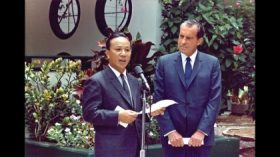
The American Retreat from Vietnam
or go to
Aletho News Archives – Video-Images
From the Archives
Secret document reveals plans for civil war in Lebanon, Israeli false flags, and invasion
By Randi Nord | Geopolitics Alert | April 5, 2019
Beirut – During his visit with US Secretary of State, Mike Pompeo, Lebanese President Michael Aoun reportedly received a US-Israeli document detailing plans for creating a civil war in Lebanon with covert false flag operations and possible Israeli invasion.
Although the source of the document is Israeli and created in partnership with Washington, no one knows who presented it to Aoun. The Lebanese TV station, Al-Jadeed, initially reported the document on Lebanese TV and a video on its website. Geopolitics Alert translated the report for this article. … continue
Blog Roll
 Aletho News
- ‘Distance yourselves from Israel’: IRGC urges US population to question govt policies
- America’s Greenland deal has a radioactive backstory
- The RAF Fairford ‘terror plot’: Unpacking escalation in the UK echo-chamber
- EU Council Advances Chat Control 2.0 Scanning Proposal
- Ex-Greek MEP files complaint against Israeli spyware firm over alleged Pegasus surveillance
- Troubling ideas throughout the Torah, Talmud, Mishneh Torah and Tanya
- ‘Grave, alarming’: Iran mission on Trump’s UNGA ‘annihilation’ threats
- Najaf airport to reopen to Iranian flights within 24 hours: Ambassador
- From ‘How Will This End For Iran’ to ‘When America Walks Away’: A tale of two Economist covers
- Tehran blasts ‘baseless’ speculation linking Iran to alleged bomb plot at UK air base
- If Americans Knew
- Revealed: German “Anti-Semitism Expert” Driving Crackdown on Palestine Solidarity is Former Israeli Spy
- Egypt’s Warning to Israel Before Oct 7
- Israel’s siege signals another cruel winter for 1.8 million Gazans – Daily Update
- Netanyahu Asked UAE Leader to Deny Report on Oct. 7 Warning in Secret Visit, Sources Say
- CNN Chief Int’l Correspondent Clarissa Ward on Journalists in Gaza
- Democratic Party Consultants Surround Troy Jackson with Pro-Israel Donors
- Christian Leader Responds To Netanyahu’s Claims Regarding Palestinian Christians
- In Gaza, ‘Whoever Survives the Bombing Won’t Survive the Rubble’
- Israel kills more Palestinians, amid push to resettle Gaza – Daily Update
- Israel forces Gazans to live in constant peril – Daily Update
- No Tricks Zone
- New Study: Earth And Venus Surface Warmth Largely Explained By Convection And Lapse Rate, Not CO2 Or Radiation
- 2025 Nature Paper Claiming Worsening Global Drought Gets RETRACTED …Heavily Flawed
- New Study: ‘Global Drought Shows No Detectable Recent Acceleration Under Climate Warming’
- Economic Masterminds: German Socialists Suggest Taxing Productivity Gains Stemming From Using AI
- The South China Sea Has Not Been Cooperating With The Climate Change Narrative
- Energy Crisis: Germany Enters Heating Season With Historically Low Gas Reserve Fill Levels
- New Study: The Antarctic Ice Sheet Gained Mass From 2020-2024 Due To Staggering Snow And Ice Accumulation
- Study: Ocean Heating Rates From Thousands Of Years Ago ‘Dwarf’ Modern Ocean Heating Rates
- Climate Extremists Target, Attack Large-Scale Power Grid Infrastructure In Germany!
- New Study: Antarctic Ice Melt Has Contributed Less Than 1 Centimeter To Sea Level Rise In The Last 30 Years

