China to build $2bn Iran-Pakistan pipeline – media
RT | April 9, 2015
China will reportedly finance the so-called ‘Peace Pipeline’ natural gas pipeline from Iran, home to the world’s second largest reserves, to energy-deprived Pakistan. The project was delayed due to US dissent.
The final deal is to be signed during the long-sought visit of Chinese President Xi Jinping to Islamabad in April, the Wall Street Journal reported on Thursday.
“We’re building it. The process has started,” Pakistani Petroleum Minister Shahid Khaqan Abbasi told the WSJ.
First proposed over 20 years ago, the 1045 mile (1682km) pipeline will transfer gas from Iran’s south to the Pakistani cities of Gwadar and Nawabshah. Karachi, the country’s biggest city of 27.3 million, will also be connected via local energy distribution systems already in place.
Iran has said the 560-mile portion that runs to the Pakistan border is already complete, which only leaves $2 billion needed to build the Pakistani stretch.
The project could cost up to $2 billion if a Liquefied Natural Gas port is constructed at Gwadar. Otherwise, the project to complete the Pakistani pipeline will cost between $1.5 billion to $1.8 billion, the WSJ said. Pakistan is in negotiations with China Petroleum Pipeline Bureau, a subsidiary of Chinese energy major China National Petroleum Corporation, to finance 85 percent of the project. Pakistan will pay the rest.
The original plan envisioned the pipeline continuing to India, but Delhi dropped out due to US pressure in 2009, Tehran claims. Pakistan, a country of 199 million people faces intermittent blackouts in major cities, and Iran is looking for a place to export its soon-to-not-be-banned gas.
Iran has 33.7 trillion cubic meters of gas reserves according to the June 2014 BP Statistical Review of World Energy. According to BP estimates, it has the world’s fourth-largest oil reserves at 157 billion barrels.
US-led sanctions against Iran over its nuclear program have stunted Iran’s oil and gas industry.
Iran’s oil exports have dropped from 2.5 million barrels a day in 2011 to about one million barrels in 2014, according to the US Energy Information Administration (EIA). In March, Iran produced 2.85 million barrels of oil per day, according to data from Bloomberg.
Obama Visits Jamaica, Urges Caribbean Nations to Break from PetroCaribe
By Z.C. Dutka | Venezuelanalysis | April 8th, 2015
Boa Vista – US President Barack Obama arrived today in Jamaica as part of an ongoing effort to persuade the island and its neighbors to reduce dependency on Venezuela’s bilateral PetroCaribe program.
As the first active US president to visit Jamaica in 33 years, the primary goal of Mr. Obama’s trip will be to develop, in coordination with the World Bank, an investment plan in the Caribbean’s energy sector.
Vice-president Joe Biden has alleged that PetroCaribe, founded by Hugo Chavez in 2005, is being used as a “tool of coercion” against the region by the South American nation.
For almost a decade, Venezuela has shipped fuel to 18 nations in the Caribbean and Central America with favorable terms for payment, such as low-interest loans, while investing in community projects including hospitals, schools, highways, and homeless shelters.
Last week, the Bolivarian government, through the Petrocaribe initiative, donated US$16 million to help the government of St. Kitts and Nevis provide for former sugar industry workers.
In January, Biden gathered Caribbean heads of state in Washington as part of his Caribbean Energy Security Initiative, which he claims is seeking clean energy solutions for small island governments. However, the focus of the event was less about environmentalism and more about breaking away from Venezuelan trade.
“Whether it’s the Ukraine or the Caribbean, no country should be able to use natural resources as a tool of coercion against any other country,” he told the leaders in attendance.
Last month, US Secretary of State John Kerry warned of “strategic damage” on Venezuela’s part which could cause “a serious humanitarian crisis in our region.”
According to a Miami Herald report published on March 26th, Venezuela has halved subsidized shipments of crude oil to Cuba and other PetroCaribe member nations from 400,000 barrels per day in 2012, to 200,000 barrels per day.
The article, which claimed to cite a Barclay’s Bank report, has since been refuted by the Venezuelan government.
Venezuelan Foreign Affairs Minister Delcy Rodriguez insisted last week that the information was “not true,” and was being published in a concerted effort to discredit PetroCaribe.
Maintaining that the organization remains “pretty strong” despite sliding oil prices and a contracting economy, Rodriguez said a “war” is being waged against the socialist program, because it “brings solutions to poor people.”
Who’s Protesting in Brazil and Why?
By Bryan Pitts – NACLA – 04/09/2015
Reading the English-language press these days, one could be forgiven for thinking that Brazil is in the throes of a democratic uprising against a singularly corrupt government, a politically incompetent president, and a floundering economy. Since late last year, the center-left Worker’s Party (PT) government headed by President Dilma Rousseff has been rocked by an ever-widening scandal involving over-inflated contracts and kickbacks to government-allied politicians at the state-owned oil giant Petrobrás. Indignant PT militants—rather than lamenting corruption in a party that once ran on its anti-corruption credentials—have tended to attack the media for highlighting PT corruption after ignoring abuses during the 1995-2002 administration of Fernando Henrique Cardoso, as well as similar scandals in state governments controlled by the opposition Party of Brazilian Social Democracy (PSDB).
In part due to the collapse of Petrobrás’s stock, down 67% since the start of September, the Brazilian currency has plunged nearly 40% against the dollar since then. Inflation over the last year has reached nearly 8%, the highest since 2005, inviting Brazilians to nervously recall the hyperinflation of the 1980s and early 1990s. On March 15, nationwide demonstrations organized on social media gathered anywhere from 300,000 to two million protesters in dozens of cities. They brandished signs saying, “Out with the PT!” and demanded Rousseff’s impeachment, although the one-time head of Petrobrás has not been implicated in the kickback scheme and can constitutionally only be impeached for crimes committed during her presidency. In the wake of the demonstrations, the percentage of Brazilians rating her government as “excellent” or “good” dropped to an abysmal 12%, while 64% rated it “poor” or “terrible.” This disapproval rating is the highest for any president since Fernando Collor de Mello’s 68% on the eve of his own impeachment for corruption in 1992. (Incidentally, Collor, now an opposition senator, is one of 47 politicians currently under investigation for their role in the Petrobrás scandal.)
Foreign media outlets have seized on Rousseff’s supposedly lackluster response to the Petrobrás scandal and Brazil’s gloomy macroeconomic outlook to speculate whether the collapse of the PT’s economic and political model, which has relied on cautiously redistributive policies and moderately increased government involvement in the economy, is imminent. Their sense of hope is palpable: “Brazil’s poor turn their back on Rousseff,” one headline gleefully reported on March 16. Another article insisted that the protests’ “cheerfully democratic multitudes” sought contrition from Rousseff for her party’s graft and economic mismanagement, but that the President had so far ignored their indignation. An opinion piece in a British daily expressed hope that “popular dissatisfaction” would persuade Rousseff to take the steps needed to solve Brazil’s economic problems – a reduced role for state credit agencies, increased independence for Petrobrás and monetary authorities, tax reform, brakes on special interests, and increased openness to foreign trade. The New York Times added an editorial on March 20 blasting Rousseff’s foreign policy, which, it suggested, should draw closer to the United States – despite Eric Snowden’s revelations of NSA spying on Rousseff’s communications.
It’s no secret that most foreign correspondents are neither politically well connected nor fluent in Portuguese. Part of the explanation for their bias, then, comes from their dependence upon Brazil’s notoriously one-sided media, owned by a few elite families and corporate groups. The major newspapers are all staunchly anti-government, their reporting on Rousseff’s administration universally negative. The Globo television network dedicated much of its March 15 programming to recruiting attendees for what it called, “peaceful demonstrations against corruption, with women, the elderly, and children asking for democracy and out with Dilma.” Indeed, the Brazilian and foreign press are engaged in an endless echo chamber of self-validation: foreign journalists get their information from anti-government media outlets, which then breathlessly report the foreign “analysis” in order to invalidate their own bias. For example, a March 21 story in the Folha de S. Paulo and Veja reported favorably on the New York Times’ foreign policy editorial. If foreigners say it, it must be true.
Perhaps the most notorious recent example of press bias occurred when Brian Winter, Reuters’ chief Brazil correspondent, interviewed Fernando Henrique Cardoso. Published in Portuguese by Reuters Brasil, the story contained a paragraph admitting that one of the Petrobrás officials involved in the corruption scheme claims that it dated to Cardoso’s administration. The paragraph was followed by a parenthetical note, apparently penned by one of the Brazilian editors, that accidentally remained undeleted: “We can take this part out if you want.” To his credit, Winter didn’t remove the paragraph, but the gaffe shows the inner-workings of the Brazilian branch of an American media outlet, where protecting the opposition and attacking the PT trumps even a casual relationship with the truth. Although the article was hastily corrected (without any indication that it had been modified), it was too late: attentive readers had already posted the gaffe to Twitter, under the hashtag #PodemosTirarSeAcharMelhor.
Amidst predictions of Rousseff’s demise, the mainstream media has consistently downplayed, and occasionally outright ignored, one fact: the social backgrounds of protesters. It is not “the Brazilian people” who are in the streets, but rather a very specific segment of the population whose economic interests are historically opposed to those of the majority. They are largely middle and upper class and, consequently, mainly white. In the 2014 elections they sensed that their time had come to get rid of the PT, only to see their favored candidate, former Minas Gerais PSDB governor Aécio Neves, lose in Brazil’s closest-ever presidential contest. Despite the very real and serious flaws of the current government, this discontent with the PT finds its true source in centuries of elite fear of popular mobilization and a deep resentment of the gains working class people have made since Lula took office in 2003.
Of course, if one asks the demonstrators in the streets why they are protesting, no one will say that it’s because the poor aren’t as poor anymore. Indeed, 44% of demonstrators in Porto Alegre told pollsters that they were attending to speak out against corruption. And, responding to a question that permitted multiple answers, 58% indicated that their greatest disappointment lies with the political class overall, as compared to 44% that identified the PT and 29% Rousseff. A further 78% argued that political parties, including the opposition, should have no role in their movement. Could it be the case that the demonstrations were, in fact, overwhelmingly democratic and targeted primarily at corruption? Several clues indicate that this is not the case.
Although they represented a small minority of demonstrators, a vocal contingent was not satisfied with calls for impeachment. In a chilling scene for those who remember the repression unleashed during Brazil’s 1964-1985 military dictatorship, protesters carried signs emblazoned with slogans like “Military intervention now” and “SOS Armed Forces.” A banner in Rio de Janeiro featured a swastika and read, “Armed Forces, liberate Brazil.” Another read (in English), “Army, Navy, and Air Force. Please save us once again of [sic] communism.” “The best communist is a dead communist. Dilma, Maduro, Hugo, Fidel, Cristina, Lula: the world’s garbage.” Their signs were eerily reminiscent of the media’s enthusiastic response to Brazil’s 1964 coup, when the country’s press overwhelmingly cheered the military’s ouster of João Goulart—another mildly-leftist, so-called “communist” president—as a victory for democracy.
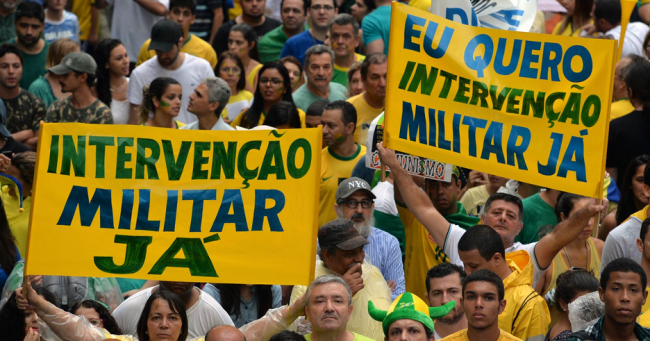
Protesters in São Paulo Plead for a Military Coup, March 15, 2015 (Source: Nelson Almeida / AFP)
In response to the pleas for military intervention, a spokesman for Revoltados ON LINE, a grassroots group that helped organize the protests and has 750,000 Facebook likes, commented, “The people asking for [military] intervention want to remove the PT from power. That is the sole focus. The participation of a variety of groups strengthens the group as a whole.” Though a military coup still looks unlikely, it is widely known that many in the military are incensed with the Rousseff administration over the final report of the National Truth Commission, which blasted the armed forces for torture and disappearances during its rule.
If those waxing nostalgic for dictatorships of yore were in the minority, what of the rest of the protesters? Despite attempts to highlight the supposed multi-class composition of the crowds on March 15, they represented, above all, Brazil’s white, university-educated economic elite. As Gianpaolo Baiocchi and Marcelo K. Silva recently pointed out, in Porto Alegre, nearly 70% of protesters were college-educated, in contrast with 11% of the general population, while over 40% belonged to the top income brackets, which make up but 3% of the population. Photographs confirm this; in a country with a high correlation between skin color and economic class, where over half of the population identifies as black or brown, the crowds had a decidedly lighter hue. A viral Tumblr account poked fun at the similarities with the upper-class, yellow-and-green-clad crowds that attended pricey World Cup matches last year by challenging visitors to determine if the photographs posted came from a March 15 demonstration or the World Cup.
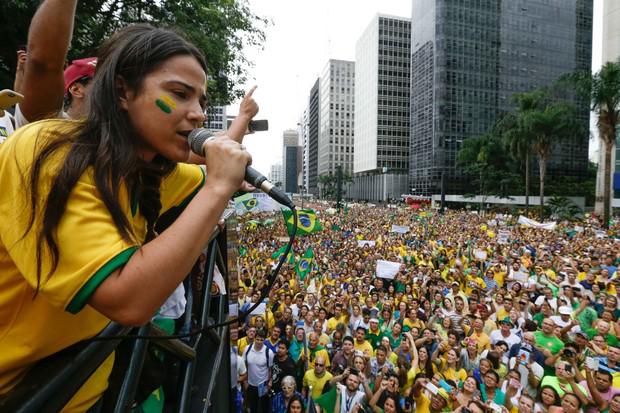
Singer Wanessa Camargo performs the National Anthem for a largely white crowd in São Paulo, March 15, 2015 (Source: Vanessa Carvalho / BPP / AGNEWS)
Of course, the fact that the demonstrations largely consisted of white middle- and upper-class Brazilians does not automatically mean that they were anti-democratic. At the same time, it would be a grave mistake to interpret the class composition of the crowds outside the context of Brazil’s historic inequalities of class, race, and region. What does it mean if the majority of demonstrators demanding the ouster of a moderately redistributive center-left party come from the social classes and regions that have least benefited from its policies? What problems do they see with corruption, the PT, or Rousseff that are insufficient to motivate the working classes or people from the impoverished Northeast of the country to take to the streets?
Since the colonial period, political and economic power has been wielded by a tiny European-descended elite, and since the collapse of the Northeastern plantation sugar economy in the nineteenth century, economic power has been concentrated in the Southeast and South, especially in the coffee and industrial powerhouse of São Paulo—today the epicenter of the opposition. An influx of European immigration in the late nineteenth and early twentieth centuries only heightened the disdain light-skinned, prosperous Southeasterners felt for their mixed-race Northeastern and Northern countrymen and women, and after the 1950s, that prejudice was turned against Northeastern migrants who came to work in the region’s expanding industries. Brazil’s middle class of government bureaucrats, small business owners, and professionals, tied to the landowning and industrial elite by socialization and patronage, has in turn largely identified with elite interests. Whenever Brazilian leaders, be they the populist dictator and later elected president Getúlio Vargas (1930-1945, 1950-1954), or the left-leaning would-be reformer João Goulart (1961-1964), have proposed reforms that would decrease inequality and broaden political representation, they have been ousted by an indignant elite and middle class – at precisely the moments when the minimum wage was growing the fastest.
The leveling results of the last 12 years are striking, if still far short of what Brazil needs to comprehensively address income inequality. In January 2003, the Inter-union Department of Socioeconomic Statistics and Studies (DIEESE) calculated that in order to provide a living wage, the minimum wage should be 6.93 times what it actually was; by February 2015, the ratio had fallen to 4.03. The unemployment rate when Lula took office was 11.2%; today, it is 5.9% (though it has risen from 4.4% in November 2014). At the same time, the gains were not evenly spread out; between 2001 and 2013, the income of the poorest 10% of the population grew at nearly three times the rate of that of the richest 10%. The result was a Gini coefficient that, while still among the highest in the world at 0.527 in 2012, reached its lowest level since 1960. In sum, then, though economic growth between 2003 and 2014 benefited the whole population, it benefited the poor and working class the most, largely as a result of real increases in the minimum wage. As economist Luiz Carlos Bresser Pereira, a cabinet minister under Cardoso, put it, “This hatred [against the PT] is a result of the fact that the government revealed a strong and clear preference for workers and the poor.”
The persistence of prejudice against the poor and Northeasterners manifested itself most clearly on social media in the wake of the 2014 elections—when the Northeast voted overwhelmingly for Rousseff. “These Northeastern sons of bitches need to die in a drought; good-for-nothings, sucking on the government’s teat, ignorant sons of bitches,” read one tweet. “Northeasterners don’t have a brain, they have no culture; it’s the slum of Brazil,” read another. Even former president Cardoso, a one-time leftist sociologist and champion of the struggle against the military dictatorship, grumbled, “The PT relies on the least informed, who happen to be the poorest.” Much like in the United States, in the wake of government efforts to reduce inequality, the wealthy and middle class have reacted with racially inflected charges of laziness, dependency, and ignorance. And so far it has largely been the same social groups who voted for Neves and blasted Northeasterners who have been participating in the demonstrations against Rousseff.
If the March 15 demonstrations expressed the concerns of the middle class and elite, what are the implications for Rousseff’s government? First, despite Rousseff’s dismal approval ratings, the PT’s base of support in the working class and poor is not ready to abandon it. The PT has retained their support through policies like the wildly popular conditional cash transfer program Bolsa Família, the expansion of the federal university system, and race and class-based quotas in college admissions that have yielded tangible improvements in their daily lives. Unless the economy deteriorates to the point where the working class and poor join the demonstrations – and even Brazil’s small leftist press admits that this is not impossible – it’s hard to imagine the protests gaining further traction. Second, despite the common class interests of the demonstrators, a message decrying working class gains is not politically feasible. In the absence of this message, which in fact is the real motivator of the protests, the demonstrators are left in the tenuous position of calling for the ouster of the PT through a legally invalid impeachment, with no agreement at all about, or what should, happen afterwards.
The same groups that organized the March 15 demonstrations are planning another round for April 12. Will they attract working class support? What developments in the Petrobrás scandal might affect their success? Will calls for military intervention become more prominent or fade into the background? One thing remains certain: In the absence of a mass working-class defection from the PT, proof of crimes justifying impeachment, or military interest in a coup, the prospects for a change in government are remote. Yet this is unlikely to dampen the hopes of wealthy and highly educated protesters, who will continue to use corruption as an excuse to protest against the socioeconomic ascension of those they see as their inferiors. As sociologist Jesse de Souza pointedly explains, “What distinguishes Brazil from the United States, Germany, and France, who we admire so much,” isn’t the level of corruption, “but the fact that we accept maintaining a third of the population in subhuman conditions.” The PT governments of the last 12 years made progress toward improving those conditions, but in the process they threatened the Brazilian elite’s deeply ingrained sense of superiority. Whether conscious or not, class and regional prejudice—not corruption—is the driving force behind the demonstrations.
Bryan Pitts is visiting assistant professor of History at Duke University and a Fulbright Scholars postdoctoral fellow at the Instituto de Ciência Política of the Universidade de Brasília (UnB).
Russia readies end to Greek food embargo – Economy Minister
RT | April 8, 2015
Russia has drafted a number of proposals that could end the embargo on food products from Greece, Russia’s Economic Development Minister Aleksey Ulyukayev said at a meeting with Greek Prime Minister Alexis Tsipras on Wednesday.
“We’ll be discussing in detail this issue during the meeting of the Russian Prime Minister and his Greek counterpart tomorrow,” Ulyukayev told reporters, as quoted by TASS.
“We’ve prepared a number of proposals regarding the embargo issue for discussion,” the Economy Minister said.
Russia is also considering rescinding food sanctions against Cyprus and Hungary, according to Aleksey Pushkov, head of the Duma Foreign Affairs Committee.
Greece has been hit especially hard by the ban, as more than 40 percent of Greek exports are to Russia. In 2013, more than €178 million in fruits and conserves were exported to Russia, according to the Greek fruit export association, Incofruit-Hellas.
On March 3, Greece sent a letter to the Russian food watchdog Roselkhoznadzor requesting the temporary restrictions on agricultural products such as strawberries, kiwis, peaches, and seafood is lifted.
Up until the ban, Russia had been Greece’s biggest single trading partner worth $12.5 billion (€9.3 billion) by 2013, more than double the 2009 figure.
Russia’s agricultural food ban applies to EU countries and is not due to expire until August 2015, a year after the restrictions were imposed in response to Western sanctions.
Alexis Tsipras, the newly elected PM of Greece,is in Moscow for a two-day visit and meets Russian President Vladimir Putin on Wednesday afternoon. Distancing itself from its other EU members, Athens hopes to strike a chord of cooperation with Moscow.
“Your visit could not have come at a better time, as we must analyze what we could do together to restore the former rate of growth,” Putin said ahead of his meeting with Tsipras.
Tsipras has taken a hard-line stance against EU policies towards Russia,calling the sanctions a ”road to nowhere.”
Greece offers 5 key points for consensus with international creditors
RT | April 6, 2015
Greek Finance Minister Yanis Varoufakis has unveiled his plan on reviving the Greek economy by both meeting the IMF requirements and circuiting the austerity measures. A preliminary agreement over proposal is expected on April 24.
Greece expects to reach a preliminary agreement with creditor countries on financing the economy and the external debt at a meeting of eurozone finance ministers on April 24, Varoufakis said in an interview to Naftemporiki newspaper published Monday.
“Preliminary results will be achieved at the meeting of the Eurogroup on April 24,” he said adding that Greece expects to negotiate the unblocking of the last tranche of €7.2 billion from the EU loan program, and to negotiate restructuring of external debt of €324 billion, or 178 percent of GDP, by June.
The Greek authorities have also said they would pay a $450 million tranche of the IMF on April 9 and start a dialogue on economic issues, said the head of the IMF, Christine Lagarde Sunday after a meeting with Greek Finance Minister Yanis Varoufakis in Washington. Varoufakis, in turn, said the country intends to fulfill “all the obligations with respect to all the creditors.”
Both Lagarde and Varoufakis agreed that the uncertainty about Greece’s ability to repay debts is not in the interest of Athens. Earlier, there were fears that Greece wouldn’t be able to meet the next $450 million repayment of the IMF loan.
Greece and its international lenders have been at a dead end negotiating about Athens’ debt. The Troika of creditors insists that Greece sticks to the austerity measures in order to meet all its commitments.
Varoufakis says the austerity policy contravenes the election pledge of the newly elected government and demands the international creditors made concessions in restructuring the Greek debt.
In February, the Troika agreed to extend the bailout program until June.
Five points of Varoufakis’s plan
“Negotiations [with international lenders – Ed.] will be completed when we come to a decent agreement that will give a real prospect of stabilization and further substantial growth to the Greek economy,” said Varoufakis, noting that his Cabinet won’t agree to carry out measures leading to a recession.
Greece requires a new agreement with Europe to make its debt sustainable, said Varoufakis pointing out five terms on which the plan is expected to work out.
First, it is a reasonable level of primary budget surplus about 1.5 percent of GDP instead of 4.5 percent agreed by the previous government which has led to a severe recession.
Secondly, it is a reasonable debt restructuring that will link payments with the growth rate of nominal GDP.
In addition, Greece needs an investment package from the European Investment Bank and the European Investment Fund, which should be placed mainly in the private sector in accordance with the new, non-bureaucratic procedures.
Fourth, Greece should pass on effective restructuring of troubled loans by allocating them to a ‘Bad Bank’ unlike other resources of the Fund for financial stability.
The fifth thing is significant reforms that will give support to creative people and businesses that produce tradable goods, with export prospects, he added.
Read more: Greece preparing for Grexit, own currency – media
Where the Argentine Debt Case Stands Now, and Why it Still Matters
By Aldo Caliari – NACLA – 04/06/2015
In NML v Argentina, the world continues to witness a rare and surreal spectacle: the unpredictable consequences unleashed by a U.S. judge going rogue on the law. Last June, the U.S. Supreme Court validated a lower court ruling that granted investment group NML Capital the right to obtain payment of 100% of its claims against the Argentine government, setting a legal precedent whose impact is just beginning to become clear.
NML’s actions against Argentina demonstrate why the firm is frequently described as a “vulture fund.” After initially acquiring Argentine sovereign debt bonds following the country’s 2002 default, the investment group refused to accept the terms of the agreement that Argentina reached with over 92% of bondholders, in 2005 and 2010. Then, NML sued in U.S. courts for payment of 100% of its bonds’ value, plus interest, aiming to get what amounts to a 1600% return on its original investment.
NML’s lawsuit was part of a carefully thought-out script during Argentina’s long debt restructuring process, a strategy that vulture funds have exploited in the past. First, buy the debt of a country in trouble, on the cheap. Second, systematically reject any offer of a deal worth less than the whole claim. Third, wait until the country’s circumstances improve, aided by a mix of debt relief granted by other creditors and the normal healthy impacts that such debt cancellation, if timely and sufficient, will have on the debtor country’s economy. Then, sue for the whole amount of the claim plus interest.
It is easy to see that if all creditors followed this playbook—waiting for the debtor to get better without sacrificing any part of their credit—the strategy would not work.
Unfortunately, at the international level and for nations issuing sovereign debt, there is no recourse to anything like bankruptcy, so they are exposed to rulings – even divergent ones – made by judges with jurisdiction over particular bonds.
In this particular case, U.S. Judge Thomas Griesa decided to depart from the traditionally accepted interpretation of the pari passu clause typically inserted in sovereign bonds. Whereas the standard pari passu clause is normally understood to grant equality of rank and treatment, Griesa extended the interpretation to forbid Argentina from making payments on its restructured debt without also paying the holdout bondholders.
Argentina went ahead and deposited the payment for its restructured bondholders with the banks the instruments designate as fiduciaries – in charge of collecting the payment and giving it to the bondholders. Since the banks took the judge’s order to mean they could not disburse those funds, an anomaly has emerged: a country complying with its debt obligations falling into default due to a foreign court preventing payment from being disbursed. Amazingly, the unusual nature of the ruling was only the beginning of a sui generis scenario that continues to unfold.
Holders of bonds that were restructured under European or Argentinean jurisdiction filed claims arguing that by blocking payment on their credits—even when made by U.S. banks—Judge Griesa had overstepped his jurisdiction. In fact, the judge has already granted several “one-and-only-time” exceptions so the fiduciary banks could make payments to certain non-U.S. bondholders. When one of the banks, Citi, requested that the injunction be lifted for those payments, to avoid requesting an exception every time interest payments came due, the judge denied the request, only to later backtrack on his own decision. But while agreeing to give Citi this maneuvering room, the judge expanded the initial order – and the jurisdiction overstep – by ruling that future debt under Argentine law, if it will or can be paid in U.S. dollars, qualifies as external debt. So, financial entities helping Argentina make any such payments would be prevented from doing so by the court order.
An English court, in one of these cases, ruled that payments deposited with the fiduciary institution in New York are the property of the bondholders, and no longer belong to the debtor country. Therefore, they should not fall under the jurisdiction of a US judge. Indeed, therein lies another anomaly created by the judge’s ruling: His decision ignored the arrangement Argentina reached with 92% of creditors, but then issued measures that affect payments to these majority creditors—arguably bringing them coercively under his jurisdiction.
The Argentinean Congress also passed legislation according to which it will give non-restructured bondholders – such as NML – the same deal it granted to the restructured ones, but no more. To fulfill this commitment, the government has been depositing these payments in an Argentinean banking institution , which the “vulture funds” could claim at any moment if they so wished (so far they have not).
Some observers speculated that the Argentinean government would agree to settle with the vulture funds after expiration of the RUFO clause. RUFO stands for “right upon future offer” and is inserted in the restructured bonds to promise their holders they will have a right to be offered any better deal that other bondholders receive in the future. If Argentina had settled before the expiration of the clause, it could have faced immediate demands from majority bondholders for payments proportionally equal to those made to NML. But the expiration of the clause in January did not bring any change to Argentina’s offer to the vulture funds. These observers’ speculation failed to recognize that a settlement where NML gets paid the whole amount it demands—even in the absence of the “RUFO effects”—could invite lawsuits from other non-restructured bondholders. In fact, in the wake of the Supreme Court’s ruling last June, some of those bondholders have already filed suit hoping to follow in the footsteps of NML. Since these investors hold claims to some $15 billion, this is hardly an advisable course of action for Argentina.
Regardless of what happens with Argentina, however, repercussions from Griesa’s decision reach much farther. The ruling continues a trend that, legal experts say, has seen holdouts increasingly better treated by courts, at the expense of the soundness of sovereign debt restructurings. What former IMF economist Anne Krueger characterized in 2003 as a gap in the international financial architecture is now wider than ever. By increasing the potential rewards of holdout behavior, this recent judicial precedent will make future debt crises harder to resolve, with unpredictable systemic consequences.
At the same time, creditors might opt for a jurisdiction where the traditional understanding of pari passu still holds – such as England– at the expense of New York’s current dominance as a preferential jurisdiction for issuing sovereign debt. Indeed, a large number of prominent economists warned of this possibility following Griesa’s ruling.
Last September, facing the United States and other countries’ continuing resistance to reach a consensus, developing countries voted to create a sovereign debt workout mechanism, and negotiations have begun on establishing such a legal framework at the United Nations. Even in the worst-case scenario—failure to get all countries on board—these negotiations would create a U.N.-endorsed standard for settling future sovereign debt crises. If history is any guide, there is one thing we know for sure: sooner or later there will be a country that needs to resort to it.
Aldo Caliari has been, since 2000, staff at the Washington DC-based Center of Concern where, since 2002, he has been Director of the Rethinking Bretton Woods Project, focusing on linkages between trade and finance policy, global economic governance, debt, international financial architecture and human rights in international economic policy.
Greece preparing for Grexit, own currency – media
RT | April 3, 2015
Athens is currently trying to negotiate a new bailout deal with its Troika of creditors, but if that falls ‘Plan B’ could reportedly involve getting rid of the euro and cutting off its banking system from the European Central Bank.
Greece’s government is getting ready to nationalize the country’s banks and return to the the drachma, the Telegraph reported citing sources.
“We are a left-wing government. If we have to choose between a default to the IMF or a default to our own people, it is a no-brainer,” a senior official told The Daily Telegraph.
“We will shut down the banks and nationalise them, and then issue IOUs if we have to, and we all know what this means. What we will not do is become a protectorate of the EU,” according to another source.
The drachma was Greece’s currency from 1832 until 2002, when it switched to the euro. At the time, 1 euro equaled about 340 drachma.
When the financial crisis hit Iceland in 2008, the government decided to let the banks fail and default on $85 billion, and the country’s three main banks were nationalized. The transition was painful- the stock market plummeted 90 percent, unemployment jumped to 10 percent, and inflation ballooned to 18 percent. Though the economy still struggles with an unstable currency, a slow and steady recovery has occurred. GDP is finally back at pre-crisis levels, unemployment has improved to 5 percent, and inflation is below 2.5 percent.
Crunch day April 9
The Greek government has €463.1 million of IMF loans to be repaid by April 9 and another €768 million falling due in May.
After Greece does this, and the EU approves the reform proposals by Finance Minister Yanis Varoufakis, the Troika of lenders- the IMF, the European Central Bank, and the European Commission, is expected to release the next €7.2 billion tranche to Athens.
According to senior official, Syriza and Prime Minister Alexis Tsipras have the power to decide not to make the upcoming payments.
“We may have to go into a silent arrears process with the IMF. This will cause a furor in the markets and means that the clock will start to tick much faster,” the source told The Telegraph.
On Friday the Finance Ministry denied rumors they wouldn’t pay the €460 million sum on April 9.
Countries in the past that have defaulted in their IMF loans include Sudan, Peru, Liberia, the Congo, Somalia, Zambia, Guyana, Yugoslavia, Vietnam, Zimbabwe, and Iraq.
With its massive €316 billion debt, a collapse of the Greek economy has the potential to shake the rest of Europe. The reason the EU came to Athens’ rescue with two bailouts totaling 240 billion euro was to protect the euro currency, which at the time was shared by 18 separate countries, Greece included.
In the case that lending is cut off, Greek banks will overnight become insolvent and Athens would have to start printing its own currency to replace the euro.
In February, deposits in Greek banks declined by around €7.6 billon to a 10-year low of €140.5 billion, as customers started pulling out their money over growing concerns the country may leave the eurozone.
Options on table
Alexis Tsipras came to power in January on the promise of no more austerity from the EU, but has had to compromise many of his big ideals in order to receive more funds.
The four month extension agreed in February will expire at the end of June. In anticipation, Greek and EU officials will hash out a more permanent solution, which could include a third bailout package, or if Greece has its way, debt forgiveness.
Greece needs to receive about €17 billion in order to meet its payments for the rest of 2015.
Another option Greece has is to turn its back on its European creditors and look eastward, either to China or Russia, for a loan with less strings attached. The Greek PM is scheduled to visit Moscow and meet with President Vladimir Putin on April 9.
Former Greek Prime Minister Antonis Samaras has returned to the political arena to try and build a coalition to make sure Greece stays in the eurozone.
Read more: Greece submits 26-page reform plan to get €7.2bn bailout
Free Trade, Corporate Plunder and the War on Working People
By COLIN TODHUNTER | CounterPunch | April 3, 2015
Prior to last year’s national elections in India, there were calls for a Thatcherite revolution to fast-track the country towards privatisation and neo-liberalism. Under successive Thatcher-led governments in the eighties, however, inequalities skyrocketed in Britain and economic growth was no better than in the seventies.
Traditional manufacturing was decimated and international finance became the bedrock of the ‘new’ economy. Jobs disappeared over the horizon to cheap labour economies, corporations bought up public utilities, the rich got richer and many of Britain’s towns and cities in its former industrial heartland became shadows of their former selves. Low paid, insecure, non-unionised labour is now the norm and unemployment and underemployment are rife. Destroying ordinary people’s livelihoods was done in the name of ‘the national interest’. Destroying industry was done in the name of ‘efficiency’.
In 2010, 28 percent of the UK workforce, some 10.6 million people, either did not have a job, or had stopped looking for one. And that figure was calculated before many public sector jobs were slashed under the lie of ‘austerity’.
Today, much of the mainstream political and media rhetoric revolves around the need to create jobs, facilitate ‘free’ trade, ensure growth and make ‘the nation’ competitive. The endless, tedious mantra says ordinary people have to be ‘flexible’, ‘tighten their belts, expect to do a ‘fair day’s work for a fair day’s pay’ and let the market decide. This creates jobs. This fuels ‘growth’. Unfortunately, it does neither. What we have is austerity. What we have is an on-going economic crisis, a huge national debt, rule by profligate bankers and corporate entities and mass surveillance to keep ordinary people in check.
So what might the future hold? Unfortunately, more of the same.
The Transatlantic Trade and Investment Partnership
The Transatlantic Trade and Investment Partnership being negotiated between the EU and US is intended to be the biggest trade deal in history. The EU and US together account for 40 percent of global economic output. The European Commission tries to sell the deal to the public by claiming that the agreement will increase GDP by one percent and will entail massive job creation.
However, these claims are not supported even by its own studies, which predict a growth rate of just 0.01 percent GDP over the next ten years and the potential loss of jobs in several sectors, including agriculture. Corporations are lobbying EU-US trade negotiators to use the deal to weaken food safety, labour, health and environmental standards and undermine digital rights. Negotiations are shrouded in secrecy and are being driven by corporate interests. And the outcome could entail the bypassing of any democratic processes in order to push through corporate-friendly policies. The proposed agreement represents little more than a corporate power grab.
It should come as little surprise that this is the case. Based on a recent report, the European Commission’s trade and investment policy reveals a bunch of unelected technocrats who care little about what ordinary people want and negotiate on behalf of big business. The Commission has eagerly pursued a corporate agenda and has pushed for policies in sync with the interests of big business. It is effectively a captive but willing servant of a corporate agenda. Big business has been able to translate its massive wealth into political influence to render the European Commission a “disgrace to the democratic traditions of Europe.”
This proposed trade agreement (and others like it being negotiated across the world) is based on a firm belief in ‘the market’ (a euphemism for subsidies for the rich, cronyism, rigged markets and cartels) and the intense dislike of state intervention and state provision of goods and services. The ‘free market’ doctrine that underpins this belief attempts to convince people that nations can prosper by having austerity imposed on them and by embracing neo-liberalism and ‘free’ trade. This is a smokescreen that the financial-corporate elites hide behind while continuing to enrich themselves and secure taxpayer handouts, whether in the form of bank bailouts or other huge amounts of corporate dole.
In much of the West, the actual reality of neo-liberalism and the market is stagnating or declining wages in real terms, high levels of personal debt and a permanent underclass, while the rich and their corporations to rake in record profits and salt away wealth in tax havens.
Corporate plunder in India
Thatcher was a handmaiden of the rich. Her role was to destroy ‘subversive’ or socialist tendencies within Britain and to shatter the post-1945 Keynesian consensus based on full employment, fairness and a robust welfare state. She tilted the balance of power in favour of elite interests by embarking on a pro-privatisation, anti-trade union/anti-welfare state policy agenda. Sections of the public regarded Thatcher as a strong leader who would get things done, where others before her had been too weak and dithered. In India, Narendra Modi has been portrayed in a similar light.
His government is attempting to move ahead with ‘reforms’ that others dragged their feet on. To date, India has experienced a brand of ‘neo-liberalism lite’. Yet what we have seen thus far has been state-backed violence and human rights abuses to ‘secure’ tribal areas for rich foreign and Indian corporations, increasing inequalities, more illicit money than ever pouring into Swiss bank accounts and massive corruption and cronyism.
Under Modi are we to witness an accelerated ‘restructuring’ of agriculture in favour of Western agribusiness? Will more farmers be forced from their land on behalf of commercial interests? Officialdom wants to depopulate rural areas by shifting over 600 million to cities. It begs the question: in an age of increasing automation, how will hundreds of millions of agriculture sector workers earn their livelihoods once they have left the land?
What type of already filthy and overburdened urban centres can play host to such a gigantic mass of humanity who were deemed ‘surplus to requirements’ in rural India and will possibly be (indeed, already are) deemed ‘surplus to requirements’ once in the cities?
Gandhi stated that the future of India lies in its villages. Rural society was regarded as India’s bedrock. But now that bedrock is being dug up. Global agritech companies have been granted license to influence key aspects of agriculture by controlling seeds and chemical inputs and by funding and thus distorting the biotech research agenda and aspects of overall development policy.
Part of that ‘development’ agenda is based on dismantling the Public Distribution System for food. Policy analyst Devinder Sharma notes that the government may eventually stop supporting farmers by doing away with the system of announcing the minimum support price for farmers and thereby reduce the subsidy outgo. He argues that farmers would be encouraged to grow cash crops for supermarkets and to ‘compete’ in a market based on trade policies that work in favour of big landowners and heavily subsidised Western agriculture.
By shifting towards a commercialised system that would also give the poor cash to buy food in the market place, rather than the almost half a million ‘ration shops’ that currently exist, the result will be what the WTO/ World Bank/IMF have been telling India to for a long time: to displace the farming population so that agribusiness can find a stronghold in India.
We need only look at what happened to the soy industry in India during the nineties, or last year’s report by GRAIN, to see how small farmers are forced from their land to benefit powerful global agritech. If it cannot be achieved by unfair trade policies and other duplicitous practices, it is achieved by repression and violence, as Helena Paul notes:
“Repression and displacement, often violent, of remaining rural populations, illness, falling local food production have all featured in this picture. Indigenous communities have been displaced and reduced to living on the capital’s rubbish dumps. This is a crime that we can rightly call genocide – the extinguishment of entire Peoples, their culture, their way of life and their environment.”
Although Helena Paul is referring to the situation in Paraguay, what she describes could well apply to India or elsewhere.
In addition, the secretive corporate-driven trade agreement being negotiated between the EU and India could fundamentally restructure Indian society in favour of Western corporate interests and adversely impact hundreds of millions and their livelihoods and traditional ways of living. And as with the proposed US-EU agreement, powerful transnational corporations would be able to by-pass national legislation that was implemented to safeguard the public’s rights. Governments could be sued by multinational companies for billions of dollars in private arbitration panels outside of national courts if laws, policies, court decisions or other actions are perceived to interfere with their investments.
A massive shift in global power and wealth from poor to rich
Current negotiations over ‘free’ trade agreements have little to do with free trade. They are more concerned with loosening regulatory barriers and bypassing any democratic processes to allow large corporations to destroy competition and siphon off wealth to the detriment of smaller, locally based firms and producers.
The planet’s super rich comprise a global elite. It is not a unified elite. But whether based in China, Russia or India, its members have to varying extents been incorporated into the Anglo-American system of trade and finance. For them, the ability to ‘do business’ is what matters, not national identity or the ability to empathise with someone toiling in a field who happened to be born on the same land mass. And in order ‘to do business’, government machinery has been corrupted and bent to serve their ends. In turn, organisations that were intended to be ‘by’ and ‘for’ ordinary working people have been successfully infiltrated and dealt with.
The increasing global takeover of agriculture by powerful agribusiness, the selling off of industrial developments built with public money and strategic assets and secretive corporate-driven trade agreements represent a massive corporate heist of wealth and power across the world. The world’s super rich regard ‘nations’ as population holding centres to be exploited whereby people are stripped of control of their livelihoods for personal gain. Whether it concerns rich oligarchs in the US or India’s billionaire business men, corporate profits and personal gain trump any notion of the ‘national interest’.
Still want a Thatcherite revolution?
Colin Todhunter is an extensively published independent writer and former social policy researcher based in the UK and India.
Europe and the BRICS countries forge an independent rating system
By Ian BLOHM | Oriental Review | April 2, 2015
Despite attempts to portray the work of the “big three” as globally oriented, the rating agencies maintain a close link to the US financial institutions. The 2008 economic crisis sent their reputations reeling. Now the global market for making ratings needs to be de-monopolized and equipped with new, transparent tools for working with risk.
Currently, Fitch, Standard & Poor’s, and Moody’s enjoy almost complete legal immunity for their evaluations and are guaranteed high profits, regardless of the consequences. According to the French edition of Le Monde, between 2000 and 2007, Moody’s earnings quadrupled, thanks to CMBS, ABS, CDO, and other securities that had become the main source of the company’s financial gains, with a profitability margin of 52%. Unfortunately, accurate data on S&P and Fitch are not published, although it would be interesting to look at the accounting records of these organizations that insist on full transparency for everyone but themselves.
In any event, the US taxpayer makes up for any discrepancy between the rating and the reality – suffice it to recall the 2008 scandal over the ratings of “toxic” assets within the US banking system just before the collapse of Lehman Brothers.
The way it works
Rating agencies act as a “filter” regulating the movement of investment capital from developed markets into developing ones. The mechanism is simple – any rating assigned by the “Big Three” that is used by the head of a major investment fund affects the default risk. Actual business practice is often ignored. For example, the retirement accounts of America’s senior citizens can be invested into crazy foreign financial schemes, as long as their ratings are properly pitched. The rating system is designed so that cash from banks and investment funds passes only into the “right” hands under favorable terms. This creates a type of political road map for investors, which has little to do with the real macroeconomic indicators.
But this does not stop the experts from the “Big Three.” “Imagine a large group of people arguing strenuously with each other,” David Levey, a former managing director of Moody’s, told Foreign Affairs. “It could sometimes get to that. These were very exciting meetings and often there were substantial disagreements. In every case, the ultimate decision was made by majority vote.” But were any of the people involved in these debates elected? And on what basis did they wield such influence?
In 2011, this question was answered by William Harrington, a former senior president at Moody’s (a voice in the wilderness, indeed). “This salient conflict of interest permeates all levels of employment, from entry-level analyst to the chairman and chief executive officer of Moody’s corporation,” Harrington said in a filing to the US financial regulator, the Securities and Exchange Commission (SEC).
The myth that the rating agencies are a “global” business.
With a single stroke of a pen, highly rated players are given a significant competitive advantage based on their proximity to the source of investment. To ensure political control over developing markets, the analyses of all three ratings agencies always include assessment criteria that affect the overall result. At Moody’s, for example, those criteria are called “institutional strength” or “susceptibility to event risk.”
At their own risk and peril, agency analysts evaluate the stability of the institutions of a sovereign player, on the basis of some kind of “global” paradigm of historical development. Not one of the agencies is entirely forthcoming about its methodology for assigning ratings. And this is hardly surprising – how else to explain high ratings to the press, given sovereign bankruptcies, in, for example, Iceland?
The idea of global development, as part of a neoliberal world order, arose only recently (in the late 1980s) and is, like many ideological concepts, a political tool. The agencies, however, use this idea in all their documents, all the while professing objectivity. To evaluate developing markets, regardless of the local conditions, the “universal” IMF criteria are used, such as the degree of privatization and liberalization of the national economy. The crises in Latin America offer clear evidence of what happens when a government is prompted by the “ratings racket” to sell off its liquid assets during a period of financial instability.
 For example, in February 2015, the rating agency Moody’s downgraded the credit rating of the Brazilian oil and gas company Petrobras from Baa2 to Ba2, and as a result the company plunged from “investment grade” to “speculative.” The influential Brazilian edition of Jornal do Brasil calls that decision “absurd and premeditated robbery” and asks – what is more significant, the three million barrels per day produced by Petrobras or the opinion of a group of anonymous Moody’s analysts who upheld Greece’s high rating until the bitter end.
The “good” and “bad” guys
It has long been noted that if a more or less sovereign government comes to power in a country that has been exhausted by the neoliberal economic programmes, the “Big Three’s” ratings begin to drop as if by magic. The most remarkable story in recent times has been seen in France. In 2012 the French market, one of the most highly developed in the EU, found itself on the rating agencies’ “bad guys” list, due to its “incorrect” tax policy and the government’s refusal to relegate its local culture to the mercies of the anonymous forces of the financial market.
According to the journalist Édouard Tétreau, (Le Monde) in his article “The United States of Europe vs. the dream of Standard & Poor’s,” ratings are manipulated in order to “Balkanize” Europe. To counter this, he prescribes the creation of real banks in Europe that can “send the brokers on Wall Street and the City of London packing.” During the assaults on the EU’s credit, Antonio Tajani, a former vice president of the European Commission, told El País that the rating agencies “work for the dollar.” In short, when it comes to evaluating the real economic indicators, old Europe is doing its best to distance itself from the ratings.
Among Europe’s “good guys,” the rating agencies list only the minuscule economies of the Baltic states of Lithuania, Latvia, and Estonia, which in 2014 received upgraded investment ratings from S&P for their progress in tax reform.
In the US, the “Big Three” are evidence of the miracles of lobbying. On January 12, 2003, the state of Georgia passed strong anti-fraud laws drafted by consumer advocates. Four days later, Standard & Poor’s announced that if Georgia passed anti-fraud penalties for corrupt mortgage brokers and lenders, packaging including such debts could not be given AAA ratings. S&P’s move meant Georgia lenders would have no access to the securitization money machine. It is interesting that this situation arose five years before the time bomb known as the subprime crisis went off.
Is there an alternative?
The rating market is in dire need of de-monopolization. “We can’t have private companies, whose primary goal is maximizing profit, behaving like sovereign judges passing down opinions that are binding for disinterested third parties,” believes Thomas Straubhaar, the director of the Hamburg Institute of International Economics. The BRICS countries are solidly united with Europe in the search for alternatives to the “Big Three.”
New, transnational rating agencies, such as the Universal Credit Rating Group (UCRG), will be an important milestone in the rating market. UCRG was created in 2012 as a partnership between the Chinese rating agency Dagong, Russia’s RusRating, and United States’ Egan-Jones. The fundamental principle behind the formation of new transnational actors must be the requirement that they are unbiased and unaffiliated with any state or corporate entity.
Ian Blohm is the economist and international financial adviser of the Polish origin. He is currently based in Moscow and can be reached at ian_blohm@myway.com
Greece submits 26-page reform plan to get €7.2bn bailout
RT | April 2, 2015
The Greek Finance Ministry has put together a 26-page list of policy reforms, which calls for €19 billion in funds this year. The reforms also plan to tackle tax evasion, and propose a €1.5 billion privatization plan.
Greece’s international creditors- the European Commission, International Monetary Fund, and European Central Bank- must OK the detailed reform plan before Greece can unlock its next €7.2 billion in bailout funds and avoid going bankrupt. The Greek government is still hesitant to push through the reforms, as they don’t align with hardline promises made back in January.
Greek Finance Minister Yanis Varoufakis intended to submit the plan to parliament, but it was leaked and released early.
The Financial Times obtained and uploaded the document in its entirety.
The plan reaffirms that Greece has no plan to exit the euro currency or the European Union.
“The Hellenic Republic considers itself to be a proud and indefeasible member of the European Union and an irrevocable member of the eurozone,” the document said.
Greece believes it is “urgent” to close the chapter on twin bailout packages from the EU totaling over €240 billion, and to start a fresh deal with less strings attached. The IMF, European Central Bank, and European Commission only lent money to Greece under the condition of severe austerity measures. These budget tightening measures have stifled growth in Greece, which has been in recession for the last six years, and has created a rift between the Syriza party and the country’s creditors. Several reports have sparked it may be looking elsewhere for support, perhaps to Russia.
The Finance Ministry predicts 1.4 percent growth in the real economy in 2015, and unemployment to drop to 22.5 percent on the assumption there are no policy changes.
Tying up the loose ends that allow individuals and businesses to evade taxes remains a priority for the new Syriza government, as does privatization of state assets, which the current government believes has “failed spectacularly” in the past. In 2015, Greece hopes to raise a total of €1.5 billion in privatization revenues, after coming nowhere close to raising the previously proposed €50 billion between 2011 and 2016, of which only €2.6 billion was realized between 2011-2013.
The new, revised plan of the Syriza government is to raise €22.3 billion in revenues by 2020.
Other parts of the plan propose more luxury taxes and a gradual hike in the minimum wage.
The list is still a “very long way from being a basis (for a deal),” a eurozone official said, as quoted by Reuters.
Neither side has signaled that they are close to a new deal. Ministers from the EU and Greece hope to reach a breakthrough in negotiations at their next meeting on April 24.
The European Central Bank has been used as leverage against Greece, by only raising the emergency liquidity for Greek banks by miniscule amounts. The total emergency liquidity assistance now stands at €71.8 billion, which Greece believes is too small.
Greece has told its creditors that it will run out of cash by April 9, and may not be able to pay its €450 million repayment to the International Monetary Fund (IMF) if it didn’t receive a cash injection.
With its massive €316 billion debt, a collapse of the Greek economy has the potential to shake the rest of Europe.
The enduring reality of government by wealth and some of its consequences
By John Chuckman | Aletho News | April 2, 2015
If you really want to understand the world in which we live – its endless wars, coups, interventions, and brutality towards great masses of people – you need to start with a correct understanding of the political machinery at work. Talk of liberal interventions or fighting for rights, Western values, and democracy are hopelessly naïve and mostly deliberately deceptive. America’s record in such matters is one of securing everything from bananas, copper, and crude oil concessions to, at the very least, foreign governments obedient to its mandates after removing a disliked leader, whether elected or not. There is no concern for principles outside of their being featured in blowhard, insincere political speeches. The interests of America’s government do not match the interests of ordinary people, those in America or anywhere else, and, were the informed consent of the governed genuinely involved in launching bloody adventures, they likely never would happen.
The underlying reality of how people in the West are governed now compared to hundreds of years ago is surprisingly unchanged, much the way the rules governing how chemical bonds form have not changed despite a long and great parade of events and discoveries in the visible world. Despite all the revolts, revolutions, congresses, constitutions, and great movements over the centuries, we are in fact governed in the same essential way people were.
Of course to see this, you have to strip away the forms and rituals we have constructed over the centuries, forms and rituals which create impressive effects much like the green smoke and thunderous voice of the Wizard of Oz, a wizened old man who worked from his curtained control room, pulling levers and hitting buttons to create intimidating effects. Most Americans remain impressed with the smoke and thunder and cheap magic tricks, it requiring some dedicated effort to shake off well-done illusions, and, as I’ve written before, Americans work extremely hard in their jobs or live a kind of marginal life trying to scrape by on low wages or part-time work, either of which situations leaves little time or inclination to question what government is really doing and for whose benefit.
And so long as America remains under the rule of wealth, it is unlikely other states, as in Western Europe, will emerge from it because America’s establishment has such decisive influence – economic, financial, military, and political – over many of them.
What is considered as wealth changes over time and with economic development, and with those changes so do its interests as well as the practices of its power. Great deposits of copper ore or crude oil In the Middle Ages were virtually worthless. Wealth then was land for agriculture, forestry, and hunting, with the family names of owners determined by their estates. The revenue from that natural wealth was converted to great houses and jewels and the implements of war. War, too, was a source of wealth with most wars being little more than adventures for dominance and looting on a grand scale. Again, as in our own day, they were dressed up with slogans about principles or causes which had almost no meaning. The case of the “Christian” Crusades, which continued their pillaging and orgy of killing, on and off, for centuries, springs to mind. Soldiers and sailors, up until modern times, were not motivated by their paltry pay and poor supplies, it being understood as a condition of employment that they would enjoy a share of the bounty looted in any campaign.
Today, the forms of wealth are as diverse and complex as is our society, and many of them are not apparent to ordinary people in the way great estates and hunting rights and obligations in war and peace to great lords were apparent in 800. Even as late as, say, 1850, wealth in the form of belching factories employing armies of people was often still quite apparent, but today’s complex banking and securities and financial institutions are not well understood by most people, although they represent immense wealth just as real in its demands and power as estates and obligations of the 9th century. Wealth today also comes from huge global manufacturing concerns of every description often with operations scattered out of sight, great shipping and transportation fleets, or electronic and communications empires. Land itself remains an important form of wealth where it can produce industrial-scale crops or contains deposits of valuable minerals or can generate flows of electricity or has been developed into great cities or resorts. War remains a source of wealth, only on a scale which could not have been imagined a few hundred years ago, but the spoils no longer go to soldiers in professional armies, they go to those responsible for the war, often in forms not easily recognized, as with special rights and concessions and secret arrangements.
As the nature of wealth evolved from the Middle Ages to the Modern Era, outward forms and rituals of government also changed. We have moved from the near-absolute power of kings and autocrats through aristocracies and republics with senates to a great variety of forms, parliaments and congresses, which appear designed to yield, to one degree or another, the consent of the governed.
But appearances, as in the case of the Wizard of Oz, can be deceiving.
Today, a single wealthy individual cannot make the kind of demands upon ordinary people that marked arrangements in the Middle Ages – although that must be qualified as I’m sure anyone who has become involved in a dispute with a wealthy neighbor or a great corporation will be happy to explain – but the class of wealthy people can indeed make just such demands, and they do so all the time. You will be taxed to pay for the schemes that their lobbying establishes, your water and air will contain the pollution of their manufacturing and mining, your children will be sent to kill and die in their wars, the ethics or morals you were taught as a child will be trampled upon, and virtually all important legislation will deal with the rights and interests of wealth, and not those of the broad mass of people.
In America, once in four years you will be asked to choose between two names, both of which have been closely vetted by the powers that be, to elect as head of government. Not only have they been vetted, but the immense costs of their campaigns in reaching you on television, at rallies, and with opinion polls to regularly fine tune their words will be paid almost exclusively by those whose real interests are at stake in every major election, the wealthy and their important serving institutions of government. The end effect is not really all that different than the old single-candidate Soviet elections at which the press trained Americans to sneer.
Many of America’s founding fathers had dark suspicions about the existence of wealth being secure in the presence of democratic government, and that is why they created forms – mostly adapted from Britain, a place no one regarded as a democracy then – to keep wealth safe. Over a couple of centuries, the original arrangements were modified, the country moving from a tiny one percent or so privileged voters – for perspective, that’s roughly the same as the percent of voters in China’s Communist Party deciding who rules the country – to something approaching universal suffrage, but always arrangements were made to safeguard wealth against the assumed predations of democracy.
In elections for the American Senate, the legislative body with real power, authority, and privilege, you again will be asked to choose between two well-vetted and well-connected candidates. Others may run, but they will be rendered helpless by the vetted candidates’ flood of money and resources, you will never hear their voices, and America’s press – itself an empire of wealth serving wealth – will waste no time on their views. In the case of the Senate, you will be asked once in six years to vote, with the elections staggered so that only one-third of that body faces election at any time – a perfectly-conceived formula for keeping the old bunch in charge despite issues which might have generated election discontent. In fact, you can never “throw the bums out” in America. Anyway, there really isn’t much risk for Senators running for re-election, with incumbents winning about 95% of the time. Senate seats are so secure they sometimes become family sinecures, handed down from father to son. After the election, unless you live in a small-population, insignificant state, you will never see or meet your Senator, and you will certainly have no opportunity to lobby. Virtually all seeing, meeting, and lobbying will be done by the wealthy sponsors of the successful candidates or by their hired help.
The average American Senator is said to spend two-thirds of his or her time securing funds for the next election, and such elections have now been bid-up to unbelievable amounts of money. The huge costs serve as what economists call “a barrier to entry,” a kind of high financial wall which keeps others from entering the political market, or, if somehow they do manage to enter, keeps them from effectively competing. Only the other wealth-vetted and connected candidate will have any hope of collecting a big enough pot of money to threaten an incumbent. The belief that people giving millions of dollars to candidates expect nothing in return is not even worth discussing. What they get – apart from goodies like important and prestigious appointments or valuable government contracts – is access, and access is exactly what most people never enjoy. Intimate access to politicians in high office, people always mindful of the necessity for another overflowing campaign war chest, is genuine power.
It is not impossible to have compatibility between democracy and wealth, but it requires a set of laws and regulations concerned with campaign financing, lobbying, and dis-establishing a political duopoly of two privileged parties, laws which simply cannot happen in America over our lifetimes. In America, law makes corporations persons, and the highest court, packed by judges appointed to serve wealth’s interests, has ruled that campaign money is free speech. These are not things easily turned around.
The American system of campaign financing not only assures the secure power of domestic wealth, it assures also the influence of wealthy lobbies serving the interests of foreign states, Israel being the most outstanding example. Other foreign states also exploit this system to varying degrees, but no other state has more than five million American citizens in great part keen to serve its interests. And many of them are successful, affluent, and well-placed people enjoying a connected set of organizations and well-funded lobbies. Other foreign states also do not enjoy having many of their lobbyists in America being dual-citizens, free to move back and forth between the country being lobbied and the country being lobbied for, surely an ethical issue for politics and foreign affairs of the first magnitude. It is a unique situation in many respects, and it has helped create a unique set of problems in the world.
The wealthy interests of America happen to share some important interests with lobbyists for Israel, including securing [or limiting competition to] the Western world’s supply of energy and not permitting the rise of states of any power in the Middle East who disagree with America’s essential views. It is important to keep in mind that “America’s essential views” are not necessarily the views of most of the American people and that many of those “essential views” have never received genuine informed consent. Elections conducted the way America’s high-level elections are conducted are incapable of bestowing meaningful consent, especially in vitally important matters.
The Israeli-American alliance is something of an unholy one because in binding America so closely to Israel, some huge and unresolvable conflicts have been created. Israel is associated with a long series of wars and abuses in the region, and, ipso facto, so is America. Israel, given the nature of its founding, expansion, and practices, is not liked by any neighboring states, although many now cooperate secretly, and sometimes even openly, in areas of mutual interest and have learned to tolerate its existence, the way generally eased by large American bribes or equally large American threats.
Traditionally, states in the Middle East are not democracies. Their often short histories have given limited opportunity for wide-spread development and prosperity creating a strong middle-class, the sine qua non for democracy. With the United States always (insincerely) praising democracy – including Israel’s grotesque contradiction of “democracy for some but not others” – it has been caught in a bind between supporting what it says it opposes and opposing what it says it supports.
Its proposed solution was a huge CIA project, nick-named “the Arab Spring” by America’s wealth-serving and often dishonest press, a set of manufactured uprisings intended to bring a semblance of democracy to the region. It has been largely a failure, ending with some countries trapped in chaos or civil war and others, notably Egypt, briefly gaining a government Israel hated intensely, the truth being that genuine democracy in virtually any of these countries will not be friendly to Israel’s geopolitical ambitions in the region nor to those of its American promoter and protector. While the “Arab Spring” was allowed to proceed in some states, in others, where it was neither intended nor desired, such as Saudi Arabia or Bahrain, spill-over effects were deliberately and violently suppressed with American assistance. So the American-Israeli relationship now still locks the United States effectively in fighting against democracy in some countries and in supporting absolute monarchs and oligarchs in others, while in still others, such as Syria and Iraq, it is involved literally in smashing them as states, in violation of all international law and long-term good sense.
The entire situation is an ongoing disaster and is almost certainly not sustainable over the long term. How do you insist a huge country like Egypt remain a backwater without democratic rights indefinitely? How can you justify the destruction of an ancient and beautiful country like Syria? How can you justify supporting absolute monarchs and keeping their people in total political darkness? How do you continue supporting Israel in its abuse of millions, depriving them of every human right, or in its constant aggression to secure its hegemony? The drive for regional hegemony is all that is behind Israel’s constant hectoring of Iran, and how is that behavior different to the aggressive wars condemned by the Nuremburg Tribunal? It’s not, of course. Further, destructive, deliberately-induced conflicts like that in Syria, by degrading its economic advance, only slow the day for democracy’s having a real chance to emerge.
So here is America, self-proclaimed land of the free, mired in a vast situation where it works to suppress democracy, supports tyrants, and supports aggressive war because its leaders, with no genuine consent of the governed, have put it there, and this is just one of many unhealthy and destructive consequences of wealth’s rule in the United States. Wealth has no inherent interest in democracy, and it is entirely up to a people anywhere to demand respect for democracy through laws.
Soros Looks to Co-Own Ukraine
By Alex Freeman • TFC • March 30, 2015
Vienna, Austria – Billionaire hedge fund manager George Soros has proposed a $1 Billion contribution of a combined $50 Billion investment package in the Ukraine in order to form an economic barrier to Russia’s entry to the war torn nation. In an interview with an Austrian newspaper, Soros said, “The West can help Ukraine by increasing attractiveness for investors.” The Hungarian-born economic hitman may be more interested in helping his, and other investor’s, pockets, rather than the people of Ukraine. The speculation here could undermine any truly democratic action in Ukraine. By using low EU Central Bank interest rates to achieve his investments, Soros’s plans begin to bear marked similarities to speculations that destroyed the British Pound and took severe tolls in places like Argentina.
The business model is nothing new for Soros, who has engaged in similar investment projects in West Africa. He continues, “There are concrete investment ideas, for example in agriculture and infrastructure projects. I would put in $1 billion. This must generate a profit. My foundation would benefit from this … Private engagement needs strong political leadership.” In Nigeria, Cameroon, Uganda and others, Soros has leveraged his political connections to protect his business interests in those nations. Revenue Watch International, a Soros firm, assisted Uganda in the development of its fossil fuel drilling regulations. Open Society Institute, another Soros Non-Governmental Organization, has recently been responsible for setting up and later overthrowing presidents of Senegal and Congo. Soros maintains significant oil, gold and diamond drilling operations in these nations. The International Crisis Group, yet another Soros NGO, has repeatedly advised the US Government to provide American military intervention in these fragile societies heavy in natural resources.
The profits would certainly roll in for the relentless investor. Soros Fund Management, LLC maintains ownership of large share percentages in key corporations that will benefit from investment in Ukraine. Soros owns over 5 million shares of the chemical giant Dow Chemicals, with diversified products and services from industrial to agricultural applications. Another big agricultural winner would be Monsanto. Soros owns half a million shares of the bio-tech firm, which has been a part of most Ukraine political discussions since the civil conflict broke out two years ago. Ukraine has vast supplies of oil and natural gas. Energen, a natural gas utility, could be a prime developer of Ukraine’s fossil fuel reserves. Soros owns nearly two million shares of that company. PDC Energy, with one million shares owned, might be another contender for drilling profits. Soros also owns significant stakes of Citigroup, which stands to be a primary financial intermediary for any investment in Ukraine.
Soros’ investment strategy is not restricted to diversified holdings of major national and international corporations or mutual funds. A significant tactic is the investment in supportive elements within the US government. In 2014, Soros ranked 11th on OpenSecrets.org list of “Top Individual Contributors.” His nearly $4 Million open investment (contributions sourced directly to him and not channeled through 501c4 “dark money” organizations) could potentially amount to $400 Million dollars in returns, if not more. The Carmen Group, for instance, a lobbying company in Washington, has claimed that for every dollar invested in lobbying, their clients receive $100 in return. RepresentUs, a campaign finance reform advocacy group, has measured similar extensive gains for political contributions and lobbying expenditures.

United Republic Infographic for Return on Lobbying Investment
If Soros senses a $100 Billion profit, diversified through a number of companies he holds stakes in, he will not mind selling other countries, individual investors, or the IMF to provide the remainder of the $50 Billion total investment he thinks Ukraine needs. In fact, this was probably a major conversation topic this year at the Davos World Economic Forum meeting. The majority of these banks and corporations, however, will mine the profits from Ukraine, exporting them to other Western nations. Meanwhile, these corporations will burden Ukraine with significant loans, even if the rates are near zero. Even though these practices have devastated countries like Greece and Argentina, as long as the profits keep rolling in, the investments will continue.
Featured Video
The American Retreat from Vietnam
or go to
Aletho News Archives – Video-Images
From the Archives
Secret document reveals plans for civil war in Lebanon, Israeli false flags, and invasion
By Randi Nord | Geopolitics Alert | April 5, 2019
Beirut – During his visit with US Secretary of State, Mike Pompeo, Lebanese President Michael Aoun reportedly received a US-Israeli document detailing plans for creating a civil war in Lebanon with covert false flag operations and possible Israeli invasion.
Although the source of the document is Israeli and created in partnership with Washington, no one knows who presented it to Aoun. The Lebanese TV station, Al-Jadeed, initially reported the document on Lebanese TV and a video on its website. Geopolitics Alert translated the report for this article. … continue
Blog Roll
 Aletho News
- Department of War Awards $20.7 Billion Contract to Raytheon for Air-to-Air Missiles
- ‘Distance yourselves from Israel’: IRGC urges US population to question govt policies
- America’s Greenland deal has a radioactive backstory
- The RAF Fairford ‘terror plot’: Unpacking escalation in the UK echo-chamber
- EU Council Advances Chat Control 2.0 Scanning Proposal
- Ex-Greek MEP files complaint against Israeli spyware firm over alleged Pegasus surveillance
- Troubling ideas throughout the Torah, Talmud, Mishneh Torah and Tanya
- ‘Grave, alarming’: Iran mission on Trump’s UNGA ‘annihilation’ threats
- Najaf airport to reopen to Iranian flights within 24 hours: Ambassador
- From ‘How Will This End For Iran’ to ‘When America Walks Away’: A tale of two Economist covers
- If Americans Knew
- New Report: “Scholasticide and Genocide in Gaza: Assessment, Testimonies and Legal Analysis”
- Ex-Biden officials are desperate for a Gaza scapegoat
- Israeli “settlers” Invade Al-Aqsa; Pour Boiling Water on 75-Year-Old
- Israel Has Kidnapped Another American Teenager
- US arms sales to Israel worth $21.6 billion in 20 months
- Three Palestinians Killed in Israeli Attacks on Gaza
- Revealed: German “Anti-Semitism Expert” Driving Crackdown on Palestine Solidarity is Former Israeli Spy
- Egypt’s Warning to Israel Before Oct 7
- Israel’s siege signals another cruel winter for 1.8 million Gazans – Daily Update
- Netanyahu Asked UAE Leader to Deny Report on Oct. 7 Warning in Secret Visit, Sources Say
- No Tricks Zone
- New Study: Earth And Venus Surface Warmth Largely Explained By Convection And Lapse Rate, Not CO2 Or Radiation
- 2025 Nature Paper Claiming Worsening Global Drought Gets RETRACTED …Heavily Flawed
- New Study: ‘Global Drought Shows No Detectable Recent Acceleration Under Climate Warming’
- Economic Masterminds: German Socialists Suggest Taxing Productivity Gains Stemming From Using AI
- The South China Sea Has Not Been Cooperating With The Climate Change Narrative
- Energy Crisis: Germany Enters Heating Season With Historically Low Gas Reserve Fill Levels
- New Study: The Antarctic Ice Sheet Gained Mass From 2020-2024 Due To Staggering Snow And Ice Accumulation
- Study: Ocean Heating Rates From Thousands Of Years Ago ‘Dwarf’ Modern Ocean Heating Rates
- Climate Extremists Target, Attack Large-Scale Power Grid Infrastructure In Germany!
- New Study: Antarctic Ice Melt Has Contributed Less Than 1 Centimeter To Sea Level Rise In The Last 30 Years

