Nationalizing Britain’s railways could cut fares 10% – campaigners
RT | March 31, 2015
Britons could see train fares slashed by up to 10 percent if the railway network was brought back under public ownership, a study by campaigners has revealed.
Passengers struggling to pay for season tickets could benefit from “massive” savings if profits creamed off by private operators and shareholders were reinvested back into a nationalized railway service.
Research by Action for Rail found that £1.5 billion could be saved over the next five years, as contracts held by 11 private firms operating the rail network come up for renewal.
With the potential savings, campaigners claim the government could introduce free off-peak travel for children traveling with their parents, season tickets could be cut by 10 percent by 2017 and by 2020 all ticket prices could be reduced by 3 percent.
Action for Rail estimated £520 million of savings could be made if shareholder dividends were given to the government.
The report comes as a poll of 1,000 voters found only 17 percent want railways to remain in the hands of private companies. The group We Own It, which compiled the results, said 40 percent of respondents wanted to see the whole network controlled by the state.
It follows separate research which revealed British travelers pay twice as much as a proportion of their salary on rail fares as passengers in Germany, France, Italy and Spain, where railways are publically owned.
The publication of the report also coincides with a day of action, with events held at more than 40 stations in the UK.
Frances O’Grady, TUC general secretary and chairman of Action for Rail, said: “The UK has the most expensive rail fares in all of Europe.
“If services were run by the public sector, it would make a big difference to families and hard-pressed commuters, who have suffered year after year of wage-busting fare increases under privatized rail.
“This report highlights once again the huge cost of privatization to taxpayers and passengers. Money that could be spent on making journeys cheaper is instead being siphoned off into shareholders’ pockets and wasted on bidding and other franchising costs.
“The case for an integrated rail network under public ownership is overwhelming.”
Transport will become a point of debate in the weeks leading up to the general election. The Labour Party is expected to broach the issue in its election manifesto, following comments from former Deputy PM John Prescott, who spoke in favor of ending privatization.
The only parties openly vying for re-nationalization are the Green Party and the Trade Unionist & Socialist Coalition.
A spokesman for the Rail Delivery Group, which represents Network Rail and train operators sounded a cautionary tone.
“The figures from Action for Rail should be taken with a large pinch of salt. Compared to the late 1990s, train companies are paying five times more money to government, largely because of phenomenal passenger growth on Britain’s railway, helping to fund big investment in better services.
“Increases to season tickets are regulated by government and operators offer a range of fares to suit the needs of different passengers, including some of the cheapest fares in Europe.”
Last summer’s Israeli aggression is sending Gaza back to the Middle Ages
Zionist colonisers destroy the tools for self-sufficiency of Palestinians in Gaza
By Miguel Hernández | International Solidarity Movement | March 31, 2015
Gaza, Occupied Palestine – Months after the last massive Israeli aggression against the Gaza Strip, thanks to the social and independent media, everyone has read news and seen pictures of the attacks from the Zionist regime against residential buildings, United Nations shelter-schools, hospitals, ambulances, mosques, churches and thousands of family homes.
However, little has been said about the almost complete destruction of Gaza’s industry and economy. As the Israeli Minister of Interior Eli Yishai said, the objective of the last operation was to “send Gaza back to the Middle Ages, destroying all of its infrastructure.” One of the more terrible blows committed towards this end has been the total destruction of the Beit Hanoun industrial area.
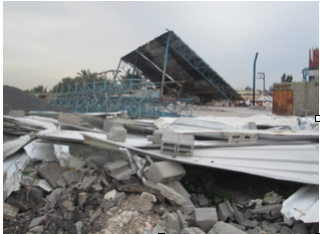 There were around 50 factories in Beit Hanoun, from which only three have been able to resume work seven months after the end of the assault.
 The factories in this industrial area provided work for 25% to 30% of Gaza’s population. Among the destroyed factories are those for paper, construction materials, clothing, medical equipment, plastic products, food and livestock products.
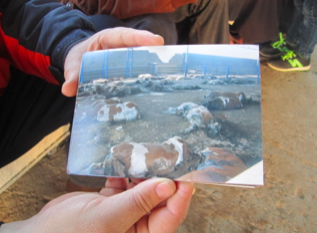 The agricultural industry has also been wounded by Israel’s summer attacks on Gaza. The owner of the Afanah Company showed us the pictures of his 800 cows killed by Israeli attacks during the last war on Gaza. Each cow was going to feed 7 families during the Eid holiday. Besides losing all his cows, Israel also destroyed the four fridges of the company, which contained 400 tons of meat.
Abu Fakhri Abu Ghais, from Beit Hanoun, explained how during the last massacre Israel killed his 17 sheep, and all his sons’ sheep, they destroyed all his farming equipment, worth over 15,000 US dollars. Israeli forces also destroyed the pumps for extracting the groundwater and the 20 tons of reserve of wheat seeds that Abu Fakhri had stored for the current year. The occupation also demolished the cabling that brought electricity to his village, Abu Safiya. He and his family now live in a tent without water or electricity, as his home was also destroyed.
 He and his family now live in a tent without water or electricity, as his home was also destroyed. Given the blockade imposed by Israel on the Gaza Strip, the struggling government of Hamas informed him that they don’t know when they’ll be able to restore the power supply, as they do not have available wire that is long enough.
In a Bedouin village located at the North of Beit Lahia, Hassan Sharadkha invited the author and his companions for a cup of tea in the wood cabin that he has built next to the rubble of his home. He showed us the pictures of everything he lost during the last summer at the hands of the Zionist occupation forces: 32 dunums of fruit and olive trees, 27 sheep and their stable, 2 cows, a 200 chicken farm, a horse, the water pump and the car he had just bought.
His older son, an electric engineer, was made unemployed because the solar panel company he worked for has also been bombed.
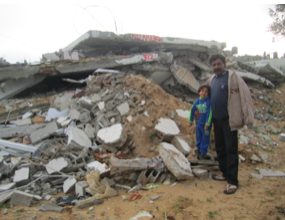 Ninety per cent of the Palestinian farmers in Gaza live in similar or worse circumstances.
 These attacks – against factories, farms, farming equipment and homes – were not by chance or accidental. These attacks demonstrate once again that the target of the genocidal Israeli colonialism is the Palestinian people itself, and that the war that Israel has been waging the last 66 years, under cover of Europe and the US, is against a nation, Palestine, that they seek to wipe off the map.
Why the West is to blame for the crisis in Ukraine: the full story
Chris Nineham reviews Frontline Ukraine: Crisis in the Borderlands by Professor Richard Sakwa
WE ALL KNOW about of the fog of war, but the current coverage and commentary on the crisis in Ukraine arguably takes wartime disinformation to new levels.
Richard Sakwa’s new book is a rare and precious exception. It is clear and measured and carefully researched and it shows that the story we are told in the west about events inside Ukraine is deeply flawed.
More generally, it exposes the idea that Russia is the aggressor and the West the protector of Ukraine’s democratic will as a travesty of the truth. In short, Sakwa’s analysis is diametrically opposed to what passes for an explanation of the Ukraine crisis in the mainstream.
One of the book’s great strengths is that it sees the crisis as a product of two connected processes, one domestic, one geopolitical.
Far from being a straightforward expression of popular will, Sakwa details how the government that emerged from the Maidan protests in February 2014 represented the victory of a minority hardline anti-Russian Ukrainian nationalism.
But this minority could come to dominate, he argues, because of the context provided by an aggressive, US-led, Western foreign policy designed to assert Western control over Eastern Europe and, at least in its more hawkish versions, de-stabilise Russia.
The push to the east
Nato and the EU have been pushing steadily eastwards ever since the end of the Cold War, despite verbal assurances from a series of Western leaders that this would not happen.
Twelve countries have joined Nato in the region since 1991. Georgia and Ukraine were promised membership at the Nato Summit in Bucharest in 2008, despite repeated warnings from the Russian government that taking Nato to the Russian border would cause a security crisis of the first order. It was only the intercession of Germany and France that forced the US to put these plans on hold.
The push to the east continued in the form, amongst others, of a plan to get Ukraine to sign up to an ‘Association Agreement’ with the EU. It was this agreement, due to be signed in November 2013, which sparked the crisis. To grasp its significance it is important to understand just how closely tied Nato and the EU have become, especially since the Lisbon Treaty signed by EU members in 2007.
Article 4 in the proposed Association Agreement committed the signatories to ‘gradual convergence on foreign and security matters with the aim of Ukraine’s ever deeper involvement in the European Security area’ (p.76). As Sakwa puts it, “it is pure hypocrisy to argue that the EU is little more than an extended trading bloc: after Lisbon, it was institutionally a core part of the Atlantic security community, and had thus become geopolitical”. (p.255)
All parties involved must have known that this document, if signed, would have caused existential anxiety in Moscow. Defenders of the West’s drive to the east justify it as the reflection of the will of the people concerned.
This is disingenuous. As Western leaders themselves have publicly admitted, a campaign to buy Ukrainain hearts and minds has been running for decades. In 2013, US Assistant Secretary of State for European and Eurasian affairs, Victoria Nuland, publicly boasted of the fact that the US had invested $5 billion in ‘democracy promotion’ since 1991, a huge sum by USAID’s standards (p.86). It has since been revealed that the EU too spent 496 million on front groups in Ukraine between 2004 and 2013 (p.90).
And there was nothing democratic about the process. Discussions about the Association Agreement in fact took place behind the backs of the Ukrainian people and the text of the agreement was not available in Ukraine till the last moment (p.74). It actually contained very little in the way of assistance to Ukraine’s economy, and its centrepiece was a radical liberalisation of EU-Ukraine trade, a direct threat to the traditional economic relations between Ukraine and Russia.
In the end, for a mixture of reasons, President Yanokovich didn’t sign up to the deal. But the pressure to sign helped to polarise the debate in Ukraine. The meaning of the agreement was an open secret in Washington. In the words of Carl Gershman from the National Endowment for Democracy, while Ukraine was ‘the biggest prize’, there was, beyond that, an opportunity to put Putin ‘on the losing end not just in the near abroad but within Russia itself’. (p.75)
Internal impact
This concerted Western strategy to surround and weaken Russia had a profound impact on the internal politics of Ukraine. Sakwa explains well the complex history that links Ukraine and Russia, a history that can’t be reduced to simple formulas of colonial dependency. The long, indigenous tradition of seeing Ukraine as part of greater Russian union has resulted in Russian being the dominant language in most of the country despite ethnic Russians being a relatively small minority. (p.8)
For all the mixed motivations behind the Maidan protests, it was a hardline anti-Russian strand that came to dominate, first in the protests themselves and subsequently in the regime that emerged out of the forced removal of the Yanukovich government.
Western policy in general gave ballast to a hardline nationalist tradition in the country that saw Russia – and the Russian minorities within the country – as the enemies of Ukrainian nationalism.
This tradition centred on the historic figure of Stepan Bandera who collaborated with the German Nazis in atrocities against Jews, Poles and Russians in Ukraine during WW2. His followers formed SS divisions which were responsible for the deaths of up to half a million people. (pp16-17). A giant poster of Bandera hung by the side of the stage in the Maidan, and many leaders of the regime that came out of the Maidan saw him as part of their tradition.
The West was minutely involved in this process. The State Department’s Victoria Nuland visited Ukraine three times in the first few weeks of the Maidan protests (p.86). The famous February leaked phone call between her and the US ambassador in Ukraine in which Nuland said ‘fuck the EU’, showed the extent to which the US was pulling the strings and in which direction.
In the call Nuland judges that the relatively moderate nationalist Vitaly Klitschko, who had the backing of Germany and the EU, should be kept out of office and that Arseniey Yatsenhuk – ‘Yats’ she calls him – a man who turned out to be a hardline chauvinist, should be the key player. Yatsenyuk indeed became the acting Prime Minister in the new government.
The result, in Sakwa’s words, was that, ‘what had begun as a movement in support of ‘European values’ now became a struggle to assert a monist representation of Ukrainian nationhood. The amorphous liberal rhetoric gave way to a much harsher agenda of integrated nationhood, and the euphoria promoted a rash of ill-considered policies’ (p.94).
As President Yanukovich was impeached and the new government was installed, armed insurgents strutted around the debating chamber. Yatsenyuk’s government was a mixture of recycled oligarchs and hard-line nationalists and fascists. It contained only two ministers from the entire south and east of the country, the areas with closest ties to Russia.
Five cabinet positions out of 21 were taken by the far right Svoboda Party, despite the fact they had only received 8% of the seats in Parliament. The minister of justice and the deputy Prime Minister came from the Russophobic Svobada party and its founder, a man with a long record of ultra nationalist activism, Andriy Parubiy, became head of the NSDC security agency.
Provocations
One of the new government’s first acts was to vote to rescind a law guaranteeing the right to instate a second official language where there were significant minorities. Although the change in the law was blocked, the vote was correctly interpreted as an attack on Russian minorities across the country.
It was followed by the outlawing of the Ukrainian Communist Party and the establishment of a ‘special service’ to root out fifth columnists in the armed forces (p.137). A wave of physical assaults on Russians duly followed.
In Odessa, pro-Russian activists were driven from an encampment into a trade union building which was then torched, killing a minimum of 48, many hundreds according to locals. The massacre was hailed by one of the Maidan leaders, Dmytro Yarosh, as ‘another bright day in our national history’ (p.98).
This series of events made a civil war virtually inevitable. Uprisings in the east of the country were motivated by political resentments, opposition to neoliberal policies and other economic grievances against Kiev, but most of all by a sense of the need for self defence. Unlike the largely middle-class movement in Kiev, the anti-Maidan movement in the Donbass region was ‘lower-class, anti-oligarchic (and Russian nationalist)’ (p.149). It was not mainly separatist. A poll by the Pew Research Center in May 2014 found that 70 per cent of eastern Ukrainians wanted to keep the country intact, including 58 per cent of Russian speakers (p.149).
The view from the East
Sakwa carefully analyses Russia’s behaviour during the crisis. His conclusions are a frontal challenge to the West’s narrative that the crisis in the Ukraine was precipitated by Russian aggression. As he shows, this is the opposite of the truth.
After the collapse of the Soviet Union, successive governments embraced a Western orientation, even making tentative moves to join Nato. In contrast to the stereotype that has been so carefully constructed, in his first term, Putin, and his successor Medvedev, sought engagement and accommodation with the West and tried to establish structured relationships with Nato and the EU. This approach faltered according to Sakwa, because of repeated rebuffs from the West:
“Continued conflicts in the post-Soviet space, the inability to establish genuine relations with the EU and disappointment following Russia’s positive demarche in its attempt to reboot relations with the US after 9/11 all combined to sour Putin’s new realist project” p.31
Over the last decade and a half, the Russian foreign policy establishment has become more and more alarmed by the unilateralism of US foreign policy, particularly over the invasion of Iraq and the attack on Libya. The non-negotiated push eastwards by Nato and the EU could of course only be perceived as hostile.
Even in these circumstances, however, for Sakwa, Putin’s central concern was to maintain the status quo in Ukraine, and try and ensure a friendly or at least neutral buffer state based on a stable settlement within the multi-ethnic Ukrainian state.
The forced, Western-backed removal of the Yanukovich government created an immediate crisis for the Russian government. Putin reacted by running a popular poll and an armed operation to secure the secession of the Crimean region to the USSR. Given the level of hostility and the mobilisations against Russian minorities, this can have surprised no-one. The Crimea was part of Russia until 1954, and it contains Sevastopol, Russia’s only major warm-water naval base. The idea that the Russian ruling class was going to stand aside and allow this area to be taken by a pro-Nato and anti-Russian government was obvious fantasy.
But if Putin’s long-term plan had been to invade, partition or even to destabilise the rest of Ukraine, he would have taken the opportunity presented by the virtual collapse of the Ukrainian government in February last year and the anti-Kiev uprisings in the east of the country which developed as a result.
His response was in fact was very different. Sakwa argues that despite the hoopla in the Western media, with the exception of the special case in Crimea, there is little evidence of significant military intervention by Russia in the months after the crisis of February, at least until August.
Putin supported the rebels to try and gain some leverage, but when it came to military assistance the rebels in the east were denouncing Putin for not delivering it. In Sakwa’s words, “Russia used proxies in the Donbas to achieve its goals within Ukraine, but this was not an attempted ‘land-grab’ or even a challenge to the international system” (p.182).
On 24 June in fact, the Russian Federation Council revoked a ruling which had previously allowed Russian military involvement in Ukraine ‘in order to normalise and regulate the situation in the eastern regions of Ukraine’ in the run up to tripartite talks involving the new Prime Minister Poroshenko (p.162). But Poroshenko had been the continuity candidate. On taking office, he had issued a statement calling for ‘a united, single Ukraine’ and characterising insurgents in the south-east as ‘terrorists’ (p.161).
Sakwa, along with most other sane commentators, is far from idealising the authoritarian and sometimes aggressive Russian regime. He criticises its human rights record and its institutions of governance. If anything his instincts are with a reformed integrationist ‘wider European project’, which, given the behaviour of the actually-existing Western institutions, seems a bit of a forlorn hope.
But what Sakwa’s book does so well is to ask us to go beyond rhetoric and generalities and examine the actual dynamics of the particular situation in its national and international dimensions.
Most importantly, he argues, we can’t begin to understand the Ukrainian catastrophe unless we completely reject the dominant, not to say consensual, Western account of what is happening. This is a crisis created by the West, but by threatening Russia’s core interests, it contains the possibility of a catastrophic confrontation; ‘the US has sought to create a regime in its own image, while Russia has sought to prevent the creation of one hostile to its perceived interests’ he argues (p.255).
We in the West have a responsibility to do everything possible to force our leaders back from the brink.
See also:
Richard Sakwa: History returns with a vengeance in Ukraine
Jonathan Steele: Who is really responsible for the crisis in Ukraine boiling over?
US fines oil giant $232 million over Iran trade
Press TV – March 26, 2015
The US government has slapped oil services giant Schlumberger with a $232.7 million fine for “violating” its sanctions on Iran and Sudan.
The US Justice Department says the company had admitted “knowingly and willfully conspiring to violate” unilateral American sanctions.
The French-US services company is charged with secretly providing services to Iran and Sudan.
While Schlumberger Oilfield Holdings was allowed to work in both countries, the government says the fine involved the company’s US Drilling and Measurements unit which was not.
Schlumberger is incorporated in the British Virgin Islands.
“Over a period of years, Schlumberger Oilfield Holdings Ltd. conducted business with Iran and Sudan from the United States and took steps to disguise those business dealings,” John Carlin, US assistant attorney general for national security, was quoted as saying.
US companies have coveted Iran’s lucrative energy sector with utmost attention despite unilateral American sanctions which are in place since the Islamic Revolution.
They see the punishments a case of lost opportunities where European and Asian rivals have used the absence to their advantage.
According to the Economist, citing unnamed foreign businessmen, American enterprises are using local middlemen to seal initial deals in Iran.
“If there is a nuclear deal (with Iran), you will find overnight that the Americans have signed one-year options on the best projects,” the weekly newspaper recently quoted one middleman as saying.
“The Europeans will be queuing up, but they will end up negotiating with ExxonMobil and Chevron, just as happened in Libya,” he said.
The Roots of Netanyahu’s Electoral Victory: Colonial Expansion and Fascist Ideology
By James Petras :: 03.24.2015
“It is always a meritorious deed to get hold of a Palestinian’s possessions” – The code of Jewish Law revised and updated by Benjamin Netanyahu
Benjamin Netanyahu’s re-election makes him the longest serving prime minister in Israel’s history. His 20% margin of victory (30 Knesset seats to 24 for his nearest opponent) underlines the mass base of his consolidation of power.
Most critical commentators cite Netanyahu’s racist pronouncements; his rejection of any two state solution and his overt appeal for a mass Jewish voter turnout to counteract the ‘droves of Arab voters’ for his electoral victories.
There is no question that the majority of Israeli Jewish leaders and parties support Netanyahu’s racist pronouncements and ‘no-state’ solution and joined him in a coalition government. But the larger issue is the positive mass response to Netanyahu’s call to action. Nearly three quarters of the electorate turned out (73%) to elect him. Moreover, Netanyahu has been elected prime minister for four terms: between 1996-99 and more recently 2009-20.
What is more, the opposition has not differed from the Netanyahu coalition regime’s Judeo-centric policies and pronouncements. In other words, ‘racist’ ideology per se is not what drives the Israeli majority to repeatedly support Netanyahu.
Jewish-centered racism is an integral and accepted part of Israel’s political culture.
Social Colonialism and Netanyahu’s Popularity
There is a more fundamental, ongoing material basis which accounts for Netanyahu’s electoral victories and mass appeal: His regime’s aggressive, perpetual and escalating seizure and dispossession of Palestinians land and his massive financing of Israel’s Jewish colonial towns.
In other words, Netanyahu’s appeal is rooted in the large-scale, long-term housing which hundreds of thousands of low and middle income Israeli Jews have obtained via his brutal land-grabbing policy. The so-called ‘settlers’ are in part armed Israeli Jewish colonists who engage in open theft and defend Netanyahu, because they materially benefit from his policies… It is not only those who have already colonized Palestinian land grabbed after 1967 – over 650,000 Jews – who vote for Netanyahu, but there are the hundreds of thousands of others in Israel, priced out of the Israeli real estate bubble, who cannot afford comfortable housing and look to the West Bank and Jerusalem for a ‘Jewish solution’ at the expense of the Palestinian inhabitants.
Racism, the foul language directed at Palestinians, which pervades Israeli-Jewish culture (‘Arab scum’ is one of many such common expressions) found expression even among the songs celebrating Netanyahu’s latest electoral victory. Racism serves to justify the land grabbing. Can the settler mind even imagine that an ‘inferior people’ should complain about land grabs by the ‘chosen people’ ? Modern educated Jewish professionals wax indignant that shepherds and olive farmers should hold back the development of glitzy shopping malls, million dollar community centers (for Jews only, of course), hospitals, sports complexes and high tech industrial parks.
And if they – ‘the Arabs’ – object to their own displacement, all the better: Their resistance provides an excellent pretext for armed Jewish settler thugs to invade a village, drive out the inhabitant and call in Netanyahu’s bulldozers, as a prelude to establishing an ‘outpost’, first steps to a new Jews only colony!
The key to Netanyahu’s big vote is that he responds favorably and forcefully in favor of new colonies. The self-styled Israeli Defense (sic) Force (IDF) is dispatched to protect the local vandals and to shoot live ammo at any rock-throwing Palestinian adolescent defending the family patrimony.
Netanyahu acts and speaks for the rapacious Jewish colonial masses. The opposition criticized Netanyahu on the basis of his neglect of socio-economic issues in Israel, especially, the soaring prices of housing in the major cities. But they failed to attract many Jewish voters because Netanyahu offers a more attractive alternative solution – the seizure of more Palestinian land and the construction of Jewish homes, instead of fighting powerful Jewish real estate moguls, land speculators and corporate landlords inside Israel.
Extremism at the Service of Jewish Housing is No Vice
For the mass of Israeli Jews, looking for a cheap, easy and government-financed road to comfortable middle class housing, seizing and occupying Palestinian property is a very attractive and viable ‘solution’.
Netanyahu’s ‘final solution’ for the Palestinians – no state – is a guarantee that land, which is seized and housing which is built, will remain under Jewish jurisdiction. The ‘final solution’ for Palestinians is the housing solution for the Jewish masses.
Under Netanyahu, from 2013 to 2015, two-thirds of new housing construction (for Jews only) has taken place on stolen Palestinian lands. His regime spends $252 million dollars a year on Jews-only colonies (‘settlements’). The Netanyahu regime spends $950 for each Jewish colonist in the West Bank, double what is invested for each Jewish Israeli resident in Tel Aviv. For the most aggressive Jewish colonists, those who destroy the productive olive groves, torch Palestinian homes and who establish ‘settler outposts’, Netanyahu spends $1,483 a year . . . with promises of roads, electricity, schools, swimming pools and air conditioning to come!
Owning the Holy City Secures the Unsavory Vote
Netanyahu’s big vote in Jerusalem can be accounted for by the fact that over 300,000 Jews have been the beneficiaries of land grabs and sparkling high-rise condos in what had been centuries-old Palestinian neighborhoods.
Netanyahu assures the Jerusalem Jews that ‘their city’ is and always will be the capital of Israel, an undivided Jewish city.
Sticking his finger in the eyes of the EU and US officials, who claim otherwise, energizes and emboldens the Jewish voters
Netanyahu’s ethnic cleansing is unrelenting: That is why he is re-elected over and over again. Israeli colonial settlements grew by over 5% each year from 2009 – 2015. There is no backtracking with Bibi Netanyahu: at this rate of ‘erasure’ all of historical Palestine will be Judified by 2050 at the latest!
Netanyahu claims that Israeli Jews must have their ‘lebensraum’ . . .
Israel and other colonial powers, like England in the 19th century and Germany in the 20th century, ‘solve’ their domestic social problems and social unrest by exporting populations across borders. The attractiveness of this solution is that it preserves the power and privileges of the domestic economic elite and provides an ‘escape valve’ for the local disaffected masses.
Emigration to settler colonies requires violent dispossession of the local inhabitants. If stiff resistance emerges – the imperial powers resort to genocide; extermination of native peoples by the English, Slavic peoples by the Germans, Palestinian Arabs and other non-Jews by the Israeli Jews.
Long past is the notion that Israeli Jews would solve their social -economic problems via a collectivist economy and popular struggle against Jewish plutocrats.
Today Jewish-Israeli millionaires flourish alongside orthodox, secular, Sephardic, Ashkenazi, Sabra and Russian emigrant colonists. The former exploits labor and markets, while the latter dispossesses Palestinians. Netanyahu has discovered a formula for uniting quarrelsome Jewish parties, leaders and voters and for winning elections.
Moreover, Netanyahu has secured the financial and political backing of numerous overseas Jewish-Zionist billionaires. He has secured the unconditional support of tens of thousands of middle class Israel-First activists, academics and professionals who operate AIPAC and dozens of similar propaganda mills in Washington and Christian Zionists throughout the US. Netanyahu’s overseas backers ensure that the US government may grumble and criticize, but will never disrupt Netanyahu’s ‘plan’ of an ethnically pure ‘Greater Israel’ with Jerusalem as its ‘eternal’ capital. Obama may whine and talk to the press about ‘reconsidering US-Israeli relations’ but he has assured Israel and Netanyahu that military and economic ties will remain intact.
Conclusion
Netanyahu has succeeded in setting a colonial agenda for all Israeli-Jewish parties (bar one).
He has established the fact that competitive elections and opposition political parties are compatible and even facilitate violent colonial expansion.
He has established the fact that Israel and its people embrace a racist ideology and receive the endorsement of most Western leaders, and mass media and the unconditional support of its overseas fifth column.
Israel’s project for Palestine, the creation of a single Jewish state, is far more than the demented vision of one man. It has been taken to heart by the great mass of the Israeli-Jewish people and their overseas supporters. The victory of Netanyahu and his supporters marks a historic victory for all those regimes and people across the world who believe and fight for an imperial dominated world.
Wall Street Journal Gets the Numbers Wrong on Venezuelan Health Care Spending
By Mark Weisbrot | CEPR Americas Blog | March 20, 2015
I have sometimes noted that in the current “four legs good, two legs bad” discourse about Venezuela, journalists can write almost anything about the country and no one will question it – so long as it is something negative. On Saturday, March 13, the Wall Street Journal published this chart on its front page in the print edition, below, and claimed health care spending as a percent of economic output was “lower in Venezuela than in all other major economies in Latin America.” The chart shows Venezuela’s health care spending at 1.6 percent of GDP.

The chart and text don’t say it, but they are referring to public (i.e., government) spending on health care, which one can find by looking at the original data from the World Health Organization. When I read this, I thought, this can’t be true: The Venezuelan government spends about the same percentage of GDP on health care as Haiti? The lowest of 19 countries in the hemisphere? Less than some of the poorer countries in Sub-Saharan Africa? And these numbers are for 2012, when the economy was booming (5.7 percent real GDP growth), Venezuelan oil was at 103 dollars per barrel, and the government built more than 200,000 homes. They had no money for health care?
This should have set off some alarm bells at the WSJ, if any editors were paying attention. This number is not plausible because it is wrong. When the government of Hugo Chávez in Venezuela decided to make health care a priority after getting control over the national oil industry in 2003, it was unable to accomplish very much by going through the health ministry and the public hospitals – running into various bureaucratic and political obstacles. So it created Misión Barrio Adentro, a system of health clinics that served people in both urban and rural areas where many did not previously have access to health care.
The short story is that the numbers used by the WSJ apparently didn’t include most of Venezuela’s health care spending, since it has gone through the misiones. In 2012, the national oil company contributed $5.5 billion for Misión Barrio Adentro. Also, the government of Venezuela has an actual agreement with Cuba, which provides specifically for the supply medical care through Misión Barrio Adentro in exchange for 98,000 barrels of oil per day, which Venezuela has provided. The value of that oil in 2012 was $3.44 billion. The medical services include not only 40,000 doctors but also medical equipment, medicines, and other health care services.
If we add in these expenses, and use the IMF’s 2012 exchange rate to convert to domestic currency, this adds another 3 percent of GDP to the government’s health care spending.
This would bring Venezuela’s health care spending to 4.6 percent of GDP. In the above chart, that would move Venezuela from 19th to 7th place among the 19 countries shown. And this figure does not include all of Venezuela’s government health care spending.
(Note: the WSJ article also claims that “the share of state spending on health, at 6%” was also “lower in Venezuela than in all other major economies in Latin America.” This is also false, for the same reasons discussed above.)
UK creates ‘political & economic reform’ fund for Eastern Europe to contain Russia
RT | March 20, 2015
Prime Minister David Cameron has announced the creation of a money pot specifically designed to aid Eastern European countries in tackling any future ‘aggression’ from Russia.
The “Good Governance Fund” is aimed at strengthening democratic institutions in areas that are wary of Russia’s influence. The fund will total £20 million ($30 million, €28 million) in 2015 and 2016.
It is broken down into £5 million for Ukraine, and continuing grants for Moldova, Georgia, Bosnia-Herzegovina and Serbia.
The announcement comes as leaders of the European Union agreed to extend the economic sanctions currently in place against Russia until the end of 2015, in a move to force Moscow to undertake a full ceasefire in eastern Ukraine.
The Minsk Agreement was reached in February after lengthy talks, but the truce has remained shaky. There have been reports of continuing skirmishes between Ukrainian forces and rebels.
EU leaders have criticized Russian President Vladimir Putin’s alleged “web of influence” across Europe after the reunification of Crimea in March 2014.
Earlier this month, the prime minister of Crimea said the former Ukrainian territory had returned to its historical homeland.
Russia has also formed an alliance with Cyprus, after Putin agreed a £1.8 billion loan for the country in return for the use of its docks for Russian military vessels.
Putin further created powerful western European allies following Marine Le Pens visit to Russia in the autumn. Russia has agreed to loan her party, the right-wing Front National, £6.5 million.
The Kremlin’s interests also extend to Greece, where Putin offered support to anti-austerity party Syriza when it campaigned for the country’s withdrawal from NATO two years ago.
When the party came to power in January, the Russian ambassador to Athens was one of the first to visit Prime Minister Alexis Tspiras.
The new fund is based on a Cold War program created by Margaret Thatcher in 1989.
At the time, her “Know-How-Fund” was used to help countries that had recently left the Soviet Union to develop, such as Hungary and Poland.
Russia denies it is providing rebels in Ukraine with arms and assistance.
The conflict has cost over 6,000 lives to date.
U.S. Dominates Weapons Export Market as Profits Grow with Sales to the Middle East
By Noel Brinkerhoff | AllGov | March 17, 2015
The global arms trade business continues to thrive, with the United States being the biggest beneficiary of an ever-growing market that’s being fueled by Middle East purchases.
IHS Inc., an international information and analytics firm based in Colorado, reported in its Global Defense Trade Report that worldwide arms sales increased last year for the sixth straight year. The total in military trade went from $56.8 billion in 2013 to $64.4 billion in 2014—a 13.4% increase.
The U.S. was responsible for one-third of all defense exports and “was the main beneficiary of growth,” IHS reported. American exports of weapons were particularly popular among buyers in the Middle East.
Saudi Arabia surpassed India to become the largest defense market for U.S. weapons makers, as the oil sheikdom increased its defense imports 54% from 2013 to 2014. This year is expected to be another strong year for Saudi imports, IHS says, rising another 52% to $9.8 billion.
“One out of every seven dollars spent on defense imports in 2015 will be spent by Saudi Arabia,” according to IHS.
Ben Moores, senior defense analyst at IHS Aerospace, Defense & Security, said: “The Middle East is the biggest regional market, and there are $110 billion in opportunities in coming decade.”
To Learn More:
Saudi Arabia Replaces India as Largest Defence Market for US, IHS Study Says (IHS Inc.)
Charted: The World’s Biggest Arms Importers (by Alan Tovey, The Telegraph )
The SIPRI Top 100 Arms-Producing and Military Services Companies, 2013 (by Aude Fleurant and Sam Perlo-freeman, SIPRI) (pdf)
Obama Steps Up Foreign Weapons Sales, Overwhelming Other Arms Makers (by Noel Brinkerhoff and David Wallechinsky, AllGov )
Banks Say “Thanks for the Bailout,” Now We’ll Park our Profits in Overseas Tax Havens
By Steve Straehley | AllGov | March 16, 2015
Giant financial institutions that benefitted from federal bailouts during the depths of the recession have repaid the American people’s largesse by hiding profits overseas to avoid paying their fair share of taxes.
According to a report (pdf) commissioned by Senator Bernie Sanders (I-Vermont), four big banks—Citigroup, Goldman Sachs, Bank of America and JPMorgan Chase—which received massive amounts of money and loan guarantees to keep them afloat in the wake of the financial crisis, park large amounts of money in tax haven nations.
Citigroup got the most help of the four in the bailout, $2.5 trillion. That company has at least 427 offshore divisions where it squirrels away profits out of reach of the American people. Those funds, as of early 2014, totaled $43.8 billion, which would mean $11.7 billion in tax revenue for the United States if they were brought to this country. Citigroup CEO Michael Corbat was rewarded with $1.5 million in salary, $4.5 million in bonuses and $8 million in stock for his work in 2014.
Bank of America received a $1.3 trillion bailout from the American people. In 2014, it had $17 billion in profits stashed offshore, which would bring $4.3 billion in funding for education, infrastructure and other badly needed projects in the United States. Bank of America CEO Brian Moynihan made $1.5 million in salary, $13 million in bonuses and $11.5 million in stock in 2014.
JPMorgan Chase got a $416 billion bailout from American taxpayers. That bank has hidden $28.5 billion overseas which would bring in $6.4 billion to the U.S. Treasury. Chase CEO Jamie Dimon was paid $1.5 million in salary, $7.4 million in bonuses and $11.1 million in company stock in 2014.
Goldman Sachs was the recipient of $814 billion in virtually zero-interest loans, as well as $10 billion from the government. It’s holding $22.5 billion offshore that would bring $4.1 billion back to the American people. Goldman CEO Lloyd Blankfein made $2 million in salary, $7.33 million in bonuses and $7.33 million in stock in 2014.
Of course, banks aren’t the only companies taking advantage of tax havens. Apple, for instance, famously worked it out so two of its subsidiaries have no home country to which to pay taxes. But then Apple didn’t come hat-in-hand begging the American people not to let it go under.
To Learn More:
Legalized Tax Fraud: How Top U.S. Corporations Continue to Profit Through Offshore Tax Havens (by Senator Bernie Sanders, U.S. Senate) (pdf)
Offshore Shell Games (U.S. PIRG) (pdf)
The Bailouts 4 Years Later: Were They Worthwhile Investments? (by Matt Bewig, AllGov )
Quantitative Easing for Whom?
Why the European Central Bank’s Trillion Euro Plan will Only Help Keep the Banks Afloat
By MICHAEL HUDSON and SHARMINI PERIES | CounterPunch | March 13, 2015
SHARMINI PERIES: In an effort to relieve some pressure on the struggling European economies, Mario Draghi, president of the European Central Bank, announced a 1 trillion euro quantitative easing package on Monday. Quantitative easing is an unconventional form of monetary policy where a central bank creates new money electronically to buy financial assets like government bonds. And this process aims to directly increase private-sector spending in the economy and return inflation to target.
Well, what does that mean and what might be wrong with it is our next topic with Michael Hudson. Michael Hudson is a distinguished research professor of economics at the University of Missouri-Kansas City. His two newest books are The Bubble and Beyond and Finance Capitalism and Its Discontents. His upcoming book is titled Killing the Host: How Financial Parasites and Debt Bondage Destroy the Global Economy.
Michael, the Fed and some economists will argue that this is what got the U.S. out of its 2008 financial crisis. In fact, they put several QE measures into place. So what’s wrong with quantitative easing?
MICHAEL HUDSON: Well, the cover story is that it’s supposed to help employment. The pretense is an old model that used to be taught in textbooks a hundred years ago: that banks lend money to companies to invest and build equipment and hire people.
But that’s not what banks do. Banks lend money mainly to transfer ownership of real estate. They also lend money to corporate raiders. They lend money to buy assets. But they don’t lend money for companies to invest in equipment and hire more workers. Just the opposite. When they lend money to corporate raiders to take over companies, the new buyers outsource labor, downsize the work force, and try to squeeze out more work. They also try to grab the pensions.
The Fed was pretty open in what quantitative easing is supposed to do since 2008. It’s supposed to lower the interest rates, which raises bond prices and inflates the stock market. Since 2008 they’ve had the largest monetary inflation history – $4 trillion of quantitative easing by the Fed. But it’s gone via the banks into the stock and bond market.
What has this done for the economy as a whole? For starters, it’s obviously helped stock and bond holders get richer. And who are they? They’re the 1 percent and the 10 percent.
People are wringing their hands and saying, why isn’t the economy getting richer? Why is it that since 2008, economic inequality and the distribution of wealth have worsened instead of gotten closer together? Well, it’s largely because of quantitative easing. It’s because quantitative easing has increased the value of the stocks and the bonds that are held mainly by the 1 percent or the 10 percent hold. This hasn’t helped the economy because the Fed is really concerned with its constituency, which are the banks.
Quantitative easing hasn’t helped one class of investors in particular: pension funds. It’s done just the opposite. Pension funds made the assumption a few years ago that in order to break even with the rate of contributions that corporations, states and municipalities are paying, they have to make eight percent or eight and a half percent a year as a rate of return. But quantitative easing lowers the interest rate.
Today’s lower interest rates have made pension funds desperate. The risk-free rate of return is less than 1 percent on short-term Treasury bills. If you buy longer-term treasuries you can make 2 percent, but then if the interest rates ever go up, you’re going to take a loss as the bond price declines. So pension funds have said, “We’re desperate; what are we going to do?”
They’ve turned their money over to Wall Street money managers and hedge funds. The hedge funds take a huge rake off of fees to begin with. But even worse, when hedge funds and the big banks – Goldman Sachs, Citibank – see a pension fund manager coming through the door, they think, “How can I take what’s in his pocket and put it in mine?” So they rip them off. That is why there are so many big lawsuits against Wall Street for mismanaging pension fund money.
To summarize, the effect of the quantitative easing has been to make pension funds desperate, and to support real estate prices, as if higher costs to obtain housing will help recovery. It doesn’t help recovery, because to the extent that quantitative easing supports a re-inflation of housing prices, new homeowners have to pay even more of their income to the banks as mortgage interest. That means they have less money to pay for goods and services, so markets for goods and services continue to shrink.
What the quantitative easing has not been used for is what was promised in 2008. Before President Obama won the election and took office, Congress said that the TARP bailout and TALF were supposed to go for debt reduction. Some was to write down mortgages, so that people could afford to stay in their homes rather than the millions of home owners that have been foreclosed on and thrown out. But even before Obama came into office, Hank Paulson, the Secretary of the Treasury, told Democrats in Congress, yes, we’re willing to write down debts. But as Barney Frank explained in exasperation, Obama said no, he’s not going to do that. Obama ended up supporting the banks. So almost none of the TARP bailout money has been used for debt write-downs.
The same phenomenon is happening in Europe.
PERIES: So, Michael, what’s wrong with what the ECB has announced in terms of a trillion euros worth of quantitative easing for Europe?
HUDSON: They head of the European Central Bank, Mario Draghi, has said that he’ll do whatever it takes to keep banks afloat. He doesn’t say that he’ll do whatever it takes to help economic recovery, or to help labor more. The ECB’s job is to help banks make more money.
Draghi was vice chairman of Goldman Sachs during 2002 to 2005. His view is that of Wall Street. It’s not a vantage point helping labor or helping economies grow. So it’s not surprising that the trillion euros of new money that the eurozone’s central bank is creating hasn’t gone to help Greece, for instance, survive. It hasn’t gone to help Greece, Spain, Italy, or Portugal get out of depression by fueling government spending. It’s simply been given away to the banks to buy bonds and stocks, including buying American stocks and bonds.
Behind this policy is the trickle-down theory that if you can make the financial sector richer, if you can make the one percent and the 10 percent richer, it’s all going to trickle down. This is the view of Paul Krugman, and it’s the view of the advisers that Obama has had. But instead of trickling down, the stock and bond price gains by the 1% and 10% drive a wedge in the economy, by increasing the value of stocks and bonds and real estate and wealth against labor. So quantitative easing is largely behind the fact that the distribution of wealth has become worse rather than better since 2008.
PERIES: One of the things that has happened in Europe that you wrote to me actually in an email was the disappearing central banks’ role in stimulating economies. Why is this an issue?
HUDSON: Central banks originally were designed to monetize government deficits. Governments are supposed to spend money into the economy, because that helps economies grow. But in Europe the Lisbon agreements say governments can’t run a deficit more than 3 percent of national income.
Furthermore, the role of the European Central Bank is not to give a penny to governments. They say that if you give a penny to government, you’ll have hyperinflation like you had in Weimar. So the central bank can only give money to banks – to invest in stocks and bonds. But the ECB won’t buy fresh bonds to finance new government spending. The result of this policy of not funding government deficits is that if the economy is to grow, it has to be entirely dependent on commercial banks for credit.
We had this situation in the United States in the last few years of the Clinton administration when the United States actually ran a budget surplus instead of a deficit. Now, how do you think the United States could grow when there’s a budget surplus sucking money out of the economy?
The answer is that commercial banks and bondholders have to supply the money. But the banks only supplied money in the form of junk mortgages and other forms of an economic bubble, such as takeover loans and a stock market bubble.
The interest of banks is not to help economies grow; it’s to extract interest from the economy. The financial sector uses part of its rising wealth to lobby for privatization sell-offs. The problem with this is that when you privatize a public utility, you give away a monopoly – and if you deregulate the economy, you let the monopoly set up tollbooths over the economy, for toll roads, communications or whatever is being privatized.
The ECB is telling Greece to privatize to raise the money to pay its bondholders, the ECB and IMF. So you have quantitative easing going hand-in-hand with the insistence on privatization. The result is debt deflation as the economy is forced to depend more and more on banks for the money to grow, instead of on government spending into the economy. You’re having the governments not being able to spend on infrastructure, letting it fall apart, as is happening with bridges and tunnels in the United States.
The next step is for the government to say, “I’m sorry, the central bank doesn’t have enough money to help us build new infrastructure. So we’ve got to sell it off to private investors who do have the money.” The next thing you know, you have the economy ending up looking like Chicago. That city sold off its sidewalks and its parking meters to Goldman Sachs and to other Wall Street firms. All of a sudden the prices of parking, driving, and living in Chicago went way, way up instead of lowering the costs as privatization promised.
You have the same phenomenon here that England suffered under Margaret Thatcher: costs for hitherto public services go up. Transportation costs go way up. Road costs go up. Communications, internet costs, telephone costs, everything that is privatized goes way up. Financialization leads to a rent-extractive, almost neo-feudal economy.
In that sense, quantitative easing and the refusal of central banks to fund governments (except to pay bondholders and bail out commercial banks) is a new kind of class war. It’s not the old kind of class war, which was between employers and their workforce over what wages will be. It’s by the financial sector trying to take over the economy, and especially to take over the public sector, to take over the public domain, to take over public utilities and whatever assets a government has. If governments cannot borrow from central banks, they have to begin selling off property.
PERIES: Michael, this is exactly what’s happening in Greece right now. The SYRIZA government is somewhat forced to continue privatization as a part of the agreement of the loans that they have been given by European banks. What could they do in this situation?
HUDSON: This is really a scandal, because most privatizations are corrupt insider dealings. The SYRIZA Party came in and said, wait a minute, the privatizations that have been done are by governmental officials to their own cronies at a giveaway price. How can we balance the budget if we’re giving away the public utilities instead of getting a fair price for them?
The European Central Bank said, no, you have to give away privatization to cronies at pennies on the dollar just like Russia did under Yeltsin, just like the United States did with the railroad giveaways of the 19th century.
Remember, the American privatization to the railroad barons and their financial backers created essentially the ruling class of the 20th century. It created the American stock market. The same thing is happening in Greece. It’s being told to continue the former politicians’ drive to endow a new oligarchy, a new kind of a feudal monopoly lord, by these privatization giveaways. The ECB says that if you don’t do that, we’re going to bankrupt the banking system.
Yanis Varoufakis went back to the party congress in Parliament and asked whether they would approve this. The left wing in Greece has said, no, we won’t approve the giveaways.
The pretense is that privatization is to make money, but the European Central Bank is saying, no, you can’t make money; you have to give it away to our cronies. It’s all one happy financial family. This is escalating financial warfare.
I can assure you that neither Varoufakis nor SYRIZA has any interest in this kind of privatization giveaway. It’s trying to figure out some way of perhaps prosecuting the cronies for bribery, for internal connections, or figuring out some way of legally stopping the rotten policies that they’re told to follow by the European Central Bank – which isn’t giving a single euro to help Greece get over the economic depression that debt deflation has brought on. The euros are only given to the financial sector, basically to help declare war on the Greek government, the Spanish government, the Italian government.
This financial warfare is trying to achieve the same thing that military warfare did in the past. It’s aim is to grab the land, to grab control of the public infrastructure, to grab control of governments themselves. But it’s doing it financially rather than militarily.
PERIES: Right. The SYRIZA Party last week did agree to the conditions of privatization, that they would not roll back on the existing agreements that had been made by previous government. They agreed to not roll back on ones that are underway, and that they’re actually not even averse to privatization as a statement by Yanis Varoufakis. What does all this mean for Greece?
HUDSON: The financial gun was put to their head. If they wouldn’t have said that, there would have been a total breakdown, and the European Central Bank would have tried to bankrupt the Greek banks. So he didn’t have much of a choice. Everything that Varoufakis has written, and all that the political leader of SYRIZA has said, has been exactly the opposite. But they had to give lip service to what they were told to do, and any agreement that’s made has to be ratified by Parliament. So, what they’ve said is, okay, we’re going to play good cop, bad cop. We’ll be the good cops with you, and let Parliament and our left wing be the bad cops and say that we’re not going to stand for this.
‘New IMF loan to Ukraine will go down the drain’
RT | March 11, 2015
President Poroshenko’s government is far more corrupt and less efficient than the previous one, according to Martin Sieff, columnist for the Baltimore Post-Examiner. It’s like a black hole, the more money you pour in the less you will have, he added.
The International Monetary Fund (IMF) is to decide Wednesday whether to give a $17.5 billion bailout package to Ukraine. The Ukrainian parliament has already passed a series of austerity reforms to cut pensions and increase taxes in order to meet the creditors’ conditions, but more changes are going to be needed to gain this financial aid.
RT: About $4.6 billion in credit was extended to Ukraine in 2014, but its economic performance has scarcely improved. Does that mean the aid had no effect?
Martin Sieff: Pretty much yes, it does. It had the effect on keeping Ukraine afloat in the short-term. But this is an unconstitutional government in Ukraine which was really established by a violent coup in Kiev last year which has waged an aggressive war of repression against two secessionist provinces of its own country, which doesn’t have any real social contract with its own people. Its efforts to conscript large numbers of forces for the regular army have been met with peaceful but very clear resistance. This is a very weak disorganized government, it’s a black hole. The more money you pour in, the less effect you will have. You can keep it stable for a year or two but no longer than that.
RT: The IMF has agreed on a new $17.5 billion lifeline to Ukraine. Do you think that will be enough to stabilize the country’s economy even if fully implemented?
MS: The aid went at least in theory to what it was supposed to, but no doubt there was a great deal of corruption. It’s ironic that the government of President Yanukovich was accused of corruption and incompetence. This government is far more corrupt than the previous government was and it’s infinitely more incompetent. So simply money leaches away, but the real problem is the lack of credibility of governance. This government is even purging its civil service of anyone remotely accused or suspected of being efficient and loyal to President Yanukovich and his predecessors. You cannot have an efficient and credible government under these circumstances.
RT: The IMF is requesting a package of economic and political reforms to be carried out when providing financial assistance to any country. Are we seeing it carried out in Ukraine at least judging by its economic performance?
MS: No, no way. First of all, there is still unrest and violence in the two eastern provinces and spreading into other parts of the country. The security conflict and the conflict with Russia have to be settled first by this government. And they are not yet ready to settle it on terms that would be acceptable and reassuring to Moscow, but that has to be resolved first. Secondly, we saw even last year President Yanukovich broke off his negotiations with the EU, but he recognized that the terms under which the EU was ready to grant association to Ukraine would be disastrous and ruinous for the Ukrainian economy and the Ukrainian people. A year ago, the EU didn’t have the resources by itself to lift up even a peaceful Ukraine under democratically elected governance. The prospects of doing that now under President Poroshenko and his war-government, his war junta are very much less. So this would be $17 billion down the drain. You know they are all saying from Washington DC, I’m paraphrasing a little “$17 billion here, $17 billion there and soon you are talking about real money”.
RT: When signing the IMF program Ukraine makes certain financial obligations, do you think they could be committed at all in the current state of its economy or is it going to be a black hole of international aid?
MS: There is no question about that. This is very unwise economic policy that has a political motivation. The EU itself and the US government both plunged in recklessly to topple the Yanukovich government last year and to support President Poroshenko. And now we have the dominant mythology, the dominant narrative in Washington, and in Brussels, and in London is that this is “a stable democratic government which is being under threat from evil totalitarian forces to the East.” That is not the truth even remotely, but that is almost universally believed by policymakers in London and Washington and many of them in Brussels and therefore there is a political motivation to try and prop up Ukraine. But you can’t fix what’s already broken. You are pouring good money after bad. Ukraine’s problems first of all have to be solved in the security sphere then they have to be solved in the political sphere restoring the political amity and credibility and the incompetent but nevertheless stable civil service that existed until February 2014 a year ago. It was the EU and the US that broke Ukraine and they cannot fix it now by simply pouring money into a black hole.
Featured Video
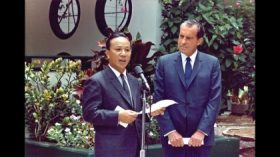
The American Retreat from Vietnam
or go to
Aletho News Archives – Video-Images
From the Archives
Secret document reveals plans for civil war in Lebanon, Israeli false flags, and invasion
By Randi Nord | Geopolitics Alert | April 5, 2019
Beirut – During his visit with US Secretary of State, Mike Pompeo, Lebanese President Michael Aoun reportedly received a US-Israeli document detailing plans for creating a civil war in Lebanon with covert false flag operations and possible Israeli invasion.
Although the source of the document is Israeli and created in partnership with Washington, no one knows who presented it to Aoun. The Lebanese TV station, Al-Jadeed, initially reported the document on Lebanese TV and a video on its website. Geopolitics Alert translated the report for this article. … continue
Blog Roll
 Aletho News
- Department of War Awards $20.7 Billion Contract to Raytheon for Air-to-Air Missiles
- ‘Distance yourselves from Israel’: IRGC urges US population to question govt policies
- America’s Greenland deal has a radioactive backstory
- The RAF Fairford ‘terror plot’: Unpacking escalation in the UK echo-chamber
- EU Council Advances Chat Control 2.0 Scanning Proposal
- Ex-Greek MEP files complaint against Israeli spyware firm over alleged Pegasus surveillance
- Troubling ideas throughout the Torah, Talmud, Mishneh Torah and Tanya
- ‘Grave, alarming’: Iran mission on Trump’s UNGA ‘annihilation’ threats
- Najaf airport to reopen to Iranian flights within 24 hours: Ambassador
- From ‘How Will This End For Iran’ to ‘When America Walks Away’: A tale of two Economist covers
- If Americans Knew
- New Report: “Scholasticide and Genocide in Gaza: Assessment, Testimonies and Legal Analysis”
- Ex-Biden officials are desperate for a Gaza scapegoat
- Israeli “settlers” Invade Al-Aqsa; Pour Boiling Water on 75-Year-Old
- Israel Has Kidnapped Another American Teenager
- US arms sales to Israel worth $21.6 billion in 20 months
- Three Palestinians Killed in Israeli Attacks on Gaza
- Revealed: German “Anti-Semitism Expert” Driving Crackdown on Palestine Solidarity is Former Israeli Spy
- Egypt’s Warning to Israel Before Oct 7
- Israel’s siege signals another cruel winter for 1.8 million Gazans – Daily Update
- Netanyahu Asked UAE Leader to Deny Report on Oct. 7 Warning in Secret Visit, Sources Say
- No Tricks Zone
- New Study: Earth And Venus Surface Warmth Largely Explained By Convection And Lapse Rate, Not CO2 Or Radiation
- 2025 Nature Paper Claiming Worsening Global Drought Gets RETRACTED …Heavily Flawed
- New Study: ‘Global Drought Shows No Detectable Recent Acceleration Under Climate Warming’
- Economic Masterminds: German Socialists Suggest Taxing Productivity Gains Stemming From Using AI
- The South China Sea Has Not Been Cooperating With The Climate Change Narrative
- Energy Crisis: Germany Enters Heating Season With Historically Low Gas Reserve Fill Levels
- New Study: The Antarctic Ice Sheet Gained Mass From 2020-2024 Due To Staggering Snow And Ice Accumulation
- Study: Ocean Heating Rates From Thousands Of Years Ago ‘Dwarf’ Modern Ocean Heating Rates
- Climate Extremists Target, Attack Large-Scale Power Grid Infrastructure In Germany!
- New Study: Antarctic Ice Melt Has Contributed Less Than 1 Centimeter To Sea Level Rise In The Last 30 Years

