Ukraine Finance Minister’s American ‘Values’
By Robert Parry | Consortium News | February 18, 2015
Ukraine’s new Finance Minister Natalie Jaresko, who has become the face of reform for the U.S.-backed regime in Kiev and will be a key figure handling billions of dollars in Western financial aid, was at the center of insider deals and other questionable activities when she ran a $150 million U.S.-taxpayer-financed investment fund.
Prior to taking Ukrainian citizenship and becoming Finance Minister last December, Jaresko was a former U.S. diplomat who served as chief executive officer of the Western NIS Enterprise Fund (WNISEF), which was created by Congress in the 1990s and overseen by the U.S. Agency for International Development (U.S. AID) to help jumpstart an investment economy in Ukraine.
But Jaresko, who was limited to making $150,000 a year at WNISEF under the U.S. AID grant agreement, managed to earn more than that amount, reporting in 2004 that she was paid $383,259 along with $67,415 in expenses, according to WNISEF’s public filing with the Internal Revenue Service.
Later, Jaresko’s compensation was removed from public disclosure altogether after she co-founded two entities in 2006: Horizon Capital Associates (HCA) to manage WNISEF’s investments (and collect around $1 million a year in fees) and Emerging Europe Growth Fund (EEGF) to collaborate with WNISEF on investment deals.
Jaresko formed HCA and EEGF with two other WNISEF officers, Mark Iwashko and Lenna Koszarny. They also started a third firm, Horizon Capital Advisors, which “serves as a sub-advisor to the Investment Manager, HCA,” according to WNISEF’s IRS filing for 2006.
U.S. AID apparently found nothing suspicious about these tangled business relationships – and even allowed WNISEF to spend millions of dollars helping EEGF become a follow-on private investment firm – despite the potential conflicts of interest involving Jaresko, the other WNISEF officers and their affiliated companies.
For instance, WNISEF’s 2012 annual report devoted two pages to “related party transactions,” including the management fees to Jaresko’s Horizon Capital ($1,037,603 in 2011 and $1,023,689 in 2012) and WNISEF’s co-investments in projects with the EEGF, where Jaresko was founding partner and chief executive officer. Jaresko’s Horizon Capital managed the investments of both WNISEF and EEGF.
From 2007 to 2011, WNISEF co-invested $4.25 million with EEGF in Kerameya LLC, a Ukrainian brick manufacturer, and WNISEF sold EEGF 15.63 percent of Moldova’s Fincombank for $5 million, the report said. It also listed extensive exchanges of personnel and equipment between WNISEF and Horizon Capital. But it’s difficult for an outsider to ascertain the relative merits of these insider deals and the transactions apparently raised no red flags for U.S. AID officials.
Bonuses for Officers
Regarding compensation, WNISEF’s 2013 filing with the IRS noted that the fund’s officers collected millions of dollars in bonuses for closing out some investments at a profit even as the overall fund was losing money. According to the filing, WNISEF’s $150 million nest egg had shrunk by more than one-third to $94.5 million and likely has declined much more during the economic chaos that followed the U.S.-back coup in February 2014.
But prior to the coup and the resulting civil war, Jaresko’s WNISEF was generously spreading money around. For instance, the 2013 IRS filing reported that the taxpayer-financed fund paid out as “expenses” $7.7 million under a bonus program, including $4.6 million to “current officers,” without identifying who received the money.
The filing made the point that the “long-term equity incentive plan” was “not compensation from Government Grant funds but a separately USAID-approved incentive plan funded from investment sales proceeds” – although those proceeds presumably would have gone into the depleted WNISEF pool if they had not been paid out as bonuses.
The filing also said the bonuses were paid regardless of whether the overall fund was making money, noting that this “compensation was not contingent on revenues or net earnings, but rather on a profitable exit of a portfolio company that exceeds the baseline value set by the board of directors and approved by USAID” – with Jaresko also serving as a director on the board responsible for setting those baseline values.
Another WNISEF director was Jeffrey C. Neal, former chairman of Merrill Lynch’s global investment banking and a co-founder of Horizon Capital, further suggesting how potentially incestuous these relationships may have become.
Though compensation for Jaresko and other officers was shifted outside public view after 2006 – as their pay was moved to the affiliated entities – the 2006 IRS filing says: “It should be noted that as long as HCA earns a management fee from WNISEF, HCA and HCAD [the two Horizon Capital entities] must ensure that a salary cap of $150,000 is adhered to for the proportion of salary attributable to WNISEF funds managed relative to aggregate funds under management.”
But that language would seem to permit compensation well above $150,000 if it could be tied to other managed funds, including EEGF, or come from the incentive program. Such compensation for Jaresko and the other top officers was not reported on later IRS forms despite a line for earnings from “related organizations.” Apparently, Horizon Capital and EEGF were regarded as “unrelated organizations” for the purposes of reporting compensation.
Neither AID officials nor Jaresko responded to specific questions about WNISEF’s possible conflicts of interest, how much money Jaresko made from her involvement with WNISEF and its connected companies, and whether she had fully complied with IRS reporting requirements.
Shared Values?
Despite such ethical questions, Jaresko was cited by New York Times columnist Thomas L. Friedman as an exemplar of the new Ukrainian leaders who “share our values” and deserve unqualified American support. Friedman uncritically quoted Jaresko’s speech to international financial leaders at Davos, Switzerland, in which she castigated Russian President Vladimir Putin:
“Putin fears a Ukraine that demands to live and wants to live and insists on living on European values — with a robust civil society and freedom of speech and religion [and] with a system of values the Ukrainian people have chosen and laid down their lives for.”
However, Jaresko has shown little regard for transparency or other democratic values, such as the right of free speech when it comes to someone questioning her financial dealings. For instance, she has gone to great lengths to block her ex-husband Ihor Figlus from exposing what he regards as her questionable business ethics.
In 2012, when Figlus tried to blow the whistle on what he saw as improper loans that Jaresko had taken from Horizon Capital Associates to buy and expand her stake in EEGF, the privately held follow-on fund to WNISEF, Jaresko sent her lawyers to court to silence him and, according to his lawyer, bankrupt him.
The filings in Delaware’s Chancery Court are remarkable not only because Jaresko succeeded in getting the Court to gag her ex-husband through enforcement of a non-disclosure agreement but the Court agreed to redact nearly all the business details, even the confidentiality language at the center of the case.
Since Figlus had given some of his information to a Ukrainian journalist, the court complaint also had the look of a leak investigation, tracking down Figlus’s contacts with the journalist and then using that evidence to secure the restraining order, which Figlus said not only prevented him from discussing business secrets but even talking about his more general concerns about Jaresko’s insider dealings.
The heavy redactions make it hard to fully understand Figlus’s concerns or to assess the size of Jaresko’s borrowing as she expanded her holdings in EEGF, but Figlus did assert that he saw his role as whistle-blowing about improper actions by Jaresko.
In a Oct. 31, 2012, filing, Figlus’s attorney wrote that “At all relevant times, Defendant [Figlus] acted in good faith and with justification, on matters of public interest, and particularly the inequitable conduct set forth herein where such inequitable conduct adversely affects … at least one other limited partner which is REDACTED, and specifically the inequitable conduct included, in addition to the other conduct cited herein, REDACTED.”
The filing added: “The Plaintiffs’ [Jaresko’s and her EEGF partners’] claims are barred, in whole or in part, by public policy, and particularly that a court in equity should not enjoin ‘whistle-blowing’ activities on matters of public interest, and particularly the inequitable conduct set forth herein.” But the details of that conduct were all redacted.
Free Speech
In a defense brief dated Dec. 17, 2012 [see Part One and Part Two], Figlus expanded on his argument that Jaresko’s attempts to have the court gag him amounted to a violation of his constitutional right of free speech:
“The obvious problem with the scope of their Motion is that Plaintiffs are asking the Court to enter an Order that prohibits Defendant Figlus from exercising his freedom of speech without even attempting to provide the Court with any Constitutional support or underpinning for such impairment of Figlus’ rights.
“Plaintiffs cannot do so, because such silencing of speech is Constitutionally impermissible, and would constitute a denial of basic principles of the Bill of Rights in both the United States and Delaware Constitutions. There can be no question that Plaintiffs are seeking a temporary injunction, which constitutes a prior restraint on speech. …
“The Court cannot, consistent with the Federal and State Constitutional guarantees of free speech, enjoin speech except in the most exceptional circumstances, and certainly not when Plaintiffs are seeking to prevent speech that is not even covered by the very contractual provision upon which they are relying.
“Moreover, the Court cannot prevent speech where the matter has at least some public interest REDACTED, except as limited to the very specific and exact language of the speaker’s contractual obligation.”
Figlus also provided a narrative of events as he saw them as a limited partner in EEGF, saying he initially “believed everything she [Jaresko] was doing, you know, was proper.” Later, however, Figlus “learned that Jaresko began borrowing money from HCA REDACTED, but again relied on his spouse, and did not pay attention to the actual financial transactions…
“In early 2010, after Jaresko separated from Figlus, she presented Figlus with, and requested that he execute, a ‘Security Agreement,’ pledging the couple’s partnership interest to the repayment of the loans from HCA. This was Figlus first realization of the amount of loans that Jaresko had taken, and that the partnership interest was being funded through this means. … By late 2011, Jaresko had borrowed approximately REDACTED from HCA to both fund the partnership interest REDACTED. The loans were collateralized only by the EEFG partnership interest. …
“Figlus became increasingly concerned about the partnership and the loans that had been and continued to be given to the insiders to pay for their partnership interests, while excluding other limited partners. Although Figlus was not sophisticated in these matters, he considered that it was inappropriate that HCA was giving loans to insiders to fund their partnership interests, but to no other partners. …
“He talked to an individual at U.S. Agency for International Development (USAID) in Washington D.C., because the agency was effectively involved as a limited partner because of the agency’s funding and supervision over WNISEF, but the agency employee did not appear interested in pursuing the question.”
A Spousal Dispute
Meanwhile, Jaresko’s lawyers mocked Figlus’s claims that he was acting as a whistle-blower, claiming that he was actually motivated by a desire “to harm his ex-wife” and had violated the terms of his non-disclosure agreement, which the lawyers convinced the court to exclude from the public record.
The plaintiffs’ brief [see Part One and Part Two] traces Figlus’s contacts with the Ukrainian reporter whose name is also redacted:
“Figlus, having previously received an audit from the General Partner, provided it to REDACTED [the Ukrainian reporter] with full knowledge that the audit was non-public. Also on or about October 2, 2012, REDACTED [the reporter] contacted multiple Limited Partners, informed them that he possessed ‘documented proof’ of alleged impropriety by the General Partner and requested interviews concerning that alleged impropriety.”
The filing noted that on Oct. 3, 2012, the reporter told Figlus that Jaresko “called two REDACTED [his newspaper’s] editors last night crying, not me, for some reason.” (The Ukrainian story was never published.)
After the competing filings, Jaresko’s lawyers successfully secured a restraining order against Figlus from the Delaware Chancery Court and are continuing to pursue the case against him though his lawyer has asserted that his client will make no further effort to expose these financial dealings and is essentially broke.
On May 14, 2014, Figlus filed a complaint with the court claiming that he was being denied distributions from his joint interest in EEGF and saying he was told that it was because the holding was pledged as security against the loans taken out by Jaresko.
But, on the same day, Jaresko’s lawyer, Richard P. Rollo, contradicted that assertion, saying information about Figlus’s distributions was being withheld because EEGF and Horizon Capital “faced significant business interruptions and difficulties given the political crisis in Ukraine.”
The filing suggested that the interlocking investments between EEGF and the U.S.-taxpayer-funded WNISEF were experiencing further trouble from the political instability and civil war sweeping across Ukraine. By last December, Jaresko had resigned from her WNISEF-related positions, taken Ukrainian citizenship and started her new job as Ukraine’s Finance Minister.
In an article about Jaresko’s appointment, John Helmer, a longtime foreign correspondent in Russia, disclosed the outlines of the court dispute with Figlus and identified the Ukrainian reporter as Mark Rachkevych of the Kyiv Post.
“It hasn’t been rare for American spouses to go into the asset management business in the former Soviet Union, and make profits underwritten by the US Government with information supplied from their US Government positions or contacts,” Helmer wrote. “It is exceptional for them to fall out over the loot.”
Earlier this month, when I contacted George Pazuniak, Figlus’s lawyer, about Jaresko’s aggressive enforcement of the non-disclosure agreement, he told me that “at this point, it’s very difficult for me to say very much without having a detrimental effect on my client.” Pazuniak did say, however, that all the redactions were demanded by Jaresko’s lawyers.
Unresponsive Response
I also sent detailed questions to U.S. AID and to Jaresko via several of her associates. Those questions included how much of the $150 million in U.S. taxpayers’ money remained, why Jaresko reported no compensation from “related organizations,” whether she received any of the $4.6 million to WNISEF’s officers in bonuses in 2013, how much money she made in total from her association with WNISEF, what AID officials did in response Figlus’s complaint about possible wrongdoing, and whether Jaresko’s legal campaign to silence her ex-husband was appropriate given her current position and Ukraine’s history of secretive financial dealings.
U.S. AID press officer Annette Y. Aulton got back to me with a response that was unresponsive to my specific questions. Rather than answering about the performance of WNISEF and Jaresko’s compensation, the response commented on the relative success of 10 “Enterprise Funds” that AID has sponsored in Eastern Europe and added:
“There is a twenty year history of oversight of WNISEF operations. Enterprise funds must undergo an annual independent financial audit, submit annual reports to USAID and the IRS, and USAID staff conduct field visits and semi-annual reviews. At the time Horizon Capital assumed management of WNISEF, USAID received disclosures from Natalie Jaresko regarding the change in management structure and at the time USAID found no impropriety during its review.”
One Jaresko associate, Tanya Bega, Horizon Capital’s investor relations manager, said she forwarded my questions to Jaresko last week, but Jaresko did not respond.
Further showing how much Jaresko’s network is penetrating the new Ukrainian government, another associate, Estonian Jaanika Merilo, has been brought on to handle Ukraine’s foreign investments. Merilo’s Ukrainian Venture Capital and Private Equity Association (UVCA), which is committed to “representing interests of private equity investors to policymakers and improving the investment and business climate in Ukraine,” included Jaresko’s Horizon Capital as a founder.
In a way, given Jaresko’s background of parlaying U.S. taxpayer’s money into various insider investment deals, perhaps she does have the experience to handle the incoming $17.5 billion in aid from the International Monetary Fund.
But the question remains whether Jaresko’s is the right kind of experience – and whether the money will go to help the impoverished people of Ukraine or simply wind up lining the pockets of the well-heeled and the well-connected.
–With research by Chelsea Gilmour
~
Investigative reporter Robert Parry broke many of the Iran-Contra stories for The Associated Press and Newsweek in the 1980s. You can buy his latest book, America’s Stolen Narrative, either in print here or as an e-book (from Amazon and barnesandnoble.com).
Canada adds Russia’s Rosneft, Rostec CEO to sanctions list
RT | February 18, 2015
Canada has added Russia’s largest oil producer Rosneft, and the CEO of Rostec, to a sanctions blacklist along with 37 Ukrainians and 17 Russian and Ukrainian organizations. They are all covered by economic sanctions and travel bans.
It’s a coordinated move with the European Union and the United States, who have already imposed a number of sanctions on Russia, according to Canadian Prime Minister Stephen Harper.
“In coordination with our EU and US partners, Canada is once again intensifying its response to the situation by announcing further sanctions against Russian and Ukrainian individuals and entities,” Harper said in a statement on his official website on Tuesday.
Canada has been trying for months to resist the pressure on taking any further restrictive measures against Russia, despite the fact it had already sanctioned 80 Russian and Ukrainian officials last year.Last May, the country decided not to impose sanctions against Rosneft and Rostec because it didn’t want politics to hurt Canada’s biggest business projects.
Russia’s oil giant Rosneft owns about 30 percent of an ExxonMobil oil field in the Canadian province of Alberta. Rosneft purchased a stake in the Cardium basin deposit in 2012; the deal became Russia’s first Canadian presence and was expected to benefit Canada’s economy by accelerating resource development.
Russian state-owned industrial and defense firm Rostec, and Canadian plane and train maker Bombardier signed a $3.4 billion deal two years ago. The companies had decided to establish joint venture to produce Q400 aircraft, which Canada recognized as a “landmark opportunity for the Q400 NextGen aircraft program.” The venture intended to build 24 aircraft a year, with some 250 constructed by 2030. The deal was postponed last year due to the anti-Russian sanctions imposed then by the Canadian government.
Read more: EU adds more Russians, eastern Ukrainians to sanctions list after successful Minsk talks
IMF aid package pushes Ukraine gas prices up 280%

RT | February 18, 2015
Ukraine has agreed to increase the cost of gas to consumer by 280 percent, and 66 percent for heating, as part of the IMF terms for getting extra financial aid, says Valery Gontareva the head of the National Bank of Ukraine.
“From now on, in accordance with our joint program with the IMF, the tariffs will see rather a sharp increase of 280 percent for gas and about 66 percent for heat,” said Gontareva Wednesday during the 11th Dragon Capital investment conference in Kiev. She added that as a result inflation will be 25-26 percent by the end of 2015.
The tariff rises are part of the amendments to the 2015 budget the government has had to introduce in order to receive an $8.5 billion loan from the IMF by the end of the year.
The changes will also see Ukraine’s budget deficit growing to 4.1 percent of GDP and forecasts a 5.5 percent decline in the Ukrainian economy.
Prime Minister Arseny Yatsenyuk had warned of future price rises for gas and heating, and stressed the IMF saved Ukraine from default, and now it’s time to make moves which should eventually result in Ukraine’s complete independence from Russian gas.
The tariff increase was among the subjects Ukraine and the IMF touched upon during negotiations in January. Deputy Chairman of the Ukraine parliament’s budget committee Viktor Krivenko said the IMF had requested a sevenfold increase in prices.
The head of IMF Christine Lagarde said on February 12 that the preliminary agreement reached between Kiev and Western creditors envisages increasing the aid package to $40 billion over the next four years.
The program will help Ukraine receive an additional $25 billion in financial aid, of which $17.5 billion will be provided to stabilize the financial situation in the country.
The latest IMF program will replace the $17 billion package agreed in April 2014. Ukraine has already received $4.5 billion under that agreement, thus the total IMF loans to Ukraine since the beginning of the crisis amount to $22 billion.
Read more: IMF announces new $17.5bn bailout package for Ukraine
Ukraine Denouement
By Michael Hudson | CounterPunch | February 16, 2015
The fate of Ukraine is now shifting from the military battlefield back to the arena that counts most: that of international finance. Kiev is broke, having depleted its foreign reserves on waging war that has destroyed its industrial export and coal mining capacity in the Donbass (especially vis-à-vis Russia, which normally has bought 38 percent of Ukraine’s exports). Deeply in debt (with €3 billion falling due on December 20 to Russia), Ukraine faces insolvency if the IMF and Europe do not release new loans next month to pay for new imports as well as Russian and foreign bondholders.
Finance Minister Natalia Yaresko announced on Friday that she hopes to see the money begin to flow in by early March.[1] But Ukraine must meet conditions that seem almost impossible: It must implement an honest budget and start reforming its corrupt oligarchs (who dominate in the Rada and control the bureaucracy), implement more austerity, abolish its environmental protection, and make its industry “attractive” to foreign investors to buy Ukraine’s land, natural resources, monopolies and other assets, presumably at distress prices in view of the country’s recent devastation.
Looming over the IMF loan is the military situation. On January 28, Christine Lagarde said that the IMF would not release more money as long as Ukraine remains at war. Cessation of fighting was to begin Sunday morning. But Right Sector leader Dmytro Yarosh announced that his private army and that of the Azov Battalion will ignore the Minsk agreement and fight against Russian-speakers. He remains a major force within the Rada.
How much of Ukraine’s budget will be spent on arms? Germany and France made it clear that they oppose further U.S. military adventurism in Ukraine, and also oppose NATO membership. But will Germany follow through on its threat to impose sanctions on Kiev in order to stop a renewal of the fighting? For the United States bringing Ukraine into NATO would be the coup de grace blocking creation of a Eurasian powerhouse integrating the Russian, German and other continental European economies.
The Obama administration is upping the ante and going for broke, hoping that Europe has no alternative but to keep acquiescing. But the strategy is threatening to backfire. Instead of making Russia “lose Europe,” the United States may have overplayed its hand so badly that one can now think about the opposite prospect. The Ukraine adventure could turn out to be the first step in the United States losing Europe. It may end up splitting European economic interests away from NATO, if Russia can convince the world that the epoch of armed occupation of industrial nations is a thing of the past and hence no real military threat exists – except for Europe being caught in the middle of Cold War 2.0.
For the U.S. geopolitical strategy to succeed, it would be necessary for Europe, Ukraine and Russia to act against their own potential economic self-interest. How long can they be expected to acquiesce in this sacrifice? At what point will economic interests lead to a reconsideration of old geo-military alliances and personal political loyalties?
This is becoming urgent because this is the first time the EU has been faced with such war on its own borders (if we except Yugoslavia). Where is the advantage for Europe supporting one of the world’s most corrupt oligarchies north of the Equator?
America’s Ukrainian adventure by Hillary’s appointee Victoria Nuland (kept on and applauded by John Kerry), as well as by NATO, is forcing Europe to commit itself to the United States or pursue an independent line. George Soros (whose aggressive voice is emerging as the Democratic Party’s version of Sheldon Adelson) recently urged (in the newly neocon New York Review of Books) that the West give Ukraine $50 billion to re-arm, and to think of this as a down payment on military containment of Russia. The aim is the old Brzezinski strategy: to foreclose Russian economic integration with Europe. The assumption is that economic alliances are at least potentially military, so that any power center raises the threat of economic and hence political independence.
The Financial Times quickly jumped on board for Soros’s $50 billion subsidy.[2] When President Obama promised that U.S. military aid would be only for “defensive arms,” Kiev clarified that it intended to defend Ukraine all the way to Siberia to create a “sanitary cordon.”
First Confrontation: Will the IMF Loan Agreement try to stiff Russia?
The IMF has been drawn into U.S. confrontation with Russia in its role as coordinating Kiev foreign debt refinancing. It has stated that private-sector creditors must take a haircut, given that Kiev can’t pay the money its oligarchs have either stolen or spent on war. But what of the €3 billion that Russia’s sovereign wealth fund loaned Ukraine, under London rules that prevent such haircuts? Russia has complained that Ukraine’s budget makes no provision for payment. Will the IMF accept this budget as qualifying for a bailout, treating Russia as an odious creditor? If so, what kind of legal precedent would this set for sovereign debt negotiations in years to come?
International debt settlement rules were thrown into a turmoil last year when U.S. Judge Griesa gave a highly idiosyncratic interpretation of the pari passu clause with regard to Argentina’s sovereign debts. The clause states that all creditors must be treated equally. According to Griesa (uniquely), this means that if any creditor or vulture fund refuses to participate in a debt write-down, no such agreement can be reached and the sovereign government cannot pay any bondholders anywhere in the world, regardless of what foreign jurisdiction the bonds were issued under.
This bizarre interpretation of the “equal treatment” principle has never been strictly applied. Inter-governmental debts owed to the IMF, ECB and other international agencies have not been written down in keeping with private-sector debts. Russia’s loan was carefully framed in keeping with London rules. But U.S. diplomats have been openly – indeed, noisily and publicly – discussing how to “stiff” Russia. They even have thought about claiming that Russia’s Ukraine loans (to help it pay for gas to operate its factories and heat its homes) are an odious debt, or a form of foreign aid, or subject to anti-Russian sanctions. The aim is to make Russia “less equal,” transforming the concept of pari passu as it applies to sovereign debt.
Just as hedge funds jumped into the fray to complicate Argentina’s debt settlement, so speculators are trying to make a killing off Ukraine’s financial corpse, seeing this gray area opened up. The Financial Times reports that one American investor, Michael Hasenstab, has $7 billion of Ukraine debts, along with Templeton Global Bond Fund.[3] New speculators may be buying Ukrainian debt at half its face value, hoping to collect in full if Russia is paid in full – or at least settle for a few points’ quick run-up.
The U.S.-sponsored confusion may tie up Russia’s financial claims in court for years, just as has been the case with Argentina’s debt. At stake is the IMF’s role as debt coordinator: Will it insist that Russia take the same haircut that it’s imposing on private hedge funds?
This financial conflict is becoming a new mode of warfare. Lending terms are falling subject to New Cold War geopolitics. This battlefield has been opened up by U.S. refusal in recent decades to endorse the creation of any international body empowered to judge the debt-paying capacity of countries. This makes every sovereign debt crisis a grab bag that the U.S. Treasury can step in to dominate. It endorses keeping countries in the U.S. diplomatic orbit afloat (although on a short leash), but not countries that maintain an independence from U.S. policies (e.g., Argentina and BRICS members).
Looking forward, this position threatens to fracture global finance into a U.S. currency sphere and a BRICS sphere. The U.S. has opposed creation of any international venue to adjudicate the debt-paying capacity of debtor nations. Other countries are pressing for such a venue in order to save their economies from the present anarchy. U.S. diplomats see anarchy as offering an opportunity to bring U.S. diplomacy to bear to reward friends and punish non-friends and “independents.” The resulting financial anarchy is becoming untenable in the wake of Argentina, Greece, Ireland, Spain, Portugal, Italy and other sovereign debtors whose obligations are unpayably high.
The IMF’s One-Two Punch leading to privatization sell-offs to rent extractors
IMF loans are made mainly to enable governments to pay foreign bondholders and bankers, not spend on social programs or domestic economic recovery. Sovereign debtors must agree to IMF “conditionalities” in order to get enough credit to enable bondholders to take their money and run, avoiding haircuts and leaving “taxpayers” to bear the cost of capital flight and corruption.
The first conditionality is the guiding principle of neoliberal economics: that foreign debts can be paid by squeezing out a domestic budget surplus. The myth is that austerity programs and cuts in public spending will enable governments to pay foreign-currency debts – as if there is no “transfer problem.”
The reality is that austerity causes deeper economic shrinkage and widens the budget deficit. And no matter how much domestic revenue the government squeezes out of the economy, it can pay foreign debts only in two ways: by exporting more, or by selling its public domain to foreign investors. The latter option leads to privatizing public infrastructure, replacing subsidized basic services with rent-extraction and future capital flight. So the IMF’s “solution” to the debt problem has the effect of making it worse – requiring yet further privatization sell-offs.
This is why the IMF has been wrong in its economic forecasts for Ukraine year after year, just as its prescriptions have devastated Ireland and Greece, and Third World economies from the 1970s onward. Its destructive financial policy must be seen as deliberate, not an innocent forecasting error. But the penalty for following this junk economics must be paid by the indebted victim.
In the wake of austerity, the IMF throws its Number Two punch. The debtor economy must pay by selling off whatever assets the government can find that foreign investors want. For Ukraine, investors want its rich farmland. Monsanto has been leasing its land and would like to buy. But Ukraine has a law against alienating its farmland and agricultural land to foreigners. The IMF no doubt will insist on repeal of this law, along with Ukraine’s dismantling of public regulations against foreign investment.
International finance as war
The Ukraine-IMF debt negotiation shows why finance has become the preferred mode of geopolitical warfare. Its objectives are the same as war: appropriation of land, raw materials (Ukraine’s gas rights in the Black Sea) and infrastructure (for rent-extracting opportunities) as well as the purchase of banks.
The IMF has begun to look like an office situated in the Pentagon, renting a branch office on Wall Street from Democratic Party headquarters, with the rent paid by Soros. His funds are drawing up a list of assets that he and his colleagues would like to buy from Ukrainian oligarchs and the government they control. The buyout payments for partnership with the oligarchs will not stay in Ukraine, but will be moved quickly to London, Switzerland and New York. The Ukrainian economy will lose the national patrimony with which it emerged from the Soviet Union in 1991, still deeply in debt (mainly to its own oligarchs operating out of offshore banking centers).
Where does this leave European relations with the United States and NATO?
The two futures
A generation ago the logical future for Ukraine and other post-Soviet states promised to be an integration into the German and other West European economies. This seemingly natural complementarity would see the West modernize Russian and other post-Soviet industry and agriculture (and construction as well) to create a self-sufficient and prosperous Eurasian regional power. Foreign Minister Lavrov recently voiced Russia’s hope at the Munich Security Conference for a common Eurasian Union with the European Union extending from Lisbon to Vladivostok. German and other European policy looked Eastward to invest its savings in the post-Soviet states.
This hope was anathema to U.S. neocons, who retain British Victorian geopolitics opposing the creation of any economic power center in Eurasia. That was Britain’s nightmare prior to World War I, and led it to pursue a diplomacy aimed at dividing and conquering continental Europe to prevent any dominant power or axis from emerging.
America started its Ukrainian strategy with the idea of splitting Russia off from Europe, and above all from Germany. The U.S. playbook is simple: Any economic power is potentially military; and any military power may enable other countries to pursue their own interests rather than subordinating their policy to U.S. political, economic and financial aims. Therefore, U.S. geostrategists view any foreign economic power as a potential military threat, to be countered before it can gain steam.
We can now see why the EU/IMF austerity plan that Yanukovich rejected made it clear why the United States sponsored last February’s coup in Kiev. The austerity that was called for, the removal of consumer subsidies and dismantling of public services would have led to an anti-West reaction turning Ukraine strongly back toward Russia. The Maidan coup sought to prevent this by making a war scar separating Western Ukraine from the East, leaving the country seemingly no choice but to turn West and lose its infrastructure to the privatizers and neo-rentiers.
But the U.S. plan may lead Europe to seek an economic bridge to Russia and the BRICS, away from the U.S. orbit. That is the diplomatic risk when a great power forces other nations to choose one side or the other.
The silence from Hillary
Having appointed Valery Nuland as a holdover from the Cheney administration, Secretary of State Hillary Clinton joined the hawks by likening Putin to Hitler. Meanwhile, Soros’s $10 million on donations to the Democratic Party makes him one of its largest donors. The party thus seems set to throw down the gauntlet with Europe over the shape of future geopolitical diplomacy, pressing for a New Cold War.
Hillary’s silence suggests that she knows how unpopular her neocon policy is with voters – but how popular it is with her donors. The question is, will the Republicans agree to not avoid discussing this during the 2016 presidential campaign? If so, what alternative will voters have next year?
This prospect should send shivers down Europe’s back. There are reports that Putin told Merkel and Holland in Minsk last week that Western Europe has two choices. On the one hand, it and Russia can create a prosperous economic zone based on Russia’s raw materials and European technology. Or, Europe can back NATO’s expansion and draw Russia into war that will wipe it out.
German officials have discussed bringing sanctions against Ukraine, not Russia, if it renews the ethnic warfare in its evident attempt to draw Russia in. Could Obama’s neocon strategy backfire, and lose Europe? Will future American historians talk of who lost Europe rather than who lost Russia?
Michael Hudson’s book summarizing his economic theories, “The Bubble and Beyond,” is now available in a new edition with two bonus chapters on Amazon. His latest book is Finance Capitalism and Its Discontents. He is a contributor to Hopeless: Barack Obama and the Politics of Illusion, published by AK Press. He can be reached via mh@michael-hudson.com
Notes.
[1] Fin min hopes Ukraine will get new IMF aid in early March – Interfax, http://research.tdwaterhouse.ca/research/public/Markets/NewsArticle/1664-L5N0VN2DO-1
5:40AM ET on Friday Feb 13, 2015 by Thomson Reuters
[2] “The west needs to rescue the Ukrainian economy,” Financial Times editorial, February 12, 2015.
[3] Elaine Moore, “Contrarian US investor with $7bn of debt stands to lose most if Kiev imposes haircut,” Financial Times, February 12, 2015.
Revolving door between arms dealers & govt exposed
RT | February 16, 2015
Arms manufacturers currently have dozens of employees seconded to the Ministry of Defence (MoD) and other British government agencies, an investigation has discovered.
The revelations highlight the close relationship between business and government, especially in highly lucrative industries such as the arms trade.
Employees from BAE Systems (manufacturers of the Eurofighter Typhoon), MBDA (makers of missiles), Babcock (defense contractor working on Trident nuclear submarine replacement), and MSI (gunnery systems producer) have all taken senior level roles within the MoD.
BAE systems, the second largest arms company in the world, has had more than 10 executives seconded to the MoD and the arms sales unit of UK Trade & Investment (UKTI) in the last year.
The MoD’s Equipment and Support Branch, which has a £14 billion annual budget to buy equipment for the armed forces, hosted nine BAE executives in senior positions, the investigation by the Guardian found.
UKTI Defence and Security Organisation, another government department, had four secondments from BAE, two from MBDA, and two from Detica, a cyber-security specialist acquired by BAE in 2010.
While on secondment, salaries are paid by the company and not by the government department they join.
Personnel exchange between business and government works in the opposite direction as well, with 13 civil servants having been seconded from the MoD to outside organizations, including cyber-security company Templar Executives, Lloyds Banking group, arms firm QinetiQ, defense think tank the Institute for Security and Resilience Studies (ISRS) and the BBC.
The Campaign Against Arms Trade (CAAT) described the arrangement as “totally inappropriate.”
Speaking to the Guardian, Andrew Smith of CAAT said, “Arms companies already enjoy a significant and totally disproportionate level of government support, and these kinds of secondments only make it more so.
“It is totally inappropriate for arms companies that will be lobbying for extra military spending to be working for departments that buy their wares.”
Natalie Bennett, the leader of the Green Party, said the British government’s relationship with arms manufacturers was “uncomfortably close.”
“All too often we’ve seen the government’s actions aligned with the interests of big business, which is particularly concerning when the businesses involved produce weapons,” she told the Guardian.
“For many years, the British government has had an uncomfortably close relationship with arms manufacturers and a shady record of arming dictatorships to match.”
“Secondments like these cast a shadow of doubt over the integrity over the actions of both the MoD and UKTI when it comes to their dealings with arms manufacturers. Our policies should serve the common good and must be free from the influence of vested interests like arms companies.”
The Guardian’s revelations come in the wake of the HSBC tax avoidance scandal in which the revolving door between financial institutions and government has also faced scrutiny.
Lord Green, the former head of HSBC, came under the spotlight for having taken the role of Minister of State for Trade and Investment immediately after leaving the bank.
Leaked documents allege that during Green’s tenure as Chairman of HSBC from 2006 to 2010, he oversaw the orchestration of industrial scale tax evasion for drug dealers, international criminals, dictators and terrorists.
Lord Green stood down from a senior position in the banking lobby group The City UK on Saturday.
RELATED: Pregnant activist crashes glitzy arms industry dinner, urges guests ‘consider career change’
Peña Nieto Wants to Keep Oil Privatization Deals Secret
teleSUR | February 14, 2015
The government of Mexican President Enrique Peña Nieto has proposed changing a key transparency law that would allow the state to keep key information secret over controversial energy reform plans.
According to a document presented before the Congress by the ruling party PRI and its ally the Ecological Green Party of Mexico (PVEM), there would be 82 changes to the Federal Law of Transparency and Access to Public Government Information.
The recommendations made by the legal adviser to the Presidency of the Republic propose removing the requirement to disclose contracts, permits, alliances and partnerships that the State signed with national and foreign companies on oil exploration.
Last year President Enrique Peña Nieto signed a package of so-called secondary laws to the country’s controversial energy reform approved in 2013. The reform opens Mexico’s public energy sector to private competition for the first time in 76 years after the former populist president, Lazaro Cardenas, nationalized the sector in 1938.
Opposition senators Dolores Padierna and Alejandro Encinas, from the Revolutionary Democratic Party (PRD), rejected the proposal saying Mexicans deserve to know what will happen with hydrocarbons, a key economic sector, especially as the reforms will see profits going to foreign oil companies.
Padierna added that the energy sector should be forced to provide information about its operation and activity, and that decisions taken during the process of liberalization and privatization should respond to the transparency law.
EU and Russia: No option but peace and coexistence
The BRICS Post | February 13, 2015
At the moment of writing, the ink on the second Minsk agreement has not yet dried.
On February 15, fighting is supposed to come to an end in Ukraine. What are the chances for success of this agreement and what’s in it for the EU and Russia?
Are we on the path to a new peace or to a new cold/hot war? That is the question that will be on the minds of many in the days to come.
There are too many uncertain factors to reliably predict what will happen. The EU and the US have different agendas, and one can even make a case that they have conflicting interests.
For Russia, a peaceful resolution to the conflict means ending the sanctions and facilitating closer economic cooperation with the EU.
But tighter economic relations with Russia, the natural hinterland of Europe, goes against the core of the transatlantic NATO alliance. This has been a nightmare scenario for the Washington elite since 1945.
Pointedly, neither the US nor the UK were involved in the Minsk negotiations, so for Washington all options are still on the table. Considering the warmongering majority in the US Congress, that is not a good omen for peace.
Then there is the matter of the government in Kiev. Hardly ever mentioned in the news, it is far from stable. Extremist militias who do not bother to hide their fascist ideologies have been integrated into the Ukrainian army.
Considering their behaviour on the battlefield so far, it is very doubtful that Kiev will be able to make them abide by the ceasefire conditions.
Besides the extremists in their own ranks, the Kiev government faces another problem – young Ukrainian men in the west are bitterly resisting military conscription. This is not to say that they sympathize with their compatriots in the east – they just do not want to die fighting them.
Furthermore, there is the inner political struggle for power.
While President Petro Poroshenko is more than willing to find a pragmatic solution to the conflict, his prime minister Arseniy Yatsenyuk, however, is a fanatic Ukrainian nationalist, who is not a man of compromise.
He wants total victory and would be more then happy to replace his president.
Then there are the rebels in Eastern Ukraine, the so-called ‘pro-Russian separatists’.
Western media make it look like they are mere pawns in Putin’s hands, but that is hardly the case.
Nobody denies that Russia is giving them ample logistic support, but the leaders of the resistance are very unreliable. Will they accept the ceasefire? Hard to tell.
First step toward peace
Yet, despite all these challenges, history shows that worse situations have led to lasting peace.
The second Minsk agreement might just work. It is only a first step, and a peaceful long-term resolution of the conflict is still to be negotiated, but it is the only way out for the EU, Russia and Ukraine.
One of the reasons it might just work is precisely that the EU alone brokered it, or rather Germany and France, and not the US. That might seem contradictory given the different variables mentioned above, but it’s not. It all depends on who and what will prevail.
The real issues are still on the table – disarmament and federalization of the country. If the EU really wants it, Brussels has the financial leverage to force Kiev’s hand in accepting a new constitution granting the eastern regions meaningful autonomy.
The EU has experience with forging complex compromise solutions. After all, the EU itself is a permanent compromise.
What is really at stake is much more than just an end to an internal conflict stoked by outside forces. A resumption of violence carries with it the risk of an all out war between nuclear powers.
This is about a possible major war on European soil.
Border control
Hence, peace is the only option for Europe and Russia.
Personally, I consider one of the last paragraphs in the Minsk agreement, which focuses on control of the border, the most difficult one.
Kiev wants to regain full control of the border between the eastern provinces and Russia. This may at first appear to be a technicality, but it isn’t. Control of the border is highly symbolic, for all parties involved.
Kiev’s control of the border would impede Russia’s direct influence on the ground; for the rebels it would symbolize a partial surrender. The only party that stands to gain from this paragraph in the agreement is Kiev, which would have been delivered a highly symbolic victory.
A reasonable option would be to deploy UN troops on the border. Russia has proposed it, but apparently it was not on the negotiating table in Minsk.
While the Cold War has prevented Europe and Moscow from peaceful coexistence on their common continent, peace in Ukraine might just open up the whole Russian hinterland to the European economy.
At the end, it boils down to two options: The renewal of the old transatlantic pact with the ally overseas leading to a new Cold War (that could turn very nasty), or peace and coexistence with Russia.
Big Sugar’s scandalous sweetheart deal with public health experts exposed
RT | February 12, 2015
British public health experts issuing guidance on obesity receive hundreds of thousands of pounds from the sugar industry, an investigation has found.
Funding from companies including Coca-Cola, PepsiCo and Nestlé has flowed into scientific research bodies such as the UK’s Scientific Advisory Committee on Nutrition (SACN) and the Medical Research Council (MRC) for over a decade.
Scientists whose work was at least partly funded and sometimes fully funded by the sugar industry include Professor Susan Jebb, the government’s obesity tsar.
Leading scientists blamed the government’s funding cuts for forcing researchers into the arms of Big Sugar, while one doctor told RT the findings were “disturbing.”
The report comes at a time when medical experts say daily guidelines on sugar intake are misleading, with the average Briton consuming two to three times the World Health Organization’s (WHO) recommended limit.
According to the BMJ’s investigation, one government-funded organization, the MRC’s Human Nutrition Research unit in Cambridge, received an average of £250,000 a year for the past decade from Big Sugar.
Other scientists received consultancy fees from Boots, Coca-Cola, Mars, Cereal Partners UK and Unilever. They have also sat on advisory boards for Coca-Cola, the Food and Drink Federation and the Institute of Grocery Distributors, the report claims.
Nutrition scientist Susan Jebb, who is the UK government’s adviser on obesity, received £1.37 million in industry funding between 2004 and 2015, according to the investigation.
This money came from food and retail companies including Cereal Partners UK, which operates under the Nestlé brand, Rank Hovis McDougal, Sainsbury’s, Coca-Cola’s Beverage Institute for Health and Wellbeing and Unilever.
In a statement published via the Science Media Centre, Jebb rejected the BMJ’s investigation.
“It refers to a series of studies in which I was involved which included funding from industry. None of these involve research into the effects of sugar on health,” she said.
“I have received no personal remuneration from any of these projects. All have been conducted according to all the MRC governance arrangements for working with industry and the industry involvement has been declared.”
Dr Aseem Malholtra, a cardiologist and Science Director at the medically led Action on Sugar, told RT the findings were “disturbing.”
“I think it’s quite disturbing. I think the public would be appalled that the people advising them on what they eat are receiving money from the food industry.”
“We know that biased funding for research is one of the root causes of problems within healthcare at the moment. Whether it’s food industry funding or pharmaceutical funding.”
Malholtra said the average UK citizen consumes 2-3 times the WHO’s recommended sugar intake.
“The labeling of sugar remains extremely misleading. The guidelines’ daily amount doesn’t distinguish between added sugars and what’s intrinsic to the product,” he said.
“The current sugar labeling suggests one could consume 22 teaspoons of sugar a day as part of your daily amount. The WHO advice is for 6 teaspoons per day.”
“My question is: what are the scientists doing turning a blind eye?”
Former SACN chair Alan Jackson blamed the government’s research funding cuts for pushing scientist towards industry money.
Universities are estimated to have lost over £460 million in government research funding between 2009-10 and 2012-13, a financial burden which has seen them turn to business for over £2 billion over the past decade.
Jackson said scientists were encouraged by the government to develop a “mixed portfolio of support” for their research which explicitly included help from industry.
“So most, if not all, researchers will have some form of industry support and funding and hence have potential conflicts of interest,” he told the BMJ.
“By the very nature of its complex roots and wide interdisciplinary engagement nutrition has particular vulnerabilities in this regard, but it is by no means unique to nutrition.”
READ MORE: Child obesity looms large, with 1/3 of European teenagers overweight
IMF announces new $17.5bn bailout package for Ukraine
RT | February 12, 2015
The International Monetary Fund announced a new $17.5 billion lifeline for Ukraine, which would bring the total bailout package to $40 billion. The new sum would be a four-year program.
Lagarde will propose the $17.5 billion expansion program to the IMF by the end of the month.
“The program is not yet approved by the governing council. I hope to offer it for approval by the end of February,” she said Thursday.
“This new four-year arrangement would support immediate economic stabilization in Ukraine as well as a set of bold policy reforms aimed at restoring robust growth over the medium term and improving living standards for the Ukrainian people,” Lagarde said in a statement.
In return Ukraine will have to present a “program of deep economic reforms,” which includes the whole economy and a plan to transform Naftogaz, Ukraine’s state oil and gas company.
“It’s a large program, it’s a longer-term program than the previous one, which was a traditional SBA [Stand-By Arrangement] for two years,” the IMF chief said.
“It’s ambitious, it’s not without risk, but we believe it is a realistic set of macroeconomic framework, ambitious reforms, but reforms the authorities feel confident they can deliver,” Lagarde said.
IMF head Christine Lagarde didn’t answer the question as to whether the four-year international bailout program for Ukraine included credits from Russia.
“The sum includes funds from the IMF and the EU, and also bilateral and multilateral loans.”
Earlier this month, the US promised Ukraine as much as $2 billion in loan guarantees, while the EU said it would disburse €1.8 billion ($2.1 billion).
Boon to Ukraine’s economy
Ukraine’s Prime Minister Arseny Yatsenyuk stressed that the new bailout program would open sources for Ukraine to get help from other international organizations and partners, making the total sum thus $25 billion.
He confirmed the commitment to reforms that will stabilize Ukraine’s economy and finance. The country’s game plan includes fighting corruption, settling the energy sector, as well as cutting and optimizing state expenditure and increasing investment to 3 percent of the GDP, Yatsenyuk explained.
“Stabilization of the banking system and the exchange rate are also the goals of the program,” Yatsenyuk said.
“Recovery in confidence in Ukraine through the adoption of the 4–year program will be a major factor in the stabilization of the exchange rate, and an objective and strong banking system of Ukraine that will give the opportunity for Ukraine’s economy to develop,” he added.
Yatsenyuk said the government is also going to provide extensive assistance to low-income households. By the end of the year he expects it to include income indexation linked to the level of price rises. He also said the IMF program will provide $500 million for low-income families to help pay for increased energy bills.
READ MORE: IMF gives green light for $17 bn Ukraine aid package
Obama the War President
By Dave Lindorff | This Can’t Be Happening! | February 6, 2015
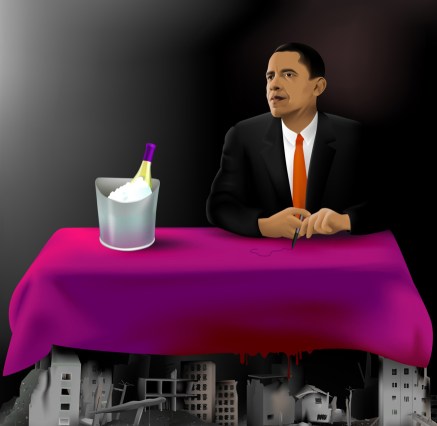
The Nobel Peace Laureate President Barack Obama, the guy who once campaigned claiming one US war — the one against Iraq — was a “bad” one, and the other — against Afghanistan — was a “good” one, turns out to be a man who, once anointed commander-in-chief, can’t seem to find a war he doesn’t consider to be a “good” idea.
Obama turned out, on taking office, to have a hard time saying good-bye to the occupation of Iraq, only leaving when he was forced out by an Iraqi government that refused to continue giving US forces legal immunity for killing Iraqi civilians. In Afghanistan, he decided to copy the same “surge” — a massive increase in targeted assassinations and violence — that he had once condemned in Iraq. Then he stepped up drone-launched rocket attacks and bombings in seven other countries.
More recently he has begun an air war against Syria (okay, he says it’s against the so-called Islamic State, but the whole world, with the exception of a lot of ill-informed US citizens, knows it’s ultimately against the Syrian government), and now his Secretary of Defense (sic) Ashton Carter and his Secretary of State John Kerry are pushing for sending heavy arms and, inevitably, US “advisors” to Ukraine to escalate US involvement in the civil war there. What makes that latest war particularly dangerous is that all the while, Peace Laureate Obama makes it clear that the “enemy” is Russian President Vladimir Putin and the Russian military.
Never mind that it is the US that originally orchestrated and encouraged the fascist coup that overthrew the elected government of Ukraine, setting in motion a huge pogrom against ethnic Russians in the east of that country and provoking the current armed conflict, and never mind that Russian concern about the Ukraine stems from a decades long history of the US pushing NATO ever closer to Russia’s western border, with Ukraine kind of the last straw.
Anyone looking objectively at the warmaking and war-promotion of this administration would have to conclude that President Obama is one of the most bellicose Chief Executives in the history of the United States.
If you don’t believe me, just look at the US military budget President Obama has proposed for FY2016. At $585.3 billion, it would if approved by Congress represent an increase in spending of $24.9 billion, or about 4%, over the 2015 budget, and that is despite a decline in what, since the Bush/Cheney years, has euphemistically been called Overseas Contingency Operations spending, or spending on actual wars. The proposed OCO budget for 2016 in this “peace” president’s budget is “just” $50.9 billion, down about $13.3 billion from 2015 thanks to what the president, in one whopper offered during his State of the Union address, called the “end of combat” in Afghanistan (that war is actually continuing, with some 12,000 US troops expected to remain stationed in that country indefinitely).
The thing about OCO funding is that it is really not predictive of anything. It could soar way beyond that $50.9-billion level, for example, in a flash if the US follows through and escalates the war in Ukraine — especially if Russian troops are drawn directly into that conflict and the US responds by upping its own involvement.
In fact, the OCO part of the budget has been used by the Pentagon and the administration over the last few years to get around the constraints of an ongoing Congressional “sequestration” requirement that cuts so-called discretionary spending, both military and non-military. Congress, ever mindful and solicitous of the country’s imperial ambitions, provided an exemption for ongoing military conflicts, and the Pentagon has since been deceptively slipping all kinds of other spending under the OCO heading now ever since the loophole was created.
But the Obama administration’s warmongering stance, in terms of the budget, isn’t told just by looking at the official Pentagon budget. There is much more spending that is really all about war. Not included in that $585.3 billion figure is $70.2 billion in discretionary spending for Veterans Affairs (that’s in addition to $90 billion in mandated spending). This is money to pay for the damages of the nation’s warmaking — the injured or ailing veterans who served or are now serving in the nation’s armed forces. Then there’s the intelligence agencies’ budgets — the CIA, the NSA, the FBI, the DIA, the DEA, the ATF and Homeland Security, etc. — most of which is really part of part of the war machine, thanks to the so-called “War on Terror,” which has re-defined the US itself as part of a global war zone. While much of that intelligence budget is concealed from the public on the spurious grounds of “national security,” it is known to exceed $100 billion a year. Add to that the $24-billion share of the Department of Energy budget that is weapons and war related, and you have a real military budget for 2016 of $707 billion. That’s out of a $1.2 trillion total discretionary spending budget (the rest of the $4 trillion proposed 2016 budget is called mandatory because it is debt repayment or spending on mandated things like Social Security and Medicare, which are funded by dedicated payroll taxes, not income taxes and other federal taxes, and which are promised to recipients like retirees and the sick.
What this means is that when you look closely, some 59% of the entire discretionary budget of the federal government – things that are funded each year by money that Congress has to appropriate — is being spent on the military. Given that the total amount of taxes collected by the federal government (income, corporate profits, exist, inheritance, etc.) also comes in at about $1.2 trillion, we’re saying that taxpayers this coming year will be pouring not just $707 billion, but 59 cents of every tax dollar in to war, planning for war, or paying for war. But it’s actually worse than that because actually the US government operates at a deficit, and doesn’t ever finance its wars on a pay-as-you-go basis. Instead, it borrows the money and then pays interest on that debt. Every year that interest comes to about $240 billion, and roughly half that is for borrowing to pay for past wars and past and current military spending. So add $120 billion to the $707 total and it become $827 billion.
In other words, it’s really 68.9% of every tax dollar you pay this April 15 that’s going to pay for America’s wars and its obsession with militarism.
No wonder our schools and universities, our parks, our roads, our once-vaunted global scientific leadership, our environment, our health and safety, our family budgets and even our life expectancy, have been going to hell! The only thing that’s really getting funded in this country is war.
By the way, the reason you may not have realized how much you are paying for war out of your taxes is that the government, and the corporate media, carefully avoid letting you know. They do this by sleight of hand. You see, they never really break out just the “discretionary” budget, or point out the parts of the budget that are outside the Pentagon but that are still really military-related, like spending on nuclear weapons and weapons development, nuclear research and cleanup, decommissioning of nuclear processing plants, and of course veterans affairs and benefits. They also do it by lumping the huge outlays for Social Security benefits and Medicare into the overall spending budget, though actually those benefits are funded not by income taxes but by a Trust fund of some $1.7 trillion that was created over the years by specially-dedicated payroll taxes separately paid by workers and their employers over the working life of each person. Adding those items into the national budget, while leaving out things like spending on veterans, nukes and war debt, appears to reduce military spending to a much less troubling 6.8% of the budget.
But it’s a fraud.
If we want to revitalize the US, the only way to do it is to end militarism and war, and to generously fund human needs.
To do that, we need a real peace president and a peace congress, not the Nobel Laureate warmonger we have now in the White House, and the bi-partisan war chorus we have in the Congress.
Featured Video
The American Retreat from Vietnam
or go to
Aletho News Archives – Video-Images
From the Archives
Secret document reveals plans for civil war in Lebanon, Israeli false flags, and invasion
By Randi Nord | Geopolitics Alert | April 5, 2019
Beirut – During his visit with US Secretary of State, Mike Pompeo, Lebanese President Michael Aoun reportedly received a US-Israeli document detailing plans for creating a civil war in Lebanon with covert false flag operations and possible Israeli invasion.
Although the source of the document is Israeli and created in partnership with Washington, no one knows who presented it to Aoun. The Lebanese TV station, Al-Jadeed, initially reported the document on Lebanese TV and a video on its website. Geopolitics Alert translated the report for this article. … continue
Blog Roll
 Aletho News
- There Is A Drought in Academia: A Drought in Honest Research on the Subject of Drought and Other Weather Extremes
- Department of War Awards $20.7 Billion Contract to Raytheon for Air-to-Air Missiles
- ‘Distance yourselves from Israel’: IRGC urges US population to question govt policies
- America’s Greenland deal has a radioactive backstory
- The RAF Fairford ‘terror plot’: Unpacking escalation in the UK echo-chamber
- EU Council Advances Chat Control 2.0 Scanning Proposal
- Ex-Greek MEP files complaint against Israeli spyware firm over alleged Pegasus surveillance
- Troubling ideas throughout the Torah, Talmud, Mishneh Torah and Tanya
- ‘Grave, alarming’: Iran mission on Trump’s UNGA ‘annihilation’ threats
- Najaf airport to reopen to Iranian flights within 24 hours: Ambassador
- If Americans Knew
- New Report: “Scholasticide and Genocide in Gaza: Assessment, Testimonies and Legal Analysis”
- Ex-Biden officials are desperate for a Gaza scapegoat
- Israeli “settlers” Invade Al-Aqsa; Pour Boiling Water on 75-Year-Old
- Israel Has Kidnapped Another American Teenager
- US arms sales to Israel worth $21.6 billion in 20 months
- Three Palestinians Killed in Israeli Attacks on Gaza
- Revealed: German “Anti-Semitism Expert” Driving Crackdown on Palestine Solidarity is Former Israeli Spy
- Egypt’s Warning to Israel Before Oct 7
- Israel’s siege signals another cruel winter for 1.8 million Gazans – Daily Update
- Netanyahu Asked UAE Leader to Deny Report on Oct. 7 Warning in Secret Visit, Sources Say
- No Tricks Zone
- New Study: Earth And Venus Surface Warmth Largely Explained By Convection And Lapse Rate, Not CO2 Or Radiation
- 2025 Nature Paper Claiming Worsening Global Drought Gets RETRACTED …Heavily Flawed
- New Study: ‘Global Drought Shows No Detectable Recent Acceleration Under Climate Warming’
- Economic Masterminds: German Socialists Suggest Taxing Productivity Gains Stemming From Using AI
- The South China Sea Has Not Been Cooperating With The Climate Change Narrative
- Energy Crisis: Germany Enters Heating Season With Historically Low Gas Reserve Fill Levels
- New Study: The Antarctic Ice Sheet Gained Mass From 2020-2024 Due To Staggering Snow And Ice Accumulation
- Study: Ocean Heating Rates From Thousands Of Years Ago ‘Dwarf’ Modern Ocean Heating Rates
- Climate Extremists Target, Attack Large-Scale Power Grid Infrastructure In Germany!
- New Study: Antarctic Ice Melt Has Contributed Less Than 1 Centimeter To Sea Level Rise In The Last 30 Years

