Corporate tax dodging another capitalist innovation
By Pete Dolack | Systemic Disorder | June 12, 2014
Competition takes many forms in capitalism. Financial engineering by corporations to avoid paying taxes is one aspect of this competition — under the rigors of market competition, evading responsibility is an innovation to be emulated.
The magnitude of tax evasion on the part of multi-national corporations through one channel — the shifting of profits to countries and territories with low or nonexistent taxes — was quantified earlier this month by the U.S. Public Interest Research Group Education Fund and Citizens for Tax Justice. Their study, “Offshore Shell Games 2014,” reports that the 500 largest U.S.-based multi-national corporations have squirreled away almost US$2 trillion in profits that lie untouched.
An estimated $90 billion a year in federal income taxes are not paid through the creative use of subsidiaries set up in offshore tax havens.
The Cayman Islands and Bermuda are favored locations, although other tax havens such as Hong Kong, Ireland and Switzerland are frequently used. The report illustrated the preposterous number of corporations with sham “offices” in the Cayman Islands:
“Ugland House is a modest five-story office building in the Cayman Islands, yet it is the registered address for 18,857 companies. … Simply by registering subsidiaries in the Cayman Islands, U.S. companies can use legal accounting gimmicks to make much of their U.S.-earned profits appear to be earned in the Caymans and pay no taxes on them. The vast majority of subsidiaries registered at Ugland House have no physical presence in the Caymans other than a post office box. About half of these companies have their billing address in the U.S., even while they are officially registered in the Caymans.” [page 4]
The Cayman Islands has a corporate tax rate of zero. Not a cent. The government there raises revenue through taxes on imports (thus a consumption tax for the people who live there as virtually everything must be imported), but, as an added bonus should any corporate executive stop by to visit the company post office box, luxury goods such as diamonds are exempted. Bermuda also has no corporate tax.
U.S. tax laws allow profits earned abroad to remain untouched until the money is brought into the country. Profits booked in other countries are instead subject to the local tax rate, even if zero. Accounting, rather than geography, often controls what constitutes “offshore” profits, however. The “Offshore Shell Games 2014” study reports that:
“Many of the profits kept ‘offshore’ are actually housed in U.S. banks or invested in American assets, but registered in the name of foreign subsidiaries. A Senate investigation of 27 large multinationals with substantial amounts of cash supposedly ‘trapped’ offshore found that more than half of the offshore funds were invested in U.S. banks, bonds, and other assets.” [page 5]
Corporate money is “off shore” if the corporation says it is
A 2013 report in The Wall Street Journal revealed that many corporations, including Microsoft Corp. and Google Inc., “keep more than three-quarters of the cash owned by their foreign subsidiaries at U.S. banks, held in U.S. dollars or parked in U.S. government and corporate securities.” Under federal tax law, those funds are “offshore” and thus exempt from taxation.
Microsoft, in its fiscal year 2013 filing with the U.S. Securities and Exchange Commission, said its funds held by its foreign subsidiaries are “deemed to be permanently reinvested in foreign jurisdictions.” It said, “We currently do not intend nor foresee a need to repatriate these funds.” It pays to be a monopoly in more ways than one.
A sampling of corporate highlights, according to “Offshore Shell Games 2014”:
- Bank of America reports 264 subsidiaries in offshore tax havens, more than any other company. The bank would otherwise owe $4.3 billion in U.S. taxes on the $17 billion it keeps offshore.
- Nike officially holds $6.7 billion offshore for tax purposes, on which it would otherwise owe $2.2 billion in U.S. taxes. Nike is believed to pay a 2.2 percent tax rate to foreign governments on those offshore profits.
- Apple holds more money offshore than any other company — $111.3 billion. It would owe $36.4 billion in U.S. taxes if these profits were they not offshore for tax purposes. Two of Apple’s Irish subsidiaries are structured to be tax residents of neither the U.S. (where they are managed and controlled) nor Ireland (where they are incorporated), ensuring no taxes are paid to any government.
- Google increased the amount of cash it reported offshore from $7.7 billion in 2009 to $38.9 billion. An analysis found that, as of 2012, the company has 23 tax-haven subsidiaries that it no longer discloses but continues to operate.
- Microsoft increased the amount of money it held offshore from $6.1 billion to $76.4 billion from 2007 to 2013, on which it would otherwise owe $19.4 billion in U.S. taxes. The company is believed to pay a tax rate of three percent to foreign governments on those profits.
You pay when corporations don’t
These arrangements don’t benefit working people in the tax havens. After Ireland’s then prime minister, Brian Cowen, announced that the government would assume all the debts of Ireland’s three biggest banks, he negotiated for what became an €85 billion bailout. In doing so, he demanded, and received, only one concession: There would be no increase in corporate tax rates, which are less than half the level of Ireland’s sales taxes. Taxes on incomes, cars, homes and fuel, however, did rise to pay for the bailout.
Critics, the authors of the “Offshore Shell Games 2014” study not excepted, propose various reforms and tend to discuss this issue in terms of morality. That massive corporate tax dodging is odious from any reasonable ethical standard is indisputable, but reducing it to immorality completely obscures the larger structural problems.
In the relentless competition fostered by capitalism, any successful innovation must be matched by competitors. Such an innovation could be a new production technique but also includes measures to lower costs. If production is moved to a location with low wages and little or no safety and environmental regulations, the boost to profits for the company that does this has to be matched by competitors that otherwise would become uncompetitive and/or fall into disfavor with financiers.
Financial engineering to avoid paying taxes is another boost to profits, and thus a competitive advantage. Other corporations, under the rigors of competition and the ceaseless necessity of expansion and pressure to increase profits, are compelled to copy these innovations.
However much we might wish to morally condemn such behavior, the personality of corporate executives is irrelevant. Expand or die is the remorseless logic of capitalism, and the executive who doesn’t do everything possible to maximize profits will soon be replaced by someone who will.
Nike, to provide an example, proudly announced that, in the past 10 years, it had “returned over $15 billion to shareholders through dividend payments and share repurchases” and assured it would provide more in the future. Nike’s shareholders’ report made no mention of what the company does to extract that money — through brutally exploitative sweatshop labor, paying workers less than a minimum wage set well below subsistence level in places where complaining leads to beatings or firings and striking lands you in prison. And by not paying taxes.
As a second example, Bank of America reported that it paid $3.2 billion to buy back its stock in 2013, money spent to boost its stock price and give extra profits to speculators. (Stock bought for this purpose is paid for at a price higher than the current stock-market value.) That money was available thanks to the billions of dollars it didn’t pay in taxes.
Reforms are good, but reforms can and are taken back when the pressure for them relents, and ultimately leaves the system that rewards such behavior untouched.
Ukraine to halt gas imports from Russia
The BRICS Post | June 14, 2014
Ukrainian Prime Minister Arseny Yatsenyuk has ordered a halt to natural gas imports from Russia from June 16 after the two countries failed to resolve their gas price dispute, the Ukrainian government said Friday.
“By its deliberate unilateral refusal to settle the conflict, Russia has been undermining the energy security of Ukraine and the European Union,” Yatsenyuk was quoted by the government press agency.
Yatsenyuk had also instructed the country’s Justice Ministry and state-run energy company Naftogaz to complete preparations to file a lawsuit with the Stockholm arbitration court over the dispute, the press service said in a statement.
Moreover, he asked the National Regulatory Commission to set “economically justified” tariffs for the transit of Russian gas through Ukrainian territory, it said.
Earlier in the day, Naftogaz Chairman Andrey Kobolev said Kiev was ready to compromise with Russia on gas issues, offering to pay a “compromise temporary price” of $326 per 1,000 cubic meters for Russian gas deliveries for the next 18 months.
Moscow currently charges Ukraine $485, but Kiev claims a fair price would be $268.
The two sides have been locked in dispute for three years over a 2009 contract, under which they agreed to tie the price of gas to the international spot price for oil.
Maenwhile, the Russian Foreign Ministry sent a note of protest to Ukraine over alleged border violation by Ukrainian soldiers, an official statement said Friday.
“The state border was violated by armed units, as infantry fighting vehicles crossed the border. An attempt was made to defy Russian border guards’ orders,” Kremlin spokesman Dmitry Peskov said on Friday.
An infantry fighting vehicle of Ukrainian armed forces crossed the Russian state border in the Rostov region of southwestern Russia earlier in the day, according to the Itar-Tass news agency. Russian border guards detained the vehicle and its crewmen retreated. No arms was used and no casualties reported.
An investigation is underway although Kiev is yet to respond to the Russian reports.
The Assault on Teachers Unions
By David Macaray | CounterPunch | June 13, 2014
Although I can understand the relentless anti-union crusade being waged by free market fundamentalists who wish to: (1) weaken the American labor movement, and (2) do away with the public school system (because there are hundreds of millions of dollars to be made by “privatizing” education), I am stunned by the public’s willingness to accept what is, on its face, a monumentally stupid argument.
While no one ever hears of American colleges and universities being accused of producing consistently “bad” accountants or bad pharmacists or bad historians or bad computer programmers or bad anthropologists, apparently, those same colleges and universities have turned out a disproportionately high number of “bad” teachers.
Even though these idealistic men and women busted their humps earning their college degrees and teaching credentials (which, by law, are required to teach in a public school, but are not required by private schools), once they entered the classroom and began plying their trade, they turned out to be a bunch of incompetents and slackers.
Of course, the explanation given by the anti-labor, privatization propagandists is that these teachers came out of their colleges and universities in satisfactory shape, but turned “bad” as soon as they became union members, because the teachers’ union, as we all know, was put on earth to protect bad teachers. Yep, as a former union president myself, I can attest that there’s nothing we union honchos admire more than a shitty worker.
Here’s something to think about: Airline pilots, flight attendants, mechanics, firefighters, nurses, actors, writers, directors, coal miners, and that woman who plays oboe in the symphony orchestra are union members. They are good at their jobs. Being represented by a union didn’t turn them into bad workers.
Southwest Airlines is the most unionized carrier in the industry and, last time I checked, it was among the most profitable. If you want to accept the outrageous falsehood—the outright lie—that union members are bad workers, that’s your privilege, but unless you have a death wish, I suggest you stay off airplanes.
Here’s something else: Some of the best school districts in the country are heavily unionized. Something else: Demonstrating that the whole thing is mainly socio-economic, schools in stable areas perform better than schools in poor, distressed areas, and unions have nothing to do with it. And something else: Non-union teachers across the country get fired at about the same rate as union teachers. It’s true. Why don’t more non-union teachers get fired? Because they don’t deserve be fired.
Has anyone who did poorly in school ever blamed the teacher for their lack of success? Has anyone ever said, “Man, I would’ve been a kick-ass student if only my teachers had been capable of teaching me”? I’ve never heard one person say that. Instead, they either blame their parents for not having assisted or “pushed” them enough, or blame themselves for simply not having put in the necessary work.
Again, this whole assault on the teaching profession is a hoax. It’s designed to beat down the unions and convince people that “private education” is the way to go. And in order to win, they need to convince a critical mass of parents that the only reason their little Johnny or Judy isn’t performing like a budding genius is because of “bad” teachers. That people believe it is a shame.
David Macaray is a labor columnist and author (“It’s Never Been Easy: Essays on Modern Labor, 2nd Edition). Dmacaray@earthlink.net
GAO Audit Accuses Obama Administration of Lowballing Cost of Maintaining Nuclear Arsenal
By Noel Brinkerhoff | AllGov | June 13, 2014
For the second time this year, government auditors have issued a report critical of the Obama administration’s projections for preserving the nation’s stockpile of nuclear weapons.
In both instances, the cost estimates put forth by the departments of Defense and Energy have been described as far too low, in part because key expenses were not budgeted. The latest audit, performed by the Government Accountability Office (GAO), supported some of the findings of the Congressional Budget Office (CBO), which concluded six months ago that the administration was off—by hundreds of billions of dollars—in estimating the future needs of maintaining the arsenal.
The Pentagon has claimed outlays will be about $264 billion. But the CBO put the figure closer to $570 billion and perhaps as much as $1 trillion over the next 30 years.
The GAO did not offer its own estimate for maintaining the weapons. But it did question the Defense Department’s claim that modernizing all ballistic missiles and bombers would require only $64 billion over the next 10 years.
In the case of the Minuteman III missile, which has served as the backbone of the nation’s land-based nuclear deterrent since the 1970s, GAO auditors found the administration left out all future funding for replacing these weapons, saying the program was “not yet defined.” As for a new bomber, the Air Force said those costs were “too sensitive” to include in the report.
At the Energy Department (DOE), which oversees all nuclear weapons research, the GAO found that officials had low-balled the cost of modernizing certain warheads for ballistic and cruise missiles.
The agency also reported that DOE had assumed billions of dollars in cost savings from efficiency efforts without determining where the savings would come from, and that Energy officials had left out the cost of revamping or replacing several nuclear-weapons laboratories.
To Learn More:
Federal Auditors Say Obama Administration Underestimates Nuclear Weapons Costs (by R. Jeffrey Smith, Center for Public Integrity)
Ten-Year Budget Estimates for Modernization Omit Key Efforts, and Assumptions and Limitations Are Not Fully Transparent (Government Accountability Office)
Obama Administration Underestimated Cost of Maintaining Nuclear Weapons by $140 Billion (by Noel Brinkerhoff and Danny Biederman, AllGov)
China rejects latest US hacking accusation
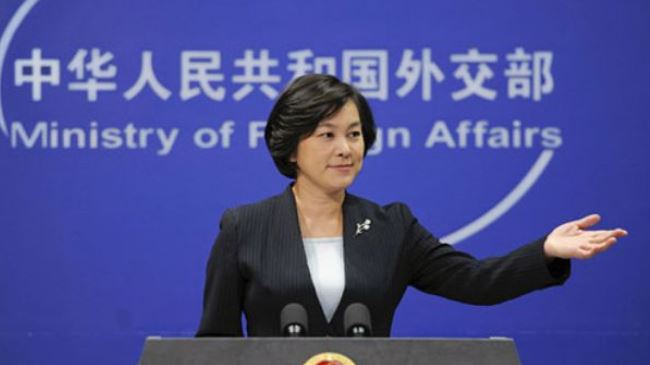
China’s Foreign Ministry Spokeswoman Hua Chunying
China has dismissed the recent allegation by the US that the Chinese military has been involved in hacking a US security firm, describing Washington’s approach on the issue as unconstructive.
A private US cyber security firm accused a unit of China’s military on Monday of hacking attempts to access information on US satellite and aerospace programs, Xinhua reported.
China’s Foreign Ministry Spokeswoman Hua Chunying rejected the allegation at a press briefing on Tuesday.
“I have noticed the report you mentioned, its wording and style looks familiar, citing the names of the hackers and their claims of their military identity,” she said, responding to a question about US reports alleging Chinese hacking attempts. “Have you ever seen thieves bearing a name tag saying ‘thieves?’” she said.
Washington had issued an indictment against five Chinese military officers on charges of cyber theft earlier on May 19.
The Chinese Foreign Ministry spokeswoman further challenged the integrity of the US allegations against her country, referring to the massive American espionage efforts across the globe as part of its PRISM program under the US National Security Agency (NSA).
The program, which was revealed by former NSA contract employee Edward Snowden in 2013, showed that the US was spying on the phone and email communications of top world leaders, including those of Washington’s allied countries as well as China.
“The US is a hacking empire,” Hua said. “It is not constructive for the US to attack others instead of repenting and correcting its own mistakes.”
The Chinese official further pointed out that cyber attacks are a global challenge – transnational and anonymous in nature – requiring cooperation among all countries to be countered.
Maduro Unveils Policy to Eradicate Extreme Poverty in Venezuela

By Ewan Robertson | Venezuelanalysis | June 9, 2014
Mérida – Venezuelan president Nicolas Maduro unveiled a new policy to focus on the needs of the least well off as part of his pledge to eradicate extreme poverty in the country by 2018.
The policy involves creating almost 1,500 special attention points that group together various social programs in areas where extreme poverty still prevails, in order to meet the basic needs of these communities.
The attention points, called Social Mission Bases, will house government social programs such as free community food kitchens, subsidised food stores, and free medical clinics. They will be spread out over the 255 of the country’s 1163 local districts where households experiencing extreme poverty still exist.
Venezuela’s National Institute of Statistics estimates that 5.5% of Venezuelan households still experience extreme poverty. This is calculated using the regionally based Unsatisfied Basic Needs (UBN) structural poverty indicator, which considers as extremely poor those homes where two or more basic needs, such as access to basic services, adequate living conditions, or schooling, are not met.
The percentage of households in extreme poverty has decreased steadily over the previous decade from 12.7% in 2003 to 5.5% currently. In the same period, overall structural poverty has decreased from 30.5% to 19.6%.
President Nicolas Maduro has vowed to eliminate extreme poverty altogether by 2018, the end of his current term of office, as well as to continue to reduce overall structural poverty.
“In the year 2018 I’ll be…able to say that we’ve achieved the goal of zero misery in Venezuela… the Bolivarian revolution must end poverty to establish a system of equality [and] justice,” he said as the first Social Mission Base was founded in the coastal state of Miranda.
Maduro also informed the country that the Social Mission Bases will be complemented with multidisciplinary teams of social program workers, such as community doctors, sports therapy trainers and cultural promoters, who will visit deprived communities house by house to assess living conditions and attend to differing needs.
“The great battalion [multi-disciplinary team] … won’t have another objective but to fight a strong battle along with our people to eradicate extreme poverty,” the president said, while also encouraging supporters to participate in the work of the Social Mission Bases.
The policy announcements come amid a debate over poverty in Venezuela, with government critics pointing to an increase in income-based poverty between the second half of 2012 and the first half of 2013, in the context of a sharp increase in annual inflation.
“The days when poverty was a winning issue for chavismo are over. Official statistics now show that poverty is rising rapidly,” wrote anti-government blogger Juan Nagel for Foreign Policy magazine recently.
Nevertheless income-based poverty actually decreased in the second half of 2013 to lower than it was in early 2012, and in keeping with the level of income-based poverty recorded in recent years, at 32.1%, down from 62.1% a decade earlier.
The Social Mission Bases policy also comes not long after Maduro announced reforms to the country’s national system of welfare programs, in order to improve their performance and reduce bureaucracy and overlapping functions.
The programs, known as “missions”, include free health clinics, free educational programs, subsidised food outlets, and the construction of heavily subsidised housing. They are held as one factor behind the large reduction in poverty since the Bolivarian government was elected to power in 1999.
Bulgaria halts Russia’s South Stream gas pipeline project
RT | June 8, 2014
Bulgaria’s prime minister, Plamen Oresharski, has ordered a halt to work on Russia’s South Stream pipeline, on the recommendation of the EU. The decision was announced after his talks with US senators.
“At this time there is a request from the European Commission, after which we’ve suspended the current works, I ordered it,” Oresharski told journalists after meeting with John McCain, Chris Murphy and Ron Johnson during their visit to Bulgaria on Sunday. “Further proceedings will be decided after additional consultations with Brussels.”
McCain, commenting on the situation, said that “Bulgaria should solve the South Stream problems in collaboration with European colleagues,” adding that in the current situation they would want “less Russian involvement” in the project.
Russia’s Energy Ministry said it had not yet received any official notification from Bulgaria on work on the project being suspended.
Earlier this week, EU authorities ordered Bulgaria to suspend construction on its link of the pipeline, which is planned to transport Russian natural gas through the Black Sea to Bulgaria and onward to western Europe. Brussels wants the project frozen, pending a decision on whether it violates the EU competition regulations on a single energy market. It believes South Stream does not comply with the rules prohibiting energy producers from also controlling pipeline access.
The EU is also asking for an investigation into how contracts were awarded for work on the pipeline in Bulgaria. Brussels sent the Bulgarian government a letter of formal notice asking for information, to which Sofia had one month to reply.
Russia’s energy giant Gazprom’s South Stream pipeline requires European approvals as its route would pass through the territory of several EU countries.
In Bulgaria, the ruling Socialists support the South Stream project, while Movement for Rights and Freedom leader Lyutvi Mestan told parliament on June 5 that Bulgaria should defend its strategic interests “in cooperation, not in confrontation” with Europe.
Earlier Serbia has said it has no plans to delay the start of construction of its leg of the South Stream pipeline, scheduled for July. Serbian Energy Minister Aleksandar Antic said that the position was not decisive: “I believe the European Commission and member states will find a solution because this is a European project in the best interests of energy security.”
Hungarian Prime Minister Viktor Orban also said June 5 that the pipeline should be built, as there was no alternative to the project.
Genetic Testing of Citizens Is a Backdoor into Total Population Surveillance by Governments and Companies
By Helen Wallace | GeneWatch UK | June 5, 2014
The new Chief Executive of the National Health Service (NHS) in England, Simon Stevens, was recently reported arguing that the NHS must be transformed to make people’s personal genetic information the basis of their treatments (1).
His proposition is unsurprising since it is in line with the efforts of successive UK governments to build a DNA database in the NHS in England by stealth. In particular, sequencing every baby at birth and storing whole genomes in electronic medical records is a plan backed by Health Secretary Jeremy Hunt (2). The current version of this plan would involve sharing whole or partial DNA sequences (genomes or genotypes) with companies like Google, which would use genetic information and health data to calculate personal risk assessments for feedback to patients (3). Massive investment from taxpayers would be required as part of a public-private partnership that would allow commercial exploitation of the data.
Building a DNA database within the NHS would be a massive waste of public money. But it would also create a system of total surveillance which would enable the government and private companies to track every individual, not to mention their relatives. This is not speculation; as wikileaks revealed, the United States government is already actively collecting DNA samples and biometric data on foreign officials and populations.
Commercial companies wish to exploit genetic information to market products such as drugs and supplements to healthy people, based on genetic risk assessments. If current trends continue, this will harm, not benefit, health: it is personalised marketing not personalised medicine. The potential for misuse is very high. Doctors could be replaced by computer algorithms used to market medication, massively expanding the drug market to include large numbers of healthy people, rather than smaller numbers of (often poorer) people who are sick. There is also the danger that prescribing would be driven by vested interests, rather than medical need: with high financial costs and more harmful side effects. Genetic risk assessments could also be misused, leading to stigma or discrimination, for example by insurers.
Why does the NHS want to collect genetic information?
There is one element of truth to Simon Stevens’ remarks. Some cancer drugs have been successfully tailored to genetic mutations that arise in the cancer tumour. However, attempts to select drugs for people based on the genetic make-up they are born with (their genome or genotype) have largely been a failure. This is because genetic differences only account for a part of individual differences in metabolism. For example, a recent study found that targeting warfarin treatment based on genetic make-up did not improve health outcomes, although this application was regarded as the ‘poster child’ of this approach (4).
Why did it not work? An important misconception, apparently shared by Simon Stevens, is that genes are good predictors of most diseases and adverse drug reactions in most people. However, contrary to misleading claims made to promote the Human Genome Project, this is not true (5). Moreover, even if it were true, there is no evidence that genetic selection of individuals, for example into high risk and low risk groups, improves outcomes or cuts costs. All of which begs the question of the purpose of taking and storing genetic information as a default medical procedure.
The online gene testing company 23andMe, funded by Google, has been forced to withdraw its gene tests from the US market due to failure to prove they can reliably predict individual risks of many common conditions using computer algorithms. The company now wants to target the UK market, where genetic testing is not regulated (6). Patrick Chung, a 23andMe board member and partner at the venture-capital firm NEA told Fast Company (7): “… 23andMe will make money by partnering with countries that rely on a single-payer health system. “Let’s say you genotype everyone in Canada or the United Kingdom or Abu Dhabi,” he says, “and the government is able to identify those segments of the population that are most at risk for heart disease or breast cancer or Parkinson’s. You can target them with preventative messages, make sure they’re examined more frequently, and in the end live healthier lives, and the government will save massive expenses because they halted someone who’s prediabetic from getting diabetes. 23andMe has been in discussion with a bunch of such societies“. Yet there is not a scrap of evidence that this approach is good for health. This is because genomic tests have limited clinical validity or utility; so in reality there is no health benefit to targeting segments of the population in this way.
Genetic testing remains useful to diagnose rare genetic disorders, mainly in babies and young children, and whole genome sequencing has helped to identify new mutations causing these diseases. Rare familial (largely inherited) forms of many common diseases also exist, including breast cancer, but these account for only a small percentage of cases of these conditions.
Use of genetic testing in the NHS should focus on prioritising resources for the limited applications that do work, not on introducing misleading and harmful screening of the whole population and creating unnecessary, expensive databases. Certainly it should not be driven by ulterior commercial and government interests.
References
(1) New NHS boss: service must become world leader in personalised medicine. The Guardian. 4th June 2014. http://www.theguardian.com/society/2014/jun/04/nhs-boss-world-leader-personalised-medicine
(2) Children could have DNA tested at birth. The Telegraph. 8th December 2013. http://www.telegraph.co.uk/health/healthnews/10501788/Children-could-have-DNA-tested-at-birth.html
(3) GeneWatch UK PR: GeneWatch UK report exposes plans to build a DNA database by stealth in the NHS. 23rd May 2013. http://www.genewatch.org/article.shtml?als[cid]=569352&als[itemid]=572536
(4) Pharmacogenomic Warfarin Dosing: Worth the Cost? Medscape. 23rd December 2013. http://www.medscape.com/viewarticle/818088
(5) Human Genetic Predispositions – the hidden politics of genomic science. Bioscience Resource Project. http://www.bioscienceresource.org/resources/human-genetic-predisposition/
(6) Gene startup 23andme casts eyes abroad after U.S. regulatory hurdle. Reuters. 6th May 2014. http://in.reuters.com/article/2014/05/07/23andme-genetictesting-idINL2N0NT05I20140507
(7) Inside 23andMe founder Anne Wojcicki’s $99 DNA Revolution. Fast Company. 14th October 2013. http://www.fastcompany.com/3018598/for-99-this-ceo-can-tell-you-what-might-kill-you-inside-23andme-founder-anne-wojcickis-dna-r
Dr Helen Wallace is Executive Director of GeneWatch UK
No Returning to G8: Russia
The BRICS Post | June 4, 2014
Russia said Wednesday that it was open for cooperation with major Western powers, but ruled out a return to the Group of Eight (G8), made up of the seven most industrialized nations, known as G7, and Russia.
“Such a format does not exist for now,” Kremlin spokesperson Dmitry Peskov told a Russian radio station.
Russia would, however, continue to participate in the Group of 20, which includes the most developed and major developing countries of the world, Peskov said.
Leaders of G7 declared in March that they would boycott the G8 summit in Sochi, where they were scheduled to have met with Russia this week. Instead, they gathered in Brussels for a two-day G7 summit.
The expulsion of Russia from the G8 came three days after Crimea accession to Russia.
Peskov said Russian President Vladimir Putin will not have a bilateral meeting with US President Barack Obama even though both leaders are attending the 70th anniversary of D-Day Landings in France’s Normandy on Friday.
“We are not making such preparations … Participants of war memorial events will stay together, in one group,” Itar-Tass news agency quoted him as saying.
He, however, did not rule out possible brief talks between Putin and Ukrainian President-elect Petro Poroshenko.
The Kremlin earlier confirmed that Putin, on his first visit to a Western country since the start of the Ukraine crisis, would have separate meetings with British Prime Minister David Cameron and German Chancellor Angela Merkel in Normandy.
The US and EU have imposed travel bans and asset freezes on dozens of Russians over what they called Russia’s “meddling” in Ukraine’s affairs.
The European Union, however, would be troubled by Russia’s attempts to veer away from gas exports to the bloc by moving towards energy-hungry China.
Russia has had some success in diverting attention away from the troubling sanctions with the successful negotiations that led to the inking of a massive $400 billion gas deal with China last month and also the signing of the treaty to form the Eurasian Economic Union (EEU) with Russia, Kazakhstan and Belarus, a combined $2.7 trillion economy and vast energy resources.
Brazil: Worker’s Struggle Trumps Sports Spectacle
By James Petras :: 06.03.2014
Introduction
For decades social critics have bemoaned the influence of sports and entertainment spectacles in ‘distracting’ workers from struggling for their class interests. According to these analysts, ‘class consciousness’ was replaced by ‘mass’ consciousness.
They argued that atomized individuals, manipulated by the mass media, were converted into passive consumers who identified with millionaire sports heroes, soap opera protagonists and film celebrities.
The culmination of this ‘mystification’ – mass distraction –were the ‘world championships’ watched by billions around the world and sponsored and financed by billionaire corporations: the World Series (baseball), the World Cup (soccer/futbol), and the Super Bowl (American football).
Today, Brazil is the living refutation of this line of cultural-political analysis. Brazilians have been described as ‘football crazy’. Its teams have won the most number of World Cups. Its players are coveted by the owners of the most important teams in Europe. Its fans are said to “live and die with football” . . . Or so we are told.
Yet it is in Brazil where the biggest protests in the history of the World Cup have taken place. As early as a year before the Games, scheduled for June 2014, there have been mass demonstrations of up to a million Brazilians. In just the last few weeks, strikes by teachers, police, construction workers and municipal employees have proliferated. The myth of the mass media spectacles mesmerizing the masses has been refuted – at least in present-day Brazil.
To understand why the mass spectacle has been a propaganda bust it is essential to understand the political and economic context in which it was launched, as well as the costs and benefits and the tactical planning of popular movements.
The Political and Economic Context: The World Cup and the Olympics
In 2002, the Brazilian Workers Party (PT) candidate Lula DaSilva won the presidential elections. His two terms in office (2003 – 2010) were characterized by a warm embrace of free market capitalism together with populist poverty programs. Aided by large scale in-flows of speculative capital, attracted by high interest rates, and high commodity prices for its agro-mineral exports, Lula launched a massive poverty program providing about $60 a month to 40 million poor Brazilians, who formed part of Lula’s mass electoral base. The Workers Party reduced unemployment, increased wages and supported low-interest consumer loans, stimulating a ‘consumer boom’ that drove the economy forward.
To Lula and his advisers, Brazil was becoming a global power, attracting world-class investors and incorporating the poor into the domestic market.
Lula was hailed as a ‘pragmatic leftist’ by Wall Street and a ‘brilliant statesman’ by the Left!
In line with this grandiose vision (and in response to hoards of presidential flatterers North and South), Lula believed that Brazil’s rise to world prominence required it to ‘host’ the World Cup and the Olympics and he embarked on an aggressive campaign. . . Brazil was chosen.
Lula preened and pontificated: Brazil, as host, would achieve the symbolic recognition and material rewards a global power deserved.
The Rise and Fall of Grand Illusions
The ascent of Brazil was based on foreign flows of capital conditioned by differential (favorable) interest rates. And when rates shifted, the capital flowed out. Brazil’s dependence on high demand for its agro-mineral exports was based on sustained double-digit economic growth in Asia. When China’s economy slowed down, demand and prices fell, and so did Brazil’s export earnings.
The PT’s ‘pragmatism’ meant accepting the existing political, administrative and regulatory structures inherited from the previous neo-liberal regimes. These institutions were permeated by corrupt officials linked to building contractors notorious for cost over-runs and long delays on state contracts.
Moreover, the PT’s ‘pragmatic’ electoral machine was built on kick-backs and bribes. Vast sums were siphoned from public services into private pockets.
Puffed up on his own rhetoric, Lula believed Brazil’s economic emergence on the world stage was a ‘done deal’. He proclaimed that his pharaonic sports complexes – the billions of public money spent on dozens of stadiums and costly infrastructure – would “pay for themselves”.
The Deadly ‘Demonstration Effect’: Social Reality Defeats Global Grandeur
Brazil’s new president, Dilma Rousseff, Lula’ protégé, has allocated billions of reales to finance her predecessor’s massive building projects: stadiums, hotels, highways and airports to accommodate an anticipated flood of overseas soccer fans.
The contrast between the immediate availability of massive amounts of public funds for the World Cup and the perennial lack of money for deteriorating essential public services (transport, schools, hospitals and clinics) has been a huge shock to Brazilians and a provocation to mass action in the streets.
For decades, the majority of Brazilians, who depended on public services for transport, education and medical care, (the upper middle classes can afford private services), were told that “there were no funds”, that “budgets had to be balanced”, that a “budget surplus was needed to meet IMF agreements and to service the debt”.
For years public funds had been siphoned away by corrupt political appointees to pay for electoral campaigns, leading to filthy, overcrowded transport, frequently breaking down, and commuter delays in sweltering buses and long lines at the stations. For decades, schools were in shambles, teacher rushed from school to school to make-up for their miserable minimum-wage salaries leading to low quality education and neglect. Public hospitals were dirty, dangerous and crowded; under-paid doctors frequently took on private patients on the side, and essential medications were scarce in the public hospitals and overpriced in the pharmacies.
The public was outraged by the obscene contrast between the reality of dilapidated clinics with broken windows, overcrowded schools with leaking roofs and unreliable mass transport for the average Brazilian and the huge new stadiums, luxury hotels and airports for wealthy foreign sports fans and visitors.
The public was outraged by the obvious official lies: the claim that there were ‘no funds’ for teachers when billions of Reales were instantly available to construct luxury hotels and fancy stadium box seats for wealthy soccer fans.
The final detonator for mass street protest was the increase in bus and train fares to ‘cover losses’ – after public airports and highways had been sold cheaply to private investors who raised tolls and fees.
The protestors marching against the increased bus and train fares were joined by tens of thousands Brazilians broadly denouncing the Government’s priorities: Billions for the World Cup and crumbs for public health, education, housing and transport!
Oblivious to the popular demands, the government pushed ahead intent on finishing its ‘prestige projects’. Nevertheless, construction of stadiums fell behind schedule because of corruption, incompetence and mismanagement. Building contractors, who were pressured, lowered safety standards and pushed workers harder, leading to an increase in workplace deaths and injury. Construction workers walked out protesting the speed-ups and deterioration of work safety.
The Rousseff regime’s grandiose schemes have provoked a new chain of protests. The Homeless Peoples Movement occupied urban lots near a new World Cup stadium demanding ‘social housing’ for the people instead of new five-star hotels for affluent foreign sports aficionados.
Escalating costs for the sports complexes and increased government expenditures have ignited a wave of trade union strikes to demand higher wages beyond the regime’s targets. Teachers and health workers were joined by factory workers and salaried employees striking in strategic sectors, such as the transport and security services, capable of seriously disrupting the World Cup.
The PT’s embrace of the grandiose sports spectacle, instead of highlighting Brazil’s ‘debut as a global power’, has spotlighted the vast contrast between the affluent and secure ten percent in their luxury condos in Brazil, Miami and Manhattan, with access to high quality private clinics and exclusive private and overseas schools for their offspring, with the mass of average Brazilians, stuck for hours sweating in overcrowded buses, in dingy emergency rooms waiting for mere aspirins from non-existent doctors and in wasting their children’s futures in dilapidated classrooms without adequate, full-time teachers.
Conclusion
The political elite, especially the entourage around the Lula-Rousseff Presidency have fallen victim to their own delusions of popular support. They believed that subsistence pay-offs (food baskets) to the very poor would allow them to spend billions of public money on sports spectacles to entertain and impress the global elite. They believed that the mass of workers would be so enthralled by the prestige of holding the World Cup in Brazil, that they would overlook the great disparity between government expenditures for elite grand spectacles and the absence of support to meet the everyday needs of Brazilian workers.
Even trade unions, seemingly tied to Lula, who bragged of his past leadership of the metal workers, broke ranks when they realized that the ‘money was out there’ – and that the regime, pressured by construction deadlines, could be pressured to raise wages to get the job done.
Make no mistake, Brazilians are sports minded. They avidly follow and cheer their national team. But they are also conscious of their needs. They are not content to passively accept the great social disparities exposed by the current mad scramble to stage the World Cup and Olympics in Brazil. The government’s vast expenditure on the Games has made it clear that Brazil is a rich country with a multitude of social inequalities. They have learned that vast sums are available to improve the basic services of everyday life. They realized that, despite its rhetoric, the ‘Workers Party’ was playing a wasteful prestige game to impress an international capitalist audience. They realized that they have strategic leverage to pressure the government and address some of the inequalities in housing and salaries through mass action. And they have struck. They realize they deserve to enjoy the World Cup in affordable, adequate public housing and travel to work (or to an occasional game) in decent buses and trains. Class consciousness, in the case of Brazil, has trumped the mass spectacle. ‘Bread and circuses’ have given way to mass protests.
NUCLEAR: Obama throws ailing reactors a potential lifeline
By Hannah Northey | Greenwire | June 2, 2014
The Obama administration today threw a potential — and limited — lifeline to the country’s ailing nuclear industry, highlighting the ability of existing reactors to help states curb emissions.
U.S. EPA unveiled a proposal for curbing emissions from existing power plants that pointed to the United States’ fleet of about 100 reactors as playing a critical role — alongside ramping up efficiency and shifting to natural gas and other low-carbon alternatives — in cutting the utility sector’s greenhouse gas emissions by 30 percent compared with 2005 levels by 2030.
At issue is EPA’s finding in the proposal that preventing the closure of “at-risk” existing reactors could avoid up to 300 million metric tons of carbon dioxide during the initial compliance phase of 10 years.
“Policies that encourage development of renewable energy capacity and discourage premature retirement of nuclear capacity could be useful elements of CO2 reduction strategies and are consistent with current industry behavior,” the agency said. “Costs of CO2 reductions achievable through these policies have been estimated in a range from $10 to $40 per metric ton.”
The U.S. nuclear industry is facing a host of challenges, including stiff competition from cheap natural gas, low wholesale energy prices, increasing fixed operation and maintenance costs, and high upfront capital costs for building new units.
EPA noted that units have recently closed in California, Florida and Wisconsin, and additional closures have been announced in Vermont and New Jersey. EPA also noted that the U.S. Energy Information Administration in its most recent annual energy outlook projected that an additional 5.7 gigawatts of capacity — about 6 percent of the country’s current capacity — is at risk of retiring.
EPA pointed to a February 2013 Credit Suisse report that found nuclear plant operators may be experiencing a $6-per-megawatt-hour shortfall in covering operating costs with electricity sales.
“Assuming that such a revenue shortfall is representative of the incentive to retire at-risk nuclear capacity, one can estimate the value of offsetting the revenue loss at these at-risk nuclear units to be approximately $12 to $17 per metric ton of CO2,” the agency wrote. “EPA views this cost as reasonable.”
The agency went on to propose that emission reductions from retaining 6 percent of each state’s historical nuclear capacity should be factored into each state’s goals. EPA also asked for comments on whether the cost of completing new reactors in Georgia, South Carolina and Tennessee should be considered in the states’ compliance plans.
Steve Clemmer, the Union of Concerned Scientists’ director of energy research and analysis, said it’s reasonable for EPA to include existing nuclear generation in the baseline and to credit states for new reactors, adding that the agency’s modeling of the rule doesn’t project the construction of new reactors beyond the five currently being built. But Clemmer questioned EPA’s methodology and finding that 6 percent of the nation’s existing fleet is at-risk economically and applying that percentage equally across the states, noting that factors playing into each plant’s closure varies.
“In states where existing plants aren’t economically vulnerable, they could get a windfall profit by getting extra credit,” he said, noting that the industry already receives generous subsidies.
The EPA proposal is already emboldening the industry’s focus on state compliance plans.
Marv Fertel, the Nuclear Energy Institute’s president and CEO, said in an interview that the U.S. nuclear industry in coming months and years will be pushing states with merchant nuclear plants to value those units for avoiding emissions. States must submit compliance plans by June 30, 2016, or ask for an extension by April 1, 2016. The rule is slated to be finalized next June.
“We have a bunch of states that have renewable portfolio standards; we think you ought to be basically looking at in the state maybe a clean energy standard … and you should be including nuclear as a part of that,” Fertel said.
Fertel said state policies could bolster nuclear units — just as they currently boost wind and solar.
“It would work the same way it’s working for renewables right now. You have to meet the renewable standard, so you’re driving renewables into certain portfolios in the state; this would say that you ought to be looking not only to drive nuclear by either updates or whatever, but value the existing nuclear for the attribute of no emissions, as well as all it does for reliability,” Fertel said.
The current fleet of reactors avoids 600 million metric tons of carbon dioxide each year, equivalent to removing 113 million cars from the road, Fertel added.
The Obama administration in recent months has highlighted the link between climate mitigation and nuclear power. Pete Lyons, the Energy Department’s assistant secretary for nuclear energy, said earlier this year that a rash of premature U.S. reactor closures could threaten the country’s climate goals.
EPA Administrator Gina McCarthy in prepared remarks for an event in Washington, D.C., today placed nuclear power on par with solar and wind, saying states have the opportunity to “shift to ‘no’ carbon sources like nuclear, wind, and solar.” McCarthy went on to say that the nation’s nuclear reactors continue to “supply zero carbon baseload power. Homegrown clean energy is posting record revenues and creating jobs that can’t be shipped overseas.”
The administration earlier this year finalized $6.5 billion worth of loan guarantees for the country’s first U.S. reactors in decades without requiring developers to pay a “credit subsidy fee” — money that protects taxpayers should the developers default (Greenwire, April 21).
The nuclear industry has stepped up its campaign efforts in recent months, with Exelon Corp. taking the lead, partially funding a new front group called Nuclear Matters. The group’s members include former White House climate adviser and former EPA Administrator Carol Browner, former Sens. Evan Bayh (D-Ind.) and Judd Gregg (R-N.H.), former Energy Secretary Spencer Abraham, and former Commerce Secretary and Obama Chief of Staff Bill Daley.
Doug Vine, a senior fellow at the Center for Climate and Energy Solutions (C2ES), said EPA is setting base lines over the country’s total generation mix, and a state’s job becomes more difficult if a reactor retires. Vine said C2ES has seen two approaches that could benefit nuclear plants, including the clean energy standard that Fertel mentioned and carbon pricing.
Kyle Aarons, a senior fellow at C2ES, said the rule could act to incentivize states to keep current reactors running.
“It’s certainly going to change states’ thinking,” Vine said. “It’s going to put a more long-term focus on nuclear.”
Featured Video

Dan Dicks with James Corbett on Solutions Watch
or go to
Aletho News Archives – Video-Images
From the Archives
MMR (Measles, Mumps and Rubella) – Vaccine Risk Statement
MMR Vaccine (Measles, Mumps, and Rubella) Is It Safer Than Measles, Mumps and Rubella?
Physicians for Informed Consent | December 2024
… It has not been proven that the MMR vaccine is safer than measles, mumps, and rubella. The vaccine package insert raises questions about safety testing for cancer, genetic mutations, and impaired fertility. Although VAERS tracks some adverse events, it is too inaccurate to measure against the risk of measles, mumps, and rubella. Clinical trials do not have the ability to detect less common adverse reactions, and epidemiological studies are limited by the effects of chance and possible confounders. Safety studies of the MMR vaccine are particularly lacking in statistical power. A review of more than 60 MMR vaccine studies conducted for the Cochrane Library states, “The design and reporting of safety outcomes in MMR vaccine studies, both pre- and post-marketing, are largely inadequate.”19 Because permanent sequelae (aftereffects) from measles, mumps, and rubella are so rare (especially in children with normal levels of vitamin A and infected after birth),6,15-17 the level of accuracy of the research studies available is insufficient to rule out the possibility that the MMR vaccine causes greater death or permanent disability than measles, mumps, and rubella. – Read full article
Blog Roll
 Aletho News
- The fallacy of US delusions about Iran’s economic collapse
- Hezbollah denies Syria cell link, warns of Israeli plan to sow discord
- The legacy of US sanctions, war, and occupation in Iraq
- Iraqi resistance group rejects disarmament, vows to maintain support for Lebanon
- Sheikh al-Asadi warns of Iraqi government compliance with US demands
- How to MAKE THE CONSPIRATORS PAY for their crimes! Dan Dicks with James Corbett on Solutions Watch
- There’s a drought in academia: A drought in honest research on the subject of drought and other weather extremes
- Department of War Awards $20.7 Billion Contract to Raytheon for Air-to-Air Missiles
- ‘Distance yourselves from Israel’: IRGC urges US population to question govt policies
- America’s Greenland deal has a radioactive backstory
- If Americans Knew
- As settlers ravage West Bank, Israeli forces kill 10 in Gaza – Daily Update
- New Report: “Scholasticide and Genocide in Gaza: Assessment, Testimonies and Legal Analysis”
- Ex-Biden officials are desperate for a Gaza scapegoat
- Israeli “settlers” Invade Al-Aqsa; Pour Boiling Water on 75-Year-Old
- Israel Has Kidnapped Another American Teenager
- US arms sales to Israel worth $21.6 billion in 20 months
- Three Palestinians Killed in Israeli Attacks on Gaza
- Revealed: German “Anti-Semitism Expert” Driving Crackdown on Palestine Solidarity is Former Israeli Spy
- Egypt’s Warning to Israel Before Oct 7
- Israel’s siege signals another cruel winter for 1.8 million Gazans – Daily Update
- No Tricks Zone
- Two More Paleo Reconstructions Affirm Meters-Higher Sea Levels Across Ireland, Brazil 7000-6000 Years Ago
- New Study: Earth And Venus Surface Warmth Largely Explained By Convection And Lapse Rate, Not CO2 Or Radiation
- 2025 Nature Paper Claiming Worsening Global Drought Gets RETRACTED …Heavily Flawed
- New Study: ‘Global Drought Shows No Detectable Recent Acceleration Under Climate Warming’
- Economic Masterminds: German Socialists Suggest Taxing Productivity Gains Stemming From Using AI
- The South China Sea Has Not Been Cooperating With The Climate Change Narrative
- Energy Crisis: Germany Enters Heating Season With Historically Low Gas Reserve Fill Levels
- New Study: The Antarctic Ice Sheet Gained Mass From 2020-2024 Due To Staggering Snow And Ice Accumulation
- Study: Ocean Heating Rates From Thousands Of Years Ago ‘Dwarf’ Modern Ocean Heating Rates
- Climate Extremists Target, Attack Large-Scale Power Grid Infrastructure In Germany!

