Brazil to bypass US-centric internet amid spy revelations
Press TV – September 17, 2013
Brazil has announced plans to bypass the US-centric internet amid revelations that Washington conducts spy operations on web communications.
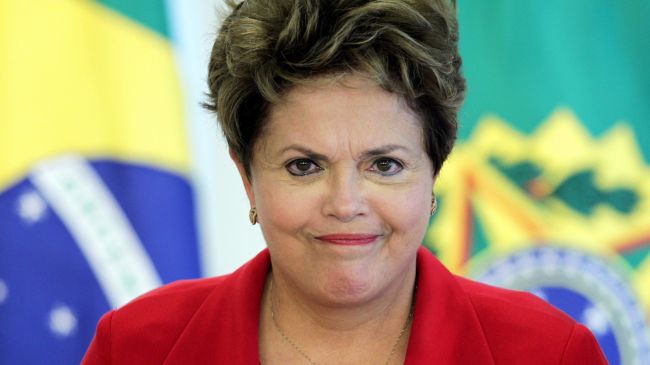 Brazilian President Dilma Rousseff announced the country’s measures to boost the Brazil’s independence and security on the World Wide Web, including storing data locally and bypassing internet traffic that goes through the United States.
Rousseff said plans are in the works to lay underwater fiber optic cable directly to Europe and all the South American nations in order to create a network free of US eavesdropping. This is while most of Brazil’s global internet traffic passes through the US.
The president also announced that she will push for new international rules of privacy and security in hardware and software during the UN General Assembly meeting later this month.
The country’s postal service also plans to create an encrypted e-mail service that would serve as an alternative to Gmail and Yahoo, two companies being monitored by the NSA.
Experts said the move may herald the first step toward a global network free from US monopoly and its illegal surveillance of global communications.
The development comes following the publication of documents leaked by whistleblower and former NSA contractor Edward Snowden in July, exposing US spying on Brazilian companies and individuals for a decade.
Snowden, a former CIA employee, leaked two top secret US government spying programs under which the NSA and the Federal Bureau of Investigation (FBI) are eavesdropping on millions of American and European phone records and the Internet data from major Internet companies such as Face book, Yahoo, Google, Apple, and Microsoft.
The NSA scandal took even broader dimensions when Snowden revealed information about its espionage activities targeting friendly countries.
Related articles
- Brazilian president postpones visit to Washington over US spying
- South America: UNASUR To Build Fibre-Optic ‘Mega Ring’
- Latin America Condemns US Espionage at United Nations Security Council
- Mercosur complains to Ban Ki-moon on US global espionage and EU affront towards Bolivia’s Evo Morales
- UK spying on Germany’s major data cable to US triggers media storm
Brazilian president postpones visit to Washington over US spying
RT | September 17, 2013
Brazilian President Dilma Rousseff has postponed a state visit to Washington in response to the US spying on her communications with top aides. Rousseff is demanding a full public apology from President Obama.
Barack Obama spoke with Rousseff on Monday in an attempt to persuade her into following through with the trip, the Brazilian president’s office said, according to AP.
Brazil’s TV Globo reported that the call between the two presidents lasted for about 20 minutes. Obama and Rousseff discussed revelations that the National Security Agency (NSA) spied on the Brazilian leader’s phone calls and emails. The two presidents then “jointly” agreed to cancel the meeting, Globo reported, citing the presidential office.
The Brazilian government said in a statement that “the conditions are not suitable to undertake this visit on the agreed date.” It expressed hope that the conflict will be resolved “properly” and the trip will happen “as soon as possible.”
The state visit was initially scheduled for October 23. The Obama administration has confirmed that the visit was canceled.
“The president has said that he understands and regrets the concerns disclosures of alleged US intelligence activities have generated in Brazil and made clear that he is committed to working together with President Rousseff and her government in diplomatic channels to move beyond this issue as a source of tension in our bilateral relationship,” said White House spokesman Jay Carney.
Earlier this month, TV Globo revealed in a report that the NSA monitored the content of phone calls, emails, and mobile phone messages belonging to President Rousseff and undefined “key advisers” of the Brazilian government. The NSA also spied on Mexican President Enrique Pena Nieto and nine members of his office.
The revelations were based on evidence provided by former CIA employee and NSA contractor Edward Snowden, which was passed to British journalist Glenn Greenwald.
A document dated June 2012 showed that the Mexican President’s emails were read through one month before he was elected. In his communications, the then-presidential candidate indicated who he would like to appoint to several government posts.
The Brazilian government denounced the NSA surveillance as “impermissible and unacceptable,” and a violation of Brazilian sovereignty.
In July, Greenwald co-wrote articles for O Globo, in which he claimed that some of the documents leaked by Snowden indicated that Brazil was the NSA’s largest target in Latin America.
Greenwald wrote that the NSA was collecting its data through an undefined association between US and Brazilian telecommunications companies, but he could not verify that Brazilian companies had been involved.
Following the revelations, the Brazilian government ordered an investigation into telecommunications companies to determine whether they illegally shared data with the NSA.
Defense ministers of Brazil and Argentina signed a broader military cooperation agreement on September 13. The two governments will work together to improve cyber defense capabilities following revelations of Washington’s spying on Latin American countries.
Brazil will be providing cyber warfare training to Argentine officers from 2014.
Related articles
Venezuelan School Year Begins with Free Books and Laptops
By Ewan Robertson | Venezuelanalysis | September 16, 2013
Mérida – Around eight million pre and primary school children began the new Venezuelan school year today, with the government announcing the distribution of free textbooks and laptops to educational centres.
This year the government will distribute 35 million textbooks to state primary and high schools from its Bicentenary Collection, which covers the national curriculum. This marks an increase from last year when 30.75 million books were distributed under the system, and 12 million in 2011.
Venezuelan president Nicolas Maduro lauded the government’s preparations for the school year, stating on Saturday that policies were designed to provide “quality” education to all.
“To begin classes on Monday and take children to school, we’re going to begin handing out 35 million textbooks so that classes start with the best quality,” he said at an official event.
The government is also planning to distribute 5 million copies of the National Constitution to schools this term in order to raise awareness of the constitution’s contents and promote the values defended in its articles.
“This [Bolivarian] revolution can only be made if we fill it with love every day, if the passion of loves moves us; the purest love for our children, our parents…for our grandchildren, love for [late Venezuelan president Hugo] Chavez,” Maduro declared.
In the Venezuelan constitution, passed in a national referendum in 1999, education is described as “a human right and fundamental social duty; democratic, free, and obligatory” (Article 102). In practice education in Venezuela is free including at university level, while private educational institutions also exist.
The government will also distribute 650,000 free “Canaima” laptops to children from 1st to 6th grade this school term. A further 1.4 million will be handed out in 2014, bringing the total distributed since 2008 to 4 million.
Assembled in Venezuela, the Canaima laptops are manufactured as part of a cooperation agreement with Portugal.
Further, under the government social program “A Drop of Love for My School”, repairs were made to 1000 educational centres over the summer holidays.
The authorities of opposition controlled municipalities in the central state of Miranda also reported to have realised repairs to some schools in their areas in preparation for the new term.
Along with the distribution of materials and renovations to infrastructure, the Maduro government is launching a new children’s theatre scheme this school year. School pupils will experience a range of classes such as acting, lighting, oral narration, and music under the program, which is named after 20th century Venezuelan dramatist Cesar Rengifo.
Related article
- Theatre Program Launched in Venezuelan Schools to Create “Culture of Peace” (venezuelanalysis.com)
No economic espionage? NSA docs show US spied on Brazil oil giant Petrobras
RT | September 9, 2013
Despite earlier US assurances that its Department of Defense does not “engage in economic espionage in any domain,” a new report suggests that the intelligence agency NSA spied on Brazilian state-run oil giant Petrobras.
Brazil’s biggest television network Globo TV reported that the information about the NSA spying on Petroleo Brasileiro SA came from Glenn Greenwald, the American journalist who first published secrets leaked by whistleblower Edward Snowden.
Globo TV aired slides from an NSA presentation from 2012 that revealed the agency’s ability to gain access to private networks of companies such as Petrobras and Google Inc.
One slide specified an ‘economic’ motive for spying, along with diplomatic and political reasons.
This seems to contradict a statement made by an NSA spokesman to the Washington Post on August 30, which said that the US Department of Defense “does not engage in economic espionage in any domain, including cyber.”
An official from the NSA told Globo that the agency gathers economic information not to steal secrets, but to watch for financial instability.
Petrobras is known to have discovered some of the world’s biggest offshore oil reserves in recent years.
Some of the new reserves are estimated to be around as 100 billion barrels of oil, according to Rio de Janeiro State University.
None of the leaked slides went into the reasons behind the NSA spying on the Brazilian firm.
The US spy agency then reportedly shared the gathered information with the UK, Canada, Australia and New Zealand.
The new report about US spying on Brazil could intensify the already existing tensions between Brazil and US.
The relationship between the two countries became tense as Globo reported about allegations that NSA has intercepted private communications of Brazil’s President Dilma Rousseff and her Mexican counterpart Enrique Pena Nieto.
Brazil responded by canceling preparations for the presidential visit to the United States and beginning a probe into telecommunications companies to see if they illegally shared data with the NSA. Also, Brazil has asked for a formal apology.
During the G20 summit US tried to address the issue by US President Barack Obama pledging to work with Brazil and Mexico to address their concerns over US spying revealed in recent NSA leaks.
‘Globesity’: US junk food industry tips global scales

By Robert Bridge | RT | September 07, 2013
From Mexico to Qatar, obesity rates are soaring to unprecedented levels. The alarming trend is damaging economic performance, as well as the health of millions of consumers worldwide.
Take our increasingly sedentary lifestyles, mix in a generous portion of American fast-food and dubious agricultural practices, add a dash of corporate duplicity and you have a recipe for high obesity rates across the planet.
The newly released United Nations report on global nutrition does not make for very appetizing reading: Amid an already floundering global economy, the reality of a fattening planet is dragging down world productivity rates while increasing health insurance costs to the tune of $3.5 trillion dollars per year – or 5 percent of global gross domestic product (GDP).
31.8 percent of US adults are now considered clinically obese. This is a remarkable figure, especially considering that it is approximately double the US obesity rate registered in 1995, according to data from the Center for Disease Control and Prevention.
An individual is considered obese when their body mass index (BMI), a measurement obtained by dividing a person’s weight in kilograms by the square of the person’s height in meters, exceeds 30 kg/m2, according to the World Health Organization.
Meanwhile, much of the international community is quickly catching up with the global consumption superpower. Mexico, for example, just surpassed US obesity rates with a whopping 32.8 percent of Mexican adults now considered to be clinically obese.
The unprecedented weight gains in Mexico, however, as well as many other countries, appear to be no accident.
Following the passage of the North American Free Trade Agreement (NAFTA), Mexico became the dumping ground for a slew of cheap fast food and carbonated drinks, according to a Foreign Policy report.
Thanks to NAFTA, there was a more than 1,200 percent increase in high-fructose corn syrup exports from the US to Mexico between 1996 and 2012, according to the US Agriculture Department. In an effort to place a cap on the high-calorie drinks, Mexican officials introduced a tax on beverages containing high-fructose corn syrup. American corn refiners, however, cried foul and the tax was voted down by the World Trade Organization.
Mexicans now consume 43 gallons of soda per capita annually, giving the country the world’s highest rate of soda consumption, according to estimates by Mexico’s national statistics agency.
Yet another disturbing casualty on the obesity trail is tiny Qatar, an oil-rich Arab nation of 250,000 people that is also rich in fast food diets.
“Like most people in the Arab Gulf, (Qataris) were traditionally desert-dwelling and therefore much more physically active,” according to a 2012 report by Policymic.com. “Now, cars have replaced camels and fast food and home deliveries take the place of home cooking. Even housework and child rearing is left to maids and nannies.”
Today, some 45 percent of Qatari adults are obese and up to 40 percent of school children are obese as well.
Last month, nutrition experts from around the world shared their views at an obesity and nutrition conference in Sydney. For many of the attendees, the primary culprit in the global obesity scourge is out-of-control corporate power, where the free market decides everything.
The rise of global fast food outlets has been a key change in our environment leading to fattier foods and fatter people, Bruce Neal, professor at the George Institute for Global Health in Sydney, told the Indo-Asian News Service.
“As fast as we get rid of all our traditional vectors of disease – infections, little microbes, bugs – we are replacing them with the new vectors of disease, which are massive transnational, national, multinational corporations selling vast amounts of salt, fat and sugar,” Neal said.
John Norris, writing in Foreign Policy, explained some of the global dynamics that contributed to the so-called “globesity” epidemic, including the soft drink industry’s move to use cheaper high-fructose corn syrup instead of sugar in many of their products.
“Suddenly, it was cheaper to put high-fructose corn syrup in everything from spaghetti sauce to soda. Coke and Pepsi swapped out sugar for high-fructose corn syrup in 1984, and most other US soda and snack companies followed suit,” Norris wrote. “US per capita consumption of high-fructose corn syrup spiked from less than half a pound a year in 1970 to a peak of almost 38 pounds a year in 1999.”
While some might be tempted to downplay the negative effects of such a harmless sounding additive, researchers from Canada’s University of Guelph, as pointed out by Norris, discovered that a high-fructose corn syrup diet in rats produced “addictive behavior similar to that from cocaine use.”
As obesity explodes, US fast food companies look abroad.
Americans, thanks in part to First Lady Michele Obama’s ‘Let’s Move’ program, have recently woken up to the unsustainability of their soda guzzling, fast food ways. Other politicians and activists have also weighed in on the debate, making the environment for the fast food industry not as comfortable as in the past.
In March, New York City Mayor Michael Bloomberg attracted the ire of the soft drink industry when he placed a ban on the sale of sodas in sizes larger than 16 ounces. Violators will be fined $200.
In his 2004 a documentary film, “Super Size Me,” Morgan Spurlock stunned audiences by tracking the physical effects on his body – none of them positive – after consuming nothing but McDonald’s food for 30 days. As a result of the experiment, Spurlock gained 24½ lbs. (11.1 kg), a 13 percent body mass increase, and a cholesterol level of 230, among other negative side-effects.
Perhaps the biggest wake-up call for the fast food industry came in 2002 when two teenagers accused McDonald’s of deceptively marketing its menu from 1985 to 2002, causing them, they alleged, to become obese. The judge dismissed the case in 2010, but the message to the industry was crystal clear.
As a result of these and other public awareness campaigns, the American fast food industry – although slower than some may like – has been gradually rewriting their menus and marketing campaigns, many of which are aimed at kids.
At the same time, the junk food industry – sensing the sea change of attitudes in the United States as the physical effects of junk food manifests itself – are investing increasingly in foreign markets where public awareness of the subject is not so developed.
Similar to the crackdown on the tobacco industry in the late 1990s, US fast food companies are busy setting up shop abroad for easy, unregulated markets to hawk their wares.
Already the size of their presence is breathtaking: “Coca-Cola and PepsiCo together control almost 40 percent of the world’s $532 billion soft drink market, according to the Economist. Soda sales, meanwhile, have more than doubled in the last 10 years, with much of that growth driven by developing markets. McDonald’s investors were disappointed that the company only turned $1.4 billion in profit during the second quarter of 2013, having become used to years of double-digit gains every three months,” according to the Foreign Policy report.
So while the United States is steadily finding ways to regulate its fast food, soft drink industry, and thus nip the obesity epidemic in the bud, it is, at the same time, legislating on behalf of unhealthy exports abroad.
Now the question is, will the rest of the world bite the hand that feeds?
Related articles
Rousseff yet to decide on US visit
Press TV – September 7, 2013
Brazil’s President Dilma Rousseff says she will decide on whether to call off her visit to the United States over allegations of Washington’s spying on her based on President Barack Obama’s full response.
On Friday, Obama said that his administration would work with the Brazilian and Mexican governments to resolve tensions over allegations of spying.
Obama met separately with Rousseff and Mexican President Enrique Pena Nieto on the sidelines of G20 international economic summit in the Russian city of St. Petersburg and discussed reports that the US National Security Agency (NSA) spied on their personal communications.
Earlier on Friday, Rousseff indicated she was not completely content with Obama’s assurances that the alleged spying on her communications by the NAS would be looked into during their meeting late on Thursday.
Rousseff added that the US president had agreed to provide a fuller explanation for the reported spying by September 11, and that she would decide whether or not to visit the US next month based in part on his response.
“My trip to Washington depends on the political conditions to be created by President Obama,” Rousseff told reporters on Friday.
Brazil’s TV Globo reported on September 1 that the NSA spied on emails, phone calls and text messages of Rousseff as president and Pena Nieto when he was a candidate.
The report was based on documents released by US surveillance whistleblower Edward Snowden, a former NSA contractor.
Angered by the report, Rousseff and her government have asked for a more complete explanation of the alleged spying.
Brazil argues that counterterrorism or cybersecurity concerns did not sufficiently explain why the NSA would spy on Rousseff’s communications.
The Brazilian government has already canceled a trip by an advance team to prepare for Rousseff’s next month visit to Washington.
Rousseff is scheduled to visit the White House in late October to meet Obama and discuss a possible 4-billion-dollar jet fighter deal, cooperation on oil and biofuels technology between the two biggest economies in the Americas, as well as other commercial projects.
Related article
EU court verdict on Iran sanctions angers US
Press TV – September 7, 2013
A new EU court ruling that rejected sanctions on a number of Iranian entities has drawn the ire of the United States, prompting Washington to extend its illegal embargoes against more individuals and businesses.
The EU’s General Court in Luxembourg lifted the bloc’s sanctions against seven Iranian companies on Friday, ruling that there wasn’t sufficient evidence to justify the embargoes.
The top EU court ruled that the bloc wrongly blocked the accounts of Post Bank of Iran, the Iran Insurance Company, Good Luck Shipping and the Export Development Bank of Iran, from 2008 to 2011.
“We are very disappointed by the [EU] court’s decision today,” a spokesman for the US Treasury Department said in a statement on Friday.
The US Treasury later announced that it blacklisted six individuals and four businesses over their alleged links to Iranian oil sales.
At the beginning of 2012, the US and the European Union imposed new sanctions on Iran’s oil and financial sectors aimed at preventing other countries from purchasing Iranian oil and conducting transactions with the Central Bank of Iran.
The illegal US-engineered sanctions were imposed based on the unfounded accusation that Iran is pursuing non-civilian objectives in its nuclear energy program.
Iran rejects the allegation, arguing that as a committed signatory to the nuclear Non-Proliferation Treaty (NPT) and a member of the International Atomic Energy Agency (IAEA), it has the right to use nuclear technology for peaceful purposes.
In addition, the IAEA has conducted numerous inspections of Iran’s nuclear facilities but has never found any evidence showing that Iran’s nuclear activities have non-civilian purposes.
France cannot afford military operation in Syria
By Steven Elliot | RT | September 6, 2013
The G20 should be focusing on their flagging economies rather than planning a military operation in Syria they can’t afford, analyst, Alex Korbel, told RT. France, in particular, is at full stretch, with 16 military campaigns abroad and an ailing economy.
The Syrian conflict has eclipsed the G20 meeting in Saint Petersburg, as the international community is unable to come to an agreement over a possible military strike. Washington has put forward a plan for military intervention against the Assad regime, which it believes is responsible for a chemical attack in a Damascus suburb on August 21.
RT: If the UN team of inspectors finds that chemical weapons were used in the Damascus attack, do you believe military intervention could be justified?
Alex Korbel: I think there is no case for military intervention in Syria for several reasons. The first reason is that there is no national interest for France or the US to actually intervene in Syria. The regime of Bashar al Assad was not a problem in the past and it is not clear why it’s now a problem for France and the US. There is no clear objective in the military intervention as it is now presented. Is it about maintaining the credibility of the US? What credibility exactly? The credibility to intervene in unnecessary wars? Is it to ban the use of chemical weapons? Then why does the US have chemical weapons in its arsenal? Is it to weaken the Bashar al Assad regime? In that case you need to put boots on the ground. If it is a humanitarian way to help the civilians, then locking on cruise missiles is not the right solution.
For all of these reasons the US and France have decided to move ahead with limited military intervention. But still there is a danger of falling down a slippery slope. What if a military intervention has no effect? Are we going to see full war? What would be the consequences in the region? I am thinking about Iran and Lebanon and I am thinking about a war less than 1000 kilometers south of Russia.
There is no broad international support for this war. Germany is against it, the UK is against it, China and Russia are against it. The only countries that are in favor are France, which has not yet consulted parliament, US and Israel and Saudi Arabia. Finally, public opinion is clearly against it everywhere. We saw it in the UK and the public polls in the US and France that the public is massively against military intervention in Syria.
RT: Given the climate of economic crisis in the EU, can France feasibly participate in another military operation?
AK: The economic situation of the EU countries is really bad. We can see in France that public debt is higher than 90 per cent of GDP. We see economic growth is less than 1 per cent. We see across G20 countries on average that unemployment is at 9 per cent and growing, that public debt is 64 per cent and growing, that economic growth is 1 per cent and weakening. What needs to be done is not to intervene militarily in another country.
France is already intervening in 16 countries worldwide. Clearly we don’t have any money to finance a seventeenth operation. The purpose of France, the US and any western power is not to ‘play the cop’ around the world but actually to maintain a sound economic policy first and then maybe lead by example on the international scene.
The Most Awkward G20 Summit Ever
By Dan Beeton | CEPR Americas Blog | September 5, 2013
President Obama is in St. Petersburg, Russia to participate in the G20 Summit today and tomorrow, amidst a time of heightened tensions between the U.S. and several G20 member nations. Looming over the summit are the Obama administration’s plans for a possible military attack on Syria, while Russian President Vladimir Putin has said that a U.S. military response without U.N. Security Council approval “can only be interpreted as an aggression” and UNASUR – which includes G20 members Argentina and Brazil, issued a statement that “condemns external interventions that are inconsistent with the Charter of the United Nations.”
New revelations of NSA spying on other G20 member nation presidents – Dilma Rousseff of Brazil and Enrique Peña Nieto of Mexico – leaked by NSA whistle-blower Edward Snowden and first reported in Brazil’s O Globo, have also created new frictions. Rousseff is reportedly considering canceling a state visit to Washington next month over the espionage and the Obama administration’s response to the revelations, and reportedly has canceled a scheduled trip to D.C. next week by an advance team that was to have done preparations for her visit. The Brazilian government has demanded an apology from the Obama administration. In an interview with Reuters on Wednesday, an anonymous senior Brazilian official underscored the gravity of the situation:
[T]he official, who declined to be identified due to the sensitivity of the episode, said Rousseff feels “patronized” by the U.S. response so far to the Globo report. She is prepared to cancel the visit as well as take punitive action, including ruling out the purchase of F-18 Super Hornet fighters from Chicago-based Boeing Co, the official said.
“She is completely furious,” the official said.
“This is a major, major crisis …. There needs to be an apology. It needs to be public. Without that, it’s basically impossible for her to go to Washington in October,” the official said.
Other media reports suggest that Brazil may implement measures to channel its Internet communications through non-U.S. companies. But when asked in a press briefing aboard Air Force One this morning, Deputy National Security Advisor for Strategic Communications Ben Rhodes did not suggest that such an apology would be forthcoming:
Q The Foreign Minister said he wanted an apology.
MR. RHODES: Well, I think — what we’re focused on is making sure the Brazilians understand exactly what the nature of our intelligence effort is. We carry out intelligence like just about every other country around the world. If there are concerns that we can address consistent with our national security requirements, we will aim to do so through our bilateral relationship.
Such responses are not likely to go far toward patching things up with Brazil. It is conspicuously dishonest to suggest that the U.S. government “carr[ies] out intelligence like just about every other country around the world,” as no other country is known to have the capacity for the level of global spying that the NSA and other agencies conduct, and few countries are likely to have the intelligence budgets enjoyed by U.S. agencies – currently totaling some $75.6 billion, according to documents leaked by Snowden and reported by the Washington Post.
There are also signs that the Washington foreign policy establishment is troubled by the Obama administration’s dismissive attitude toward Brazil’s understandable outrage. On Tuesday, McClatchy cited Peter Hakim of the Inter-American Dialogue – essentially the voice of the Latin America policy establishment in Washington:
Peter Hakim, the president emeritus of the Inter-American Dialogue, a Washington-based policy group, noted that Secretary of State John Kerry had visited Brasilia last month to patch things up after the initial NSA leaks but “really did not do a very good job. He just brushed it off.”
Hakim said he believed the O Globo report, and he added that “snooping at presidents is disrespectful and offensive.”
Rousseff and Pena Nieto had to issue strong statements, Hakim said. “Both have to show they are not pushovers, that they can stand up to the U.S.,” he said.
The ongoing revelations made by Snowden have affected U.S. relations with other countries as well. As the Pan-American Post points out, Peña Nieto may continue to reduce intelligence sharing with the U.S.; he also said yesterday that “he may discuss the issue with President Barack Obama at the summit.” U.S.-Russian relations, of course, have also recently become tense following Russia’s granting of temporary political asylum to Snowden.
The G20 Summit also comes just after the IMF, at the direction of the U.S. Treasury Department, changed its plan to support the Argentine government in its legal battle with “vulture funds” – meaning that U.S.-Argentine relations may also be relatively cool.
Related article
Desperate To Sew Up TPP Negotiations At Any Cost, Politicians Agree All Future Meetings Will Be Completely Secret
By Glyn Moody | Techdirt | September 3, 2013
We’ve been reporting for several years about the extraordinary levels of secrecy surrounding the TPP negotiations, where little information was released about what was going on, and there were few opportunities for representatives of civic and other groups to meet with negotiators to present their point of view. More recently, there have been some indications that this lack of transparency is fuelling increasing discontent among some of the participating nations.
In order to get the trade deal sewn up by the end of this year, and before resistance spreads further, the negotiators have decided to hold ‘inter-sessional’ meetings for the remaining unresolved areas. But as this article from Scoop explains, these won’t be like routine TPP meetings, with their routinely unhelpful levels of opacity:
Detective work indicates that informal ‘inter-sessional’ meetings on six chapters are scheduled within the next four weeks — all in North America.
‘ “Inter-sessional” is a misnomer’, says Professor Kelsey, ‘because they are not planning any more formal sessions. There will be no access for the media or stakeholders to these smaller meetings.’
‘Past inter-sessionals have been shrouded in secrecy to ensure we can’t find out what’s happening and we don’t have access to those negotiators who see value in talking with us.’
‘The last three years of the TPPA have been widely condemned for their lack of transparency. The process is now going further underground’.
That is, rather than opening up TPP in response to widening criticisms, its negotiators will now be meeting in complete secret, presumably until they emerge with some kind of a deal, however bad. Since no information will be released about those gatherings behind closed doors, and there will be no opportunities to convey concerns to the participants, the public in whose name all these talks are taking place will have no way of knowing what is going on or of offering its views. It’s the ultimate in arrogant, “we know best” negotiations where citizens are expected to accept what is given, no discussion allowed.
The last time this approach was used on this scale was for ACTA, which was ultimately rejected, largely because the European public took to the streets to express its outrage at the contempt being shown towards it by the negotiators. Interestingly, in Colombia people are already taking to the streets to protest against the effects of free trade agreements with the US, Europe and Canada, at least in part. Do the governments participating in the now-secret TPP negotiations really want to risk the same happening in their own countries?
Related articles
Featured Video
Can the U.S. Afford to Annihilate Iran?
or go to
Aletho News Archives – Video-Images
From the Archives
Sanctions, War and the Policy of Dual Containment
By SASAN FAYAZMANESH | March 17, 2008
It is now nearly three decades since the Unites States adopted the policy of dual containment of Iran and Iraq. While much has been written about the containment of Iraq, there has been very little in-depth analysis of this policy when it comes to Iran. In a book that is going to be released on March 31, 2008, entitled The United States and Iran: Sanctions, Wars and the Policy of Dual Containment (Routledge), I attempt to address this shortcoming by investigating when and why the US policy of containment of Iran came about, how it evolved, and where it stands today.[1] To the extent that Israel has been involved in US policy making, the study will also include the role that Israel has played in the containment of Iran. Also, since the fate of Iran has been inextricably linked to that of Iraq, occasionally the investigation will overlap with the containment of Iraq.
The policy of dual containment of Iran and Iraq originated during the Carter Administration, but it was not until the Clinton Administration that the expression “dual containment” became popular. … continue
Blog Roll
 Aletho News
- Can the U.S. Afford to Annihilate Iran? /Seyed M. Marandi
- Elmo Sold mRNA Jabs to Your Toddler. Now They Are “Off-Label.”
- British state targets Palestine Action with yet another crooked trial
- Americans are paying the price to preserve Israel’s nuclear hegemony
- Resistance factions are necessary to ensure a permanent US Iraq withdrawal
- How Israel destabilizes the Middle East: Denying sovereignty and the right to exist
- Europe’s Establishment Is Embracing War – and Losing Voters
- NATO chief advocates war of aggression
- No Vote, No Representation, No State: Democracy, Israeli Style
- Zionist Bought Senate Blocks Information About American Citizens Killed By Israel
- If Americans Knew
- Israeli Soldiers Abduct At Least 22 Across Occupied West Bank
- Eight Palestinians Killed in Israeli Attacks on Gaza
- Israeli former leaders and security chiefs threaten legal action over ‘Jewish terrorism’
- Israel map in LA Times ad includes all land from the river to the sea
- Inside Lebanon’s 200-page dossier on Israeli war crimes
- Flydubai, genocide, settler violence, Trump abuse of power to deport – Daily Update
- Counting Antisemitic Incidents: What the ADL Audit Reveals — and Obscures
- Mamdani releases plan to combat antisemitism and hate crimes in New York City
- Iran’s Revolutionary Guards Publish Letter to the American People
- DMFI launches $1 million ad campaign supporting Virginia’s Elaine Luria
- No Tricks Zone
- Green Energy Debacle: German Expert Professor Fritz Vahrenholt Warns Of Severe Economic And Social Consequences
- Two More Paleo Reconstructions Affirm Meters-Higher Sea Levels Across Ireland, Brazil 7000-6000 Years Ago
- New Study: Earth And Venus Surface Warmth Largely Explained By Convection And Lapse Rate, Not CO2 Or Radiation
- 2025 Nature Paper Claiming Worsening Global Drought Gets RETRACTED …Heavily Flawed
- New Study: ‘Global Drought Shows No Detectable Recent Acceleration Under Climate Warming’
- Economic Masterminds: German Socialists Suggest Taxing Productivity Gains Stemming From Using AI
- The South China Sea Has Not Been Cooperating With The Climate Change Narrative
- Energy Crisis: Germany Enters Heating Season With Historically Low Gas Reserve Fill Levels
- New Study: The Antarctic Ice Sheet Gained Mass From 2020-2024 Due To Staggering Snow And Ice Accumulation
- Study: Ocean Heating Rates From Thousands Of Years Ago ‘Dwarf’ Modern Ocean Heating Rates

