Trump’s Strongman Persona Inevitably Results in Lies and War
By Prof. Glenn Diesen | October 17, 2025
Trump’s claim that Prime Minister Modi had promised to end the purchase of Russian oil was obviously false; in fact, there was apparently no phone call between the two leaders at all. Such fabrications, portraying world leaders as deferential to him and as praising his greatness, constitute a recurring pattern—one that parallels his militaristic approach to peace.
As the president of a declining hegemon, Trump is convinced that the weakness of his predecessors was the source of decline. Trump has therefore concluded that projecting strength can reverse the erosion of American power. In constructing himself as the ultimate strongman—allegedly respected by all—he positions himself as the sole saviour of the US. The image of a powerful, decisive and respected leader capable of restoring US dominance also functions domestically to consolidate political support and project stability during the country’s uneasy transition from a unipolar to a multipolar international order. The American public is seemingly prepared to look the other way or justify the dishonesty and moral disgressions as the price worth paying for a return to greatness.
The central problem with the strongman image is that it sustains unrealistic expectations of reviving US primacy rather than adapting to the realities of a multipolar world. The outcome is a pattern of deception and conflict that ultimately undermines, rather than strengthens, the United States.
When the strongman cannot coerce his counterparts into subservience, the only recourse is retreat into fantasy. In this imagined world, other leaders allegedly regret their decisions of not falling into line, tremble as Trump wags his finger, shower him with compliments, offer tribute to the United States, and in Trump’s own words, line up to “kiss my ass.” Within the Trumpian bubble of superpower cosplay, these scenes of deference are celebrated as signs of a return to greatness, yet in the real world, American credibility declines and decadence deepens. As the gap between fantasy and reality widens, Trump becomes increasingly reckless. Case in point, the threats against India to sever ties with Russia and India backfired spectacularly as Prime Minister Modi instead went to China to cement India’s relations with Russia, China and the SCO.
Great powers and independent states cannot simply fall in line, for doing so would predictably lead to their destruction or subjugation. The ultimate aim of an aspiring hegemon is not to reconcile differences in pursuit of peaceful coexistence, but to defeat rival powers and capture independent states. The objective of the economic confrontation with China is not to renegotiate trade agreements, but to undermine China’s technological capacity and contain it militarily to restore US primacy. The purpose of the proxy war against Russia is not peace in terms of finding a new peaceful status quo, rather it is to use Ukrainians and increasingly Europeans to bleed and weaken Russia until it can no longer sustain great-power status. Similarly, the goal of the confrontation with Iran is not to reach a new nuclear accord—Tehran has already accepted such terms in the past—but to achieve Iran’s capitulation and disarmament by linking the nuclear issue to restrictions on missiles and regional alliances. Any power that concedes even marginally to US pressure ultimately finds itself in a weaker and more vulnerable position—one that the aspiring hegemon will inevitably exploit. Any peace agreements are therefore temporary at best, as an opportunity to regroup.
India presents an intriguing case, as it is not an adversarial power. Its commitment to non-alignment makes strong relations with the United States desirable, yet the very same non-alignment necessitates strategic diversification to reduce excessive reliance on Washington. Should India be persuaded to sever ties with other major powers such as China and Russia, it risks becoming too dependent on the United States and absorbed into a bloc-based geopolitical system. Subordination to a declining empire would be perilous, as the United States would predictably use India as a frontline against China, and simultaneously demand economic tribute and cannibalise Indian industries in pursuit of renewed dominance. In essence, India must avoid becoming another Europe.
The strongman act is most effective with weaker and dependent states—such as those in Europe—that are willing to subordinate themselves entirely in order to preserve American commitment to the continent. European states lack the economic capacity, security autonomy, and political imagination to envision a multipolar world in which the United States wields less influence and holds other priorities than a close partnership with Europe. Consequently, European leaders appear willing to sacrifice core national interests to preserve the unity of the “Political West” for a little while longer. In private, they may express disdain for Trump; in public, they pay tribute to “daddy” and line up diligently in front of his desk to receive praise or ridicule. Yet this subservience is inherently temporary: leaders who disregard fundamental national interests are, in time, swept aside by the very forces they seek to suppress.
The strongman does not create any durable peace the underlying problems are never addressed. The mantra of “peace through strength” can be translated into peace through escalation, with the assumption that the opponent will come to the table and submit to US demands. However, rival great powers that have nowhere to retreat will respond to escalation with reciprocation. The delusions of the strongman in the declining hegemony will therefore inevitably trigger major wars.
London Is Still Bent on Influencing India’s Independent Policy Trajectory
By Anvar Azimov – New Eastern Outlook – October 16, 2025
British Prime Minister Keir Starmer visited India to promote previously reached trade agreements; however, the negotiations have laid bare the extremely limited reach of London’s influence on New Delhi.
During the latest UK-India summit held on October 8-9 in Mumbai, London once again made an unsuccessful bid to affect New Delhi’s course regarding Russia, to secure its support for the Euro-Atlanticists’ plans for settling the Ukrainian conflict and for continuing anti-Russian sanctions policy.
Nevertheless, the two countries managed to make progress in expanding cooperation in trade, investments, defense, and security.
The official visit of the UK Prime Minister Keir Starmer to India aimed at cementing the agreements reached during the stay of the head of the Indian government, Narendra Modi, in London this July, and, first and foremost, at signing a far-reaching free trade agreement. The pact would open vast prospects for achieving the ambitious goal set by the parties to increase trade turnover by 2030 from the current $35 billion to $120 billion.
Starmer Urged Modi to Stop Purchasing Russian Oil
Simultaneously, the British guest made another attempt to talk New Delhi into abandoning substantial purchases of Russian energy resources, which currently account for up to 40 percent of India’s oil imports. Furthermore, the trade turnover between India and Russia, taking into account petroleum product supplies, has reached an unprecedented $70 billion, a fact that London and the West as a whole are also seriously apprehensive about. However, despite these British exertions, Prime Minister N. Modi made it clear that this matter is no exception to the rule; hence, here, India would also be guided by its own national and economic interests.
Nor has New Delhi veered from the path of distancing itself from anti-Russian Western sanctions, prioritising, once again, independent national interests. The Ukrainian conflict hasn’t evaded such a fate either, with Starmer failing to pull India completely to his side. While being committed to a peaceful settlement of the situation around Ukraine, India rejects anti-Russian rhetoric on the issue and maintains a measured, balanced stance. Even London’s various assurances of support for New Delhi’s aspirations to gain a permanent seat in an expanded UN Security Council did not spur India to alter its principled neutral position in the current struggle between the West and Russia.
Success evaded the British leader on this anti-Russian front, but he cancelled out his failure on the track of bilateral relations by means of signing a series of agreements in various fields, including defense, security, technology, trade, and education. Notably, the parties managed to conclude a military deal worth approximately $470 million for the supply of light multipurpose missiles to the Indian army. They also agreed on setting up a regional centre of excellence in maritime security and on developing marine electronic engines for Indian naval ships.
Further progress in trade, economic, and investment areas was also outlined. It is indicative that Starmer was accompanied by a representative delegation from the British business community (over 120 people), including heads of companies such as Rolls-Royce, British Telecom, Diageo, the London Stock Exchange, and British Airways. Within the framework of the joint forum held, the representatives signed commercial contracts.
India Dictates the Terms
All in all, British companies have invested about $40 billion in the Indian economy, and New Delhi traditionally remains one of London’s key trade and investment partners. And what further contributes to such a situation is the signed free trade agreement, which added up to a significant reduction in tariffs on a wide range of goods, and expanded market access for companies and Indian labour migrants.
In a nutshell, the latest meeting of the two countries’ leaders concluded with new agreements on enhancing multifaceted cooperation and increasing trade turnover to $120 billion by 2030. At the same time, Starmer was clearly frustrated that even his attempts to prompt India to weaken its ties with Russia ended up a failure, which once again confirms New Delhi’s determination to stick to its own guns on its foreign policy, providing for the development of partnerships with both the West and the East and drawing on the national interests of this major, now global, power.
Anvar Azimov, diplomat and political scientist, Ambassador Extraordinary and Plenipotentiary, Candidate of Historical Sciences, Senior Research Fellow at Eurasian Studies Institute of MGIMO University of the Ministry of Foreign Affairs of Russia
Von der Leyen issues ultimatum to EU aspirant
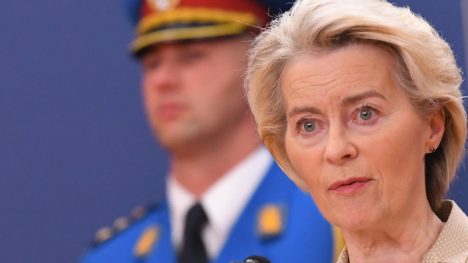
European Commission President Ursula von der Leyen. © Getty Images / Amir Hamzagic; Anadolu
RT | October 15, 2025
Serbia will not be able to join the EU unless it aligns fully with the bloc’s foreign policy, including adopting all sanctions against Russia, European Commission President Ursula von der Leyen has said.
Serbia, which applied to join the EU in 2009 and received candidate status in 2012, remains one of the few European states that has refused to impose any restrictions on Moscow. Belgrade has cited its historic ties with Russia and continues to rely on energy supplies from the country.
Speaking alongside Serbian President Aleksandar Vucic at a press conference in Belgrade on Wednesday, von der Leyen stated that Belgrade must “take concrete steps” toward membership and demonstrate “a greater level of alignment” with EU positions, including on sanctions.
She added that Serbia’s current level of alignment with EU foreign policy stands at 61%, but that “more is needed,” insisting Brussels wants to see Belgrade act as a “reliable partner.”
Vucic has repeatedly said that Serbia will not impose sanctions on Russia under any circumstances, calling his country’s stance “independent and sovereign.” However, Belgrade’s refusal to comply has drawn increasing pressure from both Brussels and Washington.
Last week, the US activated sanctions against the Petroleum Industry of Serbia (NIS), a major oil company partly owned by Russia’s Gazprom Neft, prompting Croatia to suspend crude deliveries. Vucic has warned that the measures could force Serbia’s only oil refinery to shut down by November, threatening the country’s gasoline and jet fuel supply.
At the same time, Serbia has been shaken by a wave of violent anti-government protests over the past year, which Belgrade claims are being fueled by Western influence in an effort to destabilize the government.
Russia’s Foreign Intelligence Service (SVR) has alleged that the EU is attempting to orchestrate a “Serbian Maidan” and install a pro-Brussels administration.
Budapest has voiced similar concerns, claiming that Brussels seeks to “overthrow” the governments of Hungary, Slovakia, and Serbia for maintaining ties with Moscow and refusing to abandon Russian energy.
Why western sanctions have failed and become self-defeating
Or are sanctions an end in themselves?
By Ian Proud | Strategic Culture Foundation | October 15, 2025
I recently participated in a debate in London about the effectiveness of sanctions as a tool of foreign policy. I argued that they have proven ineffective as a tool of foreign policy, and kept my remarks focussed on Russia, which is the most sanctioned country on the planet, with over 20,000 sanctions imposed so far.
For good or ill, I argued that sanctions were ineffective from a position of having [personally] authorised around half of the UK sanctions against Russia after war broke out in 2022. I take no great pride in that, but that was my job at the time and I eventually left my career as a British diplomat in 2023, largely out of a sense that UK foreign policy was failing in Ukraine.
Nevertheless, it worries me that so few people appear focused on what we in the UK want the sanctions to achieve, to the point where they have become an end in themselves. Yet, look at the legislation, specifically the Russia Sanctions Regulations of 2019, and the [alleged] purpose is quiet clear:
Encourage Russia to cease actions destablising Ukraine or undermining or threatening the sovereignty or independence of Ukraine.
More than eleven years since the onset of the Ukraine crisis and not far from four years since war broke out, the UK and its allies have manifestly failed to deliver upon that goal.
We have been through eleven years of gradually ramping up sanctions against Russia only to see Russia increase its resistance, and then to launch its so-called Special Military Operation in 2022.
Sanctions did not prevent that. One might argue that they helped to precipitate it.
Ukraine is bankrupt, its cities broken, its energy infrastructure once again subject to nightly bombardment as the winter approaches and people wonder whether they’ll be able to heat their homes.
Sanctions are not preventing this.
Yet at the debate, my opponents somehow advanced the argument that sanctions remain an effective tool of foreign policy, from the comfort of a grand hall, two thousand miles away from the frontline, even further from responsibility, and completely detached from reality.
In my mind, there are two clear reasons why sanctions policy has failed.
Firstly, because even if people in the west consider them to be justified, the Russian State considers them to be unjust.
Ever since the Minsk II peace deal was subordinated to sanctions in March 2015, President Putin has become increasingly convinced that western nations would sanction Russia come what May.
And that has proved to be the case.
Every time an inevitable new package of sanctions is imposed by the UK, Europe or others, it also convinces ordinary Russian people that this is true.
People in the west might hate Putin, but he is far more popular in Russia than Keir Starmer is in Britain, or than Friedrich Merz is in Berlin, or than Emmanuel Macron is in France.
So the idea that sanctions undermine support in Russia for President Putin is deeply misguided.
Likewise, sanctioning British-based Russian billionaires who took their assets out of Russia might play well in the Financial Times but is a meaningless gesture; these figures have no real power in Russia.
The idea that if we sanction Roman Abramovich he might some how rise up and try to unseat Putin together with other oligarchs is a fantasy.
The Russian oligarch Oleg Tinkoff who took to Instagram after the war started to criticise the Russian army, was forced to sell his eponymous bank and yet the UK still sanctioned him.
Why would any wealthy Russian on that basis stand up against President Putin on the west’s behalf only to get sanctioned by us anyway?
Yet, we have sanctioned 2000 individuals and entities, banning them from travel to the UK, even though 92% of them never had [visited] before the war started. These, I’m afraid, are empty gestures.
Sanctions will not stop the war.
And the longer they go on, more Ukrainians will die.
Despite Russia having done everything to adjust to sanctions since 2014, commentators in the west nevertheless try to tell you that, well, maybe we should have imposed more sanctions at the start for a bigger effect.
But on my second point, that denies the political reality of how sanctions are imposed.
While the combined economies of NATO are 27 times bigger than Russia, 32 states cannot coordinate policy quickly enough to take decisive action.
This results in waging war by committee.
Imagine, if you will, a chessboard with President Putin staring across at a team of thirty-two people on the other side, squabbling loudly among themselves for months on end before deciding not to make the best move.
If you believe that Europe is about to become a rapid decision-making body now at a time when its member states are increasingly turning to nationalist political parties who resent the war policy in Brussels, then my message to you is, good luck waiting for that.
Europe has now been debating for over a year whether to expropriate 200 billion in Russian assets housed in Belgium.
Yet that has not been agreed precisely because the Belgian government has blocked it consistently out of a not illegitimate fear that it will shred that’s country’s reputation among international investors at a time when new financial architecture is being constructed in the developing world.
Meanwhile, Russia’s foreign exchange reserves have continued to grow and now stand at over $700 billion for the first time. So even at this late stage if Europe chose to expropriate the assets, Russia could live without them.
Rather than being forced to the negotiating table – the complete fantasy that proponents of this hair-brained idea would tell you – Russia would be so enraged by what it sees as theft that it would keep on fighting.
And more Ukrainians would die.
President Putin is not hemmed in by the need to consult, and western indecision gives him time to adapt.
Since 2014, Russia’s economy has reoriented away from its dependence on the west, precisely to limit the impact of sanctions.
When war broke out in 2022, Russia had been adapting to sanctions for 8 years already.
Even though the scale was unprecedented, Russia had already prepared itself for the onslaught when it happened and has adapted better.
In 2022, with everyone crowing about the crashing rouble, Russia pulled in its biggest ever current account surplus of over $230 billion which, by the way, is bigger than Ukraine’s whole economy.
Despite cutting off gas supplies and bearing down on shadow tankers, Russia to this day continues to pull in hefty trade surpluses each year. It has not been in deficit since 1998.
Lots of people argued that if we had gone all in 2014, then that might have made a difference. But believe we, that was debated in Europe, and no one could agree to it.
And I wonder whether, had it been agreed, Europe would simply have faced the political and economic turmoil which is currently going on now, ten years earlier.
So let’s stop talking about what ifs.
The ugly truth is that sanctions have become an end in themselves. They are not a strategy, but a fig leaf covering the embarrassing fact that the west does not have a strategy.
They are a weak alternative to war or peace that serve no purpose other than to prolong the war in Ukraine.
Western nations have shown themselves unwilling to contemplate diplomacy. Talking to Putin is dismissed as a prize that will take him out of international isolation; even though he only appears isolated by western nations. Yet diplomacy isn’t about talking to your friends, despite the never ending round of backslapping summits our leaders attend. Diplomacy is about talking to the people with whom you most disagree. We have refused to talk to Russia and continue to avoid diplomacy at all costs to this day.
Neither do we want war, Britain’s army today has 73,000 soldiers, 2,000 fewer than 2 years ago. Russia has 600,000 troops in Ukraine, apparently. We couldn’t even agree to send 10,000 troops as part of a so-called reassurance force although, to be honest, that idea didn’t reassure me at all.
Russia is outstripping us in the production of munitions, tanks and naval warships. And it has 6,000 nuclear warheads.
So I’m glad we don’t want war either.
But as we continue to pursue ever diminishing packages of sanctions, Ukraine will remain stuck in the middle, devastated and depopulated, as Europe deindustrialises and falls into the embrace of nationalism at an accelerating rate.
Meanwhile, despite obvious headwinds, Russia’s economy appears in better shape than ours. It would be impossible to claim that there had been no economic impacts on the Russian economy from sanctions. Yet with economic links to the West now all but destroyed, sanctions relief is less important to Russia than it is to Europe.
In Budapest recently I got talking to a member of the House of Lords and former Diplomatic Service colleague who is a close friend of Boris Johnson. During his speech he remarked that sanctions on Russia have had no impact at all.
Later over drinks we discussed this and he agreed with the arguments that I have put forward today. But then he paused, and said ‘ah, but you just can’t say that in Britain though’.
It’s time to wake up and realise the terrible mess we have got ourselves into through sanctions. Sanctions have failed to the great detriment of Ukraine. It’s time, finally, to get back to diplomacy.
NATO must buy more US arms for Ukraine – Pentagon chief
RT | October 15, 2025
European NATO members should purchase more American-made weapons to sustain Ukraine’s war effort against Russia, US War Secretary Pete Hegseth said on Wednesday ahead of a meeting of the bloc’s defense ministers.
Moscow has repeatedly stated that Western arms shipments cannot change the balance of power on the battlefield, arguing that Ukraine’s chronic manpower shortage, fueled by mass draft avoidance and desertion, undermines any material advantage.
Speaking alongside NATO Secretary General Mark Rutte, Hegseth praised the Prioritized Ukraine Requirements List (PURL) initiative and said the European members must spend more funds through it.
“Our expectation today is that more countries donate even more, that they purchase even more to provide for Ukraine,” Hegseth said. Rutte noted there was “firepower coming out of our defense industry” to bolster Ukrainian forces.
US President Donald Trump recently claimed that with European funding for American weapons, Ukraine could still achieve its territorial goals – a reversal of his earlier assessment that the county had “no cards” to play. Trump is expected to soon announce whether the US will approve deliveries of long-range Tomahawk cruise missiles to Kiev, a move Moscow has warned would mark a serious escalation but would not significantly alter the frontline situation.
The Russian government has accused European backers of Kiev of prolonging the conflict at the expense of Ukrainian lives, arguing that the former are unwilling to admit the failure of their strategy.
Meanwhile, European NATO members continue to bear the economic fallout of their sanctions policy against Russia. Having rejected affordable Russian energy, many EU economies have faced surging production costs and widespread industrial bankruptcies, while the US has benefited from increased investment inflows and higher sales of liquefied natural gas to Europe.
Farming in Russia vs the West
RealReporter | September 22, 2025
In this collab with @countrysideacreshomestead2008 I visit a Canadian family who moved to rural Russia to start a homestead from scratch.
Why they came to Russia –  • Family of 10 Leaves Canada for ‘Economic O…
Follow me on:
Rumble – https://rumble.com/user/RealReporter 👉
X – https://x.com/Real_ReporterX 👉
Instagram – / konstantinreporter 👉
Telegram – https://t.me/RealReporter_tg 👉
TikTok – / konstantinreporter
If you’d like to support my project:
Patreon – / realreporter
PayPal – https://paypal.me/RealReporter
How Zionist Influence in New York Gave Rise to Zohran Mamdani
By Matt Wolfson | The Libertarian Institute | October 14, 2025
Coverage of Zohran Mamdani’s run for New York City mayor is focused on the outsized politics at play in the race: democratic socialism, Islam, state-owned grocers, former Governor Andrew Cuomo, until recently incumbent Mayor Eric Adams, and President Donald Trump. But this risks missing the real story in New York, which is the decades-long creation and maintenance of a financialized, factionalized city of free market distortions and middle class displacement at the hands of powerful Zionists and their allies that led to backlash and Mamdani’s rise. Rewinding Mamdani’s catapault to politcal stardom reveals that New York’s current situation—its transition from a city hospitable to the working and middle classes and genuine free exchange of goods and services to a feudal one of government-backed financiers and service workers—is in many ways the work of a little more than a dozen Zionist financiers who twisted government to their ends.
Zionism in New York was part of a shift in the city begun by establishment-connected WASPs away from government by wards and organizers and toward rule by government-connected finance. The originator was Nelson Rockefeller, John D. Rockefeller’s grandson and the governor of New York from 1959 to 1973, who floated New York City’s bills by arranging for banks like Chase Manhattan (run by his brother David) to buy bonds. These new bonds covered the old bills even though the bonds were not backed by actual assets of the city’s but by anticipated returns; e.g. “tax anticipation bonds,” “bond anticipation notes,” and “moral obligation bonds.” This meant the city borrowed from the bankers, paid a portion of the interest, and borrowed again, while having no long-term way to pay back the full amount of ever-increasing debt.
The fix to this problem created by financiers came from financiers: a consortium set up in 1975 by Nelson Rockefeller, now vice president, to “solve” the city’s $6 billion debt. The consortium operated through various vehicles with names like the Municipal Assistance Corporation and the Emergency Financial Control Board and it achieved this “fixing” in a predictably self-interested way. It cut out of influence the city’s old political power brokers—Jewish, Irish, Italian, Puerto Rican, and black politicians with connections to their communities. It then executed a bait-and-switch. It cut city funds from supporting welfare and unions in the name of small government while actually redirecting those funds to support financial development via investing in a real estate boom driven by a handful of connected players that attracted new “talent” to the city.
The main beneficiaries were rising Wall Street power brokers, the most notable ones Zionist, for whom the 1980s was a kind of heyday. The roster included Laurence and Robert Tisch, Maurice “Hank” Greenberg, Michael Steinhardt, the Bronfmans, Michael Milken, Stephen Schwarzman, and high-end retailers like Victoria Secret’s Leslie Wexner and Leonard and Ronald Lauder, the sons of Estee Lauder and heirs to her fortune. One difficulty of critiquing a cohort like this is that the conflation of “Jewish power” and New York is an old trope, in part because New York has been, since the early twentieth century, a Jewish city. So it should be emphasized that this cohort was small and highly specific. It was distinct from older generations of New York Jews—not just Jewish ward players like Abraham Beame, New York’s last mayor under its old power dispensation, but Jewish financiers like Felix Rohatyn, who played a major role in stabilizing the city’s debt in the 1970s.
Players like Beame and Rohatyn had planted their stakes firmly in America and nowhere else. Having experienced the rise of the Nazi Party in an economically cratered Germany as a childhood reality, they were committed to creating the conditions for what they hoped would be lasting social peace. Zionists, by contrast, had their eye on the military-corporate apparatus and its ties to Israel, and they were not especially concerned with the effects of their actions on the ground. They also rejected what would become the mores of the majority of Jews and especially Jews of a later generation: intermarriage, mixing, diverse assimilation. Their style was self-consciously distinctive and gloves off, and beginning in the 1980s they executed an aggressive reinvention not just of the financial markets but of New York.
Part of this reinvention was done, much as the Rockefellers’ rise to influence in New York had been done, through philanthropy, but at a much greater scale. Among these Zionist players’ direct bequests were the Steinhardt Conservatory at the Bronx Botanic Gardens, the NYU Steinhardt School of Culture, Education, and Human Development, the NYU Tisch School of the Arts, NYU Langone’s Tisch Hospital, the Tisch Galleries at the Metropolitan Museum, the Tisch Children’s Zoo in Central Park, the Leonard Lauder Galleries at the Metropolitan Museum and the Museum of Modern Art, Ronald S. Lauder’s Neue Museum, and the NYU Bronfman Center.
Another part of this reinvention was done through real estate, which, like Wall Street, was increasingly dominated by Zionists. Perhaps most notable among them was Lawrence D. Ackman of Ackman-Ziff, the firm which redeveloped West 34th Street, West 42nd Street, and Madison Avenue on the Upper East Side in the 1970s and 1980s and turned portions of 9th Avenue into the high-end Chelsea market in the 1990s.
So far, government had been indirectly incentivizing development; then, in the 2000s, government got directly involved. Philanthropy and real estate became direct tools of government with the mayoralty from 2002 to 2014 of Michael Bloomberg, the billionaire financial services provider and the man most connected to this class by Zionism and finance. Bloomberg’s projects pushed in one direction: using government policy and finance capital to redevelop the city to create a tourist and tech mecca. His opening gambit was re-zoning 40% of the city. He then filled those rezoned spaces with public-private projects—parks, high-rises, high-end department stores—displacing middle and working class New Yorkers and driving up rents for everyone else.
This was not a free market experiment, where the best contractor gets the development job or the philanthropic bequest. This was explicitly a project of wealthy and connected Zionists with ties to the mayor. As Leonard Lauder told it to The New York Times some years later, “When Mike Bloomberg was the mayor, he was the ultimate power broker. He would call me up on the phone and say, ‘I need this and this and this, OK?’” Hollywood Zionists who came East were mobilized too, notably the media executive Barry Diller and his wife, the designer Diane von Furstenburg, and the music producer David Geffen. So was a new generation of real estate Zionists like Steven M. Ross of Related Companies, the developer of Columbus Circle, and Gary Barnett of Extell Development Company, the son of a rabbi and former diamond trader with significant holdings in Israel. So, finally, was a new generation of Zionist financiers like the hedge fund operators Daniel Loeb and Bill Ackman, Lawrence Ackman’s son.
Development proceeded from there. Bill Ackman’s first wife Karen Herskovitz and Laurence Tisch’s niece Laurie Tisch were major backers of the public park The High Line and the High Line’s anchor building, the relocated Whitney Museum of American Art. This was Bloomberg’s pioneer re-development project: a park built on former railway lines that cut through the Lower West Side to Midtown West, from 4th to 34th Street. Barry Diller and Diane von Furstenberg provided the funds for Little Island off West 13th Street west of the High Line, which “replace[d] the dilapidated Pier 54, envisioning an extraordinary new pier combining public Park and performance space.” Stephen M. Ross, facilitated by Bloomberg and later backed by an infusion from the Saudi Public Investment Fund, developed Bloomberg’s culminating project: the mega-mall Hudson Yards on West 34th Street at the top of the High Line. Stephen Schwarzman donated $100 million to the New York Public Library. David Geffen donated $100 million to refurbish the New York Philharmonic, with the help of Leonard Lauder and Bloomberg confidante (and Zionist) Barbara Walters.
Then there was real estate. A bevy of “supertall” skyscrapers which cast shadows over the surrounding buildings and streets were developed by Gary Barnett’s Extell, among the most prolific developers in Manhattan. (The occupants of Extell’s and other supertall developments were mostly financial workers and Saudi princes, who complained when the buildings leaked from the inside and swayed in the wind.) Smaller versions of Extell’s developments appeared in Brooklyn neighborhoods, built with cheap materials and generally agreed by locals to be eyesores meant for purchase by out-of-towners. Imitators of these projects abounded, thanks to Bloomberg’s largesse via not just re-zoning but also his provision of incentives to developers and his personnel intercession to make some projects happen. During his mayoralty, seven of the twenty tallest buildings in the city were built, along with smaller towers in areas ranging from downtown Manhattan and Brooklyn to Harlem.
In all of these spaces, the natural circulation of neighborhoods, which depends on small businesses and schools and places of worship, was replaced by “excursion destinations” constructed with enormous capital investment from powerful financiers with access to government. These high rises, parks, and cultural centers and the luxury apartments surrounding them also functioned as surveillance spaces, with manicured lawns for “relaxation” flanked by buildings which were easy to watch and patrol. And they functioned as class filters, siphoning from Manhattan the middle income earners priced out by rising rents and replacing them with finance workers or wealthy foreign nationals looking for second apartment homes. These new arrivals, in turn, relied for their needs on a growing number of service workers working low-wage shifts in restaurants or at Doordash—many of them undocumented.
This finance-and-philanthropy-based surveillance-and-extraction model is quite similar to the fundamentals of the “Raze-and-Rebuild” program being pushed by prominent Zionists for Gaza: a space meant to be serviced by undocumenteds and inhabited by financiers and tourists once the “locals” are “relocated.” It is also quite similar to the cities of authoritarian regimes in West Asia and the Gulf States that rose in the 2010s. And there is past precedent for it in the developments of Paris and Berlin at the hands of authoritarian regimes of the nineteenth century—developments which immiserated the working and middle class of these cities and seeded the ground for the cycle of revolt and reaction that created fascism.
But these explicitly feudal parallels have gone almost completely unremarked on in New York, probably because Zionist financiers have also assumed positions at the helms of the city’s education system and media nexus.
At the hands of Laurence Tisch’s daughter-in-law Merryl Tisch, as Chair of the Board of Regents (in charge of education in New York state) she and her allies Andrew Cuomo and Michael Bloomberg put a focus on standardized testing in the name of “merit.” This functioned to place “high achieving” outer borough students into private or “special” schools in Manhattan rather than giving outer borough schools the resources to help these students represent their communities. At the hands of the longtime presidents of New York University and Columbia, the city’s two most powerful universities have expanded their footprints off the real estate boom and muted critiques of the crony corporatism behind it. Successive Zionist executives and op-ed editors of The New York Times and Conde Nast, which is owned since the 1980s by the Zionist Newhouse Family and publishes Vogue and Vanity Fair and The New Yorker, media coverage of New York has celebrated expansion, “modernization,” modernizers, and the celebrities and fashion innovations these shifts bring to the city. So has CBS News, owned by first the Tisches in the 1980s and 1990s and then the Redstones, another Zionist family, from the 1990s to the 2020s. Despite the quiet admonitions of older players like Felix Rohaytn against the dangers of this insularity, the fantasy of empire management has turned New York into something closer to nineteenth century Europe than anything Americans might recognize.
This project only continues faster today. Zionists like New York Times columnists Thomas Friedman and Ezra Klein are backing the “Abundance Agenda,” a spate of policies to fast-track building permits in urban areas across the nation to combat housing scarcity, which will accrue to the benefit of governmentally connected developers and financiers able to manage large-scale projects. Academics from MIT, the site of lavish donations from New York Zionist financiers like Jeffrey Epstein and Stephen Schwarzman, have been calling for New York to become a “leisure city” catering to tourists and younger workers in the finance industry.
Of course, just as there is backlash to colonization abroad, there is backlash to it at home. In the 1980s and 1990s, the backlash came in the form of crime, boycotts, and riots, and protests from leftwing activists and the leadership of black and Hispanic communities whose influence had waned after the 1970s. In the 2010s, these marginalized figures received a new infusion of outside energy from political progressives who had built up their power in universities and the arts using state grants, in effect commandeering parts of the institutions Zionists had funded to enhance their own control. These players brought media sophistication and an ideological agenda to the on-the-ground communal left which had been rudderless. Meantime, the on-the-ground left brought to the table a close connection to the communities at the stick end of Zionists’ policies. The realization of the success of this synthesis was the mayoralty of the progressive Bill De Blasio, who within three months of beginning his first term was publicly criticized by allies of Zionist philanthropists for failing to give them the attention they felt they were due.
Then, in the 2020s, came De Blasio’s successor, Zohran Mamdani, a more effective progressive (as De Blasio freely admits) on every level. Where De Blasio talked about a “tale of two cities” and universal Pre-K, Mamdani talked, over and over and in original ways, about affordability, and took direct aim at the enemies of affordability in New York, finance, and Zionism. Historically, as I have reported elsewhere, socialism and its ideological cousin redistributionism have occurred in America after long periods when finance twisted around the state and distorted its functions. At a certain point in these processes, Americans respond to a program pushing for government money to flow not toward financial firms or weapons contractors but directly to them. Indeed, Mamdani’s victory speech when he won the primary, which emphasized returning the city to serve the interests of the working people who make New York run, was an emblem of exactly what New Yorkers appear to be looking for.
Bill Ackman, Dan Loeb, and other members of the club of Zionist financial elites have sounded the alarm of creeping socialism since Mamdani’s victory, but they have not blamed themselves for creating the distortive conditions that led to it. In fact, they’ve done the opposite. They’ve turned to a characteristically Zionist—which is to say colonialist—solution to rising discontent. This is a solution which they’ve slowly been developing since the 1990s and which had its antecedents or parallels in nineteenth century Europe and the twenty-first century Middle East: techno-military law enforcement to control “restive populations.” As I will show in a coming report, if Andrew Cuomo wins on November 4, the militarist play being run by Zionists will continue without any meaningful check, since Cuomo is both a close Zionist ally and not known for his concern for civil liberties. If Mamdani wins, there may be checks on this militarism, but these checks will not be absolute. Instead, some measure of militarized law enforcement will coexist with socialist government expansion. Together, these could lead New York on a path toward government control across sectors: security, economy, politics, society.
First Minister says Scotland must seek independence amid UK decline
Al Mayadeen | October 13, 2025
Scottish First Minister John Swinney declared on Monday that “now is the time” for Scotland to become independent, arguing that Westminster’s decades of failed policies have led to national decline and stagnation.
Speaking at the Scottish National Party (SNP) annual conference, Swinney described independence as a “fresh start” for Scotland, offering hope and ambition in contrast to what he called “decline, decay, and despair” under the UK government.
“Independence offers Scotland a fresh start. This is a moment of decision. We all face a choice: decline, decay, and despair with a Westminster government or hope, optimism and ambition with a Scottish self-government,” Swinney said. “Now is the time for Scotland to become independent.”
10 Downing Street ‘working against Scotland’
The SNP leader accused the government in London of “working against Scotland,” pointing to high inflation, declining living standards, and long-term economic stagnation as “the culmination of decades of failed Thatcherite policies.”
Swinney also pledged to block any attempt by UK Prime Minister Keir Starmer to introduce a digital ID system in Scotland, adding that his government would redirect energy revenues to combat poverty and support social welfare programs.
The remarks come amid renewed debate over Scotland’s constitutional future. In June, Prime Minister Starmer reiterated that he would not permit another Scottish independence referendum during his premiership.
Scotland last voted on independence in 2014, when 55% of voters chose to remain in the United Kingdom. However, Swinney and the SNP argue that shifting political dynamics, economic challenges, and a desire for self-determination have made independence once again a central issue in Scottish politics.
Iran, Russia, Azerbaijan reach major agreement on cargo transit
Press TV – October 13, 2025
Iran, Russia, and Azerbaijan have agreed to significantly increase the volume of cargo that passes through their territories from the Baltic Sea and the Barents Sea to the Persian Gulf.
Iran’s Minister of Road and Urban Development Farzaneh Sadegh said on Monday that Tehran, Moscow, and Baku had agreed to set a target of 15 million metric tons (mt) for annual cargo transit via their territories.
Sadegh made the remarks after a trilateral meeting in Baku, where he discussed transport, energy, and customs issues with Azerbaijan’s Deputy Prime Minister Shahin Mustafayev and Russian Deputy Prime Minister Alexey Overchuk.
Sadegh said the three countries had also agreed to streamline and modernize their customs operations to help increase the volume of cargo transit via their territories.
She said that Iran and Russia had accelerated works on the construction of a key railroad link in northern Iran that would significantly boost transit volumes via the International North–South Transport Corridor (INSTC).
Sadegh said that the Russian contractor of the Rasht-Astara railroad will be able to start work on the project after March 2026, when Iran finishes land purchases and other preparations for the construction of the 160-kilometer rail link.
Russia’s Overchuk also hailed the agreements reached during the trilateral meeting in Baku, saying that Iran, Russia, and Azerbaijan have been seeking to create a common commodity market with barrier-free logistics that could cover transit from the Barents and Baltic Seas to the Persian Gulf.
Overchuk told Russia’s Tass news agency that increased transit via the INSTC would lead to more economic welfare for the people of the three countries, adding that the project would entail major benefits for producers, exporters, and importers.
The Netherlands nationalizes Сhinese-owned tech company
RT | October 13, 2025
The Dutch government has taken control of a Chinese-owned chipmaker based in the Netherlands, citing risk to the EU’s economic and technological security. The firm called the move “excessive,” saying it complied with all relevant laws and regulations.
The Netherlands Economy Ministry revealed late on Sunday that it had invoked a never-before-used emergency law to take control of manufacturer Nexperia, owned by China’s Wingtech Technology.
Once part of Dutch electronics group Philips, Nexperia specializes in the high-volume production of chips used in the automotive, consumer electronics, and other industries.
Amsterdam said it wanted to prevent a situation in which Nexperia’s chips could “become unavailable in an emergency” which “could pose a risk to Dutch and European economic security.”
The Dutch government called the move “highly exceptional,” citing “recent and acute signals of serious governance shortcomings and actions” within the company.
Wingtech shares tumbled 10% in Shanghai on Monday, forcing a halt in trading after hitting the daily limit.
The tech firm decried the Dutch government’s move as “excessive intervention driven by geopolitical bias, rather than a fact-based risk assessment,” according to a now-deleted WeChat post, which was archived by the Chinese policy blog Pekingnology. Wingtech said it would take actions to protect its rights and would seek government support.
The company later said in a filing to the Shanghai Stock Exchange that its control over Nexperia would be temporarily restricted due to the Dutch order and court rulings affecting decision-making and operational efficiency.
The Dutch takeover of Nexperia comes at a time of escalating global trade tensions. Over the past year, China and the EU have clashed over what the bloc claims is Beijing’s dumping of certain key goods and its industrial overproduction. China has accused the EU of protectionism.
Last week, China tightened its restrictions on the export of rare earth elements and magnets, a step that could further hurt the EU’s struggling auto industry.
No ground for negotiations with E3 anymore: Iran FM
Al Mayadeen | October 11, 2025
Tehran no longer sees a basis for nuclear talks with the E3 countries, Iranian Foreign Minister Abbas Araqchi stated on Saturday evening, adding that the country is not seeking it either.
Speaking to the Iranian state TV, Araghchi revealed that Washington had asked to hold direct talks with Tehran on the sidelines of the UN meetings, a message conveyed by US envoy Steve Witkoff. Iran, according to Araghchi, expressed readiness to engage, but only on the condition that representatives from the E3 countries and the IAEA Director, Rafael Grossi, be present, which the latter refused.
In this context, the top Iranian diplomat revealed that “the United States has always sought to integrate regional issues into nuclear negotiations, but we have never allowed that,” describing Washington’s positions as “constantly changing”.
Iran’s interests are red line
Regarding Tehran’s red lines, Araghchi confirmed that the interests of the Iranian people are paramount, emphasizing that while Iran will never give up its right to enrich uranium, it is willing to provide the international community with assurances, if need be, about the peaceful nature of its nuclear program.
He further criticized Europe, stating it has demonstrated a lack of independence, and indicated that Iran remains open to studying any new, fair plan from Washington as long as it respects the interests of the Iranian people, expressing a willingness to engage in dialogue.
On the topic of the Cairo Agreement, Araghchi stated, “It is currently frozen, and our cooperation with the Agency is only conducted within the framework of the Iranian parliament’s law and through the Supreme National Security Council.”
Araghchi addressed the prospect of renewed war with “Israel”, disclosing that, following an exchange between Russian President Vladimir Putin and Israeli Prime Minister Benjamin Netanyahu several days ago, Russian officials subsequently informed the Iranian ambassador in Moscow that Netanyahu has no interest in returning to a state of war with Iran.
Gaza ceasefire solely a Palestinian Resistance matter
Iranian Foreign Minister Araghchi addressed the ceasefire agreement in Gaza, denying that any discussions had taken place with Steve Witkoff concerning it, while affirming Iran’s support for any plan that would halt what he described as Israeli crimes.
Araghchi said Trump shared his view on Iran’s statement about the Gaza deal, but no messages were exchanged with Washington, adding that only the Palestinian Resistance and people can decide on a ceasefire, and no one else.
He stressed that “Israel” is not trustworthy, citing past experiences like Lebanon, which is clear proof that the entity does not honor its commitments, based on which Iran raised its concerns and issued the necessary warnings. He added that while Washington has made positive promises regarding the Gaza deal, there are doubts about its seriousness in fulfilling them, as these promises are constantly shifting.
Araghchi also noted that most foreign ministers in the region are skeptical about the future of the subsequent phases of the Gaza agreement.
On the issue of the normalization agreements, Iran’s FM noted that “these deals intrinsically constitute a sinister plan to deprive the Palestinian people of their rights,” adding that Iran’s position on such agreements is clear: “it will never join them.”
Regarding the trade war imposed by Washington, Araghchi stated that Iran would reciprocate in kind if its commercial ships were obstructed in any way under the pretext of sanctions, affirming that escalating tensions is not in anyone’s interest.
The silent collapse of the United States
By Lucas Leiroz | Strategic Culture Foundation | October 11, 2025
While Washington insists on presenting itself as the bastion of the “liberal world order,” the very foundations of the American state are showing clear signs of collapse. The internal reality of the United States today is marked by an insurmountable fiscal abyss, chronic political polarization, and an alarming inability to maintain even the most basic national security systems. The recent escalation of public debt, combined with the imminent breakdown of nuclear monitoring infrastructure, reveals that American hegemony is not just in decline — it is on the verge of functional collapse.
According to data from the U.S. Treasury, the gross national debt surpassed $37.5 trillion in 2025 — the highest level in the country’s history — exceeding 120% of its GDP. What is most alarming is the speed of this growth: in just the last 12 months, the debt increased by more than $2 trillion — without any emergency context such as war or a global pandemic. It is an unsustainable trajectory, typical of failed states, yet it is happening at the heart of the Western financial system.
At the same time, budget cuts imposed by Congress itself — deadlocked in endless partisan disputes — have directly jeopardized the security of the American nuclear arsenal. The National Nuclear Security Administration (NNSA), responsible for overseeing and maintaining the country’s atomic warheads, publicly admitted that its funds would only guarantee operations for “a few more days.” Once this period expired, a shutdown process for monitoring systems began — something unthinkable for any minimally functional power.
How can a country that spends hundreds of billions of dollars annually to fund wars in foreign territories — such as Ukraine and the occupied Palestine — be unable to finance the security of its own nuclear arsenal? The answer is simple: the United States is no longer a rational country, but a decaying “empire” driven by corporate lobbies, military-industrial interests, and a political elite entirely disconnected from national reality.
The current Republican administration tries to blame the Democratic opposition for the budget paralysis, while the Democrats sabotage any attempt at agreement in order to politically undermine the government. This argument is partially valid, but it also exposes the weakness of the Republicans themselves, who fail to counter the Democratic sabotage. This bipartisan theater is not only dysfunctional — it is suicidal. The U.S. is at the mercy of its own internal disorder, becoming a threat not only to itself but to the entire world, given the sensitive nature of the nuclear systems involved.
Thousands of NNSA employees and contractors have already been affected by shutdowns and funding freezes. Although the government claims that “critical operations” will continue, there are no guarantees or transparency about what exactly remains functional. A mistake, maintenance failure, or even a delayed response to an incident could have catastrophic consequences — including radioactive leaks or accidental detonation.
Meanwhile, countries like Russia and China continue to strengthen their energy sovereignty, defense systems, and institutional stability. The multipolar approach being built by these nations — particularly within the expanded BRICS+ framework — demonstrates strategic maturity and responsibility toward global order, in stark contrast to what is observed in Washington.
America’s decline is not expressed solely through numbers or economic graphs. It is visible in the inability to protect its own population, maintain basic infrastructure, or prevent political games from eroding the state’s structural integrity. When even the nuclear arsenal — supposedly the ultimate red line — is left vulnerable to budget cuts, the message is clear: the U.S. is no longer capable of leading the world.
The collapse on the horizon will not be merely economic. It will be institutional, military, and geopolitical. And in the face of this scenario, the world must begin looking to other — multiple, stable, sovereign, and genuinely peace-oriented — leaderships to guarantee global security.
Featured Video

“Historic Russia”: The Land Putin Will Not Give Back
or go to
Aletho News Archives – Video-Images
From the Archive
How Ukraine Tortured and Slaughtered Donbass
By Kit Klarenberg | Al Mayadeen | July 11, 2024
Almost immediately after the proxy war erupted, ISIS-tier footage of the torture and murder of Russians in Ukrainian custody emerged.
On July 6th, the New York Times published an astonishing investigation: In Ukraine, Killings of Surrendering Russians Divide an American-Led Unit. The article documents in grim detail how Chosen Company, an international volunteer battalion for Kiev, routinely executes Russian prisoners of war. It is the very first mainstream admission that this practice – a brazen breach of the Geneva Conventions, and a grave war crime – is widespread among Ukraine’s fighters, both foreign and homegrown. … continue
Blog Roll
 Aletho News
- Peace in Ukraine: the easy way – or the hard way
- Trump & the Rrrrussians
- US taxpayer money laundered back through Ukraine – Musk
- Before COVID, an NIH lab chief proposed making a SARS-like bat virus more infectious
- Gates, Bourla on Trial in Netherlands Accused of ‘Great Reset’ Scheme at Vaccine Injury Hearing
- BRITAIN’S WARNING: PREPARE FOR WAR
- “Historic Russia”: The Land Putin Will Not Give Back
- How the Cambridge Analytica scandal still haunts Mark Zuckerberg
- The Ongoing Cancellation Campaign Against a Dissenting Academic in Norway
- Yemen and ‘the Houthis’: Challenging Sami Hamdi’s Narrative
- If Americans Knew
- DAILY UPDATE: Latest essential news on Palestine, Israel, & region
- Damning report shows the media must confront its failures on Gaza
- BBC senior broadcaster speaks out on Gaza coverage
- Netanyahu vows vast West Bank invasion in response to 20-minute skirmish that left 2 Israeli soldiers and 2 Palestinian fighters dead
- Tied up and tortured: Israel using US-made electroshock weapons on Palestinian detainees
- The outsourced risk: how newsrooms rely on Gaza’s freelancers without protecting them
- Gaza bakeries forced to shut as Israel blocks flour shipments
- Gaza’s breast cancer patients face a deadly wait for treatment amid Israel’s genocide
- DAILY UPDATE: Latest essential news on Palestine, Israel, & region
- The Israel Lobby’s Changing Fortunes
- No Tricks Zone
- Two New Studies Find Thwaites Glacier Melt Cannot Be Driven By Human Activity Or A Warming Ocean
- E-Cars Reduce CO2 Emissions By Only 41% Compared To Internal Combustion Engine Vehicles
- Predictions Made By Renowned Climate Professor Over Past Decades Have Been Proven To Be Poor
- New Study Suggests Large Regions Of The Pacific Ocean Have Been Cooling For The Last 80 Years
- Germany’s Green Energy Debacle: High Energy Costs Force Kahla Porzellan to Close After 182 Years!
- New Study: 50 Years Of The Most Aggressive ‘Net Zero’ Policies Can Only Affect The Global Climate By 0.03°C
- US September “Heat” Was No Record…Many Records Set Decades Ago
- Latest European Green Energy Debacle; Portugal’s Largest Flagship Solar Park Insolvent!
- Green Energy Debacle: German Expert Professor Fritz Vahrenholt Warns Of Severe Economic And Social Consequences
- Two More Paleo Reconstructions Affirm Meters-Higher Sea Levels Across Ireland, Brazil 7000-6000 Years Ago

