Showdown in Iceland
Will Iceland Vote No or Commit Financial Suicide
By MICHAEL HUDSON | CounterPunch | April 8, 2011
A landmark fight is occurring this Saturday, April 9. Icelanders will vote on whether to subject their economy to decades of poverty, bankruptcy and emigration of their work force. At least, that is the program supported by the existing Social Democratic-Green coalition government in urging a “Yes” vote on the Icesave bailout. Their financial surrender policy endorses the European Central Bank’s lobbying for the neoliberal deregulation that led to the real estate bubble and debt leveraging, as if it were a success story rather than the road to national debt peonage. The reality was an enormous banking fraud, an orgy of insider dealing as bank managers lent the money to themselves, leaving an empty shell – and then saying that this was all how “free markets” operate. Running into debt was commended as the way to get rich. But the price to Iceland was for housing prices to plunge 70 per cent (in a country where mortgage debtors are personally liable for their negative equity), a falling GDP, rising unemployment, defaults and foreclosures.
To put Saturday’s vote in perspective, it is helpful to see what has occurred in the past year along remarkably similar lines throughout Europe. For starters, the year has seen a new acronym: PIIGS, for Portugal, Ireland, Italy, Greece and Spain.
The eruption started in Greece. One legacy of the colonels’ regime was tax evasion by the rich. This led to budget deficits, and Wall Street banks helped the government conceal its public debt in “free enterprise” junk accounting. German and French creditors then made a fortune jacking up the interest rate that Greece had to pay for its increasing credit risk.
Greece was told to make up the tax shortfall by taxing labor and charging more for public services. This increases the cost of living and doing business, making the economy less competitive. That is the textbook neoliberal response: to turn the economy into a giant set of tollbooths. The idea is to slash government employment, lowering public-sector salaries to lead private-sector wages downward, while sharply cutting back social services and raising the cost of living with tollbooth charges on highways and other basic infrastructure.
The Baltic Tigers had led the way, and should have stood as a warning to the rest of Europe. Latvia set a record in 2008-09 by obeying EU Economics and Currency Commissioner Joaquin Almunia’s dictates and slashing its GDP by over 25 per cent and public-sector wages by 30 per cent. Latvia will not recover even its 2007 pre-crisis GDP peak until 2016 – an entire lost decade spent in financial penance for believing neoliberal promises that its real estate bubble was a success story.
In autumn 2009, Socialist premier George Papandreou promised an EU summit that Greece would not default on its €298bn debt, but warned: “We did not come to power to tear down the social state. Salaried workers will not pay for this situation: we will not proceed with wage freezes or cuts.” But that seems to be what socialist and social democratic parties are for these days: to tighten the screws to a degree that conservative parties cannot get away with. Wage deflation is to go hand in hand with debt deflation and tax increases to shrink the economy.
The EU and IMF program inspired the modern version of Latin America’s “IMF riots” familiar from the 1970s and 80s. Almunia, the butcher of Latvia’s economy, demanded reforms in the form of cutbacks in health care, pensions and public employment, coupled with a proliferation of taxes, fees and tolls from roads to other basic infrastructure.
The word “reform” has been turned into a euphemism for downsizing the public sector and privatization sell-offs to creditors at giveaway prices. In Greece this policy inspired an “I won’t pay” civil disobedience revolt that grew quickly into “a nationwide anti-austerity movement. The movement’s supporters refuse to pay highway tolls. In Athens they ride buses and the metro without tickets to protest against an ’unfair’ 40 per cent increase in fares.” (Kerin Hope, “Greeks adopt ‘won’t pay’ attitude,” Financial Times, March 10, 2011.) The police evidently are sympathetic enough to refrain from fining most protesters.
A Le Monde article accused the EU-IMF plan of riding “roughshod over the most elementary rules of democracy. If this plan is implemented, it will result in a collapse of the economy and of peoples’ incomes without precedent in Europe since the 1930s. Equally glaring is the collusion of markets, central banks and governments to make the people pay the bill for the arbitrary caprice of the system.”
Ireland is the hardest-hit Eurozone economy. Its long-term ruling Fianna Fail party agreed to take bank losses onto the public balance sheet, imposing what looks like decades of austerity – and the largest forced emigration since the Potato Famine of the mid-19th century. Voters responded by throwing the party out of office (it lost two-thirds of its seats in Parliament) when the opposition Fine Gael party promised to renegotiate last November’s $115-billion EU-IMF bailout loan and its accompanying austerity program.
A Financial Times editorial referred to the “rescue” package (a euphemism for financial destruction) as turning the nation into “Europe’s indentured slave.” EU bureaucrats “want Irish taxpayers to throw more money into holes dug by private banks. As part of the rescue, Dublin must run down a pension fund built up when Berlin and Paris were violating the Maastricht rules … so long as senior bondholders are seen as sacrosanct, fire sales of assets carry a risk of even greater losses to be billed to taxpayers.” EU promises to renegotiate the deal augur only token concessions that fail to rescue Ireland from making labor and industry pay for the nation’s reckless bank loans. Ireland’s choice is thus between rejection of or submission to EU demands to “make bankers whole” at the expense of labor and industry. It is reminiscent of when the economist William Nassau Senior (who took over Thomas Malthus’s position at the East India College) was told that a million people had died in Ireland’s potato famine. He remarked succinctly: “It is not enough.” So neoliberal junk economics has a long pedigree.
The result has radically reshaped the idea of national sovereignty and even the basic assumption underlying all political theory: the premise that governments act in the national interest.
The Irish government’s €10 billion interest payments are projected to absorb 80 per cent of the government’s 2010 income tax revenue. This is beyond the ability of any national government or economy to survive. It means that all growth must be paid as tribute to the EU for having bailed out reckless bankers in Germany and other countries that failed to realize the seemingly obvious fact that debts that can’t be paid won’t be. The problem is that during the interim it takes to realize this, economies will be destroyed, assets stripped, capital depleted and labor obliged to emigrate. Latvia is the poster child for this, with a third of its population between 20 and 40 years old already having emigrated or reported to be planning to leave the country within the next few years.
The EU’s nightmare is that voters may wake up in the same way that Argentina finally did when it announced that the neoliberal advice it had taken from U.S. and IMF advisors had destroyed the economy. Debt repayment was impossible. As matters turned out, it had little trouble in imposing a 70 per cent write-down on foreign creditors. Its economy is now booming – because it became credit-worthy again, once it freed itself from its financial albatross!
Much the same occurred in Latin America and other Third World countries after Mexico announced that it could not pay its foreign debts in 1982. A wave of defaults spread – inspiring negotiated debt write-downs in the form of Brady Bonds. U.S. and other creditors calculated what debtors realistically could pay, and replaced the old irresponsible bank loans with new bonds. The United States and IMF members applauded the write-downs as a success story.
But Ireland, Greece and Iceland are now being told horror stories about what might happen if their governments do not commit financial suicide. The fear is that debtors may revolt, leading the Eurozone to break up over demands that financialized economies turn over their entire surplus to creditors for as many years as the eye of forecasters can see, acquiescing to bank demands that they subject themselves to a generation of austerity, shrinkage and emigration.
That is the issue in Iceland’s election this Saturday. It is the issue now facing European voters as a whole: Are today’s economies to be run for the banks, bailing them out of reckless loans at public expense? Or, will the financial system be reined in to serve the economy and raise wage levels instead of imposing austerity.
It seems ironic that the Socialist parties (Spain and Greece), the British Labour Party and various Social Democratic parties have moved to the pro-banker right wing of the political spectrum, committed to imposing anti-labor austerity not only in Europe, but also in New Zealand (the 1990s poster child for Thatcherite privatization) and even Australia. Their policy of downsizing public social services and embrace of privatization is the opposite of their position a century ago. How did they become so decoupled from their original labor constituencies? It seems as if their function is to impose whatever right-wing agenda the Conservative parties cannot get away with – not unlike Obama neutering possible Democratic Party alternatives to Republican lobbying for more Rubinomics.
Is it simply gullibility? That may have been the case in Russia, whose leaders seemed to have little idea of how to fend off destructive advice from the Harvard Boys and Jeffrey Sachs. But something more deliberate plagues Britain’s own Labour Party in out-Thatchering the Conservatives in privatizing the railroads and other key economic infrastructure with their Public-Private Partnership. It is the attitude that led Gordon Brown to threaten to blackball Icelandic membership in the EU if its voters oppose bailing out the failure of Britain’s own neoliberal bank insurance agency to prevent banksters from emptying out Icesave. Last weekend half a million British citizens marched in London to protest the threatened cutbacks in social services, education and transportation, and tax increases to pay for Gordon Brown’s bailout of Northern Rock and the Royal Bank of Scotland. The burden is to fall on labor and industry, not Britain’s financial class. The Daily Express, a traditionally campaigning national paper, is now running a full throttle campaign for Britain to leave the EU, on much the same ground that Britain has long rejected joining the euro.
What is the rationale of Iceland and other debtor countries paying, especially at this time? The proposed agreements would give Britain and Holland more than EU directives would. Iceland has a strong legal case. Social Democratic warnings about the EU seem so overblown that one wonders whether the Althing members are simply hoping to avoid an investigation as to what actually happened to Landsbanki’s Icesave deposits. Britain’s Serious Fraud Office recently became more serious in investigating what happened to the money, and has begun to arrest former directors. So this is a strange time indeed for Iceland’s government to agree to take bad bank debts onto its own balance sheet.
The problem is that the more Iceland’s economy shrinks, the more impossible it becomes to pay foreign debts. Iceland’s government is desperately begging to join Europe without asking just what the cost will be. It would plunge the krona’s exchange rate, shrink the economy, drive young workers to emigrate to find jobs and to avoid the bankruptcy foreclosures that would result from subjecting the nation to austerity.
Nobody really knows just how deep the hole is. Iceland’s government has not made a serious attempt to make a risk analysis. What is clear is that the EU and IMF have been irresponsibly optimistic. Each new statistical report is “surprising” and “unexpected.” On the basis of the IMF’s working assumption about the króna’s exchange rate at end-2009, for example, the IMF staff projected that gross external debt would be 160 per cent of GDP. To be sure, they added that a further depreciation of the exchange rate of 30 percent would cause a precipitous rise in the debt ratio. This indeed has occurred. Back in November 2008, the IMF warned that the foreign debt it projected by year end 2009 might reach 240 per cent of GDP, a level it called “clearly unsustainable.” But today’s debt level has been estimated to stand at 260 per cent of Icelandic GDP – even without including the government-sponsored Icesave debt and some other debt categories.
Creditors lose nothing by providing junk-economic advice. They have shown themselves quite willing to encourage economies to destroy themselves in the process of trying to pay – something like applauding nuclear power plant workers for walking into radiation to help put out a fire. For Ireland, the EU pressed the government to take responsibility for bank loans that turned out to be only about 30 per cent (not a misprint!) of estimated market price. It said that this could “easily” be done. Ireland’s government agreed, at the cost of condemning the economy to two or more decades of poverty, emigration and bankruptcy.
What makes the problem worse is that foreign-currency debt is not paid out of GDP (whose transactions are in domestic currency), but out of net export earnings – plus whatever the government can be persuaded to sell off to private buyers. For Iceland, the question would become one of how many of its products and services – and natural resources and companies – Britain and the Netherlands would buy.
It is supposed to be the creditor’s responsibility to work with debtors and negotiate payment in exports. Instead of doing this, today’s creditors simply demand that governments sell off their land, mineral resources, basic infrastructure and natural monopolies to pay foreign creditors. These assets are forfeited in what is, in effect, a pre-bankruptcy proceeding. The new buyers then turn the economy into a set of tollbooths by raising access fees to transportation, phone service and other privatized sectors.
One would think that the normal response of a government in this kind of foreign debt negotiation would be to appoint a Group of Experts to lay out the economy’s position so as to evaluate the ability to pay foreign debts – and to structure the deal around the ability to pay. But there has been no risk assessment. The Althing has simply accepted the demands of the UK and Holland without any negotiation. It has not even protested the fact that Britain and Holland are still running up the interest clock on the charges they are demanding.
Why doesn’t Iceland’s population say to Europe’s financial negotiators: “Nice try! But we’re not falling for it. Your creditor game is over! No nation can be expected to keep committing financial suicide Ireland-style, imposing economic depression and forcing a large portion of the labor force to emigrate, simply to pay bank depositors for the crimes or negligence of bankers.”
The credit rating agencies have tried to reinforce the Althing’s attempt to panic the population into a “Yes” vote. On February 23, Moody’s threatened: “If the agreement is rejected, we would likely downgrade Iceland’s ratings to Ba1 or below.” If voters approve the agreement, however, “we would likely change the outlook on the government’s current Baa3 ratings to stable from negative,” in view of a likely “cut-off in the remaining US$1.1 billion committed by the other Nordic countries and probably also to delays in Iceland’s IMF program.”
Perhaps not many Icelanders realize that credit ratings agencies are, in effect, lobbyists for their clients, the financial sector. One would think that they had utterly lost their reputation for honesty – not to mention competence – by pasting AAA ratings on junk mortgages as prime enablers of the present global financial crash. The explanation is, they did it all for money. They are no more honest than was Arthur Andersen in approving Enron’s junk accounting.
My own view of ratings agencies is based in no small part on the story that Dennis Kucinich told me about the time when he was mayor of Cleveland, Ohio. The banks and some of their leading clients had set their eyes on privatizing the city’s publicly owned electric company. The privatizers wanted buy it on credit (with the tax-deductible interest charges depriving the government of collecting income tax on their takings), and sharply raise prices to pay for exorbitant executive salaries, outrageous underwriting fees to the banks, stock options for the big raiders, heavy interest charges to the banks and a nice free lunch to the ratings agencies. The banks asked Mayor Kucinich to sell them the bank, promising to help him be governor if he would sell out his constituency.
Kucinich said “No.” So the banks brought in their bullyboys, the ratings agencies. They threatened to downgrade Cleveland’s rating, so that it could not roll over the loan balances that it ran as a normal course with the banks. “Let us take your power company or we will wreck your city’s finances,” they said in effect.
Kucinich again said no. The banks carried out their threat – but the mayor had saved the city from having its incomes squeezed by predatory privatization charges. In due course its voters sent Kucinich to Congress, where he subsequently became a presidential candidate.
So, returning to the problem of the credit rating agencies, how can anyone believe that agreeing to pay an unpayably high debt would improve Iceland’s credit rating? Investors have learned to depend on their own common sense since losing hundreds of billions of dollars on the ratings agencies’ reckless estimates. The agencies managed to avoid criminal prosecution by noting that the small print of their contracts said that they were only providing an “opinion,” not a realistic analysis for which they could be expected to take any honest professional responsibility!
Argentina’s experience should provide the model for how writing off a significant portion of foreign debt makes the economy more creditworthy, not less. And as far as possible lawsuits are concerned, it is a central assumption of international law that no sovereign country should be forced to commit economic suicide by imposing financial austerity to the point of forcing emigration and demographic shrinkage. Nations are sovereign entities.
It thus would be legally as well as morally wrong for Iceland’s citizens to spend the rest of their lives paying off debts owed for money that should rather be an issue between Britain’s Serious Fraud Office and the British bank insurance agencies. Overarching the vote is how high a price Iceland is willing to pay to join the EU. In fact, as the Eurozone faces a crisis from the PIIGS debtors, what kind of EU is going to emerge from today’s conflict between creditors and debtors. Fears have been growing that the euro-zone may break up in any case. So Iceland’s Social Democratic government may be trying to join an illusion – one that now seems to be breaking up, at least as far as its neoliberal extremism is concerned. Just yesterday (Thursday, April 7) a Financial Times editorial commented on what it deemed to be Portugal’s premature cave-in to EU demands:
“Another eurozone country has been humbled by its banks. Earlier this week, Portugal’s banks were threatening a bond-buyers’ go-slow unless the caretaker government sought financial help from other European Union countries. … Lisbon should have stuck to its position. … it should still resist doing what the banks demanded: seeking an immediate bridging loan. … By jumping the gun, the government risks having scared markets away entirely. That may prejudice the outcome of negotiations about the longer-term facility.
“The caretaker government has neither the moral nor the political authority to determine Portugal’s future in this way. It should not precipitately abandon the markets. That may mean paying high yields on debt issues in coming months – higher than they might have been had the government not folded its hand too soon. … The right time to opt for an external rescue would have been at the end of a national debate.”
The same should be true for Iceland. Looking over the past year, it seems that the island nation has been used as a target for a psychological and political experiment – a cruel one – to see how much a population will be willing to pay that it does not really owe for what bank insiders have stolen or lent to themselves.
Iceland’s government seems to have become decoupled from what is good for voters and for the very survival of Iceland’s economy. It thus challenges the assumption that underlies all social science and economics: that nations will act in their own self-interest. This is the assumption that underlies democracy: that voters will realize their self-interest and elect representatives to apply such policies. For the political scientist this is an anomaly. How does one explain why a national parliament is acting on behalf of Britain and the Dutch as creditors, rather than in the interest of their own country accused of owing debts that voters in other countries have removed their governments for agreeing to?
~
Michael Hudson is a former Wall Street economist. A Distinguished Research Professor at University of Missouri, Kansas City (UMKC), he is the author of many books, including Super Imperialism: The Economic Strategy of American Empire (new ed., Pluto Press, 2002) and Trade, Development and Foreign Debt: A History of Theories of Polarization v. Convergence in the World Economy. He can be reached at mh@michael-hudson.com
Why Public Support for Free Trade Will Collapse Soon
By Ian Fletcher | Activist Post | April 6, 2011
For once, some good news: public support for free trade will almost certainly collapse over the next few years. On this issue, the public is way ahead of the political class in the quality of its thinking, and the average hardware store owner in Nebraska understands the real economics involved better than the average U.S. Senator.
Public opinion certainly continues to turn against free trade: an NBC-Wall Street Journal poll in September 2010 found 53% of Americans believing free trade agreements hurt the U.S., with only 17% believing them beneficial. (The split had been 30% vs. 39% in the dot-com boom year of 1999.) 86% named outsourcing to low-wage nations the key cause of America’s failure to emerge fully from recession and create jobs, significantly outranking choices like the federal deficit. The turn against free trade was sharpest among the affluent and cut across boundaries of class, region, and political affiliation.
As of early 2011, there are four missing prerequisites for free trade to explode as an issue and collapse as a policy:
1. Everyone is still preoccupied with the financial crisis, its aftermath, and recovery from recession, especially job recovery.
2. There remains a residual sense in the minds of the public and the lawmakers that somehow free trade, despite all its problems, is still sound economics, and that perhaps we should just keep on eating our spinach because it will be good for us in the end.
3. There is no obvious alternative policy on the table. There is instead a grab bag of issues, ranging from Chinese currency manipulation to the proposed Korea, Colombia, and Panama free trade agreements. This paucity of credible alternatives feeds the defeatist attitude that nothing fundamental can be done, which feeds apathy.
4. A specific crisis has not happened to force the system out of its old way of doing things as the debacle in subprime mortgages upended our financial system in 2008 and made continuation of prior policy impossible whether anyone wanted it or not.
For the first prerequisite above to be supplied, all it will take is time, as recessions, even double-dip recessions (?), always eventually end, and the financial crisis of 2008 was successfully patched (albeit at astronomical cost and without fixing its underlying causes, risking a repeat).
For the second prerequisite to be supplied, all it will take is sufficient public debate, between persons perceived as credible, for free trade to become established in the public mind as an issue with two legitimate sides to it. As the reader has hopefully gathered from my column by now, once one seriously scrutinizes the underlying economics of free trade, even if one is not disabused of the policy outright it becomes hard to deny that it is a legitimately controversial issue. The pure “100 percent free trade with 100 percent of the world 100 percent of the time” position is simply not intellectually serious. (Free traders will, of course, respond that none of them actually believe in literal 100% free trade. The reader may judge whether the various kinds of 99% free trade they believe in are significantly different.)
So when public debate finally cracks open, free trade will lose its innocence very fast.
Once protectionism is perceived as a legitimate choice, it will become the actual choice of large numbers of people whose protectionist instincts have been held back by the belief that it is somehow an ignorant position to take. They will not need to master the details of why it is legitimate; they will only need to know that it is legitimate.
Sen. Sherrod Brown (D-OH), one of the leading opponents of free trade in the Senate, reports that ever since he came to Congress in 1993, every free trade vote has been accompanied by predictions by the White House of economic disaster if it was not passed. Trade wars, stock market decline, and recession were predicted every time. The power of this rhetoric to intimidate is going to end. “Protectionist” will cease to be a canard and become just another policy option.
The third prerequisite above (no obvious alternative) can emerge overnight if some major political figure launches a tariff proposal that captures the public’s imagination. Or the myriad individual issues that currently comprise the opposition to free trade could force the soldering together of an omnibus proposal on the floor of Congress.
The fourth prerequisite (a sudden crisis) is difficult to predict as to time, but we can rely securely upon the fact that unsustainable trends are always, in the end, not sustained. At some point, America’s giant overdraft against the rest of the world must come to an end. Although our government is trying to postpone the day of reckoning as long as possible, this day will come. Secretary of State Hillary Clinton flying to China to beg its government to keep buying our bonds (as she did in February 2009) won’t make much difference in the end.
Once protectionism is conceded to be a valid political position, it will eventually win the public debate, if free trade’s unpopularity continues to mount at the pace it has been mounting over the last 10 years. And this pace is, if anything, likely to accelerate.
When this happens, the status quo will be sustained only by the tacit bargain of the American political duopoly, in which the two parties agree not to make trade a serious issue, whatever tactical feints they may deploy. This corrupt bargain will hold as long as the benefits of keeping it, which mainly consist in keeping the corporate backers of both parties happy, exceed the benefits of defecting from it, which consist in winning votes.
Once one party defects, protectionism will, if rationally designed and competently implemented, almost certainly be sufficiently successful in practice (and therefore popular) that the other party will have no choice but to follow. The alternative, if one party insists on handicapping itself by clinging to an unpopular position on such a major issue, is an era of one-party political dominance like 1860-1932 or 1932-80.
Make no mistake: we are heading for a big economic paradigm shift here.
American rich keep getting richer
Press TV – April 5, 2011
A group of 25 hedge fund executives in 2010 managed to earn a combined $22.1 billion — an amount equivalent to 441,400 American households each making $50,000 a year (roughly the current average).
This is one more example that the gap between the super-wealthy in the United States and the rest of Americans is growing wider and wider.
Considering that the median household size is 2.6 persons, that means that these 25 took home as much as the average of 1,150,000 Americans combined. That is bigger than the population of Dallas…or Rhode Island.
HIGHLIGHTS
Ten years ago, the same 25 Wall Street barons would have taken home a total of $5 billion. Now, a single hedge fund chief, John Paulson, was able to make that much ($4.9 billion) in 2010. Allgov
Paulson made billions during the worst of the financial downturn because he bet that the mortgage bubble would burst. Most of his profits in 2010 came from investing in gold, buying and selling stock in Citigroup…and collecting an estimated $1 billion in management fees. Allgov
“So many of these guys are killing it on the management fees,” said Bradley H. Alford, chief investment officer of Alpha Capital Management, which invests in hedge funds. “You can’t feel good giving 30 percent of your returns to some guy who was up single digits. That has to give you indigestion.” NY Times
FACTS & FIGURES
The hedge fund industry as a whole did not do better than the stock market last year, the HedgeFund Intelligence Global Composite Index, which tracks nearly 4,000 hedge funds around the world, had a median gain of 8 percent in 2010, trailing the 11.7 percent rise in the MSCI World Index of stocks and the 12.7 percent rise in the Standard & Poor’s 500-stock index. NY Times
The upper 1 percent of Americans are now taking in nearly a quarter of the nation’s income every year in terms of wealth rather than income, the top 1 percent control 40 percent. Investorshub
Twenty-five years ago, the corresponding figures were 12 percent and 33 percent. Investorshub
While the top 1 percent have seen their incomes increased by 18 percent over the past decade, those in the middle have actually seen their incomes fall. Investorshub
All the growth in recent decades-and more-has gone to those at the top. Investorshub
Libya and Obama’s Defense of the ‘Rebel Uprising’
James Petras | The People’s Voice | April 2nd, 2011

Over the past two weeks Libya has been subjected to the most brutal imperial air, sea and land assault in its modern history. Thousands of bombs and missiles, launched from American and European submarines, warships and fighter planes, are destroying Libyan military bases, airports, roads, ports, oil depots, artillery emplacements, tanks, armored carriers, planes and troop concentrations. Dozens of CIA and SAS special forces have been training, advising and mapping targets for the so-called Libyan ‘rebels’ engaged in a civil war against the Gaddafi government, its armed forces, popular militias and civilian supporters (NY Times 3/30/11).
Despite this massive military support and their imperial ‘allies’ total control of Libya’s sky and coastline, the ‘rebels’ have proven incapable of mobilizing village or town support and are in retreat after being confronted by the Libyan government’s highly motivated troops and village militias (Al Jazeera 3/30/11).
One of the most flimsy excuses for this inglorious rebel retreat offered by the Cameron-Obama-Sarkozy ‘coalition’, echoed by the mass media, is that their Libyan ‘clients’ are “outgunned” (Financial Times, 3/29/11). Obviously Obama and company don’t count the scores of jets, dozens of warships and submarines, the hundreds of daily attacks and the thousands of bombs dropped on the Libyan government since the start of Western imperial intervention. Direct military intervention of 20 major and minor foreign military powers, savaging the sovereign Libyan state, as well as scores of political accomplices in the United Nations do not contribute to any military advantage for the imperial clients – according to the daily pro-rebel propaganda. The Los Angeles Times (March 31, 2011), however described how “…many rebels in gun-mounted trucks turned and fled…even though their heavy machine guns and antiaircraft guns seemed a match for any similar government vehicle.” Indeed, no ‘rebel’ force in recent history has received such sustained military support from so many imperial powers in their confrontation with an established regime. Nevertheless, the ‘rebel’ forces on the front lines are in full retreat, fleeing in disarray and thoroughly disgusted with their ‘rebel’ generals and ministers back in Benghazi. Meanwhile the ‘rebel’ leaders, in elegant suits and tailored uniforms, answer the ‘call to battle’ by attending ‘summits’ in London where ‘liberation strategy’ consists of their appeal before the mass media for imperial ground troops (The Independent (London) (3/31/11).
Morale among the frontline ‘rebels’ is low: According to credible reports from the battlefront at Ajdabiya, “Rebels …complained that their erstwhile commanders were nowhere to be found. They griped about comrades who fled to the relative safety of Benghazi… (they complained that) forces in Benghazi monopolized 400 donated field radios and 400 more…satellite phones intended for the battlefield… (mostly) rebels say commanders rarely visit the battlefield and exercise little authority because many fighters do not trust them”(Los Angeles Times, 3/31/2011). Apparently ‘Twitters’ don’t work on the battlefield.
The decisive issues in a the civil war are not weapons, training or leadership, although certainly these factors are important: The basic difference between the military capability of the pro-government Libyan forces and the Libyan ‘rebels’, backed by both Western imperialists and ‘progressives,’ lies in their motivation, values and material advances. Western imperialist intervention has heightened national consciousness among the Libyan people, who now view their confrontation with the anti-Gaddafi ‘rebels’ as a fight to defend their homeland from foreign air and sea power and puppet land troops – a powerful incentive for any people or army. The opposite is true for the ‘rebels’, whose leaders have surrendered their national identity and depend entirely on imperialist military intervention to put them in power. What rank and file ‘rebel’ fighters are going to risk their lives, fighting their own compatriots, just to place their country under an imperialist or neo-colonial rule?
Finally Western journalists’ accounts are coming to light of village and town pro-government militias repelling these ‘rebels’ and even how “a busload of (Libyan) women suddenly emerged (from one village)…and began cheering as though they supported the rebels…” drawing the Western-backed rebels into a deadly ambush set by their pro-government husbands and neighbors (Globe and Mail (Canada)3/28/11 and McClatchy News Service, 3/29/11).
The ‘rebels’, who enter their villages, are seen as invaders, breaking doors, blowing up homes and arresting and accusing local leaders of being ‘fifth columnists’ for Gaddafi. The threat of military ‘rebel’ occupation, the arrest and abuse of local authorities and the disruption of highly valued family, clan and local community relations have motivated local Libyan militias and fighters to attack the Western-backed ‘rebels’. The ‘rebels’ are regarded as ‘outsiders’ in terms of regional and clan allegiances; by trampling on local mores, the ‘rebels’ now find themselves in ‘hostile’ territory. What ‘rebel’ fighter would be willing to die defending hostile terrain? Such ‘rebels’ have only to call on foreign air-power to ‘liberate’ the pro-government village for them.
The Western media, unable to grasp these material advances by the pro-government forces, attribute popular backing of Gaddafi to ‘coercion’ or ‘co-optation’, relying on ‘rebel’ claims that ‘everybody is secretly opposed to the regime’. There is another material reality, which is conveniently ignored: The Gaddafi regime has effectively used the country’s oil wealth to build a vast network of public schools, hospitals and clinics. Libyans have the highest per capita income in Africa at $14,900 per annum (Financial Times, 4/2/11. Tens of thousands of low-income Libyan students have received scholarships to study at home and overseas. The urban infrastructure has been modernized, agriculture is subsidized and small-scale producers and manufacturers receive government credit. Gaddafi has overseen these effective programs, in addition to enriching his own clan/family. On the other hand, the Libyan rebels and their imperial mentors have targeted the entire civilian economy, bombed Libyan cities, cut trade and commercial networks, blocked the delivery of subsidized food and welfare to the poor, caused the suspension of schools and forced hundreds of thousands of foreign professionals, teachers, doctors and skilled contract workers to flee.
Libyans, who might otherwise resent Gaddafi’s long autocratic tenure in office, are now faced with the choice between supporting an advanced, functioning welfare state or a foreign-directed military conquest. Many have chosen, quite rationally, to stand with the regime.
The debacle of the imperial-backed ‘rebel’ forces, despite their immense technical-military advantage, is due to the quisling leadership, their role as ‘internal colonialists’ invading local communities and above all their wanton destruction of a social-welfare system which has benefited millions of ordinary Libyans for two generations. The failure of the ‘rebels’ to advance, despite the massive support of imperial air and sea power, means that the US-France-Britain ‘coalition’ will have to escalate its intervention beyond sending special forces, advisers and CIA assassination teams. Given Obama-Clinton’s stated objective of ‘regime change’, there will be no choice but to introduce imperialist troops, send large-scale shipments of armored carriers and tanks, and increase the use of the highly destructive depleted uranium munitions.
No doubt Obama, the most public face of ‘humanitarian armed intervention’ in Africa, will recite bigger and more grotesque lies, as Libyan villagers and townspeople fall victims to his imperial juggernaut. Washington’s ‘first black Chief Executive’ will earn history’s infamy as the US President responsible for the slaughter of hundreds of black Libyans and mass expulsion of millions of sub-Saharan African workers employed under the current regime (Globe and Mail 3/28/11).
No doubt, Anglo-American progressives and leftists will continue to debate (in ‘civilized tones’) the pros and cons of this ‘intervention’, following in the footsteps of their predecessors, the French Socialists and US New Dealers from the 1930’s, who once debated the pros and cons of supporting Republican Spain… While Hitler and Mussolini bombed the republic on behalf of the ‘rebel’ fascist forces under General Franco who upheld the Falangist banner of ‘Family, Church and Civilization’ – a fascist prototype for Obama’s ‘humanitarian intervention’ on behalf of his ‘rebels’.
-###-
James Petras is the author of over 62 books published in 29 languages, and over 600 articles in professional journals, including the American Sociological Review, British Journal of Sociology, Social Research, and Journal of Peasant Studies. He has published over 2000 articles in nonprofessional journals such as the New York Times, The Guardian, The Nation, Christian Science Monitor, Foreign Policy, New Left Review, Partisan Review, Temps Moderne, Le Monde Diplomatique, and his commentary is widely carried out in the Internet. James Petras is a former professor of Sociology at Binghamton University, New York, has a 50-year membership in the class struggle, the author is an advisor to the landless and jobless in Brazil and Argentina and is co – of Globalization Unmasked (Zed Books) and Zionism, Militarism and the Decline of U.S. Power (Clarity Press, 2008). James Petras latest book is War Crimes in Gaza and the Zionist Fifth Column in America (Atlanta: Clarity Press 2010). He can be reached at: jpetras@binghamton.edu
Bahrain: A Legacy of Broken Promises
By Ali Jawad / Dissident Voice / April 2nd, 2011
Stories of revolutions take a long time to be told. The tides of change currently sweeping across the Middle East – steadily rattling one kleptocratic autocrat after the next – will amaze and no doubt exhaust the energies of subsequent generations as they attempt to build a theoretical edifice against which the overpowering outburst of collective human sentiment currently being witnessed gains some veritable empirical sense of meaning.
To even the most seasoned in the art, piecing together the jigsaws is quite a delicate task. Much of the ambiguity that pertains to the political futures of Tunisia and Egypt for instance draws from a lack of clarity as regards the forces that propelled these uprisings, their political leanings, and whether or not these actors have the structural capacities to actualise their aspirations. It is thus fair to say that we are far from being in a position to present an analytical framework to comprehend the gripping dynamics of the Middle East’s uprisings.
The above said however, it is quite easy to discount some ridiculous interpretations of unfolding events that have been disseminated by decrepit monarchs and quarters that have an unvoiced proclivity to maintain the present status quo. For more than a month now, the courageous people of Bahrain have taken to the streets to voice their demands against a ruling monarchy that bears all the hallmarks of a classical mafia-like kleptocratic authoritarian dictatorship. In the face of flying bullets and unending billows of choking teargas smoke, both the young and old have descended to the streets with remarkable valour and upheld entirely peaceful methods of protest. Indeed one of the separating features of the Bahraini uprising is the ubiquitous slogan of “silmiyya, silmiyya” (peaceful, peaceful!). The narrative promoted by the ruling Al-Khalifa monarchy, neighbouring dynastic sheikhdoms and their US patrons has centred however on an entirely bogus claim of supposed Iranian interference.
In recent times, the above claim has been recycled many a time over across the Arabian Peninsula from Kuwait to Yemen. Without measuring the credibility of these claims, the mainstream media has often regurgitated accusations in spite of the most glaring contradictions. In the current context of Bahrain, the suggestion of foreign interference in the shape of an ethereal “Iran threat” (whose promotion has become Secretary of State Clinton’s single-most absorbing vocation) does not only represent a wholesale neglect of factual evidence, but in fact proceeds to insult the sacrifices of generations of Bahrainis tracing back to the birth of the nation.
The Constitutional Dream
Having formally attained independence from British rule in 1971, the political situation in Bahrain was characterised by a great deal of vibrancy and optimism. The archipelago state had witnessed organised political action throughout the British protectorate period, particularly in the decades immediately prior to independence. Precursors to the organised demands for political reform that eventually prompted the Emir to dissolve the National Assembly and brazenly violate the constitution less than two years after its promulgation could be found most notably in the mid-Fifties with the broad mobilisation achieved by the National Union Committee (NUC). The NUC represented the highest symbol of a truly nationalist reform project with demands centred upon the empowerment of an elected legislature, an end to British colonial interference, a fairer socio-economic order and a fundamental revision of state security laws.
Echoing calls made a few decades earlier, the demands raised by leading political figures shortly after independence similarly attracted a broad national, cross-sectarian constituency. The tide of political activism that swept through much of the Middle East at the time was keenly felt in Bahrain. The stoning of British Foreign Secretary, Selwyn Lloyd’s, car in 1956 in protest against Britain’s continued interference in Bahraini affairs through the person of Sir Charles Belgrave, as well as regular strikes at the BAPCO petroleum refinery and organised protests during the Suez Crisis later in the same year are representative of the political mobilisation seen in Bahrain during the period. It also highlights the grassroots identification of political movements within the country with the wider Arab situation.
Bahrain’s first post-independence head of state, Emir Isa bin Salman Al-Khalifa’s, decision to dissolve the National Assembly in 1975 set the tone however for a period that came to be defined by the jockeying for power between the Emir and his sibling, Prime Minister Khalifa bin Salman Al-Khalifa. According to most Bahrainis, much of the nation’s contemporary woes trace back to the birth of the nation and the unconstitutional steps undertaken by the first Emir. The popular political narrative thus begins with a great deal of discontent and mistrust towards the Al-Khalifa monarchy.
With a steady decline in the standard of living, rising unemployment and a suffocated public space resulting from years of absolute autocratic rule epitomised by the enforcement of the State Security Law of 1974, nationalist and leftist movements began a series of consultations in June 1990 to discuss the deteriorating situation in Bahrain. Leftist groups had been heavily weakened over the years due to the hard-handed crackdown by the monarchy for the industrial trade strikes of 1974.
These consultations climaxed with the formation of the People’s Petition Committee, and the open petition of October 1994 which was signed by more than 23,000 signatories. The demands set out therein underscored the primary need to restore the National Assembly, and highlighted the debilitating consequences of the Emir’s constitutional transgressions:
“The reality we now face dictates that we will fail our duty if we do not speak-out frankly to you. Your wise leadership witnesses the incorrect circumstances that our country is passing through amid the changing regional and international environment while the constitutional institution is absent. Had the banning of the National assembly been lifted, it would have enabled overcoming the negative accumulations which hinder the progress of our country. We are facing crises with dwindling opportunities and exits, the ever-worsening unemployment situation, the mounting inflation, the losses to the business sector, the problems generated by the nationality (citizenship) decrees and the prevention of many of our children from returning to their homeland. In addition, there are the laws which were enacted during the absence of the parliament which restrict the freedom of citizens and contradict the Constitution. This was accompanied by lack of freedom of expression and opinion and the total subordination of the press to the executive power. These problems, your Highness, have forced us as citizens to demand the restoration of the National Assembly, and the involvement of women in the democratic process. This could be achieved by free elections, if you decide not to recall the dissolved parliament to convene in accordance with article 65 of the Constitution…”
Akin to his reactions in 1975, the Emir now in the third-decade of his absolute rule brutally cracked down on nationalist groups and exiled leading figures including the current secretary general of Bahrain’s largest political group Al-Wifaq, Sheikh Ali Salman. Rather expectedly, the monarchy placed the finger of blame for the unrest on external forces, i.e., the Islamic Republic of Iran and Lebanese resistance movement Hezbollah. In order to quell the popular uprising, the Kingdom of Saudi Arabia also dispatched two brigades of its National Guard (around 4,000 soldiers).
By the time of the Emir’s death in 1999, Bahrain boasted a horrendous human rights track record including widespread practise of torture under the instruction of British colonial officer Ian Henderson. The promises of reform made by the incumbent Emir Hamad bin Isa Al-Khalifa were partly inspired by the failure of the iron-fist policies to weigh in the discontent, and also in order to buttress his own standing against his uncle, Prime Minister Khalifa bin Salman Al-Khalifa, who wielded a great deal of power acquired over three successive decades as Prime Minister; a position the latter continues to enjoy 40 years after his appointment.
The spirit of optimism was short-lived however, as the Emir reneged on his promises of meaningful reform. The “Bahrain model”, as it has condescendingly come to be known, essentially served to project an illusion of reform without altering in any substantive way, the pre-existing decision-making and power structures. Assurances made by the King in the National Action Charter (overwhelmingly supported by 98% of those who voted between 14-15 February 2002) to institute an assembly that would be elected through free and direct elections in effect gave veracity to the home-grown nature of the pro-democracy movement and its legitimate demands.
The Pearl Protests
As hundreds took to the streets on February 14 in their ‘Day of Rage’, the King’s henchmen had by then already settled on the solution of a violent suppression. Unlike in Tunisia and Egypt where live ammunition was employed after a few days of protests, in Bahrain its resort was almost immediate with the first fatality, Ali Abdulhadi Mushayma, falling on the first day of protests.
The date for the protests, 14th February, was deliberately chosen to provide a clear message to the ruling Al-Khalifa family that the hollow reforms enacted as part of the National Action Charter process had been far from satisfactory. Just as with decades past, the demands of protesters drew from the fundamental frustrations of generations who aspired for real constitutional reforms and a substantive role for an elected national assembly with legislative powers.
The monarchy’s brutal resort to violence that has thus far resulted in the deaths of at least 25 innocents served to exacerbate hopes in the reform-driven process, and has in turn directed grievances at the highest symbol of the status quo, namely, the Al-Khalifa rule. In essence, the ruling family’s desire for an absolute monopoly of power presents an intractable quandary that cannot be permanently masked by the duplicitous reforms carried out since 2002. Faced with the alternative of relenting some of its power to more democratic institutions or to violently suppress the calls for change, the Al-Khalifa regime has clearly selected the latter choice.
Since the outset of protests more than a month ago, Bahrain’s phony veneer of a progressive, liberal form of rule has been crushed before the world. The systematic silencing of journalists, use of live ammunition against defenceless protesters, dozens of arbitrarily detained individuals including major political opposition figures, shameful attacks on hospitals and medical teams, and the targeting of entire villages and neighbourhoods have all served to disclose the reality of the Al-Khalifa monarchy.
The outdated tactic of brandishing the pro-democracy movement within Bahrain as foreign-backed is principally used to deflect attention from the consistent demands for constitutional reform. In this regard, the role of the US in obstructing meaningful reforms and allowing for the gross misrepresentation of the demands of the political opposition has been pivotal. For obvious geopolitical stakes, the continued hosting of the Fifth Fleet base and unequivocal support for successive US military operations stretching from the Gulf War, the Al-Khalifa monarchy has been looked upon by Washington as a key strategic ally. The hypothesized domino-effect and shared fate that connects Bahrain and Saudi Arabia also looms large, no doubt, for US and western officials.
Shortly on the heels of their participation in a seminar at the House of Lords in London to highlight the deterioration in human rights and freedoms, the detention of leading opposition figures in August 2010 was met with the blanket support of US ambassador Adam Ereli who censured them for taking their case outside the shores of Bahrain. Their subsequent torture and the wall of silence erected in the face of journalists also drew little comment from western capitals.
The developments in Bahrain in recent weeks are in fact symptomatic of the confluence of interests of local autocratic tyrannies and imperial powers who continue to hinge their hegemonic agendas to the nightmarish reigns of unpopular despots. For decades, the pre-eminence of geopolitical and energy interests in the foreign policy outlooks of the US and its allies has relegated the suffering of millions of Arabs to a footnote that merit the occasional remonstrations or hand-wringing. All the while, the warehouses of these military-autocratic establishments have been filled with western arms in deals that run into hundreds of billions of dollars.
Revolutions certainly do take a long time to be told, but the time it takes for long compressed frustrations to burst out and overpower the most dictatorial reigns is almost instantaneous in comparison. For the US and its allies, the experiences in Egypt and Tunisia should be reason enough to return to the drawing books.
But more importantly, the uprising peoples of the Middle East have definitively established that the aspirations of peoples cannot forever be ignored in the equations of power. They have proven that real change can only occur in the absence of western tanks and fighter jets. To these brave men and women, the free peoples of the world owe great admiration and respect. The annals of history are lit with the sacrifices of selfless martyrs, and in recent weeks more glorious epics have been added to its volumes. Over time, many have sought to deface the most honourable sacrifices; the least we can do from afar is to ensure that these uprisings are placed within their correct historical, political and socio-economic contexts.
~
Ali Jawad is a political activist and a member of the AhlulBayt Islamic Mission (AIM). He can be reached at: jawad.ali313@googlemail.com. Read other articles by Ali, or visit Ali’s website.
Cutting Social Security: Policy Without a Purpose
By DEAN BAKER | CounterPunch | April 1, 2011
The accepted wisdom in Washington policy circles is that we have to cut Social Security if we are serious about dealing with the deficit. Before anyone rushes to shave the benefits of retirees it might be worth asking why.
By now, just about everyone has seen the charts touted by the deficit hawks showing that the cost of Social Security, Medicare, and Medicaid is projected to go through the roof in the decades ahead, while the cost of everything else is more or less under control. This looks very ominous. The neat trick is that if Social Security is pulled out from the category with Medicare and Medicaid, and instead placed in the category with everything else, the chart looks almost exactly the same.
The real story is that the cost of Medicare and Medicaid are projected to go through the roof because the cost of health care is projected to go through the roof. We can put in any program – veterans benefits, Head Start, foreign aid – together with Medicare and Medicaid and show the cost of these three programs together going through the roof.
Lumping in Social Security with Medicare and Medicaid conceals the reality that the real long-term budget problem is a health care cost problem. The United States already pays more than twice as much per person for its health care as other wealthy countries. It gets little obvious benefit for this additional expense. Per person health care costs in the United States are projected to rise even further relative to both GDP and costs in other countries.
If these cost projections prove accurate, then it will have a devastating impact on the U.S. economy. Part of this story will be the huge deficits touted by the budget hawks since more than half of national health care spending is paid through the public sector. However this trajectory for health care costs will also have a devastating impact on the private sector as well. The cost of health care for workers was one of the big factors in the bankruptcy of General Motors and Chrysler two years ago. If health care costs continue to soar, then the burden it imposes on employers and workers will rise correspondingly.
No one disputes these facts. The basic arithmetic would seem to demand an all out effort to control health care costs; why does Social Security get dragged into the picture?
It’s hard to argue that Social Security benefits are too generous, or that retirees enjoy extravagant lifestyles. The average Social Security benefit is just over $1,100 a month. The median income for a household headed by someone over the age of 65 in 2009 was $31,400. And the vast majority of Social Security benefits go to those who need them most. More than 75 percent of benefits go to individuals with non-Social Security income of less than $20,000 a year and more than 90 percent of benefits go to individuals with non-Social Security income of less than $40,000 a year.
Moreover, benefits in the United States are relatively stingy by international standards. We have already raised the age to receive full benefits to 66 with a further rise to 67 scheduled in the next decade. The private pension system has largely collapsed and the current group of near retirees saw much of their home equity disappear with the collapse of the housing bubble. As a result the situation of retirees is likely to be worse in the near future, especially after taking into account the growing burden of out-of-pocket health care expenses projected in the decades ahead.
This is the reality for the overwhelming majority of retired workers. The story told by the deficit hawks of the affluent elderly banking their big Social Security checks is a complete fabrication. It would make little difference in the program’s financing if we could zero out the benefits to the genuinely wealthy among the elderly. In fact, the cost of administering some sort of means test would likely exceed the potential savings, unless the purpose of the means test was to hit people that would fit anyone’s definition of middle class.
It is also worth remembering that the program pays for itself now and is projected to do so for the next 26 years. While it does face a projected shortfall in later years in the century, the deficit over the program’s 75-year planning horizon is still just 0.6 percent of GDP. This is approximately one-third of the increase in annual defense spending between 2000 and the present. Unless the intention is to use tax dollars raised through a designated Social Security tax, which is very regressive, for other purposes, this is the limit of the potential savings from Social Security cuts.
The undisputed facts around Social Security make the drive to cut benefits look like a policy without a purpose. Unfortunately, swearing support for such cuts now appears to be the price of admission to serious policy debates in Washington.
~
Dean Baker is the co-director of the Center for Economic and Policy Research (CEPR). He is the author of Plunder and Blunder: The Rise and Fall of the Bubble Economy and False Profits: Recoverying From the Bubble Economy.
Syrian reactions to Assad’s speech
Compiled by Joshua Landis | Syria Comment | March 30th, 2011
Majed: I have mixed feelings about the speech. On one hand, it wasn’t anywhere near the unrealistic expectations some officials alluded to, namely Bouthaina and Sharaa. But on the other hand, the speech was a display of strength and confidence, following a strong show of support by the Syrian people for the President a day earlier. As much as I would like to see reforms, doing so immediately following this suspicious and unpopular uprising could be interpreted as a sign of weakness that could weaken Syria’s resolve and embolden its enemies. There is no denying that the President is popular in Syria and throughout most of the Arab world; so why should he not capitalize on his popularity and turn this into an opportunity to consolidate and regroup. Why should he appease those with questionable agendas who are looking to even the score and embarrass Syria? I still think the President is a reformist. He has been slowly introducing economic reforms, and will, in due time, bring in gradual political reforms, perhaps starting this year. However, he is not willing to do it under pressure, or be black mailed into it by Syria’s enemies who are obviously trying to rob Syria out of its political gains from the recent revolutions in the “moderate Arab” camp who sided with Israel and the U.S against Syria and the Palestinian cause. Let’s face it, Syria has been vindicated since the Arab uprising, as those “moderate Arabs” and their masters suffered unprecedented humiliation. By giving in under the current environment, Syria will look indistinguishable from those who sold out to Israel and U.S, thus greatly diluting its hard earned gains.
Paul: Let me understand one thing: what could one have really expected Bashar to say? That from today on Syria is a democratic country? That people will obey traffic laws? That corruption will be over in a pass of magic? That the price of arghile will be lowered? In the circumstances I think he acted in the best possible way. Not in desperation but recognizing that change is needed. If he really understands where the wind is blowing he’ll do it slowly but surely. If not it will happen much faster and painfully.
Nabu: The people of Syria want a defiant leader, a leader with balls and that’s the image he showed in the speech. The people of Syria want a leader that doesn’t order things twice, not a weak and that’s the image he showed in the speech. Today’s speech was a gamble, I will admit. A gamble because the minority of the people who are not scared to say things they think will not like it and they’ll get again to the street. But the reaction will be strong and that’s the image he now wants to show on the ground. The govt knows it’s coming, and it will tackle it. The liberty seekers will be cornered everywhere just like he cornered them in Hama. Whatever he said, he is backed for every word he mentioned inside and outside Syria. He thought about it, he took his time and he thinks this is the best for the long run for him, his image, his community and for Syria.
Talib: I thank Mr. President, Dr. for his care and genuine feelings when he talked about the unity of the Syrian people and when he thanked us for doing our duty and focusing on the importance of the wisdom of the people in rejecting the foreign conspiracies.
Zeina: President Assad said: “The Blood that was spilled was Syrian blood. We all care about it. Those victims are our brothers. Their parents are our parents. And we should find the reasons behind the killings and those who killed them.”
Aamer: A thousand congratulations. A thousand thanks to God, and thousands of congratulations for our big victory over the campaigns of destruction and corruption.
Equus: For all who keeps lingering about the emergency law. Look at the Egyptians..they toppled Mubarak on Feb. 11th and YET the emergency law is NOT lift with no specific date in sight despite the extreme pressure from the US. So why the media wants Assad to lift his in 24 hours.
Over 400,000 join London anti-cuts march
Press TV – March 26, 2011
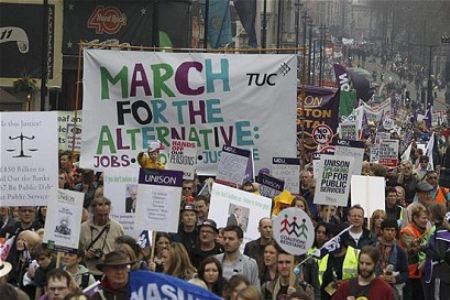
Hundreds of thousands of British opposed to the coalition government’s budget cuts are marching in London streets, chanting for an alternative to the government’s austerity cuts.
Tens of thousands of teachers, council staff, nurses, students, National Health Service (NHS) officials and many others who are angry at the public cut plans, mounting rates of unemployment, tax rises, pay cuts and pension reforms are partaking in the demonstration.
About 800 coaches were planned to get people from across the country to London to participate in the rally, which is considered the biggest public reaction against the government’s spending cuts since it took office in May 2010 following the general elections. The protesters began marching from Victoria Embankment to Hyde Park.
Hundreds of people from North East traveled to London on Saturday morning to join the London protest. Demonstrators from Aberystwyth to Aberdeen and from Penzance to Perth also arrived in London to denounce the spending cuts along with the Londoners.
British Education Secretary Michael Gove claimed that he could understand people’s anger, but “the difficulty that we have as the government inheriting a terrible economic mess is that we have to take steps to bring the public finances back into balance.”
Unite union’s General Secretary Len McCluskey said the coalition government has exaggerated about the level of the deficit.
Describing his economic plan, McCluskey said, “Our alternative is to concentrate on economic growth through tax fairness so, for example, if the government was brave enough, it would tackle the tax avoidance that robs the British taxpayer of a minimum of £25bn a year.”
Around 100 legal observers are monitoring the policing of the protest, and there are more representatives from other human rights groups on hand to offer advice to demonstrators.
Why are They Making War on Libya?
Reasons and False Pretexts
By DIANA JOHNSTONE | CounterPunch | March 24, 2011
Reason Number One: Regime change.
This was announced as the real objective the moment French president Nicolas Sarkozy took the extraordinary step of recognizing the rebels in Benghazi as “the only legitimate representative of the Libyan people”. This recognition was an extraordinary violation of all diplomatic practice and principles. It meant non-recognition of the existing Libyan government and its institutions, which, contrary to the magical notions surrounding the word “dictator”, cannot be reduced to the personality of one strongman. A major European nation, France, swept aside all those institutions to proclaim that an obscure group of rebels in a traditionally rebellious part of Libya constituted the North African nation’s legitimate government.
Since factually this was clearly not true, it could only be the proclamation of an objective to be reached by war. The French announcement was equivalent to a declaration of war against Libya, a war to defeat Qaddafi and put the mysterious rebels in power in his place.
False Pretext Number One: “to protect civilians”.
The falsity of this pretext is obvious, first of all, because the UN Resolution authorizing military action “to protect civilians” was drawn up by France – whose objective was clearly regime change – and its Western allies. Had the real concern of the UN Security Council been to “protect innocent lives”, it would have, could have, should have sent a strong neutral observer mission to find out what was really happening in Libya. There was no proof of rebel claims that the Qaddafi regime was slaughtering civilians. Had there been visible proof of such atrocities, we can be sure that they would have been shown regularly on prime time television. We have seen no such proof. A UN fact-finding mission could have very rapidly set the record straight, and the Security Council could then have acted on the basis of factual information rather than of claims by rebels seeking international aid for their cause.
Instead, the Security Council, now little more than an instrument of Western powers, rushed ahead with sanctions, referral of alleged present or expected “crimes against humanity” to the International Criminal Court, and finally an authorization of a “no-fly zone” which Western powers were certain to interpret as a license to wage all-out war against Libya.
Once the United States and its leading NATO allies are authorized to “protect civilians”, they do so with the instruments they have: air strikes; bombing and cruise missiles. Air strikes, bombing and cruise missiles are not designed to “protect civilians” but rather to destroy military targets, which inevitably leads to killing civilians. Aside from such “collateral damage”, what right do we have to kill Libyan military personnel manning airports and other Libyan defense facilities? What have they done to us?
Reason Number Two: Because it’s easy.
With NATO forces bogged down in Afghanistan, certain alliance leaders (but not all of them) could think it would be a neat idea to grab a quick and easy victory in a nice little “humanitarian war”. This, they can hope, could revive enthusiasm for military operations and increase the flagging popularity of politicians able to strut around as champions of “democracy” and destroyers of “dictators”. Libya looks like an easy target. There you have a huge country, mostly desert, with only about six million inhabitants. The country’s defense installations are all located along the Mediterranean coast, within easy reach of NATO country fighter jets and US cruise missiles. Libyan armed forces are small, weak and untested. It looks like a pushover, not quite as easy as Grenada but no harder than Serbia. Sarkozy and company can hope to strut their victory strut in short order.
False Pretext Number Two: Arabs asked for this war.
On March 12, the Arab League meeting in Cairo announced that it backed a no-fly zone in Libya. This provided cover for the French-led semi-NATO operation. “We are responding to the demands of the Arab world”, they could claim. But which Arab world? On the one hand, Sarkozy brazenly presented his crusade against Qaddafi as a continuation of the democratic uprisings in the Arab world against their autocratic leaders, while at the same time pretending to respond to the demand of… the most autocratic of those leaders, namely the Gulf State princes, themselves busily suppressing their own democratic uprisings. (It is not known exactly how the Arab League reached that decision, but Syria and Algeria voiced strong objections.)
The Western public was expected not to realize that those Arab leaders have their own reasons for hating Qaddafi, which have nothing to do with the reasons for hating him voiced in the West. Qaddafi has openly told them off to their faces, pointing to their betrayal of Palestine, their treachery, their hypocrisy. Last year, incidentally, former British MP George Galloway recounted how, in contrast to the Egyptian government’s obstruction of aid to Gaza, his aid caravan had had its humanitarian cargo doubled during a stopover in Libya. Qaddafi long ago turned his back on the Arab world, considering its leaders hopeless, and turned to Africa.
While the Arab League’s self-serving stance against Qaddafi was hailed in the West, little attention was paid to the African Union’s unanimous opposition to war against the Libyan leader. Qaddafi has invested huge amounts of oil revenues in sub-Saharan Africa, building infrastructure and investing in development. The Western powers that overthrow him will continue to buy Libyan oil as before. The major difference could be that the new rulers, put in place by Europe, will follow the example of the Arab League sheikhs and shift their oil revenues from Africa to the London stock exchange and Western arms merchants.
Real Reason Number Three: Because Sarkozy followed BHL’s advice.
On March 4, the French literary dandy Bernard-Henri Lévy held a private meeting in Benghazi with Moustapha Abdeljalil, a former justice minister who has turned coats to become leader of the rebel “National Transition Council”. That very evening, BHL called Sarkozy on his cellphone and got his agreement to receive the NTC leaders. The meeting took place on March 10 in the Elysée palace in Paris. As reported in Le Figaro by veteran international reporter Renaud Girard, Sarkozy thereupon announced to the delighted Libyans the plan that he had concocted with BHL: recognition of the NTC as sole legitimate representative of Libya, the naming of a French ambassador to Benghazi, precision strikes on Libyan military airports, with the blessings of the Arab League (which he had already obtained). The French foreign minister, Alain Juppé, was startled to learn of this dramatic turn in French diplomacy after the media.
Qaddafi explained at length after the uprising began that he could not be called upon to resign, because he held no official office. He was, he insisted, only a “guide”, to whom the Libyan people could turn for advice on controversial questions.
It turns out the French also have an unofficial spiritual guide: Bernard-Henri Lévy. While Qaddafi wears colorful costumes and dwells in a tent, BHL wears impeccable white shirts open down his manly chest and hangs out in the Saint Germain des Près section of Paris. Neither was elected. Both exercise their power in mysterious ways.
In the Anglo-American world, Bernard-Henri Lévy is regarded as a comic figure, much like Qaddafi. His “philosophy” has about as many followers as the Little Green Book of the Libyan guide. But BHL also has money, lots of it, and is the friend of lots more. He exercises enormous influence in the world of French media, inviting journalists, writers, show business figures to his vacation paradise in Marrakech, serving on the board of directors of the two major “center-left” daily newspaper, Libération and Le Monde. He writes regularly in whatever mainstream publication he wants, appears on whatever television channel he chooses. By ordinary people in France, he is widely detested. But they cannot hope for a UN Security Council resolution to get rid of him.
~
Diana Johnstone is the author of Fools Crusade: Yugoslavia, NATO and Western Delusions.She can be reached at diana.josto@yahoo.fr
JAPAN: RADIATION ‘SAFE’, PRESS EVACUATES, INVESTORS SCARED
NO RADIATION THREAT SAYS MEDIA: REPORTERS PULLED OUT OF JAPAN
Meanwhile, Frightened Investors in the USA and Europe Seek Protection
by keith harmon snow | 20 March 2011
Reporting about the nuclear crises in Japan and around the world is getting curiouser and curiouser. Western media are heavily downplaying the threat of radiation in what amounts to an Alice in Wonderland fable of disinformation straight out of the rabbit hole.
Worried about profits and the the destabilization of the YEN and NIKKEI Index, the media is doing damage control to help keep people from flooding out of Japan and further destabilizing the Japanese economy. Given the evidence, the history of disasters and epidemics of disease, reporting that downplays Japan’s radiation threat is criminal.
Meanwhile, back in the U.S.A., frightened investors are seeking protections and insurances from industry and government. Wall Street is worried. This is getting curiouser and curiouser.

The irony: “art project” photographed in Tokyo depicts humans in states of decay, resembling images of children with deformed limbs born near Chernobyl. © Keith Harmon Snow, 1992
For example, on 20 March 2011, CNN ran a video story, “Facts whisper, fears scream during crises,” where their experts proclaim that fears of radiation are unfounded and misinformation abounds. CNN’s latest nuclear expert — Dan Polansky — calls this radiophobia: an irrational fear of radiation with no basis in fact. Even for the Japanese nuclear workers who are closest to the Fukushima hot zone, says CNN reporter Stan Grant, “radiation might make people sick, but it won’t kill them.”
Meanwhile, CNN describes Dan Polansky as a “nuclear expert”, who “specializes in weapons of mass destruction and knows about radiation.” What they don’t tell us is that Polansky works for the Georgia (USA) Department of Community Health, he studied at the Lawrence Livermore National Laboratory (LLNL) and the Idaho National Engineering Laboratory (INEL), and is a recent graduate of Radiological Emergency Planning at the Harvard School of Public Health.
Pretty good credentials, no doubt. Must be telling the truth. [Quack.]
However, LLNL and INEL are two of the Department of Energy and Department of Defense top classified weapons laboratories, both also SUPERFUND sites of massive toxic nuclear waste. Work at national laboratories like INEL and LLNL requires high-level national security clearances: it looks like Daniel Polansky is another spook.
The Harvard School of Public Health (HSPH) has produced some studies that show some incidence of disease around the Yankee Rowe reactor (Rowe, MA, U.S.A.), which is now decommissioned; but they have also helped to whitewash nuclear (and other) risks of modern day society.
This is indeed very curious.
The Harvard Center for Risk Analysis (HCRA) was founded by John D. Graham and specializes in advocating forms of risk-assessment widely criticized by community groups and legitimate health professionals. The Center gained funds from both industry and government agencies, including nuclear interests like: General Electric, the Edison Electric Institute, Electric Power Research Institute, New England Electric System (at least five nukes on the New England power grid) and Westinghouse Electric. GE and Westinghouse are two of the U.S.A.’s biggest nuke companies, and EPRI is a pro-nuke think tank that has produced propaganda about nukes for more than four decades.
Harvard School of Public Health and the Harvard Center for Risk Analysis are not the same thing. Harvard School of Public Health supports the nuclear industry and helps to downplay radiation threats at many levels. However, Harvard Center for Risk Analysis is an industry front producing junk science — spurious information posited as science — and debunking truth everywhere in the corporate media.
Looking a little deeper down the rabbit hole we find, for one curious example, that David Ropeik is an Instructor in the Harvard University School of Continuing Education, Environmental Management program. Ropeik is also a former affiliate at the Harvard Center for Risk Assessment (which he says he left in 2004).
According to his own public relations biography advertised on the BAYER CropScience web page [Bayer is the big German multinational pharmaceutical corporation], Ropeik has also worked closely with the Harvard School of Public Health (HSPH) and he “has been interviewed on risk perception by ABC Nightline, National Public Radio, NBC Dateline, ABC 20/20, Fox News, CNN, CNN International, BBC, CBC, CNBC, Voice of America, and dozens of regional radio stations nationwide.”
He has also “taught courses on media coverage of risk issues at the Harvard School of Public Health, the Kennedy School of Government, the Neiman Fellowship Program at Harvard, the Knight Science Journalism Fellowship program at MIT, Boston University’s Program in Science Journalism, the Emerson College program in Health Communication, and to the National Association of Science Writers, the Council for the Advancement of Science Writers, and the Society of Environmental Journalists.”
A long-time member of the Society of Environmental Journalists, David Ropeik is now a private consultant in Risk Perception, Risk Communication, and Risk Management with Ropeik & Associates, whose nuclear clients include Entergy Power Corporation (owns the dangerously unsafe Vermont Yankee Nuclear Power Station), Edison Electric Institute, the Electric Power Research Institute, the American Nuclear Society, the Egyptian Nuclear Authority, the International Atomic Energy Agency, the Nuclear Institute, the Massachusetts Department of Public Health (who did a study on the incidence of disease on the radiation ‘pathways’ from the Yankee Rowe Nuclear Power Station), The Veterans Board for Dose Reconstruction, Department of Defense, and etc., and etc., and etc.
“Risk is a subjective affair,” reads the home page of Ropeik & Associates. “It’s not just a matter of the facts, but also how those facts feel. Understanding why some risks feel more frightening, and some less, is essential for communicating about risk effectively, and for tackling the human behavioral aspects of overall risk management.”
As far as the Society of Environmental Journalists, this is just another trade industry group, like any ‘Society of Professional This-or-That’, which maintains deep ties to industry and the media corporations that have censored and distorted the truth about radiation, nuclear weapons and nuclear power. For example, a look at their sponsors and foundation donors quickly leads to a large list of corporate interests, including nuclear corporations.
What a curious world we live in.
Given that there is “so little threat from radiation” in Japan, it is very curious that NBC pulled their entire news team out of Japan. Curiously, it seems that CNN’s Anderson Cooper also pulled out of Japan — and who could blame him! — and is now reporting on Libya from somewhere else (Hong Kong?).
On March 20, 2011, Japanese Officials confirmed radiation food poisoning. “Chief Cabinet Secretary Yukio Edano said checks of milk from Fukushima prefecture, where the plant is located, and of spinach grown in Ibaraki, a neighbouring prefecture, surpassed limits set by the government… It was the government’s first report of food being contaminated by radiation since the March 11 quake and tsunami unleashed the nuclear crisis.”
Thousands of U.S. military families have also been evacuated from Japan under the U.S. Department of Defense ‘voluntary evacuation’ program initiated because of radiation concerns.
Meanwhile, on March 19, 2011 financial media began reporting that U.S. investors seeing the nuclear industry in Japan crash, burn and melt are frightened of Financial Losses due to Boring Utility Debt.
Curiouser and curiouser.
“Investors are seeking protection from a public backlash against nuclear power producers as the threat from earthquake-damaged reactors in Japan stokes calls by U.S. lawmakers to limit plants in this nation,” reported Bloomberg News.
“Utility companies, typically considered a haven among credit investors because of their resilience in economic downturns, are being punished as Tokyo Electric Power Co. struggles to cool damaged reactors. Environmental groups want limits on U.S. nuclear plants, and Representative Edward Markey is seeking a moratorium on facilities in seismically active areas. Nuclear-power executives say the nation’s reactors can withstand such disasters.”
Behind the scenes, corporations and money markets managers and futures investors are swapping debt portfolios and jockeying to maximize profits and minimize losses.
While the people of Japan suffer the fate of massive radiation emissions — ‘leaks’ is another term invested by the industry and used by media to downplay the invisible radiation dispersed near any reactor — the utility companies are portrayed as the victims. Utility companies are “being punished” and “investors seeking protection” are now the victims.
Curiouser, and curiouser, and curiouser.
~
March 23, 2011
Guns and Butter KPFA radio program interviews Kieth Harmon Snow
See also:
Featured Video

Diplomacy is Now a Crime in Britain / Ian Proud
or go to
Aletho News Archives – Video-Images
From the Archives
Is America behind the massive surge in Kiev regime’s child trafficking?
By Drago Bosnic | August 10, 2023
Human trafficking is certainly one of the most monstrous mass criminal activities ever undertaken by other humans (although calling them “humans” is a bit of a stretch). And yet, there’s a special kind of this deeply repulsive crime that pushes it to diabolical proportions – child trafficking. Underage kids, particularly those who were abandoned, sold or have very poor/abusive family backgrounds, are by far the most vulnerable group. The depraved criminals who engage in such illicit activities specifically target unfortunate children and given there are millions of them all around the globe, particularly in war-torn areas, the “recruitment pool” is effectively endless. Unfortunately, the demand on the black market also seems to be constant and growing, making it a very lucrative and appealing prospect for criminals. … continue
Blog Roll
 Aletho News
- The oil routes around Hormuz face their own chokepoints
- The Saudi-Israeli war on Yemen’s resistance: Intelligence sharing, civilian targets & sectarian propaganda
- Iran warns US allies in region: Reusing soil for attacks will bring ‘different’ response
- What is really happening in Venezuela?
- Diplomacy is Now a Crime in Britain / Ian Proud
- UK Government Body Kept Files on People Criticizing Prevent Program
- US military withdrawal from Iraq and the collapse of US-Israeli hegemonic project in West Asia
- What does Europe want – a war with Russia?
- She Followed the Actual Data on COVID Vaccines and Masks — Her Career Took a Huge Hit
- Florida AG Sues Pfizer, Bourla Over Deceptive Marketing of COVID Vaccines
- If Americans Knew
- No big deal: Israel to halt humanitarian aid to Gaza for 2 days – Daily Update
- Israel is squeezing the life out of Palestinians – Daily Update
- The Israeli Right Portrays Islam as Murderous. It Serves a Political Purpose
- Jordan Has Had Enough: King Abdullah’s Scathing Warning to Israel
- Israeli Colonizers (i.e. Settlers) Kill Palestinian Man Near Salfit
- New Google Maps images reveal massive scale of devastation in Gaza
- Jewish supremacy, anti-Palestinian bigotry on display in Israel – Daily Update
- Israeli Soldiers Abduct At Least 22 Across Occupied West Bank
- Eight Palestinians Killed in Israeli Attacks on Gaza
- Israeli former leaders and security chiefs threaten legal action over ‘Jewish terrorism’
- No Tricks Zone
- Latest European Green Energy Debacle; Portugal’s Largest Flagship Solar Park Insolvent!
- Green Energy Debacle: German Expert Professor Fritz Vahrenholt Warns Of Severe Economic And Social Consequences
- Two More Paleo Reconstructions Affirm Meters-Higher Sea Levels Across Ireland, Brazil 7000-6000 Years Ago
- New Study: Earth And Venus Surface Warmth Largely Explained By Convection And Lapse Rate, Not CO2 Or Radiation
- 2025 Nature Paper Claiming Worsening Global Drought Gets RETRACTED …Heavily Flawed
- New Study: ‘Global Drought Shows No Detectable Recent Acceleration Under Climate Warming’
- Economic Masterminds: German Socialists Suggest Taxing Productivity Gains Stemming From Using AI
- The South China Sea Has Not Been Cooperating With The Climate Change Narrative
- Energy Crisis: Germany Enters Heating Season With Historically Low Gas Reserve Fill Levels
- New Study: The Antarctic Ice Sheet Gained Mass From 2020-2024 Due To Staggering Snow And Ice Accumulation

