EU to tap frozen Russian assets
RT | October 22, 2024
The European Parliament has approved a €35 billion ($38 billion) loan to Ukraine to be repaid with revenues from frozen Russian assets, according to an official statement on Tuesday. The financing fulfils the EU’s share of a $50 billion aid package for Kiev agreed by G7 countries in June.
MEPs approved the move with 518 votes in favor, 56 against and 61 abstentions, the parliament announced. The funds will be transferred through the end of next year, it added.
Future revenues from frozen Russian Central Bank assets will be made available to Ukraine to service the EU loan and loans from other G7 partners. The statement added that Kiev may also allocate the funds “as it sees fit.”
The proposal was endorsed earlier this month by EU governments. The European Council now plans to adopt it as a regulation, and it will enter into force after its publication in the Official Journal of the EU, the statement notes.
The EU froze approximately €210 billion ($227 billion) in Russian Central Bank assets following the start of the Ukraine conflict in February 2022. Russia has denounced the move as “theft.” The immobilized assets had generated €3.4 billion ($3.7 billion) in interest as of mid-July, according to Brussels-based central securities depository Euroclear, which holds most of Russia’s funds. In July, a transfer of €1.5 billion ($1.6 billion) of that money was approved by the European Commission to support Ukraine’s “military capabilities.”
The US is reportedly planning to contribute up to $20 billion to the G7 package, also on condition that the funds are repaid using proceeds generated by the immobilized Russian assets.
The US previously expressed concern that the EU policy of reviewing Russia sanctions every six months makes repayment of the loan uncertain as it could result in a lapse in restrictions. In response, Brussels proposed extending the renewal timeframe to three years. Hungary opposed the idea and said it would delay a decision until after the US presidential election on November 5.
Kiev’s Western backers have been trying to accelerate negotiations over the loan due to mounting concern that Washington’s aid to the country could be cut off if Donald Trump returns to the White House, Financial Times reported last week. The former US president has repeatedly threatened to scale back assistance if he is elected.
Moscow maintains that any seizure of its funds is illegal under international law and would further undermine global trust in the Western financial system.
US-Russia trade expected to fall to lowest level since 1992 under Biden regime
Sputnik – 19.10.2024
MOSCOW – The trade between Russia and the United States is expected to decline to $3.7 billion by the end of this year, the lowest level since 1992, according to Sputnik’s calculations based on data of the US statistical service.
Russian exports to the US from January to August amounted to $2.26 billion, down from $3.4 billion the previous year. Based on current trends, annual shipments may reach approximately $3.12 billion, which would be a third lower than previous year’s volumes and the lowest level since 1993.
Meanwhile, US business sales to Russia fell by 16% over eight months, totaling $334 million. For the year, they are expected to reach a record low of $539.3 million, down by 10% compared to 2023, according to Sputnik’s calculations.
During Joe Biden’s presidency, trade between the two countries has decreased sixfold. In 2020, the last year of Donald Trump’s term, trade was at $21.8 billion. This figure was slightly lower in 2016 under Barack Obama, who initiated the first wave of sanctions against Russia, at $20.4 billion.
US to pay $20 billion into loan for Ukraine – FT
RT | October 19, 2024
The US is set to provide up to $20 billion to Ukraine as part of a G7 loan, which will then be repaid using proceeds generated by the Russian assets immobilized by the West as part of Ukraine-related sanctions, Financial Times has reported, citing sources.
Kiev’s backers have been trying to accelerate negotiations over the loan in an effort to secure funding to Ukraine before the end of the year, due to mounting concern that Washington’s aid to the country could be cut off if Donald Trump wins the upcoming US election, FT noted, in an article posted on Friday. The former US president has repeatedly threatened to scale back assistance to Kiev if he were elected.
The US and its allies have frozen an estimated $300 billion in assets belonging to the Russian state after the Ukraine conflict broke out in 2022. The bulk of the money, nearly €197 billion ($214 billion) is being held by Brussels-based clearinghouse Euroclear. The immobilized funds have generated €3.4 billion ($3.7 billion) in interest as of mid-July, according to the depository.
Moscow has denounced the freeze as “theft” and said that any seizure of its funds would be against the law and would further undermine global trust in the Western financial system.
In June, G7 members agreed to grant Kiev a $50 billion loan to be financed by interest from the frozen Russian assets. The US and the EU were initially expected to provide $20 billion each as Canada, Japan and the UK were set to jointly lend the rest of the massive loan.
Later, to reassure allies that the bloc’s sanctions regime on the funds is not lifted, Brussels proposed a three-year extension of the EU’s mandate to freeze Russian assets. EU lawmakers have been renewing their sanctions every six months by unanimous decision, meaning that each vote may bring about a break in restrictions. Hungary opposed the proposal, and announced plans to postpone the decision until the US presidential elections on November 5.
Last week, the EU approved its own contribution of up to €35 billion to the G7 loan, but the bloc would need to contribute less if Washington provided the full $20 billion, Reuters reported last week. The funds, which will be managed by the World Bank, will be used for several purposes, including defense or humanitarian needs.
US senior officials, however, told FT that Washington would provide the full agreed $20 billion, even if the EU failed to convince Hungary’s premier Viktor Orban to drop his veto on extending EU sanctions, which had previously been voiced among the US demands. According to two sources cited by the paper, G7 finance ministers will make a statement on the distribution and structure of the loan on the sidelines of the IMF and World Bank meetings on October 25.
EU’s ‘arm-twisting’ making Serbia turn to BRICS – Kremlin
RT | October 16, 2024
BRICS is a more welcoming and member-oriented group than the European Union, Kremlin spokesman Dmitry Peskov has said, commenting on the possibility that Serbia could seek to join the economic bloc.
His comments came after Belgrade said that instead of EU membership, it would explore the option of joining BRICS, which is currently chaired by Russia.
“Serbia has been having its arm twisted. They [the EU] always lay down conditions for cooperation and demand certain actions,” Peskov told the Mayak radio station. “We are certain that Serbia will make decisions that are most beneficial to its people,” he added.
The Balkan country applied to join the EU in 2009 and has been a candidate for membership since 2012. In an interview on Sunday, Serbian Deputy Prime Minister Aleksandar Vulin accused Brussels of moving the goalposts for accession, most recently by linking Belgrade’s membership to severing relations with Moscow.
“BRICS does not impose any conditions on anyone. It’s based on mutual respect and the readiness to address concerns and interests of members. No one there says ‘either, or.’ That’s why [the group] is so attractive to a raft of countries,” Peskov stated.
Another long-time EU hopeful, Türkiye, officially applied to join BRICS in September, becoming the first NATO state to do so.
Azerbaijan, Algeria, Vietnam, Indonesia, Pakistan, Malaysia, Nigeria, Thailand, Venezuela, Kazakhstan, Palestine, DR Congo, Gabon, Bangladesh, Bahrain, Kuwait, Senegal, Cuba, Belarus, and Bolivia are among the other nations that have expressed their wish to join BRICS.
The Russian city of Kazan will host the annual BRICS Summit later this month. A Serbian delegation will attend, along with others from a raft of countries, including members Brazil, India, China, South Africa, Egypt, Iran, Ethiopia, and the United Arab Emirates.
Russian President Vladimir Putin said in September that the current BRICS states had agreed to discuss granting partner status to some aspiring members and to potentially approve some of the bids during the Kazan summit from October 22 to 24.
If agreed upon, partner status will become a new form of partial BRICS membership, intended to act as a gradual transition toward full integration into the group.
Iran Halts Flights to Europe Over Sanctions Slapped on Iran Air – Association
Sputnik – 15.10.2024
TEHRAN – Iran has suspended all flights to Europe after the European Union imposed sanctions against the Iran Air national carrier, the Association of Iranian Airlines (AIRA) said on Tuesday.
“Iran Air was the only airline that operated flights to Europe in our country. After new EU sanctions were imposed on Iran Air, no Iranian aircraft will fly to Europe,” AIRA Secretary General Maqsoud Asadi Samani was quoted as saying by the Ilna news agency.
Brussels accused the persons and entities under the latest package of sanctions of being involved in ballistic missile supplies to Russia. Iran rejected the accusations.
On Monday, the Council of the EU adopted sanctions against seven Iranian individuals and seven organizations, including Iran Air, for alleged military cooperation with Russia.
Druzhba: Oil Mega-Pipeline That Evaded US Sabotage to Power Eastern Europe’s Economic Boom
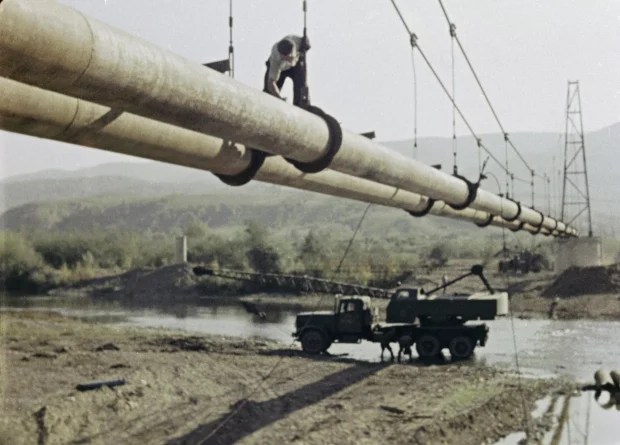
A section of the Druzhba pipeline being erected in Carpathia over a local waterway. September 1962. © Sputnik / I. Arons
By Ilya Tsukanov – Sputnik – 15.10.2024
Tuesday is the anniversary of the creation of Druzbha – the world’s longest oil pipeline, and one of the most technically sophisticated pieces of man-made engineering every created. Here’s what’s important to know about the project, why it was conceived, and why the US and its allies tried, but failed, to stop it.
October 15 marks the 60th anniversary of the inauguration of the Druzhba (‘Friendship’) oil pipeline. Conceived in 1958 at a meeting of the Council for Mutual Economic Assistance – the Soviet-led analogue to Western European integration, Druzhba helped forge closer economic links between the USSR and its Eastern European allies, and eventually, between Russia and the whole of Europe.
Drawn up to aid an economic boom being experienced by Eastern Europe, Druzhba was built to replace more costly and infrastructure-intensive rail-based oil deliveries.
Sourcing oil from the Volga-Ural oil and gas basin and starting off in Almetyevsk, modern-day Tatarstan, Druzhba runs west to Mozyr in Belarus, where it splits into two routes – one to eastern Germany via Poland, and another through Ukraine toward Bratislava in Slovakia, Prague in the Czech Republic and Budapest in Hungary.
Members of the Soviet-led economic alliance, namely Albania, Hungary, Poland, and Czechoslovakia, contributed equipment and know-how, with the USSR and Poland delivering 730,000 tons of 420-1,220 mm pipes, East Germany pumps for pumping stations, Hungary automation equipment and communications gear, and Czechoslovakia valves and fittings.
The US sought to sanction the project into submission, slapping restrictions on Western European sales of large-diameter pipes to the Eastern Bloc after the Cuban Missile Crisis of October 1962. Russian Chelyabinsk’s industrialists saved the day, creating pipes of the necessary diameter.
The success of the project led to the construction of a second line – known as Druzhba-2 and running along the same route, in 1974.
With Moscow selling oil to allies via long-term contracts, Eastern Europe was largely insulated from the oil shocks suffered by the West in the 1970s and early 1980s. Between 1971 and 1980, Hungary’s material national income rose by 62%, East Germany’s by 59%, Poland’s by 73%, Czechoslovakia’s by 57%, and capital construction in these countries grew 1.9, 1.7, 2.2, and 1.8 times, respectively.
This allowed the region to build tens of millions of new apartments, industrial goods and finished products ranging from cars and electronics to household goods.
After the USSR’s collapse, Germany’s reunification and the European Union’s expansion, Druzhba became a key source of fuel for Europe’s economic prosperity, helping Eastern Europe with its difficult transition to the market, and Germany in its effort to build on its status as an industrial powerhouse.
Accounting for expansions (including extensions to deliver oil to southern Germany and Austria), Druzhba holds the record as the longest oil pipeline network in the world, consisting of a whopping 8,900 km of pipe, 46 pumping stations, 38 intermediate pumping stations, and reservoirs that can hold up to 1.5 million cubic meters of oil.
Druzhba is also one of the most technically-sophisticated manmade engineering projects in history, crossing the Volga, Oka, Don, Dnepr, Dniestr, Vistula and Dunabe rivers and hundreds of smaller waterways, thousands of roads and railways, the Pinsk Marshes and the mountains of Carpathia.
The pipeline has an estimated capacity to pump up to 2 million barrels per day, or nearly a fifth of Russia’s total oil output. Until recently, it accounted for up to half of all Russian oil exports.
Killing Druzhba?
The US, the Eu and Ukraine have taken a series of steps to try and effectively kill the Druzhba-based energy partnership between Russia and Europe, with the EU banning deliveries of Russian oil through the northern portion of the pipeline in the summer of 2024, and Ukraine raising transit costs by more than 75%, and in July 2024 prohibiting supplies of Lukoil oil through the pipeline’s southern line to Hungary and Slovakia.
While Russia has proven able to replace its dependence on Druzhba by forging new energy ties with countries in the Global South, including India and China, Europe has been trapped by its own restrictions into buying more expensive and less dependable energy sourced in the US, leaving economic growth stagnant and industrial competitiveness in jeopardy.
French MEP backs Medvedev’s attack on NATO
RT | October 14, 2024
Former Russian President Dmitry Medvedev was stating the “absolute truth” when he took aim at NATO countries and their support for Ukraine in a scathing recent social media post, French MEP Florian Philippot has said.
The European Parliament member was commenting on a post published by Medvedev on Sunday, in which he pointed to the problems that Ukraine’s Western backers are facing with their economies.
“The West has no money to clean up Florida after Hurricane Milton, no money for French farmers, no money to revive the German industry,” Medvedev, who now serves as deputy head of the Russian Security Council, wrote on Telegram.
These countries, however, still have funds to bankroll “a bunch of drunk and crazy” Ukrainians and to produce weapons “to exterminate the Slavs in the military conflict,” he added.
In a post on X, Philippot, who is leader of the Patriots party, wrote that Medvedev “just smashed the NATO countries by throwing absolute truths at them.” Philippot also took aim at French President Emmanuel Macron, saying he is “also taking a beating” for his recent pledge of a “new check for 3 billion to Zelensky.”
Philippot called on Macron to “stop these checks and these arms shipments,” arguing that Medvedev’s remarks are “factually terribly true!”
During a visit last week to a military camp in eastern France to inspect the training of Ukrainian troops, Macron pledged some €3 billion ($3.3 billion) worth of military aid for Kiev this year. Earlier in 2024, French farmers staged massive protests across the country, demanding that preferential trade rules granted to Kiev be lifted and calling for more government support.
In the US, former President Donald Trump last week accused the administration of President Joe Biden of neglecting the survivors of Hurricane Helene in the southeastern part of the country while sending billions of dollars in aid to Ukraine.
Meanwhile, Germany, which has emerged as one of Kiev’s top backers, is facing a new recession and its economy is set to contract for a second straight year due to shrinking industrial output, high energy prices, and weak foreign demand, according to reports.
EU Leaders Face Grim Reality: How Did Bloc Seal Status as Wilting Geopolitical Power?
By Ilya Tsukanov – Sputnik – 13.10.2024
Back in the spring of 2022, Russia’s president warned that the European Union’s “suicidal” and “absolutely political” decision to wean itself off of cheap and dependable Russian pipeline energy would culminate in the serious and “perhaps irreversible” loss of competitiveness against other world powers.
“The European project is approaching a tipping point” and threatens to fall into “apathy” and geopolitical irrelevance thanks to internal “political paralysis, external threats and economic malaise,” Bloomberg European Politics & Economics managing editor Ben Sills has suggested in a wistful ode to the EU’s unenviable political and economic prospects in the years to come.
“After decades of warnings and sub-par growth, the region’s leaders are suddenly confronting a barrage of evidence that decline is becoming unstoppable,” Sills’ piece, appearing on the NY-headquartered business news agency’s front page on Sunday, warned.
Pointing to a string of political and economic ‘bad news’ for Europe’s Europhile forces, from gains by the populist right in France to German carmaker giant Volkswagen’s threats to close factories, to Silicon Valley’s exit from European markets over stringent AI rules, the observer suggested that the developments demonstrate “the EU’s failure to act as a cohesive and dynamic economic bloc” against both adversaries and potentially, its allies across the Atlantic.
“If you wanted to be a geopolitical power, then economic might is the key ingredient,” Free University in Brussels professor Guntram Wolff told the outlet, stressing that in Europe, “productivity growth has just been a disaster,” and that while the region “is still rich… these differentials over 20 years have massive implications.”
“Something is changing very dramatically and very, very deeply in this world,” ex-Polish president Aleksander Kwasniewski said. “We can’t react correctly, because we are too slow,” he warned.
By comparison, while the US and China – Europe’s major competitors, face problems of their own, they at least have institutions for centralized decision-making, and the ability to “generate vast amounts of private or public capital for defense and investment in cutting-edge technology” – something that’s not the case in the EU’s case.
Sills pointed to surprisingly frank comments by Emmanuel Macron at a panel in Germany earlier this month, where the French president highlighted the “risk” the bloc faces of finding itself “out of the market” if it continues its classic strategies, and pointed to the loss of cheap Russian energy supplies after 2022, combined with the Biden administration’s moves to lure European industries out of the bloc via cheap energy and subsidies, as central to undermining the EU’s export-centered economies’ competitiveness.
“That adds to pre-existing challenges posed by the rise of China and its own vast manufacturing machine, and the global leap forward in technology innovation that has largely bypassed the region,” Sills suggested, warning that “the result threatens to cause damage that goes beyond simply lagging in investment and productivity,” causing EU leaders to ‘lose faith’ in the European project itself.
“It’s not just Eurosceptics like Hungary’s Victor Orban, a perennial thorn in the bloc’s side. Officials in core European countries are starting to view the EU as an obstacle they need to get around – rather than the source of prosperity and protection it has represented until now,” the observer stressed, pointing, for example, to Paris’s talk of integration with a smaller bloc of Western European economies, and divisions on issues like defense and Chinese investment inflows.
But the EU’s woes have been a longtime coming, Sills stressed, pointing out that the bloc has been in “relative decline” going as far back as the euro monetary union in the late 1990s, and citing a Bloomberg analysis estimating that the bloc would be €3 trillion richer “if it had kept pace with the US – enough to boost the income of the average worker by about €13,000 a year.”
Instead, after 2008 and particularly since 2022, many of the region’s traditional powerhouse economies, including Germany, have been teetering on the brink of and occasionally slipping into recession, and facing deindustrialization amid self-inflicted, unsustainably high energy prices, loss of markets and increasingly potent foreign competition.
“Today we see that for absolutely political reasons, due to their own ambitions and under pressure from their American overlords, European countries are imposing more and more sanctions on the oil and gas market,” President Putin said in May 2022 as Brussels announced plans to wean itself off of cheap and dependable pipeline-delivered Russian oil and gas.
“Rejection of Russian energy resources means Europe will systematically become the region with the highest energy costs in the world… This will seriously – and according to some experts irrevocably – undermine the competitiveness of a significant part of European industry, which is already losing the competition to companies in other regions of the world,” Putin said at the time. “One gets the impression that our Western colleagues, politicians and economists have simply forgotten the foundations of the elementary laws of economics, or, to their detriment, prefer to deliberately ignore them,” he added.
West must come to terms with the fact that it’s strategy has completely failed, get real about peace terms
By Sergey Poletaev | RT | October 12, 2024
Joe Biden is expected to make some new decisions regarding Ukraine in the weeks leading up to the country’s November elections. The US president was supposed to attend an important meeting of Kiev’s backers in Rammstein, Germany, on October 12, but canceled his visit, citing the need to stay at home due to Hurricane Milton.
What decisions can we expect to be made when it eventually takes place? Most likely, nothing particularly important will happen – here’s why.
A unified stance
Amidst the fog of propaganda, it can be hard to discern true motives, and often these only become clear over time.
After the start of Russia’s military operation, in February 2022, Western media presented a unified and convincing narrative: the entire so-called “free world” came together to defend Ukraine, determined to deliver a strategic blow to Russian President Vladimir Putin and restore the US-led global order. However, these proclamations didn’t match the steps taken by the West. After all, if your goal is to defeat an opponent, shouldn’t you do everything in your power to achieve it?
If the West was counting on a Ukrainian military triumph, it should have provided as much military aid to Kiev as possible. The first step would have been to open up full access to Western weapons arsenals; the second would have been to accept the country into NATO and turn it into a key stronghold on the border with Russia. Even if Putin would have done everything to stop this, such a step would automatically signify his defeat, since even a nuclear strike wouldn’t be able to change the situation and reverse the West’s decision.
Historical examples clearly illustrate this point. For instance, after withdrawing its troops, the West provided South Vietnam with nearly 3,000 aircraft and helicopters, 200 ships, over 2,500 combat boats, more than 1,000 tanks, up to 2,500 towed and self-propelled artillery pieces, and around 100,000 heavy vehicles, along with other equipment. Compare this to the situation in Ukraine, where receiving a dozen outdated fighter jets or two dozen old tanks is a major event.
Let’s take another example. In the aftermath of WWII, and during the Cold War, Türkiye became a key strategic region. Then Soviet leader Joseph Stalin demanded the country’s neutrality and even sought to establish a Soviet naval base in the area of the Bosphorus and Dardanelles straits. The USSR’s former allies, the US and UK, could not allow a Soviet military facility in the Mediterranean Sea, so Türkiye was accepted into NATO just three years after the alliance was formed, despite the fact that the country had nothing to do with the North Atlantic region or ‘Western democracies’. At the time, the Truman Doctrine was in effect, and the US was offering a security umbrella to anyone ‘under threat’ from communism.
The West isn’t buying Zelensky’s ‘Victory Plan’. So what happens next?
Why are things different now? The doctrinal principle that has shaped the West’s policy on Ukraine since 2014 is to prevent Putin from achieving his goals without engaging in a direct military conflict with Russia.
Biden and his administration have consistently stated that their priority is to avoid a full on confrontation with Russia, yet this message has largely been forgotten.
How does this principle align with what we have today – the largest armed conflict in Europe since World War Two, in which the West is fighting Russia by means of the Ukrainian army? Sure, it may not be on the same scale as Vietnam, but the military aid provided to Kiev is still significant.
The answer is simple: the decision-makers in the West – often referred to as the globalists – never truly believed that Ukraine could defeat Russia on the battlefield (Well, let’s say almost never; there was one notable exception, which we’ll discuss later).
Biden’s doctrine implied that the West could achieve its goals through financial and trade strategies. Recognizing that an armed conflict was looming, the globalists spent years developing an “economic nuclear bomb” that was supposed to bring Russia to its knees.
The plan was ambitious: they assumed that unprecedented “sanctions from hell” would essentially block Russia’s access to the outside world, plunging it into economic chaos and ultimately toppling the country’s current ruling elite. Maybe this wouldn’t happen overnight; perhaps it would take years, but the idea was that the Russian government would eventually yield to the demands of a people suffering from the sanctions, and would then yield to Western demands without firing a single shot. This would not only serve as a harsh lesson for Russia but would also send a strong message to the main enemy: China.
Ukraine’s military resistance wasn’t factored into this equation; many will recall that the Pentagon initially estimated that Kiev would fall within three days. Ironically, the US thought that if the 30-million-strong nation found itself under Russian control (the legitimacy of which no country in the world would officially recognize), it would become an unbearable burden for Putin and would only hasten Russia’s economic collapse.
How to lose friends and alienate sponsors: Zelensky is making enemies in America
Moscow failed to achieve its goals through a swift and relatively bloodless military operation, while the West eventually realized that its sanctions didn’t achieve the intended effect either – or perhaps even backfired. After brands like Ikea, Starbucks, and Disney left Russia, the Russian people didn’t rise up to overthrow Putin; and the seizure of rich people’s yachts and mansions didn’t spur a regime change either.
In reality, the globalists dramatically overestimated the West’s influence over economic processes, not only in the so-called Global South but even in their own backyard. Three years into the conflict, they still cannot prevent dual-use and military goods from entering Russia, let alone everyday consumer products. Moscow quickly rerouted its trade flows, bypassing the West, found new partners, prioritized import substitution, and, despite certain challenges, achieved noticeable and sustained growth in its economy and foreign trade. All of this turned out to be beyond Western control.
So, the original plan didn’t work out, and this prompted the West to urgently invent a new strategy.
At the same time, the Russian military didn’t take Kiev, and strategically withdrew from northern Ukraine. Vladimir Zelensky convinced NATO countries that this was the result of the military triumph of the Armed Forces of Ukraine (AFU). He argued that if the West provided Ukraine with enough weapons, it could hold out for a significant period of time. Back then, in the spring of 2022, the outcome of the economic war was still unclear, and with no better ideas on the table, the West settled on the following plan: the Ukrainian army would wear Russia down in combat, while Western sanctions would do the rest.
The Rammstein meetings on Ukraine became a platform for making major decisions regarding military supplies; at the same time, Western diplomats toured the Global South, urging it to join the economic war against Russia.
At that time, there was still no talk of admitting Ukraine into NATO or directly intervening in the conflict. However, at some point, the West came to believe its own propaganda: it came to think of the Russian army as a paper tiger which might be easier to crush than the Russian economy. At that point, Western leaders became convinced that they could force Putin to bend to their will through military rather than economic means.
This shift occurred in the fall of 2022, after Ukraine’s attack on the Crimean Bridge, and advances in Kherson and Kharkov regions, the chaos of partial mobilization in Russia, and the resulting emigration of some dissenters. At that time, some seemed to believe that one more push could bring Putin down.
Riding this wave of optimism, the globalists approved a major Ukrainian counteroffensive. Throughout the winter of 2022-2023, tank, artillery, and missile units were formed, and new, highly motivated Ukrainian brigades were trained in Western Europe. They were supposed to break through to the Sea of Azov and bring Putin to his knees. For this counteroffensive, the West supplied Ukraine with as many weapons as it could without compromising its own interests.
A suitcase without a handle
Everyone knows how this story ended. Kiev’s operation failed and became a turning point in the conflict. Having fallen far short of achieving its military goals, Kiev lost the trust of its backers who realized that they were initially right to think that Ukraine could never win this conflict on the battlefield.
However, it also became clear that Biden’s doctrine was ineffective. Russia couldn’t be economically crushed and it couldn’t be defeated on the battlefield. So what now?
Since the spring of 2022, we have often pointed out that the West has to make a choice: either engage in serious negotiations with Russia or enter into a direct military conflict. However, no one in NATO has been willing to take responsibility for such a decision – neither the increasingly incapacitated Biden, or Western European politicians. Who are equally unfit, but for different reasons.
For now, all the West can do is continue to send aid to Ukraine, while the latter can still try to hold out on the frontlines. At the same time, the West is trying to “test the ground” about possible negotiations with Moscow, but so far this has amounted to little more than wishful thinking. NATO has convinced itself that the Kremlin will be happy to freeze the conflict without any commitments, as long as such an option is put on the table.
What happens when this third gamble fails as well? Will the West finally shake off its lethargy and make a clear choice, or will it continue to go with the flow?
It seems that all the scheduled participants of the Rammstein meeting were probably happy enough at the news of its cancellation. Clearly, neither the outgoing US president nor NATO’s European members have any viable ideas regarding Ukraine. This means that, at least until the US elections, Ukraine will continue to endure reverses, to the accompaniment of the globalists’ hollow rhetoric.
Sergey Poletaev is an information analyst and publicist, co-founder and editor of the Vatfor project.
Housing prices are exploding and the EU is going to make it worse, warns Polish MEP
Remix News | October 10, 2024
Housing prices are exploding, warns Polish MEP Anna Zalewska, and EU policy backed by commission President Ursula von der Leyen will lead to disaster.
“In the European Parliament, we have recently been discussing crises themselves — the automotive industry, the competitiveness of the EU economy and yesterday, the housing crisis,” said MEP Anna Zalewska. “There is one conclusion from all these debates. Ursula von der Leyen is leading the European Union to the edge of the abyss.”
Zalewska claims that the reason for the housing crisis is EU climate regulations during the 10th session of the EU parliament, according to Polish news outlet Do Rzeczy. She cites the energy efficiency directives, as well as the regulation on eco-design, on construction products, and the certification of CO2 emissions. All of these factors are rapidly driving up the cost of not only modernizing homes, but also the cost of building new ones.
“This will make housing not only a luxury good, but also an unattainable good. What is the European Commission proposing? If someone does not comply with these documents, they will pay fines on how their apartment is heated, among other things. These documents should be thrown in the trash,” Zalewska.
Even left-wing organizations and news outlets have acknowledged that “green renovations” are driving up housing and apartment prices. In many cases, any renovations landlords will need to make to meet energy efficiency and carbon goals will be passed on to tenants.
“With their sights set on energy efficiency, policy-makers neglect that green renovations are driving up rents for the most vulnerable. Only with strong social protections and a shift away from financialization can the basic right to housing be made compatible with curbing emissions,” writes the Green European Journal.
Housing costs across Europe have already soared over the last 10 years, but in many countries, such as Germany, new-build construction has slowed dramatically. Builders cite high building material costs, high costs for labor, and a shortage of labor. In addition, national regulations have placed serious cost burdens on developers and construction companies. Now, EU regulations are expected to cost €1 trillion to bring buildings up to code in Europe in terms of energy efficiency.
However, EU regulations are not the only factors. Mass immigration is also driving up rental and even housing prices in Europe, especially in migrant-heavy countries such as Germany. Many newcomers want to live in the cities, where competition for housing is intense.
For instance, in 2002, Remix News reported that Germany’s apartment vacancy rate has seen its biggest decline in more than 20 years, falling to just 2.5 percent nationwide at the end of 2022, and migration is being fingered as one of the primary causes behind the crisis.
The data, published by consulting institute Empirica and the real estate specialist CBRE, shows that the “market-active vacancy rate,” apartments that can be rented out immediately or offered for rent over the medium term, fell 2.5 percent to about 554,000 residential units at the end of 2022.
“The (drop) in vacancies in 2022 was characterized by the immigration of around 1 million people from Ukraine,” said Empirica CEO Reiner Braun at the time.
Poland, on the other hand, has not seen an influx of foreigners at the same rate as Germany, although hundreds of thousands of Ukrainians have arrived in the country in recent years. Other factors at work are internal migration patterns to larger cities away from rural areas, international investment and speculation, and gentrification trends.
Although housing prices dipped in many countries shortly after the Covid-19 pandemic — which sent asset prices, including real estate, to sky-high prices — real estate prices are already recovering and marching higher, according to a new report from ING.
A Resurrection of the Austro-Hungarian Empire? – Part 21 of the Anglo-American War on Russia
Tales of the American Empire | October 10, 2024
After Russian intervention in Ukraine in 2022, the United States pressured its European vassals to end all trade with Russia, and later China to slow its economic growth that outperforms the United States. This has led to three years of economic decline in European Union economic bloc, known as the EU, as energy prices to tripled.
Europeans are angry, so if victorious Russian troops arrive on Ukraine’s western border, several EU nations may leave the dying EU to relink to prospering Asia and access to cheap Russian energy.
Leaders of some EU nations are openly critical of mandates banning trade and allowing mass immigration. Leaders of Hungary, Slovakia, Austria, and Croatia are quietly discussing the advantages of leaving the EU. These nations were once united into the powerful Austro-Hungarian empire until it was dissolved by victorious France and Britain in 1919. Political, business, and cultural ties remain, so they may form their own economic block. Serbia never joined NATO nor the EU and remains friendly with Russia, so would join this union.
A new Balkan economic block would prosper by allowing trade with Russia, China, Russian controlled Ukraine, and could join forces to guard borders from mass illegal immigration.
________________________________________
“Resurgent far-right conjures Austria-Hungary headache for EU on Ukraine”; Francois Murphy; Reuters; August 4, 2024; https://www.reuters.com/world/europe/…
Related Tale: “The Destruction of Yugoslavia”;  • The Destruction of Yugoslavia
“A Rumored Resurrection of Austria-Hungary”; Matthew Karnitschnig; Politico; December 13, 2023; https://www.politico.eu/article/vikto…
“Austrian Right-Wing Freedom Party Scores Historic Victory In National Elections”; Tyler Durden; Zero Hedge; September 30, 2024; https://www.zerohedge.com/markets/aus…
“Ukraine to end gas transit agreement with Russia, PM Shmyhal”; Energy pipelines to central Europe may shutdown soon; Remix; Oct. 7, 2024; https://rmx.news/article/ukraine-to-e…
Related Tales: “The Anglo-American War on Russia”; • The Anglo-American War on Russia
Energy prices cross a critical threshold in Poland, leaving some companies fighting for their lives
By Liz Heflin | Remix News | October 10, 2024
Energy prices have crossed a critical point in Poland, leaving some companies fighting for their lives, according to wnp.pl. The site further says that the EU’s goal of lowering greenhouse gas emissions means higher obligations on those companies that depend on energy usage.
Market participants are finding it increasingly difficult to compete, with those relying on coal burdened by emission fees. “The energy-intensive industry is responsible for over 20 percent of Poland’s GDP,” WNP says, which has led to more and more demand for renewables to lower carbon footprint and remain competitive.
Henryk Kaliś, president of the board of the Chamber of Industrial Energy and Energy Recipients, says the key factor for companies is not the price of energy itself, but whether it allows for profitable production and competition with foreign (non-European) companies. Electricity prices need to be below 60 euros per megawatt-hour to compete, and prices have already surpassed this threshold.
The EU’s climate policy affects companies across the continent and has led to European industry moving to Asia. However, Poland is in a particularly vulnerable position, as gas fuel accounts for 45 percent of the country’s energy system, explains Robert Tomaszewski, head of the energy department of Polityka Insight. Compare this to Scandinavian countries where electricity is mainly supplied by hydroelectric power plants, Spain where nuclear and renewables make up 70 percent of the energy mix, or France which has turned back on their nuclear plants, driving one megawatt-hour of electricity down to €47.
In early August, Polityka Insight’s data had Poland’s average wholesale price of electricity at an average of €90 per megawatt-hour, with higher prices only seen in Ireland (€98.68) and Italy (€95-98)
Mikołaj Budzanowski, who sits on the management board of Poland’s Boryszew Group, says there is no doubt that high energy prices are a major problem for Polish industry.
Featured Video

Macgregor: We Haven’t Seen the Worst of the Iran War Yet
or go to
Aletho News Archives – Video-Images
From the Archives
15 Saudi ‘hijackers’ were CIA agents working for US: Scholar
Press TV – April 13, 2016
Fifteen of the 9/11 “hijackers” from Saudi Arabia were CIA agents working for the United States government, which was seeking to destroy the Middle East for Israel and to double the American military budget, says Dr. Kevin Barrett, an American academic who has been studying the events of 9/11 since late 2003…. continue
Blog Roll
 Aletho News
- Iran’s Plan to Shut Down AI in the Persian Gulf
- Israel seeks ‘compensation’ from Washington over Saudi F-35 sale
- Saudi crown prince seeks dialogue with Ansarullah after Yemeni blows: Report
- Damascus rejects Saudi request for Syrian fighters to counter Yemen: Report
- South Korea says will not send troops to join terrorist US war on Iran
- Russia Just Struck the Eyes of NATO’s War Machine in Ukraine
- Russia summons UK charge d’affaires over Kiev drone support
- NATO member warns bloc seeking pretext for war with Russia
- Macgregor: We Haven’t Seen the Worst of the Iran War Yet
- ‘We are not like everyone else’ laws that bind other nations do not apply to Israel, says Likud lawmaker
- If Americans Knew
- Debunking The Claim That Macklemore Has A “History Of Antisemitism”
- CPJ demands release of arrested Palestinian-US journalist near Bethlehem
- Robert Kraft: The Billionaire Friend of Netanyahu Pulling The Strings Behind the Macklemore/Ed Sheeran Blow Up
- Columbia Administered Fund Gives Big Money to Pro-Israel Groups
- Deportation Case of Palestinian Activist Salah Sarsour Tests First Amendment
- ‘We Will Not Forget’: Palestinians Mark 44 Years since Sabra and Shatila
- Why do we let Zionists decide what we can and can’t say?
- US welcomes Israeli, Iranian delegations to UN, but not Palestinians – Daily Update
- Biden’s Genocide Accomplices Targeted by New Accountability Campaign
- AIPAC’s Network Has Already Spent $67.2 Million to Shape the Midterm Elections
- No Tricks Zone
- New Study: ‘Global Drought Shows No Detectable Recent Acceleration Under Climate Warming’
- Economic Masterminds: German Socialists Suggest Taxing Productivity Gains Stemming From Using AI
- The South China Sea Has Not Been Cooperating With The Climate Change Narrative
- Energy Crisis: Germany Enters Heating Season With Historically Low Gas Reserve Fill Levels
- New Study: The Antarctic Ice Sheet Gained Mass From 2020-2024 Due To Staggering Snow And Ice Accumulation
- Study: Ocean Heating Rates From Thousands Of Years Ago ‘Dwarf’ Modern Ocean Heating Rates
- Climate Extremists Target, Attack Large-Scale Power Grid Infrastructure In Germany!
- New Study: Antarctic Ice Melt Has Contributed Less Than 1 Centimeter To Sea Level Rise In The Last 30 Years
- Fear Of Debate: Alarmist German Climate Scientist Calls On Mainstream Media To Discredit Skeptic Voices
- End-Of-August Arctic Sea Ice Extent Hasn’t Fallen In 20 Years, Official Data Show!
 Aletho News