Russian victory will liberate Europe – top French historian
RT | October 9, 2024
A Ukrainian defeat would represent a victory for Europe, French anthropologist Emmanuel Todd has claimed, in an interview with the Italian news outlet Corriere di Bologna published on Tuesday.
According to Todd, who has stressed that he is not an explicit supporter of Moscow, if Russia were to lose in the Ukraine conflict, this would allow “European submission to the Americans to be prolonged for a century.”
The leading intellectual has argued that Europe has effectively delegated the representation of the West to the US and has been paying the consequences ever since. He claims in the interview that nothing can be done to change this fact at the moment due to the ongoing Ukraine conflict, but suggests that its outcome will “decide the fate of Europe.”
“If, as I believe, the US is defeated, NATO will disintegrate and Europe will be left free,” Todd told the outlet, noting that it is unlikely that Russia would be compelled to militarily attack Western Europe after establishing itself on the Dnieper River.
“Russia will have neither the means nor the desire to expand once the borders of pre-communist Russia are reconstituted. The Russophobic hysteria of the West, which fantasizes about the desire for Russian expansion in Europe, is simply ridiculous for a serious historian,” he said.
A number of Western leaders have in recent months raised concerns that if Russia were allowed to defeat Ukraine it would eventually set its sights on other European and NATO countries.
Moscow, however, has repeatedly stressed that it has no intention of attacking any other countries once it accomplishes its goals in Ukraine. Russian President Vladimir Putin has dismissed talk of a ‘Russian threat’ as “nonsense” being peddled by Western governments to scare the European population in order to “extract additional expenses” from them.
EU economy suffering from loss of Russian energy – Orban
RT | October 9, 2024
The EU’s refusal to buy Russian energy has been crippling the bloc’s economic growth, Hungarian Prime Minister Viktor Orban told a plenary session of the European Parliament on Wednesday.
Orban, whose country currently holds the EU’s six-month rotating presidency, was addressing the parliament in Strasbourg, France.
“EU productivity is growing at a slower pace than that of our competitors. Our share of world trade is declining,” he said.
He added that EU businesses were facing electricity prices that are two to three times higher than in the US. And when it comes to natural gas, “prices are four to five times higher.”
Half of European companies consider the cost of energy to be the main obstacle to investment, according to Orban. In energy-intensive industries that are vital for the bloc’s economy, production has fallen by between 10% and 15%, he claimed.
“Moving away from Russian energy has endangered the European Union’s GDP growth, while significant financial resources had to be redistributed to energy subsidies and the construction of infrastructure necessary for the import of LNG,” Orban said.
The Hungarian PM added that the EU should not be under the illusion that a green transition will solve the problem. He cited study results suggesting that “the share of fossil fuels will not change significantly until 2030.”
The EU declared the elimination of its reliance on Russian energy as one of its key priorities after hostilities in the Ukraine conflict broke out in February 2022. Sanctions imposed on Moscow and the sabotage of the Nord Stream pipeline in 2022 have led to a dramatic drop in Russia’s gas supplies to the EU. The bloc has turned to the US and the Middle East to replace them with costlier liquefied natural gas.
Russia reportedly accounted for over 16% of the value of natural gas imports into the bloc in the first quarter of this year, down from 40% in 2021. According to estimates by Russia’s Energy Ministry, American LNG is 30-40% more expensive than Russian pipeline gas.
Prior to the Ukraine conflict, Washington had for years been pressuring the EU to cut its dependence on Russian energy.
In June, the EU banned some operations related to LNG of Russian origin, including reloading, ship-to-ship transfers, and ship-to-shore transfers with the purpose of re-exporting to third countries via the bloc. Russian seaborne gas imports into the EU remained permitted via LNG terminals that are linked to the interconnected natural gas network. However, the bloc has stopped short of imposing sanctions on the fuel beyond a ban on trans-shipments, which has yet to come into force.
Former European Central Bank president Mario Draghi said last month that the EU’s global economic competitiveness has been substantially eroded due to the loss of cheap energy from Russia.
Washington spent at least $23bn in one year to assist Israel: Report
The Cradle | October 8, 2024
The US government spent at least $22.76 billion between 7 October 2023 and 30 September 2024 to support Israel’s genocide of Palestinians in Gaza and fuel the raging regional war, according to a report published by Brown University’s Costs of War project.
Since the launch of Operation Al-Aqsa Flood by Hamas one year ago, Washington provided Israel with $17.9 billion in military aid alone, the highest amount in the two countries’ histories, adjusted for inflation. Nevertheless, the report highlights that “this figure represents only a partial picture of total US support for the Israeli [army] over that time period.”
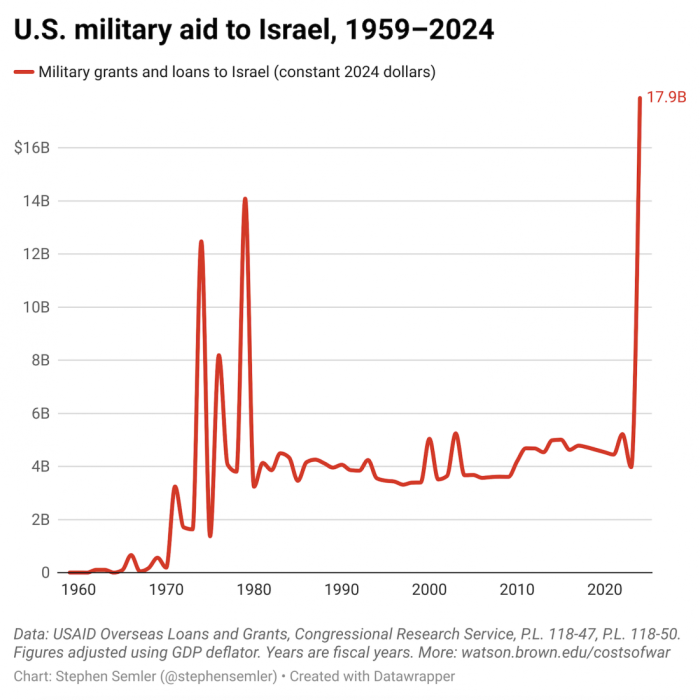
A large portion of Washington’s “security assistance” for Israel consists of munitions, from artillery shells to 2,000-pound bombs that have been dropped over residential areas in Gaza and Lebanon.
“The weapons have come through a variety of channels, including existing US stocks, including the multi-billion dollar WRSA-I stocks located in Israel, commercial sales approved by the State Department, Foreign Military Sales (FMS) approved by State and negotiated and brokered by the Pentagon, Foreign Military Financing (FMF), which provides grants for the purchase of US defense articles and services, and the Excess Defense Articles (EDA) program, which provides used systems no longer needed by US forces for free or at a steep discount,” the Costs of War report details.
However, Washington has worked to obscure “the full amounts of aid and types of systems through bureaucratic maneuvering,” in particular, by making sure that over 100 arms deals signed with Tel Aviv over the past year did not exceed the threshold that would have required reporting them to Congress: “$14 million for major defense equipment and $50 million for defense articles and services, ranging from weapons systems to equipment maintenance and military training.”
Based on publicly available information cited by the researchers, the $17.9 billion figure is divided as follows: $4 billion to replenish Iron Dome and David’s Sling missile defense systems; $1.2 billion for the Iron Beam defense system; $3.5 billion for the procurement of advanced weapons systems, defense articles, and defense services through the FMF program; $1 billion to enhance the production and development of artillery and critical munitions; $4.4 billion to replenish defense articles and defense services provided to Israel from US stocks; finally, the total figure also includes Israel’s usual annual military aid installment of $3.8 billion.
The amount surpasses what Washington spent during the 1973 Arab–Israeli war and is about four times the amount Israel received in the 1980s during its war with the Palestinian Liberation Organization (PLO) in Lebanon, its 15-year occupation of Lebanon, and the 2006 war with Hezbollah.
“Israel receives favorable financing arrangements related to US military aid. For example, US aid is provided on a ‘cash flow’ basis, which means that Israel is able to finance multi-year purchases from the US based on future commitments before the funds have been officially appropriated by Congress … Unlike any other country in the world, Israel is allowed to spend 25% of its routine annual military aid from the United States on its own arms industry,” the report highlights.
Since October 2023, the US has spent an additional $4.86 billion funding its illegal war against Yemen and its failed efforts to protect western trade interests in the Red Sea and beyond. This figure includes $2.4 billion approved by Congress in April for “military operations in the broader region to respond to attacks over the next year,” another $2.4 billion in operation costs for “additional Aircraft Carrier Strike Groups and additional actions against [Yemen],” and between $50 to $70 million in additional combat pay for troops.
“There are an estimated 40,000 American personnel stationed in the region, (including personnel on ships, aircraft, and bases) (compared with 34,000 prior to October 7, 2023). This number rose to 50,000 in early August 2024, when Secretary Austin ordered a second carrier strike group to the area after Israel assassinated Hamas leader Ismail Haniyeh in Tehran,” the report states.
By June, the US navy estimated it had fired $1 billion worth of munitions to confront Yemeni attacks. Furthermore, the Yemeni armed forces have downed at least 11 US MQ-9 Reaper drones over the country. With each costing $30 million, Sanaa has handed Washington at least $330 million in losses.
Finally, the Costs of War investigation reveals that western arms dealers are the ones reaping the benefits of Washington’s unchecked spending to support Israel’s genocidal war, chief among them Boeing, General Dynamics, Lockheed Martin, Northrop Grumman, RTX, and other equipment producers such as Caterpillar.
Sanctions have made Russian economy stronger – top academic
RT | October 8, 2024
Western sanctions imposed on Russia amid the Ukraine conflict have made the country’s economy stronger, Nikita Anisimov, rector of the HSE University in Moscow, has said.
Speaking on behalf of HSE economists at a parliamentary hearing on the draft of the 2025-2027 federal budget on Monday, Anisimov said sanctions have effectively propelled the restructuring of the country’s economy. According to the expert, this has led to Russia “essentially ceasing” its dependence on the export of raw materials such as oil and gas for income – a task the government has been grappling with for years.
“As a result, today, largely due to the situation of external shocks and the rapid restructuring of our economy, we have been able to significantly reduce our dependence on raw materials exports. Thus, we can say that the sanctions have only made our economy stronger and more resilient,” Anisimov stated.
The subject of Russia’s successes in cutting reliance on oil and gas revenues was raised by President Vladimir Putin at the St. Petersburg International Economic Forum (SPIEF) in June. He noted that Russian GDP expanded by 3.6% last year, bouncing back from a 1.2% downturn in 2022, when the country was first targeted by the West’s wide-ranging economic restrictions. Most of that growth stemmed from non-resource-based industries such as manufacturing, construction, and agriculture, as well as trade, hospitality, and financial services, Putin said.
Last month, Finance Minister Anton Siluanov announced that the Russian economy had continued to expand in 2024, with GDP growth in the first half of the year hitting 4.7%. Siluanov said he expected GDP growth at the end of the year to be 3.9%, exceeding the figure for 2023.
Many analysts, both Russian and international, have noted that sanctions have failed to destabilize the country’s economy. Most have attributed this resilience to Russia’s swift pivot to the East for trade, as well as economic policies implemented to offset the effect of the restrictions.
The World Bank and the International Monetary Fund both raised their growth forecasts for the Russian economy earlier this year. The former predicted it to grow by 2.9% in 2024, and in July upgraded Russia to a “high-income country.”
The IMF in April said it expected the country’s GDP to expand by 3.2%, faster than all advanced economies, including the US, the UK, Germany, and France.
German economy in crisis mode as industrial orders plummet
By Liz Heflin | Remix News | October 8, 2024
German industrial orders fell 5.8 percent in August compared to July, a far higher drop than the 2 percent drop anticipated, with economists now warning of a recession and doubting a quick recovery.
The numbers reported by the German Federal Statistical Office amounted to the biggest drop since January of this year, with the German Ministry of Economics announcing that “in view of the continuing weak demand and the deterioration in business sentiment, a significant recovery in the industrial economy in the second half of 2024 is unlikely.”
Jens-Oliver Niklasch, an expert at Landesbank Baden-Württemberg, cited by Money.pl, stated bluntly: “Leading indicators are falling, forecasts are falling, bad news is not stopping. Everything points to a recession.”
Jörg Krämer, chief economist at Commerzbank, describes the data as a “bitter disappointment,” adding that the best-case scenario will be gross domestic product stagnating in the second half of the year.
Of key concern is the data regarding strength, or lack thereof, in the domestic and European economies. While orders from abroad also fell just 2.2 percent, domestic orders were down by 10.9 percent. Orders from eurozone countries fell by 10.5 percent, while orders from other countries actually increased by 3.4 percent.
Experts emphasize that the current situation is a clear signal of a crisis, with key sectors being hit the hardest, including auto manufacturing, mechanical engineering and chemicals.
The Macroeconomic Policy Institute (IMK) predicts gross domestic product will stagnate this year and grow by just 0.7 percent next year, with experts agreeing that the federal government’s expectations of economic growth above 1 percent in 2025 seem unrealistic.
Meanwhile, the German government is expected to need €46 billion to finance welfare benefits, with half of the recipients reportedly being foreign citizens, many of whom came to Germany specifically for its generous welfare system.
The situation is not bad for everyone. Remix News just reported today that Germany is spending some €50 billion annually on housing asylum seekers and war refugees and providing them with benefits, with private security firms earning hundreds of millions across Germany for policing migrant accommodations.
EU airline’s boss wants Chinese to pay for flying over Russia
RT | October 8, 2024
Brussels should establish financial measures to curb competition from Chinese airlines that can freely cross Russian airspace, according to Royal Dutch Airlines (KLM) CEO Marjan Rintel.
Western countries closed their airspace to Russian airlines as part of sanctions imposed after the onset of the Ukraine conflict in 2022. In response, Moscow banned aircraft from “unfriendly nations,” forcing EU planes to reroute, resulting in higher fuel consumption and increased costs.
“Russia’s airspace is closed to European airlines, while Chinese carriers fly over it, which can save two to four hours. You see that reflected in pricing, and consequently, our costs are higher,” Rintel said in an interview with Dutch broadcaster WNL on Sunday.
Rintel suggested that Brussels should intervene to address this competitive imbalance. “Europe can at least explore how we can level the playing field by adjusting pricing or examining other alternatives,” she stated.
In response to rising costs, KLM plans austerity measures aimed at saving €450 million ($494 million) annually, including €100 million ($110 million) by “adjusting” in-flight catering, Rintel noted.
“In the Netherlands, we are facing a tight labor market and rising wage costs, which differs from the situation in France,” she added, referring to KLM’s parent company, Air France-KLM. “Due to a shortage of pilots and technicians, roster changes will occur, and maintenance may need to be outsourced,” she explained.
Last month, Germany announced it was considering halting its daily Frankfurt-Beijing flights due to similar pressures from rising costs and competition from Chinese and Gulf airlines that can fly over Russia. The previous month, British Airways announced it would suspend London-Beijing flights starting in October. Additionally, Virgin Atlantic recently terminated its only China route to Shanghai.
U.S. Swings and Misses in Energy Competition
By Wallace Manheimer | RealClear Energy | September 30, 2024
Who can develop reliable, cheap, clean power? In the parlance of baseball, the U.S. led early with a leadoff home run. It invented, developed and perfected the first ultra-super critical (USC) coal-powered plant.
Coming online in 2012, the 600-megawatt (MW) John W. Turk Jr. Coal Plant in Arkansas employed new technology, most notably, an advance in metallurgy that allowed pipes and boilers to operate for extended periods at extremely elevated temperature and pressure.
This higher temperature allows efficiency of 40%, instead of the more usual 33%. Also, Turk had the best pollution controls, its emissions being mostly carbon dioxide and water vapor. Power Magazine was so impressed that it gave the plant its highest honor in 2013.
It looked like the U.S. was set to win the game, until it took its eye off the ball and made numerous errors. Instead of exploiting its remarkable technological achievement, U.S. policymakers decided to abandon coal and promote wind and solar.
Powerful environmental groups fought to end coal; Michael Bloomberg bragged that he contributed $500 million to the effort. Companies in the coal industry suffered, some went out of business, and domestic consumption of the country’s most abundant fuel declined. Turk is still the only USC plant in the U.S.
Solar and wind do not provide reliable power, as they fluctuate with the weather and time of day.
Also, they are not cheap. Germans, whose electric system relies heavily on solar, pay more than twice as much for electricity as the nuclear-dominant French and nearly triple the amount paid by U.S. consumers.
Furthermore, solar and wind technologies, contrary to popular belief, are not clean; not where their materials are mined, nor where they are used, nor at the end of life.
First, the mining: These technologies use many exotic and rare earth materials like praseodymium, terbium, cadmium, indium and dysprosium. Such materials are available mostly in Western China and Africa, under who-knows-what environmental and working conditions.
Secondly, where they are used, solar and wind take up tremendous amounts of land – many times the acreage of a coal plant. The average solar power reaching Earth is about 200 MW per square kilometer. Hence, with a perfectly efficient conversion to electricity, a 1,000 MW solar farm would require 5 square kilometers. But maximum solar efficiency is only 20%, boosting the land requirement to 25 square kilometers, space that could not be used for anything else. Even the maximum theoretical efficiency is only 30%.
The numbers for wind are worse: A 1,000 MW wind farm would require a whopping 500 square kilometers – equal to about 27,000 big league baseball fields. This land could be used for crops and grazing animals, but not much else.
Finally, disposal of the huge amount of material used in the fabrication of solar and wind facilities, whose life spans are mere fractions of traditional generating plants, must be disposed of. Many of these exotic materials are not suitable for standard landfills, as their compounds are harmful to humans and are water soluble. Frequently, the solar or wind company has just walked away and left the relics in place for others to worry about.
Solar and wind are more of an environmental disaster than an environmental savior.
With the U.S. relegated to the locker room, China came to bat and staged a tremendous scoring rally. Out of the top 100 Chinese coal plants, 90 are ultra-supercritical units.
Having improved on USC technology, Chinese plant efficiency is around 44%. The new 1,350 MW Pingshan Phase II plant achieves 49% efficiency! The best Chinese coal plant is now cleaner and 22 % more efficient than its American counterpart.
Since 2010, India has constructed more than 90 super critical and ultra-super critical coal plants.
Has the U.S. played its last coal-fired season?
Perhaps- unless America’s free enterprise system were brought fully into the game, with the private sector mostly doing the engineering and the federal government sponsoring long-range scientific research.
However, U.S. policymakers must abandon their obsession with solar and wind as answers for a climatic “existential threat.” Otherwise, sensible people play a fool’s game in a fantasy league that demonizes a gas sustaining all life — carbon dioxide – as others compete in the majors.
Such absurdity is no match for the technical leadership displayed in China and India.
Dr. Wallace Manheimer is a life fellow of the American Physical Society, the Institute of Electrical and Electronic Engineers and is a member of the CO2.Coalition. He is the author of more than 150 refereed papers.
Chinese airlines grab market share from US and European carriers who have to fly around Russia
Inside China Business | August 15, 2024
US and European airlines are banned from Russian airspace, and so must route around the world’s largest country. This is causing much longer and costlier flights between North America and Europe, and destinations in Southeast Asia. Chinese, Korean, and Indian airlines still enjoy Russian overflight privileges, however, and can thereby offer shorter and less expensive fares. As a result, Chinese carriers are gobbling up markets and gates across international markets. Chinese airlines already operate with 30% lower costs on a passenger-mile basis compared to US- and European-flagged carriers, and their cost advantages only multiply after adjusting for the issues involving Russian airspace.
Resources and links:
Flight maps from Great Circle Maps http://www.greatcirclemap.com) and Reuters, Unfriendly skies:
How Russia’s invasion of Ukraine is redrawing air routes https://www.reuters.com/graphics/UKRA…
A year into Russian airspace ban, flight costs and lengths are rising https://globalnews.ca/news/9645165/ru…
Flight Radar, Which major airlines are still flying over Russian airspace? https://www.flightradar24.com/blog/wh…
British Airways axes one of its ‘most important’ routes amid Russian airspace ban https://www.independent.co.uk/travel/…
Reuters, British Airways to halt flights to Beijing from Oct. 26 https://www.reuters.com/business/aero…
Reuters, Foreign airlines lose interest in China as domestic carriers expand abroad https://www.reuters.com/business/aero…
Bloomberg, US Airlines Urge Officials to Block Additional China Flights https://www.bloomberg.com/news/articl…
Europe buying Russian oil via India at record rates in 2023 despite Ukraine war https://www.independent.co.uk/news/wo…
Reuters, Airbus wins reprieve from Canadian sanctions on Russian titanium https://www.reuters.com/business/aero…
Closing scene, Qingdao Olympic Sailing Center and Lighthouse, Qingdao, Shandong
Iran to destroy all Israel gas fields, power plants at once if Tel Aviv makes mistake: Deputy IRGC chief
Press TV – October 4, 2024
Iran will simultaneously destroy all of Israel’s energy facilities if the regime attempts any new aggression against Iran, warns IRGC’s deputy-in-command.
General Ali Fadavi told the Lebanese television channel Al-Mayadeen on Friday that the Israeli regime will risk its existence if it attacks Iran.
“If the occupying entity makes a mistake, we will target all its energy resources, power plants, refineries, and gas fields.”
He pointed out that Iran is a large and vast country with many economic centers, while Israel has only three power stations and several refineries.
“We can strike them all at once,” the general asserted.
Iran launched Operation True Promise II late Tuesday in response to the Israeli assassination of late Hamas leader Ismail Haniyeh in Tehran in April and also the assassination of late Hezbollah chief Sayyed Hassan Nasrallah along with Iranian military advisor, Brigadier General Abbas Nilforoushan in September.
Iran fired around 200 ballistic missiles at Israel during that operation, saying 90 percent of them hit their targets.
The Israeli regime has vowed to respond to that attack, with some Zionist officials calling for attacks on Iran’s nuclear energy sites, oil fields, and other scientific and economic infrastructure.
Iran has warned to attack the regime’s infrastructure if it wants to respond to the Iranian retaliation.
‘Israel to receive a devastating response’
Meantime, commander of the Iranian Army Major General Abdolrahim Mousavi told Al-Mayadeen on Friday that the Israeli regime would receive a “severe and devastating response” if it engaged in uncalculated actions.
“We have exercised restraint and patience in the past, but we are ready to deliver a precise and destructive blow at the right time,” he said.
He noted that Iran would respond more forcefully than the level of aggression shown by its enemies if they made a mistake at any level.
Iran’s oil production nears pre-sanctions levels: Report
The Cradle | October 4, 2024
Iran’s oil production is running at almost full capacity despite US sanctions, amid Israeli threats to target Tehran’s oil infrastructure in an expanded regional war, Bloomberg reported on 4 October.
The Islamic Republic’s oil output has reached 3.4 million barrels per day, just a few hundred thousand barrels below a previous high of 3.9 million.
After US President Donald Trump withdrew the US from the JCPOA nuclear deal in 2018 and reimposed sanctions on Iran, Tehran’s production dropped as low as two million barrels per day.
Iran now sells much of its oil to China at reduced prices, as Beijing has been willing to ignore US sanctions seeking to block the sales.
“Iran is having success exporting thanks to a willing customer in China, the increased sophistication of illicit transportation channels, and the relatively low interest in the US to take action,” said Henning Gloystein and Greg Brew, analysts at Eurasia Group. “There’s a risk that Israel strikes Iranian oil facilities.”
According to Bloomberg, Tehran’s increased sales to China have taken place with the “tacit approval” of the White House, as US President Joe Biden and his advisors have eased sanctions enforcement to keep gasoline prices low.
In August 2023, before the wars in Gaza and Lebanon began, Bloomberg reported that “months of secretive diplomacy” between the US and Iran “have yielded progress on prisoner exchanges, the unblocking of frozen assets, and possibly even Iran’s enrichment of uranium. They also seem to have produced an informal arrangement on oil flows.”
Israel reportedly threatened to bomb Iran’s nuclear or oil facilities following Tehran’s large-scale missile attack on Israel.
Iran fired as many as 400 ballistic missiles at Israel on 1 October in retaliation for its killing of Hamas leader Ismail Haniyeh in Tehran in July and Hezbollah leader Hassan Nasrallah in Beirut on 27 September.
In an off-the-cuff remark to a reporter, Biden said that his administration has been “discussing” possible Israeli plans to attack Iran’s oil industry in retaliation for the Iranian attack.
Bloomberg added that world oil prices jumped five percent on Thursday after Biden’s comment.
Tehran Will Strike Israeli Refineries, Gas Fields If Israel Attacks Iran – IRGC
Sputnik – 04.10.2024
TEHRAN – Tehran will strike Israeli refineries, gas fields if Israel attack Iran, deputy commander in the Iran’s Islamic Revolutionary Guard Corps (IRGC), Ali Fadavi, said on Friday.
“If the occupiers [Israel] make a mistake [by attacking Iran], we will strike at all their energy sources … all oil refineries and gas fields,” Fadavi was quoted as saying by the Mehr news agency.
Iran is a large country with many economic centers, while Israel has only three power plants and several refineries that Iran can hit at the same time, Fadavi added.
Tehran does not intend to continue to strike Tel Aviv, but if Israel takes any action against Iran, the response will be tougher, Iranian Foreign Minister Abbas Araghchi said on Friday.
“We do not intend to continue the attacks. If Israel takes any more steps against Iran, our actions will be tougher, and we will definitely respond. Our response will be proportionate and absolutely calculated,” Araghchi told a press conference in Lebanon, as quoted by the Tasnim news agency.
Russia eyeing record energy profits – think tank
RT | October 4, 2024
Russia’s energy revenues may reach record levels this year, buoyed by high export oil prices, according to independent economic think tank the Institute for Energy and Finance Foundation (FIEF).
Oil and gas profits have increased sharply this year, FIEF Director of Research Aleksey Belogoriev told the Far Eastern Energy Forum “Oil and Gas of Sakhalin” on Friday.
Income from oil exports jumped by 63% in January-July this year compared to the same period in 2023, totaling 6.4 trillion rubles ($67.5 billion), the researcher said during the session on the future of Russian energy exports. Gas revenues increased by 13% to 1.2 trillion rubles ($12.6 billion), he added.
“This year’s [oil and gas] revenues will be lower than in the record 2022, becoming the second highest in history,” said Belogoriev.
The expert cited an increase in the average export price of oil, and the relatively low revenue posted in the first half of 2023.
In January, one barrel of Russia’s flagship Urals blend of crude cost an average of $60 per barrel, but prices then gained steadily, reaching $84 in April. In July, Russian crude traded at around $80 per barrel.
The increase comes despite a barrage of sanctions imposed on Russia by the US, the EU and their allies since tensions between Moscow and Kiev escalated to its military operation in Ukraine in 2022.
The restrictions included an embargo on seaborne Russian oil, along with a $60-per-barrel price cap on other types of crude.
EU countries fell short of sanctioning Russian natural gas but started shunning it instead. In response, Moscow redirected its energy supplies to Asia, particularly to India and China, to compensate for the loss of some of the Western customers.
According to the latest data from the Finance Ministry released on Thursday, oil and gas revenues of the Russian budget grew by 49.4% in January-September year-on-year. The ministry is expecting oil and gas earnings to reach 10.99 trillion rubles ($116 billion) this year. In 2022 the Russian budget received 11.586 trillion rubles ($165 billion at the exchange rate at the time) from energy exports.
Featured Video

Macgregor: We Haven’t Seen the Worst of the Iran War Yet
or go to
Aletho News Archives – Video-Images
From the Archives
15 Saudi ‘hijackers’ were CIA agents working for US: Scholar
Press TV – April 13, 2016
Fifteen of the 9/11 “hijackers” from Saudi Arabia were CIA agents working for the United States government, which was seeking to destroy the Middle East for Israel and to double the American military budget, says Dr. Kevin Barrett, an American academic who has been studying the events of 9/11 since late 2003…. continue
Blog Roll
 Aletho News
- Iran’s Plan to Shut Down AI in the Persian Gulf
- Israel seeks ‘compensation’ from Washington over Saudi F-35 sale
- Saudi crown prince seeks dialogue with Ansarullah after Yemeni blows: Report
- Damascus rejects Saudi request for Syrian fighters to counter Yemen: Report
- South Korea says will not send troops to join terrorist US war on Iran
- Russia Just Struck the Eyes of NATO’s War Machine in Ukraine
- Russia summons UK charge d’affaires over Kiev drone support
- NATO member warns bloc seeking pretext for war with Russia
- Macgregor: We Haven’t Seen the Worst of the Iran War Yet
- ‘We are not like everyone else’ laws that bind other nations do not apply to Israel, says Likud lawmaker
- If Americans Knew
- Debunking The Claim That Macklemore Has A “History Of Antisemitism”
- CPJ demands release of arrested Palestinian-US journalist near Bethlehem
- Robert Kraft: The Billionaire Friend of Netanyahu Pulling The Strings Behind the Macklemore/Ed Sheeran Blow Up
- Columbia Administered Fund Gives Big Money to Pro-Israel Groups
- Deportation Case of Palestinian Activist Salah Sarsour Tests First Amendment
- ‘We Will Not Forget’: Palestinians Mark 44 Years since Sabra and Shatila
- Why do we let Zionists decide what we can and can’t say?
- US welcomes Israeli, Iranian delegations to UN, but not Palestinians – Daily Update
- Biden’s Genocide Accomplices Targeted by New Accountability Campaign
- AIPAC’s Network Has Already Spent $67.2 Million to Shape the Midterm Elections
- No Tricks Zone
- New Study: ‘Global Drought Shows No Detectable Recent Acceleration Under Climate Warming’
- Economic Masterminds: German Socialists Suggest Taxing Productivity Gains Stemming From Using AI
- The South China Sea Has Not Been Cooperating With The Climate Change Narrative
- Energy Crisis: Germany Enters Heating Season With Historically Low Gas Reserve Fill Levels
- New Study: The Antarctic Ice Sheet Gained Mass From 2020-2024 Due To Staggering Snow And Ice Accumulation
- Study: Ocean Heating Rates From Thousands Of Years Ago ‘Dwarf’ Modern Ocean Heating Rates
- Climate Extremists Target, Attack Large-Scale Power Grid Infrastructure In Germany!
- New Study: Antarctic Ice Melt Has Contributed Less Than 1 Centimeter To Sea Level Rise In The Last 30 Years
- Fear Of Debate: Alarmist German Climate Scientist Calls On Mainstream Media To Discredit Skeptic Voices
- End-Of-August Arctic Sea Ice Extent Hasn’t Fallen In 20 Years, Official Data Show!
 Aletho News