NATO Countries’ Silence After Nord Stream Attacks is Shocking – French Politician
Sputnik – 26.09.2024
The silence of NATO member countries after the destruction of the Russian Nord Stream export gas pipelines is shocking; it is sabotage of strategic infrastructure, French politician, leader of the Patriots party, Florian Philippot told Sputnik.
“What is the most shocking is the degree of subordination of NATO countries, which have not even declared that they were victims of this sabotage. They simply do not even talk about it: the French government has not discussed it at all,” Philippot said.
He said it is surprising that European countries have not even admitted that they suffered from sabotage of the gas pipelines.
The Nord Stream pipelines, built to deliver gas under the Baltic Sea from Russia to Germany, were hit by explosions on September 26, 2022. Denmark, Germany and Norway have left Russia out of their investigations into the attack, prompting Moscow to launch its own probe on charges of international terrorism.
Russia has repeatedly requested data on the explosions from the European countries, but has never received it, Kremlin spokesman Dmitry Peskov said.
Thirst for money enriches oligarchs, but bankrupts Europe
By Lucas Leiroz | Strategic Culture Foundation | September 24, 2024
There are many reasons why Europe wants to prolong the war in Ukraine. Irrational liberal ideology and commitment to the project of a unipolar global order are undoubtedly the most important reasons. However, business and private profit cannot be ignored. According to many recent reports, there has been a huge increase in the profits of military-industrial companies in a number of Western countries, which explains the thirst for war of the pro-Ukrainian oligarchies.
One of the most notorious cases of this war profiteering is taking place in Germany. The military giant Rheinmettall is seeing its profits growing amid a wave of systematic support for the Kiev regime. By continuously and incessantly sending weapons, the German company has managed to escape a serious financial crisis and now has a chance to once again rank among the world’s leading defense companies.
Rheinmettal’s business was in a bad way. The company was on the verge of abandoning the military sector to focus on civilian production, since most of its profits were coming from the production of automobile parts. However, Germany’s participation in military assistance programs led the corporation to revitalize its production of weapons and ammunition, once again becoming a global giant in the sector.
Armored vehicles, tanks, ammunition, artillery pieces and air defense systems are some of the products in Rheinmettal’s current industrial catalog. After making adventures into industrial base projects on the Polish-Ukrainian border, the company is now working on opening a new factory in Saxony, where it expects to produce more than one hundred thousand artillery shells per year.
Obviously, the German state is interested in these profits. Recently, an action plan by the German government was announced to use part of the profits of Rheinmettal for reindustrialization projects – which seem more necessary now than ever, since Germany has been the country most affected by the anti-Russian madness. It only remains to be seen how this reindustrialization will be possible without Russian gas and cheap energy.
In short, Germany believes it is profiting from the war. But this calculation is wrong – as well as dangerous and irresponsible. The profits do not go to the German people, but to a small number of defense oligarchs who employ an absolute minority of German society. Furthermore, the real economic revival is minimal, since the constant demand for weapons requires a systematic production routine that hinders any research project in technological innovation. In other words, Rheinmetall – as well as the entire Western military-industrial complex – is doomed to continually produce the same type of equipment according to its current samples, without any relevant innovation.
Industry without innovation has little chance of long-term success. Western weapons, which have already proven to be largely unsuitable for the Ukrainian battlefield, are likely to become increasingly obsolete, and there will be no capacity for technological renewal, since, thanks to anti-Russian sanctions, the precarious European society is reaching a pre-industrial stage of development.
And, still on the subject of sanctions, it is important to emphasize that increased spending on the military industry could be a ticking time bomb for a country without reliable sources of cheap energy. After the blockade of Russian gas, Germany has been experiencing a period of profound energy instability, depending on unusual alternative sources to meet its needs – such as burning wood or buying American gas at exorbitant prices. This scenario is completely inconsistent with a situation of economic development and stability.
Germany will discover an old lesson in economics: the private profits of the oligarchies do not reflect a real situation of economic development and social well-being. Without solving the problems generated by sanctions – which obstruct technological innovation – and without relieving the pressure on the systematic production of weapons, not even constant demand will be able to save Germany and the whole of Europe from a deep crisis.
Despite the profits, aid to Ukraine remains an obstacle to European economic progress, pleasing only transnational oligarchies.
The Russia-China grains corridor will completely displace the US, Canada, Australia, and France
Inside China Business | August 31, 2024
Russia and China are developing a transnational grains corridor, connecting Russia’s enormous agricultural production to export markets in China, South Asia, and the Middle East. When complete, Russian production and shipments on this network will exceed 8 million tons per year. China is the world’s largest importer of wheat and grains, and in 2023 imported over 6 million tons of wheat from the United States, Canada, Australia, and France.
Large distribution hubs are being completed in China’s Northern and Central provinces, which will further transport Russian food exports within China, and on to other Asian countries.
The proposed BRICS grains exchange enjoys wide support across the bloc, and will accelerate the decoupling of Global South markets from the Western banking and trading systems, to the detriment of farmers in North America and Europe.
Resources and links:
The Sino-Russian Land Grain Corridor and China’s Quest for Food Security https://asiasociety.org/policy-instit…
BRICS countries back grain exchange idea, Russia says https://gulfbusiness.com/brics-countr…
Russia, China agree to build new grain hub on border https://www.world-grain.com/articles/…
Visual Capitalist, Visualizing the world’s largest consumer markets in 2030 https://www.visualcapitalist.com/the-…
U.S. Dominance in Corn Exports on the Wane Due to Brazilian Competition https://farmdocdaily.illinois.edu/202…
The New Land Grain Corridor, website and infographics https://www.nlgc.ru/en/
Closing scene, Chinese rural area outside Guilin, Guangxi province
Scramble to Tighten Europe’s Borders Shows Politicians are Playing ‘Catch Up’ With Public Concern
By Svetlana Ekimenko – Sputnik – 22.09.2024
After Germany instituted new checks at its borders to try and clamp down on the influx of refugees, the Dutch government and Hungary followed suit with announcements that they would seek an opt-out from the European Union’s migration policies.
The scramble to tighten border policies in some EU countries is a sign that politicians are desperately “trying to play catch up” with public concern, Dr. George Szamuely, a senior research fellow at the Global Policy Institute, told Sputnik.
Europe’s migrant crisis was imposed by the elites on their own population, he stressed. It was part of a “fateful alliance among the big corporations that want cheap labor and the kind of multicultural advocates who think that that’s a good thing for Europe to be more diverse,” Szamuely noted, stressing that this is “what’s causing this intense political feeling because people don’t really want it. This is something that the elites had desired.”
After Germany instituted sweeping checks at its borders and stronger deportation laws, the new Dutch government announced it was aiming to set in place “the strictest admission rules in the EU.” Dutch Prime Minister Dick Schoof said on Friday that the government would officially ask the European Commission for an opt-out on EU asylum and migration policies.
“We cannot continue to bear the large influx of migrants to our country. People are experiencing an asylum crisis,” Schoof said.
post by Hungarian Minister for EU Affairs János Bóka.
Echoing the same sentiments, Hungary is also going to request an opt-out from the European Union’s migration policies, Hungarian Minister for EU Affairs Janos Boka said in a post on X. As it is, Hungary has traditionally opted for a tougher migration policy than the rest of the bloc. During the 2015 European migrant crisis, Prime Minister Viktor Orban rejected the resettlement of hundreds of thousands of migrants and refugees coming from Syria, Afghanistan and other countries torn apart by NATO warmongering.
Geert Wilders, the right-wing leader of the PVV (PfE) – the party that came out on top in the last national elections in the Netherlands – described the Dutch official request to opt out of EU migration policy as a ‘mini-Nexit’ in a nod to Brexit.
“Tens of hundreds of thousands of asylum seekers come into Europe and then make their way into the most prosperous parts of Europe, becoming an additional huge burden on countries,” underscored George Szamuely.
Europe is witnessing “complete abuse of the asylum seeker scheme,” said the researcher, adding: “it’s a combination of these anxieties, and the rise of anti-immigrant populist parties that is leading to the stricter measures or, at least, demands for stricter measures throughout Europe.”
Regarding the opt-out of EU rules, the expert noted that such an outcome is very difficult to achieve, as it requires renegotiating the treaty and “that’s not something that’s easily doable, and could take a long time […] because EU rules are supposed to be binding on all member states.”
The issue of immigration is besetting one country after another, and results of elections in European countries are starkly reflecting this. The issue of unrestrained immigration helped Wilders and his populist right Freedom Party win a plurality of seats in the Netherlands’ House of Representatives last November. In Germany, the success of the right-wing Alternative for Germany (AfD) party in regional elections piled pressure on the government of Chancellor Olaf Scholz to tackle the migrant issue and close its borders, temporarily ending the Schengen-Visiting Zone.
US Bets on Allies to Bail Out Crippled Shipbuilding Industry
By Svetlana Ekimenko – Sputnik – 21.09.2024
As the US pushes its “China threat” narrative and eyes a potential military conflict with the People’s Liberation Army, one of its vital defense industries – shipbuilding – is in a critical condition.
The US is betting on its ally South Korea to help bail out its crippled shipbuilding industry.
South Korean shipbuilding company Hanwha Ocean recently announced its acquisition of a former naval shipyard in Philadelphia.
Along with the shipyard deal, valued at $100 million, Hanwha secured its first maintenance and repair contract with the US Navy.
The US shipbuilding industry has become notorious for years-long delays and cost overruns. Washington’s allies South Korea and Japan are the world’s largest shipbuilders, and hopes are that they could boost production of both commercial and naval vessels.
But stark new figures show that even with support from Asian firms, it could take the US years to close the gap with China in maritime power.
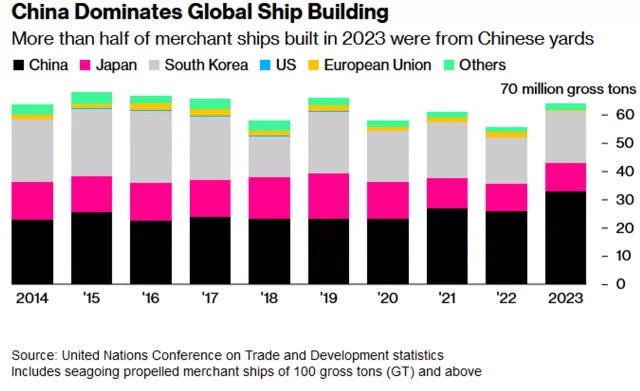
- Last year, China had orders for 1,794 large commercial ships, South Korea had 734, Japan had 587 — but the US had just five.
- While China commands 40 percent of global commercial shipbuilding output, the US accounts for less than one percent.
- China had over 5,000 oceangoing commercial vessels in early 2023, while the US-flagged merchant fleet had only 177.
- China’s shipbuilding capacity is over 200 times that of the US, according to a US Naval Intelligence chart cited by media.
The struggle to prop up the floundering US shipbuilding base comes as the US Navy has released its plan for a potential military conflict with China by 2027.
Announcing the Navigation Plan for America’s Warfighting Navy, US Chief of Naval Operations (CNO) Admiral Lisa Franchetti referred to China as a “pacing challenge” and a “complex, multi-domain and multi-axis threat.”
The plan includes streamlining maintenance for warships, submarines and aircraft, eliminating delays and restoring “critical infrastructure that sustains and projects the fight from shore.”
US tech giant suspends huge German factory project
RT | September 19, 2024
US tech giant Intel is halting construction of two chip manufacturing plants in Germany as it struggles to counter shrinking sales and mounting losses, the company’s CEO Pat Gelsinger announced on Monday.
According to Gelsinger, the project in the city of Magdeburg in Saxony-Anhalt is expected to be delayed by around two years.
The company had planned to build two chip factories in Magdeburg worth over $33 billion, creating some 3,000 jobs as part of a larger investment plan for the EU. Intel had also signed an agreement with the German government for about $11 billion in state subsidies for the project, according to the DPA news agency.
The plans, however, have been put on hold as the US tech giant struggles to reduce losses and launched a cost-saving program earlier this year. Intel also said it is postponing a new factory in neighboring Poland.
“We must continue acting with urgency to create a more competitive cost structure and deliver the $10 billion in savings target we announced last month,” Gelsinger said in a letter to employees.
The German manufacturing site was due to become the largest chip-making facility supported under the European Union’s Chips Act which was passed last year. Intel’s decision to delay the project could deal a blow to EU plans of producing one-fifth of the world’s semiconductors by 2030.
“Without Intel in Magdeburg, Europe is lacking its flagship project,” Frank Bosenberg, the managing director of German industry group Silicon Saxony, told Bloomberg on Monday. “Neither a European market share of 20% or the desired technological sovereignty through semiconductor production below 10 nanometers seem realistically achievable by 2030,” he added.
The EU aimed to increase its global chip manufacturing share to 20% by the end of the decade, supported by over $44.5 billion in subsidies to attract semiconductor companies and reduce foreign dependency. Intel’s project in Germany was a key component of the strategy.
Following the announcement, German Finance Minister Christian Lindner called for subsidies earmarked for the Intel project to be repurposed to close a $13.3 billion federal budget gap projected for 2025.
How Could Lebanon Blasts Affect Global Security and Attitude to Western Hi-Tech Producers?
By Ekaterina Blinova – Sputnik – 19.09.2024
A series of blasts reportedly involving Taiwanese, Japanese, American, and European-made devices in Lebanon on September 17 and 18 have prompted grave security concerns worldwide.
“Weaponizing mobile communications devices will fill many people with horror and fear,” Marc Ostwald, chief economist at ADM Investor Services International, told Sputnik. “It may, at the margin, dampen demand.”
The Lebanese government attributed the attack to Israel, accusing Tel Aviv of an outright act of terrorism.
Given almost “unconditional support” provided to Israel by some Western countries, some of them may have colluded with Tel-Aviv, said Hasan Abdullah, analyst and researcher at Global Security and Strategy Institute.
“The US is going to be the country that’s going to generate the greatest trust deficit with their customers, primarily because of its very close collaboration with Israel,” Abdullah told Sputnik.
The US has long been one of the largest suppliers of communication equipment, including for military needs, to the Global South, the pundit noted, adding that the recent blasts could alienate the developing world from Western producers.
Earlier, researcher Mehmet Rakipoglu and military analyst Alexei Leonkov told Sputnik they did not rule out US involvement in the Lebanon attack.
The Intercept reported on Wednesday that the US military had explored the possibility of planting remote-activated bombs in innocuous devices starting from the 1960s.
Middle East and other developing countries could eventually turn to Russian, Chinese or Turkish tech firms out of fear that the US involvement could compromise their security, Abdullah said.
Ostwald and Abdullah believe that several measures could be taken to stop the covert bombings, starting with investigations into manufacturing processes and ending with the deployment of international watchdogs to oversee production and supply.
How Rothschild Banking Clan Uses Its Vast Wealth to Influence World Events and Control Governments

By Ilya Tsukanov – Sputnik – 15.09.2024
How powerful is the Rothschild banking family? How did they amass their fortune? Just how rich are they? Do they secretly control the world? Sputnik explores.
Media-shy banking firm Rothschild & Co popped up in the news recently when it was revealed that it played a key role in restructuring over $20 bln in Ukrainian debt, including by arranging face-to-face meetings between Kiev officials and vulture funds like Black Rock and Amundi. The Rothschilds are known to have played an active role in carving up Ukraine’s wealth since at least 2014 and the Euromaidan coup.
But in the global scheme of things, despite its rich black soil and immense resource wealth, Ukraine may be just a side project for the banking family, whose role in the creation of the modern international financial order goes back to the 18th century, when German banker Mayer Amschel Rothschild and his five sons forged a global banking empire with offices in Frankfurt, London, Paris, Vienna and Naples.
What is the Rothschild Banking Clan Known For?
Emerging in the heyday of European colonial empires, the Rothschilds cashed in on the vast wealth flowing to the continent to create merchant and private banking, asset management, venture capital, insurance, commodities, sovereign debt, media, transport, real estate, pharmaceuticals, mining, and energy enterprises.
Establishing close ties to the British Crown, Mayer and his sons played an instrumental role in financing and operating colonial megaprojects of the day, from the Suez Canal trade artery to the East India Company – the British imperial megacorporation which ruthlessly ruled over India as a private company through much of the 18th and 19th centuries, sucking out untold wealth.
The family proved highly active in the international politics of the tumultuous 19th and 20th centuries, betting on Britain against France during the Napoleonic Wars by financing Hessian mercenary soldiers and loaning money to the Crown, and using insider knowledge of government deliberations and a sophisticated communication system to make financial decisions that would consolidate its fortunes.
How Rich are the Rothschilds?
A big question mark surrounding the Rothschild family revolves around their net worth, with publicly available valuations varying from a paltry $1 billion to $400 billion and even $1.2 trillion – which would put the family well above the oft-published pop financial media lists of the “world’s richest,” which typically include names like the Waltons, the Arnaults, the Kochs, Elon Musk and Bill Gates.
The difficulty in establishing a precise figure stems from the family’s incredible secrecy, combined with the murky nature of finance capital. The Rothschilds ‘went dark’, financially speaking, in the early 20th century, when the introduction of national taxation schemes across Europe led family banks to formally split to create ‘independent’ financial institutions.
For instance, while reporting on the family’s public-facing business empire is often focused on the Paris, London and Singapore-based Rothschild & Co, other divisions, like the Geneva-based Edmond de Rothschild Group are less often mentioned, and they are rarely if ever mentioned together.
How Powerful are the Rothschilds?
The world of high finance is an incredibly small place, with the Rothschilds assumed to enjoy a prominent place among banking families like the Rockefellers, Morgans, Barclays, Lazards, Warburgs and others in control over the world’s top private banks, from JPMorgan Chase and Citigroup to HSBC, Deutsche Bank, Societie Generale, and others.
The Rothschilds also have ownership stakes and investments ranging from 5%-50% or more in an array of European, US and Asian mega corporations, from Glencore Mining and TotalEnergies to Siemens, Exxon, Chevron, Repsol, Shell, Mitsubishi, Itochu Corp and the Rio Tinto Mining Corporation.
In his book ‘Big Oil & Their Bankers’, researcher Dean Henderson discovered that the Rothschilds and a clique of seven other banking families enjoy a controlling stake in the New York Federal Reserve Bank – the most powerful Fed bank and the heart of America’s financial system. Other investigators believe the Rothschilds either control the city of London and the Bank of England, or own it outright, although this has been disputed.
Do Rothschilds Control the World’s Politicians?
A handful of political figures, including several of America’s founding fathers, warned about the threat posed by the rise of powerful banking clans in their day. In a letter to John Taylor in 1816, Thomas Jefferson characterized the US banking system as a “blot” in “all our constitutions, which, if not covered, will end in their destruction,” and sweep away “the fortunes and morals of our citizens.”
“I sincerely believe that banking establishments are more dangerous than standing armies, and that the principle of spending money to be paid by prosperity, under the name of funding, is but swindling futurity on a large scale,” Jefferson warned.
200 years on, Rothschild influence over world politicians has become impossible to conceal, with the family’s prominent members rubbing shoulders with the likes of Ronald Reagan, Bill Clinton, Henry Kissinger, Margaret Thatcher, Francois Mitterrand, Petro Poroshenko, Emmanuel Macron, and others, either taking advantage of business connections and sheer economic and market power, or in Macron’s case – hiring him as an investment banker before he began his political career.
Do the Rothschilds Control the World?
To suggest that the Rothschild family is so powerful that they control the planet’s entire economic and political life and world events would be a stretch, not only due to the never-ending, largely silent struggle for resources and power with competitors, but the ever-shifting geopolitical balance of the modern world, which powerful banking elites might try to influence, but never control outright. Nonetheless, overlooking these shadow forces’ actions, or worse, dismissing them as mere “ conspiracy theories,” risks an overly simplistic view on the events and processes taking place in the modern world.
Banks Urged to Stop Financing Livestock Production
By Jesse Allen | American AG Network | September 13, 2024
Over 100 climate groups are pressuring JPMorgan Chase, Citigroup, and other private banks to stop financing global meat and dairy companies.
Agriculture Dive Dot Com says the institutions’ lending activities undermine their environmental commitments. An open letter from groups led by Friends of the Earth to some of the world’s biggest banks calls for a halt on any new financing that expands industrial livestock production and to add requirements that meat, dairy, and feed clients disclose their climate action plans. The letter calls out the banks by name for supporting the world’s biggest meat, dairy, and animal feed producers like JBS, Tyson Foods, and others.
While food companies are a small part of the banks’ overall lending portfolios, the groups say they have a much bigger impact on the institutions’ environmental footprints. The letter says increased lending has let the world’s biggest emitters grow their operations and emissions.
British Labour’s raw deal for working people
By Finian Cunningham | Strategic Culture Foundation | September 12, 2024
Keir Starmer’s Labour Party won a landslide election in July with the slogan “a new deal for working people”.
Already the electioneering can be seen as a sham. This week, the Labour government won a majority vote in the House of Commons to cut winter fuel payments for pensioners. Around 10 million senior citizens will no longer receive a financial grant to help them pay soaring energy bills and keep their houses warm this winter.
The energy crisis for households in Britain and across Europe is a result of the NATO proxy war in Ukraine and the cutting off of Russia’s abundant gas and oil supplies to the continent. The Biden administration ordered the blowing up of the Nord Stream gas pipelines under the Baltic Sea from Russia to Germany. That was in September 2022. The best way to end the energy crisis for European households would be to stop the war, make peace, and return to normal relations. But the new Labour government is having none of that common sense. It is eagerly fueling the proxy war as much as the Conservatives before it, and what’s more now making the poor of Britain pay for the warmongering.
Prime Minister Starmer told angry unions and workers that he would make no apology for the winter fuel payment cut. His ministers are claiming they have “no choice” but to repair a “£22 billion blackhole” in public finances gutted by the predecessor Conservatives.
Starmer’s Labour is warning that more “tough choices” are coming in the coming weeks, meaning that working people and low-income families are going to face more economic austerity. So much for a democratic change from the hated Tories and the supposed “new deal for workers”.
The warped priorities of this government (as with the previous one) can be seen from the promises to boost spending on Britain’s military. Starmer has vowed to uphold a commitment to increase Britain’s “defense” budget from £54.2 bn (€64 bn, $74.7 bn) a year to £57.1 bn. That represents a 4.5 percent increase.
Under Starmer, Britain will continue to donate billions of public money to the Kiev regime.
This week, while the Labour government was voting to cut winter welfare for pensioners, the British foreign minister David Lammy traveled to Kiev alongside the U.S. secretary of state Antony Blinken, where they assured the Ukrainian regime that they would deliver more weapons, hinting at ending restrictions on long-range missiles to hit deep inside Russia.
Meanwhile, Britain’s defense minister John Healey will be in Ramstein, Germany, this week to meet with other military chiefs of the so-called Ukraine Contact Group. Healey, who calls himself “Mr Ukraine”, is to unveil another British military aid package of multi-role missiles worth £162 million. Healey is very much a deep-state figure inside the Labour government. This means a continuity in foreign policy despite the name change in Downing Street.
To date, since the eruption of the conflict in Ukraine in February 2022, Britain has doled out £12.5 bn (€14.7 bn) in military aid to the Kiev regime, including the training of up to 45,000 Ukrainian soldiers.
Britain is the third-biggest military aid donor to Ukraine after the United States and Germany.
Starmer’s new Labour government is showing itself every bit as committed to funding the proxy war against Russia as its Conservative predecessor was.
Just three days after the general election on July 4, the new defense minister, John Healey, made his first overseas visit to Ukraine on July 7. Healey vowed to continue Britain’s support.
So while the Labour government claims that it has “no choice” but to slash public spending at home, it unquestioningly keeps spending on militarism at home and abroad.
This is a matter of political choice. If a Labour government were to genuinely prioritize the needs of working people, it could find the finances easily by cutting Britain’s excessive military budget and the largesse it bestows on a NeoNazi regime and the reckless proxy war against Russia that could escalate into a nuclear conflagration.
The insulting deception of Labour’s “new deal” means that Starmer’s government will require close shepherding, just in case it wobbles from the inevitable public backlash.
The vote this week to axe winter fuel payments to elderly citizens has sparked fury among the wider population. The anger will grow as more austerity measures against citizens kick in and while the proxy war in Ukraine continues to receive endless support with British public money.
It seems no coincidence that this week Britain’s Starmer is to visit the White House. The visit by Blinken to London and thence to Kiev alongside his British counterpart, as well as the Ramstein meeting for UK defense chief Healey, all suggest that a close eye is being kept on Downing Street to ensure that it does not get any notions about “serving the people”.
To that end too, it seems significant that the former Conservative defense minister Ben Wallace has taken to whipping up public fears of Russia.
Wallace wrote a recent oped in the Daily Telegraph in which he claimed that Russian leader Vladimir Putin “will soon turn his war machine on Britain”.
The article was reported in several other British media outlets. The same fear-mongering has been echoed by the new head of Britain’s armed forces, General Sir Roly Walker, who warned that the United Kingdom could be in an all-out war with Russia in the next three years.
Wallace, who is a cipher for Britain’s deep state, claimed that “Britain is in Putin’s cross-hairs”. He added: “Make no mistake, Putin is coming for us… we must be prepared for the inevitable.”
The hysteria from Britain’s ruling class is of course cringe-making. These claims about Russia’s malign intent and comparing Putin with Hitler are completely bereft of any historical facts, such as NATO expansionism and the weaponizing of a Nazi-adulating regime in Ukraine to provoke Russia.
Russian leaders have repeatedly said they have no intention of attacking any NATO nations. They say their involvement in Ukraine is a special operation to neutralize NATO threats to Russia’s national security.
Sooner or later, the British and Western public are going to demand accountability from their governments on why such huge finances are being ladled into promoting a highly dangerous conflict with Russia.
Britain’s Labour government is vulnerable to a public backlash because of its blatant duplicity.
That would explain the close attention from Washington to London’s policy, ensuring Starmer keeps toeing the line of NATO’s hostility to Moscow. British deep state assets like Ben Wallace also need to keep writing scare stories to frighten the public away from common sense criticism of London’s deranged warmongering and betrayal of working people.
Demoralization is deepening Ukraine’s armed forces as its situation in Donbass deteriorates
By Dmitri Kovalevich | Al Mayadeen | September 12, 2024
The economic situation in Ukraine has deteriorated sharply in recent months. According to Bloomberg News on September 4, the Western countries have begun to reduce their financial support to the government in Kiev, while the IMF is ‘recommending’ that the government devalue the currency at a faster rate, cut interest rates, and strengthen tax-raising efforts to fill the country’s budget gap.
This occurred just ahead of a planned visit by Kiev regime head Volodymyr Zelensky to New York to attend the 79th session of the UN General Assembly, which opened on September 10. While in New York, Zelensky will meet with U.S. government officials, and he says he wants to visit both camps in the current U.S. presidential election. Diplomatic niceties aside, a key reason for the visit is to press for more funding and more weapons for the regime’s key role as a proxy for the NATO countries’ war against Russia.
Former MP and right-wing nationalist Igor Mosiychuk is sure that the U.S. government will opt for caution over its continued military aid to Kiev because so much of that aid is being lost in battle or being destroyed by Russia’s missile defense before it arrives in the battle theatre. The degree of destruction of U.S. and other Western weaponry makes for a very big public relations problem for those arms manufacturers. It is hardly to the credit of their military technology that even their most modern and advanced weapons—tanks, armored personnel carriers, missile systems—are routinely being destroyed by Russia and otherwise not coming close to tipping the military balance.
Mosiychuk writes, “My sources in this delegation [the one traveling to Washington] say that there will be no large-scale assistance announced for the near future. That is, military supplying will continue as is. That’s because of the failure to defend Pokrovsk and because so much of the equipment that was thrown into the Kursk incursion has been destroyed,” the online Politnavigator reports on September 3.
Pokrovsk is a small city that is a key supply and transport depot for the war being prosecuted by Ukraine and its Western backers in the Donbass region. It lies some 80 km west of Donetsk city.
Of note recently is the inadvertent confirmation in early September that the British government of the day did, indeed, press Kiev to abandon the peace negotiations with Russia that took place in Istanbul in March and April 2022. Then-British prime minister Boris Johnson was caught out in an interview recently by the two, notorious Russian pranksters Vladimir ‘Vovan’ Kuznetsov and Alexei ‘Lexus’ Stolyarov, as reported on September 4 in Britain‘s Daily Mirror.
Today, Johnson is saying that Ukraine needs an even-harsher, compulsory military conscription and it needs more young men to fill the trenches and other defensive works along the front lines of the war. There are too many older soldiers and not enough young ones in Ukraine’s armed forces, Johnson says. “They haven’t called up many of their young people yet,” he said, referring to Ukraine’s age of military service being 25 (already lowered from 27 to 25 amidst huge controversy in April 2024).
The exchange by Johnson with the two pranksters was cringeworthy for many reasons, not least for the claim by Johnson that he wishes he could lead a legion of foreign mercenaries in Ukraine but lacks the military training to do so. He came much closer to reality when he cautioned against the entry of NATO-country soldiers into Ukraine. “I normally have a very high and healthy appetite for risk, but I think that would take risk to a new level and we don’t need to do that.” He added his view that while Zelensky might have accepted the loss of Donbass and Crimea at the negotiations in Istanbul in April 2022, that would be politically impossible today.
Zelensky is now actively requesting that the NATO countries supply long-range missiles capable of striking deep inside Russia. A formal request to the G7 countries to that effect was adopted by the Ukrainian legislature (Verkhovna Rada) on September 3.
Ukrainian political scientist Ruslan Bortnik believes that behind the request for more advanced missile and missile-defense weaponry is a desire to drag NATO directly into the conflict with Russia, as Ukraine cannot prevail by itself. “The path to victory considered possible in Ukraine is to draw as many of our Western allies into this war as possible. By themselves, long-range missiles will not solve anything, but they can help achieve a balance of power for a couple of weeks, maybe for a month,” he said.
He added, importantly, “Given that Ukraine cannot fire these missiles on its own, that it also needs training and assistance with guidance, programming, and reconnaissance, the use of such missiles deep into Russian territory will create an excuse for Russia to strike back not only at Ukrainian territory but also at certain military bases of Western countries, for example in Poland or Romania. This raises the hope that the West will then get directly involved in the war.”
Ukrainian MP Oleksandr Dubynskyy writes that if the U.S. fails to permit the Kiev regime to strike Russia with more advanced missiles when President Biden meets with Zelenskyy in New York, this will be the sunset of Ukraine’s military campaign and the start of peace talks.
Who pays for Ukraine’s costly war?
Lesya Zaburanna, a member of the Verkhovna Rada’s budget committee, said on Aug. 30 that potential creditors are demanding that her committee and the Ukraine legislature as a whole look for more sources of military funding from within their own country. The war is becoming more and more expensive not only for the governing regime in Kiev Ukraine regime but also for its Western masters. “Both the IMF and a number of our partners are urging us to look for more internal resources [to pay for budget deficits],” the legislator said. That ‘internal resource’ is none other than the civilian population, to be robbed even further through higher taxes and service fees.
The price of drones for the Ukrainian military, for example, has gone up since September 1. Drones (UAVs—unmanned aerial vehicles) have come to play a significant, nay crucial, role in this NATO proxy war. Significantly fewer of them are available on the open market due to export restrictions introduced last year by China for drones capable of military use. China has recently eased export restrictions for drones serving civilian purposes but further tightened restrictions for drones capable of military tasks.
As reported by Ukraine’s Strana news outlet on August 29, the commander of the tactical aerial reconnaissance group of the Armed Forces of Ukraine, Robert Brovdi, says military radios and electronic warfare systems are also being further restricted. According to Strana, the entirety of Ukraine’s arsenal of military drones is purchased from manufacturers in China.
Brovdi believes that restrictions on drone supply will push Kiev into negotiations. “I think that these restrictions will be one of the components of sitting us down to the negotiating table, but not at all on parity terms,” he says.
As it turns out, the West is unable to quickly establish mass production of military drones. According to a report in Al Jazeera in January 2024, “Data from the Stockholm International Peace Research Institute shows China has delivered some 282 combat drones to 17 countries in the past decade, making it the world’s leading exporter of the weaponised aircraft. By comparison, the United States, which has the most advanced UAVs in the world, — has delivered just 12 combat drones in the same period, all of them to France and Britain. The U.S., however, still leads in the export of unarmed surveillance drones.”
Similar, extreme shortages apply also to artillery shells for Ukraine. Recently, South Africa blocked its supply of ammunition to Poland in order to prevent it from reaching Ukraine, as reported in the Polish daily Rzeczpospolita. Warsaw had ordered 155-mm shells from German defense giant Rheinmetall, to be manufactured by Denel Munition, a subsidiary of the company in the Republic of South Africa.
The Czech Republic buys another portion of shells for Ukraine, in its case from Turkey. But it is significantly increasing its price for resale to Kiev, as was reported by the supplier company Czechoslovak Group at the end of August. According to the company, Turkish manufacturers sell the shells for 2,700 US dollars equivalent, but the company itself takes 500 dollars on top because it “provides a rather complicated service adding significant value”.
Deteriorating war front in Donbass region
It is a rare Ukrainian military officer, politician or expert of late who has not been panicking about the collapse of the Ukrainian Armed Forces in Donbass and the rapid advance of the Russian armed forces in the region. Ukrainian military and Telegram channels note that the Russian armed forces are steadily taking towns and villages in Donbass and there is none of the total destruction that took place in the heavily fortified cities of Bakhmut and Avdeevka, which fell in 2023 and 2024, respectively. (The towns and cities of Ukraine-controlled Donbass were heavily fortified in the years following 2015, when Ukraine was supposed to be implementing the Minsk 2 peace agreement it signed with the pro-autonomy movement in Donbass on February 15, 2015 then proceeded to sabotage. (The ‘Minsk-2’ agreement, text here in Wikipedia, was endorsed by no less than the UN Security Council on February 17, 2015.)
Oleksiy Arestovich, a former advisor to the office of the Ukraine president, calls the pace of Russian advances in and around Pokrovsk an operational crisis for the AFU; it is demoralizing the entire Ukrainian military. “Rumors are growing among the troops (and this is the worst part) that the Donetsk region is simply being surrendered by quiet agreement with the Kremlin. Such rumors are signs of very serious demoralization,” he says.
Roman Ponomarenko, a cadre of the former, neo-Nazi ‘Azov Battalion’ (today fully integrated into the Ukraine armed forces and national guard) talks about the same thing, stressing that forcibly conscripted Ukrainians do not want to fight. “For now, it looks like our front in Donbass has collapsed. The defense by the Ukrainian Armed Forces is disorganized, the troops are tired and weakened, and many units are demoralized. The replenishments do not help, due to their inexperience and limited training. In fact, they only complicate the combat work of the existing units. The Russians are not breaking through deeply because their troops are as exhausted as ours. But they retain a significant, quantitative advantage in numbers and weaponry. They have unlimited supplies of ammunition, and therefore, their offensive continues. We cannot stop it yet.”
Igor Mosiychuk has also spoken about the demoralization of the Ukrainian troops. “My friends who are fighting confirm to me that what is happening now among the troops is just a horror—personnel issues, defensive strategy, the movements and rotations of units—it’s just a horror.”
He also notes that in Pokrovsk, where the Russian army is approaching, many Ukrainian citizens, including those from Kiev, are now hastily registering to obtain Russian passports.
Demoralization in the Ukrainian army is caused not only by the fact that most of the army is made up of recruits conscripted against their will in a dubious ‘fight for democracy’. The fact is that neither officers nor soldiers understand the logic of the Ukrainian command’s actions, for example, its incursion into Russia’s Kursk region. To many of them, military decisions seem irrational and have led to unnecessary deaths, and all this plays a role in the army’s decomposition.
Towns and small cities in Donbass where fortifications have been built since 2014 (the year of the far-right coup in Kiev) are suddenly being abandoned and military units are being transferred for an offensive in Kursk, only to be exposed to crushing air strikes there due to the lack of fortifications. In the summer of 2023, Ukrainian troops were sent head-on into a highly publicized ‘counter-offensive’ against carefully prepared Russian defense lines; large numbers were killed or taken prisoner.
Periodically, the Ukrainian command orders groups of commandos to go on raids for public relations purposes, from which many do not return. The purpose of such raids is beyond the comprehension of many military strategists. Soldiers are tasked with staging a ‘breakthrough’ of a small group to a deserted coastline in Crimea, planting a flag and taking a photo, and then leaving, if possible. The cost of a brief video with accompanying photos is human lives.
A captured Ukrainian commando, Oleksandr Lyubas, who survived a failed raid on Crimea, told a court in Russia in early September, “Our training was on scooters, so that disembarkation and advancing could go quickly. There were scooters everywhere. All of us were trained, but the training didn’t last long, maybe three days. We trained in Vilkovo, Odessa region, and were then tasked with entering Crimea, putting up a flag, making a speech and then moving away.”
The timing of such operations, as military leaders have noted in various interviews, is also unclear to the soldiers. The chosen dates are not based upon what can be most effective but, rather, to coincide with some visit somewhere by a Western leader, or when a major international event is to take place.
The Ukrainian telegram channel ‘Rubicon’ warns that if the Ukrainian Armed Forces do not demonstrate significant successes in the near future, skeptical assessments in the Western press of their activities will only gain momentum. It says that in today’s post-modern society, keeping a public’s attention on something for two and a half years is an extremely difficult task and not to be trivialized. This is what the Western governments and media have been trying to do through the ‘serialization’ of information, as in a television series. Loyal media presents to its readers or viewers a series of loosely connected stories, each of which they try to ‘sensationalize’ to maximize public attention. Totally absent are analytical reports, offering a strategic forecast for the future.
In 1914-1917, during World War I, discontent and unrest in the Russian army of the day often arose precisely because offensives and operations were carried out at the wrong time and lacked military logic or visible purpose. They were staged solely at the behest of the allies (Great Britain and France) and treated as a ‘working off’ of the Western loans undertaken by the Tsarist government of the day.
A retired colonel of Ukraine’s SBU (secret police) and military expert, Oleh Starikov believes that in two months’ time, there will be “some kind of capitulation”, and this will lead to big changes in Ukraine’s political landscape. “November will be the end of the war, but what the new beginning will be, I cannot say. It will be the beginning of ‘something’, but no one knows what, exactly. Ukraine will be different; the structure of society and the elites of society will be completely different. Those elites who are now in the Verkhovna Rada will no longer be there. Whether that is for the better or worse is a separate conversation, but for sure Ukraine will be different.”
Thus is Ukraine entering a period of strong political and economic turbulence. This is a direct consequence of its complete dependence—economic and military—on the United States and on the outcome of its presidential election in November.
In the meantime, Western leaders and bankers are advising Ukraine to catch ever-more people with its military conscription and ship them off to the front while raising taxes on everyone and looking for yet more financial resources to repay loans for the whole imbroglio.
There is a joke circulating in Ukraine that for a cow to give more milk while eating less, it needs to be fed less and milked more. This is a rather ironic summary of what Western imperialism is holding out for the future of Ukraine.
Featured Video

Macgregor: We Haven’t Seen the Worst of the Iran War Yet
or go to
Aletho News Archives – Video-Images
From the Archives
15 Saudi ‘hijackers’ were CIA agents working for US: Scholar
Press TV – April 13, 2016
Fifteen of the 9/11 “hijackers” from Saudi Arabia were CIA agents working for the United States government, which was seeking to destroy the Middle East for Israel and to double the American military budget, says Dr. Kevin Barrett, an American academic who has been studying the events of 9/11 since late 2003…. continue
Blog Roll
 Aletho News
- Iran’s Plan to Shut Down AI in the Persian Gulf
- Israel seeks ‘compensation’ from Washington over Saudi F-35 sale
- Saudi crown prince seeks dialogue with Ansarullah after Yemeni blows: Report
- Damascus rejects Saudi request for Syrian fighters to counter Yemen: Report
- South Korea says will not send troops to join terrorist US war on Iran
- Russia Just Struck the Eyes of NATO’s War Machine in Ukraine
- Russia summons UK charge d’affaires over Kiev drone support
- NATO member warns bloc seeking pretext for war with Russia
- Macgregor: We Haven’t Seen the Worst of the Iran War Yet
- ‘We are not like everyone else’ laws that bind other nations do not apply to Israel, says Likud lawmaker
- If Americans Knew
- Debunking The Claim That Macklemore Has A “History Of Antisemitism”
- CPJ demands release of arrested Palestinian-US journalist near Bethlehem
- Robert Kraft: The Billionaire Friend of Netanyahu Pulling The Strings Behind the Macklemore/Ed Sheeran Blow Up
- Columbia Administered Fund Gives Big Money to Pro-Israel Groups
- Deportation Case of Palestinian Activist Salah Sarsour Tests First Amendment
- ‘We Will Not Forget’: Palestinians Mark 44 Years since Sabra and Shatila
- Why do we let Zionists decide what we can and can’t say?
- US welcomes Israeli, Iranian delegations to UN, but not Palestinians – Daily Update
- Biden’s Genocide Accomplices Targeted by New Accountability Campaign
- AIPAC’s Network Has Already Spent $67.2 Million to Shape the Midterm Elections
- No Tricks Zone
- New Study: ‘Global Drought Shows No Detectable Recent Acceleration Under Climate Warming’
- Economic Masterminds: German Socialists Suggest Taxing Productivity Gains Stemming From Using AI
- The South China Sea Has Not Been Cooperating With The Climate Change Narrative
- Energy Crisis: Germany Enters Heating Season With Historically Low Gas Reserve Fill Levels
- New Study: The Antarctic Ice Sheet Gained Mass From 2020-2024 Due To Staggering Snow And Ice Accumulation
- Study: Ocean Heating Rates From Thousands Of Years Ago ‘Dwarf’ Modern Ocean Heating Rates
- Climate Extremists Target, Attack Large-Scale Power Grid Infrastructure In Germany!
- New Study: Antarctic Ice Melt Has Contributed Less Than 1 Centimeter To Sea Level Rise In The Last 30 Years
- Fear Of Debate: Alarmist German Climate Scientist Calls On Mainstream Media To Discredit Skeptic Voices
- End-Of-August Arctic Sea Ice Extent Hasn’t Fallen In 20 Years, Official Data Show!
 Aletho News