What Is Joe Biden’s Legacy?

By Oleg Burunov – Sputnik – 22.07.2024
Biden announced he is dropping out of the 2024 presidential race on July 21. It came amid calls by prominent Democrats and donors to withdraw following his performance in last month’s debate against former President Donald Trump.
In a statement on his decision to withdraw from the 2024 presidential race, President Joe Biden also reflected on the results of his four years in office, claiming that the US has built the “strongest economy in the world.”
He touted efforts to expand what he described as “affordable healthcare to a record number of Americans,” also arguing that his administration allegedly provided “critically needed care to a million veterans exposed to toxic substances.”
Is It So, Joe?
First and foremost, the US economic meltdown shows no signs of abating, with 36% of Americans recently surveyed by Pew Research rating the national economy as “poor”. Add to this the fact that America’s state debt, which now stands at nearly $34.4 trillion, is rising by $1 trillion about every 100 days.
Also, the US migration crisis persists as new data by the Customs and Border Protection (CBP) reveals a significant surge in illegal border crossings, with more than 205,000 apprehensions in June alone, pushing the total for fiscal year 2024 to 2.5 million.
Drug overdose, meanwhile, remains one of the leading causes of injury death in adults in the US and has risen over the past several years. Overdoses specifically pertain to synthetic opioids (fentanyl) and stimulants (cocaine and methamphetamine), according to Centers for Disease Control and Prevention data.
Biden’s Foreign Policy Track Record
The Ukraine crisis is in full swing, as the Biden administration continues to add fuel to the fire by providing the Kiev regime with military supplies despite Russia’s repeated warnings that such assistance would only prolong the standoff.
Separately, the Gaza war is still in place despite Biden’s much-hyped plan to help clinch a ceasefire between Israel and Hamas. The US president last month said that the Gaza war must end now and Israel must not occupy the Palestinian enclave after the end of hostilities – another statement that apparently fell on the Jewish state’s deaf ears.
As a cherry on the top, Biden failed to deliver on his promise to restore the 2015 Iran nuclear deal, with the Vienna talks on the matter finally coming to a standstill.
Ministers Were Informed Of mRNA Lies During Mandates, Cardiologist Reveals
Dr Aseem Malhotra had a direct line of communication to the Health Secretary

By JJ Starky | The Stark Naked Brief | July 19, 2024
We’ve had another mainstream breakthrough.
Yesterday, Dr. Aseem Malhotra appeared on TalkTV to discuss the UK government’s Covid response in light of Baroness Hallett’s report on the first module of the Covid Inquiry.
Commentators were surprised. Most predicted that the Covid Inquiry chair’s report would echo sentiments seen during proceedings, suggesting that lockdowns, despite all credible evidence, were the only viable solutions for dealing with Covid.
So when Hallett’s team concluded that “the imposition of a lockdown should be a measure of last resort… indeed, there are those who would argue that a lockdown should never be imposed,” it almost seemed strange.
During the interview, much like his January 2023 appearance on the BBC where he pivoted from discussing statins to linking Covid vaccines to cardiovascular issues, Malhotra shifted the focus to vaccines.
He covered a lot of detail in quick succession. He argued that the term “vaccine” used for mRNA products is misleading, as they are better described as gene technologies. He cited peer-reviewed reanalysis of Moderna and Pfizer’s clinical trials, which showed an adverse event rate closer to 1-in-800, a figure that outweighed Covid hospitalisation risk. He also mentioned that Israel saw a 25% increase in cardiac events among people aged 16-39 during the vaccine rollout.
But the standout moment came when Malhotra discussed his involvement in a court case in Finland concerning an entrepreneur who was denied entry to a café because he was unvaccinated.
Malhotra revealed that he witnessed a World Health Organisation (WHO) chief scientist testify under oath that by December 2021, the mRNA vaccine offered zero protection against Covid. He then disclosed that he had texted Sajid Javid, the UK Secretary of State for Health and Social Care, informing him of this testimony, but Javid effectively ignored it.
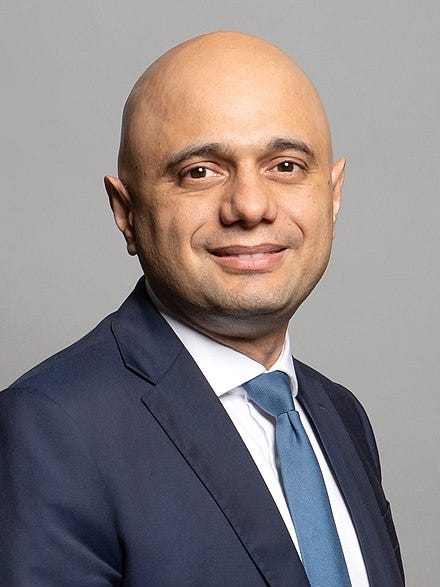
Former UK Secretary State for Health and Social Care Sajid Javid
It has been difficult to gauge what certain officials knew at what time. However, now we have an indication that some were categorically made aware that their policies were illogical and at direct odds with the evidence-base.
Press releases show that Javid’s department finally revoked the Covid vaccine mandate for health and social care staff on March 15, 2022, months after Malhotra made contact.
In November 2021, a survey of industry leaders estimated that up to 20,000 carers had already quit or been sacked over mandatory jabs. Given the mandate carried on to March the following year, that could be a vast underestimate.
Malhotra, who once advocated for everyone to receive the vaccines before his father reportedly passed away from them, notably said, “This is the biggest corporate crime committed by the drug the industry.”
TalkTV did not post the interview on YouTube as the platform continues to issue strikes to channels discussing the topic. So here it is in full.
Summary of Hallett’s Report on the Covid Inquiry:

- Ad Hoc Intervention: Epidemiologist Professor Mark Woolhouse described lockdown as an ad hoc intervention with no prior planning, guidelines, or clear expectations.
- Lack of Scrutiny on Consequences: The novelty of the lockdown approach meant there was no time to scrutinise its potential side effects, leading to ill-prepared policies with unknown consequences.
- Significant Economic Impact: The report highlights the 25% drop in GDP between February and April 2020 due to lockdowns, representing a major gap in the UK’s assessment of pandemic risk.
- Missing Topics: The report does not discuss the UK government’s evidence that the Test and Trace system had minimal impact on reducing Covid infections despite its high cost.
- Balancing Factors in Health Emergencies: The report emphasises the need for a balanced approach in health emergencies, considering economic impact, social wellbeing, and effects on education, as advocated by former chief medical officer Sally Davies.
- Exclusion of Certain Testimonies: Testimonies from Chief Medical Officer Chris Whitty are notably absent, indicating a potential shift from previously dominant perspectives during the pandemic.
- Real Story of the Report: The report suggests that the UK was not prepared for the “wrong pandemic”, but rather that it resorted to an unprecedented policy without a proper evidence base or risk assessment. It advocates that lockdowns should be a measure of last resort, and perhaps never used at all.
Ukraine ‘Shot Itself in the Foot’ by Banning Transit of Lukoil Crude to Hungary and Slovakia
By Ilya Tsukanov – Sputnik – 20.07.2024
Hungary and Slovakia stopped receiving oil from Russian oil giant Lukoil via the Soviet-built Druzhba (‘Friendship’) pipeline which runs through northwestern Ukraine after Kiev imposed a transit ban. Financial analyst Paul Goncharoff says the move is both counterproductive and shortsighted, but that hasn’t stopped Ukraine’s authorities before.
Officials in Budapest and Bratislava confirmed this week that the delivery of oil supplies purchased from Lukoil through the Druzhba oil pipeline network had dried up.
Slovakian oil transporter Transpetrol said non-Lukoil Russian deliveries appear unaffected so far.
Hungarian Foreign Minister Peter Szijjarto said Budapest is receiving oil via the TurkStream pipeline, running from Russia through the Black Sea to southeastern Europe, but that supplies via Druzhba had been stopped “due to a new legal situation” imposed by Kiev.
“We are now working on a solution that would allow oil transit to restart as Russian oil is very important for our energy security,” Szijjarto said Tuesday.
Kremlin spokesman Dmitry Peskov said Friday that Moscow doubts whether dialogue with the Ukrainian companies responsible for oil transit on this issue is possible.
“This sort of decision was made not at the technical, but the political level. We don’t have any dialogue here,” he said.
Druzhba is one of the longest and largest oil pipeline networks in the world, with a capacity to ship about 66.5 million tons of oil annually. The network branches off in southern Belarus into a northern route running through Poland to eastern Germany, and a southern route, which winds through southwestern Ukraine to the Hungarian and Slovakian borders.
Hungary, Slovakia and the Czech Republic negotiated with Brussels in late 2023 to allow them to maintain their pipeline-based imports of Russian oil, citing a lack of access to sea-based deliveries, and lack of opportunities to receive substantial amounts of oil from other sources.
The three countries collectively imported about 15 million tons of Russia divided roughly evenly between them in 2022, and dropped purchases modestly (between 2 and 10 percent) in 2023, according to Russian oil transport giant Transneft.
Shipments of Russian oil to Poland and further west to Germany via Druzhba’s northern branch were halted by Warsaw in early 2023.
Last month, Ukraine formally banned the transit of crude produced by Lukoil – Russia’s second-largest oil company, through the section of Druzhba running through Ukraine.
The move signals another short-sighted escalation by Ukraine’s pro-Western elite which will ultimately harm ordinary Ukrainians in the long run, says veteran financial analyst Paul Goncharoff.
“Whether Ukraine can afford to further escalate the situation surrounding the movement of energy resources is a moot point. Escalation on all fronts has passed all reasonable limits, politically, economically and militarily. They cannot afford it economically [nor] politically as they have now estranged both Slovakia and Hungary, [but will continue to escalate], regardless of cost, as their marching orders from Washington along with the servile echoes of Brussels and their insistence to ‘demonstrate resolve’” dictate, Goncharoff told Sputnik.
“The real consequences should become very clear in 3-4 months as winter descends on Ukraine, and any energy goodwill there may still be in countries neighboring Ukraine will be scarce to nonexistent,” the observer expects.
At this stage, Goncharoff says, Russian oil exporters not affiliated with Lukoil can still send oil through the Druzhba pipeline, but “how long this possibility will continue is anyone’s guess.”
“In discussions I have had with persons closely involved in this trade, there are swap workarounds being looked at in order not to deprive Slovakia or Hungary from needed and contracted resources. Unfortunately, the political reality is such that it is likely any workarounds will raise a hue and cry from the West, and they will try to close the workarounds off as well, if for no other reason but to be politically correct,” the market analyst said.
Ultimately, the old saying “shooting oneself in the foot” is an apt description for Kiev, Brussels and Washington’s policy today, “while the world looks on, shaking its collective head in wonder,” Goncharoff concluded.
Russian oil and gas flows to Europe have dropped dramatically following the escalation of the conflict in the Donbass into a full-fledged proxy war between Russia and NATO. The decline in Russian energy flows west prompted Moscow to reorient part of its energy trade to its BRICS partners (particularly China and India) and pushed EU countries and the UK to kick off a global scramble to secure the energy needed to power their economies.
The West’s attempts to “punish” Russia by cutting off energy purchases have so far had a boomerang effect, raising prices and undermining Europe’s global industrial competitiveness against China and the United States. Traditional European industrial powerhouse Germany has been hit particularly hard, facing the outflow of major manufacturers looking for greener pastures, and cheaper energy costs, in countries abroad.
How western Big Tech giants enable Israel’s occupation
By Kit Klarenberg | The Cradle | July 20, 2024
On 10 July, Hebrew newspaper Maariv reported that 46,000 Israeli businesses have been forced to shut down due to the ongoing Gaza war and its devastating effect on the economy. The outlet referred to Israel as a “country in collapse.”
Regular readers of The Cradle will be well aware of the scale of the occupation state’s economic collapse since the Gaza genocide began. Yet, its effect on the precipitous decline of Tel Aviv’s once-thriving tech sector remains underexplored.
Complicity in occupation infrastructure
In mid-June, mainstream news outlets reported that chip giant Intel was halting expansion of a major factory project in Israel, which was slated to pump an extra $15 billion into the occupation entity’s economy.
Intel is just one tech giant whose fortunes have soured since Palestinian freedom fighters breached Gaza’s concentration camp walls on 7 October 2023.
The same fate has been suffered by many tech companies profiteering from illegal Zionist settlement expansion, which also provide infrastructure and resources used to oppress Palestinians and enforce Tel Aviv’s apartheid.
Multiple consumer-facing western companies that not only profit from illegal Jewish settlement expansion but actively provide core infrastructure and resources used to oppress Palestinians and enforce Tel Aviv’s apartheid could now be subject to lawsuits.
This week, the International Court of Justice (ICJ) ruled that Israel’s continued presence in occupied Palestinian territory is unlawful and should come to an end “as rapidly as possible.” Notably, the court opened the door to “reparations” for any illegal actions carried out by Israel and other entities since 1967.
The ICJ’s landmark judgment means the long-term viability of these tech firms’ operations in the occupied territories is moribund – for fear of legal repercussions, if nothing else.
Fittingly, given Germany is currently in the dock at the ICJ for its support and facilitation of the genocide in Gaza, Munich-headquartered tech conglomerate Siemens is among the culprits.
The firm is “focused on automation and digitalization in the manufacturing industries, intelligent infrastructure for buildings and distributed energy systems, smart mobility solutions for rail transport, and medical technology and digital healthcare services.” Its products are profuse throughout the occupation state and its illegal settlements.
Traffic control systems and traffic lights produced by Siemens can be found in areas of the West Bank where Palestinian residents are forbidden from traveling. In 2014, the company’s Israeli subdivision RS Industries won a tender to provide traffic control systems across the Jerusalem Municipality too – East Jerusalem, designated as the capital of the Palestinian state, was occupied in 1967, and falls within the ICJ’s mandate.
Elsewhere, Siemens provides its DDEMU model cars for the Tel Aviv Jerusalem Fast Train and, in 2018, was awarded a $1 billion contract by the entity-owned Israel Railways to supply 330 electric cars as part of Israel’s electrification project, which includes the Tel Aviv – Jerusalem Fast Train (A1).
A highly controversial project that passes through two areas of the West Bank, including privately owned, occupied Palestinian land, it is intended for exclusive use by Israeli Jews.
Don’t Buy Into Occupation (DBIO) states: “Siemens’ activities are of concern, as they are linked to the provision of services and utilities supporting the maintenance and existence of settlements.”
However, the company’s activities extend far further. Through its Israeli representative, Orad Group, the company provides equipment and technology to the notorious Israel Prison Service (IPS).
In 2004, the Orad Group provided a Siemens technology-based perimeter security system to Gilboa prison — a detention center specifically designated for Palestinian political prisoners. Siemens also supplies the IPS with a sophisticated fire detection and extinguishing system.
Connecting settlements
US brand Motorola is widely recognized for its innovative smartphone devices. However, DBIO has meticulously documented the involvement of Motorola’s Tel Aviv division in settlement expansion over the past decade.
The tech giant has collaborated closely with Israeli occupation forces, the Ministry of Defense, and Zionist settlement councils across the illegally occupied territories. A prime example of this collaboration is the surveillance system “MotoEagle,” designed to monitor settlers on appropriated land, operate within occupation military bases, and oversee the Gaza concentration camp’s separation wall.
Notably, Motorola-produced radar stations have been installed on illegally appropriated private Palestinian land, restricting Palestinian movement in these areas. Furthermore, Motorola supplies the Ministry of Defense’s Zramim System, a smart card operation utilized at Israeli checkpoints to monitor goods transportation.
Palestinian drivers, merchants, and transport companies are compelled to register their personal information in this system, enabling Tel Aviv to monitor all entry and exit points meticulously.
The company is also a preferred contractor for internal security systems in numerous occupation settlements. The Jordan Valley regional council, encompassing more than 20 settlements in the occupied West Bank, employs multiple Motorola products, including command and control systems and surveillance cameras. Additionally, the Population and Immigration Authority in the settlement of Beitar Illit uses Motorola for its security needs.
In 2022, Motorola Solutions secured a contract to provide security cameras and entrance control resources for the Jerusalem Light Rail’s (JLR) entire Green Line. This route links the Gilo settlement in occupied East Jerusalem with the city center and the Ramat Eshkol, Ma’alot Dafna, and French Hill settlements, facilitating connectivity between settler enclaves and supporting settler movement. Consequently, Motorola has been listed in the UN’s database of firms profiting from illegal settlement expansion.
Powering apartheid
Hewlett Packard Enterprises (HPE), which split from personal computer and printer provider Hewlett Packard in 2015, is one of the most profitable US corporations. However, it is less well-known that HPE supplies and manages much of the technological infrastructure underpinning the occupation state’s apartheid and settler colonialism.
For example, HPE provides “Itanium” servers and maintenance services to Tel Aviv’s Population and Immigration Authority. This computerized Israel’s checkpoint system while storing vast amounts of information on all Palestinians with Israeli citizenship and non-citizen Palestinian residents of occupied East Jerusalem.
HPE directly contracts with the illegal settler municipalities of Modi’in Ilit and Ariel, two of the largest Jewish-only settlements in the West Bank, providing them with a range of services. Additionally, HPE maintains the central server system for the Israeli Prison Service (IPS), placing the company at the core of Tel Aviv’s use of mass incarceration to suppress Palestinian resistance. A 1994 Human Rights Watch report highlighted this by noting:
“The extraction of confessions under duress, and the acceptance into evidence of such confessions by the military courts, form the backbone of Israel’s military justice system.”
Moreover, HPE is the primary provider of the Basel system, an automated biometric access control system employed at Israeli checkpoints and the Gaza apartheid wall. ID cards distributed under Basel are integral to the systematic discrimination against Palestinians.
The checkpoints, by design, segregate and fragment the Occupied Palestinian Territories and its inhabitants, separating workers from their places of employment, students from their schools, and families from each other through electrified fences, watchtowers, and concrete barriers.
Electronic counter intifada
This system is part of a broader state of siege under which Palestinians have lived for decades, significantly intensified by the sealing off of Gaza and the West Bank. The Israeli navy, another HPE customer, relies on the company’s IT infrastructure and support services. The siege severely restricts the movement of goods and people in and out of Palestinian territories, aiming explicitly to crush Palestinian resistance.
In 2006, Dov Weisglass, an adviser to then-Israeli Prime Minister Ehud Olmert, explained: “The idea is to put the Palestinians on a diet, but not to make them die of hunger.” It was hoped hunger pangs through limited caloric intake might encourage Palestinians to reject Hamas or at least force its fighters to temper their resistance efforts. The starvation of Palestinians has only galvanized their support for Hamas and their yearning for freedom from Israeli occupation.
The occupation state failed to crush the Palestinian resistance via Operation Swords of Iron, an effort so catastrophic that even Israeli media has branded it a “total defeat.”
Following Iran’s successful 14 April retaliatory strikes against Israel, Tel Aviv’s reign of impunity appears to be nearing its long-overdue end. It is only a matter of time before major western tech firms like HPE, which facilitated the oppression of Palestinians, will face consequences for their complicity.
This investigation is the second in a series at The Cradle that examines illegal investments by western corporations in the occupied Palestinian territories and/or that assist Israel in implementing its apartheid system. The first investigation can be found here.
Ukraine plans to adopt law allowing foreign debt payments suspension
Al Mayadeen | July 18, 2024
Ukraine intends to pass legislation allowing the government to freeze foreign debt payments while the country and its international creditors negotiate conditions for restructuring more than $20 billion in bonds, Bloomberg reported.
The proposed law, filed by the chairman of President Volodymyr Zelensky’s party, aims to allow for the suspension of payments on foreign sovereign debt and state-guaranteed obligations due to a coupon payment scheduled for August 1.
The parliamentary budget committee convened Thursday morning and suggested that the measure be approved by the assembly, according to chairman Danylo Hetmantsev’s message on Telegram.
The clock is ticking for Ukraine and bondholders on debt restructure, as a payment freeze agreed upon 2 years ago will soon expire.
Unless a settlement is reached or a two-year moratorium is extended by the end of this month, Ukraine will legally default on its obligations in September.
“It is necessary to introduce, for the period of transactions to change the terms of borrowing, temporary measures related to the servicing and repayment of debt obligations and a moratorium on satisfaction of creditors’ claims,” the bill that was released by the president’s office said.
Taiwan must pay for defense – Trump
RT | July 17, 2024
Republican presidential candidate Donald Trump has indicated he would be less willing to defend Taiwan from mainland China than his Democratic rival and incumbent US President Joe Biden.
It is “stupid” for Washington to offer protection to Taipei for free, Trump insisted in an interview with Bloomberg recorded on June 25 but published in full on Tuesday.
“I know the people very well, respect them greatly. They did take about 100% of our chip business. I think Taiwan should pay us for defense,” he said.
The self-governed island of Taiwan, which China views as part of its territory, produces an estimated 90% of the world’s super-advanced semiconductor chips.
“I don’t think we are any different from an insurance policy,” the former president stressed. “Taiwan doesn’t give us anything” despite being “immensely wealthy,” he added.
According to Trump, protecting Taipei would also be problematic for Washington due to purely geographical reasons. “Taiwan is 9,500 miles (around 15,000km) away [from the US]. It’s 68 miles (just under 110km) away from China,” he explained.
Taiwanese Premier Cho Jung-tai responded to Trump’s comments by saying that the island of 23.5 million is dedicated to boosting its defenses and “willing to take on more responsibility” for its own security.
“Taiwan has steadily strengthened its defense budget and demonstrated its responsibility to the international community,” he said during a press conference on Wednesday.
Cho expressed the belief that “as long as we continue to demonstrate [these efforts], we will receive support from more countries.”
The premier thanked the US several times for paying attention to the issue of Taiwanese security, stressing that Taipei and Washington have “good relations” despite the lack of any formal ties.
Officially, the US accepts the One China policy, which states that Taiwan is an integral part of Chinese territory. However, Washington has been backing Taiwanese pro-independence forces and supplying weapons to the island. Biden has pledged on several occasions that America would defend Taiwan militarily if it were attacked from the mainland.
Beijing vigorously opposes contacts between Washington and Taipei, repeatedly calling the Taiwanese issue its “red line.” The Chinese authorities have said that they would prefer peaceful reunification with the island, but have warned that a military scenario cannot be ruled out.
A poll published earlier this year by the Taiwanese National Chengchi University showed that more than 80% of the island’s population was not seeking independence, but wanted to maintain the status quo with mainland China.
New Study: ‘Carbon Dioxide And A Warming Climate Are Not Problems’
Instead, warmth and elevated CO2 are a boon for humanity
By Kenneth Richard | No Tricks Zone | July 8, 2024
A new peer-reviewed paper published in The American Journal of Economics and Sociology (May and Crok, 2024) counters the prevailing “wisdom” that says a warmer climate and greener vegetation are problematic.
The authors detail the horrors of the much colder Little Ice Age that destroyed civilizations (crop failures, summerless years). Half the population of Finland and 15% of Scotland’s citizens died off in the 1690s due primarily to the cold-induced famines and frozen-over water supplies.
Elevated CO2 and warmth are 70% and 8% responsible, respectively, for a much greener, more vegetated landscape across the world since the 1980s.
The incidence and severity of storms, hurricanes, floods, and extreme weather in general have undergone flat to declining trends over the last several decades. Thus, “it is hard to find any unusual weather or weather-related disaster that can be blamed on climate change, whether natural or anthropogenic.”
“52 of 53 studies of disaster losses due to extreme weather were unable to attribute the events to human causes…”
The US government estimates the warming since 1950 has reduced the country’s gross domestic product by less than 0.5%, and an estimated 3°C of warming by 2100 still only reduces the GDP by less than 1%. Considering the US economy grew by 800% from 1950 to present, this means any assumed “damage” from warmth and elevated CO2 would not be detectable.
The quest to “save” the world from warming and elevated CO2 is devoid of scientific and socio-economic merit.
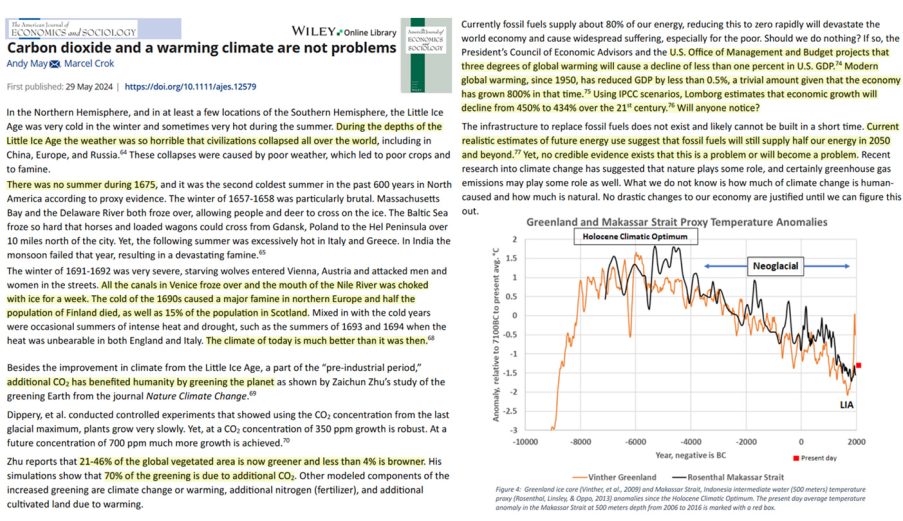
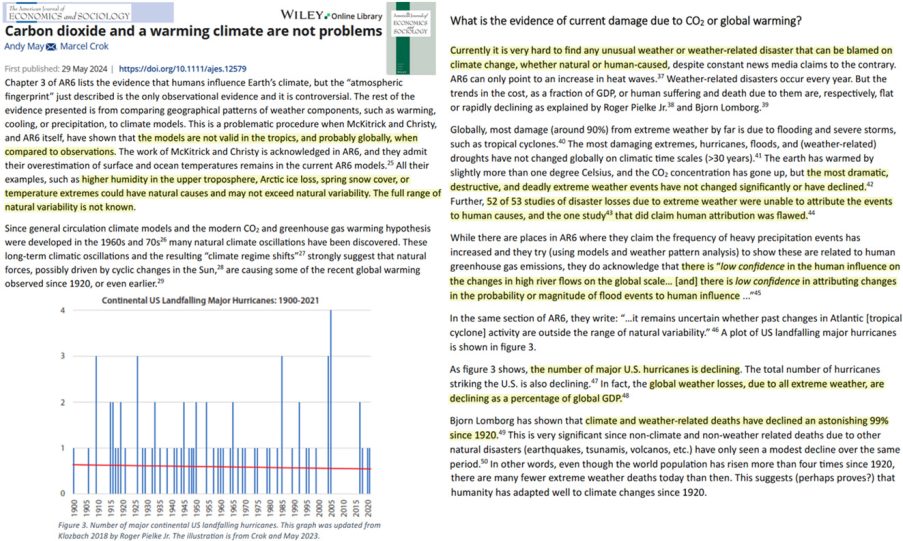
Image Source: May and Crok, 2024
Why France’s Snap Election Proves EU’s Warmongering Agenda Flopped
By Ekaterina Blinova – Sputnik – 10.07.2024
Despite surviving the runoff vote, Emmanuel Macron sustained a crushing and unexpected defeat during the snap election, Fabien Chalandon, French political commentator and writer, told Sputnik. What’s more, the parliament’s new composition may put the brakes on Macron’s bellicosity.
The outcome of the snap election in the French National Assembly has left no party with a majority, leading to uncertainty regarding the formation of a coalition. This raises the question of whether the left-wing and centrist parties will be able to collaborate effectively in order to establish a functional parliament.
“This is the key question,” Fabien Chalandon, chevalier of the French Legion d’Honneur, investor, and writer, told Sputnik. “No party has any majority, and any government can be deposed at any time by a combination of the two other groups. The parliament is therefore in a gridlock and ungovernable. In addition, the left-wing New Popular Front (NFP) is a coalition of small parties all deeply opposed on any subject, including Ukraine, and which have only one common ground: their hate of the National Rally (RN), which cannot provide a common set of practical objectives for an effective governing alliance.”
The NFP, a broad left-wing coalition which brought together Socialists, Communists, Greens and the hardline leftist France Unbowed Party (La France Insoumise), was hastily founded on June 10 with the sole aim of defeating the right-wing RN in the snap legislative election.
According to the commentator, the likelihood of the NFP coalition passing the test of time is “remote as it may explode on the issue of loss of real income, when finally politicians admit that the bulk of the current impoverishment of French middle and poor class has been stoked by inflation directly derived from the Ukrainian conflict.”
Macron’s Bellicosity Backfired During Elections
Meanwhile, it appears that the new composition of the parliament could disrupt French President Emmanuel Macron’s “tour de force” for European leadership.
Over the past several months, Macron has made a series of controversial statements, ranging from putting NATO boots on the ground in Ukraine to doubling the EU budget and promoting the idea of a “major European loan” to finance the bloc’s rearmament effort.
Macron’s sudden transformation into a “Ukraine hawk” – given that France has been ranked 15th in terms of military aid to Kiev – raised questions in the European mainstream press. According to the Spectator, one of the causes of Macron’s bellicosity was his desire to “embarrass” the National Rally in the European elections, “not to mention their predicted victory in the 2027 presidential race.”
The French president’s scheme appeared to have boomeranged. His Renaissance party secured just 15.2 percent of the vote during the EU parliamentary elections last month, while the National Rally got a whopping 31.5 percent.
In the snap election, announced by Macron after the humiliating defeat, the centrist-liberal Ensemble (Together) party survived by pure luck and due to its unholy formal alliance with Les Republicains (LR) and the NFP to obstruct “at all costs” the National Rally in the second round, according to Chalandon.
“Compared to the 2022 elections, the Macron presidential party ‘Together’ lost 100 seats to 168,” the political commentator noted.
“This [snap] election is therefore a second crushing defeat for M. Macron,” the pundit said. “Macron did not expect such a damning result after the first round. In fact, this snap election is overwhelmingly portrayed in the French press and social media as a ‘childish’ decision following the RN tsunami during the previous European elections.”
The election outcome would continue to undermine Macron’s warmongering posture, including his push for rearmament and increased military support to Ukraine, according to the commentator.
“On Ukraine, the NFP is clearly against the EU and EU support of Ukraine. But so is the Unbowed France Party… Any proposal for additional funding to Ukraine may not be approved if these two coalesce to block it, even if they do not coordinate,” Chalandon said.
While the EU’s bureaucracy could circumvent the legislative gridlock in its member states by stealthily boosting its funding to Ukraine within its general budget, the crux of the matter is that Europeans and especially young people across the continent have increasingly started to realize the collective West’s hypocrisy with regard to Ukraine, according to the pundit.
Chalandon notes that Europeans are steadily recognizing the West’s 20-year provocations against Russia, as well as the sabotage of the Istanbul agreement in April 2022 led by the US and UK.
“Moreover, the cause of the recent sharp decline of Europe’s purchasing power is starting to be attributed to the Ukrainian conflict, so far, a taboo subject among politicians. Ukraine’s war and open-ended funding will not continue unabated and may progressively appear for what it is: the main cause of Europe’s recent economic downfall,” the commentator emphasized.
How Could US Political Debacle Affect Europe’s Ukraine Policy
Nonetheless, the EU elites are unwilling to change their stance on the Ukraine conflict, especially given their political dependency on their peers in Washington.
However, US neocons have recently found themselves on the horns of a dilemma given that their major “pro-war” presidential candidate Joe Biden appears to be “unsellable” to American voters, as Wall Street analyst Charles Ortel noted in an earlier interview with Sputnik.
“The key factor which could affect French and Europe’s attitude in the Ukrainian conflict is if M. Trump wins the US election and decides to force Ukraine to negotiate by interrupting its military aid,” Chalandon said, referring to the Republican frontrunner’s plan to stop the fighting and look into peace negotiations.
The political commentator noted, however, that despite Trump’s high-powered numbers across US nationwide polls, his victory is not a done deal given the lawsuits brought forward by his political opponents.
Likewise, the Biden camp is also teetering in the balance as the Democratic Party is waging a behind the scenes battle over a possible replacement for the aging Biden. This potential change could allegedly shift Washington’s attitude on the Ukraine conflict.
“Since European efforts towards Ukraine cannot survive a withdrawal by the US, Europe and France will be left with no other option than to cave in,” the French political commentator remarked.
Chalandon concluded that if a new US context were to arise, Europe’s determination to carry on with the ongoing military “solution” to the Ukrainian conflict would amount to nothing more than empty posturing.
In parallel to his investment banking career, Chalandon co-founded and ran a French political think tank, Fondation Concorde, and was awarded the French Legion d’Honneur in 2000 and wrote for leading French newspapers on political issues. His father, Albin Chalandon, served as minister of various governments under President Charles de Gaulle and Georges Pompidou and then minister of justice between 1986 and 1988 in a Jacques Chirac-led government under then President Francois Mitterrand.
Niger, Burkina Faso, Mali sign treaty to become confederation
Al Mayadeen | July 7, 2024
“This summit marks a decisive step for the future of our common space,” Capt. Ibrahim Traore, the leader of Burkina Faso, wrote on X.
The military-led governments of Mali, Burkina Faso, and Niger convened their first joint summit on Saturday in Niamey, the capital of Niger. During this historic meeting, they announced the formation of a confederation of the three Sahel states.
In their inaugural summit since coming to power, the leaders adopted a joint statement outlining a treaty to establish the confederation.
“This summit marks a decisive step for the future of our common space. Together, we will consolidate the foundations of our true independence, a guarantee of true peace and sustainable development through the creation of the ‘Alliance of Sahel States’ Confederation,’” Capt. Ibrahim Traore, the leader of Burkina Faso, wrote on X.
Tensions with ECOWAS persist
The summit appears to signal a departure from the Economic Community of West African States (ECOWAS). Tensions between the Sahel nations and ECOWAS escalated after Gen. Abdourahamane Tiani seized power from the elected President Mohamed Bazoum in a coup in Niger last July. In response, ECOWAS imposed sanctions on Niger and threatened intervention, further straining relations.
“The AES (Alliance of Sahel States) is full of enormous natural potential which, if properly exploited, will guarantee a better future for the people of Niger, Mali and Burkina Faso,” said Traore.
“Our people have irrevocably turned their backs on ECOWAS,” stated Tiani to his fellow Sahel leaders.
The three AES countries accuse ECOWAS of being manipulated by former colonial ruler France, with Tiani calling for the new bloc to become a “community far removed from the stranglehold of foreign powers.”
Niger, Mali, and Burkina Faso’s military leaders have all rejected French influence, expelling French troops from their countries and turning instead toward what they call their “sincere partners” – Russia, Turkey, and Iran. They emphasize sovereignty as a guiding principle of their governance and aim to establish a common currency.
What Will Iran’s Foreign Policy Be Under New President Pezeshkian?
Sputnik – 06.07.2024
Masoud Pezeshkian has emerged as the winner of the presidential runoff in Iran this week, receiving 54 percent of the votes.
The newly elected President of Iran Masoud Pezeshkian spoke to Sputnik on the eve of the election about the main priorities of Iran’s foreign policy, which include: strengthening relations with Russia and China; Iran’s active presence in BRICS and the Shanghai Cooperation Organisation; restoration of the Joint Comprehensive Plan of Action (JCPOA) and the lifting of sanctions.
“Russia is a friend and partner of Iran, and I consider it a priority to deepen and expand relations with Russia and China, as well as intensify foreign policy activities in the Asian direction in general,” Pezeshkian said. “And we, of course, at all levels – bilateral, regional and international – will continue our efforts to expand interaction with the Russian Federation.”
According to him, Iran “opposes the policy of unidirectionality” and supports “the principle of multipolarity.”
“One of the priorities of my foreign policy program is regional cooperation, and for this purpose, Iran will expand its presence in BRICS and the SCO, as well as strive for more active cooperation with the Eurasian Economic Union to more fully realize the potential of trade and economic relations with the member countries of these organizations,” Pezeshkian explained.
Regarding the JCPOA, Pezeshkian pointed out that it is “an international agreement approved by the UN,” and that the United States’ unilateral withdrawal from this agreement “caused serious damage to Iran and the Iranian people.”
“As the Russian side has repeatedly emphasized, Iran has fulfilled its obligations, and we see our task as returning the other participants to this agreement as soon as possible and achieving the lifting of sanctions. I am confident that the friendly governments of Russia and China will support Iran and assist it in resolving this issue,” he added.
Not-Transitioning: India burns more coal than the US and Europe combined
India is going gangbusters building new coal plants
By Jo Nova | July 5, 2024
The need for energy in India is so dire, the Modi government just leaned on the power companies to get their act together. Instead of adding the usual 1 – 2 gigawatts of new coal power, which they have for a lot of the last decade, last year they ordered enough gear to build 10 gigawatts. And this year Modi wants them to aim for 31 gigawatts. Which is about the same capacity as the entire coal generation of the Australian National Grid (and our gas plants too).
Somewhat miraculously, they are talking of building them “in the next 5 or 6 years”:
India ‘Asks Utilities to Order $33bn in Gear to Lift Coal Output’
Rush to add more coal plants
India is rushing to add fresh coal-fired plants as it is barely able to meet power demand with the existing fleet in non-solar hours.
Post pandemic, the country’s power demand scaled new records on the back of the fastest rate of economic growth among major economies and increased instances of heatwaves.
India saw its biggest power shortfall in 14 years in June, and had to race to avoid night time outages by deferring planned plant maintenance, and invoking an emergency clause to mandate companies to run plants based on imported coal and power.
— Asia Financial
And they are discussing numbers like $33 billion instead of $3.3 trillion. When President Modi wants electrical generation fast, he didn’t say “quick, build 50,000 wind mills, with batteries, gas plants, high voltage lines and pumped hydro.”
Meanwhile the Western advisors sit around at frequent-flyer lounges on the way to UN junkets and tell themselves how the world is transitioning away from coal. And when the UN patsy declares coal is a “stranded asset” they nod obediently and sip more champagne.
When our inept and traitorous scientific agencies calculate energy costs, they won’t even put coal on the map unless they add up the cost of every cyclone in the next hundred years and park it in the “coal” column. Witchdoctors, every one of them.
Featured Video

Macgregor: We Haven’t Seen the Worst of the Iran War Yet
or go to
Aletho News Archives – Video-Images
From the Archives
15 Saudi ‘hijackers’ were CIA agents working for US: Scholar
Press TV – April 13, 2016
Fifteen of the 9/11 “hijackers” from Saudi Arabia were CIA agents working for the United States government, which was seeking to destroy the Middle East for Israel and to double the American military budget, says Dr. Kevin Barrett, an American academic who has been studying the events of 9/11 since late 2003…. continue
Blog Roll
 Aletho News
- Iran’s Plan to Shut Down AI in the Persian Gulf
- Israel seeks ‘compensation’ from Washington over Saudi F-35 sale
- Saudi crown prince seeks dialogue with Ansarullah after Yemeni blows: Report
- Damascus rejects Saudi request for Syrian fighters to counter Yemen: Report
- South Korea says will not send troops to join terrorist US war on Iran
- Russia Just Struck the Eyes of NATO’s War Machine in Ukraine
- Russia summons UK charge d’affaires over Kiev drone support
- NATO member warns bloc seeking pretext for war with Russia
- Macgregor: We Haven’t Seen the Worst of the Iran War Yet
- ‘We are not like everyone else’ laws that bind other nations do not apply to Israel, says Likud lawmaker
- If Americans Knew
- Debunking The Claim That Macklemore Has A “History Of Antisemitism”
- CPJ demands release of arrested Palestinian-US journalist near Bethlehem
- Robert Kraft: The Billionaire Friend of Netanyahu Pulling The Strings Behind the Macklemore/Ed Sheeran Blow Up
- Columbia Administered Fund Gives Big Money to Pro-Israel Groups
- Deportation Case of Palestinian Activist Salah Sarsour Tests First Amendment
- ‘We Will Not Forget’: Palestinians Mark 44 Years since Sabra and Shatila
- Why do we let Zionists decide what we can and can’t say?
- US welcomes Israeli, Iranian delegations to UN, but not Palestinians – Daily Update
- Biden’s Genocide Accomplices Targeted by New Accountability Campaign
- AIPAC’s Network Has Already Spent $67.2 Million to Shape the Midterm Elections
- No Tricks Zone
- New Study: ‘Global Drought Shows No Detectable Recent Acceleration Under Climate Warming’
- Economic Masterminds: German Socialists Suggest Taxing Productivity Gains Stemming From Using AI
- The South China Sea Has Not Been Cooperating With The Climate Change Narrative
- Energy Crisis: Germany Enters Heating Season With Historically Low Gas Reserve Fill Levels
- New Study: The Antarctic Ice Sheet Gained Mass From 2020-2024 Due To Staggering Snow And Ice Accumulation
- Study: Ocean Heating Rates From Thousands Of Years Ago ‘Dwarf’ Modern Ocean Heating Rates
- Climate Extremists Target, Attack Large-Scale Power Grid Infrastructure In Germany!
- New Study: Antarctic Ice Melt Has Contributed Less Than 1 Centimeter To Sea Level Rise In The Last 30 Years
- Fear Of Debate: Alarmist German Climate Scientist Calls On Mainstream Media To Discredit Skeptic Voices
- End-Of-August Arctic Sea Ice Extent Hasn’t Fallen In 20 Years, Official Data Show!
 Aletho News