US ban on Russian metals ‘cuts both ways’ – Kremlin
RT | April 15, 2024
New Western sanctions against Russian metals are a weapon that cuts both ways, Kremlin spokesman Dmitry Peskov has said. The US and UK have targeted Russian-origin aluminum, copper, and nickel, aiming to reduce Moscow’s export revenues.
The “illegal” restrictions introduced last week will backfire on the countries that imposed them, Peskov claimed on Monday. He noted there has been a “certain destabilization” on the metals market following the ban, referring to a rally on a leading commodity exchange earlier the same day.
Washington banned the import of Russian-origin aluminum, copper, and nickel into the US on Friday, and has coordinated with the UK to crack down on global trade in these metals.
The decision affects aluminum, copper, and nickel produced in Russia after April 13, 2024, and the world’s leading commodity exchanges – the London Metal Exchange (LME) and Chicago Mercantile Exchange (CME) – are obliged to prohibit their trade.
Aluminum jumped as much as 9.4% on the LME on Monday, the most since the current form of the contract was launched in 1987, according to Bloomberg. Nickel rose as much as 8.8%.
The rally is being fueled by “worries that the sanctions will reduce Russian flows to Western markets,” the outlet reported. The new restrictions “inject major uncertainties” into metals markets that have already been reshaped since the start of Russia’s military operation in Ukraine and the Western sanctions campaign against Moscow, it added.
The LME confirmed to Bloomberg on Saturday that “old” Russian aluminum, namely metal produced before April 13, 2024, will continue to be delivered.
As of March 2024, the share of Russian aluminum in the LME warehouse system was 91%, while the share of Russian copper stood at 62% and nickel at 36%, according to LME calculations.
Russia currently accounts for 6% of the global nickel supply, 5% of aluminum, and 4% of copper. According to Forbes, most analysts agree that the new sanctions will lead to an increase in Russian metal supplies to China.
Israeli general pegs cost of defending against attack – media
RT | April 14, 2024
Israel has claimed success in defending itself against Saturday’s drone and missile barrages by Iran, but that effort reportedly came at a high price.
The interceptors, jet fuel and other materials expended in shooting down Iran’s unmanned aerial vehicles (UAVs) and missiles cost about 4 billion to 5 billion shekels ($1.06 billion to $1.33 billion), Israeli Brigadier General Reem Aminoach told local media outlet Ynet News on Sunday. The estimate included only Israel’s direct costs, not counting the considerable weaponry used by the US and other allies in helping to defend against the attack.
Aminoach, formerly the financial adviser to the Israel Defense Forces (IDF) chief of staff, said West Jerusalem used such munitions as Arrow and David’s Sling interceptor missiles, which have per-unit costs of about $3.5 million and $1 million, respectively. He also included sortie expenses for the fighter jets that did the bulk of the work in shooting down Iranian drones.
The general lamented that it was far cheaper for Iran to launch the attack than for Israel to defend itself. “The attack cost Iran less than 10% of what it cost us to defend against it,” he told Ynet. “In the future – in a year, two years, or five years – they can carry out 50 such attacks. And let’s say that if the IDF’s net budget in 2023 was 60 billion shekels, with less than double that you have no chance of reaching a situation where we can maintain the required amounts.”
The IDF claimed that 99% of the more than 300 kamikaze drones and missiles launched from Iranian territory were successfully intercepted. All of the UAVs and cruise missiles were shot down, military spokesman Daniel Hagari said, while a few ballistic missiles got through Israel’s defenses.
Those projectiles fell at the Nevatim Airbase and caused “only minor damage to infrastructure,” the spokesman said. He added that the drones launched by Iranian-backed militants in Iraq and Yemen all failed to reach Israeli territory. The only casualty was a shrapnel wound to a 10-year-old Bedouin Israeli girl who was hit while sleeping at her home in southern Israel.
Saturday’s attack came in response to an April 1 airstrike that killed seven Iranian military officers, including two senior commanders, at Tehran’s consulate in Damascus. Israel has vowed to “exact a price” from Iran for striking back.
Australia bins 35% of multi-billion dollar Covid vaccine supply
By Rebekah Barnett | Dystopian Down Under | April 12, 2024
As part of its pandemic response, the Australian government purchased 267.3 million doses of Covid vaccines, enough to vaccinate Australia’s population of approximately 26 million people ten times over.
But figures released to me by the Department of Health (DOH) this week confirm that, three years into the vaccine program, only 70 million doses, or 26% of the 267.3 million doses purchased, have been administered, while 35% of vaccines doses have been wasted since the start of the vaccine rollout.
Last week, the Australian reported that more than 35% of Covid vaccines were being tossed out as of January due to oversupply. The revelation came from the DOH’s public submission to the federal Covid inquiry.
The wording made it unclear if this was a cumulative figure or applicable only to the month of January, so I contacted the DOH to confirm the total wastage to date, along with some further questions on the value of doses purchased, delivered, and wasted, and exactly how many had been administered.
A DOH spokesperson responded,
“As of 31 March 2024 the total COVID-19 vaccine program wastage rate was at 35.69%. Australia’s wastage rate is within the World Health Organization (WHO) acceptable wastage parameters for multidose vials of 15% and 40%.
“Approximately 80% of COVID-19 vaccine wastage is attributed to expiry of doses across warehouses and vaccine administration sites.”
This appears to mean that 80% of the wasted doses simply expired on the shelf.
The remaining 20% of wasted doses would likely be due to administration sites not managing to use the entire contents of multi-dose vials once opened. While unopened vials have a shelf-life of anywhere between 9-18 months, opened vials must be used within 6-48 hours.
The DOH refused to confirm the value of doses purchased or wasted, or how many of the purchased doses have actually been delivered, “for contractural and security reasons.” The Australian government has repeatedly refused to release details of its tax-payer-funded Covid vaccine purchase agreements.
However, we know that total government spending on Covid vaccines and treatment supply amounts to over $18 billion, of which it appears that the lion’s share was allocated to purchasing vaccine doses.1

Most of these remain unused. DOH figures provided to me this week show that as at 3 April, only a quarter (70 million) of the 267.3 million purchased doses had been used, at a total usage rate of 26.2%
Of the remaining 197.3 million unadministered doses, the DOH advised that approximately 53 million doses have been donated as foreign aid.2
That leaves approximately 144 million doses, more than half of the total stockpile, either already expired, or likely to expire within the next several years, as booster rates hover below 10%. 3
As Australia’s vaccine purchases extend into 2023 and 2024, it is probable that a portion of these doses will still be viable up to 2025.
But even if vaccine doses never expired, it would take Australians 29 years to work their way through the glut, based on the five million boosters administered in the past 12 months.
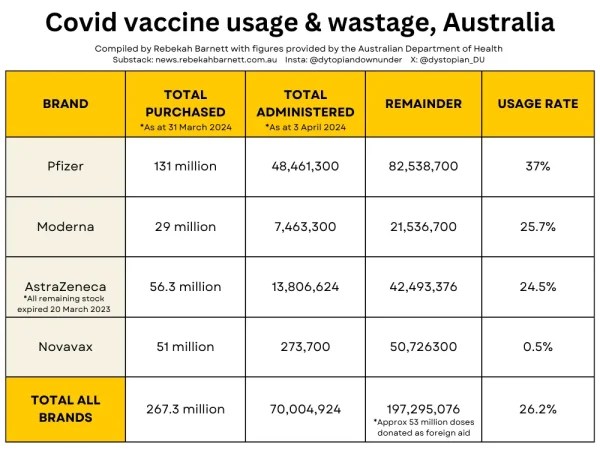
As it stands, usage rates by brand are as below:
- Of 131 million Pfizer doses purchased, 48.5 million have been administered, a usage rate of 37%. 82.5 million doses remain.
- Of 29 million Moderna doses purchased, 7.5 million have been administered, a usage rate of 25.7%. 21.5 million doses remain.
- Of 56.3 million AstraZeneca doses purchased, 13.8 million have been administered, a usage rate of 24.5%. As the AstraZeneca stockpile expired on 20 March 2023, the remaining 42.5 million doses have been binned, unless they were donated as aid prior to this date.
- Stunningly, of 51 million Novavax doses purchased, only 273,700 have been administered, a usage rate of 0.5%. 50.7 million doses, 99.5% of the stockpile, remain. This is because by the time Novavax was approved for use, in December 2021, over 90% of Australians aged 16 and over had already been double vaccinated.
In a July 2022 article investigating Australia’s already apparent vast vaccine wastage, the ABC asked if perhaps the government had bought too many vaccines?
Deborah Gleeson, Associate Professor of Public Health at La Trobe University, criticised the government’s run on the global vaccine supply, suggesting that Australia had hoarded more than its share.
Prof Gleeson told the ABC,
“Australia really participated in a bigger trend that we’ve seen worldwide of wealthy countries buying up far more doses of COVID-19 vaccines than they needed early on in the pandemic. And this is a practice that unfortunately has continued.”
It’s enough to make advocates for global vaccine equity lose sleep at night.
The news of the Australian government’s wastage of billions of dollars worth of Covid vaccines comes as Australians are grappling with the soaring cost of living and the worst housing crisis on record, with over a quarter of a million Australians accessing homelessness services in 2022-2023.
The government webpage also details investment in aid program COVAX, and research and supply chain developments, including some funding for the development of a potential Covid vaccine (since abandoned). The page mentions a 10-year partnership with Moderna and the Victorian Government that will see Moderna build an mRNA vaccine manufacturing facility at Monash University Victoria. However, it is unclear if funding for the Moderna partnership comes from this $18 billion investment, or from other funding.
From a DOH spokesperson,
“Australia has donated more than 52 million doses to countries in the Indo Pacific and Southeast Asia.
· 23.6 million as part of our commitment to share 40 million doses through the Department’s procured supply; and
· 28.5 million as part of the commitment to share 20 million doses through DFAT’s agreement with UNICEF.
“Australia has offered a further 16.8 million doses to the COVAX Facility for distribution to participating developed and developing countries. Of the 755,200 doses that were accepted by the COVAX Facility, 14,400 have been donated.”
Note that because the DOH would not confirm how many of the 267.3 million purchased doses have been delivered, the precise number of doses sitting in the national stockpile cannot be determined. However, the vaccine agreement webpage does specify delivery dates of some purchases, and from this, it can be ascertained that the great majority of doses purchased have already been delivered.
To support my work, share, subscribe, and/or make a one-off contribution to DDU via my Kofi account. Thanks!
Europe’s sinking economy: how many causes can we name while ignoring the Russia factor?
By Gilbert Doctorow | April 12, 2024
As I indicated in my last essay, a great deal of information that would allow one independently to come to a comprehensive understanding of what is going on in the world is available in mainstream media, however counterintuitive that may be for those who revile the Washington narrative and its commercial purveyors. However, the facts we need to know are either buried deep in articles that have titles and opening paragraphs that contradict the content lower down OR as I wrote in that last essay, they are separate dots that are never connected by the journalists and their editors to draw the big picture they do not want to see.
My case today is not taken from the Ukraine war but from its consequences: the visible and statistically demonstrated decline of the European economy and in particular of the country that has long been celebrated as its locomotive, Germany.
This issue has featured in much of the reporting of The Financial Times and other major media these last several weeks when numbers for the economic performance at the end of last year and start of this year have been published. The latest growth estimate for Europe put out by the European Central Bank is an anemic 0.6% while Germany is likely entering a second quarter of recession.
A lot has been written about the leading causes of the bad economic results, in the expectation that once they are identified suitable corrective measures can be put in place. Of late, attention has been directed at the weak capital markets in Europe, compared to the United States, for example, all of which deprives industry of funds for investment that will raise productivity and make Europe more competitive on world markets.
Additional points for discussion are eagerly awaited from Mario Draghi, former Italian prime minister and former President of the European Central Bank, who has been tasked by the European Commission to deliver recommendations on how European competitiveness might be improved.
However, these approaches overlook the fact that deficient capital markets and the many other handicaps that Draghi is likely to name have been around for a long time but that the present stark weakness of the German economy is something very new and, frankly astonishing, to anyone who cares to look at the figures on the collapse of German automobile manufacturing, for example.
Going back six months or more there were articles in our press and feature programs on the BBC and other media recounting how German industrialists are moving abroad and making new manufacturing investments there rather than in their homeland. At that time the high cost of energy ever since Russian pipeline gas was discontinued following the destruction of Nord Stream I was openly mentioned as a factor in the deindustrialization of Germany.
However, that objectivity and frankness has since been put aside. In a BBC report on German industry a week ago, I heard that high energy costs due to the end of cheap Russian gas is not a significant factor in Germany’s economic travails since only 6% of German industry is very energy dependent.
Today, when European gas prices have dropped dramatically from the record levels of late 2022, there is some truth in reducing the weight we give to energy when explaining the German economic decline that is ongoing. However, natural gas has a far greater role in economic and social life than just to fuel the metallurgical or glass industries. It also is feedstock for the chemical and related industries as well as for fertilizers needed to maintain German and European agricultural output. Moreover, the decision of the German and European governments to prioritize geopolitics over domestic economic performance has been a very clear message to industry that Europe is not the place they want to be. Industrialists may not say much in public, but their falling investment here speaks volumes.
The facts are so obvious when you look at them that even the propagandists at The Financial Times have been obliged to give them space. See the article a day ago entitled “German industry unlikely to fully recover from energy crisis, warns RWE boss.” Here you see it in black and white: “German industry is unlikely to recover to pre-Ukraine war levels as elevated prices from imported liquefied natural gas have put Europe’s largest economy at a ‘disadvantage’, the chief of one of Germany’s leading energy companies has warned.”
This is not Russian propaganda. It is highly authoritative and responsible German executives speaking and they are reported in the viciously anti-Russian FT. No investigative journalists like Sy Hersh need apply to light the way for the general public.
©Gilbert Doctorow, 2024
IRGC seizes Israel-linked container ship in Strait of Hormuz
Press TV – April 13, 2024
The special naval forces of the Islamic Revolution Guards Corps (IRGC) have seized Israel-linked MSC Aries container ship near the Strait of Hormuz, official news agency IRNA reports.
The ship was impounded by the Sepah Navy Special Force (SNSF) in a heliborne operation and rappelling of forces on the ship’s deck, the agency said Saturday.
“The ship has now been directed towards the territorial waters of our country,” IRNA said.
The Portuguese-flagged ship, operated by Zodiac Maritime, is owned by Israeli real estate, energy, technology and shipping magnate Eyal Ofer, it added.
Zodiac Maritime is part of the Israeli billionaire’s Zodiac Group.
A video released by IRGC shows SNSF commandos rappelling down onto a stack of containers sitting on the deck of the vessel.
A crew member on the ship could be heard saying: “Don’t come out.” He then tells his colleagues to go to the ship’s bridge as more commandos come down on the deck.
Reports said the MSC Aries had been last located off Dubai heading toward the Strait of Hormuz on Friday. The ship had reportedly turned off its tracking data, which has been common for Israeli-affiliated ships moving through the region.
The incident comes amid Israel bracing for Iranian retaliation after the regime’s April 1 strike on a building in the Iranian embassy compound in the Syrian capital of Damascus, which killed seven IRGC military advisors, including two generals.
‘Russia turned off the gas’ – German leader

RT | April 12, 2024
Germans should blame Moscow and not Berlin for high energy prices, Chancellor Olaf Scholz said in an interview published on Friday. He claimed the embargo against Russia was necessary for defending Europe from “imperialism.”
Speaking with Die Tageszeitung, Scholz defended his government’s policy of unequivocal support for Ukraine.
“It’s about defending Europe’s peace order. Russia is waging an imperialist war and must not win,” he told the outlet. “Second: Russia stopped its gas deliveries, not us.”
Russia’s Gazprom delivered natural gas to Germany both via Ukraine – upholding the existing transit contracts – and via the Nord Stream pipeline, built under the Baltic Sea. Under pressure from the US, Germany blocked the certification of Nord Stream 2 in November 2021 – months before the Ukraine conflict escalated.
Berlin refused to certify Nord Stream 2 even after Nord Stream 1 was destroyed by explosive charges in September 2022. Western investigators have yet to name the culprit for the bombing.
According to Scholz, however, his government “developed new sources of supply for gas and oil and built terminals to import liquefied gas.” The LNG has come mainly from the US, at a much higher price.
“All of this has led to energy prices falling again,” the German chancellor said, arguing that his government prevented a ten-year economic crisis through “decisive action.”
Scholz seconded the message of his economy minister, Green leader Robert Habeck, who has argued that the German model of prosperity built around cheap Russian energy was over for good.
“The peacemaking effect of economic contacts was certainly overrated,” he told the Tageszeitung, claiming that Russia sacrificed its economic well-being by choosing violence. To defend its “democracy and freedom,” Germany needs a strong military, an efficient arms industry, and to support Ukraine, he insisted.
Scholz also brushed off the Germans’ concerns about the economy and inflation by saying that green energy and the pharmaceutical industry will soon turn things around.
On the same day his interview was published, Germany’s largest steelmaker Thyssenkrupp announced “a substantial reduction in production” at its Duisburg facility, laying off 13,000 employees. The company blamed “high energy costs and tight emission reduction regulations” as well as increased pressure from Asian imports.
All for One and One for All
By William Schryver – imetatronink – April 13, 2024
Russia, China, and Iran have now formed a de facto military and economic alliance — what they prefer to call a “partnership”.
In the case of Russia and China, a comprehensive full-spectrum partnership has emerged: military, economic, and monetary.
Trade between Russia and China has exploded both quantitatively and qualitatively.
Importantly, trade settlement is overwhelmingly denominated in rubles and renminbi. Use of the dollar and its international mechanisms is being aggressively deprecated.
Russia and China now conduct regular joint naval and air patrols of the western Pacific, from Alaska to the South China Sea.
Russia, China, and Iran conduct regular joint exercises in the Arabian Sea. Those exercises have increased in both scope and frequency in recent years.
Both Russia and China are investing vast sums of capital in Iran, much of it in the energy sector and in ambitious transportation projects aiming to construct fast and efficient trade corridors linking China, Iran, and Russia as primary nodes of Eurasian commerce.
Arms and technology transfers between the three countries have reached unprecedented levels.
Russian foreign minister Sergey Lavrov just concluded several days of talks with Chinese leaders, including both Wang Yi and Xi Jinping. In its report of the talks, the Chinese government’s flagship media organ, Global Times, summarized (in the words of prominent CPC commentator Li Haidong) the current state of the Russia/China relationship:
“China and Russia will not target any third party, but if hegemonic forces threaten China and Russia, or threaten world peace, China and Russia will stand together and fight to protect their own interests and safeguard world peace together.”
It is increasingly evident that Russia, China, and Iran recognize that an attack against any one of them would constitute an existential threat to them all. The strategic interests of all three countries are now inextricably intertwined.
Most importantly, they are united in a single overriding strategic objective: to dismantle the dominion of the long-reigning Anglo-American empire.
Naturally, the rapidly waning global hegemon is not inclined to relinquish its throne without a fight. What form that fight takes remains to be seen. But if the empire attempts to preserve its so-called “rules-based international order” via force of arms, it is essential to understand this incontrovertible reality:
In order for the United States to make war against any ONE of Russia, China, or Iran, it would be necessary to effectively vacate every major US base on the planet in order to concentrate enough military power to undertake the mission.
In a putative war between the United States and Iran, both Russia and China would actively support Iran. I’m not suggesting Russian or Chinese forces would fight alongside Iranians — although that could happen. But it would likely not be necessary. Iran would simply be supplemented with arms and other logistical necessities from both its partners — and quite possibly taken under their nuclear umbrella in an explicit act of deterrence.
Additionally, in consequence of the US weakening its force posture in Europe and the western Pacific in a bid to militarily subdue Iran, Russia and China would be enabled to apply immense pressure to western logistics, trade, and political influence in those regions. This is not to suggest that China would invade Taiwan or Russia would invade the Baltics or Poland. They would need only to exert their dominant influence in what were previously considered to be unassailable American imperial domains in east Asia and Europe.
The empire is stretched so thin and its potential for power projection is so diluted that undertaking even one Big War would be enough to bring the entire house of cards tumbling down.
This is the harsh reality the Masters of Empire are now facing, and no amount of mythologizing about the “limitless” power at their disposal can change it.
There is a vast difference between imagined power and the actual ability to project and sustain power against the adversaries the United States military must now face and defeat in order to prevent or even meaningfully delay the end of American global hegemony.
And, to the extent Russia, China, and Iran are determined to act all for one and one for all, they represent a combination of global military and economic power that cannot be defeated.
EU criminalizes sanctions busting by member states
RT | April 12, 2024
The Council of the European Union adopted a law on Friday that criminalizes the violation and circumvention of EU sanctions.
According to a press release published on the council’s website, the law covers bloc-wide minimum rules for the prosecution of sanctions evasion.
“Certain actions will now be considered criminal offences in all member states, for example helping to bypass a travel ban, trading in sanctioned goods or performing prohibited financial activities,” the statement reads. Inciting, aiding and abetting these offences can also incur penalties.
According to the report, the directive will enter into force on the 20th day following publication in the Official Journal of the EU. Member states will have 12 months to incorporate the provisions into national legislation.
The European Commission proposed the directive in December 2022 in order to limit sanctions circumvention and tighten enforcement. The press release noted that the EU has adopted an “unprecedented number of restrictive measures” against Russia over the Ukraine conflict.
In February, Brussels adopted its 13th package of sanctions against Moscow ahead of the second anniversary of the beginning of the Ukraine conflict. The new sanctions restrict trade in dual-use goods, as well as technologies and electronic components that could be used by Russia’s defense industry.
The previous measures target a broad range of sectors and include trade embargoes, travel bans, and individual sanctions against Russian businessmen and public officials.
Many reports have indicated that EU sanctions on Russia are being “massively circumvented” via third countries. Nations friendly to Russia have reportedly been re-exporting high-priority items to the country.
World War II Didn’t End The Great Depression
Stark Realities with Brian McGlinchey | April 4, 2024
A principal goal of Stark Realities is to “expose fundamental myths across the political spectrum” — and few myths are as universally embraced as the notion that US participation in World War II (1941-1945) lifted the American economy out of the Great Depression.
This myth is dangerous not only because it leads citizens and politicians to see a bright side of war that doesn’t really exist, but also because it helps foster a belief that government spending is essential to countering economic downturns. That belief, in turn, has helped propel us to a point where the national debt now exceeds $34.6 trillion, with interest payments alone on pace to reach $1 trillion a year in 2026, inviting financial catastrophe.
In part, the wartime-prosperity myth springs from the fact that, during conflict on the scale of World War II, broad, macroeconomic measures like gross national product (GNP) and the unemployment rate are completely untethered from the economy’s most important facet: the standard of living enjoyed — or endured— by everyday people.
Between 1940 and 1944, real GNP rose at an unprecedented 13% annual clip. Using GNP alone, one would think the war delivered a major improvement in the standard of living, with Americans enjoying a greater abundance of goods, accompanied by a rise in quality, selection and affordability.

The reality was the exact opposite: Americans endured rationing, shortages, declining product quality, and the outright unavailability of many new goods, such as cars, trucks and stoves. This was the inevitable result of factories and raw materials being redirected from the creation of things consumers want to building things like tanks and fighter planes that do nothing whatsoever to improve people’s lives (setting aside the separate issue of the war’s justness).
In many respects, America experienced an outright economic devolution. In the preceding century, industrialization and the division of labor led to enormous increases in productivity. During World War II, however, shortages motivated people who’d contentedly relied on farmers to start growing their own food and canning it. The scarcity of new clothing led homemakers to redirect time and energy to sewing their own garments and resewing them to stretch as much use out them as possible.
“Those remaining on the home front were forced to produce for themselves what they had previously been able to purchase,” wrote Steven Horwitz and Michael J. McPhillips. “The household again became a center of production rather than consumption alone.”
GNP wasn’t the only measure falsely signaling wartime prosperity; employment numbers from the era were likewise misleading. The US unemployment rate plummeted from 17% in 1939 to 1.2% in 1944. Note, however, that military service members are not considered part of the labor force — which means that the draft extracted 11.5 million men from the denominator in the unemployment rate calculation.
Another 6.3 million volunteered, though many signed up because they preferred to secure a role they favored rather than face the chance of being drafted as an infantryman.
While it’s true that draftees and volunteers were “employed” by the armed forces, all these millions of men — no matter how noble their overseas missions may have been — weren’t doing anything to create prosperity at home.
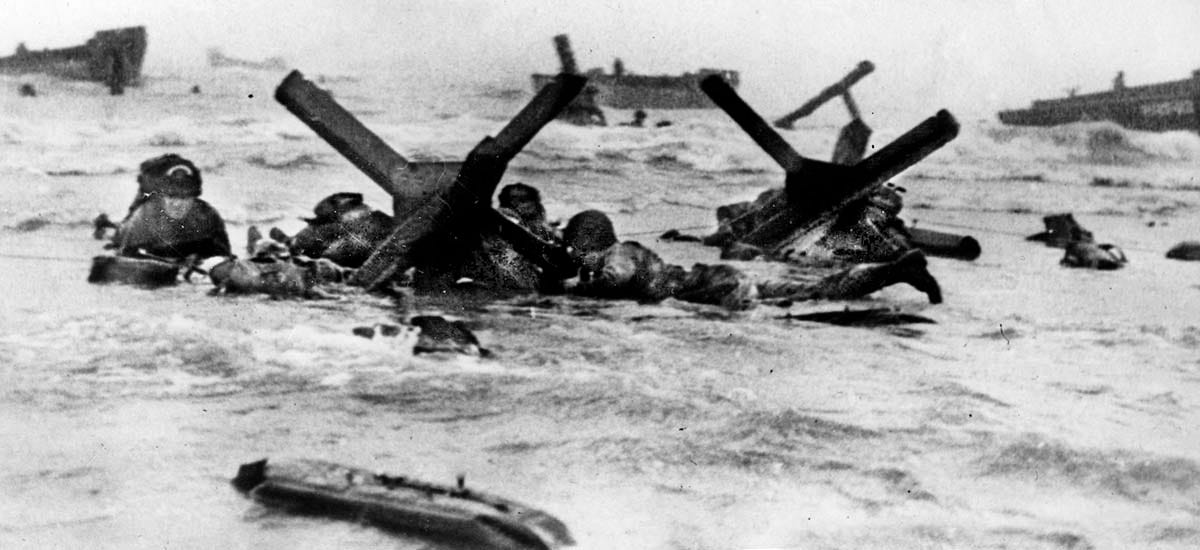
Not a prosperous path to full employment: Soldiers under withering fire on D-Day’s Omaha Beach
That’s not to say the war machine didn’t demand laborers. With so many able men taken out of the economy, the slack was taken up by teenagers, women and retirees, many who’d have preferred to be doing other things.
In a growing economy, more people are producing goods and services, and elevating standards of living in the process. That was far from the case during World War II. Factories were humming, but they were making bayonets, bombs and battleships. “Four-tenths of the total labor force was not being used to produce consumer goods or capital capable of yielding consumer goods in the future,” noted Robert Higgs.
Defying conventional wisdom about “wartime prosperity,” Americans’ standard of living suffered tremendously from their government’s entry into World War II. In The Reality of the Wartime Economy, Horwitz and McPhillips tapped some interesting source material to bring the grim economic realities of American life during World War II into sharp focus.
For example, a series of newspaper ads placed by Canton Electric Light & Power Company — a local New York State utility — present a vivid, time-lapse portrayal of rapidly declining conditions following the December 1941 declaration of war:
- Foreshadowing anticipated shortages, a March 17, 1942 ad for appliances is headlined “You Can Still Buy Them.” The ad includes a qualifier that’s upbeat while still signaling creeping scarcity: “We have a fairly good supply.”
- Just two months later, Canton Electric’s ad says “Now Is The Time” to buy various appliances and equipment, warning that “production of most of these items has stopped and only the supply in your dealers’ stock is available.”
- Another two months later, a July 1942 ad indicates that some items that were briefly not available are back in inventory.
- In November of that first year of America’s World War II participation, Canton Electric switched to warning consumers that, “due to the war emergency, it is quite impossible to get replacement motors for civilian use,” and urging them to ensure they’re properly maintaining their “stokers and oil burners.”
- Later that same month, Canton Electric punted on advancing its retail business altogether, instead using its ad space to encourage readers to grow their own food, eat everything on their plates and comply with ration-stamp rules.

Horwitz and McPhillips also drew on letters written between 1942 and 1945 by Saidee Leach to her son serving in the Pacific. Contrary to the image of prosperity supposedly indicated by leaping GNP or plummeting unemployment, she tells him of:
- Conserving scarce home-heating fuel during the coldest days by wearing fur coats indoors and residing only in their kitchen
- Having her typewriter seized by the government, and now using a lesser model she acquired from a Howard Johnson “which had to close due to the ban on pleasure driving.”
- Making an Easter dinner centered on fried Spam, because she “could not get fresh meat of any kind,” and later noting that “potatoes have entirely disappeared”
- Local farmers refusing to sell their turkey flocks for Thanksgiving meals at the prices set by the Office of Price Administration — illustrating the folly of government price controls.
That is not the picture of an economy delivered from the Great Depression. Rather, “World War II institutionalized the falling standards of living of the depression through wage and price controls, and extensive rationing of consumer goods and services,” wrote Peter Ferrara. “The economic deprivation, and reduced standards of living, continued, although people perceived it was now for a good cause.”
America’s postwar experience presents another pointed contradiction of the myth of wartime prosperity.
As the war’s end grew closer, Keynesian economists unanimously predicted peace would bring economic disaster. For example, Paul Samuelson said America would experience “the greatest period of unemployment and dislocation any economy has ever faced.”
Alvin Hansen warned that the economy must be kept on a centrally-controlled wartime footing, even in peacetime: “When the war is over, the government cannot just disband the Army, close down munitions factories, stop building ships, and remove all economic control.”

Nobel Prize winner Paul Samuelson, who predicted peace would bring economic disaster, taught Nobel Prize winner Paul Krugman, who predicted the internet’s impact would be akin to that of the fax machine
However, that’s pretty much what happened — and Hansen, Samuelson and their fellow economic flat-Earthers couldn’t have been more wrong about the consequences. “The year 1946, when civilian output increased by about 30 percent, was the most glorious single year in the entire history of the U.S. economy,” wrote Higgs.
This despite the fact that government purchases of goods and services collapsed by 68% between the second quarter of 1945 and the first quarter of 1946 — and upwards of a million civilian government employees were laid off and millions of service members discharged.
As war-fighting men poured back into civilian life, millions of women withdrew from the labor force, contentedly returning to duty as mothers and home managers. Rather than soaring as predicted by the “experts,” unemployment merely edged higher, from 1.9% in 1945 to 3.9% in 1947.
“Less than a year and a half after VJ-day,” crowed President Truman, “more than 10 million demobilized veterans and other millions of wartime workers have found employment in the swiftest and most gigantic change-over that any nation has ever made from war to peace.” (Note this happened despite — and in part because of — Truman’s failure to institute a higher minimum wage as the war ended.)
Having been proven enormously wrong about the economic implications of peace, Keynesians scrambled to credit the war with enabling the postwar boom, arguing that it was fueled by people drawing down savings accumulated while the supply of consumer goods was sharply restricted. However, as Higgs determined by studying the data of the time, “Holdings of liquid assets did not decline at all after the war. People financed their spending for consumer goods by reducing their saving rate.”

Once again an engine of real prosperity: In 1946, vehicles proceed along Ford’s first postwar assembly line
Contrary to the myth, it was only after World War II that — free from the government’s commandeering of factories, workers and resources, and saddled with fewer price controls and other federal market intrusions — America was finally able to emerge from the Great Depression.
You wouldn’t know that if you evaluated the economy’s health using Keynesians’ preferred measure. Just as the GNP gauge provided a 180-degree misreading of wartime economic realities, it failed in similarly spectacular fashion during the postwar boom: From 1945 to 1947, GNP plummeted 22%.
In addition to further illuminating the shortfalls of aggregate economic measures, America’s postwar economic experience delivered another broadside to the myth of World War II-fostered prosperity, and to the idea that government spending, central planning and market interventions are essential to economic achieving economic recovery.
How do Iranians ‘Boil a Frog’? Slowly and methodically.
Iran’s apparent restraint in the face of Israeli aggression should not be mistaken for weakness. Tehran steadily applies pressure on Tel Aviv through its own methods, setting the stage carefully for Israel’s unravelling.

By Shivan Mahendrarajah | The Cradle | April 3, 2024
A strategy in asymmetrical warfare is expressed by the “boiling frog” theory:
Legend has it that a frog placed in a shallow pot of water heating on a stove will remain happily in the pot of water as the temperature continues to climb, and will not jump out even as the water slowly reaches the boiling point and kills the frog. The change of one degree of temperature at a time is so gradual that the frog doesn’t realize he is being boiled until it is too late.
While the story is an apologue – a pretty fable meant to convey a meaningful lesson – it is one frequently invoked by militaries and geopoliticians to describe the “long game” of reaching strategic objectives.
Today, it is Iran and its regional allies who are using a measured approach to increase temperatures in West Asia until the water boils the US and Israeli ‘frogs’ to death. Strategy, discipline, and rare patience – the antithesis of western short-termism – will bring Iran victory. To quote the Taliban: “Americans have watches, but we have the time.”
Time is now on the side of Iran’s Islamic Revolutionary Guard Corps (IRGC) and its regional allies. Two connected examples show how the IRGC is calibrating temperatures like scientists in a laboratory.
The Yankee Frog
Following the launch of the Hamas-led resistance operation Al-Aqsa Flood on 7 October of last year, US President Joe Biden deployed US Navy assets to the Persian Gulf and Mediterranean Sea to “defend” Israel.
On 26 November, the USS Eisenhower and its escorts navigated through the Straits of Hormuz, anchoring in the Persian Gulf on the Saudi Arabian side. Yemen’s Ansarallah-aligned naval forces initially targeted Israeli ships and Eilat Port with their first shots on 19 October. But by 29 November, their attacks escalated to include vessels bound to or from Eilat, irrespective of flag or ownership.
This pattern culminated in the Pentagon’s announcement of “Operation Prosperity Guardian” on 18 December, aimed at safeguarding Israel’s economic interests at the expense of US military personnel. Subsequently, the Eisenhower and its naval escorts relocated from the Persian Gulf to the Red Sea and the Gulf of Aden, purportedly to “defend” the occupation state.
Instead, the positioning of US Navy assets in the Red Sea and Gulf of Aden has left them susceptible to potential attacks from Iranian or Iranian-supplied weaponry, including cruise missiles, ballistic missiles, and drones.
Despite efforts from the US Navy (USN) and the US Air Force (USAF), Ansarallah remains undefeated. Previous Anglo–American airstrikes in Yemen have proven ineffective, while the ongoing pace and expanding scope of Yemeni operations are straining naval resources and dampening morale.
Unlike ‘Hollywood guns,’ US Navy vessels do not have unlimited interceptor missiles, nor can they be reloaded at sea. As for the morale of American personnel, it will break in the long run, particularly since many, if not most, sailors and marines are simply not invested in a fight for Israel.
Last month, Captain Chris Hill, the commanding officer of the USS Eisenhower, said: “People need breaks, they need to go home.”
While sailors, marines, and airmen are getting antsy dodging Ansarallah’s drones and missiles on a daily basis, the ‘Yankee Frog’ is merrily paddling about his Washington hot tub, believing the ‘might’ of the USN will defeat the pesky ‘Houthis.’
This was arguably a well-calibrated move supported by Iran that accomplished two objectives: First, it got the carrier battle group out of the Persian Gulf, and second, it sucked the US into an escalatory trap. The Yankee Frog is in the Red Sea/Gulf of Aden hotpot. It cannot win.
It will either jump out and flee in humiliation, further destroying the credibility of the US armed forces following its humiliating 2021 debacle in Afghanistan; or it will remain in the hotpot and be boiled to death—with the loss of ships and lives.
With either outcome, Iran wins. Relatedly, an Iranian defeat of the US will be welcomed by China, Russia, and scores of US adversary states, particularly across the global south. As noted by one astute Twitter/X user, Armchair Warrior (describing Russia’s likely responses to Ukrainian provocations), by its actions, Iran has demonstrated “reflexive control” over Washington’s actions. By this, he means, “If every military action you take gets a symmetrical reaction, then you can control the nature, venue, and tempo of the conflict to your benefit.” This is precisely what the IRGC is cleverly doing.
The Israeli Frog
The wee ‘Israeli Frog,’ meanwhile, somnolent in the warm water, is dreaming of his ‘new Israel’ – the Israel that he will create once he has ethnically cleansed Gaza. He has plans to develop Gaza, build luxury condos along the beachfront, and build housing units for new settlers.
Architects are now drawing up plans. Former President and current Republican contender Donald Trump’s son-in-law, Jared Kushner, a Netanyahuist and Likud Party benefactor, is measuring drapes for his Gaza waterfront condominium.
However, the Israeli military has not defeated Hamas, which continues to inflict significant damage to Israeli military hardware and human assets. By one estimate, Hamas has only been degraded by 15–20 percent. The occupation army wholly depends on the US and its European vassal states for armaments since its domestic production capacities are limited.
According to one estimate, some 500,000 settlers have returned to their homelands; most will not return. Since 7 October, conscription is no longer a safe yet inconvenient three-year requirement: parents are afraid for their daughters and sons.
The dormant refusenik movement that emerged from the 1982 Israeli invasion of Lebanon has re-awakened. Draftees are refusing to serve and being jailed as a result. The conscription exemption for ultra-Orthodox Jews expired on 1 April; they are threatening to flee Israel, whose very survival is dependent on Jews moving there.
If representatives of ultra-Orthodox Jews quit Prime Minister Benjamin Netanyahu’s coalition, it could bring down his extremist government. Internal tensions within Israeli society are escalating, fueled by socio-economic pressures and disillusionment with the government’s handling of the war.
The Israeli economy is in shambles. The shekel is declining. Budget deficits and borrowing have skyrocketed. Moody’s downgraded Israel’s credit from A1 to A2 on 9 February. Israel’s tourism industry has collapsed into crisis. Most major airlines no longer fly to Israel. Israel’s manufacturing and agricultural bases are small. Israel has limited access to natural resources and energy; it depends on overland lifelines to Jordan and Egypt, with Azerbaijani oil and gas coming to Haifa from Turkey.
Iran is doing to Israel just what Israel did to it with economic sanctions. But unlike Israel, Iran has abundant supplies of oil and gas, 85 million literate and educated people who are not planning to flee, and formidable agricultural and manufacturing bases.
Tehran is methodically throttling Israel’s economy. Haifa port is on Hezbollah’s target list. If Haifa is shut down alongside Eilat, Israel will only have overland lifelines for food and energy supplies. Ben Gurion International and other airports may be targeted in the future.
Turning up the heat, one degree at a time
The recent Israeli attack on the Iranian diplomatic mission in Damascus, purportedly in response to an Iraqi drone striking Eilat, mirrors Netanyahu’s apprehensions and frustrations – that “the whole world is ganging up on us.”
Netanyahu’s strategy appears to be to goad Iran into escalating tensions, potentially prompting them to target American military assets in the region, thereby drawing the US into the Gaza War. However, it’s uncertain whether Tehran will take the bait.
While the IRGC is likely to respond, they will look to avoid falling into Netanyahu’s trap. Instead, Iran may opt to tighten its economic stranglehold on Israel, possibly by targeting strategic locations such as Eilat, Haifa, and Ben Gurion Airport.
The IRGC understands that Israel’s economy cannot sustain a prolonged conflict. Therefore, their strategy might involve a gradual escalation – effectively boiling the Israeli frog slowly – through coordinated actions involving Hezbollah, Ansarallah, and various Syrian and Iraqi-based factions.
As the economist Herbert Stein noted, “If something cannot go on forever, it will stop.” While Israel is far from being on the brink of collapse, the disciplined and calculated actions of the IRGC are steadily increasing regional tensions. If left unchecked, this could lead to significant repercussions for Israeli society and its economy – all without it realizing, like the wee boiling frog.
China sees big gains in Southeast Asia as ASEAN loses faith in Washington
The Cradle | April 3, 2024
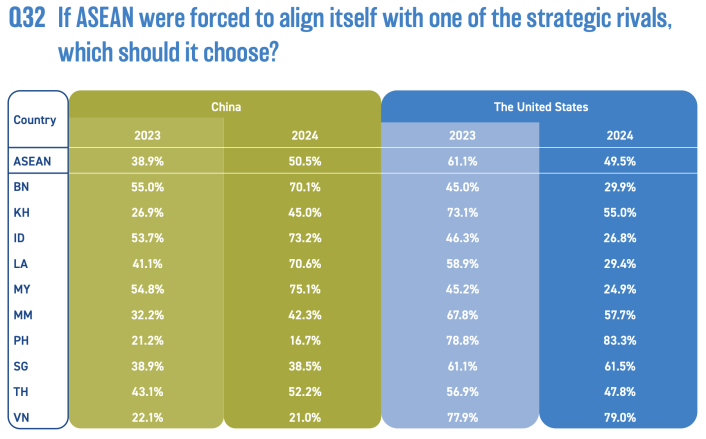
A majority of residents from the Association of Southeast Asian Nations (ASEAN) say they would prefer their countries align with China over the US in a significant year-on-year shift in regional sentiment toward the world’s two largest economic powers.
According to the results of an opinion poll conducted by the ASEAN Studies Centre at ISEAS – Yusof Ishak Institute in the 10 nations that make up the bloc, 50.5 percent of respondents said they would pick China if their country was “forced to align itself” with one of the two superpowers.
On the other hand, 49.5 percent chose the US, as 11.6 percent of respondents changed their opinions between 2023 and 2024.
The ASEAN bloc includes Brunei, Cambodia, Indonesia, Laos, Malaysia, Myanmar, the Philippines, Singapore, Thailand, and Vietnam. According to IMF figures, the bloc’s combined nominal GDP in 2023 was approximately $3.9 trillion.
China’s surge was most prominent among respondents from Malaysia (75.1 percent), Indonesia (73.2 percent), Laos (70.6 percent), Brunei (70.1 percent), and Thailand (52.2 percent).
Although the EU also saw a year-on-year drop in confidence – from 42.9 to 37.2 percent – it remains securely in third place behind the US as a “preferred and trusted strategic partner for ASEAN,” followed by Japan and India.
The poll also highlights a “growing sense of optimism” in future ASEAN–China ties, with respondents “anticipating improvement” jumping from 38.7 percent in 2023 to 51.4 percent in 2024.
A total of 1,994 respondents from all ASEAN member states participated in the survey, with most of them holding a university degree and working in the business and finance sector.
When asked what geopolitical events they consider to be “strategic uncertainties facing the region,” 46.5 of respondents chose the Israeli genocide in Gaza.
“A large proportion of Southeast Asia respondents are concerned that Israel’s attack on Gaza has gone too far. Rise in extremist activities (29.7 percent), diminished trust in international law and rules-based order (27.5 percent), and erosion of domestic social cohesion (17.5 percent) are the most serious impacts of the Israel-Hamas conflict on Southeast Asia,” the poll details.
The ASEAN bloc made headlines last year when member states began the process of de-dollarization, replacing the greenback with local or regional currencies for trade to circumvent the threat posed by unilateral US sanctions.
Featured Video

Macgregor: We Haven’t Seen the Worst of the Iran War Yet
or go to
Aletho News Archives – Video-Images
From the Archives
15 Saudi ‘hijackers’ were CIA agents working for US: Scholar
Press TV – April 13, 2016
Fifteen of the 9/11 “hijackers” from Saudi Arabia were CIA agents working for the United States government, which was seeking to destroy the Middle East for Israel and to double the American military budget, says Dr. Kevin Barrett, an American academic who has been studying the events of 9/11 since late 2003…. continue
Blog Roll
 Aletho News
- Breast Cancer: Before You Consent
- Iran’s Plan to Shut Down AI in the Persian Gulf
- Israel seeks ‘compensation’ from Washington over Saudi F-35 sale
- Saudi crown prince seeks dialogue with Ansarullah after Yemeni blows: Report
- Damascus rejects Saudi request for Syrian fighters to counter Yemen: Report
- South Korea says will not send troops to join terrorist US war on Iran
- Russia Just Struck the Eyes of NATO’s War Machine in Ukraine
- Russia summons UK charge d’affaires over Kiev drone support
- NATO member warns bloc seeking pretext for war with Russia
- Macgregor: We Haven’t Seen the Worst of the Iran War Yet
- If Americans Knew
- Debunking The Claim That Macklemore Has A “History Of Antisemitism”
- CPJ demands release of arrested Palestinian-US journalist near Bethlehem
- Robert Kraft: The Billionaire Friend of Netanyahu Pulling The Strings Behind the Macklemore/Ed Sheeran Blow Up
- Columbia Administered Fund Gives Big Money to Pro-Israel Groups
- Deportation Case of Palestinian Activist Salah Sarsour Tests First Amendment
- ‘We Will Not Forget’: Palestinians Mark 44 Years since Sabra and Shatila
- Why do we let Zionists decide what we can and can’t say?
- US welcomes Israeli, Iranian delegations to UN, but not Palestinians – Daily Update
- Biden’s Genocide Accomplices Targeted by New Accountability Campaign
- AIPAC’s Network Has Already Spent $67.2 Million to Shape the Midterm Elections
- No Tricks Zone
- New Study: ‘Global Drought Shows No Detectable Recent Acceleration Under Climate Warming’
- Economic Masterminds: German Socialists Suggest Taxing Productivity Gains Stemming From Using AI
- The South China Sea Has Not Been Cooperating With The Climate Change Narrative
- Energy Crisis: Germany Enters Heating Season With Historically Low Gas Reserve Fill Levels
- New Study: The Antarctic Ice Sheet Gained Mass From 2020-2024 Due To Staggering Snow And Ice Accumulation
- Study: Ocean Heating Rates From Thousands Of Years Ago ‘Dwarf’ Modern Ocean Heating Rates
- Climate Extremists Target, Attack Large-Scale Power Grid Infrastructure In Germany!
- New Study: Antarctic Ice Melt Has Contributed Less Than 1 Centimeter To Sea Level Rise In The Last 30 Years
- Fear Of Debate: Alarmist German Climate Scientist Calls On Mainstream Media To Discredit Skeptic Voices
- End-Of-August Arctic Sea Ice Extent Hasn’t Fallen In 20 Years, Official Data Show!
 Aletho News