Trump revives Gaza ‘Riviera’ plan in White House meeting with Blair and Kushner
MEMO | August 28, 2025
Former UK Prime Minister Tony Blair has participated in a White House meeting led by Donald Trump and Jared Kushner to discuss Gaza’s future, a gathering that has raised alarm due to its exclusion of Palestinians and ties to a plan that many describe as a blueprint for ethnic cleansing.
The meeting, described as a “large gathering” by Trump’s Middle East envoy Steve Witkoff, reportedly focused on a post-war vision for Gaza that echoes Trump’s earlier calls to depopulate the besieged territory and transform it into a US-controlled “Riviera” on the Mediterranean. Witkoff framed the initiative as “well-meaning,” yet there is widespread concern over an initiative led by figures who back Gaza’s ethnic cleansing.
Blair’s presence at the meeting has drawn scrutiny given previous involvement of staff from his institute with a project widely linked to this so-called “Riviera Plan”. Earlier reporting by the Financial Times (FT) revealed that staff from Blair’s Institute for Global Change took part in discussions involving an economic development slide deck that envisioned a depopulated Gaza rebranded as a smart zone for luxury tourism and offshore development. Although the Blair Institute has stressed that it neither authored nor endorsed the plan, the participation of its staff has raised questions.
Kushner, Trump’s son-in-law and former Middle East adviser, has long been an advocate of such proposals. In February 2024, he remarked on the “value” of Gaza’s waterfront and publicly suggested Israel should “move the people out” and redevelop the territory. That statement closely mirrors Trump’s suggestion that the US could oversee the reconstruction of Gaza once its population is expelled.
Trump’s White House has been consulting Kushner for months on the future of Gaza and is reported to have collaborated with economists like Joseph Pelzman, who openly advocated for razing Gaza entirely and relocating its residents. The academic, speaking on an Israeli podcast, outlined a plan to dig up all infrastructure and “move [the locals] around,” suggesting Egypt—described as “bankrupt”—could be pressured into accepting the displaced population.
No Palestinian officials or representatives were present at the meeting. Nor were any Arab states reportedly invited, despite the meeting’s sweeping implications for regional stability. Instead, the attendees included Israeli Strategic Affairs Minister Ron Dermer, a close confidant of Prime Minister Benjamin Netanyahu.
The absence of Palestinian voices and the involvement of figures like Kushner, who has dismissed Palestinian statehood and backed Israeli settlement expansion, has intensified criticism.
For Blair, a former Quartet envoy to the Middle East, participation in such a meeting, alongside proponents of Gaza’s ethnic cleansing, is especially controversial. A source close to Blair told the FT that his attendance was driven by a desire to restart a political process and secure a two-state solution, claiming “it is absolutely not and never was about forcible displacement.”
The “Riviera” vision for Gaza has been condemned by Palestinian civil society, international legal scholars and numerous human rights organisations as a dangerous fantasy rooted in colonial logic. Turning a traumatised, war-ravaged land into a playground for foreign investors, while its indigenous population is exiled, has been likened to historical settler projects where violence, displacement and economic opportunism went hand in hand.
The meeting took place just as Israel prepares a fresh ground assault on Gaza City, and after Hamas accepted a ceasefire plan that Israel then rejected. In parallel, Trump officials have worked to block Palestinian statehood initiatives at the UN, pressuring allies including the UK, France and Australia to fall in line.
The price of genocide: How US funding sustains an unraveling Israeli economy
By Ramzy Baroud | MEMO | August 28, 2025
In an important step toward the economic isolation of Israel due to its genocide in Gaza, Norway’s Government Pension Fund Global has decided to divest from yet more Israeli companies.
Norway’s sovereign wealth fund is the world’s largest, with total investments in Israel once estimated at $1.9 billion. The decision to divest was taken gradually but is consistent with the Norwegian government’s growing solidarity with Palestine and rising criticism of Israel.
Taking a leading role along with Spain, Ireland, and Slovenia, Norway has been a vocal European critic of the Israeli genocide and man-made famine in Gaza, actively contributing to the International Court of Justice’s investigation into the genocide, and formally recognising the state of Palestine in May 2024. This diplomatic and legal stance, coupled with its financial divestment, represents a coherent and escalating effort to hold Israel accountable for the ongoing extermination of Palestinians.
The Israeli economy was already in a state of freefall even before the genocide. The initial collapse was related to the deep political instability in the country, a result of Israeli Prime Minister Benjamin Netanyahu and his extremist government’s attempt to co-opt the judicial system, thus compromising any semblance of “democracy” remaining in that country. This resulted in a significant lowering of investor confidence.
The war and genocide, beginning on 7 October 2023, only accelerated the crisis, pushing an already fragile economy to the brink. According to reports from the Israel Ministry of Finance, foreign direct investments in Israel fell by an estimated 28 per cent in the first half of 2024 compared to the same period in 2023.
Any supposed recovery in foreign investments, however, was deceptive. It was not the outcome of a global rallying to save Israel, but rather a consequence of a torrent of US funds pouring in to help Israel sustain both its economy and the genocide in Gaza, along with its other war fronts.
Israel’s Gross Domestic Product was estimated by the World Bank to be around $540 billion by the end of 2024. The war on Gaza has already taken a considerable bite out of Israel’s entire GDP. Estimates from Israel itself are complex, but all data points to the fact that the Israeli economy is suffering and will continue to suffer in the foreseeable future. Citing reports from the Bank of Israel and the Ministry of Finance, the Israeli business newspaper Calcalist reported in January 2025 that the cost of the Israeli war on Gaza had already reached more than $67.5 billion. That figure represented the costs of the war up to the end of 2024.
Keeping in mind that the ongoing war costs continue to rise exponentially, and with other consequences of the war—including divestments from the Israeli market by Norway and other countries—future projections for the Israeli economy look very grim. The Israeli Central Bureau of Statistics reported that the Israeli economy, already in a constant state of contraction, shrunk by another 3.5 per cent in the period between April and June 2025.
This collapse is projected to continue, even with the unprecedented US financial backing of Tel Aviv. Indeed, without US help, the precarious Israeli economy would be in a much worse state. Though the US has always propped up Israel—with nearly $4 billion in aid annually—the US help for Israel in the last two years was the most generous and critical yet.
Israel is the recipient of $3.8 billion of US taxpayer money per year, according to the latest 10-year Memorandum of Understanding signed in 2016. Equally, if not more valuable than this large sum are the loan guarantees, which allow Israel to borrow money at a much lower interest rate on the global market. The backing of the US has, therefore, enabled investors to view the Israeli market as a safe haven for their funds, often guaranteeing high returns. This applies to the Norwegian sovereign wealth fund as it did to numerous other entities and companies.
Now that Israel has become a bad brand, affiliated with unethical investments due to the genocide in Gaza and growing illegal settlement expansion in the West Bank, the US, as Israel’s main benefactor, has stepped in to fill the gaps.
The US emergency supplemental appropriations act of April 2024 allocated a total of $26.4 billion for Israel. While much of the money was earmarked for defense expenditures, in reality, most of it will percolate into the Israeli economy. This amount, in addition to the annual military aid, allows the Israeli government to minimize spending on defense and allocate more money to keep the economy from shrinking at an even faster rate.
Additionally, it will free the Israeli military industry to continue producing new, sophisticated military technology that will ensure Israel’s continued competitiveness in the arms market. The military-industrial complex, a significant part of the Israeli economy, is thus not only sustained but given a fresh impetus by American aid, ensuring the war machine continues to function with minimal financial disruption.
All of this should not diminish the importance of divestment from the Israeli financial system. On the contrary, it means that divestment efforts must increase significantly to balance out the US push to keep the Israeli economy from imploding.
Moreover, this should also make US citizens, who object to their government’s role in the genocide in Gaza, more aware of the extent of Washington’s collaboration to save Israel, even at the price of exterminating the Palestinians. Indeed, the flow of funds from the US is not a passive action; it is an active collaboration that directly enables the Israeli genocide in Gaza.
Compound Crime: Three wounded journalists being denied medical evacuation
Palestinian Information Center – August 27, 2025
GAZA – The Palestinian Journalists Protection Center (PJPC) issued an urgent appeal on Wednesday, demanding the immediate medical evacuation of several Palestinian journalists who sustained severe injuries in a direct Israeli strike on the Nasser Medical Complex in Khan Yunis, southern Gaza Strip.
In a press statement, PJPC confirmed that three journalists suffered life-threatening injuries that also jeopardize their professional futures. The wounded journalists are Mohammed Fayeq, who is suffering from partial paralysis that could become total; Jamal Baddah, whose right leg was amputated; and Hatem Omar, who sustained shrapnel wounds to the head.
The center stressed that the ongoing refusal to allow medical evacuation for the wounded journalists constitutes a “compound crime,” adding to the long list of Israeli violations against Palestinian journalists, who have paid a steep price while covering the war in an effort to bring the truth to the world.
PJPC urged international media organizations and press freedom bodies to take immediate action and pressure for the urgent evacuation of the injured journalists so they can receive proper treatment outside Gaza, before it is too late.
On Monday, 20 Palestinians were killed, including journalists and civil defense workers, in a double Israeli airstrike that targeted the Nasser Medical Complex in southern Gaza.
US-Israeli scheme for Lebanon includes forced displacement, turning Beirut suburb into ‘refugee camp’: Report
The Cradle | August 27, 2025
There is a new US plan for a “clampdown” on Beirut’s southern suburb, which could potentially see the area come under the control of a foreign or Arab security force, according to a report released by Al-Akhbar newspaper on 27 August.
The southern suburb, a strong base of support for Hezbollah, was heavily bombarded by Israel during its brutal war on Lebanon last year. The suburb has been repeatedly hit by airstrikes since the ceasefire took effect.
According to Al-Akhbar, the plan aims to “treat the southern suburbs just like Palestinian refugee camps.”
The 1969 Cairo Agreement for years allowed Palestinian groups a degree of autonomy over refugee camps in Lebanon. Despite the agreement being declared null in the 1980s, the status of the camps has remained more or less the same.
However, Lebanese troops maintain checkpoints and a heavy presence around the camps. Palestinian camps in Lebanon have recently begun a symbolic disarmament process in line with the state’s efforts to monopolize control of weapons in the country.
The Al-Akhbar report frames the new US plan as part of Washington’s broader goal of disarming Hezbollah, which the Lebanese government vowed to achieve in a cabinet session in early August.
“The US proposal envisions checkpoints at all entrances [of the Beirut suburb], thorough searches of individuals and vehicles, and a tight control on goods, materials, and money flows. This mission would not be handed to the Lebanese army. Instead, the plan calls for a foreign security force, possibly an Arab one, to take on the task,” it said.
Al-Akhbar also said the plan falls in line with US efforts to “empty the southern border region.”
A recent report by Axios said there is a US plan for a “Trump economic zone” near the southern border, aimed at preventing Hezbollah from re-establishing its presence there. The report said this would happen with the help of Gulf financing.
During a press conference in Lebanon’s Presidential Palace on Tuesday, US envoy Tom Barrack confirmed plans for the economic zone.
“We have to have money coming into the system. The money will come from the Gulf. Qatar and Saudi Arabia are partners and are willing to do that for the south (of Lebanon) if we’re asking a portion of the Lebanese community to give up their livelihood,” Barrack said.
“We have 40,000 people that are being paid by Iran to fight. What are you gonna do with them? Take their weapon and say ‘by the way, good luck planting olive trees?’ It can’t happen. We have to help them,” he added, referring to Hezbollah members.
“We, all of us, the Gulf, the US, the Lebanese are all gonna act together to create an economic forum that is gonna produce a livelihood,” he went on to say.
This economic zone reportedly serves as an ethnic cleansing plan to remove residents of the southern border villages and prevent the return of those already displaced from there.
Lebanese MP and former head of Lebanon’s General Security Directorate Jamil al-Sayyed said in a post last week that “Envoy Tom Barrack has received the Israeli response to his mediation over the south.”
“The response included a ceasefire, the handing over of prisoners, and border demarcation, according to the following conditions: Lebanon must grant Israel the right to remain inside 14 villages and to fully or partially evacuate their residents. The villages Israel demanded in their entirety are: Odaisseh, Kfar Kila, Houla, Markaba, and Aita al-Shaab. The villages where Israel demanded to establish permanent military sites on their outskirts and forests are: Khiam, Ramiya, Yaroun, Aitaroun, Alma al-Shaab, Al-Dhayra, Marwahin, Maroun al-Ras, and Blida,” he added.
“If this news is true, and becomes official tomorrow or soon, it may be celebrated in our country as an ‘achievement’ similar to yesterday’s celebration over the symbolic handover of weapons in Burj al-Barajneh camp,” Sayyed went on to say.
Tom Barrack’s imperial tantrum in Beirut: When entitlement speaks
By Tala Alayli | Al Mayadeen | August 26, 2025
Thomas Barrack, Washington’s special envoy, breezed into Beirut today oozing of the usual arrogance, condescension, and the smug self-righteousness that American officials have long mistaken for diplomacy. In what he must have thought was a moment of wit, Barrack dismissed the Lebanese press as “uncivilized,” even likening journalists’ actions to those of animals.
It is telling, of course, that the representative of a country responsible for the post-1991 siege that killed half a million Iraqi children, which former US Secretary of State Madeleine Albright described as “worth it”, turning Afghanistan into an endless graveyard, and underwriting the daily massacres in Gaza, would accuse others of lacking civility.
American officials seem to have mastered this peculiar art: bombing entire nations by morning, then lecturing those nations on decorum by afternoon.
Barrack’s performance is not a slip of the tongue, but a look into the imperial psyche. To him, like most of Western society, Lebanon is not a sovereign country with a free press and a tradition of political debate; it is a space to be managed, where we are expected to smile politely while being lectured on democracy and modernity. Arabs are not clever, competent, and equal human beings, but mindless herd societies that must be subjugated.
And what is civility either way? Surely not the baby-killing machine in Gaza, which has been endlessly praised by the United States, the same administration calling us animalistic. Perhaps the definition must be de-Americanized to make sense.
Besides, it is almost comical that Thomas Barrack, a man who once found himself charged with embezzlement and caged in his house on arrest in the United States with a monitor chained to his ankle, now parades around Lebanon as a moral authority. This is the same envoy whose career has been shadowed by allegations of corruption and shady financial dealings.
If anything, Barrack’s legal entanglements reveal a pattern: entitlement is not just a political habit for American officials, it is a personal one. He walks into Lebanon not as a humbled man marked by scandal, but as an imperial messenger who believes that his past sins are irrelevant, that he is owed respect simply because he carries Washington’s seal.
The irony is maddening: an envoy representing an empire that thrives on plunder, brutality, and deceit, scolding journalists for their supposed lack of manners.
Then leave!
Perhaps the most infuriating was Barrack’s sense of self-importance. “Do you think this is fun for us? Do you think it is economically beneficial for Morgan and I to be here, putting up with this insanity? If that’s not how you’d like to operate, we’re gone.”
Does Barrack think it is fun for us to sit and witness his condescension? Or watch “Israel” obliterate our homes with US-made weapons? Or listen to American-Israeli discourse about how to make the region more agreeable to those who want to overtake our resources, our lands, our lives?
Also, if billions in military aid to the mega-maniacal occupiers is economically beneficial, then surely a trip to Beirut at the US’s own discretion is not a bank-shatterer.
If journalists doing their jobs was slightly too overwhelming for a diplomat who is certainly used to press conferences as such, then said diplomat must rethink his competence.
And if decorum and mutual respect are an overload of work, then leave!
What is it about humiliation?
Yet what is most shameful is not only Barrack’s insult. Such condescension is expected from American envoys. His companion, Morgan Ortagus, once strutted into the Baabda Palace and cheerfully applauded the terrorist pager operation that left thousands of citizens, including children, wounded and blind. “Israel”-born Amos Hochstein once got his afternoon coffee from a Starbucks at a moment of peak boycott and gladly allowed a desperate Lebanese bourgeois citizen to pay.
Equally shameful is the silence that followed. A room full of journalists, veterans of a region where press freedom is under constant attack, sat in silence. Not one voice rose to challenge him.
The Lebanese press corps prides itself on resilience. In a country where journalists have been assassinated, bombed, and silenced, surviving in the profession is no small feat. Yet resilience without dignity is hollow.
What good is endurance if it does not sharpen your spine? What meaning does the word “journalist” carry if you cannot call power to account, especially when that power spits in your face?
Thomas Barrack was a temporary guest; he’s on our land, in our home. When the Trump administration leaves office, he will go back to being an irrelevant nobody. He should not have been allowed to shame the people of this country into silence.
By letting his words pass unchecked, today’s journalists failed not only themselves but the very people they claim to represent. Journalism is not stenography. It is not about politely recording the musings of foreign officials, no matter how insulting. It is about holding those officials accountable, about asking uncomfortable questions, about reminding every diplomat and politician that they are guests in this country, not its overlords.
Dignity, unfortunately, cannot be faked. It is not something anyone can claim retroactively, in editorials or late-night debates. It must be demonstrated in the moment. And this is a disease Lebanon has been plagued with. Only a few understand the true meaning of dignity, while others embarrassingly fail to embody it.
Let us be brutally honest: the American envoy insulted Lebanese journalists to their faces and walked away unscathed. Tomorrow, he will fly back to Washington or to whichever embassy compound he calls home, and he will report that Lebanon is pliable, that it can be insulted with impunity, that this country is still a stage for American entitlement.
Potato Potato, Dignity… Delusion
Lebanon is no stranger to foreign interference. From colonial mandates to military occupations to today’s endless meddling, the country has had to endure a parade of foreign “experts” and “envoys” who arrive with prescriptions and leave with nothing but disdain for the very people they claim to advise.
But through it all, Lebanon’s press has often stood as a thorn in the side of power. That tradition is not something to be taken lightly.
Thomas Barrack’s words today were contemptuous, yes, but they were also a test of whether Lebanese journalists still have the fire to defend their dignity, to insist that Lebanon is not an American playground, that its press is not an expendable backdrop for imperial theatrics. That test was failed.
We cannot afford such failures in today’s political climate. With Gaza burning under Israeli bombs, with Western governments spewing propaganda to justify genocide, with Arab sovereignty under constant threat, the role of the press has never been more urgent.
The journalist’s duty is not to play pleasant host to foreign arrogance but to confront it. To expose it. To ridicule it when it deserves ridicule, and to eviscerate it when it crosses the line of civility.
Right now, the people who sat in that room, deluded by a false sense of dignity, instead of protesting the plain enslavement, have become a laughingstock to those who understand true pride. They have become sitting ducks in front of those who play God.
How disappointing.
Here is why the Israeli occupation of Gaza won’t work
By Robert Inlakesh | Al Mayadeen | August 26, 2025
At every key juncture of the Zionist regime’s “seven front war”, it has announced new plans that it will claim are going to defeat Hamas or that they will reach a ceasefire agreement. The truth is that they have no intention of reaching a negotiated settlement, nor do they have a plan to achieve “victory” in Gaza.
At the beginning of the Zionist entity’s ground invasion of the Gaza Strip, in late October of 2023, its military campaign had focused on northern Gaza. For those who remember, the major goal of their operation at the time was to take control of al-Shifa Hospital in Gaza City, claiming it to be a “Hamas command and control center”.
Back then, the Western corporate media reported that US intelligence reports supported the notion that at the very least, there was a Hamas “command node” based there, as the Israeli army released CGI footage featuring an extensive tunnel network under the hospital.
After committing various massacres, in and around al-Shifa Medical Complex, it became clear that the claims were all lies and no Hamas infrastructure existed underneath the hospital. However, the Israelis and their Western allies did not admit that the entire military operation was based upon a pack of lies and that no Hamas targets were there; instead, they simply moved on to the next major set of lies, as the Zionist military finished off its genocidal missions in northern Gaza.
Failing to inflict any major blow, let alone a total defeat upon Hamas or any of the some dozen Palestinian armed groups in northern Gaza, then came the claim that “the real Hamas headquarters” were in Khan Younis. In December of 2024, again with the full backing of their Western allies and their media machines, the Israelis launched the invasion of Khan Younis.
After besieging Khan Younis in January of 2024, they eventually made it their final mission to assault the Nasser Hospital, again claiming that it was used by Hamas as a major base. By this time, the Israelis had launched a campaign to systematically target every hospital their forces worked in the vicinity of, seizing medical workers and the injured as captives, inflicting massacres, setting up bases inside the hospitals, and always claiming that Hamas was there.
As the military campaign on the ground waged on, the Israeli public realised that they were not even one step closer to the “total defeat” of Hamas that Israeli Prime Minister Benjamin Netanyahu had promised them. So then began the talk of invading Rafah.
Israeli political leaders vowed that without invading Rafah, they could not “win the war”. They claimed that tunnels were leading into Gaza from Egypt, despite knowing they were all sealed off around a decade ago.
In the lead-up to the invasion of Rafah, a massive deception campaign was launched with the full unquestioning complicity of the Western media. We heard about then US President Joe Biden’s alleged “red line” being Rafah. Up until that point, we had also heard about Biden hanging up the phone on Netanyahu, yelling at him and even swearing, for which there was never any evidence produced.
We had the propaganda of a “Christmas ceasefire” and a “Ramadan ceasefire”, with even the UN Security Council voting on the temporary Ramadan ceasefire that never materialised. The public was also informed about all of the alleged hard work that the US government was doing to achieve a ceasefire, which we would later learn never happened from Israeli media leaks; Biden never once asked his Israeli allies for a ceasefire.
In the lead-up to the invasion of Rafah, which would eventually happen on May 6 with full US support, we heard two main narratives. One warned of the impending humanitarian disaster after the Israelis had displaced the majority of the population to Rafah, the second was the idea that this would mean the defeat of Hamas and would rob the group of its financing networks.
Evidently, the Israelis launched their invasion, and unsurprisingly, it was more of the same; they continued mass murdering civilians and destroying Gaza’s infrastructure. Hamas still lived. There were even initiatives then like the failed US military aid pier, which only appeared to have been used one time, for a deadly military operation in Nuseirat that killed around 300 civilians to seize back Israeli captives.
Fast forward to October 2024, when we began to hear about the infamous “General’s Plan”, an operation that was again sold by the Israeli regime and its media as the final blow to end Hamas by besieging northern Gaza entirely and then starving out the remaining fighters. This went on for months, until there was a ceasefire declared in January.
On March 18, the Israelis violated the Gaza Ceasefire. Then came an escalation in its genocidal campaign against civilians in the territory, an uptick once again in the bombardment, coupled with the total blockade on all aid into the territory that would last over 80 days.
For some time after violating the ceasefire, the Israeli media and regime’s officials promoted the idea of a new operation that was going to be the most explosive yet and the final blow against Hamas. They spoke of potentially new weapons and strategies, hyping up the campaign to be a game changer.
The May offensive was then labelled “Operation Gideon’s Chariots”, dubbed “Phase 2” of the Gaza war. First, the Israeli media hyped it up and put out reports that 20,000 reservists had been called up to duty, then we heard 60,000, the next day 50,000, some even claimed 100,000 soldiers would be used to invade Gaza.
The real result was a few small incursions into the outskirts of major cities and camps, which were met with deadly ambushes carried out by the Palestinian resistance. “Gideon’s Chariots” was a game changer, but repeated the exact same cowardly strategy as every Israeli operation before it.
So now we have the approval of plans to “occupy Gaza”. Originally, the idea communicated across Israeli media platforms was that all of Gaza would be occupied, which is what Netanyahu would go on to claim. Then it went back and forth between all of the territory and just Gaza City, which is not the established goal of the newly approved operation.
Logistically, this plan makes no sense for an already overburdened Zionist military force that does not want to fight in the Gaza Strip at all anymore. They’ll need an absolute minimum of 200,000 soldiers just to occupy Gaza City, a plan that, according to Israeli military analyst,s will take between 2 to 5 years to properly complete.
On top of this, the strategy runs contrary to the Israeli military’s doctrine and strategy that it has followed throughout the entire war. The reality on the ground is that with the exception of a limited number of special forces operations, the Israeli army never targeted Hamas. They invaded with the intention of making Gaza unlivable and have systematically dismantled the territory’s infrastructure, while inflicting a genocide.
The truth is that they have no military strategy to defeat Hamas. They don’t even have an answer as to how to end the fighting at all, even as their allied Arab regime attempts to give them solutions. A ceasefire would happen within a day if they wanted it to, but they clearly don’t, and no Israeli politician even accepts the notion of the Palestinian Authority taking over Gaza because they believe it will lead to a so-called “Two-State solution”.
So here we are again, back to the same old tired Israeli script. They send negotiating delegations with no intention of reaching deals and launch new operations that will ultimately fail to achieve anything other than continuing the slaughter of civilians.
The Zionist Entity has done everything except actually target and try to fight the Palestinian Resistance on the ground, hiding in fortified areas and inside their military vehicles, occasionally getting picked off by ambushes. This is also why they have no battle footage despite having fought for 22 months, because they only engage in armed clashes on the ground when they are being attacked by the Palestinian armed groups. There is no real army, it’s a glorified police force that was built to bully teenagers, with a sophisticated intelligence apparatus and air force behind it.
It appears very unlikely that we will see Israeli soldiers manning checkpoints in between tent cities in Gaza and managing everyday life like we see in the occupied West Bank. Simply put, they are too cowardly for this task, and unlike the case in the West Bank, it will be extremely dangerous for them to do this, costing them thousands of casualties over a long period of time.
More likely than not, this has all been psychological warfare, as the Israeli military prepares to attack on a different front. Although it does seem likely they will launch some kind of operation in northern Gaza, one which will accelerate its mass murder of civilians, but will fail to achieve its stated objectives.
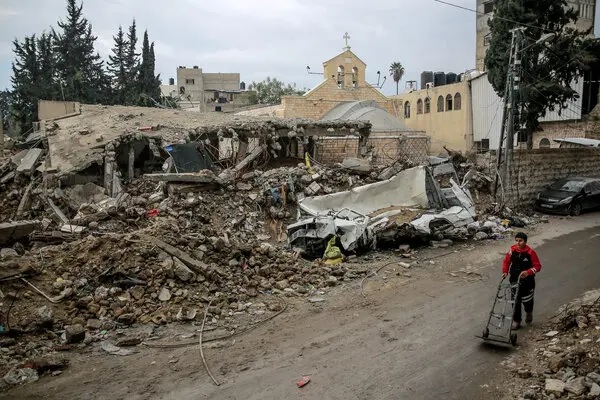
Jerusalem churches say their staff will not leave Gaza City
Palestinian Information Center – August 26, 2025
OCCUPIED JERUSALEM – The Greek Orthodox Patriarchate and the Latin Patriarchate in Occupied Jerusalem have said that their staff will not evacuate Gaza City, ahead of the Israeli occupation regime’s declared intent to take control of the city, where hundreds of thousands of civilians live.
In a joint statement on Tuesday, the patriarchates said that the Greek Orthodox compound of Saint Porphyrius and the Holy Family Church compound have been refuges for hundreds of civilians since the outbreak of war in October 2023, among them elderly people, women, and children.
“Among those who have sought shelter within the walls of the compounds, many are weakened and malnourished due to the hardships of the last months. Leaving Gaza City and trying to flee to the south would be nothing less than a death sentence. For this reason, the clergy and nuns have decided to remain and continue to care for all those who will be in the compounds,” they said.
They criticized Israel’s announced attack, saying “there can be no future based on captivity, displacement of Palestinians or revenge.”
The patriarchates called on the international community to act for an end of this deadly and destructive war.
Gaza: Southern displacement impossible as shelter shortage exceeds 96%
MEMO | August 25, 2025
The Government Media Office in Gaza has said that displacement to the southern governorates is almost impossible, as they cannot absorb 1.3 million people forcibly displaced from Gaza City.
In a statement, the office warned: “With the Israeli occupation threatening to invade Gaza City, we caution against the worsening humanitarian disaster experienced by more than 2.4 million Palestinians in the Gaza Strip.”
The office added: “Since the occupation announced that it would allow the entry of tents and shelter supplies, only around 10,000 tents have actually entered Gaza. This represents just 4 per cent of the urgent need for 250,000 tents and caravans, highlighting the manipulation and deliberate delays in meeting essential humanitarian requirements.”
It pointed out that the deficit in providing shelter in Gaza has now exceeded 96 per cent, stressing that no tents or shelter materials are currently available at the crossings because of strict Israeli restrictions on the work of international organisations, which has further deepened the suffering of hundreds of thousands of displaced people.
Syria, the Druze, and the Greater Israel project
By Gavin O’Reilly | Strategic Culture Foundation | August 25, 2025
On the 12th of August, media outlet Axios revealed that the United States and Israel were in discussions to establish a land corridor between the occupied Golan Heights and the southern Syrian city of Suwayda, ostensibly to protect the country’s Druze minority. The following Saturday, protests broke out in Suwayda calling for Druze self-determination, with many in attendance waving Israeli flags.
Last December, following a lightning offensive by insurgents based in the northwestern city of Idlib, the Syrian government of Bashar al-Assad collapsed in dramatic fashion. This marked the culmination of a thirteen-year effort by various powers to impose regime-change on the Arab Republic. One such power was Israel, who had provided arms to Salafist militants opposed to Assad’s secular rule. Syria, having acted as a conduit between Iran and Hezbollah, had long been in Tel Aviv’s crosshairs.
Within hours of Assad’s fall, Israel launched a ground invasion of southern Syria. Tel Aviv declared that this was in order to establish a buffer zone between Israel and Syria’s new Islamist government, in spite of the fact Damascus’ new rulers had effectively acted in Israel’s interests over the past decade. Israel also later stated that it intended to defend Syria’s Druze minority.
Syria, like Iraq and Libya before it, had subsequently fallen into bloody sectarian strife following Assad’s removal from power. In early March, government pogroms along Syria’s coast resulted in the deaths of more than 1,400 members of the Shi’a Alawite minority. Rather than any concern over sectarian bloodshed however, Israel’s interest in the Druze instead lies primarily in achieving a geostrategic goal that has been planned for decades.
In 1982, Oded Yinon, a senior official at the Israeli foreign ministry, penned a paper entitled A Strategy for Israel in the Nineteen Eighties. More commonly known as the Yinon Plan, the document was published by the World Zionist Organisation in the Hebrew journal KIVUNIM. In it, Yinon prioritised the dissolution of Iraq along ethnic and religious lines as a key long-term strategic goal for Israel.
Iraq, which subscribed to the pan-Arab Ba’athist ideology, had begun to emerge as Israel’s main regional rival following the Camp David Accords and the normalisation of ties between Egypt and Israel. In 1981, the Israeli Air Force had bombed the under-construction Osirak in eastern Iraq, after suspecting it would be used to develop nuclear weapons.
In early 1991, amidst the breakout of the Gulf War, Iraq launched dozens of scud missiles towards Israel. This was done in the hope that an Israeli response would galvanise Arabs across the region and undermine Gulf support for the U.S.-led coalition. Following pressure from the United States however, Israel would ultimately not respond to these strikes. By the end of February 1991, Iraqi forces had been defeated in Kuwait.
Though it subsequently emerged that the U.S. had gone to war on a fabricated account of Iraqi troops removing premature infants from incubators and leaving them to die on a hospital floor, Washington still maintained a belligerent stance towards Iraq. In April 1991, the U.S., Britain and France imposed a no-fly zone over northern Iraq, ostensibly to protect the Kurdish minority. The following year, a similar no-fly zone was put in place over the south of the country, this time under the pretext of protecting Shi’ite Muslims. Like Israel’s current interest in the Druze, this too had a strategic purpose.
The Yinon Plan outlined how in order to Balkanise Iraq, the country would have to be divided into three distinct sections. In the north of the country, a Kurdish separatist state based around the city of Mosul, in central Iraq, a Sunni region tied to the capital Baghdad, and in the south, a Shi’ite region centred around Basra. The United States’ no-fly zones effectively polarised Iraq along these lines.
Following the 9/11 attacks, a radical new U.S. foreign policy was put into place, beginning with the invasion of Afghanistan in October 2001. Eighteen months after September 11th, a U.S.-led coalition invaded Iraq, in spite of the fact no tangible evidence was ever produced to link Saddam Hussein to the attacks. Coalition forces quickly toppled the Iraqi government, and replaced it with a provisional authority. Its first executive order was to permanently ban all members of the Ba’ath Party from working in the public sector. Iraq subsequently plunged into sectarian bloodshed in the wake of the invasion.
Like Iraq, Ba’athist Syria was also identified by the Yinon Plan as a target for Balkanisation. The 1982 document envisaged a Sunni state in northern Syria centred on the city of Aleppo, an Alawite state along Syria’s Mediterranean coast, and another Sunni state, based around the southern capital of Damascus and hostile to its northern counterpart. Amidst this division, Yinon predicted the establishment of a separatist Druze state in the occupied Golan Heights and the Hauran region of southern Syria and northern Jordan.
Following the collapse of Bashar al-Assad’s government, such an arrangement has now effectively been put in place. Northwest Syria, where Aleppo is located, has become a stronghold of the Turkish-backed Syrian National Army. Hay’at Tahrir al-Sham, which led the offensive that ended Assad’s rule, is based in the capital Damascus. Its recent pogroms against the coastal Alawites polarising Syria along the same sectarian divisions outlined in the Yinon Plan. The recent Israeli-backed calls for Druze self-determination serve to even further fragment the former Arab Republic in line with the 1982 paper.
On the same day that Axios outlined U.S.-Israeli negotiations to establish a land corridor to Suwayda, Israeli Prime Minister Benjamin Netanyahu was interviewed by journalist and former Knesset member Sharon Gal for the Israeli outlet i24. When presented by Gal with an amulet containing ‘a map of the Promised Land’, Netanyahu stated that he felt a connection to a vision of ‘Greater Israel’. This is a historical Zionist term referring to an expansionist Israeli state that would incorporate the West Bank, Gaza Strip and Golan Heights at a minimum.
On Wednesday, Israel announced plans to construct 3,400 housing units in the West Bank between Jerusalem and the eastern settlement of Ma’ale Adumin. Such a move would effectively partition the territory between north and south. Bezalel Smotrich, the Israeli minister who announced the plan, declared that it would ‘bury the idea of a Palestinian state’.
Last year, Miriam Adelson, wife of casino magnate Sheldon Adelson, donated $100mn to Donald Trump’s presidential campaign. This was done on condition that the Republican candidate would endorse the formal Israeli annexation of the West Bank if elected. Sheldon Adelson, who died in 2021, had previously donated $20mn to Trump’s first presidential campaign in 2016. This too had a stipulation attached. That the U.S. Embassy would be moved from Tel Aviv to Jerusalem, a move that Trump subsequently followed through with in December 2017.
24 hours after Trump’s inauguration in January of this year, Israel launched Operation Iron Wall. Intended to destroy the Jenin refugee camp, Iron Wall has resulted in the largest mass-expulsion of Palestinians from the West Bank since 1967.
Since October 7th 2023, Israel has subjected the beleaguered Gaza Strip to a military onslaught in response to Hamas’ Operation Al-Aqsa Flood. This was the largest military incursion into Israel since the 1973 October War. Global media attention was drawn to the fact that the Supernova music festival was taking place on the Gaza border at the same time. However, less attention was paid to the revelation that the event had only been moved to that location two days beforehand. That there were no security or insurance concerns over holding a music festival in direct proximity to a location where clashes had taken place between Islamic Jihad and Israeli forces the previous summer, simply beggars belief.
Further questions arose when it emerged that Egypt, which acts as mediator between Hamas and Israel, had repeatedly warned Tel Aviv that ‘something big’ was coming in the run up to October 7th. This was corroborated by two media reports from The New York Times and CNN, which revealed that U.S. intelligence had also passed on similar warnings to Israel prior to Al-Aqsa Flood. By December 2023, it was revealed that Israel had known of Hamas’ attack plan over a year in advance.
Seven months prior to October 7th, Orit Strock, the Israeli minister responsible for the development of settlements in the West Bank, called Israel’s 2005 withdrawal from Gaza a ‘sin’. Strock was speaking upon the repeal of legislation that had ordered the dismantlement of four West Bank settlements. This was declared by Strock as a precursor to the eventual re-occupation of Gaza, a move that would ‘involve many casualties’.
Indeed, this sentiment was later echoed by Israeli security minister Yoav Gallant, who in the days following October 7th announced a blockade on Gaza, cutting off electricity and preventing food and fuel from entering the besieged strip. Gallant described Palestinians as ‘human animals’, language that couldn’t be described as anything less than genocidal.
In April 2024, a report by The Times of Israel revealed that an offer by Hamas to release all civilian captives in exchange for Israeli forces not entering the strip had been rejected by Tel Aviv. Three months later, a Haaretz report revealed that the Hannibal Directive had been applied on October 7th. This is an Israeli military directive in which a command is given to fire upon their own troops in order to prevent them being taken captive. Its use on October 7th was a significant contributory factor to the death toll on the day. Despite these damning revelations, the Israeli slaughter in Gaza has continued unabated for almost two years.
On Friday, the United Nations released a report officially acknowledging the presence of a man-made famine in Gaza. UN Human Rights Chief Volker Türk did not shy away from placing blame for the situation, and held Israel responsible for what is in reality, a genocide. Starvation is being used to ethnically cleanse the Gaza Strip in line with the Greater Israel project. A project that now also has designs on the Druze and southwestern Syria.
Bands boycott UK festival after Irish group ‘cut off’ for waving Palestinian flag

Press TV – August 24, 2025
Several bands have pulled out of a major UK music festival after an Irish folk band said organizers cut their set when they displayed a Palestinian flag and chanted “Free Palestine.”
The Mary Wallopers were performing at Victorious Festival in Portsmouth on Friday when organizers accused them of using a chant “widely understood to have a discriminatory context.”
The Mary Wallopers dismissed the allegation as “misleading,” saying, “Our video clearly shows a Victorious crew member coming on stage, interfering with our show, removing the flag from the stage and then the sound being cut following a chant of ‘Free Palestine’.”
Organizers first claimed the set was stopped over a chant, but later admitted the sound was cut after the flag was shown. They apologized “to all concerned” and pledged a “substantial donation” to humanitarian relief for Palestinians.
In protest, The Last Dinner Party, The Academic and Cliffords announced on Saturday that they would boycott the festival over censorship.
“We are outraged by the decision to silence The Mary Wallopers,” The Last Dinner Party wrote on Instagram, calling it “political censorship.”
The Academic said they could not “in good conscience” perform at a festival that silences free speech, while Cliffords said they “refuse to play if we are to be censored for showing our support to the people of Palestine.”
The festival, which continues through Sunday with headliners including Kings of Leon, Bloc Party and Gabrielle, now faces growing backlash over silencing pro-Palestinian protest.
Israel Bombs Presidential Palace in Sanaa, Prepares For Large-Scale War in Yemen
By Kyle Anzalone | The Libertarian Institute | August 24, 2025
Israel conducted dozens of strikes in Yemen, including striking the presidential palace. Tel Aviv is collecting a large bank of targets for a widespread bombing campaign in Yemen.
On Sunday, the IDF said more than ten Israeli warplanes dropped 35 bombs in Yemen. Along with the presidential palace, Israel targeted the Hizaz and Asar power plants.
Officials in Tel Aviv said the strikes were in response to a missile fired by Ansar Allah, or the Houthis, at Israel on Friday. The IDF reports it was a new type of missile that contained submunitions.
Ansar Allah, the group that has ruled most of Yemen since 2015, stated a blockade of Israeli-linked shipping in the Red Sea in response to the ongoing genocide in Gaza. Ansar Allah has expanded the operations to missile and drone strikes against Israel and US warships in response to Israel and the US bombing Yemen.
Ansah Allah has maintained that it will not end attacks on Israel or the blockade until Tel Aviv ends the onslaught in Gaza. Following the Israeli strikes, a Yemeni official explained that Ansar Allah will “not retreat from it until the aggression is lifted, the siege is broken, and the starvation of Gaza’s people is stopped.”
Walla, an Israeli outlet, reports that Tel Aviv is preparing for large-scale strikes against Yemen. “A very large effort is underway by the Intelligence and Security Service (MNA) and the Mossad to build a broad target bank in order to strike the Houthis’ centers of gravity,” the outlet explains.
Israeli political officials told Walla, “We need to simultaneously hit their military intelligence system, ports, military capabilities, and defense industry.”
From March to May, President Donald Trump ordered the military to attack Yemen to break the blockade of Israeli-linked shipping. Over ten weeks, the US dropped over 1,000 bombs on Yemen, killing hundreds of civilians.
However, the strikes failed to break the blockade. Ansar Allah downed seven US drones and caused an F-18 to fall off an aircraft carrier. Trump agreed to a truce with Ansar Allah in May to end the attacks on American warships in the Red Sea. The ceasefire did not expand to Israel.
The officials argued to Walla that the Israeli strikes on Yemen must do more damage than the American operations. “It is necessary to accumulate many targets whose combined effects can cause very heavy damage, unlike the American operation that failed to defeat them,” they said.
Algeria demands UNSC stop ‘Greater Israel’ project, end Gaza famine
Al Mayadeen | August 23, 2025
Algeria has held the UN Security Council responsible for thwarting the “Greater Israel” project and for safeguarding the foundations of the “two-state solution”, which it described as “the cornerstone of any just, lasting, and final settlement to the Israeli-Palestinian struggle.”
Regarding the situation in the Gaza Strip, Algeria’s Foreign Ministry affirmed that the United Nations’ official declaration of a state of famine in the Strip constitutes an extremely dangerous precedent and a first of its kind in the history of the Palestinian cause and the history of the region.
The Ministry added in its statement on Saturday that the most condemnable and reprehensible aspect is that this full-fledged famine is not a product of unavoidable circumstances, but is rather a deliberate political choice and a result of planning and orchestration by the Israeli occupation.
Famine consistent with ‘Greater Israel’ project
It further clarified that this declared famine is entirely consistent with, and inseparable from, the project of forced displacement, the project of reoccupying Gaza, and what has come to be known as the “Greater Israel” project.
Algeria strongly condemned these policies and practices imposed on the Palestinian people as part of the ongoing war of annihilation in Gaza and, as a Security Council member, stressed its commitment to continuing its diplomatic efforts to support the Palestinian people and work toward ending this unprecedented humanitarian catastrophe.
Furthermore, Algeria called for “action to expedite the establishment of an independent and sovereign Palestinian State with al-Quds as its capital.”
This comes as the Israeli occupation forces continue their genocidal war and deliberate starvation in the Gaza Strip, with the latest figures from the Health Ministry reporting that the aggression has now claimed 62,622 lives and caused 157,673 injuries since October 7, 2023.
Moreover, 281 people, including 114 children, have perished due to starvation, while an additional 2,076 were killed and more than 15,308 were injured by the occupation’s targeting of civilians awaiting aid at various distribution points throughout the Strip.
Featured Video

The Truth About the Trump Shootings with Ken Silva
or go to
Aletho News Archives – Video-Images
From the Archives
Trans ‘milk’ as good as the real thing – NHS
RT | February 18, 2024
The drug-induced nipple secretions of trans women are as good as mothers’ breast milk for babies, the University of Sussex Hospitals NHS Trust claimed in a letter to campaigners made public in a report by British think tank the Policy Exchange on Sunday.
The healthcare trust’s medical director, Rachel James, argued that the off-label prescription drug cocktail men transitioning to female take in order to produce milk was “similar to the natural hormones which encourage lactation to develop when the baby is newly born.”
“The evidence which is available demonstrates that the milk is comparable to that produced following the birth of a baby,” James wrote in the letter, sent to Children of Transitioners last August.
Biological men who wish to lactate must first take hormones to grow milk glands and then take high doses of either domperidone or metoclopramide to stimulate milk production. Neither drug is approved for this use, though they are occasionally prescribed off-label to biological women who have trouble lactating.
However, domperidone’s own manufacturer, Janssen, warns patients the drug “may cause unwanted side effects affecting the heart in a breastfed baby” and “should be used during breastfeeding only if your physician considers this clearly necessary.” … continue
Blog Roll
 Aletho News
- Leaked: Britain’s Sham Conviction Of Hashim Thaci
- Seyed M. Marandi: U.S. Strike Imminent – Toward Total War in the Middle East
- Russia Voted Under Fire. Washington Is Loading the Tankers.
- 12 Things Your Oncologist Was Trained Not to Tell You
- Anthrax Attacks Paved Way for COVID-Era ‘Junk Drugs and Vaccines’
- How Real Is the Impact of Western Sanctions on Israel?
- France, You Are Guilty: How Paris Turned Western Sahara into the Maghreb’s Powder Keg
- 2025 Nature Paper Claiming Worsening Global Drought Gets RETRACTED …Heavily Flawed
- Your Milk Is Not the Problem
- The Truth About the Trump Shootings with Ken Silva
- If Americans Knew
- Salah Sarsour’s Legal Team Says DHS Has Not Met Its Burden to Prove He Is Deportable
- An analysis of tax forms by The Intercept show Kraft’s charity and LLC have donated to Friends of the IDF and AIPAC’s super PAC.
- Israeli attacks kill four Palestinians in Gaza – Daily Update
- Inside Gaza’s death trap of collapsing, bombed-out buildings
- The everyday items Israel bans from Gaza every day
- Inside the siege, the ruined buildings of Gaza – Daily Update
- Debunking The Claim That Macklemore Has A “History Of Antisemitism”
- CPJ demands release of arrested Palestinian-US journalist near Bethlehem
- Robert Kraft: The Billionaire Friend of Netanyahu Pulling The Strings Behind the Macklemore/Ed Sheeran Blow Up
- Columbia Administered Fund Gives Big Money to Pro-Israel Groups
- No Tricks Zone
- 2025 Nature Paper Claiming Worsening Global Drought Gets RETRACTED …Heavily Flawed
- New Study: ‘Global Drought Shows No Detectable Recent Acceleration Under Climate Warming’
- Economic Masterminds: German Socialists Suggest Taxing Productivity Gains Stemming From Using AI
- The South China Sea Has Not Been Cooperating With The Climate Change Narrative
- Energy Crisis: Germany Enters Heating Season With Historically Low Gas Reserve Fill Levels
- New Study: The Antarctic Ice Sheet Gained Mass From 2020-2024 Due To Staggering Snow And Ice Accumulation
- Study: Ocean Heating Rates From Thousands Of Years Ago ‘Dwarf’ Modern Ocean Heating Rates
- Climate Extremists Target, Attack Large-Scale Power Grid Infrastructure In Germany!
- New Study: Antarctic Ice Melt Has Contributed Less Than 1 Centimeter To Sea Level Rise In The Last 30 Years
- Fear Of Debate: Alarmist German Climate Scientist Calls On Mainstream Media To Discredit Skeptic Voices
 Aletho News