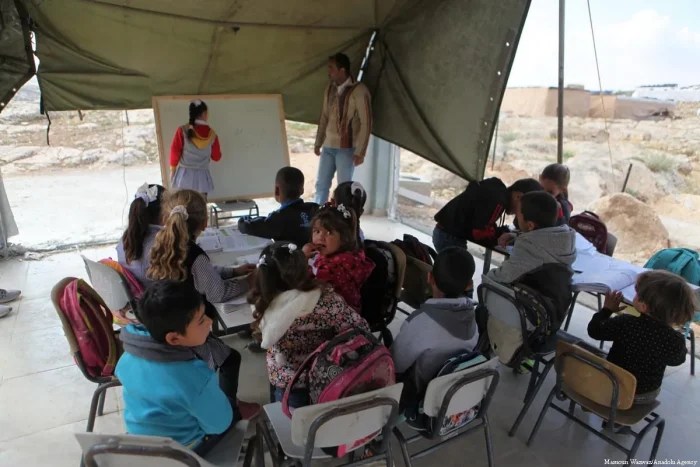
The Israeli Knesset advanced two bills yesterday that stipulate increasing the security grip over Arab schools in Israel and easing restrictions on firing Arab teachers, local media reported.
According to Haaretz, if approved, the bills would see the Israeli authorities upping the Israeli secret service’s background checks on staff and making it easier to fire teachers who affiliate with or support anti-occupation Palestinian groups.
The bills refer to the anti-occupation groups as “terror organisations” and stipulate punishments for supporting them.
Critics of the bills say they pose serious threats to freedom of expression and would undermine the right of teachers to condemn the aggression of the Israeli occupation.
One of the bills proposes the reinstatement of a permanent Shin Bet representative to the education ministry – a position which was cancelled in 2005.
In a previous report, Yedioth Ahronoth revealed that Shin Bet has a say regarding the recruitment of new Arab teachers.
… The bill was submitted by Ami Halevy, a Likud lawmaker, in order to establish licensing of Palestinian schools dependent on their “accommodating the fundamental requirements of the Israeli school system.”
This announcement came a day after the Israel Justice Minister, Yariv Levin, told Knesset members that the supreme court must feature judges who “understand” why Jewish settlers are “not prepared” to live alongside Arabs, which ultimately underlines the cabinet members’ pro-apartheid rhetoric. … Full article
As Israeli colonial violence resulted in the forced displacement of the 200 residents of Ein Samiyah in Area C of the Occupied West Bank, the range of reactions, from silence to pathetic commentary, only increased impunity for the settler-colonial enterprise. A day after Al Jazeerareported on the recent Palestinian displacement, EU diplomats issued yet another futile reproach urging Israel to stop settlement expansion, warning that “settlement expansion has resulted in increased settler violence”. Do Palestinians really need EU diplomats to point out what they have been experiencing daily for decades?
Ein Samiyah’s displaced residents have now moved to Al-Mughayyir and Al-Nuwaimah, still within reach of settler violence, and illustrating how Israel’s ongoing Nakba has been perfected by the state for normalisation by the international community.
As expected, the Palestinian Authority excelled in nothing but complacency. Comments to Al Jazeera by the PA’s presidency spokesman, Ibrahim Melhem, not only highlighted Ramallah’s complicit silence, but also the carefully crafted impunity which it enjoys as a result of its collaboration with Israel.
“The PA does not have the ability to prevent such crimes,” Melhem stated. “It is a victim of these crimes, since the international community does not implement the agreed-upon decisions in dealing with Israel.”
The statement is partly true – the international community relishes non-binding resolutions when it comes to Israel’s war crimes and international law violations. However, the PA is to blame for its blind endorsement of the two-state paradigm, which provided Israel with the opportunity to expand into Palestinian territory, just as the 1947 Partition Plan paved the way for the colonial enterprise to take shape.
When Israel creates refugees, the PA stays silent, not because it is a victim, but because it does not want to veer away from the role the international community and Israel intended it to play. The current term of forcibly displaced Palestinians conveniently detracts from the perpetual cycle of refugees which Israel created since the 1948 Nakba. Yet, for the PA to stop at forced displacement is a form of political violence which Palestinians should not be suffering from their illegitimate, expired leadership.
Even if the PA does not have the ability to prevent settlement expansion – its illegitimate rule adds to its restrictions already imposed by the international community – there is much it could do if Palestine and Palestinians were truly a political concern. The PA stands in the way of political change by refusing to hold democratic elections, by failing to give refugees the necessary political space, by detaining and torturing its opponents, by exploiting the cycle of refugees Israel creates for the sake of temporary rhetorical embellishment and meaningless international solidarity gestures.
“Our main goal is to pressure for their return to their lands, not to submit to moving,” Melhem declared of the Ein Samiyah residents. The question is, how? How can the PA call for return when it persists in ignoring Palestinian refugees? At some point, the collective Palestinian refugees, who have now become a nameless multitude, were also current concerns. How long before Ein Samiyah’s people suffer the same fate, and the PA lapses into the same silence about Palestinian refugees’ political rights?
As promised, the White House hosted a virtual event followed by the issuance of a fact sheet and detailed strategic report last Thursday that described in some detail a sweeping plan that will be implemented to confront what it describes as surging antisemitism. I reported last week how the US Special Envoy to Monitor and Combat Antisemitism Ambassador Deborah Lipstadt, who participated in the ceremony, has articulated the Biden Administration’s somewhat hyperbolic view that “Antisemitism is not a niche issue…it is an existential threat to democracy.” She had also regretted that “America has never done something like a national plan to fight antisemitism.” It should be noted that Lipstadt’s brief as ambassador is to confront what she perceives to be antisemitism all around the world, though it is likely that her role will expand to include domestic authorities under whatever new arrangements emerge as the Biden plan is implemented.
The plan that was unveiled was developed by an interagency task force created by Joe Biden last December, which was headed by “Second Gentleman” Doug Emhoff, who is both Jewish and has the misfortune to be married to Kamala Harris. It reportedly incorporates contributions and insights from claimed discussions with no less than “more than 1,000 community leaders” including various Jewish religious denominations and also representing both Jewish and non-Jewish civic organizations in the United States. Prior to the virtual event and press release, President Biden promised that the plan would “include more than 200 measures that government agencies, social media platforms and elected officials can adopt to counter rising antisemitism.” The measures will reportedly include at least 100 “provisions” that will require congressional action.
That the plan will be considered a success by inter alia suppressing what once passed as free speech in the United States seems to have bothered none of the Jewish groups that applauded the development. Occasionally sensible liberal leaning J Street enthused how “In a period when the threats of antisemitism, far-right extremism and white nationalism are surging in the United States, it’s deeply encouraging to see the White House make this a top priority and adopt a nuanced, well-considered, comprehensive approach.”
J Street’s President Jeremy Ben-Ami, who describes George Soros as a “Jewish philanthropist,” misses the point that Israel, which will be a principal beneficiary from stomping down on the First Amendment as nearly any criticism of the Jewish state will become a “hate crime, is preeminently a country awash in “far-right extremism.” He slyly concludes that “The struggle against antisemitism and all forms of bigotry is far too important to become a mere proxy for debates over Israel,” making the entire issue vanish in typical J Street fashion. Nor does that particular irony appear to have bothered any Congressmen or anyone in the mainstream media, such is the power of the Jewish establishment over both the press and the two joined-at-the-hip on this issue political parties that alternately govern us.
Note how the Plan, relying on wildly exaggerated statistics relating to what are often contrived or alleged antisemitic incidents, not by coincidence, seeks to protect Jews from a malignant force which is presumed to be the “white supremacists” that Biden and his cohorts have been otherwise targeting and also labeling as “terrorists.” That accomplishes two things politically: it gets the powerful Jewish/Israel Lobby and their controlled media fully on board to reelect Biden and it also identifies the enemy as likely to be conservative Republicans. In so doing, you take highly visible steps to protect the Jews (whether or not they actually need protection) and you create a credible enemy that everyone can identify and attack.
So what does the White House’s May 25thpress release entitled “Fact Sheet: Biden-Harris Administration Releases First-Ever US National Strategy to Counter Antisemitism” tell us about what will be put in place to protect America’s wealthiest and already most powerful ethno-religious group? A sub-heading and the lead paragraphs summarize it this way: “[The] Administration announces over 100 new actions and over 100 calls to action to combat antisemitism, including new actions to counter antisemitism on college campuses and online; whole-of-society strategy includes new stakeholder commitments.
“Today, the Biden-Harris Administration is releasing the first-ever U.S. National Strategy to Counter Antisemitism. This strategy includes over 100 new actions the Administration will take to raise awareness of antisemitism and its threat to American democracy, protect Jewish communities, reverse the normalization of antisemitism, and build cross-community solidarity.
“While antisemitic incidents most directly and intensely affect the Jewish community, antisemitism threatens all of us. Antisemitic conspiracy theories fuel other forms of hatred, discrimination, and bias—including discrimination against other religious minorities, racism, sexism, and anti-LGBTQI+ hate. Antisemitism seeks to divide Americans from one another, erodes trust in government and nongovernmental institutions, and undermines our democracy.”
The Fact Sheet and the full report explain in frightening detail how Biden is dedicating significant financial and human resources to essentially pander to Jews and Israel over their concerns that they are being perceived badly, something that might be attributed to their own behavior. Admittedly, some concerns were expressed that Israel would be immune from criticism in spite of the fact that it is widely recognized as an apartheid state that commits crimes against humanity and even war crimes on a nearly daily basis. Most recently this has included a Flag Day march in East Jerusalem in which settlers chanted “Death to Arabs.” The Times of Israelsubsequently printed an article calling for the extermination of the Palestinians. Willfully blind to that reality, the fact sheet has only this to say: “In addition, the strategy reaffirms the United States’ unshakable commitment to the State of Israel’s right to exist, its legitimacy, and its security—and makes clear that when Israel is singled out because of anti-Jewish hatred, that is antisemitism.” In other words, because Israel is the self-designated Jewish state criticism of it will be ipso facto regarded as a hate crime, antisemitism.
I will not bore the reader by reviewing most of the 60 page long “Strategy” report’s more intrusive features, but it is worth observing that it commits itself to have “The US government…harness our collective resources to increase education about antisemitism and its threat to democracy, the Holocaust, and Jewish contributions to American society.” “Collective resources” of course includes taxpayer money, which will be flowing in the billions to Jewish businesses and facilities for “protection,” as is already happening with Department of Homeland Security discretionary grants, more than 90% of which support increased security for Jews and their organizations.
The “Strategy’s” four “Pillars” as elaborated in both the fact sheet and the full text are:
Pillar 1: Increase awareness and understanding of antisemitism, including its threat to America, and broaden appreciation of Jewish American heritage
Pillar 2: Improve safety and security for Jewish communities
Pillar 3: Reverse the normalization of antisemitism and counter antisemitic discrimination
Pillar 4: Build cross-community solidarity and collective action to counter hate
One should expect major initiatives in requiring educational courses in holocaust and other Jewish issues, compulsory training and re-education sessions both in government and the corporate world on the threat posed by antisemitism, and creating law enforcement mechanisms backed by new legislation that will provide empowerment to investigate and criminalize various antisemitic acts as “hate crimes.” One “Strategic Goal” that might be of particular interest to readers of this article might be “Tackling Antisemitism Online,” which includes “Ensure terms of service and community standards explicitly cover antisemitism. The Administration commends platforms with terms of service and community standards that establish ‘zero-tolerance’ for hate speech, including antisemitism. All online platforms are encouraged to adopt zero-tolerance terms of service and community standards” and “to permanently ban repeat offenders, both personal accounts and extremist websites.” It calls for “algorithms” to be employed on social media sites to block any and all antisemitic content. Somewhat bizarrely, it also calls for “Establish[ing] relationships with Jewish community organizations to share best practices related to reporting hate speech and utilizing platforms to lift up Jewish stories.”
So, in effect, the US government’s national security agencies would be answering to and propagandizing for “Jewish community organizations,” which one might think to be inappropriate. But the fact sheet and report itself do not mention what legislation will be in the works to penalize those who choose to be non-cooperative, though the model would likely be the laws that have been passed in 26 states and counting to punish or deny benefits to those who either support Boycott, Divestment and Sanctions (BDS) or are in favor of any nonviolent action directed against Israel. Note particularly that “college campuses” are explicitly mentioned as targets by the White House fact sheet since BDS, seen as a major threat by the Israeli government and by groups like the Anti-Defamation League (ADL), is increasingly popular among students at a number of universities.
And speaking of BDS, where even Biden has perhaps hesitated to go too deep too directly, there is always a boneheaded congressmen who is ready to take up the pander to Israel mission. Senator Marco Rubio, who has never been bothered by having to think anything through, has introduced a bill that would prevent US companies and individuals from participating in boycotts of countries “friendly to the US.” Israel is not named in the legislation, but the Congressmen involved have freely admitted that it is directed particularly against BDS. Rubio claims that “The BDS movement is the single most destructive campaign of economic warfare against the Jewish state of Israel. This bill, which previously passed the Senate, would mark an important step toward bringing an end to the movement’s discriminatory efforts.” The bill’s cosponsor Republican Senator Bill Hagerty added that it would “Provide state and local governments [with] the tools they need to counter ‘the discriminatory and hate-inspired conduct of the anti-Semitic BDS movement aimed against Israel our closest ally in the Middle East.’”
Make no mistake, the “Strategy” and all that will develop from it is misguided, overkill, and the death of freedom to speak, write and associate. It is a consequence of the immense Jewish power over the United States government and is in no way justified by developments. One notes how conservative critics of the Biden Administration Elon Musk and Tucker Carlson have recently been called antisemites without any real evidence demonstrating that to be the case. Joe Biden’s plan of action will surely similarly open the door to what will quickly become an open season on alleged antisemites. It will subsequently be easy for politicians and the media to label critics of domestic issues like the state of the Mexican border or international issues like the pointless and highly dangerous war against Russia as “haters” and by a tortuous extension antisemites. Appropriate punishment will follow.
Philip M. Giraldi, Ph.D., is Executive Director of the Council for the National Interest, a 501(c)3 tax deductible educational foundation (Federal ID Number #52-1739023) that seeks a more interests-based U.S. foreign policy in the Middle East. Website is councilforthenationalinterest.org, address is P.O. Box 2157, Purcellville VA 20134 and its email is inform@cnionline.org.
Israeli forces secure demolition of a building belonging to Palestinians claiming that it was unlicensed at Jabel Mukaber Neighborhood in East Jerusalem on May 24, 2023 [Mostafa Alkharouf – Anadolu Agency]
China has called on Israel to “stop encroaching” upon Palestinian territory and resources, as Tel Aviv continues to allow and approve the construction of illegal Jewish settlements in the Occupied Territories.
Speaking to the United Nations Security Council yesterday, Geng Shuang, China’s deputy Permanent Representative to the UN, stated that “since the beginning of this year, Israel has continued to advance unilateral actions on approving returns, building new settlements and legalising settlements”.
Emphasising that such settlement building and activities violate international law and UN Security Council Resolution 2334, he expressed Beijing’s stance to “urge Israel to immediately halt these actions and stop encroaching upon the land and resources of the Palestinian people”.
Shuang also stressed that “the historical status quo of religious holy sites in Jerusalem must be respected and upheld”, saying that Israeli National Security Minister, Itamar Ben-Gvir “caused renewed tensions” by storming the Al Aqsa Mosque compound for the second time this year and proclaiming Israel’s alleged ownership of the Islamic holy site.
“On the issue of religious holy sites, Israel must stop its provocations, guarantee the right to worship of Muslim worshipers, uphold the peace and tranquillity of religious holy sites, and respect the custodianship of Jordan”, he asserted.
Shuang also drew attention to the fact that tensions and clashes between the Israeli occupation and Palestinian Resistance groups “have been repeating themselves over the past few years, fully demonstrating that a long-stalled peace process is not sustainable, that piece-meal crisis management will not last, and that a comprehensive and just solution is irreplaceable”.
He indicated China’s increasing role in the issue, as with others in the region, and the possibility of surpassing the United States as a mediatory force and hegemon. Supposedly referring to the US, he stated that “the country with major influence on the parties concerned should make concrete efforts to advance the Middle East peace process and should not unjustifiably prevent the Security Council from arriving at the minimum consensus on the Palestine-Israeli issue”.
The Chinese diplomat’s remarks came as the Israeli government yesterday approved the proposed state budget for 2023-2024, which allocates around 3.5 billion Israeli shekels ($941 million) for the illegal settlement projects and the upgrading of their infrastructure.
Current estimates report that there are around 700,000 illegal settlers living in 164 settlements and 116 outposts in the Occupied West Bank and Occupied East Jerusalem, with that set to expand as Tel Aviv frequently approves thousands of more settlement units.
Well, if you thought the American Civil War ended back in 1865, you are apparently wrong. No less an authority than President Joe Biden, in a May 13thcommencement speech to historically black Howard University’s graduates, told the overwhelmingly black students and their families that “The most dangerous terrorist threat to our homeland is white supremacy. And I’m not saying this because I’m at a Black HBCU, I say it wherever I go.” Indeed, both Biden and his inert Attorney General Merrick Garland nee Garfinkel have delivered that same message on a number of occasions, but this was the first time it was employed in such a racially charged environment. It was clearly a pre-electoral call to arms against white people in America, placing government sanctioned targets on the backs of whites who are generally peacefully struggling to retain their communities, identities, religion, heritage and culture, all of which are being engulfed by the White House’s tidal wave of self-serving and politically motivated “woke” promotions.
Five days later, on the 18th, the Republican-led House Judiciary Committee and the Select Subcommittee on the Weaponization of the Federal Government released an 80 page report revealing that the FBI had deliberately miscategorized its investigations into the events surrounding the January 6th Capitol Hill violent demonstration to substantially inflate the numbers suggesting a dramatic increase in domestic terrorism in the United States. The GOP report, based largely on whistleblower testimony, stated that “whistleblowers assert that the FBI pressured agents to reclassify cases as domestic violent extremism (DVE), and even manufactured DVE cases where they may not otherwise exist, while manipulating its case categorization system to feign a national problem.” The FBI’s Washington Field Office deliberately categorized its Capitol disturbance cases to make the rise in DVE cases look more like a national problem than a one-time post-electoral incident.
The report includes “According to whistleblower information, the FBI has manipulated the manner in which it categorized January 6-related investigations to create a misleading narrative that domestic terrorism is organically surging around the country.” The manipulated statistics, based on regarding every individual even peripherally or allegedly involved in an incident as a terrorist suspect rather than as part of a group interaction, were then used to support the Biden Administration’s increasing rhetoric about “domestic terrorism.” One whistleblower explained how “By opening a separate case for each individual as opposed to one case with however many subjects are involved, they’ve turned one case into a thousand cases… And by spreading them to the field, they’ve given the impression that those domestic terror cases are around the country…”
Using the new parameters, the FBI Director Christopher Wray was able to testify before the Senate Judiciary Committee in August 2022 that “the number of FBI investigations of suspected DVEs has more than doubled since the spring of 2020.” The FBI was, in fact, conducting approximately 1,400 pending domestic terrorism investigations at the end of fiscal 2020, a number that jumped to 2,700 domestic terrorism investigations by the end of fiscal 2021. The Bureau arrested approximately 180 domestic terrorism subjects in 2020, a number that increased to 800 such subjects in 2021.
And then there was the May 15th release of the long-awaited Durham Report on the shenanigans engaged in by Team Clinton in 2016 to use the nation’s security apparatus to make it appear that Donald Trump was being directed by the Russian government. Predictably, there will likely be no political or legal consequences relating to the revelation. No one in the FBI or CIA , or even in the Clinton campaign, will be held accountable for efforts made to influence the outcome of the 2016 election and to denigrate Trump personally using what they knew to be lies. The FBI leadership has reportedly apologized and says it will not engage in such activity in the future, but many are skeptical, particularly as there was something of a repeat performance in 2020 involving the letter signed by 51 members of the intelligence and national security community claiming that the Hunter laptop allegations were nothing more than a Russian disinformation operation. “Will it ever end?” one might ask.
And there’s more. Nina Jankowicz, who made the news briefly back when she was about to assume the post of the Department of Homeland Security Disinformation Czar in April last year before she abruptly resigned three weeks later on May 18th is now, one year later, suing Fox News. She claims the network has been “waging a campaign of ‘vitriolic lies’ against her that amounts to a threat to democracy [by] damaging her reputation as a specialist in conspiracy theories and disinformation campaigns.”
Biden simultaneously got cold feet about systematically criminalizing what Americans were saying and writing and shut down The Disinformation Governance Board abruptly in the wake of attacks by Fox and others that the new DHS division Jankowicz led was itself part of a conspiracy to censor rightwing comment spearheaded by President Biden. Janowicz is claiming that no less than Tucker Carlson, the news channel’s then primetime ratings star fired by Fox recently in the wake of the Dominion settlement, led the charge. In his opening monologue on April 28th 2022, Carlson described Jankowicz as a “moron” and said that what she was doing constituted a “full-scale attack on free speech.” He also referred to the disinformation board as “the new Soviet America”.
Finally, what would the week be like without hearing more about the Biden Administration’s endless war against anti-Semitism? There were predictably numerous anti-Semitism developments during the week but the most compelling was the demand by Deborah Lipstadt, the US government’s renowned holocaust expert who serves as Special Envoy to Combat Antisemitism, that one of the world’s richest men Elon Musk must be taken to task for daring to criticize George Soros. Lipstadt elaborated how “You can criticize George Soros — many people do — for his economic policies, even for his political programs, for his foundation. But when you turn him into the Rothschild of the 21st century, then you’re engaging in antisemitism. When you link his activities to his Jewish identity, when you disparage his activities — some of which I may disagree with — and when you turn him into this villainous character, which has antisemitic overtures, you’ve crossed the line.”
Lipstadt was responding to Musk’s tweet “Soros reminds me of Magneto.” He was comparing Soros to a Marvel supervillain/hero character named Magneto, who is also Jewish like Soros and, also like him, a claimed holocaust survivor. Lipstadt believes that even mentioning the Jewish globalist Soros, or referring to someone as a “globalist” or “cosmopolitan,” just might be considered as “invoking antisemitic tropes,” as it implies that they are Jews. Per Lipstadt, “What you’re saying is Jews do not have loyalty to the country in which they live in, that they have loyalty one to the other and that they are out to destroy the countries in which they live in.”
And you will be hearing more from Ambassador Deborah Lipstadt, who also states flatly that “Antisemitism is not a niche issue… it is an existential threat to democracy,” possibly later this week when President Biden will be unveiling the first-ever national plan to counter “anti-Jewish bigotry.” She explains how “America has never done something like a national plan to fight antisemitism, which involves most of the major agencies of the US government. There will be some things that people will disagree with. But when I see the time and effort that has gone in by White House, by high-ranking individuals, it’s a message that we take this seriously.”
The plan was developed in recent months by an interagency task force created by Joe Biden last December. It incorporates claimed conversations with more than 1,000 Jewish community leaders across denominations in the United States. President Biden, at May 9th’s White House celebration of Jewish American Heritage Month, said it will “include more than 200 measures that government agencies, social media platforms and elected officials can adopt to counter rising antisemitism.”
There is considerable irony in all of this much ado about little based on deliberately inflated numbers promoted largely by the Anti-Defamation League (ADL) claiming that antisemitism is surging. Neither the hideous Jonathan Greenblatt of ADL nor Dr. Lipstadt has suggested to their Israeli friends that the sometimes negative perception of Jews in America might improve if the self-declared Jewish state were to stop killing Palestinian children. Indeed, real antisemitic prejudice that produces negative consequences is hard to identify as American Jews have notably become the best educated and wealthiest demographic in the United States. Though only two per cent of the population, they dominate in key economic and social sectors to include finance, entertainment, the media and education. They occupy many if not most of the key policy making positions in the Biden Administration and are greatly overrepresented in Congress and in government in general. They constantly seek and regularly obtain benefits that accrue only to them, like the 90% of Homeland Security discretionary grants that go to them for “security.”
That new “measures” are being implemented to give Jews even more enhanced protected status that directly limits free speech might be considered ridiculous if it were not so downright dangerous, one more step in handing the keys of the kingdom over to an autocratic and self-centered tribe that describes itself as “chosen” by God. We will no doubt be hearing a lot more about their victimhood over the summer to justify what repressive new measures will be put in place. Will criticizing the so-called holocaust and the apartheid state of Israel become hate crimes with large fines and jail time attached? Stay tuned!
Philip M. Giraldi, Ph.D., is Executive Director of the Council for the National Interest, a 501(c)3 tax deductible educational foundation (Federal ID Number #52-1739023) that seeks a more interests-based U.S. foreign policy in the Middle East. Website is councilforthenationalinterest.org, address is P.O. Box 2157, Purcellville VA 20134 and its email is inform@cnionline.org.
A foreign diplomatic source says there has been no progress in the normalization of diplomatic ties between the Tel Aviv regime and Saudi Arabia, as Saudi Crown Prince Mohammed bin Salman (MBS) has rejected a request from Israeli prime minister Benjamin Netanyahu to meet.
Netanyahu and bin Salman spoke on the phone twice in recent weeks. Bahraini Foreign Minister Abdullatif bin Rashid Al Zayani facilitated the calls.
The source, speaking on condition of anonymity, said, the 73-year-old Israeli leader and Saudi Arabia’s de facto ruler held talks before and after last week’s Arab League meeting in the Red Sea port city of Jeddah to discuss the possibility of rapprochement.
The leaders also did not discuss the possibility of direct flights from the Israeli-occupied territories to Saudi Arabia for the annual pilgrimage Hajj to the holy city of Mecca this year.
According to the N12 news site, Saudi authorities presented a list of demands for Israeli concessions vis-à-vis the Palestinians.
Those demands include allowing the Palestinian security apparatus to be strengthened at the expense of Israeli military forces in the occupied West Bank, the report said.
MBS also requested Palestinian security control over al-Aqsa Mosque compound and the Church of the Holy Sepulcher in the occupied Old City of al-Quds.
Last week, Israeli foreign minister Eli Cohen told The Jerusalem Post newspaper normalization with Saudi Arabia was “not a matter of if, but of when. We and Saudi Arabia have the same interests.”
He said White House Coordinator for the Middle East and North Africa Brett McGurk and Special Presidential Coordinator for Global Infrastructure and Energy Security Amos Hochstein had spoken to the Saudi crown prince about détente with Israel during their visit to Jeddah earlier this month.
Normalization with Saudi Arabia could come within the next six months to a year, though senior Saudi officials have always said publicly that headway must be made between Israel and the Palestinians for Riyadh to take that step, Cohen told N12 Saturday night.
“The Palestinian issue was and remains the central issue for Arab countries, and it is at the top of the kingdom’s priorities,” MBS said at the Arab League summit in Jeddah.
“We will not delay in providing assistance to the Palestinian people in recovering their lands, restoring their legitimate rights and establishing an independent state on the 1967 borders with East al-Quds as its capital,” he noted.
Saudi Arabia did not show any opposition when the United Arab Emirates, Bahrain, Sudan and Morocco in 2020 became the first Arab countries in decades to normalize relations with Israel in a deal brokered by former US President Donald Trump.
The oil-rich kingdom is yet to jump on the bandwagon, but the two sides have seen growing contacts and de-facto rapprochement in recent years, despite claims that it is committed to the 2002 so-called Arab Peace Initiative, which conditions normalizing ties with Israel on the establishment of an independent, sovereign Palestinian state within the 1967 borders.
The Riyadh regime in November 2020 granted permission for Israeli airlines to use its airspace, hours before the first Israeli flight to the UAE was set to take off.
Palestinian leaders, activists and ordinary people have repeatedly rejected Arab-Israeli normalization deals as “a stab in the back of the Palestinian cause and the Palestinian people.”
A New York State assembly member has introduced a legislation to stop charities from sending millions of dollars to Israel to stop its settlement expansion activities across the occupied Palestinian territories which are being advanced in flagrant violation of the international law.
The legislation, dubbed “Not on our dime!: Ending New York Funding of Israeli Settler Violence Act,” was introduced by state assembly member Zohran Mamdani, the third Muslim in the New York State assembly, earlier this week.
It would give the state attorney general authority to sue and dissolve not-for-profit organizations that are found to be using their tax-deductible donations to support organizations funding illegal Israeli settlements in the occupied West Bank.
The legislation would also give Palestinians harmed by settler organizations funded by New York-based charities the right to seek damages in American courts.
“Charities registered in New York State currently send more than $60 million dollars a year in tax-deductible donations to aid and abet Israeli settlements. This is done on our dime as New Yorkers,” Mamdani said, the Middle East Eye reported on Thursday.
He added, “This legislation puts an end to that and makes explicit that subsidizing violence and activities outlawed by the Geneva Convention is not, and should not be considered, charitable giving. It’s past time for New York to catch up to international law.”
Mamdani noted that while this issue is important to him as a Muslim, as his faith informs his fight to ensure justice for all people, this is not a bill motivated by religion.
“It is a bill motivated by a desire that New York State stop subsidizing human rights violations through the conferring of charitable status to organizations such as these,” he said.
“Too often, we see an exception drawn when it comes to Palestine – whether it be in our policies or the application of them. This makes it clear that our belief in human rights is universal, without exception,” he added.
The legislation has already received some backlash. Mamdani highlighted that his office has received a call saying all Muslims should die and all Muslim lovers should be killed as well.
“This is the reality when you dare speak up about Palestine and Palestinians,” he said.
Additionally, 66 lawmakers signed an open letter condemning the legislation, saying it “attacks” Jewish organizations.
Emboldened by former US president Donald Trump’s all-out support, Israel has stepped up its illegal settlement construction activities in defiance of United Nations Security Council Resolution 2334, which pronounced settlements in the West Bank and East al-Quds “a flagrant violation under international law.”
More than 600,000 Israelis live in over 230 settlements built since the 1967 Israeli occupation of the West Bank and East al-Quds.
All Israeli settlements are illegal under international law. The UN Security Council has condemned Israel’s settlement activities in the occupied territories in several resolutions.
Palestinians want the West Bank as part of a future independent state with East al-Quds as its capital.
The last round of Israeli-Palestinian talks collapsed in 2014. Among the major sticking points in those negotiations was Israel’s continued illegal settlement expansion.
Many Palestinians believe the Israeli plans to annex one-third of the already occupied West Bank, including parts of the strategic Jordan Valley, is only a formality and that a de facto Israeli occupation of their land has been underway for many years.
It would seem that American politicians and media think that the entire world should rightly conform to the marching orders emanating from Washington, even though that pretense has become a bit shopworn after more than twenty years of pointless wars initiated and sustained by a series of clueless presidents and Congress. Increasingly, the international community is looking for a way out of the tight embrace offered by the White House, a growing sense that a multipolar world would be much better than “rule of law” dictated by any self-proclaimed superpower.
Recently there have been indications that rather than Washington being the center of the universe that title should rightly belong to Jerusalem as an extremist-led Israel has demonstrated its power over the self-anointed idiots who fancy themselves to be the “leaders” of the United States of America. Why do I think that? I truly believe that there have been several interactions lately involving US politicians and the Israelis that illustrate just how ignorant and self-absorbed America’s governing class actually is. The most egregious example of the “wag the dog” syndrome whereby Israel says “jump” and the fawning American government representatives beg to ask “How high?” comes from none other than the newly appointed Speaker of the House of Representatives Kevin McCarthy, who spoke before the Israeli Knesset on May 1st. McCarthy made it a point to flatter his Israeli hosts by emphasizing that traveling to Israel was his first foreign trip as speaker, underlining the value of the relationship, and observing that he was also only the second speaker invited to make the trip to the Jewish state to address the Knesset.
McCarthy was accompanied by the usual cast of congressional toadies who flock to Israel during every recess. The group was bipartisan and included the loathsome Steny Hoyer of Maryland who has made and even led the groveling entourage more than twenty times. The ambition-driven McCarthy, who has never been accused of having a great deal of brain power, delivered a predictable speech that produced the pro forma standing ovations from the audience, but I would call attention to one part of it in particular where he said the following: “This is the foundation of our special relationship: We are the only two countries in history that were conceived in liberty and dedicated to the proposition that we are all equal. Our values are your values. Our heritage is your heritage. Our dreams are your dreams. America is grateful for our friendship with Israel. We are a better nation because of it. And we must never shy away from defending it… As long as I am speaker, America will continue to support fully funding for security assistance in Israel.”
Nearly every line in this part of the McCarthy speech is basically either an out-and-out lie or a twisting of reality to such an extent that it is incomprehensible. Palestine, by the way, was not mentioned by McCarthy, but how Israel can claim to be “conceived in liberty” with the “proposition that we are all equal” when it has been engaged in genocide and expulsion as well as government endorsed violence directed against its Christian and Muslim subject population? And if American and Israeli values are identical, can we expect in the US different laws based on religion. And our common “heritage?” Israeli Jews claim to be “chosen,” don’t they? And finally, how on earth does McCarthy claim that the United States is a better nation because of its ties to Israel? It is ridiculous and insulting, but it leads to the punchline that McCarthy is making an unconstitutional pledge to defend Israel, no matter what Prime Minister Benjamin Netanyahu and his band of criminals do, presumably to include attacking Iran. McCarthy should be impeached. Or even better he should magically become a Palestinian and spend a couple of months under the Israeli occupation. He might change his tune.
McCarthy continued his exaltation of Israel campaign after his return to Washington. On May 9th, he blocked an effort by Congresswoman Rashida Tlaib to host a gathering at the Capitol Visitor Center that would have included least nine groups for an event entitled “Nakba 75 and the Palestinian People.” “Nakba” in the title of Tlaib’s canceled event is the Arabic word for “catastrophe,” which would have meant the speakers would be describing the founding of the state of Israel as a “catastrophe” for the Arab inhabitants of historic Palestine, which it was with hundreds of thousands left homeless, many winding up in refugee camps. McCarthy announced in a message that he was shutting down the event, tweeting that “This event in the US Capitol is canceled. Instead, I will host a bipartisan discussion to honor the 75th anniversary of the US-Israel relationship.” McCarthy’s announcement was in response to a letter from Anti-Defamation League (ADL) CEO Jonathan Greenblatt to him which said ADL had concerns that some of the organizers of the “Nakba” event “have a record of rhetoric that demonizes and delegitimizes Israel, as well as dangerous stereotypes about Israel’s supporters.” Apparently free speech relating to a historic event is not even allowed to congressmen in today’s Zionist-occupied America.
If more evidence of the slime that is at the heart of the American political class is needed, I would cite another event which took place in Jerusalem on April 27th as both shameful and a disgrace. And “no” I am not referring to the Israeli police and army shooting dead more Palestinian teenagers on and around that date before stealing their family homes and destroying their livelihoods. I am referring to Florida’s governor and presidential aspirant Ron DeSantis’s groveling performance in bowing to Jewish power and money during his own trip to Israel. His abhorrent crawling before his masters culminated in his signing a new state law that will inter alia exploit the “hate” mechanism to criminalize nearly all criticism or even skepticism regarding Israeli apartheid, of the co-called holocaust narrative, or of the behavior of Jewish groups and individuals.
At the signing, DeSantis boasted how “We are doing what we can do in Florida to enhance the ability to hold people accountable when that really crosses the line into threatening conduct. We are fighting back.” He also made clear that the legislation was as much about Israel as about Judaism, arguing that rejecting “Israel’s right to exist is antisemitism” and adding that the non-violent Boycott, Divestment and Sanctions (BDS) movement is “DOA” in his state. He also bizarrely described “Iran’s pursuit of nuclear weapons” as an “existential threat to the state of Israel and to the United States of America.”
Perhaps DeSantis should have checked with the CIA and even Mossad before commenting on Iran as both have confirmed that the Iranians do not currently have a nuclear weapons program. Unsurprisingly DeSantis claims that “Florida is the most Israel-friendly state in the country and as long as I’m Governor, we will continue to stand with the Jewish community.” In that he is no doubt correct. Twenty-six other states have penalized anyone seeking to either boycott Israel or promote doing so, sometimes to include denial of government jobs or benefits, but there is no doubt that Florida is currently number one in its deference to the Jewish state and its claimed interests.
The bill (HB 269/SB 994), which passed unanimously in both chambers of the Florida legislature, attempts to criminalize what it perceives as anti-Semitism. Even though its language avoids identifying Jews as the protected class, the clear intent of the document is to do just that. It accomplishes that by transforming what would have once been seen as trivial incidents into hate crimes, which are felonies. It includes “to litter a yard with a flier, harass people, disrupt schools or religious services, deface graves and certain buildings, or project images on someone else’s property” as possible actions rendered felonious based on racial or ethnic prejudice, making them hate crimes. It might mean, for example, that if someone laughs at another person’s clothes and if the attire is considered “ethnic or religious” that person can be arrested and charged with a third-degree felony as a hate crime. Or if a student in a college history class disputes the standard largely fabricated narrative relating to the founding of Israel, a Jewish student can feign distress and demand that the offender be arrested.
One of the bill’s co-sponsor’s State Representative Randy Fine, who was present at the signing in Jerusalem, explained how “There is no First Amendment right to conduct. If you graffiti a building, it is a crime now, but if your motivation is hate, it will be a third-degree felony and you will spend five years in prison. If you want to litter, it’s a crime right now, but if you litter and your motivation is a hate crime, it will be a third-degree felony and you will spend 5 years in jail.” After the bill passed the Senate, Fine tweeted that the bill was “the strongest antisemitism bill in the United States” adding “To Florida’s Nazi thugs, I have news: attack Jews on their property and you’re going to prison. Never again means never again.” Another co-sponsor Mike Caruso warned “If we do nothing, we are going to have 1933’s Nazi Germany all over again.”
DeSantis, who is seeking Jewish money and media support for his run at the presidency, turned in something of a repeat performance of his inaugural trip to Israel back in 2019. At that time, he boasted, like Kevin McCarthy, that his first foreign trip was to good friend and perpetual ally Israel. He took his entire gubernatorial cabinet with him to celebrate his election and theatrically signed an earlier bill (HB 741) in Jerusalem that sought to “criminalize ordinary political speech” by making religion as a “protected class” similar to “racism” to be included in “hate crime” legislation. The new designation specifically included attempts to “demonize Israel.”
The Florida bill also included the controversial International Holocaust Remembrance Alliance definition of anti-Semitism, similar to that which is favored by the office of the US Department of State’s Special Envoy to Monitor and Combat Anti-Semitism, maintaining that “anti-Semitism” is “a certain perception of Jewish people, which may be expressed as hatred toward Jewish people, rhetorical and physical manifestations of anti-Semitism directed toward a person, his or her property, or toward Jewish community institutions or religious facilities.” Under the bill, the BDS movement was defined as a terrorist “hate” group no different than the Ku Klux Klan (KKK) or the Islamic State in Syria (ISIS), which at that time prompted some civil libertarians to question if criticism of the behavior of the Jewish state could be deliberately mischaracterized as being an “anti-Semitic hate crime” that should or might be construed as criticism of the Jewish people and their religion.
HB 741 amended Florida’s “hate crime” statute to include such “antisemitic” acts as:
“Calling for, aiding, or justifying violence against Jews.
“Alleging myths about a world Jewish conspiracy or that Jews control the media, economy, government, or other institutions.
“Accusing Jewish people as a whole of being responsible for real or imaginary wrongdoing by a single Jewish person, group, or the state of Israel, or for acts of non-Jews.
“Accusing the Jewish people of inventing or exaggerating the Holocaust.
“Accusing Jewish citizens of countries other than Israel of being more loyal to Israel than their own nations.
“Demonizing, applying a double standard to, or delegitimizing Israel.”
DeSantis has long nurtured political ambitions and, recognizing the power and wealth of those who are passionate about Israel, he harbors a particular “sensitivity” to Jewish and Israel issues as a means to help him move onwards and upwards. When he was a congressman, survivors from the Israeli attack on the USS Liberty that killed 34 American seamen who lived in his district in Florida report that they sought to meet with him to discuss the possibility of opening a new inquiry into the incident. Even though DeSantis is a former Navy officer, he refused to meet with them.
The power of international Jewry has been most observable in the largely successful attempts to silence criticism of Israel by making such activity describable as motivated by anti-Semitism. Former Israeli government minister Shulamit Aloni has even described the practice of labeling all critics as anti-Semites as “It’s a trick. We always use it… the suffering of the Jewish people” is routinely used to “justify everything we do to the Palestinians.” A number of European countries have also criminalized what is described as “holocaust denial” and in Germany and France have imprisoned those who violate the laws, even when that denial only consists of questioning some of the facts that are employed in the standard accepted narrative of the event. The most recent country to climb onto the “hate speech” express is Ireland, where new legislation is being considered by the country’s parliament. Interestingly, the debate over what one is allowed to say without criminally offending someone else has largely focused on transexuals and gender identity, but it has also been observed that the law would impact on supporters of the Palestinian cause who would perforce criticize Israel, the Jewish state. That might easily be construed as anti-Semitism and lead to heavy fines or even prison time. Interestingly, the bill even criminalizes the mere possession of material considered to be “hateful.”
In any event, the domestic war dedicated to stamping out what is referred to as anti-Semitism continues and grows in the United States, even when it is trivial, largely imaginary, or even fabricated by hate groups like the ADL headed by the hideous Jonathan Greenblatt. And if free speech and honest inquiry have to be sacrificed along the way, so be it. On May 10th the Biden Administration used its United Nations Security Council veto to block a report on Israel’s war crimes in targeting civilians while bombing Gaza, which has killed 25 Palestinians, mostly women and children. Unsurprisingly, Secretary of State Antony Blinken, Secretary of Defense Lloyd Austin and National Security Adviser Jake Sullivan responded to the development by declaring their unwavering support for “Israel’s right to defend itself.”
Clearly, for the vast majority of politicians in Washington and even at the states level, allegiance and subservience to Israel and its interests are more important than protecting constitutional rights or managing a sane and responsible foreign policy. One wonders whether Ron DeSantis, if elected president in 2024, just might hold his inauguration in Jerusalem, just as he did when he became governor. It would actually be something of a relief – at last the ultimate acknowledgement of who is really in charge back here in America.
Philip M. Giraldi, Ph.D., is Executive Director of the Council for the National Interest, a 501(c)3 tax deductible educational foundation (Federal ID Number #52-1739023) that seeks a more interests-based U.S. foreign policy in the Middle East. Website is councilforthenationalinterest.org, address is P.O. Box 2157, Purcellville VA 20134 and its email is inform@cnionline.org.
The Israeli regime’s new assassination campaign in the besieged Gaza Strip has essentially sought to isolate the Palestinian Islamic Jihad (PIJ) resistance movement from Hamas, in what Palestinian resistance leaders, across the board, believe is a miscalculation.
The Israeli occupation military carried out a barrage of deadly strikes on the residences of PIJ leaders in the Gaza Strip in the wee hours of Tuesday morning.
The strikes were carried out just after 2:00 AM local time and claimed the lives of Khalil Bahtini, Jihad Ghanem and Tariq Ezz Ad-Din, three senior leaders of the Gaza-based PIJ movement, along with their spouses and children.
The three resistance leaders were reportedly supposed to head to the Egyptian capital Cairo that day to discuss rising tension in the occupied territories and the regime’s relentless aggression, due to which PIJ had loosened its state of emergency a day earlier.
On Thursday, two more PIJ officials, part of the al-Quds brigades, were assassinated in Israeli drone strikes, prompting a massive barrage of rockets from Gaza towards Tel Aviv and other occupied areas in retaliation.
According to a PIJ military source, who spoke to the Press TV website on the condition of anonymity, Zionists launched the attack to “save their image” and to “isolate the resistance groups”.
“They wanted to see Islamic Jihad isolated from our brothers in Hamas. This has failed and we fight as one force, an attack on one is an attack on all,” he said.
Divide and conquer fails
This statement reflects the sentiment of the PIJ leadership too, who view this battle as a means to demonstrate unity among the resistance movements, which has been established through the Joint Room for the resistance factions in Gaza, which rose to prominence during the Battle of Saif al-Quds in May 2021.
Head of the Islamic Jihad’s political department, Muhammad al-Hindi asserted that there is political communication at the highest level between the two movements and “attempts to drive wedge will fail”.
Hamas has also explicitly said that it is part of the response and its armed wing, the Qassam brigades, is the most powerful force in the Palestinian Joint Room.
The Joint Room also released a statement affirming that the resistance “will remain on all fronts of the homeland as one unit, a sword and a shield for our people, our land, and our sanctities.”
The component of dividing the Palestinian resistance factions has been integral to the Zionist entity’s assassination campaign in Gaza, with the Israeli military warning Hamas to stay out of the confrontation after it carried out its initial strikes.
Yoav Gallant, the Israeli minister of war, stated after the first extrajudicial killings were carried out that “the goals of the operation have been achieved; the leadership of Islamic Jihad in Gaza has been eliminated”, without mentioning Hamas.
Calculated response
However, the resistance forces managed to flip the script on their enemy, waiting for over a day before retaliating, despite continued Israeli missile strikes.
The decision to make the Israelis wait for the response caused hysteria, keeping bomb shelters open for settlers throughout occupied Palestine, as they waited for the anticipated response to high-profile assassinations.
Notably, the response of the resistance forces was not anticipated in the way that it happened. Although there were preparations made for rocket fire toward Tel Aviv, many Israeli analysts believed that past strategies of slowly expanding the range of fire would be adopted.
The wait was perhaps the most important component of the initial retaliatory rocket fire, building anticipation and causing bickering amongst Israelis.
Another key component of the Israeli offensive has been the game of political point scoring, claiming imaginary victories and making tall and deceptive statements following the assassination strikes.
Israeli prime minister Benjamin Netanyahu’s far-right coalition partners – Likud and Otzma Yehudit – had been in dispute over what was labeled by Israel’s security minister Itamar Ben Gvir as a “feeble” response to the PIJ rocket fire last week.
Adnan’s murder
The rocket fire came as a response from the Joint Room to the custodial murder of Palestinian political icon and PIJ West Bank spokesperson, Khader Adnan, who was allowed to die a slow death inside his cell in an Israeli military prison, denied basic medical aid.
Adnan went on hunger strike for 86 consecutive days and according to the Palestinian Prisoners Society organization his custodial murder came as a result of deliberate medical negligence by prison authorities, therefore making it an assassination, or as one Palestinian group said, “cold-blooded execution”.
Before the killing of Adnan, another exchange of fire occurred between the occupation forces and Gaza’s resistance groups during the holy month of Ramadan.
After the Israeli forces stormed the al-Aqsa Mosque compound, attacked worshippers, desecrated the holy site, and arrested and injured over 400 Palestinians, rockets were fired from the Gaza Strip.
The following day, a barrage of rockets also came from southern Lebanon, followed by two batches of rockets fired from Syria into the occupied Golan Heights.
Israeli strikes in Gaza, Lebanon and Syria were lackluster against the backdrop of major threats from the Zionist entity at the time. In both Gaza and Lebanon, Israeli strikes hit open areas of no strategic value, which even made it to social media memes.
Wary of backlash
It is because of the two previous exchanges that the Zionist regime has gone through a process of repeated embarrassments. Its leadership is wary of the political backlash that would come with the outbreak of a real war with all sides, so it settled for a low-scale battle.
In the case of the latest aggression on the besieged Gaza Strip, the PIJ movement has been chosen as what Israel believes to be an easier target, however, as Hamas leader Ismail Haniyeh stated this Tuesday, the regime has “severely miscalculated” and instead of being able to isolate PIJ, they have been dragged into a battle with a unified resistance front this time.
On November 12, 2019, the Zionist regime carried out a brief military operation that targeted only the PIJ movement, assassinating the group commander Baha Abu Atta, which sparked days of fierce fighting.
At that time, Palestinian Islamic Jihad fought separately from Hamas even though the relations between both groups remained friendly, contrary to the hideous Israeli propaganda.
Last year, in August, under former Israeli prime minister, Yair Lapid, the Zionist military launched another military operation to assassinate leading members of PIJ, managing to kill Khaled Mansour and Tayseer Jabaari.
In response, the PIJ movement, as part of the Joint Room, launched “Operation Unity of Squares”, which involved heavy coordination with Hamas throughout.
The aim of dividing the groups failed, yet the Zionist regime managed to keep Hamas from getting involved with full force.
It was using this model that Israeli PM Benjamin Netanyahu launched an attack this time, however, what was planned to be a short assassination campaign failed to isolate the PIJ movement from the other resistance groups and rather unified the resistance front against the occupying entity.
Robert Inlakesh is a journalist, writer and political analyst, who has lived in and reported from the occupied West Bank.
US officials blocked an effort led by China at the UN Security Council (UNSC) on 10 May to condemn Israel’s latest onslaught on the besieged Gaza Strip, according to senior Israeli officials that spoke with the Times of Israel.
Washington’s interference reportedly came at the request of Tel Aviv, who feared the motion at Tuesday’s emergency meeting “would draw an equivalence” between the Israeli army and the Palestinian Islamic Jihad (PIJ) resistance group.
Over the decades, the US has consistently stepped in to protect Israel from facing the consequences of rampant human rights abuses, the military occupation of Palestinian land, and the imposition of an apartheid system targeting Palestinians.
The only exception to this rule came earlier this year, when Washington allowed a statement to pass at the UNSC blasting Israel’s expansion of illegal settlements in the occupied West Bank. Nonetheless, the US went on to block a binding resolution against Israel.
Former US President Harry Truman was the first world leader to recognize Israel when it was created in 1948 following the ‘Nakba,’ or catastrophe, during which at least 700,000 Palestinians were violently evicted from their lands by Jewish settlers.
Israel is also the largest cumulative recipient of US foreign aid in the post-World War II era and enjoys unequivocal political and diplomatic cover from both the Democratic and Republican parties as well as from US corporate media.
However, US influence in the region has started to wane in recent months, pushing Israel further into isolation.
Last month, Beijing offered to help facilitate peace talks between Israel and Palestine as part of a larger effort to mediate historic conflicts in West Asia.
In December, Chinese President Xi Jinping expressed support for an end to the Israeli occupation of Palestine and voiced frustration over the “historical injustice” suffered by Palestinians.
He also called for granting Palestine “full membership in the United Nations” and said Beijing “supports the two-state solution and the establishment of a Palestinian state on the 1967 borders, with East Jerusalem as its capital.”
The Asian giant has slammed recent comments by a Jewish supremacist government minister, who in March said, “there is no such thing as a Palestinian people.”
“The Israeli senior official is wrong and irresponsible to deny Palestinian people’s existence and to display an ‘Israel map’ including Jordan and Palestinian places occupied by Israel at an event in Paris,” said Wang Wenbin, a spokesman for China’s Foreign Ministry.
An Israeli military dog attacked 13-year-old Raja and terrified 8-year-old Nidal when Israeli forces entered their home in Al-Far’a refugee camp in the middle of the night. Raja’s leg wounds are still healing, while Nidal refuses to sleep alone.
In November 2022, Israeli forced demolished a Palestinian elementary school in the rural community of Isfay Al-Fouqa, located in the Masafer Yatta region of the southern occupied West Bank. Now, children are trying their best to learn in a tent.
When a mere subplot overnight assumes habitation and a name, it becomes more fascinating than the main plot itself. Syria’s return to the Arab League after its decade-long exclusion can be regarded as a sub-plot of the China-brokered rapprochement between Saudi Arabia and Iran. But then, China and Iran are not per se party to the process.
Syria’s return to the Arab League is seen as an Arab initiative, but it is quintessentially a project Riyadh steered through in close consultation and coordination with Damascus, ignoring some murmur by a clutch of Arab States and patently in defiance of Washington’s trenchant opposition.
Against the backdrop of the epochal struggle for a new world order characterised by multipolarity and resistance to Western hegemony, Russia and China quietly encouraged Riyadh to move in such a direction.
A riveting thing about the decision taken by the foreign ministers of the seven Arab League nations at the meeting in Cairo on Sunday is its sweet timing. For, this is the 80th anniversary of the establishment of the Ba’ath Party in Damascus in 1943, which espoused an ideology of Arab nationalist and anti-imperialist interests that have lately re-appeared in the geopolitics of West Asia.
Syria has a tradition of strategic autonomy. Through the past decade, it was preoccupied with fighting off the US-sponsored regime change project, with help from Russia and Iran. As it turns the corner and is stabilising, Syria’s strategic autonomy will be increasingly in evidence. This is one thing.
However, the strategic relations with Russia and Iran will continue to remain special and there should be no misconceptions on that score. But Syria is capable of ingenuity and diplomatic acumen to create space for itself to manoeuvre, as geopolitics takes a back seat and Assad prioritises stabilisation and reconstruction of the economy, which requires regional cooperation.
The recent visit by Iran’s president Ebrahim Raisi to Syria testifies to Tehran’s “soft diplomacy,” exuding pragmatism that on the one hand made it clear that despite the recent rapprochement between Damascus and Arab countries, Syrian-Iranian ties are still strongand even highlighted Syria’s role in the resistance to Israel — with Raisi holding a meeting in Damascus with senior Palestinian officials, including leaders of Hamas and Islamic Jihad — while on the other hand, the negotiations with the Syrian leadership was largely about economic cooperation.
Raisi said Iran is ready to take an active part in the post-war reconstruction of Syria. Iran faces competition from Gulf countries that have deep pockets. Meanwhile, the warming of relations between Syria and Turkey is also on the agenda, which is sure to lead to increased trade and spur investment flow.
To put matters in perspective, Iran’s exports to Syria currently amount to a paltry sum of $243 million. However, since the beginning of the conflict in Syria, Iran has been a key sponsor of the Syrian authorities. In January 2013, Tehran opened the first credit line of $1 billion for Damascus, which was under international sanctions, thanks to which the government was able to pay for imported food. This was followed by a loan of $3.6 billion for the purchase of petroleum products. The third loan of $1 billion was extended in 2015. Tehran also allocated funds to Damascus to pay salaries to civil servants, which helped preserve state institutions. In 2012, a free trade agreement began to operate between the countries. Iran is also spending billions to finance Shiite militias in Syria and supply them with weapons. Naturally, Tehran would like to recoup some of these investments.
Syria is assessing, rightly so, that normalisation with the Arab neighbours and Turkey will be a game changer. But, while everyone is talking about Syria’s “readmission to the Arab family” as a concession, Damascus reacted to the Arab League decision in a measured way.
The Syrian Foreign Ministry statement said on Sunday, “Syria has been following the positive trends and interactions that are currently taking place in the Arab region, and believes that these benefit all Arab countries and favour the stability, security and well-being of their peoples.
“Syria has received with interest the decision issued by the meeting of the Council of the League of Arab States.”The statement went on to stress the importance of dialogue and joint action to confront the challenges facing the Arab countries. It recalled that Syria is a founding member of the Arab League and always had a strong position in favour of strengthening joint Arab action.
Most important, the statement concluded by reaffirming that the next stage requires “an effective and constructive Arab approach on the bilateral and collective levels on the basis of dialogue, mutual respect, and the common interests of the Arab nation.”
From all appearance, the Arab League statement itself was a “consensus statement” drafted with great sensitivity by Saudi Arabia.
In an interview with Al-Mayadeen, Raisi said prior to his departure for Damascus that “Syria has always been on the axis of resistance… We unequivocally support all fronts of the axis of resistance, and my visit to Syria is within the framework of this support, and we are working to strengthen the resistance front, and we will not hesitate in this.” In fact, Raisi’s arrival in Syria coincided with increased Israeli attacks by Israel on Iranian military facilities, including on Aleppo airport.
Without doubt, Iran remains Syria’s main ally and Iranian influence in Damascus is still strong. Iran views Syria as its strategic territory through which Tehran can establish ties with Lebanon and confront Israel.
What works to Syria’s advantage here is that the Saudi-Iranian detente is based on a common view in Riyadh and Tehran that they have to coexist in one form or another, since their enmity and regional rivalry turned out to be a “lose-lose” proposition that didn’t improve their regional standing. Suffice to say, their national interest resulting from their rapprochement overrides past rivalries.Syria will be a testing ground where each other’s true intentions as well as conduct will come under close scrutiny.
The good part is that the Saudis have concluded that President Assad is firmly in the saddle, having weathered the most devastating war since World War 2, and mending relations with Damascus can be a “win-win” for Riyadh.
That said, Syria is a strategic hinge where Riyadh will need to balance its strategic ties with the US and its tacit ties with Israel. But then, Saudi Arabia’s new strategic calculus also includes China and Russia. When it comes to Syria, Russia is an anchor sheet for Assad, while China has been all along on the right side of history.
This geopolitical setting has driven Biden Administration into frenzy, NSA Jake Sullivan rushed to Saudi Arabia holding the hands of his Indian and Emirati counterparts for company! Wisdom lies in Washington using Saudis (and Emiratis and Indians) to open a line to Damascus.However, Assad will set the very same non-negotiable condition to Washington for normalisation that he insisted with Turkey — vacation of US occupation. Beyond that lies, of course, Israel’s annexation of Golan Heights.
Beirut – During his visit with US Secretary of State, Mike Pompeo, Lebanese President Michael Aoun reportedly received a US-Israeli document detailing plans for creating a civil war in Lebanon with covert false flag operations and possible Israeli invasion.
Although the source of the document is Israeli and created in partnership with Washington, no one knows who presented it to Aoun. The Lebanese TV station, Al-Jadeed, initially reported the document on Lebanese TV and a video on its website. Geopolitics Alert translated the report for this article. … continue
This site is provided as a research and reference tool. Although we make every reasonable effort to ensure that the information and data provided at this site are useful, accurate, and current, we cannot guarantee that the information and data provided here will be error-free. By using this site, you assume all responsibility for and risk arising from your use of and reliance upon the contents of this site.
This site and the information available through it do not, and are not intended to constitute legal advice. Should you require legal advice, you should consult your own attorney.
Nothing within this site or linked to by this site constitutes investment advice or medical advice.
Materials accessible from or added to this site by third parties, such as comments posted, are strictly the responsibility of the third party who added such materials or made them accessible and we neither endorse nor undertake to control, monitor, edit or assume responsibility for any such third-party material.
The posting of stories, commentaries, reports, documents and links (embedded or otherwise) on this site does not in any way, shape or form, implied or otherwise, necessarily express or suggest endorsement or support of any of such posted material or parts therein.
The word “alleged” is deemed to occur before the word “fraud.” Since the rule of law still applies. To peasants, at least.
Fair Use
This site contains copyrighted material the use of which has not always been specifically authorized by the copyright owner. We are making such material available in our efforts to advance understanding of environmental, political, human rights, economic, democracy, scientific, and social justice issues, etc. We believe this constitutes a ‘fair use’ of any such copyrighted material as provided for in section 107 of the US Copyright Law. In accordance with Title 17 U.S.C. Section 107, the material on this site is distributed without profit to those who have expressed a prior interest in receiving the included information for research and educational purposes. For more info go to: http://www.law.cornell.edu/uscode/17/107.shtml. If you wish to use copyrighted material from this site for purposes of your own that go beyond ‘fair use’, you must obtain permission from the copyright owner.
DMCA Contact
This is information for anyone that wishes to challenge our “fair use” of copyrighted material.
If you are a legal copyright holder or a designated agent for such and you believe that content residing on or accessible through our website infringes a copyright and falls outside the boundaries of “Fair Use”, please send a notice of infringement by contacting atheonews@gmail.com.
We will respond and take necessary action immediately.
If notice is given of an alleged copyright violation we will act expeditiously to remove or disable access to the material(s) in question.
All 3rd party material posted on this website is copyright the respective owners / authors. Aletho News makes no claim of copyright on such material.