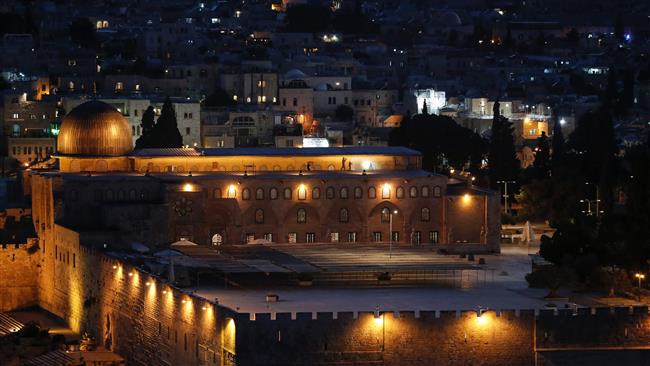
Israel’s State Prosecutor yesterday closed the case into two Israeli soldiers who shot dead a Palestinian man at one of the entrances to Al-Aqsa Mosque in the occupied city earlier this month.
According to Haaretz, the State Prosecutor, Amit Aisman, accepted the claims of the Israeli Justice Ministry’s police misconduct unit and the deputy state prosecutor for criminal affairs. Following “solid and clear evidence,” the State Prosecutor’s Office announced that the victim, Mohammad Al-Osaibi, shot two bullets while attempting to grab the weapon of one of the officers before he was shot dead and therefore, no offence was imposed by the Israeli forces.
Moreover, further investigation, according to Aisman, concluded that the area where the attack took place was not recorded by the cameras in the area and the Israeli officers failed to switch on their body cameras due to lack of time.
Rights groups have, however, questioned the lack of video footage of the event.
Al-Osaibi’s family deny the police’s version of events, saying the 26-year-old doctor from Houra, a Bedouin Arab village in southern Israel, was shot when he intervened to help a Palestinian girl.
His uncle, Ahmed Alasibi, told Haaretz : “From what we understand, he encountered the police who were harassing a young Palestinian woman, and apparently there was an argument. They shot him to death for no reason, the whole talk about an attack and taking their weapon is a lie.”
Tensions have been running high across the occupied West Bank, including East Jerusalem, in recent months amid repeated Israeli raids into Palestinian towns and Al-Aqsa Mosque.
Over 90 Palestinians have been killed by Israeli fire since the start of the year, according to Palestinian figures. Fourteen Israelis have also been killed over the same period.
April 7 was “Good Friday” for Western Christians, the day when they believe Jesus was hung on a cross. But it was a “Sad Friday” in Jerusalem. To the Muslims of the world, this is the third Friday of Ramadan, and this morning worshippers attempting to pray at the Al-Aqsa Mosque in East Jerusalem were prevented entry to the area and severely beaten by Israeli Police batons. Street vendors and shopkeepers were also attacked by Israeli Police. It was indeed a sad Friday.
Who gave the order to attack the worshippers inside the Al Aqsa Mosque?
Kobi Shabtai is the Commissioner of the Israel Police. In 2021, he ordered the police to prevent access to the Damascus Gate in East Jerusalem in a similar escalation of tensions then.
National Security Minister Itamar Ben-Gvir leaked a recording of a conversation with Shabtai, in which he said, “There’s nothing we can do. They murder. It’s in their nature. That’s the mentality of the Arabs.” There were calls by Israeli Arab politicians for his dismissal because of his racist remarks.
Why did Israeli police storm Al-Aqsa Mosque?
On April 4, about 80,000 worshippers attended the evening prayers at the Al-Aqsa Mosque in East Jerusalem. Some of the Palestinians stayed overnight in the mosque to pray in a tradition observed during Ramadan. Some voiced concern to protect the third holiest site in Islam from extremist Jewish settlers who had threatened to come to the mosque to offer animal sacrifices in honor of Passover, which began on April 4.
The extremist Jewish settlers have a plan to destroy the Al-Aqsa Mosque and build a Jewish Temple on its site.
By the early hours of April 5, Palestinians had filled the streets near the mosque to pray the early morning prayer. The Israeli police were ordered to prevent Palestinians under the age of 40 to enter the area for prayers. By evening, the police entered the mosque by force and arrested dozens of worshippers after severely beating both men and women praying inside.
Palestinian Authority Prime Minister Mohammad Shtayyeh said in a statement “What happened in Jerusalem is a major crime against the worshipers. Prayer in Al-Aqsa Mosque is not with the permission of the [Israeli] occupation, but rather it is our right.”
Israeli air strikes on Gaza
In response to the attacks on Al Aqsa Mosque, several rockets were fired from Gaza into Israel. The Israeli air force then targeted multiple locations across Gaza causing damage to homes and the Al-Durrah Children’s Hospital in Gaza City. The Geneva Convention prohibits attacking civilian health facilities.
Israel has imposed a blockade upon Palestinians in the Gaza Strip since 2007, an illegal act of collective punishment. Israel’s repeated attacks upon the Gaza Strip have primarily impacted civilians, resulting in potential war crimes and crimes against humanity according to international investigations. Israel uses U.S. weapons to enforce its blockade and attack the Gaza Strip in violation of U.S. laws.
Lebanon rockets
A Palestinian resistance group in southern Lebanon launched rockets yesterday at Israel from Marjayoun in southern Lebanon in response to the Israeli attacks on the Al-Aqsa Mosque.
The Israeli forces then retaliated by striking southern Lebanon, but both sides have since stopped, and no casualties were reported. The flare-up came at a time when Hamas leader Ismail Haniyeh is in Lebanon on a private visit.
Previous attacks
The Arab League met in an emergency session after the Israeli police raid on the Al-Aqsa Mosque left at least 12 Palestinian injured, and 400 arrested on April 5, who remains in custody at Atarot police station in East Jerusalem.
The raids continued into the morning as Israeli police were videoed assaulting and pushing Palestinians out of the compound and preventing them from praying, while Israeli extremist settlers were allowed in under police protection. The police used stun grenades, tear gas, batons, and rifles to beat the worshippers. Some victims suffered respiratory injuries due to the gas which was thrown into the mosque after the police first broke the upper windows.
The Arab League Secretary-General Ahmed Aboul Gheit said, “The extremist approaches that control the policy of the Israeli government will lead to widespread confrontations with the Palestinians if they are not put to an end.”
The Palestinian Red Crescent reported that the Israeli police prevented them from reaching the mosque to attend to three injured victims who needed hospitalization.
Israeli police said in a statement that they were forced to enter the compound after “masked agitators” locked themselves inside the mosque with fireworks, sticks, and stones. No violence would have occurred if the police had remained outside. The police had never been threatened by people inside the mosque, and it was an unprovoked attack on people praying inside a closed building.
“Israel is committed to maintaining freedom of worship, freedom of access to all religions and the status quo and will not allow violent extremists to change that,” Israeli Prime Minister Netanyahu said.
Netanyahu is calling the victims inside the mosque ‘extremists’ when in fact it is his citizens, the extremist Jews who provoked the attack by insisting on going to the mosque during Passover. Netanyahu’s government is an alliance between his party and extremist Jewish parties who call for the deportation of all Palestinians, and refuse all calls for human rights for Palestinians. Netanyahu is bound to be beholden to those extremists, even though he has ridiculed them in the past. If he were to stand up to them now, the alliance would be broken, his government would fall, and he would go straight to jail. The only thing keeping him out of jail on multiple corruption charges is those extremists like Ithamar Ben-Gvir.
The U.S. reaction
The UN, Turkey, the U.S., Canada, and several other countries and bodies have expressed concern about Israeli forces storming the Al-Aqsa Mosque.
Washington said on Wednesday that it was “extremely concerned” about the violence.
“We urge all sides to avoid further escalation,” White House press secretary Karine Jean-Pierre told reporters. “It is imperative now more than ever that Israelis and Palestinians work together to de-escalate tensions and restore calm.”
“We remain extremely concerned by the continuing violence and we urge all sides to avoid further escalation,” White House National Security Council spokesman John Kirby said.
Since 1948, the U.S. has provided Israel with over $125 billion in military aid, which transformed the Israeli forces and police into one of the world’s top forces. Israel has been designated as a U.S. Major Non-NATO Ally, and yet the U.S. has never once held Israel accountable for war crimes, crimes against humanity, and the apartheid state in Israel.
With its silence, the U.S. stands complicit in the crimes against the Palestinian people who are deprived of every human right.
Turkey
Turkey’s President Recep Tayyip Erdogan condemned the Israeli police raid, calling such acts in the mosque compound a “red line” for Turkey.
“I condemn the vile acts against the first qibla of Muslims in the name of my country and people, and I call for the attacks to be halted as soon as possible,” Erdogan said. “The name of this is the politics of repression, the politics of blood, the politics of provocation. Turkey can never remain silent and unmoved in the face of these attacks.
Canada
Canadian Prime Minister Justin Trudeau said, “We need to see the Israeli government shifting in its approach, and Canada is saying that as a dear and close and steadfast friend to Israel, we are deeply concerned about the direction that the Israeli government has been taking.”
UAE
The UAE foreign ministry said in a statement, “The UAE called on Israeli authorities to halt escalation and avoid exacerbating tension and instability in the region.”
Saudi-Iran agreement
The recent restoration of full diplomatic relations between Iran and Saudi Arabia has changed the Middle East. Now, the two biggest powerhouses in the region have put differences aside and are willing to work together for peace and security. Neither nation has normalized a relationship with Israel, even though Netanyahu stated in December 2022 that getting a deal with Saudi Arabia was one of the two biggest goals of his new administration.
The U.S. has not offered any leadership for decades on an Israeli-Palestinian peace plan. In the meantime, the U.S. has slipped from global leadership, especially from the days of influence in the Middle East, since the area has turned independent of dictates from the Oval Office.
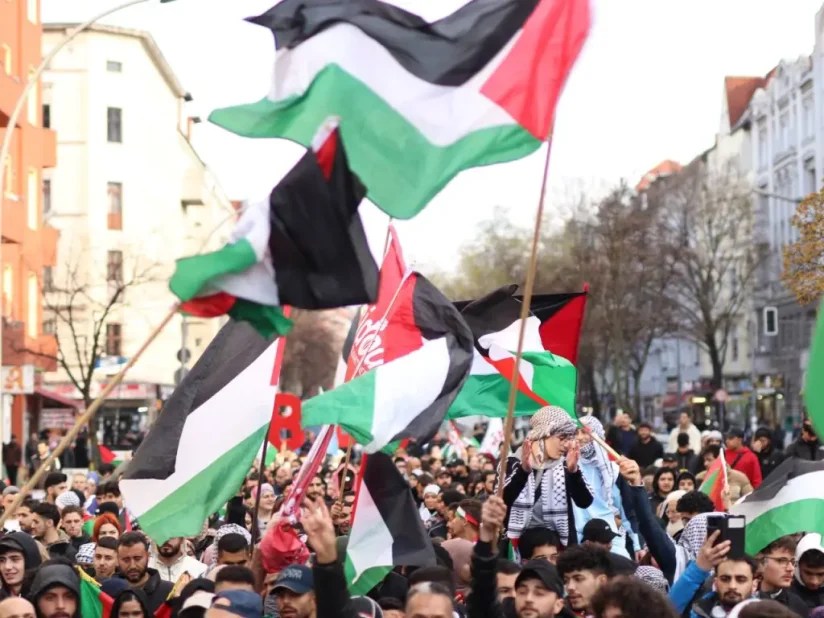
On Saturday, 8 April, nearly 1,000 people marched through the streets of Berlin in solidarity with Palestine. The reality of this demonstration was that it was strong and organized, an expression of outrage and internationalism against the war crimes and crimes against humanity being committed against the Palestinian people by the Israeli occupation regime.
Despite the presence of an excessively large number of police as well as Arabic translators specifically brought by the police to surveil the crowd, there were no incidents reported by anyone while the demonstration took place. Instead, images of the demonstration spread around the world, a sign that Palestinians, Arabs, and internationalists in Germany have not forgotten the ongoing injustice in Palestine.
As always, when there is a large demonstration for Palestine, and particularly when the Palestinian and Arab community in Berlin speaks out for justice and against racism and repression, the attacks and attempts to criminalize the demonstration soon follow. We have seen this same rhetoric play out time and time again, and every time a new pretext is used to incite the suppression of the Palestinian voice in Berlin — as well as the suppression of all voices for justice.
This time, the pretext is a sensationalized video that is widely circulated by German media. The video in question contains deliberate translation errors, open demonization of Palestinians in general and Samidoun Network in particular, and openly vilifies political prisoners on hunger strike fighting blatantly political charges as civilians before occupation military courts, elderly political prisoners being murdered in Israeli prisons due to medical neglect, and child prisoners. The video attempts to highlight a single voice allegedly shouting an anti-Semitic slogan during the demonstration. The individual that allegedly shouted this statement is never shown in the video, they were not joined by any other person, the chant did not come from the front of the demonstration nor over the microphone, and this individual voice in a mass demonstration of a thousand people just happened to be close enough to these “journalists” for them to pick up his chant and use it to launch an extensive smear campaign against organizing for Palestine in Germany.
The identity of this person is entirely unclear, as is their reason for shouting this or even whether they were a participant in the demonstration at all. One thing is clear: they had nothing to do with the organization, direction, leadership or political framework of the mobilization and this statement does not reflect our clear anti-racist, anti-colonial vision for a liberated Palestine. Every single Palestinian demonstration in Germany is routinely and falsely targeted and smeared as anti-Jewish, when it is in fact anti-racist and pro-liberation. This is also being used to try to criminalize Samidoun, our member organizations and our initiatives in other countries thousands of kilometers away, which shows the true intentions of this campaign.
This smear tactic aims at putting in question our clear stance against anti-Semitism and all forms of racism, and by extent, our natural stance against the statement allegedly shouted by a single individual in the vicinity of the demonstration. Principled organization for Palestine is by definition anti-Zionist, against this racist and colonial system that oppresses and attempts at eliminating the Palestinian people. And we are joined in this struggle with our anti-zionist Jewish comrades, because our struggle is not in the context of a religious conflict, but is a liberation movement against colonialism, occupation, and oppression.
Two very important points about the weaponization of such incidents that are impossible to account for in a mass demonstration:
We view such statements as a tool in the hands of reactionary and repressive forces, including pro-apartheid organizations that seek to criminalize support for Palestine.
Zionism and its ongoing drive to designate this fascist ideology as “Jewish” has long played a nefarious role in confusing Zionism, a racist political ideology, with Judaism and Jewishness. The same is true of Western powers that repeatedly refer to the Israeli occupation as the “Jewish state”, attempting to tar all Jews with the brush of Zionist crimes. It is the Palestinian liberation movement that rejects the equation of Jews with Zionists and the Zionist movement that seeks to institutionalize that same equation.
Further, we are also clear that these coordinated attacks do not reflect any desire to act against racism, including anti-Semitism, in Berlin or in Germany. Instead, they exist to achieve three main objectives:
Attempt to manufacture a pretext to prohibit organizations working for justice and liberation in Palestine, like the Samidoun Network, or to ban demonstrations, like the upcoming marches to commemorate the 75th anniversary of al-Nakba, the catastrophic occupation of Palestine, as we experienced in May 2022.
Attempt to manufacture anti-Palestinian racism and repression on the streets of Berlin and to intimidate our community from participating in actions and demonstrations.
Attempt to draw attention away from the topic of the demonstration itself — that is, the ongoing war crimes and crimes against humanity in Palestine, justified by the German government and its political parties, up to and including the extreme settler movement that marched through the West Bank of occupied Palestine today, the calls to occupy all of Jordan as well as all of Palestine by Israeli Minister Bezalel Smotrich and the attacks on Palestinians at prayer in Al-Aqsa Mosque during Ramadan.
We will not be silenced or suppressed, and we will not stand by as our community is targeted for repression and criminalization. We urge all to join us on Sunday, 16 April for the March to Free Palestinian Prisoners. With our collective clarity and voice, we once again affirm, from the river to the sea, Palestine will be free!
The head of the Greek Orthodox Church in Jerusalem, Archbishop Atallah Hanna, has demanded Palestinian Muslims and Christians be guaranteed freedom of access to their holy places in the occupied city of Jerusalem to practise their religious rituals in peace.
For years Israeli checkpoints have impeded the arrival of Christian worshippers to the Church of the Holy Sepulchre, he added, adding that Christian pilgrims visit Palestine to pray, worship and seek blessings from the holy places, and not to be stopped at the checkpoints and be abused.
Archbishop Hanna said freedom of worship and freedom of access to the holy places in Jerusalem are one of the most basic rights, and therefore it is not permissible to overlook these rights, or accept the fait accompli imposed by the Israeli occupation on Palestinians, where the city of Jerusalem becomes a military barracks with checkpoints in every corner.
“These days, Palestinian Christians are eager to visit the Church of the Holy Sepulcher and pray in it, but, unfortunately, there are unjust measures that prevent Palestinians from reaching Jerusalem, where military checkpoints and the Apartheid Wall surround the Holy City and prevent Palestinian Christians and Muslims, from reaching their holy places until after they obtain special permits that allow them to enter,” he explained.
“It is not permissible to hinder the arrival of Palestinian Christians and pilgrims coming from different parts of the world to the Church of the Holy Sepulchre, as well as our Muslim brothers who wish to reach Al-Aqsa Mosque,” he added.
“Open Jerusalem for its people so that they may reach it with complete freedom. Open Jerusalem to all its visitors and pilgrims who come to it from all parts of the world. Jerusalem is the city of our faith and the incubator of our most important sanctities. No believer should be prevented from reaching the holy places in this blessed part of the world,” he said.
According to the Israeli newspaper Haaretz, one of the leading candidates to head Israel’s new National Guard is Avinoam Emunah, a retired colonel known for advocating violence against Palestinians.
Middle East Eye (MEE) noted that Emunah is the former commander of the infamous elite paratroopers Unit 101. Established in 1953, the unit was first led by former general and prime minister Ariel Sharon and was known for carrying out operations terrorizing Palestinian, Jordanian, and Egyptian civilians.
While a member of Unit 101, Emunah fought in campaigns during the Second Intifada, the invasion of Lebanon in 2006, and the war on Gaza in 2014.
Sources in the Israeli military report that Emunah punished his soldiers who did not use enough violence during fighting in the Gaza Strip in 2014.
In addition, a Video emerged of Emunah telling his soldiers, “Much of the time, you’ll be seeing them fleeing … Kill them as they flee” and “Smile, guys. You should enjoy it. Try to enjoy it.”
In a 2015 article published in an army magazine, he dubbed the “smile-kill-enjoy” motto as “words to spur on” the troops.
On 2 April, Israel’s government announced the establishment of the National Guard under the supervision of National Security Minister Itamar Ben Gvir, who is also known for his extreme anti-Palestinian views.
Haaretzreported as well that when asked who he would like to see enlist in the national guard, Ben-Gvir specifically mentioned La Familia, the racist hooligan fan club of the Beitar Jerusalem soccer team, and said that there are “officers and ethical people” among them.
The Israeli government approved a budget of around $278 million for the establishment of the armed branch while also increasing the salaries of over 3,000 police officers.
Ben Gvir said the establishment of the National Guard is “important news for Israeli residents and will improve personal security.”
However, the Association for Civil Rights in Israel called the proposed national guard “a private, armed militia that … will first and foremost act in mixed cities, first and foremost against the Arab population.”
Ben Gvir had previously called for establishing an Israeli National Guard to prepare the country for a new “imminent” war with Hamas.
The deal to establish the National Guard was reached with Gvir’s party, Otzma Yehudit, in exchange for not leaving the government over Prime Minister Benjamin Netanyahu’s intention to postpone the legislation of the controversial judicial reform bill.
Senior Ukrainian presidential advisor Mikhail Podolyak brazenly admitted to Kiev’s genocidal intentions in the NATO-Russianproxy war that’s presently being fought in his former Soviet Republic during an interview with US Government-controlled “Radio Free Europe/Radio Liberty” (RFERL). The relevant excerpt will now be shared in order to raise awareness of his words, which can be read in their original Ukrainian at that outlet’s website here for those skeptics who doubt that he truly said them:
“We have to completely close everything related to the Russian cultural space [in Crimea after its reconquest]. We have to eradicate everything Russian. There should be only Ukrainian cultural space or global cultural space. We should not have a dialogue about whether a person has the right to use the Russian language or not. At home, please use it, but it is not a tool of pressure, it is not a tool of protest, it is not a tool of blackmail.”
Podolyak admitted to precisely what Moscow has always accused Kiev of intending since the Western-backed fascist coup of early 2014 popularly known as “EuroMaidan”, namely the ethnic cleansing and genocide of Crimea’s indigenous Russian population. He therefore inadvertently justified its democratic reunification with Russia that was carried out for the purpose of defending its people’s UN-enshrined human rights, thus discrediting his side’s and its foreign patrons’ moral stance in this conflict.
Not only that, but the so-called “rules-based order” that’s aggressively being promoted by the US-led West’s GoldenBillion was exposed as a hypocritical sham. That de facto New Cold War bloc isn’t waging their proxy war against Russia in order to defend “democracy” and “human rights” like its propagandists claim, but to advance Kiev’s publicly confirmed goals that stand in direct contradiction to those two concepts.
Any political force in the West that agitates for literally eradicating another culture and prohibiting its people from speaking their native language outside of their homes would rightly be condemned by society as fascist, yet there’s no chance that the US or EU will ever normalize describing Kiev in that way. These double standards speak to the ulterior motives connected to the previously mentioned “rules-based order”, which has always been about advancing American hegemony on any given pretext.
Returning to Podolyak’s candid admission, nobody can credibly claim that funding Kiev isn’t equivalent to funding fascism. There’s no other way to describe that side’s intention to eradicate Russian culture in its entirety and prohibit its people from speaking their native language in public. This bonafide fascism is being funded by the West in violation of its own self-proclaimed “values”, which reveals that everything it’s claimed about wanting to defend “democracy” and “human rights” across the world was simply a lie.
Inviting Kiev to Brussels over Budapest’s explicit objections violates NATO’s principles, Hungarian Foreign Minister Peter Szijjarto said on Tuesday. He took part in the meeting of the NATO-Ukraine Committee anyway, to raise the issue of ethnic Hungarian minority rights.
“We came here in hope that no one will question the validity of our earlier joint decision that NATO is not a part of the war taking place in our neighbor [Ukraine] and that everything must be done to prevent a direct NATO-Russia conflict,” Szijjarto said on Facebook, posting from the foreign minister conference of bloc members.
Inviting Ukraine “violates the principle of the unity of the allies within NATO, but in the spirit of constructiveness we will participate in the meeting,” he added. “I will also make it clear that Hungary will support any integration efforts of Ukraine only if the Ukrainians restore to Transcarpathian Hungarians the rights they had before 2015.”
Around 150,000 ethnic Hungarians live in modern Ukraine, mainly in the Transcarpathian Region. Budapest has vowed not to give up on them “under any circumstances,” even though there has been pressure from “both sides of the Atlantic” to do so, Szijjarto had said earlier this month.
Hungary will not support Ukraine’s applications to either the EU or NATO so long as Kiev’s laws threaten Hungarian-language schools, the minister repeated last week.
Ukraine’s crackdown on Russian-speakers, begun by the government installed by the US-backed coup in 2014, has also affected Hungarian, Romanian, and Polish minorities. Romania had previously joined Hungary in demanding linguistic protections for around 400,000 ethnic Romanians and Moldovans, but Bucharest has been silent as of late.
According to Szijjarto, Ukraine had made promises to Hungary for years, but did nothing to address the matter. Despite criticism from the Council of Europe, Kiev has only doubled down on legislation mandating the use of Ukrainian at all levels of education.
NATO procedures require a consensus of members, but the joint commission with Ukraine was set up over Hungary’s objections. The US-led bloc has given Kiev billions of dollars worth of military aid over the past year, but continues to insist it is not actually involved in the conflict with Russia.
GAZA – Hamas spokesman Hazem Qasem has described the Israeli government’s decision to form a terrorist militia under the name of “national guard” led by far-right security minister Itamar Ben Gvir as a “serious development confirming that this fascist government plans to escalate its aggression against the Palestinians in 1948 occupied Palestine.”
In press remarks on Sunday, spokesman Qasem said that such decision asserts that “the racist and fascist behavior is the main element that governs the Israeli government’s behavior and policies.”
The spokesman added that this decision also reflects that “the mentality of ethnic cleansing is still present in the Israeli practices against the Palestinians in 1948 occupied Palestine.”
The Israeli government approved on Sunday the establishment of a national guard supervised by the far-right security minister, Itamar Ben-Gvir, who said it would focus on suppressing Arab protests and unrest in Israel.
The exact powers of this national guard squad will be discussed by a committee comprising all the Israeli security agencies, which will submit recommendations within 90 days, Israeli premier Benjamin Netanyahu’s office claimed in a statement.
Ben Gvir, for his part, said that government funding would enable the initial intake of 1,850 persons for the new squad.
Syria has reasserted its “inalienable right” to restore its sovereignty to the Israeli-occupied Syrian territory of the Golan Heights, denouncing the US’s support for the regime that has emboldened it to prolong the occupation.
Syria’s permanent representative to the United Nations Office in Geneva, Ambassador Haider Ali Ahmed made the remarks, addressing a session of the Human Rights Council on the situation in the Middle East, the official Syrian Arab News Agency (SANA) reported on Wednesday.
The Israeli regime seized the Golan Heights from Syria during the 1967 Six-Day War and later occupied it in a move that has never been recognized by the international community. The regime has built dozens of settlements in the area ever since and has been using the region as a launch pad for its military operations against the Arab country.
“Israel commits a war crime by building colonies and settlements in the occupied Syrian Golan, and its colonization plans have witnessed an escalation since the end of 2021, when it announced the doubling of the number of settlers in the Golan over a period of five years,” the Syrian envoy said.
Ahmed also pointed to a plan by the occupying regime to install wind turbines in Golan, saying the scheme proved Tel Aviv’s intransigence in keeping up its colonial and racist practices in the Syrian territory.
“The time has come to start taking concrete steps to put an end to the Israeli regime’s occupation of Arab lands, which comes as a result of the support that the US and other countries provide to the Israeli occupation entity,” added the Syrian diplomat.
The United States has proven the Israeli regime’s biggest and most dedicated ally since 1948, when the regime claimed existence after occupying huge expanses of regional territories during a similar war.
With a cast-iron resolve, Washington has invariably provided sustained arms, logistical, and political support for Tel Aviv that has encouraged it to sustain the occupation and keep up its near-daily deadly crimes against the peoples of the occupied territories, foremost among them the Palestinians.
The Syrian official said the US’s continuing to provide this support despite the horrible crimes served as the greatest evidence of Washington’s contempt for the provisions of international law, the United Nations Charter, and international resolutions.
16-year-old Anas Al-Khalili was used as a human shield by Israeli forces in the northern occupied West Bank town of Nablus earlier this year. In this video, he describes his terrifying experience.
13-year-old Abdul-Rahman was shot in the head by Israeli forces while collecting grapes near his home in the village of Kafr Qaddoum in the occupied West Bank. An expanding bullet struck him in the forehead and doctors were unable to remove all the bullet shards, leaving Abdul-Rahman with lifelong injuries.
These bullets used by Israeli forces are designed to expand inside the body upon impact, causing massive internal injuries. Customary international law prohibits the use of expanding bullets, or any bullets that expand or flatten easily in the human body, though DCIP regularly documents fatalities and injuries seemingly as a result of expanding bullets, also known as dumdum bullets.
Hate crimes including vandalism and assaults carried out by Israeli Jews against Arab Christians in occupied Jerusalem have been rising sharply since the start of this year, Haaretz revealed on Sunday. Church leaders attribute the rise of anti-Christian hate crimes to the rhetoric of the most extreme far-right government that Israel has ever had.
According to Haaretz, the Israeli police do not take the issue seriously enough and refuse to recognise the growing number of hate crimes. Christians now feel that it is futile to report such incidents.
An Armenian priest quoted by the Jerusalem Inter-Church Centre said that he has been spat on more than ninety times this year already, mostly in Jerusalem’s Old City.
“It is no coincidence that the legitimisation of discrimination and violence within the current Israeli political environment also translates into acts of hatred and violence against the Christian community,” said Father Francesco Patton, the custodian of the Franciscan order in the Holy Land. “We expect and demand that the Israeli government and law enforcement agencies act decisively to guarantee security for all communities, to guarantee the protection of religious minorities and to eradicate religious fanaticism. We refer specifically to these serious incidents of intolerance, crimes of hatred and vandalism directed against Christians in Israel.”
Israel police denied the Christian narrative and claimed that all reported incidents are dealt with quickly and decisively, and that suspects had been arrested in most cases, and charged in some of them.
RT pointed out that Christians made up 25 per cent of Jerusalem residents 100 years ago, but are just one per cent today. The number of Arab Christians in Jerusalem started to decline following the 1967 occupation, as Israel has since confiscated 30 per cent of their land and stolen many properties through questionable land deals.
The ‘Butcher of Tantura’, who often bragged about murdering unarmed Palestinians after invading their small hamlet on the Mediterranean coast in the summer of 1948, is dead. He was 96.
Amitzur Cohen was groomed as part of the Zionist terrorist group Lehi and went on to carry out some of the most horrendous crimes against humanity, including the Tantura massacre.
After the illegitimate Zionist entity came into existence in May 1948 as part of the British project to colonize Palestine, hundreds of Palestinian villages and cities were ethnically cleansed and destroyed.
On the intervening night of May 22-23, the Palestinian coastal village of Tantura with a population of around 1,500 was among the last to be ambushed and occupied by the Israeli army’s Alexandroni Brigade, leaving behind a trail of death and destruction.
In his book ‘The birth of the Palestinian refugee problem’, historian Benny Morris writes that the occupying regime forces took the decision to “expel or subdue” native Palestinians in Tantura.
A communique issued by the Israeli military a day after the Tantura massacre brazenly boasted that “hundreds of Arabs and a large quantity of booty fell into our hands”.
As per activists and researchers, more than 200 Palestinians were killed and buried in a mass grave measuring 115 x 13 feet following the carnage carried out by the Zionist terrorist group.
Last year, Israeli media reported the discovery of a mass grave in the village, which prompted calls from Palestinian groups for an international commission to probe the series of massacres that followed the forcible expulsion of at least 750,000 Palestinians from their homeland, known popularly as the Nakba, or catastrophe.
An explosive documentary film by Alon Schwarz titled ‘Tantura’, which premiered late last year at the Sundance festival in the US, documented in detail the horrifying details of the colossal tragedy.
One of the vilest testimonies in Schwarz’s film was that of Cohen, the Zionist mass murderer who boastfully spoke about his first months as the Israeli regime soldier and how he killed for sport.
“I do not remember the number of Arabs I killed in 1948. I never counted the number, because I was a murderer, and I did not take any prisoners,” Cohen admitted, bursting into peals of laughter.
“I didn’t count. I had a machine gun with 250 bullets. I can’t say how many,” he said on being asked how many Arab Palestinians he remembered murdering in the events of May 1948.
Cohen eerily and unapologetically acknowledged that if a group of Arabs was standing in front of him, with their hands raised in a show of surrender, he would still shoot them dead.
The testimonies in the documentary film, including that of Cohen, were collected by Teddy Katz, who interviewed 135 people and collected 140 hours as part of his thesis at the University of Haifa in the late 1990s. Katz was later harassed by the Israeli regime for letting skeletons out of the closet.
Cohen, who was a member of the Zionist terrorist group Lehi that eventually took the shape of Israeli military force, had earned notoriety for carrying out complex terrorist operations, including derailing passenger trains and planting landmines on the tracks, as mentioned on the Lehi website.
“Amitzur took part in Lehi operations, such as derailing trains by laying mines on the tracks and blowing up the large railway bridge by Hotel HaCarmel,” the website states, referring to the railway line that linked the coastal Palestinian city of Haifa and Cairo at the time.
According to a report, Cohen joined the Lehi group “to resist and exterminate the Arabs in 1946” although his father and brother were members of the armed Zionist “Haganah” gangs.
“I was looking for work when I was captured by the Zionist underground ideology,” he was quoted as saying in the report. “I was ready for that, to kill without worrying (for consequences).”
On Saturday, the “butcher of Tantura” died at the age of 96 in the Binyamina settlement that he founded in 1922, named after French banker and supporter of Zionism, Benjamin de Rothschild.
Syed Zafar Mehdi is a Tehran-based journalist, political commentator and author. He has reported for more than 13 years from India, Afghanistan, Kashmir and West Asia for leading publications worldwide.
MMR Vaccine (Measles, Mumps, and Rubella) Is It Safer Than Measles, Mumps and Rubella?
Physicians for Informed Consent | December 2024
… It has not been proven that the MMR vaccine is safer than measles, mumps, and rubella. The vaccine package insert raises questions about safety testing for cancer, genetic mutations, and impaired fertility. Although VAERS tracks some adverse events, it is too inaccurate to measure against the risk of measles, mumps, and rubella. Clinical trials do not have the ability to detect less common adverse reactions, and epidemiological studies are limited by the effects of chance and possible confounders. Safety studies of the MMR vaccine are particularly lacking in statistical power. A review of more than 60 MMR vaccine studies conducted for the Cochrane Library states, “The design and reporting of safety outcomes in MMR vaccine studies, both pre- and post-marketing, are largely inadequate.”19 Because permanent sequelae (aftereffects) from measles, mumps, and rubella are so rare (especially in children with normal levels of vitamin A and infected after birth),6,15-17 the level of accuracy of the research studies available is insufficient to rule out the possibility that the MMR vaccine causes greater death or permanent disability than measles, mumps, and rubella. – Read full article
This site is provided as a research and reference tool. Although we make every reasonable effort to ensure that the information and data provided at this site are useful, accurate, and current, we cannot guarantee that the information and data provided here will be error-free. By using this site, you assume all responsibility for and risk arising from your use of and reliance upon the contents of this site.
This site and the information available through it do not, and are not intended to constitute legal advice. Should you require legal advice, you should consult your own attorney.
Nothing within this site or linked to by this site constitutes investment advice or medical advice.
Materials accessible from or added to this site by third parties, such as comments posted, are strictly the responsibility of the third party who added such materials or made them accessible and we neither endorse nor undertake to control, monitor, edit or assume responsibility for any such third-party material.
The posting of stories, commentaries, reports, documents and links (embedded or otherwise) on this site does not in any way, shape or form, implied or otherwise, necessarily express or suggest endorsement or support of any of such posted material or parts therein.
The word “alleged” is deemed to occur before the word “fraud.” Since the rule of law still applies. To peasants, at least.
Fair Use
This site contains copyrighted material the use of which has not always been specifically authorized by the copyright owner. We are making such material available in our efforts to advance understanding of environmental, political, human rights, economic, democracy, scientific, and social justice issues, etc. We believe this constitutes a ‘fair use’ of any such copyrighted material as provided for in section 107 of the US Copyright Law. In accordance with Title 17 U.S.C. Section 107, the material on this site is distributed without profit to those who have expressed a prior interest in receiving the included information for research and educational purposes. For more info go to: http://www.law.cornell.edu/uscode/17/107.shtml. If you wish to use copyrighted material from this site for purposes of your own that go beyond ‘fair use’, you must obtain permission from the copyright owner.
DMCA Contact
This is information for anyone that wishes to challenge our “fair use” of copyrighted material.
If you are a legal copyright holder or a designated agent for such and you believe that content residing on or accessible through our website infringes a copyright and falls outside the boundaries of “Fair Use”, please send a notice of infringement by contacting atheonews@gmail.com.
We will respond and take necessary action immediately.
If notice is given of an alleged copyright violation we will act expeditiously to remove or disable access to the material(s) in question.
All 3rd party material posted on this website is copyright the respective owners / authors. Aletho News makes no claim of copyright on such material.