Americans criticize US Middle Eastern policies
By Viktor Mikhin – New Eastern Outlook – 18.10.2022
The USA never misses an opportunity to present itself as an open and democratic society and a state in which the government authorities respect the will of the majority of the people and tailor their policies accordingly. That may have been the case in the past, but the facts no longer support this view – the President and his team are pushing through policies which favor their own interests and which are quite different from what they promised in their election campaigns.
There is a great deal of evidence to support this claim, but one particularly striking example is a new wide-ranging survey of Americans’ views on Washington’s foreign policy in the Middle East. The survey revealed that the majority of young Americans oppose their country’s policy in relation to Israel and, specifically against its sale of arms to the Israeli regime. The survey also shows that there is a great deal of support in American society for the Iran nuclear deal.
The survey, conducted by the Eurasia Group Foundation (EGF), shows that young Americans are more politically aware than older generations in relation to Israel’s aggressive policies against the Palestinians and its Arab neighbors. Most respondents aged between 18 and 29 were not in favor of continuing to supply arms to Israel. Older Americans (over sixty years old), on the other hand, tend to be in favor of the US providing military support to Israel.
The US supplies Israel with military aid worth some $4 billion a year. As a result, Israel is the biggest recipient of American military support in the world. But this support is being paid for by American taxpayers, many of whom are unaware that their taxes are being used to support the genocide and ethnic cleansing of the native Palestinians. Similarly, more than 80% of Americans support the Biden administration’s policy of negotiating in order to revive the Iran nuclear deal, as they consider that this will help improve the situation in the Middle East. Both in the region and at the international level there is a great deal of debate about how ready ordinary Americans are to criticize their government’s military support for dictatorships and authoritarian regimes enforcing policies of territorial occupation and ethnic segregation. Washington, in a bid to justify its actions, frequently claims that its support is made necessary by so-called security concerns, but many are skeptical of these arguments, dismissing them as cheap populism.
Mark Hannah, senior fellow at the Eurasia Group Foundation, describes the motivation behind the survey, “We began this survey five years ago because we believed lawmakers and foreign policy leaders conducting foreign policy on behalf of the American people would benefit from a window into their opinions and priorities.” He also expressed the hope that the survey results would be used by decision makers responsible for foreign policy in relation to the Middle East would study the survey “to make the activities they pursue more sensitive to – and informed by – the opinions of their constituents, and to bridge the gap between the concerns of policymakers and those of ordinary Americans.”
Unfortunately, the above hope is very naive: officials in Washington and in the Biden administration do not take the interests of ordinary Americans into account when making foreign policy decisions. It would suffice to cite Washington’s involvement supporting neo-Nazi groups in the war in Ukraine, thus threatening the world with nuclear war.
Or one could cite its offer to supply Israel – completely free of charge – with four Boeing military refueling aircraft over the next four years. Boeing signed a contract with the US Defense Department for the supply of four Boeing KC-46 Pegasus aircraft at a cost of $927 million. In effect, this means that the purchase price of $927 million will be paid by the US taxpayer, and Boeing will make a handsome profit from the transaction. According to Israeli media reports and also official government sources, Israel is already planning to use these state-of-the art aircraft to attack Iranian territory. It is obvious that the revival of the so-called Iran nuclear deal is in the interests both of the USA and of ordinary Americans, and that it would have a very positive effect on the highly tense situation in the Middle East.
In a formal statement on the decision to supply Israel with the refueling planes, Benny Gantz, Israel’s Minister of Defense, said, “This is further proof of the alliance and the strategic relations of the Israeli and American defense establishments.” In line with their standard practice, the Minister of Defense and other Israeli officials, along with their counterparts in Washington, all falsely name Iran as the justification for their huge military aid budget. This military aid has support from both parties in Congress, and is approved each year by a majority of lawmakers, even though this support goes against the interests of ordinary Americans.
According to a study by Maryland University, less than 1% of respondents consider Israel to be one of Washington’s two main allies. Many other surveys conducted over a number of years confirm the findings of the Eurasia Group Foundation. Earlier this year a survey by Pew Research also found that Americans under 30 tended to have a negative view of Israel. 61% of respondents in that age group felt sympathy towards the Palestinians. Maryland University also found that only a small proportion were in favor of stronger links with Israel, and that Israel is able to manipulate these links to favor its own interests.
In an interview with Middle East Eye, Dr. Zuri Linetsky, a Research Fellow at the Eurasia Group Foundation, explained that many American respondents who stated that they were against arms sales to Israel explained that they saw Israel’s long-term occupation of Palestinian territory as a violation of human rights. That last survey also found that many Americans are against their government’s continuing arms sales to Saudi Arabia, with 70% of respondents critical of Washington’s policy in relation to Riyadh.
That is despite the fact that rights groups are deeply concerned about the Biden administration’s continuing approvals of new arms sales to countries such as Israel, which have a record of invading other Arab nations. In August President Biden approved a $5 billion sale of rocket technology to Saudi Arabia and the UAE. The survey also shows that respondents are in favor of reining in US military involvement abroad, and, conversely, want to see the US administration make more efforts in the field of diplomacy, especially in relation to US rivals.
One of the key findings of the survey conducted by the Eurasia Group Foundation is that respondents attach a lot of importance to the Iran nuclear deal. It revealed that, irrespective of whether they vote Democrat or Republican, most Americans are in favor of talks with Tehran. Almost 80% of them support Joe Biden’s administration engaging in talks to revive the nuclear deal. To a great extent, support for the talks cuts across party divisions, with more than 70% of Republicans believing that the USA should continue with the talks.
However, approximately 80% of respondents also feel that Congress should more strictly control the President’s powers and authority in military matters, and that such decisions should be made by Congress. The USA has invaded many countries, most notably Afghanistan and Iraq, and its military continues to be involved in combat operations in Syria. Washington is also still illegally “occupying” a number of Arab countries, and has military bases in Kuwait, Qatar, Oman, Saudi Arabia and Bahrain. And the Pentagon does all this without consulting Congress – it prefers to take action and present the legislature with a fait accompli.
When asked about Afghanistan, almost two thirds of respondents consider that the most important lesson to be learned from the Afghan war is that the USA should not be involved in nation-building, or that it should only send troops into harm’s way if its vital national interests are threatened.
As for nuclear weapons, almost 75% of respondents said that they were concerned about this problem. Those respondents who have served or currently serve in the armed forces were less concerned than those with no military experience. “For the vast majority of the 21st century, the United States has been involved in conflicts in far-flung parts of the world. So the question is, is this what the American people want? Does this represent their interests?”, asked Zuri Linetsky, in his interview with Middle East Eye.
In conclusion, the author can confidently state that the survey is a good test to determine the areas in which respondents are dissatisfied with American policies in relation to the Middle East, and what they consider should be their leaders’ priorities, whether concerning international or domestic matters. The survey shows that in relation to many questions, the White House’s policies are inconsistent with the views of the majority of respondents. The survey sample was made up of a highly diverse group of Americans from all parts of the country, with different religions, political affiliations, drawn from every age group and representing all income levels.
What kind of democracy is that?
Palestinian President Rules Out US as Sole Mediator, Open to Russia Filling Role
By Kyle Anzalone | The Libertarian Institute | October 13, 2022
In a meeting with Russian President Vladimir Putin, Palestinian President Mahmoud Abbas said he did not trust Washington and the US could not play the sole mediating role in resolving the Israeli occupation. Abbas voiced support for Moscow, saying, “Russia stands for justice.”
Abbas made the remarks during a public meeting with Putin in Kazakhstan on Thursday. “We don’t trust America and you know our position.” He continued, “[w]e don’t trust it, we don’t rely on it, and under no circumstances can we accept that America is the sole party in resolving a problem.”
He said the situation can only be resolved by the “Quartet” – Russia, the US, the United Nations and the European Union working together. Abbas stressed the importance of Moscow’s role in coming to a resolution. “We believe and know that Russia has a clear position on the settlement, and I am absolutely sure that it will never change. We know perfectly well that Russia stands for justice, for international law,” the Palestinian leader said.
Putin responded favorably and said he hopes to increase ties between Moscow and Ramallah. Russia has “a principled stance based on the fundamental resolutions of the United Nations and it remains unchanged,” Putin said.
Abbas is 87 years old and was last elected in 2005. His mandate to rule expired in 2009. However, Tel Aviv and Ramallah have prevented new elections since. While Israel maintains security control and enforces its laws over all the territory of historic Palestine, Abbas and his government in Ramallah have some control in the West Bank. His influence does not extend to Gaza, where Hamas rules as the last elected political leader.
Abbas’s “Quartet” plan appears to be a non-starter. Currently, American and many European officials are refusing to attend any meeting with Russian officials.
The meeting between Putin and Abbas does expose fractures in the West’s campaign to isolate the Kremlin. After Russia invaded Ukraine in February, President Joe Biden said he would ensure Putin lost his global partners.
Washington is Tel Aviv’s primary sponsor. The US provides Israel with $3.8 billion in military aid every year. Tel Aviv’s control over Palestinians amounts to apartheid, according to several Western human rights organizations.
Three poultry farms, one car burned by settlers in West Bank village
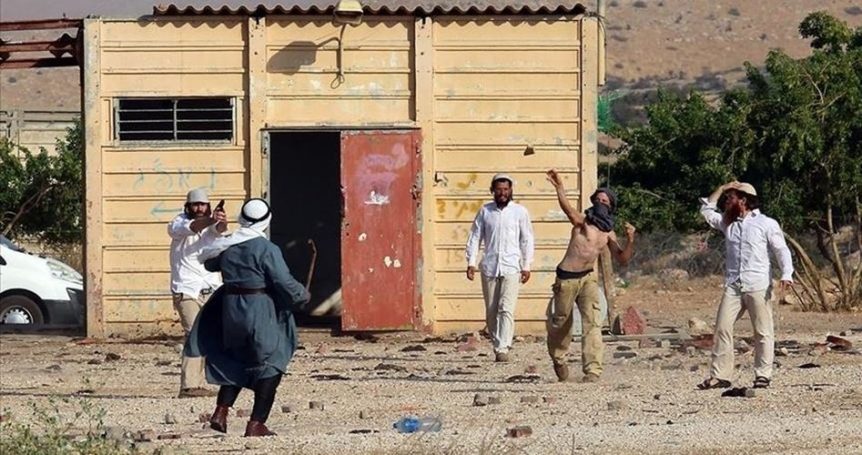
Settler opens fire at Palestinian citizens in Silwan
Palestine Information Center – October 13, 2022
NABLUS – Three agricultural structures and one car were destroyed on Wednesday when extremist Jewish settlers launched arson attacks in Qusra village, south of Nablus City, under military protection.
The Palestinian civil defense said on Thursday that a crew of its firefighters dealt with a number of blazes that were started by settlers in Qusra village.
The civil defense added that the fires destroyed three poultry farms and killed 30,000 chickens, pointing out that the settlers burned a vehicle near the farms.
It also said that its firefighters faced obstacles as they were heading for the area to tackle the fires.
Palestinian towns and villages in the southern countryside of Nablus, especially, Qusra, Jalud and Burin, are exposed to repeated attacks by Jewish settlers, who escalate their crimes during the olive harvest season.
Fatah rejects Algeria proposal for internal Palestinian reconciliation
MEMO | October 12, 2022
Before the start of Palestinian national meetings in Algiers yesterday, Fatah rejected an Algerian proposal for the internal Palestinian reconciliation, Quds Press reported yesterday.
“While the Palestinian Islamic Resistance Movement Hamas has accepted the Algerian proposal for the reconciliation with Fatah, the latter rejected the proposal and suggested two major changes,” an informed source told Quds Press.
The source added: “Fatah set a condition that Hamas must accept the International Quartet’s decisions and recognising that the Palestine Liberation Organisation (PLO) is the only representative of the Palestinian people.”
According to the source, Fatah wants Hamas to recognise the PLO without seeking to make any change to it.
For its part, Hamas told the Algerian mediator that “it completely rejects Fatah’s conditions,” stating that the Quartet, which was created in 2002 by the UN, US, UK and Russia, wanted Hamas to recognise the Israeli occupation of Palestine and give up legal resistance.”
Algerian President Abdelmadjid Tebboune is hosting a comprehensive Palestinian dialogue for the Palestinian factions, including Fatah and Hamas. Talks began yesterday and are due to resume today.
New York Times sacks Gaza journalist for expressing support for Palestinian resistance

MEMO | October 6, 2022
Palestinian photojournalist, Hosam Salem, has been fired by the New York Times for expressing support for Resistance against Israeli occupation. The Gaza- based journalist has been working as a freelancer for the American outlet since 2018, but was dismissed after a dossier compiled by a pro-Israel group, accusing Salem of anti-Semitism, was presented to the Times.
Since joining the Times, Salem has been covering critical events in Gaza, such as the weekly protests at the border fence with Israel. He carried out an investigation into the Israeli killing of field nurse Razan Al-Najjar and, more recently, the May 2021 Israeli offensive on the Gaza strip, which killed at least 254 Palestinians, including 66 children, 39 women and 17 elderly people.
Details of his dismissal were revealed by Salem himself on Twitter. He said that the decision to fire him was made based on a report prepared by a Dutch editor – who obtained Israeli citizenship two years ago – for a website called “Honest Reporting”. The anti-Palestinian group is a staunch supporter of Israel and is often accused of peddling false narratives in Western media about Israel’s human rights violations.
Salem said that the dossier used by the Times to dismiss him used examples of social media posts in which he expressed support for Palestinian Resistance against Israeli occupation. “My aforementioned posts also spoke of the resilience of my people and those who were killed by the Israeli army – my cousin included – which “Honest Reporting” described as ‘Palestinian terrorists,'” said Salem on Twitter.
Salem claims that the editor of the dossier later wrote an article stating that he had succeeded in sacking three Palestinian journalists working for the Times in the Gaza Strip, based on allegations of anti-Semitism.
“Not only has “Honest Reporting” succeeded in terminating my contract with The New York Times, it has also actively discouraged other international news agencies from collaborating with me and my two colleagues,” Salem continued, while warning of the silencing of Palestinian voices.
“What is taking place is a systematic effort to distort the image of Palestinian journalists as being incapable of trustworthiness and integrity, simply because we cover the human rights violations that the Palestinian people undergo on a daily basis at hands of the Israeli army.”
The EU prioritises the Abraham Accords
By Ramona Wadi | MEMO | October 4, 2022
At the UN General Assembly, Israeli Prime Minister, Yair Lapid, defined Israel’s security concerns as the motivating factor behind supporting the two-state paradigm, even as the US has been repeating that it does not envisage any resolution in the immediate future. With the Abraham Accords being the main driving force behind US-Israeli decisions, Lapid’s nod towards the failed international consensus holds no substance for the Palestinian people. In practice, Lapid’s words are no different from refuting the paradigm – the Israeli government’s colonial settlement expansion has determined the pace.
However, the EU’s Foreign Policy Chief, Josep Borrell, claimed encouragement at Lapid’s words. “This is also what we want to push for. We want the resumption of a political process that can lead to a two-state solution and a comprehensive regional peace,” Borrell stated at the EU-Israeli Association Council meeting on Monday.
The EU’s position statement regarding the meeting, however, indicates full agreement with the Abraham Accords, which are mentioned prior to the bloc’s adherence to the two-state compromise. Referencing the normalisation agreements, the EU’s statement partly reads, “In this regard, the EU will seek to encourage and build upon the recent establishment of diplomatic relations between Israel and a number of Arab countries, with a view to enhancing the prospects to reach a comprehensive settlement in the Middle East Peace Process.” Giving prominence to the Abraham Accords in this way suggests that the EU was not as averse to the Trump administration’s politics as it sought to portray. Only US President Joe Biden made it easier for the EU to retain its two-state diplomacy, while overtly agreeing to policies which were previously ridiculed only because the US had Donald Trump as President.
Since the US is actively engaging with Arab countries through the normalisation framework and trying to get the Palestinian Authority on board as well, the Abraham Accords have gained more recognition in international circles. The EU, however, is clearly stating that it will be using the agreements to “enhance” the possibility of a resolution, knowing full well that the agreements only serve to solidify Israel’s diplomatic ties and, in return, bolster its impunity.
In his virtual address to the meeting yesterday, Lapid’s commitment to the two-state paradigm included an assertion that Jerusalem would remain Israel’s undivided capital, which goes against international resolutions. However, Lapid’s best card was the Israeli government’s economic concessions to the PA, spoken of without the context of Israel knowing it is facing a gradually changing Palestinian society which will not wait upon its leadership to determine the way forward to legitimate resistance against colonialism.
The EU’s press release describing the meeting states the intent to “build upon the momentum generated at the UN General Assembly” in terms of the so-called peace process. Yet, Palestinians know that the veneer of concern was nothing more than a bid to deflect criticism from the fact that the EU chose, yet again, to engage with a colonial entity which specialises in breaking international law and committing war crimes. With the Abraham Accords subtly taking centre stage, and with full agreement on behalf of the EU, it should at least be made clear that no independence and no Palestinian State can be reached, unless a radical change in politics is implemented.
Truss declares herself a ‘huge Zionist’
Samizdat | October 4, 2022
British Prime Minister Liz Truss described herself as a “huge Zionist” and “huge supporter of Israel” during a meeting with with a pro-Israeli Tory parliamentary group on Sunday.
Truss was a guest of honor at the Conservative Friends of Israel (CFI) event during the annual Tory Party conference in Birmingham, which she was attending for the first time in her new capacity. Talking to a crowd on the sidelines of the event, she declared her unwavering commitment to the Israeli cause, according to footage of her remarks published on social media.
“As you know I am a huge Zionist, I am a huge supporter of Israel, and I know that we can take the UK-Israel relationship from strength to strength,” she told the cheering attendees.
The CFI itself focused on part of her speech, in which she referred to “threats from authoritarian regimes who don’t believe in freedom and democracy,” against which “two free democracies, the UK and Israel, need to stand shoulder to shoulder.”
Truss’ position on Israel is well known, and she promoted it during her campaign to become the new Conservative leader and prime minister. Among the policy changes that she pledged to effect in office was to review the relocation of her nation’s embassy from Tel Aviv to Jerusalem. Former US President Donald Trump did the same thing during his tenure in the White House.
The British PM made the same promise last month, during a meeting with her Israeli counterpart Yair Lapid on the sidelines of the UN General Assembly meeting in New York. Pro-Palestinian groups and the Palestinian leadership have condemned the idea.
The targeted killing of Palestinians is the next Israeli crime to be normalised

By Ramona Wadi | MEMO | October 3, 2022
For decades, the international community has sought to portray the occupied West Bank as being distinct from Gaza by focusing on the Palestinian Authority in terms of diplomacy, and showcasing Ramallah as an example of prosperity. Israel’s colonial violence in the occupied West Bank and the PA’s “sacred” security collaboration to oppress Palestinians don’t suit this narrative. Neither does it suit the PA’s financial backers to speak about how Palestinians in the West Bank and Jerusalem are also active in legitimate anti-colonial resistance, against both the PA and Israel.
The truth is that while Palestinians’ experiences in Gaza differ from those of Palestinians under the PA in the occupied West Bank, colonial violence is a reality across the occupied Palestinian territories and Israel has the power to implement measures that can make both on a par in terms of violence, because it enjoys unparalleled international impunity.
Despite the efforts by Israel and the PA, particularly given Washington’s insistence that the latter should be strengthened to avoid the possibility of Hamas gaining ground politically, the Palestinian people have reclaimed their anti-colonial struggle from the manipulation of political factions. The refugee camps in particular have displayed unity in resistance which has prompted Israel to approve the use of drones during raids by the Israeli military, thus making targeted killings of Palestinians another violation to which the international community will soon be turning a blind eye.
According to Israeli media reports, drones will now be used “not only as cover and intelligence for forces during operations but also to carry out strikes should armed gunmen be identified as posing imminent threats to their troops.” The targeted killings of Palestinians are thus the next Israeli crimes to be normalised.
Both Israel and the PA have attempted to write off Palestinian refugees as irrelevant. For Israel, refugees represent an absolute demographic alteration if their legitimate right of return is ever implemented. During the Trump administration, Israel sought to change the definition of who constitutes a Palestinian refugee to the point of their elimination altogether. The PA, on the other hand, has written off Palestinian refugees and the right of return as symbolic references in its rhetoric, while removing their relevance to the formation of a Palestinian state by diluting the already compromised right of return, and has no apparent issue at all with Zionist colonialism.
Palestinian anti-colonial struggle has been moving towards its roots, recognising the strength within communities on the ground and uniting with a common objective. The emergence of new brigades which are not affiliated to political factions is also evidence of the changes which Palestinians are now displaying. Mistrust of the PA, largely due to its security services carrying out purges within the occupied West Bank for the benefit of Israel and PA leader Mahmoud Abbas, have prompted Palestinians to reclaim not only their narrative, but also their political expression.
Extending not only the use of drones, but also the targeted killings of Palestinians, should prompt us all to questions about Israel and its accomplices, including the PA. Just months ago, an Israeli sniper murdered Palestinian American journalist Shireen Abu Akleh, who posed no threat to the Israeli army at the time of her killing. The absence of on the ground contact in Israel’s new page of aggression against the Palestinians will take targeted killings like that of Akleh to a new level. In the past, such killings made headlines due to the involvement of Israel’s domestic security agency, Shin Bet. The Israeli plan to normalise such violence within the occupied Palestinian territories using the latest technology is upping the ante against Palestinian refugees, while extending the boundaries of what constitutes normalised and acceptable violence, as long as Palestinians are the victims.
We have to ask both the PA and the international community why they continue to speak of a “two-state solution” even while Israel is seeking to make the killing of Palestinians even easier. Why are they not talking about protecting Palestinians from, and their right to resist, Israel’s brutal military occupation?
WAFA documents 26 Israeli violations against Palestinian journalists and media in September
WAFA – October 1, 2022
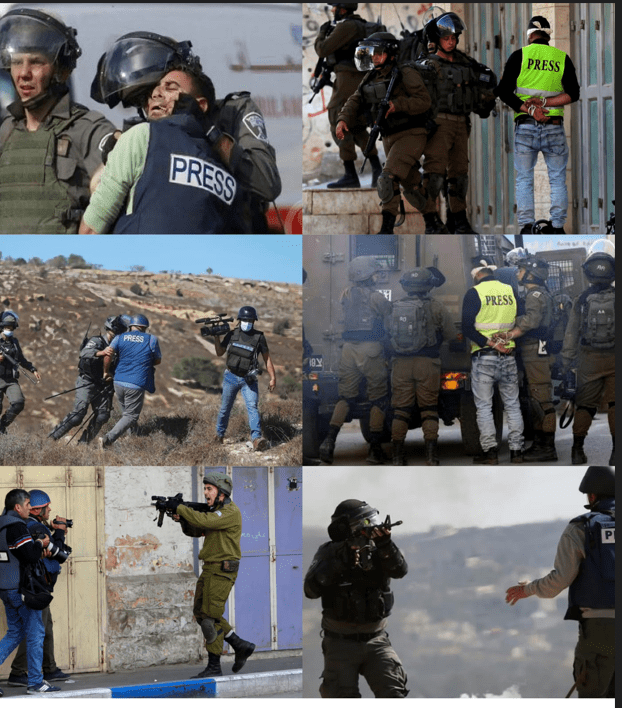
RAMALLAH – The Palestinian News and Information Agency, WAFA, documented 26 Israeli violations against Palestinian journalists and media in the occupied territories during September.
It said in its monthly report on Israeli violations against journalists and media outlets published today that the Israeli occupation forces continued to deliberately target Palestinian journalists with an aim to limit their coverage of the Israeli army practices and violations against the defenseless Palestinian citizens.
The report said 11 journalists were hurt in September from rubber-coated metal bullets and tear gas canisters fired by soldiers, as well as severe beatings and other attacks.
In addition, 13 cases were recorded in which soldiers detained, seized press cards or opened fire at journalists without causing injury, while two cases were documented in which soldiers damaged press equipment and attacked media outlets.
Whose side is the PA on?
By Ramzy Baroud | MEMO | September 27, 2022
The arrest of a couple of prominent Palestinian activists, one of whom was Musab Shtayyeh, by Palestinian Authority police on 20 September was not the first time that the notorious Preventive Security Service (PSS) has arrested someone who is wanted by Israel. The PSS is largely linked to the routine arrest and torture of Palestinians who are active against the Israeli occupation.
Several Palestinians have died as a result of PSS violence, the latest being Nizar Banat who was tortured to death on 24 June last year. The killing of Banat ignited a popular revolt against the PA across occupied Palestine.
For years, various Palestinian and international human rights groups have criticised the PA’s violence against dissenting Palestinian voices, quite often within the same human rights reports critical of Israel’s military occupation of Palestine. The de facto Hamas government in Gaza also has to take its fair share of blame in terms of violence against dissenters.
In its January 2022 World Report, Human Rights Watch said that, “The Palestinian Authority (PA) manages affairs in parts of the West Bank, where it systematically arrests arbitrarily and tortures dissidents.” This was neither the first nor the last time that a human rights group has made such an accusation.
The link between Israeli and Palestinian violence targeting political dissidents and activists is equally clear to most Palestinians, even though some may at one point have believed that the PA’s role is to serve as a transition between their national liberation project and full independence and sovereignty on the ground. Nearly thirty years after the formation of the PA, though, such a notion has proved to be wishful thinking. Not only has the PA failed to usher in the coveted independent State of Palestine, but it has also morphed into a massively corrupt institution whose existence more or less serves the interests of a small class of Palestinian politicians and business people; in Palestine, they are largely one and the same group.
PA corruption and violence aside, what continues to irk most Palestinians is that the authority, with time, has become another manifestation of the Israeli occupation, curtailing Palestinian freedom of expression and carrying out arrests on behalf of the occupation security services. Sadly, many of those arrested by the Israeli military in the West Bank have experienced arrest by PA goons as well.
Riots in Nablus following Shtayyeh’s arrest were reminiscent of the riots against Israeli occupation forces in the northern West Bank city and elsewhere in occupied Palestine. Unlike previous confrontations between Palestinians and PA police — following the killing of Banat, for example — this time the violence was widespread, and involved protesters from all Palestinian political groups, including the ruling Fatah faction.
Perhaps unaware of the massive collective psychological shift that has taken place in Palestine in recent years, the PA was desperate to contain the violence. Subsequently, a committee that represents united Palestinian factions in Nablus declared on 21 September that it had agreed a “truce” with PA security forces in the city. The committee, which includes prominent Palestinian figures, told Associated Press and other media that the agreement restricts any future arrests of Palestinians in Nablus to the condition that the individual must be implicated in breaking Palestinian, not Israeli, law. That provision alone implies a tacit admission by the PA that the arrest of Shtayyeh and Ameed Tbaileh was motivated by an Israeli, not a Palestinian agenda.
But why would the PA bow down so quickly to pressure from ordinary Palestinians on the street? The answer lies in the changing political mood in Palestine.
In considering this matter it must be stated that resentment of the PA has been brewing for years. One opinion poll after another has indicated the low regard that most Palestinians have of their leadership, of PA President Mahmoud Abbas and particularly of the PA’s “security coordination” with Israel.
Moreover, the torture and death of political dissident Banat last year erased whatever patience Palestinians had with regard to the leadership. Banat’s death demonstrated that the PA is not an ally of the people, but a threat to the people.
It also has to be said that the Unity Intifada of May 2021 has emboldened many segments of society across occupied Palestine. For the first time in years, Palestinians have felt united around a single slogan and are no longer hostage to the geography of politics and factions. A new generation of young Palestinians has advanced the conversation beyond Abbas, the PA and their endless and ineffectual political rhetoric.
Finally, armed struggle in the West Bank has been growing so rapidly that the Israeli army Chief of Staff, Aviv Kochavi, claimed on 6 September that since March, around 1,500 Palestinians have been arrested in the West Bank and that, allegedly, hundreds of attacks against the Israeli military have been thwarted.
In fact, evidence of an armed intifada is growing in the Jenin and Nablus regions. What is particularly interesting, and alarming from the Israeli and PA viewpoint, about the nature of the budding armed struggle, is that it is largely led by the military wing of the ruling Fatah party, in direct cooperation with Hamas and other Islamic and national military wings.
For example, on 9 August, the Israeli army assassinated Ibrahim Al-Nabulsi, a prominent Fatah military commander, along with two others. Not only did the PA do little to stop the Israeli military machine from conducting more such assassinations, but six weeks later it also arrested Shtayyeh, a close comrade of Nabulsi.
Interestingly, Shtayyeh is not a member of Fatah, but a commander within the Hamas military wing, Al-Qassam Brigades. Although Fatah and Hamas are meant to be intense political rivals, their political tussle seems to be of no relevance to military groups in the West Bank.
Unfortunately, more violence is likely to follow because Israel is determined to crush any armed intifada in the West Bank before it spreads across the occupied territories; there is a leadership transition looming within the PA due to Abbas’s old age; and unity is growing among Palestinians around the issue of resistance.
While the Israeli response to all of this can easily be gleaned from its legacy of violence, the PA’s future course of action will likely determine its relationship with Israel and its western supporters on the one hand, and with the Palestinian people on the other. The question has to be asked: whose side is the PA on?
Featured Video

Dan Dicks with James Corbett on Solutions Watch
or go to
Aletho News Archives – Video-Images
From the Archives
MMR (Measles, Mumps and Rubella) – Vaccine Risk Statement
MMR Vaccine (Measles, Mumps, and Rubella) Is It Safer Than Measles, Mumps and Rubella?
Physicians for Informed Consent | December 2024
… It has not been proven that the MMR vaccine is safer than measles, mumps, and rubella. The vaccine package insert raises questions about safety testing for cancer, genetic mutations, and impaired fertility. Although VAERS tracks some adverse events, it is too inaccurate to measure against the risk of measles, mumps, and rubella. Clinical trials do not have the ability to detect less common adverse reactions, and epidemiological studies are limited by the effects of chance and possible confounders. Safety studies of the MMR vaccine are particularly lacking in statistical power. A review of more than 60 MMR vaccine studies conducted for the Cochrane Library states, “The design and reporting of safety outcomes in MMR vaccine studies, both pre- and post-marketing, are largely inadequate.”19 Because permanent sequelae (aftereffects) from measles, mumps, and rubella are so rare (especially in children with normal levels of vitamin A and infected after birth),6,15-17 the level of accuracy of the research studies available is insufficient to rule out the possibility that the MMR vaccine causes greater death or permanent disability than measles, mumps, and rubella. – Read full article
Blog Roll
 Aletho News
- Moscow issues warning to NATO over Russian exclave
- Yes, the Iran war has destroyed Trump’s presidency
- The fallacy of US delusions about Iran’s economic collapse
- Hezbollah denies Syria cell link, warns of Israeli plan to sow discord
- The legacy of US sanctions, war, and occupation in Iraq
- Iraqi resistance group rejects disarmament, vows to maintain support for Lebanon
- Sheikh al-Asadi warns of Iraqi government compliance with US demands
- How to MAKE THE CONSPIRATORS PAY for their crimes! Dan Dicks with James Corbett on Solutions Watch
- There’s a drought in academia: A drought in honest research on the subject of drought and other weather extremes
- Department of War Awards $20.7 Billion Contract to Raytheon for Air-to-Air Missiles
- If Americans Knew
- Iran’s Revolutionary Guards Publish Letter to the American People
- DMFI launches $1 million ad campaign supporting Virginia’s Elaine Luria
- US Senate blocks resolution seeking report on Americans killed by Israel
- Israeli Attacks Kill Ten Palestinians in Gaza
- Massacre at Minab: The School That Became a Grave
- Israeli media: The IDF Shows It Doesn’t Turn a Blind Eye; It Actively Emboldens Settler Havoc
- As settlers ravage West Bank, Israeli forces kill 10 in Gaza – Daily Update
- New Report: “Scholasticide and Genocide in Gaza: Assessment, Testimonies and Legal Analysis”
- Ex-Biden officials are desperate for a Gaza scapegoat
- Israeli “settlers” Invade Al-Aqsa; Pour Boiling Water on 75-Year-Old
- No Tricks Zone
- Green Energy Debacle: German Expert Professor Fritz Vahrenholt Warns Of Severe Economic And Social Consequences
- Two More Paleo Reconstructions Affirm Meters-Higher Sea Levels Across Ireland, Brazil 7000-6000 Years Ago
- New Study: Earth And Venus Surface Warmth Largely Explained By Convection And Lapse Rate, Not CO2 Or Radiation
- 2025 Nature Paper Claiming Worsening Global Drought Gets RETRACTED …Heavily Flawed
- New Study: ‘Global Drought Shows No Detectable Recent Acceleration Under Climate Warming’
- Economic Masterminds: German Socialists Suggest Taxing Productivity Gains Stemming From Using AI
- The South China Sea Has Not Been Cooperating With The Climate Change Narrative
- Energy Crisis: Germany Enters Heating Season With Historically Low Gas Reserve Fill Levels
- New Study: The Antarctic Ice Sheet Gained Mass From 2020-2024 Due To Staggering Snow And Ice Accumulation
- Study: Ocean Heating Rates From Thousands Of Years Ago ‘Dwarf’ Modern Ocean Heating Rates

