Israel to get another billion dollars – Time for an Iron Dome for Palestinians
By Alison Weir | Israel-Palestine News | September 24, 2021
The House of Representatives just voted 420-9 in favor of a fast-tracked bill (H.R. 5323) to give Israel an additional $1 billion dollars. The bill is now in the Senate (S.2839), where it is expected to be passed with little or no dissent.
In other words, once again, the vast majority of U.S. politicians from both parties obeyed Israel’s demand that American taxpayers give Israel their hard-earned tax dollars. Keep in mind that this $1 billion is over and above the $3.8 billion – $10.5 million per day – in military aid Israel currently receives from the U.S. Plus, our reps plan to expend an additional $3 billion on behalf of Israel.
This is on top of decades of receiving more U.S. tax money than any other country on earth. On average, Israelis have received 7,000 times more aid from the U.S. per capita than others around the world.
In voting for this latest billion dollars to Israel, members of the Israel lobby were elated at this demonstration of their power. Other Congress people explained that they were supporting the bill because it would ‘save civilian lives’ in Israel. Speaker of the House Nancy Pelosi, for example, said that Iron Dome has “saved thousands of lives.”
Pelosi and the other 408 politicians who voted for the bill didn’t explain why Israel’s numerous billionaires and millionaires shouldn’t pay for this system themselves.
More important, our politicians failed to note that the population whose civilians have been killed in vastly larger numbers are actually Palestinians, including multitudes of children.
The bill that our politicians voted for states that the billion dollars “shall be provided to address emergent requirements in support of Operation Guardian of the Walls.”
The bill leaves out the fact that during this operation Israeli forces killed 260 Gazans, 66 of them children (Palestinian resistance groups killed a total of 13 people in Israel).
The bill also fails to mention that the Israeli operation damaged 52,000 Palestinian homes, totally destroying 2,400 of them, and displaced 120,000 Palestinian men, women, and children. Human Rights Watch and Amnesty International both reported that Israel committed war crimes.
Amnesty stated: “There is a horrific pattern emerging of Israel launching airstrikes in Gaza targeting residential buildings and family homes – in some cases entire families were buried beneath the rubble when the building they lived in collapsed.”
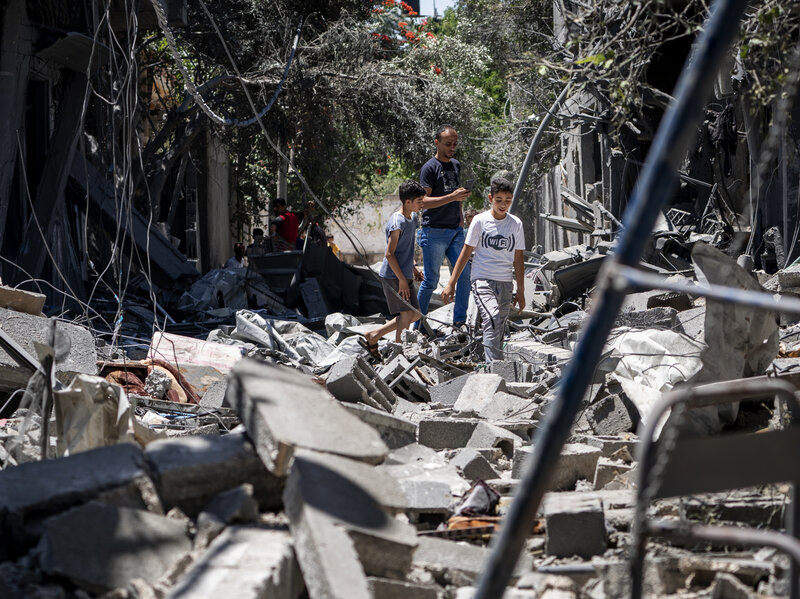
Gazan children walk among the rubble of a building destroyed by an airstrike, May 24, 2021, in the Gaza Strip. (John Minchillo, AP )
And this is typical. Previous “wars” between Israel and Gazans (the large majority of whom are from families that were ethnically cleansed by Israel) have been just as one-sided. Over the years, Israeli airstrikes have killed approximately 4,000 Gazans, while Palestinian rockets have killed a total of 49 people in Israel.
In other words, Iron Dome actually costs lives – It allows Israel to attack and oppress Palestinians time after time, without being constrained by concern that such attacks could lead to retaliation that would endanger Israeli citizens.
It is clear that civilians in Gaza are in desperate need of protection.
Therefore, I suggest that our Congressional representatives who say they are so deeply concerned about civilian deaths now support an Iron Dome-like system for Palestinians.
If any of our Congress members truly care about all human beings, regardless of race, religion, ethnicity, or nationality, they will immediately introduce such a bill.
Anyone who agrees with this can use the form below to contact their Congress members and ask them to introduce such life-saving legislation.
The PA keeps losing its authority, through its own actions
By Ramona Wadi | MEMO | September 24, 2021
Recent statistics corroborate the growing resentment in the occupied Palestinian territories against the Palestinian Authority and its leader Mahmoud Abbas. The Palestinian Centre for Policy and Survey Research (PSR) carried out a poll at a time when the PA persisted in proving how unsynchronised it is with the Palestinian people’s needs, and to what lengths it would go to ensure its political survival over Palestinian liberation.
Against the backdrop of the latest Israeli aggression on Gaza, the extrajudicial killing of Palestinian activist Nizar Banat by the PA’s security services, as well as the PA’s repression of protests calling for justice for Banat, the PA fared badly, to the point that an unprecedented 80 per cent of Palestinians are now demanding Abbas’ resignation. Indeed, the PA would do well to heed the survey’s findings, because its reliance on Israel and security coordination to keep Palestinians under control might not be so effective, when considering Palestinian unification from the people’s perspective.
While Abbas is clearly failing to inspire Palestinians, as seen in the increasing calls for his resignation, 87 per cent of Palestinians stated that the escape of the six Palestinian prisoners from Gilboa served “as an inspiration to Palestinians outside the prison to take the initiative and actively work toward the ending of occupation.” Abbas has also fared badly in terms of the Israeli bombardment of Gaza when compared to Hamas – 45 per cent of Palestinians believe that Hamas would better represent the Palestinians people, while only 19 per cent advocated for Fatah under the leadership of Abbas.
For decades, security coordination has provided safety for Abbas with regard to his political leadership and the purported state-building funded by the international community. Diplomatically, security coordination was considered an integral component of state-building, so much so that it overrode the Palestinian people’s legitimate concerns and fears of repression.
If the PA wished for its violent tactics to cement silence among Palestinians, Banat’s murder heralded the opposite. The survey shows that 63 per cent of the Palestinian public believe that the PA or security leaders ordered his extrajudicial killing deliberately. Likewise, 63 per cent supported the demonstrations demanding Abbas’ resignation, while 69 per cent are not satisfied with the steps taken by the PA in terms of seeking justice for Banat’s murder. And if the PA expected that violence would suppress dissent, 74 per cent of Palestinians “believe the steps taken by the PA security services in arresting the demonstrators who demanded justice for Banat is a violation of liberties and human rights.”
A dire picture has been painted for the PA. Not only have the Palestinian people expressed their beliefs in the survey – their demands are being publicly articulated. There is no turning back for the Palestinian people – Abbas and the PA proved themselves unworthy of leadership not only by clinging to illegitimate rule, but also through the “sacred” security coordination. The only option remaining is to turn to the people, and Abbas will soon realise that even turning to the people will not suffice, because Palestinians are no longer waiting for the leadership to spell out their political demands.
Poll: 80% of Palestinians call for Palestinian President Mahmoud Abbas to resign
MEMO | September 22, 2021
A recent poll found that about 80 per cent of Palestinians want Palestinian Authority (PA) President Mahmoud Abbas to resign, Quds Press reported yesterday.
The poll was conducted by Khalil Shikaki, who runs the Palestinian Center for Survey and Policy Research in the West Bank city of Ramallah.
According to Shikaki, 1,270 Palestinian adults were interviewed for the survey across the occupied West Bank and besieged Gaza Strip between 15-18 September.
“This is the highest number we have seen calling for Abbas’ resignation since Abbas’ election in 2005,” Shikaki told the media.
“If presidential and parliamentary elections were held today,” Shikaki said, “Hamas will win against Fatah if Abbas was Fatah’s choice, but if Fatah nominated Marwan Al Barghouti, it will win.”
A large majority of the Palestinians, the poll found, believe that Hamas deserves to represent the Palestinians, while Fatah, the PA and PA security services have lost people’s confidence.
Meanwhile, most of the Palestinians want Hamas to launch rockets at Israel if it expels Palestinian families from Sheikh Jarrah and puts restrictions on accessing Al-Aqsa Mosque.
The poll found that the Palestinians have confidence in Hamas’ pledges to free Palestinian prisoners from Israeli jails, but they do not believe Fatah and the PA’s promises to do so.
Two-thirds of the Palestinians saw that Hamas fought the last war with Israel in defence of the residents of Jerusalem and Al-Aqsa Mosque.
‘Israel and the Zionist enterprise were born in sin’, says heir to an iconic Zionist family
![Yaakov Sharett [Youtube]](https://i1.wp.com/www.middleeastmonitor.com/wp-content/uploads/2021/09/Yaakov-Sharett.png?resize=1200%2C800&quality=85&strip=all&zoom=1&ssl=1)
Yaakov Sharett
MEMO | September 20, 2021
In a remarkable political conversion, Yaakov Sharett, the heir to an iconic Zionist family and son of Israel’s second Prime Minister, Moshe Sharett, has turned his back on the founding ideology of the occupation state.
“The State of Israel and the Zionist enterprise were born in sin,” said Sharett in an interview with Haaretz. The 95-year-old spoke at length about his journey from a faithful servant of Zionism in the state of Israel to one of its harshest critics.
Sharett was born in 1927 and is said to belong to a well-connected family from the cream of the Yishuv, the Jewish community in Palestine. His father was Israel’s first foreign minister and one of the country’s leaders who signed the Declaration of Independence in 1948. Sharett also dutifully served Israel as a member of the Shin Bet, the country’s security agency, and helped Soviet Jews flee to Israel.
Ending his days in Tel Aviv as an anti-Zionist, Sharett predicts dark days for the country he spent nearly his entire life serving. “This original sin pursues and will pursue us and hang over us,” said Sharett referring to the ethnic cleansing of Palestine prior to Israel’s creation in 1948. More than half of the indigenous community were expelled in an attempt to artificially construct a Jewish majority.
Sharett recollected the history of Zionism and its rise within Jewish communities. He argued that the moment Zionism called for the Jews to immigrate to Israel, in order to establish an ethno-nationalist state, a conflict was created. “I see in this whole transformation of the majority [Arab] to a minority and the minority [Jewish] into a majority as immoral,” explained Sharett.
“Have you seen anywhere in the world where the majority would agree to give in to a foreign invader, who says, ‘our forefathers were here,’ and demands to enter the land and take control?” Sharett rhetorically asked. “The conflict was inherent and Zionism denied this, ignored it… as the proportion of Jews to Arabs changed in favor of the Jews, the Arabs realized that they were losing the majority. Who would agree to such a thing?”
Lamenting his continued presence in Israel he said that he sees himself as a “a collaborator” against his will.
I’m a forced collaborator with a criminal country. I’m here, I have nowhere to go. Because of my age, I can’t go anywhere. And that bothers me. Every day. This recognition won’t leave me. The recognition that in the end, Israel is a country occupying and abusing another people.
Sharett also railed against Israel’s turn towards religious fundamentalism and ultra-nationalism. “When I see the prime minister with a kipah on his head, I don’t feel good,” he added. “This is not the Israel I want to see. How did it happen that this new place, that was to have brought innovations, became the blackest place, controlled by the nationalist ultra-Orthodox? How is it that here of all places, there’s reactionism and zealotry, messianism, the desire to expand and control another people?”
Hamas calls for revoking Abraham accords with occupation state
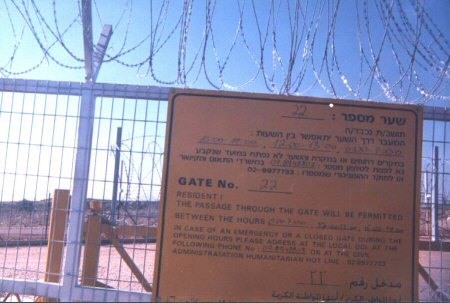
Palestine Information Center – September 19, 2021
GAZA – The Hamas Movement has called for renouncing the shameful Abraham accords and ending all forms of normalized relations with the Israeli occupation state, urging the Muslim and Arab nations to restore their role in defending Palestine.
In a press release on Saturday, Hamas stressed the need “to swiftly correct such wrong political trajectory and respond to the aspirations of the peoples in the region who reject any sort of normalization with the occupation state.”
“The so-called Abraham accords are a Zio-American project par excellence, aimed at establishing regional openness and normalization with the Zionist entity, integrating it into the region and forging alliances with it to shift the conflict priorities, instead of being with the Zionist entity that is occupying Palestine and considered the greatest danger to the region,” the Movement said.
“The US administration and the Zionist entity are working on deceiving our nations and anesthetizing their awareness through an intensive marketing and promotion campaign for the Abraham accords that have been brokered with rogue regimes working against the region’s history, present and future,” it added.
“Those accords are aimed at consolidating and achieving the Zionist hegemony over the region militarily, politically and economically, plundering its wealth, marginalizing the Palestinian cause and isolating our Palestinian people from its Arab and Islamic surrounding and depth,” the Movement underscored.
On September 15, 2020, the United Arab Emirates and Bahrain officially signed normalization deals (Abraham accords) with the occupation state under the auspices of the previous US administration. Sudan and Morocco followed suit soon later.
Reflections on the 39th anniversary of the Sabra and Shatila massacre

Memorial posters in the Sabra and Shatila massacre graveyard [Ferdous Al-Audhali/Middle East Monitor]
Dr Swee Chai Ang | MEMO | September 18, 2021
The steadfastness and courage of Sabra and Shatila are in all of our hearts. Today, we commemorate the cruel injustice inflicted on the Palestinians in the massacre of 1982, knowing that this is just one of the continuous assaults on Palestinians since 1948. We resolve to continue to be with you all in your difficult journey in solidarity, hope and love, knowing that one day, the freedom and peace stolen from the Palestinian people for all these years will be won back through your struggle. We commemorate with tears, but pledge our commitment to this struggle with all our strength and lives. We know that the day will come when our children’s laughter will be the reward of years of sacrifice and endurance.
In June 1982, Israel invaded Lebanon. It bombed Lebanon by land, air and sea, and laid siege to Beirut. Israel killed and wounded thousands of innocent people and made at least 100,000 homeless within a few weeks. Beirut city was denied electricity, medicine, food and water.
I resigned from my job at a hospital in London to help the victims in Lebanon. At that time, my sympathies were with Israel, and I had not known that Palestinians existed. But I could no longer stand by and watch the wounding and killings of women, children and unarmed civilians – or watch them being made homeless as the bombs continuously fell on Lebanon.
I arrived in Beirut in August 1982, and was seconded to Gaza Hospital in Sabra and Shatila Palestinian refugee camp in Beirut. It was one of nine hospitals and 13 clinics of the Palestine Red Crescent Society and the only one that was not flattened by the bombs.
The people of Sabra and Shatila told me about their suffering ever since they were driven out of Palestine to become refugees in 1948. Many of the residents of Sabra and Shatila were third and fourth-time refugees being driven from camp to camp when their families were killed and homes destroyed by Israeli planes. That was the first time I heard about their terrible suffering. That was also the first time I met Palestinians.
After resisting the continuous bombardment for ten weeks, the Palestine Liberation Organisation (PLO) evacuated in exchange for peace. The US promised that it would protect the 300,000 Palestinian refugees left behind in Lebanon. They were encouraged to return from the shelters to the refugee camps to rebuild their homes and lives. But this did not happen.
Three weeks later, on 15 September, 1982, Israeli tanks were allowed to overrun Beirut. A large number surrounded and sealed Sabra and Shatila refugee camp so that no one could leave nor enter the camp.
Sniping started once the camp was sealed. Initially, the wounded and dead brought into the hospital were mainly women gathering water and food for their families. By the afternoon of the next day, men, women, children and babies were shot in their homes. Many were brought in dead and filled the mortuary.
More than 2,000 frightened people fled into our hospital with stories that the Haddads, Kataebs and Israelis were killing defenceless families in the camp. They feared for their lives.
They could not escape, and no one protected them.
The hospital ran out of blood, medication and food. Our medical and surgical team worked non-stop. I wanted the nurses to give the last packet of blood to a wounded mother, but she pleaded for it to be given to her child, and she died shortly afterwards.
At night, the skies of Sabra and Shatila were lit with Israeli military flares. We heard explosions and machine gun noises throughout, and the wounded continued to be brought into Gaza Hospital.
It was especially painful to operate on a little boy who was shot along with 27 members of his family. As the bodies fell on him, he passed out and was mistaken for dead by the murderers. When he awoke, he was in great pain. Years later, he told of how he heard women being rounded up and raped. His physical wounds may have healed, but his emotional scars are still with him today. It took my American colleagues four years to get him out of living in the house where his family was murdered. He was not the only child who suffered in this way.
At dawn on 18 September, 1982, soldiers with machine guns forced the entire international medical volunteer team out of the hospital.
When we were marched into Rue Sabra, we saw groups of old men, women and children rounded up by militia. A frightened, desperate young mother tried to give me her baby, but was forced to take it back. She begged them to spare her baby. They were all subsequently executed, including the mother and baby.
There were dead bodies piled up in the camp alleys and bulldozers destroying camp homes. We had struggled for 72 hours non-stop without food and sleep to save dozens of lives. But within the same 72 hours, at least 3,000 were killed.
I was 33 years old then. I grew up a Zionist Christian and never knew Palestinians existed until I stepped foot in Sabra and Shatila. I knew then that it was my human responsibility never to walk away from this horrendous injustice. I also realised that I must speak up on behalf of the victims. The dead could not speak up, and the survivors needed my voice.
After testifying to five Commissions of Inquiry on Sabra and Shatila, including travelling to Israel with Ellen Siegel to give evidence to the Israeli Kahan Commission of Inquiry into the conduct of the Israeli Army in Sabra and Shatila, I returned to the UK. The Palestinians in Lebanon continued to be destitute, homeless and hungry. Justice seemed not to be in sight. The situation was dire for them, and indeed, they continued to suffer and become more desperate. Children were born and grew up in the long, dark shadow of the massacre, and there was no hope of returning to Palestine. Could we make their lives just a little bit easier?
Medical Aid for Palestinians (MAP) was founded in the aftermath of the Sabra and Shatila massacre, under those circumstances. We wanted to support the Palestinians in any small way that we could. The founders of MAP formed the organisation so that the horrors of the massacre could be turned into a bridge – a positive channel of friendship and solidarity between people in the UK and the Palestinians – not only in Lebanon, but also in the Occupied Palestinian Territories, and in the diaspora.
Since then, MAP has not only worked with the Palestinians in Lebanon, but also in Gaza and the West Bank. The existence of MAP is also our way to let them know we will never forsake or forget them. What MAP is doing is minuscule, a drop in the ocean, but we are part of the tide moving towards justice for the Palestinians.
As for me, I count myself privileged and honoured to be able to journey alongside the Palestinians, to be accepted as their family. Whether in Shatila, in Gaza, onboard the Freedom Flotilla Al-Awda to Gaza, in Israeli prison or being deported, I want my life to be an acceptable tribute to the Palestinians. They welcomed me into their broken lives and homes and made me one of their own, offering me Arabic coffee in the midst of the rubble they call home. For this, I will thank God every day of my life, until death do us part.
Lebanon House Speaker: Israeli exploration in controversial maritime zone blasts UN-sponsored Framework Agreement
Al-Manar | September 18, 2021
In a statement issued today, House Speaker Nabih Berri called on the Ministry of Foreign Affairs to take “urgent and immediate action in the direction of the UN Security Council and the international community to verify the possibility of a new Israeli attack on Lebanese sovereignty and rights,” following reports received about the “Halliburton” company winning the contract to explore for oil and gas in the disputed area between Lebanon and occupied Palestine.
Berri stressed that “the Israeli entity’s undertaking commissions and concluding offshore exploration contracts for Halliburton or other companies in the disputed area at sea represents a violation, or even a blow to the framework agreement sponsored by the United States of America and the United Nations.”
He also considered that “the reluctance and procrastination of the alliance of Total Novatek and Eni companies in starting the drilling operations, which were supposed to begin several months ago in Block No. 9 of the Lebanese side of the maritime borders, raises major questions.”
“The Israeli entity’s persistence in its aggression represents a threat to international peace and security,” Berri emphasized.
Israel soldiers break Palestinian physician’s arm
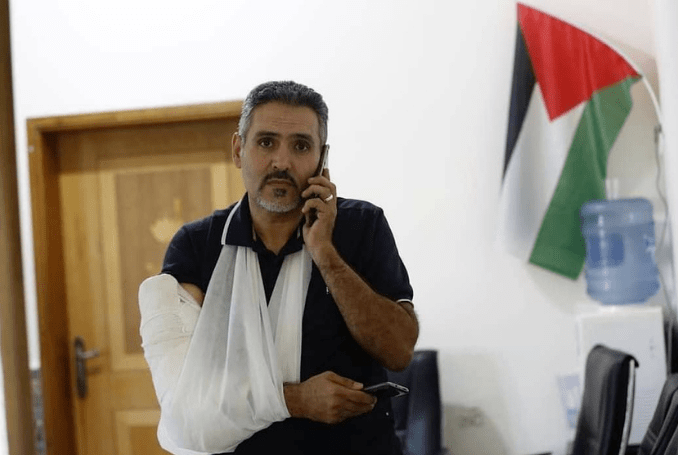
Israeli soldiers broke Nidal Arda’s arm following his detention. (Photo: via Social Media)
MEMO | September 17, 2021
Israeli soldiers assaulted a 46-year-old Palestinian physician from the town of Arraba southwest of Jenin following his detention last week and broke his arm.
According to the Wafa news agency, Nidal Arda found Israeli occupation forces in army jeeps surrounding his home after he returned from the mosque following dawn prayers.
“They were waiting at my house and apparently wanted to ambush me. The jeeps turned their lights on in my direction and then ordered me to come out of the car,” he said.
There were around 40 soldiers accompanied with dogs, he said, who had broken into and raided his house before he got there.
“The soldiers destroyed my house,” he explained. “They broke the doors and windows and ransacked the entire house. They terrorised my family and children, who were separated from their mother and put in another room.”
Nidal was interrogated about the Palestinian escapees from Israel’s Gilboa Prison as two members were from Arraba.
“They threatened me with my son and said they would not allow him to travel to finish his higher education abroad if I do not cooperate with them,” he said.
He was blindfolded and forced into a jeep with other members of the family and neighbourhood and taken away to a military base.
“We were blindfolded and handcuffed,” he said. “One soldier pushed me and I fell to the ground. My right arm hit something and I felt great pain. I knew it was broken since I am a doctor,” he added.
The soldiers then removed his handcuffs and only left him with sedatives to ease the pain, before taking him to a detention centre.
Due to the noticeable pain, he was taken to a nearby hospital where doctors confirmed he had a broken bone and placed it in a cast. He was then forced back to the detention centre and interrogated about the Palestinian escapees.
A military court ordered his release a week later, reported Wafa. The two Palestinians from Arraba who escaped from prison were caught by the Israeli army before his release.
Israel launched its largest-ever manhunt in the bid to recapture the six men, whose escape was a huge embarrassment for the occupation state.
The Escape and Capture of Zakaria Zubeidi

By Israel Shamir | Unz Review | September 16, 2021
Heroes are rare; they are tragic and inspiring at the same time. Such a real-life hero is Zakaria Zubeidi, 45, from Jenin in Palestine. A man of brawn and brain, of sword and harp, he was an al Aqsa Brigade commander as well as the director of the Freedom Theatre. Years ago, the Sunday Times called him ‘one of Israel’s most wanted and implacable enemies’. A cat of nine lives, he survived many Israeli assassination attempts; he had been in and out of jail many times; he got his first Israeli bullet at 13; his film premiere at 14.
A few days ago, he staged an audacious escape from Israel’s high security prison, together with five other convicts. They dug a 20 yard-long tunnel with their spoons, just like the Count of Monte Cristo, and emerged outside the walls, squeezing through a narrow communication channel. This brave, nay impossible feat encouraged the captive Palestinians and gave them a second wind when they were exhausted and desperate. The people in the Holy Land and the large Palestinian diaspora held its collective breath following their escape and prayed for them to reach safety.

It is normal for humans to empathise with fugitives, rather than pursuers. Young readers of Uncle Tom’s Cabin thus followed the plight of Eliza, child in tow, crossing the frozen Ohio River from bondage to freedom, escaping the murderous dogs and slave catchers. Alas, Zakaria never reached the safe shore. In the Dixie of the 1830s, there were courageous and noble white people who harboured the runaway black slaves. Germans and Russians, Poles and Frenchmen provided refuge for the Jews that escaped from the camps. In Israel 2021, not a single Jew offered the fugitives water and food nor helped a Palestinian runaway; everyone who saw them immediately informed police, said the authorities. In a few days, four starved prisoners were hunted down, beaten up and taken back to jail; two are still at large.
I saw on Israeli TV news four shackled prisoners in the court. Zakaria had been badly beaten. His capturers broke his ribs and jaw, while he was already handcuffed. His face was grim and stern like that of a suffering Christ before the crooked court of Synedrion. It was a sad sight, the return of the hero to the dark dungeons of the Jewish state. But then, he was born and brought up under the occupation. His story is the story of the cheated generation that came to the fore after the great betrayal.
In 1993, the State of Israel and the PLO signed the Oslo accords; this agreement certified by handshake on the White House lawn promised Palestinians full independence after five years of transition. The Jews reneged on the deal. While individual Jews can be honest and honourable; as a collective they are extremely untrustworthy. It comes from a Jewish superiority complex, of a refusal to obey the rules established for lesser species; of feeling they can do whatever they find expedient. Fair play is not a Jewish idea at all.
The Palestinians, swindled by Israel, had nobody to turn to; they responded by initiating the Second Intifada, the rising taking place in 2000. It was the pivotal event for Zakaria’s generation; for me, too. I was radicalised by the Intifada, by the dishonesty and cruelty of the Jewish state and by the courage of Palestinian resisters. In 2001, I began writing in English to an international audience; next year, in 2002, I entered the church, parting with Jewry.
The Jews became radicalised, too: The support of US Jewry for the 9/11 narrative and for the War on Terror can’t be understood outside of this context: the Oslo accords, reneging on Oslo, the Intifada and 9/11 are links of one chain. Before 9/11, Jews were condemned for reneging on Oslo and for the bloody suppression of the Intifada. After 9/11 they could smash the Palestinians with all their might. For young men like Zakaria even survival was problematic.
Zakaria deserves a Plutarch to write up his life, but I’ll do what I can, until a Plutarch comes along. Zakaria was born and grew up in the Jenin Refugee Camp, a place where the expelled Palestinians from Haifa’s Carmel were corralled in 1948 by the victorious Jews. His father was an English language teacher; he died rather young, leaving his widow and their eight children to survive.
Zakaria was 11, when the First Intifada began. It was a spontaneous protest, caused by the enclosure of common Palestinian lands and their transfer to Jewish settlers. Jewish lawyers, predominantly ladies of liberal persuasion, applied the English 16th century idea of ‘enclosure of the commons’ and claimed all commonly held lands as belonging to Jews only. In England this policy caused ‘enclosure riots’; as it did in Palestine. In response to Jewish land grabbing, unarmed peasants took the nearest handy stone and threw it at Jewish settlers’ cars. The Jews replied with fire. Hundreds of unarmed Palestinians were shot and killed. The children suffered most.
Instead of being cowed, the camp boys like Zakaria took the danger in their stride. The daredevils would throw stones at invading jeeps like the 13-year old boy, Farris Odeh did. Farris was the Palestinian kid we saw throwing stones at Israeli tanks with the nonchalance of a village boy chasing away a ferocious dog. It was a dangerous game: the famous picture of Farris was taken on October 29, and a week later, on 8th of November, a Jewish sniper murdered him in cold blood. Boys like Zakaria lived dangerously in the camp. The Israeli army treated refugee camps as their hunting ground. They would drive in on their Jeeps and shoot around, terrorising children and grown ups. Chris Hedges, of the New York Times, wrote of their modus operandi in his Gaza Diary, published in Harper’s magazine: “the refugee camp … is still and peaceful. Children play with scrap-paper kites and ragged soccer balls. Suddenly two IDF jeeps with loudspeakers pull up. They immediately taunt the boys with obscenities, luring them up to the fence. Then [a] percussion grenade explodes. The boys, most no more than 10 or 11 years old, scatter, running clumsily across the heavy sand. They descend out of sight behind a sandbank in front of me… The soldiers shoot; the bullets from the M-16s tumble end over end through the children’s slight bodies. Children have been shot in other conflicts I have covered but I have never before watched soldiers entice children like mice into a trap and murder them for sport.”
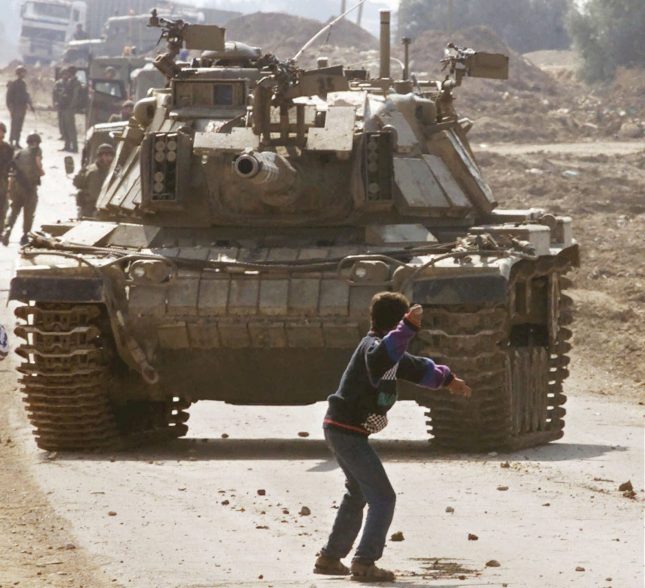
Karni crossing point between Israel and the Gaza Strip, on the outskirts of Gaza city, Oct. 29, 2000. (AP Photo/Laurent Rebours)
In similar circumstances, 13-year-old Zakaria had been shot by a Jewish soldier. The bullet entered his leg; he spent six months in hospital and went through multiple operations. He remains lame to this very day. The soldier has never been tried or punished for shooting a child, but a Jewish soldier is practically never tried or punished for wounding or murdering a Palestinian child, and there are thousands of murdered children.
As Zakaria recuperated, his mother (who was a great believer in peaceful coexistence with Israeli Jews) invited a new theatre company to do rehearsals at her home. She gave them the upper floor of their house, fed them and helped them. It was a children’s theatre, performed by camp children and for camp children, organized by an unusual person, Arna Mer. This Jewish communist lady “betrayed her people” (as many Jews were prone to say) and married an Arab, an Orthodox Christian Palestinian Arab, also a communist, even a prominent member of Communist Party. They called their son Sputnik, as a sign of their love for the Soviet Union, the beacon of light for such liberation movements. Eventually Sputnik found his name too exotic, and changed it to ‘Juliano Mer’. He became a friend of Zakaria. Together they acted on stage; the company consisted of six or eight children. The theatre was called The Stone Theatre. It was around 1988-89, at the height of the First Intifada, the rising that convinced Israel to seek an accommodation and enter Oslo accords with Palestinian leadership.
Years later, Juliano Mer made a film Arna’s Children, based on their memories and video archive. It turned out that the majority of the young actors were killed by Jews by that time. Zakaria’s mother was also killed by a Jewish sniper, shot through the window, while she was at home. One hour later, the same sniper shot her elder son and killed him. Their house, which had served as a home for the Stone Theatre, was bulldozed together with many other homes in Jenin.
Jenin was the place for a Jewish onslaught on the Palestinians in 2002. Recently the Israeli court banned Jenin, Jenin, a film about these fateful events, but you still can find it on Bitchute. Zakaria was a great fighter; he became the commander of Jenin’s Al Aqsa Brigade. He survived four assassination attempts by the Israelis: in 2004, they murdered five Palestinians, including a 14-year-old child, while targeting a vehicle suspected of carrying Zakaria. On another occasion they killed 9 Palestinians, but Zakaria escaped.
Zakaria became widely known and respected in the West Bank and even in Israel. He was befriended by Yasser Arafat; he supported the election of Mahmud Abbas, Arafat’s successor. An Israeli woman, Tali Fahima, came to Jenin to support Zakaria and serve as his human shield. Israel arrested her in 2004 and she spent three years in prison for ‘aiding a terrorist organization’. After her release, she converted to Islam having become totally disillusioned by the massive Jewish support for the bloody punitive actions against Palestinians. Zakaria, who spoke perfect Hebrew and had many Israeli friends, was also disappointed by the Israeli Jewish Left. None defended him during these terrible years, despite all the efforts of his late mother to build relations with Israelis.
However, the uprising was defeated. And Zakaria continued his struggle by other means, establishing, together with Juliano Mer, his childhood friend, a new and bigger theatre company, the Freedom Theatre of Jenin. It is still around, and even prospers, though Zakaria is now in jail, and Juliano Mer was killed by unknown assassins. In 2007, Zakaria accepted the amnesty offered by Israelis to the Fatah fighters, though by its conditions he couldn’t leave Jenin. He abided by the amnesty conditions, but it didn’t help him: a few years later, Israel rescinded the amnesty. In 2019, Zakaria was caught and sent to jail for life.
He would rot in jail like other prisoners, and every second Palestinian of his generation had been in an Israeli jail for some part of his life. But then, the audacious breakout brought his name back to our awareness. He returned hope into the hearts of the Palestinians and their friends, but alas, for a short time.
It happened exactly twenty years after 9/11, the event that empowered the Jews to smash Palestinian resistance. Nowadays, the Jews can do whatever they want with their captive goyim. People aren’t even allowed to object. At the recent Tokyo Olympic games, an Algerian judoka Fethi Nourine refused to pair with an Israeli sportsman, saying his support for the Palestinian cause made it impossible for him to compete against an Israeli. The International Judo Federation promptly suspended the brave Algerian for ten years.
In the discourse, the Jews possess an unassailable position, and whoever demurs finds himself jobless and castigated as a ‘bigot’. Every time I post an item about Palestine, Facebook’s Zuckerberg bans me for a week. Never was Jewish dominance so complete. Before 9/11, the right wing was traditionally anti-Jewish. Nowadays, the European and American nationalist Right accept the rules of the game. It’s hard to find a ‘fascist’ or ‘white nationalist’ who doesn’t worship Israel. The Jewish ‘left’ in Israel avidly supports the current Israeli Prime Minister Bennett who is as strong a Jewish chauvinist as has ever held this position; and Bennett says openly that Palestinians will never be free.
And we also have lost our freedom. Freedom to roam the land, freedom to have and voice our opinion. Freedom to refuse a dubious ‘medical’ treatment. What 9/11 started, Corona completed. We are all Palestinians now.
However, as I watched the stern Christ-like face of Zakaria Zubeidi in the courtroom, I thought that despite all efforts of the Synedrion, the suffering and crucified Christ came back to life. So will Palestine. So will the World. Resurrection is as inevitable as Death, and it beats Death.
Israel Shamir can be reached at adam@israelshamir.net
Two of the Captured Detainees Report Torture, one Hospitalized

IMEMC | September 16, 2021
Lawyers for two of the Palestinian prisoners who managed to escape Israeli prison on September 6, on Wednesday, confirmed that the escapees have suffered torture at the hands of the Israeli forces, the Associated Press (AP) has revealed.
For the first time, since they were captured, on September 11, lawyers were permitted to interview two of the detainees.
Attorney with the Palestinian Prisoners’ Society (PPS) Raslan Mahajna, met with political prisoner Mahmoud al-‘Arda, one of the six Palestinians who escaped from Israeli prison, who informed him of the harsh details of interrogation and the systematic denial of basic human needs.

Detainee Mahmoud al-‘Arda
Israeli human rights lawyer, Avigdor Feldman, told AP that his client, Zakariyya Zobeidi, said that security forces handcuffed him, asked him his name, and when he stated “Zakariyya”, they proceeded to brutally assault him, causing him two rib fractures and a fractured jaw.
Feldman added; “They didn’t have any intention to commit any kind of terrorist attack.”
On September 12, one day after his capture, the health condition of Zobeidi, 46, deteriorated, so he was transferred to Rambam Medical Center in Haifa for medical treatment, according to Hasan Abed Rabbo, the spokesperson for the Palestinian Detainees Affairs Commission.

Detainee Zakariyya Zobeida
~ AP, WAFA
New Poll Finds That 50% of Americans Support Cutting Aid to Israel

By Eric Striker | National Justice | September 15, 2021
Aid to Israel is now a highly polarizing issue, a poll conducted by the Chicago Council on Global Affairs and the pro-Zionist Israel Democracy Institute have found.
The survey taken last month found that the US government’s deferential treatment of Israel is completely out of line and unrepresentative of popular opinion.
On the question of whether to restrict US military aid to Israel, 50% of all Americans support ending such support, compared to 45% who oppose it. Among supporters of aid restrictions are 32% of registered Republicans, 62% of Democrats, and 52% of Independents. This is a drastic rise from historical opinion polls for all political persuasions right, left and center.
In respects to the Israel-Palestine conflict itself, only 32% of Americans believe the US government should be getting involved on Israel’s side.
A glaring distinction is made clear when both the US and the Jewish Israeli public were asked about potential solutions to the dispute. Last July, it was found that 56% of Americans and 69% of Israel’s Arab minority support a two state solution, which would allow the West Bank and Gaza to become an independent Palestinian state. Only 34% of Jews in Israel support this view.
Even more telling were the answers on a potential one state solution. A one state solution would incorporate Gaza and the West Bank and transform Israel into an American or European style multi-racial democracy where Arabs in occupied territories would enjoy equal rights to Jews. Even higher numbers of Americans (60%) support this resolution, as well as 56% of Israeli Arabs. Meanwhile, only a paltry 14% of Israeli Jews would even consider such an idea.
The only opinion Israeli Jews responded favorably to was to maintain the status quo (42%) in the conflict, which means the slow and illegal expansion of their regime as they ethnically cleanse and kill Palestinians. This view was only shared by 26% of Americans and 15% of Israeli Arabs.
It is not controversial to say that global Jewry is by far the most vocal and powerful advocate for racial pluralism, mass immigration, and multi-culturalism in the West. Yet, in the Jewish state, the idea of a “rainbow nation” is rejected by a super-majority, who are so inflexible that they do not even want Palestinians to have even the most sensible demand of an independent nation composed of the West Bank and Gaza Strip.
As this poll run by the Israel lobby shows, Zionism in the United States is rapidly losing ground among popular opinion. This has yet to make any significant mark on Washington consensus, where both Democrats and Republicans have repeatedly shown that American aid to Israel is unconditional.
Israel has concerns about the US withdrawal from Afghanistan
![Afghan protesters shout slogans against the US and Israel during a protest in downtown Kabul on December 8, 2017 [WAKIL KOHSAR/AFP via Getty Images]](https://i2.wp.com/www.middleeastmonitor.com/wp-content/uploads/2021/09/GettyImages-888278700-scaled-e1631610540399.jpg?resize=1200%2C799&quality=85&strip=all&zoom=1&ssl=1)
Afghan protesters shout slogans against the US and Israel during a protest in downtown Kabul on December 8, 2017 [WAKIL KOHSAR/AFP via Getty Images]
Dr Adnan Abu Amer | MEMO | September 14, 2021
Israelis are concerned about the shameful American withdrawal from Afghanistan and think that their government now needs to reassert its ability to protect its own interests in the region and beyond. The general feeling is that the withdrawal will now give Israel’s enemies more freedom to move, especially Iran, which will not hesitate to strengthen its relations with China, which in turn has clear interests in Afghanistan and the Arab Gulf. Events in Afghanistan have rung alarm bells for Israel and its allies in the region.
At the same time, Israelis believe that the US withdrawal from most of its strongholds in the Middle East and Central-South Asia — Iraq first and now Afghanistan, and perhaps Syria later — may push some regional states to move against Israel. The evaluation of America’s role in the Middle East is that US forces can no longer rely on using Arab countries for emergencies. A comprehensive view of the region puts Israel in a better position in terms of US interests, at least according to an uncertain Israeli assessment.
However, the fear remains that what happened in Afghanistan could be mirrored in the occupied West Bank, not least due to the exposure of American weakness. The strategic patience and steadfastness of the Taliban have created an inspiring narrative for the Palestinian Islamic Resistance Movement, Hamas.
In this context, Israelis are asking if events in Afghanistan could be replicated in the Palestinian arena, especially if Israel withdraws from parts of the West Bank in any deal with the Palestinians. Such an exit would almost certainly lead, at least in the short term, to instability, and encourage Hamas to try to expand its influence in the territory.
Although Israel and the occupied Palestinian territories are geographically distant from Afghanistan, the Israeli government claims that it will be required to respond to any development that threatens its security at home and abroad. In this case, it will take into account the current situation in the conflict with the Palestinians, and the de facto reality of a “one-state solution”, with all the negative political and social ramifications that it will have based on successive security warnings.
America’s exit from Afghanistan was embarrassing for Washington, but there were no demonstrations on US streets, either in support of or opposing the withdrawal. Any Israeli withdrawal from even a small part of the occupied West Bank, however, will cause a great stir. A lot of political determination and conviction will be required before such a move could be taken. Indeed, it could be beyond the current government, the survival of which would be threatened.
Israel expects the US withdrawal from Afghanistan to encourage its enemies to attack it. Although the Taliban movement does not pose a direct threat to Israel, it represents a concern for the colonial state, because it shares a border with Iran and the US withdrawal confirms the ongoing reduction of American intervention in the Middle East and beyond. Ideological and political differences aside, Israel knows that successive US presidents have shared a desire to end their involvement in the bloody wars in the Middle East and Central-South Asia. In doing so, believes Israel, America’s ability to challenge Iranian influence may create a domino effect tipping the scales of regional power at the expense of the Zionist state.
Nevertheless, there may be opportunities for Israel to enhance its regional position, because it is not only watching Afghanistan with concern but also, and perhaps more importantly, watching the positions of the Arab regimes that depend on the US for their security, in light of a growing mistrust in its ability to support them. Saudi Arabia and other countries in the region may approach Israel, as a possibly more reliable ally than the US, to fulfil their security needs, even without full normalisation of relations. Security cooperation between Israel and a number of Gulf States is already overt. It is thus likely that such Israeli cooperation with other Arab countries will increase.
Rapprochement and subsequent engagement with Israel may not be limited to “moderate” Arab countries. NATO, for example, could expand its security cooperation with the Zionist state, replacing the US with a willingness to get involved in regional affairs.
All of this is speculation at the moment in the wake of the US withdrawal from Afghanistan. Although not actually part of the Middle East, a Taliban-led Afghanistan is going to play a major role in reshaping the region and how changes might affect Israel.
Featured Video
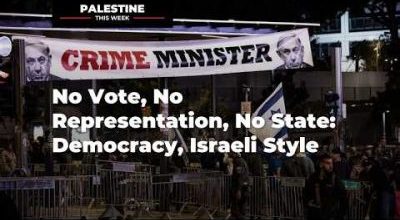
No Vote, No Representation, No State: Democracy, Israeli Style
or go to
Aletho News Archives – Video-Images
From the Archives
Sanctions, War and the Policy of Dual Containment
By SASAN FAYAZMANESH | March 17, 2008
It is now nearly three decades since the Unites States adopted the policy of dual containment of Iran and Iraq. While much has been written about the containment of Iraq, there has been very little in-depth analysis of this policy when it comes to Iran. In a book that is going to be released on March 31, 2008, entitled The United States and Iran: Sanctions, Wars and the Policy of Dual Containment (Routledge), I attempt to address this shortcoming by investigating when and why the US policy of containment of Iran came about, how it evolved, and where it stands today.[1] To the extent that Israel has been involved in US policy making, the study will also include the role that Israel has played in the containment of Iran. Also, since the fate of Iran has been inextricably linked to that of Iraq, occasionally the investigation will overlap with the containment of Iraq.
The policy of dual containment of Iran and Iraq originated during the Carter Administration, but it was not until the Clinton Administration that the expression “dual containment” became popular. … continue
Blog Roll
 Aletho News
- No Vote, No Representation, No State: Democracy, Israeli Style
- Zionist Bought Senate Blocks Information About American Citizens Killed By Israel
- While Gaza dominates the UN, these are the people keeping it alive
- New Report: “Scholasticide and Genocide in Gaza: Assessment, Testimonies and Legal Analysis”
- ‘THAAD Delusion’: Iran war exposes US missile shield limits – The Atlantic
- Moscow issues warning to NATO over Russian exclave
- Yes, the Iran war has destroyed Trump’s presidency
- The fallacy of US delusions about Iran’s economic collapse
- Hezbollah denies Syria cell link, warns of Israeli plan to sow discord
- The legacy of US sanctions, war, and occupation in Iraq
- If Americans Knew
- Mamdani releases plan to combat antisemitism and hate crimes in New York City
- Iran’s Revolutionary Guards Publish Letter to the American People
- DMFI launches $1 million ad campaign supporting Virginia’s Elaine Luria
- US Senate blocks resolution seeking report on Americans killed by Israel
- Israeli Attacks Kill Ten Palestinians in Gaza
- Massacre at Minab: The School That Became a Grave
- Israeli media: The IDF Shows It Doesn’t Turn a Blind Eye; It Actively Emboldens Settler Havoc
- As settlers ravage West Bank, Israeli forces kill 10 in Gaza – Daily Update
- New Report: “Scholasticide and Genocide in Gaza: Assessment, Testimonies and Legal Analysis”
- Ex-Biden officials are desperate for a Gaza scapegoat
- No Tricks Zone
- Green Energy Debacle: German Expert Professor Fritz Vahrenholt Warns Of Severe Economic And Social Consequences
- Two More Paleo Reconstructions Affirm Meters-Higher Sea Levels Across Ireland, Brazil 7000-6000 Years Ago
- New Study: Earth And Venus Surface Warmth Largely Explained By Convection And Lapse Rate, Not CO2 Or Radiation
- 2025 Nature Paper Claiming Worsening Global Drought Gets RETRACTED …Heavily Flawed
- New Study: ‘Global Drought Shows No Detectable Recent Acceleration Under Climate Warming’
- Economic Masterminds: German Socialists Suggest Taxing Productivity Gains Stemming From Using AI
- The South China Sea Has Not Been Cooperating With The Climate Change Narrative
- Energy Crisis: Germany Enters Heating Season With Historically Low Gas Reserve Fill Levels
- New Study: The Antarctic Ice Sheet Gained Mass From 2020-2024 Due To Staggering Snow And Ice Accumulation
- Study: Ocean Heating Rates From Thousands Of Years Ago ‘Dwarf’ Modern Ocean Heating Rates

