Crossword clues and bullying – the influence of Australia’s pro-Israel lobby unveiled
Michael West Media | October 3, 2021
The intimidating power of Australia’s pro-Israel lobby limits what mainstream media outlets dare publish about Israel and forces self-censorship on editors and journalists alike, writes John Lyons in his latest book Dateline Jerusalem: Journalism’s toughest assignment. Kim Wingerei reports.
In 2019, Fairfax Media’s Sydney and Melbourne mastheads made an error. In the daily crossword section, the answer to the clue “Holy land” turned out not to be six letters starting with an I, as some would expect, but nine letters: Palestine. So affronted was the Australia/Israel and Jewish Affairs Council (AIJAC) that they demanded an investigation.
Fairfax acceded, blamed the error on an external contractor and apologised to Colin Rubenstein, executive director of the AIJAC.
This is just one of many examples which John Lyons uses to illustrate the power of a lobby group so influential it can force changes to Government policy, hound journalists out of their jobs and pressure the ABC board to justify the appointment of foreign correspondents.
… there are only three people who can tell the editors of The Australian what they can or can’t use: Rupert Murdoch, Lachlan Murdoch and Colin Rubenstein. – John Lyons
 John Lyons is an experienced journalist. Currently the head of investigative journalism at the ABC, his 40 years in the media include being editor of the Sydney Morning Herald, Middle East correspondent for The Australian and winning one of his three Walkley Awards for “Stone Cold Justice”, a Four Corner’s episode which exposed the human rights abuses in Israel military courts.
His earlier book Balcony over Jerusalem covered his six years of witnessing the tragedies and contradictions of a region which has suffered more armed conflict than any other since World War II.
In his latest book released this weekend (at 85 pages, it’s closer to essay size), Lyons focuses entirely on the Israel-Palestine conflict and specifically how pro-Israel lobbyists seek to control the narrative for the Australian audience.
He makes the point several times that the press in Israel is far more overtly critical of the policies of Israel’s Government than is the media in Australia, including how the regular flare-ups in the West Bank are covered.
To the AIJAC it’s a war of words. It is a battle to control how and what is said.
For example, Colin Rubenstein and his fellow lobbyists are particularly sensitive about using the word “occupation” in reference to Israel’s occupation of Palestinian Territories. But as the lieutenant colonel responsible for Israel’s army operations in the occupied territories quips:
If this is not occupied then the media has missed one of the biggest stories of our time, (Israel’s) withdrawal from the West Bank! – LC Eliezer Toledano, Israel Army
The pro-Israel lobby has even developed a special dictionary. The Global Language Dictionary was funded by The Israel Project to “guide politicians and journalists on the language to use to win support for settlement expansion.”
Merely using the word Palestine can land a journalist in trouble. Jennine Khalik, a Palestinian Australian and former journalist at The Australian recounts in the book how she was yelled at by a sub-editor for referring to a refugee and singer as coming from Palestine:
PALESTINE DOES NOT EXIST … Palestine is NOT a place … What kind of journalist are you, using the word Palestine?
For Jennine Khalik this was the last straw, she left the paper shortly after, following what had been a concerted campaign by the pro-Israel lobby, including diplomats from the Israel embassy questioning her editors about the appointment of “a Palestinian activist”.
In another example of the tactics used to control the narrative, Lyons refers to a story told by former The Age editor, Andrew Holden, where Colin Rubenstein and Mark Leibler – lawyer and well known leader of the Jewish business community – marched into his office and complained loudly about the paper’s coverage of the 2014 Gaza war.
Anyone who thinks that such a display by an esteemed member of the Australian community doesn’t have a chilling effect is kidding themselves. I have seen its effect in the years since in hesitancy on the part of editors and trepidation about any story which may show Israel in a negative light. – John Lyons
Lyons himself has also been subjected to threats and intimidation over the years for his reporting on Israel and Palestine. Like many who have dared to criticise the Israeli Government, he has been called an anti-semite, but also a “Goebbels” and “a Hamas smelly used tampon”.
It is a tactic he says is used persistently by those in Australia agitating for positive coverage of Israeli government actions.
I think the aim is to make journalists and editors decide that, even if they have a legitimate story that may criticise Israel it is simply not worth running, as it will cause more trouble than it’s worth. – John Lyons
As a result, most Australians don’t know much about the plight of the Palestinian people. They don’t know about the 101 permits that Palestinians need to obtain from Israel to be able to work and live in what they believe is their own land. They don’t know that Palestinians don’t enjoy free speech, freedom of movement or equality before the law.
In April 2021, Human Rights Watch (HRW) released its landmark report “A Threshold Crossed: Israel Authorities and the Crimes of Apartheid and Persecution”. It was largely ignored by mainstream media in Australia. “Including by my own organisation, the ABC,” says Lyons.
Abusive Israeli policies constitute crimes of apartheid, persecution
The pro-Israel lobby is so effective it has achieved the ultimate aim of information suppression – self-censorship.
John Lyons: Dateline Jerusalem: Journalism’s Toughest Assignment – now available from Monash University Publishing
Kim Wingerei is a businessman turned writer and commentator. He is passionate about free speech, human rights, democracy and the politics of change. Originally from Norway, Kim has lived in Australia for 30 years. Author of ‘Why Democracy is Broken – A Blueprint for Change’.
Palestinian factions call for cancellation of Oslo and adoption of national agenda
MEMO | October 7, 2021
Five Palestinian factions called on Wednesday for the cancellation of the Oslo Accords and the adoption of a national agenda agreed upon by their secretaries general in September last year, Sama has reported.
According to the news agency, the five factions are the Democratic Front for the Liberation of Palestine, Islamic Jihad in Palestine, the Vanguard for the Popular Liberation War, the Popular Front for the Liberation of Palestine, and the Popular Front for the Liberation of Palestine – General Command.
They warned against what they called the blackmailing of the UN Relief and Works Agency (UNRWA) and undermining of its status at the expense of the rights of the Palestinian refugees. The EU’s “extortion” against UNRWA to make school textbooks and curriculums “Israel friendly” is intended to make Palestinian students grow up without knowing their national identity, they said.
The factions also reiterated the importance of fast-tracking the adoption of a national resistance strategy instead of Oslo and its related Paris Economic Protocol. The formation of a united leadership for a comprehensive popular resistance effort to push the Israeli occupation out of Palestine is also a priority, they insisted.
“Betting on the delusional international proposals” and dependence on the International Quartet led by the United States “is an extension of a three-decade of failure,” they added. “Political escalation is not achieved through illusory and empty statements, but through the accumulation of material power on the ground.”
Sen. Marco Rubio equates boycott of Israel with “un-American activity”
By Kathryn Shihadah | If Americans Knew | October 6, 2021
US Senator Marco Rubio (R-FL) has introduced a bill, the Mind Your Own Business Act (S.2829), that would hold corporate officers personally liable when actions they take on behalf of the corporation are considered political, “un-American,” or in some other way not in the best interests of the shareholders.
Among other things, Mind Your Own Business would hold corporate officers personally liable for the act of “boycotting a state” – undermining their freedom to boycott Israel over its endemic human rights abuses. This is in spite of the fact that Americans in general are very supportive of boycotts: only about 1 in 5 agree with the anti-BDS legislation of the type that Rubio and others (including many Democrats) have been trying to pass. The BDS movement (boycott, divest, and sanctions) is based on “the simple principle that Palestinians are entitled to the same rights as the rest of humanity.”
The practice of boycott in the 1990s was instrumental in the toppling of apartheid in South Africa, and is a growing movement today. Numerous experts have documented Israel’s profoundly discriminatory system, which amounts to apartheid.
The BDS Movement has declared that “states have a legal responsibility to end complicity and dismantle apartheid” in Israel; all over the US, universities, local governments, and unions are considering BDS actions.
Israeli impunity
Interestingly, while laws in 32 states forbid the boycotting of Israeli companies, these same states are in favor of boycotting under different circumstances.
That is, businesses (and in some cases, individuals) that participate in boycotts of Israel are often themselves boycotted. The difference is simply that in the first case, the action is taken on moral grounds (for example, in protest of Israel’s human rights abuses against Palestinians); the second is merely punishment for the entity’s exercise of free speech.
Last month, several states boycotted Unilever, parent company of Ben & Jerry’s, when the ice cream company decided to stop selling its products inside illegal Israeli settlements.
Human rights organizations argue that penalizing those that oppose Israel’s policies has enabled Israel to continue violating international law. Human Rights Watch maintains that “States should encourage, not sanction, companies that avoid contributing to rights abuses.”
Supporting Israel is damaging to Americans on many levels.
In addition to providing arms to a country that abuses human rights (and that in turns provides arms to other human rights abusers), the US has lost respect globally for its complicity; foreign agents are controlling much of our country’s foreign policy; pro-Israel donors hold many politicians hostage; and American freedoms are being eroded in the name of protecting Israel from criticism. Israel also often spies on Americans and steals our technology.
Congressional impunity
Sen. Rubio himself, like many other senators, refuses to take responsibility for his actions in Congress that are not in the best interest of his constituents: his support for Israel (and Israel partisans’ support for him) is well-known; Rubio has prioritized Israel over his own country, and worked against American free speech.
Only a quarter of Americans consider themselves Zionists, yet the vast majority of our Congress members vote pro-Israel.
In addition, Americans are increasingly in favor of limiting and/or conditioning aid to Israel, while the majority of our legislators are willing to send Israel $10 million a day (and much more besides) with no strings attached – even though we have laws that prohibit such aid to countries that commit large-scale human rights abuses.
This would suggest that perhaps these Congress members – not corporations wanting to boycott Israel – may be acting in an un-American way, not according our best interests.
Our Congress is failing its shareholders.
The Amen Corner Strikes Again
Congress is in Israel’s pocket
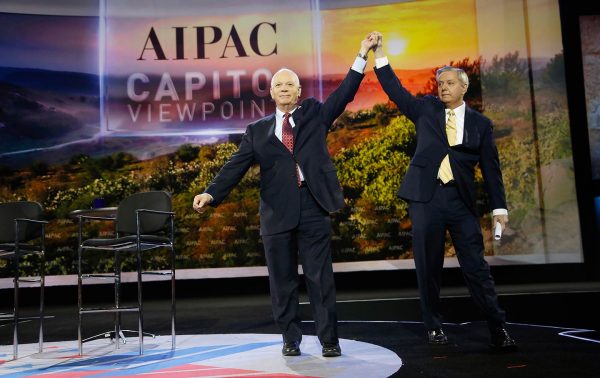
BY PHILIP GIRALDI • UNZ REVIEW • OCTOBER 5, 2021
Once upon a time the Israel Lobby destroyed critics of the Jewish state and its behavior by stealth. If a Congressman or Senator were speaking honestly about the lopsided relationship with Israel which required suppressing, it was done by making sure that individual was not reelected. This was normally accomplished by vetting an attractive opposition primary candidate who would do Israel’s bidding, funding him or her generously and providing unfavorable press coverage of the incumbent.
One great victory for Israel using that technique was the 1992 defeat of George H. W. Bush by Bill Clinton. Bush had dared to withhold guarantees on loans sought to fund Israel’s expansion of its settlements, clearly a genuine American interest as the settlements were a violation of international law. Going into the election, he appeared to be the much stronger candidate, but then the captive media starting to write about how the economy was in bad shape, which was not true, and switched over to deeply negative coverage of his campaign. The Lobby also heavily contributed financially to the Clinton campaign. George H.W. subsequently privately blamed the Israel Lobby for his defeat, a lesson his son George W. clearly absorbed in that he took pains to never anger Israel. He went rather the other way, surrounding himself with Jewish neocons as his national security policy team, which in turn produced Afghanistan and, quite plausibly, was the driving force behind the catastrophic attack on Iraq.
Legislators who have been dethroned by Israel using the same technique are Senators Chuck Percy and William Fulbright as well as congressmen Paul Findley, Pete McCloskey, Cynthia McKinney and James Traficant. They all faced credible, well-funded opponents and lost their seats. And the Israel Lobby, behind it all, never even had to complain about their views on Israel. In fact, it was believed to be better to not raise that issue directly.
Well, with great power frequently comes what the Greeks called hubris, and Israel has undoubtedly the most powerful foreign policy lobby in Washington. And that power is unique in that it also extends to many states and even local jurisdictions. As Lord Acton put it, “All power corrupts and absolute power corrupts absolutely,” meaning inter alia that the power wielded by Israel has corrupted our entire political system. What Israel wants, Israel gets, as became clear two weeks ago in the near unanimous vote for $1 billion dollars in extra Iron Dome expenses by the US Congress.
The critical difference is that now the Israelis have become so disdainful of their United States benefactor that the gloves are off when it comes to making their demands clear and insisting on positive responses. Those who do not go along are no longer brought down in semi-clandestine fashion. They are instead openly and explicitly denounced as anti-Semites and holocaust-deniers. Anti-Semitism has become the hot wire in American political discourse. Or, as one of Israel’s many proxies in Congress, House Majority Leader Steny Hoyer put it, all who support the “American way” cherish the relationship with “the Democratic state of Israel.” Surely there is a double entendre in the use of “democratic,” though Hoyer, who was acting on a demand made by Israeli Foreign Minister Yair Lapid, appears to have somehow confused democracy with apartheid.
The Israel Lobby has for several years now been vexed by the group of recently elected congressional progressives who have not been particularly shy about criticizing the Jewish state, though they have frequently had to backtrack of statements under intense pressure from the party leadership. The pushback from other Congressmen and from the media frequently accuses them of being flat out anti-Semites or often inclined to use anti-Semitic “tropes.” A favorite point of attack is to deny that Jewish groups and billionaires use money to advance their political objectives, prominently among which is uncritical support of Israel.
Congresswoman Ilhan Omar notoriously once responded to a question raised by journalist Glen Greenwald, who had posted his observation that “It’s stunning how much time US political leaders spend defending a foreign nation even if it means attacking free speech rights of Americans.” Omar tweeted in a curt response to Greenwald: “It’s all about the Benjamins baby.” Benjamins means one-hundred-dollar bills, which bear the image of Founding Father Benjamin Franklin. The entire Democratic Party leadership and every media pundit immediately voiced outrage at the antisemitic “trope.” Apparently, linking Jewish groups and money as part of America’s political corruption, which even the casual observer can hardly miss, had been elevated to something like a hate crime within the Democratic Party.
Sometimes the pressure is more subtle in the old-fashioned way. In the voting two weeks ago on Iron Dome one progressive Congresswoman Alexandria Ocasio Cortez surprisingly voted “present” instead of “no.” It turns out that her own party is preparing to gerrymander her congressional district to put more Jewish voters in it and hopefully remove her by running a well-funded candidate against her. One might suggest that she put ambition ahead of ethical behavior in her voting, but as the Lobby is out to get her one tiny gesture will hardly prove to be her salvation.
Only one Republican voted against the Iron Dome money, Representative Thomas Massie of Kentucky. He pointed out that most foreign aid comes down to the effectiveness of the foreign influence exerted on US politicians at home. It is a perfect pithy explanation of how the Israel Lobby operates. For his pains, Massie is being subjected to the hardball treatment. The American Israel Political Action Committee (AIPAC), which is the most active player in the Lobby, published a Facebook ad that included a picture of Massie and a text stating “Efforts to cut, add conditions, or restrict America’s strong, bipartisan commitment to Israel will only harm America’s national interests.” A caption claimed that “when Israel faced rocket attacks, Tom Massie voted against Iron Dome.” The ad attracted numerous comments asserting that Massie is an anti-Semite.
Massie opposed nearly all foreign aid based on principle, saying that “My position of ‘no foreign aid’ might sound extreme to some, but I think it’s extreme to bankrupt our country and put future generations of Americans in hock to our debtors.” He responded to the AIPAC ad with “How is THIS not foreign interference in our elections?” and AIPAC answered Massie’s tweet with one of its own, saying it “will not be deterred in any way by ill-informed and illegitimate attacks on this important work. We are proud that we are engaged in the democratic process to strengthen the US-Israel relationship. Our bipartisan efforts are reflective of American values and interests.”
The Anti-Defamation League (ADL) is also hunting Republicans who are not toeing the line. It has focused on Tucker Carlson in particular. It has demanded that Fox News fire Tucker for promoting the “great replacement” theory as well as other white-nationalist talking points. “To use his platform as a megaphone to spread the toxic, antisemitic, and xenophobic ‘great replacement theory’ is a repugnant and dangerous abuse of his platform,” said ADL CEO Jonathan Greenblatt. Under-fire Republican Representative Matt Gaetz also became involved in the argument, saying that Tucker Carlson is correct about white nationalist ‘replacement’ conspiracy theory and he called the ADL racist.
AIPAC has also been active in denigrating the progressive Democrats of the so-called “Squad.” In August, Congresswoman Ilhan Omar accused the pro-Israel lobby of deliberately putting herself at risk with an ad campaign that featured her photo and was headlined, “Stand with America. Stand against Terrorists.” The ad included: “For Ilhan Omar, there is no difference between America and the Taliban; between Israel and Hamas; between democracies and terrorists; tell Rep. Omar: Condemn terrorists, not America.”
Israel’s ability to influence developments in the US is such that it also believes itself to be empowered to interfere in American education, promoting mandatory holocaust courses at all levels and stifling any serious study of what is going on in the Middle East. In August, Israeli Consul General to the Southeastern United States Anat Sultan-Dadon demanded a meeting with a dean at the University of North Carolina at Chapel Hill to discuss a graduate student teaching a course on the Israeli-Palestinian conflict. The Israeli claimed the PhD student Kylie Broderick was an anti-Semite and said she was unfit to teach the course.
The intervention by an Israeli government official came after a pressure campaign by right-wing pro-Israel websites and advocacy groups to remove the student from teaching a history department course called “The Conflict Over Israel/Palestine.” Now, Ted Budd, a Congressional Representative from North Carolina has joined the fray, including writing a letter to the president of UNC:
“President Hans: I write to express my concern over repeated antisemitic activity at the University of North Carolina at Chapel Hill (UNC). Kylie Broderick, a graduate student, is scheduled to teach a course titled ‘The Conflict over Israel/Palestine.’ Ms Broderick has a troubling history of public antisemitic statements. In her public tweets she has lamented how hard it is for her to pretend that there are two sides to the Israeli-Palestinian conflict in the classroom, noting that ‘there is only 1 legitimate side – the oppressed – versus imperialist propaganda. I don’t ever want to encourage them to believe there is reason to take on good faith the oppressive ideologies of American and Western imperialism, Zionists, & autocrats.’ Among other things, she has also falsely and unapologetically accused Israel of ethnic cleansing and denied Israel’s right to exist.”
Other pro-Israel groups have joined in, even claiming that Broderick was engaging activity that is illegal under both local and federal law! Indeed, one might suggest that what Israel and its friends are seeking is a world in which even thinking about the war crimes and crimes against humanity committed by the Jewish state will be strictly illegal. The Ukraine, which has been heavily Israel-ized since its pro-Russian government was removed through US interference in 2014, has, in fact, just passed a law banning anti-Semitic sentiment. Sentiment means what is inside one’s head. In other European countries anti-Semitic acts, which include criticism of Israel and expressions disparaging Jews, are illegal, but this is a first step to criminalize anti-Israeli or anti-Semitic thoughts. Could something similar be coming to the United States? Judging from the resistance that an occupied Congress is likely to put up, which is zero, it is more than likely that we will be heading in the same direction.
Philip M. Giraldi, Ph.D., is Executive Director of the Council for the National Interest, a 501(c)3 tax deductible educational foundation (Federal ID Number #52-1739023) that seeks a more interests-based U.S. foreign policy in the Middle East. Website is https://councilforthenationalinterest.org address is P.O. Box 2157, Purcellville VA 20134 and its email is inform@cnionline.org
Panama police shoot targets in Arab clothing in Israel-run training course
![Panama police shoot targets in Arab clothing in Israel-run training course [@PedroUnderdog09/Twitter]](https://i1.wp.com/www.middleeastmonitor.com/wp-content/uploads/2021/10/FAnuhfPWQCEtOgo.jpg?resize=1200%2C800&quality=85&strip=all&zoom=1&ssl=1)
MEMO | October 4, 2021
Images published on social media exposed Panama’s police officers shooting at targets dressed in traditional Arab clothing, including a headdress, during an Israeli-run training course.
The images, which caused controversy online, were published on Twitter by the National Police and the local Israeli chamber of commerce but were later deleted.
The controversy also drew criticism from the Panamanian Committee of Solidarity with Palestine, which said that the course promoted “violence and racism, so that anyone who wears a hijab or something similar can be classified as a terrorist.”
They added a request to the government in Panama to discontinue the intervention of foreign countries in training security forces.
“This training constitutes a violation of the protocols referring to the shooting courses that prohibit the use of distinctive figures of the Arab peoples as objects of hatred and persecution,” the statement said.
In response, the Panama police force issued an apology: “We are respectful of cultural, religious and ethnic differences. We regret that … a situation arose outside the nature of our mission and duty.”
The deleted Twitter posts claimed that the training was organised by the Israeli embassy in Panama
From Glorious Millennia to Death and Destruction: Zionists Rewrite Palestine’s Story

By Miko Peled | MintPress News | September 20, 2021
One of the great tragedies of Palestine is that almost every day there is a commemoration of one massacre or another, the death of a child or destruction of a home or village, leading one to think that the Palestinian narrative is one of death and destruction, which is what Israel wants people to think. But the truth is that this is not the case. The Palestinian narrative is one of a glorious history with periods of great sadness and tragedy. It is the Zionist story that is full of killing, stealing and destruction and not, as they try to sell it, one of creation and growth.
September 16, 2021, marked 39 years since the massacres at Sabra and Shatila refugee camps in Lebanon. As people remember and mourn the thousands of unarmed civilians who were butchered and the countless who survived suffering terrible injuries and emotional scars, we must also remember the man that stood behind this bloodbath.
This was a man whose complicity even the Israeli authorities could not ignore, the former general and renowned war criminal Ariel Sharon. And although he was momentarily penalized and banished from politics, he very quickly returned, and for a quarter of a century, he was the most powerful and influential man in Israeli politics.
Narratives
At the end of the day, it is all about the narrative, and we know all too well that Israel has done an outstanding job of erasing the Palestinian narrative and injecting its own mythical, false narrative in its place. In the media, in movies, in literature, in public education, and in politics the false Zionist narrative rules supreme and we who oppose racism and violence are faced with an enormous task as we engage in the work of reversing the narrative – a task without which it is hard to imagine Palestine ever becoming free.
Over the last 100 years, the Zionist movement managed to take the truly incredible history of Palestine and turn it into a historical footnote, replacing it with a mythical story that relies heavily on a Protestant-Zionist, literal reading of the Old Testament, which allowed them to create what is known as “return history.” In other words, the Zionist version of the history of Palestine creates the impression that the Jews returned to their ancient homeland after 2,000 years, making it an unprecedented historical event that overshadows anything else that occurred in Palestine over that bimillennial span.
The Zionist narrative is designed to turn the ancient history of Palestine into a small, unimportant story that cannot be compared with the grandeur of the narrative that is presented by the Old Testament. This is highlighted when Israeli politicians like the current prime minister, Naftali Bennett, refer to the Bible as the source of legitimacy for Israel.
A four thousand-year history
Thanks to the historian Nur Masalha, we now know that the name Palestine goes back close to 4,000 years. We know that the name Palestine was used in Egyptian sources going back to the Bronze Age, more than 1,000 BCE. Later, the name was used by the Assyrians in inscriptions from that era. The Greek historian Herodotus, who lived in the 5th century BCE and who is considered to be the father of history as we know it, visited the country and referred to it as Palestine. The Greek scientist and philosopher Aristotle also refers to Palestine by name in his writings.
The cities of Lyd, Ramle, and Yaffa all had remarkable histories, as did the cities of Akka, Haifa, and, of course, Nablus, Gaza, and Al-Quds-Jerusalem. Throughout the Muslim rule of Palestine, cities grew, cultures flourished, economic conditions and trade with Europe allowed people to prosper. Dhaher Al-Umar, who ruled over large parts of Palestine during the 18th century, is seen as the founding father of Palestinian modernity and, according to Nur Maslaha, he was the most influential figure in the modern orientation of Palestine towards the Mediterranean. During his reign in Palestine, there were agricultural and technical innovations introduced that “benefited the majority of Palestinian peasantry.” Thanks to Dhaher Al-Umar, there was considerable growth in the export of cotton, olive oil, wheat and soap.
Other, lesser-known parts of Palestine also flourished throughout history, such as the Palestinian town of Khalasa, which was founded by the Nabatean Arabs in the fourth century and then depopulated by the Zionist militia in 1948. It was known to be on what is called the “Arab incense route” and, according to Nur Masalha, under Arab-Islamic rule, the town, which sits just southwest of the city of Bi’r Al-Saba, was a major urban center.
According to Mansur Nasasra, the Palestinian Bedouin in the Naqab had a very profitable export of barley to England for the production of beer. Aerial photos from the early British occupation of Palestine also show large tracts of cultivated land in the Naqab. These lands are now mostly depopulated and the Palestinian Bedouin in the Naqab are prohibited from cultivating their ancestral lands. All of this stands in the face of Zionist claims that they came to a barren land and made it bloom.
The Zionist narrative is arguably responsible for the welcoming and forgiving attitude the entire world has towards the horrendous, unforgivable crimes committed by Israel since its founding in 1948. In order to prevent the next massacre by Israel, a state that seems to have an insatiable thirst for Palestinian blood, we have to reverse the narrative and delegitimize Zionism.
Israel officials intervene to have US academic removed
MEMO | October 1, 2021
Israeli diplomats reportedly put pressure on the dean of a US university to have a teacher critical of the occupation state removed using allegations of anti-Semitism. Details of the intervention by Israeli consular officials, in what has been slammed as another example of the gross interference by a foreign state, were reported by the Intercept.
Israeli consular officials in the southeast US arranged meetings with a dean at the University of North Carolina at Chapel Hill to remove graduate student, Kylie Broderick, from teaching the history department course called ‘The Conflict over Israel/Palestine’. Details of the visit by Israeli officials are said to have been exposed by two UNC professors who had knowledge of the meeting.
The intervention by the Israeli officials followed a pressure campaign by right-wing pro-Israel websites and an advocacy group who pointed to postings Broderick had made on Twitter that criticised Israel and Zionism and, without evidence, cited the postings as evidence of anti-Semitism.
Over the past few years there has been a concerted campaign to conflate anti-Semitism with criticism of Israel using the adoption of a highly controversial definition of racism known as the International Holocaust Definition of anti-Semitism. Seven of the 11 examples of anti-Semitism cited in the IHRA conflate criticism of Israel with anti-Semitism. Critics have argued that its adoption has had a chilling effect on all levels of society especially in universities and campuses.
The two UNC professors revealed that in addition to the intervention by the Israeli government, the university faced pressure from a member of the US House of Representatives.
“It is not a new phenomenon where outside parties have tried to stifle academic freedom on this subject,” Broderick is reported saying. “But these people have never seen me teach, never seen my past evaluations which have said that I treat students fairly, and thus have no right to dictate what I say inside the classroom.”
“I think that a representative of a foreign government attempting to police an academic class is, in the first place, ridiculous, and an obvious overreaction to what is essentially an issue that started on Twitter,” Broderick added. “I also think it is strange that the Israeli consulate general was granted an audience. If this was a class on Hungary or Australia, would the university have permitted the attempted interference of a foreign government? The fact that this meeting happened at all is clearly a threat to academic freedom.”
Let’s Arm the Gazans!
Victims of aggression need America’s help!

BY PHILIP GIRALDI • UNZ REVIEW • SEPTEMBER 28, 2021
Well, here we go again. The Israelis, in collusion with no less than 420 criminals in the US Congress, have again ripped off the US taxpayer. I stop short of calling the congresscritters “traitors” because the US Constitution, which defines the word, requires that one actually be cooperating with a declared enemy of the United States to be so described. Israel is not yet an enemy as defined by a declaration of war from that same Congress, which is instead intent on showering our goods and even our freedoms on the Jewish state. Indeed, Israel has so corrupted our political system that it receives far more in benefits from the federal treasury than does any American state. And it is all done with a wink and a nod from the Jewish dominated media and through the agency of a grossly disproportionate number of Zionist Jews in high office and government aided and abetted by a host of pigshit ignorant Christian Zionists who are incapable of seeing or understanding what is best for their own country.
To be sure, many of those in Congress who pander to Israel as a top priority are not Jewish. But they know that that the Jewish state can be a harsh master if they deviate in any way from providing their enthusiastic support for the Greater Zionist project outlined in the Yinon Plan of 1982. This has led to America’s own interests being sacrificed and a continuous cash flow of many billions of dollars from Washington to Jerusalem, even though Israel is one of the ten wealthiest countries in the world per capita and its citizens enjoy free top level medical and educational benefits that many Americans cannot afford.
This is what happened last week, revealing yet again the US government’s total subjugation by Israel: Congress was preparing to vote on a multi-billion stopgap bill to pay for continuing government functions through December since a comprehensive budget has not yet been agreed to. Democratic Party friends of Israel had inserted an amendment into the bill only days before, consisting of a $1 billion gift to Israel so it could rearm its Iron Dome defense system, which ran low on missiles during the recent “Operation Guardian of the Walls” slaughter of Gazans, as well as for the purchase of other munitions. Senator Richard Shelby of Alabama defended the arrangement, saying “Importantly, our legislation includes funding for the Iron Dome, making good on our commitment to a historic and significant ally.” He explained that the money would “bolster Israel’s defense capacity and protect against Hamas attacks.”
Hamas attacks? Inserting freebies for Israel in such a fashion is routine in Congress as it allows money to flow without any debate or context, but this time there was a problem. A number of Democratic Party progressives in Congress objected and made an issue of it, in part because procedurally the move was an obvious attempt to hide what was being done, so the amendment was withdrawn. The Israel friendly media, tv talking heads from both parties, and leading congressmen all immediately went to bat for poor little defenseless Israel and a new bill was quickly drafted up to give the Jewish state the money without delay. Representative Josh Gottheimer complained in a tweet how “The Iron Dome protects innocent civilians in Israel from terrorist attacks and some of my colleagues have now blocked funding it. We must stand by our historic ally – the only democracy in the Middle East.”
One might suggest that Gottheimer go to live in Israel as he appears to like it so much and he might well fact-check his comment. It is not possible to be an apartheid state and occupying power as well as a nation where only one religion constitutes full citizenship if one aspires to be a democracy.
In spite of continued objections by “the squad” progressives, including this by Congresswoman Rashida Tlaib, daughter of Palestinian immigrant parents, who said “I will not support an effort to enable and support war crimes, human rights abuses and violence. The Israeli government is an apartheid regime,” the new bill passed by 420 votes to 9. It did not mention that Israel had previously used its US-provided weapons to kill more than 250 Palestinian civilians, including 60 children. The nine brave Congressmen, who will now be targeted for non-re-election by Israel and all its friends, consisted of Thomas Massie (R-KY), Rashida Tlaib (D-MI), Ilhan Omar (D-MN.), Raúl Grijalva (D-AZ), André Carson (D-IN), Marie Newman (D-IL), Ayanna Pressley (D-MA), Cori Bush (D-MO) and Chuy Garcia (D-IL). Massie was the only Republican, who tweeted that “Foreign aid is the result of foreign influence exerted on US politicians at home.”
It is interesting to note some of the media comments that surfaced supportive of giving the Israelis another billion dollars on top of the $11 billion or so it already gets annually in direct military assistance, trade agreements and support for its illegal settlements coming from fake charities. The conservative Washington Times described Iron Dome, somewhat bizarrely, as “relied on against Islamist efforts to kill its [Israel’s] civilians.” A New York Daily News editorial last Thursday reads in part “A small claque of far-left House Democrats thought on Tuesday that they had torpedoed a $1 billion replenishment for Israel’s Iron Dome missile defense system by threatening to vote down a larger package, forcing the Israeli assistance to be stripped out of it. On Thursday it all backfired, when 210 Democrats joined with 210 Republicans to approve the money in a brand new, standalone bill, the Iron Dome Supplemental Appropriations Act of 2022. Exposed and alone, no shield to protect them, just eight Dems voted no, along with an always cantankerous Republican… So that’s the vote, on the record: almost unanimous support in the House for the Jewish state’s right to defend itself from Hamas and Hezbollah rockets.”
Bret Stephens, over at the New York Times, has this to say about anyone who would dare oppose funding Israel’s war machine: “It would behoove Democrats in the honorable majority to start treating their Israel-hating members not as parliamentary nuisances or social media embarrassments but as the ill-intended bigots they well and truly are.” Sure Bret, it all comes down to anti-Semitism, like always, doesn’t it? Bret is of course Jewish and reliably Zionist. He lived in Israel where he was editor of the Jerusalem Post.
The Republicans inevitably had accused the Democrats of having gone wobbly on Israel, with House Minority Leader Kevin McCarthy tweeting “While Dems capitulate to the antisemitic influence of their radical members, Republicans will always stand with Israel.” House Republican Conference Chairwoman Elise Stefanik also tweeted that Democrats “do NOT support Israel. Instead they choose to side with the Hamas Caucus wing of their Party.”
Representative Rosa DeLauro of Connecticut, the Democratic chairman of the House Appropriations Committee, provided pushback as she enthused after the vote: “This bill demonstrates Congress’s commitment to our friend and ally Israel is bipartisan and ironclad.” What she should have said was the Israel’s grip on the US Congress and theft of taxpayer money is shameful, but somehow she must have misspoke. And the Daily News piece is, of course, bullshit unless one actually believes that snipers shooting children and warplanes blowing up apartment buildings is defense against home-made rockets and balloons.
And there was also plenty going on behind the scenes between Capitol Hill and Jerusalem. House Majority Leader Steny Hoyer of Maryland, possibly the most rabidly pro-Israel partisan in Congress, said “There are some few that won’t support [the new bill], but the overwhelming majority of this Congress — not in a partisan way but in an American way — will support defending the Democratic state of Israel.”
Hoyer seems to be saying that all good Americans must support Israel. He should know as he was negotiating with the Israelis on the deal to bring about a quick vote to approve the Iron Dome funding. His maneuvering was in response to Israeli officials, including Foreign Minister Yair Lapid, who had watched developments in Washington with alarm and telephoned Hoyer who, in turn, assured Lapid that what had occurred was no more than a “technical delay.” He quickly moved to bring the new bill to a vote. Of course, one might also note that Lapid had not hesitated to contact Hoyer and state clearly Israel’s demand that something be done. He felt himself empowered to put pressure on a foreign legislative body to take action that would result in considerable benefit to his own country precisely because he knew that Hoyer would be on his side. One wonders if bottom dwellers like Hoyer might be indicted under the Foreign Agents Registration Act (FARA) since he is clearly no longer working for the United States, nor defending its Constitution as he is required by oath to do.
So it is a done deal once again. Israel has its money, as always, and has bent American politicians to its will. Unfortunately, the denizens of Congress were all too willing to be bent. The stooges on Capitol Hill and in the media are largely to blame for this shameful behavior, to be sure, but Alison Weir of If Americans Knew has proposed that those who object to the use of US taxes to support a rogue state might well begin to put pressure on their congresscritters to encourage the wealthy Israelis to pay for their own missiles. Beyond that, as it is the Gazans, West Bank Palestinians and Lebanese who have borne the brunt of Israel aggression, the US can finally seize the high ground on a major human rights issue by ponying up another billion to improve their defensive capabilities for the next time the Jewish state comes calling. It is a wonderful idea and it just might convince Israel that there are consequences for bad behavior. And, by the way, it would be an antidote to some very bad behavior by the United States of America, which has been funding and encouraging Israel and emboldening its apologists ever since the Suez Crisis in 1956, which was the last time a US President actually successfully defied Israel.
Philip M. Giraldi, Ph.D., is Executive Director of the Council for the National Interest, a 501(c)3 tax deductible educational foundation (Federal ID Number #52-1739023) that seeks a more interests-based U.S. foreign policy in the Middle East. Website is https://councilforthenationalinterest.org address is P.O. Box 2157, Purcellville VA 20134 and its email is inform@cnionline.org
Stop Antisemitism org brands GOP congressman ‘Jew hater’ for voting against Iron Dome funding
‘Appalling slander’
RT | September 27, 2021
American conservatives condemned the Stop Antisemitism organization after it branded libertarian Congressman Thomas Massie (R-Kentucky) a “Jew hater” for voting against more US funding for Israel’s Iron Dome.
Stop Antisemitism, which was launched in 2018, has listed many Americans as its “Antisemite of the week,” including pop star Dua Lipa, Daily Show host Trevor Noah, MSNBC’s Mehdi Hasan, and even Human Rights Watch executive director Ken Roth – a Jewish American whose father was a refugee from Nazi Germany.
After Massie became the only Republican congressman to vote against further funding for Israel’s Iron Dome missile system last week – an act consistent with his politically libertarian and fiscally conservative track record in Congress – Stop Antisemitism set its sights on the representative, publishing a photo of his face with “JEW HATER” stamped on top.
“Rep. Thomas Massie’s voting record clearly shows his lack of support of the Jewish people and the Jewish Nation. In fact, his views are aligned with those of other notorious antisemites like Congresswomen Ilhan Omar and Rashida Tlaib,” the organization declared, also listing Massie’s opposition to the government “labeling BDS as antisemitic.”
Though Stop Antisemitism’s campaign against Massie received support from Arizona state representative and Democrat Zionist Alma Hernandez, many prominent conservatives and libertarians piled onto the organization in protest.
“This is defamatory nonsense. Massie has explained in detail how he votes, and he is against *government funding* of avenues where he believes the government has no role,” reacted journalist Jordan Schachtel, while Human Events co-publisher Will Chamberlain called the organization’s comments “appalling slander” and said it “should be ashamed of itself.”
Reason senior editor Robby Soave tweeted, “This is nonsense. It is not anti-Semitic to believe that other countries should pay for their own defenses,” while New York Young Republican Club’s chairman, Gavin Wax, accused Stop Antisemitism of “devaluing the meaning of antisemitism” with its “incredibly stupid” attack.
The organization wasn’t alone, however. The American Israel Public Affairs Committee (AIPAC) also took out an ad criticizing Massie, which the Kentucky Republican called “foreign interference” in US elections.
When his colleague Rep. Eric Swalwell (D-California) chimed in, Massie dismissed him as an expert in “foreign affairs” – a reference to Swalwell’s ties with a suspected Chinese spy.
Despite experiencing heavy backlash for its campaign against Massie, the organization refused to apologize or withdraw the congressman as “Antisemite of the week.”
Massie is not the only elected US official to be chosen as “Antisemite of the week.” Representatives Marjorie Taylor Greene (R-Georgia), Alexandria Ocasio-Cortez (D-New York), Ilhan Omar (D-Minnesota), and Rashida Tlaib (D-Michigan) have previously been the subjects of attack by Stop Antisemitism.
Palestine Voices: Abrahim Amen, Bet Lahia, Gaza
Al-Haq | September 20, 2021
Abrahim Amen, a survival from an Israeli rocket attack that destroyed his family house and killed his father and three sisters, on May 14, 2021.
Iraqi Government Rejects “Normalization” Conference Held in Erbil
Al-Manar | September 25, 2021
The Iraqi government highlighted its rejection of the conference held by some tribal figures in Erbil city in Kurdistan for advocating the normalization of ties with the Israeli enemy.
The Iraqi government also stressed that the tribal figures who attended the conference did not represent the cities they came from, adding that the assembly was aimed at stirring sectarian sedition amid the national preparations for the upcoming public elections.
The government further indicated that normalization is constitutionally, legally and politically rejected in Iraq, reiterating support to the Palestinian cause and rights in face of the Israeli aggression.
Featured Video
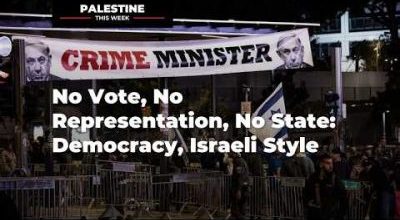
No Vote, No Representation, No State: Democracy, Israeli Style
or go to
Aletho News Archives – Video-Images
From the Archives
Sanctions, War and the Policy of Dual Containment
By SASAN FAYAZMANESH | March 17, 2008
It is now nearly three decades since the Unites States adopted the policy of dual containment of Iran and Iraq. While much has been written about the containment of Iraq, there has been very little in-depth analysis of this policy when it comes to Iran. In a book that is going to be released on March 31, 2008, entitled The United States and Iran: Sanctions, Wars and the Policy of Dual Containment (Routledge), I attempt to address this shortcoming by investigating when and why the US policy of containment of Iran came about, how it evolved, and where it stands today.[1] To the extent that Israel has been involved in US policy making, the study will also include the role that Israel has played in the containment of Iran. Also, since the fate of Iran has been inextricably linked to that of Iraq, occasionally the investigation will overlap with the containment of Iraq.
The policy of dual containment of Iran and Iraq originated during the Carter Administration, but it was not until the Clinton Administration that the expression “dual containment” became popular. … continue
Blog Roll
 Aletho News
- No Vote, No Representation, No State: Democracy, Israeli Style
- Zionist Bought Senate Blocks Information About American Citizens Killed By Israel
- While Gaza dominates the UN, these are the people keeping it alive
- New Report: “Scholasticide and Genocide in Gaza: Assessment, Testimonies and Legal Analysis”
- ‘THAAD Delusion’: Iran war exposes US missile shield limits – The Atlantic
- Moscow issues warning to NATO over Russian exclave
- Yes, the Iran war has destroyed Trump’s presidency
- The fallacy of US delusions about Iran’s economic collapse
- Hezbollah denies Syria cell link, warns of Israeli plan to sow discord
- The legacy of US sanctions, war, and occupation in Iraq
- If Americans Knew
- Mamdani releases plan to combat antisemitism and hate crimes in New York City
- Iran’s Revolutionary Guards Publish Letter to the American People
- DMFI launches $1 million ad campaign supporting Virginia’s Elaine Luria
- US Senate blocks resolution seeking report on Americans killed by Israel
- Israeli Attacks Kill Ten Palestinians in Gaza
- Massacre at Minab: The School That Became a Grave
- Israeli media: The IDF Shows It Doesn’t Turn a Blind Eye; It Actively Emboldens Settler Havoc
- As settlers ravage West Bank, Israeli forces kill 10 in Gaza – Daily Update
- New Report: “Scholasticide and Genocide in Gaza: Assessment, Testimonies and Legal Analysis”
- Ex-Biden officials are desperate for a Gaza scapegoat
- No Tricks Zone
- Green Energy Debacle: German Expert Professor Fritz Vahrenholt Warns Of Severe Economic And Social Consequences
- Two More Paleo Reconstructions Affirm Meters-Higher Sea Levels Across Ireland, Brazil 7000-6000 Years Ago
- New Study: Earth And Venus Surface Warmth Largely Explained By Convection And Lapse Rate, Not CO2 Or Radiation
- 2025 Nature Paper Claiming Worsening Global Drought Gets RETRACTED …Heavily Flawed
- New Study: ‘Global Drought Shows No Detectable Recent Acceleration Under Climate Warming’
- Economic Masterminds: German Socialists Suggest Taxing Productivity Gains Stemming From Using AI
- The South China Sea Has Not Been Cooperating With The Climate Change Narrative
- Energy Crisis: Germany Enters Heating Season With Historically Low Gas Reserve Fill Levels
- New Study: The Antarctic Ice Sheet Gained Mass From 2020-2024 Due To Staggering Snow And Ice Accumulation
- Study: Ocean Heating Rates From Thousands Of Years Ago ‘Dwarf’ Modern Ocean Heating Rates

