US, Western intelligence services behind creation of Takfiri terrorist groups: Yemen leader
Press TV – October 19, 2020
The leader of Yemen’s Houthi Ansarullah movement has held the United States and Western intelligence services responsible for the creation of Takfiri terrorist groups, saying France’s external intelligence agency plays a significant role in this regard.
“Takfiris are supported by the US, France and Western countries. They are the parties that have stood by Takfiris to target Muslims as they massacre them. The United States and its allies in Syria, Yemen, and other countries are supporting Takfiris, because they are using the extremists to tarnish the image of Islam. Western intelligence agencies, including the one in France, are involved in monitoring and supporting them,” Abdul-Malik al-Houthi said at a televised speech broadcast live from the Yemeni capital of Sana’a on Monday evening.
Houthi also warned that distortion and misinterpretation of Islamic teachings have created a deep rift among Muslims and posed serious problems to them.
“Enemies have used such deviation to insult the Holy Qur’an and Islam. There is no mercy or sympathy whatsoever in the Western civilization. They trample on [the rights of] human societies, deprive people of their freedom, plunder their wealth and occupy their lands, and then lecture others on human rights,” he highlighted.
The Ansarullah chief then questioned Western states’ respect for human rights in Yemen, Palestine and other Arab and Muslim countries, saying US President Donald “Trump is proud that he is ready to give Arab lands to the [Israeli] enemy and expropriate them as he did in the Syrian Golan Heights. What sort of civilization is this?”
Houthi went on to say that insulting Islam is allowed while criticizing Zionists is prohibited in France and whoever does so will be brought to trial.
“In the West, on the other hand, you are allowed to insult Islam and prophets, become atheists and insult God. But you are not permitted to insult Zionists and stand up to them,” the Yemeni Ansarullah leader pointed out.
“In the world, there is a blatant and insulting attack on the Prophet [Muhammad (PBUH)], Islam and Muslims, and the campaign seeks to target our faith with the goal of cultural dominance,” Houthi noted.
The Ansarullah leader stressed that efforts are being made to turn Muslim nations into subordinates of the US, Western states and the Israeli regime.
“Plots aimed at enslaving and distancing us from our religious teachings and identity must not be accepted at all,” he said.
He then denounced French President Emmanuel Macron’s recent anti-Islam remarks as a form of hostility toward the Muslim world.
“France and the West are insulting Islam and the Prophet Muhammad (PBUH). At the same time, they are caring for Zionists and don’t stand any insults directed at them,” he said.
The Ansarullah leader finally held arrogant powers, led by the US and the Israeli regime, accountable for the sufferings of nations worldwide.
Arab support for PA budget falls by 82%
MEMO | October 19, 2020
Arab support for the Palestinian Authority’s budget has fallen by 82 per cent during the first eight months of this year, Shehab news agency reported on Sunday.
According to data issued by the PA Ministry of Finance, the Arab countries have paid the PA $38.1 million in 2020 so far, compared to $198.33 million during the same period last year.
Over the past few months, US President Donald Trump revealed that he had asked the wealthy Arab states to stop paying money to the Palestinians. In July, the PA’s Minister of Finance Shukri Bsharah reported that a number of Arab states had suspended their financial aid for the authority.
The decline in Arab support coincides with a budget deficit in the normally supportive states due to the sharp decline in oil prices and reduced demand for crude oil.
Saudi assistance, Shehab reported, declined by 77.2 per cent, down from $130m in the same period in 2019 to just $30.8m this year. Algerian support fell to zero whereas it paid $26.1 million during the first eight months of 2019.
The PA said last week that Arab support for its budget has fallen by 55 per cent over the past five years from a high of around $1.1 billion. The authority is in the middle of its worst ever financial crisis since refusing to accept the tax revenues collected by Israel on its behalf since July. That is when PA President Mahmoud Abbas announced the suspension of all agreements with the occupation state.
Hamas: the US has told Arab states to stop supporting the PA
MEMO | October 19, 2020
A senior Hamas official has claimed that the US has told a number of Arab states to stop giving financial support to the Palestinian Authority, Al-Aqsa TV reported on Sunday. According to Saleh Al-Arouri, a number of states have been asked to put pressure on Fatah, which controls the PA, in order to pull out of any reconciliation with Hamas.
The Deputy Head of the Hamas Political Bureau added that these countries are those which sponsored the US deal of the century. He stressed, however, that Hamas is committed to the Palestinian understandings reached in Istanbul and would never backtrack on them.
Al-Arouri also revealed that the US had offered to talk with Hamas over the so-called “deal”, but Hamas refused because Washington’s intention was to split the national Palestinian stance and threaten the PLO leadership.
In July, the former Hamas leader Khaled Meshaal said that the best way to undermine the Israeli annexation plans “is to change the function of the PA” from serving the Israeli occupation to confronting it. He stressed that if such a change was not made, the PA should be dissolved after discussions with the different Palestinian factions and reaching an agreement on a replacement in order not to end up in chaos.
Macron’s Hypocrisy Is Typical of the Subservience to Israel By Most Western Leaders and Mainstream Media
By William Hanna | October 19, 2020
“The term does not necessarily signify mass killings . . . more often [genocide] refers to a coordinated plan aimed at destruction of the essential foundations of the life of national groups so that these groups wither and die like plants that have suffered a blight. The end may be accomplished by the forced disintegration of political and social institutions, of the culture of the people, of their language, their national feelings and their religion. It may be accomplished by wiping out all basis of personal security, liberty, health and dignity. When these means fail the machine gun can always be utilised as a last resort. Genocide is directed against a national group as an entity and the attack on individuals is only secondary to the annihilation of the national group to which they belong.”
Raphael Lemkin (1900-1959), Jewish Polish legal scholar who coined the term genocide
The decapitating in Paris of a French teacher who showed his pupils a caricature of the prophet Muhammad — from the satirical newspaper Charlie Hebdo — during a moral and civic education class discussion about freedom of speech, deserves to be unreservedly condemned by everyone. Extrajudicial executions are barbaric acts of extreme cruelty that violate international standards on human rights irrespective of where, or by whom, such heinous atrocities are committed.
While French President Emmanuel Macron was rightly justified in denouncing that barbaric attack, his comments about “ . . . freedom of expression, the freedom to believe or not believe,” was to say the least extremely hypocritical because in France, as in most other Western nations, freedom of expression — the freedom to hold opinions and to receive and impart information and ideas without interference by public authority and regardless of frontiers — is selective and has been criminalised when it involves criticism of Israel’s irrefutable crimes against humanity in the brutally and illegally Occupied Palestinian Territories.
While speaking at a dinner attended by Jewish leaders in February 2019, Macron claimed the surge in anti-Semitic attacks in France was unprecedented since World War Two and promised a crackdown including a new law to tackle hate speech on the internet; confirmed that France would be adopting the definition of anti-Semitism as set by the International Holocaust Remembrance Alliance (IHRA): and added that “anti-Zionism is one of the modern forms of anti-Semitism.” The World Jewish Congress welcomed Macron’s actions by asserting “this is just the beginning of a long road ahead. Adopting this definition of anti-Semitism must be followed by concrete steps to encode into law and ensure that this is enforced.”
Human rights activists consequently fear being unfairly branded as anti-Semitic because of their criticism of Israel for its occupation of territory internationally recognised as Palestinian; for its inhumane blockade of the Gaza Strip which has devastated the economy and caused unspeakable hardships in what is in effect the world’s largest prison; and for its perpetration of a genocide as defined by Raphael Lemkin who while managing to escape from the Nazis and save his own life, nonetheless lost 49 relatives in the Holocaust: a genocide which prompted the Jewish peoples’ commendable but sadly disregarded vow of “never again.”
Such disregard is the result of Zionism having hijacked and weaponised anti-Semitism and the Holocaust to silence any criticism of Israel’s crimes against humanity which spineless and unscrupulous Western leaders like Macron dismiss with the disingenuous soundbite of “Israel has a right to defend itself”: a right which apparently — according to the Western concept of impartial justice and equal rights for all humanity — is not applicable to the Palestinian people whom “God’s Chosen,” have frequently described as “animals” who have never actually existed as a people.
De-Arabizing the history of Palestine is another crucial element of the ethnic cleansing. 1500 years of Arab and Muslim rule and culture in Palestine are trivialised, evidence of its existence is being destroyed and all this is done to make the absurd connection between the ancient Hebrew civilisation and today’s Israel. The most glaring example of this today is in Silwan, (Wadi Hilwe) a town adjacent to the Old City of Jerusalem with some 50,000 residents. Israel is expelling families from Silwan and destroying their homes because it claims that King David built a city there some 3,000 years ago. Thousands of families will be made homeless so that Israel can build a park to commemorate a king that may or may not have lived 3,000 years ago. Not a shred of historical evidence exists that can prove King David ever lived yet Palestinian men, women, children and the elderly along with their schools and mosques, churches and ancient cemeteries and any evidence of their existence must be destroyed and then denied so that Zionist claims to exclusive rights to the land may be substantiated.
Miko Peled, Israeli peace activist and author
According to Miko Peled “Israel has been on a mission to destroy the Palestinian people for over six decades,” and he asked “why would anyone not give solidarity to the Palestinian people?” He also regarded Israel’s actions in the Six-Day War of 1967 as deliberate acts of aggression rather than a genuine response to a real threat; that “every single Israeli city is a settlement”; and that “expressing solidarity with Palestinians is the most important thing people can do.”
Expressing solidity with Palestinians, however, is a morally justifiable human right which Apartheid Israel has managed to suppress with the complicity of a US-led Western alliance of unprincipled bought and paid for political leaders like Macron aided by a mainstream media which while masquerading as the “the voice of the people,” actually consists of conglomerate-owned news outlets that have gutted newsrooms, abandoned the concept of investigative journalism, and replaced reporting of the true facts with shallow infotainment.
If President Macron and other spineless Western leaders of his ilk are genuinely concerned about the “surge in anti-Semitism,” they would do well to seriously consider the following warning by Yehoshafat Harkabi — Chief of Israeli Military Intelligence (1955-9) and subsequently a professor of International Relations and Middle East Studies at the Hebrew University of Jerusalem — who in his 1989 book, Israel’s Fateful Hour, called for Israel’s withdrawal from the occupied territories and warned that:
We Israelis must be careful lest we become not a source of pride for Jews but a distressing burden. Israel is the criterion according to which all Jews will tend to be judged. Israel as a Jewish state is an example of the Jewish character, which finds free and concentrated expression within it. Anti-Semitism has deep and historical roots. Nevertheless, any flaw in Israeli conduct, which initially is cited as anti-Israelism, is likely to be transformed into empirical proof of the validity of anti-Semitism. It would be a tragic irony if the Jewish state, which was intended to solve the problem of anti-Semitism, was to become a factor in the rise of anti-Semitism. Israelis must be aware that the price of their misconduct is paid not only by them but also Jews throughout the world. In the struggle against anti-Semitism, the frontline begins in Israel.
William Hanna is a London-based freelance writer on democracy and human rights and author of the recently published book, The Grim Reaper. Further information including book reviews, articles, sample chapters, videos, and contact details at: https://www.williamhannaauthor.com/
95% of Bahrainis against normalization deal with Israel: Opposition tells UN
Press TV – October 18, 2020
Bahrain’s largest opposition group calls on the United Nations to intervene in the kingdom’s unbridled push to deepen its relations with the Israeli regime, saying the move falls short of the general population’s consent.
The Al-Wefaq National Islamic Society released the statement on Sunday, as the two sides are expected to sign a “joint communique on establishing peaceful and diplomatic relations” during a visit by Israeli and US delegations to the Bahraini capital Manama.
The move marks a major step forward in formalizing Manama and Tel Aviv’s ties after a September 15 event at the White House during which Bahrain and the United Arab Emirates signed “normalization” deals with the occupying regime.
All the Palestinian factions besides countless independent Muslim figures and bodies have unanimously blasted the détente as a stab in the back of the Palestinian nation and a US-facilitated attempt at betraying the Palestinian cause of ending the Israeli occupation and aggression.
The opponents of the rapprochement say the move that has been taken by a handful of unelected authorities in Manama and Abu Dhabi never qualifies to represent the opinion of the world’s millions-strong Arab and Muslim community.
“More than 95% are against the agreement and the normalization with the Zionists and the absence of any authority representing the people” in the push towards cementing the détente, al-Wefaq said, addressing UN Secretary-General Antonio Guterres.
“We call on the secretary-general and the international community to ask the Bahraini regime to allow Bahrainis to give their final word on the agreement between the Bahraini regime and the Zionist occupation,” it added.
“The people of Bahrain need to express their opinion about this illegal agreement,” the statement read, calling the deal unconstitutional and contrary to “patriotic and national values.”
The movement said another reason for the agreement’s illegality was that Manama was going ahead with it while stifling all instances of opposition at home.
Since 2011, Bahrain has been witnessing near-daily peaceful rallies against Manama’s routine practice of heavily discriminating against its Shia Muslim majority. The state has come down hard on the protests, killing scores of people and jailing hundreds of others.
An Environmental Nakba: The Palestinian Environment Under Israeli Colonization

Artwork by Andrea Settimo
By Mazin B. Qumsiyeh and Mohammed A. Abusarhan | Volume 23, number 1, Science Under Occupation
Prior to the 1948 war and even the Zionist Congress of 1897, Palestine had some thirteen hundred villages and towns, each with a small and manageable population living sustainably with nature. The land was owned or worked by the Palestinian people, who were 85 percent Muslim, 9.2 percent Christian, and 5.3 percent Jewish.1 This structure changed radically when mostly European Jews mobilized for massive migration to Palestine and began to assume colonial control over the land. In its long recorded history, Palestine has indeed undergone significant environmental and demographic changes, but it is really only in the past century that these changes took on a colonial dimension. The best-known of these changes is the forcible removal of the indigenous population, which reached its peak between 1948 and 1950. During those years, five hundred villages and towns were destroyed by Zionist militias, resulting in the largest wave of refugees after the Second World War.2 But the environmental dimensions of the catastrophe, or Nakba, is little talked about.3 In 1967 Israel occupied the remaining 22 percent of historic Palestine, namely Gaza and the West Bank, and built settlements throughout these occupied territories in contravention of to international law (the Fourth Geneva Convention).4 These dramatic transformations were detrimental to the people and nature of Palestine. Here, we focus on the environment and sustainability in Palestine, an often overlooked casualty of the colonial occupation.
Colonial Impact on the Environment
Once Israel was declared a Jewish state in May 1948, native trees (such as oaks, carobs, and hawthorns) and agricultural crops (olives, figs, and almonds) were systematically uprooted and replaced by European pine trees. These planted pines reduced biodiversity and harmed the local environment.5 Pines shed leaves that are acidic and prevent the growth of underbrush plants. These trees are also very susceptible to fire because of their resins. Indeed, fires are now a common occurrence in the areas in which they were planted. Trees, however, were not the only targets of Israel’s colonial practices. Natural resources, primarily water aquifers, have also been confiscated from the Palestinians. This often happened by deliberately building Israeli colonies on hilltops to ensure effective access to these resources and to maintain surveillance over the Palestinians.6 Environmental sustainability was never a priority for Israel, whose practices detrimentally affected the landscape, resulting in the destruction of diverse habitats and water runoff.7
The occupation of the West Bank and Gaza in 1967 opened opportunities for Israeli industries. Many of the highest polluting companies moved to the West Bank and were provided with tax incentives to do so.8 There the companies only faced the opposition of the Palestinians who had no way to stop them. For example, pesticide and fertilizer manufacturer Geshuri, which faced significant court setbacks in its original plant in Kfar Saba, was moved to an area adjacent to Tulkarm inside the West Bank in 1987. Significant pollution caused by Geshuri and other companies in this area has damaged citrus trees and vineyards.9 Moreover, research on genotoxicity in the Occupied Territories shows the significant impact of the Barkan industrial settlement on the Palestinians of Burqeen village.10 As DNA and chromosomes are damaged, there are increasing cases of miscarriage, cancer, and congenital birth defects. Air and water pollution has also caused diseases ranging from respiratory illness to gastrointestinal failures. Other health-related problems have resulted from the Israeli practice of sending trash, including electronic debris, across the Green Line.11 This debris is often recycled by destitute Palestinians in environmentally harmful ways, such as using fire to remove plastic from useful metals. This practice releases substances that cause serious ailments, including cancer and lung diseases.
Israel has also built an extensive network of roads and other infrastructure serving settlers. Trees and any buildings within seventy-five meters of these roads are bulldozed and declared closed military zones to the Palestinians. The total area used in the West Bank for settler roads was 51.2 km2 in 2000 and has doubled since. Added to the 150.5 km2 of built settlement-colonies, this is a huge area that was previously used by Palestinians for agriculture, pasture, or leisure.12 The disparity between settlers and natives in land control and standard of living is compounded by disparity in access to other natural resources, especially water.13 Israeli officials have deliberately ignored facts and selectively presented falsified or inaccurate data to serve their political interests in the Jordan River while catastrophically impacting Palestinian access to water. For example, 91 percent of the total water of the West Bank is expropriated for Israeli settler use.14
The Israeli occupation has resulted in considerable loss of biodiversity in the Palestinian territories. This began many years ago when Israel diverted the waters of the Jordan Valley, and when trees surrounding destroyed Palestinian villages were replaced by monoculture crops. More recently the apartheid wall in the West Bank obstructs human activities and animal movement, causing a loss of both human and animal biodiversity.15 Humans and nature have been intertwined in Palestine for thousands of years, and the continuing loss of biodiversity irreversibly damages Palestine’s cultural and natural heritage, threatens endangered species, and harms agriculture and environmental sustainability.16
There are many other practices through which the occupation has undermined sustainable development and protection of the environment. These include refusal to issue building permits in most of the West Bank and destruction of any “unauthorized” structures, even including cisterns and solar panels.17 Another example is the policy of Israel to absorb the Palestinian tourism sector, including ecotourism.18
One of the major threats to the Palestinian landscape is the confiscation of land for settlements, sometimes with temporary false excuses of preventing damage to nature.19 For example, the Palestinian village of Ras Imweis and six adjacent areas were initially confiscated under such an excuse then turned into the settlement of Nahal Shilo. In many other instances, the Israeli occupation authorities prevented Palestinian sustainable development by claiming certain stretches of land as “green areas,” then turning them into Jewish settlements within the span of two to three years. Such exploitation was also obvious in the Bethlehem district, where Abu Ghuneim Mountain, one of the largest forests in the Bethlehem district, was turned into the Har Homa settlement in 1997. This is how Israel is “green-washing” the occupation.20
International Failure
Israel’s colonial settlements have had a devastating impact on the Palestinian environment and on indigenous Palestinian lives. This raises significant questions about the possibility of sustainable development under occupation.21 Indeed, there are ample grounds, backed by solid scientific and legal research, to bring claims of environmental injustice to local, national, and international forums.
Article 49 of the Fourth Geneva Convention (which Israel ratified) states that “the Occupying Power shall not deport or transfer parts of its own civilian population into the territory it occupies,” adding that life in military occupied areas must be allowed to proceed as normally as possible. UN Security Council Resolution 465 of 1980 reads in part that “all measures taken by Israel to change the physical character, demographic composition, institutional structure or status of the Palestinian and other Arab territories occupied since 1967, including Jerusalem, or any part thereof have no legal validity and that Israel’s policy and practices of settling parts of its population and new immigrants in those territories constitute a flagrant violation of the Fourth Geneva Convention.”
Israel has largely ignored international law. This impunity is enabled by the international community. For example, a 2003 United Nations Environment Program report identified key effects of the occupation on the environment and made over one hundred recommendations but failed to prioritize them or set target dates. This failure of the international legal system to hold Israel accountable is not just related to environmental issues, but extends across many other areas including Israel’s abuse of prisoners and destruction of civilian life.22 Israel’s aggressive political lobby has also influenced many governments and shapes decisions at the UN, where the United States has veto power. [Mazin B. Qumsiyeh, Sharing the Land of Canaan: Human Rights and the Israeli-Palestinian Struggle (London: Pluto Press, 2004).] The international failure to hold Israel accountable has left the issue—like in South Africa under apartheid—up to organizers and activists on the ground.23
Grassroots Organizing for Environmental Justice
In situations where international law fails, civil society often intervenes, as we have seen in the movements for boycott, divestment, and sanctions (BDS) in South Africa and in Palestine against the respective apartheid regimes. The BDS movement and other forms of civil or popular resistance do make a difference.24 That we have not yet reached the post-apartheid era like South Africa is due to the fact that the settler-colonial occupation of Palestine has been strengthened by international complicity and by agreements, such as the Balfour Declaration and resolutions by the League of Nations and the UN, that exclude the Palestinians. The international community has long abrogated its responsibilities and has thus given Israel a green light to engage in significant violations of human rights (including environmental rights). Civil society must increase pressure on international leaders to assume their responsibility to return dignity and sovereignty to the Palestinian people. International bodies must enforce law and implement sanctions against Israel to rectify the rampant environmental injustices that disproportionately harm the indigenous Palestinian population. Palestinians have no recourse to domestic laws since what laws are available are those of an apartheid settler-colonial state.25 There is recent scholarly and activist interest in using international law to buttress environmental justice claims, especially in developing countries, but as Noura Erekat pointed out, this is undermined by the imbalance of power and influence of the Zionist movement around the world.26 Although we are witnessing the growth of the BDS movement, we need much more pressure and mobilization to enforce recognition of Palestinian rights.27
Nevertheless, a significant movement for environmental justice and sustainability is growing even under the very difficult conditions of occupation and colonization. People are working at the grassroots level to build popular institutions that enhance and promote sustainable natural and human communities in the context of a larger anti-colonial struggle.28 Educating new generations of Palestinians in their culture and history can also help address some of the challenges Palestinians are facing.29 Because colonizers work to separate the colonized from their land and destroy their culture and history, strengthening the connection between the indigenous people and their land will help new generations understand the value of nature beyond the exploitative framework imposed by colonialism.30 Environmental struggles are an integral part of the struggle for freedom and justice in Palestine as elsewhere.
Acknowledgement: We thank the Darwin Initiative (UKaid) and the European Union for their support of some of our work at PMNH/PIBS/Bethlehem University.
About the Authors
Mazin B. Qumsiyeh is a professor and researcher at Bethlehem and Birzeit Universities. He previously served on the faculties of the University of Tennessee, Duke University, and Yale University. He and his wife returned to Palestine in 2008 to start a number of institutions and projects, including the Palestine Institute for Biodiversity and Sustainability (PIBS) at Bethlehem University. He, his wife, and volunteers and staff at PIBS have “joyful participation in the sorrows of this world” and make a difference for sustainability of nature and human communities.
Mohammed A. Abusarhan is a masters student in biotechnology at Bethlehem University and Palestine Polytechnic University. He earned a degree in Biology from Bethlehem University. Since 2017, he has worked at the Palestine Museum of Natural History as a Museum Biologist conducting animal collecting, taxidermy, and identification. His research interests are focused on conservation, museum digitization, biodiversity databases, and bat echolocation. He has published several research articles and spent the summer of 2019 in Germany in a prestigious laboratory as an exchange researcher.
References
- “Demographics of Historic Palestine prior to 1948,” Canadians for Justice and Peace in the Middle East CJPME, July, 2004, https://www.cjpme.org/fs_007.
- Ilan Pappe, The Ethnic Cleansing of Palestine (Oxford: Oneworld Publication, 2006).
- Mazin B. Qumsiyeh, “The Coming Environmental Nakba” in The Third Palestinian Environmental Awareness and Education Conference. EEC (Bethlehem, 2013), 57–59.
- Nur Masalha, Expulsion of the Palestinians: The Concept of “Transfer” in Zionist Political Thought, 1882–1948 (Institute for Palestine Studies, 1992). See also Mazin B. Qumsiyeh, Sharing the Land of Canaan: Human Rights and the Israeli-Palestinian Struggle (London: Pluto Press, 2004).
- Pappe, The Ethnic Cleansing of Palestine.
- Meron Benvenisti, Sacred Landscape: The Buried History of the Holy Land since 1948 (Berkeley: University of California Press, 2002). See also Eyal Weizman, Hollow Land: Israel’s Architecture of Occupation (Brooklyn: Verso Books, 2012).
- ARIJ, Status of Environment in OPT (Applied Research Institute – Jerusalem, 2015).
- United Nations Conference on Trade and Development, “The Economic Costs of the Israeli Occupation of the Palestine People: The Unrealized Oil and Gas Potential,” United Nations, 2019 Report.
- ARIJ, Status of Environment in OPT.
- Khloud M. Hammad and Mazin B. Qumsiyeh, “Genotoxic Effects of Israeli Industrial Pollutants on Residents of Bruqeen Village (Salfit District, Palestine),” International Journal of Environmental Studies 70, no. 4 (2013): 655–62.
- Nadia Khlaif and Mazin B. Qumsiyeh, “Genotoxicity of Recycling Electronic Waste in Idhna, Hebron District, Palestine,” International Journal of Environmental Studies 74, no. 1 (2017): 66–74.
- ARIJ, Status of Environment in OPT.
- Neve Gordon, “From Colonization to Separation: Exploring the Structure of Israel’s Occupation,” Third World Quarterly 29, no. 1 (2008): 25–44. See also Weizman, Hollow Land: Israel’s Architecture of Occupation.
- Clemens Messerschmid and Jan Selby, “Misrepresenting the Jordan River Basin,” Water Alternatives 8, no. 2 (2015): 258–79.
- Qumsiyeh, Mazin B. Unpublished data.
- Alon Tal, Pollution in a promised land: An environmental history of Israel (Berkeley, Calif:Univ. of California Press, 2002); International Union for Conservation of Nature – Regional Office for West Asia (IUCN – ROWA), State of Palestine Fifth National Report to the Convention on Biodiversity. Amman, Jordan 2015; Abdallah T, Swaileh K. “Effects of the Israeli Segregation Wall on biodiversity and environmental sustainable development in the West Bank, Palestine,” International Journal of Environmental Studies 68: 543-555 (2011).
- MOPAD, “State of Palestine National Development Plan 2014-2016’” (Ministry of Planning and Administrative Development, 2014).
- Talia Shay, “The Ethnocracy of the Palestinian Urban Space and the Indigenous Approach: Praxis and Theory,” Archaeologies 12 (2016): 73–90. See also Rami Isaac, C. Michael Hall, and Freya Higgins-Desbiolles, eds., The Politics and Power of Tourism in Palestine (London: Routledge, 2015).
- Dror Etkes and Hagit Ofran, “Construction of Settlements and Outposts on Nature Reserves in West Bank,” Peace Now, February 13, 2007, https://peacenow.org.il/en/nature-reserve.
- Sara Hughes, “‘Greenwashing’ the Occupation: The Role of Environmental Governance and the Discourse of Sustainability in Sustaining the Israeli Occupation of Palestine,” in The Annual Meeting of the American Association of Geographers, 2018.
- Jad Isaac, Khaldoun Rishmawi, and Abeer Safar, “The Impact of Israel’s Unilateral Actions on the Palestinian Environment,” (Applied Research Institute-Jerusalem, 2004).
- Susan M Akram et al., eds., International Law and the Israeli-Palestinian Conflict: A Rights-Based Approach to Middle East Peace (London: Routledge, 2010). See also Noura Erakat, Justice for Some: Law and the Question of Palestine (Stanford, California: Stanford University Press, 2019).
- Mazin B. Qumsiyeh, Popular Resistance in Palestine: A History of Hope and Empowerment (London: Pluto Press, 2012).
- Qumsiyeh, Popular Resistance in Palestine.
- “Environmental Injustice in Occupied Palestinian Territory: Problems and Prospects,” Al-Haq, August 4, 2015.
- Ruchi Anand, International Environmental Justice: A North-South Dimension (London: Routledge, 2017); Erakat, Justice for Some.
- Mazin B. Qumsiyeh, “A Critical and Historical Assessment of Boycott, Divestment, and Sanctions (BDS) in Palestine,” in Conflict Transformation and the Palestinians (Routledge, 2016), 114–29.
- Mazin B. Qumsiyeh, “Nature Museums and Botanical Gardens for Environmental Conservation in Developing Countries” BioScience 67, no. 7 (2017): 589–90. See also Mazin B. Qumsiyeh et al., “Role of Museums and Botanical Gardens in Ecosystem Services in Developing Countries: Case Study and Outlook,” International Journal of Environmental Studies 74, no. 2 (2017): 340–50, https://doi.org/10.1080/00207233.2017.1284383.
- Mazin. B. Qumsiyeh, “Ethnoecology of Palestine: Preserving Culture Heritage of Palestine’s Natural History,” presented at the 4th Hyperheritage International Seminar Proceedings (International Conference): Smart Heritage, 2018.
- Michael R Dove, “Indigenous People and Environmental Politics,” The Annual Review of Anthropology, 35 (2006): 191–208.
Facebook COO pledges $2.5 mill to Israel advocacy group, brushing off Palestinian complaints of censorship

If Americans Knew | October 17, 2020
In the midst of a campaign by Palestinian journalists accusing Facebook of suppressing their content, Facebook’s Chief Operating Officer, Sheryl Sandberg, has pledged $2.5 million to the ADL, an organization that devotes much of its work to Israel advocacy.
We’ll first look at the complaints about censorship, then at the ADL, and then at Sandberg.
The current campaign is the latest in a long line of complaints that Facebook discriminates against Palestinian users.
A 2016 Fortune magazine article reported accusations that a Facebook agreement with the Israeli government had led to the closing of some Palestinian accounts.
A 2017 article in The Intercept reported: “Facebook has been on a censorship rampage against Palestinian activists who protest the decades-long, illegal Israeli occupation, all directed and determined by Israeli officials. Indeed, Israeli officials have been publicly boasting about how obedient Facebook is when it comes to Israeli censorship orders.”
In 2018 there were reports that Facebook had closed 500 Facebook pages of Palestinian activists, journalists and bloggers.
This month a campaign called “Facebook Blocks Palestine” was launched by Palestinian journalists and activists saying that Facebook restrictions against Palestinian pages had “dramatically increased,” including deleting pages and accounts, removing posts, banning comments sections, restricting pages, blocking live streaming, etc.

Mohammad Kareem’s Facebook page was suddenly taken down. Kareem tweeted: “Facebook has blocked my account after 8 years of using it. This is like deleting a history of someone for a weird reason. ‘Something you posted’! What is it?”
An organizer explained that one of the campaign’s goal is to expose the “double-standard policy of Facebook management” in dealing with Israeli and Palestinian content.
A day or two later Facebook deleted yet another Palestinian page: the Arabic account of the Palestinian Information Centre (PIC), a news organization founded in 1997 that had almost five million Facebook followers. According to PIC, Facebook provided no prior warning or justification for its action.

Photograph posted by Palestine Information Center, Aug. 31, 2019
Over the years it appears that Facebook has tried to develop strategies to make fair, rational decisions about which content to remove and which accounts to take down. These have included using content reviewers, instituting a review process, and writing algorithms to catch “hate speech” and “incitement.”
At the heart of of all this, however, are the human beings who review the content, who write the algorithms, and who are in charge of the process.
It is, therefore, problematic when Facebook executives work with the Israeli government to decide what content to remove, when Facebook collaborates with an Israel advocacy organization to “combat cyberhate,” and when top Facebook executives such as Mark Zuckerberg are connected to the top rung of the Israeli government.
And it is problematic when the number two person at Facebook – especially during a time period when Facebook is specifically being charged with anti-Palestinian, pro-Israeli bias – makes a large, very public donation to an organization devoted to advocating for Israel.
The ADL and Israel
On Oct. 16th Facebook COO Sheryl Sandberg announced (on Facebook, of course) that she was making “a personal gift” to the ADL. Sandberg is considered one of the most powerful figures in the tech world.
While many people consider the ADL a benign, almost official organization–and news media virtually always repeat its claims without scrutiny–it is a highly political, private organization with no public accountability and with very clear agendas.
One of its main agendas is being a “a strong voice for Israel.”
While the ADL was allegedly formed to oppose discrimination, it actively supports a nation based on discrimination. Israel was established in 1948, in the words of an Israeli historian, through a war of ethnic cleansing, and continues this process today.
Numerous groups and individuals have documented Israel’s current systemic discrimination, its long record of human rights violations, as well as its violations of U.S. laws and damage to the U.S.
Nevertheless, the ADL devotes much of its effort to Israel, advocating on its behalf with American elected officials, U.S. media and on American campuses, including producing a guide about how to block campus events aimed at informing students about the Palestinian situation.
Screen shot of ADL page.
And while the ADL claims to oppose defamation, it often attacks groups and individuals its dislikes, particularly those who provide information on Israel-Palestine that the ADL doesn’t wish Americans to know.
While the ADL’s statements may at times constitute outright defamation, almost no one is able to take on the organization, given its assets of $145 million+. Rare exceptions were 1993 lawsuits over the ADL’s vast spying operation on Americans, which had gone on for decades. Eventually, the ADL was forced to settle the suits, paying out unknown sums of money. (In the interest of full disclosure, I’m among the ADL’s more recent targets, the organization having published false statements about me that it has refused to retract.)
In 2017 the ADL collaborated with an Israeli think tank to produce a 2017 strategy paper on how to counter the growing public awareness of Israeli violations of human rights. The Israeli Minister of Strategic Affairs, Brigadier General Sima Vaknin-Gil, said of the ADL-coauthored paper: “The correlation between the Ministry’s mode of operation and what comes out of this document is very high, and has already proven effective… ”
Among its recommendations, the 32-page document called for “industry engagement with corporations such as Google, Facebook, and Twitter.”
That same year the ADL launched the “Center for Technology and Society,” whose advisory board contains a number of tech executives.
One is Facebook Vice President Guy Rosen, who studied in Israel and is a member of the TechAviv Community LinkedIn Group, formed “to help Israeli startup founders and their companies succeed by harnessing the collective energy, knowledge, and networks of the global Israeli startup community.”
ADL’s “educational materials”
The ADL considers many criticisms of Israel to be “anti-Semitism,” using a definition formulated by an Israeli minister. The materials it provides for schools are highly selective, often have clear agendas, and are glaring in the ADL’s “PEP” stance (Progressive Except Palestine). For example:
• There is a high school unit on the Rohingya people but nothing on the Palestinian people.
• The ADL provides a lesson plan on “Refugee Crisis in Europe” that makes no mention of Palestinian refugees, a major refugee group and one that began long before the current crisis.
• There is a teaching unit on nonviolent resistance that includes materials on The Holocaust, Civil Rights, sanctuary cities, opposition to the U.S. wall on the southern border, etc, but completely ignores the Israeli wall confiscating Palestinian land, the ongoing nonviolence movement in the Palestinian West Bank (including the killing of participants Rachel Corrie and Tom Hurndall), and the massive nonviolent movement launched in Gaza a year and a half ago that has continued for every week since.
• A unit on “Challenging AntiSemitism: Debunking the Myths and Responding with Facts” includes a number of references to Israel and uses as a reference the Jewish Virtual Library, a website managed by the American-Israeli Cooperative Project in order to “to strengthen the U.S.-Israel relationship.” (The unit includes derogatory references to Christianity, Islam, and Arabs.)
The ADL’s facebook posts periodically focus on Israel. For example, it “welcomed” the decision to remove Palestinian Zahra Biloo from the Women’s March over her criticism of Israel, announced that it would discuss “bias against Israel” with UN officials, and alerted its Facebook followers to a discussion about “how to fight” anti-Zionism.
Sheryl Sandberg and Israel
Sandberg has visited Israel periodically throughout her life.
In August, she went on another family visit to Israel, met with Israeli President Reuven Rivlin and others, and inaugurated a new Facebook venture in Tel Aviv.
“I am so excited to be in Israel today.” she announced at the celebration. “This is a country that is deeply meaningful to me personally. But this country is also deeply meaningful for Facebook because… this is a country of startups and entrepreneurs.”
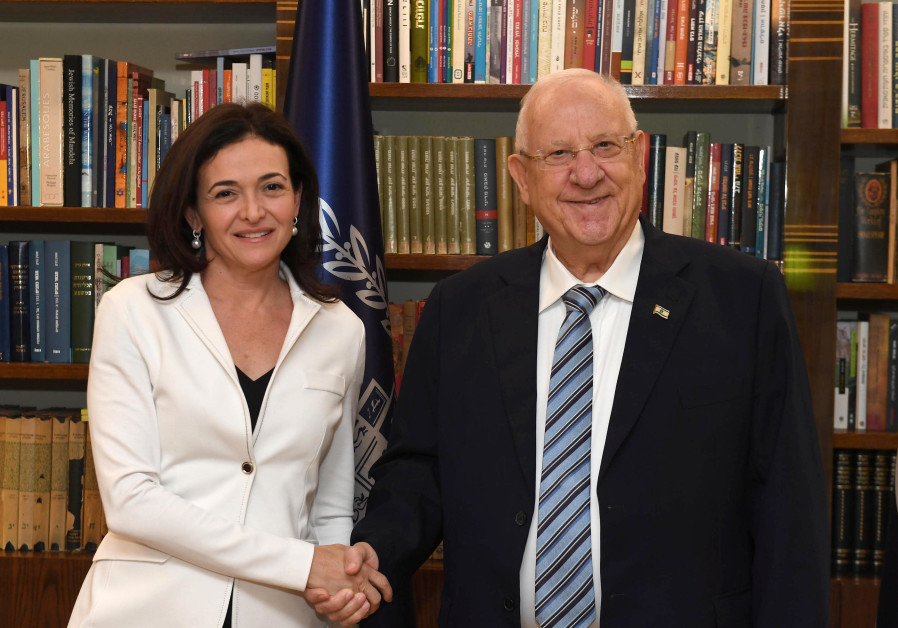
In her Facebook post, Sandberg described the importance to her of her Jewish identity. She said that her horror at the recent tragic “mass murder” of Jews in Pittsburgh (11) and Germany (2) inspired her to make the donation.
The timing of her announcement is startling in its lack of concern for the current Palestinian campaign against unfair treatment by Facebook, and of recent Palestinian deaths and injuries inflicted by the Jewish state.
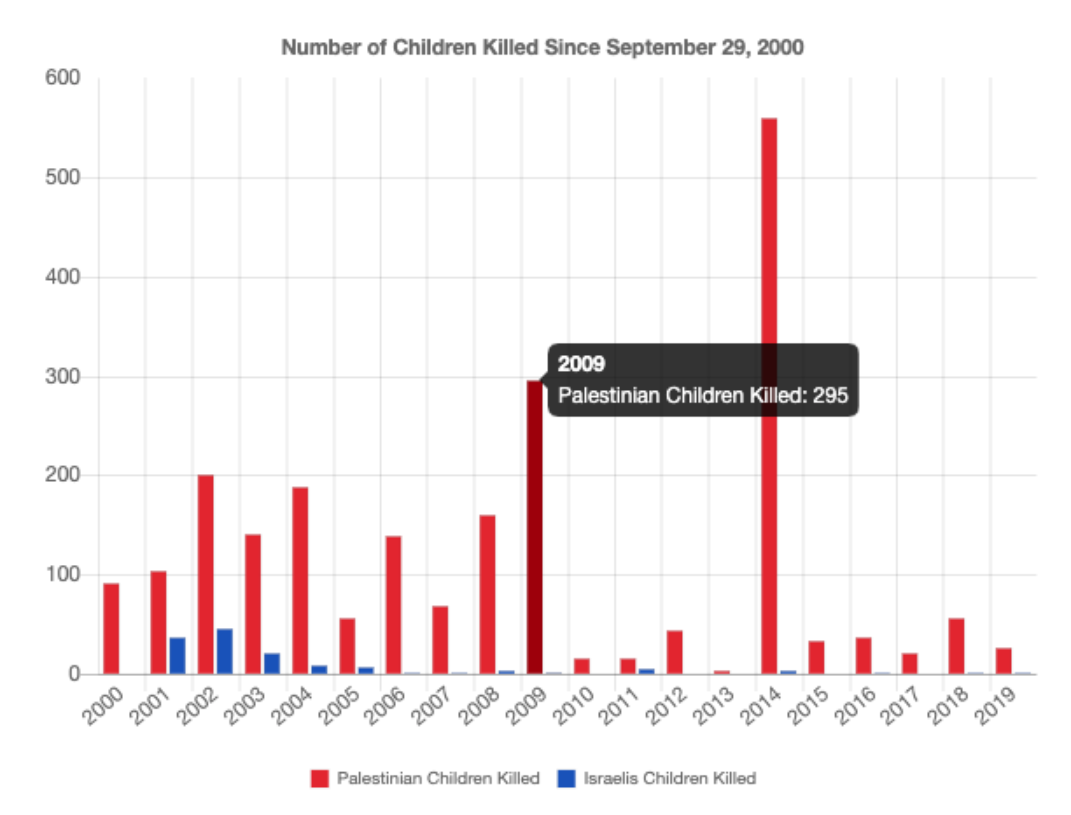
In the past year and a half Israeli forces have killed at least 326 and injured over 28,000 men, women, and children taking part in demonstrations in Gaza.

Abdullah al-Anqar, 13, at a Gaza clinic, 10 June 2018. He was shot by an Israeli sniper during a demonstration along the Gaza-Israel border in May. (Photo from Medicins San Frontieres)
A search for donations that Sandberg may have dedicated on behalf of these victims turns up only an ambulance – which she presented to Israel, which has suffered massively fewer deaths and injuries.
Given Sandberg and the ADL’s opposition to “hate” and “bias,” they may wish to read the extensive documentation of widespread discrimination and hatred in Israel.
Israeli academic and author Nurit Peled-Elhanan has spent years documenting the pervasive anti-Palestinian bias in Israeli textbooks.
“One question that bothers many people,” she says, “is how do you explain the cruel behaviour of Israeli soldiers towards Palestinians, an indifference to human suffering, the inflicting of suffering. People ask how can these nice Jewish boys and girls become monsters once they put on a uniform.”
Peled-Elhanan said: “I think the major reason for that is education. So I wanted to see how school books represent Palestinians.” In studying hundreds of Israeli textbooks she did not find one photograph that depicted an Arab as a “normal person.”
Peled-Elhanan says that as a result of the Israeli school system, Israeli children grow up to serve in the army and internalize the message that Palestinians are “people whose life is dispensable with impunity. And not only that, but people whose number has to be diminished.”
Perhaps Steinberg’s next anti-hate donation could go to Peled-Elhanan.
And perhaps instead of working with the Israeli government to remove Palestinian posts that document the results, Facebook executives could meet with the Palestinian journalists and activists they’re censoring and listen to what they have to say.
38 billion reasons to vote for Joe Biden – If you’re Israeli
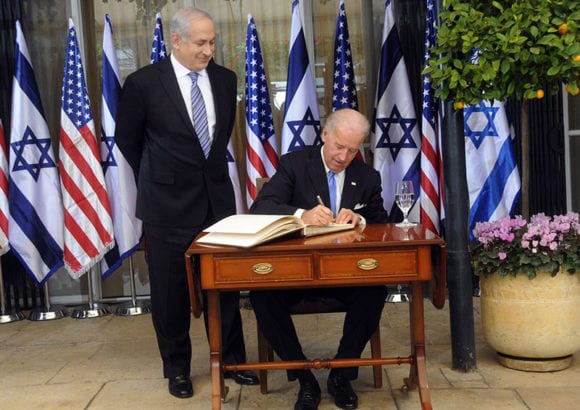
Israeli Prime Minister Benjamin Netanyahu (L) watches Vice President Joe Biden sign his guestbook, March 9, 2010.
By Alison Weir | If Americans Knew | October 14, 2020
The Jewish Forward has just published an article saying that Joe Biden’s long loyalty to a foreign country is a reason to vote for him. The article is entitled “38 billion reasons to vote for Joe Biden.”
The title refers to the $38 billion aid package to Israel, which works out to $7,000 per minute from American taxpayers and is approximately $23,000 per each Jewish Israeli family of four.*
This money is going to Israel even while the U.S. economy has been crippled by COVID-19 closures – 163,735 US businesses have closed down and millions of Americans have lost jobs.
The article celebrating this aid to Israel is by Robert Wexler, who was a Democratic member of the House of Representatives from 1997 to 2010, allegedly representing Florida’s 19th district.
Wexler fails to mention that Israel has a long, thoroughly documented record of human rights violations, beginning with its founding war of ethnic cleansing against the Muslims and Christians who had been the large majority of the region’s inhabitants.
Israeli violence against Palestinian men, women, and children occurs every day, though it’s rarely reported by U.S. media.
In addition, the Forward fails to inform readers that Israel is known for a system of supremacy in which unwelcome religious/ethnic groups, such as Muslims and Christians, are discriminated against and oppressed.
While Israelis reap the benefit of massive US aid packages, these drain much-needed money from American taxpayers and can lead to job losses. Israel has a history of stealing US technology, sometimes selling it to American adversaries.
For former U.S. Congressman Wexler, however, Biden’s leading role in siphoning US tax money to Israel is a reason to vote for him. Below is an excerpt of Wexler’s article published in the Forward:
“…I want to assure these voters that we can count on Joe Biden to fight for Israel’s safety and security. Under his administration, the United States will take steps to strengthen our ties with Israel and enhance Israel’s ability to survive and flourish as a democratic, Jewish state.
Elections are binary choices. We don’t pick and choose the best qualities of each candidate. Regardless of your assessment of President Trump’s performance on Israel, you can vote for Biden with confidence, knowing that his presidency will reflect the deep friendship he has shown toward Israel throughout five decades in public service.
As Vice President, Biden took a leading role in negotiating the 10-year, $38 billion U.S. aid package to Israel that Congress passed in 2016 — the largest in U.S. history. Biden opposes conditioning aid to Israel, even when the U.S. and Israel disagree on policy. Biden is also committed to maintaining Israel’s qualitative military edge. Based on Biden’s past support for Israel’s QME, it is unlikely that a Biden administration would authorize the sale of F-35s or any sophisticated arms to Israel’s neighbors without consulting with Israel and ensuring that safeguards were in place to protect Israel’s security.
Since the 1960s, American presidents have made commitments to Israel’s security and qualitative military edge, a core pillar of Israel’s security strategy that allows the Jewish state to defend itself despite its adversaries’ advantages in size, population, and resources. [Editor’s note: Israel has one of the most powerful militaries in the world, and is the only country in the Middle East with nuclear weapons.] The Trump Administration’s promise of advanced weapon systems tied to the normalization agreement with the United Arab Emirates has made reaffirming this principle all the more important.
Biden has been a strong friend of Israel since his first trip there in 1973. He opposed the sale of AWACs to Saudi Arabia in the 1980s because of his commitment to maintaining Israel’s QME, and within the Obama administration, he advocated providing Israel with crucial missile-defense systems like Iron Dome, David’s Sling, and Arrow 3.
Biden supports humanitarian assistance to the Palestinian people, which will stabilize the Palestinian Authority and enhance Israel’s security. But Biden has been clear that this aid must comply with the Taylor Force Act, which means that the Palestinian Authority must end payments to Palestinian prisoners and families of “martyrs” and eliminate any financial reward for committing acts of terror. [Editor’s note: To understand this legislation for Israel read this and this.]
Biden would restart a positive dialogue with the Palestinians by unequivocally stating that U.S. policy is anchored in a vision of two nation-states — Israel, and a new Palestinian state — living side by side in peace and security. Taking steps with both parties designed to simultaneously improve lives, narrow the conflict, and build a two-state reality would strengthen Israel’s security and bolster bipartisan support for Israel in the U.S. [Editor’s note: In reality, the “state” proposed for Palestinians would be a nonviable entity composed of non-contiguous cantons on, at most, 20 percent of the land; also see this.]
Republicans claim Trump even more dedicated to Israel
While Wexler favors Biden, the Republican Jewish Coalition is promoting Trump, dropping $3.5 million on TV ads for Trump in South Florida. In one ad the narrator says: “Only one candidate has stood with the Jewish community: President Donald Trump, the most pro-Israel president in history.”
Israel partisan Sheldon Adelson is often credited with driving Trump’s policies on the Middle East.
Adelson has said that he regrets that he served in the US military rather than the Israeli one:
* A bill to set the agreement into U.S. law is currently before Congress. It would increase the amount to Israel and provide additional perks to the Jewish state.
Alison Weir is executive director of If Americans Knew, president of the Council for the National Interest, and author of Against Our Better Judgment: The Hidden History of How the U.S. Was Used to Create Israel.
UAE official accuses Palestinians of ‘ungratefulness’ after criticism of Israel ties
Press TV | October 14, 2020
A high-ranking United Arab Emirates (UAE) official has accused Palestinians of “ingratitude” and “lack of loyalty” after Ramallah’s envoy to France harshly criticized the Persian Gulf state and Bahrain over signing normalization agreements with the Israeli regime.
“I was not surprised by the statements made by the Palestinian Ambassador to Paris [Salman El Herfi], and his ungrateful discussion of the Emirates,” Anwar Gargash, the UAE’s minister of state for foreign affairs, wrote in Arabic on his Twitter account.
“We have grown accustomed to the lack of loyalty and the ingratitude. We proceed toward the future confident in all our actions and beliefs,” he added.
Earlier, El Herfi told French magazine Le Point in an interview that UAE and Bahrain “have become more Israeli than Israel” itself and are violating the Charter of the United Nations.
‘UAE dictator playing with fire’
The Palestinian diplomat said that the UAE had long abandoned the Palestinian cause and that he wasn’t surprised by Abu Dhabi’s decision to normalize with Tel Aviv.
“The only new thing was the formalization of this relationship. I thank them (UAE officials) for having revealed their true face,” he said.
“The truth is that the Emirates were never at the Palestinians’ side,” El Herfi went on, noting that the UAE froze aid for the Palestine Liberation Organization (PLO) back in 1985.
Abu Dhabi Crown Prince Mohammed bin Zayed Al Nahyan is merely “a little dictator who wants to become known, and he’s playing with fire,” the veteran Palestinian diplomat said.
The UAE’s de facto leader “surrendered to Israel without a fight,” El Herfi added.
He said the UAE and Bahrain violated a long list of Arab League and UN resolutions by normalizing ties with Israel.
The Palestinian ambassador also denounced the two deals as “pure propaganda,” saying they had neither parliamentary approval nor public support.
“And with all due respect, how many Emiratis are there in the world, 800 thousand? And Bahrainis, 500 thousand? There are 340 million Arabs,” he said.
“In fact, these two countries have come more Israeli than the Israelis. But we have full confidence in the fact that their people will not accept this over the long term,” El Herfi pointed out.
Relations between the UAE and the Palestinians have soured ever since the Emirates and Israel agreed as part of a US-brokered deal to establish formal relations on August 13.
Emirati officials have described the normalization deal with the Tel Aviv regime as a means to stave off annexation and save the so-called two-state solution to the Israeli-Palestinian conflict.
The Palestinians, however, dismiss the claims, saying the deal had long been in the works in the course of secret contacts between Abu Dhabi and Tel Aviv.
Israeli leaders have lined up to reject the UAE’s bluff that Israel’s annexation plans were off the table. Netanyahu has underlined that annexation is not off the table, but has simply been delayed.
Palestinians, who seek an independent state in the occupied West Bank and Gaza, with East Jerusalem al-Quds as its capital, view the deals as a betrayal of their cause and say they run counter to a long-standing Arab consensus over a “two-state solution” along the 1967 borders.
Palestinian President Mahmoud Abbas has said the agreements will be fruitless as long as the United States and the Israeli regime do not recognize the rights of the Palestinian nation and refuse to resolve the issue of Palestinian refugees.
UK Minister’s Christmas Message to Universities…. Adopt IHRA anti-Semitism definition or I’ll axe your funding!

Education Secretary, Gavin Williamson in 10 Downing Street. Credit: Pippa Fowles/ No 10 Downing Street.
By Stuart Littlewood | American Herald Tribune | October 14, 2020
Gavin Williamson is Education Secretary in the screwball government of Boris Johnson. And he has just threatened universities that they could have their funding cut if they don’t adopt the International Holocaust Remembrance Alliance (IHRA) definition of anti-Semitism before Christmas.
Williamson wrote to vice-chancellors last week saying he was “frankly disappointed” that there were still “too many disturbing incidents of anti-Semitism on campus and a lack of willingness by too many universities to confront this”, and that the number of universities adopting the definition “remains shamefully low”.
“These providers are letting down all their staff and students, and, shamefully, their Jewish students in particular,” he said.
He insists that adopting the IHRA definition “is morally the right thing to do” – and he underlines morally! “You should have no doubt: this government has zero tolerance towards anti-Semitism. If I have not seen the overwhelming majority of institutions adopting the definition by Christmas then I will act.”
Williamson is asking officials to consider directing the Office for Students (OfS) to impose a new regulatory condition of registration or suspend funding for universities at which anti-Semitic incidents occur and which haven’t signed up to the definition.
“While many universities have rightly been quick over the summer to demonstrate their readiness to take action against other forms of racism, it is frankly disturbing that so many are dragging their feet on the matter of anti-Semitism.
“The repugnant belief that anti-Semitism is somehow a less serious, or more acceptable, form of racism has taken insidious hold in some parts of British society, and I am quite clear that universities must play their part in rooting out this attitude and demonstrating that anti-Semitism is abhorrent.”
The OfS said they will explore with the Department for Education what practical steps should be taken to ensure the IHRA definition’s wider adoption. But Universities UK were more cautious: “We recommend universities do all they can to tackle anti-Semitism, including considering the IHRA definition, whilst also recognising their duty to promote freedom of speech within the law.” And that last bit is what Williamson ought to have considered before stupidly going off the deep end.
Individual right of free expression in all higher education institutions
Williamson’s first problem is his ignorance. He’s completely at odds with the opinion of top legal experts who were asked for their views by Free Speech on Israel, Independent Jewish Voices, Jews for Justice for Palestinians and the Palestine Solidarity Campaign. In a nutshell, those in public life cannot behave in a manner inconsistent with the European Convention on Human Rights, which provides for freedom of expression which applies not only to information or ideas that are favourably received or regarded as inoffensive, but also to those that offend, shock or disturb the State or anyone else.
There is a further obligation to allow all concerned in public debate “to express their opinions and ideas without fear, even if these opinions and ideas are contrary to those defended by the official authorities or by a large part of public opinion, or even if those opinions and ideas are irritating or offensive to the public”.
Read Article 10 of the European Convention on Human Rights, Mr Williamson, which says that everyone has the right to freedom of expression including “freedom to hold opinions and to receive and impart information and ideas without interference by public authority and regardless of frontiers.”
Also, check Article 19 of the Universal Declaration of Human Rights which says the same sort of thing, subject of course to the usual limitations required by law and respect for the rights of others.
The House of Commons Home Affairs Select Committee recommended that before accepting the IHRA’s definition of anti-Semitism, two caveats should be included:
- It is not anti-Semitic to criticise the Government of Israel, without additional evidence to suggest anti-Semitic intent.
- It is not anti-Semitic to hold the Israeli Government to the same standards as other liberal democracies, or to take a particular interest in the Israeli Government’s policies or actions, without additional evidence to suggest anti-Semitic intent.
The Government, in its eagerness to appease the Zionist lobby, dropped the caveats saying they weren’t necessary.
Eminent human rights lawyer Hugh Tomlinson QC also criticised the definition. Firstly, it wasn’t a legally binding definition so it didn’t have the force of a statutory one. And it couldn’t be considered a legal definition of anti-Semitism as it lacked clarity. Therefore any conduct contrary to the IHRA definition couldn’t necessarily be ruled illegal.
Secondly, the language was far too vague to be useful as a tool. In Tomlinson’s view the Government’s decision to adopt the IHRA Definition was simply a freestanding statement of policy, a mere suggestion. No public body is under an obligation to adopt or use it, or, given the unsatisfactory nature of the definition, should be criticised for refusing.
He warned that if a public authority did decide to adopt the definition then it must interpret it in a way that’s consistent with its statutory obligations. In particular, it cannot behave in a manner inconsistent with the European Convention on Human Rights, which provides for freedom of expression and freedom of assembly.
A further obligation put on public authorities is “to create a favourable environment for participation in public debates for all concerned, allowing them to express their opinions and ideas without fear, even if they are contrary to those defended by the authorities or by a large part of public opinion”.
So, in Tomlinson’s opinion the IHRA Definition doesn’t mean that calling Israel an apartheid state that practises settler colonialism, or advocating boycott, divestment or sanctions (BDS) against Israel, can properly be characterized as anti-Semitic. Furthermore, a public authority seeking to apply the IHRA Definition to prohibit or punish such activities “would be acting unlawfully.”
Government’s ‘naive stance’
Retired Lord Justice of Appeal, Sir Stephen Sedley, also offered advice criticising the IHRA working definition for lack of legal force. “At the same time, it is not neutral: it may well influence policy both domestically and internationally.”
He added that the right of free expression, now part of our domestic law by virtue of the Human Rights Act, “places both negative and positive obligations on the state which may be put at risk if the IHRA definition is unthinkingly followed”. Moreover the 1986 Education Act established an individual right of free expression in all higher education institutions “which cannot be cut back by governmental policies”.
Sedley was of the view that the IHRA definition is open to manipulation and “what is needed now is a principled retreat on the part of government from a stance which it has naively adopted in disregard of the sane advice given to it by the Home Affairs Select Committee.”
Williamson’s second problem is his prejudice. He’s a fanatical Israel worshipper and far from neutral in the hype surrounding anti-Semitism in the UK. In January 2018 when he was defence secretary he addressed an audience of over 250 Conservative Friends of Israel and supporters, including 50 parliamentarians, telling them that “Britain will always be Israel’s friend” and praising Israel as a “beacon of light and hope, in a region where there is so much hatred and hurt”. He added: “We shouldn’t underestimate how difficult it is to keep that light bright and burning”.
Recalling his visit to Israel as a teenager, he said: “What I found was a liberal, free, exciting country that was so at ease with itself, a country that absorbed and welcomed so many people. That made an enormous impression upon me”.
Williamson condemned the “completely unreasonable… sheer simple hatred” channelled towards Israel and asked: “If we are not there to stand up for a country, whose views and ideals are so close, or are simply our own, what are we as a nation? What are we in politics, if we cannot accept and celebrate the wonderful blooming of democracy that is Israel?”
Achingly funny. And highlighting the UK’s role in the creation of Israel, he said: “Britain and Israel have an amazing relationship. We would like to think that we were very much at the birth of the nation, and very much helped it in terms of its delivery and coming into the world”.
He said that Britain and Israel have “a strong and firm relationship of working together. It’s a relationship of partners…. It’s a partnership of equals. A partnership of friends”.
So hopelessly brainwashed.
Then, in April 2018 at a similar meeting to celebrate the regime’s 70th anniversary Williamson waxed lyrical describing Israel as a “light unto the nations” and adding that not only do Israel and Britain face shared security threats, “our relationship is underpinned by a shared sense of values: justice, compassion, tolerance”. He emphasised that Israel is a “liberal, free and exciting country” and that the UK-Israel relationship is the “cornerstone of so much of what we do in the Middle East”.
Breaching the Ministerial Code?
But Gavin Williamson is not the only Government minister to threaten our universities in this crude manner. A year ago Communities Secretary Robert Jenrick vowed to take action against universities and “parts of local government” who, he said, had become “corrupted” by anti-Semitism. He directed his attack on the universities who receive public money but “choose not to accept our IHRA definition of anti-Semitism and use it when considering matters such as disciplinary procedures”.
Writing in the Sunday Express, he added: “I will use my position as Secretary of State to write to all universities and local authorities to insist that they adopt the IHRA definition at the earliest opportunity.
“I expect them to confirm to me when they do so. Failure to act in this regard is unacceptable and I will be picking up the phone to Vice Chancellors and local government leaders to press for action, if none is forthcoming.”
According to Wikipedia Jenrick’s wife was born in Israel and their children are brought up in the Jewish faith. He told the Board of Deputies he would not tolerate local authority approved BDS (Boycott, Divestment and Sanctions) campaigns against those profiteering from Israel’s illegal occupation of Palestine. “Local authorities should not be wasting time and taxpayer’s money by dabbling in foreign policy or pursuing anti-Israel political obsessions, but instead focusing on delivering first class local public services.” The same could be said of his colleague Williamson’s pro-Israel obsession – and his own – when they should be getting on with governing Britain, but of course they are exempt from their own rules.
Both Jenrick and Williamson appear to fall foul of the Ministerial Code. The first two paragraphs are enough to banish them to outer darkness, one would have thought.
1.1 Ministers of the Crown are expected to maintain high standards of behaviour and to behave in a way that upholds the highest standards of propriety.
1.2 Ministers should be professional in all their dealings and treat all those with whom they come into contact with consideration and respect. Working relationships…. should be proper and appropriate. Harassing, bullying or other inappropriate or discriminating behaviour wherever it takes place is not consistent with the Ministerial Code and will not be tolerated.
Elsewhere the Code decrees that “ministers must ensure that no conflict arises, or appears to arise, between their public duties and their private interests” and they are expected to observe the Seven Principles of Public Life. The Principle of Integrity states that holders of public office “must avoid placing themselves under any obligation to people or organisations that might try inappropriately to influence their work”.
That suggests to me they ought to be slung out on their ear and never allowed near the levers of power again. But nobody in government is principled enough or has the balls to do it.
What do you think?
Dying Alone: When We Stopped Caring for Palestinian Prisoners
By Ramzy Baroud | Dissident Voice | October 12, 2020
“No one cares about the prisoners.” Over the past few years, I have heard this phrase — or some variation of it — uttered many times by freed Palestinian prisoners and their families. Whenever I conduct an interview regarding this crucial and highly sensitive topic, I am told, repeatedly, that ‘no one cares.’
But is this really the case? Are Palestinian prisoners so abandoned to the extent that their freedom, life and death are of no consequence?
The subject, and the claim, resurfaces every time a Palestinian prisoner launches a hunger strike or undergoes extreme hardship and torture, which is leaked outside Israeli prisons through lawyers or human rights organizations. This year, five Palestinian prisoners died in prison as a result of alleged medical negligence, or worse, torture.
Even international humanitarian aid workers, like Mohammed el-Halabi, are not immune to degrading treatment. Arrested in August 2016, el-Halabi is yet to be charged for any wrongdoing. News of his plight, which originally received some media attention — due to his work with a US-based organization – is now merely confined to Facebook posts by his father, Khalil.
As of October 1, el-Halabi has been paraded before 151 military trials, yet unaware what the charges are. The cherished Palestinian man, who has played a major role in providing cancer medicine to dying children in Gaza, now holds the record of the longest military trial ever carried out by the Israeli occupation.
Desperate for some attention, and fed up with cliches about their ‘centrality in the Palestinian struggle’, many prisoners, whether individually or collectively, launch hunger strikes under the slogan: ‘freedom or death’. Those who are held under the draconian and illegal ‘administrative detention’ policy, demand their freedom, while ‘security prisoners’, who are held in degrading conditions, merely ask for family visitations or food that is suitable for human consumption.
Health complications resulting from hunger strikes often linger long after the physical ordeal is over. I have interviewed families of Palestinians who were freed from Israeli prisons, only to die in a matter of months, or live a life of endless pain and constant ailments for years following their release.
According to some estimates, over 800,000 Palestinians have been imprisoned in Israeli jails since the Israeli occupation of East Jerusalem, the West Bank and Gaza in June 1967.
Maher al-Akhras is currently writing the latest chapter in this tragic narrative. At the time of writing this article, he has just concluded 77 days of uninterrupted hunger strike. No medical opinion is necessary to tell us that al-Akhras could die any moment. A recent video released of al-Akhras on his Israeli hospital bed conveyed a glimpse of the man’s unbearable suffering.
With a barely audible voice, the gaunt, exhausted-looking man said that he is left with only two options: either his immediate freedom or death within the confines of Israel’s “phony justice system.”
On October 7, his wife, Taghrid, launched her own hunger strike to protest the fact that “no one cares about” her husband.
Once again, the lack of concern for the plight of prisoners, even dying ones, imposes itself on the Palestinian political discourse. So, why is this the case?
The idea that Palestinian prisoners are all alone in the fight for freedom began in the early 1990s. It was during this period that the various Oslo Accords were signed, dividing the Occupied Territories into zones governed by some strange Kafkaesque military system, one that did not end the Israeli occupation, but, rather, cemented it.
Largely dropped from the Israeli-Palestinian negotiations agenda at the time, but permanently, eventually, were several pressing issues fundamental to Palestinian rights and freedom. One of these issues was Israel’s brutal system of incarceration and imprisonment without trial.
Certainly, some Palestinian prisoners were released in small batches occasionally, as ‘gestures of goodwill’; but the system, itself, which gave Israel the right to arrest, detain and sentence Palestinians, remained intact.
To date, the freedom of Palestinian prisoners — nearly 5,000 of them are still held in Israel, with new prisoners added daily — is not part of the Palestinian leadership political agenda, itself subsumed by self-interests, factional fights and other trivial matters.
Being removed from the realm of politics, the plight of prisoners has, over the years, been reduced to a mere humanitarian subject — as if these men and women are no longer political agents and a direct expression of Palestinian resistance, on the one hand, and Israel’s military occupation and violence, on the other.
There are ample references to Palestinian prisoners in everyday language. Not a single press release drafted by the Palestinian Authority, its main Fatah faction or any other Palestinian group fails to renew the pledge to free the prisoners, while constantly glorifying their sacrifices. Unsurprisingly, empty language never produces concrete results.
There are two exceptions to the above maxim. The first is prisoner exchanges, like the one that took place in October 2011, resulting in the freedom of over 1,000 Palestinian prisoners. And, second, the prisoners’ own hunger strikes, which are incremental in their achievements, but have, lately, become the main channel of resistance.
Sadly, even solidarity with hunger strikers is often factional, as each Palestinian political group often places disproportionate focus on their own striking prisoners and, largely ignores others. Not only has the issue of prisoners become depoliticized, it has also fallen victim to Palestine’s unfortunate disunity.
While it is untrue that ‘no one cares about Palestinian prisoners’, thousands of Palestinian families are justified to hold this opinion. For the freedom of prisoners to take center stage within the larger Palestinian struggle for freedom, the issue must be placed at the top of Palestine’s political agenda, by Palestinians themselves and by Palestinian solidarity networks everywhere.
Maher al-Akhras, and thousands like him, should not risk their lives to obtain basic human rights, which should, in theory, be guaranteed under international law. Equally important, Palestinian prisoners should not be left alone, paying a price for daring to stand up for justice, fairness and for their people’s freedom.
 Ramzy Baroud is a journalist and the editor of The Palestine Chronicle. He is the author of five books. His latest is These Chains Will Be Broken: Palestinian Stories of Struggle and Defiance in Israeli Prisons (Clarity Press). Baroud is a Non-resident Senior Research Fellow at the Center for Islam and Global Affairs, Istanbul Zaim University (IZU). Read other articles by Ramzy, or visit Ramzy’s website.
Featured Video
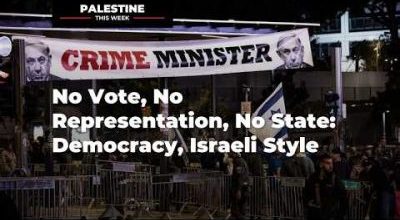
No Vote, No Representation, No State: Democracy, Israeli Style
or go to
Aletho News Archives – Video-Images
From the Archives
Sanctions, War and the Policy of Dual Containment
By SASAN FAYAZMANESH | March 17, 2008
It is now nearly three decades since the Unites States adopted the policy of dual containment of Iran and Iraq. While much has been written about the containment of Iraq, there has been very little in-depth analysis of this policy when it comes to Iran. In a book that is going to be released on March 31, 2008, entitled The United States and Iran: Sanctions, Wars and the Policy of Dual Containment (Routledge), I attempt to address this shortcoming by investigating when and why the US policy of containment of Iran came about, how it evolved, and where it stands today.[1] To the extent that Israel has been involved in US policy making, the study will also include the role that Israel has played in the containment of Iran. Also, since the fate of Iran has been inextricably linked to that of Iraq, occasionally the investigation will overlap with the containment of Iraq.
The policy of dual containment of Iran and Iraq originated during the Carter Administration, but it was not until the Clinton Administration that the expression “dual containment” became popular. … continue
Blog Roll
 Aletho News
- Elmo Sold mRNA Jabs to Your Toddler. Now They Are “Off-Label.”
- British state targets Palestine Action with yet another crooked trial
- Americans are paying the price to preserve Israel’s nuclear hegemony
- Resistance factions are necessary to ensure a permanent US Iraq withdrawal
- How Israel destabilizes the Middle East: Denying sovereignty and the right to exist
- Europe’s Establishment Is Embracing War – and Losing Voters
- NATO chief advocates war of aggression
- No Vote, No Representation, No State: Democracy, Israeli Style
- Zionist Bought Senate Blocks Information About American Citizens Killed By Israel
- While Gaza dominates the UN, these are the people keeping it alive
- If Americans Knew
- Israeli Soldiers Abduct At Least 22 Across Occupied West Bank
- Eight Palestinians Killed in Israeli Attacks on Gaza
- Israeli former leaders and security chiefs threaten legal action over ‘Jewish terrorism’
- Israel map in LA Times ad includes all land from the river to the sea
- Inside Lebanon’s 200-page dossier on Israeli war crimes
- Flydubai, genocide, settler violence, Trump abuse of power to deport – Daily Update
- Counting Antisemitic Incidents: What the ADL Audit Reveals — and Obscures
- Mamdani releases plan to combat antisemitism and hate crimes in New York City
- Iran’s Revolutionary Guards Publish Letter to the American People
- DMFI launches $1 million ad campaign supporting Virginia’s Elaine Luria
- No Tricks Zone
- Green Energy Debacle: German Expert Professor Fritz Vahrenholt Warns Of Severe Economic And Social Consequences
- Two More Paleo Reconstructions Affirm Meters-Higher Sea Levels Across Ireland, Brazil 7000-6000 Years Ago
- New Study: Earth And Venus Surface Warmth Largely Explained By Convection And Lapse Rate, Not CO2 Or Radiation
- 2025 Nature Paper Claiming Worsening Global Drought Gets RETRACTED …Heavily Flawed
- New Study: ‘Global Drought Shows No Detectable Recent Acceleration Under Climate Warming’
- Economic Masterminds: German Socialists Suggest Taxing Productivity Gains Stemming From Using AI
- The South China Sea Has Not Been Cooperating With The Climate Change Narrative
- Energy Crisis: Germany Enters Heating Season With Historically Low Gas Reserve Fill Levels
- New Study: The Antarctic Ice Sheet Gained Mass From 2020-2024 Due To Staggering Snow And Ice Accumulation
- Study: Ocean Heating Rates From Thousands Of Years Ago ‘Dwarf’ Modern Ocean Heating Rates

