Israeli Soldiers Kill A Palestinian Near Ramallah
IMEMC News – May 30, 2020
Israeli soldiers killed, on Friday evening, a Palestinian father of five children, including an infant, allegedly after he tried to ram them with his car near Nabi Saleh village, northwest of the central West Bank city of Ramallah. His family denied the military allegations and said the man lost control of his car after Israeli colonialist settlers opened fire at it.
The Israeli army claimed that the soldiers fired live rounds at the Palestinian car after the driver reportedly tried to ram them, and that the soldiers “neutralized the threat,” a term Israel and various Israeli media outlets frequently use when the soldiers fatally shoot a Palestinian.
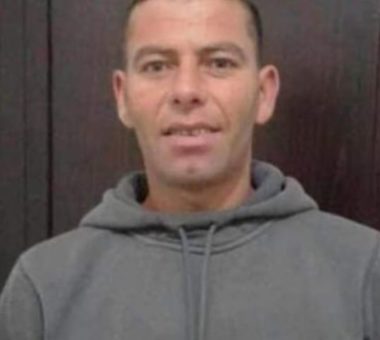 The slain man has been identified as Fadi Adnan Sarhan Samara, 37, a father of five children, including an infant (two months of age) from Abu Qash village, north of Ramallah.
He works in Israel and came back home to Nabi Saleh to celebrate the Muslim feast of al-Fitr with his family.
His brothers stated that he left his home in the evening heading to the az-Zawiya village, west of Salfit in central West Bank, to drive his wife and children back home, as they were visiting her family there.
The Israeli army claimed that the man tried to ram soldiers with his car near a natural spring in the Ramallah governorate. He was shot in the leg and was left to bleed for about an hour, without any first aid.
Palestinian media outlets and residents in the area said the man lost control of his car when illegal Israeli colonialist settlers, who repeatedly invade the area, opened fire at his car, before the soldiers fired a barrage of live rounds at it, claiming that he was attempting to ram them.
One of his brothers, and one of his cousins, were both detained by the army, and after being released, they stated that an army officer told them, after confirming his identity, that they cannot take his corpse for burial.
They stated that the military was taunting them by stating that the family can have his corpse back “maybe in an hour or two, a month or two, a year or two….”
His family, and the residents of his village, strongly denounced his murder, and stated that the Israeli soldiers are always “trigger happy” when it comes to shooting Palestinians, and that the army tries to justify these crimes by making false allegations.
They called for a serious investigation into the fatal shooting and called on international organizations to act and hold Israel accountable at the International Criminal Court (ICC) for its escalating crimes and ongoing violations against the Palestinian people, their homes and property.
Israeli Police Kill Unarmed Man with Mental Disability in Jerusalem
![Iyad Hallaq, a mentally disabled Palestinian was killed by Israeli forces in Jerusalem on 30 May 2020 [Twitter]](https://i1.wp.com/www.middleeastmonitor.com/wp-content/uploads/2020/05/Iyad-Hallaq.jpg?resize=1200%2C787&quality=85&strip=all&ssl=1)
Israeli forces shot and killed Iyad Khairi Hallak, 32, a Palestinian man with mental disability. (Photo: via Social Media)
Palestine Chronicle | May 30, 2020
Israeli forces shot and killed a Palestinian man with mental disability in East Jerusalem on Saturday morning, according to the Palestinian news agency WAFA.
According to Israeli reports, Israeli officers opened fire on a man who was carrying “a suspicious object that looked like a pistol” and ran away when ordered to stop.
Later Israeli reports confirmed that the man, who was shot dead during the chase, was actually unarmed.
The victim was identified as Iyad Khairi Hallak, 32, from Wad el-Joz neighborhood in occupied East Jerusalem. Hallak, who was attending an institution for people with special needs in the same area where he was killed, was left on the ground bleeding until he died.
Police closed all gates leading into Jerusalem’s old city following the incident and banned entry or exit from it. They also raided the Hallak home in Wad el-Joz, according to Palestinian sources.
Annexing the Aquifers: Israel and the Water Crisis in Occupied Palestine
By Fareed Taamallah | Palestine Chronicle | May 28, 2020
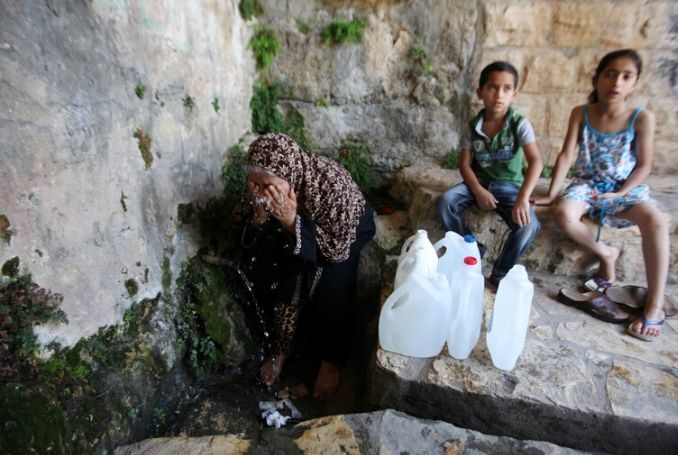
Last week, the Palestinian Water Authority blasted Israel for significantly reducing the amount of water allotted to the West Bank. “We are facing this crisis as we enter the summer season, a time of the year when people are usually in need of more, not less water,” PWA leader Mazen Ghneim was quoted as saying.
In my neighborhood in Ramallah, every year during the summer months, we hardly have water in the pipes. Water runs only one day a week. So, all the households must follow the water distribution schedule to plan their house activities such as doing the laundry and house cleaning. Some Palestinian communities in the West Bank are linked to “joint” water networks that serve illegal Israeli settlers. During the dry summer months, water valves leading to the adjacent Palestinian communities are routinely shut off by Israeli authorities, so that the settlers do not suffer water shortages.
The water shortage in the Palestinian territories is not a nature-related water crisis, but rather a result of the Israeli occupation which exploits over 85% of the water resources.
Facts and Figures
Israel controls the main three trans-boundaries aquifers in the occupied Palestinian territories. The first and the biggest one is the West Bank (mountains) aquifer which is fed by rainfall and generates 679 mcm of water per year. The second is the Jordan river which provides Israel with an estimated 450 mcm per year. Palestinians are denied access and supply of its water. The third is the coastal aquifer which generates 450 mcm of water for Israel and 55 mcm for Gaza.
Palestine has a good precipitation rate. Ramallah, for instance, has an annual rainfall average of 615 millimeters which is almost as much as London at 620 mm.
According to the Palestinian water authority report of 2012, around 784 mcm of rainfall is estimated to have recharged the groundwater systems in the West Bank and the Gaza Strip. However, Palestinians are allocated only 375 mcm of that groundwater, while Israel consumes 2,346 mcm annually.
The Oslo Agreement
The water problem started from the beginning of the Israeli occupation of Palestine but was exacerbated with the Oslo II interim agreement between the PLO and the Israeli government in 1995. The Oslo Agreement stipulated “the equitable utilization of joint water resources for implementation in and beyond the interim period.” But in reality, this has never happened.
The agreement which was supposed to be an interim period of five years bounded the development of Palestinian water resources and was framed on the assumption that Palestinian water needs were 70–80 mcm per year and that the interim water development must be managed through a Palestinian-Israeli mechanism. The topics of ‘common interest’ (water being one) would be further delineated under the permanent status negotiations.
The failure to reach a permanent agreement has meant the inequitable distribution of the West Bank groundwater resources with 15% allocated to the Palestinians and 85% to Israel.
As indicated in the Oslo Agreement, a Joint Water Committee (JWC) was established to oversee all water and wastewater related projects in the West Bank. JWC is made up of an equal number of representatives of Israel and the Palestinian Authority, respectively, and decisions are made by consensus. This gave Israel a veto power over all Palestinian water resource projects and blocked any request by the Palestinians to drill a new well. Wells built or rehabilitated without Israeli-issued permits are systematically destroyed by the Israeli occupation forces.
Water Apartheid
While the Palestinian communities are facing drought and water shortages, the Israeli settlements – located in the same geographical area – are enjoying an abundance of water supplies, allowing settlers to fill their swimming pools and irrigate their gardens and fields. The lack of access to adequate quantities of water necessary for livestock herding and food production leaves Bedouins, livestock owners and farmers particularly vulnerable.
Israeli agricultural settlements in the West Bank, particularly those in the Jordan Valley, enjoy up to 6 times the amount of water of the nearby Palestinian communities. In the Palestinian town of Tubas, the consumption rate is 30 liters per person per day. However, residents of the nearby illegal Israeli settlement of Beda’ot, consume around 401 liters per day, according to B’Tselem.
While the Palestinian population has doubled, water availability has decreased. According to the World Bank report of 2018 “With the West Bank and Gaza population of approximately 4.8 million growing at an average annual rate of 2.8 percent, the domestic supply gap is projected to be about 152 and 135 million cubic meters respectively”.
Israeli hydro-hegemony has left Palestinians with a deficit water budget. They have been forced to purchase from Israel around a quarter of domestic water supplies to make up for this deficit.
According to the Palestinian Bureau of Statistics, the daily per capita water consumption rate is around 88 liters. By comparison, the daily per capita water consumption in Israel is 257 liters. The World Health Organization (WHO) recommends 100 liters of water per capita per day as a minimum. Palestinian consumption is less than the minimum.
In the Gaza Strip, the water situation is even worse. The severe lack of water caused by the Israeli brutal blockade since 2007, has led to a heavy reliance on the underlying portion of the Coastal aquifer as Gaza’s only water supply.
The 2 million inhabitants extracted about 180 mcm in 2017, but this quantity is obtained via unsafe pumping that jeopardizes the sustainability of the source, while the total recharge is only one-third of extraction. The direct consequences of over pumping are seawater intrusion and uplift of the deep brine water; as a result, 97% of the water is undrinkable and does not match WHO quality standards of accepted guidelines for potable water resources.
Annexation Plan
Israel is controlling the two main Palestinian water resources in the West Bank (the Jordan River basin in the east and the western mountain aquifer) which supply Israel with about 900 million cubic meters of water annually.
Through the annexation of the West Bank areas expected this summer, Israel aims to keep the West Bank aquifers behind the new Israeli borders by retaining control of the settlement blocks adjacent to the basins, in particular, the Jordan Valley and the Salfit area where my hometown of Qira is located.
That annexation will perpetuate the high Israeli water-consumption levels while denying basic Palestinian needs and force Palestinians to depend on Israel for water, thus preserving the status quo of a dramatic unjust division of water resources, dimming any hope for a viable Palestinian state and peace in the region.
– Fareed Taamallah is a Palestinian journalist, a farmer, and a political activist based in Ramallah.
Pro-Israel PAC Funds Go to Democrats To Keep Them in Line
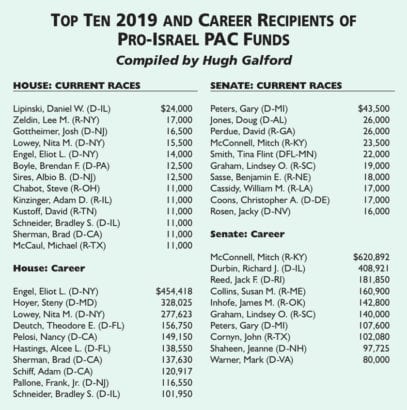
Washington Report on Middle East Affairs, June/July 2020, p. 32
Election Watch
By Delinda C. Hanley and Dale Sprusansky – Washington Report on Middle East Affairs
It’s ironic that despite the Trump administration showering gifts on Israel (moving the embassy to Jerusalem, accepting the annexation of the Golan Heights and giving a green light to annexing even more of the West Bank), the pro-Israel Political Action Committees (PACs) gave most of their cash to Democrats. And we don’t even count Super PACs, which can raise funds from individuals, corporations, unions, and other groups without any legal limit on donation size. For those pay a visit to http://www.OpenSecrets.org.
Even with so many Israeli dreams coming true under a Republican president, the lobby remained staunch Democratic contributors.
As presidential candidate Bernie Sanders surged ahead in the polls, a pro-Israel super PAC called Democratic Majority for Israel, went after him, airing TV attack ads on the man who would have been the first Jewish president. His crime? Sanders called Israeli Prime Minister Binyamin Netanyahu a “reactionary racist” and blasted the American Israel Public Affairs Committee for providing a platform “for leaders who express bigotry and oppose basic Palestinian rights.”
Sanders also said, if elected president, he would leverage the $3.8 in U.S. military aid to push Israel to change its policies toward the Palestinians. Enough said. [Editor’s note: A bill to require American taxpayers to give Israel at least that much every year for the next 10 years is poised to be passed right now, unless enough people object.]
But other candidates won their fights with the pro-Israel lobby. Despite receiving more money from pro-Israel PACs than any other candidate running for a House seat this election cycle, Rep. Daniel Lipinski (D-IL) lost his March primary to a challenger from the left, entrepreneur Marie Newman.
Better known for being the last pro-life Democrat to hold federal office than his support for Israel, Lipinski was nevertheless a dependable pro-Israel vote. In 2014, Lipinski co-sponsored the Protect Academic Freedom Act, which would have denied federal funding to academic institutions supporting a boycott of Israel.
Newman, endorsed by the liberal Zionist group, J Street, issued a lengthy 12-point explainer in 2019, describing her rather mainstream views on Israel/Palestine. She expressed her support for U.S. aid to Israel, a two-state solution, and the right of Israel to exist as a Jewish state. Notably, she did vow to oppose anti-boycott laws that threaten the rights of Americans to boycott Israel.
Lipinski had held his reliably Democratic northern Illinois seat since 2005. He lost the primary to Newman by less than 3,000 votes. Every vote counts, but not every dollar guarantees a win.
Dale Sprusansky is managing editor and Delinda Hanley is executive editor of the Washington Report on Middle East Affairs.
‘Muzzling Freedom of Expression’: Facebook Slammed for Appointing Israeli Censor to Oversight Board
Sputnik – May 28, 2020
On 6 May Facebook revealed the first 20 members of its Oversight Board, an independent body entrusted with the final say over certain content moderation decisions for the world’s largest social media platform, the creation of which was announced in November 2018, to avoid accusations of bias over removing content deemed problematic
Facebook has been taking flack for hiring the former director-general of Israel’s justice ministry as a member of its new Oversight Board, which will be able to overturn the company’s own content moderation decisions.
Under Emi Palmor, who headed the justice ministry from 2014 until she was dismissed from her post last year, the Israeli ministry “petitioned Facebook to censor legitimate speech of human rights defenders and journalists because it was deemed politically undesirable,” insisted Palestinian civil society groups in May, writes The Electronic Intifada, an online Chicago-based publication covering the Israeli–Palestinian conflict.
The groups slammed Facebook’s choice of Palmor to the international panel that will take content moderation decisions for the world’s largest social media platform.
Palmor, they warn, could potentially “muzzle freedom of expression” on the platform, censoring human rights defenders, particularly Palestinian, Arab and Muslim.
The Palestine Digital Rights Coalition, the Palestinian Human Rights Organizations Council and the Palestinian Non-Governmental Organizations Network have been quoted as urging Facebook to “consider the grave consequences that electing Emi Palmor may have particularly on Palestinian human rights defenders and on freedom of expression online in defense of Palestinian rights.”
Palmor was employed as a top civil servant during the term in office of Ayelet Shaked as Minister of Justice.
Under Palmor’s oversight, say the groups, the ministry established a cyber unit whose efforts resulted in the removal of tens of thousands of Palestinian posts from social media platforms, with Adalah, a group advocating for the rights of Palestinians in Israel, calling into question the legality of the unit’s practices.
According to Adalah, with “no transparency or legal procedure whatsoever”, the unit directs requests to the Israeli state attorney, demanding that “Facebook and Google remove, restrict or suspend access to certain content, pages or users.”
Adalah claims the procedure leaves users no possibility to defend themselves against allegations that their posts were “illegal or warranted removal.”
The Oversight Board
On 6 May Facebook revealed the names of the first 20 members of its international Oversight Board, an independent body that will be tasked with specific content moderation decisions.
The board will govern appeals regarding content takedowns from Facebook and Instagram users, receiving cases through a content management system linked to Facebook’s own platforms.
The members – a diverse group containing lawyers, journalists, human rights advocates and other academics with expertise in digital rights, religious freedom, content moderation, internet censorship and civil rights – will discuss the case as a group before issuing a final say regarding whether the content should be allowed to stay up or not.
“We are all committed to freedom of expression within the framework of international norms of human rights,” the four co-chairs of the board – Catalina Botero-Marino, Jamal Greene, Michael W McConnell and Helle Thorning-Schmidt – wrote in a New York Times op-ed introducing themselves to the public on 6 May. “We will make decisions based on those principles and on the effects on Facebook users and society, without regard to the economic, political or reputational interests of the company.”
In November 2018, in the wake of a New York Times report that slammed Facebook for social media misuses, the company announced the establishment of an independent panel.
Helle Thorning-Schmidt, former Prime Minister of Denmark and one of the board’s four co-chairs, was quoted by CNBC as saying:
“Up until now some of the most difficult decisions about content have been made by Facebook and you could say Mark Zuckerberg… Facebook has decided to change that.”
Set to eventually comprise around 40 members, the board will begin hearing cases in the coming months.
Amid a slew of charges of bias and politically censoring content, the move is seen by many as potentially able to help Facebook avoid the accusations which it emphatically rejects.
Last December, Facebook pledged the board $130 million in funding, with the money set to cover operational costs for at least six years.
In January, however, Facebook outlined the extent to which it remained in control, in a 46-page document.
Facebook outlined the powers and limitations of the board, stating that the board’s decisions do not necessarily set precedents that the company would be called upon to adhere to in the future, and the board is limited when it comes to content it can address.
Netanyahu on Annexation Plan: Palestinians Will Offer Concession, Not ‘Israel’
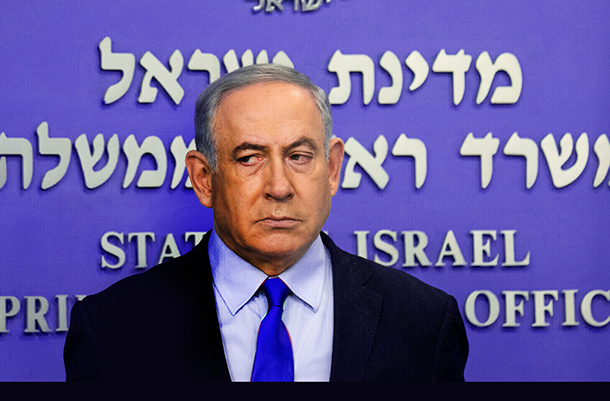
Israeli prime minister Benjamin Netanyahu holds a press conference at the Prime Ministers office in Jerusalem on March 12, 2020. Photo by Olivier Fitoussi/Flash90
Al-Manar | May 28, 2020
Benjamin Netanyahu says the Palestinians are the side who will offer concession as the Israeli PM eyes implementing the annexation plan of West Bank and Jordan Valley.
“Only if the Palestinians agree that Israel has security and control throughout the territory, they will receive their own entity that (US President Donald) Trump defines as a state,” Netanyahu told Israel Hayom in an interview.
“We are not urged to offer concessions, but the Palestinians are those who will do so,” the Israeli PM added.
Meanwhile, he said that “attempts to set free Israelis held in Gaza are underway,” but noted that he “will not release Palestinian prisoners who “have blood on their hands.”
Member of the Scottish parliament dismisses Palestinian Nakba as ‘self-inflicted’
![Richard Lyle during First Minister's Questions in the Scottish Parliament, on February 7, 2019 in Edinburgh, Scotland. [Ken Jack/Getty Images]](https://i1.wp.com/www.middleeastmonitor.com/wp-content/uploads/2020/05/GettyImages-1094968024-scaled-e1590509175132.jpg?resize=1200%2C800&quality=85&strip=all&ssl=1)
Richard Lyle during First Minister’s Questions in the Scottish Parliament, on February 7, 2019 in Edinburgh, Scotland. [Ken Jack/Getty Images]
MEMO | May 26, 2020
A member of the Scottish parliament (MSP) has sparked outrage by suggesting that the ethnic cleansing of 750,000 Palestinians when Israel was founded in their land in 1948 was “self-inflicted”.
The remark by Richard Lyle, of the Scottish National Party (SNP), was made in a proposed amendment to a parliamentary motion marking the 72nd anniversary of the Nakba (Catastrophe).
More than half of the indigenous Palestinian population was expelled by Zionist militias and the nascent Israeli army between 1947 and 1949 in a deliberate campaign of ethnic cleansing known as “Plan Dalet”. Historians explain that this was intended to gerrymander a Jewish majority in Palestine through violent means. The Nakba is marked annually by Palestinians and their supporters around the world.
Lyle, who is the deputy convener of the cross-party group called “Building Bridges With Israel” (BBI) and has visited the Zionist state at the invitation of the Israeli embassy in London, made an amendment to a Nakba Day parliamentary motion submitted by fellow SNP member Sandra White MSP.
The motion recognised the “mass eviction of over 750,000 people from historic Palestine land, which included the destruction of over 500 towns and villages” which “led to generations of pain for the Palestinian people, who continue to live under a state of occupation.”
However, Lyle’s amendment peddled an Israeli propaganda trope blaming the victims. The Nakba, he added, was “sadly a self-inflicted tragedy, which must, after all these years, be finally resolved by peaceful means and discussions between the parties involved.”
This triggered a backlash. Some SNP members have condemned the move, calling the motion an “insult to every Palestinian worldwide” and describing it as a “disgusting piece of revisionist history.”
“It is disgraceful to suggest that the Nakba and subsequent occupation which has led to the killing of tens of thousands of innocent men, women and children is somehow self-inflicted,” insisted Nadia El-Nakla, the convenor of SNP Friends of Palestine, whose family members were and are victims of Israel’s ethnic cleansing of their land. El-Nakla added that Lyle’s comments are “abhorrent… racist and hate filled.” She called for the amendment to be withdrawn and for Lyle to apologise.
The amended motion has apparently garnered the support of just one other MSP, Conservative Adam Tomkins.
Lyle is a controversial figure in Scotland on the issue Palestine and Israel. In 2018 he was part of a BBI delegation to the occupation state. According to the Times, the trip was valued at £2,200 ($2,716) per person and was paid for by the Israeli Embassy in London. The visit was criticised sharply, especially as it coincided with Israel passing the so-called Nation State Bill. Critics, including traditional supporters of the Zionist state, have denounced the legislation as “racist”.
The MSP may face disciplinary action by his own party for his comments. SNP affiliate groups are said to be reporting Lyle to the party’s national secretary.
Political ambiguity or a doomsday weapon: Why Abbas abandoned Oslo
By Ramzy Baroud | MEMO | May 26, 2020
This time, we are told, it is different and that President of the Palestinian Authority, Mahmoud Abbas, is absolutely serious about his decision to absolve his leadership from all previous agreements signed with Israel and the United States.
But this time is not different, and Abbas is not serious.
“The Palestine Liberation Organization (PLO) and the state of Palestine are absolved … of all the agreements and understandings with the American and Israeli governments … including the security ones,” Abbas declared at an emergency meeting of his leadership held in Ramallah on May 19.
Unsurprisingly, there were no massive demonstrations reported throughout Occupied Palestine in support of Abbas’ latest decision. Aside from a few loyalists in PA-controlled media, it seemed as if the man did not utter a word, let alone cancel all agreements that justified the very existence of his Authority over the course of nearly 30 years.
The demonstrable truth is that Abbas ceased to matter to Palestinians a long time ago. However, for Israel, he mattered greatly, because his Authority has served as an additional security buffer between occupied Palestinians and the occupation army. Thanks to ‘security coordination’, Israel was allowed to fortify its occupation in peace.
Palestinians have long lost faith in Abbas as proved by one public opinion poll after another. This is not a sudden occurrence, but the accumulation of decades of failure and disappointments. Abbas’ commitment to the Oslo Accords led to absolutely nothing, except for the creation of a massive and utterly corrupt security apparatus that largely exists to ‘coordinate’ the subjugation of Palestinians with their Israeli oppressors.
Since his advent to power in 2005, Abbas and his faithful followers within the Fatah party became obsessed with their enmity, not with Israel and the United States, but with Abbas’ own Palestinian rivals, within Fatah itself – Mohammed Dahlan, etc. – and, to a larger extent, with Hamas in Gaza.
Israel mainly factored in Abbas’ many speeches in Ramallah and at the UN General Assembly in New York; despite all the rhetoric, little or no action ever followed. Concurrently, Israeli soldiers and illegal Jewish settlers carried on with their systematic abuse of Palestinians, unhindered.
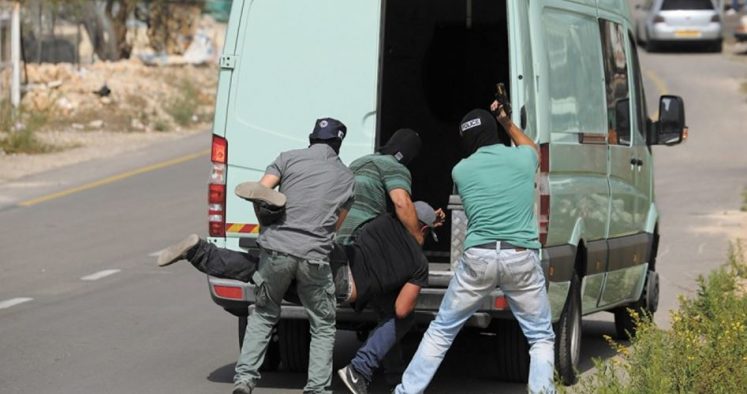
Not once did Abbas’ ever-growing security forces (estimated at 80,000 strong) move to block the path of a single Israeli bulldozer demolishing a Palestinian home or uprooting an ancient olive grove in the West Bank. Nor did they prevent the arrest of an anti-Israeli occupation activist. Often, they carried out the arrests themselves.
Even as Israel was pounding Gaza with massive bombs and white phosphorus, Abbas continued barking insults at his Palestinian enemies. He berated Gaza’s armed resistance, yet offered no meaningful alternative to whatever version of ‘resistance’ he championed.
But if Abbas managed to co-exist under these humiliating conditions, why did he decide to cancel the agreements now? To answer this, first, let us look at the political context of Abbas’ decision.
In February 2015, Abbas threatened to sever security ties with Israel as a response to the Israeli decision to withhold millions of dollars of Palestinian tax revenues, which Tel Aviv obtains on behalf of the PA. Similar threats were made in July 2017, this time in response to Israel’s illegal measures around the Muslim holy sites in occupied Jerusalem. And again, in September 2018, when the US unilaterally recognized Jerusalem as the capital of Israel. And, yet again, in July 2019, when Israel demolished Palestinian homes in occupied East Jerusalem.
The latest episode, Abbas’s threat to dissolve the PA, was in response to the American announcement of the so-called ‘Deal of the Century’.
These are only the notable threats that registered in media coverage. In reality, Abbas has waged his ‘war’ on Israel in the form of endless threats that were always met with disdain in Israel.
The difference, this time, is because Abbas has never experienced this degree of abandonment and political vulnerability. Discarded by the Americans and disowned by the Israelis, Abbas’ credibility is at an all-time low. More importantly, the Palestinian people have long abandoned any illusion that the path of liberation will go through Abbas’ office in Ramallah.
Overwhelmed by many odds, Abbas decided to conduct what is, most likely, to be his final political act. What happens next matters little, because at this stage the 84-year-old Palestinian leader is left with nothing to lose.
Canceling the Palestinian commitment to the agreements should translate into little on the ground, considering that Israel and the US have already reneged on these agreements.
The Oslo Accords were meant to be relevant up to a point, until 1999, when the final status negotiations were meant to be held as the last step before the establishment of an independent Palestinian State.
Jerusalem, like the rights of Palestinian refugees, was meant to be resolved then, not to be completely “taken off the table”, two decades later. No territorial swap, let alone annexation, was to be permitted without a bilateral agreement between both parties.
Only two components of these agreements survived Israel’s numerous violations: the ‘security coordination’ and the ‘donors’ money’, which kept the PA and its massive – but useless – army in operation.
Now that the US has withheld all funds to Abbas’ Authority, and Israel’s new national unity government has agreed, in principle, to annex much of the West Bank, Abbas is left with nothing.
By canceling all agreements, Abbas and his supporters are hoping that alarm bells sound in Washington and Tel Aviv, especially since the halting of ‘security coordination’ could prove costly to the safety of Israel’s Jewish settlers.
If Abbas was, indeed, serious in his announcement, he would have included in his speech a clear articulation of a new Palestinian political agenda that is predicated on unity – but a true Palestinian strategy was never the PA leader’s ultimate goal.
What Mahmoud Abbas is hoping to achieve, with his latest theatrics, is the establishment of a new political game, one that is based on political ambiguity, so that he is not entirely abandoned by his Western backers, or finally shunned as a collaborator by his own people.
Zionists Have Feelings Too
Words to criticize Israel are fast disappearing
By Philip Giraldi • Unz Review • May 26, 2020
Regular visitors to this site will be aware that I frequently write about the massive propaganda campaign being run by supporters of Israel to conceal the damage done by the Jewish state to actual United States’ interests. One of the more interesting aspects of that effort is the bowdlerization of language to extirpate some words that might have anti-Semitic overtones and to twist the meaning of others in such a fashion as to deprive them of any meaning. Providing loans at usurious rates of interest used to be regularly referred to “Shylocking” even in legal circles, named after the Shakespearean character in the Merchant of Venice. It is an obvious word just waiting around to be censored and has consequently disappeared from use.
Recently, those obvious expressions denoting ethnicity have been joined by a whole lot of words condemned by the American Jewish Committee that are a lot more subtle like “clannish,” “cosmopolitan” and “globalist.” The AJC defines the alleged anti-Semitic expression “dual loyalty” as “… a bigoted trope used to cast Jews as the ‘other.’ For example, it becomes antisemitic when an American Jew’s connection to Israel is scrutinized to the point of questioning his or her trustworthiness or loyalty to the United States. By accusing Jews of being disloyal citizens whose true allegiance is to Israel or a hidden Jewish agenda (see globalist), anti-Semites sow distrust and spread harmful ideas—like the belief that Jews are a traitorous ‘fifth column’ undermining our country.”
The AJC’s definition of “dual loyalty” would perhaps bemuse President George Washington whose Farewell Address included “… nothing is more essential than that permanent, inveterate antipathies against particular nations, and passionate attachments for others, should be excluded; and that, in place of them, just and amicable feelings towards all should be cultivated. The nation which indulges towards another a habitual hatred or a habitual fondness is in some degree a slave. It is a slave to its animosity or to its affection, either of which is sufficient to lead it astray from its duty and its interest… So likewise, a passionate attachment of one nation for another produces a variety of evils. Sympathy for the favorite nation, facilitating the illusion of an imaginary common interest in cases where no real common interest exists, and infusing into one the enmities of the other, betrays the former into a participation in the quarrels and wars of the latter without adequate inducement or justification. It leads also to concessions to the favorite nation of privileges denied to others which is apt doubly to injure the nation making the concessions; by unnecessarily parting with what ought to have been retained, and by exciting jealousy, ill-will, and a disposition to retaliate, in the parties from whom equal privileges are withheld. And it gives to ambitious, corrupted, or deluded citizens (who devote themselves to the favorite nation), facility to betray or sacrifice the interests of their own country, without odium, sometimes even with popularity; gilding, with the appearances of a virtuous sense of obligation, a commendable deference for public opinion, or a laudable zeal for public good, the base or foolish compliances of ambition, corruption, or infatuation.”
If it seems that the First President was predicting the current subservient condition of the United States vis-à-vis Israel, I will leave that judgement up to the reader. More recently, Jewish pressure groups who seek to benefit Israel exclusively have been aided and abetted by the so-called U.S. Ambassador to Israel David Friedman to suppress the use of words that cast Israel in a bad light. Most contentious is the elimination of the word “occupation” in State Department reporting to describe the wholesale illegal Israeli seizure of land in Palestine. The “occupied territories” held by Israel for over fifty years are now described as “disputed” while Jewish settlements on Palestinian land once routinely described as illegal are now legal. Friedman has expressed his approval of those “disputed” bits being scheduled for “annexation” after July 1st. Perhaps he will come up with a new word to replace annex, possibly something like “restore” or “reunite.” Or “fulfilling biblical prophecy.”
Words are important because how they are used and their context shapes the understanding of the reader or listener. In the United States there has been a concerted effort to equate any criticism of Israel with anti-Semitism while simultaneously making anti-Semitism a hate crime and thereby converting what one might perceive as exercise of a First Amendment right into a felony. This is largely being done as part of the plan to create a legal basis to suppress the growing Boycott, Divestment and Sanctions movement (BDS). Twenty-seven states have now passed laws criminalizing or otherwise punishing criticism of Israel, to include requirements to sign documents declaring opposition to boycotts of the Jewish state if one wants a government job or other benefits. Donald Trump has also signed an executive order to combat what he calls discrimination against Jews and Israel at universities and there are several bills working their way through Congress that can criminalize BDS in particular, incorporating prison time and punitive fines.
But when it comes to protecting Israel in speech and in writing, no one outdoes the totally cowed Europeans. It is a criminal offense to challenge the many shaky details of the standard holocaust narrative in France, Germany and Britain and now the wordsmiths are hard at work to broaden what is unacceptable in speaking or writing.
A truly bizarre story comes from England, once upon a time the mother of parliamentary democracy and a model for those who cherished free speech. One recalls that recently Labour Party leader Jeremy Corbyn was ousted after a sustained effort headed by the country’s Chief Rabbi marshalling what one might reasonably call Britain’s “Israel Lobby.” It was claimed that Corbyn was an anti-Semite because he believed in the human rights of the Palestinian people and had also attended several pro-Palestinian events. Since the departure of Corbyn, there has been a major effort by the totally subdued Labourites to purge the party of all traces of anti-Semitism to include criticism of Israel and any expressions of sympathy for the Palestinians.
The new Labour leader Sir Keir Starmer has apparently learned how to behave from the Corbyn experience. He has been crawling on his belly to Jewish interests ever since he took over and has even submitted to the counseling provided by the government’s “Independent Adviser on Antisemitism,” a special interests office not too dissimilar to the abomination at the U.S. State Department where Elan Carr is the Special Envoy for Monitoring and Combating anti-Semitism.
The adviser, Lord Mann, who like Carr is of course Jewish, has now insisted to Starmer that the use of words like ‘’Zionist’’ or ‘’Zionism’’ in a critical context must be regarded as anti-Semitism if Starmer wants to establish what he refers to as “comprehensive anti-racism” within the Labour Party. Mann wants to confront what he refers to as “anti-Jewish racism” in Britain, saying that “the thing Keir Starmer has to do is stick with the clear definition of antisemitism, and not waver from that. The second thing he should do if he wants to really imbed comprehensive anti-racism including antisemitism across the Labour Party – then the use of the words Zionist or Zionism as a term of hatred, abuse, of contempt, as a negative term – that should [be] outlawed in the party.”
Perhaps not surprisingly Lord Mann’s comments came during an online discussion with the Antisemitism Policy Trust’s director Danny Stone, one of the major components of Israel’s powerful U.K. Jewish/Zionist Lobby. A majority of British Members of Parliament of both parties are registered supporters of “Friends of Israel” associations, another indication of how Jewish power is manifest in Britain and of how spineless the country’s politicians have become.
Mann added: “If he does that, it gives him [Starmer] the tools to clear out those who choose to be antisemitic, rather than those who do so purely through their ignorance as opposed to their calculated behavior. I think he is seeing tackling antisemitism as one of those things that will be shown to mark that he is a leader.”
So, in Britain you are still presumably free to criticize Zionism, but not Israelis, as long as you do not use the word itself. If you do use it in a critical way you will be one of those presumably who will be “cleared out [of the Labour Party] for choosing to be antisemitic.” Do not be alarmed if similar nonsense takes hold in the United States, where already criticism of Israel, such as it is, eschews the word Jewish in any context. Fearful of retribution that can include loss of employment as happened to Rick Sanchez at CNN, the few who are bold enough to criticize Israel regularly employ generic euphemisms like the “Israel Lobby” or “Zionism,” ignoring the fact that what drives the process is ethno- or religious based. However one chooses to obfuscate it, the power of Israel in the United States is undeniably based on Jewish money, media control and easy access to politicians. When the friends of Israel in America follow the British lead and figure out that the word Zionist has become pejorative they too will no doubt move to make it unacceptable in polite discourse in the media and elsewhere. Then many critics of the Jewish state will have no vocabulary left to use, nowhere to go, as in Britain, and that is surely the intention.
Philip M. Giraldi, Ph.D., is Executive Director of the Council for the National Interest, a 501(c)3 tax deductible educational foundation (Federal ID Number #52-1739023) that seeks a more interests-based U.S. foreign policy in the Middle East. Website is https://councilforthenationalinterest.org, address is P.O. Box 2157, Purcellville VA 20134 and its email is inform@cnionline.org.
Salam Taha: 82 days of interrogation in the al-Moskobiyeh slaughterhouse
The following article, by Palestinian writer Hind Shraydeh, was originally published in Arabic at Hadf News :
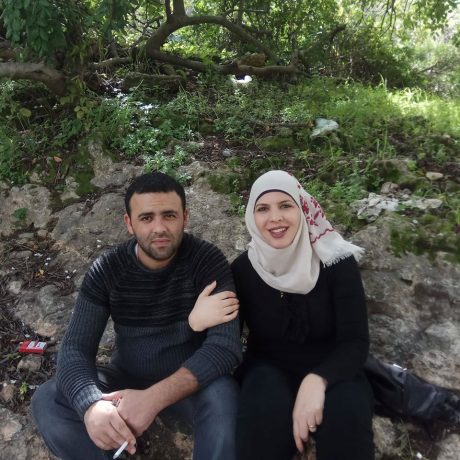
Salam and Rubou’
The different meanings of “Peace”
To some who hold power and authority, “peace” is linked with settlement and accommodation, with privileges they aspire to obtain in exchange for crumbs of the historic Palestine. Salam, on the other hand, whose name in Arabic means “peace,” exemplifies another meaning for the term.
Salam Taha was born in the village of Deir Abu Misha’al, situated northwest of Ramallah city. He adores the sea, although he was deprived of enjoying it due to the occupation. Salam usually escapes from the noise of the city to Khirbet Al-Rachniyeh east of the village, to relish the green views of his secret place, gazing towards the occupied Palestinian coast, confronting his feelings with absolute silence, and spending time in spacious verdant fields.
“He is the most shy among us but the bravest too,” says his friend at university.
Arrested while caring for his child
Israeli military soldiers raided Salam’s house after exploding its door to make their entry. They attacked Salam, forcing against the wall and cowardly hitting his body with their rifles.
It was four o’clock in the morning, when Salam was awake caring for his one-month baby, Cana’an. He never knew it is going to be his last turn in the ongoing rotation with his wife, Rubou’ or that he would be unable to look after his child for quite a long time.
Salam was tied to the kitchen chair, while military soldiers ransacked his place, turning it upside down. They were looking for his older mobile phone, which was directly in front of them the entire time, but they claimed not to notice it while acting in such a vicious manner.
Salam remained placid, as if he was unbothered, and mocked the soldiers’ actions, an attitude that angered the chief officer, who tried to provoke Salam by cursing his wife Rubou’ and directing profane insults at her while she prepared some milk for her child to calm his continuous crying during the assault. He stared at the chief officer with a shaming look, as if asking, “Is this the way you are raised to respect mothers?!”
He hummed a melody, with unidentifiable lyrics, repeating the only recognized words of it, which were “you may.”
After the extensive vandalism inside the house, the Israeli soldiers handcuffed Salam’s hands and grabbed him tightly from the shoulders. Rubou’ quickly knelt down on the ground, trying to put her husband’s shoes on with all care and diligence.
Salam saluted her, saying, “It will not take so long… I will come back soon.”
“This is how my husband was abducted on a Friday at dawn, 30 August 2018, only two days before his master’s degree studies commenced, as he was registered in the International Studies Program at Birzeit University,” Rubou’ says.
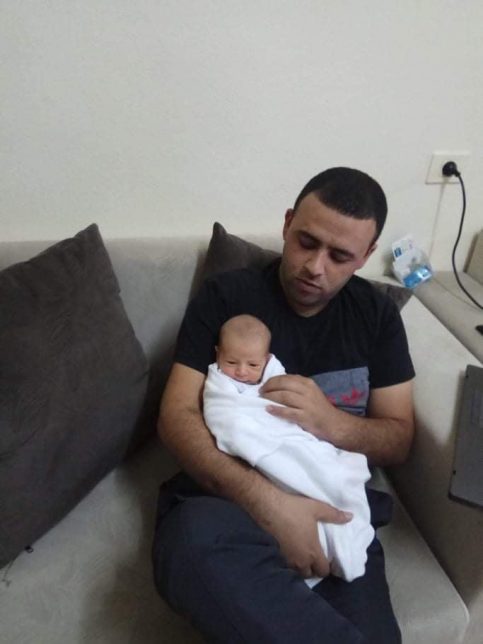
Salam with baby Cana’an
Earning his undergraduate degree with several interruptions
Over 80 students at Birzeit University are currently imprisoned in Israeli prisons. 20 of them are held under administrative detention, without any charges or trial. Their detentions are based on the “predictions” of the area commander of the Israeli military occupation, that these students might pose a “security threat to the state of Israel.” The rest of the students face indictments in military court, mostly revolving around involvement in student activities inside the university.
“Salam earned his BA degree in political science with a minor in public administration. His undergraduate studies were frequently interrupted by arrests, which extended the normal duration required to finish his studies,” Rubou’ stated.
There are students whose first university degree take them double the time they actually need to complete all their university requirements, in addition to courses related to their specialty. Students fail to join their classes, due to their repeated detentions, and yet try hard to resume their studies again at an older age with younger cohorts and sometimes different generations than the ones that launched their academic journey with them.
Last week, three more student leaders were abducted by Israeli soldiers, just days before the end of the semester: Izz Shabaneh from the village of Sinjil, Mehdi Karajeh from the village of Saffa, and Basil Barghouthi from the village of Beit Rima.
Salam’s secret weapon
The Sunday after the invasion, Rubou’ knew that her husband is being held at Al-Moskobiyeh interrogation center in Jerusalem, where Salam remained for 46 days of harsh interrogation, during which he was banned from seeing his lawyer. Salam visited Jerusalem not as a tourist visiting the Dome of the Rock or the Holy Sepulcher, but rather stuck in an underground dungeon with numerous torture methods that are hatefully designed in order to drain the prisoner’s will. Fluorescent lights were switched on 24/7, causing him a severe headache and irritating his eyes, coupled with echoes of endless screaming and low temperatures directed on his body by an air-conditioner were only some of the examples of the constant pressure and inhuman treatment.
After three months of detention, Rubou’ decided to take the risk in order to cheer her husband up and transfer to him good feelings to help him stay strong and carry on with a brave heart. She decided to provide her husband with a secret weapon while attending his court session.
How is that possible if even a tissue is not allowed to pass through the punitive inspections and searches?! She took extra care of her outfit, wore her favorite jacket, closed its buttons, and luckily succeeded to pass through the first inspection, the second one through an automatic inspection machine, and the last personal one, that looks like two harassing hands passing an electronic stick over your body. After she waited outside in the cold for hours, the security guard notified Rubou’ that it was time for Salam’s trial. She walked into the court room with her surprise and unbuttoned her jacket, where Salam was able to see his son Cana’an’s smiling face printed on Robou’s T-shirt. For two minutes long, the security guards were frozen in place. They did not know how to deter such a secret weapon!
Rubou’ laughed while recalling the incident, saying: “I felt that we had won a victory … the guards were frozen and did not know what to do! They think they can abolish the longing in our hearts, but we proved them wrong. This was my way of resistance and standing by Salam’s side.”
82 days of harsh investigation in the Al-Moskobiyeh slaughterhouse
“Salam did not sleep for so long, he was immensely pale, and bleeding from his wrists due to the tight shackles around them. The prison administration employed a number of interrogators who created stories and fake scenarios about our family to weaken Salam. Some of their fabrications were about me, his wife, and our son Cana’an, found dead in a car accident, others were about bringing me for interrogation in a room adjacent to Salam’s cell”, Rubou said, recalling what Salam told her in one of her visits.
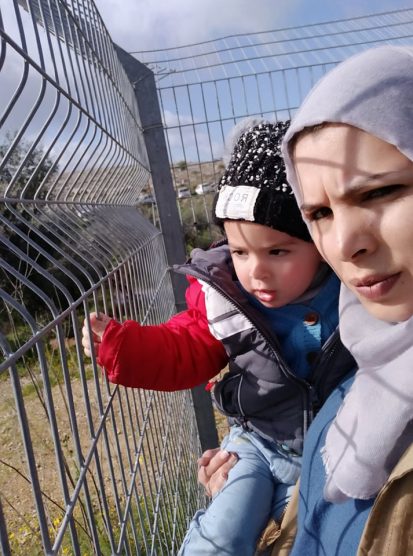
Rubou’ with Cana’an
Many deceptions and malicious tricks were practiced by the Israeli intelligence agency, known as the Shabak, in order to put pressure on Salam, with one sole aim: Extracting confessions from him in order to celebrate their delusional victory and prove their domination over Palestinians.
“Before his recent arrest, Salam underwent a colonoscopy, as he suffers from colon problems, stomach pains and hemorrhoids that caused him bleeding during the interrogation. The lawyer submitted Salam’s medical papers explaining his condition, but the fascist regime did not care about his medication, and refused to let him go to the bathroom frequently,” Rubou’ says.
The Israeli occupation deliberately mistreats prisoners, providing them with poor and inadequate health care in an attempt to exhaust the captives. As punishment for Salam’s steadfastness, the illegitimate military court sentenced him to 18 months in prison.
Just two weeks before the end of his sentence, when Rubou’ was wondering about the color of the dress that she planned wear to welcome her partner home, and the unique outfit she is preparing for her son Cana’an to wear, only two weeks before Salam’s sentence ended, the Israeli military forces sent him to the slaughterhouse of Al-Moskobiyeh once again. Salam underwent thirty-six days of cruel interrogation with an agitated and hysterical frequency, during which he was once again prevented from meeting with his lawyer.
Eighty-two days is the cumulative time of interrogation Salam has gone through, while the “civilized” world and the luckier youths of the colonial project live in isolation from the tragedies of the occupation, perhaps by playing soccer or baseball and setting some exciting plans for their travels to the Maldives. Eighty-two days of interrogation, and yet the occupation steals years from Palestinian youth: Their future, their families and their children.
Meanwhile, international human rights organizations act like Pontius Pilate, when he washed his hands of guilt for the blood of Christ. Such organizations’ roles are to adopt “codes of conduct,” or issue informative brochures, or to express their “mild” concerns about a rough death that happened in a sacred spot in the far reaches of the earth, called Palestine.
Salam is still detained without trial in the Eshel desert prison, after he was arbitrarily transferred in mid-March from Ofer prison overnight as a punitive measure, as a result of which he had to sleep a full night in the “Ramla crossing-point”, a place where prisoners are gathered before they are distributed to other prisons. This happened at a time when the occupation claimed to be cautious and to stop unnecessary movement between prisons, in order to prevent the spread of coronavirus.
“You may build a huge wall around me, and another wall around you, the enemy of the sun … Still I will not compromise” lyrics of an Arabic song
Eshel Prison differs in its structure from other prisons; it is more isolated and brutal. The square yard, known as the fora, in which the prisoners spend their outdoor time is covered, so that they do not see the sky at all, nor the sun’s light. It is not available all day, but only for specific hours, and it is also far from the prisoners’ rooms. When released prisoners describe this prison, some say: “The bathroom in Eshel does not accommodate a chubby person, and the showers are narrow. All can be coped with except the climate of the desert, the high humidity and temperature in the morning and extreme cold at night”.
Salam spends most of his time reading and trying to maintain a healthy pattern by playing sports. He keeps humming his favorite song, as he walks in the fora: “You may steal the last inch of my land… You may feed the years of my youth to the prison … You may put down the flame I keep rising… You may prevent me from kissing my mother …You may defeat the dreams I have for tomorrow. You may deprive my children of wearing their Eid holiday outfits… You may build a wall and yet another taller one… In that act you assure to the world that you are the enemy of the sun. Still I will not compromise. Until the last pulse in my veins, I will continue fighting,” an Arabic song by Lebanese singer Julia Butros,

Fatherhood on hold
“It is not easy to raise a child on your own, while the pictures of the baby’s father are hung on the wall”, Rubou’ said. “Cana’an will turn two years old in July, while he does not know his father. I finally obtained a permit to visit Salam after being banned for almost a year. The long-anticipated permit allowed me to visit my husband three times only before the spread of COVID-19, after which visits were suspended.”
“We were born in pursuit of joy, and for joy we die”
“To see my husband in front of me through an insulated partition and isolating glass without being able to touch his hand, and to speak to him through telephones which the jailers control, is not easy at all. This increases the pain in my heart,” Rubou’ says. “Salam and I experienced a beautiful love story at university, which was completed in our marriage, and Cana’an is the fruit of our love.”
“With all the suffering that I live alone with Cana’an, and all the decisions I have to make, serving as mother and father at the same time, I return to remember what we insisted on highlighting in our wedding card. ‘We were born in pursuit of joy, and for joy we die.’ This is our conviction, and this is our belief in which we live every day, and we will raise our children to follow it as well,” Rubou’ concluded.

Salam and Rubou’s wedding card
Hind Shraydeh is a Palestinian writer and human rights advocate. She is also the wife of Palestinian prisoner Ubai Aboudi, the Executive Director of the Bisan Center. We encourage you to join the 1 June Day of Action for Ubai Aboudi and to sign the Scientists for Palestine petition supporting him.
Translation by Samidoun Palestinian Prisoner Solidarity Network.
US military presence in Iraq aimed at protecting Israel’s security, interests: PMU leader
Press TV – May 25, 2020
A high-ranking official with Iraq’s Popular Mobilization Units (PMU), better known by the Arabic name Hashd al-Sha’abi, has strongly denounced US military presence in his country, saying such a deployment is meant to safeguard the security and interests of the Israeli regime.
“There is a national and courageous will, which rejects the presence of any foreign troops on Iraqi soil. There have been talks of US intentions to withdraw from Iraq, but we doubt them,” Qais al-Khazali, leader of Asa’ib Ahl al-Haq, which is part of the PMU, was quoted as saying by the Lebanon-based and Arabic-language al-Ahed news website on Monday.
He added, “The US [military] presence in Iraq is meant to protect the security and interests of the Israeli regime. Neither are we warlords nor thirsty for blood, but rather patriots looking for the dignity and sovereignty of the Iraqi nation.”
“If the withdrawal [of US troops] does not take place, the foreign occupier must know that Iraqis will not accept the presence of its forces. The Americans, who will open negotiations [on the extension of their presence] in June, must remember the centenary of the Great Iraqi Revolution of 1920 against British forces,” Khazali pointed out.
He also praised the sacrifices made by Lieutenant General Qassem Soleimani, the commander of the Quds Force of Iran’s Islamic Revolution Guards Corps, and Abu Mahdi al-Muhandis, the deputy head of PMU, who were assassinated along with their companions in a US airstrike authorized by President Donald Trump near Baghdad International Airport early on January 3.
Iraqi lawmakers unanimously approved a bill two days later, demanding the withdrawal of all foreign military forces led by the United States from the country following the targeted killings.
Later on January 9, former Iraqi prime minister Adel Abdul-Mahdi called on the United States to dispatch a delegation to Baghdad tasked with formulating a mechanism for the move.
The 78-year-old politician said Iraq rejected any violation of its sovereignty, particularly the US military’s violation of Iraqi airspace in the assassination airstrike.
Biden Condemns Pro Palestinian BDS Movement
teleSUR | May 21, 2020
Left-wing activists in the U.S. rejected assertions by the presumptive Democratic nominee for president, Joe Biden, who said criticism of Israel too often drifts towards anti-Semitism before he declared his opposition to the Boycott, Divest, and Sanctions movement (BDS).
“Criticism of Israel’s policy is not anti-Semitism,” Biden said during a phone call with donors earlier this week. “But too often that criticism from the left morphs into anti-Semitism.”
The call was part of a virtual fundraiser hosted by Dan Shapiro, a former ambassador to Israel, and Deborah Lipstadt, a professor of Jewish history and Holocaust studies at Emory University.
Biden was asked how to respond to anti-Semitism among progressive activists in both the U.S. and the United Kingdom.
“We have to condemn it, and I’ve gotten in trouble for doing that,” the former vice president said. “Whatever the source, right, left, or center.”
The Biden campaign later released a policy paper saying it “firmly rejects” the BDS movement, a nonviolent initiative launched by Palestinians in 2005 to pressure Israel to comply with international law and defend Palestinian human rights.
Biden said the movement “singles out Israel – home to millions of Jews – and too often veers into anti-Semitism while letting Palestinians off the hook for their choices”.
Leaders of the BDS movement replied that Democratic voters should be endorsing the movement instead of rejecting it.
“By rejecting BDS, Joe Biden endorses U.S. complicity in Israel’s decades-old regime of occupation, colonialism, and apartheid, and supports depriving Palestinians of our fundamental human rights,” the group said.
Biden has struggled to unite a Democratic Party deeply divided between moderates and younger progressives who gravitated towards Biden’s rival, Senator Bernie Sanders, who has withdrawn from the election.
The progressive wing has been outspoken in its opposition to Israel’s policies towards Palestinians in the West Bank and Gaza, particularly under right-wing Prime Minister Benjamin Netanyahu.
Featured Video
10K More U.S. Troops Deploy as Trump Weighs New Iran Strikes
or go to
Aletho News Archives – Video-Images
Book Review
The Genetic Deception — now in paperback (Second Edition)
Lies are Unbekoming | October 2, 2026
The genes the field promised were never there.
The genetic story of disease is a cover story.
The twenty-first century runs on it. Paediatric clinics. Cancer centres. Forensic laboratories. Family-planning counsel. It is used to explain illness, to assign blame, to foreclose questions. It protects the industries whose products and practices are what actually caused the harm.
It isn’t true.
In 2010, Jonathan Latham and Allison Wilson looked at over seven hundred genome-wide association studies covering some eighty common diseases. The genes the field had promised were not there. The field invented a term, “missing heritability”, to explain the absence, and has quietly worked to bury the finding ever since.
The Genetic Deception is a book about what Latham and Wilson found. What the field did with it. And what the public was told instead. … continue
Blog Roll
 Aletho News
- Von der Leyen gifts her spin doctor a job for life
- 10K More U.S. Troops Deploy as Trump Weighs New Iran Strikes /Suliaman Ahmed
- Iranian crew declared Dena training vessel ‘unarmed’ to US warship before deadly torpedo strike: Report
- Iran’s NPT debate moves beyond parliament
- Houthis condemn Saudi claims of attack on Medina
- Fatuous False Flags
- Are Europe’s Smallest Nations Dragging the Continent into War?
- EU draws up contingency plans for possible Merz exit
- G7 caves to US blackmail, announces ‘massive’ release of diesel reserves
- Reporting of the RAF Fairford arrests blows the idea of a ‘free press’ out of the water
- If Americans Knew
- The Israeli Right Portrays Islam as Murderous. It Serves a Political Purpose
- Jordan Has Had Enough: King Abdullah’s Scathing Warning to Israel
- Israeli Colonizers (i.e. Settlers) Kill Palestinian Man Near Salfit
- New Google Maps images reveal massive scale of devastation in Gaza
- Jewish supremacy, anti-Palestinian bigotry on display in Israel – Daily Update
- Israeli Soldiers Abduct At Least 22 Across Occupied West Bank
- Eight Palestinians Killed in Israeli Attacks on Gaza
- Israeli former leaders and security chiefs threaten legal action over ‘Jewish terrorism’
- Israel map in LA Times ad includes all land from the river to the sea
- Inside Lebanon’s 200-page dossier on Israeli war crimes
- No Tricks Zone
- Green Energy Debacle: German Expert Professor Fritz Vahrenholt Warns Of Severe Economic And Social Consequences
- Two More Paleo Reconstructions Affirm Meters-Higher Sea Levels Across Ireland, Brazil 7000-6000 Years Ago
- New Study: Earth And Venus Surface Warmth Largely Explained By Convection And Lapse Rate, Not CO2 Or Radiation
- 2025 Nature Paper Claiming Worsening Global Drought Gets RETRACTED …Heavily Flawed
- New Study: ‘Global Drought Shows No Detectable Recent Acceleration Under Climate Warming’
- Economic Masterminds: German Socialists Suggest Taxing Productivity Gains Stemming From Using AI
- The South China Sea Has Not Been Cooperating With The Climate Change Narrative
- Energy Crisis: Germany Enters Heating Season With Historically Low Gas Reserve Fill Levels
- New Study: The Antarctic Ice Sheet Gained Mass From 2020-2024 Due To Staggering Snow And Ice Accumulation
- Study: Ocean Heating Rates From Thousands Of Years Ago ‘Dwarf’ Modern Ocean Heating Rates

