Yemen’s Al-Houthi offers to exchange Saudi pilots for Hamas prisoners
MEMO | March 27, 2020
The leader of Yemen’s Houthi movement, Sayyid Abdulmalik Al-Houthi, has made an offer to release Saudi captives in exchange for members of the Palestinian resistance movement, Hamas, being held in Saudi Arabia.
“We are fully prepared to release one of the captured pilots along with four Saudi officers and soldiers,” Al-Houthi said in a televised speech on Al-Masirah. “This will be in exchange for the release of those from Hamas arrested in the Kingdom of Saudi Arabia.”
Last September, Saudi detained 81-year-old Dr Muhammad Saleh Al-Khodari, a prominent member of Hamas who has served as the movement’s officially-acknowledged representative in the Kingdom for 20 years. He was also the head of Hamas’s General Shura (Consultative) Council.
Earlier this month it was reported that the Saudis were preparing to prosecute Palestinians held in its prisons. Al-Khodari and his son, Hani, are among the detainees. Their arrests on “terrorism” charges are seen by some to be politically-motivated following Saudi Arabia’s increasing normalisation of relations with Israel under de facto ruler Crown Prince Mohammad Bin Salman.
Last week the Head of the Hamas Political Bureau, Ismail Haniyeh, urged King Salman Bin Abdulaziz to release the Palestinian prisoners, citing health concerns given the spread of coronavirus Covid-19.
Senior Hamas official Mahmoud Al-Zahar welcomed the proposal by the Houthis: “The initiative of the leader of Ansar Allah has pleased the hearts of all Palestinian resistance fighters,” he was reported as saying by Al Mayadeen.
A statement by Hamas also expressed appreciation for the solidarity and support shown by the Houthis: “We greatly appreciate the spirit of brotherhood and sympathy with the Palestinian people and support for their steadfastness and resistance. We express our thanks for this interest and this self-initiative.”
Speaking on the fifth-anniversary of the US-backed, Saudi-led coalition’s war on Yemen yesterday, Al-Houthi said, “Unfortunately, the regimes of Saudi Arabia and the United Arab Emirates have presented [themselves] as worse than Israel.”
Al-Houthi also said that his movement is “ready for peace and stopping the war if the aggressor is serious about stopping the aggression and siege.” He vowed that the sixth year of the conflict will involve “advanced military capabilities” and will entail new surprises for the coalition. “The general evaluation and studies confirm that the economic losses of the Saudi regime are great and its ambitions have failed,” he added.
Its coronavirus response provides more evidence of Israel’s racism
By Motasem A Dalloul | MEMO | March 25, 2020
The coronavirus Covid-19 has spread around the world, with 372,757 confirmed cases and 16,231 deaths according to an updating dashboard run by the World Health Organisation. The Director-General of the WHO, Dr Tedros Adhanom Ghebreyesus, has said that it is “deeply concerned both by the alarming levels of spread and severity” of the virus.
This severity has pushed many countries to put hostilities aside and work together against the virus. Strict measures have been imposed to curb its spread and protect humanity: large gatherings have been banned; schools and universities have been closed; congregational prayers in places of worship have been suspended; and some countries have even released prisoners.
In Israel, however, the response to the virus has simply emphasised its officially-sanctioned racism. For example, on 20 March, the Times of Israel reported that Internal Security Minister Gilad Erdan had decided to release 500 Israeli prisoners into house arrest in an effort to reduce the risk of a coronavirus outbreak in the country’s prisons. Erdan apparently accepted the recommendation of acting Israel Prison Service chief Asher Vaknin. Not a single one of the 5,000 Palestinian prisoners held by Israel — including 180 children, 43 women and 430 detained with neither charge nor trial —is being released, though, not even those with critical health conditions.
According to the Palestinian Prisoners’ Club (PPC), at least four Palestinian prisoners held by Israel has tested positive for coronavirus. However, the Israeli occupation authorities deny this. The PPC pointed to the restrictions imposed by Israel on reporting news from its prisons, so it is in any case unlikely to make such an admission.
Rights group Addameer noted that the Israel Prison Service has banned visits to Palestinian prisoners by family members and lawyers since the outbreak of the virus instead of providing them with hygiene and cleaning materials essential to curb its spread. No other measures appear to have been implemented to protect the prisoners.
“Palestinian prisoners in Israeli prisons and detention centres constantly suffer from clear medical negligence,” explained Addameer. The situation has not changed since the outbreak of the virus. “Despite the fact that prisons are overcrowded and rooms, cells and sections are small, and lack proper ventilation, the IPS is yet to make clear preventive procedures… The prisons lack sterilisers, cleaning materials, and medications such as antibiotics and necessary nutrition.”
Last Thursday, the Palestinian prisoners threatened to launch a hunger strike if measures to protect them against the virus are not implemented. The occupation authorities did nothing for them, prompting them to begin gradual protest action.
The second evidence of Israel’s inherent racism is the inhumane treatment of a Palestinian worker who was thought by Israelis to have contracted coronavirus when he came down with flu-like symptoms. A video on social media showed him being dumped at Israel’s Sira/Maccabim military checkpoint near the occupied West Bank city of Nablus.
The man spoke to Palestinian and Israeli journalists about the incident. He explained that he had suffered from fever and his condition developed to into a normal flu. His employer took him to Ichilov Hospital in Tel Aviv, where he was tested for the coronavirus, but before the result was known, police officers arrived, handcuffed him and took him to the checkpoint where he was dumped; he then collapsed.
While the occupation authorities ordered Israeli employees to stay at home, they decided to block thousands of Palestinian workers in their work places regardless of the measures being taken against the spread of the coronavirus. When a Palestinian worker was thought to have contracted the virus, the Israelis dealt with him with neither compassion nor mercy. Such words are not in the Israeli vocabulary when it comes to dealing with Palestinians.
Other incidents have occurred over the past few weeks, but these two suffice to illustrate Israeli racism.
To conclude, take note of the words of UN Special Rapporteur for the situation of human rights in Palestine, Michael Lynk, who voiced his concerns about Israel’s racism when he observed that the official Israeli publications to increase awareness about the disease were issued “exclusively in Hebrew”.
“This serious imbalance is apparently being addressed after protests, but it highlights the importance of ensuring equality of treatment,” stressed Lynk. “The legal duty, anchored in Article 56 of the Fourth Geneva Convention, requires that Israel, the occupying power, must ensure that all the necessary preventive means available to it are utilised to ‘combat the spread of contagious diseases and epidemics’.”
Yet again, and to the surprise of nobody, least of all the Palestinians, the Israelis are simply ignoring international laws and conventions. And, as usual, the effects could be deadly for the people of occupied Palestine.
As the world turns its attention to the pandemic, Israel is moving forward with military raids

By Lucas Leiroz | March 25, 2020
The West Bank situation is becoming increasingly complicated amid the coronavirus pandemic and territorial disputes between Palestinians and Israelis. At first, the Palestinian Authority and Israel showed signs of cooperation in combating the pandemic. A few weeks ago, joint measures were announced between both sides to contain the epidemic of the new coronavirus in the region. The measures include distribution of cleaning and personal hygiene materials, in addition to virus testing kits and medical equipment.
On the part of Tel Aviv, the total closure of the West Bank was promoted, allowing, however, access for Palestinian workers involved in the construction and agriculture sectors to the Jewish state, which is why the proposal was well accepted by Ramallah. On the part of the Palestinians, the West Bank has also been blocked, but only partially and for two weeks, since last Sunday (March 22), in addition to the implementation of a series of control and quarantine measures.
However, efforts to contain the pandemic have not prevented Israeli incursions into the region, which have increased recently. Ibrahim Melhim, a spokesman for the Palestinian Authority, acknowledged Israeli efforts to contain the coronavirus in the country and in Palestine, but criticized the unstoppable incursions against the Palestinians. “We have very strong round-the-clock coordination with the Israeli side to prevent the coronavirus from spreading (…) At the same time, Israel continues to operate in the Palestinian Territories as if there is no coronavirus crisis (…) They [Israeli forces] continue their raids across the West Bank, arresting people and confiscating lands, and that harms the existing coordination between the PA and Israel putting an additional burden on the Palestinian Authority,” said the spokesman.
Apparently, Israel pretends to collaborate with Palestine to stop the pandemic, when, in fact, it freely promotes its military maneuvers in the region, which go unnoticed by the mainstream media, strongly focused on covering the viral tragedy. In addition, Tel Aviv’s own collaboration to control COVID-19 in the region seems extremely limited. The blocking measures made it impossible, for example, for doctors from the “Physicians for Human Rights” (an Israeli NGO that serves Palestinians free of charge) to move alongside the West Bank, clearly hampering medical care in the region.
Mention should also be made of the fact that Israel, not Palestine, is the major focus of infections by the new coronavirus in the region. Israel has already more than 1,000 officially reported cases of the disease, in addition to one death, and several suspicions. In contrast, Palestine has around 60 infected people. It is clear from these data that the most stringent containment measures should come exclusively from Ramallah, since the Israeli military presence in the region itself poses a serious risk to Palestinian public health.
According to a survey by the Truman Institute for Peace at the Hebrew University of Jerusalem, 63% of Israelis say Israel must help Palestinians during the coronavirus crisis. Vered Vinitsky-Serousse, president of the Institute, said that “the majority of Israelis believe that, when necessary, the government should devise preventive measures to help Palestinians during the Covid-19 epidemic.” The big problem, however, is how these joint maneuvers are conducted. Perhaps the first step to be taken in establishing joint measures is the definitive and immediate end to military incursions in the region, which constantly bring insecurity and terror to the Palestinian people.
The situation of tensions in the region must still be read in the context of the so-called “Deal of the Century”, the “peace” proposal for the conflict between Israelis and Palestinians announced by American President Donald Trump. The “agreement” was celebrated unilaterally by the Washigton-Tel Aviv axis, with no participation of Palestinians, which is why it was rejected by the Palestinian Authority and the Arab League. The document foresaw the annexation of Israeli settlements in the West Bank, leaving around 70% of the region under Palestinian rule – a figure much lower than that proposed by all previous attempts to resolve the conflict. Everything indicates that Israel will not stop its attempts to occupy that territory as much as possible.
It is in this context that the “joint” actions between Israelis and Palestinians must be analyzed with skepticism and suspicion. Are these pandemic containment measures really good, even when behind them the Israeli army expands its occupation in the region with increasingly aggressive incursions? Also, to what extent does Palestine benefit from the help of these joint actions when Israel has an absurdly greater number of infected people? Would Israel be able to help the Palestinians? Or would that aid be a mask for such military incursions? All of these are valid questions.
It is also worth remembering that a few weeks ago, at the end of February, Israel announced the construction of more than 2,000 new settlements in Palestinian territories – and on the same occasion, Netanyahu authorized the construction of other 7,000 units in the East Jerusalem region. These data mean that Israel’s aggressiveness against the Palestinians was increasing recently. Did this aggression really disappear from Tel Aviv’s plans in the face of a “commotion” with public health in Palestine (which is much better than the situation in Israel)? Perhaps, the mainstream media and Human Rights observers should divide their attention between the coronavirus and the conflict in Palestine, before more serious clashes erupt.
Lucas Leiroz is a research fellow in international law at the Federal University of Rio de Janeiro.
Palestinian Worker Dumped at Israeli Checkpoint for Exhibiting Coronavirus Symptoms
PNN | March 24, 2020
Yesterday, Israeli occupation forces threw a worker by the side of the road at the “Beit Sira” checkpoint near the city of Nablus, over suspicion of him being infected with the novel Corona virus.
Locals filmed the man and called the medical crews who rushed to save the worker, who was left at the road, unable to move, for around three hours with high temperature.
He was rushed to the National Hospital of Nablus.
Government spokesman Ibrahim Melhem said in his daily briefing on Tuesday morning that the sample of the worker showed that he was not infected with corona-virus.
Consequently, Melhem warned the Palestinian workers from going to the occupation workshops, where they are subjected to inhuman treatment and living conditions.
In the press conference as well, Melhem also announced that a woman was infected with Corona virus while returning to Ramallah from the United States, bringing the number of infected people to 60, including 16 recovered cases.
Melhem also confirmed that the samples taken for a citizen from Kufur Aqab and those in contact with an infected man have not yet emerged.
He added that the health condition of the patients in Bethlehem is stable and all of them are under health supervision.
US airlifts Lebanese-American accused of torture, murder from Lebanon
MEMO | March 20, 2020
Lebanese-American Amer Fakhoury, accused of torturing and murdering prisoners while serving in the Israeli-backed south Lebanon army, has been airlifted from Beirut by the US, Senator Jeanne Shaheen announced yesterday.
A US Marine Osprey was seen landing at the US Embassy in Beirut, hours before Fakhoury’s release was announced.
Shaheen said she had spoken with Fakhoury on the phone soon after his release, adding that “anytime a US citizen is wrongfully detained by a foreign government, we must use every tool at our disposal to free them”.
In a statement later yesterday, US President Donald Trump said that he was “very grateful to the Lebanese government. They worked with [the US]”.
Fakhoury was detained on 12 September when he arrived in the country to visit family after more than two decades.
The former member of the south Lebanon Army has been accused of being the “Butcher of Khiam” over allegations that he oversaw the torture and murder of detainees during his tenure as a prison guard.
Former detainee Abbas Qabalan told local media Naharnet that “not a single person held in Khiam was spared physical and psychological torture”. At least ten people died at the prison while Fakhoury was working there.
The charges against Fakhoury were initially dropped on Monday, when he was acquitted because the alleged offences took place more than ten years ago.
However, a military judge ordered a re-trial after Judge Ghassan Khoury asked the Military Court of Appeals to overturn the acquittal. A court order forbidding Fakhoury from travelling internationally for two months was announced later.
In the wake of Fakhoury’s release, the head of the Military Tribunal Brigadier General Hussein Abdallah announced his resignation from the post this morning, the Daily Star reported.
Abdallah said he resigned “out of respect for my oath and military honour” adding the military tribunal had become a place where “the application of the law equals to the release of an agent of pain”.
Tensions between the US and Lebanon have risen dramatically as a result of Fakhoury’s detention, with Senators Shaheen and Cruz tabling legislation in February which would invoke sanctions against Lebanese officials and associates which are deemed to have been involved in the illegal detention of a US citizen.
The Trump administration have threatened to withhold aid to the country and sanction the Lebanese military.
Democratic Front for the Liberation of Palestine delegation meets with Russian foreign minister
MEMO | March 18, 2020
On Tuesday a delegation from the Democratic Front for the Liberation of Palestine (DFLP) met with Russian foreign minister, Sergey Lavrov, and special presidential representative for the Middle East and Africa and deputy foreign minister, Mikhail Bogdanov, in the Russian capital of Moscow.
According to a statement issued by the DFLP, the two sides discussed the general situation in the Middle East, specifically the Palestinian issue and the Palestinian people’s national rights. This came in light of the repercussions of US President Donald Trump’s endeavour to liquidate the cause of the Palestinians and confine the Palestinian state to a series of isolated patches of land ghettos, under the hegemony of the occupation state and its apartheid laws.
The DFLP stated that the two parties agreed that Trump’s vision violates international standards to solve the Palestinian issue, and constitutes a complete disregard for international legitimacy resolutions, as well as a threat to the stability of the region, in addition to paving the way for the emergence of more conflicts.
The two sides described the Israeli policies in the occupied areas as violations of international legitimacy resolutions, rising to the level of war crimes.
The two parties agreed that the United Nations, the International Council for Human Rights Policy (ICHRP) and the International Criminal Court (ICC) are required to assume their political, legal and moral responsibilities towards the Palestinian people.
The two sides stressed the necessity to end the division among Palestinian political actors, and reunite the Palestinian front in the face of the occupation and settlement, as well as Trump’s plan.
The two parties reaffirmed the Palestinian people’s right to fight for a fully sovereign independent state with Jerusalem as its capital, and to resolve the refugee issue in accordance with Resolution 194, which grants them the right of return.
Forced displacement and the US-Israel special relationship
By Ramona Wadi | MEMO | March 18, 2020
Democrats in the US House of Representatives have sent a letter to Secretary of State Mike Pompeo, asking the government to ensure that Israel is not using military equipment supplied or financed by America to perpetuate the forced displacement of Palestinian civilians.
“As supporters of the US-Israel special relationship and in light of the longstanding use of US-origin and supplied equipment by Israeli security forces,” they wrote, “we specifically request an examination of Israeli compliance with the requirements.” This was a reference to the US Arms Export Control Act which does not permit recipient countries to use such equipment unless for “legitimate self-defence” purposes.
The US said the Representatives, “should work to prevent unlawful home demolitions and the forcible transfer of civilians everywhere in the world and prevent the use of US-origin equipment in this destructive practice.”
Politically, though, the US-Israel relationship will take precedence over any human rights concerns. A letter by supporters of this relationship is already compromised in terms of upholding the colonial narrative and separating the recent statistics regarding home demolitions from the historical ethnic cleansing of Palestine which paved the way for colonial Israel’s establishment.
In light of the US “deal of the century” and the impending annexation of more Palestinian land, there is an inherent futility in this exercise of demanding answers from the government. It might satisfy some uneasy consciences but it will not contribute anything to the Palestinian people in terms of safeguarding their legitimate rights.
The deal of the century has demonstrated that what Israel has been doing all along — imposing unilateral measures to expand its colonial project — has given the Zionist state perpetual impunity. Israel, now aided by the US overtly, is ahead of the international community and its stagnant practices when it comes to human rights violations and international law. The US, like other countries, should be working towards eradicating forced displacement. Instead, it has chosen to support Israel’s expansion and penned a deal which will increase the number of people displaced.
Asking for clarification as a means to preserve US support for Israel defeats the purpose of trying to ensure that the end use of US aid is lawful. This contradictory approach must not be construed as a step forward in protecting Palestinians’ rights. It is a perfunctory exercise that detracts from the international law violation at hand, which is America’s political support for Israel’s annexation plans.
The letter shows how human rights concerns are being subjected to political allegiances. It does not call for a suspension of the “special relationship” between the US and Israel, but rather selectively targets a sliver of cooperation which facilitates Israel’s colonial expansion. It is well known that Israel manipulates its self-declared “exceptionalism” to prolong its violations against the Palestinian people and that the US is happy to play along with this.
“My hope is that Israel will stop the home demolitions and will see that there are many supporters of the US-Israel relationship on this letter,” explained US Representative Rohit Khanna. Such emphasis clarifies the underlying intent; the signatories may oppose forced displacement, but the political relationship will continue to take precedence, rather than make Israel reflect upon the consequences of what the International Criminal Court has clearly defined as war crimes.
Sheldon Adelson keeps casinos open despite coronavirus danger
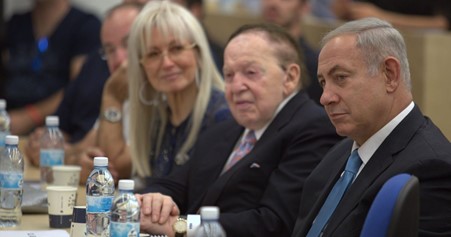
By Alison Weir | If Americans Knew | March 17, 2020
Bloomberg news reports that while other major Las Vegas casinos have closed to protect employees and the public from the coronavirus pandemic, Sheldon Adelson is keeping his casinos open.
According to Casino.org : “From the Strip to New England to the Midwest to California, commercial and tribal operators announced over the weekend they’d either voluntarily close casinos or do so to comply with state government orders barring large gatherings.”
On Monday President Trump called for Americans to avoid gatherings of more than 10 people, and the Nevada governor ordered schools and state offices to close.
Unlike governors elsewhere, the order did not include casinos, a powerful force in Nevada. However, the governor asked local governments to enforce a new Centers for Disease Control and Prevention guideline that all events with attendance above 50 be canceled or postponed.
Adelson’s billions used on behalf of Israel
Adelson is known for using his casino profits to obtain US policies beneficial for Israel by donating to American candidates for office. Adelson’s net worth is in the range of $37 billion.
In recent years, Adelson and his wife Miriam, an Israeli citizen, gave $205.83 million to Republican campaign efforts.
The Adelsons are credited with Trump’s decision to move the US Embassy to Jerusalem (after both Republican and Democratic presidents had long kept it in Tel Aviv), Trump’s decision to withdraw from the Iran nuclear deal, and the recent Trump-Kushner “peace plan.”
Adelson is a fervent advocate for Israel despite its long record of human rights violations and violations of U.S. laws, documented by Human Rights Watch, the Red Cross, Foreign Service Journal, and others.
He once infamously announced that he regretted serving in the U.S. army rather than the Israeli military.
Similarly, Miriam Adelson has said that her heart has always remained in Israel, but she got “stuck” in America after meeting Adelson.
In 2018 Trump bestowed the Presidential Medal of Freedom on the couple for their “philanthropic work.”
While the Adelsons have donated to medical research and programs addressing drug addiction (but apparently not gambling addiction, disastrous for many Americans), it appears that the bulk of their philanthropy involves Israel. Inside Philanthropy reports:
“The Adelson Family Foundation, one of Adelson’s philanthropic vehicles, is concerned with Jewish causes around the world. Adelson takes a decidedly pro-Israel stance, which is reflected in his and his wife Miriam’s philanthropy. The foundation supports charitable organizations located primarily in Israel and the United States, with funds going to Israel Advocacy and Defense, Israel Studies, Holocaust and Anti-Semitism Awareness, among others.
“Birthright Israel is a major grantee. The couple via their foundation have given tens of millions to the organization. Another youth outfit that the Adelsons have funded is B’nai B’rith Youth Organization. The Adelsons founded the Dr. Miriam and Sheldon G. Adelson Educational Campus in Las Vegas, “the only school in Nevada built on the Jewish ethos of community, service, innovation and discourse.” The school offers classes for students aged 18 months through 12th grade. Other education grantees include a mix of Israel and U.S. outfits, including American Friends of Ariel University, which supports Ariel University in Israel, and Rashi School in the Boston Area. Adelson funds a number of agencies that aim to shift policy and attitudes around Israel and the Jewish people, including Christians United for Israel, “an American pro-Israel Christian organization that defines itself as “a national grassroots movement focused on the support of Israel.” Sheldon and Miriam have also given millions to SpaceIL, an Israeli nonprofit founded by three young engineers at the end of 2010, answering the Google Lunar XPRIZE challenge.”
Trump had been scheduled to attend a fundraiser at the Adelsons’ Las Vegas mansion on Thursday, but called this off due to the pandemic. He had also been planning to address the Republican Jewish Coalition’s annual leadership meeting at Adelsons’ Sands’ Venetian casino resort.
Scheduled for Adelson’s Venetian and Palazzo resorts, the three-day meeting was expected to include numerous conservative politicians and leaders. Tickets began at $1,00 and were only available for current members of the RJC National Leadership. Adelson is on the RJC board.
The RJC announces that it “stands with Israel.” While the RJC states, “Hamas has sent hundreds of missiles from Gaza against Israeli civilians in recent days,” it fails to report that these mostly homemade rockets came after massive Israeli violence. Rockets from Gaza have killed about 29 Israelis in total, while Israeli airstrikes have killed over 3,500 Gazans.
Alison Weir is executive director of If Americans Knew, president of the Council for the National Interest, and author of Against Our Better Judgment: The Hidden History of How the U.S. Was Used to Create Israel.
Israel settlers attack Palestinian farmers in Jordan Valley

MEMO | March 16, 2020
While Palestinians are busy fighting the outbreak of the coronavirus, Israeli occupation settlers have increased their attacks in the occupied Jordan Valley, Al Mugtama Magazine reported yesterday.
The armed settlers carried out a wide-scale campaign of attacks on the Palestinian herders and farmers. They stole scores of animals and damaged wide swathes of farmlands.
“The situation in the Jordan Valley is very difficult,” Mahmoud Bsharat, who has received an expropriation order for his farm, told the magazine.
He said that the “gangs of settlers” cut trees and steal cattle, as well as opening fire at the Palestinian shepherds. They also steal tractors from Palestinian farmers and damage their farms.
Activist Aref Daraghmeh told the magazine that Jewish settlers carried out 45 attacks over the past few days in the Jordan Valley, noting that they stole farming equipment in addition to damaging farms and homes.
He also said that the occupation imposed high fines on Palestinians and has been carrying out military drills that damage their crops.
This, Daraghmeh explained, was part of the settlers’ efforts to force Palestinians out of the area in preparation for its annexation by Israel.
The Palestinian Authority warned that Israel may use the state of emergency brought on by the COVID-19 to carry out its “colonial” plans in the occupied West Bank based on what was announced in the US ‘deal of the century’.
Ireland: Investigative Journalists Uncover Plot by Zionists and University Officials to Bring “Antifa” Violence to Dublin

By Eric Striker | National Justice | March 14, 2020
Irish journalists at the student publication The Burkean have published a series of phone calls and social media communications exposing prominent officials and left-wing activists in an international conspiracy to astroturf American-style anarchist paramilitary activity aimed at stifling political discussion on Irish college campuses.
The investigation began when the journalists created a twitter account adorned in “Antifa” imagery that solicited the public for recruits to create an American/German style “Antifa” group that would target nationalist students. What they found was not the occasional mentally ill person, but prominent university administrators.
In one recorded call with Jacob Woolf, the leader of the Jewish Society at Trinity College (there are only 2500 Jews in all of Ireland), Woolf told the journalists he would travel to New York City to meet with prominent Zionist acquaintances and raise money to start an official “Anti-Semitism Watchdog” in Ireland to aid the “Antifa” group. What makes Woolf’s offer so interesting is that he is a leading organizer for People Before Profits, a Trotskyite activist group that claims to fight for Palestinian rights.
Woolf also expressed a desire to try and “infiltrate” The Burkean itself in order to spy and blackmail the journalists working there. According to him, he had influence with a senior manager at Trinity College Dublin and could have dissident students caught in his sights expelled on a whim.
Michelle Byrne, another prominent conspirator, was recorded promising the fake “antifa” members to collect the private information of right-wing students using her database and hand it to them for the explicit purpose of physically attacking them. Byrne is the Deputy President of the Union of Students Ireland (USI), which is supposed to represent hundreds of thousands of young people regardless of their political affiliation.
In response to this reporting, the USI suspended Byrne pending investigation.
Other prominent political officials and prize winning university administrators were recorded trying to help the undercover journalists in a conspiracy of political violence.
Woolf’s participation as a leading left-wing figure personifies how the line between “anti-fascist” extremists and above-ground Zionist organizations has become blurred in recent years. Members of groups like these often belong to the same tightly knit ethnic networks. Not long ago, the “antifa” group Hope Not Hate teamed up with the pro-Israel “Community Security Trust” Jewish vigilante group to publish a dossier of opposition research and surveillance they conducted on Vanessa Beeley, a left-wing anti-war journalist who exposed the White Helmets in Syria as frauds.
As for the broader public in Ireland, The Burkean’s excellent work has provoked outrage among the broader public. Institutions like Trinity College, unlike contemporary American Universities, are culturally expected to live up to their traditions of spirited intellectual exchange.
In recent years, Ireland has become a laboratory for radical neoliberal excesses, particularly in the fields of economics and mass immigration. In response, organizations like Justin Barrett’s National Party have emerged to organize native Irishmen in their proud nationalist tradition against the globalist forces destroying their country.
Young Ireland appears to be on the brink of a drawn out battle with Zionist interlopers like Jacob Woolf, who is in the country apparently just to terrorize Irish people, as well as Michelle Byrne, a careerist moron who asks strangers on the internet to engage in violence against her own constituents for their beliefs. The Burkean’s stunning work may have set this conspiracy in the making back significantly.
‘Zionist’ Biden in His Own Words: ‘My Name is Joe Biden, and Everybody Knows I Love Israel’
By Ramzy Baroud | MEMO | March 14, 2020
“I am a Zionist. You don’t have to be a Jew to be a Zionist,” current Democratic Presidential candidate, Joe Biden, said in April 2007, soon before he was chosen to be Barack Obama’s running mate in the 2008 elections.
Biden is, of course, correct, because Zionism is a political movement that is rooted in 20th century nationalism and fascism. Its use of religious dogmas is prompted by political expediency, not spirituality or faith.
Unlike US President, Donald Trump, or Bernie Sanders, Biden’s only serious opponent in the Democratic primaries, Biden’s stand on Israel is rarely examined.
Trump has made his support for Israel the cornerstone of his foreign policy agenda since his inauguration into the White House in January 2017. The American President has basically transformed into Israel’s political genie, granting Tel Aviv all of its wishes in complete defiance of international law.
Sanders, on the other hand, came to represent the antithesis of Trump’s blind and reckless support for Israel. Himself Jewish, Sanders has promised to restore to the Palestinian people their rights and dignity, and to play a more even-handed role, thus ending decades of US unconditional support and bias in favor of Israel.
But where does Biden factor into all of this?
Below is a brief examination of Biden’s record on Palestine and Israel in recent years, with the hope that it gives the reader a glimpse of a man that many Democrats feel is the rational alternative to the political imbalances and extremism of the Trump administration.
August 1984: Palestinians and Arabs are to Blame
Biden’s pro-Israel legacy began much earlier than his stint as a vice-President or presidential candidate.
When Biden was only a Senator from Delaware, he spoke at the 1984 annual conference of ‘Herut Zionists of America’. Herut is the forerunner of Israel’s right-wing Likud party.
In his speech before the jubilant right-wing pro-Israel Zionist crowd, Biden derided the Palestine Liberation Organization (PLO) and Arab governments, for supposedly derailing peace in the Middle East.
Biden spoke of “three myths (that) propel U.S. policy in the Middle East” which, according to the American Senator, are, “the belief that Saudi Arabia can be a broker for peace, the belief that King Hussein (of Jordan) is ready to negotiate peace, and the belief that the Palestine Liberation Organization can deliver a consensus for peace.”
April 2007: ‘I am a Zionist’
Time only cemented Biden’s pro-Israel’s convictions, leading to his declaration in April 2007 that he is not a mere supporter of Israel – as has become the standard among US politicians – but is a Zionist himself.
In an interview with Shalom TV, and despite his insistence that he does not need to be Jewish to be a Zionist, Biden labored to make connections with the ‘Jewish State’, revealing that his son is married to a Jewish woman and that “he had participated in a Passover Seder at their house,” according to the Israeli Ynet News.
March 2013: ‘Qualitative Edge’
This commitment to Israel became better articulated when Biden took on greater political responsibilities as the US vice-president under Obama’s administration.
At a packed AIPAC conference in March 2013, Biden elaborated on his ideological Zionist beliefs and his president’s commitment to ‘the Jewish state of Israel’. He said:
“It was at that table that I learned that the only way to ensure that it could never happen again was the establishment and the existence of a secure, Jewish state of Israel. I remember my father, a Christian, being baffled at the debate taking place at the end of World War II ..” that any country could object to the founding of Israel on the ruins of the Palestinian homeland.
“That’s why we’ve worked so hard to make sure Israel keeps its qualitative edge in the midst of the Great Recession. I’ve served with eight Presidents of the United States of America, and I can assure you, unequivocally, no President has done as much to physically secure the State of Israel as President Barack Obama.”
December 2014: ‘Moral Obligation’
In one of the most fiercely pro-Israel speeches ever given by a top US official, Biden told the annual Saban Forum at the Brookings Institution in Washington on December 6, 2014, that, “If there weren’t an Israel, we would have to invent one”.
In his speech, Biden added a new component to the American understanding of its relationship with Israel, one that goes beyond political expediency or ideological connections; a commitment that is founded on “moral obligation”.
Biden said, “We always talk about Israel from this perspective, as if we’re doing (them) some favor. We are meeting a moral obligation. But it is so much more than a moral obligation. It is overwhelmingly in the self-interest of the United States of America to have a secure and democratic friend, a strategic partner like Israel. It is no favor. It is an obligation, but also a strategic necessity.”
April 2015: ‘I Love Israel’
“My name is Joe Biden, and everybody knows I love Israel,” Biden began his speech at the 67th Annual Israeli Independence Day Celebration held in Jerusalem in April 2015.
“Sometimes we drive each other crazy,” the US vice-president said in reference to disagreements between Israel and the US over Israeli Prime Minister, Benjamin Netanyahu’s refusal to halt construction of illegal Jewish settlements.
“But we love each other,” he added. “And we protect each other. As many of you heard me say before, were there no Israel, America would have to invent one. We’d have to invent one because … you protect our interests like we protect yours.”
July 2019: US Embassy Stays in Jerusalem
In response to a question by the news website, AXIOS, which was presented to the various Democratic party candidates, on whether a Democratic President would relocate the American embassy back to Tel Aviv, the Biden campaign answered:
“Vice President Biden would not move the American embassy back to Tel Aviv. But he would re-open our consulate in East Jerusalem to engage the Palestinians.”
October 2019: Support for Israel Unconditional
In an interview with the Wall Street Journal on October 31, 2019, Biden was asked whether he agrees with the position taken by his more progressive opponent, Bernie Sanders, regarding US financial support to Israel and Jewish settlement.
Sanders had said that, “if elected president he would leverage billions of dollars in U.S. military aid to Israel to push Jerusalem to change its policies toward the Palestinians,” The Hill news website reported.
Biden’s response was that, “… the idea that we would draw military assistance from Israel, on the condition that they change a specific policy, I find to be absolutely outrageous. No, I would not condition it, and I think it’s a gigantic mistake. And I hope some of my candidates who are running with me for the nomination — I hope they misspoke or they were taken out of context.”
March 2020: ‘Above Politics, Beyond Politics’
Biden’s fiery speech before the pro-Israel lobby group, AIPAC, at their annual conference in March 2020, was a mere continuation of a long legacy that is predicated on his country’s blind support for Israel.
Biden’s discourse on Israel – a mixture of confused ideological notions, religious ideas and political interests – culminated in a call for American support for Israel that is “above politics and beyond politics”.
“Israelis wake up every morning facing an existential threat from their neighbors’ rockets from Gaza, just like this past week .. That’s why I’ve always been adamant that Israel must be able to defend itself. It’s not just critical for Israeli security. I believe it’s critical for America’s security.”
Palestinians “need to end the rocket attacks from Gaza,” Biden also said. “They need to accept once and for all the reality and the right of a secure democratic and Jewish state of Israel in the Middle East.”
Featured Video
10K More U.S. Troops Deploy as Trump Weighs New Iran Strikes
or go to
Aletho News Archives – Video-Images
From the Archives
Genetic baloney in thick slices
MAYBE COULD BE INC.
By Jon Rappoport | No More Fake News | July 8, 2021
Gene research companies tend to come and go. They start out banging and popping like fireworks in the sky, and then they fade out—selling themselves to larger outfits who’ve hired better liars…
Once upon a time, it sounded easy. Start with a disease, find the gene responsible for the disease, and correct the problem.
Then, researchers wondered, was disease the result of one gene or a group of genes acting together?
Either way, the proof would be in devising cures for diseases using gene therapy. “Not yet, but soon…”
And regardless, the major need was: money. Lots and lots of money.
This need required good PR people. “We have to pump up the idea that we’re on the edge of tremendous breakthroughs. We’re always on that edge…”
This hype also needed to obscure the fact that there wasn’t (and isn’t) ANY gene cure for ANY disease. … continue
Blog Roll
 Aletho News
- US military withdrawal from Iraq and the collapse of US-Israeli hegemonic project in West Asia
- What does Europe want – a war with Russia?
- She Followed the Actual Data on COVID Vaccines and Masks — Her Career Took a Huge Hit
- Florida AG Sues Pfizer, Bourla Over Deceptive Marketing of COVID Vaccines
- Von der Leyen gifts her spin doctor a job for life
- 10K More U.S. Troops Deploy as Trump Weighs New Iran Strikes /Suliaman Ahmed
- Iranian crew declared Dena training vessel ‘unarmed’ to US warship before deadly torpedo strike: Report
- Iran’s NPT debate moves beyond parliament
- Houthis condemn Saudi claims of attack on Medina
- Fatuous False Flags
- If Americans Knew
- The Israeli Right Portrays Islam as Murderous. It Serves a Political Purpose
- Jordan Has Had Enough: King Abdullah’s Scathing Warning to Israel
- Israeli Colonizers (i.e. Settlers) Kill Palestinian Man Near Salfit
- New Google Maps images reveal massive scale of devastation in Gaza
- Jewish supremacy, anti-Palestinian bigotry on display in Israel – Daily Update
- Israeli Soldiers Abduct At Least 22 Across Occupied West Bank
- Eight Palestinians Killed in Israeli Attacks on Gaza
- Israeli former leaders and security chiefs threaten legal action over ‘Jewish terrorism’
- Israel map in LA Times ad includes all land from the river to the sea
- Inside Lebanon’s 200-page dossier on Israeli war crimes
- No Tricks Zone
- Green Energy Debacle: German Expert Professor Fritz Vahrenholt Warns Of Severe Economic And Social Consequences
- Two More Paleo Reconstructions Affirm Meters-Higher Sea Levels Across Ireland, Brazil 7000-6000 Years Ago
- New Study: Earth And Venus Surface Warmth Largely Explained By Convection And Lapse Rate, Not CO2 Or Radiation
- 2025 Nature Paper Claiming Worsening Global Drought Gets RETRACTED …Heavily Flawed
- New Study: ‘Global Drought Shows No Detectable Recent Acceleration Under Climate Warming’
- Economic Masterminds: German Socialists Suggest Taxing Productivity Gains Stemming From Using AI
- The South China Sea Has Not Been Cooperating With The Climate Change Narrative
- Energy Crisis: Germany Enters Heating Season With Historically Low Gas Reserve Fill Levels
- New Study: The Antarctic Ice Sheet Gained Mass From 2020-2024 Due To Staggering Snow And Ice Accumulation
- Study: Ocean Heating Rates From Thousands Of Years Ago ‘Dwarf’ Modern Ocean Heating Rates

