US Ambassador sends strong message to Netanyahu: patience, young grasshopper, you’ll annex the West Bank soon
By Sarah Abed | February 11, 2020
On January 28th, United States President Donald Trump accompanied by Israeli Prime Minister Benjamin Netanyahu and top advisor/son-in-law Jared Kushner unveiled the much anticipated so-called “Deal of the Century” also referred to as the “Mideast Peace Plan”. The deal greenlighted the annexation of Palestinian land, subjugation of Palestinians, and apartheid in Israel. Israeli politicians couldn’t wait to pounce on the opportunity to steal vast areas of occupied land along the Jordan valley. They did little to hide their enthusiasm as they announced that a vote on annexation would take place a few days later.
What became clear even before the ink had dried is that behind the scam of the century was the normalization of Israel’s apartheid in Palestine. The deal was praised by Israel as the opportunity of a lifetime and outright rejected by Palestinian politicians including President Mahmoud Abbas.
Just days after the deal was announced, plans were made to vote on annexing parts of the West Bank, which are sites of Israeli settlements, and seen by a number of countries as illegal Israeli occupation that defies international law and United Nations Charters, but then that vote was postponed. Almost two weeks later as word spread that another vote might be on the horizon ahead of the March 2nd election, Washington decided to halt Netanyahu’s progress just temporarily causing him to backtrack on his plan for immediate annexation of the West bank. Netanyahu mentioned on Saturday that mapping of the region was underway.
David Friedman, the Trump administration’s Ambassador to Israel is not only one of the masterminds behind the annexation plan but has historically supported illegal colonial settlements. On Sunday, he tweeted warning Israeli politicians against taking any unilateral steps which could endanger the Plan and American recognition. Of course, Israeli Prime Minister took the cue very seriously and knowing that the US’s blessing is of utmost importance stressed to both his fans and critics that they have waited for this opportunity since 1967 and won’t jeopardize things by being impatient.
Friedman tweeted the following on Sunday February 9th, “President Trump’s Vision for Peace is the product of more than three years of close consultations among the President, PM Netanyahu and their respective senior staff. As we have stated, the application of Israeli law to the territory which the Plan provides to be part of Israel is subject to the completion of a mapping process by a joint Israeli-American committee.” He added “Any unilateral action in advance of the completion of the committee process endangers the Plan & American recognition.”
As if it wasn’t already crystal-clear that the steal of the century was never ever a legitimate deal between Israeli’s and Palestinians nor a deal that Palestinians would ever be able to consider let alone agree to, Friedman’s tweet drives home the message loud and clear. Palestinians were neither consulted, nor will they be part of the mapping process.
Amidst widespread condemnation and what many countries consider a violation of international law, steps are being taken to pave the way for the annexation of Israeli settlements on Palestinian land captured during the 1967 war. Netanyahu’s focus right now is on winning a fourth consecutive term in office and taking drastic measures could help win him the election. It’s probably also a good distraction from the series of corruption charges he is facing.
Palestinian authorities have adamantly rejected Washington’s supposed peace plan and are against any unilateral steps being taken whether it’s now or after the election that violate the 1967 Palestinian map borders. Israel tries to appeal to the masses by citing security, biblical, and historic ties to the land on which their settlements are built and Palestinians refuse to accept the theft of more of their ancestral lands.
Many Israeli’s on Twitter didn’t appreciate Friedman’s tweets; some were saying that the United States shouldn’t interfere in Israel’s internal affairs. The irony of how Israel has hijacked US Middle Eastern policies seems to go over their heads. They certainly appreciate how Trump and Kushner’s biased pro-Israeli “Deal of the Century” greenlights the subjugation of Palestinians and the illegal annexation of Palestinian-claimed land but they don’t want Washington involved in implementation or to set any guidelines on how quickly they can expand their reign of terror over Palestinians and their land.
The only reason why Israel is able to continue to override international law and make unilateral declarations of statehood and persist with its terror campaigns at the hands of its Jewish militias, all while ethnically cleansing and massacring countless Palestinians is because of its relationship with Washington and many nations around the world turning a blind eye. Due to a lack of defined borders and the absence of accountability, Israel plans to annex East Jerusalem, the Golan Heights of Syria, and soon swathes of land in the West Bank.
The bottom line is peace cannot be achieved without justice and the recognition of Palestinian human and political rights, solely by Israeli authorities and political figures. Mutual recognition, Palestinian freedom of movement and Palestinian right of return, borders, security, water rights, control of Jerusalem are all part of the decades long conflict. A democratic state can only exist in historical Palestine if Muslims, Jews, Christians, etc. live in harmony with equal rights.
Canada celebrates agents of Palestinian misery

Ambassador Deborah Lyons with Canadians fighting in IDF Yaakov Herman, Robbie Kohos and Ayala Rotenberg
By Yves Engler · February 10, 2020
Canada is celebrating the agents of Palestinian misery.
Last month the Canadian Embassy in Tel Aviv held an event to celebrate Canadians fighting in the Israeli military. They invited all 78 Canadians in the IDF to the ambassador’s residence to demonstrate their appreciation. Referring to non-Israelis who join the IDF, ambassador Deborah Lyons told the Jerusalem Post, “Canadian lone soldiers are a particularly special group … This is something we want to do on a yearly basis to show our support.” At the event Canada’s ambassador said, “we both share a love of Canada and a love of Israel. We at the embassy are very proud of what you’re doing.”
A top diplomat organizing an event to celebrate Canadians fighting for another country’s military ought to generate criticism. Doing so while that force humiliates Palestinians at checkpoints in the West Bank, fires on protesters in Gaza and bombs Syria in violation of international law is an outrage that must be condemned.
The government has legislation designed to deter Canadians from joining other countries’ militaries. The Foreign Enlistment Act is supposed to prohibit Canadians from recruiting for a foreign army. It notes, “any person who, within Canada, recruits or otherwise induces any person or body of persons to enlist or to accept any commission or engagement in the armed forces of any foreign state or other armed forces operating in that state is guilty of an offence.”
Similarly, the Canada Revenue Agency (CRA) restricts registered charities from supporting other countries militaries. CRA guidelines note, “increasing the effectiveness and efficiency of Canada’s armed forces is charitable, but supporting the armed forces of another country is not.”
Despite these rules, ambassador Lyons celebrated Canadians fighting for the IDF. The event promoting the IDF was a nod to a network of Canadian organizations backing the Israeli military. In November 1100 people attended an Association for the Soldiers of Israel–Canada and Canadian Zionist Cultural Association event in Toronto. The Canadian Jewish News reported, “the evening featured heartfelt and captivating speeches from IDF commanders, as well as a performance by the IDF Ensemble.”
Two months ago, Herut Canada brought Israeli military reservists to a number of Ontario universities. At York their event sparked a high-profile confrontation.
A number of Jewish day schools promote the Israeli military. At Toronto’s Leo Baeck an Israeli emissary spends a year at the school and when they return, notes the Canadian Jewish News, “engages with students by way of live video chat from their Israel Defence Forces barracks dressed in their military uniforms.” Students also pay “tribute to Israel’s fallen heroes” and fundraise for Beit Halochem Canada/Aid to Disabled Veterans of Israel, which supports injured IDF soldiers.
At the other end of the age spectrum a group of 80-something Torontonians gather regularly to make hand-knitted tuques for IDF soldiers. They are part of the Hats for Israeli Soldiers initiative. Another organization that supports the IDF is Israel Defence Forces Widows & Orphans-Canada. Sar-El offers more concrete support to the IDF. Some 150 Canadians volunteer on Israeli army supply bases each year with an organization founded by an IDF general.
For its part, the International Christian Embassy Jerusalem (Canada) has sponsored “fun activities” for “lone soldiers.” Established by billionaire power couple Gerry Schwartz and Heather Reisman, the Heseg Foundation for Lone Soldiers also supports non-Israelis in the IDF.
At its Toronto office, the Friends of Israeli Scouts’ Garin Tzabar program provides Hebrew lessons and support services, as well as help with transport and accommodation in Israel, for Canadian “lone soldiers”. Nefesh B’Nefesh’s also helps non-Israelis join the IDF.
In November the Israeli consulate in Toronto announced a military recruiting effort. According to their announcement, “an IDF representative will conduct personal interviews at the Consulate on November 11-14. Young people who wish to enlist in the IDF or anyone who has not fulfilled their obligations according to the Israeli Defense Service Law are invited to meet with him.”
Sar-El, Nefesh B’Nefesh, Heseg Foundation for Lone Soldiers, Israel Defence Forces Widows & Orphans-Canada and Association for the Soldiers of Israel–Canada (through the Canadian Zionist Cultural Association) offer tax receipts for donations. In January of last year the Beth Oloth Charitable Organization, which had $60 million in revenue in 2017, had its charitable status revoked for supporting the Israeli military. Not particularly well known, the organization appears to have been a conduit for donations to different Israeli charities.
In response to a formal complaint submitted by four Palestine solidarity activists and Independent Jewish Voices Canada in fall 2017, the Canada Revenue Agency (CRA) began an audit of the Jewish National Fund for contravening Canadian charitable law. The JNF financed multiple projects for the Israeli military in direct contravention of CRA rules for registered charities. Despite the JNF openly supporting the Israeli military, the audit of its operations has gone on for two years. The CRA is undoubtedly facing significant behind-the-scenes pressure to let the JNF off with little more than a slap on the wrist. In 2013 Justin Trudeau attended a JNF gala and other Liberal cabinet ministers participated in more recent events put on by an explicitly racist organization that Liberal MP Michael Leavitt once oversaw. Ambassador Lyons attended a JNF event in Jerusalem in 2016 and another one in October.
Canadian charitable guidelines and the Foreign Enlistment Act are designed to deter Canadians from supporting other countries’ militaries. Yet Canada’s ambassador in Israel is celebrating Canadians fighting in that military.
How many Canadians consider that appropriate?
Exposed: The “Con of The Century” Will Not Bring Peace
State of Palestine, PLO Negotiations Affairs Department | February 9, 2020
Everything you need to know about Trump’s “apartheid” deal :
1. Does the plan, presented by U.S. President Trump, support an independent and sovereign State of Palestine, with East Jerusalem as its capital, or a Greater Israel between the river Jordan and the Mediterranean?
The plan outrageously dismisses the right of Palestine to exist as an independent, sovereign, and contiguous State. By sponsoring the legalization of Israeli illegal settlements and dictating that none will be dismantled, the plan simply represents the annexation of territory, rendering a free Palestine impossible. Under this plan, Israel would retain its overriding security control over vast areas of occupied Palestine, including its capital East Jerusalem and the Jordan Valley. It suggests a fictional State of Palestine, whereby it substitutes territorial contiguity with “transportation contiguity” thus undermining the very viability of Palestinian statehood. This fictional state will be divided into a series of enclaves, scattered around like an archipelago to be connected by tunnels and bridges, allowing Israel to maintain security control over Palestinian terrestrial and maritime borders, airspace, and natural resources. As such, the plan cancels all possibilities for the State of Palestine to exercise any meaningful sovereignty and the very security of the state. On the other hand, the plan outlines total support for a Greater Israel between the river Jordan and the Mediterranean.
While fully serving the interests of the State of Israel alone, the plan constitutes a continuation of the Balfour Declaration of 1917 and Israel’s Jewish-Nation State law of 2018. It aims to formalize the Greater Israel colonial project over the land of historic Palestine, which denies the national rights of the Palestinian people and only allows them to live in self-governing Bantustans with barely a handful of civil and religious rights. It relieves Israel of the burden of paying the cost of its occupation and assuming its responsibilities as an occupying power.
2. Does the plan constitute a “peace” plan or an “apartheid” plan?
By legalizing the annexation of occupied Palestinian territory to the Israeli state, and limiting Palestinians to dis-contiguous enclaves on their own land, the plan consolidates an already existing system where two sets of laws apply in the occupied Palestinian territory: one for Israeli settlers and another one for the occupied Palestinian people. While Israeli law is applicable to illegal Israeli settlers in the occupied West Bank of Palestine, Palestinians are subject to Israeli military laws and courts. Not only does the plan propose a Palestinian state with no sovereignty, but it spells out a one-state reality with two systems, whereby Palestinians continue to be denied the political, economic, cultural and social rights that are enjoyed by Israeli Jews. Indeed, with the number of Palestinians, in the State of Palestine and Palestinian citizens of Israel already surpassing the number of Israeli Jews in the land between the river Jordan and Mediterranean, Israel is one step away of becoming a full-fledged apartheid state. In all, this plan demands that the Palestinian leadership and people submit to total subjugation in Israel’s apartheid state.
3. Is the plan in line with the two-state solution on the 1967 border?
At the outset of this plan, its authors introduce the conflict as one between “the State of Israel and the Palestinians,” effectively destroying the two-state solution and deceptively erases the 1967 border, known as the Green Line. The defined borders of the internationally recognized State of Palestine by 139 nations worldwide in accordance with UN resolution 67/19 of 2012 are located within the 1967 borders, comprising the West Bank, including the capital East Jerusalem, and the Gaza Strip. On the other hand, Israel has not yet defined its borders. Not only does the map endorsed by President Trump eliminate the 1967 border, but it also recognizes Israel’s illegal facts on the ground and its de-facto ‘one state with two systems’. Unmistakably, the plan supports the realization of a Greater Israel that erodes the concept of the internationally endorsed two-state solution and replaces it with apartheid.
4. Does the plan respect international law and United Nations resolutions?
The plan brazenly violates international law and consensus, and all United Nations Resolutions concerning the question of Palestine. This includes resolutions endorsing the two-state solution, others considering Israeli settlements as illegal, resolutions recognizing East Jerusalem as the capital of the State Palestine, and deeming any alterations to Jerusalem by Israel as null and void, and resolutions recognizing the rights of Palestine refugees to return and compensation. The plan normalizes (i) the colonization of Palestine, in violation of international law and UN resolutions (ii) annexation of occupied Palestinian territory, manifestly illegal under international law and deemed a crime of aggression under Rome Statute and (iii) apartheid, recognized as a crime against humanity under the Rome Statute.
Both the US and Israel are thus defying and threatening international law and order to replace them with a racist, hegemonic and exploitative new world order. As stated by Michael Lynk, the UN Special Rapporteur on the situation of human rights in the Palestinian territory occupied since 1967: “This plan would turn the rules-based international order on its head and would permanently entrench the tragic subjugation of the Palestinians that is already existing on the ground,”. He added that: “The abandonment of these legal principles threatens to unravel the long-standing international consensus on the conflict, favouring realpolitik over rights, power over justice and conflict management over conflict resolution.”
5. Which party is rejecting the internationally-endorsed references to achieve peace?
Based on international law and relevant UN resolutions, the Palestinian Peace Initiative of 1988 marked a historic and painful compromise by accepting Israel’s right to exist on 78 percent of the land of historic Palestine, with the State of Palestine on the remaining 22 percent, comprised of the West Bank, including East Jerusalem, and the Gaza Strip. Unlike Israel, which continues to create illegal facts on the ground and to violate both international law and signed agreements, the Palestine Liberation Organization (PLO) continues to honor all its international obligations, including under signed agreements with Israel, and to seize every opportunity to achieve peace and the right of the people of Palestine to self-determination. During the past thirty-two years, the PLO has been genuinely engaged in the peace process that started with the Madrid Peace Conference of 1991 and concluded with the last round of negotiations led by the former U.S. Secretary of State John Kerry in 2014, which failed as a result of Israel’s continued use of negotiations as a smokescreen to violate Palestinian rights and international law.
On the other hand, since the signing of the Oslo Interim Agreement in 1993, Israel has been heavily engaged in a colonial process of settlement building on Palestinian territory, while continuing to violate nearly all Palestinian rights, at the expense of the peace process. Israel has been systematically destroying the very foundations of the peace process as it continues to appropriate Palestinian land and transfer of its own civilian population into the occupied Palestinian territory, in clear violation of international law.
According to the Israeli NGO Peace Now, until 1994, there was over 280,000 Jewish Israeli settlers living in occupied Palestine. In contrast, the current available statistics show that this number has almost tripled to more than 640,000 settlers living in over 200 settlements, including 42 in and around occupied Jerusalem. In fact, during the past decade alone, according to a recently published report by an Israeli settler organization, the number of Israeli settlers increased by 48 percent. In 2019 alone, there was an increase of 3.4%, which is more than double the rate of population growth in Israel proper that reached 1.9% at the beginning of 2020.
6. How does the plan prejudge core issues reserved for permanent status negotiations?
Through a series of unilateral decisions, and since its recognition of Jerusalem as Israel’s capital in late 2017, the Trump administration has methodically been undermining the permanent status negotiations mainly concerning the core issues: borders, Jerusalem, and the question of Palestine refugees. A careful reading of the Trump plan shows how all its details embody the racist vision of the most ideologically extreme Israeli settlers, who have been gradually empowered since the assassination of the former Israeli Prime Minister Yitzhak Rabin in 1995 and in fact have been leading the State of Israel for over a decade now.
Overall, the plan denies Palestinians’ sovereign statehood, recognizes Jerusalem as the capital of Israel, violates the historic status quo at Al-Aqsa Mosque Compound, by imposing time and location divisions inside the compound for different faiths, legalizes the annexation of all Israeli settlements, and categorically dismisses the rights of Palestine refugees. By allowing Israel to expand and perpetuate its colonial-settlement enterprise, the plan negates the Palestinian right to self-determination and proposes an alternative to the international terms of reference for negotiations between Israel and Palestine, all in violation of international law, UN resolutions, international consensus, and previously signed agreements. Engaging with this plan means a legitimization of Israel’s acquisition of territory by force and a perpetuation of its superiority and domination over the land and lives of the people of Palestine. In other words, it legitimizes “might over right.”
7. Can the economic part of the plan be a substitute or an alternative to a comprehensive, just and lasting peace?
The State of Palestine has the right to exercise its sovereignty with independent financial and monetary plans, control over its imports and export policies, as well as with access to its borders and natural resources, including water, minerals, natural gas, and oil resources. It is only through a just and lasting peace that Palestine can ensure the independence, prosperity, and sustainability of its economy, beginning with an end to Israel’s occupation and the fulfillment of Palestinian statehood and inalienable rights. According to various economic studies, Palestine has great economic potential and the number one obstacle to achieving that potential is the Israeli occupation. For example, in 2013, a World Bank report estimated that if Israeli restrictions on Area C of the West Bank were lifted it “could bring about significant expansion of many sectors of the Palestinian economy,” which will be able to generate $2.2 billion a year in value added terms. According to the report: “The bulk of this would come from agriculture and Dead Sea minerals exploitation.” The Dead Sea, a strategic area for Palestine, is promised to Israel in the Trump plan.
In all, the economic portion of the plan is a failed attempt to cover up for the prolongation of Israel’s belligerent occupation and the theft of Palestinian land and resources.
8. What is the position of the State of Palestine?
The State of Palestine considers the U.S. apartheid plan as blatant aggression against the inalienable rights of the people of Palestine, which were endorsed by the United Nations to enable our nation to exercise its right to self-determination, national independence and sovereignty, and the right of our refugees to return. The plan undermines international law and the role United Nations, and hence constitutes a direct threat to the people of Palestine and their just cause, and on the entire international rules-based system as we know it. It considers all Israeli settlements as legal, including those in East Jerusalem – Palestine’s internationally recognized capital, which is comprised of the Old City and the surrounding area of 6 km2.
The State of Palestine has endorsed all relevant UN resolutions and international law as the basis of any solution towards the achievement of peace. It considers the Arab Peace Initiative (API) as the foundation formula that can achieve the diplomatic and economic integration of Israel into the region in exchange for ending its occupation of all Arab territories, including the Lebanese Shebaa Farms, Arab Syrian Golan and the occupied State of Palestine, as well as achieving a just and agreed-upon solution to the question of Palestine refugees.
9. What are the positions of the international community and the Arab world?
While a number of countries “welcomed” the U.S announcement, none have endorsed the plan. But the majority of the responses were positive in insisting on the importance of the two-state solution, international law, and relevant UN resolutions as the way forward to achieve peace. This includes the European Union, through a statement issued by the High Representative/Vice-President Josep Borrell, which affirmed the EU’s position that “does not recognise Israel’s sovereignty over the territories occupied since 1967”, and considered that “Steps towards annexation, if implemented, could not pass unchallenged.” Also, the Arab League decided “to reject the American – Israeli ‘Deal of the Century’, which does not meet the minimum of the Palestinian people’s aspirations and rights, and violates all of the references of the peace process that are based on international law and the pertinent international resolutions.” Additionally, the Organization of Islamic Cooperation (OIC) reaffirmed “its rejection of any plan, deal, or initiative submitted by any party whatsoever, which is inconsistent with the legitimate and inalienable rights of the Palestinian people as enshrined in agreed international legitimacy resolutions, or not in conformity with internationally recognized terms of reference of the Middle East peace process, foremost of which is international law, UN resolutions, and the Arab Peace Initiative.”
10. What is the way forward to achieve peace?
Our vision to achieve peace is fundamentally based on the end of Israel’s colonial occupation of Palestine. An independent and viable State of Palestine can only be based on complete sovereignty over our territory and our resources; control over our borders, airspace, and maritime boundaries; and, most importantly, self-determination: the ability to freely determine the shape of our political, civil, economic, cultural and social lives. Henceforth, the way forward should be in line with international law, and the system of justice and accountability that the international legal order is designed to preserve. Any plan that flouts international law and United Nations resolutions, and instead legitimizes illegal land theft and annexation is no peace plan at all. This is why, the recent Palestinian Peace Initiative of 2018, as proposed by President Mahmoud Abbas at the United Nations Security Council, can achieve such an objective.
The Palestinian Peace Initiative calls for the implementation of the principle of the two-state solution on the 1967 borders. While proposing the convening of an international peace conference that is firmly based on international law, the plan specifies that unilateral actions that may undermine final status negotiations should not be taken. The overall vision of this plan is clear: it is based on the respect of international legitimacy and relevant UN resolutions, including with the fulfillment of a just and agreed-upon solution for Palestine refugees based on UN resolution 194 that stipulates their right to return to their homes and to just compensation. The plan calls for “East Jerusalem as the capital of the State of Palestine and an open city for the faithful of the three monotheistic religions.” It as well demands ensuring the security of both Palestine and Israel “without undermining the independence and sovereignty of either of them.” Ultimately, our vision for peace requires justice and an ability to exercise our rights freely in our homeland. We remain confident that with the support of peace-loving nations that seek to preserve the threatened international order, we will succeed in our pursuit of this just and long-lasting peace.
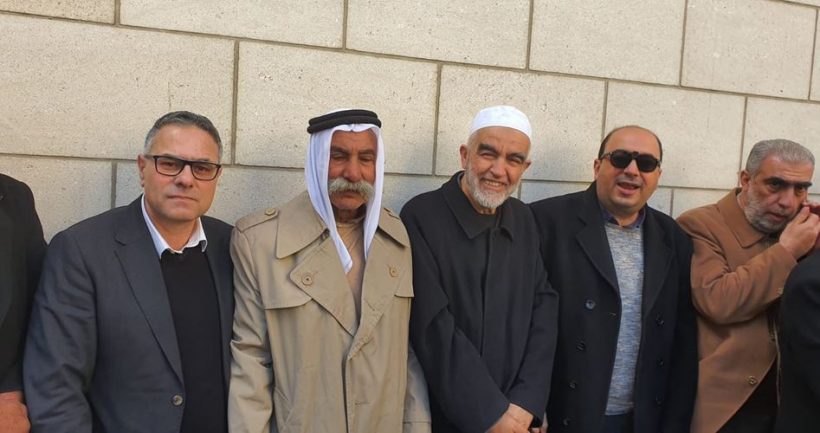
Israel hands Sheikh Raed Salah 28-month jail term
MEMO | February 10, 2020
An Israeli court today sentenced Palestinian resistance icon Sheikh Raed Salah to 28 months in prison, stoking strong condemnation of the country’s legal system and the suppression of free speech.
Salah received a 28-month prison sentence from the Haifa Magistrate’s Court for remarks he had made at a funeral in 2017. The 61-year-old has already served 11 months in detention as part of his sentence and is therefore expected to remain in prison for 17 months.
Israeli police arrested Salah nearly three years ago, accusing the former mayor of Umm Al-Fahm of praising three Arab Israelis who shot dead two police officers in a July 2017 attack. In November, he was convicted of “incitement” and engaging in “anti-Israel activities” for remarks he had made during the funeral of the three assailants.
According to the indictment, Salah praised the attackers saying: “At these moments [we need to stand together] as one house, as one family. We take leave of our martyrs … and express the wish that they join the prophets, the righteous ones and the martyrs. At these moments, may we pray that God increases their value in the heavens in paradise.”
In his defence Salah argued that his views were religious opinions rooted in the Quran, and did not constitute a direct call to violence. Salah’s lawyer also explained that the remarks were made within the context of a religious sermon and urged Israel “to not prosecute him for his faith and beliefs”.
Haifa Magistrate’s Court Judge Shlomo Benjo conceded that some of Salah’s remarks at the funeral had been mistranslated but still ruled that the translation errors did not alter the general meaning of his comments.
“Despite the attempts to give the defendant’s statements a religious character, the conclusion is that the accused expressed praise, sympathy and support for the attacks,” the judge said in delivering his verdict.
Joint List MK Yousef Jabareen criticised the decision by pointing to the normalisation of incitement to hate and violence in Israeli society.
“In a country where the prime minister, senior ministers and main religious figures incite against the Arab public and its leaders from morning till night, Raed Salah’s conviction marks another step in the political persecution of the Arab,” Jabareen wrote on Twitter. He explained that the verdict marked “a dangerous erosion of freedom of expression for the leadership and delegitimisation of political and religious activity”.
Muhammad Baraka, the head of the Higher Follow-up Committee for Arab Citizens in Israel, also dismissed the verdict. The “ruling was prepared in advance, and was based on racist foundations and incitement against Arabs,” Baraka was quoted as saying in a Turkish news source.
In an interview, Salah’s lawyer, Khaled Zabarqa, said that Israel’s endless efforts to silence the Palestinian leader was intended to pave the way for the controversial peace plan known as the “deal of the century”.
According to Zabarqa, Israel has been planning for the past two years to ban any appearance by Sheikh Salah due to his ability to mobilise Palestinians to reject any Israeli plan intending to terminate Palestinian rights in Jerusalem.
See also:
Palestinians in Israel are the next target for the deal of the century
Kissing International Law Goodbye to Satisfy Israeli Greed
By Stuart Littlewood | American Herald Tribune | February 10, 2020
Palestinian chiefs say that Trump’s so-called peace plan contains 300 violations of international law and they will take it up with the Security Council. That’s nearly two violations per page. Given the document was put together by America and Israel, both lawless and criminal to the core, no-one is surprised. It is a brazen expression of criminal intent from start to finish.
In the UK our new Foreign Secretary, Dominic Raab, has shot to prominence. We’re told he spent the summer of 1998 at Birzeit University (in Palestine’s West Bank) working for one of the PLO’s chief negotiators on the Oslo peace accords. That doomed-to-fail initiative began in 1993 and created a form of interim governance and the framework for a final treaty by the end of 1998. So Mr Raab was there at a time when the two sides had been faffing about for 5 years achieving nothing.
In October 1998 the US, desperate to keep the charade going, convened a summit at Maryland’s Wye River Plantation at which Clinton with Yasser Arafat, Benjamin Netanyahu, and senior negotiators produced the Wye River Memorandum. Not that this did much good either. But Raab must have learned a lot about Israeli perversity and intransigence, not to mention America’s shortcomings as an honest broker.
Before entering Parliament Raab joined the Foreign Office and worked at the The Hague bringing war criminals to justice, then became an adviser on the Arab-Israeli conflict. But you wouldn’t think so when looking at his latest performances.
As reported in Jewish News Raab welcomed Trump’s so-called peace plan calling it “a serious proposal, reflecting extensive time and effort. A peace agreement between Israelis and Palestinians that leads to peaceful coexistence could unlock the potential of the entire region, and provide both sides with the opportunity for a brighter future. Only the leaders of Israel and the Palestinian territories can determine whether these proposals can meet the needs and aspirations of the people they represent.
“We encourage them to give these plans genuine and fair consideration, and explore whether they might prove a first step on the road back to negotiations.”
His boss Boris Johnson said of it: “No peace plan is perfect, but this has the merit of a two-state solution. It is a two-state solution. It would ensure that Jerusalem is the capital of Israel and of the Palestinian people.” A fatuous remark if ever there was one because (a) he clearly hadn’t read it carefully, (b) the Palestinians weren’t consulted, and (c) as Jewish News stated, a Palestinian capital would be established on the outskirts of East Jerusalem while most of Jerusalem, including the sublime and ancient walled city (which is officially Palestinian), would remain under Israeli control. That is perhaps the cruellest part of the Zionist swindle.
UK Government a ‘Force for Good’?
In the Global Britain debate on 3 February Raab pompously declared that “the third pillar of our global Britain will be the UK as an even stronger force for good in the world. Our guiding lights will remain the values of democracy, human rights and the international rule of law”.
But Alistair Carmichael (LibDem) pricked Raab’s pretty balloon, asking: “If the concept of a global Britain is to have any meaning and value, surely it must have respect for human rights and an international rules-based order at its heart. With that in mind, will the Foreign Secretary reconsider the unqualified support he gave to President Trump last week in respect of the so-called peace plan for Palestine? Will the right hon. Gentleman repudiate the proposed annexation of the West Bank and at long last support the recognition of a Palestinian state?”
Raab replied: “I gently say to the right hon. Gentleman that I do not think he has read the detail of this. Whatever else he may disagree with, the one thing that the plan put forward by the US included was a recognition of and commitment to a two-state solution. We have been absolutely clear that that is the only way in which the conflict can be resolved…. Rather than just rejecting the plan, it is important that we try to bring the parties together around the negotiating table. That is the only path to peace and to a two-state solution.”
I’d have expected Raab, by now, to be extremely sceptical of any two-state solution given the many irreversible facts on the ground that Israel has been allowed to create with impunity. And he would know better than most how many times the sides have come to the table for grotesquely lopsided negotiations and how the Israelis never honour the agreements they make.
Raab won the Clive Parry Prize for International Law while at Cambridge. So if he’s so wedded to the values of democracy, human rights and the international rule of law, why are these vital ingredients missing from his recipe for peace? It must be obvious to everyone – except Government ministers – that you cannot achieve peace without justice. And justice in the form of UN resolutions and international and humanitarian law has already spoken several times. It waits… and waits… and waits… to be implemented.
Then we had Dr Andrew Murrison, Minister of State for International Development & the Middle East, in answer to a written question: “We have made clear our deep concern about the suggestion that any parts of the Occupied Palestinian Territories should be annexed…. Any declaration of a unilateral border change undermines the rules-based international order and the UN Charter. The UK calls on all parties to refrain from actions in contravention of international law that would imperil the viability of a two-state solution, based on the 1967 lines, and make it harder to achieve a just and lasting peace.”
Dr Murrison can’t have been paying attention. Illegal border changes departing from 1947 Partition lines and 1967 lines, annexations and other actions in contempt of international law and the UN Charter have been going on for 70 years simply because none of those pillars of modern civilisation have been enforced where Israel’s concerned. Rules-based international order has been constantly undermined and is now non-existent in the Holy Land.
The question is, what does the UK Government, which is largely responsible for this sorry state of affairs, plan to do about it besides mouthing the usual limp-wristed idiocy? Is the Johnson administration happy, in George Orwell’s words, for the US-UK-Israeli boot to stamp on the human face of the Palestinians for ever?
BDS targeted
And as if the Holy Land fiasco wasn’t enough we must put up with crass ministerial utterances on the home front. Robert Jenrick, the Secretary of State for Housing, Communities & Local Government, complains that only 136 of the 343 local authorities in England have agreed to adopt the International Holocaust Remembrance Alliance (IHRA) definition of anti-Semitism and insists that all universities and local councils “must adopt” it. If they don’t, and they fail to tackle anti-Semitism, they can expect to lose public funding.
According to the Jewish Chronicle he vowed to take action against universities and “parts of local government” who have become “corrupted” by anti-Semitism. Writing in the Sunday Express, he added: “I will use my position as Secretary of State to write to all universities and local authorities to insist that they adopt the IHRA definition at the earliest opportunity. I expect them to confirm to me when they do so.”
Jenrick qualified as a lawyer so should respect warnings by top legal opinion (for example Hugh Tomlinson QC, Sir Stephen Sedley and Geoffrey Robertson QC) that the IHRA definition is “most unsatisfactory”, has no legal force, and using it to punish could be unlawful. It also undermines Article 19 of the Universal Declaration of Human Rights and Article 10 of the UK’s own Human Rights Act 1998.
But Jenrick seems to have aligned himself with sinister moves by Johnson aimed at protecting Israel from the consequences of its countless breaches of international law and crimes against the Palestinians by banning public bodies from imposing their own boycotts, disinvestment or sanctions (BDS). What could any decent administration possibly fear from BDS? It is simply a peaceful response to Israel’s thuggery. It urges non-violent pressure on Israel until it complies with international law by meeting three perfectly reasonable demands:
- Ending its unlawful occupation and colonization of all Arab lands and dismantling the Wall (international law recognises the West Bank including East Jerusalem, Gaza and the Syrian Golan Heights as occupied by Israel).
- Recognizing the fundamental rights of the Arab-Palestinian citizens of Israel to full equality.
- Respecting, protecting and promoting the rights of Palestinian refugees to return to their homes and properties as stipulated in UN Resolution 194.
So how is Boris Johnson proposing to block BDS? Briefing notes accompanying the Queen’s Speech to Parliament, which set out his Government’s programme, said:
- We will stop public institutions from imposing their own approach or views about international relations, through preventing boycotts, divestment or sanctions campaigns against foreign countries and those who trade with them.
- This will create a coherent approach to foreign relations from all public institutions, by ensuring that they do not go beyond the UK Government’s settled policy towards a foreign country. The UK Government is responsible for foreign relations and determining the best way to interact with its international neighbours.
The ban will apply to institutions across the public sector, not just councils, and will cover purchasing, procurement and investment decisions.
Johnson and his underlings just don’t get it. BDS is a legitimate, peaceful way of opposing the Israel’s illegal occupation. Put simply, as long as the Occupation is business as usual for Israel, there should be no business with Israel. Furthermore the foreign policies of successive UK governments have not met with the approval of the British people, and never will with US-Israel pimps dictating at Westminster.
If the Government’s “settled policy” towards Israel was consistent with international law and human rights conventions – as it should be – there’d be no need for BDS campaigns because the UK would already be applying sanctions. Furthermore the Conservatives’ election manifesto pledged to “ensure that no one is put off from engaging in politics…. by threats, harassment or abuse, whether in person or online.” They also promised to champion the rule of law, human rights, free trade, anti-corruption efforts and a rules-based international system – all of which Israel refuses to comply with.
Yet, only last month Jenrick announced to a Conservative Friends of Israel parliamentary reception that he would “look forward to the day” when Britain’s embassy in Israel will be “moved to Jerusalem.” And he told the Board of Deputies of British Jews he would not tolerate local authority approved BDS campaigns in the UK. “Local authorities should not be wasting time and taxpayer’s money by dabbling in foreign policy or pursuing anti-Israel political obsessions.”
By the same token one might ask why the Secretary of State for Housing, Communities and Local Government is wasting time and taxpayers’ money dabbling in foreign policy and advocating on behalf of a foreign military power? It’s not in his job spec.
Jenrick has an Israeli-born wife and is a member of Conservative Friends of Israel. Before he tries ordering local authorities what to think and do he should have the courtesy to declare these interests. According to the Guardian he’s an MP who is “on the up.” Heaven help us.
Johnson is expected to hold a Cabinet reshuffle this week. His administration is already top-heavy with Zionists and, as 80 percent of Conservative MPs are reportedly signed-up Friends of Israel, there’s no shortage of compliant stooge material to fill even more top posts.
The US bought Sisi for $9bn, but the Egyptian people cannot be swayed
By Amelia Smith | MEMO | February 9, 2020
When Trump announced Jerusalem was Israel’s undivided capital under his so-called “deal of the century”, the Egyptian public questioned whether Al-Sisi had a hand in preparing the plan. His support, after all, came just half an hour after the announcement.
Officially, Egypt supports the establishment of a Palestinian state on its pre-1967 borders with East Jerusalem as its capital. According to Mada Masr, Al-Sisi’s statement originally included a sentence to that effect, but in a later draft it was removed, after it had passed through the president’s office for review.
Since he came to power, Abdel Fattah Al-Sisi’s rule has been decidedly anti-Palestinian. When Egypt’s military overthrew Mohamed Morsi on 3 July 2013, one of the first things the generals did was close the Rafah Crossing and deport Palestinians arriving in the country through Cairo Airport.
But in some respects the Egyptian dictator has tried to maintain nominal respect for the Egyptian position. In 2017, it was Egypt which filed a draft resolution rescinding Trump’s declaration that Jerusalem was Israel’s capital amid the global outrage that followed his announcement.
The price for Egypt’s new position was $9 billion, the amount promised at the economic workshop for the deal of the century in Bahrain last summer. It’s a big chunk of money for Egypt, given the dire straits it has found itself in under Al-Sisi’s mismanagement of the economy, and should provide some generous bonuses for the ruling generals, who we know through the whistleblower Mohamed Ali are getting rich through corruption and at the expense of their own people.
For its part, Israel has achieved political and economic gains it never imagined could be possible. This has been described as the golden age of Israeli-Egyptian relations symbolised by the transfer of Tiran and Sanafir islands to Saudi Arabia, which opened up the Straits of Tiran to Israel, and compounded by security cooperation between the Egyptian and Israeli army in Sinai.
As Yehya Okail, a former MP in Sinai, once told me:
Hosni Mubarak was a treasure to Israel, however Sisi is much more than that. Israel never imagined that it would be served by anyone in the history of Egypt as Sisi has done.
Trump’s plan proposes “cross-border services” including building desalination and power plants next to the Egypt-Gaza frontier. Observers have long talked about the US’ plans to build infrastructure projects in the Sinai Peninsula where Palestinians can work.
As Al-Sisi laid the groundwork for these projects, Sinai’s indigenous population, the Bedouin, have felt the plans acutely. The government has razed homes and obliterated fertile farmland, offering Sinawis no compensation for their loss. All of this has taken place under a protracted “war on terror” in Sinai authorities have been fighting for years now. As well as being accused of systematic war crimes, the army is no closer to defeating the estimated 1,000 militants there.
With Trump’s announcement, Egypt has another excuse to ramp up security in Sinai, which is already suffocating under a curfew and restrictions on goods entering the peninsula. No one knows better than the people of Sinai that increased security in the peninsula is a pretext for increased repression. At the beginning of the week, Egypt arrested 32 women from a prominent North Sinai tribe.
Reports reveal high level military and intelligence leaders have demanded security forces be on high alert in anticipation of events in Gaza, including the claim that Palestinians will storm the border and make their way deep into Egyptian territory. With this, Egypt has flipped the narrative on its head to persuade the public it is Palestinians that want to flood Sinai, not that it is preparing to give its own land up at the behest of Israel and the US.
It’s not just in Sinai that people will feel the reverberations of Trump’s deal. Dual Palestinian-Egyptian national Ramy Shaath, the general coordinator of BDS Egypt who was imprisoned for speaking out about Egypt’s participation in the Bahrain workshop, and his colleague Mohamed El-Massry, are both imprisoned as part of the regime’s crackdown on pro-Palestinian solidarity. Their sentences and conditions could be negatively affected by the announcement and its aftermath.
Whilst the Egyptian regime has made a significant shift in its official position, in the long-term convincing its people isn’t so easy, as is evident from the public outcry in January, not just over the government’s official response to the deal of the century, but also because last month was when Israel began transporting natural gas to Egypt under a $15 billion deal.
In an attempt to change hearts and minds, Egypt intelligence sent round a WhatsApp to top media editors with instructions on how to report on the announcement. It asked them to refer to the US proposal as a “peace plan”, rather than the more negatively-viewed deal of the century, it said was viewed as an American-driven project to secure Israel’s interests. Editors were told not to address or focus on religious or national elements of the plan or to ask Al-Azhar for its view on the matter. It also asked journalists to emphasise the historical and pivotal role of Egypt on the Palestinian issue.
Attempts to control the narrative are widespread. One source in Sinai told me that two people were arrested in Arish around Christmas over Facebook posts about Israel, another researcher said that only high-ranking officers in the Egyptian army know they are cooperating with Israel in Sinai. These incidents show how entrenched pro-Palestinian sentiment is in Egypt, and how insecure the regime is. But it won’t stop Trump’s “favourite dictator”, as he presses ahead with the deal of the century to his benefit and to the detriment of his own people.
Oslo Accords and the PA are a Hindrance to Palestinian Liberation
By Marion Kawas | Palestine Chronicle | February 8, 2020
On January 28, 2020, US President Donald Trump unveiled the details of his ‘Deal of the Century’ in Washington D.C. with Benjamin Netanyahu by his side.
Many of these details had been leaked before, but this press conference put it all together in one package, replete with maps. For many Palestinians, this exercise simply acknowledged what is already the reality on the ground.
But for those still clinging to the façade of “international order”, Trump’s apartheid plan is the final nail in the coffin of the much-touted “two-state” solution. The “two-state” solution that has dragged on for over 25 years, and only resulted in more theft of Palestinian land, more illegal Israeli settlements and more oppression for Palestinians.
It is time to realize that the “state-building” exercise, initiated by the Oslo accords, has failed and failed in a way that has crippled the Palestinian struggle for decades. It is also time to acknowledge that Trump’s Steal/Scam/Theft of the Century is regrettably the logical outcome of those same Oslo Accords.
In the 1970s, the Palestine Liberation Organization PLO was widely recognized as the sole, legitimate representative of the Palestinian people. One of the main planks in its platform was the creation of an independent, secular, democratic state in Palestine. Western governments of the day went out of their way to attempt to vilify and exclude the PLO from international forums and other events.
How did we possibly come from that to what we are witnessing today? How and when did the PLO change its focus and what were the repercussions on the Palestinian struggle? Why did the Palestine National Council PNC vote in 1998, under the guns of the occupier, to amend and nullify crucial articles in the PLO charter? A vote that ultimately neutered and marginalized both the PNC and the PLO as effective representative bodies for Palestinians, a vote that was boycotted at the time by many PNC members and leading visionary Palestinian intellectuals, such as Edward Said.
The Oslo Accords dramatically re-framed the parameters of the Palestinian movement and what was considered “acceptable”; but did they also succeed in laying the foundation and granting legitimacy for greater normalization with Israel?
If you want a favor from the U.S. government, it seems normalization with Israel is the road to take, as happened recently with Sudan’s leader al-Burhan. These are all important questions that need serious discussion in the entire Palestinian movement, including those in diaspora and in refugee camps. The fight for Palestinian liberation cannot move forward until the setbacks of the past are addressed, and the disgraced Palestinian Authority, and its job as a security contractor for Israel, held to account.
It’s immaterial now if the Oslo Accords could have worked if they had been honored and implemented as promised – they weren’t. In fact, it is now apparent that the whole intent of the Oslo Accords (or at least its backers) was to contain, control and censor the militant spirit and legacy of the Palestinian struggle. History has brought us to another pivotal moment for the Palestinian national collective. This moment can either be met with a recognition of these realities and give birth to bold ways for new leadership to move forward, or be squandered and add more unnecessary years to the arduous path for liberation.
Palestinians around the world demonstrated and protested in the last week to show their total rejection of this latest attempt on their national dignity and existence. And no, it’s not because they insist to “miss an opportunity to miss an opportunity”! It’s because they refuse these “opportunities” to surrender, to commit national suicide, and to sell-out their and their children’s birthright.
As in the darkest periods that have come before, the Palestinian people will prevail and foil all conspiracies against their legitimate national and human rights. The right of return, the right to genuine self-determination, the right to live in dignity and freedom – the new generation of Palestinians are as committed as any before them that these rights are sacred and will NOT be sacrificed.
– Marion Kawas is a member of the Canada Palestine Association and co-host of Voice of Palestine.
Israel uses civilian flight as shield to raid Damascus after Syrian troops liberate Saraqib
Press TV – February 7, 2020
An Israeli airstrike, carried out as Syria troops were liberating the terrorist-held town of Saraqib in northwestern Idlib province, has endangered a civilian flight carrying 172 passengers, according to the Russian Defense Ministry.
Defense Ministry spokesman Major General Igor Konashenkov said Friday the civil Airbus-320 was heading to Damascus from the Iranian capital early Thursday when it was forced to divert its route as the Syrian capital’s air defenses were intercepting Israeli missiles.
The plane made an emergency landing in the Hmeymim air base in Syria’s western coastal province of Latakia.
“Only due to timely actions of the Damascus airport dispatchers and the efficient operation of the automated air traffic control system, the Airbus-320 managed to… successfully land at the closest alternative airfield,” Konashenkov said.
‘Israel using passenger jets as shields’
The spokesman stressed that Israel was well aware of civilian flights around Damascus and that such missions demonstrated the regime’s reckless disregard for human lives.
“The Israeli general staff’s use of passenger jets as a cover for its military operations or as a shield from Syrian missile system fire is becoming a typical trait of Israeli air force,” he said.
Russia had previously warned that Israeli airstrikes against Damascus were endangering civilian jets.
Lebanese officials have also stated that Israeli jets illegally conducting operations against Syria from the country’s airspace pose a danger to civilian aircraft in Lebanon.
In 2018, Syrian air defenses mistakenly shot down a Russian Ilyushin Il-20 reconnaissance plane after it was similarly used as a cover by Israeli warplanes, killing 15 people on board.
Syria: Saraqib fully liberated
The Israeli airstrikes took place as Syrian troops were entering the terrorist-controlled town of Saraqib, which lies at the crossroads of two key highways in the Idlib province, the last major terrorist bastion in Syria.
The town has currently been fully liberated by Syrian forces.
Damascus has highlighted that the Israeli airstrike on Thursday happened at the same time the Turkish military was deploying a military caravan in Idlib to “protect the terrorists” and halt the Syrian military advance in the province.
Damascus has slammed the operation as evidence of Tel Aviv and Ankara’s coordinated support for the terrorists.
Israel is known for conducting airstrikes against Damascus during major Syrian military advancements.
The reported joint Israeli-Turkish operations in Syria come as Ankara – which has also been a major backer for terrorists in Syria – has warned that it may resort to military action if Syria does not withdraw its troops battling terrorist forces in Idlib until the end of February.
The ongoing Syrian army offensive in Idlib was launched last August after terrorists failed to honor the Sochi de-escalation zone agreement brokered between Russian and Turkey in September 2018.
Large swathes of the province have since been liberated by Syrian troops.
Tehran offers mediation, stresses political resolution
Iran’s Ambassador to the United Nations Majid Takht-Ravanchi said Iran, as a main party to the Astana peace process, was ready to help solve disputes between Damascus and Ankara regarding the Idlib province.
“We have to guarantee that this crisis is solved politically while at the same time prohibiting terrorists from using this as an opportunity to fortify their positions, turn Idlib into a safe refuge and target more civilians,” he said.
“We have to be aware that the goal of protecting civilians doesn’t get replaced with protecting terrorists,” he added.
The UN envoy added that an Astana meeting, which is planned to be held in the near future in Tehran, provides an “indispensable opportunity” to resolve issues related to the Syria conflict.
The Astana peace process was launched by Iran, Turkey and Russia in 2017 and had a major role in reducing violence in the country by agreeing to de-escalation zones in the war-wracked country.
Ex-Netanyahu Adviser Brings Thousands Of Christians To Israel On Propaganda Trips
MEMO | February 6, 2020
A former adviser to Israeli Prime Minister Benjamin Netanyahu has brought thousands of Christian American students to Israel over the last four years for propaganda junkets, reported JTA.
“Passages”, a nine-day trip whose itinerary includes Jerusalem, Tel Aviv, Bethlehem and West Bank settlement Alfei Menashe, began in 2016 and will reach 10,000 participants by the end of this year.
The programme was founded by former Netanyahu adviser Rivka Kidron and former US marine Robert Nicholson.
The initiative is funded by what Kidron described to JTA as a “diverse group” of private donors to the tune of $16.7 million per year (the annual budget for 2020).
According to JTA, Passages is “unabashedly pro-Israel”, calling the country “a force for good in the region and in the world” on its website.
Passages participants “must be recommended and go through a rigorous screening process that aims to identify leadership potential”.
The executive director of “Passages”, Scott Phillips, described the success of the programme as a “long game”.
“Growing the number of students it brings to Israel is one goal, but the final measure of success will be keeping them engaged in the Christian community and in Israel advocacy,” JTA added.
Abbas is a mouthpiece for international impositions on Palestine
By Ramona Wadi | MEMO | February 6, 2020
The Palestinian Authority has learned nothing from decades of futile UN Security Council Resolutions. Do the people of Palestine really need international consensus regarding the already very clear illegality of US President Donald Trump’s so-called deal of the century?
Pushing on regardless, PA leader Mahmoud Abbas is pursuing repetitive, useless and time-wasting options to give an impression of being engaged diplomatically with the international community and its impositions. While Abbas pleads at the UN to obtain another symbolic show of alleged international support, Israeli Ambassador to the UN Danny Danon is lobbying the Security Council “to enlist their support for the joint US-Israeli action and to prevent support for any Palestinian declarations of protest.”
The draft resolution calls for a rejection of Trump’s deal and seeks yet another endorsement of the two-state compromise, despite the impossibility of its implementation. Abbas’s refusal to consider a unified Palestinian approach that encompasses all legitimate forms of resistance against Israeli colonisation makes UN Secretary General Antonio Guterres’s job of presiding over the constant Israeli violations of international law and human rights easier. As long as the PA scrambles after the international community for a solution, the UN only has to regurgitate the same rhetoric about its two-state vision. Accountability in this regard is not applicable, as the PA and the UN know full well.
In what would now be perceived as a weak condemnation of Trump’s deal, Guterres cautioned against “actions that would erode the possibility of a viable and contiguous Palestinian state,” with reference to Israeli settlement expansion. However, the US-Israeli scheming goes beyond expansion to formal, rather than merely fact-on-the-ground annexation. The UN is, as usual, several strategic steps behind, so as not to run out of the plethora of violations to speak out against during opportune moments in which the Palestinian cause is exploited yet again.
If the US vetoes the resolution, which is certain, the PA is likely to get another round of passive support from the UN General Assembly. For Abbas, a show of votes might be enough to claim validity, yet again, for the two-state compromise, as opposed to Palestinians’ political rights. The truth, however, is that the international community has only supported rhetoric about Palestinian rights. Altering its trajectory now would spell disaster for the UN in terms of its own complicity in endorsing Israel’s colonisation of Palestine. Hence, the cautious warnings against settlement expansion while refusing to advocate in favour of decolonisation. Likewise, the UN will entertain Abbas and his overtures because the PA has proved that it squanders any potential for change.
Trump’s deal is the least of the international community’s concerns. Abbas is only accentuating his irrelevance with resolution gimmicks at the UN. Palestinians are voiceless at the UN primarily because of the UN’s protection of Israel, but also due to Abbas consolidating his role as spokesman for international demands and counter-narratives about what Palestinians want. A resolution confirming what is already known makes no difference to the political violence that Israel continues to inflict upon Palestinians. The PA should be turning towards its own people, as it should have done on previous occasions and refused, instead of wasting time at the UN for yet another opportunity to lament about delays.
Palestinians in Israel are the next target for the deal of the century
![Women in Gaza come together to protest against Trump's 'peace deal' on 5 February 2020 [Mohammad Asad/Middle East Monitor]](https://i0.wp.com/www.middleeastmonitor.com/wp-content/uploads/2020/02/Women-in-Gaza-protest-against-US-peace-deal2.jpg?resize=1200%2C800&quality=85&strip=all&ssl=1)
Women in Gaza come together to protest against Trump’s ‘peace deal’ on 5 February 2020 [Mohammad Asad/Middle East Monitor]
MEMO | February 6, 2020
Israelis of all political persuasions welcomed the Trump “peace plan”, but the Palestinian citizens of the self-styled Jewish state are angry because the deal refers to land and population swaps between Israel and Palestinian Authority territory. This confirms that Israel wants to displace them, fulfilling right wing aspirations.
Arab members of the Israeli parliament have said that they will not agree to the deal of the century and its explicit annexation proposal. Nevertheless, the right-wing Israeli government now has a green light to strip citizenship from hundreds of thousands of Palestinians living in the “Triangle” in northern Israel.
It is clear that Trump’s plan is not just about taking more of the Palestinian land occupied in 1967, but that it also wants to “transfer” Palestinians from the areas occupied in 1948. Israel wants to “swap” the area with the PA; protests against this are not, therefore, simply in solidarity with the Palestinians in the West Bank and Gaza Strip, and the refugees in the diaspora. There is also a conspiracy against their existence in Israel.
The Palestinians in Israel have held crisis talks about the implications of the deal, especially for those in the Triangle, which is a predominantly Arab area in Israel, near the West Bank, divided into the Northern Triangle and the towns of Kafr Qara, Ar’ara, Baqa Al-Gharbiyye and Umm Al-Fahm, and the Southern Triangle, which includes Qalansawe, Tayibe, Kafr Qasim, Tira, Kafr Bara and Jaljulia. It is a stronghold of the Islamic movement in Israel, led by Sheikh Raed Salah.
The part of the Triangle mentioned in the Trump plan covers 350 square kilometres. The area threatened by the swap proposal covers more than 42,000 acres, inhabited by 300,000 Palestinians, who make up 20 per cent of the total Palestinian population inside Israel and have Israeli citizenship. These villages are thus a source of demographic concern for Israel due to the steadily increasing population, which is expected to reach 500,000 in the next five years, tipping the demographic balance in favour of the Palestinian Arabs.
The Triangle is more conservative in nature than the more integrated Arab regions in Israel. Swapping the land and population out of Israel will see the loss of those who best preserve traditional Palestinian identity. Local political groups believe that the land and population swap is an extension of previous efforts by Israel to liquidate the Palestinian issue; Israel wants more land but without the people of Palestine on it. It is not the first time that the Israelis have sought to transfer the largest number of Triangle residents and the least amount of land. Such a move will not only hit the Palestinians directly involved, but also their extended families and social connections, many of which will be severed.
Efforts to Judaise the Triangle areas to provide Israel with some strategic depth have included a belt of settlements on the outskirts of the Arab towns. This has caused anxiety among the Palestinians, with almost daily attacks by settlers against them and their properties. There is also a fear that another massacre like that at Kafr Qasem in 1956 is on the cards in order to make the local population leave of their own accord.
A plan developed by the late Prime Minister Ariel Sharon, called the “Seven Stars” project, tried to change the demographic nature of the Triangle. A Jewish majority was to be created by establishing religious centres, hemming-in Umm Al-Fahm so that it could not be developed further, and linking the area to settlements in the West Bank. This would also have seen the removal of the so-called Green “Armistice” Line of 1949 dividing the Palestinian territories occupied in 1948 from those occupied in 1967. The latter were supposed to form the “State of Palestine” according to the international consensus. Sharon’s project did not get beyond the discussion stage.
It is clear that Israel is seeking to buy enough time to impose a fait accompli on the ground by getting Knesset approval for the deal. Although the Arab MKs have the third largest coalition with 12 seats, their chances of thwarting the vote on the plan are almost non-existent in light of the general agreement within Israel to implement Trump’s plan.
Israelis have declared the Palestinian-Israeli population growth as a “demographic time bomb”. With a falling birth rate among Israeli Jews, the fear is that Palestinians will outnumber them across historic Palestine within the next ten years.
Land swaps to defuse this “threat” to the “Jewishness” of the state of Israel have been mooted before, of course. Post-1967, Israel’s policies in the newly-occupied territories have included the annexation of Jerusalem, still unrecognised by most countries in the world; land confiscation; house demolitions and the removal of residency rights.
In 1982 a secret document called for the Interior Ministry to crack down on the Palestinians and push them to leave their land. This was picked up by the racist General Rehavam Ze’evi in 1988, and notorious Rabbi Meir Kahane, who called for Umm Al-Fahm to be attacked as a means of provoking its residents.
By 2004, former Defence Minister Avigdor Lieberman was proposing the swap of minor Israeli settlements in the West Bank with Arab villages and towns in the Triangle, based on similar agreements made post-World War Two in different parts of the world. Donald Trump’s “peace plan” is in many ways simply a US-endorsed Judaisation project giving Israel everything that it wants, for now. Its aims and objectives mirror those of earlier schemes.
Israeli security agencies are also concerned about the growing influence and activities of the Islamic movement within the “Jewish state”, particularly in the Triangle, as its ideas are similar to those of the Muslim Brotherhood. The movement also mobilises volunteers against Israeli violations at Al-Aqsa Mosque. The fear is that the conflict will spill over into serious clashes between Palestinian Muslims and religious Jews.
The timing of the release of the deal of the century helped Benjamin Netanyahu, who faces yet another general election next month — the third in less than a year — as well as indictments for corruption. The deal is a bit of a lifeline for the Israeli Prime Minister. Nevertheless, approval and implementation of its terms may be postponed until after the election, giving the Arab MKs time to try to prevent the displacement of citizens from the Triangle.
Palestinians within Israel believe that the Trump “peace plan” is anything but peaceful, and will lead to violence. In fulfilling the aims and aspirations of the Israeli far-right, it looks set to entrench even further Israel’s status as an apartheid state, with the indigenous people facing ever more discriminatory legislation and displacement. It remains to be seen if they can prevent the implementation of the plan, at least the land swap clause, which seeks to rob so many people of their citizenship and transfer them against their will.
READ ALSO:
The PA will opt for losing Palestine if it means keeping its ‘authority’
Featured Video
10K More U.S. Troops Deploy as Trump Weighs New Iran Strikes
or go to
Aletho News Archives – Video-Images
From the Archives
Genetic baloney in thick slices
MAYBE COULD BE INC.
By Jon Rappoport | No More Fake News | July 8, 2021
Gene research companies tend to come and go. They start out banging and popping like fireworks in the sky, and then they fade out—selling themselves to larger outfits who’ve hired better liars…
Once upon a time, it sounded easy. Start with a disease, find the gene responsible for the disease, and correct the problem.
Then, researchers wondered, was disease the result of one gene or a group of genes acting together?
Either way, the proof would be in devising cures for diseases using gene therapy. “Not yet, but soon…”
And regardless, the major need was: money. Lots and lots of money.
This need required good PR people. “We have to pump up the idea that we’re on the edge of tremendous breakthroughs. We’re always on that edge…”
This hype also needed to obscure the fact that there wasn’t (and isn’t) ANY gene cure for ANY disease. … continue
Blog Roll
 Aletho News
- US military withdrawal from Iraq and the collapse of US-Israeli hegemonic project in West Asia
- What does Europe want – a war with Russia?
- She Followed the Actual Data on COVID Vaccines and Masks — Her Career Took a Huge Hit
- Florida AG Sues Pfizer, Bourla Over Deceptive Marketing of COVID Vaccines
- Von der Leyen gifts her spin doctor a job for life
- 10K More U.S. Troops Deploy as Trump Weighs New Iran Strikes /Suliaman Ahmed
- Iranian crew declared Dena training vessel ‘unarmed’ to US warship before deadly torpedo strike: Report
- Iran’s NPT debate moves beyond parliament
- Houthis condemn Saudi claims of attack on Medina
- Fatuous False Flags
- If Americans Knew
- Israel is squeezing the life out of Palestinians – Daily Update
- The Israeli Right Portrays Islam as Murderous. It Serves a Political Purpose
- Jordan Has Had Enough: King Abdullah’s Scathing Warning to Israel
- Israeli Colonizers (i.e. Settlers) Kill Palestinian Man Near Salfit
- New Google Maps images reveal massive scale of devastation in Gaza
- Jewish supremacy, anti-Palestinian bigotry on display in Israel – Daily Update
- Israeli Soldiers Abduct At Least 22 Across Occupied West Bank
- Eight Palestinians Killed in Israeli Attacks on Gaza
- Israeli former leaders and security chiefs threaten legal action over ‘Jewish terrorism’
- Israel map in LA Times ad includes all land from the river to the sea
- No Tricks Zone
- Green Energy Debacle: German Expert Professor Fritz Vahrenholt Warns Of Severe Economic And Social Consequences
- Two More Paleo Reconstructions Affirm Meters-Higher Sea Levels Across Ireland, Brazil 7000-6000 Years Ago
- New Study: Earth And Venus Surface Warmth Largely Explained By Convection And Lapse Rate, Not CO2 Or Radiation
- 2025 Nature Paper Claiming Worsening Global Drought Gets RETRACTED …Heavily Flawed
- New Study: ‘Global Drought Shows No Detectable Recent Acceleration Under Climate Warming’
- Economic Masterminds: German Socialists Suggest Taxing Productivity Gains Stemming From Using AI
- The South China Sea Has Not Been Cooperating With The Climate Change Narrative
- Energy Crisis: Germany Enters Heating Season With Historically Low Gas Reserve Fill Levels
- New Study: The Antarctic Ice Sheet Gained Mass From 2020-2024 Due To Staggering Snow And Ice Accumulation
- Study: Ocean Heating Rates From Thousands Of Years Ago ‘Dwarf’ Modern Ocean Heating Rates

