For Israel, Annexation of the West Bank is a Long-established Goal
With Benjamin Netanyahu under pressure and the US signalling its support, the time to realise this catastrophic ambition may be fast approaching
By Jonathan Cook • The National • June 17, 2019
When Israeli prime ministers are in trouble, facing difficult elections or a corruption scandal, the temptation has typically been for them to unleash a military operation to bolster their standing. In recent years, Gaza has served as a favourite punching bag.
Benjamin Netanyahu is confronting both difficulties at once: a second round of elections in September that he may struggle to win; and an attorney general who is widely expected to indict him on corruption charges shortly afterwards.
Mr Netanyahu is in an unusually tight spot, even by the standards of an often chaotic and fractious Israeli political system. After a decade in power, his electoral magic may be deserting him. There are already rumblings of discontent among his allies on the far right.
Given his desperate straits, some observers fear that he may need to pull a new kind of rabbit out of the hat.
In the past two elections, Mr Netanyahu rode to success after issuing dramatic last-minute statements. In 2015, he agitated against the fifth of Israel’s citizens who are Palestinian asserting their democratic rights, warning that they were “coming out in droves to vote”.
Back in April, he declared his intention to annex large chunks of the occupied West Bank, in violation of international law, during the next parliament.
Amos Harel, a veteran military analyst with Haaretz newspaper, observed last week that Mr Netanyahu may decide words are no longer enough to win. Action is needed, possibly in the form of an announcement on the eve of September’s ballot that as much as two-thirds of the West Bank is to be annexed.
Washington does not look like it will stand in his way.
Shortly before April’s election, the Trump administration offered Mr Netanyahu a campaign fillip by recognising Israel’s illegal annexation of the Golan Heights, territory Israel seized from Syria in 1967.
This month David Friedman, US ambassador to Israel and one of the chief architects of Donald Trump’s long-delayed “deal of the century” peace plan, appeared to offer a similar, early election boost.
In interviews, he claimed Israel was “on the side of God” – unlike, or so it was implied, the Palestinians. He further argued that Israel had the “right to retain” much of the West Bank.
Both statements suggest that the Trump administration will not object to any Israeli moves towards annexation, especially if it ensures their favoured candidate returns to power.
Whatever Mr Friedman suggests, it is not God who has intervened on Israel’s behalf. The hands that have carefully cleared a path over many decades to the West Bank’s annexation are all too human.
Israeli officials have been preparing for this moment for more than half a century, since the West Bank, East Jerusalem and Gaza were seized back in 1967.
That point is underscored by an innovative interactive map of the occupied territories. This valuable new resource is a joint project of the Israeli human rights group B’Tselem and Forensic Architecture, a London-based team that uses new technology to visualise and map political violence and environmental destruction.
Titled Conquer and Divide, it reveals in detail how Israel has “torn apart Palestinian space, divided the Palestinian population into dozens of disconnected enclaves and unravelled its social, cultural and economic fabric”.
The map proves beyond doubt that Israel’s colonisation of the West Bank was never accidental, defensive or reluctant. It was coldly calculated and intricately planned, with one goal in mind – and the moment to realise that goal is fast approaching.
Annexation is not a right-wing project that has hijacked the benign intentions of Israel’s founding generation. Annexation was on the cards from the occupation’s very beginnings in 1967, when the so-called centre-left – now presented as a peace-loving alternative to Mr Netanyahu – ran the government.
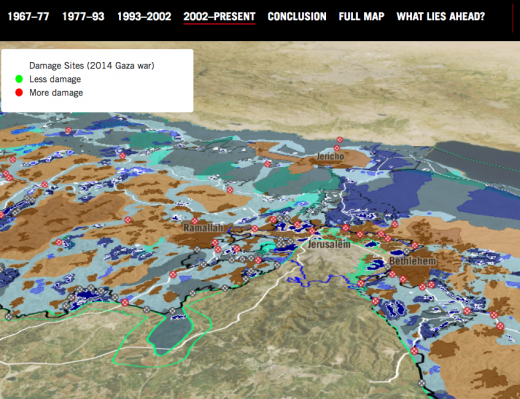
The map shows how Israeli military planners created a complex web of pretexts to seize Palestinian land: closed military zones today cover a third of the West Bank; firing ranges impact 38 Palestinian communities; nature reserves are located on 6 per cent of the territory; nearly a quarter has been declared Israeli “state” land; some 250 settlements have been established; dozens of permanent checkpoints severely limit movement; and hundreds of kilometres of walls and fences have been completed.
These interlocking land seizures seamlessly carved up the territory, establishing the walls of dozens of tightly contained prisons for Palestinians in their own homeland.
Two Nasa satellite images of the region separated by 30 years – from 1987 and 2017 – reveal how Israel’s settlements and transport infrastructure have gradually scarred the West Bank’s landscape, clearing away natural vegetation and replacing it with concrete.
The land grabs were not simply about acquisition of territory. They were a weapon, along with increasingly draconian movement restrictions, to force the native Palestinian population to submit, to recognise its defeat, to give up hope.
In the immediate wake of the West Bank’s occupation, defence minister Moshe Dayan, Israel’s hero of the hour and one of the architects of the settlement project, observed that Palestinians should be made “to live like dogs, and whoever wants to can leave – and we shall see where this process leads”.
Although Israel has concentrated Palestinians in 165 disconnected areas across the West Bank, its actions effectively won the international community’s seal of approval in 1995. The Oslo accords cemented Israel’s absolute control over 62 per cent of the West Bank, containing the Palestinians’ key agricultural land and water sources, which was classified as Area C.
Occupations are intended to be temporary – and the Oslo accords promised the same. Gradually, the Palestinians would be allowed to take back more of their territory to build a state. But Israel made sure both the occupation and the land thefts sanctioned by Oslo continued.
The new map reveals more than just the methods Israel used to commandeer the West Bank. Decades of land seizures highlight a trajectory, plotting a course that indicates the project is still not complete.
If Mr. Netanyahu partially annexes the West Bank – Area C – it will be simply another stage in Israel’s tireless efforts to immiserate the Palestinian population and bully them into leaving. This is a war of attrition – what Israelis have long understood as “creeping annexation”, carried out by stealth to avoid a backlash from the international community.
Ultimately, Israel wants the Palestinians gone entirely, squeezed out into neighbouring Arab states, such as Egypt and Jordan. That next chapter is likely to begin in earnest if Mr Trump ever gets the chance to unveil his “deal of the century”.
Florida Passes Bill Suppressing Free Speech on Israel, Palestine

Florida Governor Ron De Santis during his recent tour of Israel. (Photo: via Social Media)
Palestine Chronicle | June 17, 2019
Israel has been granted protection from its critics by the state of Florida in recent amendments to the Florida Educational Equality Act (FEEA) that suppresses free speech.
Under new definitions of anti-Semitism adopted by the American state, limits have been placed on discussions of the plight of the Palestinian people and underscoring the brutality of Israel’s occupation.
The bill is likely to open the door for criminal charges to be leveled against human rights activists and critics that advocate a single democratic state in which Israeli Jews, Palestinians, and all others are granted full, equal rights.
Supporters of the Palestine cause face the prospect of being silenced on the grounds that calls for equality under a single democratic state is deemed to be an attempt to deny the Jewish people their right to self-determination and that such a call for non-discrimination questions Israel’s right to exist.
Florida signed the bill while its governor, Ron DeSantis, was on tour of Israel and the occupied territories.
DeSantis, who has called Florida “the most Israel-friendly state in the country”, visited the US embassy in Jerusalem to ceremonially sign the new law. He also paid a visit to Ariel University, located in an illegal settlement, to receive an honor for “his dedication, leadership, and commitment to the State of Israel.”
Reports also confirm that he had met with Sheldon Adelson, a top funder of the Republican Party and Israeli Prime Minister Benjamin Netanyahu.
Ghassan Zawahreh boycotts Israeli occupation court at administrative detention hearing

Ghassan Zawahreh
Samidoun Palestinian Prisoner Solidarity Network – June 17, 2019
Palestinian prisoner Ghassan Zawahreh announced his boycott of the Israeli occupation courts after he was ordered to another six months in administrative detention, imprisoned without charge or trial. Zawahreh is a former long-term hunger striker and a prominent leftist activist in Dheisheh refugee camp; he was seized from his home in the pre-dawn hours of 10 December 2018, only months after he was released in July 2018 after over a year in administrative detention and a seven-month prison sentence.
He declared on 14 July that he would not appear before the occupation court to confirm his administrative detention order. Instead, he sent a letter to the court through his lawyer, declaring:
“Administrative detention is a heinous crime for the ages. What is even more criminal is the occupation’s attempts to mislead through mock courts and charades where the executioner and the ruler, dressed up in military suits, represent the Occupation and its crimes.
I will not be a part of this charade until administrative detention is ended once and and for all. I reject this court and refuse to be represented by anyone in it”.
He has spent over 14 years in total in Israeli prisons; his brother Moataz Zawahreh was murdered by Israeli occupation forces as he participated in a popular protest in Bethlehem in 2015. Moataz had actually returned home to Palestine from where he was studying in France to support Ghassan, who was engaged in a long-term hunger strike against his imprisonment without charge or trial.
Administrative detention orders are issued for up to six months at a time on the basis of secret evidence and are indefinitely renewable. There are currently approximately 500 Palestinians – out of over 5,200 total Palestinian prisoners in Israeli jails – held in administrative detention, and Palestinians have been jailed for years at a time without charge or trial under these repeated orders.
The Israeli occupation also turns to administrative detention to keep Palestinians jailed even after sentences imposed upon them by the military courts expire. For example, on Sunday, 16 June, Jafar Ezzedine, 47, from Jenin, was suddenly transferred to administrative detention under a three-month order, immediately following his planned release from Megiddo prison after serving a five-month sentence. While his family, including his wife and eight children, was waiting for his return home, he was instead once again thrown behind bars – with no charge and no trial.

Jafar Ezzedine, Photo: alasra.ps
Ezzedine has spent a total of five years in Israeli prison in the past, including several periods of administrative detention. He has engaged in multiple long-term hunger strikes while detained without charge or trial, including a 55-day strike in 2012 and a 93-day strike in 2013.
Ezzedine is not alone; Palestinian prisoner Malik Mohammed Abu Eisha, 34, from al-Khalil, was also ordered to four months in administrative detention after the end of his one-year sentence. Detained since May 2018, Abu Eisha was supposed to be released at the end of May 2019. Instead, his wife and three children were left waiting for him as he remains imprisoned without charge or trial. Two of his brothers are detained as well; his brother Abdel-Qader is serving an 11 year sentence that will end in 2019, while his brother Abdel-Hadi has been detained without charge or trial in administrative detention since May 2019.
In addition, Fidaa Mohammed Damas, 25, from Beit Ummar, currently the only Palestinian woman prisoner held without charge or trial under administrative detention, was once again ordered to two more months of arbitrary imprisonment on 12 June, only two days before her detention was to expire. Her detention was renewed for the fourth time in a row by the Israeli military court; she has now been imprisoned for over a year, since 29 May 2018. She was originally sentenced to 90 days in Israeli prison; on the day of her release, the university student in business administration was ordered to remain jailed without charge or trial under administrative detention for six months. Her detention was renewed in February and again on 12 June.

Fidaa Damas
Damas was previously seized by Israeli occupation forces on 28 January 2015 and sentenced to six months in prison; she was released in July 2015. She is currently held in Damon prison with the other women prisoners preparing for an open hunger strike on 1 July.
Kushner as a Colonial Administrator: Let’s Talk About The ‘Israeli Model’
By Ramzy Baroud | teleSUR | June 13, 2019
In a TV interview on June 2, on the news docuseries “Axios” on the HBO channel, Jared Kushner opened up regarding many issues, in which his ‘Deal of the Century’ was a prime focus.
The major revelation made by Kushner, President Donald Trump’s adviser and son-in-law, was least surprising. Kushner believes that Palestinians are not capable of governing themselves.
Not surprising, because Kushner thinks he is capable of arranging the future of the Palestinian people without the inclusion of the Palestinian leadership. He has been pushing his so-called ‘Deal of the Century’ relentlessly while including in his various meets and conferences countries such as Poland, Brazil and Croatia, but not Palestine.
Indeed, this is what transpired at the Warsaw conference on ‘peace and security’ in the Middle East. The same charade, also led by Kushner, is expected to be rebooted in Bahrain on June 25.
Much has been said about the subtle racism in Kushner’s words, reeking with the stench of old colonial discourses where the natives were seen as lesser, incapable of rational thinking beings who needed the civilized ‘whites’ of the western hemisphere to help them cope with their backwardness and inherent incompetence.
Kushner, whose credentials are merely based on his familial connections to Trump and family friendship with Israeli Prime Minister, Benjamin Netanyahu, is now poised to be the colonial administrator of old, making and enforcing the law while the hapless natives have no other option but to either accommodate or receive their due punishment.
This is not an exaggeration. In fact, according to leaked information concerning Kushner’s ‘Deal of the Century,’ and published in the Israeli daily newspaper, Israel Hayom, if Palestinian groups refuse to accept the US-Israeli diktats, “the US will cancel all financial support to the Palestinians and ensure that no country transfers funds to them.”
In the HBO interview, Kushner offered the Palestinians a lifeline. They could be considered capable of governing themselves should they manage to achieve the following: “a fair judicial system … freedom of the press, freedom of expression, tolerance for all religions.”
The fact that Palestine is an occupied country, subject in every possible way to Israel’s military law, and that Israel has never been held accountable for its 52-year occupation seems to be of no relevance whatsoever, as far as Kushner is concerned.
On the contrary, the subtext in all of what Kushner has said in the interview is that Israel is the antithesis to the unquestionable Palestinian failure. Unlike Palestine, Israel needs to do little to demonstrate its ability to be a worthy peace partner.
While the term ‘US bias towards Israel’ is as old as the state of Israel itself, what is hardly discussed is the specific of that bias, the decidedly condescending, patronizing and, often, racist view that US political classes have of Palestinians – and all Arabs and Muslims, for that matter; and the utter infatuation with Israel, which is often cited as a model for democracy, judicial transparency and successful ‘anti-terror’ tactics.
According to Kushner a ‘fair judicial system’ is a condition sine qua non to determine a country’s ability to govern itself. But is the Israeli judicial system “fair” and “democratic”?
Israel does not have a single judicial system, but two. This duality has, in fact, defined Israeli courts from the very inception of Israel in 1948. This de facto apartheid system openly differentiates between Jews and Arabs, a fact that is true in both civil and criminal law.
“Criminal law is applied separately and unequally in the West Bank, based on nationality alone (Israeli versus Palestinian), inventively weaving its way around the contours of international law in order to preserve and develop its ‘(illegal Jewish) settlement enterprise’,” Israeli scholar, Emily Omer-Man, explained in her essay ‘Separate and Unequal’.
In practice, Palestinians and Israelis who commit the exact same crime will be judged according to two different systems, with two different procedures: “The settler will be processed according to the Israeli Penal Code (while) the Palestinian will be processed according to military order.”
This unfairness is constituent of a massively unjust judicial apparatus that has defined the Israeli legal system from the onset. Take the measure of administrative detention as an example. Palestinians can be held without trial and without any stated legal justification. Tens of thousands of Palestinians have been subjected to this undemocratic ‘law’ and hundreds of them are currently held in Israeli jails.
It is ironic that Kushner raised the issue of freedom of the press, in particular, as Israel is being derided for its dismal record in that regard. Israel has reportedly committed 811 violations against Palestinian journalists since the start of the ‘March of Return’ in Gaza in March 2018. Two journalists – Yaser Murtaja and Ahmed Abu Hussein – were killed and 155 were wounded by Israeli snipers.
Like the imbalanced Israeli judicial system, targeting the press is also a part of a protracted pattern. According to a press release issued by the Palestinian Journalists Union last May, Israel has killed 102 Palestinian journalists since 1972.
The fact that Palestinian intellectuals, poets and activists have been imprisoned for Facebook and other social media posts should tell us volumes about the limits of Israel’s freedom of press and expression.
It is also worth mentioning that in June 2018, the Israeli Knesset voted for a bill that prohibits the filming of Israeli soldiers as a way to mask their crimes and shelter them from any future legal accountability.
As for freedom of religion, despite its many shortcomings, the Palestinian Authority hardly discriminates against religious minorities. The same cannot be said about Israel.
Although discrimination against non-Jews in Israel has been the raison d’être of the very idea of Israel, the Nation-State Law of July 2018 further cemented the superiority of the Jews and inferior status of everyone else.
According to the new Basic Law, Israel is “the national home of the Jewish people” only and “the right to exercise national self-determination is unique to the Jewish people.”
Palestinians do not need to be lectured on how to meet Israeli and American expectations, nor should they ever aspire to imitate the undemocratic Israeli model. What they urgently need, instead, is international solidarity to help them win the fight against Israeli occupation, racism and apartheid.
EU Blasted for Ever Closer Co-Operation with Terror Regime in Israel
By Stuart Littlewood | American Herald Tribune | June 13, 2019
155 European Researchers and academics have delivered a stinging rebuke to Federica Mogherini, High Representative of the European Union for Foreign Affairs & Security Policy and Vice-President of the European Commission, and Carlos Moedas, European Commissioner for Science, Research & Innovation.
In a beautifully crafted letter they express the outrage felt throughout the world, and especially in European countries including the UK, at the EU’s policy of rewarding the war crimes and crimes against humanity committed by Israel. Each new act of unspeakable brutality, each new onslaught of disproportionate force against civilians brings fresh privileges, fresh co-operation, fresh embraces from an enthusiastic EU elite.
Perhaps the most shameful thing about Europe’s relations with Israel is the EU-Israel Association Agreement which came into force in 2000. This is about special trading and other privileges and its purpose is to promote (1) peace and security, (2) shared prosperity through, for example, the creation of a free trade zone, and (3) cross-cultural rapprochement. It governs not only EU-Israel relations but Israel’s relations with the EU’s other Mediterranean partners, including the Palestinian National Authority.
To enjoy the Association’s privileges Israel undertook to show “respect for human rights and democratic principles” as set out as a general condition in Article 2, which says: “Relations between the Parties, as well as all the provisions of the Agreement itself, shall be based on respect for human rights and democratic principles, which guides their internal and international policy and constitutes an essential element of this Agreement.”
“Essential” being the operative word. Respecting human rights and democratic principles is not optional. Article 2 allows steps to be taken to enforce the contractual obligations regarding human rights and to dissuade partners from pursuing policies and practices that disrespect those rights. The Agreement also requires respect for self-determination of peoples and fundamental freedoms for all.
Well, that’s a joke for a start. Given Israel’s contempt for such principles the EU, had it been an honourable group, would have enforced Article 2 and not let matters slide. They would have suspended Israel’s membership until the regime fully complied. Israel relies heavily on exports to Europe so the EU could by now have forced an end to the brutal occupation of the Holy Land instead of always rewarding it.
The signatories to the letter to Mogherini and Moedas aptly quote the warning by Israel’s own human rights group B’Tselem: “If the international community does not come to its senses and force Israel to abide by the rules that are binding to every state in the world, it will pull the rug out from under the global effort to protect human rights in the post-WW2 era.”
Here is that excellent letter:
To Ms. Federica Mogherini – High Representative of the European Union for Foreign Affairs and Security Policy
To Mr Carlos Moedas – European Commission, DG for Research and Innovation
Brussels, June 4, 2019
Re: Letter from European researchers and academics concerning Israel’s participation in Horizon Europe
Dear Ms. Federica Mogherini, Dear Mr. Moedas,
We researchers and academics from Europe are writing to you in order to express our deep concern about the participation of Israel and its military companies in EU Research Programs. While we write, new Israeli raids flare up and the smoldering remnant of Gaza protesters of the Great March of Return, already forgotten and forsaken. More than 270 unarmed civilians were killed during the March of return, including women, children and persons with disabilities and thousands more were injured [28.939, of whom 7.247 by live fire]. They were only demanding their rights enshrined in international law: end of the illegal blockade and for the right of return to their ancestral homes from which they were expelled.
A report of the United Nation’s Independent Commission of Inquiry published earlier this year concluded that the Israeli army might have committed war crimes and crimes against humanity by indiscriminately killing health workers, journalists and unarmed protesters who did not pose any imminent threats to the soldiers.
Relentless violence rages again after 11 years of inhumane siege and three military assaults that shattered the fabric of normal life. Gaza is declared to be uninhabitable by 2020 according to a report by the UN, but this “environmentally defined” deadline reflects only the intentionality of an imposed series of emergencies, followed each time by a further decrease in health, energy, food independence and commerce after each episode of armed aggression since 2007.
The hermetic siege combined with the systematic large scale military destruction is slowly strangling nearly the two million inhabitants of Gaza. None of the basic civilian infrastructure such as hospitals and power plants, was ever sufficiently rebuilt after each of the three military assaults due to severe restrictions by the blockade. Electricity is available only a few hours a day, 98% of water is not drinkable, and many hospitals periodically stop functioning due to lack of medication, spare parts of machinery, electricity and fuel. Permission for patients to leave in order to receive life-saving treatment elsewhere has been continually declining in time. Tools for education, number of teachers, and rebuilding of schools are severely impaired. The inhabitants of Gaza have been consistently denied basic human rights and human dignity.
The disproportionate use of force on the civilians amounting to war crimes has also been systematic throughout all, long and short term, military operations, including the almost daily assaults to fishermen and agricultural workers.
These facts have been meticulously documented in authoritative reports by the UN and human rights organizations and widely condemned by the international community. Yet Israel’s policies of aggression and repression have continued.
This ongoing impunity is allowing Gaza, the world’s largest open air prison, to be used as a military testfield. In each offensive Israel deployed, tested and perfected new high-tech military weapons and surveillance systems. These new cutting edge high-tech products are exhibited and sold as “battle-tested”, an exclusive label Israeli home land security industry boasts. Israel became the world’s top arms exporter per capita.This grave violation of human rights is thus highly profitable for Israel’s war industry disclosing another side of the claim of “only self-defense” and the interests beyond the lack of measure in the aggressions on Palestinians of Gaza.
Nonethelss, in spite of continual and serious breaches of international law and violation of human rights, and regardless of the commitment for upholding human rights of European countries, Israel enjoys an exceptionally privileged status in dealing with Europe also through the Association Agreement and has been receiving grants from the European Commission in the area of research and innovation (FP7 and its successor Horizon 2020).
Funds are granted even to Israeli arms producers such as Elbit Systems and Israel Aerospace Industries Ltd. (IAI), the producers of lethal drones that were used in the Gaza military assaults against civilians, together with numerous academic institutions that have close ties with Israeli military industry.
We appeal to the European Union to impose a comprehensive military embargo on Israel, as long as Israel continues to blatantly violate human rights. We are deeply disturbed that public funds contributed by European tax payers are channeled to a country that not only disregards human rights but also uses most advanced knowledge and technology for the very violation of human rights. We believe that knowledge and innovation should serve progress in humanity and society, not to develop dual use or military research of a country that has a record history of grave human rights violations. This is not compatible with the values Europe upholds.
In 2017 more than 150 European trade unions, political parties, human rights organizations and faith groups from over 16 European countries issued a call urging the EU to uphold its legal responsibilities and exclude Israeli military companies from EU Framework Programs.
We support Amnesty International call for a military embargo on Israel issued last year following the attacks on the unarmed protesters of the Great March of Return using maiming bullets and brutal means by the Israeli army, unnecessary in that context.
Youth of Gaza appealed to you to stop funding Israeli manufacturers of weapons and surveillance system that guard their open-air prison, maimed them and destroyed their future. In support of their outcry we call upon European Union and European Commission to suspend the Association Agreement with Israel and exclude Israel as an eligible partner for Horizon Europe (successor of Horizon 2020), as long as it refuses to comply with the rules of international law. We also share the concern of B’Tselem, Israeli human rights organization, which stated “If the international community does not come to its senses and force Israel to abide by the rules that are binding to every state in the world, it will pull the rug out from under the global effort to protect human rights in the post-WWII era.”
Signatories*:
1.Dr. Nozomi Takahashi, Center for Inflammation Research, VIB-Ghent University, Belgium
2.Prof. Marc Van Ranst,Department of Microbiology, Immunology and Transplantation, KU Leuven,Belgium
3.Dr. Leander Meuris, Medical Biotechnology, VIB-Ghent University, Belgium
4.Prof. Tarek Meguid,
5.Prof. Em. John Dugard, Universities of Leiden and the Witwatersrand (UN Special Rapporteur onthe human rights situation in the Occupied Palestinian Territory 2001-2008)
6.Prof. Em. Herman De Ley, Ghent University, Belgium
7.Dr. Andrea Balduzzi, Università di Genova, Italy
8.Prof.Giuliano Donzellini, University of Genua, Italy
9.Prof.Sergio Morra,University of Genua, Italy
10.Prof. Paolo Bartolini, University of Genua, Italy
11.Dr.Angela Waldegg, Austria
12.Prof. Salvatore Palidda,University of Genua, Italy
13.Andrea Sbarbaro,office worker (psychologist),University of Genua, Italy
14.Prof.Marcello Maneri, University of Milano-Bicocca, Italy
15.Dr.Syksy Räsäne, University of Helsinki, Finland
16.PhD. Prof. Haseeb Shehadeh, University of Helsinki, Finland
17.Paola Manduca, Former Associate Professor Genetics,University of Genoa, Italy
18.Prof. Em.Giorgio Forti, Unuversità degli Studi di Milkano, Italy
19.Adjunct Professor Pertti Multanen, University of Tampere, Finland
20.Dr. Angela Flynn, University College Cork, Ireland
21.Docente ordinario Giuseppe Mosconi, Università di Padova, Italy
22.Prof.Anna Boato, Uniiversità di Genova, Italy
23.Dr. Ronit Lentin, Trinity College Dublin, Ireland,
24.Mathias Urban, Desmond Chair of Early Childhood Education, Dublin City University, Ireland
25.Prof. Sancia Gaetani, Già Istituto Nazionale Nutrizione, Italy
26.James Roche, Lecturer,Technoligical University Dublin, Ireland
27.Prof. Angelo Baracca,University of Florence, Italy
28.Prof.Giorgio M. Giallocosta, University of Genoa, Italy
29.Prof PhD Alessandro Bianchi, Department Informatics – Univ. Bari, Italy
30.Em. Prof Elisabetta Donini, University of Turin, Italy
31.Prof. Luca Queirolo Palmas,University of Genoa, Italy
32.Rosella Franconi, Senior scientist, Italy
33.Pediatric surgeon Bruno Cigliano, University “Federico II” Naples-Italy
34.Prof. Vittorio Agnoletto,University of Milan, Italy
35.Em. Prof.Andrea Frova, Università di Roma “La Sapienza”, Physics Dept, Italy
36.Em. Prof. Mariapiera Marenzana, Ministry of Education, Italy
37.Massimo Di Rosa, Italy
38.Prof. Iain Chambers, University of Naples, “Orientale”, Italy
39.Dr. Paola Rivetti, Dublin City University, Ireland
40.Prof. Lidia Curti, University of Naples, Italy
41.Phd. Kati Juva, Helsinki University Central Hospital, Finland
42.Hessel Christiane, Epouse de l’Ambassadeur de France Stéphane Hessel, France
43.Phd. Bruno Lapauw, Ghent University, Belgium
44.Prof. Matthieu Lenoir, Ghent University, Belgium
45.Prof. Stef Craps, Ghent University, Belgium
46.Prof. Dr. De Baerdemaeker Luc, Ghent University, Belgium
47.Ana Cabal, University of Antwerp, Belgium
48.Dr. Kristina Mercelis, Belgium
49.Arch assistant. Geert Pauwels, Vrije Universiteit Brussel, Belgium
50.R. Van Laere, Royal academy for Archaeology of Belgium
51.Prof. Karel Arnaut, KU Leuven – IMMRC, Belgium
52.Prof. Dr.Willie van Peer, University of Munich, Austria
53.Prof. Dr. Em. Frans Daems,University of Antwerp, Belgium
54.Omar Jabary Salamanca, Ghent University, Belgium
55.Prof. Jan Delrue, KU Leuven University, Belgium
56.Em. Prof. Christian Kesteloot, KU Leuven University, Belgium
57.Prof. Em. Aviel Verbruggen, University of Antwerp, Belgium
58.Medical student Serhat Yildirim,Ghent University , Belgium
59.Prof. Emer. Piet Mertens, KU Leuven, Belgium
60.Associate Professor Nadia Fadil, KU Leuven, Belgium
61.Em. Prof. Dr. Patric Jacobs, Ghent University, Geology Deparment, Belgium
62.Honourary Professor Michel Vanhoorne, Ghent University, Belgium
63.Docent Jan Wyns, Belgium
64.Em. Prof. Marc David, Universiteit Antwerpen, Belgium
65.Prof. Pieter Rombouts, Ghent University, Belgium
66.Mireille Gleizes, Belgium
67.Dr. Barbara Van Dyck, University of Sussex, UK
68.Em. Prof. Claude Veraart, University of Louvain (UCL), Belgium
69.Professeur Honoraire Pierre Gillis, Université de Mons, Belgium
70.Researcher Patrick Italiano, University of Liege, Belgium
71.Professeur Ordinaire Honoraire André Gob, Université de Liège, Belgium
72.Researcher Jacques Moriau, ULB, Belgium
73.Philosopher Marc Vandepitte, Technische Scholen Mechelen, Belgium
74.Abdessalam Faraj, Belgium
75.PhD Gillet S. University of Namur, Belgium
76.Em. Prof. Mateo Alaluf, Université Libre de Bruxelles, Belgium
77.Prof. Em. Biesemans Monique, Vrije Universiteit Brussel, Belgium
78.Em. Prof. Fred Louckx, Vrije Universiteit Brussel, Belgium
79.Prof. Marc Jacquemain, University of Liege, Belgium
80.Prof. Germain Marc, Université de Lille, France
81.Professeur-chercheur Lucienne Strivay, Université de Liège, Belgium
82.Prof. Gilles-Maurice de Schryver, Ghent University, Belgium
83.Researcher Andrew Crosby, Université libre de Bruxelles, Belgium
84.Prof. Bert Cornillie, KU Leuven, Belgium
85.Docent Dario Giugliano, Accademia di Belle Arti di Napoli, Italy
86.Prof. de Beer Daniel, Université Saint-Louis, Belgium
87.Researcher M Louise Carels, Université de Liège, Belgium
88.Prof. Victor Ginsburgh, Université libre de Bruxelles, Belgium
89.Em. Prof. Heinz D. Hurwitz, Université Libre de Bruxelles, Belgium
90.M.A. Maria Aurora De Angelis, SOAS University of London, UK
91.Dr. Jef Peeters, KU Leuven, Belgium
92.Em. Prof. Magda Devos, University of Ghent, Belgium
93.Em. Prof. Norbert Van den Bergh, Gent University, Belgium
94.Em. Prof. Stefan Kesenne, University of Antwerp, Belgium
95.Prof. Dr. Em. Madeline Lutjeharms, Vrije Universiteit Brussel, Belgium
96.Marie Scheirlinck, Belgium
97.Koen Verrept, VUB, Belgium
98.Prof. Roberto Beneduce, University of Turin, Italy
99.Prof. Patricia Willson, Université de Liège, Belgium
100.Em. Prof. Christiane Schomblond, Université Libre de Bruxelles, Belgium
101.Em. Prof. Florimond De Smedt, Vrije Universiteit Brussel, Belgium
102.Professeur Honoraire Mormont Marc, Université de Liège, Belgium
103.Dr. Zahidi, University of Antwerpen, Belgium
104.PhD Leena Saraste, Finland
105.Em. Prof. P. Marage, Université Libre de Bruxelles, Belgium
106.Em. Prof. Michel Gevers, Université catholique de Louvain, Belgium
107.Senior Research Associate Giselle Corradi, Ghent University, Belgium
108.Tiziana Terranova, Italy
109.Honorary Prof. Albert Martens, Katholieke Universiteit Leuven, Belgium
110.Em. Prof. Vandermotten Christian, Université Libre de Bruxelles, Belgium
111.Prof. Jean-Claude Gregoire, Université libre de Bruxeles, Belgium
112.Researcher Xavier May, Université Libre de Bruxelles, Belgium
113.Dr. Duez Colette, University of Liege, Belgium
114.Phd Tanneke Herklots, the Netherlands,
115.Em. Prof. Marc De Meyere, Gent University, Belgium
116. Researcher Antonio Mazzeo, Italy
117. Prof. Michele Carducci, UniSalento – Lecce, Italy
118. Prof. Carine Defoort, KU Leuven, Belgium
119. Dr. Chiara Cardelli, Institute for Quantum Optics and Quantum Information Vienna, Austria
120. Prof. Em. Pieter Saey, Gent University, Belgium
121. Independent scholar Celeste Ianniciello, Italy
122. Em. Prof. Jonathan Rosenhead, London School of Economics, UK
123. Prof. Dr. Em. Erik Van der Straeten, Belgium
124. Prof. James Dickins, University of Leeds, UK
125. Dr. Tajul Islam, University of Leeds, UK
126. Dr. Barry Heselwood, University of Leeds, UK
127. Patrik Lasure, Pax Christi Vlaanderen, Belgium
128. Wim Nerinckx, Belgium
129. René Weemaels, Belgium
130. André Posman, Belgium
131. Technician Kelly Lemeire, University of Ghent, Belgium
132. Em. Prof. Schomblond Christiane, Université Libre de Bruxelles, Belgium
133. Dr. Gie Van Den Berghe, University Gent, Belgium
134. Rasha Soliman, University of Leeds, UK
135. Simona Antonova, UMC Utrecht, the Netherlands
136. PhD Michail Mamantopoulos, Belgium
137. Dr. Tom Moerenhout, Graduate Institute of International and Development Studies, Switzerland
138. Prof. Dirk Vandermeulen, KU Leuven, Belgium
139. Em. Prof. Heinz Hurwitz, Université Libre Bruxelles, Belgium
140. Sénateur Honoraire Galand Pierre, Belgium
141. Prof. Megan Povey, University of Leeds, UK
142. Branch President UCL UCU Sean Wallis, University College London, UK
143. Dr. M Akhtar, University of Leeds, UK
144. Tom Hickey, University of Brighton, UK
145. Dr. Karen Evans, University of Liverpool, UK
146. Dr. Anne Alexander, University of Cambridge, UK
147. Dr Anandi Ramamurthy, Sheffield Hallam University, UK
148. Prof. Franco Montanari, University of Genoa, Italy
149. Dr. Stephanie Kourula, Belgium
150. Em. Prof. Chris Roberts, University of Manchester, UK
151. Researcher- PhD student Ainhoa Ruiz Benedicto, Centre Delàs d’Estudis per la Pau, Spain
152. Tica Font, Centre Delàs d’Estudis per la Pau, Spain
153. Researcher Edgard Vega, Centre Delàs d’Estudis per la Pau, Spain
154. Ph Dr. Retired Assistant Professor Xavier Bohigas, Uinversitat Politècnica de Catalunya, Catalonia-Spain
155. Prof. Jan Dumolyn, University of Ghent, Belgium
* Institutions are added for identification purposes only. All signatories have signed the letter in a personal capacity
An Electronic Engineer in Orwell’s Britain
By Eve Mykytyn | June 13, 2019
Dr. Ali was dismissed from his job at the University of Essex for alleged anti Semitism. The charges stemmed from his opposition to a new campus society, a branch of the Zionist organization, the Union of Jewish Students (UJS) and from four of the many posts Dr Ali has made to Facebook over the last ten years. For more: SEE. Dr. Ali’s story makes plain that although the University claimed to dismiss him for anti Semitism, in fact he was dismissed for anti Zionism. The following interview with Dr Ali will be one of the first articles in which he will be able to tell his side of the story, which differs in important ways from the story told in the British press.
EM: Can you give us a brief bio, including where you grew up and your academic background?
MA: My family moved to London from the then newly independent country of Bangladesh in 1975 when I was seven,. We came as refugees, we had lost 22 members of our family including my elder brother who was murdered when he was barely thirteen. My father was a Professor of History and a Barrister (Lincoln’s Inn).
I grew up in the eastern suburbs of London and was educated at Chigwell School in Essex. I earned my PhD in Electronic Engineering at King’s College London. I have spent most of my career as a university lecturer in the UK.
EM: How did you get involved in the debate over the new Jewish society? Were you opposed to the formation of any Jewish group?
MA: At the University of Essex, student union members are invited by email to vote on any new student society, and a favorable vote by a majority is required for formation. Before a vote, the proposed society must clearly state its aims and objectives.
I read UJS’s manifesto and did not agree with their zealous promotion of Zionism and the state of Israel. That was my only concern. I was not voting against Jews, Judaism or their culture. When I was a student, I voted against the formation of political Islamic societies even though I am a Muslim.
The same concerns regarding the political Zionist basis of the UJS were raised by Student Union Committee Members, the University Amnesty Society, the University Palestinian Solidarity Group and 240 other students. I would like to stress that I did not and would not vote against the formation of a Jewish Society that was not politically Zionist.
EM: Did any of your students complain of anti-Semitism? Did the issue ever come up in one of your classes?
MA: I never discuss religion or politics in my lectures nor have the issues of Zionism or anti Semitism ever come up in any of my classes during my career. There has never been any complaint made against me by any student at the University or at any university at which I have taught.
Two former students, one a 50+ year old ex-British soldier, wrote a letter to Human Resources at the University defending me and stating that I was always inclusive, never discussed religion or politics and that I was an excellent lecturer. The other, a woman who is an ex- US marine who heard about my case, wrote to the Vice Chancellor directly. Neither letter was taken into consideration by the University.
EM: Why do you think you were singled out? Were there other opponents of the UJS?
MA: I made a comment on the University Palestinian Solidarity Facebook page that Zionists were trying to create a society at our University. Someone asked why I was against Jews. I replied that I was not against Jews, their religion or their culture. I was opposed to the Zionist ideology presented in the society’s manifesto. In my 10 years on Facebook, I have never posted anything supporting the destruction of the state of Israel.
Obviously, I was singled out. The media falsely portrayed me as a ringleader of the 240 students who voted against the UJS. I did not urge these students to vote ‘no.’ I am a part-time Bangladeshi lecturer without powerful connections, and a bearded Muslim Asian – I was a useful scapegoat for their witch hunt.
The media failed to report that the vote was cancelled because of the 240 ‘no’ votes. After that, the UJS changed their manifesto and softened their wording regarding Israel and Zionism. They denied making this change, even though some students had screenshots of the two different manifestos.
I was asked to be part of a second vote, but I declined and did not vote. Part way thorough the second vote, the Vice Chancellor cancelled the election and created UJS as a “University” society. Later on, the Student Union revealed that ‘“some” of the 600 votes in favor of the UJS had been cast “externally” by non-students.
The University tribunal charged me based on the UJS’s second less political manifesto, to which I never objected nor even voted on. Despite my vehement objection the University failed to take notice that it was the first manifesto to which I and others objected.
EM: So all you did was post an objection to the UJS based on their first, more extreme manifesto and then vote against it?
MA: Yes
EM: What about the Facebook posts they claimed were anti Semitic?
MA: The tribunal considered six posts and dismissed two of them. Until the tribunal no one had ever complained about a post of mine and Facebook never warned or took any action against me. The posts they considered were as follows.
1. A post from smoloko.com I made four years ago that a French police officer allegedly killed in terror attacks in Paris was actually a Mossad agent. There are many such theories about the 2015 attacks and I posted it for discussion purposes.
2. In 2016 I posted that 50,000 Jews in New York protested Israel’s policies and that the event was not really covered by the media. In the tribunal, I pointed out that my post clearly distinguished between Jews and Zionists
3. Posted on 1 August 2018 and clearly labeled as ‘revisionist history’ was a quote from Edgar Steele that the number of Holocaust survivors receiving pensions exceeded the number of Jews in Europe before the Holocaust.
4. A post on 17 January 2019 stating that the Jews put Palestinians in concentration camps. The Tribunal said I was comparing Jews to Nazis by the use of the word “concentration.” My Jewish Union rep. objected, pointing out that it was the British who originated the term ‘concentration camp’ when they used them in South Africa.
EM: You are not anti Semitic but you do have problems with the behavior of the state of Israel? Who defended you and what procedure did the University follow in making its decision?
MA: I am not anti-Semitic and the investigation and the tribunal both found that I, as a person, was not anti-Semitic. I do have problems with all kinds of oppression; against humans, animals or the environment. As I told the tribunal, I have criticised almost all governments. The tribunal brushed aside my criticism of Israel’s oppressive activities. My opinions were backed up by reports from the UN, the Red Cross, Israeli human rights organisations and newspapers like Haaretz.
I was defended personally by one University Union member, a Professor who is Jewish, but who has not given me permission to reveal his name. He told the tribunal that he believed that neither I nor my posts were anti-Semitic even though he did not agree with some of the posts.
Prominent Jewish voice for Peace (JVP) member, Prof. Haim Bresheeth, an Israeli-British film maker and a Professor at the University of London, wrote to the Vice Chancellor on my behalf. He made clear the distinction between Zionism and Judaism and wrote that opposing Zionism or criticizing Israel is not anti Semitism. In addition, renowned Professor, Norman Finkelstein, wrote a letter of support for me.
The University claimed my case had been investigated by “independent” investigator Nigel Youngman. My objections to the lack of actual investigation by Mr. Youngman were totally disregarded by the tribunal. He did not interview any of the key witnesses, not the 240 students who voted no, not a single member of the University’s Amnesty Society or Palestinian Society, and not members or staff at the Student Union. Youngman never asked anyone why he objected to the first manifesto or why there were two manifestos. When he spoke to the tribunal he read from the second less extreme manifesto as if that was the one to which I had objected, although I had repeatedly told him that my reaction was to the first manifesto.
The University’s rules provided me the right to present a witness. I informed the tribunal that I intended to bring Prof. Bresheeth, and although I followed their procedural rules, the tribunal denied me my right to a witness claiming only a certain date was available as the tribunal was to be attended by “very important” people.
I knew as soon as the tribunal began that the University intended to dismiss me. They followed their procedures only to the extent that they would not affect the preordained outcome. For example, Prof. Andrew Le Sueur, who acted as prosecutor, instructed the tribunal to ignore the letters from Prof Finkelstein and Prof Bresheeth and not to take JVP’s statement against Zionism into consideration. That made it clear the tribunal was a farce, intended to allow them to dismiss me while pretending to the media that I had been given ‘due process.’
The major problem I faced was that the University treated Zionism as just a harmless Jewish belief. I do not know why they are so ignorant. The University would not listen when I tried to explain that there is a difference between Judaism and Zionism and that many people, including Jews, object to Israel’s actions but are not anti Semitic. I am happy that there were many Jews from JVP who came to my defense.
EM: The University advised you not to speak to the press. Do you now think that advice was for your benefit?
MA: I should not have listened to them since I believe the decision to dismiss me was made well before the hearing. From the beginning, I wanted to set the record straight and explain that I was not at all the person the media portrayed. I had written a careful apology to the University and, contrary to my expectations, the University did not share either my position or my apology.
EM: What have been the other effects of the dismissal? Will you be able to get another academic job in the UK?
MA: I have been dismissed from all my other part-time positions, including my work for St John Ambulance. When St John first investigated the allegations, I was found not to be anti Semitic. After the University dismissed me, St John fired me.
I have lost all sources of income, a financial loss I am not in a position to cover. It seems this is the penalty imposed upon opponents of Zionism.
I am not sure if I can find another job in the UK let alone an academic job. I could only be employed by someone who is willing to stand up to Zionist bullying and intimidation.
EM: Did you receive any hate mail?
MA: Yes I received a barrage of xenophobic, Islamophobic hate emails, threatening death to my family and me. Careful examination revealed that all the emails originated from only 14 unique email addresses. The British police are currently investigating these threatening emails.
In addition, there was a smear campaign against me as nearly all the 65 pages of British newspaper and online articles were essentially copied from an unfavorable and inaccurate article in the Jewish Chronicle.
EM: Was a police complaint or legal action filed against you?
MA: No police action has been taken against me, even though some of the hate emails claimed that I was being reported to the police for hate crimes and anti Semitism.
EM: Has your family faced discrimination in the UK? Is there is a double standard?
MA: Yes, my children have faced terrible discrimination. Some boys at his school threw my eldest son on the ground and tried to force feed him pork. He was called many horrible names including ‘terrorist.’ His school took no action against the boys who assaulted my son.
There is a clear double standard at the University of Essex. Two examples:
A Muslim Bangladeshi staff member was threatened by his immediate boss, a Latvian, who said any Muslim who came to his country would be murdered by him. He was reported but the University has done nothing in response to the threat.
A Muslim woman, a student, was harassed by her flatmate, a staff member of the University’s Law School. He told her: “your religion will make you bomb a building.” In front of a witness he said, “I can do whatever I want with you and I will not be punished for it.” She suffered death threats, physical abuse, and eventually left the school. A police lawsuit was shelved for lack of evidence despite a witness and a bruised arm. The University did not see that he breached any code of conduct, instead the University is doing everything to protect this staff member and have threatened a lawsuit if his name is revealed. More information can be found at this link: https://www.facebook.com/516992240/posts/10157873235557241?sfns=mo
The University of Essex that claims to have ‘zero tolerance to hate’ seems to apply that standard based upon who the victim is.
Moldova to move embassy to Jerusalem
MEMO | June 12, 2019
Moldova has announced that it will move its embassy in Israel from Tel Aviv to Jerusalem, a move which would make it the first European country to do so.
The announcement comes against the backdrop of a political crisis in Moldova, a small Eastern European country located between Romania and Ukraine.
The country has been engaged in a power struggle between three parties – the pro-European Union ACUM bloc; the Socialists led by Moldovan President Igor Dodon and backed by Russia; and the Democratic Party run by media tycoon Vladimir Plahotniuc – since it held elections in February.
After months of post-election deadlock, ACUM and the Socialist party agreed to form a government – a move not recognised by the Democratic Party which insists that the previous prime minister, Pavel Filip, remains in charge.
On Sunday, the Democratic Party persuaded the country’s Constitutional Court to briefly suspend President Dodon and install Filip as president for enough time to allow him to issue a decree calling for snap elections in September, US-based magazine Algemeiner explains. While acting as president, Filip announced that Moldova would move its embassy from Tel Aviv to Jerusalem.
In a statement issued yesterday, Filip tied the country’s domestic difficulties to the announcement of the embassy move, as well as the sale of land for the construction of a new US embassy in Moldovan capital Chisinau.
The interim prime minister wrote: “We are in [a] situation [in which we need] to urgently adopt these decisions taking into account the political instability and uncertainty in the country, but also the latest political developments [in which] one of the political parties that constantly blocked these two projects is attempting an illegal takeover of power.”
He continued: “These are two commitments that we have previously undertaken and we want to make sure they will be respected, regardless of what happens after the snap elections.”
Given Moldova’s internal political instability, it is unclear whether the government will be able to follow through on its announcement. If the relocation is undertaken, Moldova will become the first European country to move its Israeli embassy to Jerusalem.
Since US President Donald Trump recognised Jerusalem as Israel’s capital in December 2017 and relocated the US embassy to the Holy City in May 2018, a handful of countries have followed suit. Most of these have been Latin American countries with close ties to the US, including Paraguay and Guatemala.
However, within months of relocating its mission, Paraguay reversed the decision and moved the embassy back to Tel Aviv, citing a desire to support “broad, lasting and just peace” among Israelis and Palestinians.
Brazil – which recently elected pro-Israel politician Jair Bolsonaro as its president – has also toyed with the idea of moving its embassy to Jerusalem. In March, however, Brazil appeared to backtrack on its promise, saying it would instead open a “business office” in Jerusalem.
Likewise Hungary’s right-wing Prime Minister Viktor Orban – who, like Bolsonaro, is considered a close associate of Israeli Prime Minister Benjamin Netanyahu – has said his country will open a “diplomatic office” in Jerusalem, though stopped short of promising a full-service embassy.
Despite Israel encouraging other countries to relocate their embassies to Jerusalem – and announcing it would build a new “embassy complex” which could house nine diplomatic missions for the purpose – the international community has generally opted not to follow President Trump’s controversial move.
Kushner as a Colonial Administrator
Let’s Talk About the “Israeli Model”
By Ramzy Baroud | Dissident Voice | June 11, 2019
In a TV interview on June 2, on the news docuseries “Axios” on the HBO channel, Jared Kushner opened up regarding many issues, in which his ‘Deal of the Century’ was a prime focus.
The major revelation made by Kushner, President Donald Trump’s adviser and son-in-law, was least surprising. Kushner believes that Palestinians are not capable of governing themselves.
Not surprising, because Kushner thinks he is capable of arranging the future of the Palestinian people without the inclusion of the Palestinian leadership. He has been pushing his so-called ‘Deal of the Century’ relentlessly, while including in his various meets and conferences countries such as Poland, Brazil and Croatia, but not Palestine.
Indeed, this is what transpired at the Warsaw conference on ‘peace and security’ in the Middle East. The same charade, also led by Kushner, is expected to be rebooted in Bahrain on June 25.
Much has been said about the subtle racism in Kushner’s words, reeking with the stench of old colonial discourses where the natives were seen as lesser, incapable of rational thinking beings who needed the civilized ‘whites’ of the western hemisphere to help them cope with their backwardness and inherent incompetence.
Kushner, whose credentials are merely based on his familial connections to Trump and family friendship with Israeli Prime Minister, Benjamin Netanyahu, is now poised to be the colonial administrator of old, making and enforcing the law while the hapless natives have no other option but to either accommodate or receive their due punishment.
This is not an exaggeration. In fact, according to leaked information concerning Kushner’s ‘Deal of the Century,’ and published in the Israeli daily newspaper, Israel Hayom, if Palestinian groups refuse to accept the US-Israeli diktats, “the US will cancel all financial support to the Palestinians and ensure that no country transfers funds to them.”
In the HBO interview, Kushner offered the Palestinians a lifeline. They could be considered capable of governing themselves should they manage to achieve the following: “a fair judicial system … freedom of the press, freedom of expression, tolerance for all religions.”
The fact that Palestine is an occupied country, subject in every possible way to Israel’s military law, and that Israel has never been held accountable for its 52-year occupation seems to be of no relevance whatsoever, as far as Kushner is concerned.
On the contrary, the subtext in all of what Kushner has said in the interview is that Israel is the antithesis to the unquestionable Palestinian failure. Unlike Palestine, Israel needs to do little to demonstrate its ability to be a worthy peace partner.
While the term ‘US bias towards Israel’ is as old as the state of Israel itself, what is hardly discussed are the specifics of that bias, the decidedly condescending, patronizing and, often, racist view that US political classes have of Palestinians – and all Arabs and Muslims, for that matter; and the utter infatuation with Israel, which is often cited as a model for democracy, judicial transparency and successful ‘anti-terror’ tactics.
According to Kushner a ‘fair judicial system’ is a conditio sine qua non to determine a country’s ability to govern itself. But is the Israeli judicial system “fair” and “democratic”?
Israel does not have a single judicial system, but two. This duality has, in fact, defined Israeli courts from the very inception of Israel in 1948. This de facto apartheid system openly differentiates between Jews and Arabs, a fact that is true in both civil and criminal law.
“Criminal law is applied separately and unequally in the West Bank, based on nationality alone (Israeli versus Palestinian), inventively weaving its way around the contours of international law in order to preserve and develop its ‘(illegal Jewish) settlement enterprise’,” Israeli scholar, Emily Omer-Man, explained in her essay ‘Separate and Unequal’.
In practice, Palestinians and Israelis who commit the exact same crime will be judged according to two different systems, with two different procedures: “The settler will be processed according to the Israeli Penal Code (while) the Palestinian will be processed according to military order.”
This unfairness is constituent of a massively unjust judicial apparatus that has defined the Israeli legal system from the onset. Take the measure of administrative detention as an example. Palestinians can be held without trial and without any stated legal justification. Tens of thousands of Palestinians have been subjected to this undemocratic ‘law’ and hundreds of them are currently held in Israeli jails.
It is ironic that Kushner raised the issue of freedom of the press, in particular, as Israel is being derided for its dismal record in that regard. Israel has reportedly committed 811 violations against Palestinian journalists since the start of the ‘March of Return’ in Gaza in March 2018. Two journalists – Yaser Murtaja and Ahmed Abu Hussein – were killed and 155 were wounded by Israeli snipers.
Like the imbalanced Israeli judicial system, targeting the press is also a part of a protracted pattern. According to a press release issued by the Palestinian Journalists Union last May, Israel has killed 102 Palestinian journalists since 1972.
The fact that Palestinian intellectuals, poets and activists have been imprisoned for Facebook and other social media posts should tell us volumes about the limits of Israel’s freedom of press and expression.
It is also worth mentioning that in June 2018, the Israeli Knesset voted for a bill that prohibits the filming of Israeli soldiers as a way to mask their crimes and shelter them from any future legal accountability.
As for freedom of religion, despite its many shortcomings, the Palestinian Authority hardly discriminates against religious minorities. The same cannot be said about Israel.
Although discrimination against non-Jews in Israel has been the raison d’être of the very idea of Israel, the Nation-State Law of July 2018 further cemented the superiority of the Jews and inferior status of everyone else.
According to the new Basic Law, Israel is “the national home of the Jewish people” only and “the right to exercise national self-determination is unique to the Jewish people.”
Palestinians do not need to be lectured on how to meet Israeli and American expectations, nor should they ever aspire to imitate the undemocratic Israeli model. What they urgently need, instead, is international solidarity to help them win the fight against Israeli occupation, racism and apartheid.
Dr. Ramzy Baroud is an author and a journalist. He is athor of The Second Palestinian Intifada: A Chronicle of a People’s Struggle and his latest My Father Was a Freedom Fighter: Gaza’s Untold Story. He can be reached at ramzybaroud@hotmail.com.
How NeoCon Billionaire Paul Singer Is Driving the Outsourcing of US Tech Jobs to Israel
By Whitney Webb | MintPress News | June 11, 2019
WASHINGTON — With nearly 6 million Americans unemployed and regular bouts of layoffs in the U.S. tech industry, major American tech companies like Google, Microsoft and Intel Corporation are nonetheless moving key operations, billions in investments, and thousands of jobs to Israel — a trend that has largely escaped media attention or concern from even “America first” politicians. The fact that this massive transfer of investment and jobs has been so overlooked is particularly striking given that it is largely the work of a single leading neoconservative Republican donor who has given millions of dollars to President Donald Trump.
To make matters worse, many of these top tech companies shifting investment and jobs to Israel at record rates continue to collect sizable U.S. government subsidies for their operations while they move critical aspects of their business abroad, continue to layoff thousands of American workers, and struggle to house their growing company branches in Israel. This is particularly troubling in light of the importance of the tech sector to the overall U.S. economy, as it accounts for 7.1 percent of total GDP and 11.6 percent of total private-sector payroll.
Furthermore, many of these companies are hiring members of controversial Israeli companies — known to have spied on Americans, American companies, and U.S. federal agencies — as well as numerous members of Israeli military intelligence as top managers and executives.
This massive transfer of the American tech industry has largely been the work of one leading Republican donor — billionaire hedge fund manager Paul Singer, who also funds the neoconservative think tank American Enterprise Institute (AEI), the Islamophobic and hawkish think tank Foundation for Defense of Democracies (FDD), the Republican Jewish Coalition (RJC), and also funded the now-defunct Foreign Policy Initiative (FPI).
Singer’s project to bolster Israel’s tech economy at the U.S.’ expense is known as Start-Up Nation Central, which he founded in response to the global Boycott, Divest and Sanctions (BDS) movement that seeks to use nonviolent means to pressure Israel to comply with international law in relation to its treatment of Palestinians.
This project is directly linked to Israeli Prime Minister Benjamin Netanyahu, who in recent years has publicly mentioned that it has been his “deliberate policy” to have former members of Israel’s “military and intelligence units … merge into companies with local partners and foreign partners” in order to make it all but impossible for major corporations and foreign governments to boycott Israel.
In this report, MintPress identifies dozens of former members of an elite Israeli military intelligence unit who now hold top positions at Microsoft, Google and Facebook.
Singer’s nonprofit organization has acted as the vehicle through which Netanyahu’s policy has been realized, via the group’s close connections to the Israeli PM and Singer’s long-time support for Netanyahu and the Likud Party. With deep ties to Netanyahu, the American Israel Public Affairs Committee (AIPAC), and controversial tech companies — like Amdocs — that spied on the American government, this Singer-funded organization has formed a nexus of connections between the public and private sectors of both the American and Israeli economies with the single goal of making Israel the new technology superpower, largely at the expense of the American economy and government, which currently gives $3.2 billion in aid to Israel annually.
Researched and developed in Israel
In recent years, the top U.S. tech companies have been shifting many of their most critical operations, particularly research and development, to one country: Israel. A 2016 report in Business Insider noted that Google, Facebook, Microsoft, Amazon and Apple had all opened up research and development (R&D) centers in recent years, with some of them having as many as three such centers in Israel, a country roughly the size of New Jersey. Other major tech companies that have also opened key operation and research centers in Israel include Sandisk, Nvidia, PayPal, Palantir and Dell. Forbes noted last year that the world’s top 10 tech companies were now “doing mission-critical work in Israel that’s core to their businesses back at HQ.”
Yet, some of these tech giants, particularly those based in the U.S., are heavily investing in their Israeli branches while laying off thousands of American employees, all while receiving millions of dollars in U.S. government subsidies funded by American taxpayers.
For example, Intel Corporation, which is the world’s second largest manufacturer of semiconductor computer chips and is headquartered in California, has long been a major employer in Israel, with over 10,000 employees in the Jewish state. However, earlier this year, Intel announced that it would be investing $11 billion in a new factory in Israel and would receive around $1 billion in an Israeli government grant for that investment. Just a matter of months after Intel announced its major new investment in Israel, it announced a new round of layoffs in the United States.
Yet this is just one recent example of what has become a trend for Intel. In 2018, Intel made public its plan to invest $5 billion in one of its Israeli factories and had invested an additional $15 billion in Israeli-created autonomous driving technology a year prior, creating thousands of Intel jobs in Israel. Notably, over that same time frame, Intel has cut nearly 12,000 jobs in the United States. While this great transfer of investment and jobs was undermining the U.S. economy and hurting American workers, particularly in the tech sector, Intel received over $25 million dollars in subsidies from the U.S. federal government.
A similar phenomenon has been occurring at another U.S.-based tech giant, Microsoft. Beginning in 2014 and continuing into 2018, Microsoft has laid off well over 20,000 employees, most of them Americans, in several different rounds of staff cuts. Over that same time period, Microsoft has been on a hiring spree in Israel, building new campuses and investing billions of dollars annually in its Israel-based research and development center and in other Israeli start-up companies, creating thousands of jobs abroad. In addition, Microsoft has been pumping millions of dollars into technology programs at Israeli universities and institutes, such as the Technion Institute. Over this same time frame, Microsoft has received nearly $197 million in subsidies from the state governments of Washington, Iowa and Virginia.
Though Israeli politicians and tech company executives have praised this dramatic shift as the result of Israel’s tech prowess and growing reputation as a technological innovation hub, much of this dramatic shift has been the work of the Netanyahu-tied Singer’s effort to counter a global movement aimed at boycotting Israel and to make Israel a global “cyber power.”
Start-Up Nation Central and the Neocons
In 2009, a book titled Start Up Nation: The Story of Israel’s Economic Miracle, written by American neoconservative Dan Senor and Jerusalem Post journalist Saul Singer (unrelated to Paul), quickly rose to the New York Times bestseller list for its depiction of Israel as the tech start-up capital of the world. The book — published by the Council on Foreign Relations, where Senor was then serving as Adjunct Senior Fellow — asserts that Israel’s success in producing so many start-up companies resulted from the combination of its liberal immigration laws and its “leverage of the business talents of young people with military experience.”
“The West needs innovation; Israel’s got it,” wrote Senor and Singer. In a post-publication interview with the blog Freakonomics, Senor asserted that service in the Israeli military was crucial to Israel’s tech sector success, stating that:
“Certain units have become technology boot camps, where 18- to 22-year-olds get thrown projects and missions that would make the heads spin of their counterparts in universities or the private sector anywhere else in the world. The Israelis come out of the military not just with hands-on exposure to next-gen technology, but with training in teamwork, mission orientation, leadership, and a desire to continue serving their country by contributing to its tech sector — a source of pride for just about every Israeli.”
The book, in addition to the many accolades it received from the mainstream press, left a lasting impact on top Republican donor Paul Singer, known for funding the most influential neoconservative think tanks in America, as noted above. Paul Singer was so inspired by Senor and Singer’s book that he decided to spend $20 million to fund and create an organization with a similar name. He created the Start-Up Nation Central (SUNC) just three years after the book’s release in 2012.
To achieve his vision, Singer – who is also a top donor to the Republican Party and Trump – tapped Israeli economist Eugene Kandel, who served as Netanyahu’s national economic adviser and chaired the Israeli National Economic Council from 2009 to 2015.
Senor was likely directly involved in the creation of SUNC, as he was then employed by Paul Singer and, with neoconservatives Bill Kristol and Robert Kagan, co-founded the FPI, which Singer had long funded before it closed in 2017. In addition, Dan Senor’s sister, Wendy Singer (unrelated to either Paul or Saul), long-time director of Israel’s AIPAC office, became the organization’s executive director.
SUNC’s management team, in addition to Eugene Kandel and Wendy Singer, includes Guy Hilton as the organization’s general manager. Hilton is a long-time marketing executive at Israeli telecommunications company Amdocs, where he “transformed” the company’s marketing organization. Amdocs was once highly controversial in the United States after it was revealed by a 2001 Fox News investigation that numerous federal agencies had investigated the company, which then had contracts with the 25 largest telephone companies in the country, for its alleged role in an aggressive espionage operation that targeted the U.S. government. Hilton worked at Microsoft prior to joining Amdocs.
Beyond the management team, SUNC’s board of directors includes Paul Singer, Dan Senor and Terry Kassel — who work for Singer at his hedge fund, Elliott Management — and Rapheal Ouzan. Ouzan was an officer in the elite foreign military intelligence unit of Israel, Unit 8200, who co-founded BillGuard the day after he left that unit, which is often compared to the U.S.’ National Security Agency (NSA). Within five months of its founding, BillGuard was backed by funding from PayPal founder Peter Thiel and former CEO of Google, Eric Schmidt. Ouzan is also connected to U.S. tech companies that have greatly expanded their Israeli branches since SUNC’s founding — such as Microsoft, Google, PayPal and Intel, all of which support Ouzan’s non-profit Israel Tech Challenge.
According to reports from the time published in Haaretz and Bloomberg, SUNC was explicitly founded to serve as “a foreign ministry for Israel’s tech industry” and “to strength Israel’s economy” while also aiming to counter the Boycott, Divest and Sanctions (BDS) movement that seeks to use a nonviolent boycott to end the illegal military occupation of the West Bank and Israeli apartheid, as well as the growth of illegal Jewish-only settlements in occupied Palestinian territory.
Since its founding, SUNC has sought to transfer tech jobs from foreign companies to Israel by developing connections and influence with foreign governments and companies so that they “deepen their relationship with Israel’s tech industry.” Though SUNC has since expanded to include other sectors of the Israeli “start-up” economy, its focus has long remained on Israel’s tech, specifically its cybersecurity industry. Foreign investment in this single Israeli industry has grown from $227 million in 2014 to $815 million in 2018.
In addition to its own activities, SUNC appears to be closely linked to a similar organization, sponsored by Coca Cola and Daimler Mercedes Benz, called The Bridge, which also seeks to connect Israeli start-up companies with large international corporations. Indeed, SUNC, according to its website, was actually responsible for Daimler Mercedes Benz’s decision to join The Bridge, thanks to a delegation from the company that SUNC hosted in Israel and the connections made during that visit.
Teaming up with Israel’s Unit 8200

Members of Israel’s signals intelligence Unit 8200 work under a Saudi flag. Photo | Moti Milrod
Notably, SUNC has deep ties to Israel’s military intelligence unit known as Unit 8200 and, true to Start Up Nation’s praise of IDF service as key to Israel’s success, has been instrumental in connecting Unit 8200 alumni with key roles in foreign companies, particularly American tech companies. For instance, Maty Zwaig, a former lieutenant colonel in Unit 8200, is SUNC’s current director of human capital programs, and SUNC’s current manager of strategic programs, Tamar Weiss, is also a former member of the unit.
One particularly glaring connection between SUNC and Unit 8200 can be seen in Inbal Arieli, who served as SUNC’s Vice President of Strategic Partnerships from 2014 to 2017 and continues to serve as a senior adviser to the organization. Arieli, a former lieutenant in Unit 8200, is the founder and head of the 8200 Entrepreneurship and Innovation Support Program (EISP), which was the first start-up accelerator in Israel aimed at harnessing “the vast network and entrepreneurial DNA of [Unit] 8200 alumni” and is currently one of the top company accelerators in Israel. Arieli was the top executive at 8200 EISP while working at SUNC.
Another key connection between SUNC and Unit 8200 is SUNC’s promotion of Team8, a company-creation platform whose CEO and co-founder is Nadav Zafrir, former commander of Unit 8200. In addition to prominently featuring Team8 and Zafrir on the cybersecurity section of its website, SUNC also sponsored a talk by Zafrir and an Israeli government economist at the World Economic Forum, often referred to as “Davos,” that was attended personally by Paul Singer.
Team8’s investors include Google’s Eric Schmidt, Microsoft, and Walmart — and it recently hired former head of the NSA and U.S. Cyber Command, retired Admiral Mike Rogers. Team8 described the decision to hire Rogers as being “instrumental in helping strategize” Team8’s expansion in the United States. However, Jake Williams, a veteran of NSA’s Tailored Access Operations hacking unit, told CyberScoop:
“Rogers is not being brought into this role because of his technical experience. … It’s purely because of his knowledge of classified operations and his ability to influence many in the U.S. government and private-sector contractors.”
In addition to connections to Unit 8200-linked groups like Team8 and 8200 EISP, SUNC also directly collaborates with the IDF in an initiative aimed at preparing young Israeli women to serve in Unit 8200. That initiative, called the CyberGirlz Club, is jointly funded by Israel’s Defense Ministry, SUNC and the Rashi Foundation, the philanthropic organization set up by the Leven family of Perrier-brand water, which has close ties to the Israeli government and IDF.
“Our aim is to bring the girls to this process already skilled, with the knowledge needed to pass the exams for Unit 8200 and serve in the military as programmers,” Zwaig told Israel National News.
Seeding American tech
The connections between SUNC and Unit 8200 are troubling for more than a few reasons, one of which being that Unit 8200, often likened to the U.S.’ NSA, closely coordinates with Israel’s intelligence agency, the Mossad, and is responsible for 90 percent of the intelligence material obtained by the Israeli government, according to its former commander Yair Cohen. Cohen told Forbes in 2016, that “there isn’t a major operation, from the Mossad or any intelligence security agency, that 8200 is not involved in.” For obvious reasons, the fact that an organization founded by an American billionaire is actively promoting the presence of former military intelligence officers in foreign companies, specifically American companies, while also promoting the transfer of jobs and investment to that same country, is very troubling indeed.
Particularly troubling is the fact that, since SUNC’s founding, the number of former Unit 8200 members in top positions in American tech companies has skyrocketed. Based on a non-exhaustive analysis conducted by Mintpress of over 200 LinkedIn accounts of former Israeli military intelligence and intelligence officers in three major tech companies, numerous former Unit 8200 alumni were found to currently hold top managerial or executive positions in Microsoft, Google and Facebook.
At Microsoft, managers for at least 15 of the company’s products and programs — including Microsoft’s lead managers for engineering, product strategy, threat analytics and cloud business intelligence — publicly listed their affiliation with Unit 8200 on their LinkedIn accounts. In addition, the general manager of Microsoft’s Israeli Research and Development Center is also a former member of Unit 8200. In total, of the 200 accounts analyzed, 50 of them currently worked for Microsoft.
Similarly, at Google, 28 former Unit 8200 members at the company were identified from their LinkedIn accounts. Among them are Google’s Engineering Director, its strategic partner manager, two growth marketing leads, its lead technical manager, and six product and program managers, including Google’s manager for trust and safety search.
Facebook also has several Unit 8200 members in prominent positions, though fewer than Google and Microsoft. MintPress identified at least 13 Unit 8200 alumni working for Facebook, including its director of engineering, lead manager for express wi-fi, and technical program manager. Notably, Facebook has spent the last several years collaborating with Israel’s government to censor Israel’s critics.
Of course, there is likely much more influence of Unit 8200 on these companies than this non-exhaustive analysis revealed, given that many of these companies acquired several Israeli start-ups run by and staffed by many Unit 8200 alumni who subsequently went on to found new companies and start-ups a few years or shortly after acquisition. Furthermore, due to the limitations of LinkedIn’s set-up, MintPress was not able to access the complete list of Unit 8200 alumni at these three tech companies, meaning that the eye-opening numbers found were generated by a relatively small sample.
This jump in Unit 8200 members in top positions in tech companies of global importance is actually a policy long promoted by Netanyahu, whose long-time economic adviser is the chief executive at SUNC. During an interview with Fox News last year, Netanyahu was asked by Fox News host Mark Levin if the large growth seen in recent years in Israel’s technology sector was part of Netanyahu’s plan. Netanyahu responded, “That’s very much my plan … It’s a very deliberate policy.” He later added that “Israel had technology because the military, especially military intelligence, produced a lot of capabilities. These incredibly gifted young men and women who come out of the military or the Mossad, they want to start their start-ups.”
Netanyahu further outlined this policy at the 2019 Cybertech conference in Tel Aviv, where he stated that Israel’s emergence as one of the top five “cyber powers” had “required allowing this combination of military intelligence, academia and industry to converge in one place” and that this further required allowing “our graduates of our military and intelligence units to merge into companies with local partners and foreign partners.” The direct tie-ins of SUNC to Netanyahu and the fact that Paul Singer has also been a long-time political donor and backer of Netanyahu suggest that SUNC is a key part of Netanyahu’s policy of placing former military intelligence and intelligence operatives in strategic positions in major technology companies.
Notably, just as SUNC was founded to counter the BDS movement, Netanyahu has asserted that this policy of ensuring Israel’s role as a “cyber power” is aimed at increasing its diplomatic power and specifically undermining BDS as well as the United Nations, which has repeatedly condemned Israel’s government for war crimes and violations of international law in relation to the Palestinians.
Building the bi-national surveillance state
Top U.S. tech companies have filled top positions with former members of Israeli military intelligence and moved strategic and critical operations to Israel, boosting Israel’s economy at the expense of America’s, and SUNC’s role in this marked shift merits scrutiny.
A powerful American billionaire has built an influential organization with deep connections to the U.S.-Israel lobby (AIPAC), an Israeli company that has been repeatedly investigated for spying on the U.S. government (Amdocs), and the elite Israeli military intelligence unit (Unit 8200) that has used its influential connections to the U.S. government and the U.S. private sector to dramatically shift the operations and make-up of major companies in a critical sector of the U.S. economy.
Further consider that U.S. government documents leaked by Edward Snowden have flagged Israel as “leading threat” to the infrastructure of U.S. financial and banking institutions, which use much of the software produced by these top tech companies, and have also flagged Israel as a top espionage threat. One U.S. government document cited Israel as the third most aggressive intelligence service against the U.S. behind Russia and China. Thus, Paul Singer’s pet project in Start-Up Nation Central has undermined not only the U.S. economy but arguably U.S. national security as well.
This concern is further exacerbated by the deep ties connecting top tech companies like Microsoft and Google to the U.S. military. Microsoft and Google are both key military contractors — Microsoft in particular, given that it is set to win a lucrative contract for the Pentagon’s cloud management and has partnered with the Department of Defense to produce a “secure” election system known as ElectionGuard that is set to be implemented in some U.S. states for the 2020 general election.
Whitney Webb is a MintPress News journalist based in Chile. She has contributed to several independent media outlets including Global Research, EcoWatch, the Ron Paul Institute and 21st Century Wire, among others. She has made several radio and television appearances and is the 2019 winner of the Serena Shim Award for Uncompromised Integrity in Journalism.
Welcome David Schenker
Another Zionist in charge of American foreign policy

By Philip Giraldi • Unz Review • June 11, 2019
Those who think that the foreign policy of the United States should be the product of serious discussion embracing a variety of viewpoints to come to a conclusion that benefits the American people should perhaps take note of what has been going on in the President Donald Trump administration. The use of unrelenting pressure to include threats of military intervention rather than negotiation has been noted by many, but the media predictably has failed to discuss the implications of having a team in place making decisions relating to the volatile Middle East and beyond that consists overwhelmingly of Orthodox Jews and Christian Zionists.
To recap, Trump’s A-team in the Middle East is headed by his Jewish son-in-law Jared Kushner who is being personally advised by a group of Orthodox Jews. David Friedman, the U.S. (sic) Ambassador to Israel is also an Orthodox Jew and a former bankruptcy lawyer with no diplomatic or foreign policy credentials. He is a passionate supporter and even a funder of the illegal Israeli settlements on the West Bank and on the Golan Heights. Friedman endlessly and ignorantly repeats Israeli government talking points and eventually succeeded in changing the language used in State Department communications, eliminating the word “occupied” when describing Israel’s control of the West Bank. His humanity does not extend beyond his Jewishness, defending the Israeli shooting of thousands of unarmed Gazan protesters and the bombing of schools, hospitals and cultural centers. How he represents the United States and its citizens who are not dual nationals must be considered a mystery.
Friedman’s top adviser is Rabbi Aryeh Lightstone, who is described by the Embassy as an expert in “Jewish education and pro-Israel advocacy.” Once upon a time Lightstone described Donald Trump as posing “an existential danger both to the Republican Party and to the U.S.” and even accused him of pandering to Jewish audiences. Apparently when opportunity knocked, he changed his mind about his new boss. Pre-government in 2014, Lightstone founded and headed Silent City, a Jewish advocacy group supported by extreme right-wing money that opposed the Iran nuclear agreement and also worked to combat the nonviolent Boycott, Divestment and Sanctions (BDS) movement.
Trump’s chief “international negotiator” for the Middle East is yet another Orthodox Jew Jason Greenblatt, the former Trump Organization lawyer. If you have read a recent New York Times op-ed by Greenblatt entitled “Care about Gaza? Blame Hamas” you would understand that the misery being experienced by Palestinians in Gaza has nothing to do with Israeli snipers, artillery rounds and phosphorous bombs. It is all the Arabs’ own fault. Greenblatt uniquely claims that Israel’s illegal settlements are “not an obstacle to peace” and he is very upset because some naysayers are actually putting part of the blame for the human catastrophe in Gaza on Israel.
Kushner, Greenblatt and Friedman are perfect examples of the type of “dual” loyalist who cannot appreciate that their overriding religious and ethnic allegiances are incompatible with genuine loyalty to the United States. The other key pro-Israel players in the foreign policy establishment are nominally Christian, including Vice President Mike Pence and Secretary of State Mike Pompeo, both of whom are Christian Zionists who believe (and hope) that the re-creation of Israel is part of biblical prophecy that will lead to a great war, the end of the world as we know it and the second coming of Christ. The final component of the Zionist line-up is National Security Advisor John Bolton, who has been a recipient of the “Defender of Israel Award” as well as an outspoken advocate of war with Iran.
Not exactly a model of diversity, is it? Well, there was one piece missing and that was the State Department’s Assistant Secretary of State for Near Eastern Affairs, which has been vacant for the past fourteen months due to failure of the Senate to approve the candidate proposed by Trump, one David Schenker. Schenker was not on hold because of what might be regarded as legitimate concerns about his background or his presumed biases, but rather because Senator Tim Kaine had been demanding from the White House documents relating to military action in Syria, a more-or-less unrelated issue. Last Wednesday Schenker was finally approved by the Senate in an 83 to 11 vote.
Schenker has spent most of his time in Washington at the Washington Institute for Near East Policy (WINEP), a think-tank that supports the Israeli government. He began as an analyst after graduate school and his career exhibits the familiar neocon pattern of jumping between pro-Israel foundations and government jobs to build a resume and credibility. He served in the George W. Bush Pentagon, which was a hot bed of neocon subversion featuring Paul Wolfowitz and Doug Feith. And WINEP is no ordinary think-tank. It was founded by the American Israel Public Affairs Committee (AIPAC), the most powerful pro-Israel lobby in Washington. To describe WINEP as “supporting the Israeli government” is an understatement.
When news of the Senate’s confirmation vote came through, WINEP Executive Director Robert Satloff enthused that “David Schenker’s career has been dedicated to enhancing the quality of U.S. Middle East policy, and it is only fitting he should now be the one enacting such policies at such a critical time for U.S. interests in the region.” Satloff is right to gloat, as The Lobby that he is part of now has its nice Jewish boy in a senior position at the State Department where he will be “enhancing the quality” of U.S. foreign policy for the Middle and Near East to favor Israel.
In a press release WINEP Institute President Shelly Kassen and Chairman Martin J. Gross also joined in, describing how “We are proud of the fact that David Schenker will be the latest in a long line of Institute experts to join the government in senior positions — in both Republican and Democratic administrations — to provide expertise on the Middle East.”
Yes, Schenker is clearly full of expertise, though it is odd how the government appears to think that expert opinion on the Middle East is an attribute belonging only to Jewish pseudo-scholars and think-tank parasites. It is expected that Schenker will not hesitate to get tough with the Arabs. In a September 2017 interview he emphasized the threat posed by “Hezbollah’s tunnels under the Israel-Lebanon border.” And he believes that a future war between Israel and Hezbollah is “not a matter of ‘if,’ but ‘when.’” There is little doubt which side Schenker will be on, even if Benjamin Netanyahu starts the war.
There is an unfortunate history of American Jews closely attached to Israel being promoted by powerful and cash rich domestic lobbies to act on behalf of the Jewish state, enabling them to move between think-tanks and government almost effortlessly. To be sure, by virtue of their relentless networking and gaming of the system, Jews who are Zionists are vastly overrepresented in all government agencies that have anything at all to do with the Middle East. Meanwhile, one can also reasonably argue that the Republican and Democratic Parties are de facto in the pockets of Jewish/Israeli billionaires named Sheldon Adelson and Haim Saban, both of whom regard the advancement of Israeli rather than American interests as their top priorities.
What is to be done? Well, it would be nice, almost unbearably nice, to see the media and Congress just for once doing their jobs by challenging the bona fides of poseurs like Kushner, Friedman, Greenblatt and Schenker not to mention the demented trio of Pence, Pompeo and Bolton. It is not in the United States’ interest to have as its representatives and spokesmen in an important and highly volatile part of the world individuals who are demonstrated partisans on issues that that will surely require some compromise if they are ever to be resolved. Israeli leaders have described with a grin how easy it is to “move” the United States in their favor by virtue of the power of their diaspora associates both in and out of government. Perhaps it is time to wake up to that fact, to get rid of the Quislings and set the pendulum swinging in the other direction.
Philip M. Giraldi, Ph.D., is Executive Director of the Council for the National Interest, a 501(c)3 tax deductible educational foundation (Federal ID Number #52-1739023) that seeks a more interests-based U.S. foreign policy in the Middle East. Website is councilforthenationalinterest.org, address is P.O. Box 2157, Purcellville VA 20134 and its email is inform@cnionline.org.
Report: Israel committed 84 violations against Palestinian journalists in May
Press TV – June 9, 2019
The Palestinian Center for Development and Media Freedoms (MADA) says the Israeli military committed 84 violations against Palestinian journalists in the month of May as the Tel Aviv regime continues its repressive measures against members of the press both in the occupied West Bank and besieged Gaza Strip.
MADA, in a report published on Sunday, announced that the number marks a sharp increase compared to the preceding month of April, when 19 violations were documented.
The report then pointed to the recent closure of Facebook accounts of at least 65 Palestinian journalists and activists in a campaign carried out on May 23 and 24.
MADA further noted that Israeli military aircraft targeted and destroyed the office of Turkey’s official Anadolu news agency, besides the office of Palestine Liberation Organization-affiliated Abdullah al-Hourani Center for Studies and Documentation when they bombed the Gaza Strip on May 4.
The report went on to say that Palestinian photojournalist Mohammed Mahmoud Hassan suffered a gunshot wound as he was covering a weekly demonstration against the expropriation of Palestinian lands by the Israeli regime in the village of Kfar Qaddum, near Nablus in the occupied West Bank, on May 10.
Two journalists, identified as 42-year-old Abdel Rahim Mohammed Khatib and Ramzi Hatem al-Shukrit, 35, were also separately injured during their coverage of the anti-occupation Great March of Return protests east of the border city of Rafah, located 30 kilometers south of Gaza City, on the same day.
One of them was struck by a rubber-coated metal bullet, while the other was directly hit by a tear gas canister.
On May 12, Israeli military forces arrested seven journalists and human rights activists in the northern Jordan Valley area, and prevented them from covering deportations being carried out by the military against Palestinian farmers and residents living there.
Furthermore, Israeli forces prevented Munther Mohammed Shehadeh al-Khatib, a photographer for al-Ghad satellite television network, from filming scenes of crowds of Palestinian worshippers flocking to the occupied Jerusalem al-Quds to perform the last Friday prayers of the holy Muslim fasting month of Ramadan and threatened to destroy the camera, forcing him to leave the area.
According to the report, Ahmed Salah al-Najjar, who worked as a photographer with Noor media network, suffered an Israeli gunshot wound in the back while covering an anti-occupation protest east of Khan Yunis on May 31.
Featured Video

Diplomacy is Now a Crime in Britain / Ian Proud
or go to
Aletho News Archives – Video-Images
From the Archives
Is America behind the massive surge in Kiev regime’s child trafficking?
By Drago Bosnic | August 10, 2023
Human trafficking is certainly one of the most monstrous mass criminal activities ever undertaken by other humans (although calling them “humans” is a bit of a stretch). And yet, there’s a special kind of this deeply repulsive crime that pushes it to diabolical proportions – child trafficking. Underage kids, particularly those who were abandoned, sold or have very poor/abusive family backgrounds, are by far the most vulnerable group. The depraved criminals who engage in such illicit activities specifically target unfortunate children and given there are millions of them all around the globe, particularly in war-torn areas, the “recruitment pool” is effectively endless. Unfortunately, the demand on the black market also seems to be constant and growing, making it a very lucrative and appealing prospect for criminals. … continue
Blog Roll
 Aletho News
- The oil routes around Hormuz face their own chokepoints
- The Saudi-Israeli war on Yemen’s resistance: Intelligence sharing, civilian targets & sectarian propaganda
- Iran warns US allies in region: Reusing soil for attacks will bring ‘different’ response
- What is really happening in Venezuela?
- Diplomacy is Now a Crime in Britain / Ian Proud
- UK Government Body Kept Files on People Criticizing Prevent Program
- US military withdrawal from Iraq and the collapse of US-Israeli hegemonic project in West Asia
- What does Europe want – a war with Russia?
- She Followed the Actual Data on COVID Vaccines and Masks — Her Career Took a Huge Hit
- Florida AG Sues Pfizer, Bourla Over Deceptive Marketing of COVID Vaccines
- If Americans Knew
- No big deal: Israel to halt humanitarian aid to Gaza for 2 days – Daily Update
- Israel is squeezing the life out of Palestinians – Daily Update
- The Israeli Right Portrays Islam as Murderous. It Serves a Political Purpose
- Jordan Has Had Enough: King Abdullah’s Scathing Warning to Israel
- Israeli Colonizers (i.e. Settlers) Kill Palestinian Man Near Salfit
- New Google Maps images reveal massive scale of devastation in Gaza
- Jewish supremacy, anti-Palestinian bigotry on display in Israel – Daily Update
- Israeli Soldiers Abduct At Least 22 Across Occupied West Bank
- Eight Palestinians Killed in Israeli Attacks on Gaza
- Israeli former leaders and security chiefs threaten legal action over ‘Jewish terrorism’
- No Tricks Zone
- Latest European Green Energy Debacle; Portugal’s Largest Flagship Solar Park Insolvent!
- Green Energy Debacle: German Expert Professor Fritz Vahrenholt Warns Of Severe Economic And Social Consequences
- Two More Paleo Reconstructions Affirm Meters-Higher Sea Levels Across Ireland, Brazil 7000-6000 Years Ago
- New Study: Earth And Venus Surface Warmth Largely Explained By Convection And Lapse Rate, Not CO2 Or Radiation
- 2025 Nature Paper Claiming Worsening Global Drought Gets RETRACTED …Heavily Flawed
- New Study: ‘Global Drought Shows No Detectable Recent Acceleration Under Climate Warming’
- Economic Masterminds: German Socialists Suggest Taxing Productivity Gains Stemming From Using AI
- The South China Sea Has Not Been Cooperating With The Climate Change Narrative
- Energy Crisis: Germany Enters Heating Season With Historically Low Gas Reserve Fill Levels
- New Study: The Antarctic Ice Sheet Gained Mass From 2020-2024 Due To Staggering Snow And Ice Accumulation

