MP who fabricated anti-Semitism scandal leaves Labour, citing ‘culture of racism and anti-Semitism’
RT | February 20, 2019
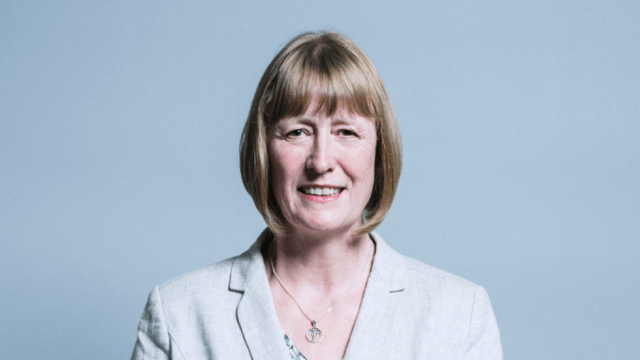
The latest Labour MP to jump ship over alleged racism and anti-Semitism is Joan Ryan, which is curious, because it was she who was exposed as having created an alleged anti-Semitism scandal within the Labour Party.
Ryan announced she was joining the Independent Group because of the “culture of anti-Jewish racism and hatred for Israel” within the party under leader Jeremy Corbyn on Tuesday.
Ryan is chair of the Labour Friends of Israel (LFI), which was exposed as having ties to the Israeli government and exerting influence on UK politics in a 2017 Al Jazeera documentary into the Israel lobby in the UK.
Al Jazeera’s undercover reporter filmed Ryan creating what would later be framed as an anti-Semitism scandal at the Labour conference in 2016. Labour member Jean Fitzpatrick approached a stand to ask questions about Labour’s support of a two-state solution with Israel and Palestine and was soon dismissed by Ryan.
Ryan later claimed the woman had made “anti-Semitic tropes” about Israel’s influence and banking, but the footage showed she made that up.
In September, Ryan lost a no confidence vote brought against her by her local parliamentary constituency over her smearing of Labour leader Jeremy Corbyn, but said she would not step down.
In the Al Jazeera footage, Ryan also talks to a then-senior officer of the Israeli embassy who tells her he has secured “more than one million pounds” in Israeli government funding for an LFI trip to Israel. Out of the six Labour MPs to quit the party, six are listed supporters of Labour Friends of Israel.
Social media users were quick to point out the irony of an MP leaving a party over anti-Semitism when she created a false anti-Semitism claim from within the Labour Party.
How the rule of the rabbis is fuelling a holy war in Israel
By Jonathon Cook | February 13, 2019
In which country did a senior, state-salaried cleric urge his followers last month to become “warriors”, emulating a group of young men who had murdered a woman of another faith?
The cleric did so with impunity. In fact, he was only echoing other highly placed colleagues who have endorsed a book – again without penalty – urging their disciples to murder babies belonging to other religions.
Where can the head of the clergy call black people “monkeys” and urge the expulsion of other religious communities?
Where does a clerical elite wield so much power that they alone decide who can marry or get divorced – and are backed by a law that can jail someone who tries to wed without their approval? They can even shut down the national railway system without notice.
Where are these holy men so feared that women are scrubbed from billboards, college campuses introduce gender segregation to appease them, and women find themselves literally pushed to the back of the bus?
Is the country Saudi Arabia? Or Myanmar? Or perhaps, Iran?
No. It is Israel, the world’s only self-declared Jewish state.
Which ‘shared values’?
There is barely a politician in Washington seeking election who has not at some point declared an “unbreakable bond” between the United States and Israel, or claimed the two uphold “shared values”. Few, it seems, have any idea what values Israel really represents.
There are many grounds for criticising Israel, including its brutal oppression of Palestinians under occupation and its system of institutionalised segregation and discrimination against the fifth of its population who are not Jewish – its Palestinian minority.
But largely ignored by critics have been Israel’s increasing theocratic tendencies.
This hasn’t simply proved regressive for Israel’s Jewish population, especially women, as the rabbis exert ever greater control over the lives of religious and secular Jews alike.
It also has alarming implications for Palestinians, both under occupation and those living in Israel, as a national conflict with familiar colonial origins is gradually transformed into a holy war, fuelled by extremist rabbis with the state’s implicit blessing.
Control of personal status
Despite Israel’s founding fathers being avowedly secular, the separation between church and state in Israel has always been flimsy at best – and it is now breaking down at an ever-accelerating rate.
After Israel’s establishment, David Ben Gurion, Israel’s first prime minister, decided to subordinate important areas of life for Israeli Jews to the jurisdiction of an Orthodox rabbinate, representing the strictest, most traditional and conservative stream of Judaism. Other, more liberal streams have no official standing in Israel to this day.
Ben Gurion’s decision in part reflected a desire to ensure his new state embraced two differing conceptions of Jewishness: both those who identified as Jews in a secular ethnic or cultural sense, and those who maintained the religious traditions of Judaism. He hoped to fuse the two into a new notion of a Jewish “nationality”.
For that reason, the Orthodox rabbis were given exclusive control over important parts of the public sphere – personal status matters, such as conversions, births, deaths and marriages.
Biblical justifications
Bolstering the rabbis’ power was the urgent need of Israel’s secular leaders to obscure the state’s settler-colonial origins. This could be achieved by using education to emphasise Biblical justifications for the usurpation by Jews of the lands of the native Palestinian population.
As the late peace activist Uri Avnery observed, the Zionist claim was “based on the Biblical history of the Exodus, the conquest of Canaan, the kingdoms of Saul, David and Solomon … Israeli schools teach the Bible as real history.”
Such indoctrination, combined with a much higher birth rate among religious Jews, has contributed to an explosion in the numbers identifying as religious. They now comprise half the population.
Today, about a quarter of Israeli Jews belong to the Orthodox stream, which reads the Torah literally, and one in seven belong to the ultra-Orthodox, or Haredim, the most fundamentalist of the Jewish religious streams. Forecasts suggest that in 40 years the latter will comprise a third of the country’s Jewish population.
‘Conquer the government’
Both the growing power and extremism of the Orthodox in Israel was highlighted in the last week of January when one of their most influential rabbis, Shmuel Eliyahu, publicly came to the defence of five students accused of murdering Aisha Rabi, a Palestinian mother of eight. Back in October they stoned her car near Nablus, in the occupied West Bank, forcing her off the road.
Eliyahu is the son of a former chief rabbi of Israel, Mordechai Eliyahu, and himself sits on the Chief Rabbinical Council, which controls many areas of life for Israelis. He is also the municipal rabbi of Safed, a city that in Judaism has the equivalent status of Medina in Islam or Bethlehem in Christianity, so his words carry a great deal of weight with Orthodox Jews.
Last month, a video came to light of a talk he gave at the seminary where the five accused studied, in the illegal settlement of Rehelim, south of Nablus.
Eliyahu not only praised the five as “warriors” but told fellow students that they needed to overthrow the “rotten” secular court system. He told them it was vital to “conquer the government” too, but without guns or tanks. “You have to take the state’s key positions,” he urged them.
Law-breaking judges
In truth, that process is already well-advanced.
Justice Minister Ayelet Shaked, who should have been the first to denounce Eliyahu’s comments, is closely aligned with religious settlers. Tellingly, she and other government ministers have maintained a studious silence.
That is because the political representatives of Israel’s religious Jewish communities, including the settlers, have now become the lynchpin of Israeli coalition governments. They are the kingmakers and can extract enormous concessions from other parties.
For some time, Shaked has been using her position to bring more openly nationalistic and religious judges into the legal system, including to the highest court in the land, the Supreme Court.
Two of its current 15 judges, Noam Sohlberg and David Mintz, are law-breakers, openly living in West Bank settlements in violation of international law. Several more judges appointed to the bench by Shaked are religious and conservative.
This is a significant victory for the Orthodox religious and the settlers. The court is the last line of defence for the secular against an assault on their religious freedoms and on gender equality.
And the court offers the only recourse for Palestinians seeking to mitigate the worst excesses of the violent and discriminatory policies of the Israeli government, army and settlers.
Chosen people
Shaked’s colleague, Naftali Bennett, another ideologue of the settlement movement, has been education minister in the Netanyahu government for four years. This post has long been a critical one for the Orthodox because it shapes Israel’s next generation.
After decades of concessions to the rabbis, Israel’s school system is already heavily skewed towards religion. A survey in 2016 showed 51 percent of Jewish pupils attended sex-segregated religious schools, which emphasise Biblical dogma – up from 33 percent only 15 years earlier.
This may explain why a recent poll found that 51 percent believe Jews have a divine right to the land of Israel, and slightly more – 56 percent – believe that Jews are a “chosen people”.
Those results are likely to get even worse in the coming years. Bennett has been placing much greater weight in the curriculum on Jewish tribal identity, Bible studies and religious claims to Greater Israel, including to the Palestinian territories – which he wants to annex.
Conversely, science and maths are increasingly downplayed in the education system, and entirely absent from schools for the ultra-Orthodox. Evolution, for example, has been mostly erased from the syllabus, even in secular schools.
‘No mercy’ to Palestinians
Another key sphere of state power being taken over by the religious, and especially the settlers, are the security services. Police Commissioner Roni Alsheikh lived for years in a settlement renowned for its violent attacks on Palestinians, and the force’s current chief rabbi, Rahamim Brachyahu, is also a settler.
Both have actively promoted a programme, Believers in the Police, that recruits more religious Jews into the police force. Nahi Eyal, the programme’s founder, has said his aim is to help the settler community “find our way into the command ranks”.
The trend is even more entrenched in the Israeli military. Figures show that the national-religious community, to which settlers belong – though only 10 percent of the population – make up half of all new officer cadets. Half of Israel’s military academies are now religious.
That has translated into an increasing role for extremist Orthodox rabbis in motivating soldiers on the battlefield. In Israel’s 2008-09 ground invasion of Gaza, soldiers were issued with pamphlets by the army rabbinate using Biblical injunctions to persuade them to “show no mercy” to Palestinians.
Call to kill babies
Meanwhile, the rapidly growing ultra-Orthodox population has been encouraged by the government to move into West Bank settlements purpose-built for them, such as Modi’in Illit and Beitar Illit. That, in turn, is gradually fuelling the emergence of an aggressive nationalism among their youth.
Once the Haredim were openly hostile, or at best ambivalent, towards Israeli state institutions, believing that a Jewish state was sacrilegious until the Messiah arrived to rule over Jews.
Now, for the first time, young Haredim are serving in the Israeli army, adding to the pressure on the military command to accommodate their religious fundamentalist ideology. A new term for these hawkish Haredi soldiers has been coined: they are known as the “Hardal”.
Brachyahu and rabbis for the Hardal are among the senior rabbis who have endorsed a terrifying book, the King’s Torah, written by two settler rabbis, that urges Jews to treat non-Jews, and specifically Palestinians, mercilessly.
It offers God’s blessing for Jewish terror – not only against Palestinians who try to resist their displacement by settlers, but against all Palestinians, even babies, on the principle that “it is clear that they will grow [up] to harm us.”
Gender segregation expands
The dramatic rise in religiosity is creating internal problems for Israeli society too, especially for the shrinking secular population and for women.
Posters for the forthcoming election – as with adverts more generally – are being “cleaned” of women’s faces in parts of the country to avoid causing offence.
Last month, the Supreme Court criticised Israel’s Council for Higher Education for allowing segregation between men and women in college classrooms to spread to the rest of the campus, including libraries and communal areas. Female students and lecturers are facing “modesty” dress codes.
The council has even announced that it intends to expand segregation because it is proving difficult to persuade religious Jews to attend higher education.
Violence of the mob
Israel has always been a society deeply structured to keep Israeli Jews and Palestinians apart, both physically and in terms of rights. That is equally true for Israel’s large Palestinian minority, a fifth of the population, who live almost entirely apart from Jews in segregated communities. Their children are kept away from Jewish children in separate schools.
But the greater emphasis in Israel on a religious definition of Jewishness means that Palestinians now face not only the cold structural violence designed by Israel’s secular founders, but additionally a hot-tempered, Biblically sanctioned hostility from religious extremists.
That is most keenly evident in the rapid rise of physical assaults on Palestinians and their property, as well as their holy places, in Israel and the occupied territories. Among Israelis, this violence is legitimised as “price tag” attacks, as though Palestinians have brought such harm on themselves.
YouTube is now full of videos of gun- or baton-wielding settlers attacking Palestinians, typically as they try to access their olive groves or springs, while Israeli soldiers stand passively by or assist.
Arson attacks have spread from olive groves to Palestinian homes, sometimes with horrifying results, as families are burned alive.
Rabbis such as Eliyahu have stoked this new wave of attacks with their Biblical justifications. State terrorism and mob violence have merged.
Destroying al-Aqsa
The biggest potential flashpoint is in occupied East Jerusalem, where the growing symbolic and political power of these Messianic rabbis risks exploding at the al-Aqsa Mosque compound.
Secular politicians have long played with fire at this Islamic holy site, using archaeological claims to try to convert it into a symbol of historic Jewish entitlement to the land, including the occupied territories.
But their claim that the mosque is built over two Jewish temples, the last of which was destroyed two millennia ago, has been rapidly reconfigured for incendiary, modern political purposes.
The growing influence of religious Jews in parliament, the government, the courts and the security services means that officials grow ever bolder in staking a physical claim to sovereignty over al-Aqsa.
It also entails an ever greater indulgence towards religious extremists who demand more than physical control over the mosque site. They want al-Aqsa destroyed and replaced with a Third Temple.
The gathering holy war
Slowly, Israel is transforming a settler-colonial project against the Palestinians into a battle with the wider Islamic world. It is turning a territorial conflict into a holy war.
The demographic growth of Israel’s religious population, the cultivation by the school system of an ever-more extreme ideology based on the Bible, the takeover of the state’s key power centres by the religious, and the emergence of a class of influential rabbis who preach genocide against Israel’s neighbours has set the stage for a perfect storm in the region.
The question now is at what point will Israel’s allies, in the US and Europe, finally wake up to the catastrophic direction Israel is heading in – and find the will to take the necessary action to stop it.
US court reopens Palestinian lawsuit against billionaire Israel donor Adelson
MEMO | February 20, 2019
A US appeals court has reopened a billion-dollar lawsuit against Jewish-American tycoon Sheldon Adelson, which seeks to hold him and more than 30 others liable for war crimes and support of Israel’s illegal settlements in the occupied Palestinian territories (oPt).
The US Court of Appeals for the District of Columbia (DC) Circuit yesterday voted unanimously in favour of reopening the case, arguing that a federal district judge concluded wrongly in August 2017 that all of the plaintiffs’ claims raised political questions that could not be decided in US courts, Ynet has reported. At the time, the district judge claimed that the lawsuit raised political questions over which the court had no authority, including who has sovereignty over the occupied West Bank, occupied East Jerusalem and the besieged Gaza Strip. Yesterday, however, US Circuit Judge Karen LeCraft Henderson said that the sovereignty issue was separate from a broader question of whether war crimes were being committed in the oPt, reported Fortune Magazine.
“A legal determination that [illegal] Israeli settlers commit genocide in the disputed territory [oPt] would not decide ownership of the disputed territory and thus would not directly contradict any [US] foreign policy choice,” explained Judge Henderson. The lawsuit, she added, could thus be treated as a “purely legal issue” and, since genocide violates international law, the court could hear the case under America’s Alien Tort Statute, which allows foreign citizens to seek remedies in US courts for human rights violations committed outside the United States.
The lawsuit is being led by Bassem Al-Tamimi from the West Bank village of Nabi Saleh, father of Palestinian teen Ahed Tamimi who was jailed for eight months for slapping an Israeli soldier who trespassed on her family’s land. He is one of 18 Palestinians or Palestinian-Americans, as well as a Palestinian village council, who filed the lawsuit, claiming that Adelson and the other defendants conspired to expel non-Jewish communities from the oPt and accusing them of aiding genocide and other war crimes.
The other defendants include a number of high-profile US billionaires and companies with histories of funding or cooperating with Israel. Among them is Jewish-American businessman Larry Ellison – who is known to have donated billions of dollars to the Israeli army via the Friends of the IDF (FIDF) – as well as Elliot Abrams, a vocal critic of former US President Barack Obama’s lukewarm support for Israel’s illegal settlements.
Two major Israeli banks are also involved in the lawsuit — Bank Leumi and Bank Hapoalim – as well as technology company Hewlett Packard Enterprise (HPE), which the Boycott, Divestment and Sanctions (BDS) movement accuses of providing technology for Israel’s checkpoints and Separation Wall in the occupied West Bank.
Adelson has long been a controversial figure for his support of Israel and involvement in the pro-Israel lobby in the US. Having made his fortune with the Las Vegas Sands Casino, Adelson is estimated to be worth $36.1 billion. He is known to have given $410 million to Birthright, which sends young Jews on trips to Israel, and has donated billions of dollars to the US Republican Party as well as President Donald Trump’s 2016 election and 2018 mid-term campaigns.
The billionaire Adelson is also the owner of Israel Hayom, Israel’s biggest circulation newspaper known for its overt support of Israeli Prime Minister Benjamin Netanyahu. Israel Hayom lies at the heart of Case 2000, one of three corruption cases in which Netanyahu is embroiled. The Prime Minister is being investigated for promising Arnon Mozes – the owner of Israeli newspaper Yedioth Aronoth – that he would curtail the circulation of Israel Hayom, Mozes’s main competitor publication, in return for favourable coverage of him and his policies. Netanyahu is also under investigation in two other cases – dubbed Case 1000 and Case 4000 – and is awaiting a decision by Israel’s Attorney General Avichai Mandelblit as to whether he will be recommended for indictment before the country’s upcoming general election on 9 April.
UK: Daniel Finkelstein admits powerful Jews engage in secret political plotting
Diversity Macht Frei | February 20, 2019
Yet another case study in hypocrisy from the Chosen People.
First, here’s an incident they were complaining about a few days ago.
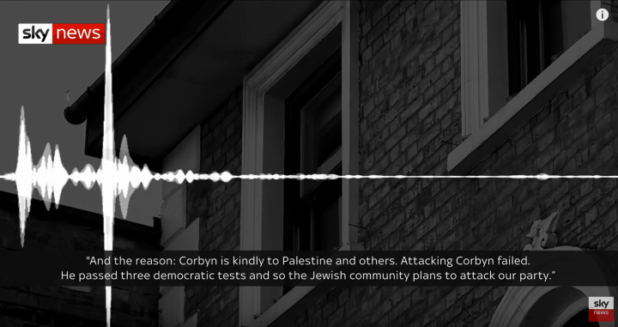
A local Labour party member, Sir Michael Duncan, complains that the “Jewish community plans to attack our party.”
Jews then attacked his party, claiming that his statement that they planned to attack his party was antisemitic and false.
Jew Mike Katz complained:
“Talking about an undemocratic elite, talking about the Jews acting as a whole community to attack the Labour party, that really plays into some of the oldest antisemitic tropes about Jews being conspiratorial, acting in secrecy, as some sort of cult, to try and influence politics”.
Yet top Jew, milord Daniel Finkelstein offered an interesting revelation in a recent Times article as he reflected on the departure of the monstrous Luciana Berger from the Labour party.
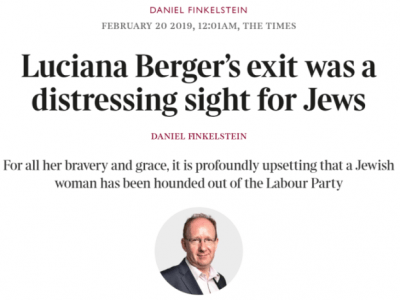
Yesterday, in modern Britain, a young woman was driven out of Britain’s biggest progressive party by people who hate Jews and by other people who won’t do anything about it. Set against that, so much else just seems blah.
I attend meetings of the Jewish community where we discuss the problem and what to do about it. The room is full of dynamic people used to getting things done. There’s plenty of strength there and determination and brains too. Yet we all feel numb.
Finkelstein made a similar admission about Jewish collective political strategising a few years ago. Of course there were no consequences, just as there will be none now. Danny the Fink (his chosen Twitter handle) won’t lose his job or be accused of promoting “antisemitic tropes” by acknowledging that a clique of powerful Jews meet in secret to plot political change. But poor Sir Michael Duncan, who earned a knighthood by making distinguished contributions to engineering, doing something real, building things, will probably now be chased from his political party by mere artful wordsmiths and manipulators for the crime of noticing that a hostile elite is pursuing an agenda of its own, disconnected from the interests of the country it is living in.
The best illustration of the power of the Jews is that they can tauntingly admit something in one of their own articles one day then destroy your life for pointing it out the next. We are living in an ethno-tyranny.
This is why Al-Quds is being silenced
By Mohammed Ayesh | MEMO | February 19, 2019
If Al-Quds satellite station actually closes its doors and completely stops broadcasting, which is what is currently occurring, albeit gradually, this means that the enemies of the Palestinian national project succeeded in silencing the voice that has long plagued the occupation over the past ten years. Moreover, silencing Al-Quds carries a number of implications, most importantly those associated with the “deal of the century”, which is simmering on a low heat, and the need to silence voices opposed to it.
The collapse of Al-Quds, which broadcasts from Beirut, is occurring shortly after the imminent closure of Al-Aqsa television in Gaza, which almost occurred a few weeks ago. However, this was cancelled at the last minute. It is also occurring a few months after the complete shutdown of Al-Ketab satellite which was broadcast from Gaza. The common reason behind all of these closures and obstacles is a financial crisis.
Al-Quds has been a source of concern for the Israelis over the last ten years and it played an important role during the three wars waged against the Gaza Strip. It has therefore been bombed by the Israeli air force in Gaza and its crews were prohibited from operating in the occupied West Bank, occupied Jerusalem, and the territories inside the Green Line. Some of its journalists and correspondents were arrested and the channel was eventually shut down in those areas.
The only reason for the collapse and closure of Al-Quds channel is the financial crisis, and the reason behind the financial crisis is the siege imposed by the Arabs on the Palestinian resistance and all of its media outlets. This was the siege the Israelis were unsuccessful with, but the Arab regimes succeeded in this regard. It is a carefully planned and systematic siege that aims to silence the voices that are opposed to the “deal of the century”. It has become clear that a number of Arab regimes are involved in the arrangements of this deal and have colluded in passing it, despite the unanimous Palestinian and Jordanian rejection of it.
All the other reasons that some of the employees and those monitoring the situation have referred to are embellishments and are not the truth. Administrative errors, financial waste, or other reasons do not lead to the complete shut down of a television channel and cannot silence its voice. Moreover, a lot of these stories and statements are just figments of the imagination of those uttering them.
Al-Quds and other channels that can be referred to as the resistance’s media outlets are funded by Arab donors who have a love and passion for Palestine and Jerusalem and those who want to support the Palestinian people. Such donors were singled out by the Arab regimes, which spend millions, and even billions of dollars to slander the Palestinian people in order to promote normalisation with Israel.
The Arab regimes that besiege the Palestinians and demonise them and prevent donors from supporting them and supporting their resistance and steadfastness in the face of the occupation, are the same ones that have recently been exposed as being involved in the Judaisation of occupied Jerusalem. They are also the same regimes that are in collusion with Trump and his son-in-law Jared Kushner in preparing the “deal of the century”. They are also the same countries who mobilise electronic armies to post comments online such as, “the Palestinians in Palestine carry an Israeli passport, the Palestinians abroad sold their country, the Palestinian in Gaza are spies for Iran, and the Arabs’ interests i.e. in normalising relations with Israel because Iran is more dangerous than Israel.” Those who believe this foolish and dubious theory are the same people who besieged Al-Quds and silenced its voice in order to continue their project.
The bottom line is that the targeting and silencing of Al-Quds is happening in the context of the siege imposed on the entire Palestinian nation and as part of the systematic campaign targeting Palestinians in order to justify normalisation with Israel. This then leads to justifying the “deal of the century”, which these Arab regimes do not want any one opposing.
READ ALSO:
The Growing Anti-Semitism Scam
By Philip Giraldi • Unz Review • February 19, 2019
“An anti-Semite used to mean a man who hated Jews. Now it means a man who is hated by Jews.” – Joe Sobran
In his novel 1984 George Orwell invented the expression “newspeak” to describe the ambiguous or deliberately misleading use of language to make political propaganda and narrow the “thought options” of those who are on the receiving end. In the context of today’s political discourse, or what passes for the same, it would be interesting to know what George would think of the saturation use of “anti-Semitism” as something like a tactical discussion stopper, employed to end all dispute while also condemning those accused of the crime as somehow outside the pale, monsters who are consigned forever to derision and obscurity.
The Israelis and, to be sure, many diaspora Jews know exactly how the expression has been weaponized. Former Israeli Minister Shulamit Aloni explained how it is done “Anti-Semitic”…”its a trick, we always use it.”
If one were to read the U.S. mainstream media, reflective as it nearly always is of a certain institutional Jewish viewpoint, one would think that there has been a dramatic increase in anti-Semitism worldwide, but that claim is incorrect. What has been taking place is not hatred of Jews but rather a confluence of two factors. First is the undeniable fact that Israel has been behaving particularly badly, even by its admittedly low standards. Its slaughter of Palestinians in Gaza has been unusually observable in spite of media attempts to avoid mentioning it, plus its support of terrorists in Syria and attacks on that country have also raised questions about the intentions of the kleptocratic regime in Tel Aviv, which is currently pushing for an attack on Iran. That all means that the perception of Israel, which boasts that it is the exclusively Jewish state, inevitably raises questions about the international Jewish community that provides much of its support. But the shift in perception is driven by Israeli behavior, not by Jews as an ethnicity or a religion.
Second, the alleged increase in anti-Semitic incidents is largely fueled by how those incidents are defined. Israel and its friends have worked hard to broaden the parameters of the discussion, making any criticism of Israel or its activities either a hate crime or ipso facto an anti-Semitic incident. The U.S. State Department’s working definition of anti-Semitism includes “… the targeting of the state of Israel” and it warns that anti-Semitism is a criminal offense. Recent legislation in Washington and also in Europe has criminalized hitherto legal and non-violent efforts to pressure Israel regarding its inhumanity vis-à-vis the Palestinians. Legitimate criticism of Israel thereby becomes both anti-Semitism and criminal, increasing the count of so-called anti-Semitic incidents. That means that the numbers inevitably go up, providing fodder to validate a repressive response.
One might add that Hollywood, the mainstream media and academia have contributed to the allegations regarding surging anti-Semitism, relentlessly unleashing a torrent of material rooting out alleged anti-Semites and so-called holocaust deniers, while simultaneously heaping praise on Israel and its achievements. Professor of Holocaust Studies Deborah Lipstadt has written a book Anti-Semitism: Here and Now about what she regards as the new anti-Semitism, supporting her belief that it is getting markedly worse in both Europe and the U.S. There is also a movie about her confrontation with holocaust critic David Irving called Denial. All of the media exposure of so-called anti-Semitism has a political objective, whether intended or not, which is to insulate Israel itself from any criticism and to create for all Jews the status of perpetual victimhood which permits many in the diaspora to unflinchingly support a foreign country against the interests of the nations where they were born, raised and made their fortunes. That is called dual loyalty and, in spite of frequent denials from Israel-apologists, it clearly exists for many American Jews who are passionate about the Jewish state, including members of the Trump Administration Jason Greenblatt, David Friedman and Jared Kushner.
In the past week, a newly elected member of congress has been derided, shunned and then forced to both recant and apologize for having said something that is manifestly true: that Jewish money corrupts the American political system to favor Israel. The controversy erupted after House minority leader Republican Kevin McCarthy said he would initiate investigations of two Muslim congresswomen, Rashida Tlaib of Michigan and Ilhan Omar of Minnesota, over their criticisms of Israel. McCarthy called for the two to be denounced by the Democratic Party as anti-Semites after Tlaib had said that the sponsors of recent legislation intended to benefit Israel by limiting free speech “… forgot what country they represent. This is the U.S. where boycotting is a right and part of our historical fight for freedom and equality. Maybe a refresher on our U.S. Constitution is in order, then get back to opening up our government instead of taking our rights away.”
Indeed, Tlaib had a point as the Congressional Israel boosters have long since forgotten that they are supposed to uphold the Constitution of the United States while also promoting the interests of their constituents, not those of a country seven thousand miles away. Glenn Greenwald of the Intercept responded to the news of the McCarthy threat with a tweet “It’s stunning how much time US political leaders spend defending a foreign nation even if it means attacking free speech rights of Americans.” Ilhan Omar then tweeted her own pithy rejoinder to Greenwald on Sunday February 10th: “It’s all about the Benjamins, baby!” which was in reference to the Founder Benjamin Franklin’s portrait on hundred-dollar bills. Her comment was almost immediately interpreted as meaning that she was accusing McCarthy of being bought by Jews. She followed up on a question about who was doing the buying she tweeted “AIPAC,” an elaboration that unleashed something like an anti-Semitism shit storm in her direction.
It was manufactured outrage, with political leaders from both parties latching on to a media frenzy to score points against each other. Even though it is perfectly legitimate for a Congresswoman on the Foreign Affairs Committee to challenge what AIPAC does and where its money comes from, Speaker of the House Nancy Pelosi complained that Omar’s “use of anti-Semitic tropes and prejudicial accusations about Israel’s supporters” was “deeply offensive.” Chelsea Clinton accused Omar of “trafficking in anti-Semitism.” President Donald Trump, who has admitted that his Mideast policy is intended to serve Israeli rather than U.S. interests, also jumped in, saying “I think she should either resign from congress or she should certainly resign from the House Foreign Affairs Committee.”
Ilhan Omar quickly understood that she had touched a live wire, surrendered, and recanted. She apologized by Monday afternoon, 18 hours after her original tweet, saying “Anti-Semitism is real and I am grateful for Jewish allies and colleagues who are educating me on the painful history of anti-Semitic tropes. My intention is never to offend my constituents or Jewish Americans as a whole. We have to always be willing to step back and think through criticism, just as I expect people to hear me when others attack me for my identity. This is why I unequivocally apologize.” But she also bravely wrote “At the same time, I reaffirm the problematic role of lobbyists in our politics, whether it be AIPAC, the NRA or the fossil fuel industry. It’s gone on too long and we must be willing to address it.”
Pelosi approved of the apology. Senator Amy Klobuchar, a Democrat from Minnesota who is running for president in 2020, chimed in to make sure that everyone knew how much she loves Israel, saying “I’m glad she apologized. That was the right thing to do. There is just no room for those kinds of words. I think Israel is our beacon of democracy. I’ve been a strong supporter of Israel and that will never change.”
Two days later, a motion sponsored by Congressman Lee Zeldin of New York passed by a 424 to 0 vote. It was specifically intended to serve as a rebuke to Omar. It stated that “it is in the national security interest of the United States to combat anti-Semitism around the world because… there has been a significant amount of anti-Semitic and anti-Israel hatred that must be most strongly condemned.”
Congressional votes professing love for Israel notwithstanding, the fact is that there is a massive, generously funded effort to corrupt America’s government in favor of Israel. It is euphemistically called the Israel Lobby even though it is overwhelmingly Jewish and it boasts fairly openly of its power when talking with its closest friends about how its money influences the decisions made on Capitol Hill and in the White House. Its combined budget exceeds one billion dollars per year and it includes lobbying powerhouses like the American Israel Public Affairs Committee (AIPAC) which alone had $229 million in income in 2017, supporting more than 200 employees. It exists only to promote Israeli interests on Capitol Hill and throughout the United States with an army of lobbyists and its activities include using questionably legal all expenses paid “orientation” trips to Israel for all new congressmen and spouses.
McCarthy and the other stooges in Congress deliberately sought to frame the argument in terms of Ilhan Omar having claimed that he personally was receiving money from pro-Israel sources and that money influenced his voting. Well, the fact is that such activity does take place and was documented three years ago by the respected Foreign Policy Journal, which published a piece entitled “The Best Congress AIPAC can Buy” as well as more recently in an al-Jazeera investigative expose using a concealed camera.
And Kevin McCarthy does indeed receive money from Israel PACs – $33,200 in 2018. The amount individual congressmen receive is dependent on their actual or potential value to Israel. Completely corrupt and enthusiastically pro-Israel Senator Robert Menendez of New Jersey received $548,507 in 2018. In the House, Beto O’Rourke of Texas received $226,690. The numbers do not include individual contributions of under $200, which are encouraged by AIPAC and can be considerable. In general, congressmen currently receive over $23,000 on average from the major pro-Israel organizations while Senators get $77,000.
But, of course, direct donations of money are not the whole story. If a congressman is unfriendly to Israel, money moves in the other direction, towards funding an opponent when re-election is coming up. Former Rep. Brian Bard has observed that “Any member of Congress knows that AIPAC is associated indirectly with significant amounts of campaign spending if you’re with them, and significant amounts against you if you’re not with them.” Lara Friedman, who has worked on the Hill for 15 years on Israel/Palestine, notes how congressmen and staffs of “both parties told me over and over that they agreed with me but didn’t dare say so publicly for fear of repercussions from AIPAC.”
A good example of how it all worked involves one honest congressman, Walter Jones of South Carolina, who recently passed away. In 2014, “Wall Street billionaires, financial industry lobbyists, and neoconservative hawks” tried to unseat Jones by bankrolling his primary opponent. The “dark money” intended to defeat him came from a PAC called “The Emergency Committee for Israel,” headed by leading neoconservative Bill Kristol. Jones’ war views, including avoiding a war with Iran, were clearly perceived as anti-Israel.
And one should also consider contributions directly to the political parties. Israeli/U.S. dual nationals Sheldon Adelson and Haim Saban are the largest single donors to the GOP and to the Democrats, having contributed $82 million and $8,780,000 respectively in the 2016 presidential campaign. Both have indicated openly that Israel is their top priority.
If they have demonstrated fealty to Israel while in office, many Congressmen also find that loyalty pays off after retirement from government with richly remunerated second careers in Jewish dominated industries, like financial services or the media. And there are hundreds of Jewish organizations that contribute to Israel as charities, even though the money frequently goes to fund illegal activity, including the settlements. Money also is used to buy newspapers and media outlets which then adhere to a pro-Israel line, or, where that does not work, to buy advertising that is conditional on being friendly to Israel. So the bottom line is indeed “the Benjamins” and the corruption that they buy.
Karen Pollock of the Holocaust Education Trust said in January that “One person questioning the truth of the Holocaust is one too many.” That is nonsense. Any, and all, historical events should be questioned regularly, a principle that is particular true regarding developments that carry a lot of emotional baggage. The Israel Lobby would have all Americans believe that any criticism of Israel is motivated by historic hatred of Jews and is therefore anti-Semitism. Don’t believe it. When the AIPAC crowd screams that linking Jews and money is a classic anti-Semitic trope respond by pointing out that Jews and money are very much in play in the corruption of congress and the media over Israel. Terrible things are being done in the Middle East in the name of Jews and of Israel and it all comes down to those Benjamins and the silence they buy by accusing all critics of anti-Semitism. Just recall what the Israeli minister admitted, “It’s a trick, we always use it.”
The First Rule of AIPAC Is: You Do Not Talk about AIPAC
By Thomas L. Knapp | Garrison Center | February 15, 2019
Washington’s political establishment went berserk when US Representative Ilhan Omar (D-MN) publicly noted that US-Israel relations are “all about the Benjamins” — slang for $100 bills, referring to money shoveled at American politicians by the American Israel Public Affairs Committee (AIPAC).
Omar was accused of antisemitism — immediately by Republicans, shortly after by members of her own party — and bullied into apologizing. She may or may not be prejudiced against Jews, but even if she is, that wasn’t her real offense.
Her real offense was publicly mentioning the irrefutable fact that many members of Congress take their marching orders from a foreign power’s lobbying apparatus (an apparatus not, as required by law, registered under the Foreign Agents Registration Act), at least partly because those marching orders come with promises of significant donations to those politicians’ campaigns.
AIPAC itself doesn’t make direct donations to political campaigns. But AIPAC and other pro-Israel lobbying groups like Christians United For Israel punch well above their weight in American politics, largely by motivating their supporters to financially support and work for “pro-Israel” candidates in general elections and help weed out “anti-Israel” candidates in party primaries.
By the way, “pro-Israel” in this context always means “supportive of the jingoism of Benjamin Netanyahu’s Likud Party,” and never “supportive of the many Israelis who’d like peace with the Palestinian Arabs.”
One AIPAC supporter alone, casino magnate Sheldon Adelson, spent $65 million getting Republicans elected, including $25 million supporting Donald Trump, in 2016. But that $25 million was only put into action after Trump retreated from his early position of “neutrality” in the Israeli-Palestinian conflict, publicly prostrated himself to AIPAC in a speech at one of its events, and pronounced himself “the most pro-Israel presidential candidate in history.”
But: We’re not supposed to talk about that. Ever. And it’s easy to see why.
If most Americans noticed that many members of Congress (as well as most presidents) are selling their influence over US policy to a foreign power, we might do something about it.
For decades, howling “antisemitism” any time the matter came up proved an effective tactic for shutting down public discussion of the “special relationship” under which Israel receives lavish foreign aid subsidies, effective control of US foreign policy in the Middle East, and lately even state (and pending federal) legislation requiring government contractors to sign loyalty oaths to Israel’s government.
The Israeli lobby’s power to prevent that discussion seems to be slipping, however. Why? In part because the lobby’s money and political support, which used to be spent buying both sides of the partisan aisle, has begun tilting heavily Republican in recent years, freeing some Democrats to not “stay bought.” And in part because the newest generation of politicians includes some like Ilhan Omar who aren’t for sale (to Israel, anyway).
Decades of unquestioning obedience to the Israel lobby has drawn the US into needless and costly conflicts not even remotely related to the defense of the United States. We’ll be better off when the “special relationship,” and the corruption underlying it, ends.
Thomas L. Knapp (Twitter: @thomaslknapp) is director and senior news analyst at the William Lloyd Garrison Center for Libertarian Advocacy Journalism (thegarrisoncenter.org). He lives and works in north central Florida.
And now, a word from the Jewish Democratic Council of America
Jewish Democratic Council of America
Friends,
Events of the past week demonstrated that words matter. The Jewish Democratic Council of America (JDCA) immediately condemned Representative Ilhan Omar’s tweet for what it was – an anti-Semitic trope. We followed-up with a statement, denouncing Rep. Omar’s tweet because it represented a form of anti-Semitism that has historically been used to target Jews. We expressed deep concern that a member of Congress would express such incendiary views, and asserted that her constituents and the American people deserved better.
Within 24 hours, House Democratic leadership, as well as dozens of Democratic members of Congress, condemned Rep. Omar’s statement and expressed similar concerns. Facing immense pressure, Rep. Omar “unequivocally” apologized for her tweet. JDCA responded by welcoming Rep. Omar’s recognition that her words were offensive and her willingness to learn. We expressed hope that this would be last time she repeats dangerous stereotypes targeting Jews and said we look forward to engaging with her to voice our deep concerns. We also expressed concern that her apology was in fact equivocal because it repeated some of the same references she had originally tweeted about. JDCA is committed to ensuring that all members of Congress understand the gravity of these issues and calling out anti-Semitism wherever we see it.
JDCA has spoken out against Rep. Omar and other Democrats with whom we disagree before, and we will continue to speak out against anyone who engages in anti-Semitism irrespective of their party affiliation. Speaking truth to power, even within your own party, is consistent with our values. Words matter. But hypocrisy matters too.

That is why JDCA will continue to call out the hypocrisy of Republicans who are quick to criticize anti-Semitism when it’s politically expedient, but refuse to denounce anti-Semitism in their own ranks and at the highest levels of power.There is no question that insinuations of Jewish money controlling American politics is an anti-Semitic canard. So where was the Republican outrage when House Minority Leader Kevin McCarthy insinuated just four months ago that Jews were attempting to buy the midterm election? In the last election, Republican state parties and candidates ran attack ads in six states featuring Jews clutching cash. Where was the outrage over the GOP’s widespread use of this anti-Semitic trope? Unfortunately, it wasn’t there. Instead, we have seen Republicans selectively condemn anti-Semitism when it suits their political interests but remain silent when it comes from the highest ranks of power.
Republicans were silent as Donald Trump ran a presidential campaign in which he frequently used anti-Semitic tropes. His final campaign ad – which was explicitly condemned by at least five Jewish groups, including the Anti-Defamation League (ADL) – referred to the same anti-Semitic trope Rep. Omar invoked this week. But that wasn’t the first time, nor would it be the last. In 2015, Trump told a crowd of Jews that “you’re not going to support me because I don’t want your money.” More recently, he promoted an anti-Semitic conspiracy theory on Twitter. And we will never forget that the President of the United States publicly created a moral equivalence between neo-Nazis and those protesting them in Charlottesville.
Again, where is the Republican outrage? There has been none. Just silence.
Republicans have been quick to point to their recent condemnation of Rep. Steve King for his alignment with white supremacy, but as Speaker Nancy Pelosi reminded us on Wednesday, Republicans’ decision to finally take action against King – who has long been known to hold anti-Semitic views – took Republicans 13 years.
Even this past week, 177 House Republicans voted against a bill containing language condemning anti-Semitism. All Democrats – including Rep. Omar – voted for it, but Republicans chose party over principle, and nearly all of them voted “no.” JDCA spoke out after this vote, affirming that it was “blatant hypocrisy on the part of Republicans, plain and simple, and we condemn them for it in the strongest possible terms.”
This hypocrisy is simply unacceptable.
We’ve had enough. Anti-Semitism cannot be tolerated, and we must uniformly hold elected officials to the highest standards. If you are committed to calling out anti-Semitism only when it’s politically expedient, then you are just dedicated to partisanship not principles. That’s why we’re encouraging the GOP to commit to calling out anti-Semitism whenever and wherever it emerges. As JDCA stated on Wednesday in a message to Republicans – “enough of the willful blindness, hypocrisy, and double standards.”
Words matter, but hypocrisy matters too, and if you agree with the work JDCA is doing, please consider supporting our efforts today. Please also check out more of JDCA’s work from this past week on our website, including our response to the breaking news of President Trump’s emergency declaration at our border, an op-ed by Executive Director Halie Soifer published in the Times of Israel, and a letter to the editor published in the Jewish Journal by JDCA Board Member Ada Horwich and Halie Soifer.

Shabbat Shalom,
Ron Klein
Chair, Jewish Democratic Council of America
Halie Soifer
Executive Director, Jewish Democratic Council of America
Ní Riada Calls on EU to End Funding to Israel

IMEMC News & Agencies – February 16, 2019
Sinn Féin MEP Liadh Ní Riada has called for the ending of all EU funding to Israel.
The Ireland South MEP made the call as she tabled an amendment designed to close the loophole allowing Israel to use EU funds for military purposes.
“Israel must be completely excluded from receiving any funding for research and development,” she said.
“Every penny that they have received under the research and development scheme, which they have egregiously abused, makes the EU complicit in each and every murder Israel has carried out since 2000.
“That’s over 10,000 Palestinians. More than 2,000 of them children.
“The EU’s Horizon 2020 is the biggest research and development program in the world, with €80 billion dedicated to it since 2014”.
“Israel is allowed to take part in the program on the basis of the EU-Israel association agreement, signed in 2000. An outrageous agreement that we warned two decades would only give legitimacy to Israel’s campaign of genocide.
“We have been proved depressingly right. In that time, in addition to their usual litany of human rights abuses, they have launched no less than five major assaults and invasions on Palestinian territory, started a war in Lebanon and hijacked an international peace flotilla carrying humanitarian aid, massacring those on board.
“EU treaties do not allow any spending on military or defense to be charged to the EU budget. However, the European Commission has been continuously undermining this clear rule for many years now through a blatant loophole made for ‘dual-purpose’ technologies.
“Dual-purpose technology, is any technology that can also be used for military purposes. This allows Israeli arms manufacturers and military companies to apply for EU funding.
“It has been well documented that Israel systematically uses dual-purpose technology for military purposes once it is through the research and development stage.
“Today, I tabled an amendment that calls for the EU to stop funding dual-purpose technology under this program. This would immediately stop taxpayer’s money from subsidizing the Israeli arms industry, and by extension, wholesale murder, under the guise of civilian innovation.
“This, however, is only a start. The EU needs to stop all funding to Israel until we see an end to human rights violations by Israeli forces in the Occupied Palestinian Territories.”
Hamas: Warsaw summit serves Israel only
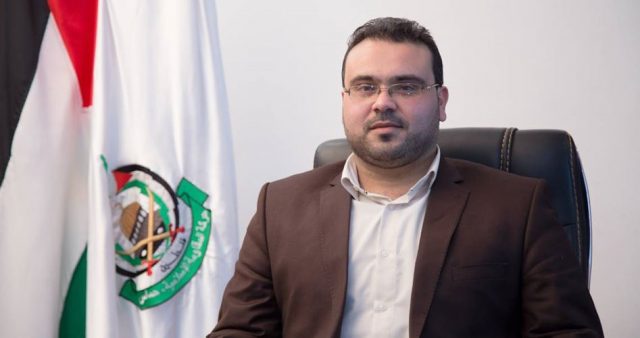
Hazem Qasem
Palestine Information Center | February 15, 2019
GAZA – Hamas’s spokesman Hazem Qasem on Thursday said that the US-led Warsaw conference serves the interests of Israel only.
Qasem said in a brief statement that the US administration seeks to integrate Israel into the regional community and liquidate the Palestinian cause.
“Warsaw conference portrays Iran as the most dangerous enemy instead of the Israeli occupation, which will lead to more divisions in the Middle East. All this is a free service offered by the US administration to Netanyahu,” he added.
Qasem pointed out that Warsaw conference is a thinly-veiled attempt by Israel and the US to pass the so-called Deal of the Century.
The conference will be attended by representatives from dozens of countries including Arab countries like Bahrain, Saudi Arabia, Morocco, and the UAE.
Israel training mercenaries for Yemen war in UAE camps in Negev: Haaretz
Press TV – February 16, 2019
Israel’s leading daily Haaretz says Tel Aviv is a partner to the Saudi war on Yemen and is “reaping the profits” from its partnership in the brutal aggression.
Haaretz revealed that Israeli officers are training foreign mercenaries, led by the Colombians and Nepalese, in UAE-funded camps situated in the Negev Desert.
Quoting sources in a US House Intelligence Committee, the report said the mercenaries have been recruited by Mohammed Dahlan, security adviser to Abu Dhabi Crown Prince Mohammed bin Zayed Al Nahyan.
Dahlan had “visited these camps on more than one occasion to check the progress of preparations and training received by mercenaries, under the personal supervision of the Israeli occupation army officers,” the report said.
The mercenaries, it added, later took part in the Saudi offensive against the port city of Hudaydah and other conflict zones in Yemen.
American sources were cited as saying that Israel has also sold bombs and missiles to Saudi Arabia, some of which are banned.
Saudi Arabia and the UAE launched the devastating military campaign against Yemen to bring the Riyadh-backed former government back to power. The invaders have, however, failed to achieve their objective in the face of Yemeni resistance.
“Israeli cyber companies, gun traders, terror-warfare instructors and even paid hit men operated by an Israeli-owned company are partners to the war in Yemen,” Haaretz said.
It further cited reports suggesting Israeli companies’ relations with Saudi Arabia and its allies.
Israeli software firm NSO Group is suspected of selling Riyadh Pegasus spyware accused of helping trace Saudi dissident journalist Jamal Khashoggi, who was killed by a hit squad inside kingdom’s Istanbul consulate last October.
Security firm AGT International, which is owned by an Israeli businessman, won in 2007 a $6 billion bid to set up surveillance systems in Abu Dhabi.
Spearhead Operations Group, another company set up by Israeli Avraham Golan, is also responsible for assassinations in Yemen.
Last October, Golan told BuzzFeed media company that there was a plan for targeted assassinations in Yemen. “I ran it. We did it. The plan was under the UAE auspices as part of the Arab coalition,” he said.
Haaretz also referred to some reports that say Israel has sold Saudi Arabia combat drones and intends to sell the kingdom Iron Dome missile systems following US-mediated secret meetings in Washington.
Israel has recently been working behind the scenes to establish formal contact with Saudi Arabia and its allies.
Critics say Saudi Arabia’s flirtation with Israel will undermine global efforts to isolate Tel Aviv and harm the Palestinian cause.
Featured Video

or go to
Aletho News Archives – Video-Images
Book Review
The Maidan Killings and the False-Flag Case
By Freddie Ponton | 21st Century Wire | September 5, 2026
Before the killings that helped bring down Ukraine’s president in February 2014, American diplomats were discussing who should enter its government. In a leaked telephone call, senior State Department official Victoria Nuland told US ambassador Geoffrey Pyatt, “I think Yats is the guy,” referring to opposition leader Arseniy Yatseniuk. Washington had clear preferences and was working to advance them. Later that month, Yatseniuk became prime minister.
Ivan Katchanovski’s The Maidan Massacre in Ukraine examines the violence that preceded that transfer of power. Drawing on television footage, witness testimony, forensic examinations and Ukrainian court proceedings, he argues that elements of the opposition shot protesters and police in a false-flag operation. His case centres on evidence of protesters being shot from opposition-controlled locations, including Hotel Ukraina, overlooking the killing ground. … continue
Blog Roll
 Aletho News
- What changes with Lula or Flávio?
- Britain leads Western media’s demise through ‘fear porn’ narrative
- The Maidan Killings and the False-Flag Case
- Georgia’s Largest Healthcare System Will Fire Employees Who Refuse Flu Vaccine
- The Five-Year Fuel Crisis: Why the World Economy Is Paying for a War It Thinks Is Ending
- Trump’s Big Bluff on Iran
- Swiss scammed out of millions by Ukraine-linked call centers – media
- Germany facing potential ‘violent conflict’ with Russia – spy chief
- Ukraine’s EU neighbors reject new plea from Kiev – Politico
- British Transport Police Facial Recognition Trial Scanned 926,912 People With Zero Arrests
- If Americans Knew
- “We See Our Homes Now From A Satellite, Like Strangers”
- Watch “Gaza: Doctors Under Attack”, originally censored by BBC
- NAZA: Israeli embassies in UK and US promote rival documentary to challenge Gaza genocide allegations
- David Ellison appoints Israeli to lead merged Paramount-Warner studios
- Turkish Red Crescent helps elderly Gaza man walk again after Israel confiscates his prosthetic limb
- Four Palestinians Killed in Israeli Attacks in Gaza
- Two Palestinian youths killed and village razed as Israeli attacks on West Bank continue
- Two more Christian women victims of Israeli raids on Gaza
- Cruelty, Deprivation, Indignity: A Journalist’s 22 Months in Israeli Prison
- New IDF Website Frames Slain Gaza Journalists as Terrorists
- No Tricks Zone
- Latest European Green Energy Debacle; Portugal’s Largest Flagship Solar Park Insolvent!
- Green Energy Debacle: German Expert Professor Fritz Vahrenholt Warns Of Severe Economic And Social Consequences
- Two More Paleo Reconstructions Affirm Meters-Higher Sea Levels Across Ireland, Brazil 7000-6000 Years Ago
- New Study: Earth And Venus Surface Warmth Largely Explained By Convection And Lapse Rate, Not CO2 Or Radiation
- 2025 Nature Paper Claiming Worsening Global Drought Gets RETRACTED …Heavily Flawed
- New Study: ‘Global Drought Shows No Detectable Recent Acceleration Under Climate Warming’
- Economic Masterminds: German Socialists Suggest Taxing Productivity Gains Stemming From Using AI
- The South China Sea Has Not Been Cooperating With The Climate Change Narrative
- Energy Crisis: Germany Enters Heating Season With Historically Low Gas Reserve Fill Levels
- New Study: The Antarctic Ice Sheet Gained Mass From 2020-2024 Due To Staggering Snow And Ice Accumulation

