As US Laments Human Rights in Venezuela, US-Allied Colombia Descends into Drug-fueled Humanitarian Crisis
By Whitney Webb | MintPress News | February 8, 2019
BOGOTÁ, COLOMBIA – Several troubling situations are currently playing out across Colombia, yet the country’s continuing downward spiral into drug-fueled and politically-motivated violence has caused little concern in Washington, offering yet another clear indication that the U.S.’ current posturing on Venezuela is hardly motivated by concerns about “democracy,” “human rights,” or the welfare of the Venezuelan people.
This, of course, can hardly be considered surprising, given that Colombia is a top U.S. ally whose government has long been closely aligned with Washington’s interests. However, although the lack of U.S. government or media attention to Colombia may effectively hide it from the American public, the country is becoming increasingly lawless, with cocaine production reaching new record levels and the government sanctioning the mass murder of the country’s largest indigenous group. Not only that but since Colombia’s new president, Iván Duque, came to power late last year, the number of indigenous social leaders who have been murdered has spiked to the highest levels in over a decade.
Ultimately, the lack of media coverage of Colombia’s humanitarian crises, which have large implications for the Americas as a whole, is a telling example of how such crises are regularly weaponized by governments and media to exclusively target governments it wishes to pressure or overthrow, while turning a blind eye to those same or worse acts when committed by an allied nation.
An absurdly double standard
Though it was Barack Obama who first deemed Venezuela a “national security threat” and re-initiated draconian sanctions against the oil-rich nation, the Trump administration has greatly increased the sanctions targeting Venezuela, often citing its government’s alleged participation in illegal drug trafficking as justification for doing so. However, the U.S. has offered little in the way of concrete evidence to back up those allegations.
During this same period, moreover, the Trump administration has expressed little concern for the booming illicit drug trade in neighboring Colombia, which has broken records for cocaine production for the last two years in a row. Though the Colombian government and military have been repeatedly tied to the country’s drug trade, the Trump administration – like previous U.S. administrations – hasn’t lifted a finger.
According to UN figures released last September, Colombia’s cocaine production has again broken records, with the country producing an estimated 1,379 tons of cocaine in 2017, the latest year for which such statistics exist. That figure is a 31 percent increase in cocaine production from 2016. 2016 itself was a record-breaking year with cocaine production gaining by 50 percent over 2015 levels.
Though Trump had threatened to decertify former Colombian President Juan Manuel Santos’ government over the rapid growth of cocaine production, he ultimately gave Colombia a pass in the U.S.’ annual determination of countries considered to be “major drug transit or major drug producing” areas “because the Colombian National Police and Armed Forces are close law enforcement and security partners of the United States in the Western Hemisphere.”
The document also described Venezuela, along with its regional ally Bolivia, as “countries that have failed demonstrably during the previous 12 months to adhere to their obligations under international counternarcotics agreements” despite the fact that Bolivia had the fewest illegal coca crops of any South American country that year.
Since getting a free pass from the Trump administration, Colombia’s current president, Iván Duque, has signaled his hopes to revive a failed, U.S.-backed program to indiscriminately spray suspected coca fields with the infamous Monsanto product glyphosate to reduce cocaine production.
Though the U.S. government and Western media have traditionally placed the blame on leftist guerillas in Colombia, like the FARC, the 2016 peace deal that saw the FARC abandon the drug trade has removed this convenient scapegoat and highlighted the long-standing role of the Colombian military and prominent right-wing politicians in cocaine production.
In fact, the United Nations Drug Control Program (UNDCP) has described the Colombian military — which has been armed and trained for decades by the U.S. under the Clinton era policy known as “Plan Colombia” — as being among “the biggest heroin and cocaine trading institutions.”
The Colombian government has also been intimately involved, particularly during the presidency of Álvaro Uribe, who allegedly served as the “head of Colombia’s paramilitary groups” both before and while in office. Uribe was once ranked by the U.S. Defense Intelligence Agency “on a list of 104 important narco-traffickers contracted by the Colombian narcotics cartels.”
There are also indications of the U.S. government’s own involvement in the Colombian cocaine trade. For example, Colombia’s most notorious drug trafficker, Pablo Escobar, at one point worked for the U.S. Central Intelligence Agency, according to Escobar’s own children. Escobar allegedly sold cocaine for the CIA to help the U.S. government finance its fight against communism and left-wing governments in Latin America.
As pointed out in the book Cocaine, Death Squads and the War on Terror: U.S. Imperialism and Class Struggle in Colombia, the U.S.’ anti-drug efforts in Colombia were never intended to eradicate cocaine, but instead alter the market share by ensuring that allies of the U.S. in Colombia – the Colombian government, paramilitaries and the wealthy elite who are favorable to U.S. business interests – could monopolize the drug trade with no competition from outsiders. Thus, it should hardly shock anyone that the U.S. continues to turn a blind eye to the country’s booming illegal drug trade and its associated violence, even as it continues to break records year after year.
Erasing the erasure of the Wayuú
As the long-standing, U.S.-backed plan to oust the Chavista regime in Venezuela has unfolded, Maduro’s government has been called out in Western media for “starving his own people,” despite the fact that U.S. sanctions imposed on Venezuela are a driving factor behind the country’s economic crisis. However, since 2011, Colombia has been the site of ongoing genocide against the country’s largest indigenous group – the Wayuú – in the country’s Guajira region, after the Colombian government diverted their only source of water to support the operations of the country’s – and continent’s – largest coal mine.
The suffering of the Wayuú, who have reported the deaths of at least 14,000 children due to the lack of clean water, has gone unreported by the same outlets that routinely raise concern about lack of essential goods in Venezuela. The Wayuú, who comprise around 20 percent of Colombia’s entire indigenous population and 48 percent of the Guajira region’s total inhabitants, are now on the brink of dying out completely seven years after the Ranchería river – their community’s only freshwater source – was diverted by the government-constructed Cercado dam in order to service the water needs of the Cerrejón coal mine.
An estimated 37,000 Wayuú now suffer from severe malnutrition, as they can no longer grow crops or raise livestock without a freshwater source. Each person in the community now lives off of less than 0.7 liters (24 oz.) of water a day while the Cerrejón mine guzzles more than 2.7 million liters of water in a 24-hour period – most of which is used to improve mine “visibility” by minimizing dust pollution. Despite the clear impact of the dam and mine on the humanitarian crisis facing the Wayuú, the Colombian government and supportive Western media have blamed “climate change” and weather patterns like El Niño for the situation.
The most likely reason for the erasure of the slow genocide of the Wayuú from Western media is the fact that the Cerrejón mine is a largely a U.S.-backed operation, as the mine was originally founded by ExxonMobil and is now owned by a consortium of largely Western mining companies such as Anglo American and BHP Billiton. These same mining companies often work with right-wing paramilitary groups — who are also closely connected to the Colombian government — and who repeatedly threaten the lives of Wayuú who speak up about their people’s suffering, including their chief legal advocate, Javier Rojas Uriana.
Notably, the Colombian Wayuú have been immigrating to the Wayuú community in Venezuela in order to avoid the slow death caused by malnutrition, lack of water, and waterborne illnesses from the polluted water from the community’s remaining wells. The Venezuelan Wayuú have been largely supportive of Chavismo and have backed the Maduro-led government, referring to U.S.-backed opposition protests as violent riots “intended to create chaos.” The Huffington Post noted in 2017 that the Wayuú’s support for Maduro had largely been erased by the Western media because it “does not match up with the media’s anti-Venezuelan government narrative.”
Liquidating social leaders, activists, human-rights advocates
While the fate of the Wayuú (and thus 20 percent of the country’s entire indigenous population) continues to hang in the balance, the plight of Colombia’s indigenous peoples has grown even worse since the recent inauguration of Colombian President Iván Duque.
Despite Duque’s having come to power just last August, El Tiempo recently reported that the murders of indigenous leaders in the country have spiked to levels unseen in over a decade since Duque became Colombia’s president. According to data cited by El Tiempo, 120 indigenous social leaders – as well as human-rights defenders — have been murdered in cold blood during Duque’s first 100 days in office.
Though the murder of social leaders by right-wing paramilitary groups has a standing problem in Colombia’s recent history, this level of targeted murder represents a spike over recent years — in which 226, 159, and 97 such murders occurred over the course of the entire years of 2018, 2017 and 2016, respectively. Notably, the Venezuelan government of Nicolás Maduro has been routinely accused by Western media of murdering opposition activists; yet, those same outlets have been silent on Colombia’s recent spike in activist murders.
Despite the jump, Duque’s government has expressed little concern. This is hardly surprising when one considers that Duque is the hand-picked successor and protégé of Álvaro Uribe, the former Colombian president who was once “the head of Colombia’s paramilitary groups,” according to former paramilitary group commanders of the right-wing death squad AUC, which has been funded by several prominent U.S. corporations.
Uribe, who was Colombia’s president from 2002 to 2010, and was a close ally of George W. Bush, was also personally implicated in organizing a massacre conducted by a right-wing paramilitary group; and his cousin, Colombian politician Mario Uribe, was charged with mobilizing right-wing death squads in the country to help secure Uribe’s presidential victory in 2002. Uribe’s brother was also arrested for founding a right-wing paramilitary group in 2016.
Under Uribe’s presidency, the Colombian military massacred thousands of civilians — such as in the “false positives” scanda,l where the Colombian military dressed up an estimated 5,000 civilians in guerilla clothing and killed them in cold blood, subsequently gaining a bonus from Uribe’s government for the sinister act. It should be no surprise then that, under Uribe, the murder rate of indigenous leaders and human-rights activists reached its all-time high at 1,912 murders in 2003.
Given Duque’s close relationship to Uribe, it is also little surprise that paramilitary groups have endorsed Duque following his election and have vowed to “exterminate” Duque’s opposition, calling prominent Colombian progressives “military targets.”
What to expect if US gets its way in Venezuela
If Washington’s publicly stated concerns about “human rights” and the welfare of a country’s people in Venezuela were genuine, it would be equally critical of Colombia’s government, given the numerous troubling situations currently unfolding in that country. Instead, the dichotomy between Washington’s relationship with Venezuela and Colombia is yet another clear example that the public justifications for the U.S.’s Latin America policy are little more than window dressing for the U.S.-backed expansion of neo-fascist governments throughout Latin America.
Indeed, if Juan Guaidó – the self-declared, U.S.-backed “president” of Venezuela – manages to seize power in the country, the current state of affairs in Colombia is a telling harbinger of what would likely manifest should Nicolás Maduro be overthrown and replaced with the same type of government that the U.S. has either backed or installed in several Latin American countries over the last few decades, and particularly in recent years.
Whitney Webb is a staff writer for MintPress News and has contributed to several other independent, alternative outlets. Her work has appeared on sites such as Global Research, the Ron Paul Institute and 21st Century Wire among others. She also makes guest appearances to discuss politics on radio and television. She currently lives with her family in southern Chile.
US federal judge dismisses lawsuit against BDS supporters
MEMO | February 7, 2019
Pro-Israeli groups have suffered a major defeat in a US court after a federal judge dismissed a lawsuit against the American Studies Association’s (ASA) resolution to endorse the call to boycott Israeli academic institutions as part of the Boycott, Divestment, and Sanctions (BDS) movement.
On Monday a district court in Washington threw out the lawsuit against ASA, which is the oldest scholarly organisation devoted to the interdisciplinary study of US culture and history. The federal judge ruled that the anti-BDS plaintiffs were unable to explain how they were injured by the boycott, a requirement for the lawsuit to go forward.
The ruling is a significant victory for human rights campaigners and a blow to efforts by Israel lobby groups to use courts to harass, intimidate and silence supporters of Palestinian rights in US universities – a tactic known as lawfare. It’s also a major boost for Americans sacked from their jobs on the back of anti-BDS legislation, denounced by critics as unconstitutional.
Pro-Israeli group, the Louis D. Brandeis Centre, filed a lawsuit against ASA in April 2016 over its resolution to boycott Israeli academic institutions. The lawsuit argued that in adopting the resolution, which was voted on by an overwhelming democratic majority, the ASA operated beyond its corporate charter and caused the plaintiffs to “suffer significant economic and reputational damage.”
In the court’s 20-page ruling, US District Judge Rudolph Contreras wrote that the pro-Israeli group had “danced around key issues” and was unable to show that they had suffered enough monetary damages to warrant a federal case.
The judge found that at most, the individual plaintiffs could seek damages of a few hundred dollars to cover membership dues they allege were misappropriated, but they would have to find some other venue to pursue their claims.
Radhika Sainath, senior attorney with the civil rights group Palestine Legal, summed up the court’s judgement saying that “the court basically said, in no uncertain words, that the plaintiffs suing ASA lied when they claimed to have ‘suffered significant economic and reputational damage’.”
“But, as the court explained, ‘nowhere’ in the lawsuit could the plaintiffs explain what that damage was. It didn’t pass the smell test,” she added.
One of the four co-defendants, Dr Stephen Salaita, an outspoken advocate of Palestinian rights who was fired from the University of Illinois at Urbana-Champaign for tweets criticising Israel’s 2014 assault on Gaza, said after the verdict: “I’m thrilled that this baseless case has been dismissed. It served no purpose other than persecuting those who dare to criticise Israeli policy and seek to end the occupation through peaceful means,”
Another co-defendant Wesleyan University Professor Kehaulani Kauanui denounced the lawsuit as a politically motivated attempt to suppress free speech. “The Brandeis Centre did not hold back its clear intent to punish me for standing up in solidarity with Palestinians and to deter others. They don’t call it lawfare for nothing.”
The court’s decision comes in the context of a broader federal assault on BDS for Palestinian human rights. On Tuesday, the US Senate passed a measure that would criminalise politically motivated boycotts of Israel across the US.
US blocks UNSC criticism of Israel’s expulsion from Hebron of international monitors
MEMO | February 7, 2019
The US blocked a draft United Nations Security Council statement yesterday from issuing a statement that would have expressed concerns over Israel’s decision to expel the international observatory task force that has been monitoring the situation in the occupied West Bank city of Hebron for 20 years.
The 15-member UN Security Council discussed Israel’s decision behind closed doors at the request of Kuwait and Indonesia, which also drafted the statement. Such a statement has to be agreed unanimously.
UN diplomats said that the US had blocked the statement saying that they did not believe a council statement on the issue was appropriate.
The draft statement, seen by Reuters, would have also recognised the importance of the Temporary International Presence in Hebron (TIPH) and its “efforts to foster calm in a highly sensitive area and fragile situation on the ground, which risks further deteriorating.”
The proposed statement also intended to express the Security Council’s “regret” about Israel’s “unilateral decision” to eject the force from occupied Hebron and call for “calm and restraint”.
The TIPH was set up after a Jewish settler, Baruch Goldstein, massacred 29 Palestinians in 1994 at the Ibrahimi Mosque during the holy month of Ramadan.
Israeli Prime Minister Benjamin Netanyahu said last week he would not renew the mandate of TIPH accusing the observers of unspecified anti-Israel activity. His decision heightened Palestinian concerns over their safety. Palestinian residents of Hebron regularly come under attack from illegal settlers and Israeli occupying forces. They often say that they are living under an apartheid Israeli system. The Old City of Hebron is completely divided through the presence of barriers, closures, military zones and settlements, to accommodate some of Israel’s most extreme settlers.
The Palestinian Authority (PA) echoed the concerns and called for a UN protection force to ensure the safety of Palestinians until Israel ends its “belligerent occupation”. The UN should “guarantee the safety and protection of the people of Palestine” until “the end of Israel’s belligerent occupation,” said Palestinian official Saeb Erekat.
Israeli exploration move threatens Lebanon’s oil wealth – parliament speaker
RT | February 7, 2019
Lebanon’s parliament Speaker Nabih Berri said on Thursday that an Israeli move to license energy exploration near a disputed maritime boundary threatened to drain Lebanese oil wealth before its own drilling had started.
The previous day, Berri accused Israel of breaching Lebanese waters by licensing a company to exploit the area, Reuters reported.
Israel’s Foreign Ministry has not commented on the accusation.
Lebanon last year licensed a consortium of Italy’s Eni, France’s Total and Russia’s Novatek to carry out the country’s first offshore energy exploration in two blocks. One of the blocks, Block 9, contains waters disputed with Israel.
Berri said the Israeli move threatened “to drain a whole basin and a large part of the oil wealth.”
Are UN envoys allowed to monitor Israeli violations or just Hezbollah’s?
![Israeli forces hold down a Palestinian man in Ramallah, West Bank on 28 August 2018 [Issam Rimawi/Anadolu Agency]](https://i1.wp.com/www.middleeastmonitor.com/wp-content/uploads/2018/08/20180828_2_32103254_36728394.jpg?resize=1200%2C800&quality=75&strip=all&ssl=1)
Israeli forces hold down a Palestinian man in Ramallah, West Bank on 28 August 2018 [Issam Rimawi/Anadolu Agency]
By Motasem A Dalloul | MEMO | February 6, 2019
It is very nice to see the delegation of the UN ambassadors touring the Israeli-Lebanese borders early week to follow up closely on Israeli efforts to fight the alleged Hezbollah tunnels. It is a fantastic moment when you see the international diplomats, who live and work far from the field of the Israeli operations, having firsthand information about the issues that they will or might make decisions about on an international level.
Therefore, it was a very clever move when the Israeli Ambassador to the UN Danny Danon lobbied the UN ambassadors and organised a trip for them to tour the alleged tunnels. While the Israeli military machine was working, Danon could feed the Israeli propaganda to the international diplomats. “We say clearly that Hezbollah has established its own state in south Lebanon, a state that advances terror operations against Israel. On the day we move to defend ourselves and the UN will want to condemn us, the ambassadors standing here will understand the reality,” Ynet News reported Danon saying.
This way, Danon could evoke the sympathy of the ambassadors, who completely accepted his narrative. All the officials saw was a hole in the ground and heavy machinery to inject concrete inside it; Danon described it as an “attack tunnel”.
Anyone who lives and works far away does not recognise all of these hostile activities, the South Sudan Ambassador Akuei Bona Malwal said, according to Ynet News : “For those of us who work in New York and hear all sorts of things, the best way is to come and see and feel exactly what is happening. We came to Israel to see the challenges and how they are being handled.” While the Ambassador for Panama Meliton Arrocha Ruiz said: “We will pass on what we saw.”
But the conflict in the region is not taking place on the Israeli-Lebanese border, but in every inch of occupied Palestine. Can the UN ambassadors carry out tours to see the daily violations against Palestinians and the suffering inflicting on them?
Can the UN ambassadors visit the historical Palestinian city of Tiberias in Israel and see how the Israeli occupation has been preventing the Palestinian-Arab citizens of Israel from performing prayers at Al-Bahr Mosque since 1948? Can they visit the mosque and see what is happening there and report what they see to the UN? Can they visit dozens of mosques which have been turned into bars, nightclubs or museums in a complete disrespect to their religious status?
I am asking the UN ambassadors, who described Israel as “thriving, open and democratic”, if its government is ready to let them tour the Palestinian farms which were torn into pieces by the Israeli Separation Wall in the occupied West Bank, the illegal Israeli settlements and the daily Israeli detention of Palestinians and demolition of their homes and lands?
Are these diplomats able to visit the Gaza Strip, which has been suffering under a 12-year-old Israeli siege, and meet the 8,515 cancer patients who are facing slow death due to the Israeli restrictions on the entry of their medicines or the queues of patients who urgently need to have surgery but are unable because of the shortage of medical supplies? Can they visit Gaza and see how many thousands of homes Israel has demolished, visit empty homes whose owners were killed by Israel and see how many schools, hospitals, mosques and water and sewage infrastructure were destroyed?
If the UN ambassadors even considered visiting the occupied Palestinian territories, they would have been prevented from doing so by the “thriving, open and democratic” state. Just a couple of month ago, the Israeli occupation government prevented a delegation of MEPs visiting the occupied territories in order to monitor the humanitarian situation caused by the Israeli blockade, assess the destruction in the area following the armed conflicts, evaluate reconstruction efforts and to visit a number of development projects funded by the European Union. The official news website of the European parliament said: “The MEPs were prevented from entering the poverty-stricken Gaza Strip by the Israeli authorities. Israel has repeatedly denied the delegation access to visit the Strip since 2011.” How would these UN ambassadors describe the select manner through which the “thriving, open and democratic” state operates?
What is the benefit of the UN ambassadors’ tour? Israel does not respect the international body or any of its branches. In the wake of the Israeli offensive on Gaza in 2008-09, the UN sent a fact-finding mission to examine possible Israeli and Palestinian war crimes, but Israel did not cooperate with it. In a statement, the Israeli foreign ministry accused the mission of being bias.
However, the mission found that the Israeli offensive on Gaza was “a deliberately disproportionate attack designed to punish, humiliate and terrorise a civilian population, radically diminish its local economic capacity both to work and to provide for itself, and to force upon it an ever increasing sense of dependency and vulnerability.” What has the UN done to ensure that justice was achieved?
Finally I ask why did the UN envoys not stand up Israeli Prime Minister Benjamin Netanyahu when he addressed them and said the UN resolutions against his occupation state were “absurd”? Their silence is proof that they are tools of Israel’s propaganda.
Palestinian Professors’ Unions Urge Pitzer College to Uphold Faculty Vote to Suspend Study Abroad with Complicit Israeli Institutions
Palestinian Federation of Unions of University Professors and Employees (PFUUPE), February 5, 2019
The Palestinian Federation of Unions of University Professors and Employees (PFUUPE) supports the faculty at Pitzer College calling to suspend a complicit study abroad program in Israel over its discriminatory practices.
PFUUPE, which represents more than 6,000 Palestinian university staff at 13 higher education institutions in the occupied Palestinian territory, commends our colleagues at Pitzer College for overwhelmingly supporting this principled stand for Palestinian human rights and for equality.
Most importantly, we thank you for listening to us and acting upon the call from the vast majority of Palestinians, including academics and students, to refrain from business-as-usual academic relations with Israeli institutions while we are forced to live under oppression.
We hold dear the universal right to academic freedom, on principle and because Palestinians are obliged to fight for it every day, along with our right to education.
Our faculty members have, for decades, faced the policy of restricting movement and travel imposed by the Israeli occupation. This severely hampers our academic freedom, namely to reach our campuses, to teach our students, to conduct research, to collaborate with other academics or institutions and to participate in conferences, whether within the occupied Palestinian territory or abroad.
Israel also obstructs importation of academic material and scientific equipment for Palestinian universities, effectively imposing a boycott on our institutions of higher education.
Israel’s discriminatory policies further prevent international academics and students, in particular those of Palestinian/Arab origins or those supporting Palestinian rights, from teaching, studying and attending conferences at our universities. The past two years have seen an uptick in racially- or opinion- based denial of entry to Israel and refusal of visas and visa renewals, a repressive and deeply discriminatory Israeli policy that has long been customary.
Israel has repeatedly bombed Palestinian schools and universities in Gaza, and its illegal and brutal siege has denied the two million Palestinians there, including hundreds of thousands of students, their basic right to freedom of movement. Israel’s decade-old siege of Gaza is making it uninhabitable, according to the UN.
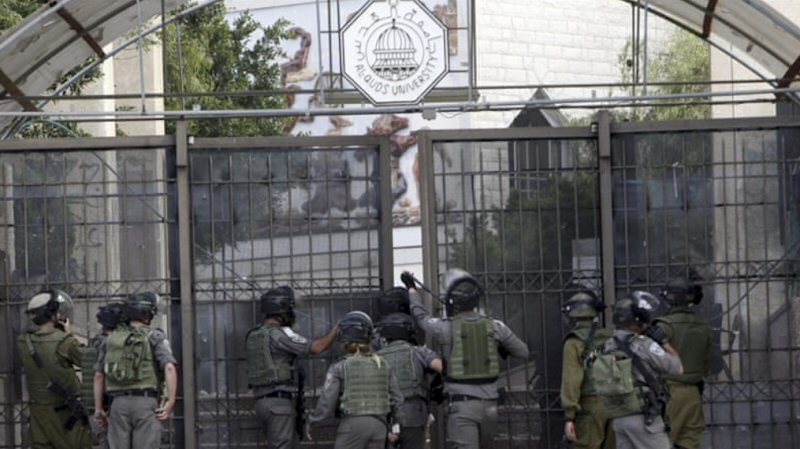
Palestinian students and faculty in the Israeli-occupied West Bank also face campus raids with Israeli soldiers firing live munitions and tear gas.
Palestinian citizens of Israel are subjected to Israel’s institutionalized racism, while Palestinian students face repressive restrictions on political activities and Palestinian educational facilities are underfunded.
We ask the Pitzer College community to try to imagine what it is like studying, teaching or performing research under these dire conditions of racism, repression and violent oppression.
As long as Israel continues to deny Palestinian human rights and academic freedom and impose discriminatory policies based on origins and political opinion, students, educators and academic institutions have a moral obligation and an ethical responsibility to ensure their campus is not contributing in any way to denying Palestinians our right to education and life.
We urge the Pitzer College Council to uphold the principled stand taken by an overwhelming majority of its faculty not to be complicit in Israel’s denial of Palestinian rights and its blatantly racist and anti-democratic discriminatory policies.
Doing so will send a strong signal to the Israeli government and its deeply complicit universities that principled academic institutions will no longer stand by. They will instead use their power of moral persuasion to hold Israel to account and effect a change in the stagnant status quo of oppression, as was the case during the struggle to end apartheid in South Africa.
Please, uphold the vote in support of our struggle for freedom, justice and equality. Keep our hope in freedom, justice and equality alive.
Sincerely,
The Palestinian Federation of Unions of University Professors and Employees (PFUUPE)
A Passionate Attachment
Deferring to Israel is “what we are”

“I believe that the establishment of the state of Israel was the greatest accomplishment of the twentieth century”
By Philip Giraldi • Unz Review • February 5, 2019
I predicted three weeks ago that the Senate bill on the Middle East, which was rejected three times while the government was shutdown, would quickly receive cloture by a comfortable margin to end debate and proceed to a full vote in the Senate after the federal bureaucracy reopened. That has proven to be the case. Senate Bill S.1 was approved on January 29th 76 for votes to 22 against. Every Republican voted for it, minus only Rand Paul and Jerry Moran, who did not vote. The Republicans were joined by 25 Democrats, all of whom had previous voted “no” to embarrass the White House over the shutdown. Minority Leader Senator Chuck Schumer, who has described himself as Israel’s protector in the Senate, switched his vote as did notoriously pro-Israel Senators Ben Cardin and Bob Menendez. The bill must now be passed by the Senate, which is certain to take place, before being sent on to the House of Representatives for its approval, where there will certainly be some limited debate. It then will go to President Donald Trump for his signature.
Readers will recall that S.1 the Strengthening America’s Security in the Middle East Act of 2019, sponsored by the singularly ambitious though demonstrably brain dead Senator Marco Rubio from Florida, included $33 billion in guaranteed aid to Israel for the next ten years, an unprecedented gesture to America’s closest ally and best friend in the whole world, as Congress might describe it.
But the legislation also incorporated measures to criminalize criticism of Israel, referred to as the Combating BDS Act of 2019. It has been correctly observed that that portion of the bill is clearly unconstitutional as it limits free speech, which is guaranteed by the First Amendment to the Constitution of the United States and is considered to be the bedrock of American civil liberties, but there is no guarantee that the Supreme Court will agree if and when the law is contested. Once free expression is abridged for Israel there will be no end to other grievance groups exploiting the precedent to silence criticism and effectively negate the First Amendment.
The potential destruction of the Bill of Rights is only one aspect of the power that Israel has over American policymakers. The widely ballyhooed election of several Congresswomen who appear willing to challenge the Israeli orthodoxy on Capitol Hill is already being countered by the establishment within the Democratic Party, demonstrating once again how deep the corruption of America’s political class by Israel has gone.
In an early December speech before a largely Jewish audience at the Israeli-American Council gathering in South Florida, House Speaker Nancy Pelosi demonstrated in no uncertain terms just how she and other Congressmen are more responsive to Israel and its supporters than they are to their own constituents. She said in response to a staged question during a “conversation” with Democratic Party top donor Israeli Haim Saban, “I have said to people when they ask me, if this Capitol crumbled to the ground, the one thing that would remain would be our commitment to our aid, I don’t even call it our aid, our cooperation with Israel. That’s fundamental to who we are.”
Now “who we are” is a favorite expression used by a certain type of progressive that was made popular by the smooth talking but devious Barack Obama, meaning “I am taking the moral high ground so don’t ask me any questions or challenge what I have just said.” In Pelosi’s case she is saying precisely that, that American patronage of Israel is a moral imperative, a commitment forever that must be sustained no matter what Israel does and even if the United States itself should fall into ruin.
It is an absurd comment for someone who represents the people of her state and has taken an oath to uphold the U.S. Constitution, the ultimate pander to a right-wing Jewish audience that is socially progressive and consistently votes Democratic, which Pelosi celebrated, while at the same time cheering the bloody repression of the Palestinian people. And while Israel’s cheering section is doing all that, it is also dragging the American people into wars that need not be fought and stealing the taxpayers’ dollars to give to the racist Kleptocrats in charge in Tel Aviv and Jerusalem.
Pelosi, like her partner in crime Senator Chuck Schumer, who also spoke at the conference, has a problem in paying for security along America’s southern border but she does not hesitate to send billions of dollars to Israel every year. One has to wonder at her priorities, but she knows that American Jews are more powerful and relevant to her party’s finances than doing the right thing would be, so there is no evidence of any hesitation on her part to throwing some Arabs and the outliers within her own party under the bus.
And Nancy also spoke of the dissidents in the Democratic Party, all five or so of them, saying “Remove all doubt in your mind. It’s just a question of not paying attention to a few people who may want to go their own way…” Apparently there is plenty of room under that bus for non-believers. And she also threw out a standard line of how “I believe that the establishment of the state of Israel was the greatest accomplishment of the twentieth century” while also unloading on the Arabs saying “We have to I think in Congress make it really clear to Palestinians that we expect them to be responsible negotiators and we haven’t seen a lot of that thus far.”
Apparently, Nancy is unaware that the “establishment” of Israel forced 700,000 people who had lived in Palestine for centuries out of their homes. And she apparently also has missed all those stories of Palestinian “terrorist” children and emergency workers being shot dead by Israeli snipers while they were “negotiating” such things as access to food, water, and medicines from the inside of the Gaza containment fence. Or maybe she’s forgotten about the towns in Israel that can legally ban Christian or Muslim residents as Israel is now officially a Jewish only state. Nancy Pelosi’s extreme efforts to demonstrate loyalty and devotion to a nation that the rest of the world views as a pariah is commendable, but only if one is a sociopath.
There is something completely dead at the heart of American politics which makes basic humanity unacceptable when confronted by a force for evil that has penetrated and manipulated both the national media and the governing political consensus. That is what Israel and its rabid band of supporters have done to the United States. First Amendment? Goodbye. If the U.S. government should crumble under the strain, don’t worry because our support for you is eternal. Kill a couple of hundred Arabs, shoot a few thousand more? No problem. It’s God’s will. And if Israel leads America into a nuclear war? Then we will do what we have to do to protect our ally.
Ask Pelosi and Schumer, “Have you been corrupted?” They will answer “No. Of course not. It is what we are.”
Philip M. Giraldi, Ph.D., is Executive Director of the Council for the National Interest, a 501(c)3 tax deductible educational foundation that seeks a more interests-based U.S. foreign policy in the Middle East. Website is www.councilforthenationalinterest.org, address is P.O. Box 2157, Purcellville VA 20134 and its email is inform@cnionline.org.
Palestine: A Four Thousand Year History – Book Review

‘Palestine – A Four Thousand Year History’ by Nur Masalha. (Book Cover)
Review by Jim Miles | Palestine Chronicle | February 4, 2019
The Israeli narrative of a nation/state returning to its homeland after a fifteen hundred year exile required deft work by the David Ben-Gurion initiated Governmental Names Committee (Va’adat Hashemot Hamimshaltit, 1949). The Hebraization of Palestine is described in Nur Masalha’s “Palestine – A Four Thousand Year History” a strong scholarly academic addition to the subject of delegitimization of an indigenous people.
The first part of the book covers the era from the Bronze Age – roughly 2,500 years ago – to the mid-Ottoman era and the autonomous governance of al-’Umar and Ahmad Pasha al-Jazzar. It concentrates its analysis mostly on the name Palestine and its historical precedents in other languages from ancient maps and historical writings. It does provide a few glimpses into the kind of society represented by the name but is mostly concerned with the philology of the name itself.
As the work reaches the Ottoman empire, many more sources are used for reference and provide a much stronger perspective on the lifestyles of the indigenous Palestinian people and a split between the urban elites and the majority living in smaller villages and working the land. In the late Ottoman empire, the early years of Christian Zionism/Orientalism/Biblicism, and in the early years of European based secular nationalist Zionism, more diverse sources are used to emphasize the denial of the indigenous Palestinians through language usage.
Masalha’s theme is simple: to demonstrate the existence of Palestine through the centuries by studying the language used, its reference in historical works, and how the modern Hebraization brought on by the western Christian Biblical traditions combined with the Zionist enterprise attempts to deny the existence of Palestine and its people. From that thesis he succeeds remarkably well, providing strong references of the use of the word Palestine up to and including Israeli usage after the 1948 Nakba. But well before that, the Orientalist Christian perspective had already begun the assault on Arabic/Palestinian historical geographic names previously supported by earlier works.
As the study continues into the modern era, many devices are used to erase and cover over any sign of Palestinian geographic inheritance. Much of the initial changes in western knowledge were brought about by various biblical study groups searching for archeological evidence for their story. When not finding much of that evidence, biblical names were simply appropriated and used for different regions, down to specific geographic features. This latter methodology was continued by the early Jewish settlers and strongly reinforced after the creation of Israel.
Appropriation of Arabic names occurred through the process of alliteration, finding – or even inventing – a Hebraic word resembling the Arabic word. A similar process was used for personal names of the Jewish European settlers by choosing a Hebrew word or as frequently an appropriated Arabic word to create a new patronymic.
One of the strongest methods is simply erasure. This occurred before, during and after the Nakba as many villages were physically destroyed, many others expropriated, and most being renamed using some form of Biblical/Hebraic names. Erasure continues both geographically and culturally ranging from street signs to educational texts and instructions.
From the general trend of Masalha’s presentation, modern Hebrew is a contrived language, based on a confined liturgical element incorporating by necessity many modern terms, many Arabic/Palestinian terms, and many biblical terms rendered into a semblance of an ancient Hebraic language. It also clearly demonstrates a history of a region called Palestine at the geographical crossroads of ancient and modern history, surviving under various rulers, some with more autonomy than others, but distinctly Palestinian.
Further, while not denying the existence of an Israeli entity, it is seen as an ongoing part of many different peoples and cultures that inhabited the area at one time or another. The Israeli myth of a sudden influx of Arabs during the Muslim conquests is compared to the historical record of a gradual introduction of Arabic ideas and peoples into the region before the conquest. Of note as well are the frequent references to the peaceful mixing and coexistence of the three major religions in the more modern landscape before the advent of the Orientalist Christian Zionism began to usurp the region.
Unfortunately for all that, “Palestine – A Four Thousand Year History” has a problem that does not deny its academic argument. The work for the purpose of spreading this information to the general public is far too scholarly and academic, something I can work through because of my background reading and my intentions as a reviewer, but would prove very difficult to attract attention to a general reader.
The first section in particular, while referencing many maps using the word Palestine or its linguistic equivalents, does not provide any visuals – no maps. A reference section with some plates showing the range of maps from ancient histories through to the British maps of Mandatory Palestine would be a valuable addition to the work.
Having said that, I must reiterate that his arguments support the main thesis very well. The latter half of the book both instructs this thesis and at the same time provides a more reader-friendly discussion of not only the geography but the essence of the people of Palestine.
(Palestine – A Four Thousand Year History. Nur Masalha. Zec Books, London, 2018.)
– Jim Miles is a Canadian educator and a regular contributor/columnist of opinion pieces and book reviews to Palestine Chronicles. His interest in this topic stems originally from an environmental perspective, which encompasses the militarization and economic subjugation of the global community and its commodification by corporate governance and by the American government.
Pentagon resists US withdrawal from Syria, claims ISIS might rise again
RT | February 5, 2019
The newest report on US-led operations against Islamic State in Iraq and Syria admits the terrorist group is down to some 2,000 fighters, but argues continued US presence in the region is needed to prevent its resurgence.
Published on Monday, the report authored by the Pentagon and State Department inspectors-general also blamed Turkey for spoiling the US-backed Kurdish militia’s operations against Islamic State (IS, formerly ISIS/ISIL), and predicts no end to strife in the region, going against President Donald Trump’s order to withdraw US troops from Syria.
The report debunked the widely circulated estimate – from June 2018 – that IS had up to 17,000 fighters in Iraq and up to 14,000 in Syria, calling it questionable even at the time. The US-led coalition, known as the Combined Joint Task Force – Operation Inherent Resolve (CJTF-OIR) had “low confidence” in those estimates as of last July, the report said. As of January, CJTF-OIR estimated only 2,000 IS fighters remaining in the group’s last remaining bastion – known at the Pentagon as the Middle Euphrates River Valley (MERV) and located in eastern Syria near the Iraqi border.
The coalition gave conflicting assessments of IS strength and capabilities, reporting at the end of December that it “remains a battle-hardened and well-disciplined force,” with high morale and “unfazed by Coalition airstrikes,” only to say its morale was “trending downward” in January.
Since December, IS has killed several coalition soldiers in ambushes and with roadside bombs. According to CENTCOM, these are “opportunistic attacks” that will allow the militants to claim a propaganda victory.
‘We have to protect Israel’
Even as US troops are pulling out of Syria, President Trump has said he wants to keep some forces in the region “to protect Israel” and “watch Iran.”
“We have to protect other things that we have,” Trump told CBS on Sunday, but said the troops will be “coming back in a matter of time.”
Monday’s report, on the other hand, matches the reasoning of US intelligence chiefs last week that IS will rise again in the absence of US troops – although only in the limited area near its current holdout, rather than Syria and Iraq as a whole.
“You’ve got these divergent narratives,” security analyst Charles Shoebridge told RT. “Trump is speaking from the hip, if you like, he is speaking off the cuff, and it might be what he’s saying is actually a little bit closer to the truth of where the American strategy actually lies.”
The US ‘deep state’ is firmly against withdrawal from Syria, Shoebridge noted.
Turkey blamed for failure of US-backed offensive against ISIS
One of the things the report revealed is that the US-backed militia was presumably on the brink of crushing the last IS holdout in the Euphrates Valley, but had to halt their operation when Turkey threatened to intervene against the Kurdish fighters.
The Kurdish YPG militia makes up more than two thirds of the US-backed Syrian Democratic Forces (SDF), which the US have used as the main proxy against IS in northeastern Syria. With the YPG busy against the Turks, the Arab component of the SDF was “unable to conduct” offensive operations, and actually lost ground to IS in late October and November, when bad weather prevented coalition airplanes from flying.
It was only in mid-November, when the YPG was back in the fight, that the SDF was able to roll back IS gains, the report said, describing the YPG “paramount to stability and efforts to defeat ISIS.”
The report was also skeptical of Turkey’s offer to take over the battle against IS, noting that with the exception of the 2016 Al-Bab operation, “Turkey has not participated in ground operations against ISIS in Syria since 2017, nor have Turkish forces participated in the fight against ISIS in the MERV, which is approximately 230 miles away from al Bab and the Turkish border.”
Let Syria finish the job?
IS will remain an issue unless Sunni “socio-economic, political, and sectarian grievances are not adequately addressed by the national and local governments of Iraq and Syria,” the soldiers and diplomats argue. Left unsaid is that these grievances are a product of upheaval caused by the 2003 US invasion of Iraq and the US support for sectarian rebels in Syria starting in 2011.
Conspicuously absent from the report is the Syrian government, which has fought IS successfully with the support of Hezbollah, Iran and Russia, Shoebridge told RT.
If the SDF strikes a deal with Damascus following the US withdrawal, Shoebridge said, “the Syrian government could fill that vacuum, and continue with their very successful campaign against ISIS themselves.”
Death Knell For Syria Pullout: “We Have To Protect Israel” Says Trump
By Tyler Durden – Zero Hedge – 02/03/2019
After approaching two months of talk of a “full” and “immediate” US troop withdrawal from Syria, first ordered by President Trump on December 19 — which was predictably met with swift and fierce pushback from beltway hawks including in some cases his own advisers — it now appears the death knell has sounded on the prior “complete” and “rapid” draw down order.
Trump said in a CBS “Face the Nation” interview this weekend that some unspecified number of US troops will remain in the region, mostly in Iraq, with possibly some still in Syria, in order “to protect Israel” in what appears a significant backtrack from his prior insistence on an absolute withdrawal.
“We’re going to be there and we’re going to be staying. We have to protect Israel,” he replied when pressed by CBS reporter Margaret Brennan. “We have to protect other things that we have. But we’re – yeah, they’ll be coming back in a matter of time.” He did note that “ultimately some will be coming home.”
“Look, we’re protecting the world,” he added. “We’re spending more money than anybody’s ever spent in history, by a lot.” Trump’s slow drift and change in tune on the subject of a promised “rapid” exit comes after Israeli officials led by Prime Minister Netanyahu alongside neocon allies in Washington argued that some 200 US troops in Syria’s southeast desert along the Iraqi border and its 55-kilometer “deconfliction zone” at al-Tanf are the last line of defense against Iranian expansion in Syria, and therefore must stay indefinitely.
“I want to be able to watch Iran,” Trump said further during the CBS interview. “Iran is a real problem.” He explained that “99%” of ISIS’s territory had been liberated but that a contingency of US troops must remain to prevent a resurgent Islamic State as well as to counter Iranian influence, for which American forces must remain in Iraq as well.
“When I took over, Syria was infested with ISIS. It was all over the place. And now you have very little ISIS, and you have the caliphate almost knocked out,” the president said. “We will be announcing in the not too distant future 100% of the caliphate, which is the area – the land – the area – 100. We’re at 99% right now. We’ll be at 100.”
However Trump’s invoking Iranian influence as a rationale for staying further contradicts his prior December statement that the defeat of ISIS was “the only reason” he was in Syria in the first place.
MARGARET BRENNAN: How many troops are still in Syria? When are they coming home?
PRESIDENT DONALD TRUMP: 2,000 troops.
MARGARET BRENNAN: When are they coming home?
PRESIDENT DONALD TRUMP: They’re starting to, as we gain the remainder, the final remainder of the caliphate of the area, they’ll be going to our base in Iraq, and ultimately some will be coming home. But we’re going to be there and we’re going to be staying—
MARGARET BRENNAN: So that’s a matter of months?
PRESIDENT DONALD TRUMP: We have to protect Israel. We have to protect other things that we have. But we’re- yeah, they’ll be coming back in a matter of time. Look, we’re protecting the world. We’re spending more money than anybody’s ever spent in history, by a lot. We spent, over the last five years, close to 50 billion dollars a year in Afghanistan. That’s more than most countries spend for everything including education, medical, and everything else, other than a few countries. — CBS “Face the Nation” Feb.3 interview transcript
The Pentagon in recent weeks has reportedly been putting logistics in place for a troop draw down from northern and eastern Syria.
Though it remains unclear just how many troops could remain as the majority possibly begin to pullout toward US bases in Iraq, the Tanf base could remain Washington’s last remote outpost disrupting what US defense officials see as a strategic Baghdad-Damascus corridor and highway, and potential key “link” in the Tehran-to-Beirut so-called Shia land bridge.
Foreign Policy magazine has identified this argument as the final card the hawks opposing Trump’s draw down had to play in order to hinder to an actual complete US exit:
“Al-Tanf is a critical element in the effort to prevent Iran from establishing a ground line of communications from Iran through Iraq through Syria to southern Lebanon in support of Lebanese Hezbollah,” an unnamed senior US military source told the magazine.
The Israeli prime minister has pushed hard against the White House pullout plan, and “has repeatedly urged the U.S. to keep troops at Al-Tanf, according to several senior Israeli officials, who also asked not to be identified discussing private talks,” per Bloomberg. The Israelis have reportedly argued “the mere presence of American troops will act as a deterrent to Iran” even if in small numbers as a kind of symbolic threat.
The internal administration debate, following incredible push back against Trump’s withdrawal decision, has made entirely visible the national security deep state’s attempt to check the Commander-in-Chief’s power. And now US presence at al-Tanf represents the last hope of salvaging the hawks’ desire for permanent proxy war against Iran inside Syria.
It appears the deep state has won out over Trump’s initial policy decision once again; but it remains to be seen if, however slowly on what’s clearly a delayed timetable departing from his original plans, all US troops ultimately exit Syria. Until then there’ll be more time and perhaps more provocations the hawks can rely on to effectively ensure full circle return to indefinite occupation in Syria.
Featured Video

or go to
Aletho News Archives – Video-Images
Book Review
The Maidan Killings and the False-Flag Case
By Freddie Ponton | 21st Century Wire | September 5, 2026
Before the killings that helped bring down Ukraine’s president in February 2014, American diplomats were discussing who should enter its government. In a leaked telephone call, senior State Department official Victoria Nuland told US ambassador Geoffrey Pyatt, “I think Yats is the guy,” referring to opposition leader Arseniy Yatseniuk. Washington had clear preferences and was working to advance them. Later that month, Yatseniuk became prime minister.
Ivan Katchanovski’s The Maidan Massacre in Ukraine examines the violence that preceded that transfer of power. Drawing on television footage, witness testimony, forensic examinations and Ukrainian court proceedings, he argues that elements of the opposition shot protesters and police in a false-flag operation. His case centres on evidence of protesters being shot from opposition-controlled locations, including Hotel Ukraina, overlooking the killing ground. … continue
Blog Roll
 Aletho News
- What changes with Lula or Flávio?
- Britain leads Western media’s demise through ‘fear porn’ narrative
- The Maidan Killings and the False-Flag Case
- Georgia’s Largest Healthcare System Will Fire Employees Who Refuse Flu Vaccine
- The Five-Year Fuel Crisis: Why the World Economy Is Paying for a War It Thinks Is Ending
- Trump’s Big Bluff on Iran
- Swiss scammed out of millions by Ukraine-linked call centers – media
- Germany facing potential ‘violent conflict’ with Russia – spy chief
- Ukraine’s EU neighbors reject new plea from Kiev – Politico
- British Transport Police Facial Recognition Trial Scanned 926,912 People With Zero Arrests
- If Americans Knew
- An error has occurred; the feed is probably down. Try again later.
- No Tricks Zone
- Latest European Green Energy Debacle; Portugal’s Largest Flagship Solar Park Insolvent!
- Green Energy Debacle: German Expert Professor Fritz Vahrenholt Warns Of Severe Economic And Social Consequences
- Two More Paleo Reconstructions Affirm Meters-Higher Sea Levels Across Ireland, Brazil 7000-6000 Years Ago
- New Study: Earth And Venus Surface Warmth Largely Explained By Convection And Lapse Rate, Not CO2 Or Radiation
- 2025 Nature Paper Claiming Worsening Global Drought Gets RETRACTED …Heavily Flawed
- New Study: ‘Global Drought Shows No Detectable Recent Acceleration Under Climate Warming’
- Economic Masterminds: German Socialists Suggest Taxing Productivity Gains Stemming From Using AI
- The South China Sea Has Not Been Cooperating With The Climate Change Narrative
- Energy Crisis: Germany Enters Heating Season With Historically Low Gas Reserve Fill Levels
- New Study: The Antarctic Ice Sheet Gained Mass From 2020-2024 Due To Staggering Snow And Ice Accumulation

