Spain company rejects Israel tender for Jerusalem railway
MEMO – February 2, 2019
A Spanish company announced yesterday that it had rejected an Israeli tender to build part of the Jerusalem railway, which will cut deep into occupied territory.
Construcciones y Auxiliar de Ferrocarriles (CAF or Construction and Other Railway Services) announced that it “refuses to build a section of the railway in Jerusalem because [it] included Palestinian land that will be confiscated, in violation of the resolutions of international legitimacy,” Al-Wattan Voice reported.
The company’s workers also rejected its participation in the project on the same grounds. Representatives of the workers said that the problem lies in the fact that the railway will pass through Palestinian lands to serve illegal settlements in East Jerusalem.
“Any project in any city around the world, especially Jerusalem, must respect human rights and international legitimacy in its implementation,” CAF stressed.
CAF added: “The General Assembly of the United Nations and the International Court of Justice [ICJ], through various resolutions, have said that they are against the occupation of land through which will pass the section of the railway.”
Read also:
Jerusalem Archbishop: ‘Everything Palestinian is targeted by Israel’s occupation’
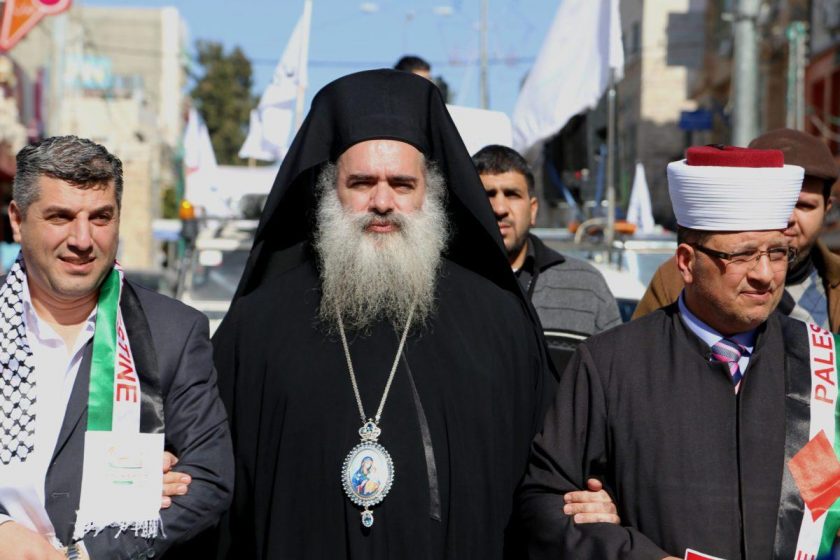
Archbishop of Jerusalem’s Greek Orthodox Church, Atallah Hanna, seen during a protest in the West bank city of Hebron, January 22, 2015 [Muhesen Amren / ApaImages]
MEMO | February 2, 2019
The Palestinian Archbishop of Jerusalem’s Greek Orthodox Church, Atallah Hanna, said yesterday that “everything Palestinian in Jerusalem is targeted by the Israeli occupation”.
During a meeting with a delegation from Médecins Sans Frontières (Doctors without Borders, MSF), Hanna explained the dangers threatening Palestinians’ existence and identity in the Holy City, Al-Wattan Voice reported.
“Everything is in danger in Jerusalem,” Hanna said, adding: “The Islamic and Christian holy sites and endowments are targeted in order to change our city, hide its identity and marginalize our Arabic and Palestinian existence.”
Hanna added that “recently, the Israeli occupation cancelled a planned celebration on the 50th anniversary of establishing Al-Maqased Hospital,” noting that the Israeli occupation had cancelled many other Palestinian events planned to take place in Jerusalem.
The Archbishop said that Palestinians “are living under severe torture and harsh persecution,” pointing to Israel’s closure of Palestinian institutions in the city. “It seems that they wanted us to give up Jerusalem and submit to their polices, measures and practices,” he added.
Hanna continued: “Jerusalem is for us and will remain for us. We will never give up our rights in Jerusalem and we will defend it against Israeli oppression.”
Addressing the MSF staff, he said: “We want you to know closely the suffering of the Palestinians and the oppression inflicted by the Israeli occupation on them in Jerusalem. We want our message to reach all the people around the world as we want more friends for the Palestinians.”
Read also:
Israeli forces detain secretary of Fatah in Jerusalem
14 Palestinians homeless as Israel forces 2 Jerusalem homes to be torn down
WHO: Injured Journalist Prevented from Receiving Healthcare

IMEMC News & Agencies – January 31, 2019
The World Health Organisation issued its monthly report entitled “Health Access Barriers for Patients in the Occupied Palestinian Territory”, in which the organisation highlighted the case of ALRAY Media Agency’s photographer, Attia Darwish, who was seriously injured a month ago.
WHO said, in its report, which comes in three parts, that a tear gas canister hit Darwish, a 31-year-old photojournalist, in his face, under his left eye, when he was covering demonstrations near the Gaza fence.
“I was taking photos when my phone rang, and I tried to take the call. Suddenly, I felt a blow to my face and fell down,” Attia said, according to Al Ray.
The ambulance picked him up within minutes and took him to a trauma stabilization point close to the fence. After initial assessment and first aid, Attia was rushed to Shifa hospital, in Gaza, for treatment. He had multiple facial fractures and severe bleeding at the back of his eye, putting his sight at risk, the report said.
WHO said that Darwish had surgery to remove shrapnel from the wound, fix his lower jaw and replace fragmented bones in his face with metal plates. He also received initial treatment for his eye injury, but needed review and specialist care outside of Gaza.
“As a photographer, I depend on my eyes to do my job. Now, I can hardly see with my left eye. Getting proper treatment is something critical for me,” Attia said. He subsequently received a medical referral, from the Palestinian Ministry of Health, to go for an appointment to St John’s Eye Hospital, in Jerusalem.
He applied to Israeli authorities for a permit to exit Gaza, for treatment, but, when the date of his hospital appointment came, his permit application was still under review. Attia despaired of getting a permit to exit Gaza, via Erez crossing with Israel, and asked the Services Purchasing Unit in the Ministry of Health to refer him, instead, for treatment in Egypt, WHO recounted.
On the day of his travel, however, Rafah crossing point to Egypt was closed for exit. “I cannot feel the left side of my face. I can only eat soft food and I’m suffering with the pain. The cold weather makes it even worse. When I was in hospital, one of the doctors said I either need a bone graft or an artificial implant. But, neither of those is available in Gaza,” he said, according to the report.
WHO said that when they spoke with Attia, he still had not received his permit to leave Gaza to Jerusalem, stressing that “his case is not an exception.”
The orgnisation pointed out that of 435 permit applications to Israeli authorities by those injured during the Great March of Return demonstrations, only 19% have been approved, where those unable to access the health care they need face a higher risk of complications and poorer health outcomes.
Hamas won’t be part of any new puppet Palestinian government: Official
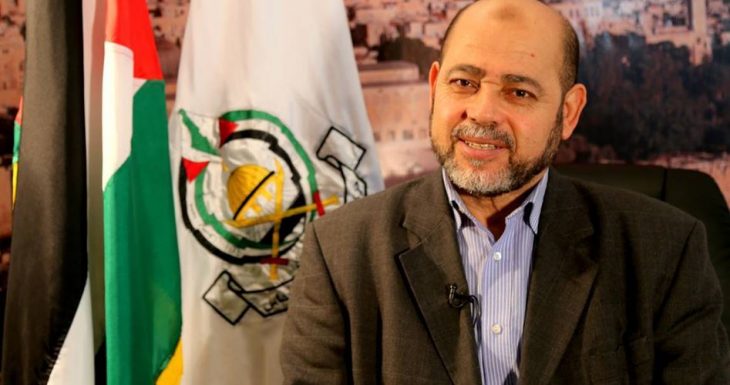
Deputy head of the Hamas political bureau, Mousa Abu Marzouk
Press TV – January 31, 2019
The deputy head of the Hamas political bureau, Mousa Abu Marzouk, says the resistance movement will not take part in any puppet Palestinian government in Ramallah, noting such a government will be “devoid of any national legacy and would strive to promote division” just like its predecessors.
Marzouk, in a post published on his official Twitter page on Wednesday, said officials from the Ramallah-based Palestine Liberation Organization (PLO) would not invite Hamas to participate in such a Palestinian government in the first place, emphasizing that the movement would turn down such an offer even if it were made.
He asserted that a new government in Ramallah would work on realizing US President Donald Trump’s “deal of the century.”
The so-called deal, a back channel plan to allegedly reach a peace settlement between the Israelis and the Palestinians, was proposed by the US administration in September 2018. Although the plan has not been released, leaks signal it will consist of the same tried and failed ideas.
While little is known about the controversial deal, leaks have suggested that it regards East Jerusalem al-Quds as Israeli territory, whereas Palestinians view the eastern sector of the occupied city as the capital of their future state.
Palestinians also believe that the US-drafted plan calls for keeping borders and security under Israeli control, while it keeps Israeli settlements’ final borders to be discussed in later negotiations.
Palestinian Prime Minister Rami al-Hamdallah officially submitted his resignation and that of his unity government to President Mahmoud Abbas on January 29, casting doubt on the prospects of reconciliation efforts with Hamas.
Abbas had been facing pressure from his ruling Fatah movement over the past few weeks to remove Hamdallah from power, and establish a new government comprised of representatives from PLO factions in addition to independent figures.
Hamdallah headed the Palestinian National Consensus Government, which was formed after Fatah and Hamas reached an agreement in 2014.
Fatah leaders said there was no point in keeping the government in power in the wake of the continued crisis between their faction and Hamas.
They also argue that since their faction is the largest group in the PLO, it should have a strong presence in any government.
Syria Briefing from Peter Ford: US Withdrawal, Safe Zones, Sanctions, Idlib, ISIS & Israel
The following situational briefing update of January 24, 2019 has been provided by Peter Ford, Former British Ambassador to Syria:
US Withdrawal
Contrary to the expectations of many experts, President Trump has remained insistent on the withdrawal of approximately 2,000 US troops from North East Syria, although he has had to concede more time. The ‘conditioned’ withdrawal touted by his uber-hawkish National Security Adviser, John Bolton, appears to have shrunk just to ensuring that the Kurds in the YPG militia the US will be leaving behind are not slaughtered by the Turks. One of the other conditions, eradicating the final remnants of ISIS, appears to have been all but met by a final Coalition push, with ISIS down now to its last village, obviating the handing of the job to Turkey which was ludicrously proposed initially, while the other condition, ensuring that Iran does not benefit, appears to have been quietly forgotten.
‘Safe zone’
Quite how the Kurdish issue will be settled remains up in the air. Not for much longer, however, if we parse correctly the statements made by Putin and Erdogan after their meeting in Moscow on 23 January.
As is often the case when the great men speak, what they do not say is as important as what they do say. Erdogan did not say, as he had done previously, that Turkey was going to police the proposed ‘safe zone’, 20 miles deep, cleared of the YPG. Rather he said that Turkey and Russia were in agreement on the establishment of such a zone. And the next day his Foreign Minister said that Turkey was open to arrangements being made involving ‘the US, Russia or others’. Putin on his side made clear that these significant ‘others’ were the Syrian government, whom he encouraged to speak to the Kurds. The day before the Putin-Erdogan meeting a Kurdish delegation was in Moscow, following earlier discussions in Damascus.
The eventual outcome, a return of Syrian security forces to the North East, is, in the view of this analyst, nailed on. The only question is when and under which conditions. The Kurds, reckoning on the Turks’ lack of appetite for a contested incursion and US dithering, are attempting to squeeze the last concession out of Damascus in terms of incorporation of the YPG into the Syrian security forces and some measures of local self-government, as well as use of the Kurdish language. Damascus, however, appears to hold the whip hand, conscious that as time goes on Trump will look as powerless over withdrawal as he does over the Mexican Wall if he does not act ‘and will if necessary call the Kurds’ bluff.
ISIS
It does indeed seem curtains for ISIS in Syria, at least as a territory-controlling caliphate. ISIS drew attention to themselves however with a suicide bomb attack in Manbij which left four Americans dead, prompting predictable cries from the foreign policy establishment in the US and Europe that it was folly to be leaving a ‘vacuum’ in Syria while there was still life in the twitching ISIS body. That experts deemed reputed could peddle this superficial analysis and be believed in the media is testimony to the blinkered thinking which dominates in the West. There will be no vacuum – the Syrian government has a good track record in the areas it has liberated of crushing ISIS, better in fact than the Americans for whom, as for their Kurdish allies, there are no-go areas of Arab villages in the areas they nominally control. These experts would do well to reflect on why ISIS are choosing this decisive moment to attack US forces, something they have curiously jailed to do for several months.
The hidden factor here is the incipient next phase in ISIS’s existence. It has gone underground, especially in Deir EzZor province which straddles the Euphrates. This is the equivalent of Iraq’s restless Anbar province which it borders. ISIS will not relish the prospect of Syrian Mukhabarat (security police) descending on Arab villages which have hitherto been no go areas to wake up ‘sleepers’. Expect more attacks on US forces.
Idlib
Putin and Erdogan also discussed Idlib, although the way forward here is less clear. Even the Turks cannot deny that in what is, to all intents and purposes, a Turkish and Western protectorate, the extreme jihadist Al Qaida-linked Tahrir Ash Sham (HTS) has run amok and now controls virtually the entirety of the area. This is the opposite of what was supposed to happen under the terms of the Russo-Turkish Sochi agreement which brought the September crisis to an end. Under Sochi the Turks were supposed to bring HTS to heel. Putin seemed to hint that military preparations would now move ahead for the Syrian government with Russian support to advance on Idlib, with Turkish acquiescence. The seamlines are already hot.
Political negotiations
One thing is clear. The Idlib issue is not going to be resolved by any political negotiations between the warring parties. The Western powers who cling to the comforting fiction that there can only be a political end to the Syrian conflict have no answers where Idlib is concerned.
The new UN envoy for Syria, Gerd Pederson, appears to be feeling his way, slowly, as well he might. Currently the Geneva process is in baulk over US, French and British blocking of a slate of candidates for inclusion in the Constitutional Committee which is supposed to come up eventually with a new constitution which will pave the way for UN-supervised elections with the participation, as the Western powers and Turkey would have it, of millions of Assad-hating refugees.
This mirage might appear harmless. However it is constantly cited by the Western powers to justify their conduct of war on Syria by other means than the military methods which are now all but exhausted.
Sanctions
How have the EU and the US responded to the prospect of normalisation in Syria? With more sanctions of course.
The EU has slapped sanctions on Syrian businessmen participating in a flagship property development scheme in Damascus deemed tantamount to assisting the ‘regime’. This scheme is emblematic of the many private investment projects now popping up, many of them involving Arab investors. Obviously the EU could not tolerate such progress, it not being enough to hamstring economic recovery with the existing deeply harmful battery of sanctions. The stated reason is that the Syrian government is not facilitating political progress towards the above mentioned mirage of elections rigged to produce a government of Western stooges. If the masterminds of EU diplomacy sincerely believe that such sanctions will make Assad bow the knee after eight years of vicious conflict have failed to do so, then we must fear for their sanity.
The US House of Representatives, with White House support, has chimed in with a Syria sanctions bill aimed at punishing any person or business which participates in any government linked project. This could have extra-territorial effect, dampening the interest of outside investors in Syria recovery projects. Again this highlights the hypocrisy of Western legislators who profess humanitarian concern but who are careless of inflicting economic suffering on a population already on its uppers after eight years of conflict, fuelled by Western support for armed groups, as long as they can strike a virtue-signalling blow against the ‘regime’. This is what a diplomacy of vindictiveness looks like.
The practitioners of this diplomacy have had some success with US and UK diplomats scouring Arab countries to pressure them into delaying normalisation of relations with Syria until the mirage has been reached. It appears that a consensus on Syria’s readmission to the Arab League as early as March is not likely to be found. Damascus will shrug this off. It is only delaying the inevitable. Arab countries who feel threatened by both Iran and fundamentalism can see that they are going to have to learn to live with Syria and that using contacts with Damascus to dilute Iran’s influence and share intelligence are very much in their interest.
Israel
Perennial party pooper Israel has attempted to spoil Assad’s successes by relaunching after a pause airborne attacks, ostensibly against Iranian targets. This is odd in that even US intelligence, cited by Trump, apparently more attentive to intelligence briefings than his detractors would have you believe, has reported that Iran has been withdrawing forces. The most recent blatant day time raid elicited a rare reprisal from Damascus, a missile which was shot down over the Syrian occupied Golan (not even Israel itself). Cue massive display of shock by the media, which had signally ignored the literally thousands of Israeli bombs dropped on Syria over the last two years. Naturally Syria and Russia’s attempt to secure some expression of concern from the Security Council failed, unprovoked aggression by Israel apparently not being inconsistent with the ‘rules based system’ constantly enjoined by the West on others.
Israel should however beware of hubris. Syria’s new Russian supplied SAM 300 air defence system is scheduled to become operational in March.
Author Peter Ford is the former British Ambassador to Syria (2003-2006) and Bahrain (1999-2002).
This briefing was originally published at the Global Network for Syria\
US warns Israel against keeping up strikes on Syria
Press TV – January 30, 2019
The top US intelligence official has warned Israel of the consequences of keeping up its military strikes on Syrian soil, saying the attacks could eventually trigger a response from Iran, which has its military advisors based in the Arab state.
Speaking at a hearing of the US Senate Select Committee on Intelligence in Washington on Tuesday, Director of National Intelligence Dan Coats said that Israel’s continued aerial assaults against Syria would increase the risk of Iran’s retaliation.
“We assess that Iran seeks to avoid a major armed conflict with Israel,” Coats said. “However, Israeli strikes that result in Iranian casualties increase the likelihood of Iranian conventional retaliation against Israel.”
Coats also raised concerns about “the long-term trajectory of Iranian influence in the region and the risk that conflict will escalate.”
He further claimed that Iran pursues “permanent military bases” in Syria and probably wants to maintain a network of “fighters” there despite the Israeli aerial assaults.
The American official was presenting the views of the US Intelligence Community to the congressional committee as part of the annual Worldwide Threat Assessment.
Tehran has been offering military advisory assistance to the Syrian army at the request of the Damascus government. Iran says it is not operating any military bases there.
The Israeli military has on multiple occasions launched air raids against targets inside Syria, some of which it claims belonged to Iranian forces.
Israel – which has been backing the terror groups operating against Damascus — views Iranian advisors in Syria as a threat and has openly pledged to target them until they leave the Arab country.
Earlier this month, the chief commander of the Islamic Revolution Guards Corps (IRGC) responded to Israeli Prime Minister Benjamin Netanyahu’s “ridiculous” threat of strikes against Iranian advisors.
Major General Ali Jafari vowed that the Islamic Republic will protect its military advisory mission against the regime’s acts of aggression.
Just days ago, Iran’s chief military commander raised the possibility of Iran adopting offensive military tactics to protect its interests.
The chief military commander says Iran is prepared to adopt offensive military tactics in order to protect its interests while generally adhering to its broad defense doctrine.
In April 2018, an Israeli airstrike against the T-4 airbase in Syria’s Homs Province killed more than a dozen people, reportedly including seven Iranian military advisors.
In May of the same year, Israel conducted its most intensive airstrikes on Syria in decades. According to Russia’s Defense Ministry, Israel had used 28 warplanes in its Syria strikes and fired 70 missiles. Both Damascus and Moscow said that the Syrian army had managed to shoot down over half of the missiles.
The Tel Aviv regime, at the time, claimed that its assault was in response to a barrage of 20 rockets that had been fired from Syria at Israeli military outposts in the occupied Golan Heights, and it blamed the rocket attack on Iran.
Brits and the Holocaust
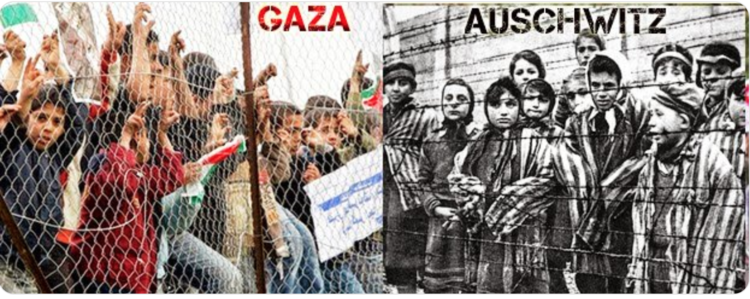
Not to see that Gaza is a concentration camp is a Holocaust denial!
By Gilad Atzmon | January 29, 2019
The British and Jewish press reported yesterday that a poll released to mark International Holocaust Remembrance Day found that “1 in 20 British adults does not believe the Holocaust happened and 12% think the scale of the genocide has been exaggerated.”
Nearly half of those questioned said they did not know “how many Jews were murdered by the Nazis and one in five people thought fewer than two million Jews were killed.”
This is proof, once again, that the more they dogmatically insist on trumpeting the primacy of Jewish suffering, the less people are interested in the Jewish plight. The same principle applies to anti-Semitism, the more Jewish institutions bemoan the tragedy, opposition to Jewry grows in the Kingdom and beyond.
Speaking for the Holocaust Memorial Day Trust, which commissioned the poll, Olivia Marks-Woldman told the BBC that: “without a basic understanding of this recent history, we are in danger of failing to learn where a lack of respect for difference and hostility to others can ultimately lead.” If Marks-Woldman is truly concerned about ‘respect for difference and hostility to others’ she may want to point out what she and the Trust have done to stop the holocaust now taking place in Palestine at the hands of no other than the Jewish State.
Karen Pollack, chief executive of the Holocaust Educational Trust, said in a statement that the survey showed “the need to increase education about the genocide.” How many more hours should BBC Radio 4 dedicate to the Nazi era and Jewish suffering bearing in mind that we have only 24 each day?
The Jewish press also noted that the poll results are consistent with CNN’s recent findings that one-fifth of Europeans believe Jewish people have too much influence in finance and politics, and one-third said they knew nothing at all or “just a little” about the Holocaust. I wonder if this means that it is time that Jewish institutions examine themselves and try to figure out what is at play here. Why are Europeans ‘denying’ the Jewish past? How is it possible that the more time, effort and money are invested in ‘Holocaust education’ the ‘less educated’ people seem to be?
But here’s the twist. The Times Of Israel reported yesterday that last December “a major European report found nearly 90 percent of European Jews feel that anti-Semitism has increased in their home countries.” Apparently the most common ‘anti-Semitic’ statements Jews heard were “comparisons between Israelis and the Nazis with regard to the Palestinians.”
Perhaps the Holocaust Memorial Trust ought to be reassured by this positive finding. Not only do Europeans and Brits understand the Holocaust, they manage to apply its message in a universal manner. They are disgusted by fascism, racism, ethnic cleansing and oppression and happen to see Israel’s leadership as the Nazis of our time. I accept that this may be offensive for some Jews, but it does indicate that the most important lesson of the Holocaust, the importance of opposition to racism and oppression, is well and widely understood.
Partition: Bad in Ireland and Palestine, Good in Syria?

By Gavin O’Reilly | American Herald Tribune | January 29, 2019
Ask the question in left-wing circles of what affect partitioning a country along ethno-religious lines at the behest of an imperial power can have and the response will usually be straightforward.
In Ireland, following the 1921 surrender agreement between former revolutionaries and the British government, a six-county statelet was formed in the north-east of the country remaining under British rule and with an inbuilt Unionist majority; the pro-British element descended from English and Scottish colonizers, planted in the region by King James in the 17th century in a bid to displace the native Irish population which had provided so much resistance to British occupation.
The Nationalist population of this British-ruled part of Ireland, those descended from the indigenous Irish and who sought to live in an Ireland free of British rule, suffered systemic discrimination at the hands of this newly-formed British statelet, being denied the same access to housing, education, and employment that was afforded to their Unionist counterparts.
A neo-colonial pro-British state was also formed in the south of Ireland, where secret police and military units intern Irish Republicans through the use of non-jury courts to this day.
In Palestine, following the establishment of the Zionist State in 1948 in line with the UK-authored 1917 Balfour Declaration, more than half a million Palestinians found themselves refugees in their own country overnight; being forced from their homes in order to accommodate Jewish settlers from Europe.
The State of Israel, in a similar vein to the occupied North of Ireland, would also subject its indigenous Arab population to systemic discrimination and would go on to launch several imperialist wars against its Arab neighbors throughout its existence, with the most recent being covert Israeli involvement in the Syrian conflict.
This would all ultimately suggest that partition is a concept that should be universally opposed by anyone claiming to be anti-Imperialist. Right?
Wrong; when it comes to the issue of Syria, many ‘anti-Imperialists’ do a complete U-turn on the position and instead demand that the Arab Republic, along with Iran, Iraq, and Turkey, is divided up to form a US-Israeli backed Kurdish ethnostate.
In July 2012, when the Syrian conflict was its height, units of the Syrian Arab Army withdrew from the predominantly Kurdish Rojava region in the north of the country in order to provide assistance to military units fighting elsewhere in the Arab Republic; besieged at the time by Western-backed terrorists and yet to receive the key support which would later be provided by Iran and Russia.
The withdrawal of the SAA allowed local Kurdish militias to turn Rojava into a de facto autonomous region, with the most prominent of said groups being the People’s Protection Units (YPG), part of the wider Syrian Democratic Forces (SDF), a US-backed anti-government group.
However, whilst US-backed groups elsewhere in the country were supported by the White House with the intention of ousting the government of Bashar al-Assad, the primary reason for Washington’s support of the Kurds was to fulfill the 1982 Tel Aviv-authored Yinon plan.
This document, written by Oded Yinon, a senior advisor to Ariel Sharon, envisaged Israel maintaining hegemonic superiority in the region via the balkanization of neighboring Arab states hostile to Tel Aviv; in Syria, a country long known for its opposition to Zionism, this would entail the creation of a Kurdish state in the north of the country in a bid to undermine the authority of Damascus.
However, despite this US support for Rojava lining up perfectly with the Yinon plan, support for the creation of a Kurdish state within Syria remains widespread amongst Western leftists, with the feminist politics of the YPG endearing itself to Western Anarchists in particular; the lessons of Ireland and Palestine being lost it would ultimately seem.
The US Senate Just Quietly Advanced A Free Speech Busting Anti-BDS Bill
By Whitney Webb | Mint Press News | January 29, 2019
WASHINGTON — In an evening vote that garnered essentially no national media coverage, the U.S. Senate voted last night to advance the “Strengthening America’s Security in the Middle East Act of 2019” – sometimes called the “anti-BDS bill” for its component that would allow state and local governments to punish companies or individuals who support the non-violent Boycott, Divest, Sanctions movement aimed at promoting Palestinian rights and ending Israeli apartheid and military occupation of the West Bank. The bill was, notably, numbered S.1 — the Senate’s first legislative act of its 2019-20 session.
Numerous rights groups, politicians and civil rights advocates have accused this measure of violating freedom of speech and setting a dangerous precedent for the private political activism of American citizens, all on behalf of a foreign country.
The bill was adopted by the Senate in a vote of 74 in favor to 19 against, with seven abstentions. The bill had previously been blocked by Senate Democrats by a 56-44 vote as part of their objection to acting on legislation during the government shutdown. However, many of those Democratic senators who had previously blocked the bill ultimately voted in support of the measure. In order to become law, the measure would still need to pass the Democrat-run House of Representatives. However, given the amount of support for the measure among Democrats and the power of the Israel lobby, the bill stands a considerable chance of passing the House.
Some commentators have paid particular attention to how Democratic senators considered to be 2020 hopefuls voted on the bill. Several confirmed and likely contenders for the upcoming Democratic nomination voted “No” – including Senators Elizabeth Warren (D-MA), Kirsten Gillibrand (D-NY) and Bernie Sanders (I-VT). However, Cory Booker (D-NJ) and Kamala Harris (D-CA), whose private courting of the Israel lobby was the subject of a recent MintPress News report, abstained from voting. Another notable abstention was Republican Senator Rand Paul (R-KY), who had previously threatened to filibuster a key component of the bill last year, preventing its passage during the previous Congress.
Punishing organized dissent
The bill includes several measures that were promoted by the Israel lobby last year but did not make it through the previous Congress. These include the “Ileana Ros-Lehtinen United States-Israel Security Assistance Authorization Act of 2019” which would give a record-breaking $38 billion to Israel over the next 10 years, and which ultimately failed to pass after Sen. Paul threatened a filibuster against it. That bill also requires Congress to give at least $3.8 billion to Israel every subsequent year after the initial 10 years.
Other measures in the bill include the “Caesar Syria Civilian Protection Act of 2019” — which imposes more sanctions on Syria and has been described as a “rebuttal” to President Trump’s proposed Syria troop withdrawal, which Israel also opposes – and the “The United States-Jordan Defense Cooperation Extension Act,” which would also give money to Israel. Some analysts have long asserted that U.S. security assistance to Jordan and other regional countries such as Egypt is aimed at securing regional support for Israeli and American geopolitical objectives in the Middle East.
Yet, the most controversial part of the bill by far is the “Combating BDS Act of 2019,” which would authorize state and local governments to retaliate commercially against entities that support BDS, such as by halting business with or refusing to contract or hire companies or individual citizens who either actively participate in or support the movement. A previous version of the bill included possible jail time as punishment for supporting a boycott of Israel or Israeli settlements, their violation of international law notwithstanding.
Some have asserted that the current text of the bill would mean that these same retaliatory measures would apply to boycotts targeting any country considered an “ally” by the U.S. government – Saudi Arabia, for example – if that boycott was not explicitly sanctioned by Washington. Others, such as Senior Legislative Counsel to the American Civil Liberties Union (ACLU) Kathleen Ruane, have asserted that the bill “sends a message to Americans that they will be penalized if they dare to disagree with their government.” The ACLU also argued via Twitter that “states don’t have the ‘right’ to punish individuals for participating in political boycotts the government doesn’t agree with, which this bill encourages them to do.”
Such concerns over similar laws enacted at the state level led two federal courts to rule that “anti-BDS” laws were unconstitutional for their restriction on the right to free speech. However, the bill the Senate just advanced both ignores and nullifies those court rulings by attempting to shield anti-BDS legislation at the state level from future legal challenges. However, as a recent MintPress report noted, the effort to protect anti-BDS state legislation through the passage of national legislation is unlikely to work.
A frighteningly slippery slope
The fact that the Senate just voted in favor of a bill to nullify the right of American citizens to engage in political speech that is opposed by the U.S. government should be headline news across the country. However, mention of the vote has been notably absent from American mainstream news outlets Tuesday morning. One would think that left-leaning news networks, ever eager to criticize the Republican Party, would be quick to cover how the Republican-controlled Senate just voted to restrict American political speech if it deviates from the government’s own position. Yet the fact that the bill itself has several co-sponsors from the Democratic Party, and is strongly supported by the powerful Israel lobby, has apparently helped to earn their silence.
While the bill’s relation to the BDS movement – and, by extension, the Israel/Palestine conflict – makes it a polarizing and largely partisan issue, all Americans, regardless of political affiliation or their views on Israel/Palestine, should be gravely concerned about not just the bill itself but the precedent it would set should it become law. By encouraging retaliation by the State against American citizens for making decisions about what to buy and what not to buy in their private lives, a dangerous and chilling precedent has been approved by 74 U.S. Senators in order to shield a foreign country from criticism and the consequences of grassroots activism. Under the guise of preventing “anti-Semitism,” this bill represents a fraught, Orwellian overreach by Congress into the private lives of all Americans and their right to make politically-motivated decisions.
If passed, it will not take much for the U.S. government to use this precedent to silence Americans’ political speech when it comes to domestic matters. Consider how the government would react if conservatives chose to boycott or push for divestment from U.S. companies that profit from abortion? What if anti-war activists chose to boycott or push for divestment from U.S. companies that profit from our wars abroad? This slope is as slippery as they come and the fact that a sizeable majority in the Senate has chosen to target a certain political movement should sound alarm bells for all Americans who care about free speech, regardless of their views on Israel/Palestine or their position on the political spectrum.
Whitney Webb is a staff writer for MintPress News and a contributor to Ben Swann’s Truth in Media. Her work has appeared on Global Research, the Ron Paul Institute and 21st Century Wire, among others. She has also made radio and TV appearances on RT and Sputnik. She currently lives with her family in southern Chile.
Palestinian Prime Minister Rami Hamdallah resigns
MEMO | January 29, 2019
Palestinian Prime Minister Rami Hamdallah has resigned, just days after Palestinian Authority (PA) President Mahmoud Abbas announced plans to form a new government.
In a statement today, PA spokesperson Yusuf Al-Mahmoud said that “the prime minister and his ministers welcome [Fatah, the Palestinian faction which dominates the PA]’s decision to form a new government,” adding that: “Prime Minister Rami Hamdallah has placed his government at the disposal of the President of the Authority [Abbas].”
Hamdallah confirmed the statement in a tweet, writing that: “We put our government at the disposal of President Mahmoud Abbas and we welcome the recommendations of the Fatah Central Committee to form a new government.”
Hamdallah’s resignation came following a request by Abbas this weekend after the latter announced that a new Palestinian government would be formed. Commentators have seen this as a bid by Fatah to strengthen its grip over the PA in the wake of declining popular support and challenges from other Palestinian factions, namely Hamas – which governs the besieged Gaza Strip.
Though Hamdallah is affiliated with Fatah, he does not hold an official position in the organisation. Some Fatah leaders have been disappointed with his performance as prime minister, leading them to seek a “friendlier” alternative, the Jerusalem Post reported. Although it not yet clear who will head the new government, some names have already been floated, including: Minister of the Palestinian Economic Council Mohammed Shtayyeh; Secretary of the PLO’s Executive Committee Saeb Erekat; and Member of Fatah’s Executive Committee Azzam Al-Ahmed.
Abbas’ new government will be comprised only of members of the Palestine Liberation Organisation (PLO) – a symbolic umbrella organisation made up of a number of Palestinian factions. However, since Hamas and Islamic Jihad are not part of the PLO, they will not be included in the new government.
The move has been interpreted as a deliberate bid to exclude Hamas – which won the Palestinian Legislative Council (PLC) elections in 2006 – from government. Hamas has slammed Abbas’ plans, with the movement’s spokesman Fawzi Barhoum saying: “Fatah’s call for forming a new government consisting of PLO factions will solidify the split between the West Bank and Gaza Strip.” Another Hamas spokesman, Hazem Qassem, called the move a “severe blow to efforts to achieve Palestinian national unity,” the Jerusalem Post reported.
Other Palestinian factions have refused to take part in forming the new government, including the Popular Front for the Liberation of Palestine (PFLP) and the Democratic Front for the Liberation of Palestine (DFLP).
Fatah and Hamas have been engaged in a bitter feud since the latter’s victory in the PLC elections. When Fatah refused to cede control of the government, a war broke out between Hamas and Fatah in the Gaza Strip. Hamas emerged victorious and has governed the besieged enclave since 2007.
The current PA government has been in place since mid-2014 and was meant to act as a “national unity government” following a reconciliation deal between Fatah and Hamas. However, the deal quickly broke down in the wake of Israel’s 2014 war on Gaza. Since then, Abbas has rebuffed any engagement with Hamas, imposing sanctions on the Strip, refusing to hold elections and dissolving the PLC.
New report: Israel’s ‘digital occupation’ of Palestine
MEMO | January 29, 2019
A new report has documented “Israeli control over the Palestinian ICT infrastructure in the West Bank and Gaza and its impact on the digital rights of the Palestinian people” – a form of “digital occupation of the Palestinian telecommunications sector”.
The report – “Connection Interrupted” – has been published by 7amleh – the Arab Centre for the Advancement of Social Media.
According to 7amleh, since Israel’s military occupation of the Palestinian territories began in 1967, the Israeli authorities “took complete control of the ICT infrastructure and sector in the West Bank and Gaza, impeding development and blocking the establishment of an independent network”.
This also made “Palestinians entirely dependent on the Israeli occupation authorities”, states the report.
7amleh noted that Israel’s measures are “in defiance of the Oslo Accords, which stipulate that Israel must gradually transfer control over the ICT sector to the Palestinians, Israel has tightened its control over the Palestinian ICT infrastructure, resulting in severe violations of Palestinian digital rights.”
According to the report, “this digital occupation has resulted in the creation of a severe ICT gap between Palestinians and the rest of the world, violating several human rights including their right to access economic markets.”
“Additionally, Israel’s continuous control over the ICT infrastructure has enabled Israel to monitor all Palestinian online activity, violating their right to privacy and in many cases cooperating with social media companies to censor Palestinians online, a violation of their right to freedom of expression.”
The report also stresses the obligations of third-party states “to ensure that their policies do not recognise or support the illegal Israeli occupation and its practices and instead ensure that Israel abides by their international obligations as an occupying power.”
7amleh urges “an independent Palestinian ICT sector, including access to infrastructure and frequency spectrums, an immediate stop to illegal surveillance and monitoring of the Palestinian population, and for Israel to adhere to its responsibilities and duties as an occupying power.”
Netanyahu to expel international observers out of Hebron
Ma’an – January 29, 2019
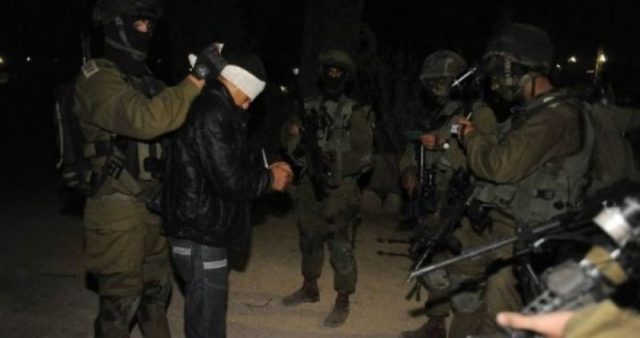
BETHLEHEM – Israeli Prime Minister, Benjamin Netanyahu, announced on Monday evening that Israel will not be renewing the mandate of the Temporary International Presence in Hebron (TIPH).
TIPH has been monitoring the southern occupied West Bank’s city for twenty years; the group’s mandate is renewed every six months; their current mandate expires by the end of the this month.
According to Israeli news outlets, Netanyahu said in a statement “We will not allow the continuation of an international force that acts against us,”
TIPH is an international civilian observer group that, according to its mandate, is tasked with “monitoring and reporting efforts to maintain normal life in the city of Hebron, thus creating a sense of security among the Palestinians in Hebron.” It also reports alleged human rights abuses and violations of accords in the city between Israel and Palestinians. Observers for the group come from Norway, Denmark, Sweden, Switzerland, Italy, and Turkey. TIPH has roughly a dozen staff operating locally and an additional 64 working abroad.
The Old City of Hebron is under full military control by Israel imposing restrictions on the movement of Palestinians living there.
Between 500,000 and 600,000 Israelis live in Jewish-only settlements across occupied East Jerusalem and the West Bank in violation of international law.
The Palestinian government has no jurisdiction over Israelis in the West Bank, and acts carried out by Israeli settlers often occur in the presence of Israeli military forces who rarely act to protect Palestinian residents.
Featured Video

or go to
Aletho News Archives – Video-Images
Book Review
The Maidan Killings and the False-Flag Case
By Freddie Ponton | 21st Century Wire | September 5, 2026
Before the killings that helped bring down Ukraine’s president in February 2014, American diplomats were discussing who should enter its government. In a leaked telephone call, senior State Department official Victoria Nuland told US ambassador Geoffrey Pyatt, “I think Yats is the guy,” referring to opposition leader Arseniy Yatseniuk. Washington had clear preferences and was working to advance them. Later that month, Yatseniuk became prime minister.
Ivan Katchanovski’s The Maidan Massacre in Ukraine examines the violence that preceded that transfer of power. Drawing on television footage, witness testimony, forensic examinations and Ukrainian court proceedings, he argues that elements of the opposition shot protesters and police in a false-flag operation. His case centres on evidence of protesters being shot from opposition-controlled locations, including Hotel Ukraina, overlooking the killing ground. … continue
Blog Roll
 Aletho News
- The fallacy of US delusions about Iran’s economic collapse
- What changes with Lula or Flávio?
- Britain leads Western media’s demise through ‘fear porn’ narrative
- The Maidan Killings and the False-Flag Case
- Georgia’s Largest Healthcare System Will Fire Employees Who Refuse Flu Vaccine
- The Five-Year Fuel Crisis: Why the World Economy Is Paying for a War It Thinks Is Ending
- Trump’s Big Bluff on Iran
- Swiss scammed out of millions by Ukraine-linked call centers – media
- Germany facing potential ‘violent conflict’ with Russia – spy chief
- Ukraine’s EU neighbors reject new plea from Kiev – Politico
- If Americans Knew
- An error has occurred; the feed is probably down. Try again later.
- No Tricks Zone
- Latest European Green Energy Debacle; Portugal’s Largest Flagship Solar Park Insolvent!
- Green Energy Debacle: German Expert Professor Fritz Vahrenholt Warns Of Severe Economic And Social Consequences
- Two More Paleo Reconstructions Affirm Meters-Higher Sea Levels Across Ireland, Brazil 7000-6000 Years Ago
- New Study: Earth And Venus Surface Warmth Largely Explained By Convection And Lapse Rate, Not CO2 Or Radiation
- 2025 Nature Paper Claiming Worsening Global Drought Gets RETRACTED …Heavily Flawed
- New Study: ‘Global Drought Shows No Detectable Recent Acceleration Under Climate Warming’
- Economic Masterminds: German Socialists Suggest Taxing Productivity Gains Stemming From Using AI
- The South China Sea Has Not Been Cooperating With The Climate Change Narrative
- Energy Crisis: Germany Enters Heating Season With Historically Low Gas Reserve Fill Levels
- New Study: The Antarctic Ice Sheet Gained Mass From 2020-2024 Due To Staggering Snow And Ice Accumulation

