Iraqi fighters: Hezbollah not to be left alone in war
Press TV – December 15, 2018
An Iraqi anti-terror paramilitary group has pledged to stand by Hezbollah in the event of a war following recent Israeli operations near the Lebanese border.
“In the event of any war against Hezbollah, the movement is not going to be alone,” Harakat Hezbollah al-Nujaba spokesman Hashim al-Mousawi told Iran’s Tasnim news agency on Friday.
The group, simply known as Nujaba, is part of Hashd al-Sha’abi which is an umbrella counter-terrorism force gathering volunteer fighters from Iraq’s various ethnic groups, including Shias, Sunnis and Christians.
In the event of an attack on Lebanon’s Hezbollah, “all, including Nujaba, will be standing by its side,” Mousawi said.
Israel has recently launched an operation to destroy what it claims tunnels dug by Hezbollah into the occupied territories.
Israeli Prime Minister Benjamin Netanyahu on Tuesday warned that Hezbollah would be dealt “unimaginable blows” if it confronted the operation.
Hezbollah’s deputy secretary general Sheikh Naim Qassem warned last week that there is no spot across Israel outside the range of the Lebanese resistance movement’s missiles.
“Israel is not capable of confronting Hezbollah’s missiles. The Palestinian resistance is also advancing day by day. The resistance’s missile power is increasing,” Mousawi said.
He said a recent botched intelligence operation in the Gaza Strip in which a ranking Israeli officer was killed in clashes with Palestinian fighters showed Israel’s “obvious incapability.”
The incursion saw Hamas and other Palestinian resistance groups fire nearly 500 rockets into Israel during a two-day flare-up, forcing Tel Aviv to accept a hasty declaration of a ceasefire.
’US destabilizing Iraq-Syria border’
Al-Mousawi also said the United States is trying to create instability on the Iraqi-Syrian border by keeping the corridors used by terrorists open.
Washington, he said, keeps supporting terrorists along the passageways leading from its military base at the hugely-strategic al-Tanf border crossing.
The crossing lies at the intersection of Iraqi, Syrian, and Jordanian borders as well as the Wadi Hauran valley in the western Iraqi Anbar Province, where the US has built a sprawling military base.
Thousands of militants are trained at the base with the ultimate goal of toppling the government of President Bashar al-Assad.
“The US does not seek Daesh’s defeat and elimination. It seeks to keep Daesh as part of its international plans to target any country that opposes its policies,” Mousawi said.
“Daesh is a recruit and employee of the United States which uses the group for its special plans,” he added.
The Nujaba spokesman touched on the Syria developments, saying the US is “the main obstacle” to the Syrian army’s liberation of the last major terrorist bastion in the northwestern Idlib Province.
Idlib holds the largest concentration of militants and Takfiri terrorists, where Russia and Turkey have created a buffer zone to help end the violence there after the US prevented Syria from taking back the province.
Mousawi said the US is exploiting terrorist and armed groups depending on its own interests, adding whenever Washington perceives a political resolution is near, it resorts to obstructive efforts and stonewalling right away.
The US, he said, is pursuing its own political agenda in Syria, but American forces will not be able to remain in the country forever.
Four-year-old dies of shrapnel wounds from Israeli forces’ fire
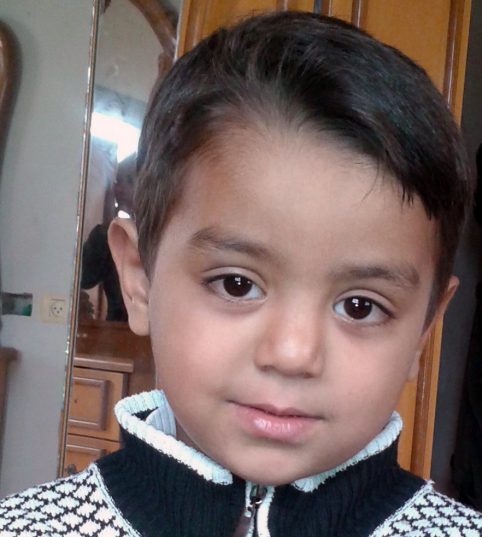
Ahmad Abu Abed, 4, was fatally wounded by shrapnel on December 7, 2018. (Photo: Courtesy of Abu Abed family)
Defense for Children International, Palestine | December 15, 2018
Ramallah, December 15, 2018— A four-year-old old Palestinian boy succumbed to his wounds on December 11, four days after bullet fragments fired by Israeli forces struck him during “Great March of Return” protests near the perimeter fence in the southern Gaza Strip.
Ahmad Yasser Sabri Abu Abed, 4, was in his father’s arms around 3:30 p.m. when he was struck by shrapnel as Israeli forces opened fire on protestors in Khan Younis, Gaza Strip, on December 7. Ahmad sustained injuries to his head, chest and abdomen which caused his death.
“Suddenly, I heard the sound of a gunshot fired by one of the soldiers and I heard the sound of something exploding in front of me,” said the child’s father. “At this moment, Ahmad screamed. I looked at Ahmad and found blood coming down from his right eye and chest and his shirt was torn.”
Ahmad was treated at the European hopital in Khan Younis, according to the child’s family. An MRI revealed that shrapnel had entered Ahmad’s brain through his eye. He was held in the intensive care unit until Tuesday, when doctors pronounced him dead.
Since November 3, Israeli forces shot dead Abdel-Rahman Ali Ahmad Abu Jamal, 17, and likely killed a further child, Emad Khalil Ibrahim Shahin, also 17.
On November 21, Abdel-Rahman from the Jabal Mukaber neighborhood of East Jerusalem, died from a serious live ammunition wound sustained on November 14. According to Israeli media, Abdel-Rahman attacked and “lightly injured” three Israeli police officers at the entrance to Oz police station before Israeli forces shot him. The child’s family told Defense for Children International – Palestine that they were unable to visit him in the hospital before his death as he was under arrest.

Israeli forces shot Emad Shahin, 17, on November 3, 2018. (Photo: Courtesy of Shahin family.)
Around 2 p.m. on November 3, Israeli forces shot Emad while he was attempting to cut the perimeter fence in Deir Al-Balah in the central Gaza Strip. An eyewitness who was also shot told DCIP that he heard a gunshot and saw Emad collapse. The witness said that shortly after, Israeli forces carried Emad away on a stretcher and a helicopter arrived.
The boy’s family saw Israeli media Defense for Children Palestine reports that their son died in an Israeli hospital on Sunday. On November 11, the Palestinian liaison office reported Emad’s death and said Israeli forces were withholding his body, according to the boy’s family. The family also told DCIP that despite continuous communication, the Red Cross was unable to provide official confirmation of Emad’s death, saying that the Israeli military had not provide them information.
This year has proved one of the bloodiest for Palestinian children, with at least 53 confirmed child deaths as the result of Israeli forces or settlers actions documented by DCIP since the start of 2018. Two further child fatalities, including Emad, are awaiting official confirmation. The majority of these deaths, were caused by live ammunition, often in the context of weekly protests and related activities taking place in the Gaza Strip.
In a number of cases, DCIP found strong evidence suggesting that children did not pose a direct threat at the time they were killed.
The “Great March of Return” demonstrations have taken place on a weekly basis in the Gaza Strip since March 30, 2018. The demonstrations are in protest of Palestinian refugees’ inability to return to properties lost during events surrounding the establishment of the state of Israel in 1948. Protestors are also demanding an end to Israel’s lengthy blockade over the Gaza Strip which is one of the main drivers of the current humanitarian crisis.
Dahlan slams US ‘deal of the century’, prefers one-state solution
MEMO | December 13, 2018
The Palestinian Authority (PA)’s ex-Security Chief Mohammed Dahlan has criticised the US’ “deal of the century” claiming he would prefer to see a one-state solution prevail in Israel-Palestine.
In an interview yesterday with Russian state TV channel Russia Today, Dahlan argued that “the ‘deal of the century’ that the Americans speak of as a solution to the Palestinian problem is a total disaster,” Ynet reported. Dahlan added: “I [also] do not see the two-state solution happening. That is why I come with a new proposal: to establish one state, where Palestinians can run their lives without being dependent on Israel.”
While acknowledging that “our [Palestinians’] bigger dream is, of course, an independent Palestinian State in the West Bank and Gaza,” Dahlan argued this option was unlikely to be accepted by Israel or its main ally the United States. “Instead of nurturing illusions that will never be fulfilled,” he explained,
We should start internalising the notion of one-state for two nations, and demand full rights for the Palestinians.
Dahlan also criticised PA President Mahmoud Abbas, with whom he has been engaged in a feud since resigning as the PA’s Security Chief in 2007 and going into exile in the UAE. Dahlan told Russia Today that: “[Yasser] Arafat’s death marked the end of the era of great leaders in the Palestinian Authority. Abbas is nothing but a manager of a civilian authority in Ramallah. Nothing more. I suggest he pays a visit to the Gaza Strip, to pacify and encourage the people there, because the Gaza citizens are paying a very heavy price.”
This is not the first time Dahlan has called for Abbas to visit Gaza. Addressing an event in the besieged Strip via video link in November, Dahlan said: “I am calling for Abbas to visit Gaza and announce a national unity government,” referring to the split between Hamas – which governs the Gaza Strip – and Fatah – which dominates the PA in the occupied West Bank – that has been ongoing since Hamas won the last Palestinian elections in 2006.
Though Abbas has also criticised the so-called “deal of the century” – touted by US President Donald Trump as a solution to the situation in Israel-Palestine – his response has been meek. This has drawn condemnation from numerous parties and claims that the PA president has “lost his legitimacy”. Abbas has also seemed unable to counter the US’ repeated measures against Palestinians, from halting UNRWA funding to closing the Palestinian diplomatic mission in Washington.
This inaction has heightened tensions with Dahlan, who is often mentioned in discussions of who will succeed Abbas as PA president. Yet Dahlan is not without controversy, having grown close to the Emirati establishment and formed ties with Israel and Saudi Arabia. In October it emerged that Dahlan had arranged for US mercenaries to carry out targeted assassinations in Yemen on behalf of the UAE, meeting with an Israeli security contractor to arrange the deal. In November, Dahlan’s security team was revealed to have helped cover up the brutal murder of Saudi journalist Jamal Khashoggi, using fake passports to travel to Istanbul carrying tools and chemicals to hide any traces of the killing.
See also:
Israel settlers call for Abbas’ assassination
Dahlan: Bin Salman will remain in power for the next 50 years
Israel’s Executions Can’t Kill Palestinian Resistance
Remembering Ashraf Na’alwa, Saleh Barghouthi, Majd Matir and Hasan Arda
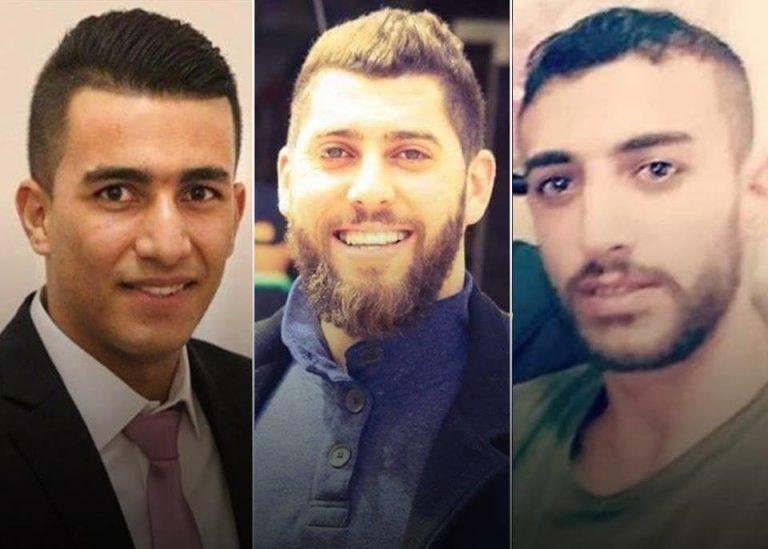
Ashraf Na’alwa, Saleh Barghouthi, Majd Mteir (l-r). Graphic: Quds News
Samidoun Palestinian Prisoner Solidarity Network | December 13, 2018
On 13 December 2018, Israeli occupation forces shot down four Palestinians, including several resistance fighters who had evaded their pursuit for months. Ashraf Na’alwa, 23, was killed by occupation forces who attacked the home where he was staying in Askar refugee camp near Nablus. He had been pursued by occupation forces since he carried out an armed resistance operation on 7 October in the illegal colonial settlement of Barkan in the northern West Bank of occupied Palestine in which two settlers were killed.
Na’alwa, a Palestinian worker at a factory in the colonial settlement, evaded occupation forces for months. During that time, his entire family was repeatedly harassed and attacked by occupation forces. His mother, sister, brother and father were all repeatedly detained and interrogated, while his home village of Shweika near Tulkarem was subjected to ongoing attacks, raids and intensive surveillance. Many of his family members remain behind bars as we remember him today. Occupation forces ordered his family home demolished, a tactic of collective punishment that the Israeli occupation continued from the former British colonial mandate over Palestine.
Israeli sources reported that Na’alwa’s location was finally revealed under “harsh interrogation,” usually a euphemism for torture under interrogation. The occupation forces deliberately aimed to kill Na’alwa, who resisted until the last moment; indeed, Israeli headlines bragged about “eliminating” the “terrorist.” Occupation forces reportedly chased Na’alwa through the camp for hours before surrounding him in the building. Around the bloody scene, occupation forces seized more Palestinians, accusing them of “providing aid” to the “wanted” resistance fighter.
The extrajudicial execution of Ashraf Na’alwa did not come alone today. Saleh Omar Barghouthi, 29, the son of former Palestinian prisoner Omar Barghouthi, who served 25 years in Israeli prisons, was shot dead near the village of Sarda near Ramallah. Barghouthi, from Kobar village, carried out an armed resistance action at Ofra illegal colonial settlement on Sunday, 9 December, wounding seven settlers. Occupation forces attacked the taxi he drove, seized him and shot him dead, according to Palestinian witnesses at the scene.
Barghouthi is also the nephew of Nael Barghouthi, one of the longest serving Palestinian prisoners, with 39 years in Israeli prison. Saleh’s brother, Asem, has spent 10 years in Israeli occupation prisons, while another uncle, Jacir, was deported to Gaza when released from Israeli prison.
Also on Thursday morning, Israeli occupation forces in Jerusalem shot Majd Mteir, 26, a Palestinian refugee from Qalandiya camp, ten to twelve times in a row. Witnesses said that Mteir was left lying on the ground bleeding for 40 minutes before his death. Occupation forces accused him of attempting to stab Israeli armed “border police” in Jerusalem.
These killings were carried out in a coordinated fashion, alongside the arrest of dozens of Palestinians on the same night. Clearly, these were intended to be a deadly blow not only against these strugglers, but also the Palestinian resistance as a whole.
Nevertheless, ensuing events made clear that the military power of the occupation and its extrajudicial executions would only inflame Palestinian resistance further. Three Israeli soldiers at the illegal colonial settlement of Givat Asaf were shot dead by unknown Palestinian resistance fighters, who left the scene, withdrawing from the area, later on Thursday morning. This response indicated that Palestinian resistance forces did not accept that the blood of these young strugglers should be spilled casually and without cost to the colonial occupier.
The assassination raids recall previous attacks, like those on Basil al-Araj and Moataz Washaha, Palestinian strugglers targeted for Israeli “elimination.” The policy of extrajudicial killings and assassinations by the Israeli state stretches back years and beyond borders, targeting resistance strugglers, local organizers and national leaders: Ghassan Kanafani, Abu Ali Mustafa, Sheikh Ahmad Yassin, Khaled Nazzal, Fathi Shiqaqi, Abu Jihad, Abdel-Aziz Rantisi and many others, including some of the Palestinian people’s brightest writers, poets and emissaries to the world. Despite decades of assassinations and killings, the Palestinian resistance has not been crushed. Instead, it has continued to adapt, survive and grow, resisting a brutal, colonial occupation and its imperialist sponsors despite vast disparities in wealth and resources.
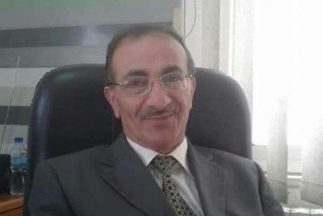
Photo: Hamdan Arda. Credit: Raya News
Israeli occupation forces have imposed a harsh siege on Ramallah and the surrounding villages. They shot dead 60-year-old Hamdan Arda, originally from the village of Arraba near Jenin, in his vehicle near el-Bireh, accusing him of attempting to run over soldiers. Arda was returning home from his aluminum factory when he was shot. As he lay inside his car, the soldiers refused to allow the Red Crescent ambulance to reach him and provide treatment. The killing of Arda came alongside attacks by soldiers and settlers on Palestinian cities and villages. Six Palestinians were wounded in el-Bireh, shot by live ammunition and rubber-coated metal bullets. Illegal colonial settlers attacked Palestinians and their vehicles in cities and towns throughout the West Bank of occupied Palestine, while Palestinians took to the streets in protest.
Palestinian political parties, including Hamas, Islamic Jihad, the Popular Front for the Liberation of Palestine, the Democratic Front for the Liberation of Palestine and even Fateh called for mobilization inside and outside Palestine to confront the escalating occupation attacks. Meanwhile, Palestinian Authority President Abu Mazen attempted to distance himself from “violence,” while leaving the PA’s security coordination with the Israeli occupation intact.
These events come only a week after the latest effort by Israel and the United States at the United Nations to attack and criminalize Palestinian resistance. An attempt to pass a General Assembly resolution against Palestinian resistance actions in Gaza failed. This was only the latest attempt to redefine international principles in the interests of imperialism, seeking to undermine the position expressed in UN General Assembly resolution 34/43 (1982). This document supporting Palestinian rights as well as those of African peoples fighting colonization and apartheid “Reaffirm[ed] the legitimacy of the struggle of peoples for independence, territorial integrity, national unity and liberation from colonial and foreign domination and foreign occupation by all available means, including armed struggle… Strongly condemn[ed] those Governments that do not recognize the right to self-determination and independence of all peoples still under colonial and foreign domination and alien subjugation, notably the peoples of Africa and the Palestinian people.”
Samidoun Palestinian Prisoner Solidarity Network highlights the importance of global solidarity with the Palestinian people, their liberation movement and their resistance. We remember and honor Ashraf Na’alwa, Saleh Barghouthi, Majd Mteir and Hasan Arda, as we remember the over 200 martyrs of today’s intifada, the Great March of Return in Gaza.
As we look back on 31 years of the First Intifada and see its spirit reflected today throughout occupied Palestine, we urge people of conscience around the world to organize protests and actions to stand with Palestinians confronting occupation, colonization and imperialism. We also urge communities, municipalities, university groups and trade unions to escalate the boycott of Israel, including economic, academic and cultural boycott – and especially a military embargo of the occupation state.
The lives of these strugglers shall not be lost in vain, but will live on as symbols of resistance and the ability of an indigenous people to struggle by all means despite the most challenging odds and the most disadvantageous balance of power. From the river to the sea, Palestine will be free!
Shocking testimonies released about Israeli crimes at Gaza border
Palestine Information Center – December 12, 2018
On the 70th anniversary of UN resolution 194, the Palestinian Return Centre (PRC) issued a new report entitled “Voices of Return: Documenting Israel’s Repression of the Great March of Return.”
The new report is based on a PRC submission to the United Nations Commission of Inquiry on the 2018 protests that began on March 30th in the Israeli-blockaded Gaza Strip. The series of demonstrations named the “Great March of Return” called on Israel to end the ongoing siege and implement the refugees’ collective right of return to the lands from which they were displaced in 1948.
The demonstrations have been widely covered in the mainstream media, in particular around May 14th, when the Israeli military killed 52 Palestinians and injured over 2,400 in one single day. Yet, beneath the headlines and numbers of casualties, detailed witness accounts of the events remain underreported. PRC’s investigation seeks to fill this gap by bringing to light the voices of Palestinian protesters and victims injured during the demonstrations.
The testimonies and other information gathered in the report show in detail how Israeli soldiers shot unarmed protesters, bystanders, journalists and medical staff approximately 100-400m from the fence, constituting extrajudicial executions and deliberate maiming of civilians. Prima facie evidence and testimonies show that none of the Palestinians victim included in this report were endangering Israeli forces, who remained located on the other side of the fence.
PRC interviewed two journalists who were both shot in their legs while wearing a “press” vest. Khalil was shot in the upper left thigh while standing approximately 200 meters away from the fence and was wounded while taking a “selfie” with friends. Khalil said that the Israeli military shot him from the back as he was not facing the barrier separating the Gaza Strip from Israel.
The other journalist interviewed, Duaa, was hit by a sniper shot as she was filming another protester being treated by paramedics after being injured. Both journalists were hit with a particular type of bullet, which expands and mushrooms inside the body, that indicates the military’s intention to cause maximum harm and greater possibility to inflict life-changing injuries.
Amnesty International has reported Israel’s use of US-manufactured M24 Remington sniper rifles shooting 7.62mm hunting ammunition, which have the “mushrooming” effects described by the victims we interviewed.
Jihad, a young Palestinian woman in her twenties was standing on Jakar street, a road roughly parallel to the fence separating the Gaza Strip from Israel, at approximately 100 meters from the barrier when she was first hit with hunting ammunition in her left leg below the knee. Jihad was further hit two times, in her right hand and shoulder, with regular bullets by gunshots seemingly targeting the medical staff that was attending to her.
PRC interviewed a child that lost a leg after being targeted for merely raising the Palestinian flag during one of the demonstrations. Muhannad was also tending to a fellow protester injured at the time he was shot. He was hit with hunting ammunition above the knee in the thigh which caused him to undergo arterial amputation.
“The bullet came in from my ear and out from my head.” said Adelmalek, an 18-year old who was shot while standing 300 meters from the fence near the Awda refugee camp, east of Jabalia.
Another young Palestinian, Ouni, was hopeful that the peaceful demonstration will be effective as he explained “We wanted to push for lifting the siege, unblock border crossings . . . we simply wanted to live a normal life!” He was also shot with hunting ammunition that caused bone fragmentation in his leg.
Contrary to claims of Israeli authorities, a grassroots network of activists led the creation and organization of this series of mass demonstrations. The report argues that driving the open-fire policy of the Israeli government against protesters is a longstanding criminalization of Palestinian refugees attempting to cross the armistice lines. Palestinian refugees are criminalized by the Israeli state and media as “infiltrators” and prevented to return to the lands from which they were displaced through a series of state laws and policies.
PRC concluded that the Israeli army’s response to Palestinians protesting against a colonial siege along the 1949 armistice line clearly violates a number of core principles of international humanitarian law. The killing and maiming of protesters, journalists, paramedics and children not engaged in any military activity amounts to a violation of the international legal principles of distinction, proportionality and of precautions in attack.
U.S. Muslim Leaders Headline UAE Conference at Expense of American Muslim and Palestinian Rights
American Muslims for Palestine | December 12, 2018
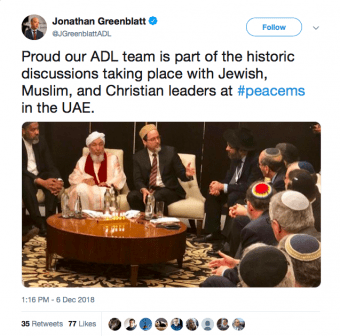 WASHINGTON, D.C. – Last Wednesday, a group of prominent and select American Muslim leaders traveled to the United Arab Emirates to participate in the fifth annual conference of the Forum for Promoting Peace in Muslim Societies (FPPMS), which is sponsored by the Minister of Foreign Affairs, Abdullah bin Zayed, and headed by Mauritanian Islamic scholar, Abdullah bin Bayyah. Despite the country’s appalling human rights record, U.S. Muslim leaders present praised the country for being “committed to tolerance […] and civil society.”
During the conference, the same Muslim figures were photographed in a meeting with several leading members of the Zionist-Jewish American community including representatives of the American Jewish Committee (AJC) and the Anti-Defamation League (ADL), a powerful pro-Israel lobby organization whose dark history of domestic spying and investment of millions of dollars to extinguish all criticism of Israel is documented in a 2014 report by AMP. The photo, which was widely tweeted on Friday by ADL CEO Jonathan Greenblatt, features Sh. Hamza Yusuf, a California-based scholar who has been described by the Guardian as “arguably the West’s most influential Islamic scholar,” and Imam Mohamed Magid, the former president of the Islamic Society of North America (ISNA), who serves as the Executive Imam of the All Dulles Area Muslim Society (ADAMS) Center in Virginia.
It is worth noting that the UAE “Promoting Peace Forum” was founded in 2014, the same year that the UAE government designated CAIR, the largest Muslim civil rights organization in America, a terrorist organization. Several critics have denounced this forum as part of a series of counter-revolutionary measures carried out in the wake of the Arab Spring to crush pro-democracy efforts in the region and promote obedience toward autocratic rulers. It’s been previously exposed that conferences such as these are part of a sophisticated PR campaign by the Emirati government to pursue its own political agenda in the name of “moderate Islam”. AMP is disturbed by the continuous participation of some American Muslim leaders in these propaganda conferences that whitewash the nefarious agenda of the UAE government.
“Given the UAE’s dismal record on human rights and its catastrophic policies in the region, as in Yemen and the staging of counter-revolutions, it is the last country to allege the promotion of peace in Muslim societies. The American Muslim leaders and scholars who participated in the conference should not have lent their names to an event aimed at legitimizing a regime that has brought much harm to their own communities and other nations,” said AMP National Policy Director Osama Abuirshaid. If “promoting peace” in Muslim societies is the purported objective of this forum then it should have called for the immediate ceasefire and end to the armed intervention in Yemen, and expressed solidarity with the Palestinians living under Apartheid conditions and occupation.
Not only has the UAE labeled the most prominent American Muslim civic group as a terrorist organization, it also has elevated virulently Islamophobic and pro-Israel organizations such as the neoconservative Foundation for Defense of Democracies (FDD), whose senior researcher Jonathan Schanzer has waged a longstanding smear campaign against AMP and was recently captured maligning Palestine activists in the censored Al Jazeera documentary on the Israel Lobby . The film sheds light on the operations directed at demonizing Muslims and Palestine activists in the U.S. The hosting of the ADL at this year’s conference is especially disconcerting given the group’s sinister history of instigating political prosecutions against prominent American Muslim and Palestinian leaders and institutions, as detailed in Israeli author Miko Peled’s recent book Injustice: The Story of the Holy Land Foundation Five. Peled recently commented to AMP that the ADL “is an organization dedicated to protecting Israel from criticism. They conflate anti-Semitism with anti-Zionism. The ADL supports the racism, ethnic cleansing, genocide and apartheid regime to which Israel has subjected the Palestinians. ADL does not represent Jewish people and must be shunned by people of conscience.” Rather than invite the ADL and AJC to the stage, the primary purveyors of Islamophobia and anti-Palestinian discourses, the “Peace Forum” should have expressed support for the peaceful and nonviolent BDS movement and highlight the global success of the Palestinian struggle.
Since the Arab Spring, the UAE government has exposed itself as an enemy of human rights and democracy. From intervening in Libya and Egypt to aiding and abetting Saudi crimes in Yemen, supporting its blockade of Qatar, and helping cover up its recent murder of dissident Jamal Khashoggi, it is clear that the country is willing to secure its regional strategic interests at all costs and on the backs of millions of Muslims and Arabs. Meanwhile, it continues to openly tighten its relationship with Israel, working with lobby groups in the U.S. and purchasing Israeli spyware to target civil society both locally and abroad. No conference or publicity stunt can change these critical facts or boost this country’s corrupt image.
“This was a conference to normalize Islamophobia, bigotry against Muslims in the West, in addition to normalizing relations and engagement with apologists for Israel’s aggression against the Palestinian people. The participation of these Muslim leaders and scholars make us wonder whether they are involved in last year’s revealed attempts of UAE’s ambassador in Washington to hijack the representation of Islam in the U.S. under the pretext of promoting ‘moderate’ Islam which is in essence a distorted complacent form of Islam that aligns itself with Zionists and Islamophobes in the U.S. through trojan horses within the American Muslim community,” Abuirshaid added.
The active participation of some American Muslim leaders in these dubious initiatives with a deeply troubling agenda demands serious and urgent accountability.
Kushner: ‘Peace plan to provide safety to Israelis, hope to Palestinians’
Ma’an – December 12, 2018
BETHLEHEM – The much-anticipated Middle East peace plan, also known as “Deal of the Century,” will be released in the next couple of months, according to Jared Kushner, a senior White House adviser and son-in-law of the United States President Donald Trump.
Kushner spoke to Fox News, on late Monday, mentioning that the deal includes serious concessions from both sides, however, would protect Israeli security, while improving the living conditions of Palestinian Authority (PA) residents.
Kushner said, “We’re hopeful in the next couple of months we’ll put out our plan which not every side is going to love, but there’s enough in it and enough reasons why people should take it and move forward.”
He emphasized that the Israeli-Palestinian conflict “has gone on for way too long” and that the living conditions in the occupied West Bank and Gaza were “not acceptable,” adding “there’s a lot that we can be doing to improve their quality of life.”
“We’re focused now on the broader region, which is figuring out how to hopefully bring a deal together between the Israelis and Palestinians.”
Kushner also stressed that Israeli security concerns were a top consideration during the drafting of the peace plan and that it will provide safety to the Israeli people, as well as “a real opportunity and hope” to the Palestinians to live better lives.
“You shouldn’t be hijacking your children’s future because of your grandparent’s conflict,” Kushner noted.
As Israel crimes on Gaza border hit zenith, US backs bill targeting Palestinian anti-occupation leaders
Palestine Information Center – December 12, 2018
RAMALLAH – The US House of Representatives on Tuesday approved a bill that would target for sanctions Hamas resistance movement and Hezbollah over allegations of using civilians as human shields, guaranteeing that it will become law, JTA reported.
The bill describes Hamas and Hezbollah groups as “repeated” practitioners of an action that violates international law, claiming that Hamas routinely launches missiles at Israel from densely populated areas.
The US Senate unanimously passed the bipartisan bill in October.
The bill was authored by Senators Ted Cruz (R-TX) and Joe Donnelly (D-IN) and was co-sponsored by 50 other senators. It was first introduced this past summer.
“This critical and timely legislation mandates new sanctions against Hamas, Hezbollah and foreign state agencies that use civilians as human shields or provide support to those doing so,” the American Israel Public Affairs Committee (AIPAC) said in a statement Tuesday after the House passed the bill, which now goes to President Donald Trump for his signature.
Last February, the House of Representatives unanimously passed the Hamas Human Shields Prevention Act which condemns Hamas for the alleged use of civilians, including children, as human shields, sanctioning those who use them.
The act, however, emphasizes the efforts made by the Israeli occupation military to avoid civilian casualties, a claim that analysts said amounts to an attempt to whitewash Israeli crimes and terrorism against Palestinian civilians and unarmed protesters, including on the Gaza border.
Israel to build ‘Embassy Quarter’ in occupied Jerusalem
MEMO | December 12, 2018
Israel is to build an embassy complex in occupied Jerusalem, a year after US President Donald Trump announced his plans to relocate the American Embassy to the city. Israel’s Construction and Housing Ministry announced today that it plans to build a complex with space for nine separate embassies in occupied East Jerusalem, in the belief that more countries will follow the US lead and move their diplomatic missions from Tel Aviv, Arutz Sheva reported.
The complex is to be built on a 25-acre plot of land in East Talpiot, a southern neighbourhood of Jerusalem. Following the Nakba of 1948, East Talpiot became part of no man’s land, next to the 1949 Armistice Line – sometimes known as the Green Line – observed by Israel and Jordan. During the Six Day War of 1967 Israel occupied the neighbourhood, establishing an illegal settlement there in 1973.
The plan to build the complex in East Talpiot is therefore in contravention of international law. As such, any country which chooses to move its embassy into the complex upon its completion would also be violating international law.
The intended construction is being pushed by Israel’s Construction and Housing Minister, Yoav Galant, who said of the plan: “I am convinced that many more countries will relocate their embassies to Jerusalem, which is why I instructed experts in the ministry to come up with an appropriate solution for the embassies in the future, including construction of a special ‘Embassy Quarter’.”
Galant urged the international community to relocate their embassies to Jerusalem. “It is our eternal capital. It is the right thing to do. Make the move quickly; the best places are going to be taken quickly.”
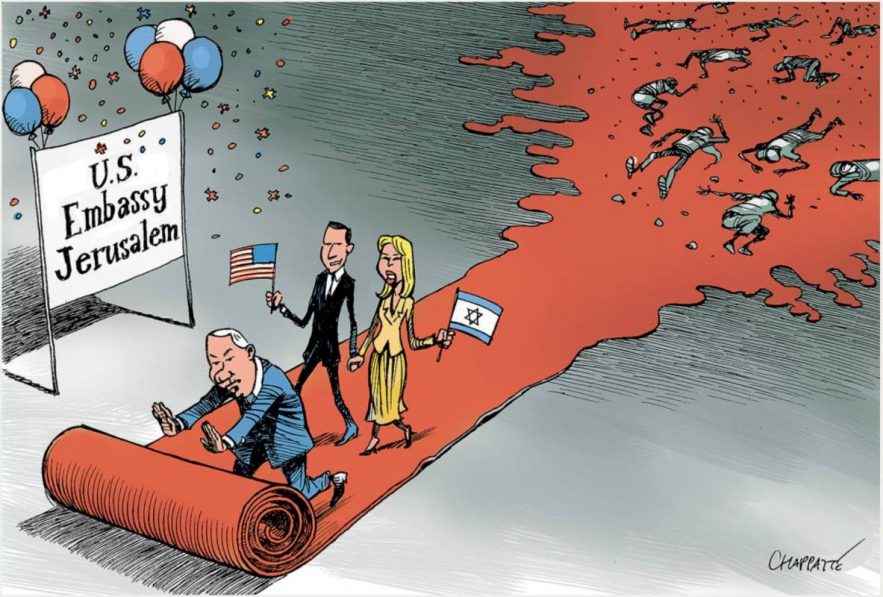
US embassy moved to Jerusalem – Cartoon [Chappatte/Twitter]
Since Trump announced that he would move the US embassy to Jerusalem last December, only Guatemala and Paraguay have followed suit. However, within months of relocating its mission, Paraguay reversed the decision and moved the embassy back to Tel Aviv, citing a desire to support “broad, lasting and just peace” among Israelis and Palestinians.
Other countries have toyed with the idea of moving their embassies to Jerusalem but have been hesitant to follow through with the move. In October, it emerged that Australia was contemplating relocating its embassy, with Prime Minister Scott Morrison saying that he was “open-minded” about it. “No decision has been made regarding the recognition of a capital or the movement of an embassy […] but at the same time, what we are simply doing is being open to that suggestion,” he explained.
This prompted a furious backlash from Malaysia and Indonesia, two countries that have historically been supportive of the Palestinian cause. Australia has not yet acted on any such plans, with reports emerging yesterday that a decision is “still pending”.
Jewish temple activists set up altar for animal sacrifice in Jerusalem
Palestine Information Center – December 11, 2018
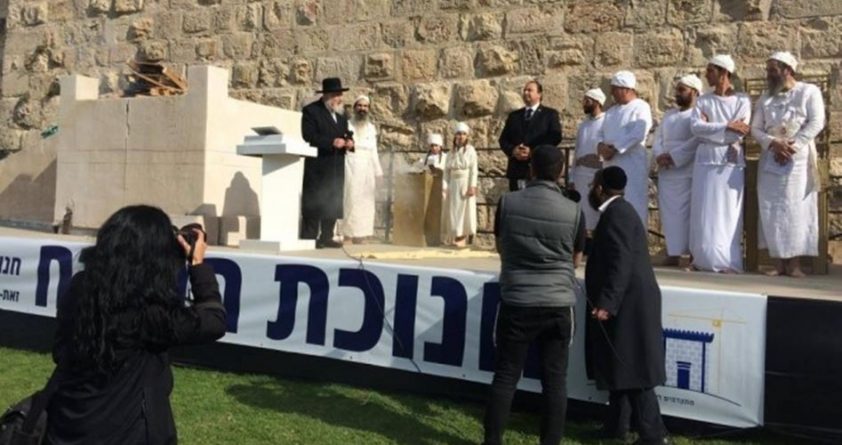
OCCUPIED JERUSALEM – Jewish activists, who hope to see the temple mount built in place of the Aqsa Mosque, unveiled a new altar in Occupied Jerusalem Monday, which they say is intended to be placed in the future on the mount after removing the Mosque and used to offer animal sacrifices.
According to Haaretz newspaper, these activists, who are preparing for a rebuilt temple by recreating some of the ancient tools used in temple rituals, have been practicing, for the past decade, the offering of sacrifices in the days before Passover.
On Monday, the activists wanted to practice using the altar but had to make do with only part of the service because the Israeli Jerusalem municipality refused to let them slaughter an animal in a public park.
“In the end, there will be a grander altar, but for the time being we have this, and the moment they open the gates we’re ready to take it up to the temple mount,” senior temple mount activist Shimshon Elboim told the newspaper.
So far the practice sessions have included slaughtering an animal and offering it on a temporary altar of wood in an area near the western wall of the Mosque
On Monday, the activists wanted to execute the complete ritual of slaughtering the animal and offering it after they received a permit from the police for that, but the municipality’s legal adviser rejected their request to slaughter an animal in a public park outside the Old City walls, thus the sheep earmarked for this purpose was taken to another location to be slaughtered.
“What we still have to do is awaken the people,” Elboim said. “There is slow but sure progress, and if the authorities allow it, tomorrow we can do the whole service.”
Seeking protection for the Palestinians at the UN empowers the criminals
By Ramona Wadi | MEMO | December 11, 2018
The debate on whether Palestinians should be granted international protection continues. Adalah’s November 2018 Report to the UN Independent Commission of Inquiry on the 2018 Protests in the Occupied Palestinian Territories says that, since Israel “failed to exercise its criminal jurisdiction over those responsible for the violation of such serious crimes”, thus upholding impunity, there is a “pressing need for international actors to take action to provide remedies and accountability for Palestinian victims of the 2018 protests.”
As Israeli snipers killed and maimed Palestinians participating in the Great March of Return protests, calls for international protection increased. In June, the UN General Assembly adopted a resolution on protecting Palestinian civilians which required the UN Secretary General to submit a report within 60 days with proposals on how to implement the resolution. Much more than 60 days have passed and the Palestinians still have neither António Guterres’s proposals nor international protection.
While the theory might sound in order, the reality reveals how macabre it is to trust in UN institutions. There are many discrepancies between human rights and institutions which have trapped many NGOs concerned with such rights into playing a role that is dissociated from the people they are supporting. Some have aligned with the UN’s interests, preferring the rhetoric of allegations rather than outright allegations that Israel is committing war crimes for all to see.
Other NGOs are attempting to secure the protection of Palestinian rights within a framework that is already corrupted. The result is that the recommendations, although made in the best interests of the people of Palestine, are likely to go unheeded or, if implemented, will still be detrimental to those they are meant to help due to the international community’s upholding of Israel’s colonial agenda.
If human rights serve the institutions’ purposes and not the people, reaching out to the international community for the protection of Palestinians is as farcical as expecting Israel to demonstrate its accountability. The UN created the foundations for Israel’s impunity and the truth is simple; upholding Palestinian rights will unravel the organisation’s stability due to the fact that it will have to face its trajectory of violence inflicted upon the Palestinian population.
There is thus no international protection for Palestinians. If NGOs and activists continue to look towards the international community for help, they will be maintaining another cycle of complacency in which the echelons that can make a difference will continue to pass defunct resolutions to add to the UN archives. Human rights violations have continued in part precisely because the world has been coerced into looking towards the privileged to allow rights to trickle down. The UN and human rights are synonymous, so it is important to dispel that narrative and expose the organisation’s role in maintaining the cycle of human rights violations.
One way to do this is to refrain from seeking international protection that will in any case never be forthcoming. If the international community really wanted to protect Palestinians, it would have done so years ago. Moreover, looking for solutions from the same entities that encouraged the colonisation of Palestine in the first place (and continue to do so), does not empower the Palestinians.
The only way forward is to shatter the façade encouraged by the UN and find ways of supporting Palestinians from within. If the UN really cares about human rights, it should step down off its pedestal and, for a change, follow the meaning of liberation from within the Palestinian narrative, not Israel’s. Until it is ready and willing to do that, seeking protection for the Palestinians from the international organisation only empowers and emboldens the criminals.
Featured Video
or go to
Aletho News Archives – Video-Images
Book Review
The Maidan Killings and the False-Flag Case
By Freddie Ponton | 21st Century Wire | September 5, 2026
Before the killings that helped bring down Ukraine’s president in February 2014, American diplomats were discussing who should enter its government. In a leaked telephone call, senior State Department official Victoria Nuland told US ambassador Geoffrey Pyatt, “I think Yats is the guy,” referring to opposition leader Arseniy Yatseniuk. Washington had clear preferences and was working to advance them. Later that month, Yatseniuk became prime minister.
Ivan Katchanovski’s The Maidan Massacre in Ukraine examines the violence that preceded that transfer of power. Drawing on television footage, witness testimony, forensic examinations and Ukrainian court proceedings, he argues that elements of the opposition shot protesters and police in a false-flag operation. His case centres on evidence of protesters being shot from opposition-controlled locations, including Hotel Ukraina, overlooking the killing ground. … continue
Blog Roll
 Aletho News
- Israel expands “incitement” charge to target Palestinian education and memory
- How Israel seeks to reshape Arab classrooms
- Paris bans pro-Palestinian demonstration planned for Oct. 7 over ‘risks of public disorder’
- In August Hanning Treason Case – All Signs Point To Tel Aviv.
- France cleared dozens of military sales to Israel between May and September: Report
- France projects nuclear power as Macron pushes arsenal expansion
- The fallacy of US delusions about Iran’s economic collapse
- What changes with Lula or Flávio?
- Britain leads Western media’s demise through ‘fear porn’ narrative
- The Maidan Killings and the False-Flag Case
- If Americans Knew
- Soldier testimony sheds light on how Israel wages information war
- CIA Report Warns Israel Could Head Toward Civil War, Total Collapse
- Banker Who Exposed Howard Lutnick’s Ties to Epstein Warned of ‘Retaliation’ and ‘Personal Consequences’ in Last Post Before Suicide
- Israeli Attacks Kill Two Palestinians in Gaza
- Gaza genocide at 3: Israeli-U.S. cruelty and the smart, deep resistance to it are changing the world
- As genocide is about to enter 3rd year, little of Gaza remains– Daily Update
- “We See Our Homes Now From A Satellite, Like Strangers”
- Watch “Gaza: Doctors Under Attack”, originally censored by BBC
- NAZA: Israeli embassies in UK and US promote rival documentary to challenge Gaza genocide allegations
- David Ellison appoints Israeli to lead merged Paramount-Warner studios
- No Tricks Zone
- Latest European Green Energy Debacle; Portugal’s Largest Flagship Solar Park Insolvent!
- Green Energy Debacle: German Expert Professor Fritz Vahrenholt Warns Of Severe Economic And Social Consequences
- Two More Paleo Reconstructions Affirm Meters-Higher Sea Levels Across Ireland, Brazil 7000-6000 Years Ago
- New Study: Earth And Venus Surface Warmth Largely Explained By Convection And Lapse Rate, Not CO2 Or Radiation
- 2025 Nature Paper Claiming Worsening Global Drought Gets RETRACTED …Heavily Flawed
- New Study: ‘Global Drought Shows No Detectable Recent Acceleration Under Climate Warming’
- Economic Masterminds: German Socialists Suggest Taxing Productivity Gains Stemming From Using AI
- The South China Sea Has Not Been Cooperating With The Climate Change Narrative
- Energy Crisis: Germany Enters Heating Season With Historically Low Gas Reserve Fill Levels
- New Study: The Antarctic Ice Sheet Gained Mass From 2020-2024 Due To Staggering Snow And Ice Accumulation

