Syria Presents Proof on Chemical Weapons Terror Attack Preparations – UN Envoy
Sputnik – August 30, 2018
Late last week, Russian Defense Ministry spokesman Igor Konashenkov said that the White Helmets group plans to film videos for Middle Eastern and English-language media outlets after staging a false-flag chemical weapons attack in Syria in order to further destabilize the war-torn country.
Damascus has handed documents to the UN to prove that al-Nusra Front terrorists plan to conduct a chemical weapons attack in the northwestern Syrian province of Idlib and point the finger at the country’s government, according to Syria’s UN envoy Bashar Jaafari.
Iran’s Fars news agency cited Jaafari as saying that any aggression against Syria “would be an aggression against a United Nations founding state, as well as against global peace and security, and would amount to supporting terrorism.”
He recalled that Syria did not have chemical weapons, reiterating Damascus’ adherence to its obligations related to the Organization for the Prohibition of Chemical Weapons (OPCW).
Jaafari emphasized that Damascus condemns any use of chemical weapons and considers it “to be immoral.”
His statement came after Russian Deputy Foreign Minister Sergey Ryabkov said that Moscow had urged Germany and the US to influence the armed opposition in Syria’s Idlib province amid possible provocations pertaining to the use of chemical weapons in the area.
Ryabkov referred to the al-Nusra Front, which he suggested was plotting “a very serious provocation” in the Idlib area with the use of chemical weapons. According to him, the White Helmets group in Syria will film a video of this “chemical weapons attack” in order for the US and its allies to use it as a pretext for massive airstrikes on Syria.
Earlier, Alexei Kondratyev, deputy chair of the Russian Upper House’s Defense and Security Committee, told Sputnik that Moscow was concerned about Washington’s military build-up in the Mediterranean near the Syrian coast.
“The United States is strengthening its naval task force in the Mediterranean Sea not far from Syria. This is done to prepare for the strike. So, it should be expected that in the event of a provocation and a decision to deliver strikes against Syria, the missiles will be launched both from the air, and from the sea,” he pointed out.
Kondratyev made the remarks as USS The Sullivans, a destroyer with 56 cruise missiles on board, arrived in the Persian Gulf late last week, while a US В-1В bomber carrying 24 air-to-surface cruise missiles was deployed at Al Udeid air base in Qatar.
While the White Helmets, a Syrian humanitarian non-government organization, claims to have saved tens of thousands of lives, Moscow and Damascus insist that the group had ties with terrorists and extremists.
On April 14, the US, Britain and France launched 103 cruise and air-to-surface missiles at government facilities in Syria, in response to the alleged April 7 chemical attack in the Damascus suburb of Douma. Most of the missiles were intercepted by Syrian air defenses.Russia’s President Vladimir Putin denounced the missile strikes as an act of aggression against a sovereign country as neither Russian experts nor local residents in Douma confirmed that any chemical attack had actually taken place there.
Last Sunday, Syrian Ambassador to Russia Riyad Haddad confirmed that Damascus eliminated all of its chemical arsenal in 2013 and that Syria “never used and will not use chemical weapons.”
READ MORE:
State Department Says US Will Respond to Chemical Weapons Use in Idlib, Syria
Macron: France Ready to Conduct New Strikes on Syria if Chemical Weapons Used
Syria Got Rid of Chemical Weapons, OPCW Confirmed Destruction — Russian FM
The 10 Main Holes in the Official Narrative on the Salisbury Poisonings: #5 – The Feeding of the Ducks
By Rob Slane | The Blog Mire | August 27, 2018
In the previous piece, I began to focus on the official timeline of events on March 4th, as stated by The Metropolitan Police on 17th March, noting that there is a missing 4 hours in the morning, which investigators were very anxious to receive information on at the time, but which they have been conspicuously silent on since. Not only have they failed to update the timeline with information about the Skripals movements on the morning of 4th March, but they have failed to do so despite now having that information. How can I be sure they have it? Because both Sergei and Yulia Skripal have been awake and talking for months now.
But in this piece, I want to focus on something even more important. Something that is crucial for two reasons:
- Firstly, the Metropolitan Police do not mention it in their timeline, even though it absolutely did happen and is vital.
- Secondly, it completely demolishes the theory that the Skripals were poisoned by touching a nerve agent on the handle of Mr Skripal’s front door.
The incident in question is the duck feed. But before I come on to it, let’s just remind ourselves of the official timeline once more, so that we can then see where this incident fits in:
Saturday 3rd March
14.40hrs on Saturday 3 March: Yulia arrives at Heathrow Airport on a flight from Russia.
Sunday 4th March
09.15hrs on Sunday, 4 March: Sergei’s car is seen in the area of London Road, Churchill Way North and Wilton Road.
13.30hrs: Sergei’s car is seen being driven down Devizes Road, towards the town centre.
13:40hrs: Sergei and Yulia arrive in Sainsbury’s upper level car park at the Maltings. At some time after this, they go to the Bishops Mill Pub in the town centre.
14.20hrs: They dine at Zizzi Restaurant.
15:35hrs: They leave Zizzi Restaurant.
16.15hrs: Emergency services receive a report from a member of the public and police arrive at the scene within minutes, where they find Sergei and Yulia extremely ill on a park bench near the restaurant.
One of the things that is immediately obvious about this timeline is its astonishing vagueness in certain places. For instance, Mr Skripal’s car was apparently seen in three different areas — London Road, Churchill Way North and Wilton Road — at 9:15. Presumably it was seen on CCTV cameras in these locations, and presumably these cameras all have time and date stamps. In which case, why could the timeline not be more precise than suggesting that Mr Skripal’s car was at three locations at the same time?
But the vagueness of the time and location of the car in the morning really is small fry compared to the time and location given at 13:40hrs:
“Sergei and Yulia arrive in Sainsbury’s upper level car park at the Maltings. At some time after this, they go to the Bishops Mill Pub in the town centre.”
At some time after this? What exactly is that supposed to mean? Were there not CCTV cameras in The Maltings and in The Mill that could give a more precise timeline? The unnerving thing – given that this is one of the biggest and most important investigations Britain has ever seen – is that yes indeed there were. And yet what these cameras show has either been ignored in the timeline altogether, or incorporated into it in some sort of vague and nebulous way that – and I don’t know how else to process it – frankly looks very suspect.
I’ll come on to the bit about The Mill in the next piece, but before we get there, perhaps we can jog the memories of investigators by reminding them of a piece of CCTV footage that they certainly do have, which is time stamped, and which shows clearly where Sergei Skripal and Yulia were at a particular time.
After parking the car, at 1:40pm, the two of them were seen near the Avon Playground, in The Maltings, feeding ducks with some local boys. This was at 1:45pm and has been confirmed to me by one of the boys’ mothers, who was shown the CCTV footage by the police, which she said was really clear. She also confirmed to me that Mr Skripal was wearing jeans and a leather jacket, and that Yulia Skripal had a red bag.
The Metropolitan Police apparently don’t think the duck feeding incident important enough to include in their timeline, and so after the parking of the car, we are treated to the vague statement that, “at some time after this, they go to the Bishops Mill Pub.”
But it is incredibly important, for the following reason: it totally, completely and comprehensively debunks the idea that Mr Skripal was poisoned at his home, after his hand came into contact with a deadly nerve agent on the handle of his front door. Why?
BECAUSE HE HANDED BREAD TO THE BOYS, AND NONE OF THEM BECAME CONTAMINATED, THAT’S WHY!
Think about it. Zizzis has remained shut since the incident, because it was apparently contaminated, and the table that the Skripals ate their meal at “had to be destroyed” because of the apparently high concentration of nerve agent there. Likewise, The Mill has been closed ever since. And of course the bench too had to be destroyed, since it was apparently contaminated.
But these were all places visited by the Skripals AFTER the feeding of the ducks.
And so we are asked to believe the following preposterous notion: That Sergei and Yulia Skripal’s hands were contaminated with “military grade nerve agent” at the door of Mr Skripal’s house, so much so that certain places they visited on that afternoon had to undergo months of decontamination, and certain items they touched had to be destroyed.
And yet in between getting the nerve agent on their hands at the door, and the visits to those locations, Mr Skripal was seen on CCTV, at 1:45pm, handing bread to local boys to give to the ducks. With his contaminated hands, apparently. And one of those boys even ate a piece. And yet none of those boys managed to become contaminated the by the “military grade nerve agent” on Mr Skripal’s hands?
No amount of “they might have been wearing gloves” will do. Firstly, the temperature was actually quite warm (8-9 degrees) and so it’s unlikely that they were wearing gloves; secondly, who actually tears bread from a loaf whilst wearing gloves (probably nobody, is my guess); but thirdly, gloves apparently weren’t enough protection to prevent D.S. Bailey from becoming contaminated, allegedly at the door handle.
No, there is no way out of this. The duck feeding incident leaves the “nerve agent on the door handle” theory in tatters. If the duck feed happened – which it did – then the “Skripals becoming contaminated with nerve agent on the door handle” did not happen. To continue to believe that it did, in the light of Mr Skripal handing bread to boys, not one of whom became contaminated, is to cast off all reason and enter a twilight world of the absurd.
But it does at least explain why the incident doesn’t make it onto the timeline!
The 10 Main Holes in the Official Narrative on the Salisbury Poisonings: #1 – The Motive
The 10 Main Holes in the Official Narrative on the Salisbury Poisonings: #2 – The Intent
The 10 Main Holes in the Official Narrative on the Salisbury Poisonings: #3 – The Capability
The 10 Main Holes in the Official Narrative on the Salisbury Poisonings: #4 – The Missing Four Hours
The 10 Main Holes in the Official Narrative on the Salisbury Poisonings: #6 – The Meal and The Drink
Skripals – When the BBC Hide the Truth
By Craig Murray | August 27, 2018
On 8 July 2018 a lady named Kirsty Eccles asked what, in its enormous ramifications, historians may one day see as the most important Freedom of Information request ever made. The rest of this post requires extremely close and careful reading, and some thought, for you to understand that claim.
Dear British Broadcasting Corporation,
1: Why did BBC Newsnight correspondent Mark Urban keep secret from the licence payers that he had been having meetings with Sergei Skripal only last summer.
2: When did the BBC know this?
3: Please provide me with copies of all correspondence between yourselves and Mark Urban on the subject of Sergei Skripal.
Yours faithfully,
Kirsty Eccles
The ramifications of this little request are enormous as they cut right to the heart of the ramping up of the new Cold War, of the BBC’s propaganda collusion with the security services to that end, and of the concoction of fraudulent evidence in the Steele “dirty dossier”. This also of course casts a strong light on more plausible motives for an attack on the Skripals.
Which is why the BBC point blank refused to answer Kirsty’s request, stating that it was subject to the Freedom of Information exemption for “Journalism”.
10th July 2018
Dear Ms Eccles
Freedom of Information request – RFI20181319
Thank you for your request to the BBC of 8th July 2018, seeking the following information under the
Freedom of Information Act 2000:
1: Why did BBC Newsnight correspondent Mark Urban keep secret from the licence payers that he
had been having meetings with Sergei Skripal only last summer.
2: When did the BBC know this?
3: Please provide me with copies of all correspondence between yourselves and Mark Urban on the
subject of Sergei Skripal.
The information you have requested is excluded from the Act because it is held for the purposes of
‘journalism, art or literature.’ The BBC is therefore not obliged to provide this information to you. Part VI
of Schedule 1 to FOIA provides that information held by the BBC and the other public service broadcasters
is only covered by the Act if it is held for ‘purposes other than those of journalism, art or literature”. The
BBC is not required to supply information held for the purposes of creating the BBC’s output or
information that supports and is closely associated with these creative activities.
The BBC is of course being entirely tendentious here – “journalism” does not include the deliberate suppression of vital information from the public, particularly in order to facilitate the propagation of fake news on behalf of the security services. That black propaganda is precisely what the BBC is knowingly engaged in, and here trying hard to hide.
I have today attempted to contact Mark Urban at Newsnight by phone, with no success, and sent him this email:
To: mark.urban@bbc.co.uk
Dear Mark,
As you may know, I am a journalist working in alternative media, a member of the NUJ, as well as a former British Ambassador. I am researching the Skripal case.
I wish to ask you the following questions.
1) When the Skripals were first poisoned, it was the largest news story in the entire World and you were uniquely positioned having held several meetings with Sergei Skripal the previous year. Yet faced with what should have been a massive career break, you withheld that unique information on a major story from the public for four months. Why?
2) You were an officer in the Royal Tank Regiment together with Skripal’s MI6 handler, Pablo Miller, who also lived in Salisbury. Have you maintained friendship with Miller over the years and how often do you communicate?
3) When you met Skripal in Salisbury, was Miller present all or part of the time, or did you meet Miller separately?
4) Was the BBC aware of your meetings with Miller and/or Skripal at the time?
5) When, four months later, you told the world about your meetings with Skripal after the Rowley/Sturgess incident, you said you had met him to research a book. Yet the only forthcoming book by you advertised is on the Skripal attack. What was the subject of your discussions with Skripal?
6) Pablo Miller worked for Orbis Intelligence. Do you know if Miller contributed to the Christopher Steele dossier on Trump/Russia?
7) Did you discuss the Trump dossier with Skripal and/or Miller?
8) Do you know whether Skripal contributed to the Trump dossier?
9) In your Newsnight piece following the Rowley/Sturgess incident, you stated that security service sources had told you that Yulia Skripal’s telephone may have been bugged. Since January 2017, how many security service briefings or discussions have you had on any of the matter above.I look forward to hearing from you.
Craig Murray
I should very much welcome others also sending emails to Mark Urban to emphasise the public demand for an answer from the BBC to these vital questions. If you have time, write your own email, or if not copy and paste from mine.
To quote that great Scot John Paul Jones, “We have not yet begun to fight”.
The 10 Main Holes in the Official Narrative on the Salisbury Poisonings: #4 – The Missing Four Hours
By Rob Slane | The Blog Mire | August 25, 2018
According to the Metropolitan Police investigation into the poisoning of Sergei and Yulia Skripal, the official timeline of their movements on the weekend of the incident is as follows:
Saturday 3rd March
14.40hrs on Saturday 3 March: Yulia arrives at Heathrow Airport on a flight from Russia.
Sunday 4th March
09.15hrs on Sunday, 4 March: Sergei’s car is seen in the area of London Road, Churchill Way North and Wilton Road.
13.30hrs: Sergei’s car is seen being driven down Devizes Road, towards the town centre.
13:40hrs: Sergei and Yulia arrive in Sainsbury’s upper level car park at the Maltings. At some time after this, they go to the Bishops Mill Pub in the town centre.
14.20hrs: They dine at Zizzi Restaurant.
15:35hrs: They leave Zizzi Restaurant.
16.15hrs: Emergency services receive a report from a member of the public and police arrive at the scene within minutes, where they find Sergei and Yulia extremely ill on a park bench near the restaurant.
Whilst fully realising that such a timeline does not necessarily need to include every detail, such as the time that Yulia arrived in Salisbury on the Saturday afternoon, nevertheless, there are some serious problems with this account, which are broadly as follows:
- Firstly, it omits crucial information from the morning of 4th March.
- Secondly, it ignores a very important incident on the afternoon of 4th March.
- Thirdly, it is, I believe, incorrect in the sequence of events it presents.
In this piece, I want to concentrate on the first one of these — the morning — and then cover the second and third in subsequent pieces.
When the timeline above was released by the Metropolitan Police on 17th March, the whereabouts of the Skripals on the morning of 4th March was unknown. At the press conference in which the timeline was released, Deputy Assistant Commissioner, Neil Basu, who is in charge of the investigation, appealed for information about their movements on the morning of 4th March:
“We believe that at around 9.15am on Sunday 4 March, Sergei’s car may have been in the areas of London Road, Churchill Way North and Wilton Road. Then at around 1.30pm it was seen being driven down Devizes Road, towards the town centre.
We need to establish Sergei and Yulia’s movements during the morning, before they headed to the town centre. Did you see this car, or what you believe was this car, on the day of the incident? We are particularly keen to hear from you if you saw the car before 1.30pm. If you have information, please call the police on 101″ [my emphasis].
Although the Skripals’ movements were unknown, it had been thought that they visited the cemetery on London Road, since there were apparently fresh flowers on the grave of Mr Skripals wife, Liudmila. But there was one very important piece of information that was known, which was extremely interesting. According to The Times:
“The Russian spy and his daughter poisoned by nerve agent turned off the GPS tracking on their mobile telephones for four hours on the day they were attacked, it was reported yesterday.”
That piece of information alone is enough to make those missing four hours in the morning vital to any investigation. There must have been a reason for the Skripals to make their phones untraceable during that time and – with apologies for stating the blindingly obvious – it was clearly because they did not want their movements at that time to be known. The most plausible explanation for this would seem to be that they had some kind of meeting that morning, a meeting which was important and secret enough for them not to want certain other people knowing where they were and what they were doing.
It is entirely understandable that the Metropolitan Police did not include details of the Skripals’ movements on the morning of 4th March in the timeline they released on 17th March, since they did not know them at that time. And given that the Skripals had made their phones untraceable, it is also entirely understandable why the Metropolitan Police desperately wanted people to come forward with information about the four hour time period.
But here’s the thing: More than five months later, and this timeline has not been updated. Not only this, but the Metropolitan Police have gone mysteriously quiet about this part of the timeline. Why mysterious? Simply because Sergei and Yulia Skripal have been awake and talking for months, and unless they have steadfastly refused to tell investigators what they were doing on that morning – which is frankly inconceivable – then the Metropolitan Police must know where they were and what they were doing on that morning. And yet they’ve stopped talking about it and have not updated their timeline since 17th March.
Which raises the following questions:
- Where were Sergei and Yulia Skripal on the morning of 4th March?
- What were they doing?
- Why did they feel the need to turn off the GPS tracking on their phones?
- Were they meeting someone, and if so who?
- Why has the Metropolitan Police not updated its timeline to include the Skripals’ whereabouts that morning, since it must by now be well aware of them?
The 10 Main Holes in the Official Narrative on the Salisbury Poisonings: #1 – The Motive
The 10 Main Holes in the Official Narrative on the Salisbury Poisonings: #2 – The Intent
The 10 Main Holes in the Official Narrative on the Salisbury Poisonings: #3 – The Capability
The 10 Main Holes in the Official Narrative on the Salisbury Poisonings: #4 – The Missing Four Hours
The 10 Main Holes in the Official Narrative on the Salisbury Poisonings: #6 – The Meal and The Drink
Russia: US plans new Syria strike with false flag attack
Press TV – August 25, 2018
The Russian Defense Ministry says the US, Britain and France are preparing to conduct a fresh aerial assault against Syria under the pretext of the alleged use of chemical weapons by the Damascus government.
The ministry spokesman Major General Igor Konashenkov said on Saturday that a group of militants, who were trained by a private British military company to work with poisonous materials, had already arrived in Syria’s northwestern Idlib Province.
“To carry out the alleged ‘chemical attack’ in the city of Jisr al-Shughur in the province of Idlib, militants from the Tahrir al-Sham group had delivered 8 tankers with chlorine… to a village a few kilometers from Jisr al-Shughur,” Konashenkov said.
The Russian general further warned that a possible militant gas attack on Syria would be followed by a Western strike against the Arab country.
“This provocation with the active participation of the British special services will serve as another pretext for the US, UK and France to conduct a missile strike on the Syrian government and economic facilities,” he said.
The official further noted that the American destroyer USS The Sullivans armed with 56 cruise missiles had also arrived in the Persian Gulf and a US В-1В bomber carrying 24 air-to-surface AGM-158 JASSM cruise missiles had been deployed at Al Udeid airbase in Qatar.
“Western countries’ actions in spite of their public statements are aimed at another sharp deterioration of the situation in the Middle East region and the disruption of the peace process on the territory of Syria.”
The warning comes as the Syrian army is now preparing for an operation to liberate Idlib Province, the last major militant stronghold.
Bolton’s warning
On Saturday, Bloomberg reported that US National Security Adviser John Bolton had warned his Russian counterpart, Nikolai Patrushev, that Washington was prepared to take strong military action against Syria if it used chemical weapons in Idlib.
Bolton issued the warning during his Thursday’s talks with Patrushev, the report quoted four people familiar with the discussions as saying.
On April 14, the US, Britain and France launched a coordinated missile attack against sites and research facilities near Damascus and Homs with the purported goal of paralyzing the Syrian government’s capability to produce chemicals.
The strike came one week after an alleged gas attack on the Damascus suburb town of Douma.
Both Damascus and Moscow accused the White Helmets volunteer group of having staged the suspected chemical weapons attack in Douma.
Turkey pushing against Syria’s upcoming Idlib campaign
As countdown begins for the Idlib counter-terrorism campaign, Turkey tries to avert the push, claiming that it will lead to a humanitarian crisis.
Speaking at a press conference with his Russian counterpart, Sergei Lavrov, in Moscow on Friday, Turkish Foreign Minister Mevlut Cavusoglu said that the two countries could cooperate on separating Idlib “terrorists” from opposition groups.
“A military solution there (in Idlib) will cause catastrophe,” he said. “Not only for the Idlib region but for the future of Syria, it will cause catastrophe and the clashes may last a long time.”
Lavrov, for his part, acknowledged that the situation in Idlib is “complex” and called for the separation of militants from opposition outfits.
He also said that when Turkey, Iran and Russia held talks on Syria’s ceasefire zones, Moscow did not expect militants to be “using it as a human shield” from which they could attack the government.
The 10 Main Holes in the Official Narrative on the Salisbury Poisonings: #3 – The Capability
By Rob Slane | The Blog Mire | August 23, 2018
Once again I return to Theresa May’s statement of 26th May, in which she stated the following:
“In conclusion, as I have set out, no other country has a combination of the capability, the intent and the motive to carry out such an act.”
She then went on to claim:
“We have been led by evidence not by speculation.”
However, as I showed in Part 1 and Part 2, her statement to the Commons contained no actual evidence of motive or intent. Claims and assertions, but nothing more.
But what of capability? Looking through the statement, here are the key passages that might be said to fall into this category:
“As I set out for the House in my statements earlier this month, our world-leading experts at the Defence Science and Technology Laboratory at Porton Down positively identified the chemical used for this act as a Novichok – a military-grade nerve agent of a type developed by the Soviet Union.”
“And we have information indicating that within the last decade, Russia has investigated ways of delivering nerve agents probably for assassination – and as part of this programme has produced and stockpiled small quantities of Novichoks.”
Her evidence, such that it is, therefore falls into two categories: firstly, capability with regard to the weapon allegedly used to poison the Skripals; secondly, capability with regard to method of delivery of the weapon.
There are three things to say with regard to the first category. To begin with, it is not quite the case that Porton Down scientists had “positively identified the chemical” as a “Novichok”. In the evidence presented to the High Court between 20th – 22nd March, here is how the Porton Down Chemical and Biological Analyst described the substance:
“Blood samples from Sergei Skripal and Yulia Skripal were analysed and the findings indicated exposure to a nerve agent or related compound. The samples tested positive for the presence of a Novichok class nerve agent or closely related agent [my emphasis].”
As you will notice, there is a degree of ambiguity in this statement which is not present in Mrs May’s statement made a few days later. Ought she not to have recognised this?
Secondly, it has been conclusively shown that a number of other countries either have produced, or know how to produce substances within the class of nerve agents that Mrs May referred to as “Novichoks”. The Czech Government has admitted producing a small quantity of the closely related substance, A-230; Iran has produced it, in compliance with the OPCW in 2016; The German Intelligence Agency, BND, was given the formula back in the 1990s, and they shared it with a number of other NATO countries, including the US and UK. The Edgewood Chemical and Biological Defense Command in Maryland, USA, recorded the formula back in 1998.
The point of this is not to point the finger at any of those countries. Merely to say that knowledge of and production of “Novichok” is by no means confined to one country. And in any case, according to one of the world’s leading experts in organic chemistry, David Collum, Professor of Organic Chemistry at Cornell University, it doesn’t even require a State party. He asserts that “any credible organic chemist could make Novichok nerve agents.”
The fact that other countries know how to produce “Novichoks”, and in some cases have produced it, shows the claim that its apparent use in Salisbury proves Russian culpability to be complete nonsense. It’s as silly as saying that a poisoning using VX points to Britain because VX is a type of nerve agent developed by Britain.
And thirdly, if the British Government did indeed have information that the Russian Government had a secret programme investigating ways of delivering nerve agents, and had produced and stockpiled small quantities of Novichoks, then it had an obligation to inform the OPCW under the Chemical Weapons Convention, which it apparently failed to do. Furthermore, as a State Party to the Convention, it should have raised objections in 2017, when the OPCW’s Director-General, Ahmet Üzümcü, declared the following:
“The completion of the verified destruction of Russia’s chemical weapons programme is a major milestone in the achievement of the goals of the Chemical Weapons Convention. I congratulate Russia and I commend all of their experts who were involved for their professionalism and dedication. I also express my appreciation to the States Parties that assisted the Russian Federation with its destruction program and thank the OPCW staff who verified the destruction.”
So much for Mrs May’s evidence of capability regarding the weapon, what of her evidence regarding the delivery?
When she stated that her Government had information that the Russian Government had investigated ways of delivering nerve agents, she was, I believe, referring to the alleged “assassin’s manual”, which the Government says it possesses, but will not show because it is classified, and which apparently contains information showing that Russian agents were trained in putting poison on door handles.
Three brief points about this:
1. It really is utter nonsense. Smearing poison on a door handle would be a frankly ludicrous way to target someone for assassination, since you could never be sure that your target would actually touch it (you never know, maybe a postman or a milkman or the man from Amazon might get there first).
2. Salisbury was treated to dozens of guys in Hazmat gear decontaminating certain parts of the city, since the substance in question was apparently so lethal that, according to Alastair Hay, Professor of Environmental Toxicology at the University of Leeds:
“A few millilitres would be sufficient to probably kill a good number of people.”
Are we really supposed to believe that the Russians have either:
a) Developed ways of putting this stuff on door handles without the requisite chemical protection and perhaps just a pair of Marigolds, or
b) Have people stupid enough to try.
3. But the biggest problem is this: The British Government was starting to point the finger at the Russian Government within a few days of the poisoning, and it was later stated that one of the reasons for this was the manual that they apparently possessed. But if they did indeed have this manual, and it was the reason for their apportioning of blame as early as 12th March:
a) Why was the door handle not the focus of the investigation from the very start?
b) When are those police officers who stood within feet of that door, and those who no doubt went in and out of the house using the door handle, going to sue Her Majesty’s Government for negligence and their failure to act on the intelligence they apparently had?
If there is indeed such a manual, my guess is that it was put together by a chap named Steele.
The 10 Main Holes in the Official Narrative on the Salisbury Poisonings: #1 – The Motive
The 10 Main Holes in the Official Narrative on the Salisbury Poisonings: #2 – The Intent
The 10 Main Holes in the Official Narrative on the Salisbury Poisonings: #3 – The Capability
The 10 Main Holes in the Official Narrative on the Salisbury Poisonings: #4 – The Missing Four Hours
The 10 Main Holes in the Official Narrative on the Salisbury Poisonings: #6 – The Meal and The Drink
The Three Musketeers, Poison Gas, and Dead Schoolkids
By Michael Howard | American Herald Tribune | August 23, 2018
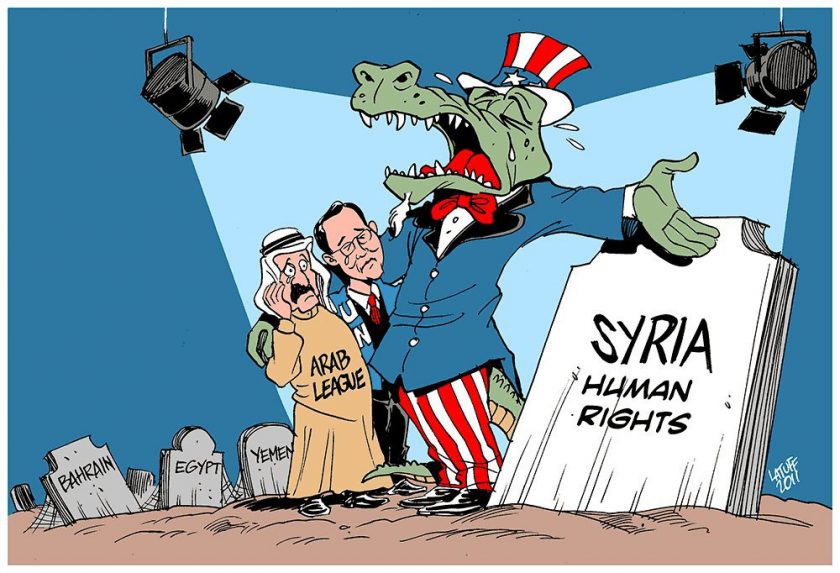
Winking and nodding to the “freedom fighters” hunkered down in the northwestern Syrian province of Idlib, the world’s schoolmarm (formally known as The West) has issued a stern warning to President Bashar al-Assad: don’t use chemical weapons “again,” or else. Said warning came via a joint statement from the US, UK and France (henceforth known as The Three Musketeers), as the Syrian government prepares its offensive to retake the country’s last remaining “rebel” stronghold. The three great and benevolent powers are “gravely concerned,” they said, about the upcoming military campaign, explaining:
We also underline our concern at the potential for further—and illegal—use of chemical weapons. We remain resolved to act if the Assad regime uses chemical weapons again. As we have demonstrated, we will respond appropriately to any further use of chemical weapons by the Syrian regime, which has had such devastating humanitarian consequences for the Syrian population.
Read it again, and take note of the crafty way in which the statement messes around with language to manipulate its target audience (us). The use of chemical weapons is accurately, and superfluously, described, and emphasized with em dashes, as “illegal,” as though there was a soul on this earth to whom this is news. Then, alluding to their coordinated missile strikes against Syria this past April, which were unleashed to much pomp and circumstance, The Three Musketeers pledge to “respond appropriately” to any such illegal action on the part of the Syrian government.
Since they insist on begging questions, we must insist on demanding answers. For instance, how “appropriate” was the aforesaid missile attack? Assuming that, in this context, a direct link exists between appropriate and legal (and only an outlaw could reject that assumption), there was certainly nothing “appropriate” about The Three Musketeers’ unilateral decision to use military force against a sovereign country last April. Quite the reverse.
The missile strike, like the one a year before, was carried out in flagrant violation of the law. There are a total of two circumstances in which the use of military force is legally justified: when greenlit by a UN Security Council resolution, or when done in self-defense, that is to say in response to a direct military attack. Neither condition was met when The Three Musketeers rocketed Syria. On the other hand, Syria is accorded the legal right under international law to strike back at its attackers, and moreover to form a coalition for that purpose. As Chapter VII Article 51 of the UN Charter states:
Nothing in the present Charter shall impair the inherent right of individual or collective self-defense if an armed attack occurs against a Member of the United Nations, until the Security Council has taken measures necessary to maintain international peace and security.
Mildly ironic, then—is it not?—that, in “appropriately” bombing the Syrian government, we granted it the legal right to bomb us back? It’s a crying shame: if only Assad and his allies were sufficiently nihilistic … we could’ve had another exhilarating World War on our hands—the third and last. To borrow a quote from of Trump’s favorite general: “Compared to war, all other forms of human endeavor shrink to insignificance. God help me, I do love it so.” On that note, I think it’s high time we substitute “War” for “God” in our Republic’s official motto. Who besides Rand Paul would vote against the proposal?
All of which is to say nothing of the fact that the alleged chemical attack in Douma, which served as the pretext for The Three Musketeers’ “appropriate” bombing raid, almost certainly didn’t happen. The first chink in the armor came in the form of Robert Fisk’s report, from the actual site of the alleged attack, that quotes a local doctor as saying:
There was a lot of shelling [by government forces] and aircraft were always over Douma at night—but on this night, there was wind and huge dust clouds began to come into the basements and cellars where people lived. People began to arrive here suffering from hypoxia, oxygen loss. Then someone at the door, a “White Helmet”, shouted “Gas!” and a panic began. People started throwing water over each other. Yes, the video was filmed here, it is genuine, but what you see are people suffering from hypoxia—not gas poisoning.
By his own count, Fisk interviewed more than twenty Douma residents; he was unable to find a single person “who showed the slightest interest in Douma’s role in bringing about the Western air attacks. Two actually told me they didn’t know about the connection.” Moreover, many of those he spoke with told him they “never believed in” the chemical weapons narratives promulgated by Western media.
Despite the fact that it squared with the Syrian Observatory For Human Rights’ (the West’s go-to authority on the Syrian conflict) assessment of the event, Fisk’s journalism was easy enough for Western ideologues to ignore or deride. He’s only one person, they countered, and he only spoke to a handful of residents and a single doctor, all of whom probably have a pro-Assad agenda. Therefore, his report is worthless and so is he.
This position grew a little less tenable when, a week after Fisk’s story was published, Russia presented to the Organization for the Prohibition of Chemical Weapons (OPCW), which was holding a conference in the Hague, seventeen eyewitnesses, a mix of residents and doctors, all of whom testified that there had been no chemical attack in Douma. As Jonathan Cook explained (yes, one had to visit his personal blog or some equally marginal source to read about this), “the US, UK and France boycotted the meeting, denouncing Russia for producing the witnesses and calling the event an ‘obscene masquerade’ and ‘theatre’”—not a very surprising reaction from a self-righteous party whose fabricated narrative is coming apart at the seams.
Then came the coup de grâce. On July 6, the OPCW published the conclusion of its fact-finding mission in Douma. Before quoting from it, I’ll jog your memory a bit. According to the Western version of events, Assad used both sarin and chlorine (or perhaps a physical mixture of the two, a nonsensical theory), in his attack on Douma—which, incidentally, had already effectively “fallen,” raising questions as to why Assad would feel compelled to use chemical weapons at all, apart from the sheer sadistic fun of it. Regardless, sarin and chlorine, said the West. Not so, said the OPCW:
OPCW designated labs conducted analysis of prioritized samples. The results show that no organophosphorous nerve agents or their degradation products were detected in the environmental samples or in the plasma samples taken from alleged casualties [my emphasis]. Along with explosive residues, various chlorinated organic chemicals were found in samples from two sites, for which there is full chain of custody. Work by the team to establish the significance of these results is on-going. The FFM team will continue its work to draw final conclusions.
Not a trace of sarin, in other words. Attempting to ascertain why “various chlorinated organic chemicals” were found at the site is a pointless exercise for someone, like myself, who knows nothing of chlorinated organic compounds. The most perfunctory research indicates that such chemicals are used for a variety of non-murderous applications, for example as solvents, and that they stick around for a long time after they’ve been introduced to an environment. The basic point, which hordes of media fixers promptly got to work obscuring, is that the Western narrative was false. The US government, in concert with its unctuous allies, lied. Go figure.
Of course, this isn’t the first time a supposed chemical attack in Syria has been called into question. Those curious about whether Assad used sarin to murder hundreds of civilians in the suburb of Ghouta in 2013, as was, and is, claimed by The West, would do well to read two essays by Seymour Hersh—“The Red Line and the Rat Line” and “Whose Sarin”—both published in the London Review of Books, both available online. Hersh also examined the chemical incident that took place in Khan Sheikhoun in April 2017—also used as a pretext for illegal US military action. This time, however, his reporting was too heretical even for the London Review of Books (not to mention the New Yorker), and so had to be published in Die Welt, which no one in the US has ever heard of, let alone read. That Hersh, the preeminent investigative journalist of his time, has been pushed into no man’s land speaks to how narrow the spectrum of permissible discourse has become in this, our great Republic. The schoolmarm is cracking her whip. At this rate Hersh will soon be relegated to the personal blog.
For other dissident views re: chemical weapons in Syria, do yourself a favor and consult the work of former UN weapons inspector Scott Ritter and MIT professor and munitions expert Theodore Postol, as well as the late journalist Robert Parry of Consortium News, all of whom have written extensively, and cogently, on the subject. Or you can keep reading the Washington Post. You’re free to decide.
But what exactly did The Three Musketeers have in mind when they broadcast their latest threat? It’s a fair question to ask. On its face, the statement appears to reflect a genuine aversion to poison gas, and a genuine hope that the Syrian government will refrain from using any in Idlib. Fair enough. Having said that, how averse could they really be, given that gas attacks provide for them the only remotely plausible excuse to lob more cruise missiles out of the Mediterranean—an activity from which they, and their media sidekicks, derive the utmost pleasure? They are, after all, incorrigible hawks. It must cut them to the bone to have to stand by and watch from the sidelines as a perfectly good war winds down, handcuffed, helpless to effect the desired outcome. How pitiable the plight of the poor impotent imperialist! Flaming warmongers need love too.
Anyway, call me schizophrenic, but when I read the words of The Three Musketeers, I couldn’t help but pick up the faint sound of a dog whistle—aimed straight at the “moderate rebels” holding down the fort in Idlib. Read between the lines, the statement is an assurance to one party dressed up as a warning to another. If there’s a “chemical incident,” we will attack: you have our word. That’s the message sent to, and received by, al-Qaeda (I don’t know what they’re calling themselves these days, and I care less) and its various affiliates. Make no mistake: The Three Musketeers have just invited, oh-so-subtly, bin-Laden’s foot soldiers to stage a chemical atrocity in Idlib (God knows how many “various chlorinated organic chemicals” they’ve got on hand there), the resulting pictures of which will duly splash across every television screen in America so as to whip up … well, you’ve heard this song before.
So here’s a new one: a bunch of kids walk onto a school bus in Yemen. As the bus steers through a crowded marketplace, Saudi Arabia drops a bomb on it, killing forty small children and injuring scores more. The bomb is later identified as a “laser-guided” precision missile (precision being the operative word), manufactured by our very own Lockheed Martin, while the mangled school bus is described by Col. Turki al-Maliki, spokesman for the Saudi-led coalition, as a “legitimate target.” Meanwhile, back in illustrious Washington, Pentagon bureaucrat Rebecca Rebarich is asked to comment on the “legitimate” massacre of forty schoolkids.
“The US has worked with the Saudi-led coalition to help them improve procedures and oversight mechanisms to reduce civilian casualties,” she says. “While we do not independently verify claims of civilian casualties in which we are not directly involved, we call on all sides to reduce such casualties, including those caused via ballistic missile attacks on civilian population centers in Saudi Arabia.”
Translated from vapid officialese: “I don’t really give a shit.”
On the bright side, we’re “gravely concerned” about the coming battle for Idlib, where the babies are beautiful and, most importantly, the bombs that kill them are un-American.
West leading campaign of hypocrisy on use of chemical weapons: Syria
Press TV – August 23, 2018
Syria has denounced a recent statement by the US, Britain and France on the alleged use of chemical weapons by the Damascus government, saying the trio is leading a campaign of misinformation against the Arab country in line with their support for terrorists.
An official source at the Syrian Ministry of Foreign Affairs and Expatriates told SANA news agency on Wednesday that the fresh Western threats against Damascus came amid the Syrian army’s territorial gains against foreign-backed terrorists.
Washington, London and Paris, in a statement on Monday, claimed that they “shared resolve to preventing the use of chemical weapons” by the government of Syrian President Basher al-Assad.
They also noted that their position on the Damascus’ “use of chemical weapons is unchanged. As we have demonstrated, we will respond appropriately to any further use of chemical weapons” by the Syrian government.
The statement was published on the fifth anniversary of the deadly chemical attack in the Damascus suburb of Ghouta in August 2013.
Elsewhere in his remarks, the Syrian Foreign Ministry source stressed that the Western countries had once again resorted to “a campaign of threats, hypocrisy and misinformation against the Syrian Arab Republic as part of the continued declared support for the armed terrorist groups, particularly Jabhat al-Nusra and its affiliated groups.”
“Syria has repeatedly asserted that it considers the use of chemical weapons immoral and condemns its use anywhere, under any circumstance and against anyone. Syria reiterates that it has no chemical weapons,” he added.
Syria surrendered its entire chemical stockpile in 2013 to a mission led by the Prohibition of Chemical Weapons (OPCW) and the UN.
The source also said it is not Syria which uses chemical weapons, but rather the armed terrorist groups that enjoy direct support from Western and regional countries such as Saudi Arabia, Turkey and Qatar.
Syria, the source added, has recently “informed the relevant international bodies about preparations by armed terrorist organizations to use poison gas in several areas” in the country.
The statement of these countries is nothing more than a sign of support for “any chemical aggression that these terrorist organizations may undertake in the next few days to use this as a pretext for aggression against Syria, as it did in its brutal aggression on 14 April 2018.”
The Western statement seeks to “justify the use of chemical weapons by terrorist organizations, prolong the war against Syria and support the terrorist organizations,” the source pointed out.
On April 14, the US, Britain and France launched a coordinated missile attack against sites and research facilities near Damascus and Homs with the purported goal of paralyzing the Syrian government’s capability to produce chemicals.
The strike came one week after an alleged gas attack on the Damascus suburb town of Douma.
The 10 Main Holes in the Official Narrative on the Salisbury Poisonings: #2 – The Intent
By Rob Slane | The Blog Mire | August 21, 2018
In the first piece in this series exposing the holes in the official narrative of the Salisbury poisonings, I looked at Theresa May’s claim of what she said was “the motive” behind the incident. In this piece I want to move on to what she called “the intent”.
Once again, I turn to the statement she gave to the House of Commons on 26th March, as it essentially sets out sets out the Government case for what happened in Salisbury on 4th March:
“In conclusion, as I have set out, no other country has a combination of the capability, the intent and the motive to carry out such an act.”
What is meant by intent? Here is a definition from the online Legal Dictionary:
“A determination to perform a particular act or to act in a particular manner for a specific reason; an aim or design; a resolution to use a certain means to reach an end.”
Intent is not action. Nor is it motive. Rather, it is the purpose of using deliberate means to bring about a particular result. A prerequisite of showing that a person or a group of people had intent to commit a particular crime, is therefore to show that they did actually commit the crime for which you are alleging they had intent.
Say I were to claim that Brian drove his car into Bob, and that he did so with deliberate intent. If I have shown that Brian did actually drive his car into Bob, then I have the right to build a case that he did so with intent. But what if I have not actually shown that Brian drove his car into Bob? Quite simply, my statement of Brian’s intent is at best nonsense, at worst slander.
To accuse someone of doing something with intent is not therefore something which can be done blithely; rather, it is something which requires, in the first place, hard evidence to show that the person actually carried out the action. According to Mrs May, this is just what she did, since she began her speech by emphatically stating who was guilty of the poisoning:
“Three weeks ago, the Russian Federation was responsible for an attempted murder here in our country.”
And after setting out her “evidence”, such as it was, she stated that:
“In conclusion, as I have set out, no other country has a combination of the capability, the intent and the motive to carry out such an act.”
But what actually was the evidence she presented? Here it is, in all its entirety:
“Mr Speaker, we are quite clear that Russia was responsible for this act. As I set out for the House in my statements earlier this month, our world-leading experts at the Defence Science and Technology Laboratory at Porton Down positively identified the chemical used for this act as a Novichok – a military-grade nerve agent of a type developed by the Soviet Union.
We know that Russia has a record of conducting state-sponsored assassinations – and that it views some former intelligence officers as legitimate targets for these assassinations.
And we have information indicating that within the last decade, Russia has investigated ways of delivering nerve agents probably for assassination – and as part of this programme has produced and stockpiled small quantities of Novichoks.”
How much of this constitutes evidence of the guilt of the Russian Government in the Salisbury poisonings? None whatsoever. I will look in more depth at her first piece of evidence in a subsequent article, suffice it to say here that it has been amply demonstrated in many places that:
a) The fact that the Soviet Union, which was dissolved on 26th December 1991, was attempting to develop a certain type of nerve agent says nothing about where the substance used in Salisbury came from or who made it.
b) Numerous other countries have the knowledge and the capacity to create the substance mentioned, and many have in fact done just this.
 As for her other two claims, they are just that: claims. Nothing more, nothing less. They in no way constitute evidence of culpability in the Salisbury case, and certainly no court of law would accept them as such. Rather, they are simply general assertions masquerading as evidence, made in the hope that nobody would notice that this is what they are. Apparently it had exactly this effect on the lawmakers in the House she was addressing, since none of them bothered to question her about it.
What Mrs May therefore did in this statement, was to invert the legal process. Rather than proving the case that the Russian Government was behind the Salisbury poisonings, then alleging intent on this basis, she instead alleged responsibility using a series of very general claims, none of which had any specific connection to the Salisbury case, and then used this unproven guilt to allege intent. They were responsible, therefore they had intent. They had intent, therefore they were responsible. All made without any actual evidence of responsibility for the Salisbury incident, and all done without any actual evidence of intent for the Salisbury incident.
I’m almost tempted to say that she used circular reasoning, but this would be an insult to circles, which are beautiful, smooth, symmetrical shapes, as indeed it would be an insult to reasoning. It’s more like a blob. Blobby, messy, meaningless unreason, which apparently none of our nation’s MPs was able or willing to spot and hold her to account for.
There is one more thing. Two days after her statement, the Metropolitan Police Force released an update on the investigation, in which they said the following:
“This is one of the largest and most complex investigations undertaken by British counter terrorism policing and we thank the public for their continued support.
As a result of detailed forensic and scientific examination, detectives believe the Skripals first came into contact with the nerve agent at their home address. Specialists have identified the highest concentration of the nerve agent, to-date, as being on the front door of the address.
The Wiltshire Police support to the Counter Terrorism Policing Network investigation remains ongoing and is likely to do so for a number of months. It is an extremely challenging investigation and police and partners continue to manage a number of unique and difficult issues. We thank the public for their continued support.”
Three brief observations. Firstly, the investigation was extremely complex and likely to last a long time, indicating that guilt, let alone intent, cannot possibly have been established at that time. Secondly, investigators had only just begun to establish the place of the poisoning (“detectives believe…”), again indicating that guilt, let alone intent, cannot possibly have been established at that time. Yet in spite of this, Theresa May apparently already knew what happened, and had established responsibility, motive and intent. In which case, why bother wasting all that police time, effort and resources on investigating the incident. They could have saved a bob or two of taxpayers money by just asking Theresa the Seer.
The 10 Main Holes in the Official Narrative on the Salisbury Poisonings: #1 – The Motive
The 10 Main Holes in the Official Narrative on the Salisbury Poisonings: #2 – The Intent
The 10 Main Holes in the Official Narrative on the Salisbury Poisonings: #3 – The Capability
The 10 Main Holes in the Official Narrative on the Salisbury Poisonings: #4 – The Missing Four Hours
The 10 Main Holes in the Official Narrative on the Salisbury Poisonings: #6 – The Meal and The Drink
The 10 Main Holes in the Official Narrative on the Salisbury Poisonings: #1 – The Motive
By Rob Slane | The Blog Mire | August 18, 2018
When I began writing about the Skripal case, I was moved to do so by three main considerations.
Firstly, I really am passionate for the truth, and whatever the truth happens to be in this case, I strongly desire it to be made manifest. It was clear to me fairly early on that this was not happening.
Secondly, I am also very passionate about concepts such as the rule of law, innocent until proven guilty, and the apparently quaint notion that investigations should precede verdicts, rather than the other way around. And so when I saw accusations being made before the investigation had hardly begun, verdicts being reached before the facts were established, I was appalled — appalled that this was happening in what we British pride ourselves is the Mother of Parliaments, and equally appalled that this meant the investigation was inevitably prejudiced and – pardon the expression – poisoned from the off.
Thirdly, the incident happened to have taken place pretty much on my doorstep, which made it of even more interest to me.
Nothing I have seen in the intervening time has persuaded me that my initial impressions were wrong. In fact, the whiff of rodent I first detected has only become stronger as time has gone on and the case has become — frankly — farcical. Not only that, but the reaction to the case has been simply incredible. For instance, the United States expelled 60 diplomats back in March, and more recently they have effectively declared economic war on the Russian Federation – all in response to unproven and inconsistent assertions of a botched assassination attempt against an old spy in a quiet Wiltshire City. Such a response ought to raise the suspicions of any sentient being that all is not what it appears.
I still do not have any clear idea of what happened on that day, but what I am certain of is that the official narrative is not only untrue, but it is manifestly inconceivable that it could be true. There are simply too many inconsistencies, too many holes and far too many unexplained events for it to be true. And whilst part of me would dearly love to leave this wretched case behind for a while, whilst it is still ongoing, and especially as it is now being used to push us even closer to the brink of war (economic warfare is often a prelude to military warfare), I find that hard to do.
What I would therefore like to do in a series of 10 short pieces over the next couple of weeks or so, is attempt to expose some of the very many holes in the official narrative. At the end of it, I may well put it all together into one PDF, so that it can be sent somewhere, where it can be completely ignored by those that matter. Enjoy!
Number 1: The Motive
In her speech to the House of Commons on 26th March, the Prime Minister, Theresa May, said this:
“In conclusion, as I have set out, no other country has a combination of the capability, the intent and the motive to carry out such an act.”
For the purposes of this piece, I am not interested in her comments on capability or intent, but simply what she describes as “the motive”.
The first question to be asked is this: What exactly does she mean by “the motive”? By including that definite article before the word “motive”, she implies that there is only one “motive” – the motive – and that only one party – the Russian Federation – possessed this. Which is of course manifest nonsense. She might at that stage have said that they possessed “a motive”, but without looking into what Mr Skripal was up to, and the contacts he had, she was in no position to state that they had “the motive”.
Imagine the following scenario: A farmer called Boggis is found shot dead in his barn. It is known that a week earlier, he had a very public quarrel with another landowner, Bunce, about the boundaries between their lands, and that the two of them had to be separated before they came to blows. Could it be said of Bunce that he had “the motive”? Well, it would be reasonable to suggest that he had “a motive”, but without looking into other circumstances and other characters connected with Boggis, it would be disingenuous to claim that he had “the motive” as if only he might have had one.
As it happens, Boggis had been committing adultery with the wife of another neighbouring farmer called Bean, and Bean had found out about this two days before Boggis was found dead. What now? Does Bean have a motive? Very possibly. So too might Boggis’ wife. Perhaps even Bunce’s wife. Who knows without examining the facts more closely?
And so herein lies the first whiff of rodent. Mrs May asserted that the Russian Federation possessed “the motive”, implying that there was only one possibility, which is something that could only be ascertained by proper investigation of Mr Skripal, his circumstances and what he was up to. She therefore committed what is a most basic fallacy in the investigative process.
The second question to ask is this: she says she set out “the motive” in her speech, but what actually was that? Here is what she presented as the motive in her speech:
“We know that Russia has a record of conducting state-sponsored assassinations – and that it views some former intelligence officers as legitimate targets for these assassinations.”
This won’t do. Firstly, many countries have records of conducting state-sponsored assassinations, and not always against their own nationals. But secondly, the claim that the Russian Federation “views some former intelligence officers as legitimate targets for these assassinations” is not a motive. At best it is a claim, but it is not a motive. A motive for an attempted murder, such as this, would need to give a reason for carrying it out on that particular person at that particular time. Simply saying that they view some former intelligence officers as legitimate targets for these assassinations does not explain why they are supposed to have decided to assassinate this particular man, at this particular time, especially since they released and pardoned him in 2010. It also does not explain why they apparently decided to wreck all possible future spy swaps, since Mr Skripal had been part of such a deal, and assassinating him would put an end to such deals.
But the most important question to ask is this: are there any other parties with a possible motive for this crime? Even without a particularly careful investigation of the details of Mr Skripal’s life, contacts and circumstances, I can say assuredly that there were. For instance, it is known — although woefully unreported because of a media ban — that Mr Skripal was connected to the man behind the so-called Trump Dossier, Christopher Steele. Personally, I am reasonably convinced that Mr Skripal had a hand in putting this dossier together, given his connections to Steele, and since it was almost certainly authored by a Russian “trained in the KGB tradition”. Might this give a motive to some very powerful groups who are nervous about the origins and details of this dossier coming to light? Yes, of course. Then why is it not a line of possible enquiry? Answers on a postcard to the Department of the Blindingly Obvious.
In summary:
- Mrs May had no right to state that the Russian Federation had “the motive”. The best she could have said at that stage, without taking other possibilities into account, was that they had “a motive”.
- The motive she does present is particularly feeble and does not explain why the Russian Federation would have wanted Mr Skripal in particular dead, and at that particular time.
- Mr Skripal’s recent activities indicate that there were others with possible motives to assassinate or incapacitate him.
The 10 Main Holes in the Official Narrative on the Salisbury Poisonings: #1 – The Motive
The 10 Main Holes in the Official Narrative on the Salisbury Poisonings: #2 – The Intent
The 10 Main Holes in the Official Narrative on the Salisbury Poisonings: #3 – The Capability
The 10 Main Holes in the Official Narrative on the Salisbury Poisonings: #4 – The Missing Four Hours
The 10 Main Holes in the Official Narrative on the Salisbury Poisonings: #6 – The Meal and The Drink
False Western Narratives have Deepened Russia-West Estrangement
Literally No Evidence is Behind the Skripal Poisoning.
By Tony Kevin | 21st Century Wire | August 17, 2018
We have a situation now in which two major world governments, UK and Russia, both nuclear powers and permanent members of the UNSC, are upholding entirely opposed and contradictory narratives on two issues – the alleged Salisbury/Amesbury Novichuk poisonings, and the alleged nerve gas attacks by Assad Government forces on 7 April in Douma, Syria (on basis of false White Helmets-staged evidence). The latter allegation led to a US/UK bombing attack on Syrian Air Force bases.
On both issues, the US and French governments – also UNSC members and nuclear powers – have in solidarity supported UK government- sourced narratives , though in the former case there has been no UK judicial process, and in the latter case OPCW inspectors have found no physical evidence of use of nerve agents in Douma, and nor do local people’s accounts support the allegations.
In the Salisbury case, OPCW technical reports made public in Moscow on 14 April by Russian Foreign Minister Lavrov, detailing results of the Skripal samples analysis by the OPCW Spiez Laboratory in Switzerland, support a finding that the Skripals were probably poisoned temporarily with non- lethal BZ toxin , found in the Skripal samples, and that quantities of Novichok ( A- 234) lethal toxin had twice been added to the samples before they passed from British Govt to OPCW custody, in two clumsy attempts some weeks apart to create a false Novichok chemical trail. Lavrov commented, in strong language for him, that the fact Spiez Lab found these two doses of A-234 in the samples “appears to be utterly suspicious.”
Nevertheless, two days later on 16 April, the OPCW Executive Council , under Western pressure, decided unprecedentedly not to release the full reports of the samples testing by the four OPCW laboratories in Switzerland, thereby casting serious doubt on the professional reputation of OPCW. See here and here.
The second document contained a manifestly untrue statement by Mr Marc-Michael Blum, the Head of the OPCW Laboratory and leader of the technical assistance team that was deployed to the United Kingdom, that:
“The Labs were able to confirm the identity of the chemical (Novichok, or A -234) by applying existing, well-established procedures. *** There was no other chemical that was identified by the Labs ***. The precursor of BZ that is referred to in the public statements, commonly known as 3Q, was contained in the control sample prepared by the OPCW Lab in accordance with the existing quality control procedures. Otherwise it has nothing to do with the samples collected by the OPCW Team in Salisbury. This chemical was reported back to the OPCW by the two designated labs and the findings are duly reflected in the report.”
This is simply laughable. The OPCW defence was that Britain had requested a very restricted test looking only for Novichok, and that it was therefore correct procedure for OPCW to withhold publication of the full laboratory results. So there is no official confirmation or denial of Lavrov’s statement that the Spiez Lab had found that A-234 had twice been improperly added to the Skripal samples. And a blatant lie was told on BZ.
Lavrov on 14 April had stood just short of accusing the UK government of concealing evidence and tampering with samples. But his imputation was very clear. Clearly he was appealing to Britain and the OPCW to do the right thing on 16 April. They did not do so. His words, recorded on the Russian MFA website, went unreported in the West. They are the essential basis of the Russian counter-narrative.
On the alleged use of CW in Douma, an alleged child victim Hassan Diab testified in The Hague three weeks later on 27 April that he had never been gassed, but he had been cruelly used in a White Helmets staged propaganda film.
Then, much later, the OPCW reported on 6 July their inspectors’ findings that they had not found any organophosphorous nerve agents or their degradation products in Douma.
These are facts. But it appears that facts no longer matter. In the UNSC, the weight of numbers is with the three Western permanent members and their allies. China has been circumspect on the issue, saying almost nothing except calling for proper procedures to be followed in OPCW.
Russia and China continue to have rights of veto on any future UNSC resolution that might try to condemn Russia for allegedly behaving as an international outlaw in these two contested matters.
Is there any legal way Russia could be expelled from the UNSC over either or both of these sets of allegations? America and Britain seem hell-bent now on portraying Russia as an international criminal, but surely this should carry no credibility now with the majority of the UNGA membership outside the compliant NATO/EU/Australia grouping.
There seems no way in which the facts of Salisbury/Amesbury can be publicly established, as long as the UK Government continues to suppress and tamper with evidence, and as long as its Western allies and the OPCW Executive continue to give to the UK Government cover and support. Only the election of a Corbyn Labour Government might offer prospect of change, because Corbyn is a decent man who would refuse to sustain a UK government lie.
Russia will continue to press for consular access to their citizens the Skripals. They cannot let the issue be forgotten. So it will go on being a cause of major Russia-UK tension and bad blood, as the histories of the two series of events recede into mythology and contested narratives, and as distracting myths and legends accumulate around Salisbury-Amesbury.
Now, the US government is resorting with increasing recklessness to unilateral sanctions outside the UN system, announcing two tranches of increasingly severe sanctions against Russia, in August and November, unless Russia admits its crimes and promises not to repeat them. Russia has of course rejected these demands out of hand, as internationally illegal and without any justification.
If the US pursues this course it will lead to further distancing between the US and Russian economies. As Lavrov points out, many other countries will draw their own conclusions about the US’s reliability as an economic partner and reserve currency.
The most likely medium-term scenario is continued simmering anger and resentment on both sides, encouraging further polarisation of a ‘3 versus 2’ situation in UNSC. But I don’t see how Russia could be expelled or suspended from the UNSC.
The current situation suits Western Russia-hating elites. It is in their interest to delay and impede any moves to Russia-West detente, keeping tensions high but at a level just short of war, and keeping Trump on a tight leash for as long as he remains US President. So far, sadly, it is all working out according to this plan.
***
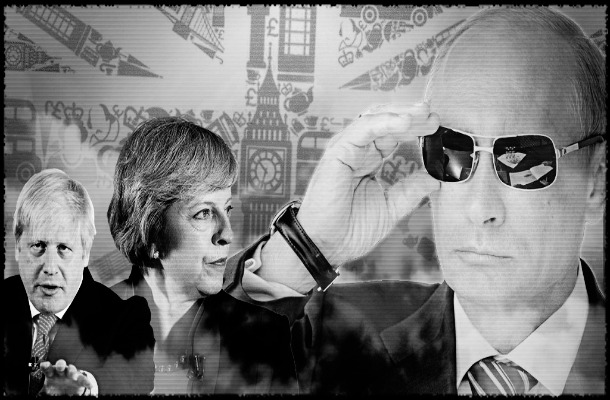
Feature image taken from John Laurit’s blog.
Tony Kevin, former Australian diplomat and author of ‘Return to Moscow’ (2017, UWA Publishing)
Featured Video
BRITAIN’S WARNING: PREPARE FOR WAR
or go to
Aletho News Archives – Video-Images
From the Archive
How Ukraine Tortured and Slaughtered Donbass
By Kit Klarenberg | Al Mayadeen | July 11, 2024
Almost immediately after the proxy war erupted, ISIS-tier footage of the torture and murder of Russians in Ukrainian custody emerged.
On July 6th, the New York Times published an astonishing investigation: In Ukraine, Killings of Surrendering Russians Divide an American-Led Unit. The article documents in grim detail how Chosen Company, an international volunteer battalion for Kiev, routinely executes Russian prisoners of war. It is the very first mainstream admission that this practice – a brazen breach of the Geneva Conventions, and a grave war crime – is widespread among Ukraine’s fighters, both foreign and homegrown. … continue
Blog Roll
 Aletho News
- Israel Demolishes Home Of Lebanese Journalist Whose Viral Film Exposed Pager Attack
- Record Oil, Empty Tanks: The UAE’s Miracle Recovery
- Burnham tackles Britain’s poverty with aggression in Yemen
- Peace in Ukraine: the easy way – or the hard way
- Trump & the Rrrrussians
- US taxpayer money laundered back through Ukraine – Musk
- Before COVID, an NIH lab chief proposed making a SARS-like bat virus more infectious
- Gates, Bourla on Trial in Netherlands Accused of ‘Great Reset’ Scheme at Vaccine Injury Hearing
- BRITAIN’S WARNING: PREPARE FOR WAR
- “Historic Russia”: The Land Putin Will Not Give Back
- If Americans Knew
- DAILY UPDATE: Latest essential news on Palestine, Israel, & region
- Damning report shows the media must confront its failures on Gaza
- BBC senior broadcaster speaks out on Gaza coverage
- Netanyahu vows vast West Bank invasion in response to 20-minute skirmish that left 2 Israeli soldiers and 2 Palestinian fighters dead
- Tied up and tortured: Israel using US-made electroshock weapons on Palestinian detainees
- The outsourced risk: how newsrooms rely on Gaza’s freelancers without protecting them
- Gaza bakeries forced to shut as Israel blocks flour shipments
- Gaza’s breast cancer patients face a deadly wait for treatment amid Israel’s genocide
- DAILY UPDATE: Latest essential news on Palestine, Israel, & region
- The Israel Lobby’s Changing Fortunes
- No Tricks Zone
- Two New Studies Find Thwaites Glacier Melt Cannot Be Driven By Human Activity Or A Warming Ocean
- E-Cars Reduce CO2 Emissions By Only 41% Compared To Internal Combustion Engine Vehicles
- Predictions Made By Renowned Climate Professor Over Past Decades Have Been Proven To Be Poor
- New Study Suggests Large Regions Of The Pacific Ocean Have Been Cooling For The Last 80 Years
- Germany’s Green Energy Debacle: High Energy Costs Force Kahla Porzellan to Close After 182 Years!
- New Study: 50 Years Of The Most Aggressive ‘Net Zero’ Policies Can Only Affect The Global Climate By 0.03°C
- US September “Heat” Was No Record…Many Records Set Decades Ago
- Latest European Green Energy Debacle; Portugal’s Largest Flagship Solar Park Insolvent!
- Green Energy Debacle: German Expert Professor Fritz Vahrenholt Warns Of Severe Economic And Social Consequences
- Two More Paleo Reconstructions Affirm Meters-Higher Sea Levels Across Ireland, Brazil 7000-6000 Years Ago

