The Salisbury Poisonings: “Novichok” – The Odourless Nerve Agent That Stinks to High Heaven
By Rob Slane | The Blog Mire | July 20, 2018
Here is a little primer for the British Government on basic logic. Actions have consequences. What this means is that consequences must stem from actions. And the two must be connected. So far so good?
Let me give an example. If I spill boiling hot coffee on my foot, it will cause me pain and possibly even a blister. To flip that over, if I have a blister on my foot, you might ask me, “Oh, how did you get that?” If I told you that I spilt hot coffee on my foot, you would probably wince and say something like, “Ouch, that must have hurt.” And the chances are that you would be satisfied with my explanation. Why? Because boiling hot coffee split on the foot is quite capable of causing a blister.
But what if, in answer to your question of how I came to get the blister, I told you that I spilt some orange juice on my hand. Would you accept my answer? Would you wince and say, “Ouch, that’s gotta hurt”? Would you go away and say to others, “Poor guy, he spilt orange juice on his hand, and now he’s got a horrible blister on his foot”? Probably not!
Your reaction would probably be more along the lines of, “Huhhh??? You spilt orange juice on your hand, and you got a blister on your foot? What are you talking about?” And the reason for this reaction is that you understand that actions have consequences, and consequences stem from actions. And we all know that whereas spilling boiling hot coffee on the foot might well cause the foot to blister, spilling orange juice on your hand will not have that effect.
This is why the Government’s explanation of the Salisbury and Amesbury poisonings is so obviously false. It fails the test of basic logic. All of the pre-2018 literature on the substance known as A-234 (one of the strains of so-called “Novichok”) states that it is lethal, and most sources tell us that it is around 5-8 times more toxic than VX. What happens if you get some of it on you? One of its creators, Vladimir Uglev, has told us what happened after he got a tiny amount of this agent on his hand:
“‘I rinsed my hands with sulfuric acid and then put them under tap water,’ he said, adding it was the only way to survive. Another researcher who was contaminated in 1987 died of multiple illnesses five years later [my emphasis].”
The only way to survive? Sulfuric acid followed by lots of running water? Has there been any confirmation that after the Skripals and DS Bailey allegedly came into contact the substance, they immediately washed their hands with sulfuric acid and water? I haven’t come across this particular detail yet, but if anybody has, do let me know. And lest anyone says that the substance that the Skripals got on their skin might have been less potent than the substance Mr Uglev got on his hand, the OPCW report of 4th May claimed that traces of the substance, allegedly on the door handle, weeks after the incident, were of “high purity”.
So they got the same substance on their hands as Mr Uglev, yet whilst for him it meant:
Sulfuric Acid + Water or Face Instant Death
For Mr Skripal and his daughter it meant:
Feeding the Ducks + Drink + Meal
Mr Uglev is no friend of the current Russian Government, but in case anyone is not satisfied with his testimony, note that it was essentially backed up recently by Alistair Hay, Professor of Environmental Toxicology at the University of Leeds, who said this in relation to the more recent Amesbury case:
“A few millilitres would be sufficient to probably kill a good number of people and you could store that in a small ampoule, or it might be in a small container like for nail varnish.”
His testimony regarding the container is particularly useful, I’m sure, and is just the sort of thing that sets Professors apart from the rest of us. I mean, who knew that liquid can be stored in a container? But it’s the other part of it that is truly fascinating. He is of course correct to say that a few millilitres of military grade nerve agent is enough to kill many people – sulfuric acid and water notwithstanding. This is what it is designed to do. So doesn’t he think it mighty odd that it somehow didn’t do this, even thought it was apparently “high purity” and “military grade”? Furthermore, doesn’t he find it odd that underneath his claim, Public Health England once again advised people who thought they might have come into contact with it to:
“Wipe personal items such as phones, handbags and other electronic items with cleansing or baby wipes and dispose of the wipes in the bin (ordinary domestic waste disposal) … Please thoroughly wash your hands with soap and water after cleaning any items.”
Wot no sulfuric acid??? Or are they now making baby wipes with traces of sulfuric acid these days? Just in case.
Coming into contact with more than a few millilitres of high purity A-234, and then going to feed ducks, have a drink and eat a meal is no more plausible than the claim that spilling orange juice on the hand leads to blisters on the foot.
But this is not all. I have consciously avoided commenting much on the Amesbury case, and this for two reasons. Firstly, because the level of disinformation and propaganda around the case means that trying to keep up with it is nigh on impossible. But more importantly, it is because the second case is being used by the authorities to shore up the first case, by a very clever sleight of hand, as if the claims made in the first case have been proven. Which they haven’t.
I’ll show you what I mean. In her statement to the House of Commons in 14th March, Mrs May said the following:
“And there were only two plausible explanations. Either this was a direct act by the Russian State against our country. Or conceivably, the Russian government could have lost control of a military-grade nerve agent and allowed it to get into the hands of others. [my emphasis]”
Since then, not only has the Government singularly failed to provide the evidence to back up either of these “plausible alternatives”, but it has become abundantly clear that there are actually a good many others. Yet on 5th July, the Home Secretary, Sajid Javid, stated the following to the House of Commons:
“The decision taken by the Russian government to deploy these in Salisbury on March 4th was reckless and callous – there is no plausible alternative explanation to the events in March other than the Russian state was responsible [my emphasis].”
See the sleight of hand? In March, there were apparently two plausible alternatives. Since then, neither of those alternatives has been backed up by any evidence whatsoever. Yet come 5th July, with the second case, the number of plausible alternatives is down to zero. There is one explanation, and one explanation alone. “Do not mistake me for a conjurer of cheap tricks,” said Gandalf to Frodo. “Do not mistake me for a person with integrity,” said Sajid Javid, conjurer of cheap tricks, to the House as he performed his sleight of hand.
Did no one in Parliament think to ask Mr Javid how the Government had managed to rule out “the other plausible alternative” between March and July? Did nobody demand to know what evidence they had discovered, which they haven’t told us about, to warrant this claim? Of course not. They never demanded to see any evidence of the two plausible alternatives back in March, and the likelihood that they might have developed some integrity and inquisitiveness in the four months following was slim. No, they accepted Mr Javid’s sleight of hand, his unsubstantiated claim dressed up as fact […]
I view the Amesbury case as a tragedy, in that Dawn Sturgess lost her life. But as far as the case itself is concerned, it seems to me to be something of a rabbit trail, with a mountain of disinformation – whether wittingly or unwittingly – which not only keeps us scratching our heads trying to figure it all out, but which is also being used to pretend that the official version of events in the first case has been proven. Which — I reiterate — it most certainly hasn’t.
Nevertheless, let’s debunk it where we can. I had understood from some of the original reports about Dawn Sturgess and Charlie Rowley, that both of them had a “high dose” of “Novichok” on just one hand. I understood this to be the case because that’s what the authorities told us, although I am of course by now well aware that Rule Number One in this case is to take everything the authorities say with a bucket of salt:
“‘This means they must have got a high dose and our hypothesis is that they must have handled a container that we are now seeking.’ It is understood the couple each had nerve agent on one of their hands.”
What is a “high dose? Is it more than the tiny amount Vladimir Uglev got on his hands, which forced him to resort to washing it off with sulfuric acid immediately? Is it more than the few millilitres Alistair Hay says, “would be sufficient to probably kill a good number of people”?
I don’t suppose it matters now, however, because the “facts” have since changed. Apparently they now didn’t get it on one hand. No, Ms Sturgess apparently sprayed it on both wrists. Wrists, not hand. Two wrists, not one hand. Got that?
“Novichok victim Dawn Sturgess died after spraying perfume laced with the nerve agent onto both her wrists, her boyfriend, who was also exposed to the deadly substance, has revealed. They are believed to have stumbled upon the same batch of Novichok used to try to assassinate Russian double agent Sergei Skripal and his daughter Yulia in nearby Salisbury in March.”
So it was the same batch of high purity A-234 that was found on Mr Skripal’s door handle – the type that Vladimir Uglev needed to cleanse immediately with sulfuric acid and water, but which sent Mr Skripal and Yulia off to feed the ducks etc? Remember the orange juice and the blister.
But there’s more. Mr Rowley’s brother, Matthew, who apparently spoke to Charlie, had this to say:
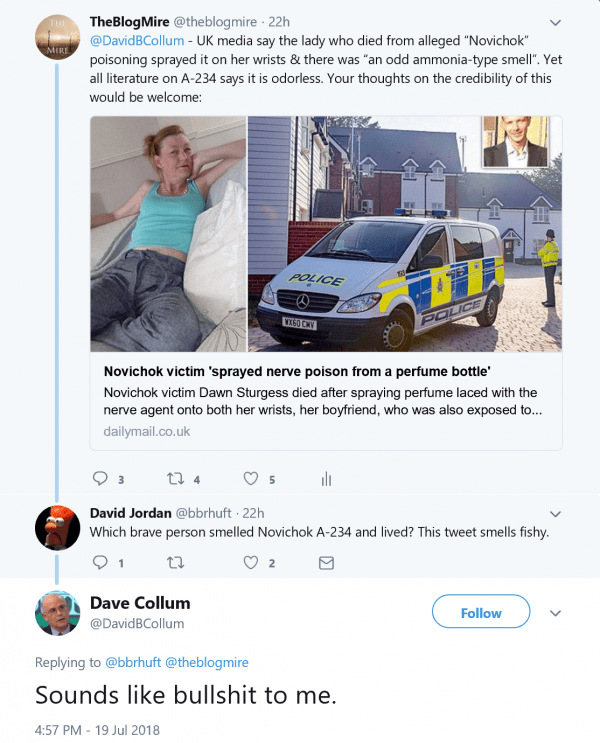
“He also mentioned that he vaguely recollects there being an odd ammonia-type smell from the perfume. We don’t know yet if he had direct contact with the nerve agent like Dawn appears to have done or whether it was after he had touched her.”
The ammonia-type smell is odd, in more ways than one. The pre-2018 scientific literature not only states that A-234 is far deadlier than VX (see here), and that its effects are rapid, usually within 30 seconds to 2 minutes (see here), but it also describes it, along with all nerve agents, as odourless (see here). But according to the latest narrative, it smelt of ammonia.
I think we have another orange juice on the hand and blister on the foot moment. If it’s odourless, it can’t very well smell of ammonia, can it? In fact, it can’t very well smell of anything, can it? It’s odourless, and odourless things don’t tend to smell of ammonia. Or anything else, come to that.
Ah, but maybe it was contaminated? Really? But didn’t the OPCW state that the stuff allegedly placed on Mr Skripals door handle – the stuff they touched before feeding the ducks, going to a pub and then going to a restaurant – was high purity? I believe they did. And this was the same batch? A batch of the stuff that certain experts were telling us could last for decades? From whence cometh the ammonia then? From the odourless “Novichok”, of course.
Folks, what we have is a substance with astonishing properties. It is lethal, but non-lethal. It is military grade, but not really military grade. It is fast acting, but slow working. It can be in the form of a gel, but morph into a liquid. It is odourless, and yet really smelly. Or are we to believe that after placing their high purity “Novichok” gel on the door handle, the assassins then spent time turning it into a liquid, which they then poured into an ammonia-laced perfume bottle? Oh, and then instead of legging it to Heathrow, they took a detour to go for a walk in the park, where they dumped the bottle of odourless but ammonia-smelling nerve agent on the floor. What do they teach them in Professional Assassin schools these days?
Hands to Wrists. Gel to Liquid. Odourless to Ammonia. Orange juice on the hand to blisters on the foot. It’s all the same to me.
From a purely logical point of view, I understand that this is all complete and utter nonsense. But I do wish I’d paid more attention in chemistry classes at school so I might at least be able to debunk it from that point of view. But alas it was not to be. However, since I know nothing about that side of things, I thought I’d ask someone who does. David Collum is a world-renowned Professor of Chemistry and Chemical Biology at Cornell University, with a PhD, MS and MA from Columbia University, and a BS from Cornell. I asked him what he thought of the claim being made in the UK media that Dawn Sturgess was poisoned by “Novichok” and this gave off an “an odd ammonia-type smell”. His answer, which I will leave you with, whilst not what you might call eloquent, was certainly to the point:
“Democratic Institutions?” – 10 Lessons from history that will destroy your trust in the CIA
Did everyone urging us to trust the CIA forget this happened? Or do they just want us to?
By Kit | OffGuardian | July 20, 2018
In the hysterical wake of the Trump-Putin Summit in Helsinki, President Donald Trump was roundly criticised in the media for taking the side of a “hostile state” over his own intelligence agencies. The Guardian referred to Mueller as a “heroic marine” who Trump disbelieved in favour of a “Russian dictator”.
In the past, when Trump has criticised the FBI, CIA or NSA he has been accused of “undermining faith in our institutions”. He’s been blamed for a collapse of trust in the government. But was this trust ever earned?
At every corner, we are urged to simply believe what we are told. Whether it is about believing Porton Down and MI6 about “novichok”, or believing the White Helmets about Sarin, or believing the FBI about “collusion”, we are presented with no facts, just assertions from authority. Those who question those assertions are deemed “bots” at best or “traitors” at worst.
Well here, fellow traitors, are the Top Ten reasons to question anything and everything the CIA – or any intelligence agency – has ever told you.
10. OPERATION PAPERCLIP – we’ll start with an oldie but a goody. In 1945, as the allies were advancing on Berlin from both sides, American Army Intelligence (this was before the CIA were founded) were “capturing” (read: recruiting) over 1,600 Nazi scientists and engineers. Most famous of them was Werhner von Braun… sorry, SS Sturmbannführer von Braun.
Whilst Allied soldiers died in the name of defeating fascism, the CIA’s predecessors were actively recruiting Nazis to come and build bombs for them.
9. OPERATION NORTHWOODS – The original, and important, precedent for accusations that the CIA et al. might engage in false-flag attacks. Operation Northwoods was a joint CIA/Pentagon proposal designed around the idea of escalating a war with Cuba by stoking public anger:
The proposals called for the Central Intelligence Agency (CIA) or other U.S. government operatives to commit acts of terrorism against American civilians and military targets, blaming it on the Cuban government, and using it to justify a war against Cuba.
The idea was vetoed by President Kennedy. Fifty years later, the CIA and Pentagon still very much exist, but there’s no longer a Kennedy there to veto their more psychopathic ideas. Funny how that worked out.
8. ALLENDE COUP – In 1970 Salvador Allende was elected to the Chilean Presidency. A Physician and dedicated socialist, Allende was the first socialist president elected in South America. The Nixon-lead government of the United States immediately implemented “economic warfare” (as they do, to this day, against Cuba, Venezuela and others). The economic warfare did not work, and in 1973 Allende’s socialist party increased their parliamentary majority.
In response, the US “assisted” (read: instructed) the Chilean military in carrying out a coup. Allende allegedly shot himself, and Augusto Pinochet was placed in power as the first dictator in Chile’s history. Pinochet was a fascist who executed Chilean “subversives” by the thousand… and was the darling of Western leaders.
7. MOSADDEGH COUP – I could just copy-and-paste the above paragraph and the change the names for this entry. In 1953, the Prime Minister of Iran – Mohammad Mosaddegh, a democratic socialist – wanted to audit the income of the Anglo-Iranian Oil Company with an eye to limiting foreign control of Iran’s oil. Within a few months, a joint US/UK operation – Operation Ajax – had removed Mosaddegh’s elected government and turned over full control of the state to the Shah. He was a brutal absolute monarch, but the question of Western control of Iran’s enormous oil reserves wasn’t raised again under his leadership.
6. OPERATION MOCKINGBIRD – A CIA operation that you could deduce existed, even if were not proven…. and it is proven. Mockingbird was the CIA project to coerce, train, control or plant CIA-friendly journalists in major news networks all across the country and in every medium. It’s existence is no longer disputed, thanks to FOIA releases of internal memos.
Mockingbird was allegedly shut down in 1976 – just after its existence was leaked – then CIA director George HW Bush claiming:
… effective immediately, CIA will not enter into any paid or contractual relationship with any full-time or part-time news correspondent accredited by any U.S. news service, newspaper, periodical, radio or television network or station.”
If you’re willing to stake anything on the word of a Bush, well, good luck with that. It’s a decision that flies in the face of historical evidence.
Remember this one when you hear about the need to trust the CIA from some pundit on CNN or MSNBC.
5. MASS SURVEILLANCE – It’s not really talked about much these days – what with the vast majority of the media and huge sections of the supposedly “anti-establishment” progressive left marching in-step with the Deep State – but the NSA spied on the whole world. The whole world. We know this to be true because an employee of the Deep State – Edward Snowden – leaked the information.
When challenged on this issue, representatives of the NSA and CIA lied. They lied to the public, and they lied to congress. When they were proven to have lied, they carefully qualified their lies.
A qualified lie is still a lie.
There is no indication they have stopped this illegal surveillance, but they may have passed laws to make it legal.
4. NAYIRAH – A classic of “atrocity propaganda”, Nayirah should be required reading material for anybody looking top hop on a pro-war bandwagon. Nayirah – who originally gave only her first name – was a fifteen year old girl who testified in front of the United States Congress. She claimed to be a volunteer from at a Kuwaiti hospital, and to be an eye-witness to Iraqi soldiers throwing Kuwaiti babies out of incubators and leaving them to die:
I volunteered at the al-Addan hospital with twelve other women who wanted to help as well. I was the youngest volunteer. The other women were from twenty to thirty years old. While I was there I saw the Iraqi soldiers come into the hospital with guns. They took the babies out of the incubators, took the incubators and left the children to die on the cold floor. It was horrifying.
It was later revealed, not only that her full name was Nayirah al-Sabah and she was the daughter of the Kuwaiti ambassador, but that she had never volunteered at a hospital and had seen no babies, soldiers or incubators. The whole thing was a fiction. A fiction paid for by the “Citizens of Free Kuwait”, an NGO (and obvious CIA front) set up to lobby the US to intervene in the Iraq-Kuwait war.
By the time this fiction was revealed it was too late, and the US had launched Operation Desert Storm…. which was, of course, the entire point of the exercise.
Remember this, when you hear about Assad gassing children or bombing kittens.
3. COINTELPRO – The FBI’s long running (and sometimes illegal) COunter INTELligence PROgram, COINTELPRO was a series of domestic projects carried out by the FBI (with cooperation from other agencies), over decades, with the aim of “surveilling, infiltrating, discrediting, and disrupting domestic political organizations”.
These political organizations included anti-Vietnam protestors, civil rights groups (including both MLK and Malcolm X), socialists, Communist Party USA, environmental groups and feminist organizations.
The brief for these “disruptions” came straight from J. Edgar Hoover who wanted the FBI to “expose, disrupt, misdirect, discredit, or otherwise Neutralize” people he perceived to be enemies of the state. The capital N in “neutralise” is no accident, as the FBI was implicated in the deaths of several Black Panther leaders, including Fred Hampton.
COINTELPRO didn’t just involve undermining left-wing groups, but also creating right-wing groups:
The FBI also financed, armed, and controlled an extreme right-wing group of former Minutemen, transforming it into a group called the Secret Army Organization that targeted groups, activists, and leaders involved in the Anti-War Movement, using both intimidation and violent acts.
Whether this was done to actually push a right-wing agenda, create a fake threat to step up police powers, or just sow division and chaos, is unclear. But it definitely happened.
Much like MKUltra (below), COINTELPRO was “officially shut down”, not long after the public found out it existed. However, the accidental outing of undercover policeman at a rally in Oakland, and recent relaxation of the laws limiting the FBI’s powers, means that COINTELPRO – or a modern successor – is very likely still a thing.
The aim of COINTELPRO was to “Neutralize” anti-establishment political figures – the vast majority of targets were left wingers – through “smearing individuals and groups using forged documents and by planting false reports in the media”. Remember that when you see Rand Paul called a “traitor” on twitter, or read about “Russian collusion”, or see Jeremy Corbyn branded an anti-Semite.
Remember that it is proven that the Deep State – our trusted intelligence agencies – pay people to plant false stories and discredit political opponents.
2. PROJECT MKULTRA – It might sound like something from a 70s sci-fi TV series, but it is unfortunately real. MKUltra was a series of (illegal) experiments carried out by the CIA from 1953 until it was *cough* “officially halted” in 1973 (just after its existence was leaked). The experiments were wide-ranging, achieved varied levels of success, but pretty uniformly brutal and unethical. They included, but were not limited too:
– Giving LSD to unsuspecting soldiers to see what happened.
– Mass hypnosis and mass suggestion
– Torture studies
– Studies on the effect of verbal and/or sexual abuse
We’ll never know the full range of studies, or how they were carried out, because in 1973 Richard Helms, then director of the CIA, ordered all MKUltra files destroyed. Only a fraction of them survive, thanks to FOIA requests, but it’s reasonable to assume they destroyed the worst parts and kept the more quote-unquote innocent files.
The CIA were not unique in this regard either, MKUltra was their baby – but there were parallel projects in other quarters of the deep state. Army Intelligence had Edgewood Arsenal, whilst the Department of Defense had Project 112. All these projects were “officially halted” in the early 70s… just around the time the public found out they existed.
The CIA (et al.) have strongly denied that these experiments and projects have ever been continued in any way, shape or form…but if you’d asked them in 1969, they would have denied they had ever taken place at all.
1. THE IRAQ WAR – This might not be the most callous, the most dangerous, the most recent, the most secret or the most insidious of the items on this list, nevertheless it is – must be – number one… because it is the most brazen.
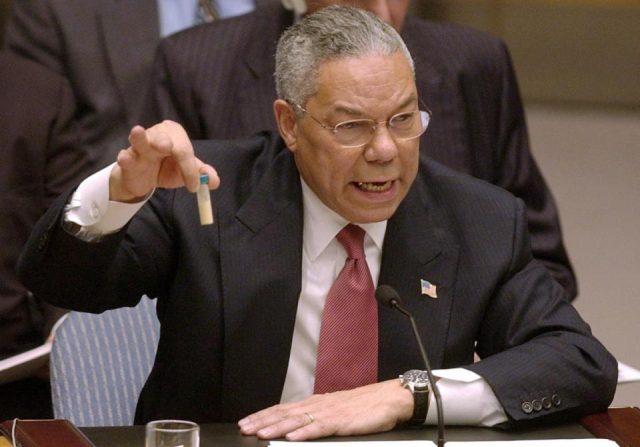
The war was started in the name of “weapons of mass destruction” that everyone – everyone – knew never existed. They all knew the truth, but they lied.
The President lied, the vice-president lied, the secretary of defence lied, the secretary of state lied. The Prime Minister lied, the defence minister lied, the foreign minister lied. They lied to the press, the people and the UN.
The CIA, the NSA, the FBI – then headed by the “heroic marine” Robert Mueller – they lied too. The press repeated these lies, without question (see: Operation Mockingbird). They weren’t “misinformed”, they weren’t “mistaken”. They lied, they lied repeatedly – and provably – and they did it in order to start a war, make money, take control, spread influence.
One million Iraqis died.
Our ruling class is peopled with psychopaths and war criminals, who have so little regard for the people they lie to they recycle the same childishly simple falsehoods to further their evil agenda again and again and again. They tried the same in Libya… it worked again. They tried again in Syria… luckily, it didn’t work there.
Our “democratic institutions” lie to start wars. There’s no reason to think they aren’t doing – or wouldn’t do – the same thing about Iran, North Korea… or Russia.
That’s our list, and there’s really only one lesson you can take away from it:
These people, agencies and institutions deserve no trust, have earned no trust and have abused every micron of trust ever placed in them. To suggest we have a duty to believe them – or that they have ever done anything to serve the public good – is to live in a dream world.
This list is not a full catalogue of Deep State crimes, it would be 1,000s of entries long if it were, but these ten are important. They’re important because they are admitted, proven and beyond debate. They are important because they show the many facets of dishonesty, hypocrisy and abuses of power that Intelligence agencies engage in, and they are important because they form the best riposte to the disingenuous clamour for “trust” in our “democratic institutions”.
Never trust the CIA, they have proved they don’t deserve it.
The Salisbury Poisonings: How the Ducks Led Down a Rabbit Trail, Then to Some Potentially Crucial Information
By Rob Slane | The Blog Mire | July 16, 2018
Nothing is simple in the Salisbury poisonings. Nothing makes much sense. The reason for this is not because no credible explanation exists which might make sense of it all. It is because the authorities have sold us a narrative which is not credible, which does not make sense, and they have done so whilst withholding crucial details about the case from the public. Here are three pieces of key information that they have withheld, which they could easily release, and which may well help with the investigation:
1. The connection between Mr Skripal and Christopher Steele of Orbis Business Intelligence, which is the organisation behind the infamous “Trump Dossier”
2. CCTV footage of Sergei and Yulia Skripal on 4th March 2018, which undoubtedly exists (see below)
3. Mr Skripal’s movements between the hours of 9am and 4pm on 4th March 2018.
Of these three pieces of information, the first may or may not be important to the case. However, whether it is important or not, I can well understand why the authorities do not wish it to be made public. If it ever did become common knowledge, regardless of whether it is directly connected with this case or not, it would be hugely embarrassing to the British Government, since it would inevitably lead to the suspicion that the real interference story of the 2016 US election was not the Russian Government’s alleged attempts to get Mr Trump elected (apparently done with the sinister method of placing a few innocuous adverts on Facebook), but rather the attempts of British intelligence (and possibly the Government) to try to stop him being elected. So I can see why they don’t want this to be common knowledge.
But with regard to points number 2 and 3, no such excuse can be considered reasonable, unless there is an alternative explanation to the one offered by the British Government. They want the culprit(s) to be caught, don’t they? They want the case to be completed to everyone’s satisfaction, don’t they? Right, so why is it the public haven’t been shown any CCTV footage of Mr Skripal from 4th March (except a second or two of a car driving down Devizes Road), even though it exists? And why don’t we know with any certainty Mr Skripal’s movements that day, even though this information should be extraordinarily simple to obtain. They could just ask him, couldn’t they, since he is apparently in their care? Bit strange that he apparently doesn’t want the details of his movements known, even though they could help catch the perpetrators, isn’t it? Draw your conclusions accordingly.
Trying to make sense of the case is like trying to square the circle, whilst nailing jelly to the wall, at the same time as attempting to thread a camel through the eye of a needle. However, just occasionally, a piece of disinformation put out by the Government or the media can lead to some quite interesting new pieces of information. As you will see.
In my previous piece on the case, I noted that on 25th March a number of newspapers carried pieces stating that some boys had been taken into hospital to be checked over, as they had been seen on CCTV from 4th March feeding ducks with none other than Mr Skripal. These articles mentioned the place as being the Avon Playground, which is within The Maltings, where the infamous bench is located.
However, in an article in the Sun on 28th March, the paper tracked down one of the boys, Aiden Cooper, interviewing him and his parents, Luke and Victoria. The piece was accompanied by four pictures, one of which had the caption: “Aiden with his parents by the pond where he spoke to Skripal”. However, the odd thing about this was that the location of the pictures was not Avon Playground at all; rather it was Queen Elizabeth Gardens, which is now very much of interest, having been closed off after the subsequent poisoning of Charlie Rowley and Dawn Sturgess.
After my piece, I managed to get in contact with Aiden’s mother, Victoria, who has very helpfully answered a few questions I put to her. Firstly, she has confirmed that – as one or two commenters on my previous piece rightly suggested – the photographs that appeared in The Sun were indeed taken in a different park to the one the duck-feeding took place, because they couldn’t get access to the Avon Playground. And so the Avon Playground, within The Maltings, was indeed the place that the duck-feeding occurred. My apologies for this. I was going on what the Sun pictures and the caption stated, which unfortunately turned out to be disinformation, but I should perhaps have attempted to verify this first.
Having said this, my correspondence with Mrs Cooper has led to one or two pieces of information which I think are of interest.
♦ Firstly, she has confirmed that the duck-feeding incident was indeed caught on CCTV, and that this was shown to her, her partner and Aiden by the police. She also said that the footage was really clear.
♦ Secondly, she remembers the time of the incident on the CCTV as being 1:15, but her partner believes it was 1:45. If it was 1:15, this would seriously mess up the police timeline, as they have stated that Mr Skripal was driving down Devizes Road towards the City at 1:35. However, if it was 1:45, this would fit well with that timeline, and with their statement that Mr Skripal parked in Sainsbury’s car park at 1:40. At least we can be sure that the duck incident took place pre-Zizzis.
♦ Thirdly, I asked what Mr Skripal was wearing, and Mrs Cooper confirmed that he was wearing “a leather jacket and blue jeans”.
♦ When I asked about the picture of the two people seen on CCTV in Market Walk, she confirmed that these are definitely not the two people Aiden had been feeding ducks with, and that – and this is very important – the CCTV they had been shown of the duck feeding had shown a “really clear picture” of Aiden with Mr Skripal with Yulia standing behind.
♦ Finally – and here is potentially the most significant thing – when I asked if the female who was with Mr Skripal had a red bag, Mrs Cooper confirmed that this was indeed the case.
I need to caveat what I am about to say with a disclaimer. Without seeing the CCTV footage, we cannot be sure whether this red bag is significant or not. However, what we can say is as follows:
- At 1:45 (or possibly 1:15), Sergei and Yulia Skripal were feeding ducks in the Avon Playground / Maltings, and Yulia Skripal was seen carrying a red bag. The incident was captured on CCTV.
- At 15:47, a smartly dressed couple, who were not Sergei and Yulia Skripal, were filmed on CCTV walking through Market Walk. The woman was carrying a red bag.
- At 16:03, a couple were seen on the bench in The Maltings, having been overcome by some sort of toxic substance. Next to the bench was a red bag, which was taken away in an evidence bag later on.
What to make of this?
As I say, without seeing that CCTV footage, we cannot be sure whether Yulia’s red bag is the same as the one in Market Walk or the one at the bench. But it is too curious a coincidence to pass over. If it is the same bag in all three instances, then we have the opposite scenario to the one I posited in Part 5 of my recent 6-part series. Whereas there I put forward the theory that the couple walking through the Market Walk were delivering a bag to Mr Skripal, this new piece of information opens up a new possibility – and I stress it is just a possibility – that the couple walking through Market Walk were the recipients of the bag from the Skripals.
Make of it what you will. Let’s just say that if this is indeed yet another rabbit trail, the police could easily clear it up by releasing into the public domain the CCTV footage they have of Mr Skripal feeding ducks, which also shows his daughter, who is carrying a red bag. They have no objection to releasing footage of Mr Skripal buying lottery tickets on different days, which is all very interesting, I’m sure, to somebody or other. Yet no footage of Mr Skripal and Yulia on the day of the poisoning, even though it’s key to the case. Why is that, I wonder?
Time to Invite Russian Diplomats Back with an Apology
By James ONeill – New Eastern Outlook – 16.07.2018
On 4th of March 2018 former Russian double agent Sergei Skripal and his daughter Yulia were discovered on a park bench in Salisbury England in a distressed state. They were treated by passers-by, including a doctor, before being taken to Salisbury General Hospital.
The hospital initially treated the Skripals for a suspected drug overdose as the symptoms they exhibited were consistent with poisoning by fentanyl, a substance 10 times stronger than heroin, and with which the hospital had prior experience. The hospital’s initial diagnosis was confirmed in an article that appeared in the Clinical Services Journal on 27 April 2018. After the journal’s online article was publicized on social media, references to “fentanyl” were changed to “a substance.”
It was not the first or last time that the official story about what happened to the Skripals was changed.
Three days after the Skripals were found, the British government issued a “D” Notice. The ‘Notice”, officially a “request” but in effect a demand, forbade mention of Mr Skripal’s friend Pablo Miller. Why publicity about Mr Miller was to be suppressed is one of the features of this case, and apart from the initial report in the UK newspaper the Daily Telegraph, which led to the ‘D’ Notice, he has not been referred to again in the mainstream media.
On 12 March 2018 the British Prime Minister Theresa May made her first statement to the House of Commons in which she alleged that the Skripals had been poisoned with a nerve agent “of a type developed by Russia,” and that it was “highly likely” Russia was responsible.
The British government subsequently circulated a memorandum and power point presentation to 80 embassies setting out the argument that Russia was responsible for what happened to the Skripals, and seeking support for their intention to expel Russian diplomats as a punishment. The various allegations made in the PowerPoint presentation were at best contentious and some were demonstrably untrue. It is suffice for present purposes however to focus only on the claims of alleged Russian responsibility for the Skripal attacks.
A number of countries, including Australia, acceded to the British demand and expelled diplomats. The statement made by Prime Minister Malcolm Turnbull announcing that two Russian diplomats would be expelled made no attempt to establish the truth of the matter or indicate any desire to do so. His statement simply echoed the allegations made in the British document.
Turnbull said that the use of a chemical weapon to try to murder Sergei and Yulia Skripal reflected a “pattern of recklessness and aggression” by the Russian government that had to be stopped. Russia, he said was threatening no less than “the democratic world” in deliberately undermining the international rules based order. He went on to list a series of other alleged transgressions that echoed the claims made by the United Kingdom government.
One of the interesting features of this case is that not only was it a rush to judgement before the evidence could possibly have been gathered and analysed, but that the mainstream media and the politicians have not deviated from their initial claims, despite the wealth of evidence that has subsequently emerged.
Like the Red Queen in Alice in Wonderland, they demanded the sentence before the evidence had been presented, and also like Alice in the eponymous story, asked us to believe six impossible things before breakfast.
The diligent reader is able to readily ascertain just how lengthy that list of impossible things is. It is suffice for present purposes to mention only a few to demonstrate that the United Kingdom’s entire story is a fabrication that would be funny were its potential consequences not so serious.
The United Kingdom government claimed that the Skripals had been poisoned by “a military grade nerve agent” that they see it was a Novichok “of a type of developed by Russia.” From that combination of alleged facts, we were expected to infer that only the Russians could have been responsible.
”Novichok” is a sufficiently Russian sounding nomenclature to give superficial credence to at least part of the claim. The first difficulty however is that there is no “Novichok” nerve agent. The term simply refers to a class of organophosphate chemical weapons. It is true that this class of chemical weapon was developed in the former Soviet Union, as described in a book published by a former employee of the chemical centre, readily available on Amazon.
That manufacturing and research development centre was demolished pursuant to the Chemical Weapons Convention in 1999, as was described as the time in an article in the New York Times. Material from the demolition process was taken back to the United States. All of this information is readily available and politicians and journalists prior to their making claims about nerve agents “of a type developed by Russia” should have known it
The Novichok class of nerve agents may or may not have been initially developed by the Soviet Union, but that is a far cry from linking the substance allegedly used in Salisbury with that original program. A number of European governments have acknowledged that they possess the Novichok class of nerve agents.
A search of the United States Patent Office records however, reveals that between 2002 and November 2017 81 patents were applied for using the name “Novichok”. A patent filed in April 2013 includes a description of a delivery method, including bullet like projectiles that can target a single person.
Secondly, the former United Kingdom Foreign Secretary Boris Johnson told the Russian ambassador to the United Kingdom on 12 March 2018 that the nerve agent used on the Skripals was an A234. You are a number of problems with this claim quite apart from Mr Johnson’s general difficulty with the truth. The consulting surgeon at Salisbury Hospital, Dr Steven Davies had a letter to The Times newspaper published on 14 March 2018 in which he stated that “no patients have experienced symptoms of nerve agent poisoning in Salisbury.” In contradistinction to unsubstantiated claims that as many as 40 people had been affected, Dr Davies referred to only three patients receiving treatment in this context. This was presumably a reference to the two Skripals and a police officer.
A234 is a highly toxic substance, 8 to 10 times more powerful then VX (of a type developed by the UK) that had been used to kill a relative of North Korean leader Kim at the Kuala Lumpur airport. VX will kill within a few minutes, yet the A234 allegedly used on the Skripals failed to kill or even severely disable them or the third alleged victim, detective Sergeant Bailey.
A further and likely conclusive reason to reject A234 as the substance used, was that the report by the OPCW based on samples collected from Salisbury 17 to 18 days after the incident said that the substance in the samples was of “high purity”.
The scientific evidence, again readily ascertainable by a reasonably diligent journalist is that A234 and similar substances degrade rapidly. It is literally impossible for samples collected 17 to 18 days after the event to be of “high purity.” The purity also makes it impossible to identify the specific source of the manufacture, and furthermore guarantees that it originated in a properly equipped laboratory. That OPCW report effectively destroyed the last shreds of the UK government’s claims.
Given that Bailey and the Skripals have both made complete recoveries, it could not have been a “military grade” nerve agent that caused their plight. There is also the indisputable fact that whatever was used on the Skripals could not have come from Yulia’s suitcase, the air vents of their motor vehicle, or the front door knob of Mr Skripal’s house, or any of the other fantastical claims made at various times by the UK government for the simple reason that they were alive and well approximately six hours after leaving the house.
During that time the Skripals visited the cemetery, had a meal at Zizzi’s restaurant, and had an untroubled walk through the centre of Salisbury, captured by the CCTV camera. The fact that they both took ill, at the same time and in the same specific location, leads to the almost irresistible inference that they were attacked at or near the park bench where they were found in a distressed state.
For these various reasons, and a great deal of the others in the now considerable body of literature on this topic, we do not know with what they were attacked, nor by whom. At best we know approximately where and at approximately what time. A proper inquiry, as opposed to the wild and unjustified accusations and premature conclusions constantly reiterated in the mainstream media, would approach this question with an open mind. It has been abundantly clear that a proper enquiry is the furthest thing from the minds of the British government or their acolytes such as Australia.
A proper inquiry would also consider the relevance of motive. There has been no plausible suggestion, much less evidence, as to why the Russian government would wish to do the Skripals harm, and some solid reasons why the Russian government would be the least likely candidate to wish ill upon the Skripals.
This brings us back to Sergei Skripal, his history and the aforementioned D notices. One of those D notices inhibited publication of the details relating to Pablo Miller. That raises the obvious question, not pursued by the mainstream media unfettered by the D notice, as to why the British government would wish to protect Mr Miller’s identity and his links to Mr Skripal.
Miller and Skripal are friends, both living in Salisbury and known to socialize together. Their history goes rather deeper. Miller is a former MI6 officer and during the time that Skripal was a double agent in the employ of the Russian GRU Agency and selling Russian secrets to the British, Miller was his ‘handler.’
Miller worked in Moscow in conjunction with Christopher Steele, the assumed author of the infamous Trump dossier that collected together various allegations about Trump’s Russian activities, both business and personal.
That dossier was commissioned by the Democratic National Committee on behalf of Trump’s opponent in the 2016 presidential election, Hilary Clinton. The DNC commissioned Fusion GPS who in turn contracted with Orbis Business Intelligence. Christopher Steele was the principal of Orbis and Miller was one of his associates.
The American outlet Buzzfeed released the complete dossier on 10 January 2017 and on the same day the May government issued a D notice prohibiting the British press from revealing Steele to be the author. The Wall Street Journal however, published his name the following day.
According to the Czech magazine Respekt, Skripal had recent links to Czech intelligence and he travelled to both the Czech Republic and Estonia in 2016 and had met with intelligence officers from both countries.
This evidence strongly supports the inference that Skripal was still an active agent on behalf of the British who were known to be strongly opposed to the election of Donald Trump. Given Skripal’s knowledge of Russian intelligence, his links with the intelligence community in at least four countries, his close ties to both Miller and Steele going back to his GRU days, and at least according to one textual analysis of the dossier, it is entirely possible that Skripal was in fact one of the authors of the dossier.
These facts are now well established. At the very least it raises serious questions about who else might have a motive to give Mr Skripal a “message.” Whoever was responsible, the incident was certainly used by the UK government as part of a wider campaign to discredit the Russian government in general and President Putin in particular. In this endeavour, they have been willingly aided and abetted by the Australian government and mainstream media.
The failure of either to acknowledge the manifold flaws in the original allegations and to accept that the UK government’s version has been comprehensively discredited is an enduring disgrace.
At the very least the Russian government is owed an apology. That would go at least some way to acknowledging that the premature judgement and intemperate response has damaged Australia’s international image and its foreign relations.
The Holes in the Official Skripal Story
By Craig Murray | July 12, 2018
In my last post I set out the official Government account of the events in the Skripal Case. Here I examine the credibility of this story. Next week I shall look at alternative explanations.
Russia has a decade long secret programme of producing and stockpiling novichok nerve agents. It also has been training agents in secret assassination techniques, and British intelligence has a copy of the Russian training manual, which includes instruction on painting nerve agent on doorknobs.
The only backing for this statement by Boris Johnson is alleged “intelligence”, and unfortunately the “intelligence” about Russia’s secret novichok programme comes from exactly the same people who brought you the intelligence about Saddam Hussein’s WMD programme, proven liars. Furthermore, the question arises why Britain has been sitting on this intelligence for a decade and doing nothing about it, including not telling the OPCW inspectors who certified Russia’s chemical weapons stocks as dismantled.
If Russia really has a professional novichok assassin training programme, why was the assassination so badly botched? Surely in a decade of development they would have discovered that the alleged method of gel on doorknob did not work? And where is the training manual which Boris Johnson claimed to possess? Having told the world – including Russia -the UK has it, what is stopping the UK from producing it, with marks that could identify the specific copy erased?
The Russians chose to use this assassination programme to target Sergei Skripal, a double agent who had been released from jail in Russia some eight years previously.
It seems remarkable that the chosen target of an attempt that would blow the existence of a secret weapon and end the cover of a decade long programme, should be nobody more prominent than a middle ranking double agent who the Russians let out of jail years ago. If they wanted him dead they could have killed him then. Furthermore the attack on him would undermine all future possible spy swaps. Putin therefore, on this reading, was willing to sacrifice both the secrecy of the novichok programme and the spy swap card just to attack Sergei Skripal. That seems highly improbable.
Only the Russians can make novichok and only the Russians had a motive to attack the Skripals.
The nub of the British government’s approach has been the shocking willingness of the corporate and state media to parrot repeatedly the lie that the nerve agent was Russian made, even after Porton Down said they could not tell where it was made and the OPCW confirmed that finding. In fact, while the Soviet Union did develop the “novichok” class of nerve agents, the programme involved scientists from all over the Soviet Union, especially Ukraine, Armenia and Georgia, as I myself learnt when I visited the newly decommissioned Nukus testing facility in Uzbekistan in 2002.
Furthermore, it was the USA who decommissioned the facility and removed equipment back to the United States. At least two key scientists from the programme moved to the United States. Formulae for several novichok have been published for over a decade. The USA, UK and Iran have definitely synthesised a number of novichok formulae and almost certainly others have done so too. Dozens of states have the ability to produce novichok, as do many sophisticated non-state actors.
As for motive, the Russian motive might be revenge, but whether that really outweighs the international opprobrium incurred just ahead of the World Cup, in which so much prestige has been invested, is unclear.
What is certainly untrue is that only Russia has a motive. The obvious motive is to attempt to blame and discredit Russia. Those who might wish to do this include Ukraine and Georgia, with both of which Russia is in territorial dispute, and those states and jihadist groups with which Russia is in conflict in Syria. The NATO military industrial complex also obviously has a plain motive for fueling tension with Russia.
There is of course the possibility that Skripal was attacked by a private gangster interest with which he was in conflict, or that the attack was linked to Skripal’s MI6 handler Pablo Miller’s work on the Orbis/Steele Russiagate dossier on Donald Trump.
Plainly, the British government’s statements that only Russia had the means and only Russia had the motive, are massive lies on both counts.
The Russians had been tapping the phone of Yulia Skripal. They decided to attack Sergei Skripal while his daughter was visiting from Moscow.
In an effort to shore up the government narrative, at the time of the Amesbury attack the security services put out through Pablo Miller’s long term friend, the BBC’s Mark Urban, that the Russians “may have been” tapping Yulia Skripal’s phone, and the claim that this was strong evidence that the Russians had indeed been behind the attack.
But think this through. If that were true, then the Russians deliberately attacked at a time when Yulia was in the UK rather than when Sergei was alone. Yet no motive has been adduced for an attack on Yulia or why they would attack while Yulia was visiting – they could have painted his doorknob with less fear of discovery anytime he was alone. Furthermore, it is pretty natural that Russian intelligence would tap the phone of Yulia, and of Sergei if they could. The family of double agents are normal targets. I have no doubt in the least, from decades of experience as a British diplomat, that GCHQ have been tapping Yulia’s phone. Indeed, if tapping of phones is seriously put forward as evidence of intent to murder, the British government must be very murderous indeed.
Their trained assassin(s) painted a novichok on the doorknob of the Skripal house in the suburbs of Salisbury. Either before or after the attack, they entered a public place in the centre of Salisbury and left a sealed container of the novichok there.
The incompetence of the assassination beggars belief when compared to British claims of a long term production and training programme. The Russians built the heart of the International Space Station. They can kill an old bloke in Salisbury. Why did the Russians not know that the dose from the door handle was not fatal? Why would trained assassins leave crucial evidence lying around in a public place in Salisbury? Why would they be conducting any part of the operation with the novichok in a public area in central Salisbury?
Why did nobody see them painting the doorknob? This must have involved wearing protective gear, which would look out of place in a Salisbury suburb. With Skripal being resettled by MI6, and a former intelligence officer himself, it beggars belief that MI6 did not fit, as standard, some basic security including a security camera on his house.
The Skripals both touched the doorknob and both functioned perfectly normally for at least five hours, even able to eat and drink heartily. Then they were simultaneously and instantaneously struck down by the nerve agent, at a spot in the city centre coincidentally close to where the assassins left a sealed container of the novichok lying around. Even though the nerve agent was eight times more deadly than Sarin or VX, it did not kill the Skripals because it had been on the doorknob and affected by rain.
Why did they both touch the outside doorknob in exiting and closing the door? Why did the novichok act so very slowly, with evidently no feeling of ill health for at least five hours, and then how did it strike both down absolutely simultaneously, so that neither can call for help, despite their being different sexes, weights, ages, metabolisms and receiving random completely uncontrolled doses. The odds of that happening are virtually nil. And why was the nerve agent ultimately ineffective?
Detective Sergeant Bailey attended the Skripal house and was also poisoned by the doorknob, but more lightly. None of the other police who attended the house were affected.
Why was the Detective Sergeant affected and nobody else who attended the house, or the scene where the Skripals were found? Why was Bailey only lightly affected by this extremely deadly substance, of which a tony amount can kill?
Four months later, Charlie Rowley and Dawn Sturgess were rooting about in public parks, possibly looking for cigarette butts, and accidentally came into contact with the sealed container of a novichok. They were poisoned and Dawn Sturgess subsequently died.
If the nerve agent had survived four months because it was in a sealed container, why has this sealed container now mysteriously disappeared again? If Rowley and Sturgess had direct contact straight from the container, why did they not both die quickly? Why had four months searching of Salisbury and a massive police, security service and military operation not found this container, if Rowley and Sturgess could?
I am, with a few simple questions, demolishing what is the most ludicrous conspiracy theory I have ever heard – the Salisbury conspiracy theory being put forward by the British government and its corporate lackies.
My next post will consider some more plausible explanations of this affair.
Iran Foreign Ministry dismisses US implicating of Iranian embassies in terror acts
Press TV – July 11, 2018
Iran’s Foreign Ministry Spokesman Bahram Qassemi has dismissed as ludicrous a recent US allegation that Iranian embassies are involved in terror attacks in Europe.
Qassemi on Wednesday rejected the allegation by US Secretary of State Mike Pompeo as baseless, preposterous and part of a targeted propaganda campaign and psychological warfare against the activities of the Iranian embassies, which he said were in line with international conventions and aimed at promoting bilateral friendly relations with other countries.
Qassemi said that bringing up such allegations was “another attempt by the United States to destroy our country’s foreign relations.”
Pompeo on Tuesday accused Iran of using its embassies to plot terrorist attacks in Europe.
“Just this past week there were Iranians arrested in Europe who were preparing to conduct a terror plot in Paris, France. We have seen this malign behavior in Europe,” Pompeo said in an interview with Sky News Arabia during a short trip to the United Arab Emirates.
“Pompeo levels such groundless claims against our country while different types of evidence of spying and acts of sabotage by the American embassies with hundreds of military and security personnel [involved]… have been published in various sources, and contemporary history is full of such types of illegitimate activities which are in contravention of international regulations,” Qassemi said.
This came after Belgian authorities claimed earlier this month that an Iranian diplomat had been arrested along with a 38-year-old man and a 33-year-old woman, suspected of plotting a bomb attack on a meeting of the notorious anti-Iran terrorist group the Mujahedin-e Khalq Organization (MKO) in the French capital Paris. The meeting was attended by US President Donald Trump’s lawyer, Rudy Giuliani, and several former European and Arab ministers.
The authorities added that Belgian police had intercepted the two suspects in Belgium on June 30 with 500 grams of the homemade explosive TATP and a detonation device found in their car.
The diplomat, 46-year-old Assadollah A, was arrested in Germany, suspected of having been in contact with the two arrested in Belgium.
Three other people were also arrested in France in connection with the case, two of whom were released.
Iranian officials have denied any involvement in any plot to blow up the MKO meeting and Foreign Minister Mohammad Javad Zarif has condemned the arrests as a “sinister false flag ploy.”
The allegations about the involvement of the Iranian diplomat in the suspected bomb attack on the MKO meeting were designed as Iranian President Hassan Rouhani paid a visit to Switzerland and Vienna and held talks with senior officials of the two European countries.
The Iranian Foreign Ministry said the allegations aimed to damage Iran-Europe relations during the visit.
It’s the Wrong Park! How the Ducks Raise Some Serious Questions in the Salisbury Poisonings

By Rob Slane | The Blog Mire | July 11, 2018
According to the Metropolitan Police investigation into the poisoning of Sergei and Yulia Skripal, here is a timeline of events on 4th March:
13:40: Sergei and Yulia arrived at the Sainsbury’s upper level car park in The Maltings. The pair go to The Mill pub.
Approximately 14.20: They eat at Zizzi restaurant on Castle Street
15:35: They leave the restaurant
16:15: Emergency services are called by a member of the public to the bench where Sergei and Yulia are slumped on a bench
So: car park, pub, restaurant, bench. Simples? Not so, as we shall see.
On 28th March, an article appeared in the Sun, which talked about a 12-year-old boy from Salisbury, Aiden Cooper, who was apparently in a park with his parents, when he saw the Skripals and went over to them to feed the ducks:
“A schoolboy told yesterday how he was caught up in the poison spy drama after assassination target Sergei Skripal gave him bread to feed ducks. Aiden Cooper, 12, was playing in a park with pals when they saw Skripal and daughter Yulia beside a stream. They were handed bread and are among the last people to have had contact with the retired Russian military intelligence colonel, now fighting for his life.“
Of course, I would always want to have a large bucket of salt on standby when reading anything in The Sun, but in this case I see no reason why they, or the people quoted in the article, would make this up. In any case, the story was repeated in a number of other outlets (The Mirror, The Mail and Metro for instance), and it mentions that the parents only found out about the identity of the breadman when they were contacted by police.
Now, the interesting thing about The Mirror, The Mail and Metro pieces is that they are all either very wrong or very vague about a quite crucial detail. The Mirror and The Mail both tell us that the incident took place “near the Avon Playground”. And Metro tells us that the incident took place at “Riverside Park”.
For those of you not familiar with Salisbury, let me shed some light. The Avon Playground mentioned by The Mirror and The Mail is next to the Avon River, and it is also about 50 yards or so from the bench where the Skripals were found (as an aside, this is not the same Avon as in Stratford-upon-Avon. Avon is a Celtic word meaning river). As for Riverside Park mentioned by Metro, this may be a figment of their imagination, as no such named park exists in Salisbury. But the important point is that from the details given in these articles, nobody would think anything other than that the duck-feeding incident took place in the same park as the bench on which the Skripals were found.
Yet all three of these media outlets are wrong, and in a way that may well be very significant. Turning back to the report in The Sun, we find that it is by far the most detailed of all the reports on the duck incident. In fact, it appeared three days after the others appeared, with The Sun sending a reporter to interview the boy and his parents. Here is a snippet:
“Aiden and his pals are thought to be the youngest of 130 exposed to the nerve agent Novichok, said to have been unleashed in Salisbury by President Vladimir Putin…
Aiden’s family were alerted after cops traced him from CCTV pics.
Aiden’s civil engineer dad Luke, 33, said: ‘Obviously we had seen the incident on the news but didn’t think we were involved at all. Aiden was playing in the park with his friends when they spotted the Russian gentleman and his daughter. Kids being kids they went over and he gave them some bread and they fed the ducks. We didn’t think anything of it until two weeks later when then the police knocked on our door.’
It was terrifying. We took Aiden to hospital for a load of tests and then the police told us they had to burn everything Aiden was wearing that day.’”
So presumably, Aiden and his friends were seen on camera, as was Sergei Skripal and possibly Yulia, and this was on 4th March. We aren’t told when in the day this was, but given that the police traced the family, and Aiden then had to go to hospital, it clearly must have been after the police claim Mr Skripal came into contact with nerve agent on his door handle.
But here’s the significant fact (I am indebted to a lady who contacted me to point it out, and I must say I kicked myself for not having realised it before). Unlike the media outlets mentioned above, The Sun doesn’t mention the name of the park, but the piece is accompanied by four photographs of Aiden with his parents in the park where they saw the Skripals, and indeed one of them has the caption “Aiden with his parents by the pond where he spoke to Skripal”. Here is one of the pictures:

But do you know something? This isn’t the Avon Playground. It isn’t even the non-existent Riverside Park. Do you want to know where it is? It happens to be Queen Elizabeth Gardens.
Why is this important? As you are probably aware, Queen Elizabeth Gardens is now a focal point of Skripal 2.0, as it is alleged to be the place where Dawn Sturgess, who has now sadly passed away, picked up a syringe or a container with the toxic substance in. And whilst I’m not entirely sure whether the location of the duck incident being in Queen Elizabeth Gardens, rather than the Avon Playground, has any bearing in terms of the cases themselves, it does raise three huge questions:
Firstly, according to the Metropolitan Police timeline at the top of this piece, there is no mention of Mr Skripal and Yulia going to Queen Elizabeth Gardens. Why is this, since according to the parents of Aiden Cooper, the police knew that they had been there, having seen footage of them feeding the ducks with their son and his friends?
Secondly, if the police knew that Mr Skripal and Yulia had been in Queen Elizabeth Gardens, and that this was after they were poisoned (as they claim), why was Queen Elizabeth Gardens not closed off immediately and subject to a clean-up operation, as were other places in the City where the Skripals were known to have visited?
Thirdly, assuming the latest official narrative, did the failure to close off and clean up Queen Elizabeth Gardens back in March, when it was known the Skripals had been there, make it more or less likely that someone would come into contact with the alleged nerve agent container at some point?
These are serious questions. I think you’ll agree that they deserve serious answers.
POSTSCRIPT
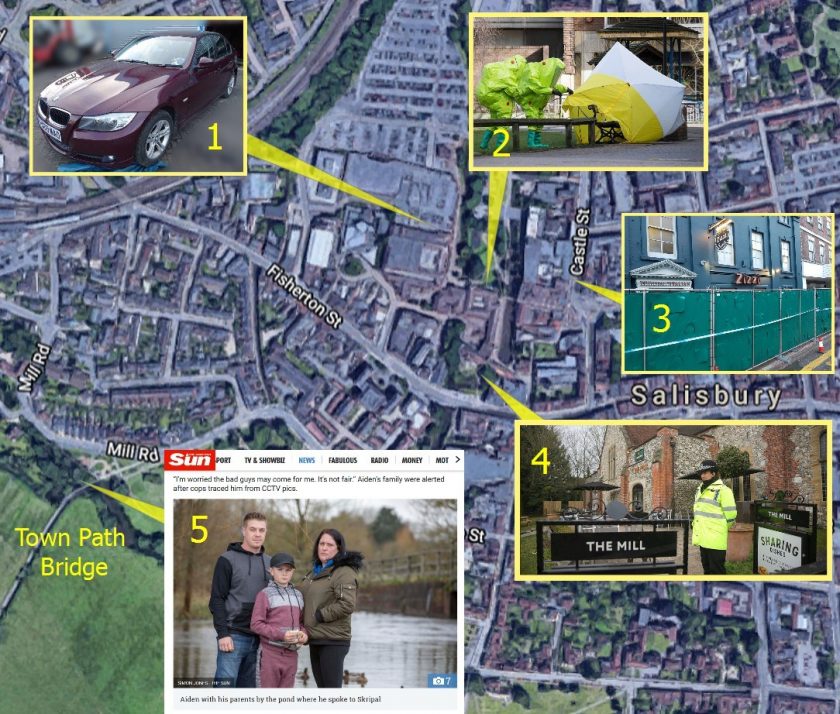
One or two comments suggest that a map would be helpful. Again, I am indebted to the lady who pointed the Queen Elizabeth Gardens connection out to me, who has helpfully created a map with the main areas of interest (see below).
Can I just caution about one thing though. The point of my post was not to try and work out whether Queen Elizabeth Gardens is important as regards the original case. I think we could go down endless rabbit holes trying to work out where the Skripals went, when they went there, and what this might mean. Unfortunately, we simply do not know this, as there is too much information that we are not party to.
What I am trying to do at the moment is exploit holes in the official story (of which there are more than a few). The police have not included QEG in their timeline, and yet they apparently know that the Skripals were there that day. Why have they not included it? Why did they not close the Gardens down? And had they done so, could this have prevented others from coming into contact with the substance?
I am not saying that I necessarily think there was a substance there. There may or may not have been. However, the point is that the authorities are saying this and yet those same authorities apparently know that the Skripals were there on 4th March, but have hushed this up. Therefore, we need to turn up the volume on it and they need to explain themselves.
Dawn Sturgess and the case against Russia
By Craig Murray | July 9, 2018
The terrible death of Dawn Sturgess casts a new shadow over the Salisbury Affair. Dawn appears to have been a popular and well grounded woman with close friend and family ties, whose life had taken a downward turn before being cruelly ended.
The illogical, inconsistent and shifting government narrative over events in Salisbury and Amesbury had appeared so ludicrous as to be tragi-comic. Any sense of amusement is now abruptly dispelled. But less us take a serious and sober look at the government case.
Savid Javid stated today:
We know back in March that it was the Russians. We know it was a barbaric, inhuman act by the Russian state. Again, for this particular incident, we need to learn more and let the police do their work.
Actually, we know no such thing and, contrary to Javid’s deliberate insinuation, the police have adduced no evidence that it was the Russian state.
The media appear to have entirely excluded from the narrative that Porton Down specifically stated that they cannot determine the origin of the poison that attacked the Skripals. Nor has the OPCW. There are scores of both state and non-state actors who could have produced the nerve agent. No evidence has been produced as to the physical person who allegedly administered the poison. In short, nothing so far has been shown which would lead any reasonable person to conclude a case against the Russian state was proven.
I believe that the following is the government narrative currently. I hope I am not mistating it:
Russia has a decade long secret programme of producing and stockpiling novichok nerve agents. It also has been training agents in secret assassination techniques, and British intelligence has a copy of the Russian training manual, which includes instruction on painting nerve agent on doorknobs. The Russians chose to use this assassination programme to target Sergei Skripal, a double agent who had been released from jail in Russia some eight years previously.
Only the Russians can make novichok and only the Russians had a motive to attack the Skripals.
The Russians had been tapping the phone of Yulia Skripal. They decided to attack Sergei Skripal while his daughter was visiting from Moscow. Their trained assassin(s) painted a novichok on the doorknob of the Skripal house in the suburbs of Salisbury. Either before or after the attack, they entered a public place in the centre of Salisbury and left a sealed container of the novichok there.
The Skripals both touched the doorknob and both functioned perfectly normally for at least five hours, even able to eat and drink heartily. Then they were simultaneously and instantaneously struck down by the nerve agent, at a spot in the city centre coincidentally close to where the assassins left a sealed container of the novichok lying around. Even though the nerve agent was eight times more deadly than Sarin or VX, it did not kill the Skripals because it had been on the doorknob and affected by rain.
Detective Sergeant Bailey attended the Skripal house and was also poisoned by the doorknb, but more lightly. None of the other police who attended the house were affected.
Four months later, Charlie Rowley and Dawn Sturgess were rooting about in public parks, possibly looking for cigarette butts, and accidentally came into contact with the sealed container of novichok. They were poisoned and Dawn Sturgess subsequently died.
I am going to leave you to mull over that story yourselves for a while. I believe it is a fair statement of the British government narrative. I also believe almost (but not quite) every single sentence is very obviously untrue. I hope tomorrow to publish a detailed analysis explaining why that is, but want you to look at it yourselves first.
One final thought. I trust that Dawn Sturgess will get a proper and full public inquest in accordance with normal legal process, something which was denied to David Kelly. I suspect that is something the government will seek to delay as long as possible, even indefinitely.
Nothing about the latest ‘novichok’ attacks adds up
We simply cannot trust the Establishment media’s reporting on the dramatic events in Amesbury
By KENNY COYLE | Morning Star | July 9, 2018
Tranquil rural Wiltshire is now the epicentre of Cold War 2.0 it seems.
The dramatic events in Amesbury at the start of the month are once again creating a frenzy of media speculation and confusion, if not outright disinformation.
However idyllic this spot of the English countryside might appear, the Salisbury/Amesbury area is ground zero for Britain’s chemical, biological, radiological and nuclear (CBRN) warfare infrastructure.
Amesbury’s closeness to the Defence Science and Technology Laboratory (DSTL) at Porton Down has been noted in some media reports, although usually with the implication that the location is a stroke of good luck in allowing super-swift scientific identification of the mysterious “novichok” substance that apparently poisoned Charlie Rowley and Dawn Sturgess.
Less attention has been paid to the fact that the area is also home to the Defence Chemical Biological Radiological Nuclear Centre at RAF Winterbourne Gunner, Salisbury. This was originally established in 1926 as the Chemical Warfare School.
The centre, according to its website, is also “home of the joint CBRN medical faculty. The centre also provides CBRN medical training to all medical officers in the UK armed services as well as specialist medical training to UK and NATO/allied nations.
“As well as military training, [the Defence CBRN Centre] also supports civilian response in partnership with the Health Protection Agency and Department of Health.”
Amesbury is little more than 10 minutes away by car.
Also handily located nearby is Boscombe Down air base. The site is currently run, managed and operated by QinetiQ, a private military company created out of the breakup of the Defence Evaluation and Research Agency (Dera) in 2001 by the Ministry of Defence.
The other part of the former Dera is Porton Down’s DSTL.
QinetiQ’s US arm produces a range of military robots. The QinetiQ Talon Hazmat is specially designed for the chemical weapons market and the company boasts it can identify “over 7,500 explosives, precursors and chemicals.”
At £4.5 million apiece, this is big business and with an increasing media focus on CBRN threats, real or imagined, this is very good news for the company’s shareholders, who snapped up its Dera parent for a song.
Amesbury also sits close to Salisbury Plain Training Area, one of the largest military zones in Britain.
In February, just weeks before the Skripal attack, Salisbury Plain hosted Exercise Toxic Dagger, a three-week chemical weapons training exercise involving 40 Royal Marine Commandos, Public Health England, the Atomic Weapons Establishment and the Defence Science and Technology Laboratory of Porton Down.
It’s in this neck of the woods that we are asked to believe that a Russian agent or agents skillfully avoided all detection and identification and managed to attack the Skripals by smearing a doorknob.
These agents then left behind a chemical trail that could be traced all the way back to Moscow, rather than disposing of the substance securely.
All this within miles of a cluster of NATO’s key chemical weapons facilities.
Then there’s the issue of timing.
The Guardian’s Ewen MacAskill noted:“The latest twist comes at a time when Russia’s image has been burnished by a successful staging of the World Cup.
“More significantly though, it comes less than a week before a NATO summit in Brussels to discuss how the transatlantic alliance should deal with Russia and ahead of Donald Trump’s meeting with Vladimir Putin.”
Quite so.
The case might not cause quite so much scepticism if we only had the inconsistencies and absurdities of the Skripal case to contend with.
This second “novichok” case creates additional problems.
According to an initial statement on Wiltshire Police’s website, “emergency services were called to an address in Muggleton Road on Saturday evening after a man and woman, both in their 40s, were found unconscious in a property.
“They are both currently receiving treatment at Salisbury District Hospital and are both in a serious condition.
“Det Sgt Eirin Martin, from Salisbury CID, said: ‘At this stage we believe the two patients have fallen ill after using a contaminated batch of drugs, possibly heroin or crack cocaine’.”
This first police statement suggested that both victims were hospitalised at the same time, on Saturday evening and that it was being treated as a Class A drug-related incident.
However, a few days later Metropolitan Police Assistant Commissioner Neil Basu gave an entirely different timeline of events.
Basu’s statement said: “The ambulance service was called to Muggleton Road on Saturday (June 30) at about 10.15am where a 44-year-old woman had collapsed. She was taken to hospital.
“And at about 3.30pm, an ambulance was called to the same address where a 45-year-old man had also fallen ill. The man was taken to hospital and Wiltshire Police were informed.”
Video footage shown by BBC and Sky News claimed to show Rowley being put in an ambulance. One pictured paramedic was wearing a full hazmat suit, which is an uncommon response to an emergency call for what was supposedly a suspected drug overdose.
However, three separate local Wiltshire media reports from July 1 contradict the official narrative.
The website of Salisbury radio station Spire FM reported that:
“An incident in the Kings Gate area of Amesbury on Saturday evening (June 30) is thought to have been a drug-related medical episode.
“More than 10 emergency vehicles arrived on the scene from police, ambulance and fire service.
“A number of roads around the estate were closed for a time, but reopened within a couple of hours.
“A South Western Ambulance Trust spokesperson told Spire FM News they were called at 6.20pm.
“One patient has been taken to Salisbury District Hospital by land ambulance.”
Initial reports in the Salisbury Journal newspaper also put the ambulance call later than Basu.
“The ambulance service was called at about 6.20pm and the fire service were called just before 7pm.
“Witnesses told the Journal that a number of residents were evacuated from their homes by firefighters.
“They also reported seeing people in hazmat suits at the scene.
“Witnesses also said about eight fire engines along with police and ambulance vehicles as well as specialist incident response vehicles were also at the scene.”
The Journal report continues: “A police spokesman said: ‘At the moment it is not a police incident. It is being led by the fire and the ambulance.
“‘It appears that there are three people who have taken drugs and had a medical incident. They have all been taken to hospital’.”
Finally, Charlotte Callen, BBC West Home Affairs Correspondent, reported on BBC online, datelined July 4, that: “neighbours tell me the peace at this usually quiet new estate in Amesbury was broken at around 6.30 pm on Saturday evening.
“It was hot and many were out BBQ’ing when they heard sirens and saw flashing lights as first ambulances then the fire brigade and police arrived at Muggleton Road.
“They saw seven fire engines and fire officers wearing Hazmats at the scene. The house was cordoned off and the word here was that this was a suspected drugs overdose,” Callan reported from the scene.
So according to three local media reports, the ambulance was called much later than the times given by Basu. Although this was supposedly being treated as a drugs-related incident, fire crews were called, residents evacuated, roads closed, hazmat personnel deployed and specialist incident response vehicles, some from as far away as Swindon, were sent to the scene. Some details differ.
Three people were in the property, according to the local police version. Presumably this was Rowley, Sturgess and Hobson, with the police claiming that all three had been taken to hospital, but only one was confirmed to the media by the Ambulance Service as being hospitalised.
This simply does not add up.
The willingness of the Establishment media not only to echo official narratives but to help create them is impressive.
From the BBC to The Guardian, the Establishment media presents a neutral narrative that would not be so readily accepted if put forward directly by government officials or ministers.
Yet the interlocking of media, military and political elites is also now on show.
The Amesbury event apparently provides a new sample of the substance, helpfully kept in a carelessly discarded container in a public space, safe from the elements.
This is presented as the final missing piece of the puzzle that had so far eluded one of the biggest peacetime counter-terrorism hunts.
BBC diplomatic and defence correspondent Mark Urban took to the air on Newsnight this week to outline what may become the official standard explanation for the whole novichok case.
Yet only now has Urban revealed that he had in fact been meeting secretly with Sergei Skripal over a year ago.
“I met Sergei on a few occasions last summer and found him to be a private character who did not, even under the circumstances then prevailing, wish to draw attention to himself.
“He agreed to see me as a writer of history books rather than as a news journalist, since I was researching one on the post-Cold War espionage battle between Russia and the West.
“Information gained in these interviews was fed into my Newsnight coverage during the early days after the poisoning. I have not felt ready until now to acknowledge explicitly that we had met, but do now that the book is nearing completion,” Urban wrote on BBC online.
Urban has strong military links, penning nearly a dozen books on British army units over the years, while collecting his BBC salary.
He is a former second lieutenant in the fourth Royal Tank Regiment, which until 1993 was garrisoned in Tidworth, Wiltshire, 15 minutes or so from Amesbury.
Leaving aside Urban’s obvious contractual conflict of interest and his commitment to writing a spy book supposedly overruling his duty as an impartial public broadcaster, it is a bombshell to find that for four months the link between Skripal and a senior BBC journalist with intimate links to the British military was kept secret from viewers.
How much did Urban’s BBC managers know of his extra-curricular activities?
Did Skripal’s MI6 handlers introduce Urban to him, did they arrange his meetings, vet or coach Skripal’s answers?
It raises once again the question of just how cosy the links are between British intelligence and many senior employees of Auntie Beeb.
And why is this information only being revealed now? Because of a looming and now, no doubt, ultra-lucrative book deal for Urban or instead to bolster the case that Skripal was indeed a likely target for Russian assassination due to continuing work for British and NATO intelligence services?
More and more questions, but don’t expect the Establishment media to ask, never mind answer, them.
9/11 and the War on Terror: Israel’s History of False Flag Operations against the U.S.A.
By Christopher Bollyn | American Herald Tribune | July 7, 2018
“We have spent $7 trillion – trillion with a T – $7 trillion in the Middle East. You know what we have for it? Nothing. Nothing.” – President Donald Trump, April 28, 2018
Dear Mr. President,
 As you said very clearly, the United States is bogged down in a costly quagmire in the Middle East, engaged in covert military operations in countries where there is no real U.S. interest. We have gained nothing from 17 years of war in which untold thousands have been killed or maimed and entire nations have been devastated. Our Middle East policy is disastrous and must be changed. If we don’t change our policy we can only expect more of the same – millions more refugees, thousands more dead, trillions more wasted.
In order to correct our policy we need to understand who got us into this mess in the first place. The 9/11 event as a false flag operation and the War on Terror campaign were both conceived by Israeli military intelligence in the 1970s under the leadership of Menachem Begin, the self-proclaimed “Father of Terrorism” and founder of the Likud party who became prime minister in 1977. War on Terror doctrine was rolled out in July 1979 at a Netanyahu Institute conference in Jerusalem. The Israeli trick was to get the U.S. military to neutralize and fragment its enemies, most notably Iraq and Syria, under the pretext of fighting terrorism. Since 1979, this devious plan has been openly promoted by Benjamin Netanyahu. On 9/11, War on Terror proponent Netanyahu told the New York Times that the terror atrocity was “very good” for U.S.-Israeli relations.
The Israelis have a long history of using false-flag terrorism against the United States:
- 1954 JUL – The Lavon Affair: Israeli agents place bombs in U.S. and British libraries and institutions in Egypt in a false-flag operation meant to be blamed on the Muslim Brotherhood.
- 1967 JUN – Israeli aircraft and ships attack the defenseless USS Liberty, killing 34 and wounding 171, with the intention of sinking the ship – with no survivors – so that the blame could be assigned to Egypt.
- 1983 OCT – A truck bomb kills 241 Marines in their barracks in Beirut. Former Mossad agent Victor Ostrovsky says Mossad knew the details of the truck, the time, and location of the bombing, but only gave a general warning to the Americans. A nebulous “Islamic Jihad” group is blamed; Defense Secretary Caspar Weinberger says U.S. has no knowledge who really did the bombing. This occurred one month after a single Marine stopped an Israeli tank column – some former Marines believe Israel organized the attack.
- 1986 FEB – Mossad plants a radio relay device in an apartment in Tripoli, Libya, to send fake messages that appear to be from the Libyan government; U.S. intelligence is successfully tricked and President Reagan orders bombing of Libya.
1978 – Israeli agent Arnon Milchan‘s first film features a Boeing 747 crashing into the PanAm building. Months before 9/11 produces a film episode in which remote controlled airplanes hit buildings.
1979 JUL – Netanyahu Institute hosts conference on terrorism calling for U.S. military intervention in Middle East.
1979 – Isser Harel, founding chief of Israeli intelligence, predicts 9/11 attacks in New York City.
1982 FEB – Israeli Likud strategist Oded Yinon plan calls for the “dissolution of Syria and Iraq” and Balkanization of all Arab states.
1983 – Israel creates foe for War on Terror: Under Ehud Barak, Israeli military intelligence (AMAN) begins arming and training anti-Western Hezb-i-Islami terrorists in Pakistan, including Osama bin Laden.
1987 – Two of Isser Harel’s senior Mossad agents, Avraham Shalom Bendor and Zvi Malkin, get the security contract for World Trade Center; Port Authority cancels the contract when their criminal history is discovered.
1990 – Rejected by Port Authority due to criminal conviction in Israel, Shalom Bendor goes to work for Jules Kroll.
1993 FEB – Zionists manage prosecution of WTC bombing: Israeli-American Michael Chertoff, U.S. Attorney for New Jersey, plays key role in prosecution. Zionist Judge Michael Mukasey presides over case against “Blind Sheikh.” FBI informant Emad Salem is paid one million dollars for his testimony. Media leads public to believe that Muslims want to destroy the Twin Towers.
1993 – After first WTC bombing Kroll Associates gets security contract for the Port Authority and the WTC.
1994 – After losing Saudi and Pakistani support, the Israeli-trained “remainder of Hezb-i-Islami merges into al-Qaeda and the Taliban.”
1998 DEC – Philip Zelikow’s Catastrophic Terrorism Study Group publishes report “Imagining Transforming Event” in Foreign Affairs (CFR). Co-authors Ashton Carter and John Deutch work for Global Technology Partners, an exclusive affiliate of Rothschild N.A.
1999 – Hugo Neu creates a global trading division headed by two veteran ferrous metal traders from Marc Rich and Glencore AG in Switzerland. A lot of expense and effort is spent to prepare a network to export scrap iron to Asia while its price is at the lowest level in 50 years. Hugo Neu and the state share the costs of dredging the Claremont channel to allow large ocean-going ships to Asia.
2000 SEP – A Neo-Con group, Project for the New American Century (PNAC) suggests that “a catastrophic and catalyzing event – like a new Pearl Harbor” may be necessary to facilitate “the process of transformation” they call for in U.S. military policy. Ten signers of the PNAC document, including Dick Cheney, were in senior positions of the Bush administration in 2001.
2001 – Israeli Mossad company ICTS controls security screening at U.S. Airports on 9/11. Directors include Yair Shamir, son of notorious Israeli terrorist Yitzhak Shamir.
2001 – Israeli intelligence creates false histories for alleged hijackers. Israeli spies posing as “art students” live near hijacker patsies. Duplicate documents are used to create false histories, standard procedure for Mossad false-flag operations.
2001 – Ronald Lauder manages Governor George Pataki’s privatization scheme which includes WTC property. Lauder funds Lauder School of Government, Diplomacy and Strategy at Mossad center (IDC) where Israeli Major General Daniel Rothschild heads Institute for Policy and Strategy.
2001 JUL 24 – Larry Silverstein gets lease for World Trade Center. Silverstein obtains lease thru fellow Zionist agent Lew Eisenberg, chairman of the Port Authority. Silverstein and Eisenberg are both members of UJA board, major Zionist fundraising organization. Since 1996, Silverstein has close contact with Netanyahu; every Sunday afternoon Netanyahu calls Silverstein. Silverstein immediately raises rents by 40% for the few tenants he has.
2001 SEP 11 – Ehud Olmert, Israel’s deputy prime minister, is on an unreported visit in New York City. Why is it secret? While all civilian planes are grounded, at 4:11 p.m. an El Al Boeing 747 takes off from JFK bound for Tel Aviv. The flight is authorized by the direct intervention of the U.S. Department of Defense.
9/11 – Alex Brown, a firm with ties to Israeli military intelligence and Yair Shamir’s company Scitex has many of the suspicious “put” options. “Buzzy” Krongard, executive director of the CIA, headed AB until 1998. His wife works for Rothschild Asset Management.
9/11 – Israeli government receives the names of 4,000 Israelis believed to be in the area of the WTC or Pentagon on 9/11. Odigo, an Israeli messaging company, is used to send warning several hours before attacks. Four Israelis die at WTC.
9/11 – Five Israelis working for Urban Moving Systems are arrested on 9/11 after being seen photographing and celebrating the attack on the WTC. The fake moving company is later found to be a front for the Mossad. Two of the Israelis are known Mossad.
9/11 – Israeli military chief Ehud Barak interprets 9/11 on BBC and Sky News in London, blaming Osama bin Laden and calling for U.S. to “launch an operational, concrete, war against terror.” Barak is Netanyahu’s commander in the Sayeret Matkal, a covert commando force of Israeli military intelligence. Other Israeli commandos (e.g. Daniel Lewin) are involved in 9/11. Bin Laden denies responsibility for 9/11.
9/11 – Netanyahu praises 9/11 atrocity to NYT: “It’s very good… it will generate immediate sympathy.” In 2008, he says in Israel: “We are benefiting from one thing, and that is the attack on the Twin Towers and Pentagon, and the American struggle in Iraq.”
9/11 – An Israeli controls 9-11 investigation. John Ashcroft puts Israeli dual-national Michael Chertoff in charge of 9/11 investigation. “For day-to-day decisions, Chertoff has the last word.” Destruction of crucial evidence begins immediately.
9/11 – Two Zionist-owned junkyards manage hasty destruction and exportation of evidence using large ships bound for Asia able to load at Hugo Neu because the Claremont Channel has been dredged since 1999.
Post 9/11 – Zionist with conflict of interest presides over 9/11 lawsuit: Judge Alvin Hellerstein manages 9-11 tort litigation, while his son is lawyer in Israel with firm that represents ICTS, key defendant in 9/11 litigation. Hellerstein dismisses ICTS and every 9/11 case is settled out of court.
Post 9/11 – Zionists manage compensation funds: Kenneth Feinberg and Sheila Birnbaum oversee compensation settlements for 9/11 families. Not a single case goes to trial. No 9/11 discovery occurs in court.
2003 MAR – Zionists control 9/11 myth: Appointed director of 9/11 Commission, Philip Zelikow frames the agenda and decides what evidence the commission sees. A specialist in “public myths,” Zelikow comes to commission with complete outline of report – before staff even begins working.
Until 2011 – Israelis construct 9/11 memorial and legacy: WTC memorial is designed by Israeli Michael Arad, son of Moshe Arad, former Israeli ambassador to the United States.
Until today – Controlled media ignores crucial 9/11 questions and evidence. Media pushes false narrative about 9/11 and the War on Terror while ignoring evidence that disproves the official myth.
Very respectfully,
Christopher Bollyn
Featured Video
BRITAIN’S WARNING: PREPARE FOR WAR
or go to
Aletho News Archives – Video-Images
From the Archive
How Ukraine Tortured and Slaughtered Donbass
By Kit Klarenberg | Al Mayadeen | July 11, 2024
Almost immediately after the proxy war erupted, ISIS-tier footage of the torture and murder of Russians in Ukrainian custody emerged.
On July 6th, the New York Times published an astonishing investigation: In Ukraine, Killings of Surrendering Russians Divide an American-Led Unit. The article documents in grim detail how Chosen Company, an international volunteer battalion for Kiev, routinely executes Russian prisoners of war. It is the very first mainstream admission that this practice – a brazen breach of the Geneva Conventions, and a grave war crime – is widespread among Ukraine’s fighters, both foreign and homegrown. … continue
Blog Roll
 Aletho News
- Israel Demolishes Home Of Lebanese Journalist Whose Viral Film Exposed Pager Attack
- Record Oil, Empty Tanks: The UAE’s Miracle Recovery
- Burnham tackles Britain’s poverty with aggression in Yemen
- Peace in Ukraine: the easy way – or the hard way
- Trump & the Rrrrussians
- US taxpayer money laundered back through Ukraine – Musk
- Before COVID, an NIH lab chief proposed making a SARS-like bat virus more infectious
- Gates, Bourla on Trial in Netherlands Accused of ‘Great Reset’ Scheme at Vaccine Injury Hearing
- BRITAIN’S WARNING: PREPARE FOR WAR
- “Historic Russia”: The Land Putin Will Not Give Back
- If Americans Knew
- DAILY UPDATE: Latest essential news on Palestine, Israel, & region
- Damning report shows the media must confront its failures on Gaza
- BBC senior broadcaster speaks out on Gaza coverage
- Netanyahu vows vast West Bank invasion in response to 20-minute skirmish that left 2 Israeli soldiers and 2 Palestinian fighters dead
- Tied up and tortured: Israel using US-made electroshock weapons on Palestinian detainees
- The outsourced risk: how newsrooms rely on Gaza’s freelancers without protecting them
- Gaza bakeries forced to shut as Israel blocks flour shipments
- Gaza’s breast cancer patients face a deadly wait for treatment amid Israel’s genocide
- DAILY UPDATE: Latest essential news on Palestine, Israel, & region
- The Israel Lobby’s Changing Fortunes
- No Tricks Zone
- Two New Studies Find Thwaites Glacier Melt Cannot Be Driven By Human Activity Or A Warming Ocean
- E-Cars Reduce CO2 Emissions By Only 41% Compared To Internal Combustion Engine Vehicles
- Predictions Made By Renowned Climate Professor Over Past Decades Have Been Proven To Be Poor
- New Study Suggests Large Regions Of The Pacific Ocean Have Been Cooling For The Last 80 Years
- Germany’s Green Energy Debacle: High Energy Costs Force Kahla Porzellan to Close After 182 Years!
- New Study: 50 Years Of The Most Aggressive ‘Net Zero’ Policies Can Only Affect The Global Climate By 0.03°C
- US September “Heat” Was No Record…Many Records Set Decades Ago
- Latest European Green Energy Debacle; Portugal’s Largest Flagship Solar Park Insolvent!
- Green Energy Debacle: German Expert Professor Fritz Vahrenholt Warns Of Severe Economic And Social Consequences
- Two More Paleo Reconstructions Affirm Meters-Higher Sea Levels Across Ireland, Brazil 7000-6000 Years Ago

