Australian Sumud Flotilla activists file ICC war crimes case against Israel over torture, sexual violence
The Cradle | June 1, 2026
Australian activists who took part in the Global Sumud Flotilla for Gaza filed a formal submission with the International Criminal Court (ICC) on 30 May, accusing Israel of war crimes based on documented evidence of torture and sexual violence sustained during their abduction and imprisonment.
The legal filing, submitted by 11 Australian survivors of the Flotilla and their legal team, is supported by dozens of survivor testimonies, video evidence, medical records, and sworn statements.
This evidence details severe beatings and sexual abuse following the 18 May interception of an international aid mission carrying food and medicine to the besieged Gaza Strip in an attempt to break the Israeli blockade of the enclave.
One specific account included in the submission describes an Australian humanitarian worker being forcibly injected with an unidentified substance by Israeli captors.
The submission also incorporates video evidence, including footage posted to social media by Israeli National Security Minister Itamar Ben Gvir, who boasted of the ill treatment and showed handcuffed activists on their knees being taunted by Israeli soldiers.
The Global Sumud Flotilla reports that at least 67 participants suffered injuries during their imprisonment that required medical evaluation, with 12 individuals requiring hospitalization.
One survivor, Australian filmmaker Juliet Lamont, in an interview with Double Down News, recounted being dragged into a shipping container she called a “torture tunnel” where she was placed in a stress position, hands restrained behind her back, and ankles shackled in the dark before being “vaginally raped by one of the male soldiers,” while “other people had guns inserted inside them.”
She added that a 70-year-old woman’s ribs had been broken as “howls of torture and pain” would emit from the same chamber she had been tortured in.
This legal action follows the UN adding Israel to a 2026 blacklist for parties guilty of committing sexual violence in conflict zones. UN Secretary-General Antonio Guterres cited documented “patterns of sexual violence” against detainees, leading to the designation of the Israeli Prison Service on the blacklist.
While Israel’s ambassador to Australia and other Israeli officials have denied these claims, asserting that participants were treated according to established procedures, the Australian government previously sanctioned Minister Ben Gvir for his “shocking and unacceptable” treatment of the detainees.
Returning survivors have expressed outrage at the Australian federal government, noting that Prime Minister Anthony Albanese has declined multiple requests to meet with them.
Flotilla participant Isla Lamont highlighted the contrast of being granted a hearing at the ICC while being ignored by domestic leadership, stating that “If Australian survivors can be heard in The Hague but not in Canberra, something has gone badly wrong”.
The flotilla organizers are now calling for independent international investigations, arms embargoes, and the enforcement of arrest warrants for the officials responsible.
French activists are also pursuing their own separate legal complaint on the “humiliation, rape, and acts of torture” they endured, explicitly declining to cooperate with the French Foreign Ministry’s request for a criminal probe due to their government’s continued diplomatic support for Israel throughout the genocide in Gaza.
Two US political commentators banned from UK for criticizing ‘Israel’
Al Mayadeen | June 1, 2026
The UK government has blocked two prominent left-wing US political commentators, Hasan Piker and Cenk Uygur, from entering the country, reportedly over remarks concerning “Israel”.
Piker, a political streamer with 1.9 million YouTube subscribers, and Uygur, co-founder of The Young Turks, said they had been denied entry to the UK. He said in a social media post that he was prevented from boarding a flight to London to attend SXSW London and deliver a speech at Oxford.
“I’ve been banned from the UK. I tried to get on a flight to London to attend SXSW London and give a speech at Oxford. I’ve been banned for criticizing “Israel”. Are we free anymore?” he wrote, adding: “This is oppression of Western citizens by our own governments on behalf of a different country.”
Uygur also commented publicly on the decision, saying the move reflected political pressure linked to criticism of “Israel”.
Labour government bans Hasan Piker and Cenk Uygur
The UK Home Secretary Shabana Mahmood reportedly decided to ban Uygur from entering the UK, citing concerns that his presence could “risk exacerbating antisemitism due to his rhetoric.”
Piker, who is known online as HasanAbi and previously worked with The Young Turks, said the UK had also revoked his visa “at the behest of Israel.” He wrote: “The West is betraying liberal values for a genocidal fascist foreign government. Soon we will all become Israel.”
During a video uploaded to YouTube, Piker said he had been scheduled to attend events with Jeremy Corbyn, Zack Polanski, and Yanis Varoufakis.
He also read from a letter sent by the UK government, which stated: “Your UK ETA has been cancelled. This means you cannot travel to the UK without a visa. This is because your presence in the UK is not considered to be conducive to the public good. You cannot appeal this decision.”
Western weaponization of censorship
“Israel” and its Western allies have repeatedly sought to silence journalists who expose Israeli occupation and war crimes by branding critical reporting as “terror propaganda” or anti‑Israeli incitement, rather than engaging with the documented violence on the ground.
Al Mayadeen’s experience is illustrative: Israeli authorities banned the channel’s broadcasts in occupied Palestine under emergency “security” regulations, seized its equipment, and accused its reporters of serving “enemy” interests and “pretending to be journalists”.
This aggressive censorship is reinforced in Western media ecosystems, where leaked testimonies describe unwritten rules against words like “genocide” and structural pressure on reporters and scholars to self‑censor criticism of “Israel” for fear of being smeared as “anti‑Semitic” or apologetic for “terror”, producing a climate in which speaking honestly about occupation is treated as a greater offense than the atrocities themselves.
Moreover, US and UK authorities have increasingly mirrored “Israel’s” own tactics by banning or criminalizing voices that challenge its actions, turning criticism of a foreign state into a de facto speech offense. In the UK, this has meant not only designating Palestine Action a “terrorist” organization but also arresting thousands of supporters and documenting nearly 1,000 cases where students, workers, and artists faced investigations, suspensions, or event cancellations for pro‑Palestine advocacy.
Across the Atlantic, US officials have backed or tolerated these crackdowns while pursuing their own arrests and visa actions against pro‑Palestine student leaders, signalling a transatlantic consensus that views solidarity with Palestinians and sharp scrutiny of the Israeli lobby and war crimes as a security problem to be contained rather than protected political speech
Police tried to recruit café owner as Palestine Action spy
Al Mayadeen | May 30, 2026
A Manchester café owner and prominent supporter of the Palestinian cause has accused the British police of attempting to recruit him as an informant targeting Palestine Action, offering financial incentives and suggesting authorities could overlook certain minor offenses in exchange for cooperation.
Speaking to The Guardian on Saturday, Shams Sadiq, who owns two cafes in Manchester and has been active in pro-Palestine solidarity efforts, said the approach took place when he attended Ashton-under-Lyne police station on 15 May to recover electronic devices seized during a previous investigation linked to Palestine Action.
According to Sadiq, officers informed him that after examining his devices they knew he was “fully involved” with Palestine Action but said he would not face charges related to his arrest last year. He said the discussion then shifted toward securing his assistance.
“They said to me: ‘We need your help. Look, there’s benefits in helping us,'” Sadiq told The Guardian. “I’m like: ‘What kind of benefits? Financial benefits? Are you going to pay my taxes?’ They said: ‘Oh, we can help with things like that.'”
Sadiq said another officer suggested additional incentives were available.
“The other guy said to me: ‘Oh, there’s other benefits, too.’ They said: ‘We’re not saying you can go out and commit a serious crime but we can turn a blind eye to certain things.'”
When he jokingly asked whether they could remove his speeding tickets, Sadiq said the officers responded, “We don’t care about speeding.”
The 51-year-old believes the officers were attempting to recruit him as an informer because of his involvement in Palestine solidarity activities and his standing within Manchester’s Muslim community.
“He interpreted ‘help’ to mean ‘with their investigations [into Palestine Action] because they said I am involved and maybe be an informer. They also said I’m quite respected in my community, so maybe they think I would help them find Muslims in the mosque with extreme views.'”
Activism under scrutiny
The allegations emerge amid increasing scrutiny of pro-Palestine activism in Britain and growing concerns among campaigners over the use of counterterrorism powers against activists and community organizers.
Days before the alleged recruitment attempt, Sadiq said he was stopped and questioned at Manchester Airport under Schedule 7 of the Terrorism Act after returning from a holiday in Morocco.
He said officers questioned him for more than three hours about Palestine Action, Iran, and his personal finances, including details related to his mortgage. During the interrogation, he said officers also asked how he would respond if someone attending his mosque expressed extremist views. His electronic devices were seized during the encounter.
According to Sadiq, the same officers later met him at a Starbucks inside Terminal 2, where they returned the devices and apologized for the airport questioning.
Anti-terror powers
A vocal advocate for Palestine, Sadiq has participated in demonstrations and supported campaigns and cultural events highlighting Palestinian issues. His public support has previously made him a target, with one of his cafes subjected to harassment because of his pro-Palestine stance.
Sadiq said the officers also told him that they could provide protection for him and his family and gave him a contact number, making it clear that he did not have to decide immediately whether to cooperate.
He said he chose to speak publicly after rejecting the proposal, believing that public exposure offered the best protection.
“I feel like I need protection from the police rather than anything else. It’s scary that I’ve got this marker on my passport for doing nothing. If they’ve got something on me, then charge me.”
His solicitor, Simon Pook of Robert Lizar Solicitors, condemned the alleged conduct and questioned whether anti-terrorism legislation had been used as a pretext to pressure a political activist into collaborating with authorities.
“We’re unhappy that he was put in that position and offered inducements to work for the state,” Pook said. “Was the intention always to use the schedule 7 in order to offer the inducement? If that is the true intention, schedule 7 was used unlawfully, because it’s got to be used where you believe somebody may be involved in or in an act of preparation of terrorism.”
Greater Manchester Police declined to comment on the allegations.
Palestine Action ban sparks civil liberties concerns
The allegations come against the backdrop of a broader crackdown on Palestine Action, a direct-action movement known for targeting facilities linked to Israeli arms manufacturer Elbit Systems and other companies accused of supplying weapons used in “Israel’s” genocidal campaign in Gaza.
The organization gained prominence through occupations, blockades, and acts of property damage aimed at disrupting the production and shipment of military equipment destined for “Israel”. Supporters argue that the group’s actions sought to halt material support for the genocide in Gaza, while critics accused the movement of engaging in unlawful sabotage.
In July 2025, the British government designated Palestine Action a “terrorist organization” following a high-profile action at RAF Brize Norton, where activists entered the airbase and spray-painted military aircraft. The move marked the first time a direct-action protest group had been proscribed under British terrorism legislation, placing it in the same legal category as armed militant organizations.
The decision was widely condemned by civil liberties advocates, legal experts, UN rights experts, and pro-Palestine organizations, which argued that existing criminal laws were already sufficient to address any alleged offenses committed by activists. Critics warned that the proscription represented a dangerous expansion of counterterrorism powers into the realm of political protest and dissent.
Since the ban, thousands of people have reportedly been arrested across Britain for expressing support for Palestine Action, including activists, academics, religious figures, and anti-war campaigners. Supporters of the group say activists have faced heightened surveillance, airport stops, device seizures, lengthy investigations, and the threat of imprisonment for activities they view as part of a broader movement opposing Israel’s war on Gaza.
The controversy intensified in February 2026 when the High Court ruled that the government’s ban on Palestine Action was unlawful and disproportionate, finding that ministers had failed to properly justify the use of terrorism legislation against the group. However, the ban remains in force while the government appeals the decision.
For many Palestine solidarity campaigners, Sadiq’s claims reinforce concerns that anti-terrorism powers are increasingly being used to monitor, pressure, and gather intelligence on individuals involved in pro-Palestinian activism rather than to address genuine security threats.
The Guardian Runs A Smear Piece Against Anti-War Journalist For Exposing The U.S./Israeli War On Iran
The MI6 Media Is Again Smearing An Anti-War Journalist

The Dissident | May 30, 2026
Of all the media around the world, there is no country’s media that is more controlled and infiltrated by its security state than the British media.
This is best underscored by a recent smear piece published in the Guardian by tech reporter Aisha Down, which slanders British journalist Bushra Shaikh, who has reported on the U.S./Israeli war on Iran from the ground.
The article alleges Bushra Shaikh “went on two state-sponsored tours of Iran this spring where she met senior officials and was ‘active’ in spreading the regime’s message” only to later admit to having no evidence to back up this claim, writing, “It is unclear whether Shaikh and others covered their own expenses or were paid to do the trip”.
The Entire Piece Is Based On A Blog Post Smear Piece
The entire smear is based on a “report”, in reality a blog post, by a shady outfit which claims to be a “fact-checking” organisation called “Factnameh”.
The “report” that the article entirely bases its claim on is in reality a blog post on Substack, which baselessly smears the few Western journalists who reported on the ground on the U.S./Israeli war crimes committed in Iran.
The blog post claims that Bushra Shaikh’s on-the-ground reporting on Iran “demonstrates how the (Iranian) state utilises these figures to manipulate Western algorithms” without giving a shred of evidence to back this up.
In the most bizarre section of the blog post, Factnameh claimed that Bushra Shaikh was engaging in “a highly calculated pattern of social media manipulation” because she tweeted about Iran, “almost exclusively during critical events, such as the intensification of military conflicts, ceasefires, and nationwide protests.”
In other words, she engaged in “social media manipulation” because she covered news topics while they were happening.
The blog post also claimed she achieved a high social media following “by routinely targeting controversial topics and engaging in confrontational discussions that drew attention to her videos” (in other words, using social media the same way anyone else would).
It also complained that “Her online narrative consistently framed Western media and elites as hypocritical and corrupt, while portraying Iran as a rational, restrained country merely defending itself against Western aggression” a.k.a the truth.
The rest of the blog post simply complained that her reporting on the ground in Iran did not match up with CIA/Mossad narratives, such as when “she filmed herself walking unveiled through the bazaars of Tabriz and Tajrish”, “visited an Armenian monastery in Isfahan” and reporting from protests which showed “that the crowds did not want war”.
In other words, debunking the cartoonish Western portrayal of Iran’s treatment of women and religious minorities, and showing that maybe Iranians aren’t cheering to have their country carpet bombed by the U.S. and Israel.
Inside ‘Factnameh’
Factnameh, the shady organisation that the Guardian based its article on, was created by a Canadian organization called ASL19.
ASL19, according to the outlet the Verge, was created in 2009 – by Ali Karimzadeh Bangi, who came from the University of Toronto’s Citizen Lab project – in order to “promote a free Iranian internet” during the “Green Revolution” protests in Iran of 2009.
At the time, the Verge noted, “the US, Canada, and private donors were offering tens of millions of dollars in grant money for anyone who could build digital tools and give Iranians a reliable way to access them”.
The outlet also added that “Bangi’s connections at the University of Toronto’s Munk School of Global Affairs gave him an early line on (U.S. and Canadian) government-funded projects like the multimillion-dollar Digital Public Square initiative, which funded digital tools for political opposition groups around the world.”
Along with being a tool of Western government to destabilise Iran, ASL19 has been plagued with allegations of sexual assault within the organisation.
Ali Karimzadeh Bangi, the Verge noted, “appeared in court on charges of sexual assault and forcible imprisonment” and was “forced to cut ties with ASL19 entirely”.
The outlet added, “In early 2009, separate charges of sexual assault were filed against Bangi, although they were withdrawn before reaching court. The Verge has also learned of at least one separate incident in which Bangi used a nondisclosure agreement to silence a staff member in the wake of their romantic relationship”.
According to the article, written in 2018, “Many former employees of ASL19 see the charges as part of a larger pattern.”
As for Factnameh, the subsidiary of ASL19, it is edited by Farhad Souzanchi, who has baselessly claimed that Iran was behind protests against the genocide in Gaza on college campuses, claiming that “Over the years, Iranian media, officials, and the country’s Supreme Leader himself have repeatedly tried to influence international public opinion against Israel”.
Factnameh has published lies to cover up Mossad infiltration in Iran. In one blog post, the outfit claimed that a New York Times report which heavily implied Mossad infiltration of the protests in Iran in January does not make “any reference to the January 8th and 9th protests being a Mossad plan to encourage Trump to attack Iran” adding, “Iran’s state media has repeatedly misrepresented international news coverage and reports”.
In reality, the article heavily implied that there was Mossad involvement in the January protests, without explicitly saying it, writing:
As the United States and Israel prepared to go to war with Iran, the head of Mossad, Israel’s foreign intelligence service, went to Prime Minister Benjamin Netanyahu with a plan.
Within days of the war’s beginning, said David Barnea, the Mossad chief, his service would likely be able to galvanize the Iranian opposition — igniting riots and other acts of rebellion that could even lead to the collapse of Iran’s government. Mr. Barnea also presented the proposal to senior Trump administration officials during a visit to Washington in mid-January.
Mr. Netanyahu adopted the plan. Despite doubts about its viability among senior American officials and some officials in other Israeli intelligence agencies, both he and President Trump seemed to embrace an optimistic outlook. Killing Iran’s leaders at the outset of the conflict, followed by a series of intelligence operations intended to encourage regime change, they thought, could lead to a mass uprising that might bring about a swift end to the war.
The Israeli newspaper Ynet, however, directly confirmed that the Mossad had infiltrated the protests, writing, “David Barnea was appointed head of the Mossad in 2021. Iran had been the organization’s main arena of operations for years. Barnea ordered a dramatic change in an area that had been marginal until then – driving influence within the general Iranian public. Under him, this area became central to the campaign against Iran … faced with a regime that is all poison, Israel has set up its own poison machine. The organization began four years ago and reached operational maturity two and a half years ago. This is a weapons system that, if activated at full power, could be deadly far beyond the boundaries of the social network … in January of this year, tens of thousands of Iranians took to the streets, at their own pace. The enormous work that Israel had put in was behind the demonstrations”. (Emphasis: Mine)
Factnameh has even gone as far as to defend U.S/Israeli war crimes against Iranian civilians.
In one blog post, the outfit claimed that “In Iran, mosques and other religious sites function not only as places of worship but also as components of the country’s security infrastructure. Many host local bases of the Basij, a paramilitary force operating under the IRGC, with numerous neighbourhood units co-located in or around these mosques. This overlap embeds security and military activity within civilian neighbourhoods, effectively extending the battlefield into residential areas. As a result, when aerial strikes target elements of the country’s security apparatus, they often occur in densely populated areas, increasing the risk to surrounding civilians”, blatant propaganda to justify U.S./Israeli bombings of civilians.
The Guardian Wants Bushra Shaikh Investigated By The Security State
The real purpose of the Guardian hit piece becomes clear when it writes, “Earlier this year, Shaikh’s tours sparked criticism from Iranian digital rights activists, who noticed she appeared to have access to the internet that ordinary people did not, suggesting her trips were at the invitation of the regime. Iranian activists, some affiliated with the Women, Life, Freedom movement, circulated an online petition suggesting Shaikh should be investigated for sanctions violations.” (Emphasis:Mine).
To back up calls for Bushra Shaikh to be investigated by the British security state, the Guardian links to a petition started by zionist Nicholas Lissack which says, “We demand that the UK Government, OFSI, HMRC, and FCDO immediately investigate UK citizen Bushra Shaikh for potential breaches of the Iran (Sanctions) Regulations 2023 and the Foreign Influence Registration Scheme (FIRS).”
Nicholas Lissack, a self-described “Western Civilisationist” with a British and Israeli flag in his Instagram bio, has publicly agitated for a war with Iran to install the son of the U.S. backed Shah of Iran, posting only a day ago:
This is it. Our last chance to crush the terrorist Mullahs and liberate Iran.
President Trump: Choose humanity. Free the Iranian people from this Islamist nightmare and enter history as a hero.
Abandon them—and be remembered as its greatest traitor.
Make the call.
Free Iran. King Reza Pahlavi. Javid Shah!
He has also written :
President Trump, the time to strike Iran is now.
They’ve repeatedly broken the ceasefire, rejected nuclear negotiations, and tried to assassinate your daughter Ivanka.
Honour your promise to the tens of thousands of slaughtered Iranians: Free Iran now.
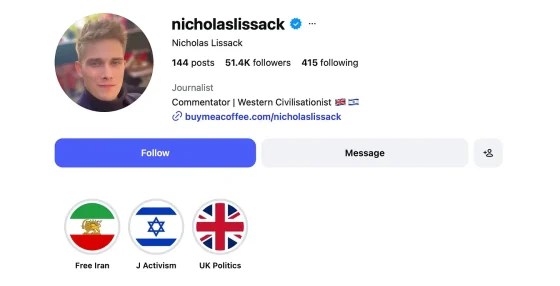
Pictured Above: Instagram profile of Nicholas Lissack, who started the petition cited in the Guardian.
Yet again, instead of investigating actual power, the MI6 media in the UK instead spends its time slandering an anti-war reporter and attempting to get her investigated.
Israel Relaunches, Rebrands Online Propaganda Campaign
By Harrison Berger | The American Conservative | May 21, 2026
Israel has relaunched and rebranded Act.IL, an online campaign originally designed by Israeli intelligence officials at the Ministry of Strategic Affairs to harass and intimidate American critics of Israel. Such operations are generally referred to as “troll farming,” though the forces behind Act.IL use softer, more highfalutin language.
Rebranded as RiseApp, the program is operated by Israel’s Reichman University (IDC Herzliya) and, according to the project’s website, aims to mobilize Act.IL’s existing database of more than 40,000 pro-Israel online operatives to counter what it describes as “antisemitism” and “misinformation.”
The Reichman University website describes RiseApp as delivering “fact-checked, expert-led responses” for users to deploy in “social media debates and public forums,” in order to engage in “proactive advocacy” on behalf of Israel. A “dual purpose,” of the app, Reichman says, is that it allows users to flag and “identify emerging adversarial narratives” while “alerting partner organizations” to “develop tailored responses.”
A presentation for the forthcoming app’s interface, posted to the Reichman website, pitches the platform as “empowering and uniting the Jewish community” and includes tabs for “The Useful Idiots” and “Genocide Claims.” The latter would seem to provide users with arguments to combat the consensus of human rights organizations that Israel committed genocide against Palestinians in Gaza.
RiseApp’s predecessor Act.IL was launched in 2017 as a joint project of Reichman Institute and the Israeli-American Council (IAC)—the U.S.-based Israel lobby group founded by casino billionaire Sheldon Adelson and run by Adam Milstein (Tuvia Milsztein), who was convicted in 2008 for his involvement in the Spinka tax fraud ring involving Orthodox Jewish charity fronts—and was operated by Yarden Ben-Yosef alongside other current and former Israeli intelligence officials.
“We work with the Ministry of Foreign Affairs and the Ministry of Strategic Affairs, consult with them and manage joint projects.” Act.IL director Ben-Yosef said in a 2018 interview with Forbes Israel. In an interview with The Forward a year earlier, he said of Act.IL’s relationship with Israeli spy agencies: “We talk with each other. We work together.”
As The Forward described the app in 2017, Act.IL would gather “high school students and adult mentors” who complete “social media ‘missions’ assigned out of a headquarters in Herzliya, Israel,” including pressuring social media platforms to censor content supportive of the Boycott Divestment and Sanctions (BDS) movement and critical of Israel, with users getting “points” for each mission they complete.
That propaganda and troll campaign was part of a broader Israeli government operation orchestrated by Gilad Erdan’s Ministry of Strategic Affairs called Concert, whose purpose was to create third party-operated surveillance, censorship, and propaganda firms that could hide all Israeli government links to their operations, which at the time were directed against the BDS movement in North America.
“Ambiguity is part of our guidelines,” the Israeli intelligence officer and director-general of the Ministry of Strategic Affairs Sima Vaknin-Gil explained in a leaked 2016 video recording featured in the suppressed Al Jazeera documentary The Lobby, telling a private audience of Adelson’s IAC activists that Israel has established “a civil intelligence unit that collects, analyzes, and acts upon” Israel’s enemies, using data from “campuses… and labor unions, and churches,” calling the program “Israel Cyber Shield.”
Israel Cyber Shield was eventually expanded into a much larger Israeli propaganda program which cycled through the names Kela Shlomo (Solomon’s Sling), Concert, and finally Voices of Israel. It is now housed under Amichai Chikli’s Ministry of Diaspora Affairs.
The rebranding of controversial hasbara operations is a documented pattern of the Israeli government and its intelligence services. Before Act.IL launched, Israeli company Psy-Group , also staffed by former Israeli spies and affiliates of Reichman University, ran “Project Butterfly” to infiltrate and destabilize BDS chapters on college campuses using fake identities, later pitching their social media manipulation services to Trump’s 2016 presidential campaign. Psy-Group founder Joel Zamel met Donald Trump Jr. at Trump Tower in August 2016, along with the businessman Erik Prince and a man named George Nader who presented himself as an emissary of the UAE and Saudi Arabia, while a senior campaign aide, Rick Gates, had separately solicited proposals from the Israeli spy-staffed firm for a covert influence campaign targeting Republican convention delegates and Hillary Clinton. When special counsel Robert Mueller’s Russiagate investigators closed in on those meetings, Psy-Group simply shut down and relaunched as Percepto International, while the Israel Lobby insinuated that Mueller was antisemitic for looking into Psy-Group’s Israeli interference efforts.
The relaunch of Act.IL as RiseApp follows the Israeli Knesset’s approval of the country’s largest ever budget for foreign propaganda operations, or hasbara, quintupling funding from 2025 to a total of $730 million. That scaled-up expenditure comes amid surveys showing declining support for Israel across party lines in the United States, a trend Israel correctly perceives as an existential threat to the unconditional funding and diplomatic protection their country depends on.
Harrison Berger is a correspondent at The American Conservative. He has contributed to Drop Site News, The Nation, and Responsible Statecraft. Previously, he was a researcher and producer for System Update with Glenn Greenwald. His work focuses on civil liberties and U.S. foreign policy. He studied Political Science and Russian Studies at Union College (NY).
German politician blasts ‘totalitarian madness’ of sanctions on pro-Palestinian journalist
RT | May 29, 2026
Germany’s implementation of EU sanctions against a pro-Palestinian journalist whom Brussels has accused of fueling discord on Russia’s behalf has descended into “totalitarian madness,” German opposition politician Sahra Wagenknecht has said.
Wagenknecht has called for financial restrictions imposed on Huseyin Dogru and his Berlin-based family to be lifted. On Tuesday, Dogru said Comdirect bank had frozen the assets of his elderly mother, citing what it described as a “control relationship over the funds by [her] son.” His wife’s bank account was targeted in March, while his father is reportedly under investigation by the authorities.
“This is how dictatorships treat opposition figures,” the left-wing BSW party founder told Berliner Zeitung on Thursday.
“The EU’s scandalous overreach against a German journalist and the German government’s complicity in breaking the law and collective punishment must finally stop,” she added. “If the Federal Office for the Protection of the Constitution were doing its job, this totalitarian government extremism would actually be a case for them.”
EU portrays pro-Palestinian advocacy as serving Russia
Dogru is a Turkish-German journalist who previously worked with the media outlet Redfish, which received funding from Ruptly, a video agency Western governments have labeled as being part of Russia’s “propaganda” infrastructure.
The EU imposed personal sanctions on Dogru in May 2025, accusing him of “systematically spreading false information about politically controversial topics, with the intention of sowing ethnic, political and religious discord” in Germany and claiming that his work aligned with Russian objectives.
Dogru says Brussels and Berlin are targeting him over his pro-Palestinian activism. Even Council of Europe Human Rights Commissioner Michael O’Flaherty criticized Germany over the issue, warning in April that “freedom of expression has been restricted disproportionately, regarding debates on Palestinian rights or legitimate criticism of the Israeli government.”
‘Civil death’ without charges
The German financial restrictions severely limit what Dogru, a father of three young children, can legally do to support his family. He is barred from carrying out donation-funded journalism or accepting solidarity aid, as the government considers such payments an attempt to circumvent sanctions. His assets have been frozen, with only around €500 ($590) per month permitted for expenses. His travel has also been restricted.
Dogru’s supporters say he has effectively been subjected to a “civil death” despite no formal charges being filed against him. A campaign urging the EU to lift the sanctions was launched last week on the anniversary of their introduction.
Wagenknecht is among the signatories of the petition, which argues that Dogru is facing state censorship in violation of the German constitution and EU laws.
After Western governments made combating what they call “Russian disinformation” a major policy priority, Moscow argued that the campaign reflected an attempt to preserve narrative control amid the rise of alternative online media.
Trump Administration’s DOJ Filing in Supreme Court ‘Sharp Betrayal’ of Religious Freedom
By Jefferey Jaxen | May 27, 2026
In a stunning reversal the Department of Justice under President Trump has filed a brief urging the U.S. Supreme Court to deny review in John Doe et al. v. Kathy Hochul, No. 24-1015. The case involves former New York healthcare workers fired for refusing COVID-19 vaccination on religious grounds under the state’s now-repealed Section 2.61 mandate, which allowed medical exemptions but barred religious ones.
The move is in stark contrast to the COVID-era legal momentum across the board seeing courts rule in favor of employees fired for religious vaccine refusals.
The Second Circuit upheld the employers’ refusal to accommodate, citing “undue hardship.”
The DOJ’s Call for the Views of the Solicitor General (CVSG) brief argues the petition is a poor vehicle for review—no circuit split, a repealed law, and petitioners who sought only a full exemption rather than alternatives like reassignment—while defending the policy’s consistency with Title VII of the Civil Rights Act.
This position, however, draws sharp criticism for weakening core protections against religious discrimination. Aaron Siri, a leading litigator who has represented numerous affected healthcare workers, called out the filing in an X post stating:
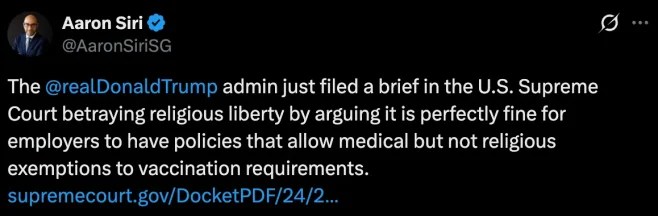
The brief’s analysis hinges on semantics and procedural technicalities. It acknowledges that petitioners claimed New York’s mandate conflicted with Title VII by foreclosing reasonable religious accommodations. Yet it frames their requests as demands for an “exemption” prohibited by state law, rather than the “accommodation” federal law requires.
Siri dismantled this in a follow-up post:
“Instead of defending these wrongfully terminated workers, the DOJ nonsensically and shamefully plays word games to characterize their requests as seeking an ‘exemption’ (which New York law prohibited) instead of an ‘accommodation’ (an option federal law requires). It then relies on this semantic nonsense to argue that the Supreme Court should not review the Second Circuit’s holding that a policy providing for medical but not religious exemptions is legal.”
Siri, who is perhaps the most experienced lawyer defending Americans who experienced COVID-era oversteps of basic liberties and freedoms, described the practical outcome bluntly: the mandate “permitted only a medical exemption and did not include a religious exemption.”
Healthcare workers with sincere religious objections were fired en masse. He continued,
“Having dealt with scores of religious employees in New York that lost their jobs under this policy, the Trump administration’s position is a sharp betrayal. The DOJ should have simply argued the obvious – that Section 2.61 foreclosed any religious exemption and hence should not stand under federal law. Period. That would have taken one or two pages. Instead, it spends over 20 pages creating a word salad of nonsense to justify New York’s and the DOJ’s unjustifiable position.”
This approach is dangerous because it normalizes differential treatment: medical exemptions are permissible, but religious ones trigger “undue hardship” claims tied to state penalties. Under Title VII, as clarified in Groff v. DeJoy (2023), employers must accommodate religious practice unless it imposes substantial increased costs. Yet the DOJ’s brief effectively blesses a regime where religious belief is disfavored, allowing employers to hide behind preempted state rules.
If a law bars religious accommodations outright, Title VII should preempt it—yet here the filing accepts a policy that functionally did exactly that while claiming otherwise.
The stakes extend far beyond healthcare. A Supreme Court denial, influenced by this brief, could embolden employers nationwide to impose vaccine or other medical mandates while dismissing religious objections as unreasonable.
It undermines the free exercise principles reinforced in cases like Fulton v. City of Philadelphia and signals that post-COVID religious liberty battles remain unwinnable in court. Workers facing future mandates—for flu shots, boosters, or novel therapies—would find their faith subordinated to bureaucratic convenience.
Siri’s critique highlights a missed opportunity for the administration that campaigned on restoring freedoms eroded during the pandemic. By playing procedural games instead of forcefully defending Title VII’s mandate to accommodate sincere religious practice, the DOJ risks setting precedent that treats faith as second-class. As Siri warned, this is no minor technical brief; it is a “sharp betrayal” that could erode religious freedom for millions. The Supreme Court must recognize the broader threat and take the case to reaffirm that no employer or state can lawfully force a choice between livelihood and conscience.
A Nation of Suspects
By Andrew P. Napolitano | Ron Paul Institute | May 28, 2026
Some of the recent legal challenges to the use of surveillance by the Department of Homeland Security upon Americans have resulted in the revelation of truly terrifying behavior by the government, in direct defiance of the Fourth Amendment to the Constitution. We now know that the federal government spies on innocent Americans without suspicion and without warrants.
The spying seems to fall into several categories. The National Security Agency, which is in the Department of Defense, employs about 60,000 domestic spies. These are the folks who want us to believe that they go through the trouble of making applications to the Foreign Intelligence Surveillance Court for warrants to spy on foreigners.
Actually, from time to time they do go to this court, but their travels there — where judges are frisked upon entering and leaving the courthouse by the NSA agents who appear before them — serve as fig leaves for their massive warrantless spying on Americans. The FISA Court is unconstitutional because it issues warrants based on probable cause of communicating with a foreign person, rather than on probable cause of crime as the Fourth Amendment requires.
The courts have ruled consistently since the 1960s that spying — surveillance, as the feds call it — is a search, and the capture of data from a surveillance is a seizure.
The Fourth Amendment protects all persons in America — not just Americans — from warrantless searches and seizures of their “persons, houses, papers, and effects.” There are some well-recognized exceptions to this constitutional baseline, such as evidence that will quickly vanish or be seriously degraded, but those exceptions do not apply here as the NSA captures in real time all keystrokes on all digital devices and all fiber optic data transmitted into, out of and within the United States.
The judges of the FISA Court surely know that the Department of Justice lawyers and NSA agents who appear before them are going through a charade, and the court has been made a part of it. The charade is the pretense that all spying is done pursuant to the warrants that FISA Court judges issue. Former NSA agents have revealed publicly that this is hardly the case.
Nevertheless, the lowered standard from probable cause of crime to probable cause of communicating to a foreign person was crafted by Congress — in another of its many moments heedless of the Constitution. After a few years of this, the FISA Court began to issue warrants for spying on the Americans who communicate with foreigners, out to the sixth degree. A sixth grader can do the math, as this leads to hundreds of millions of Americans whose communications are captured.
A second category of spying is employed by the DHS. The DHS — now a 250,000-person strong federal police department nowhere countenanced by the Constitution — has sophisticated software that can read fingerprints at 15 feet and irises at 15 inches. So, if you wave goodbye or good riddance to an ICE agent, and he holds up his mobile phone, and you are in the federal system for any benign reason, he has captured your bank, health, legal and commercial records on the spot. If he talks to you in your car and is within 15 inches of your face, he can capture the same data.
As if all this were not enough, the feds and local police use a device called a Stingray, which mimics the signal sent to all mobile devices as if the device were being used to communicate. But the communication is just one way, as the Stingray will tell the government where the person possessing the mobile device is at any given moment. This, too, is a seizure of private personal information — the contents of the computer chip in your mobile device — which the Fourth Amendment characterizes as an “effect.”
And then there is the FBI, which now uses zero-click software. This permits agents without warrants or even approval of their superiors to engage in computer hacking without having to trick the hacked victim into clicking on a link. Computer hacking is a felony.
All of this surveillance is unconstitutional, dangerous and commonplace. It consists in the use of surveillance and law enforcement tools without articulable suspicion.
For 600 years, articulable suspicion — the lowest evidentiary standard we have — has been the baseline for all government behavior that targets an individual. Articulable suspicion is the fact-based ability to state why a person — not a group — should be targeted and for what crime. This is the same standard that must be met when police stop someone in public.
Anything less than articulable suspicion is a fishing expedition; stated differently, a general warrant. General warrants — which were used by British agents on American colonists — permitted the agents to stop anyone, to search anywhere and to seize anything without articulable suspicion. The Fourth Amendment outlawed them.
How did we get from a Constitution that assumes that the individual is sovereign, our rights are natural and inalienable, and the government may only legally do what the governed have affirmatively authorized it to do to where we are today? The answer is fear. Fear is the great tool for authoritarians — fear of foreigners, fear of war, fear of crime, fear of drugs, fear of terror. When people are afraid, they will allow the government to take liberty in return for a promise of safety.
Of course, liberty once surrendered is never returned. But liberty is individual, not collective. You can surrender your liberty and your neighbors can surrender theirs, but none of you can surrender mine. These values are what animated Thomas Jefferson in the Declaration and James Madison in the Bill of Rights. Those animations seem like ancient history today. On the eve of America’s 250th anniversary, the Founders would not recognize this country of no values where everyone is a suspect.
To learn more about Judge Andrew Napolitano, visit https://JudgeNap.com.
COPYRIGHT 2026 ANDREW P. NAPOLITANO
DISTRIBUTED BY CREATORS.COM
Defining Dissent: How the Federal Crackdown on Anti-Semitism Redefines the Boundaries of Speech
The Lancaster Patriot | May 21, 2026
A dual-track federal offensive aimed at combating anti-semitism is rapidly altering the landscape of American public discourse, civil rights enforcement, and immigration policy.
The strategy is unfolding simultaneously across both the executive and legislative branches. On May 19, 2026, the Department of Justice (DOJ) Task Force to Combat Anti-Semitism officially launched a 15-city “National Awareness & Action Tour.” Concurrently, Senators Jacky Rosen (D-NV) and James Lankford (R-OK) introduced the bipartisan Jewish American Security Act, a comprehensive bill that seeks to mandate strict Title VI frameworks on college campuses, boost nonprofit security funding to $1 billion, and force social media platforms to disclose their moderation algorithms.
At the core of this sweeping nationwide push is a highly controversial legal mechanism: the codification of the International Holocaust Remembrance Alliance (IHRA) “working definition” of anti-semitism into federal civil rights investigations. By linking this specific definition to Title VI of the Civil Rights Act, federal agencies are increasingly treating political criticism of the State of Israel as potential instances of unlawful discrimination.
The Executive Foundation: EOs 13899 and 14188
The DOJ’s new 15-city tour serves as the public enforcement rollout of two pivotal executive actions spanning two administrations: Executive Order 13899, signed in 2019, and Executive Order 14188, signed on January 29, 2025.
Together, these orders dictate how the federal government defines, monitors, and punishes anti-semitism. EO 13899 explicitly instructs federal departments—including the Department of Education and the DOJ—to “consider” the IHRA definition when adjudicating discrimination complaints. EO 14188 escalated these measures by ordering agencies to utilize “all available and appropriate legal tools” to prosecute violators and aggressively targeted campus protests.
Crucially, EO 14188 directs federal agencies to leverage immigration laws (specifically 8 U.S.C. 1182(a)(3)) to investigate, block entry, or initiate deportation proceedings against foreign students and visa holders who “endorse or espouse terrorist activity” during political demonstrations. It also tasks universities with actively monitoring and reporting the activities of non-citizen students and staff to federal authorities.
The Litmus Test: What Now Counts as a Civil Rights Violation?
Because the IHRA framework is now the operational standard for federal civil rights compliance, public scrutiny has shifted heavily toward the specific “contemporary examples” of anti-semitism outlined in the text.
Under this framework, actions and statements that historically fell under protected political speech, theological debate, or historical revisionism are now systematically flagged for federal review. The specific criteria include:
1. The Nazi Comparison Ban
The IHRA framework explicitly classifies “drawing comparisons of contemporary Israeli policy to that of the Nazis” as an act of anti-semitism.
- The Impact: In practice, this guideline establishes a unique legal standard for the State of Israel. While political commentators, historians, and activists routinely draw analogies between various global governments and 20th-century authoritarian regimes (such as comparing U.S., Russian, or Chinese policies to Nazi or fascist systems), doing so specifically in reference to Israeli military or domestic policy can now trigger a federal civil rights investigation, risking a university’s federal funding.
2. The “Racist Endeavor” Test
The definition labels anti-semitic any claim that “the existence of a State of Israel is a racist endeavor.”
- The Impact: This standard directly intersects with academic and political discussions regarding the geopolitical founding of modern states. Under this rule, analyzing or criticizing the historical displacement of populations during the 1948 foundational period of Israel, or arguing that the state’s structural laws inherently favor one ethnic group over another, transitions from a matter of political theory into a potential violation of federal civil rights law.
3. Placing Historical Atrocities Outside Normal Inquiry
The framework flags “accusing the Jews as a people, or Israel as a state, of inventing or exaggerating the Holocaust.”
- The Impact: The inclusion of the word “exaggerating” introduces an unprecedented legal boundary around historical analysis. Scholars note that every major historical event—including wars, genocides, and revolutions—is subject to ongoing demographic debates, revisions of casualty numbers, and critiques regarding how governments politically leverage historical trauma. Under the federal framework, subjecting this specific historical atrocity to standard revisionist or critical analysis can be interpreted as a civil rights offense.
4. The Codification of Theological Interpretation
The IHRA definition includes “using the symbols and images associated with classic antisemitism (e.g., claims of Jews killing Jesus or blood libel) to characterize Israel or Israelis.”
- The Impact: This provision brings traditional Christian theology and historical textual interpretation into the crosshairs of federal oversight. For centuries, various Christian denominations have maintained specific theological positions regarding the New Testament accounts of first-century Jewish authorities and the rejection of Jesus Christ. If a religious group or individual applies these traditional covenantal critiques or biblical interpretations to the actions of the modern, secular State of Israel, those statements can now be legally categorized as anti-semitic harassment.
5. The “Double Standard” Mandate
The definition includes “applying double standards by requiring of [Israel] a behavior not expected or demanded of any other democratic nation.”
- The Impact: Legal experts have pointed out the extreme ambiguity of this clause. Because there is no objective legal metric to determine whether a protest group or political candidate is demanding “more” from Israel than they do from other nations, this clause gives federal investigators vast discretion to classify selective foreign policy criticism as a discriminatory act.
The Chilling Effect on Domestic Dissent
The combination of the DOJ’s 15-city tour and the newly introduced Jewish American Security Act marks a systemic shift in how the state monitors local communities. The stated objectives of the DOJ tour include “increasing reporting of antisemitic incidents by local officials” and embedding federal oversight directly into K-12 public schools and teacher unions.
Critics from across the ideological spectrum—ranging from civil liberties lawyers to anti-war activists—warn that these measures create a de facto speech code. By utilizing the machinery of the state to insulate a foreign government, its lobbying apparatus, and billions of dollars in annual U.S. foreign aid from severe public criticism, the federal government has effectively created a protected political class under the guise of civil rights enforcement.
Moscow demands release of Russian Orthodox bishop detained by NATO state
RT | May 25, 2026
Moscow has demanded the Czech Republic immediately release Metropolitan Bishop Hilarion detained in the country, branding the incident a “fabricated persecution” of the senior Russian Christian Orthodox hierarch.
The bishop was detained by Czech police on Sunday while traveling in a car from his parish church of Saint Peter and Paul in the resort town of Karlovy Vary. According to Hilarion’s press service, the law enforcement did not provide any solid reasoning behind the traffic stop, proceeding to search the car instead. The law enforcement recovered “four small containers with white substance” from the car’s trunk, believed to be illicit drugs.
“I have never had any connection to the illegal drug trade. Since I’m a clergyman, the very suggestion of such a thing is utterly false. I insist on a full, independent, and procedurally impeccable investigation of what happened,” the bishop said in a statement.
According to the hierarch’s legal team, his car was searched without proper procedure, including witnesses and video recording. The law enforcement officers also allegedly went straight for its trunk and did not search the personal belongings of Hilarion and his driver.
The Russian Foreign Ministry has strongly condemned the detaining of the bishop, accusing the Czech authorities of “fabricating” the drug claims and staging a “provocation” against the bishop and the Russian Orthodox Church as a whole. The ministry will lodge a formal protest over the incident and summon the Czech ambassador, Russian Foreign Ministry spokeswoman Maria Zakharova has said.
The Russian Orthodox Church has issued a similar statement, suggesting the incident was a part of a broader “intimidation” and “rabid spy mania” campaign against it waged by the Czech authorities.
Bishop Hilarion has long held senior posts within the church hierarchy, including leading the Hungarian and Budapest Metropolises from June 2022 to late 2024. The hierarch was stripped down from the post amid sexual misconduct and lavish lifestyle allegations circulated by some media outlets at the time. While none of the claims were proven or led to any legal consequences, the Holy Synod of the Russian Orthodox Church formally reprimanded Hilarion over “the discrepancy between the nature of his relationships with his immediate circle and his way of life with the image of a monk and a clergyman.”
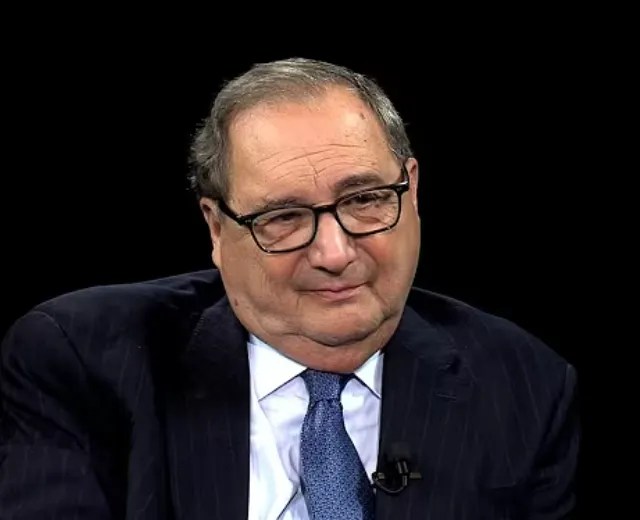
Villains of Judea: Abe Foxman
Foxman turned the ADL into a powerhouse but left behind a legacy of surveillance scandals, political vendettas, and selective outrage.
José Niño Unfiltered | May 24, 2026
When Abraham Foxman died on May 10, 2026, tributes poured in from presidents, prime ministers, and Jewish leaders worldwide, yet his legacy remains defined as much by controversy as by accomplishment.
Foxman described himself as “a passionate supporter of the State of Israel” and spent his career building the ADL into a roughly $60 million per year organization that defined mainstream American Jewish advocacy on antisemitism, civil rights, and the Jewish state.
Foxman was born Avraham Chanoch Hanach Fuksman on May 1, 1940, in Baranovichi, then under Soviet occupation, now Belarus. When German forces entered Vilnius in June 1941 and began subjecting the Jewish population to forced labor and deportation, his parents placed their 15-month-old son in the care of his Polish Catholic nanny Bronisława Kurpi. Kurpi baptized the child into the Catholic Church, gave him the Polish Christian name Henryk Stanisław Kurpi, and raised him as a Catholic in Vilnius for four years. He learned to pray the rosary, attended church every Sunday, and genuinely believed he was Catholic.
His parents survived the war. After bitter custody battles—Kurpi initially refused to release him, telling the Fuksmans, “I raised him, and he belongs to me, and he is Catholic”—the family escaped to a displaced persons’ camp in Vienna in 1947 and arrived in the United States in 1950.
Foxman settled in Brooklyn, attended the Yeshivah of Flatbush, earned a Bachelor of Arts from the City College of New York, and received his J.D. from New York University School of Law. He joined the ADL in 1965 as a legal assistant and rose quickly through the organization’s ranks. When longtime director Nathan Perlmutter died of cancer in July 1987, Foxman became National Director.
Under Foxman’s 28-year leadership, the ADL built a formidable research arm monitoring white advocacy groups, neo-Nazis, and other dissident groups. The ADL expanded its international reach with consultations across Europe, Russia, the Middle East, Asia, and Latin America. Foxman was appointed to the council of the U.S. Holocaust Memorial Museum by President Ronald Reagan in 1987 and was re-appointed by Presidents George H.W. Bush, Bill Clinton, and Joe Biden—making him, as the USHMM confirmed, “the only member of the Museum’s governing Council to be appointed by four presidents from both parties.”
With Foxman at the helm, the ADL also advocated for LGBTQ rights, including protesting the Supreme Court’s 2000 ruling in Boy Scouts of America v. Dale—which held 5-4 that the Boy Scouts could exclude a gay scoutmaster on First Amendment associational grounds. The organization also developed diversity training for law enforcement agencies and advocated for policies promoting mass migration.
Foxman operated at the center of American Jewry. The ADL and AIPAC were close partners in White House meetings and lobbying coordination. Foxman was a key participant in the Conference of Presidents of Major American Jewish Organizations and worked closely with the American Jewish Committee on public advocacy.
Further, Foxman was one of the most internationally active American Jewish leaders of his era. In March 2012, releasing the ADL’s survey of ten European countries, Foxman warned that antisemitism in Europe remained a dangerous reality. “In Hungary, Spain and Poland the numbers for anti-Semitic attitudes are literally off-the-charts and demand a serious response from political, civic and religious leaders,” he stated—findings based on poll data showing 63% of Hungarians, 53% of Spaniards, and 48% of Poles holding antisemitic views.
Foxman held consultations in Russia on “problems of ethnic hatred, violence, terrorism and promoting democracy,” attended Limmud FSU conferences engaging Russian-speaking Jewish youth, and remained deeply concerned about antisemitism in post-Soviet states. He consistently condemned Arab and Palestinian resistance and Hamas’s liberation agenda. He insisted that much criticism of Israel crossed into antisemitism, arguing: “If the only nationalism that you find apartheid in is Jewish nationalism, then you’re an anti-Semite.”
Retiring in 2015, Foxman warned that antisemitism was “the worst that it has been since World War II, and it is global”—saying he “never thought anti-Semitism would still be a clear and present danger to Jews around the world.” In 2024, he delivered an address at the ADL’s “Never Is Now” conference stating that antisemitism is “a disease without an antidote and without a vaccine.”
Foxman viewed Iran under President Mahmoud Ahmadinejad as an existential threat. In a 2007 speech to the ADL National Commission, he declared: “The greatest threat to the Jewish people and closest thing to dangers of the 1930s and 1940s is a potent cocktail consisting of the ideology of hate from an Iran with a potential nuclear weapon. This is an existential threat to Israel from an irrational regime that must be taken with the utmost seriousness.” When Iranian Supreme Leader Ali Khamenei posted content questioning the Holocaust on Twitter in 2014, Foxman responded: “Once again, the injection of Holocaust denial by an Iranian leader shows the world how such deep-seated hatred exists at the helm in Iran. We have seen the Ayatollah spew his vehement animosity toward Jews before on other national occasions in Iran and these statements once again show the bigotry and hypocrisy of this regime.”
Weeks before his death, Foxman backed the U.S.-Israel war on Iran. On February 28, 2026—the day the war broke out—he posted on social media: “Thank you President Trump and Prime Minister Netanyahu for standing up to evil and jihadist extremism. The world hopefully will be a better and safer place in the future.”
Foxman’s willingness to take controversial public stands was no late development. He led or supported numerous high-profile campaigns throughout his career. When Nation of Islam spokesperson Khalid Abdul Muhammad delivered a speech at Kean College in November 1993 referring to Jews as “bloodsuckers” and calling for the genocide of white people, Foxman’s ADL ran a full-page ad in The New York Times reprinting Muhammad’s statements. This mobilization directly contributed to Congress issuing a bipartisan condemnation of the speech in February 1994.
Foxman regularly addressed antisemitic or borderline remarks by public figures. In September 2003, during pre-release controversy over The Passion of the Christ, he asserted that Gibson’s remarks were painting “the portrait of an anti-Semite”—though he walked back the characterization the following day, and by February 2004 told ABC’s Diane Sawyer that Gibson was not an anti-Semite and the film was not antisemitic. Foxman co-authored the 2013 book Viral Hate: Containing Its Spread on the Internet with attorney Christopher Wolf, who served as national chair of the ADL Civil Rights Committee, addressing how antisemites and racists exploited the internet.
Foxman produced several other books warning about the alleged scourge of antisemitism. Never Again? The Threat of the New Anti-Semitism appeared in 2003. The Deadliest Lies: The Israel Lobby and the Myth of Jewish Control came out in 2007 as a direct rebuttal to John Mearsheimer and Stephen Walt’s The Israel Lobby and U.S. Foreign Policy, which Publishers Weekly described as “a rebuttal of a pernicious theory about a mythically powerful Jewish lobby.”
Not all of Foxman’s tenure at the ADL would be remembered in such favorable terms. In April 1993, San Francisco police and the FBI executed searches at ADL offices in California and discovered that the organization had been running an extensive domestic intelligence operation for decades. The operation centered on Roy Bullock, an undercover operative and art dealer who had collected files on more than 12,000 individuals and 950 organizations for more than three decades. His targets included not just white advocates and neo-Nazis but also Arab American groups, the American Civil Liberties Union, the African National Congress, Central America solidarity organizations, Greenpeace, the Earth Island Institute, approximately 20 San Francisco area labor unions, anti-apartheid activists, and Jewish peace groups. Bullock had also sold information to South African intelligence for $16,000.
Foxman denied any improper activity while testifying that the ADL had a right to do “whatever it must” to monitor antisemitism and threats to Jews. Critics across the political spectrum condemned the operation as a massive breach of civil liberties.
One of the most sustained controversies of Foxman’s career involved his refusal to unequivocally recognize the Armenian genocide. Critics, including the Armenian National Committee of America, accused Foxman of “genocide denial” motivated by the ADL’s desire to maintain good relations with the Turkish government. The backlash was severe. A dozen Massachusetts communities and the Massachusetts Municipal Association withdrew from the ADL’s “No Place for Hate” program. The ADL’s 2007 statement that the “consequences” of Ottoman actions were “tantamount to genocide” was widely rejected as insufficient because it circumvented the “intent” required under the 1948 UN Genocide Convention. Foxman also sent a letter to Turkish Prime Minister Erdoğan expressing regret over the difficulty his position caused for the Turkish government. It was not until May 2014 that Foxman publicly and unambiguously used the word “genocide” in remarks at Suffolk University Law School’s commencement, after years of sustained pressure.
The Armenian Genocide controversy was not the only multi-decade fight to mark Foxman’s career. Foxman engaged in a 22-year campaign against paleoconservative commentator Pat Buchanan. After Buchanan’s 2011 book Suicide of a Superpower was published, Foxman called him “a racist and an anti-Semite.” Buchanan was suspended from MSNBC in January 2012 and fired in February, and he publicly credited Foxman with playing a role in his dismissal. The ADL published a formal report titled “Patrick Buchanan: Over the Line.” Buchanan described Foxman as leading efforts to “blacklist” him, working “behind closed doors, with phone calls, mailed threats, and off-the-record meetings.” In a similar vein, Justin Raimondo, founder of Antiwar.com, was one of the most sustained libertarian critics of the ADL and Foxman. Raimondo argued that the ADL used antisemitism accusations to suppress foreign policy debate.
Whatever his American critics made of him, Foxman moved comfortably among Israel’s top political leadership across multiple governments. Foxman met with multiple Israeli prime ministers, some of whom made direct appeals to President Bill Clinton for the Marc Rich pardon. Foxman cooperated with World Jewish Congress leader Edgar Bronfman on major campaigns including Holocaust-era Swiss bank restitution. While the primary negotiation was led by Bronfman and the World Jewish Congress, the ADL under Foxman was a coalition partner in pressing Swiss banks to settle Holocaust-era claims, which resulted in a $1.25 billion settlement in 1998.
Foxman made a well-documented intervention in favor of fugitive financier Marc Rich’s pardon from President Clinton. The ADL had received $250,000 from Rich over a period of 16 years, including a $100,000 pledge made just before Foxman traveled to Paris. In February 2000, Foxman met at a Paris restaurant with Avner Azulay, head of the Marc Rich Foundation, and Zvi Rafiah, an Israeli arms consultant, and it was Foxman himself who proposed the strategy of recruiting Denise Rich to approach Clinton for a pardon. “I told them maybe they should consider trying to get a pardon,” Foxman said. “I told them, ‘Why don’t you reach out to Denise Rich… and have her approach the president and see about a pardon.’”
He wrote Clinton on December 7, 2000, urging a pardon on the grounds that “we are a country that was founded on the belief in second chances.” New York Times columnist William Safire called for Foxman to resign, writing that Rich’s $250,000 to the ADL had “induced its national director to lobby President Bill Clinton for forgiveness and thereby bring glee to the hearts of anti-Semites.”
Abraham Foxman was the consummate architect of a specific brand of ethnic activism, relentlessly searching for every angle to advance Jewish institutional interests and cement a landscape where the concerns of world Jewry were elevated above all others. Yet, even as he built these formidable structures of influence, he unwittingly accelerated the very forces he claimed to fight.
His career served as a catalyst for a tide of grassroots resentment against World Jewry that has only surged since October 7, 2023. Like many of his kin who sought to reshape Western nations in their own image, Foxman dedicated his life to the systematic erosion of gentile civilization for the benefit of his tribe.
Now that he has exited the stage, he leaves behind a nation awakening to the nature of his subversion. May he face that eternal justice that human institutions could not provide, aware that the tide has finally turned against the Jewish supremacist agenda he spent his entire life promoting.
The Ivanka Trump Assassination Plot Distraction
Last ditch effort to derail peace deal between the US and Iran
By Kurt Nimmo | Another Day in the Empire | May 24, 2026
On May 22, Rupert Murdoch’s New York Post floated a story claiming Iran attempted to murder Ivanka Trump, the president’s daughter. In the first paragraph of the Post story, the Islamic Revolutionary Guard Corps (IRGC) is blamed for the aborted attack. The sensationalist newspaper sources the claim to the Justice Department.
“Mohammad Baqer Al-Saadi had ‘pledged’ to target Ivanka Trump in retaliation for the assassination of his mentor Qasem Soleimani,” the Post reported.
Al-Saadi is said to be a high-ranking figure in Iraq-Iran terror circles, arrested in Turkey on May 15 and extradited to the US where he is charged with 18 attacks and attempted attacks throughout Europe and the United States, per the Department of Justice.
Al-Saadi is apparently a very ambitious and active terrorist. He is accused of attacking US and Jewish targets, including the firebombing of the Bank of New York Mellon in Amsterdam, the stabbing of two Jews in London, taking potshots at the US consulate building in Toronto, the firebombing of a synagogue in Liège, Belgium, the arson of a temple in Rotterdam, and “various other foiled counter-attacks in the US in response to the current conflict in the Middle East,” according to the Justice Department.
Sources cited in the reports alleged that Al-Saadi possessed a blueprint of Ivanka Trump’s Florida residence and had shared threatening messages online referencing surveillance of the property. Former Iraqi military official Entifadh Qanbar claimed that Al-Saadi openly spoke about avenging [IRGC officer Qasem] Soleimani’s death by targeting Trump’s family. [Qasem Soleimani was assassinated on 3 January, 2020 in Baghdad by a drone strike ordered by President Trump.]
Prosecutors say Al-Saadi is a commander for the Iraqi Shia militia Kata’ib Hezbollah, a US designated terrorist group allegedly linked to a little known group, Harakat Ashab al-Yamin al-Islamiya (the Islamic Movement of the Companions of the Right, a Qur’anic phrase), described as a “pop up” network that surfaced in March.
Details on the group came from Israel’s Ministry for Diaspora Affairs and Combating Antisemitism, an organization that specializes in targeting and defaming supposed anti-Semites, including popular podcasters such as Tucker Carlson, Candace Owens, Ian Carroll, the Swedish activist Greta Thunberg, and anti-Zionist political candidate Dan Bilzerian.
The Ministry cannot be trusted. It stands accused of launching a months-long campaign to covertly influence American lawmakers through AI-generated social media posts by fake users, according to The New York Times.
Critics argue Ministry programs like Voices of Israel, formerly known as Kela Shlomo and Concert, use bots and AI-generated content to attack opponents, influence public opinion, lobby for favorable legislation in the US and UK, and organize protests.
A central tactic involves deliberately amplifying anti-Muslim narratives, such as claims of “Islamic invasion,” “Sharia law,” and terrorism, in order to incite hostility between Christians and Muslims. This strategy aims to keep everyday Americans and Europeans divided and distracted with hate, encouraging them to view Muslims as the primary enemy rather than scrutinizing Israeli policies or lobbying efforts.
Therefore, it is not a stretch to assume Israel’s Ministry for Diaspora Affairs and Combating Antisemitism would either invent or exaggerate the claim Al-Saadi and Harakat Ashab al-Yamin al-Islamiya (HAY) are behind antisemitic attacks, especially at a critical juncture in the US-Israel war against Iran. The alleged targeting of Ivanka provides Trump with an excuse to restart the war and fulfill Benjamin Netanyahu’s desire to destroy Iran.
Netanyahu is afraid Trump will agree to a deal with Iran. Although Trump has stated on more than one occasion that he is not concerned about the financial burden his war has placed on the American people, he is, however, worried about the global economy as a depression would undoubtedly destroy the stock market and reduce valuations across the board. Israel, of course, is not concerned about this. It has a single objective—destroy Iran at all costs, even if billions of people suffer. Any deal Trump makes, any action short of bombing Iran, will short-circuit this objective.
A few hours after the story broke, Benjamin Netanyahu was reportedly “highly concerned and ‘worried’ President Trump will make a deal with Iran” and the Israeli PM “urged US to launch another round of strikes,” according to Axios.
By the afternoon of May 23, Trump posted to Truth Social: “Agreement has been largely negotiated, subject to finalization between the United States of America, the Islamic Republic of Iran.” It was the first time the president called Iran the “Islamic Republic of Iran.” Netanyahu reacted predictably, convening an urgent meeting with coalition leaders and Israeli security chiefs over what Channel 12 described as a “very bad” interim Iran deal.
“Final aspects and details of the Deal are currently being discussed, and will be announced shortly. In addition to many other elements of the Agreement, the Strait of Hormuz will be opened,” Trump posted.
RT reported the deal includes: an end to the war on all fronts, including Lebanon; several billion dollars of frozen Iranian assets unlocked; when the US blockade is lifted, the Strait of Hormuz will open; US bases and forces in the vicinity of Iran withdrawn; and a 30 day period to seal the nuclear deal.
Iran said Trump’s claim about the Strait of Hormuz “returning to normal” was false. It insisted on full control of the strait, including routes, timing, permits, and passage rules. Iran emphasized that no nuclear commitments were discussed during the meeting. They also claimed that US officials informed them that Trump’s posts are primarily intended for domestic media and political purposes, according to the Fars News Agency. A source told Fars that Trump “has realized that Iran is not one to give concessions” and sends word through intermediaries that his statements “should not be paid attention to.”
In what has become a pattern, the United States and Israel are reportedly collaborating behind the scenes to destroy any peace deal by assassinating supreme leader Mojtaba Khamenei, while weighing “whether his survival provides manageable stability or whether his removal could weaken Iran’s ruling structure further, per Israel Hayom.” Iranian MP and member of the negotiation delegation Mahmoud Nabavian “states that if Iranian leaders are assassinated in any attack, all of the complicit despots in the Persian Gulf will be killed and their palaces destroyed,” according to Seyed Mohammad Marandi.
On May 24, Benny Gantz, the Zionist Minister of Defense, posted to X that he believes it is “absolutely forbidden under any circumstances to accept the ceasefire in Lebanon as part of a deal with Iran,” thus signaling that Israel will continue murdering people and stealing land in southern Lebanon regardless of any deal between the United States and Iran.
Meanwhile, the conveniently timed and supposedly foiled assassination of Ivanka Trump is fading into noise, having done little more than prompt MAGA to ventilate on social media and elicit calls to “finish the job” of slaughtering Iranians. Ivanka Trump was never in danger and the plot has all the earmarks of previous concocted plots for which Trevor Aaronson covered more than a decade ago in his book, The Terror Factory: Inside the FBI’s Manufactured War on Terrorism.
Featured Video
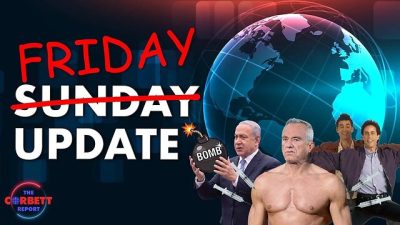
Racist Seinfeld Dances for Joy as Bibi Unveils His New Map
or go to
Aletho News Archives – Video-Images
TV Drama Review
Japanese drama projects Japan’s wartime atrocities onto Chinese characters

Global Times | October 25, 2026
By portraying Chinese characters as perpetrators of ruthless violence while casting Japanese Self-Defense Forces (SDF) intelligence operatives as defenders, the season 2 of the Japanese drama Vivant has recently drawn criticism from Chinese netizens, who argue that its depiction turns historical reality on its head while ignoring Japan’s wartime atrocities.
The TBS drama series – a spy suspense story in which an alleged unofficial intelligence unit of the SDF operates across the globe — has attracted a passionate fanbase. Its currently airing season 2 opened with a household rating of 18.8 percent, the highest for a TV drama this year, according toa commentary article by Japanese media Toyo Keizai.
What draws attention is the portrayal of the enemies in the series, the article noted. Scenes in which the Chinese organization subjects kidnapped members of the SDF unit to brutal torture are repeated with unrelenting intensity.
It is rare for Japanese TV dramas to explicitly portray a real-life country as the enemy, the article noted.
Japanese Prime Minister Sanae Takaichi also made a reference to the drama, saying that she has been recording Vivant and hopes to binge-watch it over the year-end and New Year holidays, according to Japanese media outlets.
China’s CCTV News report on Sunday revealed that the drama features scenes in which Chinese personnel cut off the fingers of and stab Japanese intelligence operatives in the abdomen. Such acts bear striking similarities to the torture inflicted on Chinese nationals by invading Japanese troops during the World War II.
The drama distorts the truth by attributing these atrocities to modern Chinese characters. Beneath the surface, it subtly glorifies Japan’s cross-border overseas operations, blurs the functional boundaries of the SDF and implicitly promotes an expansionist narrative, per CCTV News. … continue
Blog Roll
 Aletho News
- EU facing trillion-euro debt hole while seeking more cash for Kiev
- How US, Europe, Persian Gulf states exhausted missile stockpiles, splurged billions to defend Israel
- Up in arms… Koreans reject U.S. empire’s plan to make South Korea the next Ukraine
- Iran, Turkey, Pakistan, Saudi Arabia could advance region-led security framework in Tehran: FM spox
- Netizens condemn Japanese drama for projecting Japan’s wartime atrocities onto Chinese characters
- Racist Seinfeld Dances for Joy as Bibi Unveils His New Map
- A West Bank War for Netanyahu’s Election Campaign, Could It Backfire?
- Yemen denounces European Parliament’s ‘hypocritical’ push to blacklist Ansarullah
- Qalibaf: UAE’s UN bid aims to ‘clear the runway’ for ‘Greater Israel’, whitewash genocide
- Pakistan reopens Iran border after boosting security: Report
- If Americans Knew
- An error has occurred; the feed is probably down. Try again later.
- No Tricks Zone
- Sudden Stratospheric Warming, Powerful El Niño Combination May Lead To Extreme Europe Cold, Energy Crisis!
- Two New Studies Find Thwaites Glacier Melt Cannot Be Driven By Human Activity Or A Warming Ocean
- E-Cars Reduce CO2 Emissions By Only 41% Compared To Internal Combustion Engine Vehicles
- Predictions Made By Renowned Climate Professor Over Past Decades Have Been Proven To Be Poor
- New Study Suggests Large Regions Of The Pacific Ocean Have Been Cooling For The Last 80 Years
- Germany’s Green Energy Debacle: High Energy Costs Force Kahla Porzellan to Close After 182 Years!
- New Study: 50 Years Of The Most Aggressive ‘Net Zero’ Policies Can Only Affect The Global Climate By 0.03°C
- US September “Heat” Was No Record…Many Records Set Decades Ago
- Latest European Green Energy Debacle; Portugal’s Largest Flagship Solar Park Insolvent!
- Green Energy Debacle: German Expert Professor Fritz Vahrenholt Warns Of Severe Economic And Social Consequences


