AZ Governor Katie Hobbs Asked Twitter To Censor Her Critics, Emails Show
By Christina Maas | Reclaim The Net | August 11, 2023
In a controversial blend of politics and social media censorship, it has been revealed that Democratic Arizona Governor Katie Hobbs has intervened with Twitter, now X, in an effort to silence critics of her tweet where she equated Trump supporters to neo-Nazis. This revelation raises critical concerns about free speech and political bias in the era of Big Tech censorship.
Hobbs had targeted Trump and his supporter base in a contentious 2017 tweet during her tenure in the Arizona state legislature. “Trump has made it abundantly clear he’s more interested in pandering to his neo-nazi base than being president for all Americans,” she stated, an assertion that drew widespread condemnation from her digital audience. This criticism wasn’t taken lightly by Hobbs, who ascended into her role as Arizona secretary of state while these contentious debates raged on.
Hobbs’ contentious social media posting subsequently ignited debates over her impartiality in administering elections, upon which the Democratic leader demanded the censorship of online judgments against her.
Leaked emails confirmed by Arizona Capitol Oversight, a conservative political entity, revealed Hobbs officially contacted Twitter in November 2020 to sanction her online critics.
However, when Twitter demanded further details to justify Hobbs’ request, she was unable to produce the required evidence. Instead, she laid claim to being “harassed” by political opponents for her comments labeling them as Nazis. Hobbs went on to argue that they had weaponized a three-year-old tweet to spread threatening messages.
Despite countless appeals for responses from X and Hobbs regarding the censorship requests, reactions have yet to surface. In the shadow of these unfolding revelations, there is mounting evidence that many more federal departments than expected could be deliberately downplaying their engagement in online censorship.
Free Speech To The Supreme Court — And Beyond!
Historic Missouri v. Biden Censorship Lawsuit Likely Headed To Supreme Court
BY ALEX GUTENTAG | PUBLIC | AUGUST 11, 2023
Yesterday the Fifth Circuit court heard oral arguments in the Missouri v. Biden case, and the judges did not hold back. One judge suggested the government “strongarms” social media companies and that their meetings had included “veiled and not-so-veiled threats.”
Another judge described the exchange between the Biden administration and tech companies as the government saying, “Jump!” and the companies responding, “How high?”
“That’s a really nice social media company you got there. It’d be a shame if something happened to it,” the judge said, describing the government’s coercive tactics.
Attorney John Sauer, representing Louisiana, masterfully argued that the government had repeatedly violated the First Amendment. He pointed to specific evidence of coercion in the Facebook Files.
“You have a really interesting snapshot into what Facebook C-suite is saying,” Sauer explained. “They’re emailing Mark Zuckerberg and Sheryl Sandberg and saying things like… ‘Why were we taking out speech about the origins of covid and the lab leak theory?’” The response, Sauer said, was, “Well, we shouldn’t have done it, but we’re under pressure from the administration.”
He also cited an email from Nick Clegg, Facebook President of Global Affairs, that pointed to “bigger fish to fry with the Administration – data flows, etc.”
On Monday, Public reported that these “data flows” referred to leverage the Biden administration had over the company; Facebook needed the White House to negotiate a deal with the European Union. Only through this deal could Facebook maintain access to user data that is crucial for its $1.2 billion annual European business.
But Sauer also made it clear that coercion was not the only basis on which the court could rule against the Biden administration. Joint activity between the White House and social media platforms would also be unconstitutional.
Sauer compared what the government had done to book burning. “Imagine a scenario where senior White House staffers contact book publishers… and tell them, ‘We want to have a book burning program, and we want to help you implement this program… We want to identify for you the books that we want burned, and by the way, the books that we want burned are the books that criticize the administration and its policies.”
Daniel Tenny, the attorney for the Department of Justice, was left nitpicking and misrepresenting the record. In one instance, he denied that Anthony Fauci and Francis Collins had hatched a plan to orchestrate a “takedown” of the Great Barrington Declaration. Why? Because, Tenny said, according to their emails, they actually planned a takedown of “the premises of the Great Barrington Declaration.”
Tenny also stated that social media companies had not removed any true content. From the case’s discovery as well as the Facebook Files we know that is far from true. Facebook, against internal research and advice, did remove “often-true content” that might discourage people from getting vaccinated. Facebook’s own emails clearly suggest that the company only did this due to pressure from figures within the Biden Administration.
Tenny also claimed that when Rob Flaherty, the White House director of Digital Strategy, dropped the F-bomb in an exchange with Facebook it was not about content moderation. In fact, it was precisely about content moderation and occurred during a conversation about how Instagram was throttling Biden’s account. Ironically, the account couldn’t gain followers because Meta’s algorithm had determined that it was spreading vaccine misinformation.
Later, Sauer demolished an earthquake hypothetical that Tenny had introduced to justify state-sponsored censorship. “You can say this earthquake-related speech that’s disinformation is false, it’s wrong,” Sauer said. “The government can say it’s bad, but the government can’t say, ‘Social media platforms, you need to take it down.’ Just like a government can’t stand at the podium and say, ‘Barnes and Noble, you need to burn the bad books, burn the Communist books, whatever it is.’ They can’t say take down speech on the basis of content.”
Based on this hearing, the plaintiffs in Missouri v. Biden may have a strong chance of winning. Biden’s DOJ simply had no valid arguments to present. The evidence is clear: the administration brazenly engaged in an unlawful censorship campaign and instrumentalized private companies to do its bidding. This total disregard for fundamental civil liberties will be a stain on the Democratic Party for years to come.
The Supreme Court will be the supreme victory in the US, but our free speech work won’t be done after we win there. No nation enjoys free speech protections like ours. And so, after we win in the US, you can expect to see us helping our allies abroad achieve similar protections from government strongarming, aka censorship, in their own nations.
Preprint Servers Censored Research That Contradicted Government’s COVID Narrative
By Brenda Baletti, Ph.D. | The Defender | August 9, 2023
Preprint servers are being used to censor scholarly papers critical of the Centers for Disease Control and Prevention (CDC) and policy errors made by the Biden administration, according to Vinay Prasad, M.D., MPH.
Prasad, hematologist-oncologist, professor and director of a medical policy lab at the University of California San Francisco said his lab has submitted hundreds of papers to preprint servers — but only those that deviate from the official COVID-19 narrative have been rejected.
The basis for rejecting those papers is inconsistent with standards applied for other topics or with the fundamental rules of the servers, Prasad explained in a recent Substack post and YouTube video on the topic.
“All [rejected papers] are consistent with scientific practices and norms, and similar papers not critical of the CDC or Biden administration have been accepted,” Prasad wrote.
“If only papers that praise the CDC are acceptable by preprint servers,” he added, “then the role of science as a check and balance on incorrect policy is subverted.”
Preprint servers were established to address inefficiencies in academic publishing. The peer-review process typically takes months or more, delaying the real-time sharing of scientific findings with the public.
Also, many journals are proprietary and can only be accessed through expensive personal or institutional subscriptions.
Preprint servers offer a location for scientific reports and papers to be available to the public while the paper goes through peer review — making scientific findings available immediately and for free and opening them up to broader public debate.
There is no peer-review process for preprints, although there is a vetting process.
Prasad said preprint servers are supposed to be neutral and supposed to post all research conducted with a clearly explained and reproducible methodology. The goal, Prasad said, is to be inclusive and make scientific debate possible.
But instead, Prasad said, several of the preprint servers have become “gatekeepers” for what science gets published.
“When the people who work there are rabid, politicized and biased,” he said, “I think that’s a problem.”
‘The preprint servers are really a disgrace’
To test the bias of preprint servers, Prasad’s lab did a comprehensive analysis of its own preprints. Lab staff analyzed outcomes for all preprints they submitted to SSRN, medRxiv (pronounced “med archive”) and Zenodo servers — which he noted is a “reproducible systematic methodology.”
They found “a startling pattern of censorship and inconsistent standards from preprint servers. Preprint servers appear to be playing politics,” Prasad wrote.
Specifically, MedRxiv and SSRN have declined to post articles critical of the CDC, mask and vaccine mandates and the Biden administration’s healthcare policies.
“Preprint servers are not supposed to be journals — they are not supposed to reject articles merely because the people running them disagree with the arguments within.”
But the analysis suggests they are doing just that. Even the preprint of Prasad’s analysis was rejected by both medRxiv and SSRN.
“They don’t want to post a preprint that makes their own preprint server look bad,” he said, adding, “That’s pathetic. You have to post it because it’s factually true.”
Examples of censored articles demonstrate the bias behind the servers’ decisions.
One paper re-analyzed a study published in the New England Journal of Medicine that found cloth masks reduced the rates of COVID-19 transmission in some Massachusetts schools.
Prasad’s lab found that by simply lengthening the timeframe of the data analyzed in the observational analysis, the paper’s conclusion was invalidated. The data showed instead that masks did not slow the spread.
The servers didn’t post their paper, he said, citing “the need to be cautious about posting medical content.”
Prasad said the article was censored, “because it calls into question something that, frankly speaking, is pretty stupid, which is masking children with cloth masks — a stupid intervention derived by someone who cannot read randomized controlled trials and then pushed with the full force of the federal government — with no credible evidence and no randomized data.”
The servers censored Prasad’s lab’s comprehensive analysis of preprint bias using the same justification — “the need to be cautious about medical content.”
He said, “No one could possibly believe that this paper would require the need to be cautious — it merely documents your [preprint server’s] prior screw-ups.”
Another censored preprint reported on the lab’s systematic review and meta-analysis of Pfizer-BioNTech vaccination in 5 to 11-year-olds. The paper critiqued the U.S. Food and Drug Administration’s (FDA) approval of the drug for that age group.
The SSRN also removed that preprint citing, again, “the need to be cautious about medical content.”
SSRN used the same “boilerplate language” to remove the lab’s review of methodologies and conclusions in Cochrane reports. Those findings supported the controversial conclusion of the Cochrane review that community masking had no impact on slowing the spread of COVID-19.
Another article, rejected by medRxiv, which documented statistical and numerical errors made by the CDC during the pandemic, was already accepted by a journal and is one of the 10 most downloaded articles of all time on SSRN.
“Here’s the point,” Prasad said, “You don’t have to agree with me, but this preprint server is not even letting the audience of scientists decide. Who gave them this authority? They don’t get to peer review the article. That’s not their purview.”
Overall the team found that 38% of their submissions to preprint servers were rejected or removed. Yet, these rejected articles eventually were published and extensively downloaded.
“The median number of downloads for a rejected/removed article that was later accepted by a different server was 4,142 vs. 300 for articles submitted and accepted without rejection or removal,” he said.
Their analysis found that overall, Zenodo does not censor articles, but SSRN and medRxiv do.
So, he said, these organizations, established to make science transparent and uncensored have become gatekeepers “for their friends, for the views that they like.”
He also said their policies were inconsistent, with no clear scientific principles guiding rejection.
“They’re rejecting 38[%] of our articles because these are critical of establishment COVID-19 policies,” he said, adding:
“The COVID-19 pandemic is in fact a great example of … how people in power suppress minority views even when those views are meritorious — like toddlers shouldn’t mask, school should be open, you don’t need to mandate boosters, you shouldn’t mandate boosters for young men, nobody who had COVID should have to get the vaccine — those are sensible medical policies that are correct.
“History will vindicate them. They were all censored at one time or the other… The preprint servers are really a disgrace.”
Brenda Baletti Ph.D. is a reporter for The Defender. She wrote and taught about capitalism and politics for 10 years in the writing program at Duke University. She holds a Ph.D. in human geography from the University of North Carolina at Chapel Hill and a master’s from the University of Texas at Austin.
This article was originally published by The Defender — Children’s Health Defense’s News & Views Website under Creative Commons license CC BY-NC-ND 4.0. Please consider subscribing to The Defender or donating to Children’s Health Defense.
X CEO Linda Yaccarino: “Lawful But Awful” Content To Be Hidden
Who gets to decide what’s awful?
By Christina Maas | Reclaim The Net | August 10, 2023
Linda Yaccarino, X CEO and a former NBC advertising executive, underscored her autonomy in managing the day-to-day operations of X, previously known as Twitter, and shed some light on the shadowbanning operation at Twitter.
Appointed CEO by Elon Musk, she reasserted her independence from the entrepreneur, placing him firmly in a tech-based role. Her remarks have reignited debates surrounding freedom of speech and the direction online platforms should take in moderating content.
During a CNBC interview, Yaccarino discussed the demarcation of duties between herself and Musk, with the latter focusing on “product design” and leading “a team of extraordinary engineers [focusing] on new technology.”
However, it is her stance on the website’s content policies that has raised eyebrows among free speech enthusiasts.
In clarifying X’s approach to moderation, Yaccarino introduced the concept of “freedom of speech, not freedom of reach,” a policy where users, when posting narratives that are not in line with approved standards, are labeled, possibly demonetized for that content, and have their visibility reduced on the platform.
“If it is lawful but it’s awful, it’s extraordinarily difficult for you to see it,” she remarked, insinuating that even legally permissible content might be obscured if deemed undesirable by the company.
Some free speech advocates are concerned that this strategy of content labeling and demotion can quickly escalate into censorship. They argue that the distinction between “awful” and “lawful” is often a subjective one and fear the potential for misuse.
The decisions and comments made by Yaccarino might seem like a strict stance against divisive or hurtful rhetoric but critics may see it as an alarming move away from the ethos of open dialogue and free speech.
Ukrainian Orthodox Christian Priest Sentenced to 5 Years in Prison by Zelensky Regime

By Chris Menahan | InformationLiberation | August 8, 2023
A Ukrainian Orthodox Christian priest was sentenced to 5 years in prison on Monday after being accused of “justifying” Russia’s invasion of Ukraine.
From OrthoChristian, “UKRAINIAN HIERARCH SENTENCED TO 5 YEARS IN PRISON”:
A hierarch of the canonical Ukrainian Orthodox Church has been sentenced to 5 years imprisonment and the confiscation of property for various supposed crimes against the state.
His Eminence Metropolitan Jonathan of Tulchin was sentenced in a Vinnitsa Court today, reports the Tulchin Diocese.
[…] His Eminence has repeatedly denied all charges against him and will file an appeal “against the clearly illegal verdict of the Vinnitsa City Court.”
Met. Jonathan was found guilty of crimes under four articles of the criminal code:
- justification, recognition as lawful, denial of the armed aggression of the Russian Federation against Ukraine, glorification of its participants
- actions aimed at forcibly changing or overthrowing the constitutional order or seizing state power
- encroachment on the territorial integrity and inviolability of Ukraine, distribution of materials calling for changing the borders of the territory and state border of Ukraine
- violation of equal rights of citizens depending on their race, nationality, regional affiliation, religious beliefs, disability, and other grounds
The state persecution of Met. Jonathan has been going on for nearly a year already, beginning with the search of his home last October, during which the Ukrainian Security Service claims to have found “pro-Kremlin” leaflets.
His Eminence even had to undergo open-heart surgery last November, in the midst of the state persecution against him.
Zelensky seized control of the media, rounded up his opposition en masse and is now talking about suspending Ukraine’s elections under martial law.
“If we have martial law, we cannot have elections,” Zelensky told the Washington Post in May. “The constitution prohibits any elections during martial law. If there is no martial law, then there will be.”
Follow InformationLiberation on Twitter, Facebook, Gab, Minds and Telegram.
How long before all browsers are required by law to prevent users from opening allegedly infringing sites?
BY GLYN MOODY | WALLED CULTURE | AUGUST 4, 2023
Mozilla’s Open Policy & Advocacy blog has news about a worrying proposal from the French government:
In a well-intentioned yet dangerous move to fight online fraud, France is on the verge of forcing browsers to create a dystopian technical capability. Article 6 (para II and III) of the SREN Bill would force browser providers to create the means to mandatorily block websites present on a government provided list.
The post explains why this is an extremely dangerous approach:
A world in which browsers can be forced to incorporate a list of banned websites at the software-level that simply do not open, either in a region or globally, is a worrying prospect that raises serious concerns around freedom of expression. If it successfully passes into law, the precedent this would set would make it much harder for browsers to reject such requests from other governments.
If a capability to block any site on a government blacklist were required by law to be built in to all browsers, then repressive governments would be given an enormously powerful tool. There would be no way around that censorship, short of hacking the browser code. That might be an option for open source coders, but it certainly won’t be for the vast majority of ordinary users. As the Mozilla post points out:
Such a move will overturn decades of established content moderation norms and provide a playbook for authoritarian governments that will easily negate the existence of censorship circumvention tools.
It is even worse than that. If such a capability to block any site were built in to browsers, it’s not just authoritarian governments that would be rubbing their hands with glee: the copyright industry would doubtless push for allegedly infringing sites to be included on the block list too. We know this, because it has already done it in the past, as discussed in Walled Culture the book (free digital versions).
Not many people now remember, but in 2004, BT (British Telecom) caused something of a storm when it created CleanFeed:
British Telecom has taken the unprecedented step of blocking all illegal child pornography websites in a crackdown on abuse online. The decision by Britain’s largest high-speed internet provider will lead to the first mass censorship of the web attempted in a Western democracy.
Here’s how it worked:
Subscribers to British Telecom’s internet services such as BTYahoo and BTInternet who attempt to access illegal sites will receive an error message as if the page was unavailable. BT will register the number of attempts but will not be able to record details of those accessing the sites.
The key justification for what the Guardian called “the first mass censorship of the web attempted in a Western democracy” was that it only blocked illegal child sexual abuse material Web sites. It was therefore an extreme situation requiring an exceptional solution. But seven years later, the copyright industry were able to convince a High Court judge to ignore that justification, and to take advantage of CleanFeed to block a site, Newzbin 2, that had nothing to do with child sexual abuse material, and therefore did not require exceptional solutions:
Justice Arnold ruled that BT must use its blocking technology CleanFeed – which is currently used to prevent access to websites featuring child sexual abuse – to block Newzbin 2.
Exactly the logic used by copyright companies to subvert CleanFeed could be used to co-opt the censorship capabilities of browsers with built-in Web blocking lists. As with CleanFeed, the copyright industry would doubtless argue that since the technology already exists, why not to apply it to tackling copyright infringement too?
That very real threat is another reason to fight this pernicious, misguided French proposal. Because if it is implemented, it will be very hard to stop it becoming yet another technology that the copyright world demands should be bent to its own selfish purposes.
GLYN MOODY, journalist, blogger on openness, the commons, copyright, patents and digital rights.
Follow me @glynmoody on Mastodon.
Watchdog or lapdog? West’s blatant hypocrisy on media freedom
By Shabbir Rizvi | Press TV | August 7, 2023
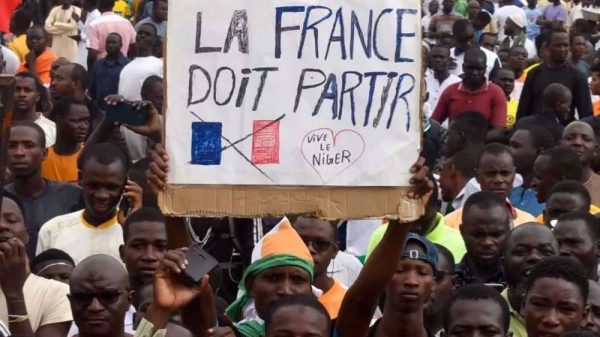
The last few weeks have seen dramatic shifts in geopolitical alignment in Africa, especially in Niger. Growing resentment over Western meddling has led to the overthrow of West-friendly President Mohamed Bazoum and the establishment of a military junta.
But that’s not all. Anti-Western sentiment has grown with demonstrators burning French flags and chanting slogans outside the French embassy in Niger’s capital Niamey.
The West has condemned the country’s junta takeover. For centuries, France has maintained colonial control over countries such as Niger. A vast amount of resources are extracted from the landlocked West African country and brought to France, fueling its economy while keeping Niger’s stagnant.
The military junta has now banned the movement of these precious resources to France.
France is naturally furious – the EU is already suffering a major economic setback due to its dogged insistence to let the Ukraine war drag on, throwing billions of dollars into weapons and resources.
Now, it’s facing the additional burden of keeping its crisis-hit industries running – a glaring admission of the country’s colonial practices to this day.
With Niger banning the export of key natural resources like Uranium to France – French and other Western media are taking to the internet and airwaves to smear the junta.
The anti-Western sentiment has come to a boiling point from decades of Western abuse and hyper-exploitation of African countries. It is a completely organic phenomenon, and so the West will need to use its media apparatuses to counter and stifle the sentiments.
Western media outlets have unleashed an aggressive campaign to accomplish this task. Parroting the narratives of Western regimes, French media such as France 24 and Radio France Internationale condemned the junta while using fear-mongering tactics to draw support for Western intervention.
They also sought to reaffirm support for French and other colonial structures within Niger – all while threatening the very people wishing to break the shackles of colonialism with military intervention.
In response, the junta leadership in Niger moved to ban the hostile French media outlets.
French officials blasted the move: “France reaffirms its constant and determined commitment to press freedom, freedom of expression, and the protection of journalists,” the French foreign ministry stated.
A European Union spokesperson joined in: “This step is a serious violation of the right to information and freedom of expression. The EU strongly condemns these violations of fundamental freedoms.”
These statements should be a textbook study of hypocrisy. Time and time again, the EU and the collective West have unleashed mass censorship campaigns, banned outlets, and arrested journalists.
It was only last year when the EU outright banned Russia’s RT and Sputnik news.
European Union satellite providers have also directly collaborated in media censorship campaigns. It has been less than a year since French satellite company Eutelsat removed Press TV from the air.
Western countries brazenly allow media outlets that affirm their own imperialistic goals to remain on air and uncensored. This includes outlets that outwardly promote foreign meddling and violence.
“Iran International” – which has significant funding from Saudi Arabia – played a large role in drumming up Western support during the failed foreign-backed riots in Iran last year.
Based in Washington D.C, the outlet pushed anti-Iran narratives, reporting misleading information or withholding context. It is an open-propaganda outlet created specifically to attack a sovereign country.
However, it is welcomed by the West with open arms. Not a single sanction has been placed on it.
If an outlet carries water for the US and EU, it will be allowed to operate without a single hurdle. If you criticize the goals of the empire in any way, you may be sanctioned. Shadowbanned. Censored. Labeled “state media.” Your very website may be seized entirely, as has been the case with Press TV.
For the crime of journalism in the West, you can be locked up in horrific conditions, fearing for your life.
Does the West seem to have completely forgotten about their ongoing treatment of Julian Assange, who exposed the war crimes of the United States – only to be smeared and pushed into solitary confinement?
If you are aligned with the American Empire’s goals, then you can even get away with killing journalists – and Western officials will try to brush it under the rug.
When Israeli occupation forces deliberately murdered Palestinian journalist Shireen Abu Akleh, the US dragged its feet to release a statement, ultimately claiming they can’t say for certain how the shooting death occurred – though all evidence affirms that she was targeted by regime soldiers.
And who can forget Jamal Khashoggi, an American journalist who actually did carry water for the West – only that he angered Saudi Arabia, so he was tortured, murdered, and dismembered on the orders of Saudi Crown Prince Mohammad Bin Salman (MBS).
Instead of demanding any explanation or even condemning the act, the US granted the Saudi leader immunity over the killing.
“Freedom of the Press” is a mockery in the West. A joke with no punchline. Freedom of the press in the EU and the US does not exist – not really. Through loopholes, shadowy dealings, and outright hypocrisy Western regimes always have the final say in what media can operate and what can’t.
It boils down to the simple goal of advancing its own interests.
Knowing this, it should come as no surprise that Niger banned France’s colonial media outlets. Their specific function is to carry France’s interests in foreign lands. Their goal is not honest and objective journalism or asking difficult questions. Their goal is to maintain and push public opinion of their own regime. A more honest classification of their work would be regime stenography.
France and the rest of the EU can condemn Niger’s actions all they want, but ultimately they have set the precedent of banning media outlets. The West will go as far as killing journalists, and then point a finger using that same bloodied hand at countries that refuse to give them a podium.
Ultimately, the world can expect more of the same double standards from the West.
The question is: if Western media’s role is to carry out its imperialistic missions rather than question and report, then why should anyone allow hostile media to operate in their country?
Shabbir Rizvi is a Chicago-based political analyst with a focus on US internal security and foreign policy.
COVID QUESTIONERS DEEMED ‘DOMESTIC TERRORISTS’
The Highwire with Del Bigtree | August 3, 2023
A trip down memory lane chronicling how Homeland Security labeled us all ‘domestic terrorists’ for trying to warn people about the harms of the COVID shots, masking kids, warnings and attacks meant to achieve COVID compliance. Will the same op be run during a climate emergency?
Musk promises to help canceled workers sue their employers
RT | August 6, 2023
The billionaire owner of X, formerly known as Twitter, has offered legal help to users unfairly fired, canceled or otherwise mistreated by their employers over posts they had shared or liked.
“If you were unfairly treated by your employer due to posting or liking something on this platform, we will fund your legal bill,” Elon Musk tweeted on Saturday evening. “No limit. Please let us know.”
Musk, who has championed himself as a “free speech absolutist,” was forced to follow through on his promise to acquire the company for around $44 billion last October.
Since then, he has fired around three quarters of Twitter’s staff and introduced a controversial paid subscription model in a bid to make the company profitable. He has also rolled back many of the company’s restrictive speech policies and released troves of documents detailing its collaboration under previous management with the US government and pro-censorship NGOs, to stifle anti-establishment content.
Critics have accused Musk of turning the social media giant into a haven for bigotry and hate speech by loosening its censorship policies.
However, the billionaire has struggled to convince some conservative Twitter users of his free speech credentials since hiring NBCUniversal advertising chief and World Economic Forum member Linda Yaccarino as the platform’s new CEO in June.
This comes despite his taking a swipe at liberal bogeyman and fellow billionaire George Soros, and hosting Republican presidential candidate and anti-woke crusader Ron DeSantis’ announcement of entry into the 2024 race.
Recently rebranded as X, Twitter has complied with 80% of all government takedown requests in the first six months since Musk took over as CEO, a significant increase from the 50% rate in the pre-Musk era.
Brazil Censorship Regime: Popular Podcaster Criminally Investigated and Fined $75,000 For Online Speech
By Didi Rankovic | Reclaim The Net | August 5, 2023
One of Brazil’s most popular podcasters, Monark (real name Bruno Monteiro Aiub), is under criminal investigation and has received a fine equivalent to $75,000 for his online conduct.
Critics of the authority’s behavior here – like Brazil-based investigative journalist Glenn Greenwald – see this as a way to completely silence the online personality known as the country’s version of Joe Rogan.
And do this without any due process, as well.
Reports in the Brazilian press say that the decision to fine Monark, whom they refer to as a digital influencer, came from Federal Supreme Court’s Minister Alexandre de Moraes.
Moraes is no stranger to taking an active part in controversial policies and decisions slammed for suppressing free speech on the internet.
In fact, he now has a fairly long history of involvement in this, dating back to the campaign to oust Brazil’s previous president.
In line with this reputation, Moraes’ decision was explained as the podcaster’s failure to comply with a court order, and in addition to the fine, includes blocking his bank account, suspending any new social media accounts, and demonetizing his channels.
In other words, a pretty thorough deplatforming and canceling. And the reason: Moraes says he’s fighting “disinformation” allegedly spread by Monark, as well as his tactic of trying to get his voice heard by creating a new account, once an old one gets banned.
Monark’s defenders, including his lawyer, say that the “crime” he committed is that of having an opinion that is not liked by the government, and that accusations of “instigation of anti-democratic acts” are not true.
On the other hand, the lawyer, Jorge Salomao, notes that in Brazil things like “disinformation and fake news” are not crimes at all, therefore cannot be criminalized, but must be dealt with in civil courts.
Salomao summed the situation up in a statement as, “summarily and unconstitutionally criminalizing thought.”
Meanwhile, Greenwald, who spoke about Monark’s case on his show “System Update,” asserted that censorship is now flourishing in Brazil, illustrated with this example of a podcaster who has over the past couple of years lost the ability to do his job and earn a living.
More than that, Greenwald believes that the West is (ab)using Brazil as a “censorship laboratory, learning how to implement and escalate their totalitarian assault on free expression.”
RFK Jr. Sues YouTube and Google, Alleges ‘Misinformation Policies’ Violated His First Amendment Rights
By Brenda Baletti, Ph.D. | The Defender | August 4, 2023
Robert F. Kennedy Jr., Children’s Health Defense founder and chairman on leave, this week filed a lawsuit against YouTube and its parent company, Google, alleging the social media giant violated his First Amendment rights.
According to Kennedy, who is running for the Democratic nomination for president of the U.S., YouTube engaged in a “censorship campaign” that included removing videos of his speech at Saint Anselm College in New Hampshire and interviews he did with clinical psychologist Jordan Peterson and podcaster Joe Rogan.
The complaint, filed Aug. 2 in the U.S. District Court for the Northern District of California, alleges the U.S. government has taken “extraordinary steps” under Joe Biden’s leadership “to silence people it does not want Americans to hear,” including himself and many others.
That censorship makes it difficult for Kennedy to reach millions of voters and also for his supporters to amplify his message, the complaint says.
The lawsuit predicts the censorship will continue throughout Kennedy’s campaign, intensifying as the primaries approach.
“Mr. Kennedy often speaks at length about topics people would like to ignore, including the negative health effects of toxic chemicals and potential safety concerns about the COVID-19 shots,” the complaint reads. Then YouTube uses its “medical misinformation” policies — developed in partnership with federal government agencies and the Biden administration — to justify removing his videos.
In doing so, the platform censored not only Kennedy’s comments on medical issues, but the entire content of his speeches and interviews, according to the suit.
Although YouTube is a private company, it is not simply a publisher, the complaint alleges — it has become “an important platform for political discourse in America, a digital town square that voters trust as a place to get news and opinions about the issues of the day.”
According to the complaint:
“YouTube operates as a public forum, the digital equivalent of a town square. As such, it cannot remove protected speech, especially political speech, based on its viewpoint. …
“There is a sufficiently close nexus between YouTube and the federal government such that YouTube’s actions may be fairly treated as that of the government itself.”
Although YouTube cited its own COVID-19 vaccine misinformation policies to censor Kennedy, those policies “rely entirely on government officials to decide what information gets censored,” according to the lawsuit.
For example, the suit says YouTube doesn’t allow content that “contradicts local health authorities’ (LHA) or the World Health Organization’s (WHO) medical information about COVID-19,” and the guidance on those policies only changes based on government decisions.
Kennedy also called YouTube’s medical misinformation policies “unconstitutional” because they are “vague” and “overbroad” and “because they give unnamed government officials, who the policies depend entirely on, the unfettered discretion to decide what information gets removed from YouTube.”
Kennedy is seeking injunctive relief to prohibit YouTube from further censoring his speech, and the restoration of any videos of his political speech removed during the campaign.
Kennedy also seeks a declaration that Google and YouTube violated his First Amendment rights and that its medical disinformation policies are unconstitutional.
Brenda Baletti Ph.D. is a reporter for The Defender. She wrote and taught about capitalism and politics for 10 years in the writing program at Duke University. She holds a Ph.D. in human geography from the University of North Carolina at Chapel Hill and a master’s from the University of Texas at Austin.
This article was originally published by The Defender — Children’s Health Defense’s News & Views Website under Creative Commons license CC BY-NC-ND 4.0. Please consider subscribing to The Defender or donating to Children’s Health Defense.
Featured Video

The Truth About the Trump Shootings with Ken Silva
or go to
Aletho News Archives – Video-Images
From the Archives
The Geopolitics behind the War in Yemen (I)
By Mahdi Darius NAZEMROAYA | Strategic Culture Foundation | 30.03.2015
The United States and the Kingdom of Saudi Arabia became very uneasy when the Yemenese or Yemenite movement of the Houthi or Ansarallah (meaning the supporters of God in Arabic) gained control of Yemen’s capital, Sanaa/Sana, in September 2014. The US-supported Yemenite President Abd-Rabbuh Manṣour Al-Hadi was humiliatingly forced to share power with the Houthis and the coalition of northern Yemenese tribes that had helped them enter Sana. Al-Hadi declared that negotiations for a Yemeni national unity government would take place and his allies the US and Saudi Arabia tried to use a new national dialogue and mediated talks to co-opt and pacify the Houthis.
The truth has been turned on its head about the war in Yemen. The war and ousting of President Abd-Rabbuh Manṣour Al-Hadi in Yemen are not the results of «Houthi coup» in Yemen. It is the opposite. Al-Hadi was ousted, because with Saudi and US support he tried to backtrack on the power sharing agreements he had made and return Yemen to authoritarian rule. The ousting of President Al-Hadi by the Houthis and their political allies was an unexpected reaction to the takeover Al-Hadi was planning with Washington and the House of Saudi. … continue
Blog Roll
 Aletho News
- IRGC air defenses destroy another US MQ-1 drone over Strait of Hormuz
- Imran Khan’s entire immediate family detained in Pakistan ahead of mass protest demanding his release
- EU nation detains former presidential frontrunner
- Leaked: Britain’s Sham Conviction Of Hashim Thaci
- Seyed M. Marandi: U.S. Strike Imminent – Toward Total War in the Middle East
- Russia Voted Under Fire. Washington Is Loading the Tankers.
- 12 Things Your Oncologist Was Trained Not to Tell You
- Anthrax Attacks Paved Way for COVID-Era ‘Junk Drugs and Vaccines’
- How Real Is the Impact of Western Sanctions on Israel?
- France, You Are Guilty: How Paris Turned Western Sahara into the Maghreb’s Powder Keg
- If Americans Knew
- Inside Israel’s ‘soft’ ethnic cleansing plan for Gaza through the eyes of its victims
- New online database tracks pro-‘Israel’ political donations in the United States
- Israeli president pardons soldier convicted for killing wounded Palestinian
- Singer Ed Sheeran says his ‘heart broken’ by Gaza devastation, addresses Macklemore controversy
- Israel Has Imprisoned Female Journalist Bushra Al-Tawil Without Trial Or Charge In Solitary Confinement For Past Month
- Israel poised to teach West Bank a lesson after one Israeli killed – Daily Update
- Salah Sarsour’s Legal Team Says DHS Has Not Met Its Burden to Prove He Is Deportable
- An analysis of tax forms by The Intercept show Kraft’s charity and LLC have donated to Friends of the IDF and AIPAC’s super PAC.
- Israeli attacks kill four Palestinians in Gaza – Daily Update
- Inside Gaza’s death trap of collapsing, bombed-out buildings
- No Tricks Zone
- 2025 Nature Paper Claiming Worsening Global Drought Gets RETRACTED …Heavily Flawed
- New Study: ‘Global Drought Shows No Detectable Recent Acceleration Under Climate Warming’
- Economic Masterminds: German Socialists Suggest Taxing Productivity Gains Stemming From Using AI
- The South China Sea Has Not Been Cooperating With The Climate Change Narrative
- Energy Crisis: Germany Enters Heating Season With Historically Low Gas Reserve Fill Levels
- New Study: The Antarctic Ice Sheet Gained Mass From 2020-2024 Due To Staggering Snow And Ice Accumulation
- Study: Ocean Heating Rates From Thousands Of Years Ago ‘Dwarf’ Modern Ocean Heating Rates
- Climate Extremists Target, Attack Large-Scale Power Grid Infrastructure In Germany!
- New Study: Antarctic Ice Melt Has Contributed Less Than 1 Centimeter To Sea Level Rise In The Last 30 Years
- Fear Of Debate: Alarmist German Climate Scientist Calls On Mainstream Media To Discredit Skeptic Voices
 Aletho News