Widespread US face surveillance is ‘imminent reality’, says tech privacy report
RT | May 18, 2019
Georgetown researchers are warning Americans about a sophisticated real-time face surveillance system that’s about to become an “imminent reality” for millions of citizens across the country.
The ‘America Under Watch’ report is a warning that authorities in select US cities may soon be able to pick you out from a crowd, identify you, and trace your movements via a secret network of cameras constantly capturing images of your face.
The report claims both Detroit and Chicago purchased software from a South Carolina company, DataWorks Plus, that gives police the ability to scan live video from cameras located at businesses, health clinics, schools, and apartment buildings. Both cities say they are not currently using the technology.
DataWorks says it provides software which “provides continuous screening and monitoring of live video streams.” The system is also designed to operate on “not less than 100 concurrent video feeds.”
According to the research team’s report, live footage is captured by cameras installed around Detroit as part of Project Green Light, a public-private initiative to deter crime which launched in 2016. The expanse of the police department’s facial recognition policy last summer, however, means the face recognition technology can now be connected to any live video, including security cameras, drone footage, and body-worn cams.
Illinois, meanwhile, is host to one of the most advanced biometric surveillance systems in the country, the report claims, adding that the Chicago Police Department (CPD) and the Chicago Transit Authority have had face surveillance capabilities since “at least 2016.”
Similar face surveillance is also apparently on the horizon for NYC, Orlando, and DC.
The report authors, Clare Garvie and Laura M. Moy, are now calling for a “complete moratorium on police use of face recognition” to give communities a chance to decide whether they want to be monitored in their streets and neighborhoods.
Last week, San Francisco became the first US city to ban facial recognition software used by police and other municipal agencies.
‘Mass surveillance is exactly what the US does’: Dotcom points out glaring irony of Huawei ban
RT | May 17, 2019
Kim Dotcom has slammed the US for hypocrisy over its Huawei ban given America’s history of “abusing technology” and “turning its entire tech sector into a spy machine.”
The Megaupload founder took to Twitter in the wake of the ban to highlight that the abuse of technology for mass surveillance is “exactly the conduct of the US” and said that “because the US does it, they think China will too.”
Trump declared a “national emergency” for the telecommunications sector on Wednesday, citing risks from “foreign adversaries.”
The US Commerce Department subsequently added Huawei Technologies Co Ltd and 70 affiliates to its so-called Entity List, which bans the Chinese brand from buying parts from US companies without government approval, making it difficult for Huawei to sell some of its products because of its reliance on US parts.
Dotcom pointed out that the US has used tech companies to spy on its own citizens as well as people all around the world. The extent of US surveillance was revealed by National Security Agency (NSA) whistleblower Edward Snowden in 2013 when he exposed the US’ warrantless surveillance, including listening in on phone conversations, its ability to compel tech companies like Google and Facebook to turn over user data, and the XKeyscore tool that can be used to collect nearly everything a user does on the internet.
Snowden also revealed how the US spies on world leaders, attempts to crack encryption and works with the UK to intercept global internet data.
The 2017 Wikileaks ‘Vault 7’ leak of CIA secrets revealed the US agency kept vulnerabilities and security bugs from tech companies so it could continue to access devices. The documents also highlighted the spy agency’s use of hacking tools to remotely hack and control smart phones, and cover their own tracks.
Year of selective blindness: Russian journalist still in Ukrainian jail under bogus treason charges
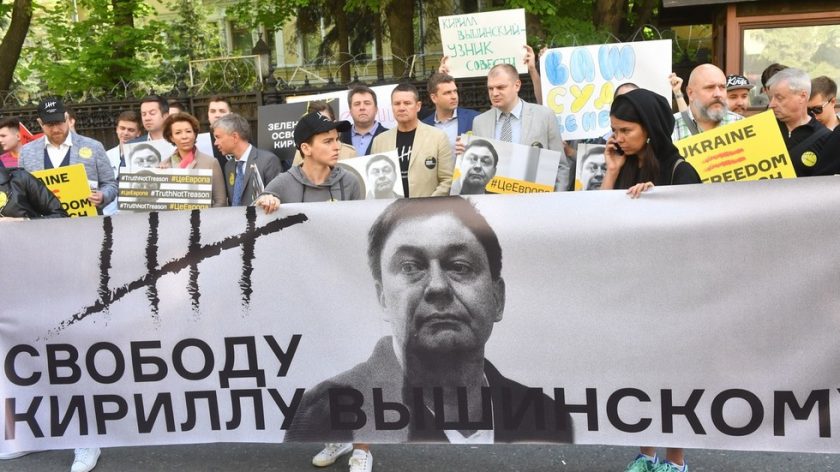
A rally in support of Kirill Vyshynsky in Moscow. ©Sputnik / Aleksey Kudenko
By Alexandre Antonov | RT | May 15, 2019
Exactly a year ago the head of a Russian-Ukrainian news agency was snatched in Kiev and put in jail under a charge of high treason. Western champions of media rights have shown spectacular will to ignore the scandalous case.
Being a journalist in a nation where the government can put you in jail for unfavorable reporting is understandably risky, but at least one can hope to find international support after getting into trouble. Foreign governments and international organizations would cry foul and try to pressure the persecutors.
Well, Kirill Vyshinsky didn’t get this response. On March 15, 2018 he was arrested by agents of the SBU, Ukraine’s powerful national security agency, and charged with treason. His alleged crime was that as head of a Russian-Ukrainian news agency he waged “information warfare” against Ukraine, or at least that’s what the SBU said at the time. The accusation may result in a 15 year jail term.
Vyshinsky has been kept in pre-trial detention since, denied bail or hospital treatment and restricted in visitation rights. The prosecution managed to formulate an 80-page indictment by March, listing 72 stories and opinion pieces published by the news agency since 2014, which the prosecution claims to be manipulative or false.
The journalist insists the accusations are absurd. How can a factually accurate news report about Crimea changing its time zone to that of Moscow or an opinion piece giving a historic overview of referenda held in Ukraine since gaining independence in 1991 be anti-Ukrainian, he argued. The prosecutors said even factually accurate stories can be “anti-Ukrainian in nature.”
Regardless of one’s attitude to what happened between Ukraine and Russia during and after the Maidan mass protests, accurate reporting of facts should not be criminalized. Just imagine what would happen, for example, if in 1999 Russia arrested and put on trial the head of the BBC Russian service, saying the British broadcaster’s coverage of the freshly reignited hostilities in Chechnya was “anti-Russian.” All hell would break loose, and rightfully so.
On Wednesday, there was a protest in front of the Ukrainian embassy in Moscow, calling on Kiev to free Vyshinsky. And a deafening silence from the usual Western defenders of media freedom. Amnesty International, for example, doesn’t mention Vyshinsky’s name on its website at all – not even on the Russian-language and Ukrainian-language versions.
Officials from the Organization for Security Cooperation in Europe and International Federation of Journalists voiced concern about Vyshinsky’s continued incarceration when asked for comments by the Russian media. But the organizations didn’t release any official statements on the occasion of the anniversary. Neither did the Committee to Protect Journalists, although it did report the start of Vyshynsky’s trial in early April.
As for mainstream media in the West, they don’t seem to be particularly interested in their Russian-Ukrainian colleague. Unless, of course, there is a chance to brand him a Russian propagandist who may threaten America’s democracy. A story that the Daily Beast ran in March says Vyshinsky’s wife hired US political consultant Ezra Friedlander to lobby for the journalist’s release in Ukraine, and implied that this may have compromised Friedlander’s other clients, including House Judiciary Committee Chairman Jerry Nadler. In other words, red-baiting at its best.
Apparently, not all reporters are made equal in the eyes of the West. There are those that deserve protection. And there are people like Vyshinsky, or WikiLeaks’ Julian Assange, who are not really reporters – just some guys telling true but unwelcomed facts about the US and its allies. They deserve to rot in jail, right?
American Pravda: How Hitler Saved the Allies
By Ron Unz • Unz Review • May 13, 2019
A couple of years ago I happened to be reading the World War II memoirs of Sisley Huddleston, an American journalist living in France. Although long since forgotten, Huddleston had spent decades as one of our most prominent foreign correspondents, and dozens of his major articles had appeared in The Atlantic Monthly, The New Republic, and Harpers, while he had authored some nineteen books. Given such eminence, his personal relationships reached far into elite circles, with one of his oldest and closest friends being William Bullitt, the American ambassador to France, who had previously opened our first Soviet embassy under FDR.
Huddleston’s credibility seemed impeccable, which is why I was so shocked at his firsthand account of wartime Vichy, totally contrary to what I had absorbed from my introductory history textbooks. While I had always had the impression that Petain’s collaborationist regime possessed little legitimacy, this was not at all the case. Near unanimous majorities of both houses of the duly-elected French parliament had voted the elderly field marshal into office despite his own deep personal misgivings, regarding him as France’s only hope of a unifying national savior following the country’s crushing 1940 defeat at Hitler’s hands.

Although Huddleston’s sympathies were hardly with the Germans, he noted the scrupulous correctness they exhibited following their overwhelming victory, policies that continued throughout the early years of the Occupation. And although he had on a couple of occasions performed minor services for the nascent Resistance movement, when the 1944 Normandy landings and the subsequent German withdrawal suddenly opened the doors of power to the anti-Petain forces, they engaged in an orgy of ideological bloodletting probably without precedent in French history, far surpassing the infamous Reign of Terror of the French Revolution, with perhaps 100,000 or more civilians being summarily butchered on the basis of little or no evidence, often just to settle personal scores. Some of the worst of the bloodshed came at the hands of the Communist exiles of the Spanish Civil War, who had found shelter in France after their defeat and now eagerly took an opportunity to turn the tables and massacre the same sort of “bourgeois” class-enemies who had defeated them in that previous conflict just a few years earlier.
As I sought to weigh Huddleston’s testimony against the traditional narrative of wartime France I had always fully accepted, most of the factors seemed to point in his favor. After all, his journalistic credentials were impeccable and as a very well-connected direct observer of the events he reported, his statements surely counted for a great deal. Meanwhile, it appeared that most of the standard narrative dominating our history books had been constructed a generation or so later by writers living on the other side of the Atlantic ocean, whose conclusions may have been substantially influenced by the black-and-white ideological framework that had become rigidly enshrined at elite American universities.
However, I couldn’t help noticing one huge, gaping flaw in Huddleston’s account, an error so serious that it cast grave doubts upon his entire credibility as a journalist. Towards the beginning of his book, he devotes a page or so to casually mentioning that in the early months of 1940, the French and British were preparing to launch an attack against the neutral Soviet Union, using their bases in Syria and Iraq for a strategic bombing offensive meant to destroy Stalin’s Baku oil fields of the Caucasus, one of the world’s leading sources of that vital commodity.
Obviously, all military organizations produce a wealth of hypothetical contingency plans covering all possible situations and opponents, but Huddleston had somehow misunderstood such possibilities or rumors as outright fact. According to him, the Allied bombing of the Soviet Union had been scheduled to begin March 15th, but was initially delayed and rescheduled for various political reasons. Then a few weeks later, the German panzer divisions swept through the Ardennes forest, surrounded the French armies, and captured Paris, aborting the planned Allied bombardment of Russia.
Given that the USSR played the leading role in Germany’s eventual defeat, an early Allied attack upon the Soviet homeland would surely have changed the outcome of the war. Although Huddleston’s bizarre fantasies had somehow gotten the best of him, he was hardly incorrect in exclaiming “What a narrow escape!”
The notion that the Allies were preparing to launch a major bombing offensive against the Soviet Union just a few months after the outbreak of World War II was obviously absurd, so ridiculous a notion that not a hint of that long-debunked rumor had ever gotten into the standard history texts I had read on the European conflict. But for Huddleston to have still clung to such nonsensical beliefs even several years after the end of the war raised large questions about his gullibility or even his sanity. I wondered whether I could trust even a single word he said about anything else.
However, not long afterward I encountered quite a surprise in a 2017 article published in The National Interest, an eminently respectable periodical. The short piece carried the descriptive headline “In the Early Days of World War II, Britain and France Planned to Bomb Russia.” The contents absolutely flabbergasted me, and with Huddleston’s credibility now fully established—and the credibility of my standard history textbooks equally demolished—I went ahead and substantially drew upon his account for my long article “American Pravda: Post-War France and Post-War Germany.”
American Pravda: Post-War France and Post-War Germany
Ron Unz • July 9, 2018 • 6,600 Words
I hardly regard myself as a specialist on the history of World War II, but I initially felt deeply embarrassed to have spent my entire life completely ignorant of that crucial early turning-point in the huge conflict. However, once I had carefully read that National Interest article, my shame quickly dissipated, for it was obvious that the author, Michael Peck, along with his editors and readers had been equally unaware of those long-buried facts. Indeed, the article had originally run in 2015, but was republished a couple of years later due to enormous reader demand. As near as I can tell, that single 1100 word essay constituted the first and only time the momentous events described had received significant public attention in the seventy years since the end of the war.
Peck’s discussion greatly fleshed out Huddleston’s brief, offhand remarks. The French and British high commands had prepared their enormous bomber offensive, Operation Pike, in hopes of destroying Russia’s oil resources, and their unmarked reconnaissance flights had already overflown Baku, photographing the locations of the intended targets. The Allies were convinced that the best strategy for defeating Germany was to eliminate its sources of oil and other vital raw materials, and with Russia being Hitler’s leading supplier, they decided that destroying the Soviet oil fields seemed a logical strategy.
However, Peck emphasized the severe errors in this reasoning. In actual fact, only a small fraction of Hitler’s oil came from Russia, so the true impact of even an entirely successful campaign would have been low. And although the Allied commanders were convinced that weeks of continuous bombardment—apparently representing the world’s largest strategic-bombing campaign to that date—would quickly eliminate all Soviet oil production, later events in the war suggested that those projections were wildly optimistic, with vastly larger and more powerful aerial attacks generally inflicting far less permanent destruction than expected. So the damage to the Soviets would probably not have been great, and the resulting full military alliance between Hitler and Stalin would surely have reversed the outcome of the war. This was reflected in the original 2015 title of the same article “Operation Pike: How a Crazy Plan to Bomb Russia Almost Lost World War II.”
But although hindsight allows us to recognize the disastrous consequences of that ill-fated bombing plan, we should not be overly harsh upon the political leaders and strategists of the time. Military technology was in tremendous flux, and facts that seemed obvious by 1943 or 1944 were far less clear at the beginning of the conflict. Based upon their World War I experience, most analysts believed that neither the Germans nor the Allies had any hope of achieving an early breakthrough on the Western front, while the Soviets were suspected of being a feeble military power, perhaps constituting the “soft underbelly” of the German war machine.
Also, some of the most far-reaching political consequences of an Allied attack upon the Soviet Union would have been totally unknown to the French and British leaders then considering it. Although they were certainly aware of the powerful Communist movements in their own countries, all closely aligned with the USSR, only many years later did it become clear that the top leadership of the Roosevelt Administration was honeycombed by numerous agents fully loyal to Stalin, with the final proof awaiting the release of the Venona Decrypts in the 1990s. So if the Allied forces had suddenly gone to war against the Soviets, the total hostility of those influential individuals would have greatly reduced any future prospects of substantial American military assistance, let alone eventual intervention in the European conflict.
Thus, if the Germans had for any reason delayed their 1940 assault on France for a few weeks, the pending Allied attack would have brought the Soviets into the war on the other side, ensuring their defeat. It seems undeniable that Hitler’s fortuitous action inadvertently saved the Allies from the disastrous consequences of their foolish plans.
Although exploring the dramatic implications of the 1940 outbreak of an Allied-Soviet war may be an intriguing instance of alternative history, as an intellectual exercise it has little relevance to our present-day world. Far more important is what the account reveals about the reliability of the standard historical narrative that most of us have always accepted as real.
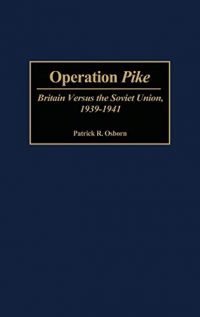
The first matter to explore was whether the evidence for the planned Allied attack on the Soviets was actually as strong as was suggested by the National Interest article. The underlying information came from Operation Pike, published in 2000 by Patrick R. Osborn in an academic series entitled Contributions in Military Studies, so I recently ordered the book and read it to evaluate the remarkable claims being made.
Although rather dry, the 300 page monograph meticulously documents its case, with the overwhelming bulk of the material being drawn from official archives and other government records. There seems not the slightest doubt about the reality of the events being described, and the Allied leaders even made extensive diplomatic efforts to enlist Turkey and Iran in their planned attack against the Soviet Union.
While the primary Allied motive was to eliminate the flow of necessary raw materials to Germany, there were broader goals as well. Forced collectivization of Soviet agriculture during the 1930s had led to the widespread slaughter of farm animals, which were then replaced by tractors requiring gasoline. The Allied leadership believed that if they succeeded in eliminating the Soviet oil supply, the resulting fuel shortage would lead to a collapse in agricultural production, probably producing a famine that might sweep the Communist regime from power. The Allies had always been intensely hostile to the Soviets, and the planned operation was actually named for a certain Col. Pike, a British officer who had died at Bolshevik hands in the Caucuses during a previous military intervention twenty years earlier.
This anti-Soviet planning rapidly accelerated after Stalin’s brutal attack upon tiny Finland in late 1939. The unexpectedly fierce Finnish resistance led the Western powers to expel the USSR from the League of Nations as a blatant aggressor, and inspired widespread demands for military intervention among both the political elites and the general public, with serious proposals being considered to send several Allied divisions to Scandinavia to fight the Russians on behalf of the Finns. Indeed, during much of this period Allied hostility seems to have been far greater towards the Soviets than towards Germany, despite the nominal state of war against the latter, with French sentiments being particularly strong. As one British elected official remarked, “One has the impression that France is at war with Russia and merely on very unfriendly terms with Germany.”
The Allies intended to use Polish exile forces in their ground combat against the Soviets, perhaps even sparking a Polish uprising against the hated Communist occupiers of their homeland. Osborn notes that if word of this plan had leaked to Stalin, that might explain why it was at this time that he signed the official orders directing the NKVD to immediately execute the 15,000 Polish officers and police whom he already held as POWs, an incident eventually known as the Katyn Forest Massacre, which ranks as one of the world’s worst wartime atrocities.
All of these military plans and internal discussions by the British and French were kept entirely secret at the time, and their archives remained sealed to historians for many decades. But in the opening of his fascinating account, Osborn explains that after the victorious German armies moved towards Paris in 1940, the French government attempted to destroy or evacuate all its secret diplomatic files, and a trainload of this very sensitive material was captured by German forces 100 miles from Paris, including the complete record of the plans to attack the USSR. In hopes of scoring an international propaganda coup, Germany soon published these crucial documents, providing both English translations and facsimile copies of the originals. Although it is unclear whether these disclosures received any significant Western media coverage at the time, Stalin surely became aware of this detailed confirmation of the information he had already gotten in bits and pieces from his network of well-placed Communist spies, and it must have deepened his distrust of the West. The story would also have quickly become known to all well-informed observers, explaining why Huddleston was so confident in casually mentioning the planned Allied attack in his 1952 memoirs.
After Hitler’s Barbarossa invasion of the USSR in June 1941 suddenly brought the Soviets into the war on the Allied side, these highly-embarrassing facts would have naturally dropped into obscurity. But it seems quite astonishing that such “politically correct” amnesia became so deeply entrenched within the academic research community that virtually all traces of the remarkable story disappeared for the six decades that preceded the publication of Osborn’s book. More English-language books may have been published on World War II during those years than on any other subject, yet it seems possible that those many tens of millions of pages contained not a single paragraph describing the momentous Allied plans to attack Russia in the early days of the war, perhaps even leaving Huddleston’s brief, offhand remarks in 1952 as the most comprehensive account. Osborn himself notes the “precious little attention” given this matter by scholars of the Second World War, citing a 1973 academic journal article as one of the very few notable exceptions. We should be seriously concerned that events of such monumental importance spent more than two generations almost totally excluded from our historical records.
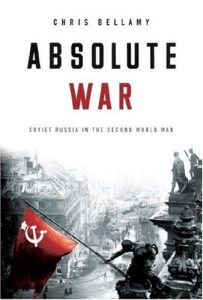
Moreover, even the release of Osborn’s massively-documented academic study in 2000 seems to have been almost completely ignored by World War II historians. Consider, for example, Absolute War published in 2007 by acclaimed military historian Chris Bellamy, an 800 page work whose glowing cover-blurbs characterize it as the “authoritative” account of the role of Soviet Russia in the Second World War. The detailed 25 page index contains no listing for “Baku” and the only glancing reference to the indisputable Allied preparations to attack the USSR in early 1940 is a single obscure sentence appearing 15 months and 150 pages later in the aftermath of Barbarossa: “But on 23 June the NKGB reported that the Chief of the British Air Staff, Sir Charles Portal, had suggested cabling the commands in India and the Middle East ordering them to stop planning to bomb the Baku oilfields, which, it had been feared, might be used to supply the Germans.” Osborn’s revelations seem to have vanished without a trace until they were finally noticed and publicized 15 years later in The National Interest.
While it is quite easy to understand why historians avoided the subject for the first couple of decades following the end of the Second World War, once a generation or two had passed, one might reasonably expect to see some reassertion of scholarly objectivity. Operation Pike was of the greatest possible importance to the course of the war, so how could it have been almost totally ignored by virtually every writer on the subject? Allied preparations in early 1940 to unleash the largest strategic bombing offensive in world history against the Soviet Union hardly seems the sort of boring, obscure detail that would be quickly forgotten.
Even if the first generation of war chroniclers carefully excluded it from their narratives to avoid ideological embarrassment, they must surely have been aware of the facts given German publication of the documents. And although their younger successors had seen no mention of it in the books they studied, one would expect that their mentors had occasionally whispered to them about some of the “hidden wartime secrets” left out of the standard narrative. Moreover, Osborn notes that discussion of the facts did very occasionally appear in professional academic journals, and one might assume that a single such instance would have spread like wildfire within the entire academic community. Yet even after Osborn’s massively documented volume appeared in a respectable academic series, the silence remained absolutely deafening. The case of Operation Pike demonstrates that we must exercise extreme caution in accepting the accuracy and completeness of what we have been told.
Such conclusions have obvious consequences. My website tends to attract a large number of commenters, of widely varying quality. One of them, an immigrant from Soviet Armenia calling himself “Avery” seems quite knowledgeable and level-headed, though intensely hostile to Turks and Turkey. A couple of years ago, one of my articles on World War II provoked an intriguing comment from him:
During the Battle of Stalingrad, Turkey, which was officially neutral but was secretly cooperating with Nazi Germany, had assembled a huge invasion force at the border of USSR (Armenia SSR). If Germans had won at Stalingrad, Turks were going to invade, race to Baku and link up with the German forces there, coming down from Stalingrad to grab the oilfields.
When Paulus’s army was surrounded and annihilated, Turks quickly left the border for their barracks.Stalin never forgot the Turk treachery and never forgave.
When Germany surrendered, Stalin assembled huge armies in Armenia SSR and Georgia SSR. The plan was to invade and throw the Turks out of East Turkey/West Armenia.
The detonation of two American atomic bombs convinced Stalin to stand down. Some believe US detonated the two bombs not to force Japan’s surrender, but as a message to Stalin.
When questioned, he admitted he was unaware of any reference in a Western source, but added:
It was common knowledge in Armenia SSR, where I am originally from.
WW2 war vets, old timers, discussed it all the time…..seeing more Red Army troops and military hardware assembling near the borders of Armenia SSR and Georgia SSR than they’d ever seen before. Then, they were all gone….
Under normal circumstances, weighing the universal silence of all Western historians against the informal claims of an anonymous commenter who was relying upon the stories he’d heard from old veterans would hardly be a difficult choice. But I wonder…
The official documents discussed by Osborn demonstrate that the British made considerable efforts to enlist Turkish forces in their planned attack upon the USSR, with the Turks going back and forth on the matter until Britain finally abandoned the project following the Fall of France. But if the Turks had strongly considered such a military adventure in 1940, it seems quite plausible that they would have been far more eager to do so 1942, given the huge losses the Soviets had already suffered at German hands, and with a very formidable German army approaching the Caucasus.
Soon after the war, Turkey became one of America’s most crucial Cold War allies against the Soviets, given a central role in the establishment of the Truman Doctrine and the creation of NATO. Any hint that the same Turkish government had come very close to joining Hitler’s Axis and attacking Russia as a Nazi ally just a few years earlier would have been extremely damaging to US interests. Such facts would have been scrupulously excluded from all our histories of the war.
Until a couple of weeks ago, I still probably would have leaned towards favoring the united front of all Western historians against the casual remarks of a single anonymous commenter on my website. But after reading Osborn’s book, I now think the anonymous commenter is more likely correct. This is a rather sad personal verdict upon the current credibility of our historical profession.
These important considerations become particularly relevant when we attempt to understand the circumstances surrounding Operation Barbarossa, Germany’s 1941 attack upon the Soviet Union, which constituted the central turning point of the war. Both at the time and during the half-century which followed, Western historians uniformly claimed that the surprise assault had caught an overly-trusting Stalin completely unaware, with Hitler’s motive being his dream of creating the huge German land-empire that he had hinted at in the pages of Mein Kampf, published sixteen years earlier.
But in 1990 a former Soviet military intelligence officer who had defected to the West and was living in Britain dropped a major bombshell. Writing under the pen-name Viktor Suvorov, he had already published a number of highly-regarded books on the armed forces of the USSR, but in Icebreaker he now claimed that his extensive past research in the Soviet archives had revealed that by 1941 Stalin had amassed enormous offensive military forces and positioned them all along the border, preparing to attack and easily overwhelm the greatly outnumbered and outgunned forces of the Wehrmacht, quickly conquering all of Europe.
As I summarized the Suvorov Hypothesis in an article last year:
And so, just as in our traditional narrative, we see that in the weeks and months leading up to Barbarossa, the most powerful offensive military force in the history of the world was quietly assembled in secret along the German-Russian border, preparing for the order that would unleash their surprise attack. The enemy’s unprepared airforce was to be destroyed on the ground in the first days of the battle, and enormous tank columns would begin deep penetration thrusts, surrounding and trapping the opposing forces, achieving a classic blitzkrieg victory, and ensuring the rapid occupation of vast territories. But the forces preparing this unprecedented war of conquest were Stalin’s, and his military juggernaut would surely have seized all of Europe, probably soon followed by the remainder of the Eurasian landmass.
Then at almost the last moment, Hitler suddenly realized the strategic trap into which he had fallen, and ordered his heavily outnumbered and outgunned troops into a desperate surprise attack of their own on the assembling Soviets, fortuitously catching them at the very point at which their own final preparations for sudden attack had left them most vulnerable, and thereby snatching a major initial victory from the jaws of certain defeat. Huge stockpiles of Soviet ammunition and weaponry had been positioned close to the border to supply the army of invasion into Germany, and these quickly fell into German hands, providing an important addition to their own woefully inadequate resources.
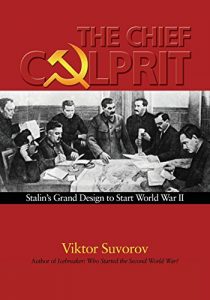
Although almost totally ignored in the English-language world, Suvorov’s seminal book soon became an unprecedented bestseller in Russia, Germany, and many other parts of the world, and together with several follow-up volumes, his five million copies in print established him as the most widely-read military historian in the history of the world. Meanwhile, the English-language media and academic communities scrupulously maintained their complete blackout of the ongoing worldwide debate, with no publishing house even willing to produce an English edition of Suvorov’s books until an editor at the prestigious Naval Academy Press finally broke the embargo nearly two decades later. Such near-total censorship of the massive planned Soviet attack in 1941 seems quite similar to the near-total censorship of the undeniable reality of the massive planned Allied attack on the Soviets in the preceding year.
Although the Suvorov Hypothesis has inspired decades of fierce academic debate and been the subject of international conferences, it has been scrupulously ignored by our Anglophone authors, who have made no serious attempt to defend their traditional narrative and refute the vast accumulation of persuasive evidence upon which it is based. This leads me to believe that Suvorov’s analysis is probably correct.
A decade ago, a solitary writer first drew my attention to Suvorov’s ground-breaking research, and as an emigrant Russian Slav living in the West, he was hardly favorable to the German dictator. But he closed his review with a remarkable statement:
Therefore, if any of us is free to write, publish, and read this today, it follows that in some not inconsequential part our gratitude for this must go to Hitler. And if someone wants to arrest me for saying what I have just said, I make no secret of where I live.
American Pravda: When Stalin Almost Conquered Europe
Ron Unz • June 4, 2018 • 4,200 Words
For almost thirty years, our English-language media has almost entirely suppressed any serious discussion of the Suvorov Hypothesis, and this is hardly the only important aspect of Soviet history that has remained hidden from public scrutiny. Indeed, on some crucial matters, the falsehoods and distortions have greatly increased rather than diminished over the decades. No example is more obvious than in the ongoing attempts to conceal the enormous role played by Jews in the Bolshevik Revolution and worldwide Communism generally. As I wrote last year:
In the early years of the Bolshevik Revolution, almost no one questioned the overwhelming role of Jews in that event, nor their similar preponderance in the ultimately unsuccessful Bolshevik takeovers in Hungary and parts of Germany. For example, former British Minister Winston Churchill in 1920 denounced the “terrorist Jews” who had seized control of Russia and other parts of Europe, noting that “the majority of the leading figures are Jews” and stating that “In the Soviet institutions the predominance of Jews is even more astonishing,” while lamenting the horrors these Jews had inflicted upon the suffering Germans and Hungarians.
Similarly, journalist Robert Wilton, former Russia correspondent of the Times of London, provided a very detailed summary of the enormous Jewish role in his 1918 book Russia’s Agony and 1920 book The Last Days of the Romanovs, although one of the most explicit chapters of the latter was apparently excluded from the English language edition. Not long afterward, the facts regarding the enormous financial support provided to the Bolsheviks by international Jewish bankers such as Schiff and Aschberg were widely reported in the mainstream media.
Jews and Communism were just as strongly tied together in America, and for years the largest circulation Communist newspaper in our country was published in Yiddish. When they were finally released, the Venona Decrypts demonstrated that even as late as the 1930s and 1940s, a remarkable fraction of America’s Communist spies came from that ethnic background.
A personal anecdote tends to confirm these dry historical records. During the early 2000s I once had lunch with an elderly and very eminent computer scientist, with whom I’d become a little friendly. While talking about this and that, he happened to mention that both his parents had been zealous Communists, and given his obvious Irish name, I expressed my surprise, saying that I’d thought almost all the Communists of that era were Jewish. He said that was indeed the case, but although his mother had such an ethnic background, his father did not, which made him a very rare exception in their political circles. As a consequence, the Party had always sought to place him in as prominent a public role as possible just to prove that not all Communists were Jews, and although he obeyed Party discipline, he was always irritated at being used as such a “token.”
However, once Communism sharply fell out of favor in 1950s America, nearly all of the leading “Red Baiters” such as Sen. Joseph McCarthy went to enormous lengths to obscure the ethnic dimension of the movement they were combatting. Indeed, many years later Richard Nixon casually spoke in private of the difficulty he and other anti-Communist investigators had faced in trying to focus on Gentile targets since nearly all of the suspected Soviet spies were Jewish, and when this tape became public, his alleged anti-Semitism provoked a media firestorm even though his remarks were obviously implying the exact opposite.
This last point is an important one, since once the historical record has been sufficiently whitewashed or rewritten, any lingering strands of the original reality that survive are often perceived as bizarre delusions or denounced as “conspiracy theories.” Indeed, even today the ever-amusing pages of Wikipedia provides an entire 3,500 word article attacking the notion of “Jewish Bolshevism” as an “antisemitic canard.”
In a subsequent article, I summarized several of the numerous sources describing this obvious reality:
Meanwhile, all historians know perfectly well that the Bolshevik leaders were overwhelmingly Jewish, with three of the five revolutionaries Lenin named as his plausible successors coming from that background. Although only around 4% of Russia’s population was Jewish, a few years ago Vladimir Putin stated that Jews constituted perhaps 80-85% of the early Soviet government, an estimate fully consistent with the contemporaneous claims of Winston Churchill, Times of London correspondent Robert Wilton, and the officers of American Military Intelligence. Recent books by Alexander Solzhenitsyn, Yuri Slezkine, and others have all painted a very similar picture. And prior to World War II, Jews remained enormously over-represented in the Communist leadership, especially dominating the Gulag administration and the top ranks of the dreaded NKVD.
Perhaps the most utterly explosive and totally suppressed aspect of the close relationship between Jews and Communism regards the claims that Jacob Schiff and other top international Jewish bankers were among the leading financial backers of the Bolshevik Revolution. I spent nearly all of my life regarding these vague rumors as such obvious absurdities that they merely demonstrated the lunatic anti-Semitism infesting the nether-regions of Far Right anti-Communist movements, thereby fully confirming the theme of Richard Hofstadter’s famous book The Paranoid Style in American Politics. Indeed, the Schiff accusations were so totally ridiculous that they were never even once mentioned in the hundred-odd books on the history of the Bolshevik Revolution and Soviet Communism that I read during the 1970s and 1980s.
Therefore, it came as an enormous shock when I discovered that the claims were not only probably correct, but had been almost universally accepted as true throughout the first half of the twentieth century.
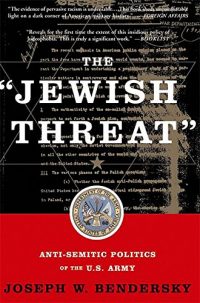
For example, The “Jewish Threat” by Joseph W. Bendersky summarizes his years of archival research and he documents that Schiff’s financial support for the Bolsheviks was widely reported in the American Military Intelligence files of the period, with British Intelligence taking the same position. Kenneth D. Ackerman’s 2016 study Trotsky in New York, 1917 describes much the same material. In 1925, the British Guardian published this information and it was soon widely discussed and accepted throughout the 1920s and 1930s by numerous major international media outlets. Naomi W. Cohen’s 1991 hagiographic volume Jacob Schiff devotes several pages to summarizing the various stories of Schiff’s strong Bolshevik ties that had earlier been published in leading American periodicals.
Writing nearly a century after the events under discussion, these three Jewish authors casually dismiss all the numerous accounts they provide by highly-credible observers—American and British Intelligence officers and prominent international journalists—as merely demonstrating the delusional nature of the extreme anti-Semitism that had infected so much of the world in those bygone days. Yet most serious historians would surely place far greater weight upon contemporaneous evidence than upon the personal opinions of those writers who happen to gather together that material evidence generations afterward.
Henry Wickham Steed was one of the foremost journalists of his era, and he had served as editor of the Times of London, the world’s most authoritative newspaper. A couple of years after his retirement, he published his lengthy personal memoirs, now conveniently online, which contain the following very intriguing passages:
Potent international financial interests were at work in favour of the immediate recognition of the Bolshevists. Those influences had been largely responsible for the Anglo-American proposal in January to call Bolshevist representatives to Paris at the beginning of the Peace Conference — a proposal which had failed after having been transformed into a suggestion for a Conference with the Bolshevists at Prinkipo. The well-known American Jewish banker, Mr. Jacob Schiff, was known to be anxious to secure recognition for the Bolshevists…
… the prime movers were Jacob Schiff, Warburg, and other international financiers, who wished above all to bolster up the Jewish Bolshevists in order to secure a field for German and Jewish exploitation of Russia.
Schiff’s own family later confirmed this widely-accepted history. The February 3, 1949 Knickerbocker column of the New York Journal-American, then one of the city’s leading newspapers, reported the account: “Today it is estimated by Jacob’s grandson, John Schiff, that the old man sank about 20,000,000 dollars for the final triumph of Bolshevism in Russia.” The present-day value of the figure quoted is probably some $2 billion, a very substantial sum.
Despite this enormous volume of convincing evidence, for the next half-century or more, Schiff’s name almost entirely vanished from all mainstream texts on Soviet Communism. As I wrote last year:
In 1999, Harvard University published the English edition of The Black Book of Communism, whose six co-authors devoted 850 pages to documenting the horrors inflicted upon the world by that defunct system, which had produced a total death toll they reckoned at 100 million. I have never read that book and I have often heard that the alleged body-count has been widely disputed. But for me the most remarkable detail is that when I examine the 35 page index, I see a vast profusion of entries for totally obscure individuals whose names are surely unknown to all but the most erudite specialist. But there is no entry for Jacob Schiff, the world-famous Jewish banker who apparently financed the creation of the whole system in the first place. Nor one for Olaf Aschberg, the powerful Jewish banker in Sweden, who played such an important role in providing the Bolsheviks a financial life-line during the early years of their threatened regime, and even founded the first Soviet international bank.
American Pravda: The Bolshevik Revolution and Its Aftermath
Ron Unz • July 23, 2018 • 6,900 Words
Perhaps the extreme caution and timorous silence exhibited by nearly all Western historians on these sensitive elements of World War II and the Bolshevik Revolution should not entirely surprise us given the professional and personal risks they might face if they strayed from orthodoxy.
Consider the very telling example of David Irving. During the first half of his professional career, his string of widely-translated best-sellers and his millions of books in print probably established him as the most internationally successful British historian of the last one hundred years, with his remarkable archival research frequently revolutionizing our understanding of the European conflict and the political forces behind it. But as he repeatedly demonstrated his lack of regard for official orthodoxy, he attracted many powerful enemies, who eventually ruined his reputation, drove him into personal bankruptcy, and even arranged his imprisonment. Over the last quarter-century, he has increasingly become an un-person, with the few occasional mentions of his name in the media invoked in the same talismanic manner as references to Lucifer or Beelzebub.
If a historian of such towering stature and success could be brought so low, what ordinary academic scholar would dare risk a similar fate? Voltaire famously observed that shooting an admiral every now and then is an excellent way to encourage the others.
The Remarkable Historiography of David Irving
Ron Unz • June 4, 2018 • 1,700 Words
The destruction of Irving’s stellar career came at the hands of Jewish activists, who were outraged at his balanced treatment of Hitler and his ongoing commitment to investigating many of the widely-accepted wartime myths, which he hoped to replace with what he called “real history.” In the introduction to his new edition of Hitler’s War, he recounts how a journalist for Time magazine was having dinner with him in New York in 1988 and remarked “Before coming over I read the clippings files on you. Until Hitler’s War you couldn’t put a foot wrong, you were the darling of the media; after it, they heaped slime on you.”
As Irving was certainly aware, the unreasonably harsh vilification of enemy leaders during wartime is hardly an uncommon occurrence. Although it has largely been forgotten today, during much of the First World War and for years afterward, Germany’s reigning monarch, Kaiser Wilhelm, was widely portrayed in the Allied countries as a bloodthirsty monster, one of the most evil men who had ever lived. This vilification came despite Wilhelm having been the beloved eldest grandchild of Britain’s own Queen Victoria, who according to some accounts died in his arms.
Moreover, although Allied propaganda routinely portrayed Wilhelm as a relentless warmonger, he had actually avoided involving Germany in a single major military conflict during the first twenty-five years of his reign, while most of the other leading world powers had fought one or more wars during that same period. Indeed, I recently discovered that only a year before the Guns of August began firing, The New York Times had published a lengthy profile marking the first quarter-century of his reign and lauded him as one of the world’s foremost peacemakers:
Now … he is acclaimed everywhere as the greatest factor for peace that our time can show. It was he, we hear, who again and again threw the weight of his dominating personality, backed by the greatest military organisation in the world – an organisation built up by himself – into the balance for peace wherever war clouds gathered over Europe. ‘(‘William II, King of Prussia and German Emperor, Kaiser 25 years a ruler, hailed as chief peacemaker,’ New York Times, 8 June, 1913)
That brief excerpt from the Times encomium points to another matter than I have never seen mentioned. I devoted much of the 2000s to digitizing and making available the complete archives of hundreds of America’s leading publications of the last 150 years, and when I occasionally glanced at the contents, I gradually noticed something odd. Although the English-language world today invariably refers to Germany’s wartime ruler as “Kaiser Wilhelm,” that was only rarely the case prior to the outbreak of war, when he was generally known as “Emperor William.” The latter nomenclature is hardly surprising since we always speak of “Frederick the Great” rather than “Friedrich der Grosse.”
But it is obviously much easier to mobilize millions of citizens to die in muddy trenches to defeat a monstrously alien “Kaiser” than “Good Emperor William,” first cousin to the British and Russian monarchs. The NGram viewer in Google Books shows the timing of the change quite clearly, with the Anglophone practice shifting as Britain became increasingly hostile toward Germany, especially after the outbreak of war. But “Emperor William” was only permanently eclipsed by “Kaiser Wilhelm” after Germany once again became a likely enemy in the years immediately preceding World War II.
Actual publications of the period also reveal numerous discordant facts about the First World War, matters certainly known to academic specialists but which rarely receive much coverage in our standard textbooks, being relegated to a casual sentence or two if even that. For example, despite its considerable military successes, Germany launched a major peace effort in late 1916 to end the stalemated war by negotiations and thereby avert oceans of additional bloodshed. However, this proposal was fiercely rejected by the Allied powers and their advocates in the pages of the world’s leading periodicals since they remained firmly committed to an ultimate military victory.
War fever was certainly still very strong that same year in Britain, the leading Allied power. When prominent peace-advocates such as Bertrand Russell and Lord Loreborn urged a negotiated end to the fighting, and were strongly backed by the editor of the influential London Economist, they were harshly vilified and the latter was forced to resign his position. E.D. Morel, another committed peace advocate, was imprisoned for his activism under such harsh conditions that it permanently broke his health and led to his death at age 51 a few years after his release.
As an excellent antidote to our severely distorted understanding of both wartime sentiments and the domestic European politics that had produced the conflict, I would strongly recommend the text of Present Day Europe by Lothrop Stoddard, then one of America’s most influential public intellectuals. Written prior to America’s own entry into the conflict, the work provides the sort of remarkable scholarly detachment which would soon became almost impossible.
Present-Day Europe
Its National States of Mind
Lothrop Stoddard • 1917 • 74,000 Words
Although the demonic portrayal of the German Kaiser was already being replaced by a more balanced treatment within a few years of the Armistice and had disappeared after a generation, no such similar process has occurred in the case of his World War II successor. Indeed, Adolf Hitler and the Nazis seem to loom far larger in our cultural and ideological landscape today than they even did in the immediate aftermath of the war, with their visibility growing even as they become more distant in time, a strange violation of the normal laws of perspective. I suspect that the casual dinner-table conversations on World War II issues that I used to enjoy with my Harvard College classmates during the early 1980s would be completely impossible today.
To some extent, the transformation of “the Good War” into a secular religion, with its designated monsters and martyrs may be analogous to what occurred during the final decay of the Soviet Union, when the obvious failure of its economic system forced the government to increasingly turn to endless celebrations of its victory in the Great Patriotic War as the primary source of its legitimacy. The real wages of ordinary American workers have been stagnant for fifty years and most adults have less than $500 in available savings, so this widespread impoverishment may be forcing our own leaders into adopting a similar strategy.
But I think that a far greater factor has been the astonishing growth of Jewish power in America, which was already quite substantial even four or five decades ago but has now become absolutely overwhelming, whether in foreign policy, finance, or the media, with our 2% minority exercising unprecedented control over most aspects of our society and political system. Only a fraction of American Jews hold traditional religious beliefs, so the twin worship of the State of Israel and the Holocaust has served to fill that void, with the individuals and events of World War II constituting many of the central elements of the mythos that serves to unify the Jewish community. And as an obvious consequence, no historical figure ranks higher in the demonology of this secular religion than the storied Fuhrer and his Nazi regime.
However, beliefs based upon religious dogma often sharply diverge from empirical reality. Pagan Druids may worship a particular sacred oak tree and claim that it contains the soul of their tutelary dryad; but if an arborist taps the tree, its sap may seem like that of any other.
Our current official doctrine portrays Adolf Hitler’s Nazi Germany as one of the cruelest and most relentlessly aggressive regimes in the history of the world, but at the time these salient facts apparently escaped the leaders of the nations with which it was at war. Operation Pike provides an enormous wealth of archival material regarding the secret internal discussions of the British and French governmental and military leadership, and all of it tends to suggest that they regarded their German adversary as a perfectly normal country, and perhaps occasionally regretted that they had somehow gotten themselves involved a major war over what amounted to a small Polish border dispute.
Although our standard histories would never admit this, the actual path toward war appears to have been quite different than most Americans believe. Extensive documentary evidence from knowledgeable Polish, American, and British officials demonstrates that pressure from Washington was the key factor behind the outbreak of the European conflict. Indeed, leading American journalists and public intellectuals of the day such as John T. Flynn and Harry Elmer Barnes had publicly declared that they feared Franklin Roosevelt was seeking to foment a major European war in hopes that it would rescue him from the apparent economic failure of his New Deal reforms and perhaps even provide him an excuse to run for an unprecedented third term. Since this is exactly what ultimately transpired, such accusations would hardly seem totally unreasonable.
And in an ironic contrast with FDR’s domestic failures, Hitler’s own economic successes had been enormous, a striking comparison since the two leaders had come to power within a few weeks of each other in early 1933. As iconoclastic leftist Alexander Cockburn once noted in a 2004 Counterpunch column:
When [Hitler] came to power in 1933 unemployment stood at 40 per cent. Economic recovery came without the stimulus of arms spending…There were vast public works such as the autobahns. He paid little attention to the deficit or to the protests of the bankers about his policies. Interest rates were kept low and though wages were pegged, family income increased by reason of full employment. By 1936 unemployment had sunk to one per cent. German military spending remained low until 1939.
Not just Bush but Howard Dean and the Democrats could learn a few lessons in economic policy from that early, Keynesian Hitler.
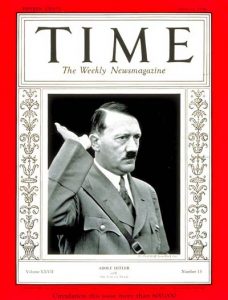
By resurrecting a prosperous Germany while nearly all other countries remained mired in the worldwide Great Depression, Hitler drew glowing accolades from individuals all across the ideological spectrum. After an extended 1936 visit, David Lloyd George, Britain’s former wartime prime minister, fulsomely praised the chancellor as “the George Washington of Germany,” a national hero of the greatest stature. Over the years, I’ve seen plausible claims here and there that during the 1930s Hitler was widely acknowledged as the world’s most popular and successful national leader, and the fact that he was selected as Time Magazine’s Man of the Year for 1938 tends to support this belief.
Only International Jewry had remained intensely hostile to Hitler, outraged over his successful efforts to dislodge Germany’s 1% Jewish population from the stranglehold they had gained over German media and finance, and instead run the country in the best interests of the 99% German majority. A striking recent parallel has been the enormous hostility that Vladimir Putin incurred after he ousted the handful of Jewish Oligarchs who had seized control of Russian society and impoverished the bulk of the population. Putin has attempted to mitigate this difficulty by allying himself with certain Jewish elements, and Hitler seems to have done the same by endorsing the Nazi-Zionist economic partnership, which lay the basis for the creation of the State of Israel and thereby brought on board the small, but growing Jewish Zionist faction.
In the wake of the 9/11 Attacks, the Jewish Neocons stampeded America towards the disastrous Iraq War and the resulting destruction of the Middle East, with the talking heads on our television sets endlessly claiming that “Saddam Hussein is another Hitler.” Since then, we have regularly heard the same tag-line repeated in various modified versions, being told that “Muammar Gaddafi is another Hitler” or “Mahmoud Ahmadinejad is another Hitler” or “Vladimir Putin is another Hitler” or even “Hugo Chavez is another Hitler.” For the last couple of years, our American media has been relentlessly filled with the claim that “Donald Trump is another Hitler.”
During the early 2000s, I obviously recognized that Iraq’s ruler was a harsh tyrant, but snickered at the absurd media propaganda, knowing perfectly well that Saddam Hussein was no Adolf Hitler. But with the steady growth of the Internet and the availability of the millions of pages of periodicals provided by my digitization project, I’ve been quite surprised to gradually also discover that Adolf Hitler was no Adolf Hitler.
It might not be entirely correct to claim that the story of World War II was that Franklin Roosevelt sought to escape his domestic difficulties by orchestrating a major European war against the prosperous, peace-loving Nazi Germany of Adolf Hitler. But I do think that picture is probably somewhat closer to the actual historical reality than the inverted image more commonly found in our textbooks.
American Pravda: Our Great Purge of the 1940s
Ron Unz • June 11, 2018 • 5,400 Words
Related Reading:
Misled again by the arbiters of anti-semitism
By Jonathon Cook | May 11, 2019
British comedian David Schneider has become one of the more influential public figures on social media seeking to arbitrate what constitutes anti-semitism. Compared to TV show host Rachel Riley, or even Guardian columnist Jonathan Freedland, Schneider is an exemplar of moderation and rationality. But, to be honest, the bar has been set pretty low in recent years.
Schneider has now published a guide in the Independent newspaper on “how to talk about Israel without sliding into antisemitism”. Although there are elements to his guide I can agree with, most of his advice is – to put it charitably – simplistic, misleading or downright unhelpful.
Given how polarised public discourse has grown on the issue of anti-semitism, and the degree to which it has been weaponised by those – Jews and non-Jews alike – opposed to a new kind of insurgency politics in the UK and US demanding the right to speak out unequivocally in support of Palestinian rights, Schneider’s blind spots need highlighting.
He rightly notes that the phrase “legitimate criticism of Israel” has become clichéd. But it is more than just a cliché; it has come to serve as a ringfence, ensuring that “legitimate” criticism relates only to Netanyahu and the Israeli right.
Many of us, however, want to point out that there would still be major problems with Israel even if Netanyahu had been replaced at last month’s election by the rival party of generals led by Benny Gantz or if the Israeli Labour party ever managed to revive itself from terminal decline. We want to talk about why Israel was a very problematic kind of state long before anyone had heard of Netanyahu, during a time when a supposed Israeli left ruled the country.
So here I offer an addendum meant to clarify and counter the arguments made in Schneider’s seven-point guide.
The relevant text of his guide is in bold, with my comments below in ordinary type:
1. Avoid saying “Zionist” or “Zionism” when discussing contemporary Israel/Palestine. The terms are too loaded now, too coarse and broad in their application, and too often used by hardcore antisemites to mean simply Jews.
Benjamin Netanyahu is a Zionist, but so are Israeli lawyers and peace activists fighting to achieve justice for Palestinians. You cannot lump them all together. Fair enough when talking historically, as long as you’re informed and precise, but for the present day, I recommend using specific terms instead, such as “the Israeli government” or “Netanyahu”.
Schneider has lost no time in revealing the nub of the problem with his guide. He is a liberal Zionist, and understandably he feels uncomfortable being lumped in with Netanyahu. But the primary goal of Palestinians and their supporters isn’t to make Schneider or other liberal Zionists feel comfortable with their political views or to comply with their demand that “legitimate” criticism of Israel be restricted to Netanyahu.
Yes, some anti-semites may use “Zionist” as code for “Jew”. But Schneider is demanding his cake and eating it in insisting that the core ideology driving Israeli policy towards the Palestinians for more than seven decades be declared largely unmentionable.
Zionism wasn’t just a historical prelude to Israel’s creation, some anachronism to be deposited in a museum. All the major political parties in Israel still firmly define themselves as Zionist. It is at the core of their political programmes, meaning that they share much common ground. The parties are often divided chiefly about how to achieve their political goals, not what those goals are.
Political disagreements in Israel revolve around two camps: Labour Zionists, who founded Israel, and Revisionist Zionists, now represented chiefly by Netanyahu’s Likud party, that have largely ousted Labour Zionists from power since the late 1970s.
The movement Schneider probably identifies most with are the Labour Zionists (now often described as liberal Zionists) whose founders drove 80 per cent of the native Palestinian population off their lands in 1948 in what would today be called an ethnic cleansing operation.
It didn’t end there, though. The Labour Zionists then created a land and residential segregation system inside the new state of Israel that very much persists to this day. In fact, almost all of Israel’s land is reserved exclusively for Jews, with many hundreds of communities using admissions committees to bar the fifth of the population who are Palestinian citizens. The Palestinian minority have been herded into deprived and overcrowded ghettoes on a tiny fraction of the remaining land. All of this is entirely separate from what happens to Palestinians in the occupied territories.
Inside Israel, the state’s control and allocation of land and resources on an ethnic basis is know as Judaisation, and it has been at the heart of state policy for 71 years.
Labour Zionists also established and maintained a rigid system of segregated state education, separating Jewish and Palestinian children – all of them Israeli citizens – in much the same way as occurred in the Jim Crow South in the US.
Outside Israel, the Labour Zionists founded the first settlements in the occupied West Bank and East Jerusalem, which were built in violation of international law and with intent to destroy any hope of a Palestinian state emerging.
Today the Labour Zionists still advocate policies to keep Israel’s Jewish and Palestinian citizens apart, and support the larger settlements, even at the cost of denying the Palestinians any viable right to self-determination. In any other context, we would call them ethnic nationalists, or racists.
In fact, one could reasonably argue that Judaisation and political Zionism – the kind that probably finds favour with 99 per cent of Israeli Jews – are as good as synonyms. Many of the Israeli Jewish lawyers and human rights activists Schneider refers to who are trying to help Palestinians in the occupied territories are still quite ready to back a political system inside Israel that keeps Palestinian citizens separate from Jewish citizens.
These extreme liberal Zionists – small in number though they are – are plagued by concerns about the rights of Palestinians in the occupied territories, but all too often because they want Israel out of those territories so it can concentrate on privileging Jews inside Israel, even though a fifth of Israel’s population are not Jewish.
Those who do not feel that way are usually described as anti-Zionists – one reason why the term “Zionist” is such a helpful ideological signpost about where Israel Jews and their supporters stand on core issues like equality inside the state of Israel itself.
The other camp, the Likud Zionists, have not opposed this system of segregation, which closely echoes apartheid South Africa. In fact, they have sought to entrench and expand it. Today, the main difference between Labour and Likud Zionists is the latter’s indifference to how such policies are perceived by the international community.
So, in other words, there is no way to understand or critique Israel’s political system, or the nature of its abuses of Palestinians, or the ideology espoused by its supporters abroad, without analysing Zionism and its aims.
Schneider’s formula makes as much sense as demanding back in the 1980s that “legitimate criticism” of South Africa not address the country’s overarching apartheid ideology but be reserved specifically for P W Botha and his government. Following Schneider’s advice would make useful, reasoned criticism of Israel impossible.
2. Do not slide from anger at the actions of the Israeli state into asserting that Israel is controlling everything or paying money to MPs, celebrities or the media to act as they do. To do so simply echoes far-right antisemitism and centuries-old conspiracy theories about Jews, now rebadged to apply to Israel.
And yes, I know about the documentary The Lobby, where a Labour MP was filmed discussing money with an Israeli embassy official. But unless you have other examples of this, I suggest you avoid it.
Few critics of Israel are actually claiming anything of this sort. Schneider has offered a strawman formulation here. But I suspect he wishes to catch in his trawl net far more than these claims.
It is interesting to consider why it is so contentious to claim that Israel wields power through its lobbies to promote its interests in the US and UK when our political elites are so ready to claim that Russia has been supposedly interfering in superhuman ways in the US and UK to pursue its interests.
It is telling that Schneider, like the British media, wishes to hurry past Al-Jazeera’s documentary The Lobby. The undercover film did not just show a Labour MP discussing money with an embassy official – as Schneider would presumably know if he had watched the documentary. It showed much, much more.
Not least, it showed an Israeli government agent, Shai Masot, who was probably working for the strategic affairs ministry at the time, plotting from within the UK to unseat a British government minister who was seen by Israel as a little too sympathetic to the Palestinians. And it showed pro-Israel activists within the Labour party, led by the Jewish Labour Movement, colluding with the Israeli embassy to damage and oust Labour leader Jeremy Corbyn because he too is seen as overly sympathetic to Palestinian rights. That is the necessary context for understanding the endless claims of a supposed “anti-semitism crisis” in the Labour party, much of it advanced by this same Jewish Labour Movement.
The Lobby – both the UK series and the censored, but leaked, US follow-up – were groundbreaking television. They put flesh on the bare bones of what we already knew about the lobby’s activities in interfering in British and American politics. To dismiss its revelations so casually and quickly is to bury one’s head in the sand – because its findings are too unpalatable for those who wish to place Israel at the core of their identity.
3. Don’t conflate Israel and Jews. It may anger you that the likes of Netanyahu try to do this, so don’t make the same mistake yourself. If you see someone talking about Jews, antisemitism or the Holocaust and find yourself leaping straight to Israel-Palestine, think again.
This would make good sense only if we had not just spent the last three years witnessing the term “anti-semitism” being publicly redefined so as to refer chiefly to criticism of Israel. It wasn’t, after all, Israel’s critics that insisted public bodies and political parties, including the British Labour party, adopt the International Holocaust Remembrance Association’s 11 examples of anti-semitism, seven of which refer to Israel.
Here’s a promise. If the accusation of anti-semitism is restricted to examples of hatred, suspicion or fear of Jews, I happily promise to avoid raising the issue of Israel during debates about anti-semitism. But when the term is being weaponised, when its meaning is being altered to defend a state, and one that has been abusing Palestinians for decades without serious censure, then I and others are under a moral responsibility to talk about Israel and remind others that criticism of Israel is not usually anti-semitic.
4. Avoid the terms “Israel lobby” and especially “Jewish lobby” unless you also say “Saudi lobby”, “Russian lobby”, “Hindu lobby” and so on. “Supporters of Israel” is safer language.
As for “Jewish lobby”, they say “two Jews, three opinions”. The idea of us agreeing enough to form a single lobby is as likely as Theresa May fighting the next election as Tory leader.
It is rather surprising that Schneider claims Jews are so disputatious with each other that they could never form a single lobby. Surprising because so many prominent Jews, including Jonathan Freeland of the Guardian, and Schneider himself, I believe, have regularly insisted that Jews are almost entirely of a single mind on at least one issue: that Israel is crucial to their identity as Jews. (This, of course, usually serves as a prelude to warning that any criticism of Israel – apart from the “legitimate” kind they approve of – is evidence of anti-semitism because it undermines Jewish identity.)
Not only is there a very obvious “Israel lobby”, but it is quite unlike the other lobbies Schneider mentions. In the UK, for example, there is no visible public lobby for Saudi Arabia or Russia, and if Hindus are actively and vocally campaigning to prevent criticism of India, or labelling such criticism as anti-Hindu, I must have missed it.
And in one obvious sense, Schneider sabotages his own argument. We have just seen American society waste more than two years hyperventilating about non-existent Russian “collusion” with Donald Trump – a US president supposedly acting as a sort of Trojan horse or Manchurian candidate for the Russia lobby.
Unlike the many conspiracy theories about Russia, the Israel lobby is talked about so much by Israel’s critics because it is so in our faces, and so obviously trying to hijack or manipulate public debate in ways that harm free speech and Palestinian rights.
Right now, more than half of state legislatures in the US have passed legislation to limit their citizens’ fundamental right to free speech – but only in relation to criticism of Israel. Similar legislation is well advanced in Congress too.
This spate of legislation has occurred not because US politicians love Israel more than their own country (which Americans are still free to criticise), but because of the ferocious tactics of an extremely well organised Israel lobby in the US. That lobby is dominated by both rightwing Jewish leadership organisations and rightwing Christian evangelical groups.
None of this is to say that the Israel lobby is supremely powerful, or even unusually powerful, even if it sometimes looks that way. There are lots of other powerful lobbies, from the health and gun lobbies to the arms and financial industries lobbies. And, we could add, the Saudi-oil lobby too.
In fact, one could plausibly argue that many of these lobbies are even more powerful than the Israel lobby because their power is typically wielded far from public view. They are less visible, and therefore their presence less felt by the public. They operate almost entirely in the shadows.
But that is hardly grounds for condemning critics of Israel who are able to identify the Israel lobby’s activities and influence, and its efforts to manipulate public debate, whether it be by misusing the anti-semitism accusation or working actively to violate Americans’ First Amendment rights.
Many of us can see very clearly what the Israel lobby is up to.
It has, for example, also begun actively interfering in British politics. One only needs to see the arch-conservative body the Board of Deputies of British Jews or the Murdoch-owned Times newspaper regularly sticking the knife into Jeremy Corbyn using anti-semitism as their weapon of choice. It is his socialism, not any presumed anti-semitism, that is really driving the agenda of these bodies.
The lobby is seeking to damage our democracies in plain sight, but it is almost impossible to say so without being accused of anti-semitism, as Schneider himself implies here. That’s a wonderful self-rationalising system if you love Israel, but it is simply terrifying if you think the Palestinians should be entitled to rights in their homeland, or that we should at least have the right to discuss whether they are entitled to such rights.
That is why it is so important to keep identifying and exposing the Israel lobby – because, unlike those other lobbies, we don’t need special access to the hidden corridors of power to see it in operation. Even as ordinary citizens we can identify its role and call it out for what it is.
5) Don’t accuse Jews of dual loyalty to Israel and the UK (or whichever country), and certainly not of just being loyal to Israel. It’s another age-old antisemitic standard, as featured in Stalinist show trials and the Dreyfus affair.
And yet, many prominent Jews in the UK and US – as previously mentioned – tell us that Israel is central to their identity, and in the US have been willing to promote a unique violation of First Amendment rights to prevent criticism of Israel.
In fact, some make no secret of their dual loyalty. Here is what I wrote recently in a piece on the lobby:
That pro-Israel lobbyists – as opposed to Jews generally – do have dual loyalty seems a peculiar thing to deny, given that the purpose of groups like AIPAC is to rally support for Israel in Congress.
Casino billionaire Sheldon Adelson, a key backer of Republican candidates for the presidency, has never hidden his passion not only for Israel but specifically for the ultra-nationalist governments of Benjamin Netanyahu.
In fact, he is so committed to Netanyahu’s survival that he spent nearly $200 million propping up an Israeli newspaper over its first seven years – all so he could assist the prime minister of a foreign country.
Similarly, Haim Saban, one of the main donors to Democratic presidential candidates like Hillary Clinton, has made no secret of his commitment to Israel. He has said: “I’m a one-issue guy and my issue is Israel.”
6) Don’t compare Israeli actions to the Nazis unless it’s incredibly specific and historically justified (such as a settler calling for Arabs to be gassed). And even then, use extreme caution.
Finally we can agree.
7) Don’t ask every Jew to condemn Israel in every tweet or comment they make. Would you ask every Muslim to condemn Saudi Arabia? I hope, and presume, not.
Well, fair enough – if anyone beyond a few unhinged people trying to get themselves noticed on social media are actually doing this unbidden.
But it’s a little more complex than Schneider cares to make out. Aren’t Schnneider and other prominent Jewish figures who publicly support Israel or Zionism not creating this problem for themselves by specifically tying their Jewishness to an identification with Israel?
If Jonathan Freedland keeps telling us that to criticise Israel too vehemently is to undermine his Jewish identity – and that this is itself a new form of anti-semitism – he can hardly complain when Israel’s critics hone in on his support for Israel and try to assess what exactly he means by it.
Does his Israel-tied Jewish identity allow him to excuse, rationalise or minimise the murder of unarmed Palestinian demonstrators in Gaza by Israeli snipers? Does he reject Israel’s claim to sovereignty over the Old City of Jerusalem, which violates international law and was based on the ethnic cleansing of many Palestinian residents living there? Does he accept that all of the West Bank must be handed over to the Palestinians as part of a future agreement? Does he accept that Palestinian refugees, ethnically cleansed from their homeland in 1948 and 1967 by Israel, have a right to return? And is he prepared to condemn unequivocally the apartheid system Israel has created inside its recognised borders that separates the rights of Jewish citizens from Palestinian citizens of Israel?
His and Schneider’s answers to those questions and many others not only help us understand what they mean when they speak of “legitimate” criticism of Israel, but what their view of their Jewish identity really entails – for their approach to human rights generally and their approach to Palestinian rights specifically.
France wants more govt regulation of Facebook and Zuckerberg calls it ‘model’ approach
RT | May 10, 2019
The French government is pushing for greater regulation of Facebook and other platforms in order to combat what it calls ‘hate speech’, according to a state-commissioned report published as CEO Mark Zuckerberg visits Paris.
The report, issued by the French Minister for Digital Economy Cedric O, found that social media companies were allowing “abuses” to take place on their platforms, particularly in the area of hateful or bigoted speech, and that the companies had not done enough to address the problems.
“Public intervention to ensure that the major players adopt a more responsible attitude protecting the cohesion of our societies is therefore legitimate,” the report said.
Though the report noted the government would “aim for minimum intervention,” it said that previous attempts at private self-regulation were not sufficient. The regulators added the government should look to strike a balance between “repressive” policies that react to ‘hate speech’ after the fact, and more preventative ones that start with the companies’ policies.
The report said the “lawfulness” of content would be decided in the courts, and specifically requested closer oversight of social media platforms’ algorithms which auto-detect supposedly hateful content.
French President Emmanuel Macron, a major advocate for greater regulation of the web, met with Facebook CEO Mark Zuckerberg on Friday to discuss some of the issues touched on in the report. Zuckerberg has also called for more government controls over the internet.
After the meeting, Zuckerberg hailed the French government’s approach as a model for other countries to follow.
“If more countries can follow the lead of what your government has done here, that will likely end up being a more positive outcome for the world in my view than some of the alternatives,” he told reporters at Facebook’s Paris office.
In January, the French digital economy minister said he was “one hundred percent in agreement” with Zuckerberg’s previous calls for regulation, but complained that Facebook’s growing size and power was creating a “huge democratic problem.”
“Facebook decides that something online is legal or not legal” and “plays the role of justice,” O told AFP last year.
Facebook took steps on its own in 2018 to censor “misleading” content it said contributed to violence, and more recently announced that ‘white nationalist’ content would be wiped from the site. The company also faced claims of censorship this month when it banned controversial figures including Alex Jones, Milo Yiannopoulos and Louis Farrakhan, citing violations of its community standards.
Facebook has seen heavy criticism on a number of other fronts in recent years. Some were outraged when the company struggled to keep videos of the Christchurch massacre off its website, while lawmakers in countries around the world have called for tighter control of the platform over the spread of ‘fake news’
Another Whistleblower Bites the Dust as The Intercept Adds a Third Notch to Its Burn Belt
By Whitney Webb | MintPress News | May 10, 2019
Early Thursday morning, the Department of Justice unsealed an indictment against Daniel Everette Hale — a former intelligence analyst for the U.S. Air Force and National Security Agency (NSA) and later a defense contractor working for the National Geospatial-Intelligence Agency (NGA) — for providing a reporter with classified government information. The reporter in question, although unnamed in the indictment, is Jeremy Scahill, co-founder of and journalist for the online publication The Intercept.
The indictment against Hale makes him the third Intercept source to be charged with leaking classified information to the outlet in less than two years. Notably, both of the government whistleblowers that have already been prosecuted and convicted by the Trump administration – Reality Winner and Terry Albury – were Intercept sources who were outed as whistleblowers by reporters working for the online publication.
The publication, which has long been associated with the documents shared by whistleblower Edward Snowden, has yet to fire any of the reporters responsible for these breaches that have seen two whistleblowers already imprisoned and third, Daniel Hale, likely to be imprisoned.
Despite its increasingly dismal track record, the publication – largely funded by government-linked tech billionaire Pierre Omidyar – continues to invite and “welcome” whistleblowers from the public and private sector and implores them to “consider sharing your information securely with us.”
“An utter failure of source protection. Again”
According to the Department of Justice website and the official indictment, Hale has been charged with obtaining national defense information, retention and transmission of national defense information, causing the communication of national defense information, disclosure of classified communications intelligence information, and theft of government property. Each charge carries a maximum sentence of 10 years in prison, meaning that Hale faces 50 years behind bars.
The indictment, which can be read in full here, details that Hale and “the reporter” (Scahill) communicated rather insecurely on several occasions, appearing at public events together, talking by phone and sending unencrypted text messages by phone.
Other information in the indictment shows that Scahill is clearly “the reporter” in question, given that “the reporter” in the indictment attended the Oscars in 2014 and held book events at the Washington, D.C. venue Busboys and Poets on April 29, 2013 and on June 8, 2013. During the June 8 book event, the indictment states that Hale was seated next to “the reporter” at an event where said reporter was promoting his book. A video taken at an event at Busboys and Poets held on June 8, 2013 shows Hale seated next to Scahill.
The indictment does not specify what led federal investigators to Hale several years after the events in question took place. Indeed, the indictment deals exclusively with events that took place between 2013 and 2015, and Hale’s house had been raided in August 2014, from which some of the evidence cited in the indictment was likely acquired. However, the Obama administration never pressed charges and it is unclear why the Trump administration has waited until now to do so, or if investigators acquired new information on Hale’s whistleblowing activities relatively recently. Hale, who appeared in the 2016 documentary National Bird about drone whistleblowers, had stated in that film that he anticipated being indicted at some point in time.
While the indictment suggests that the lack of secure communication with Scahill was a likely factor, there are other possibilities, such as the “friend” of Hale, noted in the indictment, with whom he discussed his relationship with Scahill.
Another possibility is that someone else at the Intercept other than Scahill was made aware of Hale’s identity, a point raised years ago by CIA whistleblower John Kiriakou and recently pointed out by independent journalist Caitlin Johnstone. After it was revealed that the Intercept had obtained information from a whistleblower on drone warfare, which turned out to be Daniel Hale, in 2015, Kiriakou tweeted: “New drone whistleblower at The Intercept. For God’s sake don’t let Matthew Cole learn his identity.”
Cole, as will be noted later on in this report, has been accused by Kiriakou for outing him as a journalistic source to the federal government and, two years after Kiriakou’s tweet, was believed to have helped lead federal investigators to Intercept source Reality Winner in 2017. Thus, it is possible that Cole or another employee of the online publication had learned of Hale’s identity from Scahill and then passed it along, either intentionally or inadvertently, to the government.
Betsy Reed, editor-in-chief of the Intercept, said in a brief statement that the publication “does not comment on matters relating to the identity of anonymous sources.”
Jesselyn Radack — Hale’s lawyer, who has represented several past whistleblowers, such as Thomas Drake and Kiriakou — stated on Twitter that “unsophisticated whistleblowers” like Hale, now 31 years old but who was only 23 when he met Scahill, should not have borne the burden of keeping his identity safe. Rather, Radack wrote, such a burden fell to the journalist – particularly those working at an outlet like the Intercept that promotes its source protection capabilities (now very much in doubt).
In a separate tweet to journalist Tim Shorrock, Radack called Hale’s case “an utter failure of source protection. Again.” In other words, Hale’s lawyer – who is privy to information not contained in the publicly available indictment – asserts that a large part of the blame for Hale’s arrest was attributable to the Intercept’s, and presumably Scahill’s, behavior and failure to protect their source. The other guilty party, of course, is the Trump administration’s continuation — if not intensification — of the Obama-era crackdown on whistleblowers and journalistic sources.
The Intercept’s three-of-a-kind
For readers who may be puzzled by Radack’s use of “again” in her tweet to Shorrock, it is worth revisiting the case of the two currently imprisoned Intercept sources – Reality Winner and Terry Albury – both of whose whistleblowing activities were made known to the government as a result of poor decisions by Intercept staff.
MintPress reported on the acts by the online publication and noted that the Intercept made two Freedom of Information Act (FOIA) requests in March 2016 for documents that the publication had already received from Albury — so the requests were an effort to “launder” or obfuscate the fact that the classified documents had been obtained from a whistleblower. Yet, both FOIA requests contained specific information identifying the names of the documents that were not publicly available, an error that led the FBI to link references contained in the requests to Albury’s activity on FBI information systems. The FBI subsequently found that documents that Albury had accessed had been later published by the Intercept.
Albury, a father of two young children, is currently serving a four-year sentence for bringing important information about the FBI’s abuse of power in relation to its counter-terrorism activities and surveillance of journalists to the public. To date, no one at the Intercept was fired in connection with Albury’s prosecution, despite the role of the FOIA requests made by the Intercept in his arrest.
Nine months prior to Albury’s arrest, Reality Winner, a federal contractor, had been arrested for giving a classified document to the Intercept. While the Intercept has long maintained that it was unaware that Winner was the source of the document, FBI documents have shown that negligence helped lead federal investigators straight to Winner. The Intercept’s scanned images of the intelligence report that Winner leaked contained tracking dots – a type of watermark – that, according to Rob Graham of the Errata Security blog, showed “exactly when and where documents, any document, is printed.” These dots make it easy to identify a printer’s serial number as well as the date and time a document was printed. As Graham noted, “Because the NSA logs all printing jobs on its printers, it can use this to match up precisely who printed the document.”
From left to right: Winner, Albury and Hale
Most concerning of all, the FBI warrant also notes that the reporter in question – who is unnamed in the document – contacted a government contractor with whom he had a prior relationship and revealed where the documents had been postmarked from – Winner’s hometown of Augusta, Georgia – along with Winner’s work location. He also sent unedited images of the documents that contained the tracking dot security markings that allowed the documents to be traced to Winner. Jesselyn Radack as well as whistleblower John Kiriakou, who served two and a half years in prison for exposing the CIA’s illegal torture program, have since asserted that Matthew Cole was the journalist mentioned in this warrant. Well prior to being hired by the Intercept, Cole’s behavior was known to have been a key factor that led to Kiriakou being outed as a confidential source, which led to his arrest. Upon learning of Hale’s arrest, Kiriakou openly speculated upon whether the outlet was incomptent or compromised.
Despite this track record, the Intercept hired Cole anyway. Cole continues to write for the Intercept and appears to have suffered no negative consequences for his alleged role in outing Winner. Intercept editor-in-chief Reed took responsibility for the acts on the part of the publication that led to Winner’s arrest and “for making sure that the internal newsroom issues that contributed to it are resolved.” Reed remains employed by the Intercept and continues to make a hefty six-figure salary. Winner is currently serving a five year and three month prison sentence for releasing a classified NSA document in relation to alleged Russian intrusion of a U.S. election software supplier.
Furthermore, journalist Barrett Brown — who served a lengthy 63-month prison sentence for linking to hacked material — has recently stated that Intercept journalist Sam Biddle played a role in his imprisonment, further worsening the optics of the publication’s track record. Brown originally faced a combined sentence of over 100 years in prison before negotiating a plea deal.
With Hale now the latest whistleblower to have been allegedly outed as a result of poor operational security by Intercept staff, the question turns to whether any of those responsible will be held accountable. Scahill, a celebrity reporter at the paper who makes over $40,000 per article, is just as unlikely as those involved in the outing of Albury and Winner to face any sort of negative consequences for failing to protect their sources, who risked (and have temporarily lost) their freedom to bring vital information to the public.
Will Omidyar’s pull keep Scahill out of hot water?
While only an indictment against Hale has been made public, Scahill may soon find himself in trouble with the Department of Justice based on information contained in that indictment.
As Moon of Alabama noted in an article detailing the charges against Hale:
The first contacts with Hale and the first leaks by Hale were in the first half of 2013, when Hale was still enlisted and worked at the NSA. In July Hale emailed a resume to Scahill which he wanted to use to find a job with a defense contractor who leases people with security clearances to other U.S. agencies. They seem to have discussed the resume by phone. Hale was later hired by such a contractor and worked at the NGIA. There he copied the secret and top secret documents and presentations that seem to be the objects of Scahill’s later reporting. That Scahill discussed Hale’s resume with him could be construed as active help to gain access to secrets that would then be leaked to The Intercept.”
Indeed, such a narrative is present within the indictment and Scahill may be pursued by the Trump Department of Justice, which has shown great zeal in prosecuting not only confidential government sources but also their publishers. Notably, the currently unsealed charges against WikiLeaks co-founder and Editor-in-Chief Julian Assange put forth a similar, though less compelling, narrative that Assange actively goaded Chelsea Manning into accessing state secrets that were subsequently given to WikiLeaks. Based on this alone, it seems likely that Scahill’s behavior as detailed in the indictment is likely to see the journalist pursued by the DOJ in some capacity, given the charges now facing Assange.
If this comes to pass, it will bode dark days for the future of American journalism that are already heralded by the indictment awaiting Julian Assange and the current imprisonment of Chelsea Manning for refusing to testify against Assange or WikiLeaks.
Yet, if Scahill evades any legal predicament on his end, it will raise many questions, most notably one of a double standard between his treatment and Assange’s treatment by the Trump DOJ, especially considering that both Scahill’s and Assange’s journalistic work has largely been unfavorable to government interests. Unlike Assange, Scahill’s publication and work are funded by eBay billionaire and the owner of PayPal, Pierre Omidyar, who is very well-connected to the public and private sector as well as to the U.S. intelligence community. Omidyar’s past public statements show hostility towards whistleblowers, whom Omidyar had likened to “thieves” prior to the Intercept’s founding.
If Scahill goes uncharged, it would likely be due to the intervention of powerful, politically-connected forces in the United States that are friendly towards Scahill, something Julian Assange lacks. Omidyar, given his ownership of the Intercept, would be the most probable person who could intervene successfully.
What did Hale’s whistleblowing reveal?
Based on the indictment, Hale is named as the source of several documents that revealed grave government wrong-doing, much of which related to the Obama administration’s expansion of the drone war and other counterterrorism programs with little or no oversight that have resulted in untold numbers of civilian deaths abroad.
One document noted in the indictment — “Document M,” which was classified as “secret” — appears in an article published in the Intercept in August 2014. That article revealed that most of the people in the government’s secret terror suspect database had no affiliation with any terror group and that the system disproportionately targeted Arab-Americans.
In addition, Documents A-F in the indictment appear to have been used in the Intercept’s “Drone Papers” series. Those documents revealed many stark truths and shocking facts about the Obama administration’s drone warfare campaign — which Trump has since significantly expanded — including the fact that U.S. drones killed innocent people 90 percent of the time, victims who were subsequently labeled “enemy combatants” regardless of their actual status.
Hale’s motive for coming forward with this information is very compelling and shows him to have risked his personal freedom in order to change a corrupt system. Cited in a 2015 article by Scahill as “the source,” Scahill wrote that Hale “decided to provide these documents to The Intercept because he believes the public has a right to understand the process by which people are placed on kill lists and ultimately assassinated on orders from the highest echelons of the U.S. government.”
Hale had said anonymously at the time:
This outrageous explosion of watchlisting — of monitoring people and racking and stacking them on lists, assigning them numbers, assigning them ‘baseball cards,’ assigning them death sentences without notice, on a worldwide battlefield — it was, from the very first instance, wrong…We’re allowing this to happen. And by ‘we,’ I mean every American citizen who has access to this information now, but continues to do nothing about it.”
To date, no one in the government has been held accountable for the killing of civilians in relation to the U.S. government’s covert drone assassination program.
The Intercept must be held accountable
Daniel Hale, just like Terry Albury and Reality Winner, is a hero. He exposed government programs that were out of control and killing innocent people around the world. Hale’s bravery helped hold the powerful to account and now Hale faces 50 years in prison, thanks to both the Trump administration’s troubling effort to double down on the persecution of whistleblowers and would-be whistleblowers as well as the actions of an employee, and potentially employees, of the Intercept.
If the Intercept will not hold itself accountable, as has thus far been the case, then it must be held accountable in the court of public opinion. Its employees must be held to account, including its celebrity journalists, for the paper’s refusal to deal with its indefensible track record of burning sources who have placed their trust in it. Concerned citizens on social media should ask Intercept journalists and the publication’s own accounts why nothing has been done and should demand that something tangible be done now that no less than three brave Americans who trusted the Intercept have found out the hard way that their trust was misplaced.
The lives of Winner, Albury and now Hale have been destroyed, in large part by the acts of a single publication that continues to market itself as “safe” for whistleblowers. While the Trump administration’s continued persecution of whistleblowers is the clear root of the problem, the fct remains that a site that advertises itself as “adversarial” to the State’s interests and as a haven for whistleblowers has aided the Trump administration in its persecution of whistleblowers, regardless of whether its operational security failures were intentional or inadvertent. If the Intercept as an organization were really so concerned with the Trump administration’s crackdown on press freedom, there would be accountability — not impunity — in such cases.
Sadly, by all appearances, the only confidential Intercept source from the public sector who was not outed by the publication and subsequently arrested was the source that prompted its formation: Edward Snowden, who “outed” himself. However, the Intercept closed its archive of the Snowden documents in late March, citing “cost” factors, despite the fact that the archive was less than 2 percent of its budget and its celebrity journalists, Glenn Greenwald and Jeremy Scahill, make over $500,000 and $349,000, respectively, leaving aside that the Intercept’s owner, Omidyar, is worth $12.7 billion.
If the Intercept continues to remain unaccountable, its track record of poor operational security and lack of concern for the risks its sources have taken could lead to the destruction of other lives. It also aggravates the chilling effect that the government’s prosecution of journalistic sources has had on those in the public sector seeking to expose government wrong-doing by narrowing their options for coming forward. Indeed, if something had been done after Winner’s case, perhaps the whistleblowing activities of neither Albury or Hale would have been made known to the government.
The Intercept claims to “hold the powerful accountable,” but such an adage will ring forever hollow until it is applied internally to its own organization and to those in its ranks who put the Trump administration on the trail of these brave whistleblowers.
Whitney Webb is a MintPress News journalist based in Chile. She has contributed to several independent media outlets including Global Research, EcoWatch, the Ron Paul Institute and 21st Century Wire, among others. She has made several radio and television appearances and is the 2019 winner of the Serena Shim Award for Uncompromised Integrity in Journalism.
Israel sets up fake Eurovision boycott page to counter BDS campaign
Data gathering?
RT | May 10, 2019
Sporting the URL boycotteurovision.net Israel’s PR website masquerades as part of a campaign to boycott the Eurovision song contest in Tel Aviv, but actually features pro-Israel narrative.
For most people who follow the issue, the acronym ‘BDS’ refers to the Boycott, Divestment and Sanctions movement, which aims to financially pressure Israel into improving treatment of Palestinians. However, according to a new website promoted via ads on Google, it now stands for how Israel is “beautiful, diverse, sensational.”
Despite the deceptive URL and the fact that the page doesn’t identify itself as run by the Israeli government, Tel Aviv’s PR ministry confirmed to Reuters that they were behind the campaign.
Meanwhile, with less than a week to go before the Eurovision takes place in Tel Aviv, the actual Boycott, Divestment and Sanctions movement has been ramping up its efforts to encourage people to snub the competition. They were none too pleased with the Israeli government’s latest counter-measure.
“After its theft of Palestinian land and culture, Israel is now trying to appropriate a symbol of our nonviolent resistance,” said Alia Malak, of the Palestinian Campaign for the Academic and Cultural Boycott of Israel (PACBI).
This desperate and crude propaganda is straight out of apartheid South Africa’s playbook.
Although the competition is intended to bring countries around the world together, the contest has been politicized a number of times.
Last year’s winner, Israel’s Netta Barzilai, yelled out “Next time in Jerusalem!” after receiving the trophy for her spirited chicken-themed song ‘Toy’. The statement was seen as controversial given that not even the US had yet recognized Jerusalem as the country’s capital.
Although Israel has pulled out all the stops to assure the event will go smoothly, it comes shortly after cross-border shelling between Israel and Palestine in Gaza earlier this week. Four Israelis were killed and at least 10 injured as a result of rockets fired from Gaza, while the IDF carried out some 320 air-raids which killed 25 people and injured dozens.
13 Israeli Violations against Journalists in April
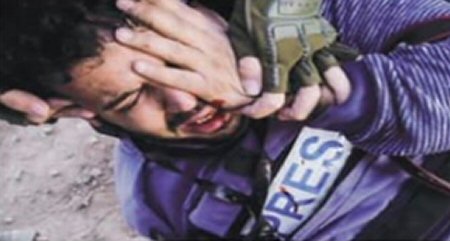
By Tareq Astal | IMEMC News & Agencies | May 9, 2019
In its monthly report on Israeli violations against journalists, published today, WAFA said that 11 journalists were injured from rubber-coated metal bullets, live bullets and tear gas canisters, fired by Israeli soldiers, as well as from severe beatings. At the same time, one journalist was detained and another had his press papers seized.
On April 3, the Jerusalem District Court rejected an appeal filed by Mustafa Kharouf, a photographer with Turkish Anadolu news agency, to release him from prison so that he can be with his family in Jerusalem, and kept him incarcerated until May 5, the date he is to be expelled to Jordan. (Kharouf’s attorney got an injunction from the Israeli High Court on May 5, stopping his expulsion until it hears his plea.)
On April 5, Israeli forces shot Amad News Agency correspondent Safinaz al-Louh, with a teargas grenade, in her right foot, and Noor News photographer Mohammad Issa with a gas bomb, in his leg, while covering the March of Return protests, east of the Gaza Strip.
On April 10, Israeli forces raided the home of Ra’ed al-Sharif, in Hebron, holding his family in one room before embarking on a thorough search of the house and tampering with its contents.
On April 12, Israeli forces shot Filistin al-Hadath photographer and correspondent Ahmed al-Zurei, with a rubber-coated bullet, in the abdomen, while he was covering protests east of al-Bureij, in the central Gaza Strip.
On April 19, freelance photographer Abdel Rahim al-Khatib was hit with a rubber-coated bullet, in the left thigh, and Reuters photographer Bassam Massoud with a gas grenade, behind his left ear. A similar bomb injured Watan Radio reporter Mohammad al-Louh and freelance photographers Mahmoud Badr, in the left foot, and Ahmad Washah, in the head, while covering protests east of the Gaza Strip.
In the same day, Xinhua photographer Nidal Shtayeh and WAFA photographer Ayman Noubani were shot with rubber-coated metal bullets, in their thighs, while covering the Israeli army’s crackdown on the weekly protests in Kufr Qaddoum village, east of Qalqilia, in the north of the West Bank.
On April 26, Israeli forces targeted Shihab News Agency photographer Ramadan al-Sharif, with a live bullet that hit him in his right foot, while he covered protests east of Rafah, in southern Gaza.
The daily attacks on journalists in the West Bank are part of an ongoing Israeli policy against their activities and their role in covering the practices and violations committed by these forces, against Palestinian civilians and property.
Hamas condemns Israel’s bombing of media offices in Gaza

Palestine Information Center – May 5, 2019
The Hamas leader Raafat Murra on Sunday decried the Israeli occupation army’s targeting of several media offices in the ongoing aggression on the Gaza Strip.
Murra condemned the Israeli attack on the Anadolu Agency office and described it as “terrorism” and “deliberate crime”.
He affirmed that Hamas fully supports all Palestinian, Arab, and international media platforms which cover the events in Gaza objectively and professionally.
Israeli warplanes on Saturday bombed the Anadolu Agency office and the Palestinian prisoners media office with several missiles during large-scale aerial attacks on Gaza.
Offended By What Someone Said? Now You Can Report Them To Law Enforcement
MassPrivateI | May 7, 2019
Soon free speech will be a thing of the past in paranoid America.
DIGIT Lab’s “Hate Incident Reporting” app promises to turn complete strangers into secret, hate speech/bias spies.
Watch what you say, because the person sitting next to you could be reporting you to law enforcement.
Gone are the days when Americans were unafraid to voice their opinions or make snide comments in public. Because DIGIT Labs will turn smartphones into bias reporting devices.
According to a PHYS.org article, DIGIT LAB’s new app allows strangers to report someone for exercising their first Amendment rights.
“The first of its kind, the app accepts reports beyond crimes captured in police records. Users from around the country can document all incident types, from derogatory epithets written in bathrooms to slurs yelled from a car window in addition to violent assaults.”
This app will make swearing at a fellow motorist or flipping someone off: hate speech.
Where in our Constitution does it say that it is acceptable to report someone who has not committed a crime?
Since 9/11, Homeland Security has tried to turn the entire country into home-grown spies with their “See Something, Say Something” campaign that essentially does the same thing as DIGIT LAB’s Hate Reporting app. If someone see’s something or see’s someone acting suspiciously they are encouraged to report it to law enforcement.
But the University of Utah’s, Hate Incident Reporting app, promises to create a Federal free speech blacklist.
“The major problem we’re dealing with is that hate crimes are so underreported, not only to police, but from police to the federal government,” said Emily Nicolosi, researcher, and Richard Medina, professor of geography. (Nicolosi helped develop the app.)
Creating a national blacklist of people who use derogatory epithets and slurs will turn this country into a mirror image of China.
“We’d like to see it used nationally to get better hate incident statistics, and to understand why, how, and where people are active in hateful incidents, and how that offends or hurts people,” said Medina.
Although the PHYS article claims that all reporting is confidential and anonymous, the amount of detailed information a person is asked to provide would make it easy for law enforcement to identify someone.
Google Bans Press TV
What’s Next?
By J. Michael Springmann and Edward C. Corrigan | Dissident Voice | May 5, 2019
What?
On April 19, 2019 (the date of the original Patriots’ Day in New England), American tech giant Google disabled the accounts of Press TV, an Iranian news service, and its sister channel Hispan TV, an outlet in Spain. Google denied their access to all its services, including its popular video streaming platform YouTube and its E-mail service Gmail. The company’s move took place without prior notice or subsequent explanation.
The action’s date is particularly significant to Americans. That day marked the beginning of the American Revolution. It saw the first armed engagement between British soldiers and colonial militiamen at the Battles of Lexington and Concord in Massachusetts on April 19, 1775. Patriots’ Day was intended to commemorate the colonists’ fight to win freedom from British rule.
But, nearly 250 years later, it observes the loss of that freedom to invisible, uncontrollable organizations.
Google and Facebook, and other social media giants, have been accused of altering search algorithms to slant or even hide information that departs from the government or corporate agenda. Independent media sources on the right and on the left have complained that searched results are tainted and being secretly manipulated on a grand scale. Now the censorship is being imposed openly in the name of political correctness and social harmony. There is a clear campaign to de-legitimize critics of US Government policy.
Target: Iran.
According to the April 22, 2019 edition of MintPress, “Iran has been on the receiving end of more than its share of censorship. Facebook has repeatedly banned “networks” it believes are “tied to Iran.” Meanwhile, both Press TV and HispanTV have faced prior crackdowns from Google. Recently, Instagram banned a number of Iranian officials following the U.S. designation of Iran’s military as a foreign terrorist organization. In some cases, Facebook has even worked with CIA-funded cybersecurity firms to target accounts. The State Department later trumpeted those findings in a report on Iran’s cybersecurity threat to the U.S., but opted to omit the source of the evidence.”
Additionally, MintPress noted: “Google’s crackdown on Iran is multifaceted, not just singling out its media for censorship, but also shutting down the accounts of its officials. Indeed, Google is on a path to destroy Iran’s ability to independently communicate its message to the world.”
What’s the issue?
Quoting Yasha Levine, journalist and author of Surveillance Valley: The Secret Military History of the Internet… “American Internet companies,” such as Google and Facebook, “are not abstract global platforms, but privatized instruments of American geopolitical power.”
And that’s the real issue.
And it’s not only Press TV, the “Voice of the Voiceless” that’s censored. The American Herald Tribune has been under attack, it says, by Zionist gatekeepers. In August 2018, it wrote one of the authors: “Dear Michael, Google has disabled all of the services we were using.” Then, the next month, it wrote: “Dear Friends/Colleagues: We were unable to retrieve our Facebook page after it was taken down without any prior notice. We have created a new Facebook page.”
Protection from bigots?
The attacks on Press TV, American Herald Tribune, and others are always couched in terms of suppressing the malign influence of the “far-right” and/or “anti-Semitic figures and organizations.” On May 3, 2019, the Washington Post used those words to headline an article celebrating Facebook’s action in permanently banning “several far-right and anti-Semitic figures and organizations, including Nation of Islam leader Louis Farrakhan, Infowars host Alex Jones, Milo Yiannopoulos [a former Breitbart editor] and Laura Loomer [a right-wing American political activist] , for being ‘dangerous’…” The paper saw this as “a sign that the social network is more aggressively enforcing its hate-speech policies at a moment when bigoted violence is on the rise around the world.”
While the 1st Amendment to the United States Constitution states: “Congress shall make no law … abridging the freedom of speech, or of the press…,” it seems that “The People” can do as they please, as long as they have large Internet organizations behind them and lots of money. And if there is pressure from supposedly liberal governments influencing them.
The Post went on to say, “Governments around the world are pushing Facebook to take town [sic] bigoted and other harmful content more quickly–or risk being banned themselves.” Germany heavily fines social media if they run afoul of “The Enforcement on Social Networks Act” (Netzwerkdurchsetzungsgesetz). Although it came into force October 1, 2017, social networks were given a three-month grace period to change their policies. If criminal content, which can include hate speech, defamation, and fake news, isn’t removed within 24 hours of its being reported, social networks can face fines reaching €50 million (US$60 million).
Like in the United States, “hate speech” is in the eye (or ear) of the beholder, especially if it deals with illegal aliens, a sore subject in some countries. This concept is probably the reason why Facebook and Twitter refused to advertise J. Michael Springmann’s book, Goodbye, Europe? Hello, Chaos? Merkel’s Migrant Bomb, an analysis of forced migration into Europe from American wars in the Middle East.
Conclusion
This all boils down to “political correctness” and lack of common sense. And governmental power. Allegedly liberal societies now engage in censorship–in the name of freedom of speech and political correctness. But it’s really censorship and control of information that is the real objective.
The Encyclopedia Britannica notes “our perception of reality is determined by our thought processes, which are influenced by the language we use. In this way language shapes our reality and tells us how to think about and respond to that reality. Language also reveals and promotes our biases. Therefore, according to the [Sapir-Whorf] hypothesis, using sexist language promotes sexism and using racial language promotes racism.”
Clever people in well-placed governmental positions and their cats-paws in large corporations evidently have taken note of this linguistic mind control and are now implementing it on a grand scale.
Michael Springmann is a lawyer, author, political commentator, and former diplomat based in Washington, D.C. While abroad with the U.S. Department of State, he served in Germany, India, and Saudi Arabia. He can be contacted at attorney@springmannslaw.net or at 202-256-3878. Edward C. Corrigan is certified as a specialist by the Law Society of Ontario (formerly the Law Society of Upper Canada) in Citizenship, Immigration and Immigration and Refugee Law. He is an author and political commentator based in London, Ontario, Canada and can be contacted at corriganlaw@edcorrigan.ca or at 519-439-4015.
Featured Video

AIDS Inc. by Gary Null (2007)
or go to
Aletho News Archives – Video-Images
From the Archives
Clash of Civilization, Iran Part II
By Jamal Kanj – Intifada-Palestine.com – January 14, 2011
Israel’s survival kit is: perpetuate conflict, insecurity to rationalize collective hate and finally playing victim.
Devoid of conflict, Israel implodes internally; without hate, Zionism loses its justification; and playing eternal victim to continue blackmailing the West. Absence of this holy trinity, Israel ceases to exist.
From its inception, the house of Zion has mastered exploiting adversarial powers to advance Israel’s cause. For instance, their influence over the Democratic Party in the US began with President Truman’s bid for 2nd term election in 1948.
Responding to strong opposition from Secretary of State General George Marshall and Department experts urging against recognition of Israel, President Truman replied: “I’m sorry gentlemen but I have to answer to hundreds of thousands [Jewish voters] who are anxious for the success of Zionism. I do not have hundreds of thousands of [voting] Arabs among my constituents”
Zionists influence over liberal American politics was matched with the doctrinal school of Conservative theoreticians aligning the Republican Party’s platform with Israel’s objectives. The Neoconservative Zionists, coined Zioncons, invented the “Clash of Civilization” concept to fight Israel’s wars. … continue
Blog Roll
 Aletho News
- Merck Virologists Admitted to Falsely Certifying Vaccine Efficacy
- Mandatory Folic Acid for every man, woman & child
- Pro-Palestine protesters arrested outside UK’s ruling Labour Conference in Liverpool
- Mauritius denies landing permit to flight from Israel, forcing cancellation: Tour operator
- Israeli finance minister calls for genocidal war on West Bank, annexation of south Lebanon
- 12 Things Your Psychiatrist Was Trained Not to Tell You
- From Unipolar Universalism to Multipolar Civilizational Distinctiveness
- RSF military group defects, joins Sudanese army: State media
- Ireland goalkeeper refuses to play ‘Israel’ as squad weighs boycott
- China pushes back against US on Cuba, Iran
- If Americans Knew
- Israel forces Gazans to live in constant peril – Daily Update
- Deconstructing Netanyahu’s pants-on-fire UN rant – Daily Update
- Trump betrayed voters with his campaign lies and prioritized a foreign country once he took office
- Netanyahu calls Israel’s war in Gaza ‘opposite of genocide’ in UN speech to near-empty hall
- Settler Kidnappings: Torture, Sexual Abuse and Terrorisation of Palestinian Abductees as Israel Deepens Annexation of West Bank
- Gaza winter nears as 162,000 tents become unusable, raising fears of humanitarian crisis
- Netanyahu says, “It’s the opposite of genocide”; UN says Gaza economy is world’s ‘most severe crisis on record’ – Daily Update
- Israel’s US-Backed Assault on Gaza Has Created the ‘World’s Most Severe Economic Crisis on Record’: UN
- ‘Protecting U.S. Citizens’… From Israel
- ‘This is where I live now, the back of a truck’: a day in the life of a grandmother in Gaza
- No Tricks Zone
- New Study: Earth And Venus Surface Warmth Largely Explained By Convection And Lapse Rate, Not CO2 Or Radiation
- 2025 Nature Paper Claiming Worsening Global Drought Gets RETRACTED …Heavily Flawed
- New Study: ‘Global Drought Shows No Detectable Recent Acceleration Under Climate Warming’
- Economic Masterminds: German Socialists Suggest Taxing Productivity Gains Stemming From Using AI
- The South China Sea Has Not Been Cooperating With The Climate Change Narrative
- Energy Crisis: Germany Enters Heating Season With Historically Low Gas Reserve Fill Levels
- New Study: The Antarctic Ice Sheet Gained Mass From 2020-2024 Due To Staggering Snow And Ice Accumulation
- Study: Ocean Heating Rates From Thousands Of Years Ago ‘Dwarf’ Modern Ocean Heating Rates
- Climate Extremists Target, Attack Large-Scale Power Grid Infrastructure In Germany!
- New Study: Antarctic Ice Melt Has Contributed Less Than 1 Centimeter To Sea Level Rise In The Last 30 Years

