Who Runs Our World?
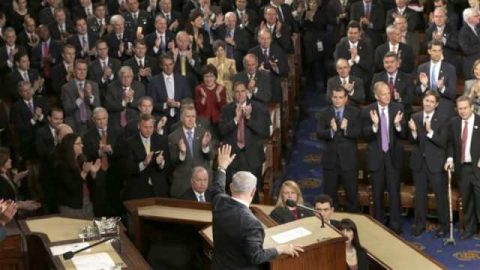
Netanyahu addresses US Congress | Photo from Al Jazeera
By Richard Hugus | January 4, 2019
Our world is run by oligarchs, the holders of vast wealth from monopolies in banking, resource extraction, manufacturing, and technology. Oligarchs have such power that most of the world doesn’t even know of their influence over our lives. Their overall agenda is global power — a world government, run by them — to be achieved through planned steps of social engineering. The oligarchs remain in the background and have heads of state and entire governments acting in their service. Presidents and prime ministers are their puppets. Bureaucrats and politicians are their factotums.
Who are politicians? Politicians are people who work for the powerful while pretending to represent the people who voted for them. This double-dealing involves a lot of lying, so successful politicians must be good at it. It’s not an easy job to make the insane agenda of the powerful seem reasonable. Politicians can’t reveal this agenda because it almost always goes against the interests of their constituents, so they become adept at sophistry, mystification, and the appearance of authority. For example, wars for Israel have been part of the agenda of the powerful for years. Since 2001, wars for Israel have been sold as “the war on terror” and lots of lies had to be made up as to why the war on terror was a real thing. The visible faces promoting the war on terror were neoconservatives in the US, almost all of whom were advocates for Israel, or Zionists. Zionists are not the only members of the oligarchy, but they seem to be its lead actors.
With this perspective we may judge all kinds of world events, such as the many false flag terror attacks which have been perpetrated in one country after another to bring about political objectives. False flag attacks range from Operation Gladio to demonize leftists, 9-11 to demonize Arabs and Muslims, and the shooting down of the MH-17 airliner to demonize Russia. Under an atmosphere of terror, with citizens clamoring for revenge, all kinds of political goals can be achieved.
Propaganda is also vital. Control of information through a likewise controlled media has facilitated mass brainwashing. To control the narrative, whistle blowers and truth tellers must be isolated and destroyed, preferably in the open, so as to warn others away. This is what is happening with Julian Assange.
The attack on Gilad Atzmon is an other example. Atzmon has been a major critic of the role of Jewish political power in our world — not just in Palestine, but all over the western world. When he says “we are all Palestinians” he is making the observation that Europe and North America are being Israelified. For example, some police in the US go for training in Israel, where they learn to view the US public, particularly African Americans, the way the Israeli military views Palestinians — as enemies to be shot in the streets and abusively treated. In the US, people are not allowed to question or discuss Jewish power, when it is evident that AIPAC, the lobby for Israel, completely controls both houses of the US Congress. We recall the members of Congress giving Benjamin Netanyahu 29 standing ovations during his denunciation of Iran in 2011. In Britain, mass insanity has taken hold, at least in the media, in the demonization of Russia via the Skripal affair and Luke Harding’s MI6 journalism in The Guardian. This is taking place solely because of Russia’s thwarting of Israel in its attempt to destroy Syria. For the neocons, the agenda is always war — the stick to bring recalcitrant states in line with the New World Order. This behavior is so dangerous that it would be crazy if we did not speak about who is doing this, and why.
In December 2018 Atzmon was banned from playing a jazz gig in Islington, north of London, because a powerful entity — the Zionist Herut Likud UK — initiated a character assassination and attack on his livelihood through Richard Watts, leader of the Islington Town Council. The Council created the lie that in banning Atzmon it was protecting the citizens of Islington from “antisemitism.” In fact, it is only protecting organized Zionists — supporters of the racist state of Israel — from one of their most effective critics.
Two paid staff for the Council — Ian Adams and Martin Bevis — were assigned to carry out the bureaucratic part of the job. They defended the assassination in the name of political correctness. They responded to Atzmon’s appeal of the Council ruling by citing almost entirely Zionist and Israeli sources to back up the claim that Atzmon is an “antisemite.” These sources include the Anti-Defamation League, the Jewish Chronicle, the Jewish Telegraphic Agency, Haaretz, the Times of Israel, and The Forward. When Atzmon countered these sources with a list of well-known academics who have supported his work — Richard Falk, John Mearschimer, Ramzy Baroud, Paul Craig Roberts, Cynthia McKinney, James Petras, Francis Boyle, among others — Ian Adams responded by saying, “I have found that the majority of them would appear to have also been subject to significant controversy or allegations of being anti-Semitic themselves.” To Adams, representing a town in Britain, the only valid authorities are in the media run out of Israel, with its blatant record of discrimination and genocide against Palestinians, which all those media support.
Power likes to cover up its crude manipulations with a veneer of reason and legality. Islington based its original decision on Atzmon’s banning on a clause in the town’s books having to do with events at the Islington Assembly Hall. The clause states:
“You must not, in connection with any Live Event, use, provide or display any material, whether written or spoken, or allow behaviour that constitutes direct or indirect discrimination or harassment, victimisation of, villification of, any person or group of persons on grounds of race, nationality, gender, sexual orientation, disability, religion or age.”
In their letters, Adams and Bevis provide no response to the fact that Atzmon was to appear at the December 21, 2018 event as a saxophone player with a jazz group called The Blockheads. There was no logical way to assume that his saxophone playing would discriminate against, harass, victimize, or vilify anyone at this event. The banning was therefore not backed up by law; it was illegal in itself, as it discriminated against Atzmon.
The only thing one can say about the bureaucrats’ defense of Islington’s decision is that they and the town officials, and indeed much of Britain’s political class, seem to be unaware that Zionism is the water in which their boat is floating. When the entire mainstream narrative is dictated by Jewish identity politics, of course all criticism of those politics must be heresy. Britain was once a sovereign nation, not a colony of Israel — much like the US. Much like Canada, Germany, France, and so on. These countries were not invaded by tanks and infantry; they were invaded by dogma. Political dogma, political “correctness,” and the totalitarian policing of our thoughts and words, are the things which Gilad Atzmon has pointed to in western culture and held up for us to examine. Zionists have made criticism of Israel “antisemitic” by definition. There is no way to win the argument. The word no longer has any meaning. This is aside from the fact that ‘semitic’ refers to a language group which includes Arabic, Aramaic, and Hebrew and that the majority of the settlers claiming rights to the Holy Land did not come from areas, like Palestine, where semitic languages were spoken.
Atzmon has asked the most basic questions: Israel defines itself as “the Jewish state” — what then is the Jewish state? What are Jewish identity politics? And why are we not allowed open discussion and debate on these questions? This is the reason for the attempt to denounce him. The bureaucrats and politicians of Islington say they’re fighting bigotry, but because they are part of a system which bigotry built, they’re actually speaking on behalf of it. Once again, the oligarchs have put through a dirty scheme under cover of benevolence and human rights.
Mumia Abu-Jamal Wins Major Court Victory
By Jeff Mackler | CounterPunch | January 3, 2019
On December 27, Philadelphia Superior Court Judge Leon Tucker ruled in favor of Mumia Abu-Jamal, holding that the actions of former Pennsylvania Supreme Court Judge Ronald Castille demonstrated a “lack of impartiality” and “the appearance of bias.”
Tucker’s decision represents a major victory for Abu-Jamal that opens the door to a new trial–or dismissal of the murder charges against him–after an appeal to the Pennsylvania courts.
Incarcerated in 1981 in a racist frame-up murder trial of police officer Daniel Faulkner and on death row for most of the past 37 years, Mumia was a prize-winning journalist and today the author of 10 books on various aspects of the freedom struggle. His latest book, Murder Incorporated: Empire, Genocide, Manifest Destiny, 2017, co-authored by filmmaker Stephen Victoria (Long Distance Revolutionary, 2014) with a forward by Chris Hedges, is invaluable reading for revolutionary activists who seek the truth about capitalist imperialism’s centuries of horrors and the historic resistance against them.
Mumia’s freedom struggle has been supported by scores of trade unions across the U.S. and in Europe as well as by Amnesty International, the NAACP and numerous city council resolutions from San Francisco to Detroit.
Tucker’s 27-page ruling was in two parts. He held in Part Two that with regard to all of Mumia’s numerous denied Post Conviction Relief Act (PCRA) appeals between 1998 and 2014, Supreme Court Judge Ronald Castille’s actions in campaigning for the Pennsylvania governor to sign death penalty warrants for all “convicted cop killers” and other biased acts, violated Mumia’s fundamental constitutional rights.
Castille had participated in PA Supreme Court decisions that denied all of Mumia’s appeals, including a request from Mumia’s attorneys that he recuse himself from deciding the case he had helped to prosecute and another decision where the same Castille court refused to consider documented evidence submitted by court stenographer Terri Maurer Carter that Mumia’s trial judge Albert “the hanging judge” Sabo had stated in his antechambers before entering the courtroom to adjudicate Mumia’s case, “Yeah, I’m going to help ‘em fry the nigger.” Mumia’s decades long sojourn through the racist U.S. “criminal justice system” is replete with what has become infamously known as “the Mumia exception,” that is, contorted applications of the “law” aimed at denying its applicability to the facts in Mumia’s case. These include systematic exclusion of eyewitness testimony proving his innocence, intimidation of witnesses, falsification of exonerating ballistics findings, fabrication of testimony that Mumia admitted to the killing of police officer Daniel Faulkner and Mumia’s physical exclusion from a majority of his trial proceedings – to name a few of the legal atrocities attendant to his trial and subsequent proceedings.
Judge Tucker’s ruling opens the door for Mumia to appeal all of Castille’s decisions over a 17-years period. Tucker denied Part One of Mumia’s appeal that pertained to whether or not Castille had been significantly or personally involved in Mumia’s prosecution in order to qualify under the provisions of the 2016 Supreme Court William’s case. Mumia’s attorneys may appeal this decision in order to fight on both legal fronts.
While the present Philadelphia District Attorney, Larry Krasner may well appeal Tucker’s amazing and unexpected decision, the door is nevertheless wide open to a lengthy legal battle along with renewed national and international campaigns to win massive and united support in the streets to demand Mumia’s freedom.
Jeff Mackler is a staffwriter for Socialist Action. He can be reached at jmackler@lmi.net socialist action.org
Nineteen Palestinian Journalists Are Still Imprisoned By Israel
IMEMC News – December 31, 2018
 The Palestinian Information Ministry has reported that there are nineteen Palestinian journalists who are still imprisoned by Israel, in direct violation of various treaties and International Law.
In a press statement Monday, the Ministry said that the Israeli occupation and its military courts are ongoing with their serious violations against the journalists and various media outlets in occupied Palestine.
It said that many journalists have also been forced under house arrest, others were forced out of their towns, in addition to facing high fines by the Israeli military courts for performing their duties.
The Ministry also said that some of the abducted journalists were shot and injured, while others are sick, in need of specialized medical treatment but are denied that right.
The soldiers also invaded and violently searched many media outlets across the West Bank, and confiscated equipment.
The Information Ministry stated that Israel’s violations are ongoing attempts to silence the Palestinian media outlets and the journalists, and urged the International Federation of Journalists, Reporters Without Borders, and various related organizations around the world to intervene and stop the escalating abuses against the media and the Freedom of the Press in occupied Palestine.
It is worth mentioning that the soldiers have also killed Palestinian Photojournalist Yasser Mortaja, and journalist Ahmad Abu Hussein, in the Gaza Strip, in addition to wounding dozens of journalists, during the Great Return March processions.
Wag the Dog… British Media Watchdog Accuses Russia of Bias
By Finian CUNNINGHAM | Strategic Culture Foundation | 27.12.2018
Irony is dead when British state media controllers accuse Russian news outlets RT and Sputnik of “imbalance” over their reporting on the Skripal alleged poisoning affair.
In the past week, Ofcom, the British media watchdog, condemned seven programs aired during March and April this year following the apparent poisoning of former Russian spy Sergei Skripal in Salisbury. The Russian outlets may be fined or denied future broadcasting rights in Britain. The latter suggests what the real, ulterior agenda is all about.
It remains a mystery as to what happened exactly to Skripal and his daughter when they reportedly fell ill on March 4 in the famous south of England cathedral town. Neither Sergei nor Julia have been seen in public since, apart from a brief and carefully controlled interview given by Julia to Reuters a few months ago, apparently having recovered from her stricken condition. Russian consular services have been denied access to Julia by the British authorities, despite her being a Russian citizen.
The murkiness of the affair, the flagrant obfuscation by the British authorities and their violation of diplomatic norms speaks of a British state intrigue aimed at provoking international recriminations against Russia. Such is the outrageous apparent skullduggery by the British state, it is arguably very appropriate therefore for critical media coverage of the incident and the subsequent prevarication by London.
However, in a staggering inversion of reality, British media regulators complain that Russian news outlets have broken “impartiality rules” in their reporting on what is a bizarre de facto disappearance of a Russian citizen and her father while in the custody of British authorities. The protagonists are off-limits from criticism; their ropey claims must be treated as the sane version of events.
Within days of the Salisbury incident, senior British officials, including Prime Minister Theresa May, were accusing Russia of an assassination attempt against the Skripals, allegedly with a Soviet-era nerve poison.
London’s narrative inculpating the Kremlin and Russian President Vladimir Putin continues, despite Russia’s vehement denial of involvement and despite the lack of independently verifiable evidence.
This week, in her Christmas speech to the nation, premier May again repeated her condemnation of the “nerve agent attack in Salisbury” and she praised British armed forces for “protecting the country’s waters and skies from Russian intrusion”.
So, Russian media are castigated for “bias”, but British media are evidently permitted to report and broadcast official British assertions that are unproven and wildly sensational, if not tantamount to inciting international conflict. Just who is breaking journalistic standards?
Among the news outlets reporting May’s words were the BBC. The government-owned British broadcaster routinely and snidely refers to Russian news outlets RT and Sputnik as “Kremlin-backed”. As if the state-backed BBC is somehow immune from disseminating British government propaganda.
May’s assertions in her Christmas speech about Russia carrying out an alleged assassination and threatening Britain with invasion went unchallenged by the BBC. Nor were her other claims about chemical weapons being used by Syrian government forces against civilians.
On Syria, May was referring to an incident near Damascus in April this year when toxic chlorine was purportedly used in an assault on civilians. Back then, the British prime minister joined with US President Trump and France’s President Macron to order air strikes on Syria, supposedly in retaliation for the Syrian army’s use of chemical weapons. But it soon transpired that the incident was a provocation staged by jihadist militants and their media operatives, the so-called White Helmets. In other words, the British, American and French carried out a criminal act of aggression against Syria under false pretenses.
Yet May in her solemn set-piece nationwide Christmas speech this week was allowed by British media to repeat blatant lies against Syria, and brazenly avoid the issue of justice facing her government over illegal air strikes on Syria, as well as to continue smearing Russia over the murky Skripal affair.
The arrogant hypocrisy of British media and the state regulator is astounding. British citizens are compelled by law to pay an annual license fee of £150 ($190) per household for possessing a television set. Failure to pay can result in a jail sentence. The TV license fee collected by the British state is handed over to the BBC. So, here we have a state-owned media channel that is funded through a compulsory tax on citizens, and yet this same channel willingly broadcasts British government propaganda claims denigrating Russia and covering up for British war crimes in Syria. If that sounds Orwellian, that’s because it is.
The BBC’s corporate advertising claims to be the “world’s leader in breaking global news”. It also assures its listeners and readers that it produces “news you can trust”.
There are countless cases where the BBC’s pompous self-importance can be exposed, revealing an altogether more malevolent purpose. One of the most notorious cases was its complicity in orchestrating the 1953 coup in Iran carried out by the American CIA and Britain’s MI6. In his book, Web of Deceit, British historian Mark Curtis details the crucial role played by the BBC and its Persian service in helping to foment the coup against the elected premier Mohammad Mosaddegh.
More recently, BBC coverage of the war in Syria over the past eight years has been a relentless propaganda assault on the government of President Bashar al Assad. It is not merely about omission or biased distortion. The BBC has been caught out actually fabricating fake news in Syria, such as the case when it accused the Syrian army of using napalm on civilians near Aleppo in 2013. Those reports were later exposed as deliberate fabrications.
More generally on Syria, the BBC, as with other Western news media, are serving as facilitators of the criminal regime-change objective of their governments. May’s grotesque falsehoods reiterated this week – in a Christmas speech of all things! – about chemical weapons are afforded respectability and apparent credibility by the way the BBC and other British outlets dutifully report her words without any qualification, let alone criticism.
It is a measure of how distorted the British media landscape is when alternative news channels which do raise critical viewpoints and insights on propaganda narratives are then accused of being “imbalanced” and “in breach of broadcasting rules”.
In response to Britain’s Ofcom regulator condemning Russia’s RT and Sputnik, Moscow is now saying that its own state regulator is considering filing a case against the BBC and how it operates in Russia. Given how the BBC tried to tie Russia to instigating the Yellow Vest protests in France and how it recently ran an article accusing the Kremlin of “weaponizing satire”, there seems much more credibility to Russian claims that the “British state-backed outlet” is in breach of journalistic standards.
The broader background of how the BBC serves British state propaganda is panoramic in its scope. But such is official British hypocrisy, the authorities attack critical news outlets that happen to expose their propaganda service posing as “news you can trust”.
Free speech in Britain? Yes, as long as you freely speak in the service of British state propaganda.
Fiasco In Islington, Part 2
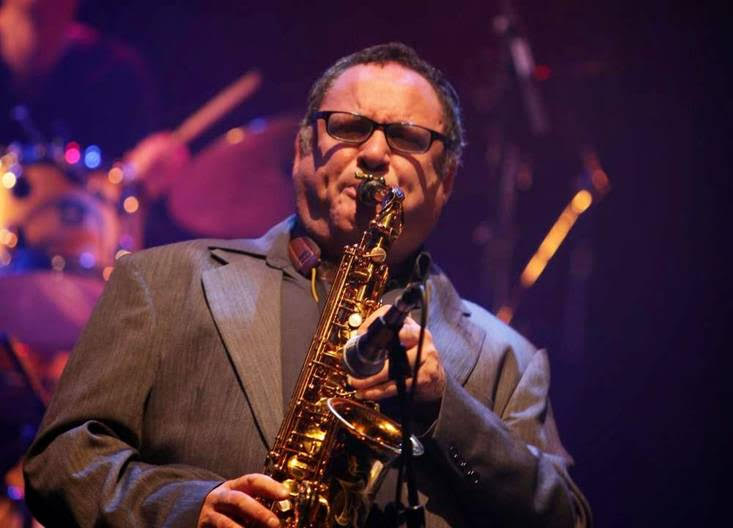
Gilad Atzmon
By Richard Hugus | December 26, 2018
More facts have come to light in the case of Gilad Atzmon and his banning by the Islington Town Council from performing at a jazz concert on December 21, 2018. The original scenario was that one e-mail from one person calling Atzmon an antisemite somehow persuaded the Islington council to take the drastic step of removing Atzmon from a town-owned venue. Many who heard the story felt this was a rash decision which would surely be reversed when the facts were brought to light. But the Council voted to uphold its decision and Atzmon was indeed not allowed to play.
Now it appears that the single complainant – Martin Rankoff – was not just an anonymous fan of Israel but the UK director of Likud-Herut. Herut (or ‘freedom’) was Israel’s founding nationalist party from 1948 until it later merged with Likud. It is a militant and extreme Zionist organization whose roots go in a straight line from Ze’ev Jabotinsky and Menachem Begin up to Benjamin Netanyahu today. Jabotinsky and Begin helped form the Irgun terrorists in 1937. Irgun committed notorious massacres in Palestine leading up to and during the Nakba (or ‘catastrophe’) of 1947-1948. These include the bombing of the King David Hotel in Jerusalem in 1946, killing 91 people, and the massacre at Deir Yassin in 1948 in which 254 unarmed Palestinian villagers were brutally murdered as an incentive for other Palestinians to leave. On its web site Likud-Herut UK lists Jabotinsky and Begin as “visionaries.” Likud-Herut is a member of the World Zionist Organization and the Zionist Federation of the UK who believe in “the inalienable right of all Jews to live and settle in all parts of the Land of Israel.”
In a letter to the New York Times in 1948 Albert Einstein, Hannah Arendt, and others compared Herut to the Nazis and Fascists who had just been defeated in World War II. Referring to this letter, Ramzy Baroud recently wrote, “the ‘Nazi and Fascist’ mentality that defined Herut in 1948 now defines the most powerful ruling class in Israel. Israel’s leaders speak openly of genocide and murder, yet they celebrate and promote Israel as if an icon of civilization, democracy and human rights.”
–
The history of Herut and Likud tells us a great deal about who the people are who complained about Atzmon to Islington Town Council. When Atzmon moved to appeal his being banned, formidable opponents again appeared in the form of the Simkins Law firm, one of the most expensive law practices in Britain, with not one but two partners at Simkins being put on the case. These are Gideon Benaim and Tom Iverson. Benaim recently became well known in Britain for winning an invasion of privacy suit against the BBC on behalf of pop singer Cliff Richard, who said he spent £3.4m ($4.3 million) on the case. Clearly, representation by Simkins doesn’t come cheap. Also listed in Benaim’s resumé as a client is the Las Vegas Sands Corporation which likely has no problem with Simkins’ fees either. The Sands casino is owned by billionaire Sheldon Adelson, who, as it happens, is a primary sponsor of the Likud Party in Israel, led by Benjamin Netanyahu. Adelson owns the newspaper Israel Hayom, a mouthpiece for Netanyahu and Likud.
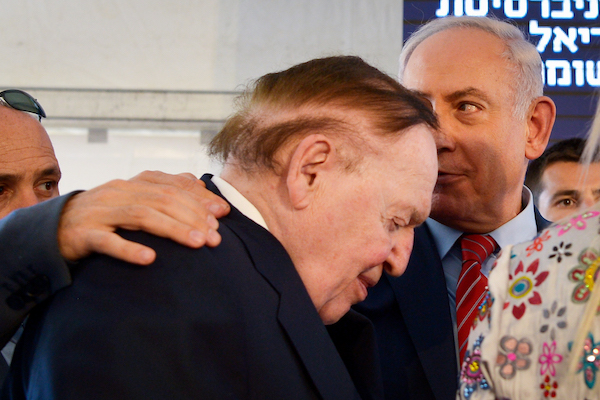
American businessman and investor Sheldon Adelson with Prime Minister Benjamin Netanyahu at the ceremony of a laying of a cornerstone for new Medicine Faculty buildings at the Ariel University in the West Bank, on June 28, 2017. Photo by Ben Dori/Flash90
It now appears that Atzmon’s banning was not the result of a casual complaint; it was an intentional attack on a well-respected supporter of Palestinian human rights by the Likud organization, directly represented by Martin Rankoff. The attack was followed up by the hiring of a lawyer who has worked for Likud godfather Sheldon Adelson. The connection to these powerful forces may explain why Islington Town Council leader Richard Watts, without any delay or attempt at negotiation, took the step of going straight to a decision to hire an expensive law firm. This is while Islington is facing serious austerity and shortage of funds in its own operating budget. Islington has a population of about 206,000 people. This very month, 43 of those people were counted in one survey as homeless and sleeping on the streets.
Regarding the financial problems of his borough and others around London, Richard Watts, told The Independent in October 2018 :
“unprecedented” funding pressures and demand for adult and children’s social care and homelessness services was “pushing councils to the limit”.
“As a result less money is being spent on the other services that keep our communities running such as libraries, local roads, early intervention and local welfare support,” he added.
Yet, to Watts and his fellow councilors in Islington, backing partisans for a foreign country -Israel- took precedence over the pressing needs of the people whom they are supposed to represent. Either Watts was inexcusably careless with scarce town funds or a deal was made and he knew that he could depend on Likud-Herut to back him. Or, like politicians all across Europe and the US facing the power of the Israel lobby, he knew he couldn’t afford to say no.
According to Simkin’s web site, Gideon Benaim “has extensive expertise in the areas of defamation, privacy, harassment and copyright.” Perhaps it is not a coincidence that immediately after Islington brought in Simkins, identical statements from an unnamed Labour spokesman describing Atzmon as “a vile antisemite” appeared in both the BBC and The Guardian. Perhaps a lawyer experienced in defending people against defamation and harassment would also know how to perpetrate these things. Perhaps this was Benaim’s opening move. Character assassination is a common tactic in cases that have a weak legal foundation, such as this one, as it goes a long way to convicting the accused before their case ever reaches a courtroom.
The involvement of Likud-Herut in the attack on Gilad Atzmon, and Islington’s official backing of that attack, constitutes a monumental scandal. This wasn’t just a stupid mistake; it was a hit. It is an affront to reason that an an arch-racist organization like Likud, who from the beginning have stood for the removal of the people of Palestine from their own land by means of terror, murder, and forced expulsion, could possibly claim they they were defamed by someone pointing out these very crimes. There is a case of defamation here for sure – the defamation of Gilad Atzmon. For Zionists, defamation is nothing more than a tool to destroy opponents who can’t be dealt with by other means. We are long since tired of truth tellers being accused of antisemitism. We’re tired of national and local resources being used to prop up the criminal state of Israel. Coercion by advocates for Israel is at the center of this issue in Islington, as it is in many other towns and many other countries. For the sake of Palestine and our own sovereignty, it has to be called out and stopped.
To sign a petition in support of Gilad click here
Lodge a formal complaint with Islington Council: https://www.islington.gov.uk/contact-us/comments-and-complaints?status=inprogress
Email: assemblyhall@islington.gov.uk
Contact the Council: +4420 7527 2000
To support Gilad’s legal battles: https://donorbox.org/gilad-needs-additional-support
Israel Removes Memorial Honoring Famed Palestinian Writer Ghassan Kanafani
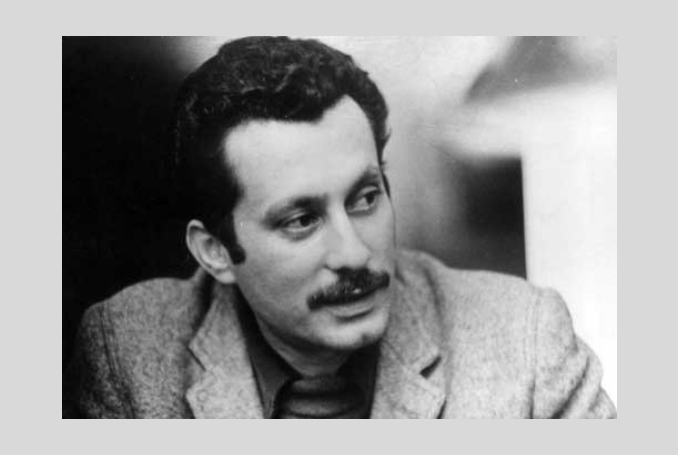
Ghassan Kanafani. (Photo: File)
Palestine Chronicle | December 22, 2018
Israel removed a memorial statue in the city of Acre this week dedicated to Palestinian intellectual and writer Ghassan Kanafani.
The statue was set up in a cemetery by Palestinians in the northern Israeli city to honor the iconic intellectual and Popular Front for the Liberation of Palestine (PFLP) member.
The local Waqf (Endowment) in Acre was contacted shortly after the memorial was erected and pressured to remove it immediately by Israel’s Interior Ministry.
Israeli authorities forced the city of Acre to remove a memorial to Palestinian playwright and novelist Ghassan Kanafani, who was born in Acre and forced to leave his city during the 1948 Nakba. https://t.co/8JdmE1Kqyo pic.twitter.com/xxGeLWGNE9
— The IMEU (@theIMEU) December 22, 2018
Israeli Interior Minister Aryeh Deri, a member of the ultra-Orthodox Shas party, said earlier this week that “we will not allow memorials in honor of terrorists in Israel”.
A relative of Kanafani said the memorial would be moved to a garden of another relative in Acre.
Ahmad Odeh, a Palestinian member of Acre’s city council, said Kanafani was a “symbol for the entire Palestinian people” and denounced the Israeli decision.
Israel removes memorial honouring famed Palestinian writer Ghassan Kanafani https://t.co/uQaUJCk7yx via @The_NewArab pic.twitter.com/EmnBc2cdby
— Araby.org Community (@ArabyOrg) December 21, 2018
Despite being a civilian who did not bear arms, Kanafani, born in Acre in 1936, was assassinated in Beirut in 1972 by a car bomb believed to have been orchestrated by Israeli Mossad agents.
Kanafani’s obituary in Lebanon famously said:
“He was a commando who never fired a gun, whose weapon was a ball-point pen, and his arena the newspaper pages.”
Kanafani was a victim of Israel’s terrorism, assassinated in Beirut on 8/7/72; his literature will always be remembered as masterpieces describing our Nakba and exile; the Zionists who removed the memorial will only be remembered as those who brought apartheid to the Holy Land. https://t.co/mCQPPrC2QG
— Xavier Abu Eid (@xabueid) December 21, 2018
His family was forcibly displaced from the city in 1948 during the mass exodus of Palestinians known as the ‘Nakba’, or catastrophe.
Acre was historically a mixed city of Palestinian Muslims, Christians, Jews, and Baha’i, but around 75 percent of the population was displaced during fighting surrounding the creation of the Israeli state.
Fiasco In Islington
By Richard Hugus | December 21, 2018
Jazz saxophonist and writer Gilad Atzmon was recently banned from playing at an assembly hall in Islington, a borough of London, by order of the Islington Town Council. This came about as a result of an e-mail from one person — Martin Rankoff — saying nothing more than that if Atzmon was going to be at the venue on December 21 he would give a ticket that was given to him to someone else. Rankoff wrote, “Mr Atzmon’s news and beliefs I personally find repulsive and do not wish to be in the same place as him, let alone listen to his music.” Rankoff included links to ADL and Israeli news outlets accusing Atzmon of antisemitism. Incredibly, on the basis of this letter alone, the Islington Council went way out of its way and contacted the show’s promoter to get Atzmon banned — something Rankoff didn’t even ask for.
Imagine the situation in reverse: Gilad Atzmon writes a letter to the Council saying he is uncomfortable with Martin Rankoff appearing in the audience at Islington assembly hall. He refers to Mr. Rankoff’s pro-Israel Twitter page where Rankoff calls Jeremy Corbyn “A F***ing Antisemite and Racist” and where Corbyn is pictured on a bike with a comment suggesting Corbyn should be rammed by a car. Atzmon says that he doesn’t feel safe with Rankoff in the audience. He finds Mr. Rankoff’s support for Israel repulsive because Israel was founded on genocide against the people of Palestine. As proof he provides links to news reports on the slaughter of unarmed protestors in Gaza since March 30, 2018, and a story on the Deir Yassin massacre of 1948.
This imaginary second complaint would have been scorned as an abridgement of Rankoff’s rights. Indeed, since the Islington Council has adopted the International Holocaust Remembrance Alliance definition of antisemitism, in which criticism of Israel is deemed antisemitic, the Council would probably feel obliged to forward the letter to the authorities as evidence of hate speech.
The Council provided a statement on the banning in which it says: “under the Equality Act 2010, the Council must, in the exercise of its functions, have due regard to the need to foster good relations between different races and religions within the borough. The Council took account of the fact that Mr Atzmon’s presence at the Hall, and knowledge of his presence among residents of the borough, might harm such relationships, as well as the Council’s duty to tackle prejudice and promote understanding within the borough.”
This begs the question — in what way would either the “presence” of Gilad Atzmon or “knowledge of his presence among residents” harm the relationship between different races and religions in the borough? Atzmon was to appear at the venue as a saxophone player in a jazz group. It’s hard to imagine a more severe inversion of the concept of discrimination. On the basis of the feelings of one complainant, the right of a musician to work or even be present in Islington is taken away.
What lies behind this is a familiar tactic. Zionists have no argument to counter critics of Israel, so they try to shut them up by attacking their character and robbing them of their livelihood. Now AIPAC and other lobbies are working to make it illegal to criticize Israel, as we see in the recent case of a Texas speech therapist whose yearly contract was denied because she refused to sign a pledge not to support a boycott of Israel. One might ask, what does a teaching position in Pflugerville, Texas have to do with one’s opinions about a country seven thousand miles away? And why does that country have the right to compel anyone in the US to sign a loyalty oath?
If the BDS movement doesn’t do it, zealotry and fanatacism will be the undoing of the Zionist project. People don’t like being told what they are allowed to think and say. When our words and thoughts are policed, it makes us question all the more. What were once decent leftist positions against racism and discrimination have been twisted into a new kind of totalitarianism, one in which it is racist to question the racist, and discriminatory to question discrimination; one in which we are told to think something doesn’t exist when we can see with our own eyes that it does. The self-righteous members of the Islington Town Council have set a very dangerous precedent, and have been used as fools on top of it.
Be Offensive and Be Damned: The Cases of Peter Ridd and Tim Anderson
By Binoy Kampmark | Dissident Voice | December 20, 2018
It has been an ordinary year for universities in Australia. While the National Tertiary Education Union pats itself on the back for supposedly advancing the rights and pay of academics, several face removal and castigation at the hands of university management. Consumerism and pay are the sort of quotidian matters that interest the NTEU. Less interesting is the realm of academic ideas and how they clash with the bureaucratic prisons that have been built into universities.
At James Cook University, Peter Ridd was sacked on “code of conduct” grounds applied with a delightful elasticity. He claimed that it was for holding views on climate change out of step with his colleagues, and attacking the credibility of the Australian Institute of Marine Science and the ARC Centre of Excellence for Coral Reef Studies. (The pettiness of such institutions knows no bounds: Ridd’s knuckles were rapped, for instance, for satirising, trivialising or parodying the university.)
At the University of Sydney, Tim Anderson, a full time critic of Western interventions in the Middle East and acquitted for ordering the 1978 Sydney Hilton Hotel bombing, has been suspended pending what would seem to be imminent sacking. Causing “offense” was what mattered.
A cardinal rule applies in this case: Be suspicious of those who use good behaviour as a criterion of policing, notably in an environment where bad behaviour and dangerous ideas should hold sway over meek bumbling and submissiveness. Be wary of the demands to be vanilla and beige – behind them lies administrative venality and the dictates of compliance.
Such rubbery provisions as being “civil” or not causing offense shield the weak, spineless and fraudulent and, most dangerously, create the very same intolerable workplace that managers are supposedly opposed to. Very importantly, such code of conduct regulations are designed to immunise management from questions about their behaviour and often daft directives, letting institutions grow flabby with corruption. Inoculated, that class thrives in its toxicity.
The Deputy Vice-Chancellor of JCU, Iain Gordon, has drawn upon the usual stock nonsense defending the decision regarding Ridd. “The issue has never been about Peter’s right to make statements – it’s about how he has continually broken a code of conduct that we would expect all our staff to stick to, to create a safe, respectful professional workplace.” The thrust of this is simple: Never cause offense; be compliantly decent; be cripplingly dull and go back to your homes in your suburbs living a life unexamined. As an academic, you are merely delivering a service mandated by individuals several steps removed from the education process, not performing an ancient duty to educate mankind.
The code of conduct, the product of a corporatized imbecility, assumes the mantle of dogma in such disputes. “All staff members must comply with the Code of Conduct,” goes Gordon’s official statement in May, with its distinct politburo flavour of placing things beyond debate. “This is non-negotiable. It is a fundamental duty and obligation that forms part of their employment.” Ridd, explains Gordon, “sensationalised his comments to attract attention, has criticised and denigrated published work, and has demonstrated a lack of respect for his colleague and institutions in doing so. Academic rebuttal of his scientific views on the reef has been separately published.”
Anderson, having found himself at stages in the University of Sydney’s bad books, has also run the gauntlet of offensiveness. The specific conduct resulting in his suspension featured lecture materials shown to students suggesting the imposition of a swastika upon Israel’s flag. This was deemed “disrespectful and offensive, and contrary to the university’s behavioural expectations”. Tut, tut, Anderson.
The Sydney University provost and acting vice-chancellor Stephen Garton followed the line taken at JCU towards Ridd with zombie-like predictability. “The university has, since its inception, supported and encouraged its staff to engage in public debate and it has always accepted that those views might be controversial.” But debate – and here, behavioural fetters were again to be imposed – had to be undertaken “in a civil manner.” Contrarianism should be expressed with a good measure of decency.
The letter of suspension from Garton to Anderson is one-dimensionally authoritarian. Principles of academic freedom were supported by the university, but only in “accordance with the highest ethical, professional and legal standards”. But the all supreme, and trumping document, remained the Code of Conduct, capitalised by the bureaucrats as Mosaic Law. “The inclusion of the altered image of the Israeli flag in your Twitter Posts, Facebook Posts and teaching materials is disrespectful and offensive, and contrary to the University’s behavioural expectations and requirements for all staff.”
Some heart can be taken from the protest last Friday on the part of 30 academics who signed an open letter objecting to the treatment meted out to Anderson, stating that academic freedom was “meaningless if it is suspended when its exercise is deemed offensive.” His suspension pending termination of his employment was “an unacceptable act of censorship and a body-blow to academic freedom at the University of Sydney”. Reaction to Ridd has been somewhat cooler.
The point with Anderson is that his views are deemed bad for university business, which tolerates no room for the offensive. This, in a place where the most varied, and, at points, tasteless views, should be expressed. But as universities have become shabby entrepreneurial endeavours which see students as obesely delicious milch cows for their existence, the idea is less important than the process.
As is so often the case of free speech, advocates of it always assume it doesn’t apply to others. It is only to be extolled as a mark on paper and university policy. But never, for instance, challenge inane university policy or the hacks who implement it. Never ridicule ideas that deserve it. Never mock the obscene nature of managerialism’s central principle: massaged incompetence and assured decline. University managers and the colourless suits aided by their ill-tutored human resources goon squads tend to hold sway over opinions, taking against anybody who questions certain aspects of their (non)performance.
The Ridd and Anderson cases, coming from separate parts of the academic spectrum, demonstrate the prevalence of toadyism on the part of those who wish to avoid questioning the rationale of a university’s management process. They also suggest an immemorial tendency of authority to savagely oppress those who ignore it; to manifest its existence through punishment. In truth, it is precisely in ignoring those officials long barnacled upon the research and teaching endeavours of the University and drawing revenue best spent on students and scholars that a grave sin is committed. Such officialdom should be ignored, treated as the bureaucratic irrelevance that it is. Time for sit-ins, occupations, boycotts and a retaking of the University.
Binoy Kampmark was a Commonwealth Scholar at Selwyn College, Cambridge. He lectures at RMIT University, Melbourne and can be reached at: bkampmark@gmail.com.
MK Zoabi ‘reprimanded’ for saying Israel soldiers ‘murdered’ civilians
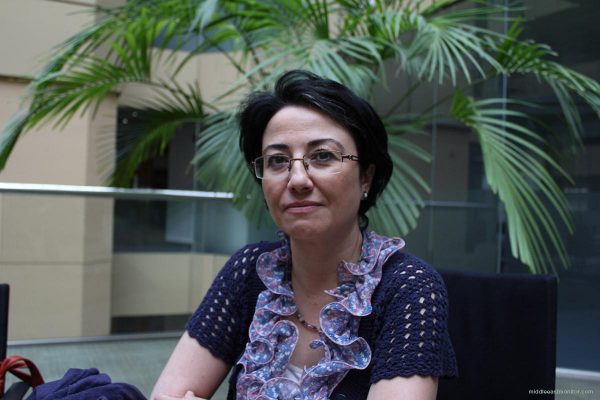
MEMO | December 19, 2018
The Knesset’s Ethics Committee decided yesterday to “severely reprimand” MK Haneen Zoabi, over remarks made by the parliamentarian about Israeli forces’ attacks on the occupied Gaza Strip.
According to the report by right-wing Israeli news outlet Arutz Sheva, Zoabi was the subject of a complaint filed by Likud MK Oren Hazan, after the Joint List legislator said that Palestinian civilians in Gaza had been “murdered by [Israeli] soldiers” during a Knesset debate.
“In this case,” the decision read, “most of the members of the committee believed that the use of the expression ‘murdered by the soldiers’ was not worthy of the broad protection that the committee spreads over the freedom of political expression of MKs.”
The committee also rejected a complaint filed by Zoabi herself, alleging that Deputy Knesset Speaker MK Tali Ploskov, who presided over the discussion, “did not defend her while she was speaking”. The committee concluded that “Ploskov’s conduct was not in violation of Knesset rules”.
Zoabi has frequently been targeted for censure by Knesset officials and racist incitement by fellow lawmakers over her outspoken support for Palestinian rights, and criticism of the Israeli army’s violations of international law.
Marc Lamont Hill’s Detractors are the True Anti-Semites
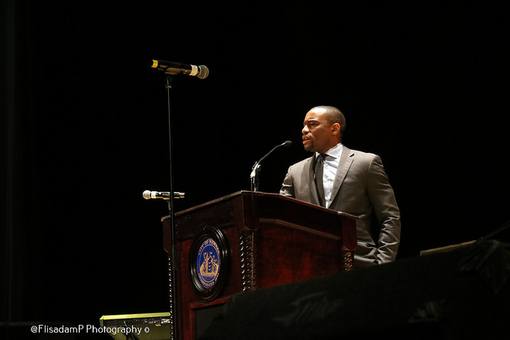
Photo Source Flisadam Pointer | CC BY 2.0
By Susan Abulhawa | CounterPunch | December 17, 2018
Temple University’s administration announced the unsurprising news that it has found no grounds to punish or investigate Professor Marc Lamont Hill for his speech at the United Nations on the occasion of the International Day of Solidarity with the Palestinian People. Yet, the university’s Board of Trustees felt compelled, nonetheless, to issue a statement further maligning Dr Hill, albeit indirectly this time, by quoting the slanderous language of others against him.
Remarkably, the Board’s statement implicitly acknowledges there was nothing inherently offensive in Dr Hill’s speech. Rather, the university’s objection lies in the way “many regard[ed]” it and how it was “widely perceived” or “broadly criticized.” In essence, the university was unable to reasonably rebuke what was ultimately a call for justice and freedom for the Palestinian people, the colonized indigenous nation that has continuously inhabited the land between the River Jordan and Mediterranean Sea for millennia. It is therefore stunning and unprecedented that a university would hold its professor responsible not for his words, but for the ways in which others interpret them.
It is also worth noting that no such statement was issued by the Board of Trustees following the exposure of Temple journalism professor Francesca Viola, who admitted to posting conspiracy theories against Muslims and immigrants. Among other things, her anonymous account posted the word “scum” under a photo of Muslims praying and called to “get rid of them.”
It beggars the imagination to consider why Temple’s Board of Trustees would ignore the abhorrent and overtly racists posts in the account of one professor, while exceeding its mandate in order to rebuke an avowedly anti-racist professor, not for the content of his speech, but for the ways in which that speech was received.
In the second paragraph of the statement, Temple’s Board attempts to divest Dr. Hill from his professional position and identity as a scholar and intellectual using wording crafted to deny his right to academic freedom. The claim that Dr. Hill was speaking as a private citizen and therefore his words simply fall under the purview of the First Amendment belies the reality that his speech as a Temple faculty member is fully protected under the principles of academic freedom. In fact, the American Association of University Professors (AAUP) is explicit that “freedom of extramural utterance is a constitutive part of the American conception of academic freedom, and the AAUP has investigated and censured many institutions for dismissing faculty members over their extramural utterances.”
The unprincipled way in which members of Temple’s Board have berated and threatened an African American professor for criticizing Israel’s Jim Crow apartheid, while turning a blind eye to the egregious oppression faced by Palestinian students and scholars every day, a reality Dr. Hill described in his U.N. speech, is reprehensible. Comments by individuals on the Board of Trustees, the collective statement by the Board and their failure to defend academic freedom are a testament to the alarmingly corrosive power that defenders of Israeli settler-colonialism and apartheid exert on the academy.
In a Philadelphia oped, Stephen Cozen, a member of Temple’s Board, proclaimed himself an authority on anti-Semitism before describing Hill’s words as “hate speech.” For good measure, he cast that disparaging net onto TAUP (Temple Association of University Professors), describing them “an association of folks who promote intersectionality, a practice which has fostered anti-Semitism from the left as well as the right.”
Ironically, the true anti-Semitism lies in conflating a 6000-year old faith with a contemporary settler-colonial nation-state that explicitly apportions human rights based on one’s religion. Indeed, it is anti-Semitic, and patently false, to assume that all Jews are of one mind that reflexively takes offense at criticism of Israel.
Marc Lamont Hill’s call for Palestinian freedom from the river to the sea upholds the the noble tenets of justice relevant to all monotheistic religions. It is also an acknowledgement of the basic historic truth that we Palestinians are not merely some miscellaneous Arabs clustered in the West Bank and Gaza, but a native and ancient nation that also comes from Akka, Haifa, Yafa, Nazareth, Jerusalem, the Galilee and all parts of Historic Palestine. This fact, which Israel has long sought to erase, is what Israel’s defenders find objectionable. But it is a fact nonetheless.
Susan Abulhawa is a bestselling novelist and essayist. Her new novel, The Blue Between Sky and Water, was released this year and simultaneously published in multiple languages, including German.
New Israeli bill banning Palestine flag in protests
Palestine Information Center – December 16, 2018
OCCUPIED JERUSALEM – Israel’s Ministerial Committee for Legislation is scheduled to discuss a new bill imposing a one-year prison sentence on individuals who raise Palestinian flags during demonstrations, according to Haaretz.
Drafted by MK Anat Berko, the bill stipulates that any gathering of at least of three people raising the flag of a state or an entity that is not friend with Israel or that prevents the raising of the flag of Israel will be considered illegal. Anyone who participates in a prohibited gathering would be subjected to up to a year in prison.
The bill defines the states that are not friends with Israel as the “states who do not recognize Israel as a Jewish and democratic state”.
Berko, in her justification, wrote that Israel is a democratic state which allows its citizens to protest against different issues; however, the new bill draws a red line between the legal protest and the protest where the flags of the countries that do not recognize Israel are raised.
Fanning the Flames of Dissent: The Ruling Class Is Having Trouble with Its Israel-Palestine Narrative
By Jason Hirthler | American Herald Tribune | December 15, 2018
Recently, the White House hosted two Hanukkah celebrations attended by the president, first lady, and vice president. One can imagine the general bonhomie as the Trumps rubbed elbows with fellow billionaire Sheldon Adelson and other luminaries of the ‘special relationship’. Trump was cheered for his provocative move of the American embassy from Tel Aviv to Jerusalem, something many observers call a sea change in U.S. foreign policy. Of course, almost every recent president has publicly stated that Jerusalem is Israel’s proper capital. Trump was simply the first president to actually follow through on the implications of that position.
In its coverage of the events, Trump was assailed by the Times of Israel for telling American Jews that Israel was “your country”, as if they were not American citizens. The paper noted that if Barack Obama had made such a rhetorical misstep, he would’ve been savaged by conservative media. As it was, Trump’s language was generally passed over in silence in the mainstream press. Despite that, the president and his coterie of Zionist comrades are likely becoming an ever more isolated pack of wolves on the American scene, their inflexible ideology and its brutal manifestations alienating them from popular opinion in the U.S.
The Scourge of Self-Deception
In his excellent book The Folly of Fools, evolutionary biologist Robert Trivers expounded his theory of deceit and self-deception among humans, including his concept of false historical narratives. A false historical narrative is essentially when a nation or tribe or people collectively believe a false version of their history. Trivers’ particular example? Israel. The author unpacks the country’s long-standing denial of Palestinian agency in its zealous Zionist pursuit of Greater Israel as a form of collective self-delusion. One that has had considerable influence in the United States where AIPAC wields outsized influence on Capitol Hill.
One wonders if false historical narratives are more likely to befall colonial settler nations. After all, the United States itself is beholden to any number of false historical narratives: the belief that America promotes and defends freedom around the world; the belief that it won World War Two; the lack of acknowledgement of the Native American genocide in its historical narrative; and that it has served as an impartial mediator in the Israeli-Palestinian conflict.
This latter belief has been lately exploded by several excellent books, among them Rashid Khalidi’s Brokers of Deceit. Thanks in large part to such works, the rise of social media, and the militancy and visibility of the Boycott, Divestment, and Sanctions (BDS) movement, the general tenor of debate in the United States, at least, has changed. This is deeply troubling for Tel Aviv and Washington, which have long depended on a tightly controlled, top-down narrative to control opinion on Palestinian issues, a storyline dutifully disseminated by sycophantic corporate media. But a false narrative cannot survive or thrive amid a digital space of unbridled debate, much of it agitated unmediated wrangling with a tendency to devolve into ad hominem attacks, but also plenty of powerful non-mainstream journalism bringing fresh perspectives to the topic.
Damming the Flood
Only heavy-handed censorship can hope to stem the tide of dissident voices from chopping the legs out from beneath the mainstream fairy tale of Israeli rectitude and Arab savagery. And that is, of course, precisely what is happening in the social space.
Facebook has purged some 400 pro-Palestinian voices from its platform for violating “community standards,” an ironic phrase given that real community standards would necessarily have to be created by the community, rather than its ‘owner’, presently being advised by the neoliberal, neocon Atlantic Council. Facebook labeled the banned commentary as “hate speech”, a term unsupported by the Supreme Court but happily flung about by the Israeli lobby–alongside the stalwart ‘anti-Semitism’–in efforts to shutter dissent. Twitter, too, has fallen in line with the pro-Israel position of both the government and its mainstream media lapdogs. It has shuttered attempts to out IDF commando unit soldiers who raided Gaza last month. The censorship aligns with Israeli military censors in Tel Aviv.
CNN wasted no time firing Marc Lamont Hill after a fairly normal speech at the United Nations during its commemoration of the International Day of Solidarity with the Palestinian People. Board members at Temple University, where he teaches, rumbled about punitive measures. The treatment of Hill falls in line with a long history of attacks on African-Americans who disagree with American foreign policy, from Paul Robeson during the McCarthy era, the many victims of the FBI’s COINTELPRO effort to destroy black solidarity movements. Even Andrew Young, serving as Jimmy Carter’s UN Ambassador, was forced to resign when he took the bold step of actually talking to the Palestinian Liberation Organization (PLO). An alliance of oppressed peoples across national borders is a true existential nightmare for imperialists, explaining in part why so many African-American leftists have been swift and energetically besieged by establishment agencies.
A Leaky Vessel
But it may be too little too late. Holes are being ripped in the Zionist false narrative, and it is leaking hard truths like a sieve. At last, Americans are beginning to recognize the cruelty of the Israeli occupation. For years the international community has angrily brandished UN resolutions against the occupation, about the right of return, and others declaring Zionism as a form of racism. To little avail. Some sixty resolutions have been widely ignored in the west. With this occupation more than any other conflict in the geopolitical arena, it is as if international law does not exist.
John Mearsheimer and Stephen Walt punctured a gaping hole in the side of stealthy Zionist influence with their landmark work The Israel Lobby and U.S. Foreign Policy. But the social media response to the brutal Israeli siege of Gaza in 2014 was likely the watershed moment. Progressives like Max Blumenthal assiduously documented the assault, while the glib Obama administration’s willingness to sell arms to Israel in the midst of its crushing attack struck many Americans as almost unconscionably blasé. So too the international response to the recently passed Basic Law, in which Israel is confirmed as a Jewish-ethnic state, with all mention of democracy stripped from the language. In one recent step by a major company, Airbnb recused itself from doing business in occupied territories, a move lauded by Palestinian supporters and naturally deplored by Zionists.
The perceptual gap between the views of the American populace and the Israeli citizenry appears to be widening. A recent polling result in Israel uncovered widespread racism targeting Arabs and Palestinians. Israelis were uncomfortable in large numbers to a variety of hypothetical interactions with Palestinians: if their children made friends with Palestinian children, if their neighbors were Palestinian, if people near them spoke in Arabic, and so on. Likewise, many said they’d be unlikely to rent to Palestinians and felt Israelis deserved job placement consideration over Arabs. As a comparison with a comparable European poll showed, Israeli discomfort with Arabs was more widespread than European discomfort with Jews, undermining the MSM discussion of rising anti-Semitism, a phenomenon that Foreign Policy argued was not tied to rising criticism of Israel.
A University of Maryland poll of Americans showed growing support for a one-state solution, as more observers have come to believe that rampant Israeli settlement-building in occupied territory have made a two-state solution completely unrealistic apart from some construction that posited a Palestinian state composed of tiny isolated cantons vigilantly policed by the IDF on the least arable land available (the rest having been annexed by entitled settlers).
A one-state solution is an anathema to Zionists. Israel has long harbored a fear of one day being outnumbered by Arabs in its own ‘homeland’. One hears the occasional trumpeting of a demographic ‘time bomb’ (and sometimes arguments that give lie to the concept). Israelis have cited the ‘security situation’ as an incentive to reproduce. In any event, settlements continue apace. It is instructive to note that inside Israel, there is vigorous debate on this issue: not about the validity of settlements, but the pace at which they are constructed.
Americans also increasingly support sanctions on Israel for its continued settlement activity. This undoubtedly partly owing to the aforementioned thaw in the commentary, particularly of the non-professional variety, but also perhaps has to do with the fact that Washington has leveled sanctions against so many perceived foes in recent years: Venezuela, Nicaragua, Russia, China, Syria, Iran, and on and on. Why, the public must wonder, is Israel left out of this seemingly indiscriminate use of economic leverage?
Zionists have mounted vigorous resistance to BDS, and have persuaded Congress to put forward the Israel Anti-Boycott Act, which would criminalize any kind of voluntary boycotting of Israel and its settlements. This last argument reflects the threadbare smear that pro-Israeli hawks like Alan Dershowitz and other informally appointed paladins of the cause have long used to defend criticism of Israel: that any criticism of Israel or Zionism is a de facto attack on Jews and therefore anti-Semitic. This attempt to conflate Israel with all Jewry is not unlike the facile use of the “hate speech” to encompass all varieties of criticism.
The Race to Narrative Hegemony
Yet dire reports surface almost daily, as Israel clamors to bar and ban and liquidate resistance. Among the recent stories that must have Israeli PR groups a furor: the expelling of Human Rights Watch officials from the country, the shooting of unarmed protestors during the ‘Great March of Return’ border protests, remorseless extrajudicial killings, the expansion of “admissions committees” to restrict Palestinian access to housing, the rationing of electricity and medicines to desperate Gazans, the forcible exile of Bedouins from historic villages. The list is interminable.
Perhaps for these reasons rather in spite of them, some 38 percent of Americans, including 37 percent of Jewish Americans polled, think Israel has too much influence in the American political system. Democrats in particular are increasingly favorable to actually neutral policies toward Israelis and Palestinians, not least because of Obama’s chilly relationship with Tel Aviv, and Benjamin Netanyahu’s undermining of the former president’s JCPOA with Iran.
It is critical to note the yawning abyss between the corporate state and corporate media positions on Israeli-Palestinian issues and those of the American public. While the MSM continues its pro-Israel stance, the ideological ground beneath it is shifting like sand, as Americans have engaged in online debates that have in some cases broadened their perspectives and in others deepened their partisanship. It is forever ironic that efforts to suppress a particular viewpoint tend to exacerbate it. As the mainstream become ever more strident in their response to heterodox opinions, the objections only grow louder. As one might expect, the historical narrative around Israel is now freighted with heretical objections, its propositions subject to relentless dissection in the digital sphere.
It is no surprise then, that Trump’s friends at those White House Hanukkah parties have grown shrill and heavy-handed in their attempts to shout down a rising chorus of resistance to the party line. The question is, can they push Washington and America’s social media giants hard enough to foreclose the numberless avenues of dissent fast enough to salvage what’s left of a tawdry argument for apartheid.
Featured Video

New positive ivermectin evidence
or go to
Aletho News Archives – Video-Images
From the Archives
Fanatical Followers of the Covid Regime: A Jim Jones-Style Cult?
By Professor Roger Watson and Dr. Niall McCrae | The Daily Sceptic | November 15, 2021
As scholars at leading British universities over recent decades, we witnessed the replacement of critical thinking and debate by narrative: facts are discrimination and scientific method is imperialism; truth, instead, is derived from ‘progressive’ values. This educational trend may be a major contributory factor to the ease in which society has been inculcated to the Covid ‘new normal’ of masking, testing, and repeated doses of vaccines for a disease of similar risk to severe influenza.
One doesn’t need much critical reasoning to observe the flawed logic of some vaccination enthusiasts, such as people who respond to experiencing any side effects, however debilitating, by saying “at least I know it’s working”, or, after contracting the disease despite their promised inoculation (over 90% effective, according to initial drug company claims), “I’d have been worse off without the jab.” … continue
Blog Roll
 Aletho News
- The Coming GOP Bloodbath?
- Arctic Scare Stories Melt Away
- Wrong, Euronews: Climate Change Has Not Created a Food, Energy, and Economic “Meta-Crisis”
- New positive ivermectin evidence
- Met Office Caught Fabricating Daily Temperature Record Claims
- Merck Virologists Admitted to Falsely Certifying Vaccine Efficacy
- Mandatory Folic Acid for every man, woman & child
- Pro-Palestine protesters arrested outside UK’s ruling Labour Conference in Liverpool
- Mauritius denies landing permit to flight from Israel, forcing cancellation: Tour operator
- Israeli finance minister calls for genocidal war on West Bank, annexation of south Lebanon
- If Americans Knew
- Christian Leader Responds To Netanyahu’s Claims Regarding Palestinian Christians
- In Gaza, ‘Whoever Survives the Bombing Won’t Survive the Rubble’
- Israel kills more Palestinians, amid push to resettle Gaza – Daily Update
- Israel forces Gazans to live in constant peril – Daily Update
- Deconstructing Netanyahu’s pants-on-fire UN rant – Daily Update
- Trump betrayed voters with his campaign lies and prioritized a foreign country once he took office
- Netanyahu calls Israel’s war in Gaza ‘opposite of genocide’ in UN speech to near-empty hall
- Settler Kidnappings: Torture, Sexual Abuse and Terrorisation of Palestinian Abductees as Israel Deepens Annexation of West Bank
- Gaza winter nears as 162,000 tents become unusable, raising fears of humanitarian crisis
- Netanyahu says, “It’s the opposite of genocide”; UN says Gaza economy is world’s ‘most severe crisis on record’ – Daily Update
- No Tricks Zone
- New Study: Earth And Venus Surface Warmth Largely Explained By Convection And Lapse Rate, Not CO2 Or Radiation
- 2025 Nature Paper Claiming Worsening Global Drought Gets RETRACTED …Heavily Flawed
- New Study: ‘Global Drought Shows No Detectable Recent Acceleration Under Climate Warming’
- Economic Masterminds: German Socialists Suggest Taxing Productivity Gains Stemming From Using AI
- The South China Sea Has Not Been Cooperating With The Climate Change Narrative
- Energy Crisis: Germany Enters Heating Season With Historically Low Gas Reserve Fill Levels
- New Study: The Antarctic Ice Sheet Gained Mass From 2020-2024 Due To Staggering Snow And Ice Accumulation
- Study: Ocean Heating Rates From Thousands Of Years Ago ‘Dwarf’ Modern Ocean Heating Rates
- Climate Extremists Target, Attack Large-Scale Power Grid Infrastructure In Germany!
- New Study: Antarctic Ice Melt Has Contributed Less Than 1 Centimeter To Sea Level Rise In The Last 30 Years

